Questions

3 Marks Question

Take a timed test

23 questions · self-marked practice — reveal the answer and mark yourself.

Question 13 Marks
A steel wire of mass 4.0g and length 80cm is fixed at the two ends. The tension in the wire is 50N. Find the frequency and wavelength of the fourth harmonic of the fundamental.
Answer
$\text{m}=\Big(\frac{4}{80}\Big)\text{g/cm}=0.005\text{kg/m}$$\text{T}=50\text{N},\ \text{l}=80\text{cm}=0.8\text{m}$
$\text{v}=\sqrt{\Big(\frac{\text{T}}{\text{m}}\Big)}=100\text{m/s}$
Fundamental frequency $\text{f}_0=\frac{1}{2\text{l}}\sqrt{\Big(\frac{\text{T}}{\text{m}}\Big)}=62.5\text{Hz}$
First harmonic $=62.5\text{Hz}$
$f_4 =$ frequency of fourth harmonic $=4\text{f}_0=\text{F}_3=250\text{Hz}$
$\text{V}=\text{f}_4\lambda_4\Rightarrow\lambda=\Big(\frac{\text{v}}{\text{f}_4}\Big)=40\text{cm}.$
View full question & answer
Question 23 Marks
The equation of a wave travelling on a string is:$\text{y}=(0.10\text{mm})\sin\big[(31.4\text{m}^{-1})\text{x}+(314\text{s}^{-1})\text{t}\big].$
  1. In which direction does the wave travel?
  2. Find the wave speed, the wavelength and the frequency of the wave.
  3. What is the maximum displacement and the maximum speed of a portion of the string?
Answer
The equation of the wave is given by$\text{y}=(0.10\text{mm})\sin\big[(31.4\text{m}^{-1})\text{x}+(314\text{s}^{-1})\text{t}\big].$ $\Big(\text{y}=\text{r}\sin\Big\{\big(\frac{2\pi\text{x}}{\lambda}\big)\Big\}+\omega\text{t}\Big)$
  1. Negative x-direction
  1. $k = 31.4m^{-1}$​​​​​​​
$\Rightarrow\frac{2\lambda}{\lambda}=31.4$
$\Rightarrow\lambda=\frac{2\pi}{31.4}=0.2\text{mt}=20\text{cm}$
Again, $\omega=314\text{s}^{-1}$
$\Rightarrow2\pi\text{f}=314$
$\Rightarrow\text{f}=\frac{314}{2\pi}=\frac{314}{\big(2\times\frac{3}{14}\big)}=50\text{sec}^{-1}$
$\therefore\ $wave speed, $\text{v}=\lambda\text{f}=20\times50=1000\text{cm/s}$
  1. Max. displacement = 0.10mm
Max. velocity $=\text{a}\omega=0.1\times10^{-1}\times314=3.14\text{cm/sec}$
View full question & answer
Question 33 Marks
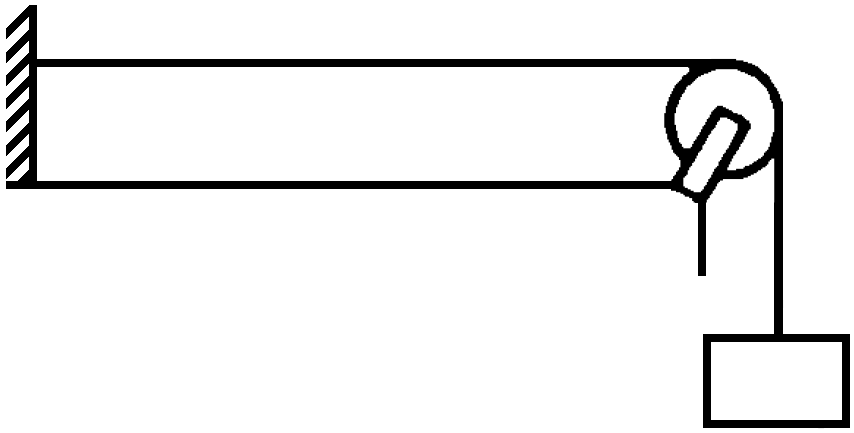
Figure, shows a string stretched by a block going over a pulley. The string vibrates in its tenth harmonic in unison with a particular tuning fork. When a beaker containing water is brought under the block so that the block is completely dipped into the beaker, the string vibrates in its eleventh harmonic. Find the density of the material of the block.
Answer
Let, $\rho\rightarrow$ density of the block Weight $\rho\text{Vg}$ where V = volume of block The same turning fork resonates with the string in the two cases$\text{f}_{10}=\frac{10}{2\text{l}}\sqrt{\frac{\text{T}-\rho_\text{w}\text{Vg}}{\text{m}}}=\frac{11}{2\text{l}}\sqrt{\frac{(\rho-\rho_\text{w})\text{Vg}}{\text{m}}}$
As the f of tuning fork is same,$\text{f}_{10}=\text{f}_{11}\Rightarrow\frac{10}{2\text{l}}\sqrt{\frac{\rho\text{Vg}}{\text{m}}}=\frac{11}{2\text{l}}\sqrt{\frac{(\rho-\rho_\text{w})\text{Vg}}{\text{m}}}$
$\Rightarrow\frac{10}{11}=\sqrt{\frac{\rho-\rho_\text{w}}{\text{m}}}$
$\Rightarrow\frac{\rho-1}{\rho}=\frac{100}{121}$ $\big($because, $\rho_\text{w}=1\text{gm/cc}\big)$
$\Rightarrow100\rho=121\rho-121$
$\Rightarrow5.8\times10^{3}\text{kg/m}^3$
View full question & answer
Question 43 Marks
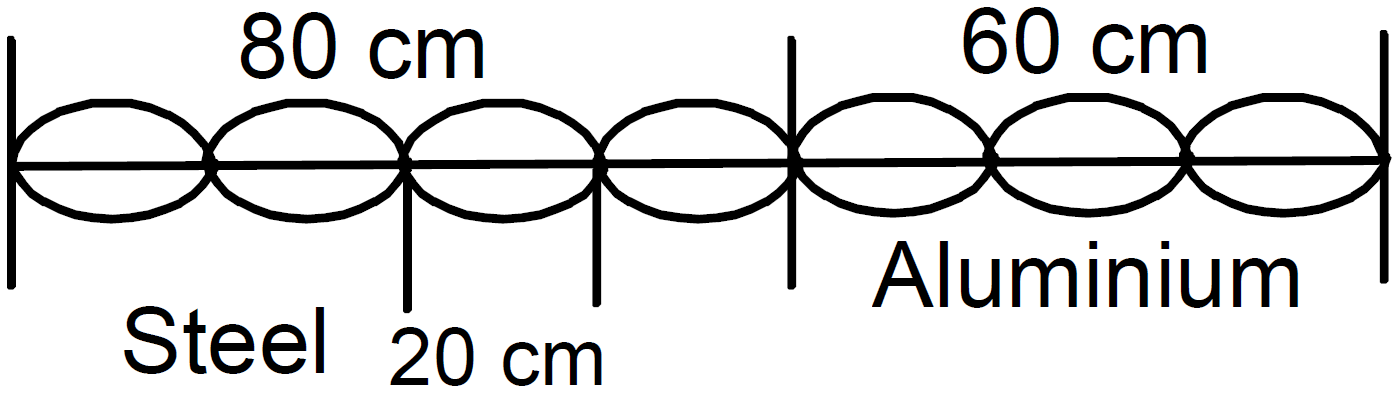
Figure, shows an aluminium wire of length 60cm joined to a steel wire of length 80cm and stretched between two fixed supports. The tension produced is 40N. The cross-sectional area of the steel wire is $1.0mm^2$ and that of the aluminium wire is $3.0 mm^2$. What could be the minimum frequency of a tuning fork which can produce standing waves in the system with the joint as a node? The density of aluminium is $2.6g/cm^3$ and that of steel is $7.8g/cm^3.$​​​​​​​
Answer

$\rho_\text{s}=7.8\text{g/cm}^3,\ \rho_\text{A}=2.6\text{g/cm}^3$
$\text{m}_\text{s}=\rho_\text{s}\text{A}_\text{s}=7.8\times10^{-2}\text{g/cm}$ (m = mass per unit length)
$\text{m}_\text{A}=\rho_\text{A}\text{A}_\text{A}=2.6\times10^{-2}\times3\text{g/cm}$
$=7.8\times10^{-3}\text{kg/m}$
A node is always placed in the joint. Since aluminium and steel rod has same mass per unit length, velocity of wave in both of them is same.$\Rightarrow\text{v}=\sqrt{\frac{\text{T}}{\text{m}}}$
$\Rightarrow\frac{500}{7}\text{m/x}$
For minimum frequency there would be maximum wavelength for maximum wavelength minimum no of loops are to be produced.$\therefore\ $maximum distance of a loop $=20\text{cm}$
⇒ wavelength = $\lambda=2\times20=40\text{cm}=0.4\text{m}$$\therefore\text{f}=\frac{\text{v}}{\lambda}=180\text{Hz}.$
View full question & answer
Question 53 Marks
Two wires of different densities but same area of crosssection are soldered together at one end and are stretched to a tension T. The velocity of a transverse wave in the first wire is double of that in the second wire. Find the ratio of the density of the first wire to that of the second wire.
Answer
Let $v_1 =$ velocity in the $1^{st}$ string$\Rightarrow\text{v}_1=\sqrt{\Big(\frac{\text{T}}{\text{m}_1}\Big)}$
Because $m_1 =$ mass per unit length $=\Big(\frac{\rho_1\text{a}_1\text{l}_1}{\text{ l}_1}\Big)=\rho_1\text{a}_1$
where $a_1 =$ Area of cross section$\Rightarrow\text{v}_1=\sqrt{\Big(\frac{\text{T}}{\rho_1\text{a}_1}\Big)}\ \dots(1)$
Let $v_2 =$ velocity in the second string$\Rightarrow\text{v}_2=\sqrt{\Big(\frac{\text{T}}{\text{m}^2}\Big)}$
$\Rightarrow\text{v}_2\sqrt{\Big(\frac{\text{T}}{\rho_2\text{a}_2}\Big)}\ \dots(2)$
Given that, $v_1= 2v_2$
$\Rightarrow\sqrt{\Big(\frac{\text{T}}{\rho_1\text{a}_1}\Big)}=2\sqrt{\Big(\frac{\text{T}}{\rho_2\text{a}_2}\Big)}$
$\Rightarrow\Big(\frac{\text{T}}{\text{a}_1\rho_1}\Big)=4\Big(\frac{\text{T}}{\text{a}_2\rho_2}\Big)$
$\Rightarrow\frac{\rho_1}{\rho_2}=\frac{1}{4}$
$\Rightarrow\rho_1:\rho_2=1:4 ($because $a_1 = a_2)$
View full question & answer
Question 63 Marks
A string of length 40cm and weighing 10g is attached to a spring at one end and to a fixed wall at the other end. The spring has a spring constant of 160N/m and is stretched by 1.0cm. If a wave pulse is produced on the string near the wall, how much time will it take to reach the spring?
Answer
$\text{l}=40\text{cm},\ \text{mass}=10\text{g}$$\therefore\ $mass per unit length, $\text{m}=\frac{10}{40}=\frac{1}{4}(\text{g/cm})$
spring constant $\text{K}=160\text{N/m}$
deflection = $\text{x}=1\text{cm}=0.01\text{m}$
$\Rightarrow\text{T}=\text{kx}=160\times0.01=1.6\text{N}=16\times10^4\ \text{dyne}$
Again $\text{v}=\sqrt{\Big(\frac{\text{T}}{\text{m}}}\Big)=\sqrt{\Big(\frac{16\times10^4}{\frac{1}{4}}\Big)}$
$=8\times10^2\text{cm/s}$
$=800\text{cm/s}$
$\therefore\ $Time taken by the pulse to reach the spring
$\text{t}=\frac{40}{800}=\frac{1}{20}=\frac{0}{05}\text{sec}.$
View full question & answer
Question 73 Marks
A 660Hz tuning fork sets up vibration in a string clamped at both ends. The wave speed for a transverse wave on this string is 220m/s and the string vibrates in three loops.
  1. Find the length of the string.
  2. If the maximum amplitude of a particle is 0.5cm, write a suitable equation describing the motion.
Answer
Frequency of the tuning fork, $\text{f}=660\text{Hz}$ Wave speed, $\text{v}=220\text{ms}$$\Rightarrow\lambda=\frac{\text{v}}{\text{f}}=\frac{1}{3}\text{m}$
No.of loops = 3
  1. So, $\text{f}=\Big(\frac{3}{2\text{l}}\Big)\text{v}$
$\Rightarrow\text{l}=50\text{cm}$
  1. The equation of resultant stationary wave is given by
$\text{y}=2\text{A}\cos\Big(\frac{2\pi\text{x}}{\text{Ql}}\Big)\sin\Big(\frac{2\pi\text{vt}}{\lambda}\Big)$
$\Rightarrow\text{y}(0.5\text{cm})\cos(0.06\pi\text{cm}^{-1})\sin(1320\pi\text{s}^{-1})$
View full question & answer
Question 83 Marks
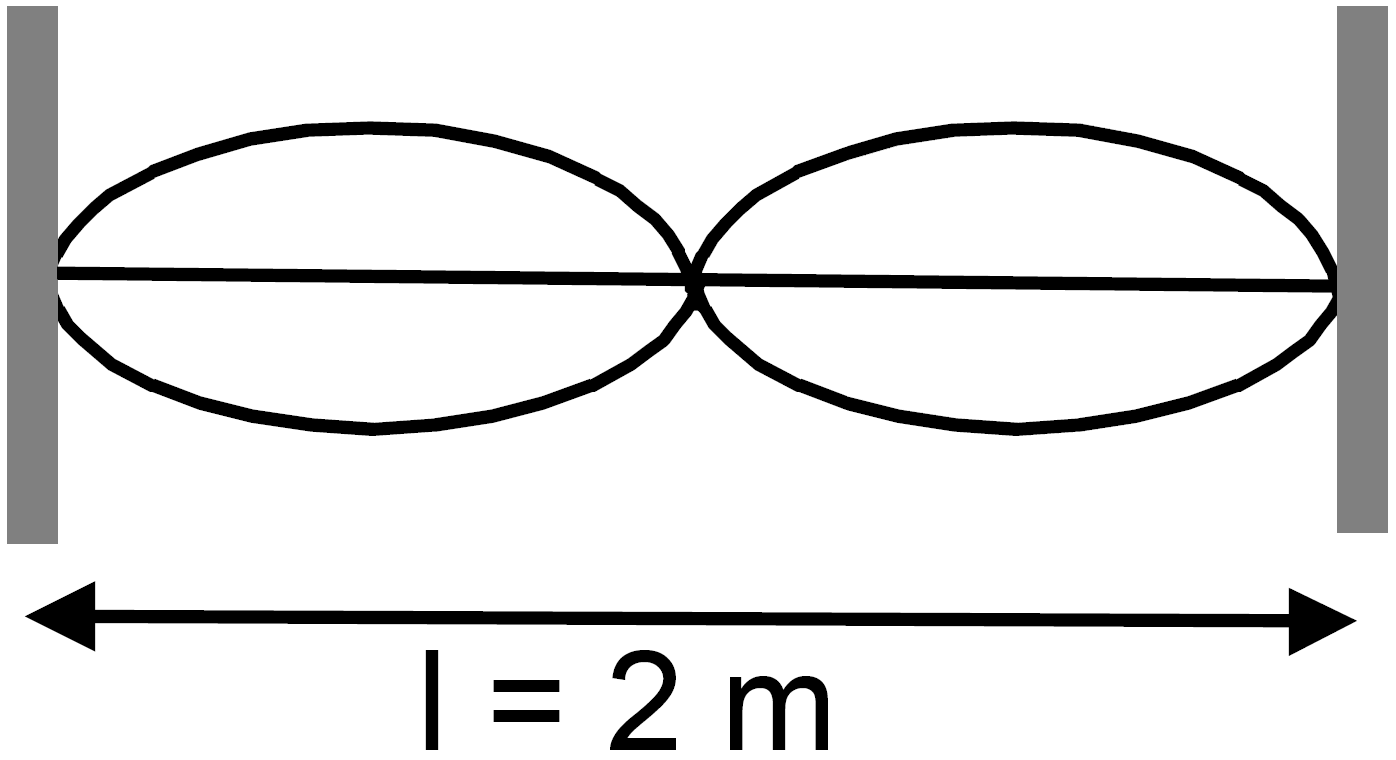
A 2 in long string fixed at both ends is set into vibrations in its first overtone. The wave speed on the string is 200m/s and thee amplitude is 0.5cm.
  1. Find the wavelength and the frequency.
  2. Write the equation giving the displacement of different points as a function of time. Choose the X-axis along the string with the origin at one end and t = 0 at the instant when the point x = 50cm has reached its maximum displacement.
Answer


$\text{V}=200\text{m/s},\ 2\text{A}=0.5\text{m}$
  1. The string is vibrating in its $1^{st}$ overtone
$\Rightarrow\lambda=1=2\text{m}$
$\Rightarrow\text{f}=\frac{\text{v}}{\lambda}=100\text{Hz}$
  1. The stationary wave equation is given by
$\text{y}=2\text{A}\cos\frac{2\pi\text{x}}{\lambda}\sin\frac{2\pi\text{Vt}}{\lambda}$
$=(0.5\text{cm})\cos\big[(\pi\text{m}^{-1})\text{x}\big]\sin\big[(200\pi\text{s}^{-1})\text{t}\big]$
View full question & answer
Question 93 Marks
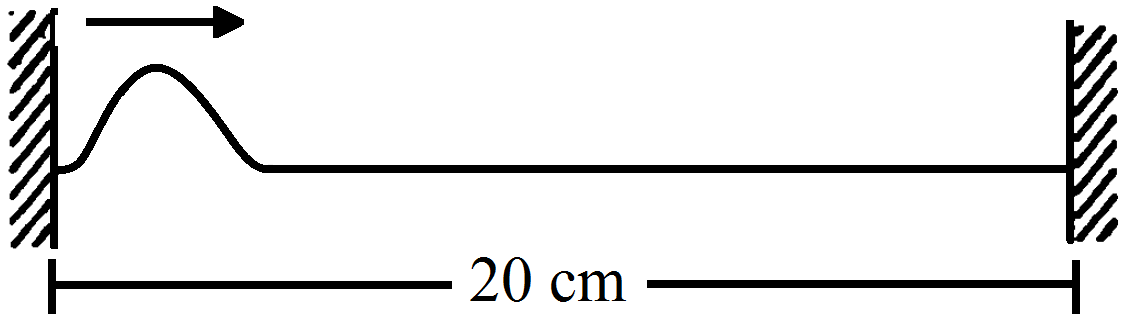
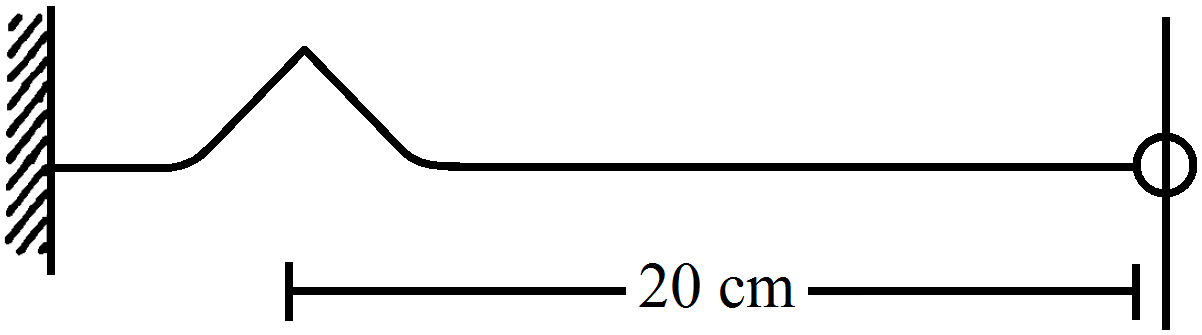
A string of length 20cm and linear mass density 0.40g/cm is fixed at both ends and is kept under a tension of 16N. A wave pulse is produced at t = 0 near an end as shown in figure, which travels towards the other end.
  1. When will the string have the shape shown in the figureagain
  2. Sketch the shape of the string at a time half of that found in part (a).
Answer

  1. Velocity of the wave, $\text{V}=\sqrt{\frac{\text{T}}{\text{m}}}$
$=\sqrt{\frac{(16\times10^5)}{0.4}}=2000\text{cm/sec}$
$\therefore\ $Time taken to reach to the other end $=\frac{20}{2000}=0.01\text{sec}$
Time taken to see the pulse again in the original position = 0.01 ×2 = 0.02sec.
  1. At t = 0.01s, there will be a ‘though’ at the right end as it is reflected.
View full question & answer
Question 103 Marks
A wave pulse is travelling on a string with a speed v towards the positive X-axis. The shape of the string at t = 0 is given by $\text{g(x)}=\text{A}\sin\big(\frac{\text{x}}{\text{a}}\big),$ where A and a are constants.
  1. What are the dimensions ot A and a?
  2. Write the equation of the wave for a general time t, if the wave speed is v.
Answer
At t = 0, $\text{g(x)}=\text{A}\sin\big(\frac{\text{x}}{\text{a}}\big)$$[\text{M}^0\text{L}^1\text{T}^0]=[\text{L}]$
Wave speed = v$\therefore\ $Time period, $\text{T}=\frac{\text{a}}{\text{v}}$ (a = wave length = $\lambda$)
$\therefore\ $General equation of wave
$\text{y}=\text{A}\sin\Bigg\{\big(\frac{\text{x}}{\text{a}}\big)-\frac{\text{t}}{\big(\frac{\text{a}}{\text{v}}\big)}\Bigg\}$
$=\text{A}\sin\Big\{\frac{(\text{x}-\text{vt})}{\text{a}}\Big\}$
View full question & answer
Question 113 Marks
A transverse wave described by$\text{y}=(0.02\text{m})\sin\Big[(1.0\text{m}^{-1})\text{x}+(30\text{s}^{-1})\text{t}\Big]$
propagates on a stretched string having a linear mass density of $1.2 \times 10^{-4}kg/m$. Find the tension in the string.
Answer
m = mass per unit length $=1.2\times10^{-4}\text{kg/mt}$$\text{y}=(0.02\text{m})\sin\Big[(1.0\text{m}^{-1})\text{x}+(30\text{s}^{-1})\text{t}\Big]$
Here, $\text{k}=1\text{m}^{-1}=\frac{2\pi}{\lambda}$$\omega=30\text{s}^{-1}=2\pi\text{f}$
$\therefore\ $velocity of the wave in the stretched string
$\text{v}=\lambda\text{f}=\frac{\omega}{\text{k}}=\frac{30}{\text{I}}=30\text{m/s}$
$\Rightarrow\text{v}=\sqrt{\frac{\text{T}}{\text{m}}}$
$\Rightarrow30\sqrt{\Big(\frac{\text{T}}{1.2}\Big)\times10^{-4}\text{N}}$
$\Rightarrow\text{T}=10.8\times10^{-2}\text{N}$
$\Rightarrow\text{T}=1.08\times10^{-1}\ \text{Newton}$
View full question & answer
Question 123 Marks
Two waves, travelling in the same direction through the same region, have equal frequencies, wavelengths and amplitudes. If the amplitude of each wave is 4mm and the phase difference between the waves is 90°, what is the resultant amplitude?
Answer
Phase difference $\phi=\frac{\pi}{2}$ f and $\lambda$ are same. So, $\omega$ is same.$\text{y}_1=\text{r}\sin\text{wt},\ \text{y}_2=\text{r}\sin\big(\text{wt}+\frac{\pi}{2}\big)$
From the principle of superposition$\text{y}=\text{y}_1+\text{y}_2$
$=\text{r}\sin\text{wt}+\text{r}\sin\big(\text{wt}+\frac{\pi}{2}\big)$
$=\text{r}\Big[\sin\text{wt}+\text{r}\sin\big(\text{wt}+\frac{\pi}{2}\big)\Big]$
$=\text{r}\Bigg[2\sin\bigg\{\frac{\big(\text{wt}+\text{wt}+\frac{\pi}{2}\big)}{2}\bigg\}\cos\bigg\{\frac{\big(\text{wt}-\text{wt}-\frac{\pi}{2}\big)}{2}\bigg\}\Bigg]$
$\Rightarrow\text{y}=2\text{r}\sin\Big(\text{wt}+\frac{\pi}{4}\Big)\cos\Big(\frac{-\pi}{4}\Big)$
Resultant amplitude $=\sqrt{2}\text{r}=4\sqrt{2}\text{mm}$ (because r = 4mm)
View full question & answer
Question 133 Marks
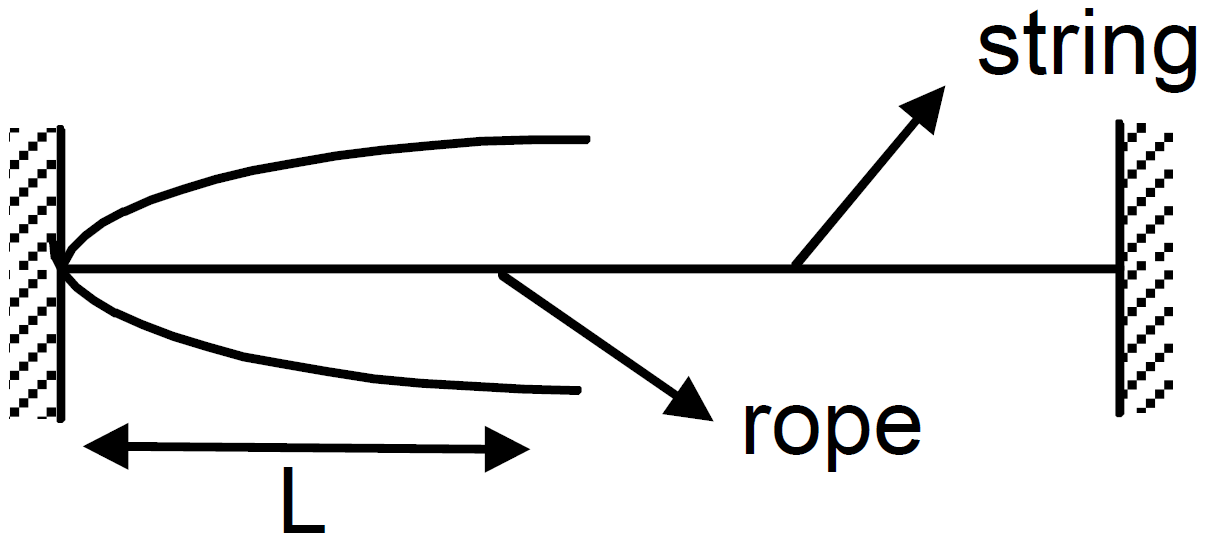
A 2.00m long rope, having a mass of 80g, is fixed at one end and is tied to a light string at the other end. The tension in the string is 256N.
  1. Find the frequencies of the fundamental and the first two overtones.
  2. Find the wavelength in the fundamental and the first two overtones.
Answer
l = length of rope = 2m M = mass = 80gm = 0.8kg mass per unit length = $\text{m}=\frac{0.08}{2}=0.04\text{kg/m}$ Tension $\text{T}=256\text{N}$ Velocity, $\text{V}=\sqrt{\frac{\text{T}}{\text{m}}}=80\text{m/s}$ For fundamental frequency,$\text{l}=\frac{\lambda}{4}$
$\Rightarrow\lambda=4\text{l}=8\text{m}$
$\Rightarrow\text{f}=\frac{80}{8}=10\text{Hz}$
  1. Therefore, the frequency of $1^{st}$ two overtones are
$1^{\text{st}}\text{overtone}=3\text{f}=30\text{Hz}$
$2^{\text{nd}}\text{overtone}=5\text{f}=50\text{Hz}$
  1. $\lambda_1=4\text{l}=8\text{m}$
$\lambda_1-\frac{\text{V}}{\text{f}_1}=2.67\text{m}$
$\lambda_2=\frac{\text{V}}{\text{f}_2}=1.6\text{mt}$
So, the wavelengths are 8 m, 2.67m and 1.6m respectively.
View full question & answer
Question 143 Marks
A transverse wave of amplitude 0.50mm and frequency 100Hz is produced on a wire stretched to a tension of 100N. If the wave speed is 100m/s, what average power is the source transmitting to the wire?
Answer
$\text{r}=0.5\text{mm}=0.5\times10^{-3}\text{mt}$$\text{f}=100\text{Hz},\ \text{T}=100\text{N}$
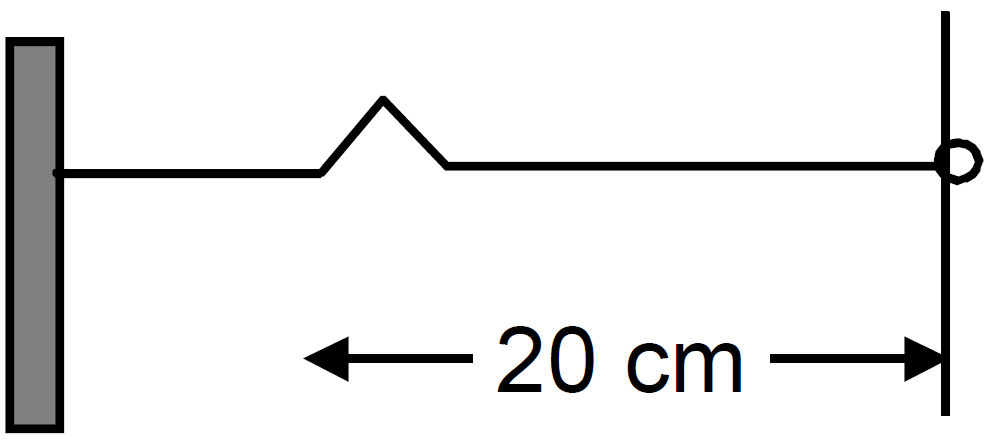
$\text{v}=100\text{m/s}$
$\text{v}=\sqrt{\frac{\text{T}}{\text{m}}}\Rightarrow\text{v}^2=\Big(\frac{\text{T}}{\text{m}}\Big)\Rightarrow\text{m}=\Big(\frac{\text{T}}{\text{v}^2}\Big)=0.01\text{kg/m}$
$\text{P}_\text{ave}=2\pi^2\text{mvr}^2\text{f}^2$
$=2(3.14)^2(0.01)\times100\times(0.5\times10^{-3})^2\times(100)^2$
$\Rightarrow49\times10^{-3}\text{watt}=49\text{mW}.$
View full question & answer
Question 153 Marks
Two long strings A and B, each having linear mass density $1.2 \times 10^{-2}kg/m$, are stretched by different tensions 4.8N and 7.5N respectively and are kept parallel to each other with their left ends at $x = 0$. Wave pulses are produced on the strings at the left ends at t = 0 on string A and at t = 20ms on string B. When and where will the pulse on B overtake that on A?
Answer
$\text{m}_\text{A}=1.2\times10^{-2}\text{kg/m},\ \text{T}_\text{A}=4.8\text{N}$$\Rightarrow\text{v}_\text{A}=\sqrt{\frac{\text{T}}{\text{m}}}=20\text{m/s}$
$\text{m}_\text{B}=1.2\times10^{-2}\text{kg/m},\ \text{T}_\text{B}=7.5\text{N}$
$\Rightarrow\text{V}_\text{B}=\sqrt{\frac{\text{T}}{\text{m}}}=25\text{m/s}$
$\text{t}=0$ in string A
$\text{t}_1=0+20\text{ms}=20\times10^{-3}=0.02\text{sec}$
In 0.02 sec A has travelled $20\times0.02=0.4\text{mt}$
Relative speed between A and B $=25-20=5\text{m/s}$
Time taken for B for overtake A $=\frac{\text{s}}{\text{v}}=\frac{0.4}{5}=0.08\text{sec}$
View full question & answer
Question 163 Marks
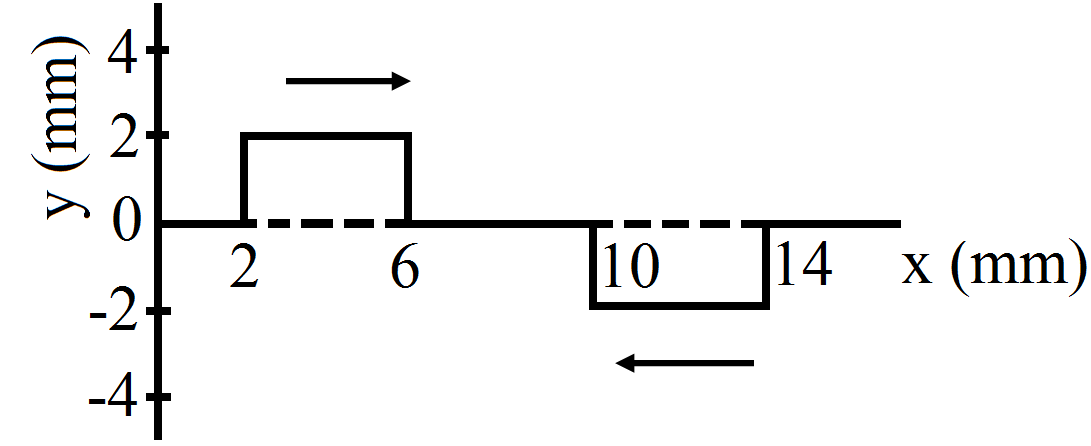
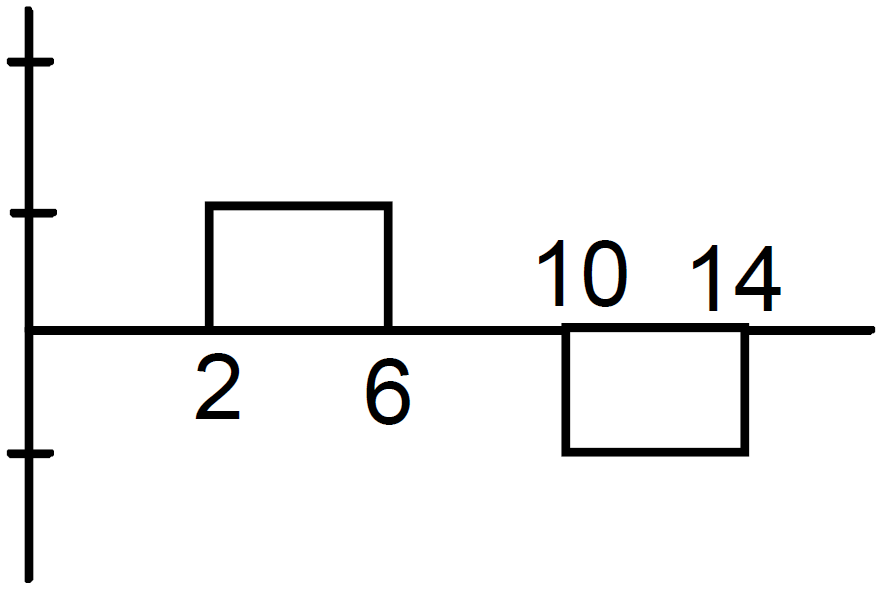
Figure shows two wave pulses at t = 0 travelling on a string in opposite directions with the same

wave speed 50cm/s. Sketch the shape of the string at t = 4ms, 6ms, 8ms, and 12ms.
Answer
The distance travelled by the pulses are shown below.
$t = 4ms = 4 \times 10^{-3}s, s = vt = 50 \times 10 \times 4 \times 10^{-3} = 2mm$
$t = 8ms = 8 \times 10^{-3} s, s = vt = 50 \times 10 \times 8 \times 10^{-3} = 4mm$
$t = 6ms = 6 \times 10^{-3} s, s = 3mm$
$t = 12ms = 12 \times 10^{-3} s, s = 50 \times 10 \times 12 \times 10^{-3} = 6mm$
The shape of the string at different times are shown in the figure.
View full question & answer
Question 173 Marks
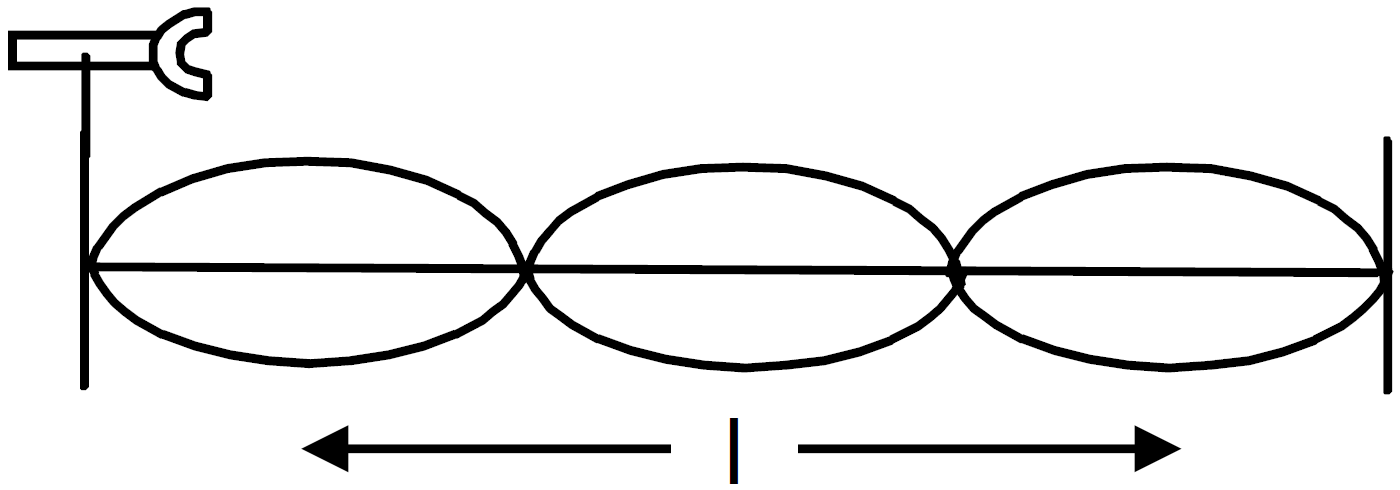
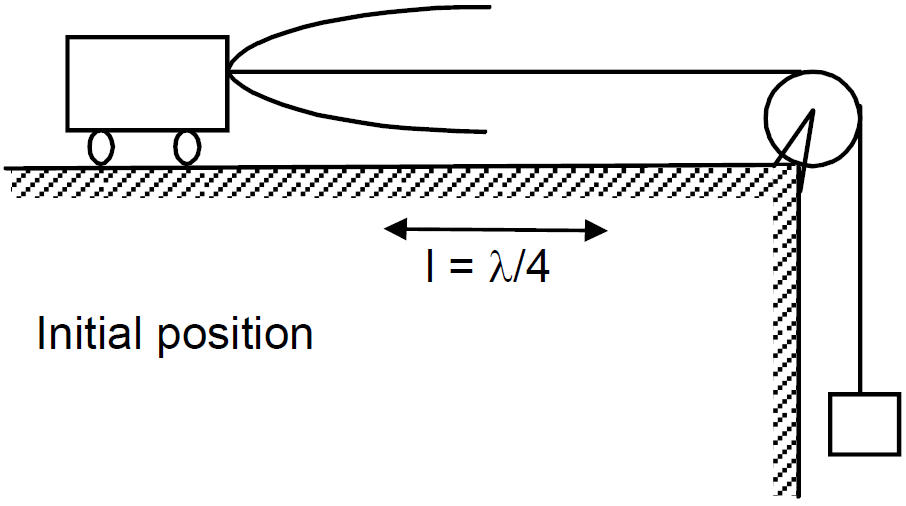
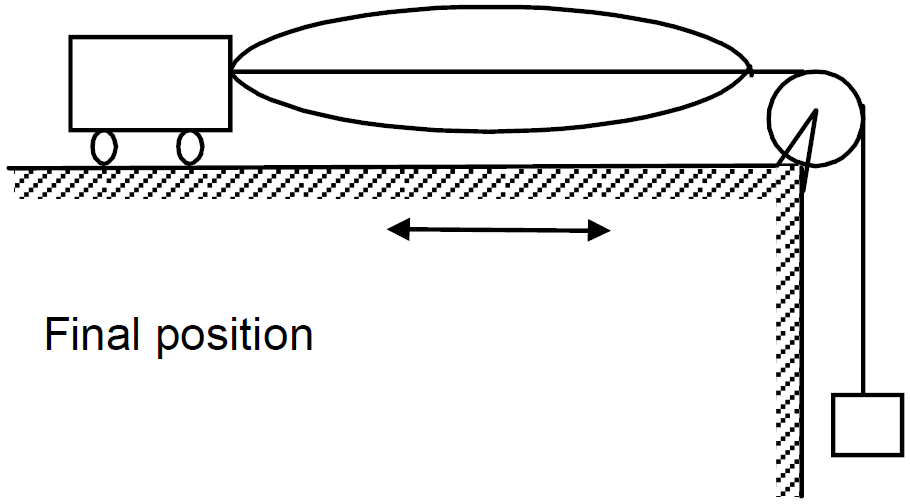
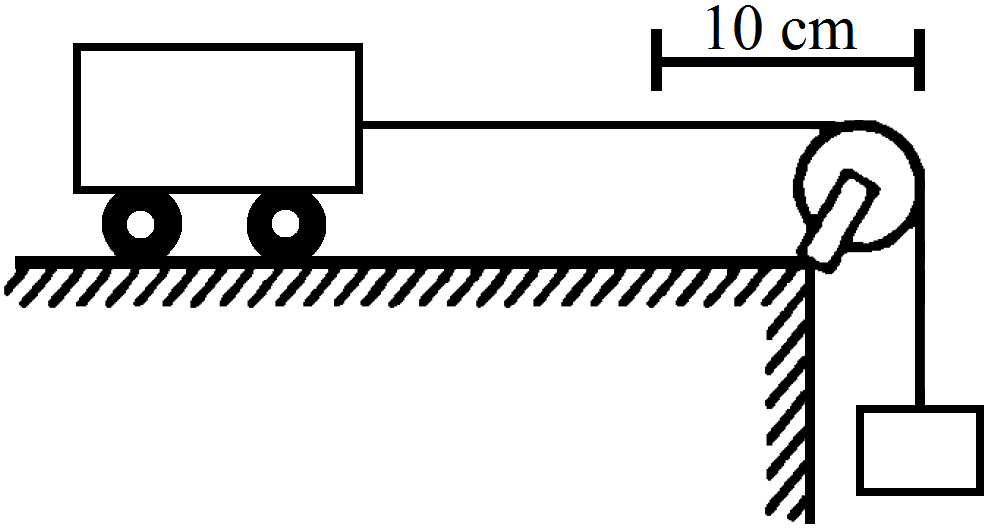
A heavy string is tied at one end to a movable support and to a light thread at the other end as shown in figure, The thread goes over a fixed pulley and supports a weight to produce a tension. The lowest frequency with which the heavy string resonates is 120Hz. If the movable support is pushed to the right by 10cm so that the joint is placed on the pulley, what will be the minimum frequency at which the heavy string can resonate?
Answer
Initially because the end A is free, an antinode will be formed.
So, $\text{l}=\frac{\text{Ql}_1}{4}$
Again, if the movable support is pushed to right by 10m, so that the joint is placed on the pulley, a node will be formed there.
So, $\text{l}=\frac{\lambda_2}{2}$
Since, the tension remains same in both the cases, velocity remains same.
As the wavelength is reduced by half, the frequency will become twice as that of 120Hz i.e. 240Hz.
View full question & answer
Question 183 Marks
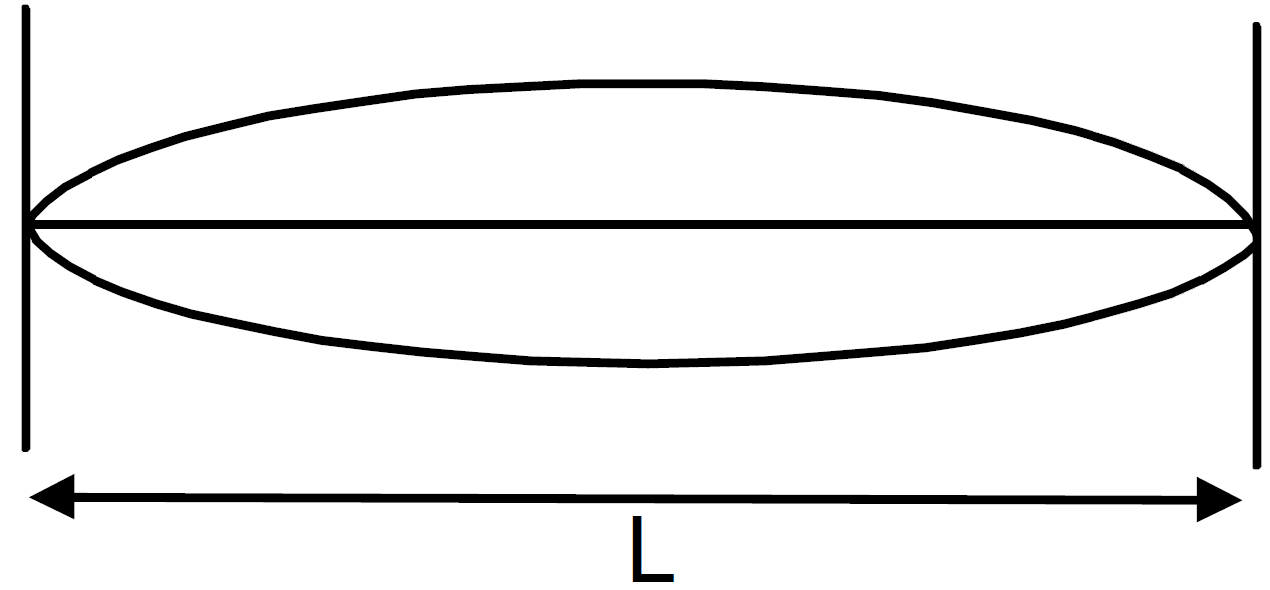
A string of length L fixed at both ends vibrates in its fundamental mode at a frequency v and a maximum amplitude A.
  1. Find the wavelength and the wave number k.
  2. Take the origin at one end of the string and the X-axis along the string. Take the Y-axis along the direction of the displacement. Take t = 0 at the instant when the middle point of the string passes through its mean position and is going towards the positive y-directian. Write the equation describing the standing wave:
Answer
Fundamental frequency$\text{v}=\frac{1}{2\text{l}}\sqrt{\frac{\text{T}}{\text{m}}}$
$\Rightarrow\sqrt{\frac{\text{T}}{\text{m}}}=\text{v}2\text{l}$ $\Big[\sqrt{\frac{\text{T}}{\text{m}}}=$ velocity of wave$\Big]$
  1. Wavelength, $\lambda=\frac{\text{velocity}}{\text{frequency}}=\frac{\text{v}2\text{l}}{\text{v}}=2\text{l}$
and wave number $\text{K}=\frac{2\pi}{\lambda}=\frac{2\pi}{2\text{l}}=\frac{\pi}{\text{l}}$
  1. Therefore, equation of the stationary wave is
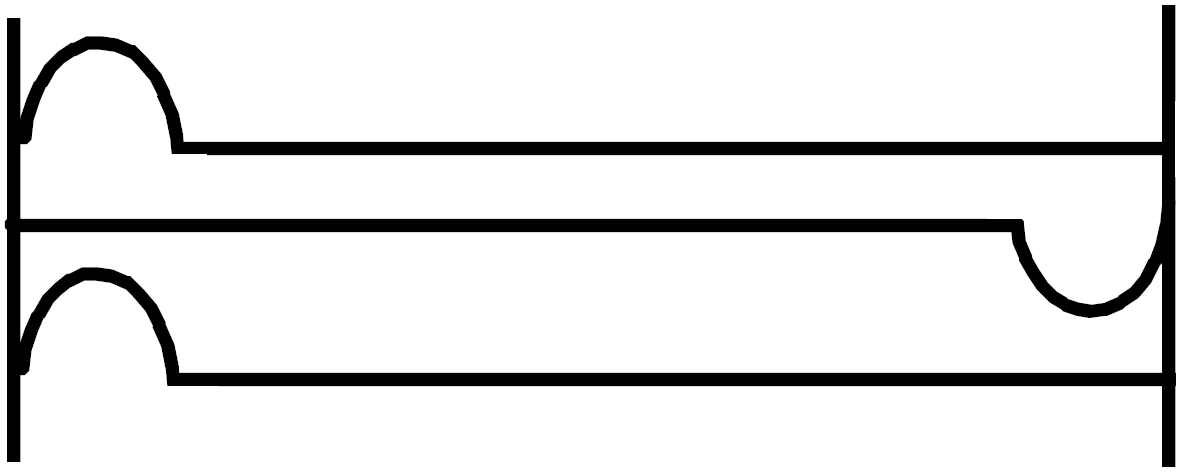
$\text{y}=\text{A}\cos\Big(\frac{2\pi\text{x}}{\lambda}\Big)\sin\Big(\frac{2\pi\text{Vt}}{\text{L}}\Big)$
$=\text{A}\cos\Big(\frac{2\pi\text{x}}{2}\Big)\sin\Big(\frac{2\pi\text{Vt}}{\text{2L}}\Big)$
$\text{v}=\frac{\text{V}}{2\text{L}}$ $\Big[$because $\text{v}=\big(\frac{\text{v}}{2\text{l}}\big)\Big]$
View full question & answer
Question 193 Marks
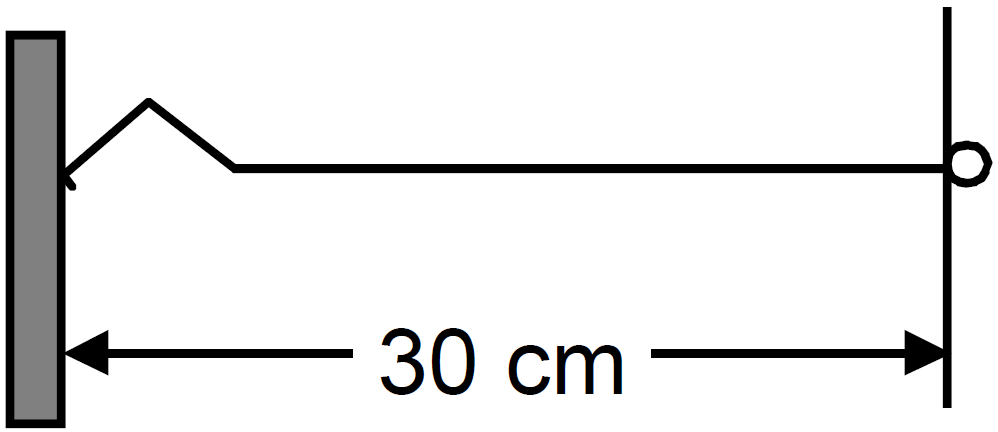
A string of linear mass density 0.5g/cm and a total length 30cm is tied to a fixed wall at one end and to a frictionless ring at the other end figure, The ring can move on a vertical rod. A wave pulse is produced on the string which moves towards the ring at a speed of 20cm/s. The pulse is symmetric about its maximum which is located at a distance of 20cm from the end joined to the ring.
  1. Assuming that the wave is reflected from the ends without loss of energy, find the time taken by the string to regain its shape.
  2. The shape of the string changes periodically with time. Find this time period.
  3. What is the tension in the string?
Answer
The crest reflects as a crest here, as the wire is traveling from denser to rarer medium.
⇒ phase change = 0
  1. To again original shape distance travelled by the wave S = 20 + 20 = 40cm.
Wave speed, v = 20m/s

$\Rightarrow\text{Times}=\frac{\text{s}}{\text{v}}$

$=\frac{40}{20}$

$=2\text{sec}$
  1. The wave regains its shape, after traveling a periodic distance = 2 × 30 = 60cm
$\therefore\ $Time period $=\frac{60}{20}=3\text{sec}.$
  1. Frequency, $\text{n}=\Big(\frac{1}{3}=3\text{sec}^{-1}\Big)$
$\text{n}=\Big(\frac{1}{2\text{l}}\Big)\sqrt{\frac{\text{T}}{\text{m}}}$

m = mass per unit length = 0.5g/cm

$\Rightarrow\frac{1}{3}=\frac{1}{(2\times30)}\sqrt{\Big(\frac{\text{T}}{0.5}\Big)}$

$\Rightarrow\text{T}=400\times0.5=200\ \text{dyne}$

$=2\times10^{-3}\ \text{Newton}$
View full question & answer
Question 203 Marks
A 40cm wire having a mass of 3.2g is stretched between two fixed supports 40.05cm apart. In its fundamental mode, the wire vibrates at 220Hz. If the area of cross-section of the wire is $1.0mm^2$, find its Young's modulus.
Answer


$\text{L}=40\text{cm}=0.4\text{m},\ \text{mass}=3.2\text{kg}=3.2\times10^{-3}\text{kg}$
$\therefore\ $mass per unit length, $\text{m}=\frac{(3.2)}{(0.4)}=8\times10^{-3}\text{kg/m}$
Change in length, $\triangle\text{L}=40.05-40=0.05\times10^{-2}\text{m}$
strain $=\frac{\triangle\text{L}}{\text{L}}=0.125\times10^{-2}\text{m}$
$\text{f}=220\text{Hz}$
$\text{f}=\frac{1}{2\text{l}'}\sqrt{\frac{\text{T}}{\text{m}}}=\frac{1}{2\times(0.4005)}\sqrt{\frac{\text{T}}{8\times10^{-3}}}$
$\Rightarrow\text{T}=248.19\text{N}$
Strain $=\frac{248.19}{1}\text{mm}^2=248.19\times10^6$
$\text{Y}=\frac{\text{Stress}}{\text{Strain}}=1.985\times10^{11}\text{N/m}^2$
View full question & answer
Question 213 Marks
A steel wire of length 64cm weighs 5g. If it is stretched by a force of 8N, what would be the speed of a transverse wave passing on it?
Answer
Mass = 5g, length l = 64cm$\therefore\ $Mass per unit length = $\text{m}=\frac{5}{64}\text{g/cm}$
$\therefore\ $Tension, $T = 8N = 8 \times 10^5$ dyne
$\text{V}=\sqrt{\frac{\text{T}}{\text{m}}}$
$=\sqrt{\frac{(8\times10^5\times64)}{5}}$
$=3200\text{cm/s}$
$=32\text{m/s}$
View full question & answer
Question 223 Marks
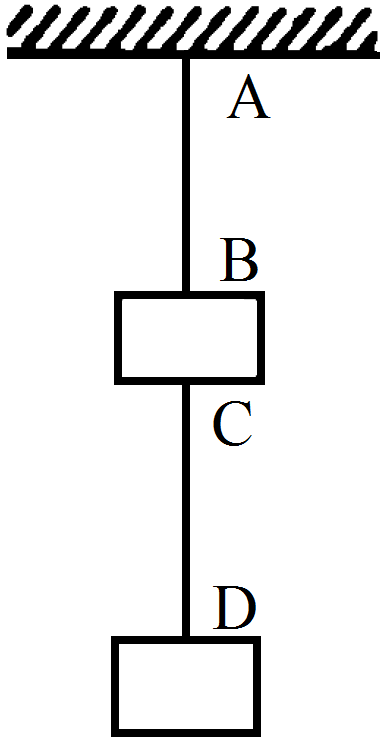
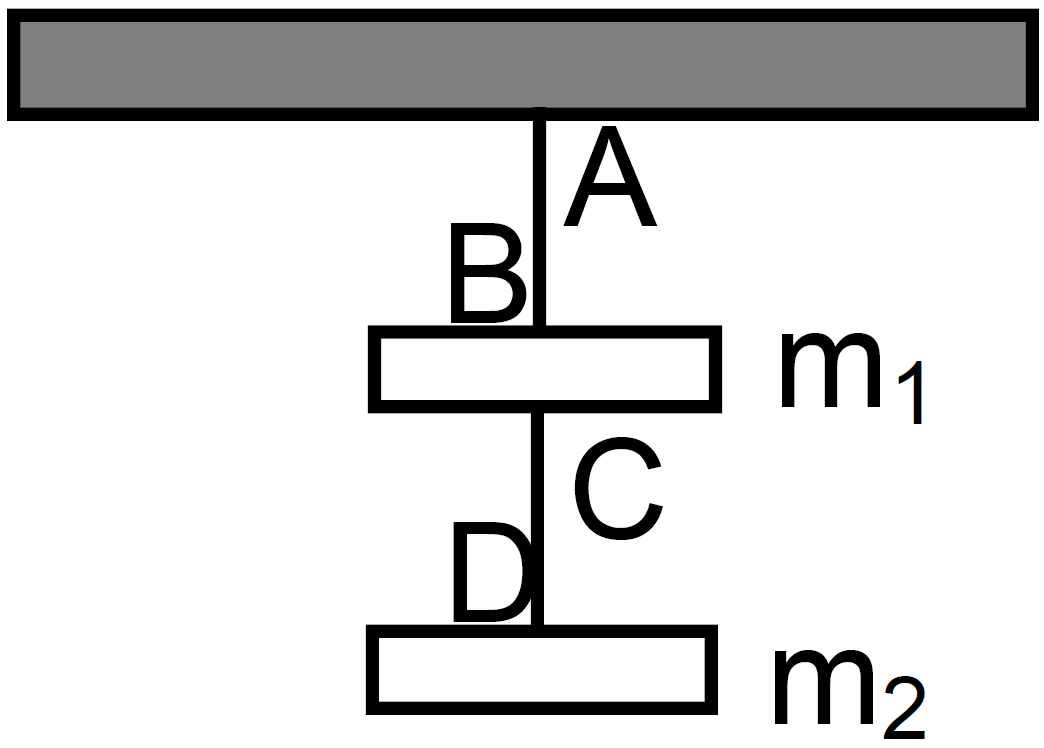
Two blocks each having a mass of 3.2kg are connected by a wire CD and the system is suspended from the ceiling by another wire AB figure, The linear mass delity of the wire AB is 10g/m and that of CD is 8g/m. Find the speed of a transverse wave pulse produced in AB and in CD.
Answer

$\text{m}_1=\text{m}_2=3.2\text{kg}$
mass per unit length of $\text{AB}=10\text{g/mt}=0.01\text{kg/mt}$
mass per unit length of $\text{CD}=8\text{g/mt}=0.008\text{kg/mt}$
for the string CD, $\text{T}=3.2\times\text{g}$
$\Rightarrow\text{v}=\sqrt{\Big(\frac{\text{T}}{\text{m}}\Big)}=\sqrt{\Big(\frac{3.2\times10}{0.008}\Big)}=\sqrt{\frac{(32\times10^3)}{8}}\\=2\times10\sqrt{10}=20\times3.14=63\text{m/s}$
for the string AB, $\text{T}=2\times3.2\text{g}=6.4\times\text{g}=64\text{N}$
$\Rightarrow\text{v}=\sqrt{\Big(\frac{\text{T}}{\text{m}}\Big)}=\sqrt{\Big(\frac{64}{0.01}\Big)}$
$=\sqrt{6400}$
$=80\text{m/s}$
View full question & answer
Question 233 Marks
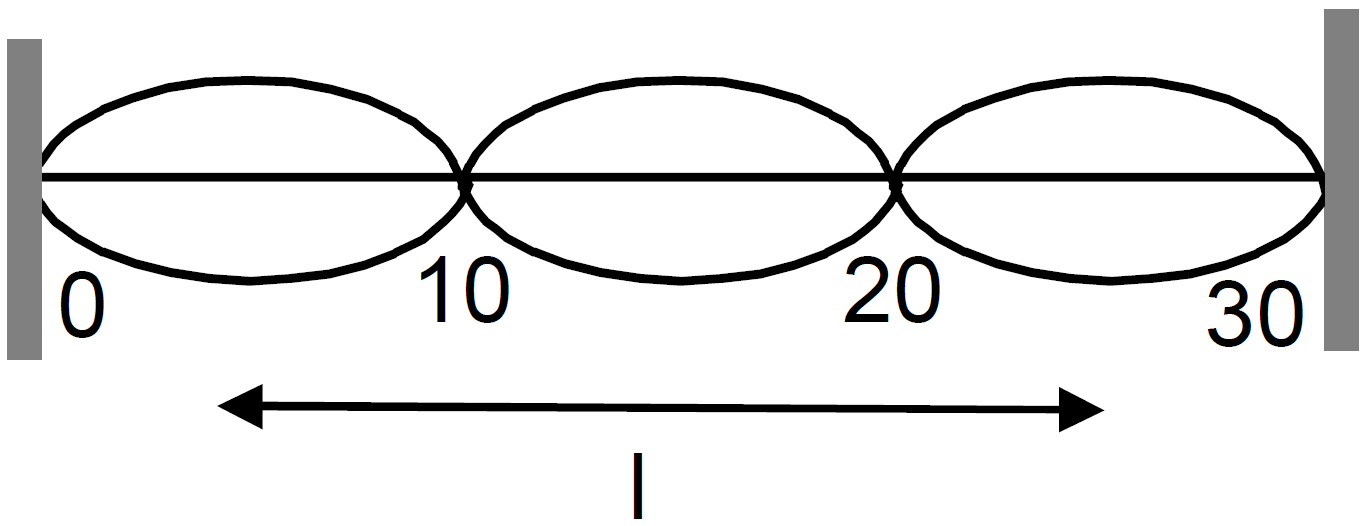
The equation for the vibration of a string, fixed at both ends vibrating in its third harmonic, is given by$\text{y}=(0.4\text{cm})\sin\big[(0.314\text{cm}^{-1})\text{x}\big]\cos\big[(600\pi\text{s}^{-1})\text{t}\big]$
  1. What is the frequency of vibration?
  2. What are the positions of the nodes?
  3. What is the length of the string?
  4. What is the wavelength and the speed of two travelling waves that can interfere to give this vibration ?
Answer
The stationary wave equation is given by$\text{y}(0.4\text{cm})\sin\big[(0.314\text{cm}^{-1})\text{x}\big]\cos\big[(600\pi\text{s}^{-1})\text{t}\big]$
  1. $\omega=600\pi\Rightarrow2\pi\text{f}=600\pi\Rightarrow\text{f}=300\text{Hz}$
Wavelength,, $\lambda=\frac{2\pi}{0.314}=\frac{(2\times3.14)}{0.314}=20\text{cm}$
  1. Therefore nodes are located at, $0,\ 10\text{cm},\ 20\text{cm},\ 30\text{cm}$
  2. Length of the string $=\frac{3\lambda}{2}=3\times\frac{20}{2}=30\text{cm}$
  3. $\text{y}=0.4\sin(0.314\text{x})\cos(600\pi\text{t})$
$\Rightarrow0.4\sin\Big\{\big(\frac{\pi}{10}\big)\text{x}\Big\}\cos(600\pi\text{t})$
since $\lambda$ and v are the wavelength and velocity of the waves that interfere to give this vibration $\lambda=20\text{cm}$
$\text{v}=\frac{\omega}{\text{k}}=6000\text{cm/sec}=60\text{m/s}$
View full question & answer