Question 12 Marks
Explain why To keep a piece of paper horizontal, you should blow over, not under, it.
AnswerWhen we blow over the paper, the velocity of air blow increases and hence pressure of air on it decreases (according to Beroulli's Theorem), where as pressure of air blow the paper is atmospheric. Hence, the paper stays horizontal.
View full question & answer→Question 22 Marks
Figures(a) and (b) refer to the steady flow of a (non viscous) liquid. Which of the two figures is incorrect? Why?
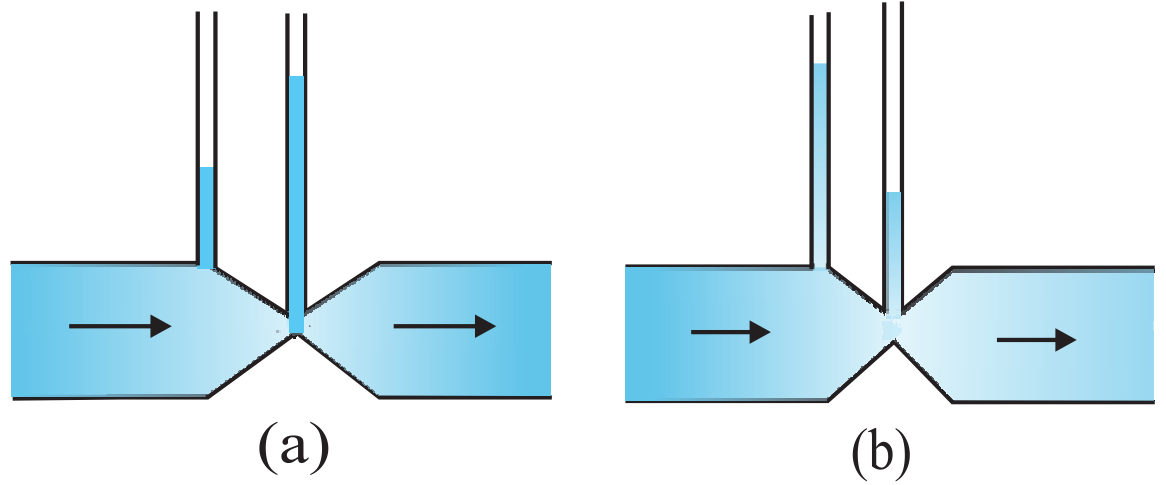
AnswerFig. (a) is incorrect. According to equation of continuity, i.e., av = Constant, where area of cross-section of tube is less, the velocity of liquid flow is more. So the velocity of liquid flow at a constriction of tube is more than the other portion of tube. According to Bernoulli’s Theorem, $\text{P}+\frac{1}{2}\rho\text{v}^2$= Constant, where v is more, P is less and vice versa.
View full question & answer→Question 32 Marks
Explain why Water on a clean glass surface tends to spread out while mercury on the same surface tends to form drops. (Put differently, water wets glass while mercury does not.)
AnswerMercury molecules (which make an obtuse angle with glass) have a strong force of attraction between themselves and a weak force of attraction toward solids. Hence, they tend to form drops.
On the other hand, water molecules make acute angles with glass. They have a weak force of attraction between themselves and a strong force of attraction toward solids. Hence, they tend to spread out.
View full question & answer→Question 42 Marks
Explain why Water with detergent disolved in it should have small angles of contact.
AnswerWater with detergent dissolved in it has small angles of contact $(\theta).$ This is because for a small $\theta$, there is a fast capillary rise of the detergent in the cloth. The capillary rise of a liquid is directly proportional to the cosine of the angle of contact $(\theta).$ If $(\theta)$ is small, then $\cos\theta$ will be large and the rise of the detergent water in the cloth will be fast.
View full question & answer→Question 52 Marks
Does it matter if one uses gauge instead of absolute pressures in applying Bernoulli’s equation? Explain.
AnswerNo, it does not matter if one uses gauge pressure instead of absolute pressure while applying Bernoulli’s equation. The two points where Bernoulli’s equation is applied should have significantly different atmospheric pressures.
View full question & answer→Question 62 Marks
Explain why A fluid flowing out of a small hole in a vessel results in a backward thrust on the vessel.
AnswerWhen a fluid flows out from a small hole in a vessel, the vessel receives a backward thrust. A fluid flowing out from a small hole has a large velocity according to the equation of continuity: Area × Velocity = Constant. According to the law of conservation of momentum, the vessel attains a backward velocity because there are no external forces acting on the system.
View full question & answer→Question 72 Marks
Explain why The blood pressure in humans is greater at the feet than at the brain.
AnswerBlood pressure is the pressure exerted by the column of blood on the blood vessel. Blood pressure depends on the force at which heart pumps the blood. The pressure of Liquid is given by: P = hdg where h = height of liquid column(blood in this case) d = density of the liquid g = Acceleration due to gravity. Hence we can say that height of blood column at feet is more than it is at brain and also at the feet the blood has to be pumped to the heart against the force of gravity and has to travel a greater distance than at the brain. so we can conclude, by saying that "The blood pressure in humans is greater at the feet than at the brain".
View full question & answer→Question 82 Marks
Explain why A drop of liquid under no external forces is always spherical in shape.
AnswerA liquid tends to acquire the minimum surface area because of the presence of surface tension. The surface area of a sphere is the minimum for a given volume. Hence, under no external forces, liquid drops always take spherical shape.
View full question & answer→Question 92 Marks
Can Bernoulli’s equation be used to describe the flow of water through a rapid in a river? Explain.
AnswerBernoulli's equation cannot be used to describe the flow of water through a rapid in a river because of the turbulent flow of water. This principle can only be applied to a streamline flow.
View full question & answer→Question 102 Marks
Explain why Hydrostatic pressure is a scalar quantity even though pressure is force divided by area.
AnswerWhen force is applied on a liquid, the pressure in the liquid is transmitted in all directions. Hence, hydrostatic pressure does not have a fixed direction and it is a scalar physical quantity.
View full question & answer→Question 112 Marks
Explain why The size of the needle of a syringe controls flow rate better than the thumb pressure exerted by a doctor while administering an injection.
AnswerThe small opening of a syringe needle controls the velocity of the blood flowing out. This is because of the equation of continuity. At the constriction point of the syringe system, the flow rate suddenly increases to a high value for a constant thumb pressure applied.
View full question & answer→Question 122 Marks
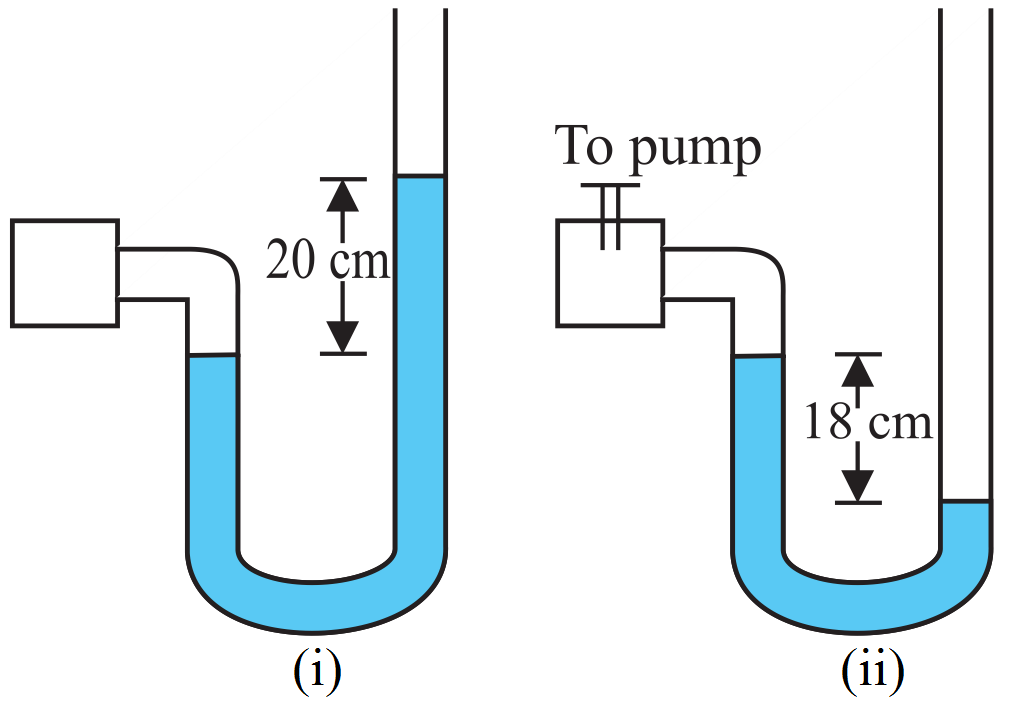
A manometer reads the pressure of a gas in an enclosure as shown in Fig.(a) When a pump removes some of the gas, the manometer reads as in Fig. (b) The liquid used in the manometers is mercury and the atmospheric pressure is $76cm$ of mercury. Give the absolute and gauge pressure of the gas in the enclosure for cases (i) and (ii) in units of cm of mercury. How would the levels change in case (i) if $13.6cm$ of water (immiscible with mercury) are poured into the right limb of the manometer? (Ignore the small change in volume of the gas.)
Answer
- Given : Atmospheric pressure,
$P_0=6 \mathrm{~cm} \text { of } \mathrm{Hg} .$
In figure (i) pressure head,
$h_1=+20 \mathrm{~cm} \text { of } \mathrm{Hg}$
Absolute pressure $(P)$ of the gas is greater than the $\mathrm{P}_0$ i.e.,
$P=P_0+h_1 p g$
$=76 \mathrm{~cm} \text { of } \mathrm{Hg}+20 \mathrm{~cm} \text { of } \mathrm{Hg}$
$=96 \mathrm{~cm} \text { of } \mathrm{Hg} .$
Gauge pressure is the difference between the absolute pressure and the atmospheric pressure. $\frac{1}{2}$ It means,
$\text { Gauge pressure }=P-P_0$
$=96 \mathrm{~cm} \text { of } \mathrm{Hg}-76 \mathrm{~cm} \text { of } \mathrm{Hg}$
$=20 \mathrm{~cm} \text { of } \mathrm{Hg} .$
In figure (ii), pressure head,
$\mathrm{h}_2=-18 \mathrm{~cm} \text { of } \mathrm{Hg} .$
$\therefore$ The absolute pressure of the gas is lesser than the atmospheric pressure is given by
$P=P_0+h_2 p g$
$=76 \mathrm{~cm} \text { of } \mathrm{Hg}+(-18 \mathrm{~cm}) \text { of } \mathrm{Hg}$
$=58 \mathrm{~cm} \text { of } \mathrm{Hg}$
$\text { Gauge pressure }=\text { Absolute pressure }- \text { Atmospheric pressure }$
$=58 \mathrm{~cm} \text { of } \mathrm{Hg}-76 \mathrm{~cm} \text { of } \mathrm{Hg}$
$=-18 \mathrm{~cm} \text { of } \mathrm{Hg}$
It means, Gauge pressure is simply equal to h cm of Hg .
b. Given : 13.6 cm of water added in the right limb is equivalent to $\frac{13.6}{13.6}=1 \mathrm{~cm}$ of Hg column i.e., $\mathrm{h}=1 \mathrm{~cm}$ of Hg column, which can be calculated as follows
- Given : 13.6cm of water added in the right limb is equivalent to $\frac{13.6}{13.6}=1\text{cm}$ of Hg column i.e., h = 1cm of Hg column, which can be calculated as follows
$\text{h}_{\omega}=13.6\text{Cm}$ of water
Suppose $h_m$ = height of Hg column equivalent to 13.6cm of water, thus equilibrium.
$\text{h}_{\text{m}}\rho_{\text{m}}\text{g}=\text{h}_{\omega}\rho_{\omega}\text{g}.$
$\text{h}_{\text{m}}=\text{h}_{\omega}\frac{\rho_{\omega}}{\rho_{\text{m}}}=\frac{\text{h}_{\omega}}{\Big(\frac{\rho_{\text{m}}}{\rho_{\omega}}\Big)}$
$=\frac{13.6}{13.6}=1\text{cm}$ of hg
The mercury will rise in the left limb such that the difference in the height of Hg column in the two limbs.
= 20cm - 1m
= 19 cm of Hg column. View full question & answer→Question 132 Marks
Explain why Surface tension of a liquid is independent of the area of the surface.
AnswerSurface tension is the force acting per unit length at the interface between the plane of a liquid and any other surface. This force is independent of the area of the liquid surface. Hence, surface tension is also independent of the area of the liquid surface.
View full question & answer→Question 142 Marks
A piece of an alloy of mass 96gm is composed of two metals whose specific gravities are 11.4 and 7.4. If the weight of the alloy is 86gm in water, find the mass of each metal in the alloy.
AnswerSuppose the mass of the metal of specific gravity 11.4 be m. Now the mass of the second metal of specific gravity 7.4 will be (96 - m). Volume of first metal $=\frac{\text{m}}{11.4}\text{cm}^3$ Volume of second metal $=\frac{96-\text{m}}{7.4}\text{cm}^3$ Total volume $=\frac{\text{m}}{11.4}+\frac{96-\text{m}}{7.4}$ Apparent loss of wt. in water $=\Big(\frac{\text{m}}{11.4}+\frac{96-\text{m}}{7.4}\Big)\text{gm wt.}$ According wt. in water $=96-\Big[\Big(\frac{\text{m}}{11.4}\Big)+\frac{(96-\text{m})}{7.4}\Big]$ According to the given peoblem,$96-\Big[\Big(\frac{\text{m}}{11.4}\Big)+\frac{(96-\text{m})}{7.4}\Big]=86$ or $\frac{\text{m}}{11.4}+\frac{(96-\text{m})}{7.4}=10$
Solving we get, m = 62.7gm.$\therefore$ Mass of second metal = 96 - 62.7 = 33.3gm
View full question & answer→Question 152 Marks
A vertical barometer tube $100cm$ in length and dipping into mercury contains a small quantity of air. When the open end is $15cm$ below the surface of mercury the meniscus is $30cm$ from the upper closed end. When the tube is pushed into the mercury so that the open end is $35cm/ s$ below the surface, the meniscus is $20cm$ from the closed end. Calculate the atmospheric pressure.
AnswerLet the atmospheric pressure be $P$ and area of cross section of the tube be $a$. Case (i): Length of air column $=30 \mathrm{~cm}$
$\therefore$ Volume of mercury column $=100-(30+15)=55 \mathrm{~cm}$.
Pressure $\mathrm{P}_1$ of air in tube $=(P-55) \mathrm{cm}$ Case (ii): Length of colum $=20 \mathrm{~cm} . \therefore$ Volume of air, $\mathrm{V}_2=(20 \times$ a)c.c.
Length of mercury column $=100-(20+30)=45 \mathrm{~cm}$. Pressure $P_2$ of air in tube $=(P-45) \mathrm{cm}$ Applying Boyle's law, $P_1 V_1=P_2 V_2(P-55) \times 30 a=(P-45) \times 20$ a Solving, we get, $P=75 \mathrm{~cm}$
View full question & answer→Question 162 Marks
Explain why To keep a piece of paper horizontal, you should blow over, not under, it.
AnswerWhen we blow over the paper, the velocity of air blow increases and hence pressure of air on it decreases (according to Beroulli's Theorem), where as pressure of air blow the paper is atmospheric. Hence, the paper stays horizontal.
View full question & answer→Question 172 Marks
Figures(a) and (b) refer to the steady flow of a (non viscous) liquid. Which of the two figures is incorrect? Why?
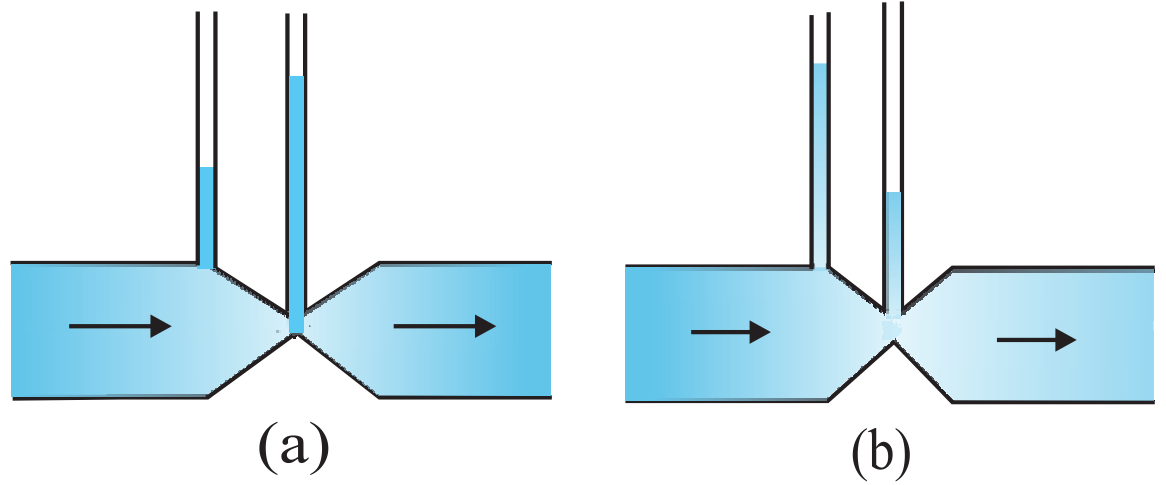
AnswerFig. (a) is incorrect. According to equation of continuity, i.e., av = Constant, where area of cross-section of tube is less, the velocity of liquid flow is more. So the velocity of liquid flow at a constriction of tube is more than the other portion of tube. According to Bernoulli’s Theorem, $\text{P}+\frac{1}{2}\rho\text{v}^2$= Constant, where v is more, P is less and vice versa.
View full question & answer→Question 182 Marks
Derive an expression for the excess of pressure inside an air bubble.
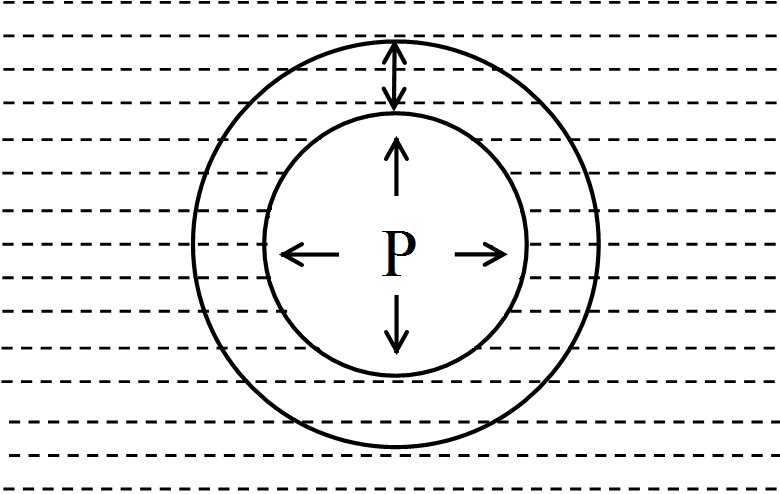
AnswerConsider a bubble of radius R with $\sigma$ the surface tension of liquid. Excess pressure inside the bubble, $P = P_i - P_0$ ($\because$ air bubble has only one free surface)$\delta\text{R}$ = Small increase in radius of bubble due to excess pressure
Work done, W = Force × Displacement. = (Excess pressure × Area) × Increase in radius$=\text{P}\times4\pi\text{R}^2\times\delta\text{R}$
Increase in surface area of bubble = Final surface area - Initial surface area$=4\pi(\text{R}+\delta\text{R})^2-4\pi\text{R}^2$
$=8\pi\text{R}(\delta\text{R})(\text{Neglecting }\delta\text{R}^2)$
$\therefore\text{P}\times4\pi\text{R}^2\times\delta\text{R}=8\pi\text{ R}(\delta\text{R})\times\sigma$
Increase in P.E. = increase in surface area × Surface tension$=8\pi\text{R}(\delta\text{R})\times\sigma$
Since the drop is in equilibrium.$\therefore\text{P}\times4\pi\text{R}^2\times\sigma\text{R}=8\pi\text{ R}(\delta\text{R})\times\sigma$
$\text{P}=\frac{2\sigma}{\text{R}}$
View full question & answer→Question 192 Marks
Explain why Water on a clean glass surface tends to spread out while mercury on the same surface tends to form drops. (Put differently, water wets glass while mercury does not.)
AnswerMercury molecules (which make an obtuse angle with glass) have a strong force of attraction between themselves and a weak force of attraction toward solids. Hence, they tend to form drops.
On the other hand, water molecules make acute angles with glass. They have a weak force of attraction between themselves and a strong force of attraction toward solids. Hence, they tend to spread out.
View full question & answer→Question 202 Marks
Two soap bubbles of radii 6cm and 8cm coalesce to form a single bubble. Find the radius of the new bubble.
AnswerSurface energy of first soap bubble = Surface tension × surface area$=2\times4\pi\text{R}^2_1\text{S}=8\pi\text{R}^2_1\text{S}$
Surface energy of second soap bubble $=8\pi\text{R}^2_2\text{S}$ Let the radius of the new shoap bubble is R, so the surface energy of new bubble $=8\pi\text{R}^2\text{S}$ By the law of conservation of enrgy,$8\pi\text{R}62\text{S}=8\pi\text{R}^2_1\text{S}+8\pi\text{R}^2_2\text{S}$
$\text{R}^2=\text{r}^2_1+\text{R}^2_2=36+64$
$\therefore\text{R}^2=100\text{cm}^2$
$\Rightarrow\text{R}=10\text{cm}$
View full question & answer→Question 212 Marks
The density of atmosphere is $1.29 \mathrm{~kg} \mathrm{~m}^{-3}$ at sea level, where atmospheric pressure is $1.013 \times 10^5 \mathrm{~Pa}$. If we assume that atmospheric density does not change with altitude, then what should be the height of the atmosphere?
AnswerHere, Pa = 1.013 × 10⁵ Pa and $\rho=1.29\text{kg m}^{-3}$ If height of air column, assuming its density to be constant, be h, then,$\text{P}\text{a}=\text{h}\rho\text{g}$
$\Rightarrow\text{h}=\frac{\text{P}\text{a}}{\rho\text{g}}$
$=\frac{1.013\times10^5}{1.29\times9.8}=8013\text{m}\simeq8\text{km.}$
View full question & answer→Question 222 Marks
A body of mass 6kg is floating in a liquid with $\frac23$ of its volume inside the liquid. Find ratio between the density of the body and density of liquid. Take $g = 10m/ s^2$.
AnswerAs we know that, for a floating body Buoyant force = Weight of liquid displaced Let V be the volume of the body, $\frac23\text{V}\rho_\text{l}\text{g}=\text{V}\rho_\text{l}\text{g}$ Where, $\rho_\text{b}=$ density of floating body and $\rho_\text{l}=$ density of liquid$\therefore\frac{\text{}\rho_\text{b}}{\rho_\text{l}}=\frac23$
View full question & answer→Question 232 Marks
A liquid drop breaks into 27 small drops. If surface tension of the liquid is S, then find the energy released.
AnswerLet the radius of larger drop = R and radius of each small drop = r Volume of 27 small drops = Volume of the large drop$=27\times\frac43\times\pi\text{r}^3=\frac43\pi\text{R}^3$
So, $\text{r}=\frac{\text{R}}{3}$ Surface area of large drop $=4\pi\text{R}^2$ Surface area of 27 small drops $=27\times4\pi\text{r}^2$$=27\times4\pi\Big(\frac{\text{R}}{2}\Big)^3=12\pi\text{R}^2$
$\therefore$ Increase in surface area $=12\pi\text{R}^2-4\pi\text{R}^2=8\pi\text{R}^2$
Increase in energy = increase in surface area × Surface tention$=8\pi\text{R}^2\times\text{S}$
View full question & answer→Question 242 Marks
In a horizontal pipe line of uniform area of cross section, the pressure falls by $8N-m^2$ between two points separated by a distance of $1km$. What is the change in kinetic energy per kg of the oil flowing at these points? Density of oil is $806kg-m^{-3}$.
AnswerAccording to Bernoulli's theorem,$\text{P}_1+\frac12\rho\upsilon_1^2=\text{P}_2+\frac12\rho\upsilon^2_2$ (pipe is horizontal)
$\text{P}_1-\text{P}_2=\frac12\rho\ (\upsilon^2_2-\upsilon^2_1)=$ change in K.E. per kg mass.
$\therefore$ Change in K.E. per kg. mass of oil $=\frac{\text{P}_1-\text{P}_2}{\rho}$
Substituting the given values, we have Change in K.E. per kg mass $=\frac{8}{800}=10^{-2}\text{J/kg.}$
View full question & answer→Question 252 Marks
As shown in figure, water flows from P to Q. Explain why height h, of column AB of water is greater than height h, of column CD of water.
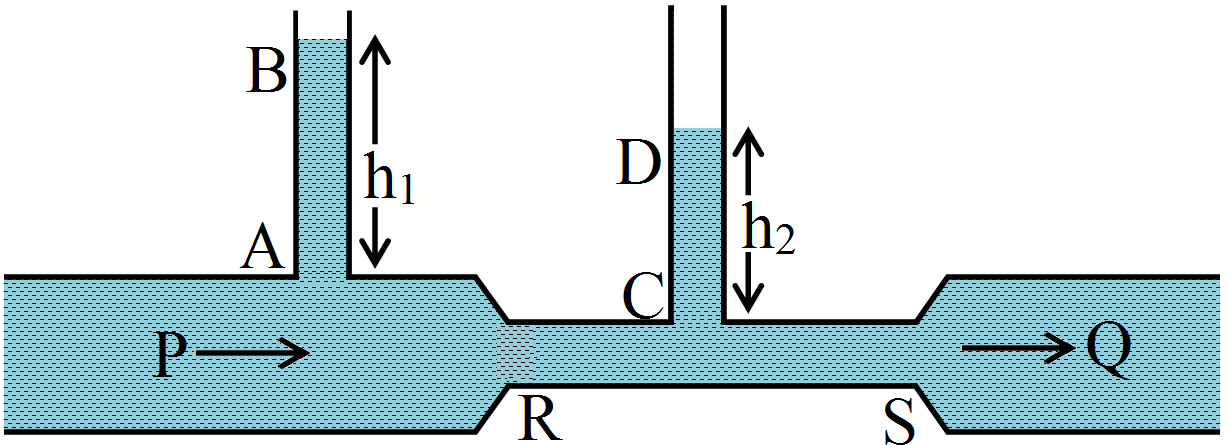
AnswerHeight in the column of water depends on difference of pressure. Since $P_1 - P_2$ greater than in arm CD. So, $h_1 > h_2$.$\text{P}_1-\text{P}_2=\text{h}\rho_\text{m}\text{g}$
View full question & answer→Question 262 Marks
At, what speed will the velocity head of stream of water be 40cm?
AnswerGiven, h = 40cm, $g = 980cm/ s^2$ We know that velocity head, $\text{h}=\frac{\text{v}^2}{2\text{g}}$$\therefore\text{v}=\sqrt{2\text{gh}}=\sqrt{2\times980\times40}$
$=280\text{cm s}^{-1}$
View full question & answer→Question 272 Marks
The antiseptics used for cuts and wounds in the human flesh have low surface tensions. Why?
AnswerFor wound to heal quickly, the antiseptic used should be able to spread itself into a thin layer on the wound. A liquid spreads more on a surface if its own surface tension is less. Therefore, the antiseptic should possess a low surface tension.
View full question & answer→Question 282 Marks
A liquid has a definite volume but no shape of its own. Explain.
AnswerLiquids take the shape of the container in which they are placed and do not possess a shape of their own. It takes the same volume irrespective the shape of the container.
View full question & answer→Question 292 Marks
What should be the maximum average velocity of water in a tube of diameter $2cm$ so that flow is laminar? The viscosity of water is $0.001Nm^{-2}s$.
AnswerD = 2cm = 0.02m$\rho=10^3\text{kg m}^{-3}$
$\eta=0.001\text{ Nm}^{-2}\text{s}=10^{-3}\text{ Nm}^{-2}\text{s}$
Flow of water will be laminar if, $N_R = 1000$ where $N_R$ is Reynold number Let $\upsilon=$ maximum average velocity
$\therefore$ Using the relation,
$\text{N}_\text{R}=\frac{\rho\upsilon\text{D}}{\eta}$ or $\upsilon=\frac{\text{N}_\text{R}\eta}{\rho\text{D}}$
$=\frac{1000\times0.001}{1000\times0.02}=0.05\text{ms}^{-1}$
View full question & answer→Question 302 Marks
A liquid drop of radius 4mm breaks into 1000 identical drops. Find the change in surface energy. $S=0.07 \mathrm{Nm}^{-1}$.
AnswerVolume of 1000 small drops = Volume of a large drop$1000\times\frac43\pi\text{r}^3=\frac43\pi\text{R}^3$
$\text{r}=\frac{\text{R}}{10}$
Surface area of large drop $=4\pi\text{R}^2$ Surface area of 1000 drop $4\pi\times1000\text{r}^2=40\pi\text{R}^2$$\therefore$ Increase in surface area $=(40-4)\pi\text{R}^2=36\pi\text{R}^2$
The increase in surface energy = Surface tension × increase in suraface area$=36\pi\text{R}^2\times0.07=36\times3.14\times(4\times10^{-3})^2\times0.07$
$=1.26\times10^{-4}\text{J}$
View full question & answer→Question 312 Marks
A balloon with hydrogen in it rises up but a balloon with air comes down, Why?
AnswerThe density of hydrogen is less than air. So, the buoyant force on the balloon will be more than its weight in case of the hydrogen. So, in this case the balloon rises up. In case of air, the weight of balloon is more than the buoyant force acting on it, so balloon will come down.
View full question & answer→Question 322 Marks
What should be the maximum average velocity of water in a tube of diameter 0.5cm. So that the flow is laminar? The viscosity of water is $0.00125Nm^{-2}s$.
AnswerHere D = 0.5cm = 0.005m$\rho=10^3\text{kg m}^{-3}$
$\eta=0.00125\text{Nm}^{-2}\text{s}$
For laminar flow, the Reynold number for water, $N_R$ = 2000 Let $\text{v}$ b the maximum average velocity,$\therefore\text{N}_\text{R}=\frac{\rho\upsilon\text{D}}{\eta}$ or $\text{v}=\frac{\text{N}_\text{R}-\eta}{\rho-\text{D}}$
$=\frac{2000\times0.00125}{1000\times0.005}=0.5\text{m/s}.$
View full question & answer→Question 332 Marks
Explain why Water with detergent disolved in it should have small angles of contact.
AnswerWater with detergent dissolved in it has small angles of contact $(\theta).$ This is because for a small $\theta$, there is a fast capillary rise of the detergent in the cloth. The capillary rise of a liquid is directly proportional to the cosine of the angle of contact $(\theta).$ If $(\theta)$ is small, then $\cos\theta$ will be large and the rise of the detergent water in the cloth will be fast.
View full question & answer→Question 342 Marks
If work required to blow a soap bubble of radius r is W, then what additional work is required to be done to blow it to a radius 3r?
AnswerIncrease in surface area $=2[4\pi(3\text{r})^2-4\pi\text{r}^2]$ Increase in surface energy $=\sigma\times2\times4\pi\times8\text{r}^2=\text{8W}$ Addditional work done = 8W.
View full question & answer→Question 352 Marks
In rising from the bottom of a lake to the top, the temperature of an air bubble remains unchanged, but its diameter gets doubled. What is the depth of the lake? Given h is the barometric height in metres of mercury of relative density ρ at the surface of the lake.
AnswerAt the surface, $\text{P}_1\text{h}\rho\text{g};\text{V}_1=\frac43\pi(2\text{r})^3$ At the bottom of depth x, $\text{P}_2=(\text{h}\rho+\text{xg})$ and $\text{V}_2=\frac{4}{3}\pi\text{r}^3$ Using Boyle's law, $\text{P}_1\text{V}_1=\text{P}_2\text{V}_2$$\therefore\text{h}\rho\text{g}\times\frac{4}{3}\pi(2\text{r})^3(\text{h}\rho\text{g}+\text{xg})\times\frac43\pi\text{r}^3$ or $\text{x}=8\text{h}\rho-\text{h}\rho=7\text{h}\rho\text{ metres}.$
View full question & answer→Question 362 Marks
A cylindrical jar of cross-sectional area $0.01m^2$ is filled with water to a height of 50cm (given figure). It carries a tight fitting piston of negligible mass. Calculate the pressure at the bottom of the jar when a mass of 5kg is placed on the piston.
Answer
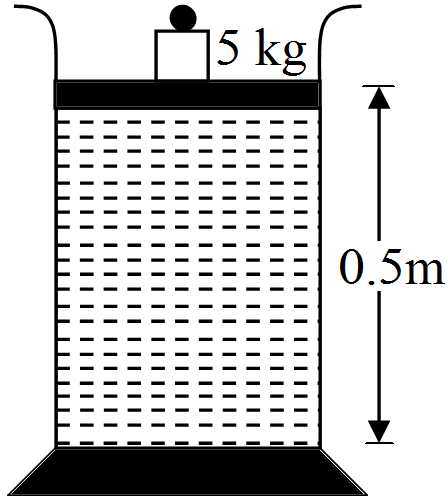
Total force acting on the base $=\text{hg}\rho\text{A}+\text{mg}$
$\text{F}=0.5\times9.8\times1000\times0.01+5\times9.8$
$=5\times9.8+5\times9.8=98.0\text{N}$
$\therefore\text{Pressure}=\frac{\text{Force}}{\text{Area}}=\frac{98.0}{0.01}=9800\text{Nm}^{-2}$ View full question & answer→Question 372 Marks
Find the work done required to make a soap bubble of radius 0.02m. Given surface tension of soap 0.03N/ m.
AnswerGiven, S = 0.03N/ m Work done = surface area × surface tension$=2\times4\pi\text{r}^2\times\text{S}$
$=2\times4\times3.14\times(2.02)^2\times0.03$
$=3\times10^{-4}\text{J}$
View full question & answer→Question 382 Marks
On what factors does the critical velocity of the liquid depend?
AnswerCritical velocity ($v_c$) of a liquid is:
- Directly proportional to the coefficient of viscosity of the liquid.
- Inversely proportional to the density of the liquid i.e., $\text{V}_\text{c}\propto\frac{1}{\rho}.$
- Inversely proportional to the diameter of the tube through which it flows i.e., $\text{V}_\text{c}\propto\frac1{\text{D}}.$
View full question & answer→Question 392 Marks
A hole of area $4cm^2$ is formed in the side of a ship $2.4m$ below the water level. What minimum force is required to hold on a patch covering the hole from the inside of the ship? Given that density of sea water = $1.03 \times 103kg m^{-3}$.
AnswerHere, depth of hole below the water level $h = 2.4m$, Density of sea water $\rho=1.03\times10^3\text{kg m}^{-3}$ and surface area of hole $A = 4cm^2 = 4 \times 10^{-4} m^2$.
$\therefore$ Minimum force required to hold on a patch covering the hole from inside the ship
F = Pressure at height h of sea water column × Surface area of hole $=\text{h}\rho\text{g A}=2.4\times1.03\times10^3\times9.8\times4\times10^{-4}$
$=9.69\text{N}.$
View full question & answer→Question 402 Marks
Calculate the work done in blowing a soap bubble from a radius of 2cm to 3cm. The surface tension of the soap solution is 30 dynes cm.
Answer$\sigma=30$ dynes/ cm, $r_1 = 2cm, r_2 = 3cm$,Since, bubble has two surface, initail surface area of bubble,
$=2\times4\pi\text{r}^2_1=2\times4\pi\times(2)^2$
$=32\pi\text{ cm}^2$
Final surface area of bubble,
$=2\times4\pi\text{r}^2_2=2\times4\pi\times(3)^2$
$=72\pi\text{r}^3$
Increase in surface area,
$=72\pi-34\pi=40\pi\text{ cm}^2$
Work done $=\sigma\times$ Increase in surface area,
$=30\times40\pi=3768\text{ ergs}$
View full question & answer→Question 412 Marks
Explain why “A drop of liquid under no external force is always spherical in shape”.
AnswerTo reduce the P.E., the surface area for a given volume is reduced by forming a spherical shape.
View full question & answer→Question 422 Marks
What is the excess pressure inside a soap bubble that is 5 cm in diameter, assuming $0.026 \mathrm{Nm}^{-1}$ as the surface tension of the soap solution?
AnswerExcess pressure inside a soap bubble is$(\text{P}-\text{P}_\text{a})=\frac{\text{4T}}{\text{r}}$
Here $\text{T}=0.026\text{Nm}^{-1}$$\text{r}=\frac52=2.5\text{cm}=2.5\times10^{-2}\text{m}$
$\therefore\text{P}-\text{P}_\text{a}=\frac{4\times0.026\text{Nm}^{-1}}{2.5\times10^{-2}\text{m}}=4.16\text{Nm}^{-2}$
View full question & answer→Question 432 Marks
Two equal drops of water are falling through air with a steady velocity v. If the drops coalesce, what will be the new steady velocity?
AnswerThe terminal velocity v of a drop of radius r, density $\rho$ while falling through a viscous medium of viscosity $\eta$ and density $\rho_0$ is,$\text{v}=\frac29\frac{2\text{r}^2(\rho-\rho_0)\text{g}}{\eta}\dots\text{(i)}$
If R is the radius of the new drop formed when two drops coalesce, then$\therefore$ New terminal velocity of drop of radius R is,
$\text{v}'=\frac{2[(2)^{\frac13}\text{r}](\rho-\text{}\rho_0)\text{g}}{\eta}=(2)^{\frac13}\text{v}$ [From (i)]
View full question & answer→Question 442 Marks
It is advised not to stand near a running train. Why?
AnswerWhen fast moving train passes on a rail, then the velocity of air streams in between the rail and the person standing near rail will be very large as compared to the velocity of air streams on the other side of person away from the rail. According to Bernoulli's theorem, the pressure of air will become low in between person and rail and is high on the other side of person. As a result of the pressure difference, a thrust acts on the person which may push the person towards rail side and the person may meet with an accident.
View full question & answer→Question 452 Marks
What height of water column produces the same pressure as a 760mm high column of mercury?
AnswerAt sea level atmospheric pressure is the pressure exerted by 0.76m of mercury column i.e., h = 0.76m Density of mercury,$\rho=13.6\times10^3\text{kg/m}^3$
$g = 9.8 m/s^2$ Atmospheric pressure,$\text{P}=\text{h}\rho\text{g}=0.76\times(13.6\times10^3)\times9.8$
$=1.015\times10^5\text{Pa}$
Now atmosphere on earth exerts a pressure of $1.01 \times 10^5Nm^{-2}$ on the surface of earth Consider the water to be of uniform density $\rho=10^3\text{kg/m}^3.$ Then height of water is,$\text{h}=\frac{\text{P}}{\rho\text{g}}=\frac{1.01\times10^3}{10^3\times9.8}=10.3\text{m}$
View full question & answer→Question 462 Marks
Derive an expression for the excess pressure inside a liquid drop.
AnswerConsider a liquid drop of radius r. If one tries to enhance the radius by a small amount ‘dr’ work has to be done to overcome the excess pressure (P). 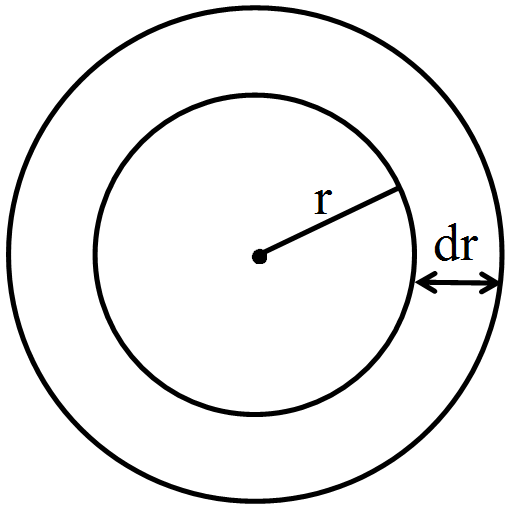 Work done $=\text{dW}=\text{p}\times4\pi\text{r}^2\times\text{dr}$ Due to surface tension $'\sigma',$ the excess pressure exists. The work done to change the area is also written as,$\text{dW}=\sigma \times\text{change in area}$
$=\sigma\times4\pi\{(\text{r}+\text{dr})^2-\text{r}^2\}=\sigma8\pi\text{rdr}$
$\therefore\text{P}4\pi\text{r}^2\text{dr}=\sigma8\pi\text{r}\text{ dr}$
$\therefore\text{P}=\frac{2\sigma}{\text{r}}$ View full question & answer→Question 472 Marks
Does it matter if one uses gauge instead of absolute pressures in applying Bernoulli’s equation? Explain.
AnswerNo, it does not matter if one uses gauge pressure instead of absolute pressure while applying Bernoulli’s equation. The two points where Bernoulli’s equation is applied should have significantly different atmospheric pressures.
View full question & answer→Question 482 Marks
Two syringes of different cross$-$sections $($without needles$)$ filled with water are connected with a tightly fitted rubber tube filled with water. Diameters of the smaller piston and larger piston are $1.0\ cm$ and $3.0\ cm$ respectively.
- Find the force exerted on the larger piston when a force of $10N$ is applied to the smaller piston.
- If the smaller piston is pushed in through $6.0\ cm$, how much does the larger piston move out?
AnswerHere, $d_1 = 1.0\ cm, d_2 = 3.0\ cm$, Force on smaller piston $F_1 = 10N$.
- According to Pascal's law of transmission of pressure $\text{P}=\frac{\text{F}_1}{\text{A}_1}=\frac{\text{F}_2}{\text{A}_2}.$
$\therefore\frac{\text{F}_2}{\text{F}_1}=\frac{\text{A}_2}{\text{A}_1}$
$=\frac{\text{r}^2_2}{\text{r}^2_1}=\Big(\frac{\text{d}_2}{\text{d}_1}\Big)^2$
$=\Big(\frac{3.00\text{cm}}{1.0\text{cm}}\big)^2=9$
$\Rightarrow\text{F}_2=\text{F}_1\times9$
$=10\times9$
$=90\text{N}.$
- Water is considered to be completely incompressible. Therefore, volume covered by the movement of smaller piston inwards is exactly equal to volume moved outwards due to movement of larger piston, distance through which smaller piston is pushed $L_1 = 6.0\ cm$. Let larger piston is pushed by a distance $L_2$ then,
$\text{V}=\text{L}_1\text{A}_1=\text{L}_2\text{A}_2$
$\therefore\text{L}_2=\text{L}_1\Big(\frac{\text{A}_1}{\text{A}_2}\Big)=\text{L}_2\Big(\frac{\text{d}_1}{\text{d}_2}\Big)^2$
$=6.0\text{cm}\times\Big(\frac{1.0\text{cm}}{3.0\text{cm}}\Big)^2$
$=\frac69\text{cm}$
$=0.67\text{cm}$ View full question & answer→Question 492 Marks
If the excess pressure inside a spherical soap bubble of radius 1cm is balanced by that due to a column of oil of specific gravity 0.9, 1.36mm high. Calculate the surface tension.
AnswerRedius, r = 1cm; $\rho=0.9\text{g cm}^{-3}$$\text{h}=1.36\text{mm}=0.136\text{cm}$
Pressure, $\text{P}=\text{h}\rho\text{g}=0.136\times0.9\times980$$=119.95\text{ dyne cm}^{-2}$
Let T be surfac4e tension of shoap solution$\therefore$ Excess pressure, $\text{P}=\frac{4\text{T}}{\text{r}}$ or $\text{T}=\frac{\text{Pr}}{\text{4}}=\frac{119.95\times1}{4}$
$= 29.988\text{ dynecm}^{-1}$
View full question & answer→Question 502 Marks
A piece of copper having an internal cavity weight 264 g in air and 221 g in water. Find the volume of the cavity. The density of copper $=8.8 \mathrm{gcm}^{-3}$.
AnswerMass of copper piece in air $=264 \mathrm{~g}$ Mass of copper piece in water $=221 \mathrm{~g}$ Apparent loss of mass $=264-221=43 \mathrm{~g}$ This is the mass of water displaced by the copper piece when immersed in water. Volume of copper piece with cavity $=43 \mathrm{~cm}^3$ Volume of copper only $=\frac{m}{\rho}=\frac{264}{8.8}=30 \mathrm{~cm}^3$ Volume of the cavity $=43-30=13 \mathrm{~cm}^3$.
View full question & answer→Question 512 Marks
Pressure of a gas in a closed cylinder is expressed in the following way : $\text{P}=\text{P}_\text{a}+\text{h}\rho\text{g}$
Identify the expressions for:
- Absolute pressure of the gas.
- Gauge pressure of the gas.
Answer
- Absolute pressure of the gas,
$P = P_a$
- Gauge pressure of the gas,
$\text{P}-\text{P}_\text{a}=\text{h}\rho\text{g}$ View full question & answer→Question 522 Marks
State Bernoulli's Theorem.
AnswerFor an incompressible, non-viscous, irrotational liquid having streamlined flow, the sum of the pressure energy, kinetic energy and poential energy per unit mass is constant.$\frac{\text{P}}{\rho}+\frac{\text{V}^2}{2}+\text{gh}=\text{constant}$
But for a steady flow Bernoulli's equation can be simplified as,$\text{P}_1+\frac12\rho\text{V}^2_1=\text{P}_2+\frac12\rho\text{V}^2_2$
View full question & answer→Question 532 Marks
Two soap bubbles in vacuum having radii 3cm and 4cm respectively coalesce under isothermal conditions to form a single bubble. What is the radius of the new bubble?
AnswerSurface energy of first bubble, = Surface are × surface tension $=2\times4\pi\text{r}^2_1\text{T}=8\pi\text{r}^2_1\text{T}$ Surface energy of second bubble $=8\pi\text{r}^2_2\text{T}$ According to the law of conservation of energy,$8\pi\text{r}^2\text{T}=8\pi\text{r}^2_1\text{T}+8\pi\text{r}^2_2\text{T}$
$=8\pi(\text{r}^2_1+\text{r}^2_2)\text{T}$
$\therefore\text{r}^2=\text{r}^2_1+\text{r}^2_2$
$=3^2+4^2=9+16=25$
$\therefore\text{r}=5\text{cm.}$
View full question & answer→Question 542 Marks
Two liquids of specific gravity $1.2$ and $0.84$ are poured into the limbs of a U-tube until the difference in levels of their upper surfaces is $9\ cm$. What will be the heights of their respective surfaces above the common surface in U-tube? What is the pressure at the common surface (lg = 10ms?)
AnswerLet $h_1, h_2$ be the heights of denser and lighter liquids above the common level.
Then, $h _2- h _1=9.0 cm$ Also $1.2 h_1 g=0.84 h_2 g$ Or $h _1=\frac{084}{1.2} h_2=0.7 h_2$
From (i), $h _2-0.7 h_2=9$ or $0.3 h_2=9$ Or $h _2=30 cm$ and $h _1=0.7 \times 30=21 cm$
Pressure at the common surface $= h \rho g =0.30 \times\left(0.84 \times 10^3\right) \times 10=2520 Nm ^{-2}$
View full question & answer→Question 552 Marks
What is the significance of:
- Wetting agents used by dyers.
- Water proofing agents?
Answer
- They are added to decrease the angle of contact between the fabric and the dye so that the dye may penetrate well.
- They are used to increase the angle of contact between the fabric and water to prevent the water from penetrating the cloth.
View full question & answer→Question 562 Marks
It is easier to spray water in which some soap is dissolved. Explain why?
AnswerWhen the liquid is sprayed, it is broken into small drops. The surface area increases and hence the surface energy is also increased. Therefore, work has to be done to supply the additional energy. Since surface energy is numerically equal to the surface tension, so when soap is dissolved in water, the surface tension of the solution decreases and hence less energy is spent to spray it.
View full question & answer→Question 572 Marks
Water flows through a horizontal pipe of radius 1cm at a speed of $2\text{ms}^{-1}$, what should be the diameter of its nozzle if the water is to come out at a speed of 10ms?
Answer$\text{r}_1=1\text{cm},\nu_1=2\text{ms}^{-1}$Since, $\text{a}\nu=\text{constant}$
$\pi\text{r}^2\nu=\text{constant}$
$\pi\text{r}^2_1\nu_1=\pi\text{r}^2_2\nu_2$
$10^{-4}\times2=\text{r}^2_2\times10$
$\Rightarrow\text{r}^2_2=2\times10^{-5}$
$\text{r}_2=\sqrt{2\times10^{-5}}=4.47\times10^{-3}\text{m}$
$\text{Diameter}=8.94\times10^{-3}\text{m}.$
View full question & answer→Question 582 Marks
Water is escaping from a vessel through a horizontal capillary tube $20cm$ long $0.2mm$ radius at a point $100cm$ below the free surface of water in the vessel. Calculate the rate of flow if coefficient of viscosity of water be $1 \times 10^{-3} Pa-s$.
AnswerHere $l = 20cm = 0.20m; r = 0.2mm = 2 \times 10^{-4}m h = 100cm = 1m; \rho=10^3\text{kg m}^{-3}$
$\eta=1\times10^{-3}\text{Pa-s};\ \text{P}$
$=\text{h}\rho\text{g}=1\times10^3\times9.8\text{Nm}^{-2}$
Let V be rate of flow (volume of water flowing per second)$\therefore$ Using the relation, $\text{V}=\frac{\pi\text{p}\text{r}^4}{8\eta\text{l}},$ we get,
$\text{V}=\frac{\pi\times9.8\times10^3(2\times10^{-4})^4}{8\times1\times10^{-3}\times0.2}$
$=3.08\times10^{-8}\text{m}^3\text{s}^{-1}.$
View full question & answer→Question 592 Marks
AnswerIt is the property of liquid which is equal to the magnitude of dragging force per unit area between the two layers of liquid whose velocity gradient is unity. So it has no direction (only magnitude of force) so it is not vector.
View full question & answer→Question 602 Marks
The excess pressure inside a soap bubble is thrice the excess pressure inside a second soap bubble. What is the ratio between the volume of the first and the second bubble?
AnswerGiven, $\frac{\text{4T}}{\text{r}_1}=\frac{3\times4\text{T}}{\text{r}_2}$ or $r_2 = 3r_1 \frac{\text{V}_1}{\text{V}_2}=\frac{\Big(\frac43\Big)\pi\text{r}_1^3}{\Big(\frac43\Big)\pi\text{r}^3_2}$
$=\Big(\frac{\text{r}_1}{\text{r}_2}\Big)^3=\Big(\frac{1}{3}\Big)^3=\frac{1}{27}$
View full question & answer→Question 612 Marks
Explain why A fluid flowing out of a small hole in a vessel results in a backward thrust on the vessel.
AnswerWhen a fluid flows out from a small hole in a vessel, the vessel receives a backward thrust. A fluid flowing out from a small hole has a large velocity according to the equation of continuity: Area × Velocity = Constant. According to the law of conservation of momentum, the vessel attains a backward velocity because there are no external forces acting on the system.
View full question & answer→Question 622 Marks
Explain why The blood pressure in humans is greater at the feet than at the brain.
AnswerBlood pressure is the pressure exerted by the column of blood on the blood vessel. Blood pressure depends on the force at which heart pumps the blood. The pressure of Liquid is given by: P = hdg where h = height of liquid column(blood in this case) d = density of the liquid g = Acceleration due to gravity. Hence we can say that height of blood column at feet is more than it is at brain and also at the feet the blood has to be pumped to the heart against the force of gravity and has to travel a greater distance than at the brain. so we can conclude, by saying that "The blood pressure in humans is greater at the feet than at the brain".
View full question & answer→Question 632 Marks
Explain why A drop of liquid under no external forces is always spherical in shape.
AnswerA liquid tends to acquire the minimum surface area because of the presence of surface tension. The surface area of a sphere is the minimum for a given volume. Hence, under no external forces, liquid drops always take spherical shape.
View full question & answer→Question 642 Marks
Can Bernoulli’s equation be used to describe the flow of water through a rapid in a river? Explain.
AnswerBernoulli's equation cannot be used to describe the flow of water through a rapid in a river because of the turbulent flow of water. This principle can only be applied to a streamline flow.
View full question & answer→Question 652 Marks
Write two factors affecting viscosity. Which one is more viscous : pure water or saline water?
AnswerForce and velocity of fluid. Saline water.
View full question & answer→Question 662 Marks
What should be the average velocity of water in a tube of radius 0.005m so that the flow is just turbulent? The viscosity of water is 0.001Pas.
AnswerD = 2 × 0.005 = 0.01m;$\rho=10^3\text{kg m}^{-3};\ \eta=0.001\text{ pas.}$
For laminar flow of water, $N_R$ = 2000 Let $\upsilon$ be the average velocity of the water,$\therefore\text{N}_\text{R}=\frac{\rho\upsilon\text{D}}{\eta}$ or $\upsilon=\frac{\text{N}_\text{R}-\eta}{\rho-\text{D}}=\frac{2000\times0.001}{1000\times0.01}=0.2\text{m/s}$
View full question & answer→Question 672 Marks
What are the conditions for equilibrium of floating bodies?
AnswerThere are two conditions for equilibrium of floating bodies:
- Condition of floatation: For a body to float, the weight of the liquid displaced must be equal to its own weight.
- Condition for equilibrium: The centre of gravity of the body, and that of the displaced liquid must be on the same vertical line.
View full question & answer→Question 682 Marks
When a body is fully or partly immersed in a liquid, name the forces acting on the body.
AnswerThere are two vertical forces acting on the body:
- The true weight of the body acting vertically downwards.
- The force of buoyancy equal to the weight of the liquid displaced.
View full question & answer→Question 692 Marks
Explain why Hydrostatic pressure is a scalar quantity even though pressure is force divided by area.
AnswerWhen force is applied on a liquid, the pressure in the liquid is transmitted in all directions. Hence, hydrostatic pressure does not have a fixed direction and it is a scalar physical quantity.
View full question & answer→Question 702 Marks
Find the height to which water at $4^{\circ} \mathrm{C}$ will rise in a capillary tube of $10^{-3} \mathrm{~m}$ diameter. Take $\mathrm{g}=9.8 \mathrm{~ms}^{-2}$. Angle of contact, $\theta=0$ and $\mathrm{T}=0.072 \mathrm{Nm}^{-1}$.
AnswerHere, $D = 10^{-3}m$, $\text{r}=\frac{\text{D}}{2}=0.5\times10^{-3}\text{m}$$\text{g}=9.8\text{ms}^{-1},\theta=0,$
$\text{T}=72\times10^{-3}\text{Nm}^{-1}$
$\cos\theta=1$
Density of water at $4^\circ C = 10^3kg m^{-3}$ Using the relation, $\text{h}=\frac{2\text{T}\cos\theta}{\text{r}\rho\text{g}}$$=\frac{2\times72\times10^{-3}\times1}{5\times10^{-4}\times10^3\times9.8}$
$=2.939\times10^{-2}\text{m}$
View full question & answer→Question 712 Marks
The excess pressure inside a soap bubble is thrice the excess pressure inside a moving soap bubble. What is the ratio between the volume of the first and second bubble?
AnswerLet $r_1$ and $r_2$ be the radii of soap bubbles, excess pressure in them are $\frac{4\sigma}{\text{r}_1}$ and $\frac{4\sigma}{\text{r}_2},$ where $\sigma$ is the surface tension. Given: $\text{P}_1=\text{3P}_2$$\frac{4\sigma}{\text{r}_1}=3\frac{4\sigma}{\text{r}_2}$
$\therefore\text{r}_2=3\text{r}_1$
Volume fo first to second bubble,$=\frac{\text{r}_1^3}{\text{r}^3_2}=\frac{1}{3^3}=\frac{1}{27}$
View full question & answer→Question 722 Marks
The velocity of water in a river is $18 \mathrm{~km} \mathrm{~h}^{-1}$ near the surface. If the river is 5 m deep, find the shearing stress between horizontal layers of water. The coefficient of viscosity of water $10^{-2}$ poise.
AnswerAs the velocity of water at the bottom of the river is zero,$\text{dv}=18\text{km h}^{-1}$
$=18\times\frac{5}{18}=5\text{ms}^{-1}$
Also, dx = 5m, $\eta=10^{-2}\text{poise}=10^{-3}\text{Pa-s}$ Force of viscosity $\text{F}=\eta\text{A}\frac{\text{dv}}{\text{dx}}$ We know that, shering strees $=\frac{\text{F}}{\text{A}}$$\Rightarrow\frac{\text{F}}{\text{A}}=\eta\frac{\text{dv}}{\text{dx}}$
$=\frac{10^{-3}\times5}{5}=10^{-3}\text{Nm}^{-2}$
View full question & answer→Question 732 Marks
What should be the average velocity of water in a tube of radius 0.005 m so that the flow is just turbulent? The viscosity of water is 0.001Pa-s.
AnswerHere, r = 0.005 m, diameter D = 2r = 0.010m$\eta=0.001\text{Pa-s},\rho=1000\text{kg m}^{-3}$
For flow to be just turbulent, $\text{R}_\text{e}=3000$$\therefore\text{v}=\frac{\text{R}_\text{e}\eta}{\rho\text{D}}=\frac{3000\times0.001}{1000\times0.010}=0.3\text{ms}^{-1}$
View full question & answer→Question 742 Marks
A large force is needed to normally separate two glass plates having a thin layer of water between them. Why?
AnswerThe thin layer of water between the glass plates forms a concave surface all around. This decreases the pressure on the inner side of the liquid film. Thus, a large amount of force is required to pull them apart against the atmospheric pressure.
View full question & answer→Question 752 Marks
As soon as parachute of a falling soldier opens, his acceleration decreases and soon becomes zero. Explain.
AnswerBecause of the viscosity of the air. Due to the viscosity effect a resistive force is offered on the soldier by the air, hence some upward acceleration acts on the soldier.$\therefore$ Net acceleration = g - a, as the soldier proceeds downward.
View full question & answer→Question 762 Marks
Find the work done in increasing the radius of a soap bubble from 4cm to 6cm. The value of surface tension for the soap solution is 30 dyne $cm^{-1}$.
AnswerGiven, r1 = 4cm, r2 = 6cm, S = 30dyne cm-1 So, change in surface area $=2\times4\pi(6^2-4^2)$ [Shoap solution has two surface]$=8\pi\ 20=160\pi\text{cm}^{2}$
Work done = S × Change in surface area = 30 × 160 × 3.142 = 15081.6erg
View full question & answer→Question 772 Marks
Water flows at a speed of 6cm/ s through a tube of radius 1cm. Coefficient of viscosity of water at room temperature is 0.001 Poise. What is the nature of the flow?
AnswerHere, V = 6cm/ s or 0.06m/ s D = 1 × 2 = 2cm or 0.02m$\eta=0.001\text{ Poise}$ and $\rho=10^3\text{kg/m}^3$ for water,
$\therefore\text{N}_\text{R}=\frac{\rho\cdot\text{V}\cdot\text{D}}{\eta}=\frac{1000\times0.06\times0.02}{0.001}=1200<2000$
Hence, the flow of water is Laminar.
View full question & answer→Question 782 Marks
A cubical block of steel of density $7.8g \ cm^{-3}$ floats on mercury $($density $13.6g \ cm^{-3})$ with its sides vertical. Assume the side of the cube to be $10\ cm$.
- What length of the block is above the mercury surface?
- If water is poured on the mercury surface, what will be the height of the water column, when the water surface just covers the top of the steel block?
Answer
- Volume of the steel block $= 10 \times 10 \times 10 = 1000\ cm^3$
Weight of the steel block $= 1000 \times 7.8g$
Volume of the block below the surface is $\left(10-I_1\right) \times 100$ where $I_1$ is the length of the block above the surface of mercury.
The weight of mercury displaced by the block $=\left(10-\mathrm{I}_1\right) \times 100 \times 13.6 \mathrm{~g}$
According to Archimedes' principle, this must be equal to the weight of the steel block.
Therefore, $\left(10-\mathrm{I}_1\right) \times 100 \times 13.6=7800$ of $\mathrm{I}_1=4.26 \mathrm{~cm}$
ii. Let $\mathrm{I}_2$ be the height of the water column,
Weight of the block $=$ weight of water displaced $+$ weight of mercury desplaced
$7800=I_2 \times 100 \times 1+\left(10-I_2\right) \times 100 \times 13.6$
Which gives $\mathrm{I}_2=4.6 \mathrm{~cm}$. View full question & answer→Question 792 Marks
In an artery of radius 'a' blood flows with a uniform speed v. If radius of artery becomes $'\frac34\text{a}'$ due to the accumulation of plague on its inner walls, what will be the flow of the blood through the constriction?
AnswerAccording to equation of continuity, Av = A'V'$\pi\text{a}^2\times\text{V}=\pi\Big(\frac{3\text{a}}{4}\Big)^2.\text{V}'$
$\text{V}'=\frac{\text{a}^2\text{V}}{\Big(\frac{\text{3a}}{4}\Big)^2}=\frac{16}9\text{V}$
$\therefore\text{V}'=1.8\text{V}$
View full question & answer→Question 802 Marks
A water pipe entering a hose has a dimeter of 2cm and the speed of water is $0.1ms^{-1}$. Eventually, the pipe tapers to a diameter of 1cm. Calculate the speed of water in the tapered portion.
AnswerHere, ${\upsilon_1=0.1\text{ms}^{-1};}$$\text{r}_1=\frac22\text{cm}=1\text{cm}=10^{-2}\text{m}$
$\therefore\text{a}_1=\pi\text{r}^2_1=\pi\times10^{-4}\text{m}^2.$
At the tapered portion,$\text{r}_2=\frac{1}{2}\text{cm}=0.5\text{cm}=0.5\times10^{-2}\text{m}$
$\therefore\text{a}_2=\pi\text{r}^2_2=\pi\times0.25\times10^{-4}\text{m}^2$
Using $\text{a}_1\upsilon_1=\text{a}_2\upsilon_2,$ we get,$\upsilon_2=\frac{\text{a}_1\upsilon_1}{\text{a}_2}=\frac{\pi\times10^{-4}\times0.1}{\pi\times0.25\times10^{-4}}=0.4\text{ms}^{-1}$
View full question & answer→Question 812 Marks
Derive the condition of floatation of a body.
AnswerWhen a body floats in a liquid with a part submerged in the liquid, the weight of the liquid displaced by the submerged part is always equal to the weight of the body. Let V = volume of the body$\sigma=$ density of its material
$\rho=$ density of the liquid in which the body floats such that its volume V' is outside the liquid.
Then volume of the body inside the liquid = V - V’ Weight of the displaced liquid $=(\text{V}-\text{V}')\rho\text{g}$ Also weight of the body $=\text{V}\sigma\text{ g}$ For the body to float, Weight of the liquid displaced by the sumberged part = weight of the body, i.e., $(\text{V}-\text{V}')\rho\text{g}=\text{V}\sigma\text{ g}$ or $\text{V}'=\frac{(\rho-\sigma)\text{V}}{\rho}$
View full question & answer→Question 822 Marks
A car is lifted by a hydraulic jack that consist of two pistons. The large piston is 1m in diameter and small piston is 10cm in diameter. If W is the weight of the car, how much smaller a force is needed on the small piston to lift the car?
AnswerDiameter of a large piston = 1m; Raduis of large piston R = 0.5m, Diameter of a small piston = 10cm = 0.1m; Radius of small piston, r = 0.05m weight of the car = W. As, $\frac{\text{f}}{\pi\text{r}^2}=\frac{\text{F}}{\pi\text{r}^2}$ Smaller force, $\text{f}=\text{F}\times\Big(\frac{\text{r}}{\text{R}}\Big)^2$$=\text{W}\Big(\frac{0.05}{0.5}\Big)^2=0.1\text{W}\text{ Newton}$
= 1% of the weight of the car. Hence, smaller force needed on the small piston to lift the car is 1% of the weight of the car.
View full question & answer→Question 832 Marks
If the required pressure in the tyre of a car is $199\ kPa,$ then
- What is the gauge pressure?
- What is the absolute pressure?
Answer
- Gauge pressure,
$\therefore\text{P}_\text{g}=199\text{k Pa}$
- Abosolute pressure,
$\text{P}=\text{P}_\text{a}+\text{P}_\text{g}[\because$ From equation $(i)]$
$=101\text{k P}+199\text{K Pa}$
$=300\text{k Pa}$ View full question & answer→Question 842 Marks
Explain why The size of the needle of a syringe controls flow rate better than the thumb pressure exerted by a doctor while administering an injection.
AnswerThe small opening of a syringe needle controls the velocity of the blood flowing out. This is because of the equation of continuity. At the constriction point of the syringe system, the flow rate suddenly increases to a high value for a constant thumb pressure applied.
View full question & answer→Question 852 Marks
A manometer reads the pressure of a gas in an enclosure as shown in Fig.$(a)$ When a pump removes some of the gas, the manometer reads as in Fig. $(b)$ The liquid used in the manometers is mercury and the atmospheric pressure is $76\ cm$ of mercury. Give the absolute and gauge pressure of the gas in the enclosure for cases $(i)$ and $(ii)$ in units of cm of mercury. How would the levels change in case $(i)$ if $13.6\ cm$ of water $($immiscible with mercury$)$ are poured into the right limb of the manometer? $($Ignore the small change in volume of the gas.$)$
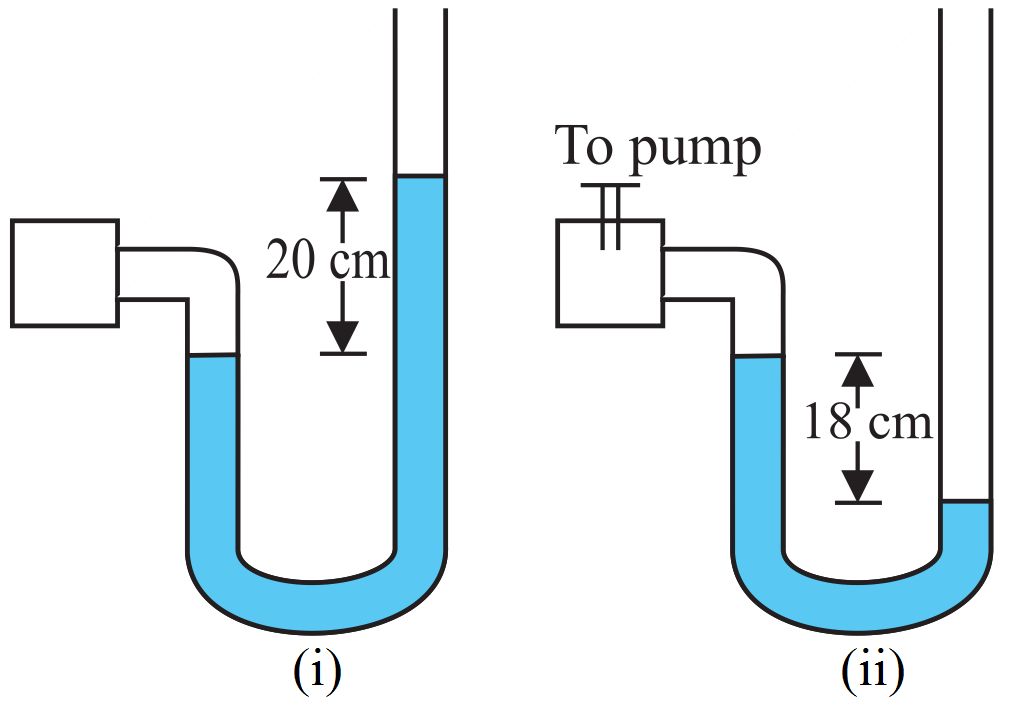
Answer
- Given : Atmospheric pressure,
$P_0=6 \mathrm{~cm}$ of $\mathrm{Hg}$
In figure $(i)$ pressure head,
$\mathrm{h}_1=+20 \mathrm{~cm}$ of $\mathrm{Hg} .$
Absolute pressure $( P )$ of the gas is greater than the $\mathrm{P}_0$ i.e.,
$P=P_0+h_1 p g$
$=76 \mathrm{~cm}$ of $\mathrm{Hg}+20 \mathrm{~cm}$ of $\mathrm{Hg}$
$=96 \mathrm{~cm}$ of $\mathrm{Hg}$
Gauge pressure is the difference between the absolute pressure and the atmospheric pressure. $\frac{1}{2}$ It means,
Gauge pressure $=P-P_0$
$=96 \mathrm{~cm}$ of $\mathrm{Hg}-76 \mathrm{~cm} \text { of } \mathrm{Hg}$
$=20 \mathrm{~cm}$ of $\mathrm{Hg} .$
In figure $(ii),$ pressure head,
$h_2=-18 \mathrm{~cm}$ of $\mathrm{Hg} \text {. }$
$\therefore$ The absolute pressure of the gas is lesser than the atmospheric pressure is given by
$P=P_0+h_2 p g$
$=76 \mathrm{~cm}$ of $\mathrm{Hg}+(-18 \mathrm{~cm}) \text { of } \mathrm{Hg}$
$=58 \mathrm{~cm}$ of $\mathrm{Hg}$
Gauge pressure $=$ Absolute pressure $-$ Atmospheric pressure
$=58 \mathrm{~cm}$ of $\mathrm{Hg}-76 \mathrm{~cm} \text { of } \mathrm{Hg}$
$=-18 \mathrm{~cm}$ of $\mathrm{Hg}$
It means, Gauge pressure is simply equal to $h \ cm$ of $Hg .$
- Given : $13.6\ cm$ of water added in the right limb is equivalent to $\frac{13.6}{13.6}=1\text{cm}$ of $Hg$ column i.e., $h = 1\ cm$ of $Hg$ column, which can be calculated as follows
$\text{h}_{\omega}=13.6\text{Cm}$ of water
Suppose $h_m =$ height of $Hg$ column equivalent to $13.6\ cm$ of water, thus equilibrium.
$\text{h}_{\text{m}}\rho_{\text{m}}\text{g}=\text{h}_{\omega}\rho_{\omega}\text{g}.$
$\text{h}_{\text{m}}=\text{h}_{\omega}\frac{\rho_{\omega}}{\rho_{\text{m}}}=\frac{\text{h}_{\omega}}{\Big(\frac{\rho_{\text{m}}}{\rho_{\omega}}\Big)}$
$=\frac{13.6}{13.6}=1\text{cm}$ of $hg$
The mercury will rise in the left limb such that the difference in the height of $Hg$ column in the two limbs.
$= 20\ cm - 1m$
$= 19 \ cm$ of $Hg$ column. View full question & answer→Question 862 Marks
A hydraulic automobile lift is designed to lift cars with maximum mass of 300kg. The area of cross-section of the piston carrying the load is $425cm^2$. What maximum pressure would the smaller piston have to bear?
AnswerIn hydraulic systems, $\text{P}_1=\text{P}_2\text{ or }\frac{\text{F}_1}{\text{A}_1}=\frac{\text{F}_2}{\text{A}_1}$$\therefore$ Maximum pressure on smaller piston = Maximum pressure on the larger piston
$\Rightarrow\frac{300\times9.8}{425\times10^{-4}}=6.92\times10^4\text{N/m}^2$
View full question & answer→Question 872 Marks
A small drop of water of surface tension T is squeezed between two clean glass plates so that a thin layer of thickness d and area A is formed between them. If the angle of contact is zero, what is the force required to pull the plates apart.
AnswerAn extremely thin layer of liquid can be considered as the collection of large number of hemispherical drops. In case of a spherical drop, the excess of pressure $=\frac{\text{2T}}{\text{r}}.$ But in case of thin layer of liquid, which is a combination of hemispherical drops, the excess pressure Force due to surface tension pushing the two plates together is $\text{P}=\frac{\text{T}}{\text{r}},$ where $\text{r}=\frac{\text{d}}{2}.$ Therefore, $\text{P}=\frac{\text{T}}{\frac{\text{d}}{2}}=\frac{2T}{\text{d}}$ Force due to surface tenstion pushing the two plates togher is,$\text{F}=\text{P}\times\text{A}=\frac{2\text{TA}}{\text{d}}$
View full question & answer→Question 882 Marks
Explain why Surface tension of a liquid is independent of the area of the surface.
AnswerSurface tension is the force acting per unit length at the interface between the plane of a liquid and any other surface. This force is independent of the area of the liquid surface. Hence, surface tension is also independent of the area of the liquid surface.
View full question & answer→Question 892 Marks
What do you mean by viscosity and terminal velocity?
AnswerViscosity: It is the property of a fluid by virtue of which an internal frictional force comes into play when the fluid is in motion in the form of layers having relative motion. It opposes the relative motion of the different layers. Terminal velocity: It is the maximum constant velocity acquired by the body while falling freely in a viscus medium. This is attained when the apparent weight is compensated by the viscous force. It is given by,$\upsilon=\frac{2\text{r}^2(\rho-\sigma)\text{g}}{9\eta}$
View full question & answer→Question 902 Marks
Oil spreads over the surface of water, whereas, water does not spread over the surface of oil. Why?
AnswerThe surface tension of the water is more than that of oil. Therefore, when oil is poured over water, the greater value of surface tension of water pulls the oil in all directions and as such it spreads on the water. On the other hand, when water is poured over oil, it does not spread over it because the surface tension of oil being less than that of water, it is not able to pull water over it.
View full question & answer→Question 912 Marks
Why are the wings of an aeroplane rounded outwards while flattened inwards?
AnswerThe special design of the wings increases velocity at the upper surface and decreases velocity at the lower surface. So, according to Bernoulli's theorem, the pressure on the upper side is less than the pressure on the lower side. This difference of pressure provides lift.
View full question & answer→Question 922 Marks
A metal block of area $0.10 m ^2$ is connected to a $0.010 kg$ mass via a string that passes over an ideal pulley $($considered massless and frictionless), as in Fig. $9.13$. A liquid with a film thickness of $0.30 mm$ is placed between the block and the table. When released the block moves to the right with a constant speed of $0.085 m s ^{-1}$. Find the coefficient of viscosity of the liquid.
AnswerThe metal block moves to the right because of the tension in the string.
The tension $T$ is equal in magnitude to the weight of the suspended mass $m$.
Thus, the shear force $F$ is $F=T=m g=0.010 \ kg \times 9.8 m s ^{-2}=9.8 \times 10^{-2} N$ Shear stress on the fluid $=F / A=\frac{9.8 \times 10^{-2}}{0.10} N / m ^2$
$\text { Strain rate }=\frac{v}{l}=\frac{0.085}{0.30 \times 10^{-3}}$
$h=\frac{\text { stress }}{\text { strain rate }} s ^{-1}$
$=\frac{\left(9.8 \times 10^{-2} N \right)\left(0.30 \times 10^{-3} m \right)}{\left(0.085 m s ^{-1}\right)\left(0.10 m ^2\right)}$
$=3.46 \times 10^{-3} Pa s$
View full question & answer→Question 932 Marks
In a car lift compressed air exerts a force $F$ on a small piston having a radius of $5.0 \ cm$. This pressure is transmitted to a second piston of radius $15 \ cm ($Fig $9.7).$ If the mass of the car to be lifted is $1350 \ kg$, calculate $F_1$. What is the pressure necessary to accomplish this task? $\left(g=9.8\ ms ^2\right)$
AnswerSince pressure is transmitted undiminished throughout the fluid,
$F_1=\frac{A_1}{A_2} F_2$
$=\frac{\pi\left(5 \times 10^{-2} m \right)^2}{\pi\left(15 \times 10^{-2} m \right)^2}\left(1350 \ kg \times 9.8\ m s ^{-2}\right)$
$=1470 N$
$\approx 1.5 \times 10^3 N$
The air pressure that will produce this force is
$P=\frac{F_1}{A_1}$
$=\frac{1.5 \times 10^3 N }{\pi\left(5 \times 10^{-2}\right)^2 m }$
$=1.9 \times 10^5 Pa$
This is almost double the atmospheric pressure.
View full question & answer→Question 942 Marks
Two syringes of different cross$-$sections $($without needles$)$ filled with water are connected with a tightly fitted rubber tube filled with water. Diameters of the smaller piston and larger piston are $1.0 \ cm$ and $3.0 \ cm$ respectively. $(a)$ Find the force exerted on the larger piston when a force of $10 N$ is applied to the smaller piston. $(b)$ If the smaller piston is pushed in through $6.0 \ cm,$ how much does the larger piston move out?
Answer$(a)$ Since pressure is transmitted undiminished throughout the fluid,
$F_2=\frac{A_2}{A_1} F_1$
$= \frac{\pi\left(3 / 2 \times 10^{-2} m \right)^2}{\pi\left(1 / 2 \times 10^{-2} m \right)^2} \times 10 N$
$ =90 N$
$(b)$ Water is considered to be perfectly incompressible. Volume covered by the movement of smaller piston inwards is equal to volume moved outwards due to the larger piston.
$L_1 A_1=L_2 A_2$
$L_2=\frac{A_1}{A_2} L_1$
$=\frac{\pi\left(1 / 2 \times 10^{-2} m \right)^2}{\pi\left(3 / 2 \times 10^{-2} m \right)^2} \times 6 \times 10^{-2} m$
$\simeq 0.67 \times 10^{-2} m$
$=0.67 \ cm$
Note, atmospheric pressure is common to both pistons and has been ignored.
View full question & answer→