Question 13 Marks
Three particles, each of mass $200g$, are kept at the corners of an equilateral triangle of side $10\ cm$. Find the moment of inertia of the system about an axis:
- Joining two of the particles.
- Passing through one of the particles and perpendicular to the plane of the particles.
Answer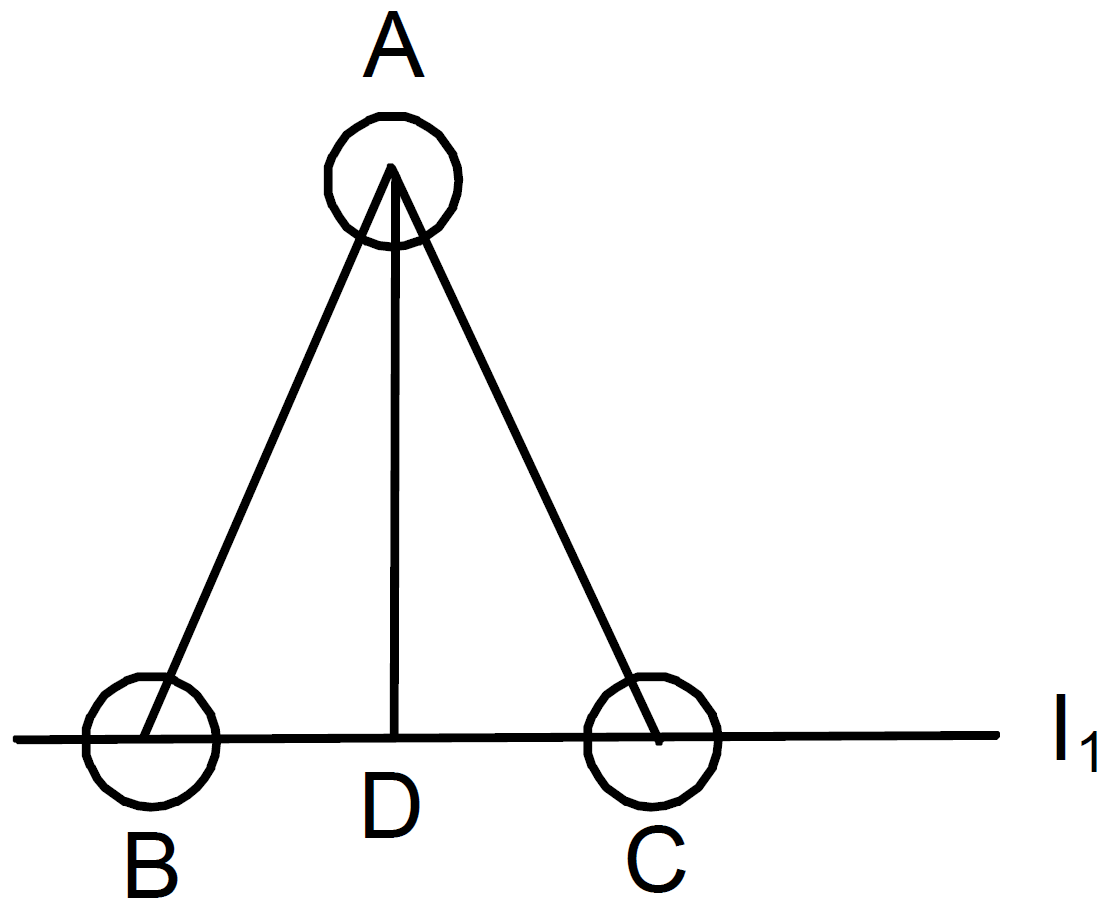
- Therefore, the $\perp$ distance from the axis $(\text{AD})=\frac{\sqrt3}{2}\times10=5\sqrt3\text{cm}.$
Therefore moment of inertia about the axis $BC$ will be
$\text{I}=\text{mr}^2=200\text{k}\big(5\sqrt3\big)^2$
$=200\times25\times3$
$=15000\text{gm}-\text{cm}^2$
$=1.5\times10^{-3}\text{kg}-\text{m}^2$
- The axis of rotation let pass through $A$ and $\perp$ to the plane of triangle
Therefore the torque will be produced by mass $B$ and $C$
Therefore net moment of inertia $= I = mr^2 + mr^2$
$= 2 \times 200 \times 10^2$
$= 40000gm-cm^2$
$= 4 \times 10^{-3}kg-m^2$. View full question & answer→Question 23 Marks
A thin spherical shell lying on a rough horizontal surface is hit by a cue in such a way that the line of action passes through the centre of the shell. As a result, the shell starts moving with a linear speed v without any initial angular velocity. Find the linear speed of the shell after it starts pure rolling on the surface.
Answer
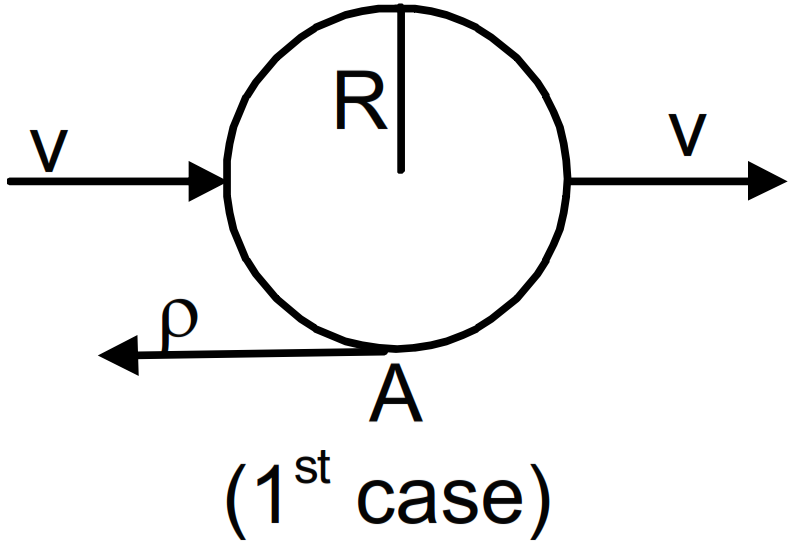
The shell will move with a velocity nearly equal to v due to this motion a frictional force well act in the background direction, for which after some time the shell attains a pure rolling. If we consider moment about A, then it will be zero.
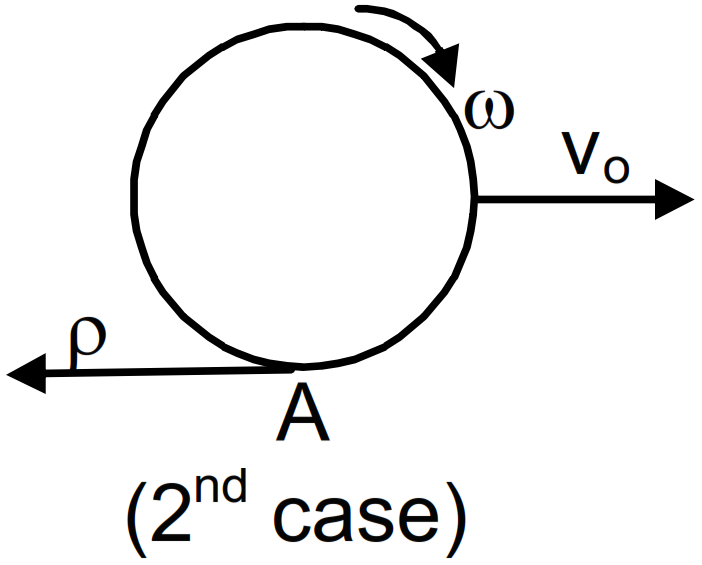
Therefore, Net angular momentum about A before pure rolling = net angular momentum after pure rolling.
Now, angular momentum before pure rolling about A = M(V × R) and angular momentum after pure rolling:
$\Big(\frac{2}{3}\Big)\text{MR}^2\times\Big(\frac{\text{V}_0}{\text{R}}\Big)+\text{MV}_0\text{R}$
($V_0$ = velocity after pure rolling)
$\Rightarrow\text{MVR}=\frac{2}3{}\text{MV}_0\text{R}+\text{MV}_0\text{R}$
$\Rightarrow\Big(\frac{5}{3}\Big)\text{V}_0=\text{V}$
$\Rightarrow\text{V}_0=\frac{3\text{V}}{5}$ View full question & answer→Question 33 Marks
A cylinder rotating at an angular speed of $50rev/s$ is brought in contact with an identical stationary cylinder. Because of the kinetic friction, torques act on the two cylinders, accelerating the stationary one and decelerating the moving one. If the common magnitude of the acceleration and deceleration be one revolution per second square, how long will it take before the two cylinders have equal angular speed?
AnswerA cylinder is moving with an angular velocity $50rev/s$ brought in contact with another identical cylinder in rest. The first and second cylinder has common acceleration and deacceleration as $1rad/s^2$ respectively.
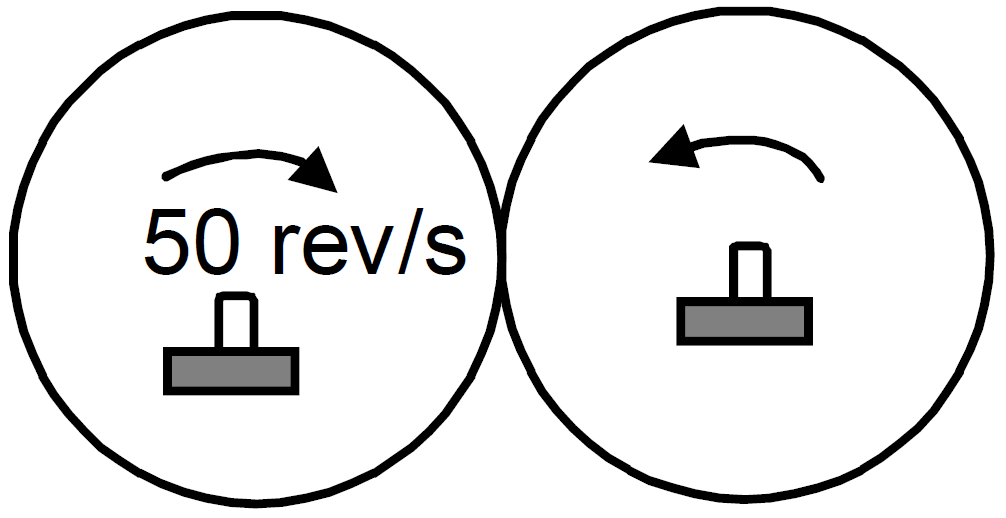
Let after t sec their angular velocity will be same $'\omega'.$ For the first cylinder $\omega=50-\alpha\text{t}$$\Rightarrow\text{t}=\frac{(\omega-50)}{-1}$
And for the $2^{nd}$ cylinder $\omega=\alpha_2\text{t}$$\text{t}=\frac{\omega}{\text{l}}$
So, $\omega=\frac{(\omega-50)}{-1}$$\Rightarrow2\omega=50$
$\Rightarrow\omega=25\text{rev/s}.$
$\Rightarrow\text{t}=\frac{25}{1}\text{sec}=25\text{sec}$ View full question & answer→Question 43 Marks
Calculate the ratio of the angular momentum of the earth about its axis due to its spinning motion to that about the sun due to its orbital motion. Radius of the earth = 6400km and radius of the orbit of the earth about the sun = $1.5 \times 10^8km$.
AnswerAngular momentum of the earth about its axis is$=\frac{2}{5}\text{mr}^2\times\Big(\frac{2\pi}{85400}\Big)\ \Big($Because, $\text{l}=\frac{2}{5}\text{mr}^2\Big)$
Angular momentum of the earth about sun’s axis$=\text{mR}^2\times\Big(\frac{2\pi}{86400\times365}\Big)$ (Because, $l = mR^2$)
Therefore, ratio of the angular momentum $=\frac{\frac{2}{5}\text{mr}^2\times\big(\frac{2\pi}{86400}\big)}{\text{mR}^2\times\frac{2\pi}{(86400\times365)}}$$\Rightarrow\frac{(\text{2r}^2\times365)}{5\text{R}^2}$
$\Rightarrow\frac{(2.990\times10^{10})}{1.125\times10^{17}}=2.65\times10^{-7}$
View full question & answer→Question 53 Marks
Find the angular velocity of a body rotating with an acceleration of $2 \mathrm{rev} / \mathrm{s}^2$ as it completes the $5^{\text {th }}$ revolution after the start.
Answer$\theta=5\text{rev},\ \alpha=2\text{rev/s}^2,\ \omega_0=0;\ \omega=?$$\omega^2=(2\alpha\theta)$
$\Rightarrow\omega=\sqrt{2\times2\times5}=2\sqrt5\text{rev/s}.$
or $\theta=10\pi\text{rad},\ \alpha=4\pi\text{rad/s}^2,\ \omega_0=0,\ \omega=?$
$\omega=\sqrt{2\alpha\theta}=2\times4\pi\times10\pi$
$=4\pi\sqrt5\text{rad/s}=2\sqrt5\text{rev/s}$
View full question & answer→Question 63 Marks
Find the moment of inertia of a uniform square plate of mass m and edge a about one of its diagonals.
AnswerLet a small cross sectional area is at a distance x from xx axis. Therefore mass of that small section $=\frac{\text{m}}{\text{a}^2} \times\text{axdx}$ Therefore moment of inertia about xx axis
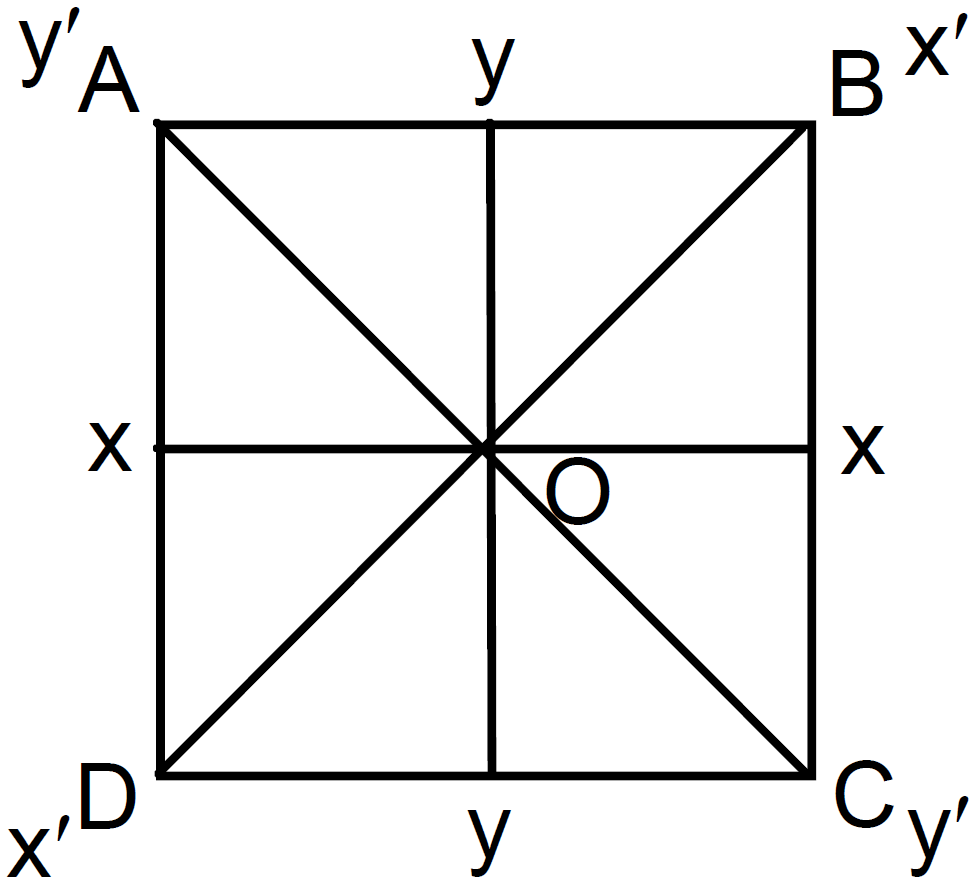
$=\text{I}_{\text{xx}}=2\int_\limits{0}^{\frac{\text{a}}{2}}\Big(\frac{\text{m}}{\text{a}^2}\Big)\times(\text{adx})\times\text{x}^2$
$=\Big[2\times\Big(\frac{\text{m}}{\text{a}}\Big)\Big(\frac{\text{x}^3}{3}\Big)\Big]^{\frac{\text{a}}2{}}_0$
$=\frac{\text{ma}^2}{12}$
Therefore $\text{l}_{\text{xx}}=\text{l}_{\text{xx}}+\text{l}_ {\text{yy}}$$=2\times\frac{\text{ma}^2}{12}=\frac{\text{ma}^2}{6}$
Since the two diagonals are $\perp$ to each other Therefore $\text{l}_{\text{zz}}=\text{l}_{\text{x}'\text{x}'}+\text{l}_{\text{y}'\text{y}'}$$\Rightarrow\frac{\text{ma}^2}{6}=2\times\text{l}_{\text{x}'\text{x}'}$ (because $I_{x’x’} = I_{y’y’}$)
$\Rightarrow\text{l}_{\text{x}'\text{x}'}=\frac{\text{ma}^2}{12}$ View full question & answer→Question 73 Marks
Figure shows two blocks of masses m and M connected by a string passing over a pulley. The horizontal table over which the mass m slides is smooth. The pulley has a radius r and moment of inertia I about its axis and it can freely rotate about this axis. Find the acceleration of the mass M assuming that the string does not slip on the pulley.
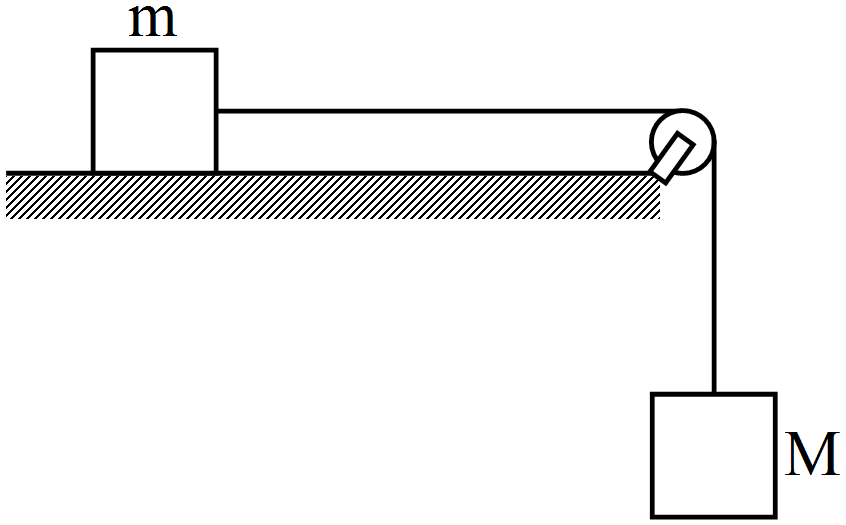
AnswerAccording to the question 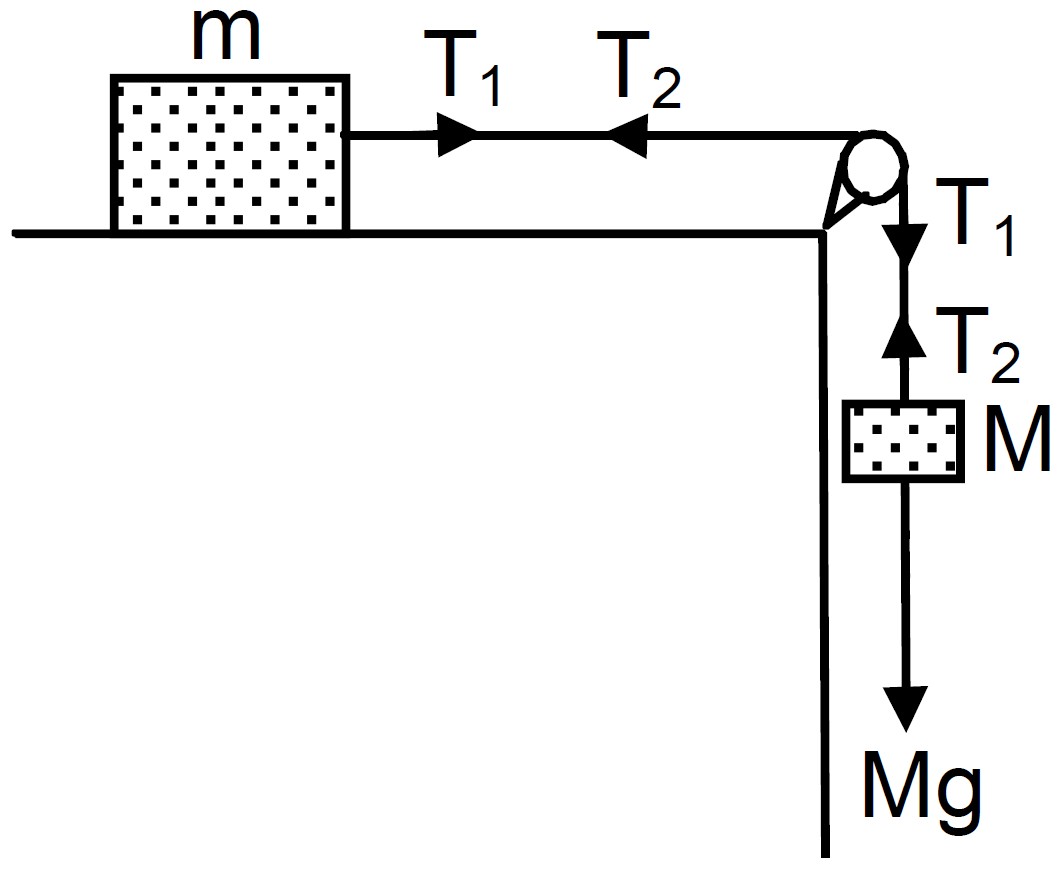 $\text{Mg}-\text{T}_1=\text{ma}\ \dots(1)$
$\text{T}_2=\text{ma}\ \dots(2)$
$\big(\text{T}_1-\text{T}_2\big)=\frac{1\text{a}}{\text{r}^2}\ \dots(3)$ $[$ because $\text{a}=\text{r}\alpha]\ \dots\ \Big[\text{T}.\text{r}=\text{l}\Big(\frac{\text{a}}{\text{r}}\Big)\Big]$
If we add the equation 1 and 2 we will get$\text{Mg}+(\text{T}_2-\text{T}_1)=\text{ma}+\text{ma}\ \dots(4)$
$\Rightarrow\text{Mg}-\frac{\text{la}}{\text{r}^2}=\text{Ma}+\text{ma}$
$\Rightarrow\Big(\text{M}+\text{m}+\frac{\text{l}}{\text{r}^2}\Big)\text{a}=\text{Mg}$
$\Rightarrow\text{a}=\frac{\text{Mg}}{\big(\text{M}+\text{m}+\frac{\text{l}}{\text{r}^2}\big)}$ View full question & answer→Question 83 Marks
A wheel of moment of inertia $0.10kg-m^2$ is rotating about a shaft at an angular speed of 160rev/ minute. A second wheel is set into rotation at 300rev/ minute and is coupled to the same shaft so that both the wheels finally rotate with a common angular speed of 200rev/ minute. Find the moment of inertia of the second wheel.
Answer
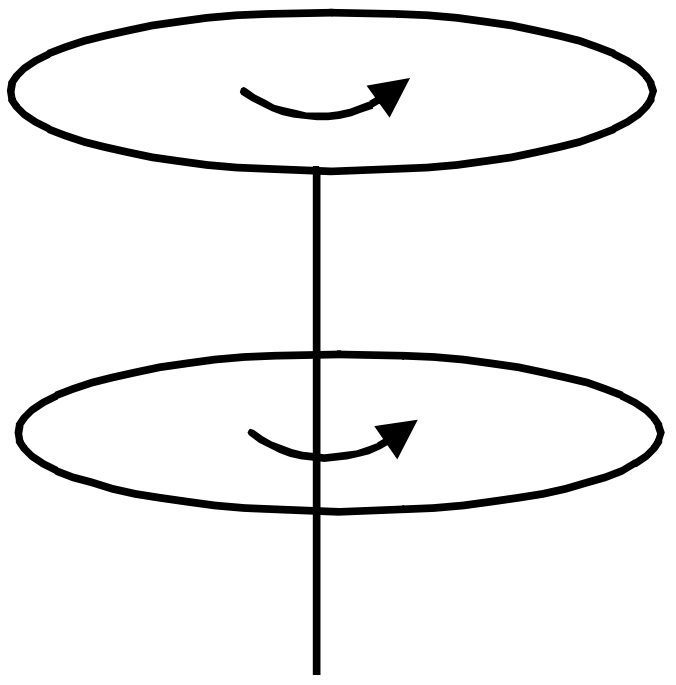
Wheel (1) has
$\text{l}_1=0.10\text{kg-m}^2$
$\omega_1=160\text{rev/min}$
Wheel (2) has
$\text{l}_2=?$
$\omega_2=300\text{rev/min}$
Given that after they are coupled, $\omega=200\text{rev/min}$
Therefore if we take the two wheels to bean isolated system
Total external torque = 0
Therefore, $\text{l}_1\omega_1+\text{l}_2\omega_2=(\text{l}_1+\text{l}_2)\omega$
$\Rightarrow0.10\times160+\text{l}_2\times300=(0.10+\text{l}_2)\times200$
$\Rightarrow\text{5l}_2=1-0.8$
$\Rightarrow\text{l}_2=0.04\text{Kg-m}^2$ View full question & answer→Question 93 Marks
The radius of gyration of a uniform disc about a line perpendicular to the disc equals its radius. Find the distance of the line from the centre.
AnswerThe moment of inertia about the center and $\perp$ to the plane of the disc of radius r and mass m is = $mr^2$. 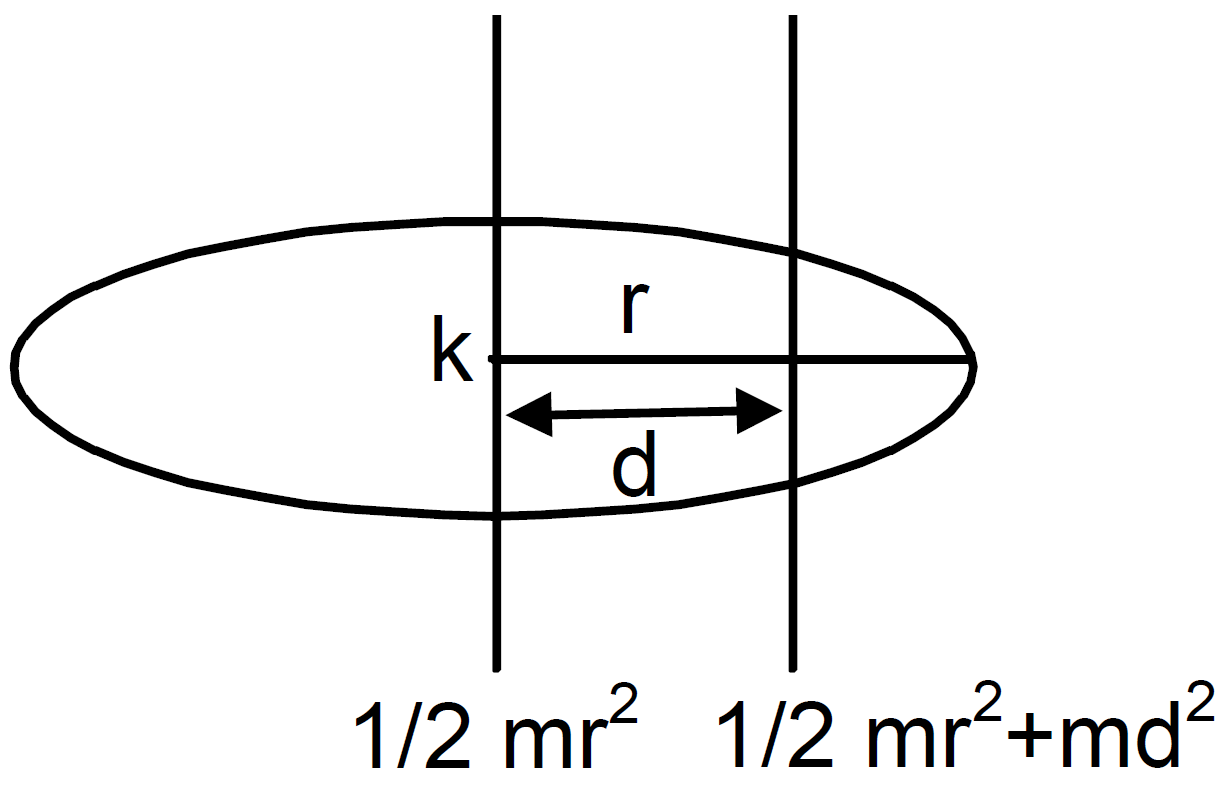
According to the question the radius of gyration of the disc about a point = radius of the disc. Therefore $\text{mk}^2=\frac{1}2{}\text{mr}^2+\text{md}^2$ (K = radius of gyration about acceleration point, d = distance of that point from the centre)$\Rightarrow\text{k}^2=\frac{\text{r}^2}{2}+\text{d}^2$
$\Rightarrow\text{r}^2=\frac{\text{r}^2}{2}+\text{d}^2$ $(\because\text{K}=\text{r})$
$\Rightarrow\frac{\text{r}^2}{2}=\text{d}^2$
$\text{d}=\frac{\text{r}}{\sqrt2}$ View full question & answer→Question 103 Marks
Suppose the rod in the previous problem has a mass of $1\ kg$ distributed uniformly over its length:
- Find the initial angular acceleration of the rod.
- Find the tension in the supports to the blocks of mass $2\ kg$ and $5\ kg$.
AnswerIn this problem the rod has a mass $1\ kg.$
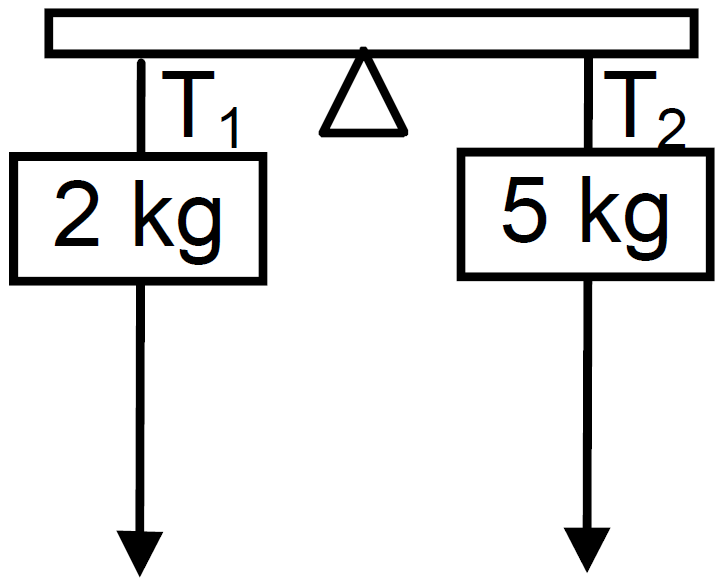
- $\tau_{\text{net}}=\text{I}_{\text{net}}\times\alpha$
$\Rightarrow5\times10\times10.5-2\times10\times0.5$
$=\Big[5\times\Big(\frac{1}{2}\Big)^2+2\times\Big(\frac{1}{2}\Big)^2+\frac{1}{12}\Big]\times\alpha$
$\Rightarrow15=(1.75+0.084)\alpha$
$\Rightarrow\alpha=\frac{1500}{(175+8.4)}=\frac{1500}{183.4}=8.1\text{rad/s}^2$ $(\text{g}=10)$
$=8.01\text{rad/s}^2 ($if $g = 9.8)$
- $\text{T}_1-\text{m}_1\text{g}=\text{m}_1\text{a}$
$\Rightarrow\text{T}_1=\text{m}_1\text{a}+\text{m}_1\text{g}=2(\text{a}+\text{g})$
$=2(\alpha\text{r}+\text{g})=2(8\times0.5+9.8)$
$= 27.6N$ on the first body.
In the second body
$\Rightarrow m_2g - T_2 = m_2a$
$\Rightarrow T_2 = m_2g - m_2a$
$\Rightarrow T_2 = 5(g - a) = 5(9.8 - 8 \times 0.5) = 29N.$ View full question & answer→Question 113 Marks
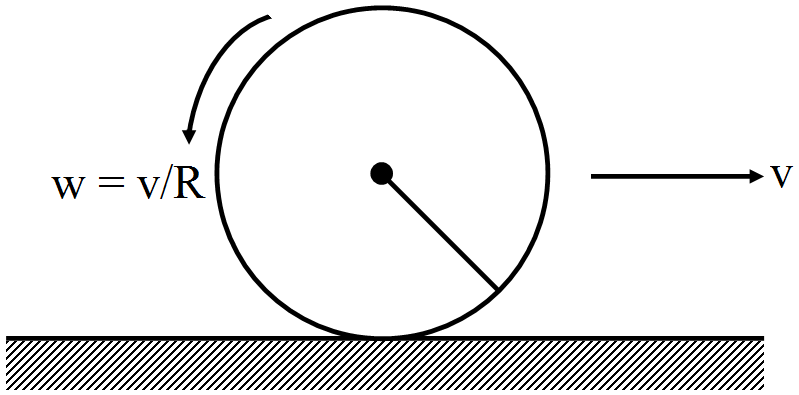
A solid sphere is set into motion on a rough horizontal surface with a linear speed $v$ in the forward direction and an angular speed $\frac{\text{v}}{\text{R}}$ in the anticlockwise direction as shown in figure. Find the linear speed of the sphere:
- When it stops rotating.
- When slipping finally ceases and pure rolling starts.
Answer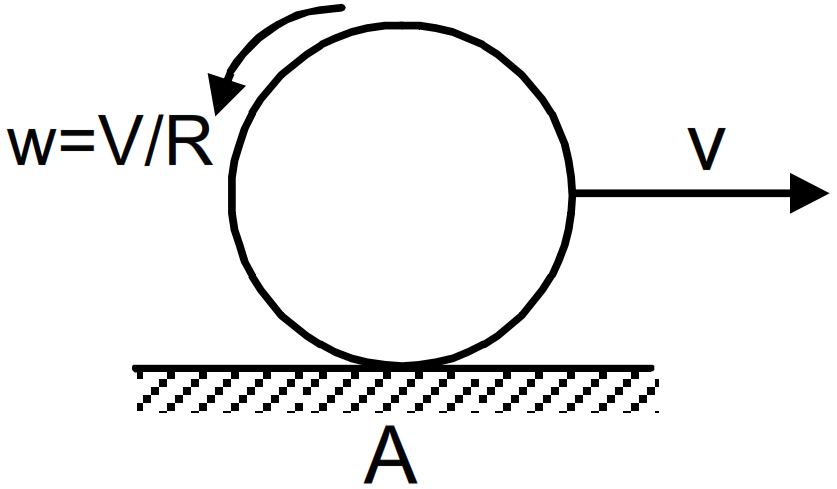
- If we take moment at $A$ then external torque will be zero.
Therefore, the initial angular momentum $=$ the angular momentum after rotation stops
$($i.e. only leniar velocity exits$)$
$\text{Mv}\times\text{R}-\ell\omega=\text{Mv}_0\times\text{R}$
$\Rightarrow\text{MvR}-\frac{2}{5}\times\frac{\text{MR}^2\text{V}}{\text{R}}=\text{Mv}_0\text{R}$
$\Rightarrow\text{v}_0=\frac{\text{3V}}{5}$
- Again, after some time pure rolling starts
Therefore,
$\Rightarrow\text{M}\times\text{v}_0\times\text{R}=\Big(\frac{2}{5}\Big) \text{MR}^2\times\Big(\frac{\text{V}'}{\text{R}}\Big)+\text{Mv}'\text{R}$
$\Rightarrow\text{m}\times\Big(\frac{\text{3V}}{5}\Big)\times\text{R}=\Big(\frac{2}{5}\Big)\text{Mv}'\text{R}+\text{Mv}'\text{R}$
$\Rightarrow\text{V}'=\frac{3\text{V}}{7}$ View full question & answer→Question 123 Marks
A cubical block of mass m and edge a slides down a rough inclined plane of inclination $\theta$ with a uniform speed. Find the torque of the normal force acting on the block about its centre.
Answer
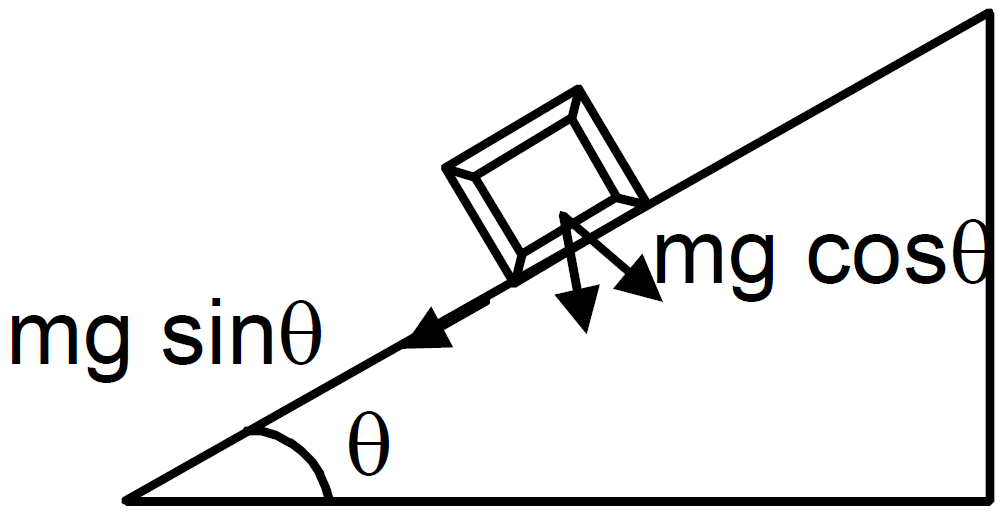 The force mg acting on the body has two components $\text{mg}\sin\theta$ and $\text{mg}\cos\theta$ and the body will exert a normal reaction.
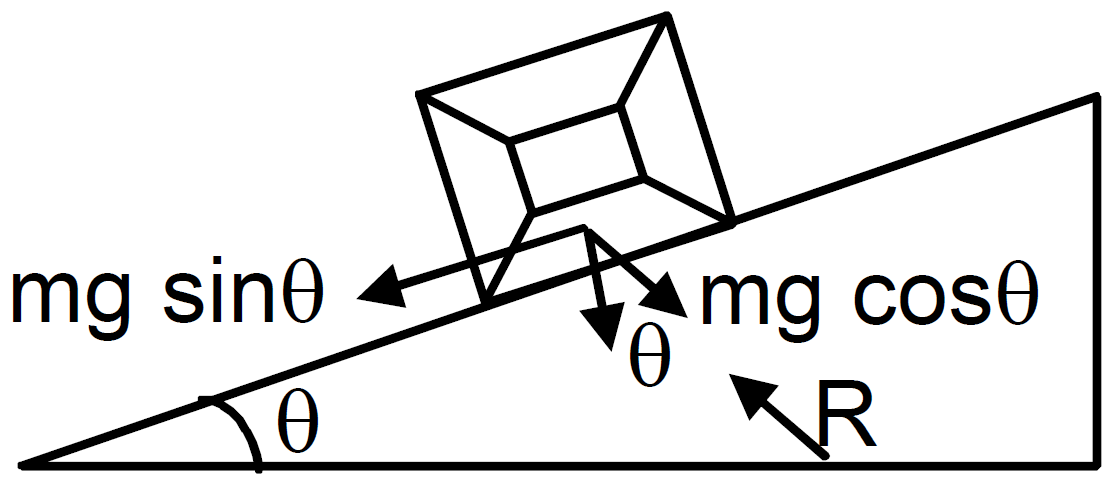
Let R = Since R and $\text{mg}\cos\theta$ pass through the centre of the cube, there will be no torque due to R and $\text{mg}\cos\theta.$ The only torque will be produced by $\text{mg}\sin\theta.$
$\therefore\text{i}=\text{F}\times\text{r}$ $\Big(\text{r}=\frac{\text{a}}2{}\Big)$ (a = ages of the cube)
$\Rightarrow\text{i}=\text{mg}\sin\theta\times\frac{\text{a}}2{}$
$=\frac{1}{2}\text{mga}\sin\theta$ View full question & answer→Question 133 Marks
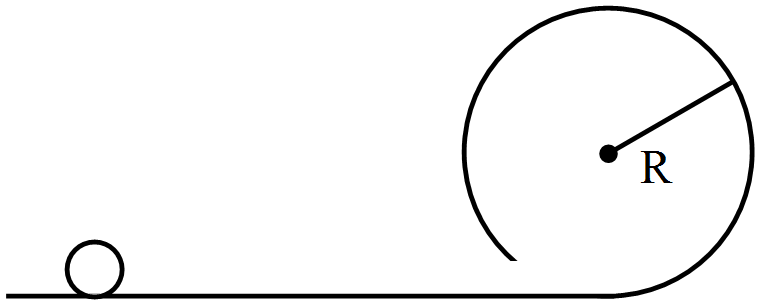
Figure shows a rough track, a portion of which is in the form of a cylinder of radius R. With what minimum linear speed should a sphere of radius r be set rolling on the horizontal part so that it completely goes round the circle on the cylindrical part.
Answer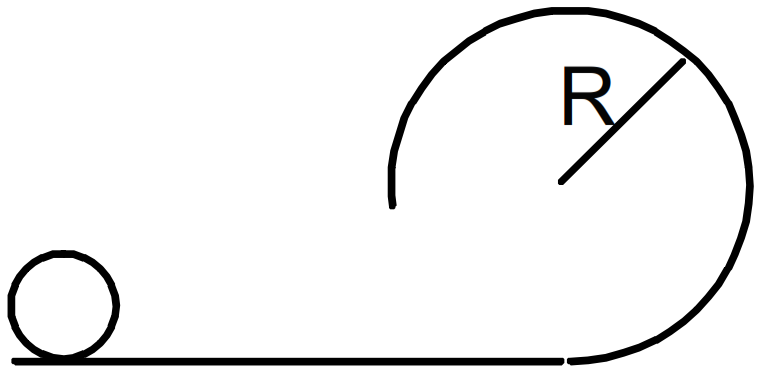 At the top most point
$\frac{\text{mv}^2}{\text{R}-\text{r}}=\text{mg}$
$\Rightarrow\text{v}^2=\text{g}(\text{R}-\text{r})$
Let the sphere is thrown with a velocity v'
Therefore applying laws of conservation of energy
$\Rightarrow\Big(\frac{1}{2}\Big)\text{mv}^2+\Big(\frac{1}{2}\Big)\text{l}\omega'^2$
$=\text{mg}2(\text{R}-\text{r})+\Big(\frac{1}{2}\Big)\text{mv}^2+\Big(\frac{1}{2}\Big)\text{l}\omega^2$
$\Rightarrow\frac{7}{10}\text{v}'^2=\text{g}2(\text{R}-\text{r})+\frac{7}{10}\text{v}^2$
$\Rightarrow\text{v}'^2=\frac{20}{7}\text{g}(\text{R}-\text{r})+\text{g}(\text{R}-\text{r})$
$\Rightarrow\text{v}'=\sqrt{\frac{27}{7}\text{g}(\text{R}-\text{r})}$ View full question & answer→Question 143 Marks
A wheel rotating at a speed of 600rpm (revolutions per minute) about its axis is brought to rest by applying a constant torque for 10 seconds. Find the angular deceleration and the angular velocity 5 seconds after the application of the torque.
AnswerA wheel rotating at a speed of 600rpm.$\omega_0=600\text{rpm}=10$ revolutions per second.
$\text{T}=10\text{sec}.$ (In 10sec. it comes to rest)
$\omega=0$
Therefore $\omega_0=-\alpha\text{t}$$\Rightarrow\alpha=-\frac{10}{10}=-1\text{rev/s}^2$
$\Rightarrow\omega=\omega_0+\alpha\text{t}$
$=10-1\times5=5\text{rev/s}$
Therefore angular deacceleration = $1rev/s^2$ and angular velocity of after 5sec is 5rev/s.
View full question & answer→Question 153 Marks
A square plate of mass 120g and edge 5.0cm rotates about one of the edges. If it has a uniform angular acceleration of $0.2rad/s^2$, what torque acts on the plate?
AnswerA square plate of mass 120gm and edge 5cm rotates about one of the edge. Let take a small area of the square of width dx and length a which is at a distance x from the axis of rotation.
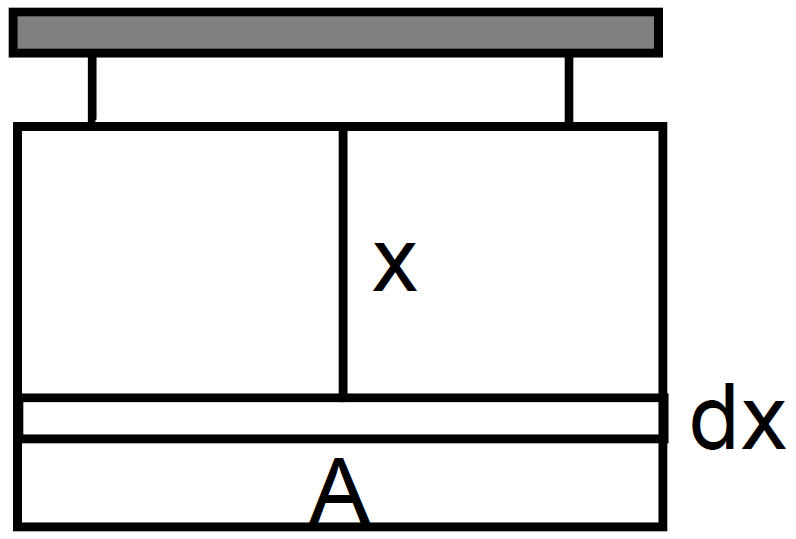
Therefore mass of that small area$\frac{\text{m}}{\text{a}^2}\times\text{adx}$ (m = mass of the square; a = side of the plate)
$\text{I}=\int\limits_0^{\text{a}}\Big(\frac{\text{m}}{\text{a}^2}\Big)\times\text{ax}^2\text{dx}$
$=\Big[\Big(\frac{\text{m}}{\text{a}}\Big)\Big(\frac{\text{x}^3}{3}\Big)\Big]_0^{\text{a}}$
$=\frac{\text{ma}^2}{3}$
Therefore torque produced $=\text{I}\times\alpha=\Big(\frac{\text{ma}^2}{3}\Big)\times\alpha$$=\Big\{\frac{(120\times10^{-3}\times5^2\times10^{-4})}{3}\Big\}0.2$
$=0.2\times10^{-4}=2\times10^{-5}\text{N-m}$ View full question & answer→Question 163 Marks
When a force of 6.0N is exerted at 30° to a wrench at a distance of 8cm from the nut, it is just able to loosen the nut. What force F would be sufficient to loosen it if it acts perpendicularly to the wrench at 16cm from the nut?
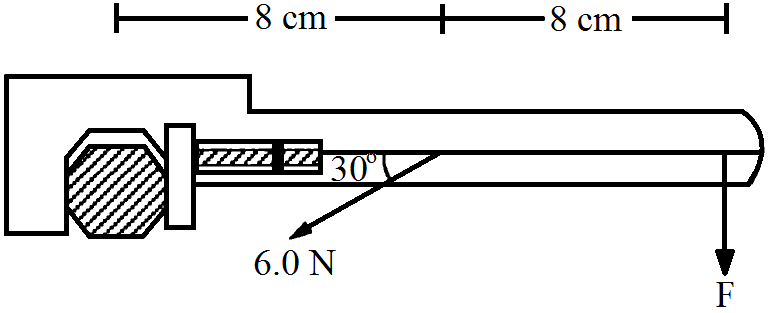
AnswerA force of 6N acting at an angle of 30° is just able to loosen the wrench at a distance 8cm from it. Therefore total torque acting at A about the point O$=6\sin30^\circ\times\Big(\frac{8}{100}\Big)$
Therefore total torque required at B about the point O$=\text{F}\times\frac{16}{100}$
$\Rightarrow\text{F}\times\frac{16}{100}=6\sin30^\circ\times\frac{8}{100}$
$\Rightarrow\text{F}=\frac{(8\times3)}{16}=1.5\text{N}$
View full question & answer→Question 173 Marks
A disc of radius $10\ cm$ is rotating about its axis at an angular speed of $20\ \text{rad/s.}$ Find the linear speed of:
- A point on the rim.
- The middle point of a radius.
AnswerA disc of radius $= 10\ cm = 0.1m$ Angular velocity $= 20\ \text{rad/s}$
$\therefore$ Linear velocity on the rim $=\omega\text{r}=20\times0.1=2\text{m/s}$
$\therefore$ Linear velocity at the middle of radius $=\frac{\omega\text{r}}{2}=20\times\frac{(0.1)}{2}=1\text{m/s}.$
View full question & answer→Question 183 Marks
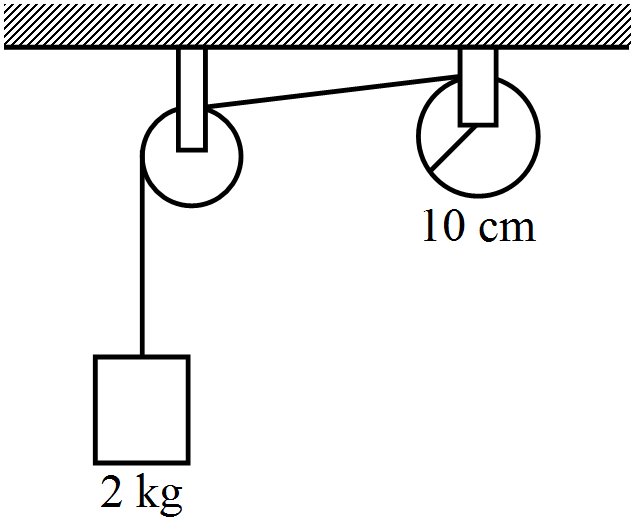
A string is wrapped on a wheel of moment of inertia $0.20kg-m^2$ and radius 10cm and goes through a light pulley to support a block of mass $2.0kg$ as shown in figure. Find the acceleration of the block.
Answer
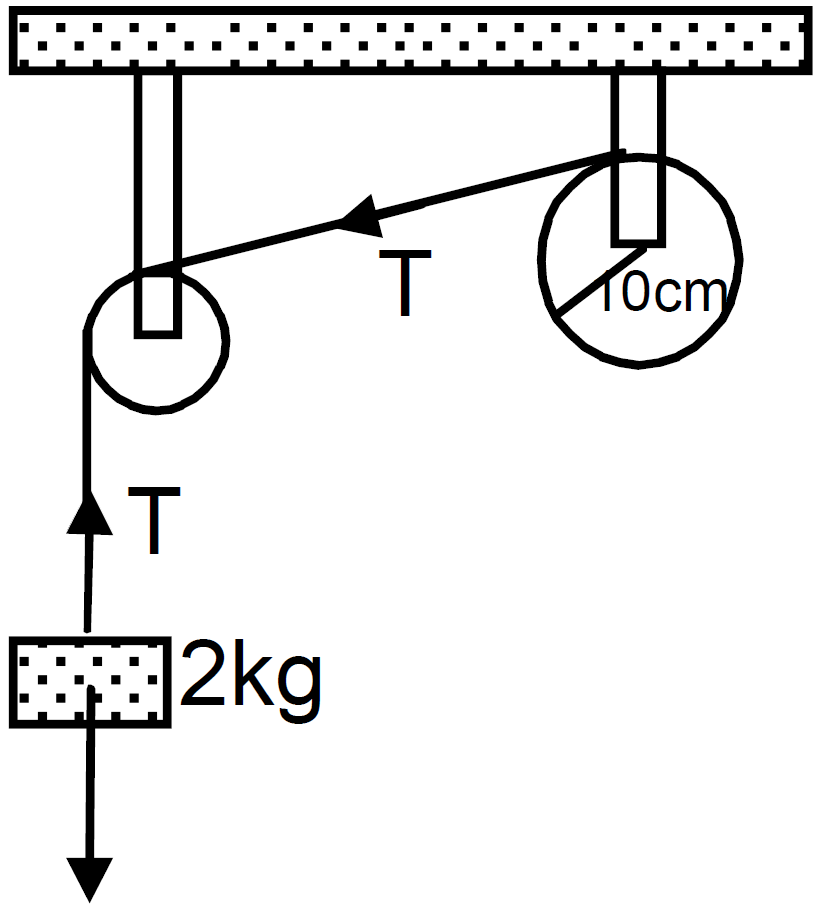
$I = 0.20kg-m^2$ (Bigger pulley)
$r = 10cm = 0.1m$, smaller pulley is light
mass of the block, m = 2kg
therefore $\text{mg}-\text{T}=\text{ma}\ \dots(1)$
$\Rightarrow\text{T}=\frac{\text{la}}{\text{r}^2}$
$\Rightarrow\text{mg}=\Big(\text{m}+\frac{\text{l}}{\text{r}^2}\Big)\text{a}$
$\Rightarrow\frac{(2\times9.8)}{\big[2+\big(\frac{0.2}{0.01}\big)\big]}=\text{a}$
$=\frac{19.6}{22}=0.89\text{m/s}^2$
Therefore, acceleration of the block = $0.89m/s^2$. View full question & answer→Question 193 Marks
Two particles of masses $m_1$ and $m_2$ are joined by a light rigid rod of length r. The system rotates at an angular speed co about an axis through the centre of mass of the system and perpendicular to the rod. Show that the angular momentum of the system is $\text{L}=\mu\text{r}^2\omega$ where $\mu$ is the reduced mass of the system defined as $\mu=\frac{\text{m}_1\text{m}_2}{\text{m}_1+\text{m}_2}.$
Answer
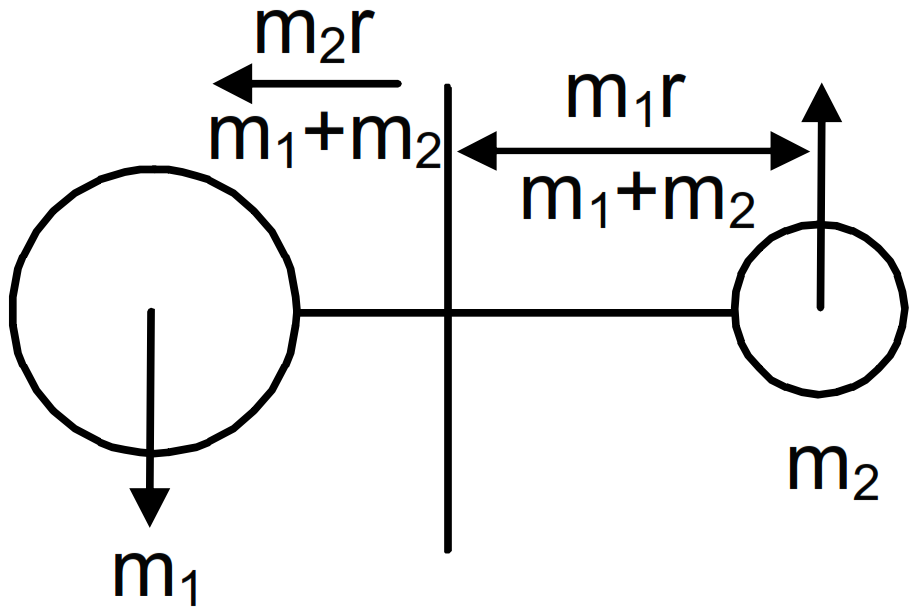
Angular momentum due to the mass $m_1$ at the centre of system is = $m_1r^{12}$.
$=\text{m}_1\Big(\frac{\text{m}_2}{\text{m}_1+\text{m}_2}\Big)^2\omega=\frac{\text{m}_1\text{m}_2^2\text{r}^2}{(\text{m}_1+\text{m}_2)^2}\omega\ \dots(1)$
Similarly the angular momentum due to the mass $m_2$ at the centre of system is $\text{m}_2\text{r}^{12}\omega$
$=\text{m}_2\Big(\frac{\text{m}_1\text{r}}{\text{m}_1\text{m}_2}\Big)^2\omega=\frac{\text{m}_2\text{m}_1^2}{(\text{m}_1+\text{m}_2)^2}\omega\ \dots(2)$
Therefore net angular momentum $=\frac{\text{m}_1\text{m}_2^2\text{r}^2\omega}{(\text{m}_1+\text{m}_2)^2}+\frac{\text{m}_2\text{m}_1^2\text{r}^2\omega}{(\text{m}_1+\text{m}_2)^2}$
$\Rightarrow\frac{\text{m}_1\text{m}_2(\text{m}_1+\text{m}_2)\text{r}^2\omega}{(\text{m}_1+\text{m}_2)^2}=\frac{\text{m}_1\text{m}_2}{(\text{m}_1+\text{m}_2)}\text{r}^2\omega=\mu\text{r}^2\omega$ (proved) View full question & answer→Question 203 Marks
A simple pendulum of length (l) is pulled aside to make an angle $\theta$ with the vertical. Find the magnitude of the torque of the weight (w) of the bob about the point of suspension. When is the torque zero?
Answer
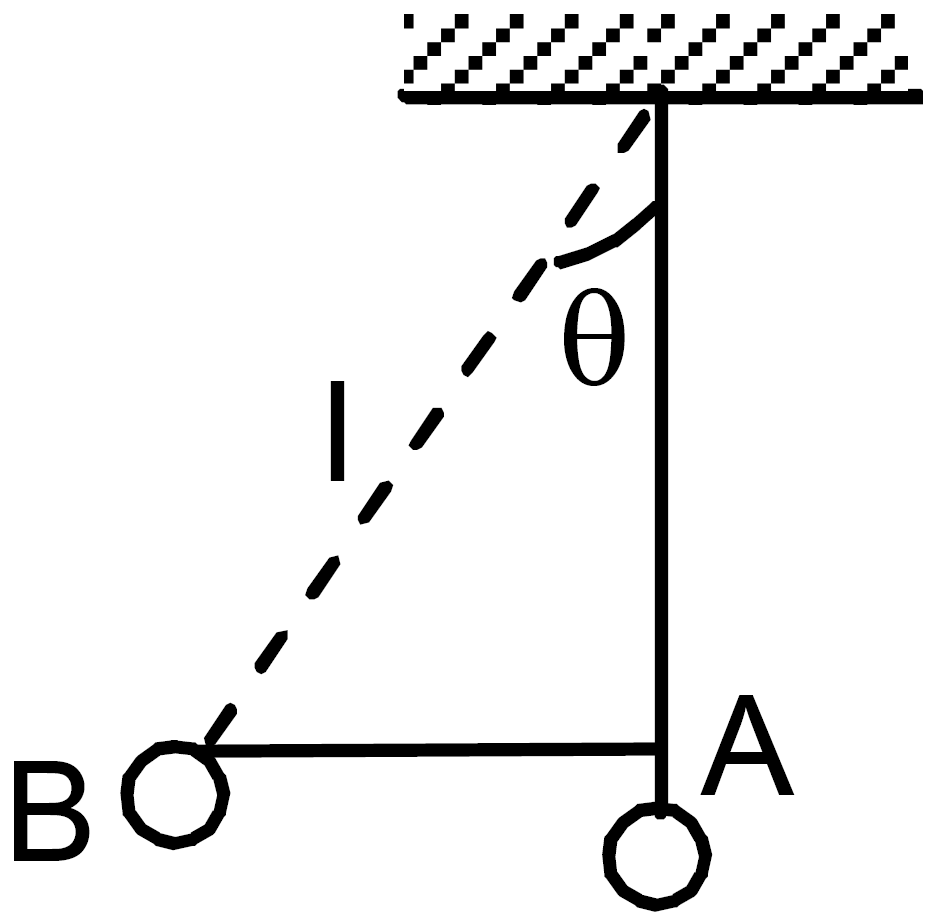 A simple of pendulum of length (l) is suspended from a rigid support. A bob of weight (w) is hanging on the other point.
When the bob is at an angle $\theta$ with the vertical, then total torque acting on the point of suspension = i = F × r
$\Rightarrow\text{Wr}\sin\theta=\text{Wl}\sin\theta$
At the lowest point of suspension the torque will be zero as the force acting on the body passes through the point of suspension. View full question & answer→Question 213 Marks
A dumb-bell consists of two identical small balls of mass $\frac{1}{2}\text{kg}$ each connected to the two ends of a 50cm long light rod. The dumb-bell is rotating about a fixed axis through the centre of the rod and perpendicular to it at an angular speed of 10rad/s. An impulsive force of average magnitude 5.0N acts on one of the masses in the direction of its velocity for 0.10s. Find the new angular velocity of the system.
Answer
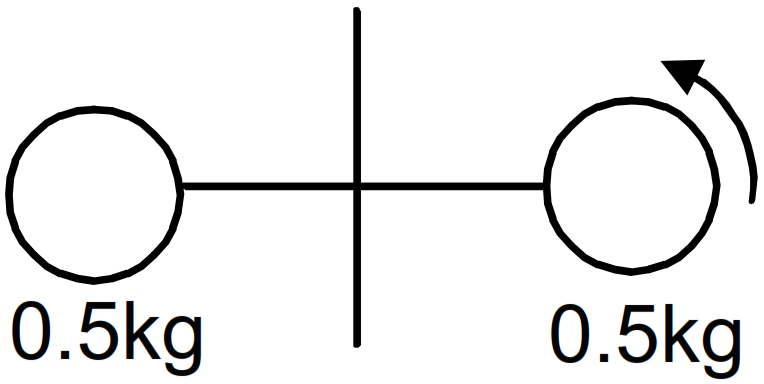 $\tau=\text{l}\alpha$
$\Rightarrow\text{F}\times\text{r}=(\text{mr}^2+\text{mr}^2)\alpha$
$\Rightarrow5\times0.25=2\text{mr}^2\times\alpha$
$\Rightarrow\alpha=\frac{1.25}{2\times0.5\times0.025\times0.25}=20$
$\omega_0=10\text{rad/s},\ \text{t}.=0.10\text{sec}$
$\omega=\omega_0+\alpha\text{t}$
$\Rightarrow\omega=10+0.10\times230=10+2=12\text{rad/s}$ View full question & answer→Question 223 Marks
A wheel rotating with uniform angular acceleration covers 50 revolutions in the first five seconds after the start. Find the angular acceleration and the angular velocity at the end of five seconds.
Answer$\theta=100\pi;\ \text{t}=5\text{sec}$$\theta=\frac{1}{2}\alpha\text{t}^2$
$\Rightarrow100\pi=\frac{1}2{}\alpha25$
$\Rightarrow\alpha=8\pi\times5=40\pi\text{rad/s}=20\text{rev/s}$
$\therefore\alpha=8\pi\text{rad/s}^2=4\text{rev/s}^2$
$\omega=40\pi\text{rad/s}^2=20\text{rev/s}^2$
View full question & answer→Question 233 Marks
A flywheel of moment of inertia $5.0\ kg-m^2$ is rotated at a speed of $60\ \text{rad/s.}$ Because of the friction at the axle, it comes to rest in $5.0$ minutes. Find:
- The average torque of the friction.
- The total work done by the friction.
- The angular momentum of the wheel $1$ minute before it stops rotating.
AnswerA flywheel of moment of inertia $5\ kg m$ is rotated at a speed of $60\text{rad/s.}$ The flywheel comes to rest due to the friction at the axle after $5$ minutes.
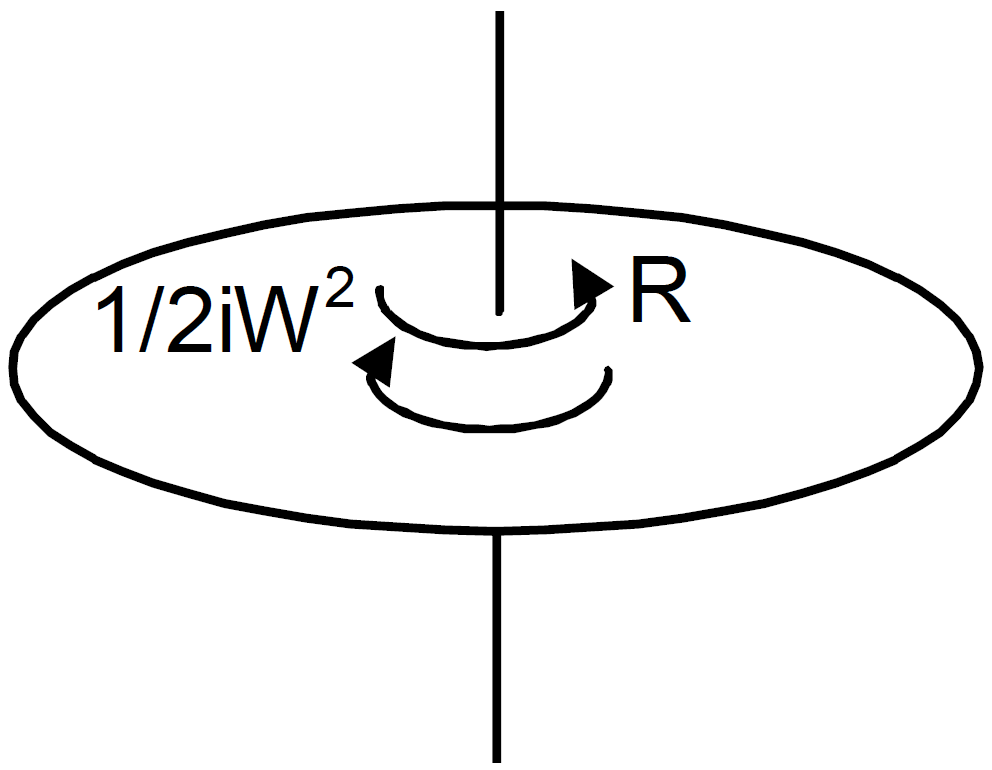
Therefore, the angular deceleration produced due to frictional force $=\omega=\omega_0+\alpha\text{t}$$\Rightarrow\omega_0=-\alpha\text{t}+\omega=0$
$\Rightarrow\alpha=-\Big(\frac{60}{5}\times60\Big)=-\frac{1}{5}\text{rad/s}$
- Therefore total workdone in stopping the wheel by frictional force $\text{W}=\frac{1}{2}\text{i}\omega^2$
$=\frac{1}{2}\times5\times(60\times60)$
$=9000\ \text{joule}=9\text{Kj}$
- Therefore torque produced by the frictional force $(R)$ is $\text{I}_{\text{R}}=\text{I}\times\alpha=5\times\Big(\frac{-1}{5}\Big)=\text{IN}-\text{m}$ opposite to the rotation of wheel.
- Angular velocity after $4$ minutes
$\Rightarrow\omega=\omega_0+\alpha\text{t}$
$=60-\frac{240}{5}=12\text{rad/s}$
Therefore angular momentum about the centre $=1\times\omega=5\times12=60\text{kg-m}^2/\text{s}$ View full question & answer→Question 243 Marks
The surface density (mass/ area) of a circular disc of radius a depends on the distance from the centre as p(r) = A + Br. Find its moment of inertia about the line perpendicular to the plane of the disc through its centre.
AnswerThe surface density of a circular disc of radius a depends upon the distance from the centre as 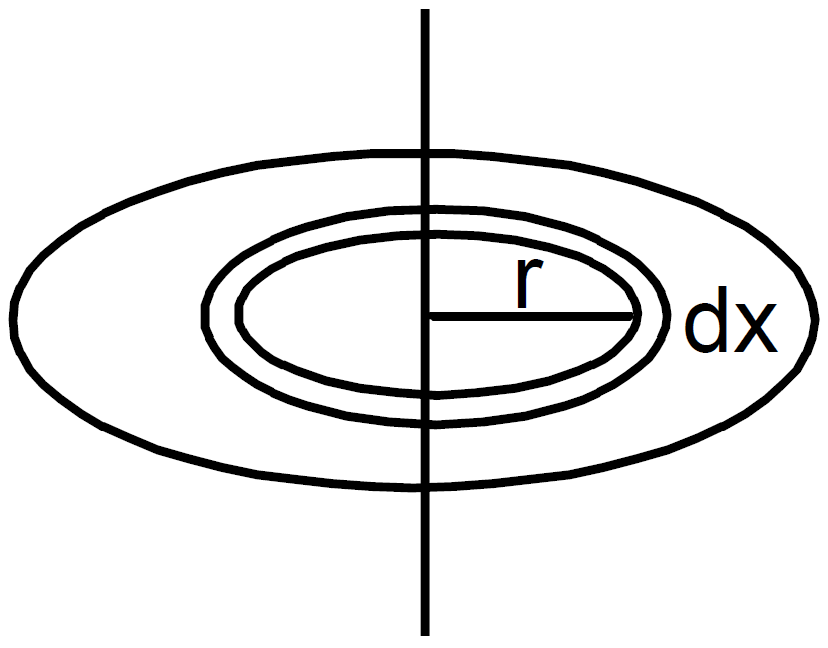 P(r) = A + Br Therefore the mass of the ring of radius r will be$\theta=(\text{A}+\text{Br})\times2\pi\text{r}\text{ dr }\times\text{r}^2$
Therefore moment of inertia about the centre will be$=\int\limits^{\text{a}}_0(\text{A}+\text{Br})2\pi\text{r}\times\text{dr}=\int\limits^{\text{a}}_02\pi\text{Ar}^3\text{dr}+\int\limits^{\text{a}}_02\pi\text{Br}^4\text{dr}$
$=\Big[2\pi\text{A}\Big(\frac{\text{r}^4}{4}\Big)+2\pi\text{B}\Big(\frac{\text{r}^5}{5}\Big)\Big]_0^{\text{a}}$
$=2\pi\text{a}^4\Big[\Big(\frac{\text{A}}{4}\Big)+\Big(\frac{\text{Ba}}{5}\Big)\Big]$ View full question & answer→Question 253 Marks
A rod of mass m and length L, lying horizontally, is free to rotate about a vertical axis through its centre. A horizontal force of constant magnitude F acts on the rod at a distance of $\frac{\text{L}}{4}$ from the centre. The force is always perpendicular to the rod. Find the angle rotated by the rod during the time (t) after the motion starts.
AnswerA rod of mass m and length L, lying horizontally, is free to rotate about a vertical axis passing through its centre. A force F is acting perpendicular to the rod at a distance $\frac{\text{L}}{4}$ from the centre. 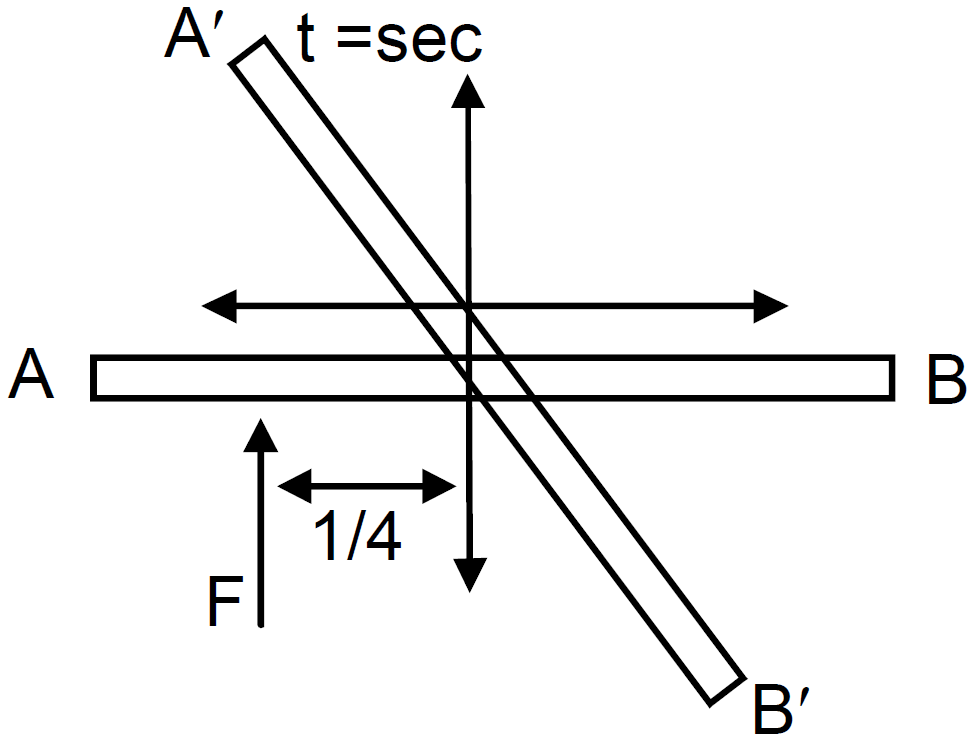 Therefore torque about the centre due to this force$\text{i}_{\text{i}}=\text{F}\times\text{r}=\frac{\text{FL}}4{}$
This torque will produce a angular acceleration $\alpha.$ Therefore $\tau_{\text{c}}=\text{l}_{\text{c}}\times\alpha$$\Rightarrow\text{i}_{\text{c}}=\Big(\frac{\text{mL}^2}{12}\Big)\times\alpha\Big(\text{l}_{\text{c}}\ \text{of a rod}=\frac{\text{mL}^2}{12}\Big)$
$\Rightarrow\frac{\text{F}_{\text{i}}}{4}=\Big(\frac{\text{mL}^2}{12}\Big)\times\alpha$
$\Rightarrow\alpha=\frac{3\text{F}}{\text{ml}}$
Therefore $\theta=\frac{1}{2}\alpha\text{t}^2$ (initially at rest) $\Rightarrow\theta=\frac{1}{2}\times\Big(\frac{\text{3F}}{\text{ml}}\Big)\text{t}^2=\Big(\frac{\text{3F}}{2\text{ml}}\Big)\text{t}^2$ View full question & answer→Question 263 Marks
If several forces act on a particle, the total torque on the particle may be obtained by first finding the resultant force and then taking torque of this resultant. Prove this. Is this result valid for the forces acting on different particles of a body in such a way that their lines of action intersect at a common point?
Answer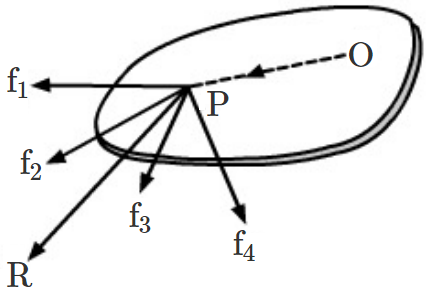 Let $\vec{\text{f}}_1,\ \vec{\text{f}}_2,\ \vec{\text{f}}_3,\ \dots\ \vec{\text{f}}_{\text{n}}$ be the forces acting on a point P. Let O be the point along which torques (moments) will be taken. Let:$\vec{\text{f}}_1+\vec{\text{f}}_2+\vec{\text{f}}_3+\dots+\vec{\text{f}}_{\text{n}}=\vec{\text{R}}\ \dots(1)$
Moments of force (torque) $\vec{\text{f}}_{\text{i}}$ about O will be:$\vec{\text{r}}_1=\overrightarrow{\text{OP}}\times\vec{\text{f}}_1$
The sum of the torques about O will be$\overrightarrow{\text{M}}=\overrightarrow{\text{OP}}\times\vec{\text{f}}_1+\overrightarrow{\text{OP}}\times\vec{\text{f}}_2+\dots+\overrightarrow{\text{OP}}\times\vec{\text{f}}_{\text{n}}$
$\Rightarrow\overrightarrow{\text{M}}=\overrightarrow{\text{OP}}\times\Big(\vec{\text{f}}_1+\vec{\text{f}}_2+\vec{\text{f}}_3+\dots+\vec{\text{f}}_{\text{n}}\Big)$
$\Rightarrow\overrightarrow{\text{M}}=\overrightarrow{\text{OP}}\times\overrightarrow{\text{R}}$ [From (1)]
Thus, we see that the torque of the resultant force $\overrightarrow{\text{R}}$ of the forces $\vec{\text{f}}_1,\ \vec{\text{f}}_2,\ \vec{\text{f}}_3,\ \dots,\ \vec{\text{f}}_{\text{n}}$gives the sum of the moments of the torques. View full question & answer→Question 273 Marks
A uniform rod of mass $300g$ and length $50\ cm$ rotates at a uniform angular speed of $2\text{rad/s}$ about an axis perpendicular to the rod through an end. Calculate:
- The angular momentum of the rod about the axis of rotation.
- The speed of the centre of the rod.
- Its kinetic energy.
AnswerA uniform rod of mass $300$ grams and length $50\ cm$ rotates with an uniform angular velocity $= 2\text{rad/s}$ about an axis perpendicular to the rod through an end.
- $\text{L}=\text{l}\omega$
l at the end $=\frac{\text{mL}^2}{3}=\frac{(0.3\times0.5^2)}{3}=0.025\text{kg-m}^2$
$=0.025\times2$
$=0.05\text{kg-m}^2/\text{s}$
- Speed of the centre of the rod
$\text{V}=\omega\text{r}$
$=\text{w}\times\Big(\frac{50}{2}\Big)=50\text{cm/s}$
$=0.5\text{m/s}$
- Its kinetic energy $=\frac{1}{2}\text{l}\omega^2=\Big(\frac{1}{2}\Big)\times0.025\times2^2=0.05\ \text{Joule}.$
View full question & answer→Question 283 Marks
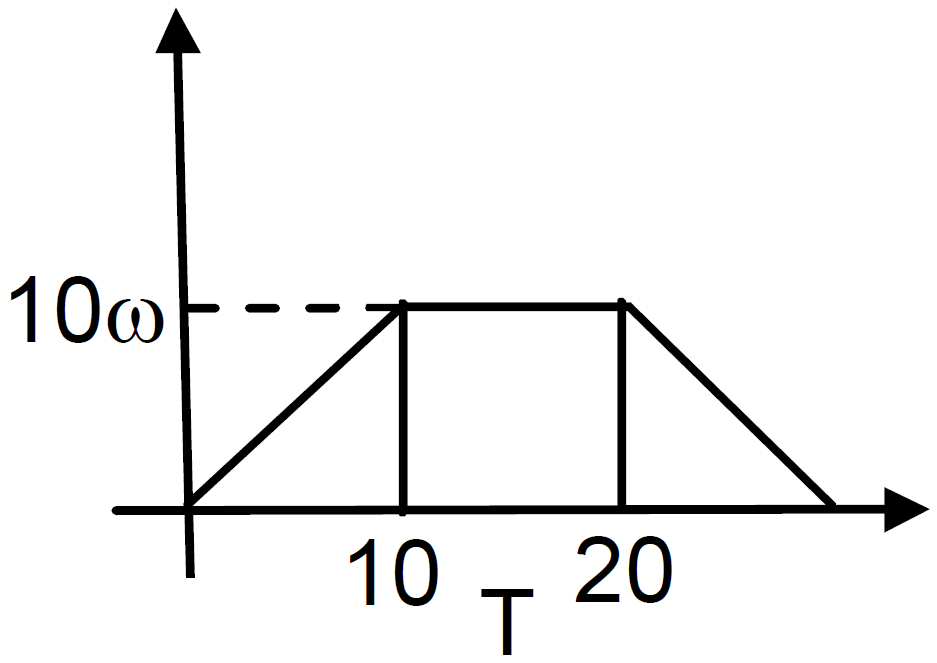
A wheel starting from rest is uniformly accelerated at $4 ~rad/-s^2$ for 10 seconds.It is allowed to rotate uniformly for the next 10 seconds and is finally brought to rest in the next 10 seconds. Find the total angle rotated by the wheel.
AnswerArea under the curve will decide the total angle rotated$\therefore$ Maximum angular velocity = 4 × 10 = 40 rad/-s
Therefore, area under the curve $=\frac{1}2{}\times10\times40+40\times10+\frac{1}{2}\times40\times10$$=800\text{rad}$
$\therefore$ Total angle rotated = 800rad.
View full question & answer→Question 293 Marks
A small spherical ball is released from a point at a height h on a rough track shown in figure. Assuming that it does not slip anywhere, find its linear speed when it rolls on the horizontal part of the track.
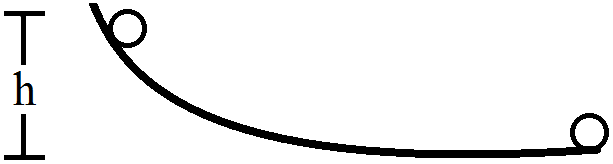
AnswerA small spherical ball is released from a point at a height on a rough track & the sphere does not slip. 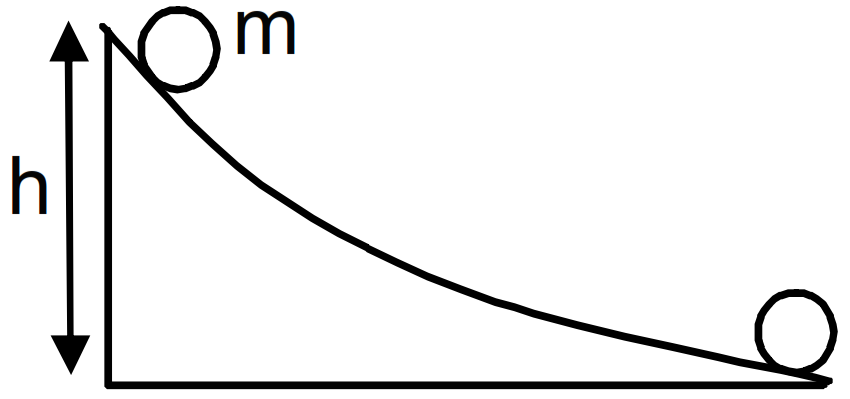 Therefore potential energy it has gained w.r.t the surface will be converted to angular kinetic energy about the centre & linear kinetic energy. Therefore $\text{mgh}=\Big(\frac{1}{2}\Big)\text{l}\omega^2=\Big(\frac{1}{2}\Big)\text{mv}^2$$\Rightarrow\text{mgh}=\frac{1}{2}\times\frac{2}{5} \text{mR}^2\omega^2+\Big(\frac{1}{2}\Big)\text{mv}^2$
$\Rightarrow\text{gh}=\frac{1}{5}\text{v}^2+\frac{1}{2}\text{v}^2$
$\Rightarrow\text{v}^2=\frac{10}{7}\text{gh}$
$\Rightarrow\text{v}=\sqrt{\frac{10}{7}\text{gh}}$ View full question & answer→Question 303 Marks
A metre stick is held vertically with one end on a rough horizontal floor. It is gently allowed to fall on the floor. Assuming that the end at the floor does not slip, find the angular speed of the rod when it hits the floor.
Answer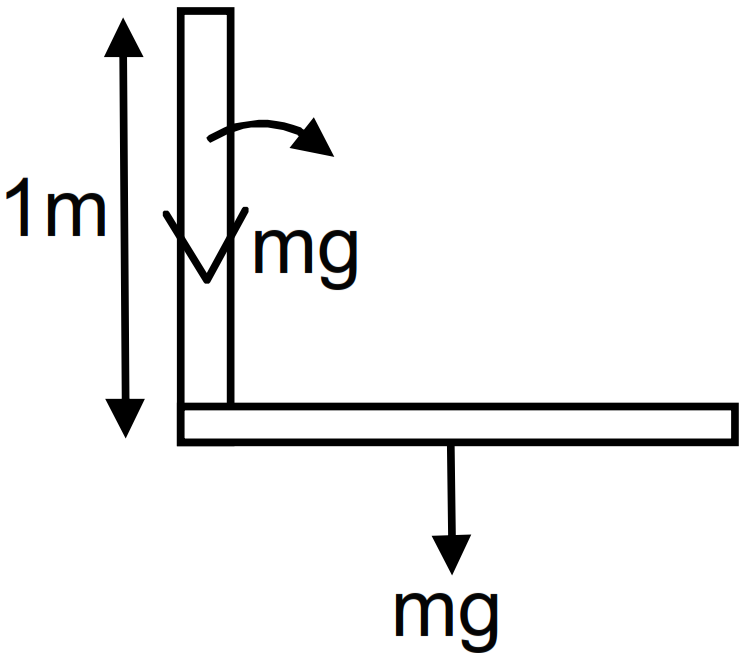 Let the mass of the rod = m Therefore applying laws of conservation of energy$\frac{1}{2}\text{l}\omega^2=\text{mg}\frac{\text{l}}2{}$
$\Rightarrow\frac{1}{2}\times\text{M}\frac{\text{l}^2}{3}\times\omega^2=\text{mg}\frac{1}{2}$
$\Rightarrow\omega^2=\frac{\text{3g}}{\text{l}}$
$\Rightarrow\omega=\sqrt{\frac{\text{3g}}{\text{l}}}=5.42\text{rad/s.}$ View full question & answer→Question 313 Marks
A wheel of moment of inertia $0.500kg-m^2$ and radius 20.0cm is rotating about its axis at an angular speed of 20.0rad/s. It picks up a stationary particle of mass 200g at its edge. Find the new angular speed of the wheel.
Answer
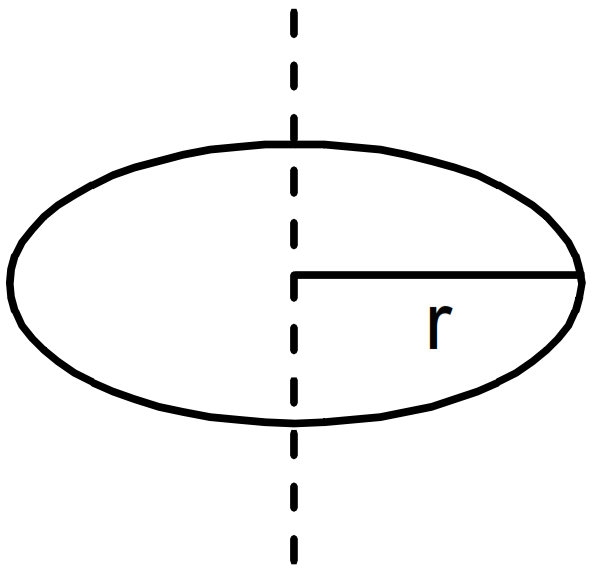
A wheel has
$\text{l}=0.500\text{Kg-m}^2,\ \text{r}=0.2\text{m},\ \omega=20\text{rad/s}$
Stationary particle = 0.2kg
Therefore $\text{l}_1\omega_1=\text{l}_2\omega_2$ (since external torque = 0)
$\Rightarrow0.5\times10=(0.5+0.2\times0.2^2)\omega_2$
$\Rightarrow\frac{10}{0.508}=\omega_2=2\text{rad/s},\ \text{l}_2=5\text{kg-m}^2$ View full question & answer→Question 323 Marks
A wheel of mass 10kg and radius 20cm is rotating at an angular speed of 100rev/min when the motor is turned off. Neglecting the friction at the axle, calculate the force that must be applied tangentially to the wheel to bring it to rest in 10 revolutions.
Answer$\omega=100\text{rev/min}=\frac{5}{8}\text{rev/s}=\frac{10\pi}{3}\text{rad/s}$$\theta=10\text{rev}=20\pi\text{rad},\ \text{r}=0.2\text{m}$
After 10 revolutions the wheel will come to rest by a tangential force.
Therefore the angular deacceleration produced by the force $=\alpha=\frac{\omega^2}{2\theta}$
Therefore the torque by which the wheel will come to an rest $=\text{I}_{\text{cm}}\times\alpha$
$\Rightarrow\text{F}\times\text{r}=\text{I}_{\text{cm}}\times\alpha$
$\Rightarrow\text{F}\times0.2=\frac{1}{2}\text{mr}^2\times\Bigg[\frac{\big(\frac{10\pi}{3}\big)^2}{(2\times20\pi)}\Bigg]$
$\Rightarrow\text{F}=\frac{1}2{}\times10\times0.2\times\frac{100\pi^2}{(9\times2\times20\pi)}$
$=\frac{5\pi}{18}=\frac{15.7}{18}=0.87\text{N}$
View full question & answer→Question 333 Marks
A uniform square plate of mass 2.0kg and edge 10cm rotates about one of its diagonals under the action of a constant torque of 0.10N-m. Calculate the angular momentum and the kinetic energy of the plate at the end of the fifth second after the start.
Answer
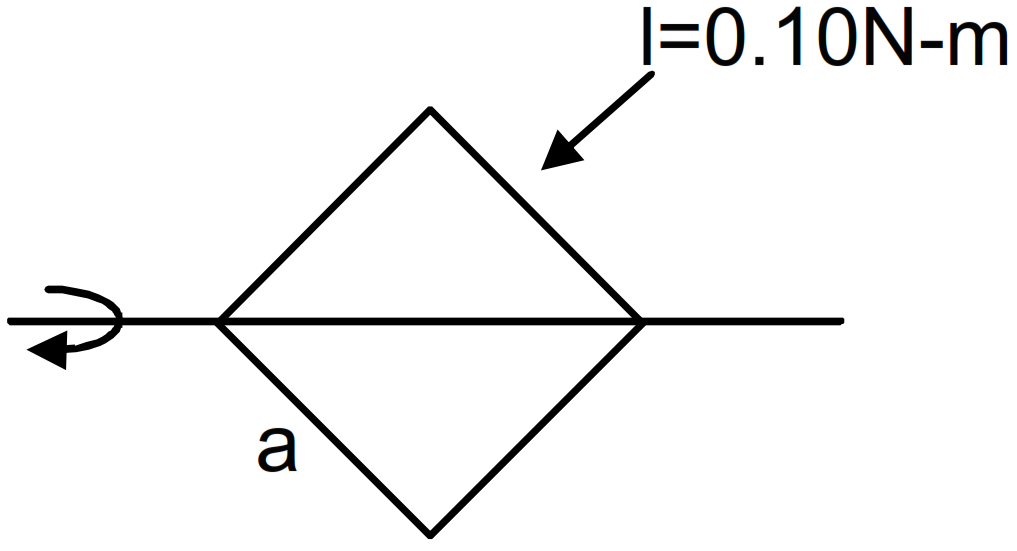 I = 0.10N-m; a = 10cm = 0.1m; m = 2kg
Therefore $\Big(\frac{\text{ma}^2}{12}\Big)\times\alpha=0.10\text{N-m}$
$\Rightarrow\alpha=60\text{rad/s}$
Therefore $\omega=\omega_0+\alpha\text{t}$
$\Rightarrow\omega=60\times5=300\text{rad/s}$
Therefore angular momentum $=\text{l}\omega=\Big(\frac{0.10}{60}\Big)\times300=0.50\text{kg-m}^2/\text{s}$
And 0 kinetic energy $\frac{1}{2}\text{l}\omega^2=\frac{1}{2}\times\Big(\frac{0.10}{60}\Big)\times300^2=75\ \text{Joules}.$ View full question & answer→Question 343 Marks
Two small balls A and B, each of mass m, are joined rigidly by a light horizontal rod of length L. The rod is clamped at the centre in such a way that it can rotate freely about a vertical axis through its centre. The system is rotated with an angular speed w about the axis. A particle P of mass m kept at rest sticks to the ball A as the ball collides with it. Find the new angular speed of the rod.
Answer
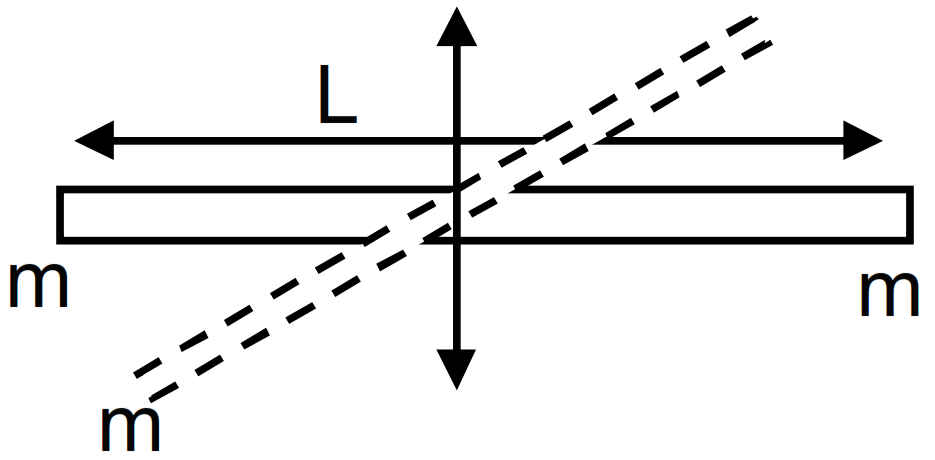 Since external torque = 0
Therefore $\text{l}_1\omega_1=\text{l}_2\omega_2$
$\text{I}_1=\frac{\text{ml}^2}{4}+\frac{\text{ml}^2}{4}=\frac{\text{ml}^2}{2}$
$\omega_1=\omega$
$\text{I}_2=\frac{2\text{ml}^2}{4}+\frac{\text{ml}^2}{4}=\frac{\text{3ml}^2}{4}$
Therefore $\omega_2=\frac{\text{l}_1\omega_1}{\text{l}_2}=\frac{\big(\frac{\text{ml}^2}{2}\big)\times\omega}{\frac{3\text{ml}^2}{4}}=\frac{2\omega}{3}$ View full question & answer→Question 353 Marks
A particle of mass m is projected with a speed u at an angle $\theta$ with the horizontal. Find the torque of the weight of the particle about the point of projection when the particle is at the highest point.
AnswerAt the highest point total force acting on the particle id its weight acting downward. 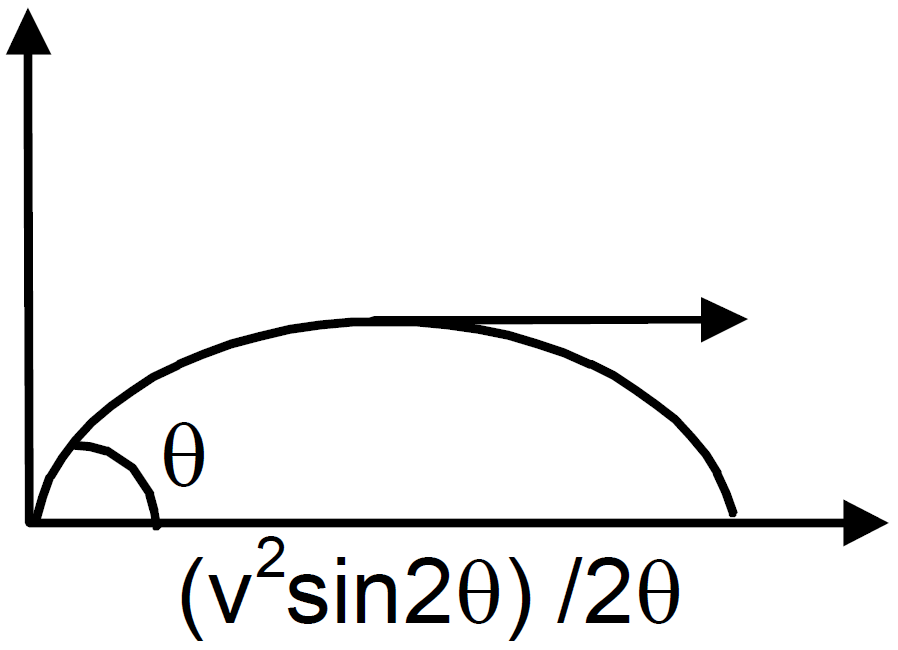 Range of the particle $=\text{u}^2\sin\frac{2\pi}{\text{g}}$ Therefore force is at a $\perp$ distance,$\Rightarrow\frac{\text{Total range}}{2}=\frac{(\text{v}^2\sin2\theta)}{\text{2g}}$
(From the initial point) Therefore $\tau=\text{F}\times\text{r}$ $(\theta=$ angle of projection$)$$=\text{mg}\times\frac{\text{v}^2\sin2\theta}{\text{2g}}$ (v = initial velocity)
$=\frac{\text{mv}^2\sin2\theta}{2}=\text{mv}^2\sin\theta\cos\theta$ View full question & answer→Question 363 Marks
A solid sphere rolling on a rough horizontal surface with a linear speed v collides elastically with a fixed, smooth, vertical wall. Find the speed of the sphere after it has started pure rolling in the backward direction.
Answer
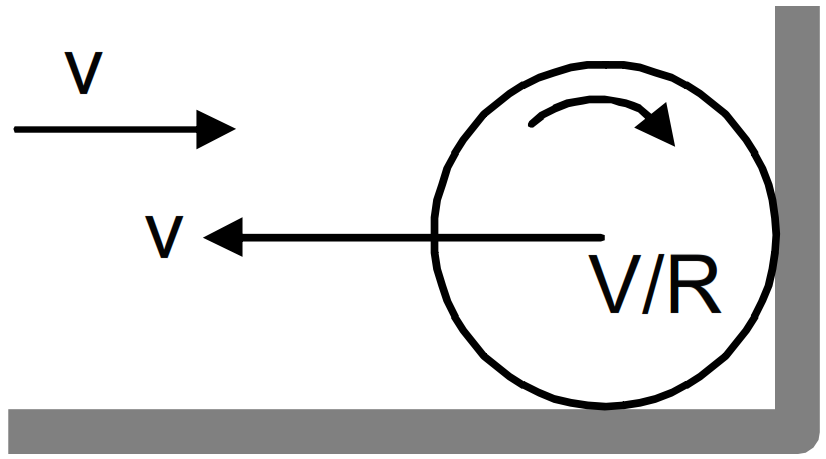 When the solid sphere collides with the wall, it rebounds with velocity ‘v’ towards left but it continues to rotate in the clockwise direction.
So, the angular momentum $=\text{mvR}-\Big(\frac{2}{5}\Big)\text{mR}^2\times\frac{\text{v}}{\text{R}}$
After rebounding, when pure rolling starts let the velocity be v' and the corresponding angular velocity is $\frac{\text{v}'}{\text{R}}$
Therefore angular momentum $=\text{mv}'\text{R}+\Big(\frac{2}{5}\Big)\text{mR}^2\Big(\frac{\text{v}'}{\text{R}}\Big)$
So, $\text{mvR}-\Big(\frac{2}5{}\Big)\text{mR}^2,\ \frac{\text{v}}{\text{R}}=\text{mvR}+\Big(\frac{2}{5}\Big)\text{mR}^2\Big(\frac{\text{v}'}{\text{R}}\Big)$
$\text{mvR}\times\Big(\frac{3}{5}\Big)=\text{mvR}\times\Big(\frac{7}{5}\Big)$
So, the sphere will move with velocity $\frac{\text{3v}}{7}.$ View full question & answer→Question 373 Marks
The pulley shown in figure has a radius of $20cm$ and moment of inertia $0.2kg-m^2$. The string going over it is attached at one end to a vertical spring of spring constant $50N/m$ fixed from below, and supports a $1kg$ mass at the other end. The system is released from rest with the spring at its natural length. Find the speed of the block when it has descended through $10cm$. Take $g = 10m/s^2$.
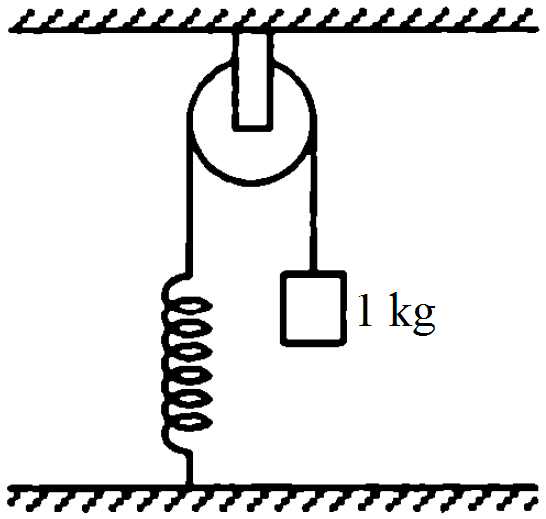
Answer
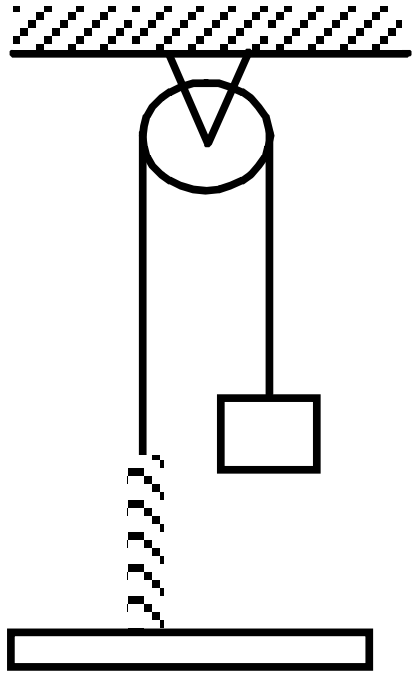
$l = 0.2kg-m^2, r = 0.2m, K = 50N/m,$
$m = 1kg, g = 10ms^2, h = 0.1m$
Therefore applying laws of conservation of energy
$\text{mgh}=\frac{1}{2}\text{mv}^2+\frac{1}{2}\text{kx}^2$
$\Rightarrow1=\frac{1}{2}\times1\times\text{v}^2+\frac{1}{2}\times0.2\times\frac{\text{v}^2}{0.04}\\+\Big(\frac{1}{2}\Big)\times50\times0.01$ $(\text{x}=\text{h})$
$\Rightarrow1=0.5\text{v}^2+2.5\text{v}^2+\frac{1}{4}$
$\Rightarrow\text{3v}^2=\frac{3}{4}$
$\Rightarrow\text{v}=\frac{1}{2}=0.5\text{m/s}.$ View full question & answer→Question 383 Marks
Suppose the platform with the kid in the previous problem is rotating in anticlockwise direction at an angular speed $\omega.$ The kid starts walking along the rim with a speed v relative to the platform also in the anticlockwise direction. Find the new angular speed of the platform.
AnswerFrom a inertial frame of reference when we see the (man wheel) system, we can find that the wheel moving at a speed of $\omega$ and the man with $\Big(\omega+\frac{\text{V}}{\text{R}}\Big)$ after the man has started walking. $(\omega'=$ angular velocity after walking, $\omega=$ angular velocity of the wheel before walking$).$ Since $\sum\text{l}=0$ Extended torque = 0 Therefore, $(1+\text{MR}^2)\omega=\text{l}\omega'+\text{mR}^2\Big(\omega'+\frac{\text{V}}{\text{R}}\Big)$$\Rightarrow(1+\text{MR}^2)\omega=\text{l}\omega'+\text{mR}^2\omega'+\text{mVR}$
$\Rightarrow\omega'=\omega-\frac{\text{mVR}}{(1+\text{mR}^2)}.$
View full question & answer→Question 393 Marks
A body rotating at 20rad/s is acted upon by a constant torque providing it a deceleration of $2rad/s^2$. At what time will the body have kinetic energy same as the initial value if the torque continues to act?
AnswerInitial angular velocity = 20rad/s Therefore $\alpha=2\text{rad/s}^2$$\Rightarrow\text{t}_1=\frac{\omega_2}{\alpha_1}=\frac{20}{2}=10\text{sec}$
Therefore 10sec it will come to rest. Since the same torque is continues to act on the body it will produce same angular acceleration and since the initial kinetic energy = the kinetic energy at a instant. So initial angular velocity = angular velocity at that instant Therefore time require to come to that angular velocity,$\Rightarrow\text{t}_2=\frac{\omega}{\alpha_2}=\frac{20}{2}=10\text{sec}$
therefore time required = $t_1 + t_2 = 20sec$.
View full question & answer→Question 403 Marks
The moment of inertia of a uniform rod of mass $0.50kg$ and length $1m$ is $0.10kg-m^2$ about a line perpendicular to the rod. Find the distance of this line from the middle point of the rod.
AnswerLength of the rod = 1m, mass of the rod = 0.5kg
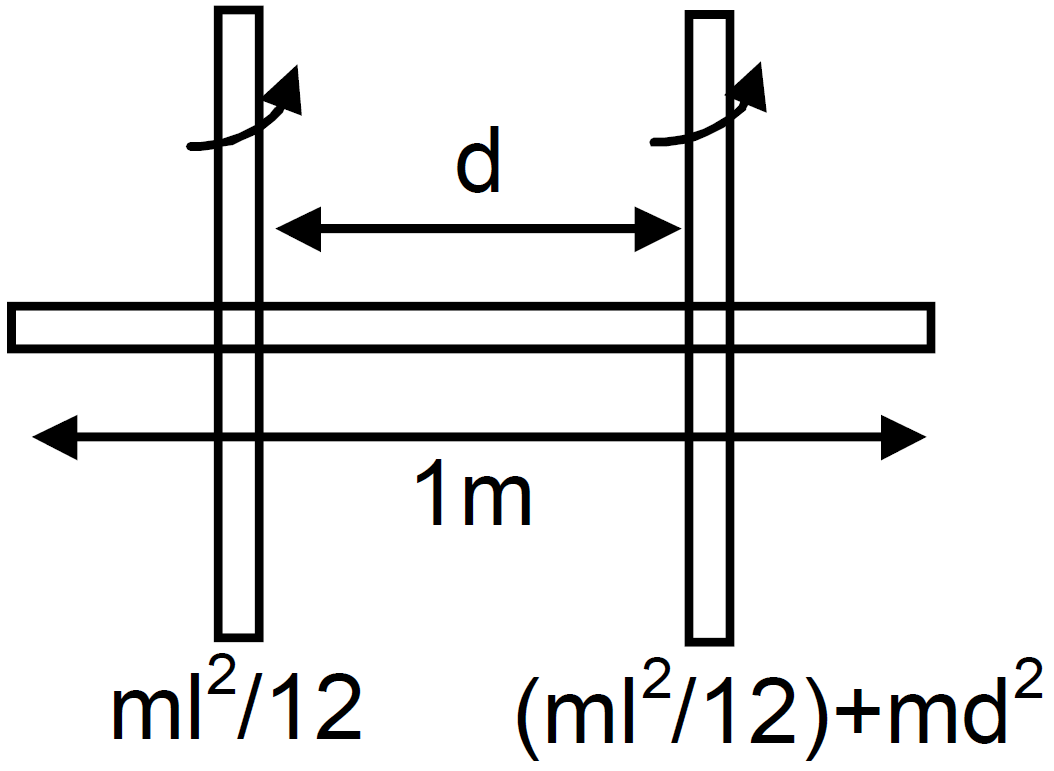
Let at a distance d from the center the rod is moving Applying parallel axis theorem: The moment of inertial about that point$\Rightarrow\Big(\frac{\text{ml}^2}{12}\Big)+\text{md}^2=0.10$
$\Rightarrow\frac{(0.5\times1^2)}{12}+0.5\times\text{d}^2=0.10$
$\Rightarrow\text{d}^2=0.2-0.082=0.118$
⇒ d = 0.342m from the centre. View full question & answer→Question 413 Marks
Find the radius of gyration of a circular ring of radius r about a line perpendicular to the plane of the ring and passing through one of its particles.
AnswerMoment of inertia at the centre and perpendicular to the plane of the ring.
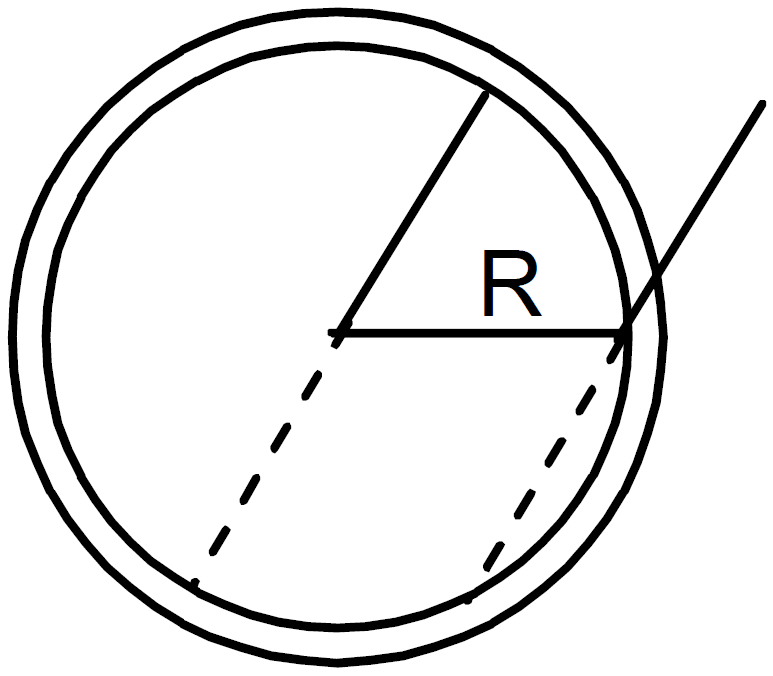
So, about a point on the rim of the ring and the axis $\perp$ to the plane of the ring, the moment of inertia $=m R^2+m R^2$ $=2 m R^2$ (parallel axis theorem $) \Rightarrow m K^2=2 m R^2(K=$ radius of the gyration $) \Rightarrow K=\sqrt{2 R^2}=\sqrt{2} R$ View full question & answer→Question 423 Marks
A block hangs from a string wrapped on a disc of radius 20cm free to rotate about its axis which is fixed in a horizontal position. If the angular speed of the disc is 10rad/s at some instant, with what speed is the block going down at that instant?
AnswerThe Block is moving the rim of the pulley The pulley is moving at a $\omega=10\text{rad/s}$ Therefore the radius of the pulley = 20cm Therefore linear velocity on the rim = tangential velocity $=\text{r}_{\omega}=20\times20=200\text{cm/s}=2\text{m/s}.$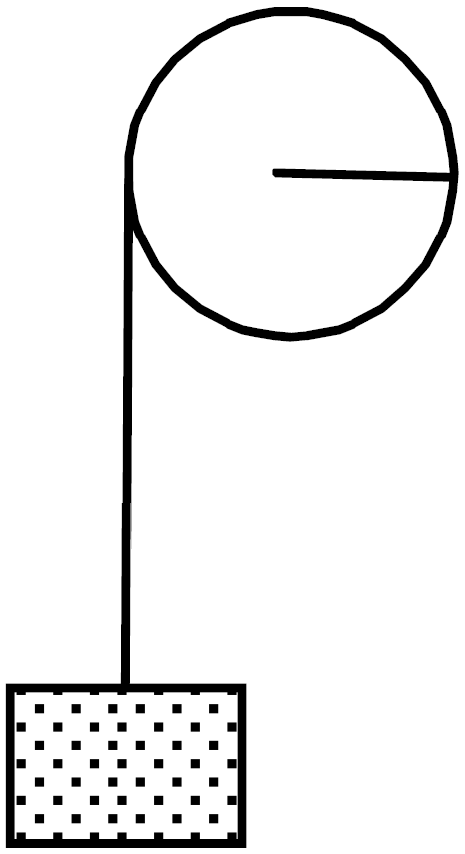
View full question & answer→Question 433 Marks
A diver having a moment of inertia of $6.0 \mathrm{~kg}-\mathrm{m}^2$ about an axis through its centre of mass rotates at an angular speed of $2 \mathrm{rad} / \mathrm{s}$ about this axis. If he folds his hands and feet to decrease the moment of inertia to $5.0 \mathrm{~kg}-\mathrm{m}^2$, what will be the new angular speed?
Answer$\text{l}_1=6\text{Kg-m}^2,\ \omega=2\text{rad/s},\ \text{l}_2=5\text{Kg-m}^2$Since external torque = 0
Therefore $\text{l}_1\omega_1=\text{l}_2\omega_2$
$\Rightarrow\omega_2=\frac{(6\times2)}{5}=2.4\text{rad/s}$
View full question & answer→Question 443 Marks
A light rod of length 1m is pivoted at its centre and two masses of 5kg and 2kg are hung from the ends as shown in figure. Find the initial angular acceleration of the rod assuming that it was horizontal in the beginning.
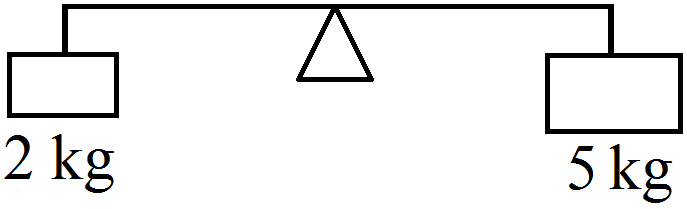
Answer
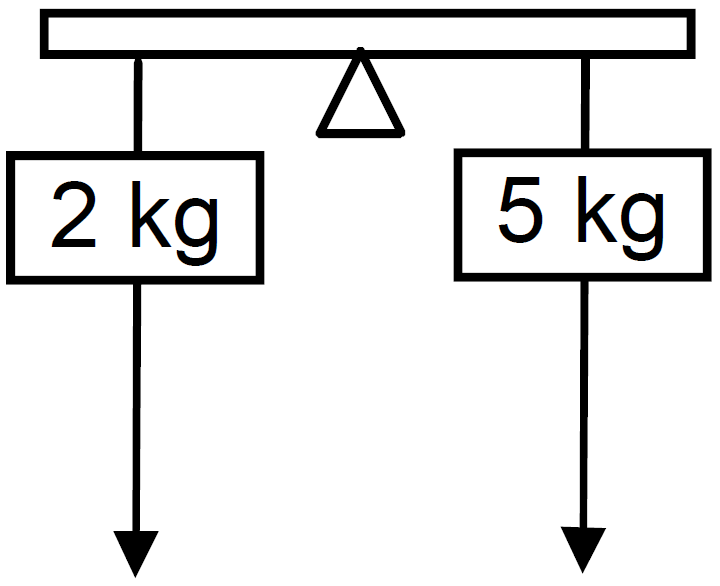 $\text{I}_{\text{net}}=\text{I}_{\text{net}}\times\alpha$
$\Rightarrow\text{F}_1\text{r}_1-\text{F}_2\text{r}_2=\big(\text{m}_1\text{r}_1^2+\text{m}_2\text{r}_2^2\big)\times\alpha-2\times10\times0.5$
$\Rightarrow5\times10\times0.5=\Big(5\times\Big(\frac{1}{2}\Big)^2+2\times\Big(\frac{1}2{}\Big)^2\Big)\times\alpha$
$\Rightarrow15=\frac{7}{4}\alpha$
$\Rightarrow\alpha=\frac{60}{7}=8.57\text{rad/s}^2$ View full question & answer→Question 453 Marks
A hollow sphere of radius R lies on a smooth horizontal surface. It is pulled by a horizontal force acting tangentially from the highest point. Find the distance travelled by the sphere during the time it makes one full rotation.
Answer
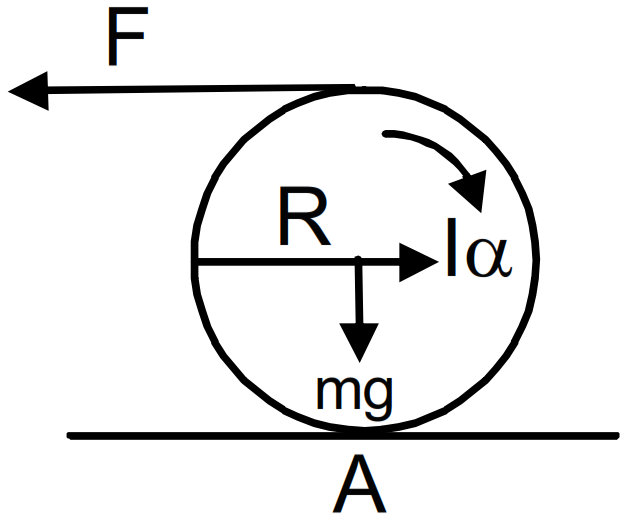 Taking moment about the centre of hollow sphere we will get
$\text{F}\times\text{R}=\frac{2}{3}\text{MR}^2\alpha$
$\Rightarrow\alpha=\frac{3\text{F}}{2\text{MR}}$
Again, $2\pi=\Big(\frac{1}{2}\Big)\alpha\text{t}^2$ $\Big(\text{From}\ \theta=\omega_0\text{t}+\Big(\frac{1}{2}\Big)\alpha\text{t}^2\Big)$
$\Rightarrow\text{t}^2=\frac{8\pi\text{MR}}{\text{3F}}$
$\Rightarrow\text{a}_{\text{c}}=\frac{\text{F}}{\text{m}}$
$\Rightarrow\text{X}=\Big(\frac{1}{2}\Big)\text{a}_{\text{c}}\text{t}^2=\Big(\frac{1}{2}\Big)=\frac{4\pi\text{R}}{3}$ View full question & answer→