Questions

5 Marks Questions

🎯

Test yourself on this topic

20 questions · timed · auto-graded

Question 15 Marks
Construct a square in which each diagonal is $5\ cm$ long.
Answer
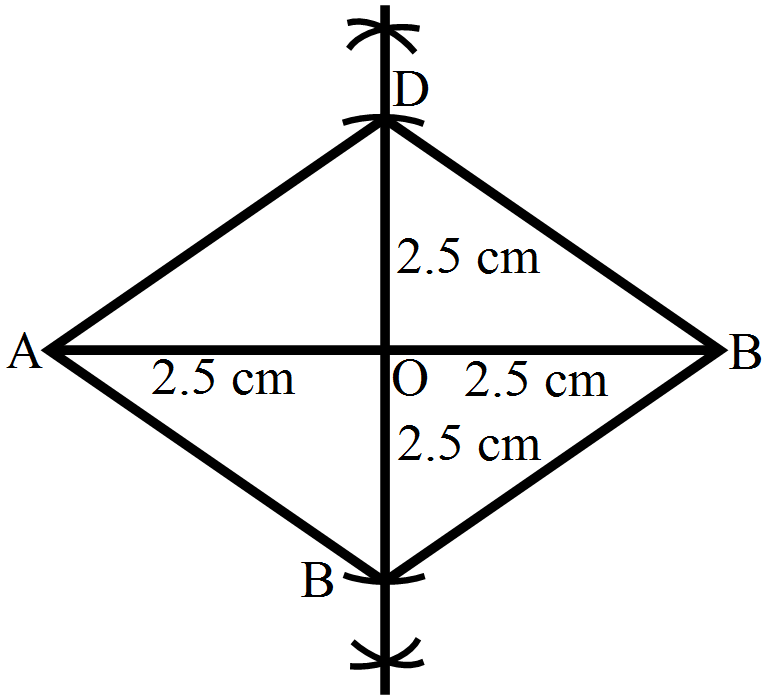
Steps of Construction:
$1.$ Draw $\text{AC} = 5\ cm$
$2.$ With $A$ as centre, draw arc length slightly greater than $\frac{1}{2}$ $\text{AC}$ above $\&$ below the line segment $\text{AC}$.
$3.$ With $C$ as centre, draw an arc of same length as in step $2$ above $\&$ below the line segment $\text{AC}$ which intersect the arcs drawn in Step $2$.
$4.$ Join both the intersection points obtained in step $3$ by a line segment which intersects $\text{AC}$ at $O$.
$5.$ With $O$ as centre cut off $\text{OB = OD} = 2.5\ cm$ along the bisector line.
$6.$ Join $\text{AD, CD, AB}$ and $\text{CB}$.

Hence, this is the required square.
View full question & answer
Question 25 Marks
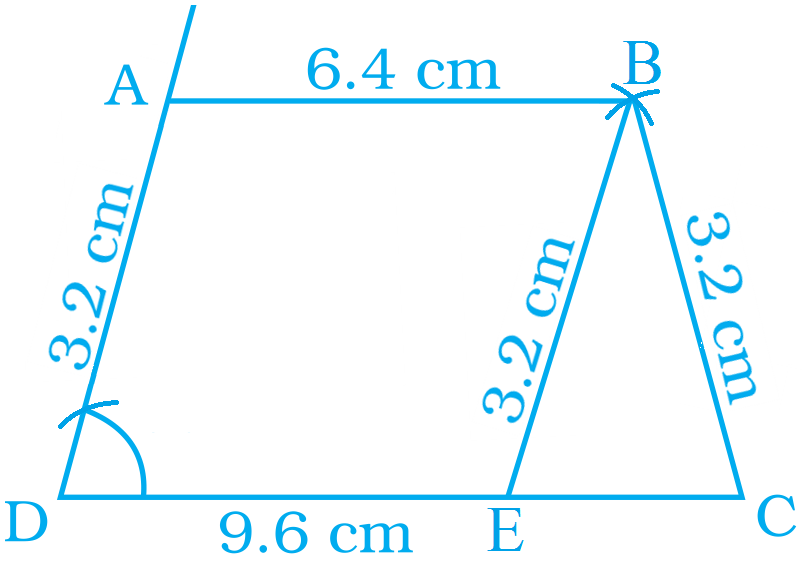
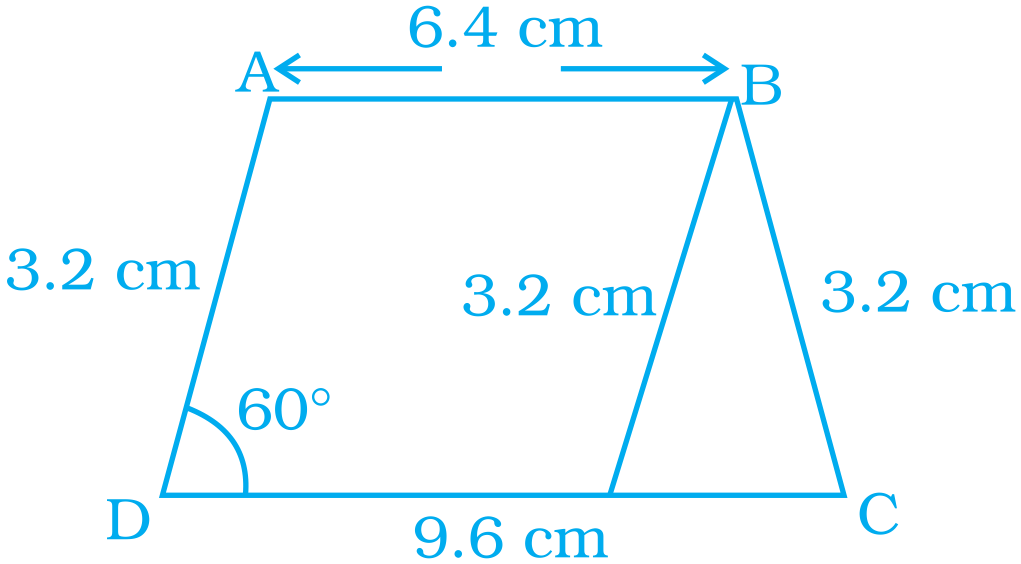
Construct a trapezium $\text{ABCD}$ where $\ce{AB \| CD, AD = BC = 3.2\ cm, AB = 6.4\ cm}$ and $\ce{CD = 9.6\ cm}$.
Measure $\angle\text{B}\ \text{and}\ \angle\text{A}.$

$[$Hint: Difference of two parallel sides gives an equilateral triangle.$]$
Answer

Steps of construction:
$1.$ Draw a line segment $\text{DC} = 9.6\ cm$.
$2.$ With $D$ as centre, draw an angle measure $60^\circ$.
Now, cut$-$off it with an arc $3.2\ cm$ called point $A$.
$3.$ Now draw a parallel $\text{AB}$ to $\text{CD}$.
$4.$ Taking $C$ as centre, cut an arc $B$ measure $3.2\ cm$ on previous parallel line.
$5.$ Draw a line segment $\text{BE} = 3.2\ cm$ from arc $B$.
$6.$ Join $B$ to $E$ and $C$.
Thus, we have required trapezium $\text{ABCD}$ in which $\angle\text{A}=120^\circ$ and $\angle\text{B}=60^\circ.$
View full question & answer
Question 35 Marks
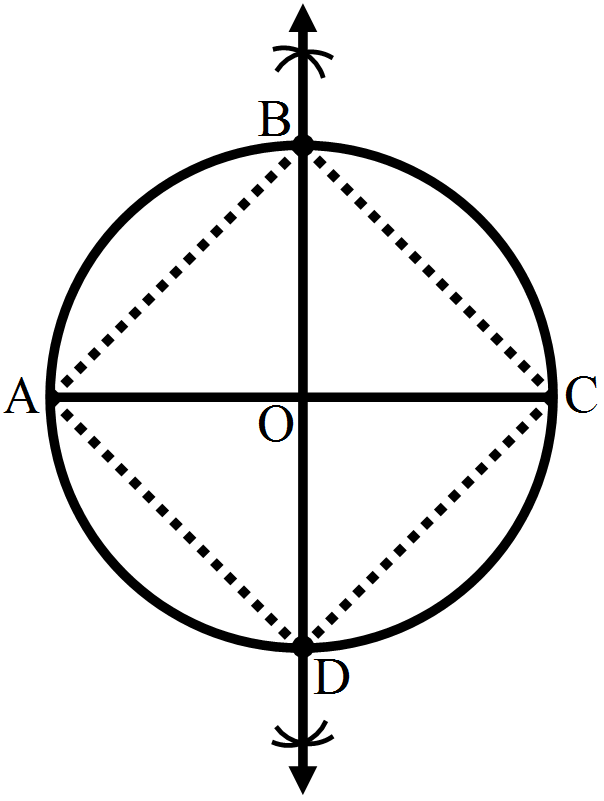
Draw a circle of radius $3\ cm$ and draw its diameter and label it as $\text{AC}$. Construct its perpendicular bisector and let it intersect the circle at $B$ and $D$. What type of quadrilateral is $\text{ABCD}$? Justify your answer.
Answer
Steps of Construction:
$1.$ Taking centre $\text{OC} = 3\ cm$, draw a circle.
$2.$ Join $A$ to $C$ and draw a perpendicular bisector of $\text{AC}$ that cuts the circumference of circle at $B$ and $D$.
$3.$ Join $B$ and $D$ .
$4.$ Thus, $\text{ABCD}$ is a cyclic quadrilateral.

Justification:
In cyclic quadrilateral,
$\angle\text{B}=\angle\text{D}=90^\circ$
$\angle\text{A}=\angle\text{C}=90^\circ [$sum of co$-$interior angles$]$
$\angle\text{D}=\angle\text{B}=180^\circ$
and $\angle\text{A}=\angle\text{C}=180^\circ$
Since, opposite angles are supplementary, thus quadrilateral is a cyclic quadrilateral.
View full question & answer
Question 45 Marks
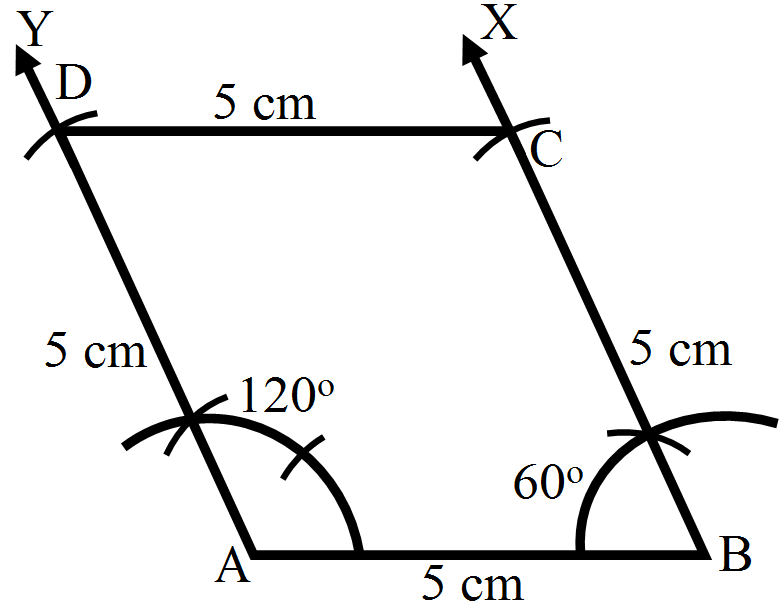
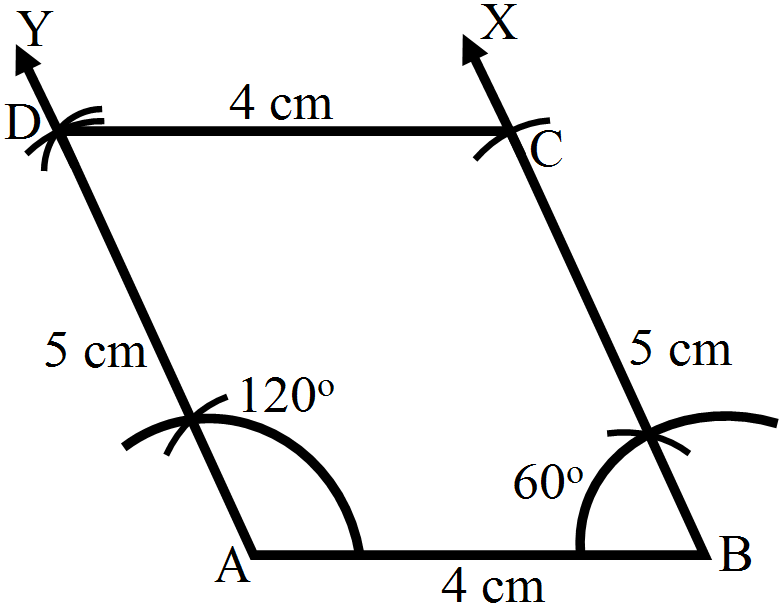
Construct a rhombus whose side is $5\ cm$ and one angle is of $60^\circ $.
Answer
$\angle\text{B}=60^\circ$
$\angle\text{A}+\angle\text{B}=180^\circ [$sum of co$-$interior angles$]$
$\angle\text{A}=60^\circ=180^\circ$
$\angle\text{A}=120^\circ$
$\text{AB = BC = CD = DA} = 5\ cm$

Steps of Construction:
$1.$ Draw $\text{AB} = 5\ cm$
$2.$ Draw a ray $\text{AY}$ such that $\angle\text{BAY}=120^\circ$
$3.$ Mark a point $D$ such that $\text{AD} = 5\ cm$
$4.$ Draw a ray $\text{BX}$ such that $\angle\text{ABX}=60^\circ$
$5.$ Mark a point $C$ such that $\text{BC} = 5\ cm$
$6.$ Join $C$ and $D$.
Hence, $\text{ABCD}$ is the required rhombus.
View full question & answer
Question 55 Marks
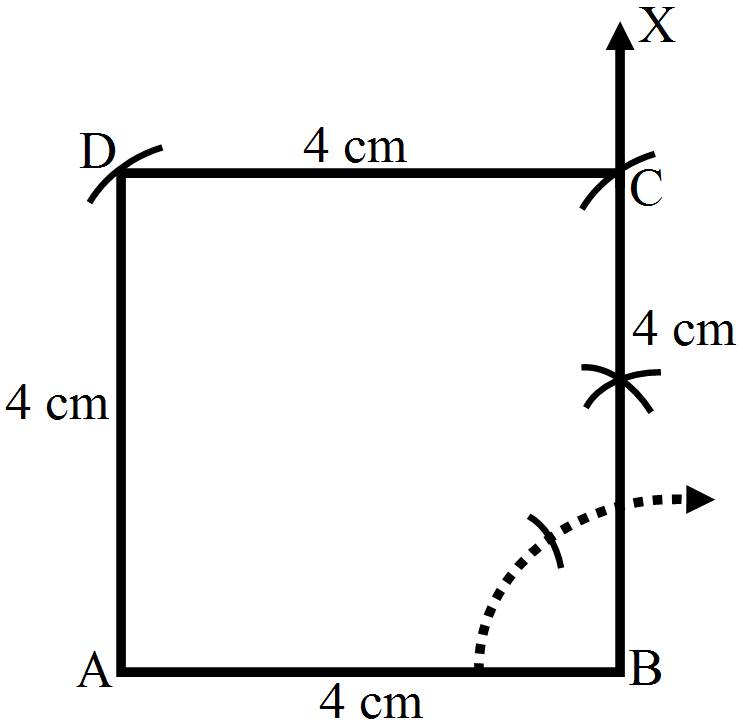
Construct a square of side $4\ cm$.
Answer
All sides of a square are equal $\&$ each side is perpendicular to adjacent side.
So, $\text{AB = BC = CD = DA} = 4\ cm$

Steps of Construction:
$1.$ Draw $\text{AB} = 3\ cm$
$2.$ At $B$ draw $\text{BX}$ such that $\angle\text{ABX}=90^\circ$
$3.$ From $\text{BX}$, cut off $\text{BC} = 4\ cm$
$4.$ With $C$ as centre $\&$ radius $= 4\ cm$, draw an arc
$5.$ With $A$ as centre $\&$ radius $= 4\ cm$, draw another arc to intersect the previous arc at $D$.
$6.$ Join $\text{CD}$ and $\text{AD}$.
Hence, $\text{ABCD}$ is the required square.
View full question & answer
Question 65 Marks
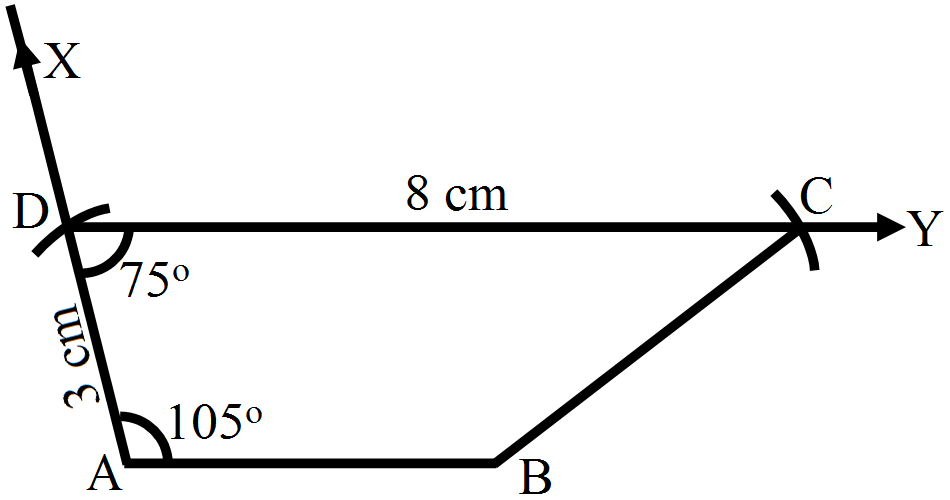
Construct a trapezium $\text{ABCD}$ in which $\ce{AB\|DC}, \angle\text{A}=105^\circ,AD = 3\ cm, AB = 4\ cm$ and $CD = 8\ cm$.
Answer
$\angle\text{A}+\angle\text{D}=180^\circ$ $+150^\circ\angle\text{D}=180^\circ$ $\angle\text{D}=75^\circ$
Steps of Construction:
$1.$ Draw $\text{AB} = 4\ cm$
$2.$ Draw $\overline{\text{AX}}$ such that $\angle\text{BAX}=105^\circ$
$3.$ Mark a point $D$ on $\text{AX}$ such that $\text{AD} = 3\ cm$
$4.$ Draw $\overline{\text{DY}}$ such that $\angle\text{ADY}=75^\circ$
$5.$ Mark a point $C$ such that $\text{CD} = 8\ cm$
$6.$ Join $\text{BC}$.
Hence, $\text{ABCD}$ is the required trapezium.
View full question & answer
Question 75 Marks
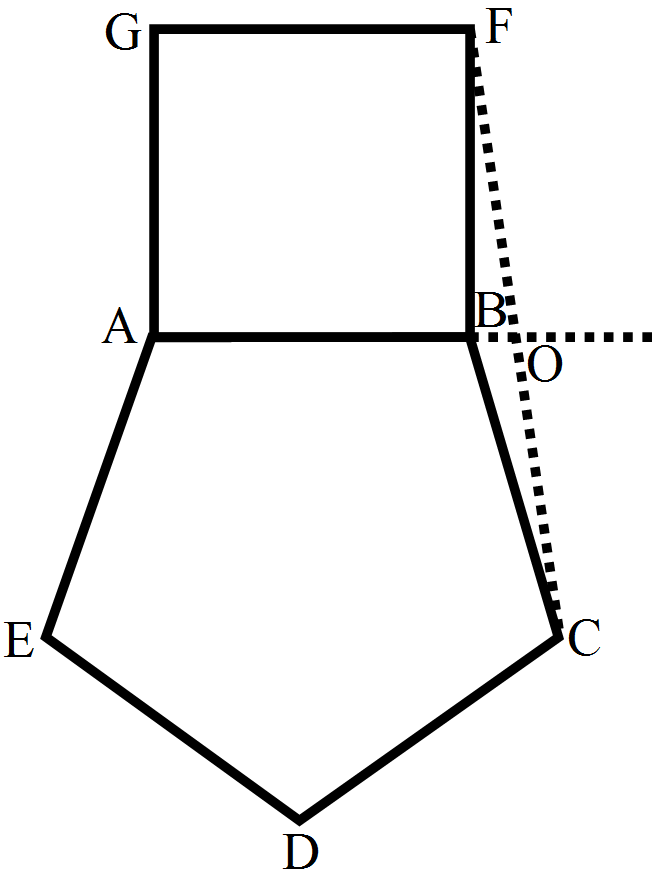
A regular pentagon $ABCDE$ and a square $ABFG$ are formed on opposite sides of $AB$. Find $\angle\text{BCF}.$
Answer
Given, $ABCDE$ is a regular pentagon.
Then, measure of each interior angle of the regular pentagon = Sum of interior angles/ Number of sides $=\frac{(\text{x}-2)\times180^\circ}{5}$
$=\frac{(5-2)\times180^\circ}{5}=\frac{540^\circ}{5}=180^\circ$
$\therefore\angle\text{CBA}=180^\circ$
Join $CF$ Now,
$\angle\text{FBC}$ $​​​​​=360^\circ − (90^\circ + 108^\circ) = 360^\circ − 198^\circ = 162^\circ$ In
$\triangle\text{FBC}$, by the angle sim property,
we have $\angle\text{FBC}+\angle\text{BCF}+\angle\text{BFC}180^\circ$
$\Rightarrow\angle\text{BCF}+\angle\text{BFC}=180^\circ-162^\circ$
$\Rightarrow\angle\text{BCF}+\angle\text{BFC}=18^\circ$
 Since, $\triangle\text{FBC}$ is an isosceles triangle and $BF = BC.$
$\therefore\triangle\text{FBC}=\angle\text{BFC}=90^\circ$
 
View full question & answer
Question 85 Marks
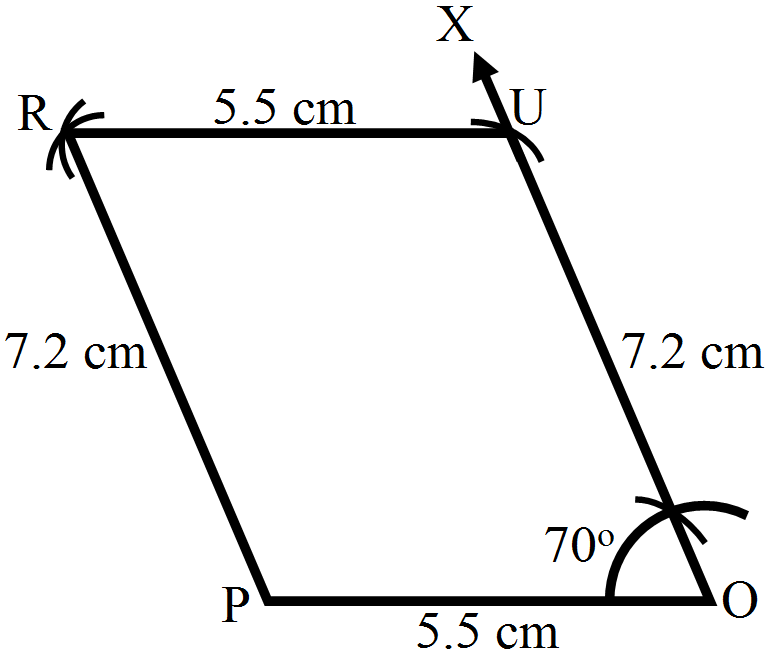
Construct a parallelogram $\text{POUR}$ in which, $\text{PO}=5.5\ cm, \text{OU} = 7.2\ cm$ and $\angle\text{O}=70^\circ.$
Answer
Since, opposite sides of a parallelogram are equal.
$\therefore$ $\text{PO = RU} = 5.5\ cm, \text{OU = RP} = 7.2\ cm.$

Steps of Construction:
$1.$ Draw $\text{PO} = 5.5\ cm$.
$2.$ Construct $\angle\text{POX}=70^\circ.$
$3.$ With $O$ as centre $\&$ radius $\text{OU} = 7.2\ cm$, draw an arc.
$4.$ With centre $U\ \&$ radius $\text{UR} = 5.5\ cm$, draw an arc
$5.$ With $P$ as centre $\&$ radius $\text{PR} = 7.2\ cm$, draw an arc to cut the arc drawn in Step $4$.
$6.$ Now, Join $\text{PR}$ and $\text{UR}$.
Hence, $\text{POUR}$ is the required parallelogram.
View full question & answer
Question 95 Marks
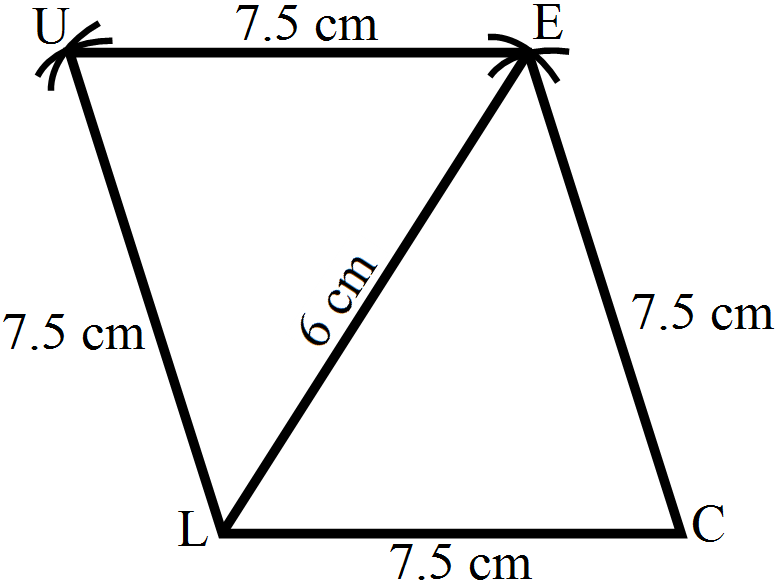
Construct a rhombus $\text{CLUE}$ in which $\text{CL} = 7.5\ cm$ and $\text{LE} = 6\ cm$.
Answer
All sides of a rhombus are equal $\&$ parallel to each other.

Steps of Construction:
$1.$ Draw a line segment $\text{CL} = 7.5\ cm$.
$2.$ With $C$ as centre, draw an arc $\text{CE} = 7.5\ cm$.
$3.$ With $L$ as centre, draw another arc $\text{LU} = 7.5\ cm$.
$4.$  Now with centre $L$, draw an arc $\text{LE} = 6\ cm$, which cut$-$off previous arc $\text{CE}$.
$5.$ With $E$ as centre, draw an arc $\text{UE} = 7.5\ cm,$ which cut$-$off previous arc $\text{LU}$.
$6.$ Now, Join $\text{UL, CE}$ and $\text{EU}$.
Thus, we have required rhombus $\text{CLUE}$.
View full question & answer
Question 105 Marks
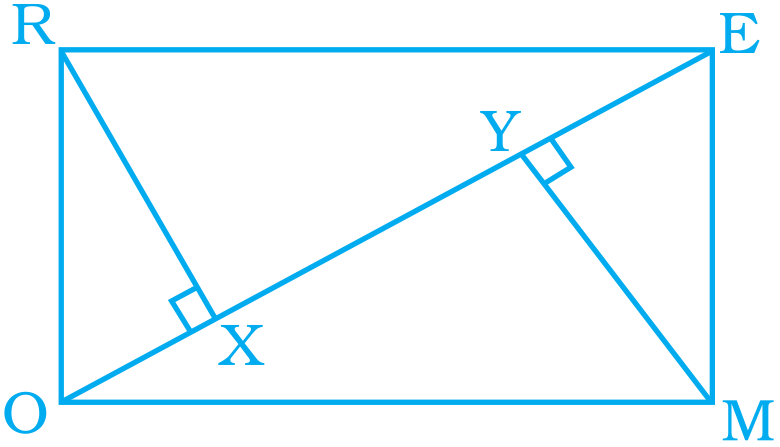
A rectangular $\text{MORE}$ is shown below:

Answer the following questions by giving appropriate reason.
$i. \text{Is}\ \text{RE}=\text{OM}$
$ii. \text{Is}\ \angle\text{MYO}=\angle\text{RXE}?$
$iii. \text{Is}\ \angle\text{MOY}=\angle\text{RXE}?$
$iv. \text{Is}\ \triangle\text{MYO}\cong\triangle\text{RXE}?$
$v. \text{Is}\ \angle\text{MY}=\angle\text{RX}?$
Answer
$i.$ Yes, $\text{RE = OM}$
Given, $\text{MORE}$ is a rectangle. Therefore, opposite sides are equal.
$ii.$ Yes $\angle\text{MYO}=\text{RXE}$
here, $\text{MY}$ and $\text{RX}$ are perpendicular to $OE$.
Since, $\angle\text{RXO}=90^\circ\angle\text{RXE}=90^\circ\ \text{and}\ \angle\text{MYO}=90^\circ$
$iii.$ Yes, $\angle\text{MOY}=\angle\text{REX}$
$\ce{RE\|OM}$ and $\text{EO}$ is a transversal
$\angle\text{MOE}=\angle\text{OER}$
$iv. \angle\text{MOY}=\angle\text{REX}$
Yes, $\triangle\text{MOY}\cong\triangle\text{RXE}$
In $\triangle\text{MYO}\ \text{and}\ \triangle\text{RXE}$
$\text{MO = RE}$
$\angle\text{MOY}=\angle\text{REX}$
$\angle\text{MYO}=\angle\text{RXE}$
$\therefore\triangle\text{MOY}\cong\triangle\text{RXE}$
$v.$ Yes, $\text{MY = RX}$
since, these are corresponding parts of congruent triangles.
View full question & answer
Question 115 Marks
Construct a parallelogram $\text{ABCD}$ in which $\text{AB} = 4\ cm, \text{BC} = 5\ cm$ and $\angle\text{B}=60^\circ.$
Answer
The opposite sides of a parallelogram are equal.
So, $\text{AB = DC} = 4\ cm$
$\text{BC = AD} = 5\ cm$
$\angle\text{A}+\angle\text{B}=180^\circ [$sum of co$-$interior angles$]$
$\angle\text{A}=120^\circ$

Steps of Construction:
$1.$ Draw $\text{AB} = 4\ cm$
$2.$ Draw $\text{BX}$ such that $\angle\text{ABX}=60^\circ$
$3.$ Mark a point $C$ such that $\text{BC} = 5\ cm$
$4.$ Draw a ray $\text{AY}$ such that $\angle\text{YAB}=120^\circ$
$5.$ Mark a point $D$ such that $\text{AD} = 5\ cm$
$6.$ Join $C$ and $D$.
Hence, $\text{ABCD}$ is the required parallelogram.
View full question & answer
Question 125 Marks
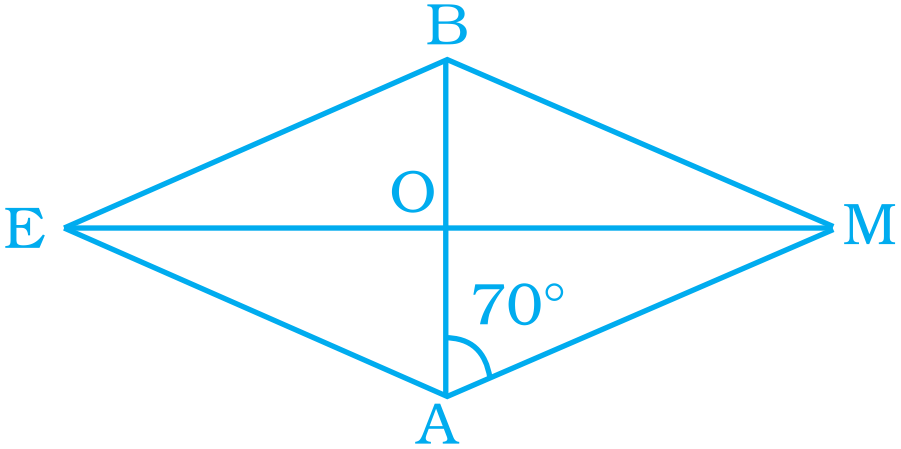
In rhombus $BEAM$, find $\angle\text{AME}\ \text{and}\angle\text{AEM}.$
Answer
Given, $\angle\text{BAM}=60^\circ$
We know that, in rhombus, diagonals bisect each other at right angles. $\angle\text{BOM}=\angle\text{BOE}=\angle\text{AOM}=\angle\text{AOE}=90^\circ$
Now, in $\triangle\text{AOM},$ $\angle\text{AOM}+\angle\text{AMO}+\angle\text{OAM}=180^\circ$ [angle sum property of triangle] $\Rightarrow\ 90^\circ+\angle\text{AMO}+70^\circ=180^\circ$
$\Rightarrow\angle\text{AMO}=180^\circ-90^\circ-70^\circ$
$\Rightarrow\angle\text{AME}=20^\circ$
Also, $\Rightarrow\text{AM}=\text{BM}=\text{EA}=\text{EA}$ In $\triangle\text{AME}$, we have $\text{AM}=\text{EA}$
$\therefore\angle\text{AME}=\angle\text{AEM}=20^\circ$ [equal sides make equal angles]
View full question & answer
Question 135 Marks
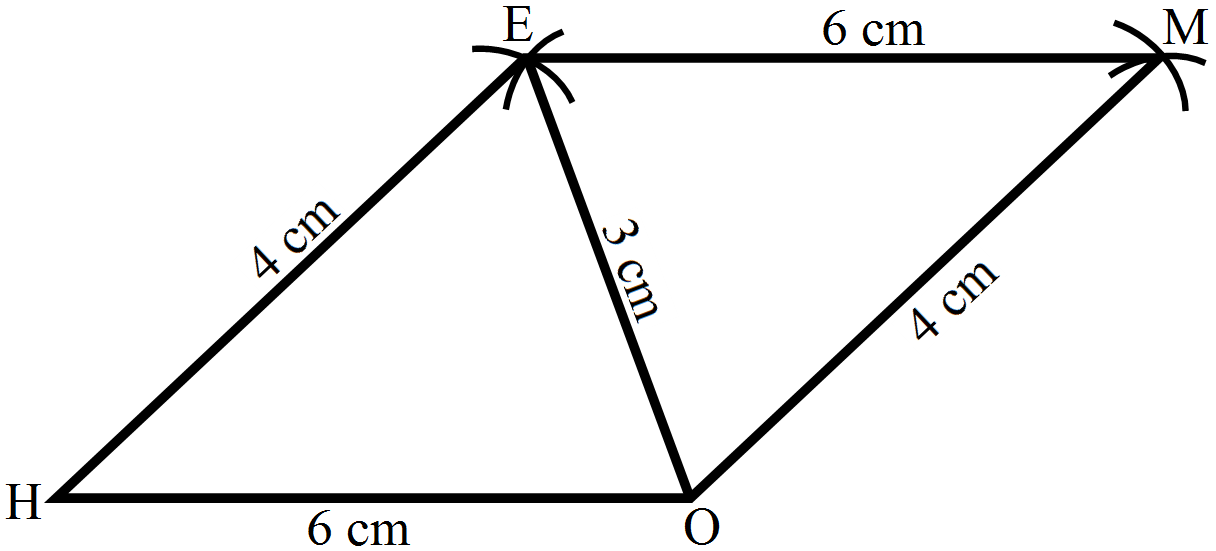
Construct a parallelogram $\text{HOME}$ with $\text{HO} = 6\ cm, \text{HE} = 4\ cm$ and $\text{OE} = 3\ cm$.
Answer

Steps of Construction:
$1.$ Draw $\text{HO} = 6\ cm$
$2.$ With $H$ as centre $\&$ radius $\text{HE} = 4\ cm$ draw an arc.
$3.$ With $O$ as centre $\&$ radius $\text{OE} = 3\ cm$, draw an arc, intersecting the arc drawn in Step $2$ at $E$.
$4.$ With $E$ as centre $\&$ radius $\text{EM} = 6\ cm$, draw an arc opposite to the side $\text{HE}$.
$5.$ With $O$ as centre $\&$ radius $\text{OM} = 4\ cm$, draw an arc, intersecting the arc drawn in in step $4$ at $M$ .
$6.$ Join $\text{HE, OE, EM}$ and $\text{OM}$.
Hence, $\text{HOME}$ is the required parallelogram.
View full question & answer
Question 145 Marks
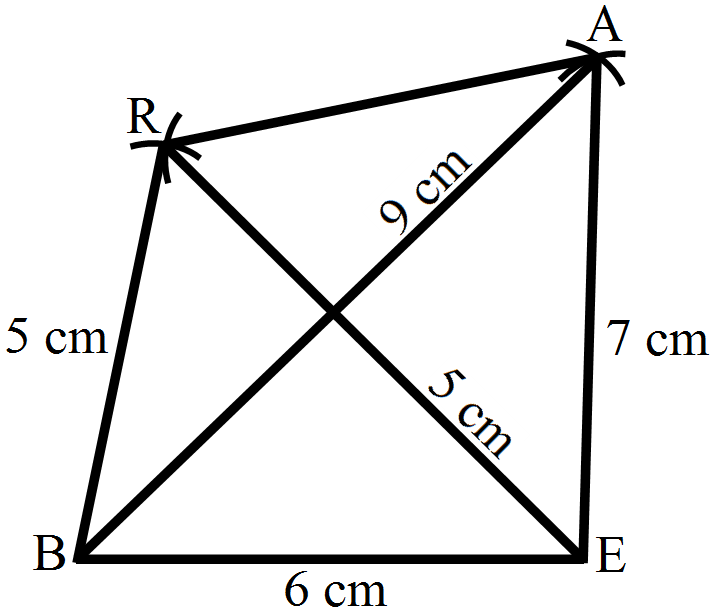
Construct a quadrilateral $\text{BEAR}$ in which $\text{BE} = 6\ cm, \text{EA} = 7\ cm, \text{RB = RE} = 5\ cm$ and $\text{BA} = 9\ cm$. Measure its fourth side.
Answer

Steps of Construction:
$1.$ Draw a line segment $\text{BE} = 6\ cm$
$2.$ With B as centre, draw an arc $\text{BR} = 5\ cm$ and with $E$ as centre , draw an arc $\text{EA} = 7\ cm$.
$3.$ Now, draw an another arc $\text{BA} = 9\ cm$ with $B$ as a centre which cut$-$off arc $\text{AE}$.
$4.$ Draw an another arc $\text{ER} = 5\ cm$ with $E$ as centre, which cut$-$off arc $\text{BR}$.
$5.$ Now join $\text{BR, EA}$ and $\text{AR}$.
Thus, we have required quadrilateral $\text{BEAR}$. Also, $\text{AR} = 5\ cm$.
View full question & answer
Question 155 Marks
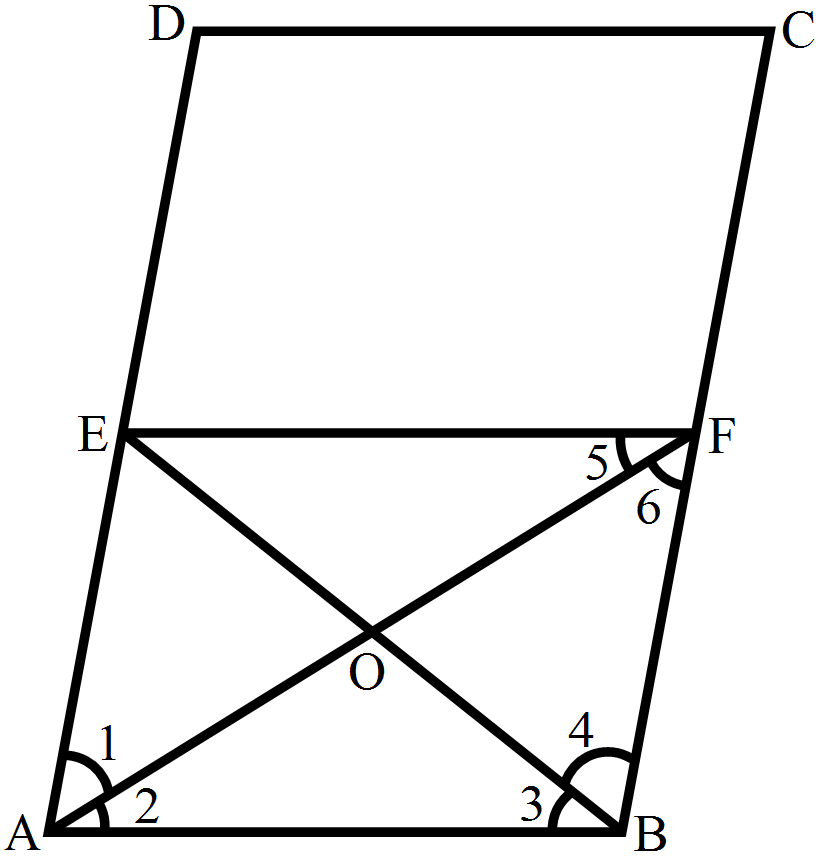
In parallelogram $ABCD$, the angle bisector of $\angle\text{A}$ bisects $BC$. Will angle bisector of $B$ also bisect $AD$? Give reason.
Answer
Given, $ABCD$ is a parallelogram, bisector of $\angle\text{A}$, bisects $BC$ at F i.e., $\angle\text{1}=\angle2,\text{CF}=\text{FB}$ Draw $FB\ ||\ BA$
$\therefore\text{ABFE}$ is a parallelogram by construction
$\angle1=\angle6$
But $\angle1=\angle2$ [given]
$\therefore\angle2=\angle6$
$AB = FB$ [opposite sides to equal angles are equal] $…(i)$
$\therefore\text{ABFE}$ is a rhombus.
Now, in $\triangle\text{ABO}\ \text{and}\ \text{BOF},\text{AB}=\text{FB}$ [from eq. $(i)$]
$BO = BO$ [common] $AO = FO$ [diagonals of rhombus bisect each other]
$\therefore\triangle\text{ABO}\cong\triangle\text{BOF}$ [by SSS]
$\angle3=\angle4$ [by $CPCT$]
Now, $BF =$$\frac{1}{2}\text{BC}$[given]
$\Rightarrow\text{BF}=\frac{1}{2}\text{AD}$ $[BC = AD]$
$\Rightarrow\text{AE}=\frac{1}{2}\text{AD}$$[BF = AE]$
$\therefore$ $E$ is the mid-point of $AD$.
View full question & answer
Question 165 Marks
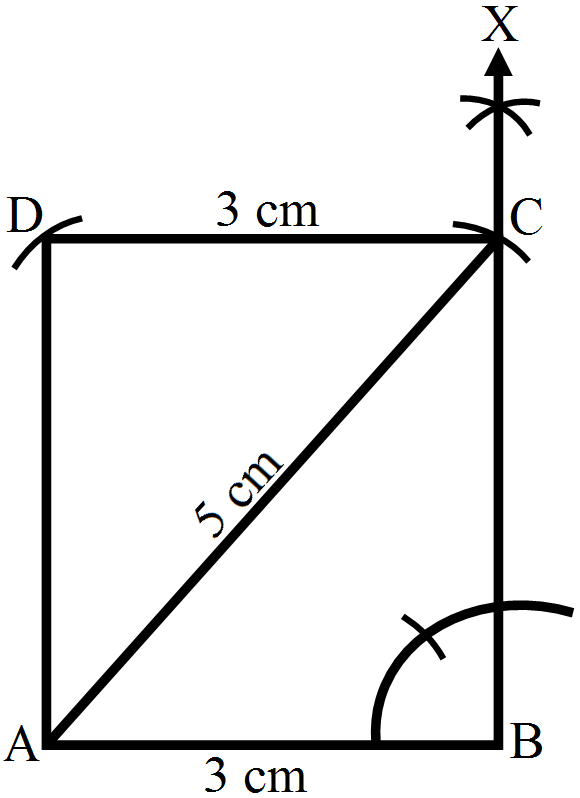
Construct a rectangle whose one side is $3\ cm$ and a diagonal equal to $5\ cm$.
Answer
Diagonals of a rectangle $\&$ opposite sides are equal. All the angles of rectangle are right angle.
So, $\text{AC} = 5\ cm$
$\text{AB} = 3\ cm$

Steps of Construction:
$1.$ Draw $\text{AB} = 3\ cm$
$2.$ Draw a ray $\text{BX}$ such that $\angle\text{ABX}=90^\circ$
$3.$ Mark a point $D$ such that $\text{AC} = 5\ cm$
$4.$ With $B$ as centre, draw an arc of radius $5\ cm$. With $C$ as centre, draw an another arc of radius $3\ cm$ which intersect first arc at a point, suppose $D$.
$5.$ Join $\text{CD}$ and $\text{AD}$.
Hence, $\text{ABCD}$ is the required rectangle.
View full question & answer
Question 175 Marks
A line $l$ is parallel to line m and a transversal p interesects them at $\text{X, Y}$ respectively. Bisectors of interior angles at $X$ and $Y$ interesct at $P$ and $Q$. Is $\text{PXQY}$ a rectangle? Given reason.
Answer
$\angle\text{l}+\angle\text{S}=180^\circ$
$60^\circ\angle\text{S}=180^\circ$
$\angle\text{S}=120^\circ$

Steps of construction:
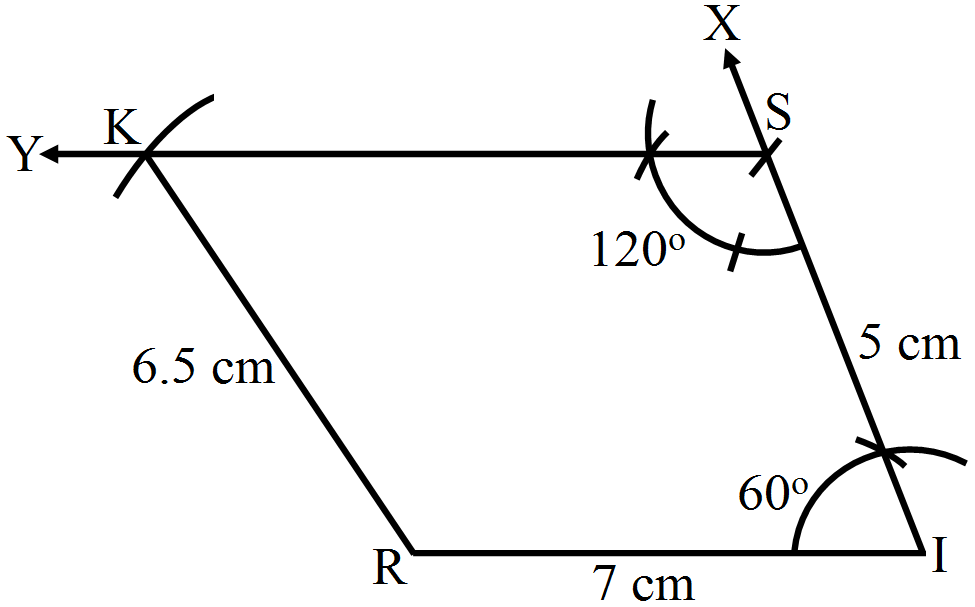
$1.$ Draw an arc $\text{RI} = 7\ cm$
$2.$ Make $\angle\text{RIX}=60^\circ$
$3.$ With $\text{I}$ as centre $\&$ radius $5\ cm$, draw an arc cutting $\text{IX}$ at $S$.
$4.$ Make $\angle\text{ISY}=120^\circ$
$5.$ With $R$ as centre & radius $6.5\ cm$, draw an arc cutting $\text{SY}$ at $K$.
$6.$ Join $\text{KR}$.
Thus, $\text{RISK}$ is the required trapezium.
View full question & answer
Question 185 Marks
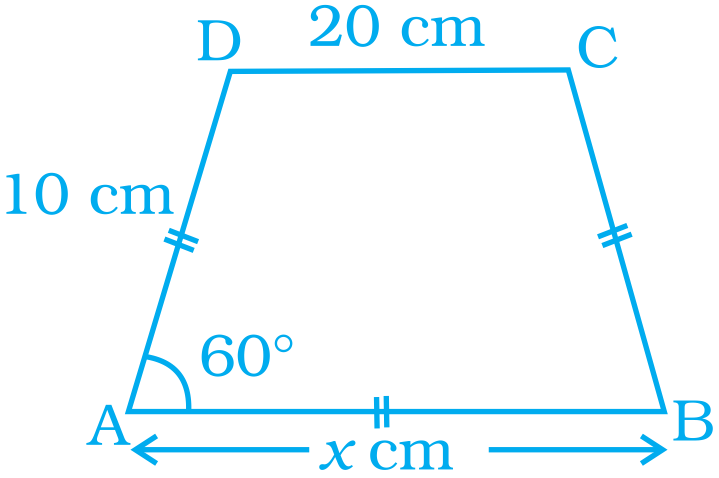
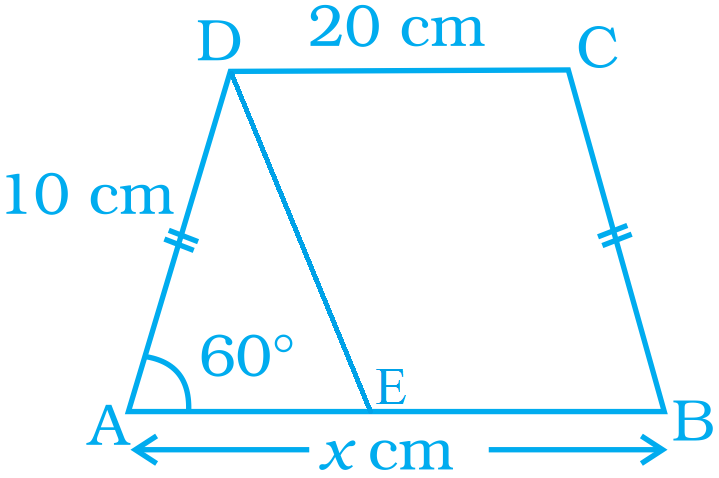
In the following figure, $AB\ ||\ DC$ and $AD = BC$. Find the value of $X$.
Answer
Given, an isosceles trapezium, where $AB\ ||\ DC, AD = BC$ and $\angle\text{A}=60^\circ$
Then, $\angle\text{B}=60^\circ$ Draw a line parallel to $BC$ through $D$ which intersects the line $AB$ at $E$ (say)
Then, $DEBC$ is a parallelogram, where

$BE = CD = 20\ cm$ and $DE = BC = 10\ cm$
Now,$\angle\text{DEB}+\angle\text{CBE}=180^\circ$
$\Rightarrow\angle\text{DEB}=180^\circ-60^\circ=120^\circ$ In
$\triangle\text{ADE},$ $\angle\text{ADE}=60^\circ$ [exterior angle]
Also, $\angle\text{DEA}=60^\circ$ [$AD = DE = 10\ cm$ and $\angle\text{DAB}=60^\circ$]
Then, $\triangle\text{ADE}$ is an equilateral triangle.
$AE = 10\ cm $
$\Rightarrow AB = AE + EB = 10 + 20 = 30\ cm$
Hence, $x = 30\ cm$.
View full question & answer
Question 195 Marks
In a rectangle $ABCD$, $AB = 25\ cm$ and $BC = 15$. In what ratio does the bisector of $\angle\text{C}$ divide $AB$?
Answer
Given, $AB = 25\ cm$ and $BC = 15\ cm$
Now, in rectangle $ABCD, CO$ is the bisector of $\angle\text{C}$ and it divides $AB$.
$\therefore\angle \text{OCB}+\text{OCD}=45^\circ$
$\therefore\angle\text{OCB}=\angle\text{OCD}=45^\circ$
we have $\Rightarrow\angle\text{CBO}=\angle\text{OCB}+\angle\text{COB}=180^\circ$ [angle sum property]
$\Rightarrow90^\circ+45^\circ\angle\text{CBO}=180^\circ$
$\Rightarrow\angle\text{COB}=180^\circ-90^\circ+45^\circ$
$\Rightarrow\angle\text{COB}=180^\circ-135^\circ+45^\circ$
Now, in $\triangle\text{OCB}$ $\therefore\angle\text{OCB}=\angle\text{OCB}$
Then, $OB = BC \Rightarrow OB = 15\ cm$ $CO$ divides $AB$ in the ratio $AO : OB.$
Let $AO$ be $x$, then $\Rightarrow OB = AB - X =25 - X$
Hence, $AO : OB = X : 25 − X $
$\Rightarrow 10 : 15 $
$​​​​​​​\Rightarrow 2 : 3$​​​​​​​
View full question & answer
Question 205 Marks
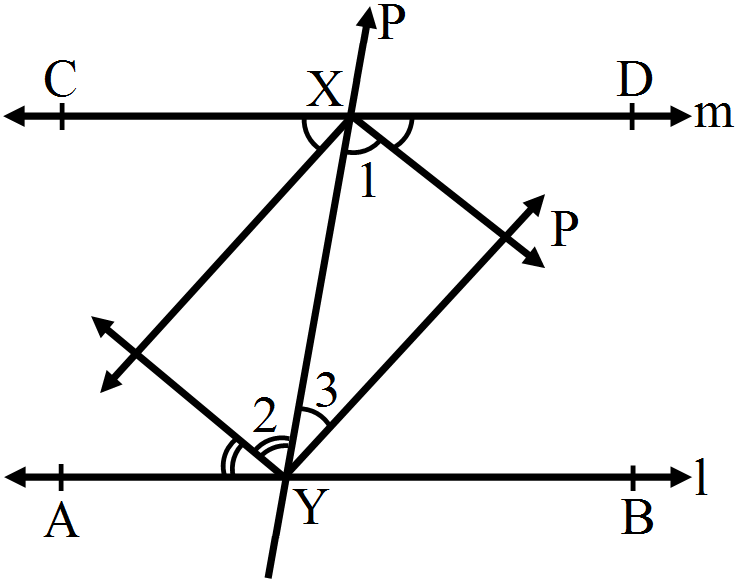
A line l is parallel to line m and a transversal p interesects them at $X, Y$ respectively. Bisectors of interior angles at $X$ and $Y$ interesct at $P$ and $Q$. Is $PXQY$ a rectangle? Given reason.
Answer
Given, $I$ is parallel to m $\therefore\angle\text{DXY}=\angle\text{XYA}$
$\Rightarrow\frac{\angle\text{DXY}}{2}=\frac{\angle\text{XYA}}{2}$
Now, $\angle1=\angle2$ Alternate angles are equal, i.e., $\angle1=\angle2$
$\therefore\text{XP}\ ||\ \text{QY}\dots(\text{i})$
Similarly, $\text{XQ}\ ||\ \text{PY}\dots(\text{ii})$
From eq. $(i)$ & (ii) $PXQY$ is a parallelogram,
$\Rightarrow\angle\text{DXY}+\text{XYB}=180^\circ\dots(\text{iii})$
$\frac{\angle\text{DXY}}{2}=\frac{\angle\text{XYB}}{2}=\frac{180^\circ}{2}$
$\angle\text{1}+\angle\text{3}=90^\circ$ $\text{In}\triangle\text{EYP},$ $\angle1+\angle3+\angle\text{P}=180^\circ$$90^\circ+\angle\text{P}=180^\circ$
$\angle\text{P}=180^\circ-90^\circ$ [from eq. $(iv)$]
$\angle\text{P}=90^\circ\dots(\text{v})$ From Eqs. $(iii)$ & $(iv)$, we get $PXQY$ is a rectangle
View full question & answer