Question 13 Marks
Two stars each of one solar mass ($= 2 \times 10^{30}kg$) are approaching each other for a head on collision. When they are a distance $10^9km$, their speeds are negligible. What is the speed with which they collide? The radius of each star is $10^4km.$ Assume the stars to remain undistorted until they collide. (Use the known value of G).
AnswerGiven: Mass of each star, $M=2 \times 10^{30} kg$ Radius of each star, $R=10^4 km=10^7 m$
Distance between the stars, $r =$
$10^9 km=10^{12} m$ For $v =0$ total energy of two stars separated at distance $r =(- GMm ) /( r )+(1 / 2) mv ^2=(- GMm ) /( r )+0$
$\qquad$ (i) When the stars are about to collide: Velocity of the stars
$= v$ Distance between the centres of the stars will be twice the radius of a star i.e. $=2 R$
Total kinetic energy of both stars $=(1 / 2) M v^2+(1 / 2) M v^2=M v^2$
Total potential energy of both stars $=(-G M m) /(2 R)$
Total energy of the two stars $=M v^2-(G M m) /(2 R)$
$\qquad$ (ii) Using the law of conservation of energy,
$Mv ^2-( GMm ) /(2 R )=-( GMM ) /( r ) v ^2=-( GM ) /( r )+( GM ) /(2 R )= GM ((-1 / r )+(1 / 2 R ))=6.67 \times$
$\left.10^{-11} \times 2 \times 10^{30}\left[\left(-1 / 10^{12}\right)+(1 / 2) \times 10^7\right)\right]=13.34 \times$ $10^{19}\left[-10^{-12}+\left(5 \times 10^{-8}\right)\right]$
$=-6.67 \times 10^{12} v =\sqrt{\left(6.67 \times 10^{12}\right)}$
$v=\left(2.58 \times 10^6\right) m / s$
View full question & answer→Question 23 Marks
As you have learnt in the text, a geostationary satellite orbits the earth at a height of nearly $36,000km$ from the surface of the earth. What is the potential due to earth’s gravity at the site of this satellite? (Take the potential energy at infinity to be zero). Mass of the earth = $6.0 \times 10^{24}kg$, radius = $6400km$.
AnswerMass of the Earth, $M=6.0 \times 10^{24} \mathrm{~kg}$ Radius of the Earth, $R=6400 \mathrm{~km}=6.4 \times 10^6 \mathrm{~m}$ Height of a geostationary satellite from the surface of the Earth, $\mathrm{h}=36000 \mathrm{~km}=3.6 \times 10^7 \mathrm{~m}$ Gravitational potential energy due to Earth's gravity at height h, $=\frac{-\text{GM}}{(\text{R+h})}$ $=-\frac{6.67\times10^{-11}\times6.0\times10^{24}}{3.6\times10^7+0.64\times10^7}$ $=-\frac{6.67\times6}{4.24}\times10^{13-7}$ $=-9.4\times10^6\text{J/kg}$
View full question & answer→Question 33 Marks
Two heavy spheres each of mass $100kg$ and radius $0.10m$ are placed $1.0m$ apart on a horizontal table. What is the gravitational force and potential at the mid point of the line joining the centres of the spheres? Is an object placed at that point in equilibrium? If so, is the equilibrium stable or unstable?
AnswerGravitational field at the mid-point of the line joining the centres of the two spheres $=\mathrm{GM} /(\mathrm{r} / 2)^2$ (along negative r ) $+\mathrm{GM} /(\mathrm{r} / 2$ ) (along r ) $=0$ Gravitational potential at the midpoint f the line joining the centres of the two spheres is V $=-\mathrm{GM} / \mathrm{r} / 2+(-\mathrm{GM} / \mathrm{r} / 2)=-4 \mathrm{GM} / \mathrm{r}=-4 \times 6.67 \times 10^{-11} \times 100 / 1.0=-2.7 \times 10^{-8} \mathrm{~J} / \mathrm{Kg}$ As the effective force on the body placed at mid-point is zero, sso the body is in equilibrium. If the body is displaced a little towards either mass body from its equilibrium position, it will not return back to its inital position of equilibrium. Hence, the body is in unstable equilibrium.
View full question & answer→Question 43 Marks
How will you ‘weigh the sun’, that is estimate its mass? The mean orbital radius of the earth around the sun is $1.5 \times 10^8km.$
AnswerOrbital radius of the Earth around the Sun, $r =1.5 \times 10^{11} m$
Time taken by the Earth to complete one revolution around the Sun,
$T=1 \text { year }=365.25 \text { days }=365.25 \times 24 \times 60 \times 60 s$
Universal gravitational constant, $G =6.67 \times 10^{-11} Nm ^2 kg^{-2}$
Thus, mass of the Sun can be calculated using the relation, +
$M=\frac{4 \pi^2 r^3}{GT^2}$
$=4 \times 3.14^2 \times\left(1.5 \times 10^{11}\right)^3 /\left[6.67 \times 10^{-11} \times(365.25 \times 24 \times 60 \times 60)^2\right]=2 \times 10^{30} kg$
Hence, the mass of the Sun is $2 \times 10^{30} kg$.
View full question & answer→Question 53 Marks
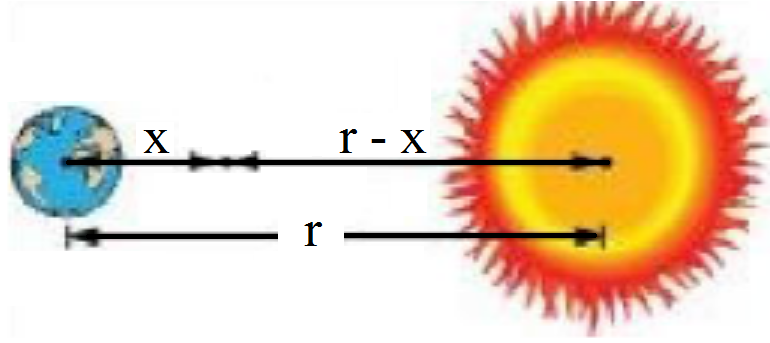
A rocket is fired from the earth towards the sun. At what distance from the earth's centre is the gravitational force on the rocket zero? Mass of the sun $=2 \times 10^{30} \mathrm{~kg}$, mass of the earth $=6 \times 10^{24} \mathrm{~kg}$. Neglect the effect of other planets etc. (orbital radius $=1.5 \times 10^{11} \mathrm{~m}$ ).
AnswerGiven: Mass of Sun M $=2 \times 10^{30} \mathrm{~kg}$ Mass of the earth $\mathrm{m}=6 \times 10^{24} \mathrm{~kg}$ Distance between Sun and Earth $\mathrm{r}=1.5 \times$
$10^{11} \mathrm{~m}$ Consider a point R , where the gravitational force on the rocket due to earth = gravitational force on the rocket due to sun. Distance of point R from the Earth = x Therefore, $\frac{(\text{Gm})}{(\text{r}^2)}=\frac{(\text{GM})}{(\text{r}-\text{x})^2}$
$\frac{(\text{r}-\text{x})^2}{(\text{x})^2}=\Big(\frac{\text{M}}{\text{m}}\Big)$
$=\frac{(2\times10^{30})}{(6\times10^{24})}$
$=\frac{(10^{6})}{(3)}$
$=\frac{(\text{r}-\text{x})}{(\text{x})}=\frac{(10)^3}{(\sqrt{3})}$
$\big(\frac{\text{r}}{\text{x}}\big)=\frac{(10)^3}{(\sqrt{3})+1}$
$\approx\frac{(10)^3}{(\sqrt{3})}$
$\text{x}=\frac{(\sqrt{3})\text{r}}{(10)^3}$
$=\frac{(1.732\times1.5\times10^{11})}{(10^3)}\text{m}$
$=2.6\times10^8\text{m}$
View full question & answer→Question 63 Marks
Calculate the acceleration due to gravity at the surface of Mars if its diameter is $6760km$ and mass one tenth that of the earth. The diameter of earth is $12742km$ and acceleration due to gravity on the earth is $9.8m/ s^2$.
AnswerAs we know $\text{g}=\frac{\text{GM}}{\text{R}^2}$ Let $g_M$ and $g_e$ be the acceleration due to gravity at Mars and Earth respectively. $\therefore\ \frac{\text{g}_\text{M}}{\text{g}_\text{e}}=\Big(\frac{\text{M}_\text{M}}{\text{M}_\text{e}}\Big)\Big(\frac{\text{R}_\text{e}}{\text{R}_\text{M}}\Big)^2$
$=\Big(\frac{1}{10}\Big)\Big(\frac{12742}{6760}\Big)^2$
$\frac{\text{g}_\text{M}}{\text{g}_\text{e}}=0.35$
$\therefore\ \text{g}_\text{M}=0.35\times\text{g}_\text{e}$
$=0.35\times9.8=3.48\text{ms}^{-2}$
View full question & answer→Question 73 Marks
What is escape velocity? Obtain the expression for the escape velocity on earth. Why is it that there is no atmosphere on the moon? Explain.
AnswerThe minimum velocity required to escape from the gravitational force of earth is called escape velocity. Total energy is the sum of P.E. and K.E. $\text{T.E}=-\frac{\text{GMm}}{\text{R}}+\frac{1}{2}\text{mv}^2$ To escape, K.E. should be greater than P.E., i.e., $\frac{1}{2}\text{mv}^2\geq\frac{\text{GMm}}{\text{R}}$ $\text{v}_{\text{e}}=\sqrt{2\frac{\text{GM}}{\text{R}}}=\sqrt{2\text{gR}}$ The escape velocity from the moon's surface is about 2.38km/ sec which is less than the r.m.s velocity of the air molecules. Thus all the molecules of gases have escaped from the surface of moon. So, there is no atmosphere.
View full question & answer→Question 83 Marks
Two satellites A and B go around a planet P in circular orbits having radius 4R and R respectively. If the speed of the satellite A is 3v, find the speed of the satellite B.
AnswerAs, $\text{v}_0=\sqrt{\frac{\text{GM}}{\text{R}}};$ so, $3\text{v}=\sqrt{\frac{\text{GM}}{4\text{R}}}$ and $\text{v}'=\sqrt{\frac{\text{GM}}{\text{R}}}$ $\therefore\ \frac{\text{v}'}{3\text{v}}=2$ $\text{v}'=6\text{v}$
View full question & answer→Question 93 Marks
Molecules in air in the atmosphere are attracted by gravitational force of the earth. Explain why all of them do not fall into the earth just like an apple falling from a tree.
AnswerThe air molecules move randomly as they possess thermal (temperature) energy. Air molecules and apples both are attracted by the earth by gravitational force but the resultant velocity of an air molecule is not exactly downward as in case of an apple (as apple has no other direction of motion except downward).
View full question & answer→Question 103 Marks
Two stars each of one solar mass ($= 2 \times 10^{30}kg$) are approaching each other for a head on collision. When they are a distance $10^9km$, their speeds are negligible. What is the speed with which they collide? The radius of each star is $10^4km.$ Assume the stars to remain undistorted until they collide. (Use the known value of G).
AnswerGiven: Mass of each star, $M = 2 \times 10^{30}kg$
Radius of each star, $R = 10^4km = 10^7m$
Distance between the stars, $r = 10^9km = 10^{12}m For v = 0$
total energy of two stars separated at distance $r = (-GMm)/(r) + (1/2)mv^2 = (-GMm)/(r) + 0 ......(i)$
When the stars are about to collide:
Velocity of the stars = v Distance between the centres of the stars will be twice the radius of a star
i.e. = 2R Total kinetic energy of both stars $= (1/2)Mv^2 + (1/2)Mv^2 = Mv^2$
Total potential energy of both stars = (-GMm)/(2R) Total energy of the two stars $= Mv^2 - (GMm)/(2R) .......(ii)$
Using the law of conservation of energy,
$ Mv^2 - (GMm)/(2R)$
$= -(GMM)/(r) v^2 = -(GM)/(r) + (GM)/(2R)$
$= GM ((-1/r) + (1/2R)) = 6.67 \times 10^{-11} \times 2 \times 10^{30}[(-1/10^{12}) + (1/2) \times 10^7)]$
$= 13.34 \times 10^{19}[-10^{-12} + (5 \times 10^{-8})] = -6.67 \times 10^{12}$
$\text{v}=\sqrt{(6.67\times10^{12})}$
$v= (2.58 \times 10^6)m/s$
View full question & answer→Question 113 Marks
Two bodies of masses $M_1$ and $M_2$ are placed at a distance d apart. What is the potential at the position where the gravitational field due to them is zero?
AnswerLet the field be zero at a point at distance x from $M_1$_. $\therefore\frac{\text{GM}_1}{\text{x}^2}=\frac{\text{GM}_2}{(\text{d}-\text{x})^2}$
$\therefore\frac{\text{x}}{\text{d}-\text{x}}=\sqrt{\frac{\text{M}_1}{\text{M}_2}}$
$\Rightarrow\text{x}\sqrt{\text{M}_2}=\sqrt{\text{M}_1}.\text{d}-\text{x}\sqrt{\text{M}_1}$
$\text{x}\big[\sqrt{\text{M}_1}+\sqrt{\text{M}_2}\big]=\sqrt{\text{M}_1}.\text{d}$
$\text{x}=\frac{\text{d}\sqrt{\text{M}_1}}{\sqrt{\text{M}_1}+\sqrt{\text{M}_2}}$
$\text{d}-\text{x}=\frac{\text{d}\sqrt{\text{M}_2}}{\sqrt{\text{M}_1}+\sqrt{\text{M}_2}}$ Potential at this point due to both the masses will be, $=-\frac{\text{GM}_1}{\text{x}}-\frac{\text{GM}_2}{(\text{d}-\text{x})}$
$=-\text{G}\bigg[\frac{\text{M}_1(\sqrt{\text{M}_1}+\sqrt{\text{M}_2})}{\text{d}\sqrt{\text{M}_1}}+\frac{\text{M}_2(\sqrt{\text{M}_1}+\sqrt{\text{M}_2})}{\text{d}\sqrt{\text{M}_2}}\bigg]$
$=-\frac{\text{G}}{\text{d}}(\sqrt{\text{M}_1}+\sqrt{\text{M}_2})^2$
$=\frac{\text{G}}{\text{d}}(\text{M}_1+\text{M}_2+2\sqrt{\text{M}_1}\sqrt{\text{M}_2})$
View full question & answer→Question 123 Marks
Compute the mass of a planet that has a satellite whose time period is T and orbital radius is r.
AnswerSuppose that a satellite of mass m described a circular orbit around a planet of Mass M. The force of attraction between the planet and its satellite is $\text{F}=-\text{G}\frac{\text{Mm}}{\text{r}^2}$ This force must be mass times the centripetal acceleration, i.e., $\frac{\text{v}^2}{\text{r}}=\omega^2\text{r}$ Thus $\text{m}\omega^2\text{r}=\frac{4\pi^2\text{mr}}{\text{T}^2}=\text{G}\frac{\text{mM}}{\text{r}^2}$ $\text{M}=\frac{4\pi^2\text{r}^3}{\text{GT}^2}.$
View full question & answer→Question 133 Marks
Viscous force increase the velocity of a satellite. Discuss.
AnswerImagine a satellite of mass m moving with a velocity v in an orbit of radius r around a planet of mass M. PE of the satellite, $\text{U}=-\frac{\text{GMm}}{\text{r}}$ KE of the satellite, $\text{K}=\frac{1}{2}\text{mv}^2=\frac{\text{GMm}}{2\text{r}}$ $\bigg[\text{as v}=\sqrt{\frac{\text{GM}}{\text{r}}}\bigg]$ Total energy of the satellite, i.e., E = K + U $=\frac{\text{GMm}}{2\text{r}}-\frac{\text{GMm}}{\text{r}}=-\frac{\text{GMm}}{2\text{r}}$ For the sake of clarity, take $\frac{\text{GMm}}{2\text{r}}=\text{x}$ Clearly, U = -2x, K = x, E = -x The orbiting satellite loses energy due to viscous force acting on it due to atmosphere and as such it loses height. Let the new orbital radius be $\frac{\text{r}}{2}(\text{say})$ Clearly, U' = -4x K' = 2x E' = -2x Clearly, E' < E, U' < U and K' > K. Since, kinetic energy has increased, the velocity of the satellite increases.
View full question & answer→Question 143 Marks
A body is projected vertically from the surface of the earth with a velocity equal to half the escape velocity. What is the maximum height reached by the body?
AnswerInitial kinetic energy $=\frac{1}{2}\text{mv}^2=\frac{1}{2}\text{m}\Big(\frac{\text{v}_\text{e}}{2}\Big)^2$ But $\text{v}_\text{e}=\sqrt{\frac{2\text{MG}}{\text{R}}}$ $\therefore$ Initial K.E. $=\frac{1}{2}\text{m}.\frac{2\text{MG}}{4\text{R}}=\frac{\text{GMm}}{4\text{R}}$ Initial P.E. $=-\frac{\text{GMm}}{\text{R}}$ Total initial energy $=\frac{\text{GMm}}{4\text{R}}-\frac{\text{GMm}}{\text{R}}=-\frac{3\text{GMm}}{4\text{R}}$ If the body comes to rest at a distance R from the centre of the earth, its final energy will be, $=-\frac{\text{GMm}}{\text{R}}$ $\therefore-\frac{3\text{GMm}}{4\text{R}}=-\frac{\text{GMm}}{\text{R}}$ $\Rightarrow\text{r}=\frac{4}{3}\text{R}$ Maximum height = r - R $=\frac{4}{3}\text{R}-\text{R}=\frac{\text{R}}{3}$
View full question & answer→Question 153 Marks
An artificial satellite is moving in a circular orbit around the earth with a speed equal to half the magnitude of escape velocity from the earth.
- Determine the height of the satellite above the earth's surface.
- If the satellite is stopped suddenly in its orbit and allowed to fall freely onto the earth, find the speed with which it hits the surface of the earth. $[g = 9.8m/ s^2$ and $R_e = 6400\ km]$
Answer
- We know that for satellite motion,
$\text{v}_0=\sqrt{\frac{\text{GM}}{\text{r}}}=\text{R}\sqrt{\frac{\text{g}}{(\text{R}+\text{h})}}$
$\Big[\text{as g}=\frac{\text{GM}}{\text{R}^2}$ and $r=\text{R}+\text{h}\Big]$
In this problem,
$\text{v}_0=\frac{1}{2}\text{v}_\text{e}=\frac{1}{2}\sqrt{2\text{gR}}$
So, $\frac{\text{R}^2\text{g}}{\text{R}+\text{h}}=\frac{1}{2}\text{gR}$
i.e., $h = R = 6400\ km$
- By conservation of $ME$,
$0+\Big(-\frac{\text{GMm}}{\text{r}}\Big)=\frac{1}{2}\text{mv}^2+\Big(-\frac{\text{GMm}}{\text{R}}\Big)$
$\text{v}^2=2\text{GM}\Big[\frac{1}{\text{R}}-\frac{1}{2\text{R}}\Big] [as\ r = R + h = R + R = 2R]$
$\text{v}=\sqrt{\frac{\text{GM}}{\text{R}}}=\sqrt{\text{gR}}=8\text{km/s}$ View full question & answer→Question 163 Marks
As you have learnt in the text, a geostationary satellite orbits the earth at a height of nearly $36,000km$ from the surface of the earth. What is the potential due to earth’s gravity at the site of this satellite? (Take the potential energy at infinity to be zero). Mass of the earth = $6.0 \times 10^{24}kg$, radius = $6400km$.
AnswerMass of the Earth, $M = 6.0 \times 10^{24}kg$ Radius of the Earth, $R = 6400km = 6.4 \times 10^6m$ Height of a geostationary satellite from the surface of the Earth, $h = 36000km = 3.6 \times 10^7m$ Gravitational potential energy due to Earth’s gravity at height h, $=\frac{-\text{GM}}{(\text{R+h})}$
$=-\frac{6.67\times10^{-11}\times6.0\times10^{24}}{3.6\times10^7+0.64\times10^7}$
$=-\frac{6.67\times6}{4.24}\times10^{13-7}$ $=-9.4\times10^6\text{J/kg}$
View full question & answer→Question 173 Marks
What will be the potential energy of a body of mass $67kg$ at a distance of $6.6 \times 10^{10}m$ from the centre of the earth? Find gravitational potential at this distance.
AnswerMass of the earth, $M = 6.0 \times 10^{24}kg, m = 67kg G = 6.67 \times 10^{-11}Nm^2Kg^{-2}$ Gravitational potential, $\text{V}=-\frac{\text{GM}}{\text{R}}$
$=-\frac{6.67\times10^{-11}\times6\times10^{24}}{6.6\times10^{10}}$
$\text{V}=-6.1\times10^3\text{J kg}^{-1}$
View full question & answer→Question 183 Marks
Calculate the change in energy of a $500kg$ satellite when it falls from an altitude of $200km$ to $199km$. If this change takes place during one orbit, calculate the retarding force on the satellite. [Given : mass of earth = $6 \times 10^{24}kg$ and radius of earth = $6400km$]
AnswerChange in energy $(\Delta)$ $=\Big\{\frac{\text{GMm}}{\text{r}}\Big\},\frac{1}{\text{r}}=\Big(\frac{1}{\text{r}_1}-\frac{1}{\text{r}_2}\Big)$
$=6.67\times10^{-11}\times6\times10^{24}\times500$ $\Big[\frac{1}{63.4\times10^6}-\frac{1}{6.399\times10^6}\Big]$
$=6.67\times10^{13}\times3000\big[1.5625\times10^{-7}-1.5627\times10^{-7}\big]$
$=20.01\times10^{16}\big[(-0.0002\times10^{-7})\big]$
$=-4\times10^6\text{J}$ If this occurs during one orbit, then the energy lost = force x distance. If we take the distance as circumference of one orbit, then retarding force $=\frac{4\times10^6}{2\pi\times6.4\times10^6}=0.0999\text{N}\simeq0.1\text{N}$
View full question & answer→Question 193 Marks
Light from a massive star suffers 'gravitational red shift' i.e., its wavelength changes towards the red end due to the gravitational attraction of the star. Obtain the formula for this gravitational red shift using the simple consideration that a photon of frequency v has energy $\text{h}\nu$ (h=planck's constant) and mass $\frac{\text{h}\nu}{\text{c}^2}.$ Estimate the magnitude of the red-shift for light of wavelength $5000\mathring{\text{A}}$ from a star of mass $10^{32}kg$ and radius $10^6km. G = 6.67 \times 10^{-11}Nm^2 kg^{-2}$ and $C = 3 \times 108m s^{-1}$.
Answer$\text{h}\nu^{'}=\text{h}\nu-\frac{\text{GMh}\nu}{\text{Rc}^2}$i.e., $\nu'=\nu\Big(1-\frac{\text{GM}}{\text{c}^2\text{R}}\Big)$
where $\nu'$ is the shifted frequency.
Now, $\lambda'=\lambda\Big(1+\frac{\text{GM}}{\text{c}^2\text{R}}\Big)$ if $\frac{\text{GM}}{\text{Rc}^2}<1$
i.e., $\lambda'-\lambda=\frac{\lambda\text{GM}}{\text{c}^2\text{R}}=0.371\mathring{\text{A}}$
View full question & answer→Question 203 Marks
What is the percentage increase in velocity for moon to escape from the gravitational pull of the earth?
AnswerOrbital velocity of moon $\text{v}_{\text{o}}=\sqrt{\frac{\text{GM}}{\text{r}}}$ Escape Velocity $\text{v}_\text{e}=\sqrt{\frac{2\text{GM}}{\text{r}}}$ $\therefore$ % increase required $=\frac{\text{v}_\text{e}-\text{v}_\text{o}}{\text{v}_\text{o}}\times100$ $=(\sqrt{2}-1)\times100=41.4 \%$
View full question & answer→Question 213 Marks
QUESIION The distance between earth and moon is $3.8 \times 10^5 km$ and the mass of earth is 81 times the mass of moon. Deduce the position of a point on the line joining the centres of earth and moon, where the gravitational field is zero. What would be the value of gravitational field there due to earth and moon separately?
AnswerLet x be the distance of the point of no net field from earth.
The distance of this point from moon is (r - x),
where $r = 3.8 \times 10^5km$.
The gravitational field due to earth $=\frac{\text{GM}_\text{e}}{\text{x}^2}$ and that due to moon $=\text{G}\frac{\text{M}_\text{m}}{(\text{r}-\text{x})^2}.$
For the net field to be zero these are equal and opposite. $\frac{\text{GM}_\text{e}}{\text{x}^2}=\frac{\text{GM}_\text{m}}{(\text{r}-\text{x})^2}$
$\frac{\text{M}_\text{e}}{\text{M}_\text{m}}=\frac{\text{x}^2}{(\text{r}-\text{x})^2}$
Given, $\frac{\text{M}_\text{e}}{\text{M}_\text{m}}=81,$ Thus, $81=\frac{\text{x}^2}{(\text{r}-\text{x})^2}$
$\Rightarrow\ \frac{\text{x}}{\text{r}-\text{x}}=9\Rightarrow\ 9\text{r}-9\text{x}=\text{x}$
$\text{x}=\frac{9}{10}\text{r}$
$\text{x}=\frac{9}{10}\times3.8\times10^5$
$=3.42\times10^5\text{km}=3.42\times10^8\text{m}$ The intensity of the field $=\frac{\text{GM}_\text{e}}{\text{x}^2}=\frac{\text{R}_\text{e}^2\text{g}}{\text{x}^2}$
$=\frac{(6.4\times10^6)^2\times9.8}{(3.42\times10^8)^2}\text{N/kg}$
$=3.43\times10^{-3}\text{ N/kg}.$
View full question & answer→Question 223 Marks
The radius of the earth is reduced by 4%. The mass of the earth remains unchanged. What will be the change in escape velocity?
AnswerEscape velocity, say v, is given by $\text{v}=\sqrt{\frac{2\text{GM}}{\text{R}}}$ $\text{ or }\text{v}^2=(2\text{GM})\text{R}^{-1}$ Differentiate w.r.t 'R', we get, $2\text{v}\frac{\text{dv}}{\text{dR}}=-(2\text{GM})\text{R}^{-2}$ $\text{or }\text{v}\frac{\text{dv}}{\text{dR}}=\frac{-\text{GM}}{\text{R}^2}\dots(1)$ $\text{aslo }\text{v}^2=\frac{2\text{GM}}{\text{R}}\dots(2)$ Dividig (1) by (2), we get, $\frac{1}{\text{v}}\frac{\text{dv}}{\text{dR}}=\frac{-1}{\text{2R}}$ $\text{or }\frac{\text{dv}}{\text{v}}=\frac{-\text{dR}}{2\text{R}}$ $\text{or }\Big|\frac{\text{dv}}{\text{v}}\Big|=\Big|\frac{-\text{dR}}{2\text{R}}\Big|=\frac{4}{2}\%=2\%$ Thus, the decrease in the radius by 4% will increase the escape velocity by 2%.
View full question & answer→Question 233 Marks
Two heavy spheres each of mass $100kg$ and radius $0.10m$ are placed 1.0m apart on a horizontal table. What is the gravitational force and potential at the mid point of the line joining the centres of the spheres? Is an object placed at that point in equilibrium? If so, is the equilibrium stable or unstable?
AnswerGravitational field at the mid-point of the line joining the centres of the two spheres $=\mathrm{GM} /(\mathrm{r} / 2)^2$ (along negative r ) $+\mathrm{GM} /(\mathrm{r} / 2)$ (along r ) $=0$ Gravitational potential at the midpoint f the line joining the centres of the two spheres is V $=-\mathrm{GM} / \mathrm{r} / 2+(-\mathrm{GM} / \mathrm{r} / 2)=-4 \mathrm{GM} / \mathrm{r}=-4 \times 6.67 \times 10^{-11} \times 100 / 1.0=-2.7 \times 10^{-8} \mathrm{~J} / \mathrm{Kg}$ As the effective force on the body placed at mid-point is zero, sso the body is in equilibrium. If the body is displaced a little towards either mass body from its equilibrium position, it will not return back to its inital position of equilibrium. Hence, the body is in unstable equilibrium.
View full question & answer→Question 243 Marks
Discuss the variation of 'g' with depth. What happens to 'g' at the centre of earth?
AnswerLet the planet earth be made of material of density p with radius R. 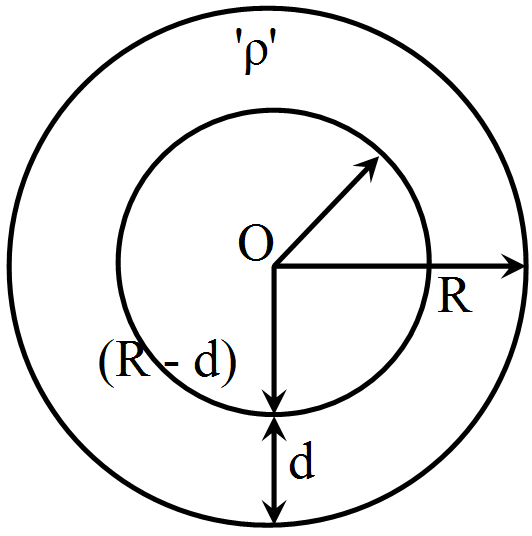 At a depth d, the gravitational force is due to the mass distributed in the sphere of radius (R - d). $\therefore$ The acceleration due to gravity at a depth d. $\text{g}'=\frac{\text{GM}'}{(\text{R}-\text{d})^2}=\text{G}\frac{4}{3}\frac{\pi(\text{R}-\text{d})^3\rho}{(\text{R}-\text{d})^2}$$=\text{G}\frac{4}{3}\pi(\text{R}-\text{d})\text{r}$
$\text{i.e.,}\text{g}'=\text{G}\frac{\text{R}^3\rho}{\text{R}^2}\frac{(\text{R}-\text{d})}{\text{R}}$ $=\text{g}\frac{(\text{R}-\text{d})}{\text{R}}=\text{g}\Big(1-\frac{\text{d}}{\text{R}}\Big)$ $\therefore$ reduces as we move from surface inwards and is zero at the centre. View full question & answer→Question 253 Marks
Planet Mars has two moons-phobos and deimos.Phobos has a period of $7$ hours $39$ minutes and orbital radius of $9.4 \times 10^3km$. Calculate the mass of Mars. $(G = 6.67 \times 10^{-11} Nm^2kg^3)$
Answer$\text{M}_{\text{mass}}=\frac{4\pi^2\text{r}^3}{\text{GT}^2}$ $\text{r}=9.4\times10^3\text{km}=9.4\times10^6\text{m.}$ $\text{G}=6.67\times10^{-11}\text{Nm}^2\text{kg}^{-2}$ $\text{T}=7\text{hr. }39\text{min}=27540\text{sec.}$ $\text{M}_{\text{mass}}=\frac{4\times\Big(\frac{22}{7}\Big)^2\times(9.4\times10^6)^3}{6.67\times10^{-11}\times(27540)^2}$ $=6.49\times10^{23}\text{kg}$
View full question & answer→Question 263 Marks
Define period of revolution. Derive an expression of period of revolution or time period of satellite.
AnswerPeriod of revolution of a satellite is the time taken by the satellite to complete one revolution round the earth. It is denoted by T. $\therefore\text{T}=\frac{\text{Circumference of circular orbit}}{\text{Orbital velocity}}$ $\text{T}=\frac{2\pi\text{r}}{\text{v}_0}$ $\text{T}=\frac{2\pi(\text{R}+\text{h})}{\text{v}_0}$ $[\because\ \text{r}=\text{R}+\text{h}]$ $\text{T}=2\pi(\text{R}+\text{h})\sqrt{\frac{\text{R}+\text{h}}{\text{GM}}}$ $\Big[\because\text{v}_0=\sqrt{\frac{\text{GM}}{\text{R}+\text{h}}}\Big]$ $\text{T}=2\pi\sqrt{\frac{(\text{R}+\text{h})^3}{\text{GM}}}$ Also, $\text{T}=2\pi\sqrt{\frac{(\text{R}+\text{h})^2(\text{R}+\text{h})}{\text{GM}}}$ $\text{T}=2\pi\sqrt{\frac{(\text{R}+\text{h})^3}{\text{gR}^2}}$ $\because\ \text{gR}^2=\text{GM}$ $\therefore\text{T}=2\pi\sqrt{\frac{(\text{R}+\text{h})^3}{\text{gR}^2}}$
View full question & answer→Question 273 Marks
If the earth has a mass nine times and radius twice that of the planet Mars, calculate the maximum velocity required by a rocket to pull out of the gravitational force of Mars. Given escape velocity on the surface of earth is $11.2km/sec$.
AnswerEscape velocity $=\sqrt{\frac{2\text{GM}_{\text{p}}}{\text{R}^2_{\text{p}}}}$ where $M_p$ is the mass of the planet and $R_p$ is the radius of the planet.
$\therefore$ Escape velocity on Mars $=\sqrt{\frac{2\times\text{G}\times4\text{M}_{\text{e}}\text{R}_{\text{e}}}{9\text{R}^2_{\text{e}}}}$
$=\sqrt{\frac{4}{9}}\sqrt{\frac{2\text{GM}}{\text{R}^2_{\text{e}}}}=\sqrt{\frac{4}{9}}\text{v}_{\text{e}}$
$=\sqrt{\frac{4}{9}}\times11.2=7.47\text{km/\sec}$
View full question & answer→Question 283 Marks
Time period of a planet around the Sun is $11.6$ years. How far is the planet from the Sun? The distance between the Sun and the earth is $1.5 \times 10^8km$.
Answer$\text{T}_{\text{p}}=11.6\text{ years,}\text{ r}_{\text{p}}=?,$
$\text{T}_{\text{e}}=1\text{ year,}$
$\text{r}_{\text{e}}=1.5\times10^{11}\text{m}$
$\frac{\text{T}^2_{\text{p}}}{\text{T}^2_{\text{e}}}=\frac{\text{r}^3_{\text{p}}}{\text{r}^3_{\text{e}}}$
$\Rightarrow\text{r}_{\text{p}}=\text{r}_{\text{e}}\Big(\frac{\text{T}_{\text{p}}}{\text{T}_{\text{e}}}\Big)^{\frac{2}{3}}$
$\text{r}_{\text{p}}=1.5\times10^{11}\times\Big(\frac{11.6}{1}\Big)^{\frac{2}{3}}$
$\text{r}_{\text{p}}=7.68\times10^{11}\text{m}$
View full question & answer→Question 293 Marks
The weight of a body on the surface of earth is 250N. Calculate its weight at distance equal to half of the radius of earth below the surface of earth. (Radius of earth = 6400km).
AnswerGiven: W = mg = 250N $\text{d}=\frac{6400}{2}=3200\text{km}$ $\text{R}=6400\text{km}$ $\text{W}'=\text{mg}'=?$ $\text{g}'=\text{g}\Big(1-\frac{\text{d}}{\text{R}}\Big)$ $\text{mg}'=\text{mg}\Big(1-\frac{\text{d}}{\text{R}}\Big)$ $\text{W}'=250\Big(1-\frac{3200}{6400}\Big)$ $=250\Big(1-\frac{1}{2}\Big)=125\text{N}.$
View full question & answer→Question 303 Marks
How will you ‘weigh the sun’, that is estimate its mass? The mean orbital radius of the earth around the sun is $1.5 \times 10^8km.$
AnswerOrbital radius of the Earth around the Sun, $r = 1.5 \times 10^{11}m$
Time taken by the Earth to complete one revolution around the Sun,
$T = 1 year = 365.25 days = 365.25 × 24 × 60 × 60s$
Universal gravitational constant, $G = 6.67 \times 10^{-11}Nm^2kg^{–2}$
Thus, mass of the Sun can be calculated using the relation,
$\text{M}=\frac{4\pi^2\text{r}^3}{\text{GT}^2}$
$= 4 \times 3.14^2 \times (1.5 \times 10^{11})^3/[6.67 \times 10^{-11} \times (365.25 \times 24 \times 60 \times 60)^2]$
$= 2 \times 10^{30}kg$
Hence, the mass of the Sun is $2 \times 10^{30}kg.$
View full question & answer→Question 313 Marks
A laboratory in sky of mass $2 \times 10^3kg$ is raised from a circular orbit of radius $2R$ to a circular orbit of radius $3R$. What is the approximate work done?
AnswerWork done $\text{W}=\Big[-\frac{\text{GMm}}{3\text{R}}\Big]-\Big[-\frac{\text{GMm}}{\text{2R}}\Big]$
$=\frac{\text{GMm}}{2\text{R}}-\frac{\text{GMm}}{3\text{R}}$
$=\frac{1}{6}\frac{\text{GMm}}{\text{R}}=\frac{1}{6}\text{mgR}$
$=\frac{1}{6}\times2\times10^3\times10\times6400\times10^3$
$=2\times10^{10}\text{J}$ It is approximate value of work done.
View full question & answer→Question 323 Marks
An artificial satellite is moving in a circular orbit around the earth with a speed equal to half the magnitude of escape velocity from earth. Determine
- The height of satellite above earth's surface.
- If the satellite is suddenly stopped, find the speed with which the satellite will hit the earth's surface after falling down.
AnswerEscape velocity $=\sqrt{2\text{gR}},$ where $g$ is acceleration due to gravity on surface of earth and $R$ the radius of the earth. Orbital velocity $=\frac{1}{2}\text{v}_\text{e}=\frac{1}{2}\sqrt{2\text{gR}}=\sqrt{\frac{\text{gR}}{2}}\dots(\text{i})$
- If $h$ is the height of satellite above earth,
$\frac{\text{mv}^2_0}{\text{R}+\text{h}}=\frac{\text{GMm}}{(\text{R}+\text{h})^2}$
$\text{v}_0^2=\frac{\text{GM}}{\text{R}+\text{h}}=\frac{\text{gR}^2}{(\text{R}+\text{h})}$
$\therefore\ \Big(\frac{1}{2}\text{v}_\text{e}\Big)^2=\frac{\text{gR}^2}{\text{R}+\text{h}}$ from eq. $(i)$
Now, $R + h = 2R$
$h = R$
- If the satellite is stopped in orbit, the kinetic energy is zero and its potential energy is $-\frac{\text{GMm}}{2\text{R}}.$
Total energy $=-\frac{\text{GMm}}{2\text{R}}$
Let $v$ be its velocity when it reaches the earth.
Hence the kinetic energy $=\frac{1}{2}\text{mv}^2$
Potential energy $=-\frac{\text{GMm}}{\text{R}}$
$\therefore\frac{1}{2}\text{mv}^2-\frac{\text{GMm}}{\text{R}}=-\frac{\text{GMm}}{2\text{R}}$
$\text{v}^2=2\text{GM}\Big(\frac{1}{\text{R}}-\frac{1}{2\text{R}}\Big)=\frac{2\text{gR}^2}{2\text{R}}$
$\Rightarrow\ \text{v}^2=\text{gR}$
$\text{v}=\sqrt{\text{gR}}$ View full question & answer→Question 333 Marks
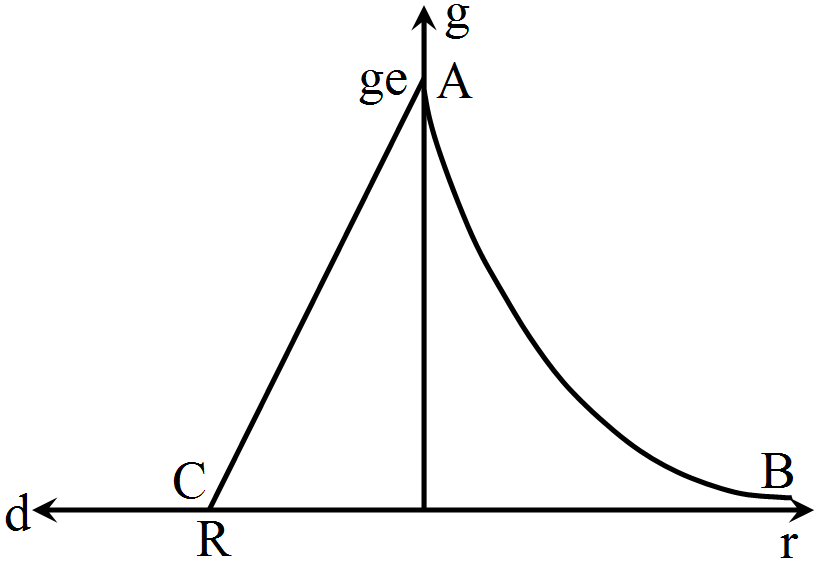
Draw the graph showing the variation of acceleration due to gravity with
- Height above the earth's surface.
- Depth below the earth's surface.
Answer
- The variation of $'g\ '$ with height $‘h\ '$ is related by
relation $\text{g}\propto\frac{1}{\text{r}^2}$
where $\text{r}=\text{R}+\text{h}$
Thus, the variation of $g$ and $r$ is parabolic curve, i.e. part $AB$ of the graph as shown in figure alongside.
- The variation of $‘g$ with depth is related by equation
$\text{g}' = \text{g}\Big(1 - \frac{\text{d}}{\text{R}}\Big)$
$\text{i.e. g}\propto(\text{R}-\text{d})$
Thus, the variation of $'g\ '$ and $'d\ '$ is a straight line, i.e. part $AC$ of the graph.
View full question & answer→Question 343 Marks
A spaceship is launched into a circular orbit close to earth's surface. What additional velocity has to be imparted to the spaceship in the orbit to overcome the gravitational pull? Radius of earth = $6400km$ and $g = 9.8ms^{-2}$.
AnswerOrbital velocity of space ship close to earth, v_0 $=\sqrt{\frac{\text{Gm}}{\text{R}}}=\sqrt{\frac{\text{gR}^2}{\text{R}}}=\sqrt{\text{gR}}$ escape velocity, $\text{v}_{\text{e}}=\sqrt{2\text{gR}}$
$\therefore$ Additional velocity required $\text{v}_{\text{e}}-\text{v}_{\text{o}}=-\sqrt{\text{2gR}}-\sqrt{\text{gR}}$
$=\sqrt{2\times9.8\times6.4\times10^6}$
$-\sqrt{9.8\times6.4\times10^6}$
$=3.2805\times10^3{\text{ms}^{-1}}$
View full question & answer→Question 353 Marks
If the radius of the Earth were increased by a factor of 3, by what factor would its density have to be changed to keep 'g' the same?
AnswerAs, $\text{g}=\frac{\text{GM}}{\text{R}^2}$ Let $\rho$ be the density of earth $\rho=\frac{\text{M}}{\text{Volume of earth}}=\frac{\text{M}}{\frac{4}{3}\pi\text{R}^3}$ $\Rightarrow\ \text{M}=\frac{4}{3}\pi\text{R}^3\rho$ $\therefore\text{g}=\frac{\text{G}}{\text{R}^2}\times\frac{4}{3}\pi\text{R}^3\rho$ $\text{g}=\frac{4}{3}\pi\text{G}\rho\text{R}$ $\frac{4}{3},\pi,$ G are constants. For no change in value of $\text{g},\text{R}\propto\frac{1}{\rho}.$ Thus, if R is made 3R, $\rho$ must become $\frac{\rho}{3}.$
View full question & answer→Question 363 Marks
What is the height at which the value of g is the same as at a depth of $\frac{\text{R}}{2}?$
AnswerAt depth $=\frac{\text{R}}{2},$ value of acceleration due to gravity,$\text{g}'=\text{g}\Big(1-\frac{\text{R}}{2\text{R}}\Big)=\frac{\text{g}}{2}$
At height x,
$\text{g}'=\text{g}\Big(1-\frac{2\text{x}}{\text{R}}\Big)$
$\therefore\ \text{g}\Big(1-\frac{2\text{x}}{\text{R}}\Big)=\frac{\text{g}}{2}$
$\frac{1}{2}=\frac{2\text{x}}{\text{R}}$
$\Rightarrow\ \text{x}=\frac{\text{R}}{4}.$
View full question & answer→Question 373 Marks
Radius of earth and Mars is about 6370km and 3440km respectively. An object weighs 200N on earth. What would it weigh on Mars? What is the acceleration due to gravity on Mars? Mars has a mass 0.11 of that of the Earth.
AnswerWeight = mg $=\frac{\text{mGM}}{\text{r}^2}$ Let 1 refer to earth and 2 refer to Mars. Then, $\frac{\text{W}_2}{\text{W}_1}=\frac{\text{M}_2}{\text{r}^2_2}\frac{\text{r}^2_1}{\text{M}_1}$ $=0.11\times\Big(\frac{6370}{3440}\Big)^2=0.377$ i.e., $\text{W}_2=0.377\times\text{W}_1$ $=0377\times200=750\text{N}$ Also, $\frac{\text{g}_2}{\text{g}_1}=\frac{\text{W}_2}{\text{W}1}$ $\Rightarrow\ \text{g}_2=\text{g}_1\Big(\frac{\text{W}_2}{\text{W}_1}\Big)$ $=9.8\times\frac{75}{200}=3.675\text{m}.$
View full question & answer→Question 383 Marks
Three equal masses m are placed at the corners of an equilateral triangle of side a. What is the work done in doing this?
AnswerThe work done to make the array of three equal masses at the corners of an equilateral triangle of side a is the potential energy in the arrangement. $\text{i.e., W}=-\text{G}\Big(\frac{\text{m}_1\text{m}_2}{\text{a}}+\frac{\text{m}_2\text{m}_3}{\text{a}}+\frac{\text{m}_3\text{m}_1}{\text{a}}\Big)$ $=-\frac{3\text{Gm}^2}{\text{a}}$ For all masses being equal.
View full question & answer→Question 393 Marks
Considering a nearly circular orbit, prove that the square of time period of a planet is proportional to the cube of its radius.
AnswerConsider a planet m moving round the sun (M) in an orbit of radius r. The centripetal force required is provided by the gravitational force of attraction, Therefore, $\frac{\text{mv}^2}{\text{r}}=\frac{\text{GMm}}{\text{r}^2}$ $\Rightarrow\text{v}^2=\frac{\text{GM}}{\text{r}}$ We know if T is the time period, then $\text{v}=\frac{2\pi\text{r}}{\text{T}}$ $\therefore\Big(\frac{2\pi\text{r}}{\text{T}}\Big)^2=\frac{\text{GM}}{\text{r}}$ $\Rightarrow\text{T}^2=\frac{4\pi^2\text{r}^3}{\text{GM}}$ $\therefore\text{T}^2\propto\text{r}^3$ is proved.
View full question & answer→Question 403 Marks
Define gravitational field intensity. Which of the planet of the solar system has the greatest gravitational field intensity? What is the gravitational field intensity of a planet where the weight of $60\ kg$ astronaut is $300N$?
AnswerGravitational field intensity of a body at a point in a field is defined as the force experienced by a body of unit mass placed at that point provided the presence of unit mass does not disturb the original gravitational field. $\text{I}=\text{g}=\frac{\text{GM}}{\text{R}^2}$
Saturn has the greatest gravitational field intensity. $\text{I}=\frac{300}{60}=5\text{m/s}^2$
View full question & answer→Question 413 Marks
Assuming the earth to be a uniform sphere of radius 100 km and density $5.5 \mathrm{~g} / \mathrm{cc}$, find the value of g on its surface. $\left(G=6.66 \times 10^{-11} \mathrm{Nm}^2 \mathrm{~kg}^{-2}\right)$
Answer$\text{Here,}\text{ R}=6400\times10^3\text{m}=6.4\times10^6\text{m};$
$\rho=5.5\text{g/c.c}=5.5\times10^3\text{kg/m}^3$
$\text{Now, }\text{g}=\frac{\text{Gm}}{\text{R}^2}=\frac{\text{Gm}}{\text{R}^2}\times\frac{4}{3}\pi\text{R}^3\times\rho$
$=\frac{4}{3}\pi\text{GR}\rho$
$=\frac{4}{3}\times\frac{22}{7}\times6.66\times10^{-11}\times6.4\times10^6\times5.5\times10^3$
$=9.82\text{ms}^{-2}$
View full question & answer→Question 423 Marks
A geostationary satellite is orbiting the earth at a height of 5R above the surface of the earth, R being the radius of the earth. Find the time period of another satellite (in hours) at a height of 2R from the surface of the earth.
AnswerFrom Kelper's third law, $\text{T}^2\propto\text{r}^3$ Hence, $\text{T}^2_1\propto\text{r}_1^3$ and $\text{T}^2_2\propto\text{r}^3_2$ So, $\frac{\text{T}^2_2}{\text{T}^2_1}=\frac{\text{r}^3_2}{\text{r}^3_1}=\frac{(3\text{R})^3}{(6\text{R})^3}$ $\Rightarrow\frac{\text{T}_2}{\text{T}_1}=\frac{1}{2\sqrt2}$ $[\because\text{T}_1=12]$ $\therefore\text{T}_2=\frac{12}{2\sqrt2}=\frac{6}{\sqrt2}$
View full question & answer→Question 433 Marks
State Kepler's laws of planetary motion and deduce Newton's Law of gravitation from them.
Answer
- The planets including earth, go around the sun in elliptical orbits.
- The line joining the Sun and the planet sweeps equal areas in equal intervals of time.
- The square of the time period of revolution is directly proportional to the cube of the semi$-$major axis of the elliptical orbit.
Since $\text{T}^2\propto\text{r}^3,$ we have,
$\Big(\frac{2\pi\text{r}}{\text{v}}\Big)^2\propto\text{r}^3$
$\text{v}^2=4\pi^2\frac{\text{r}^2}{\text{r}^3}=\frac{4\pi^2}{\text{r}}$
$\frac{\text{mv}^2}{\text{r}}=\frac{4\text{m}\pi^2}{\text{r}^2}$
The centripetal force $\frac{\text{mv}^2}{\text{r}}$ is caused by $M -$ earth on the planet of mass $m$.
Thus, $\text{F}\propto\frac{\text{Mm}}{\text{r}^2}$ It is the Newton's Universal Law of Gravitation. View full question & answer→Question 443 Marks
Derive an expression for the orbital velocity of a satellite in the orbit. Reduce it to an orbit close to the surface of earth. How is it related to escape velocity?
AnswerIn an orbit of radius r, a satellite of mass m moves round a planet of mass M. Then, $\frac{\text{mv}2_{\text{o}}}{\text{r}}=\frac{\text{GMm}}{\text{r}^2}$ $\text{v}_{\text{o}}=\sqrt{\frac{\text{GM}}{\text{r}}}=\sqrt{\frac{\text{GM}}{\text{R+h}}}$ where h is the height at which the satellite is from the surface. For close to earth orbits, h= 0 $\therefore\text{v}_{\text{o}}=\sqrt{\frac{\text{GM}}{\text{R}}}=\sqrt{\text{gR}}$ Since, $\text{v}_{\text{e}}=\sqrt{2\text{gR}},\text{v}_{\text{o}}=\frac{\text{v}_{\text{e}}}{\sqrt{2}}$
View full question & answer→Question 453 Marks
Find the ratio of the acceleration due to gravity of two planets $($surface$)$ if their radii are in the ratio $1 : 2$ under the condition,
- Mass remains same.
- Material remains same.
Answer
- $\text{g}=\frac{\text{GM}}{\text{R}^2}$
If mass is same, then $\text{g}\propto\frac{\text{I}}{\text{R}^2}$
$\therefore\frac{\text{g}_1}{\text{g}_2}=\frac{\text{R}^2_2}{\text{R}^2_1}=\frac{4}{1}$
- If material is same, $\text{g}\propto\text{R}$
$\therefore\frac{\text{g}_1}{\text{g}_2}=\frac{1}{2}$ View full question & answer→Question 463 Marks
A geostationary satellite is orbiting the earth at a height of 6R above the surface of the earth; R being the radius of the earth. What will be the time period of another satellite at a height 2.5R from the surface of the earth?
AnswerAs $\text{T}^2=\text{kr}^3$ or $\text{T}\propto\text{r}^{\frac{3}{2}}$ $\therefore\ \frac{\text{T}_2}{\text{T}_1}=\Big(\frac{\text{r}_2}{\text{r}_1}\Big)^{\frac{3}{2}}\Rightarrow\ \text{T}_2=\text{T}_1\Big(\frac{\text{r}_2}{\text{r}_1}\Big)^\frac{3}{2}$ $=24\Big(\frac{2.5\text{R}+\text{R}}{6\text{R}+\text{R}}\Big)^\frac{3}{2}$ $=24\Big(\frac{1}{2}\Big)^\frac{3}{2}=6\sqrt{2}\text{ hour.}$
View full question & answer→Question 473 Marks
Prove that gravitational potential difference is the work done in carrying a unit mass from one point to another.
AnswerGravitational potential at A $=-\frac{\text{GM}}{\text{r}_{\text{a}}}$ Gravitational potential at B $=-\frac{\text{GM}}{\text{r}_{\text{b}}}$ Difference in potential $=-\text{GM}\Big(\frac{1}{\text{r}_{\text{b}}}-\frac{1}{\text{r}_{\text{a}}}\Big)$ Work done in carrying a units mass from A to B is, $\text{W}=\int^\limits{\text{r}_{\text{b}}}_\limits{\text{r}_{\text{a}}}\frac{\text{GM}}{\text{x}^2}$ $\text{W}=-\text{GM}\Big|\frac{1}{\text{x}}\Big|^{\text{r}_{\text{b}}}_{\text{r}_{\text{a}}}=-\text{GM}\Big(\frac{1}{\text{r}_{\text{b}}}-\frac{1}{\text{r}_{\text{a}}}\Big)$ So, work done and gravitational potential difference are same.
View full question & answer→Question 483 Marks
The kinetic energy associated with a satellite is E. What is the total energy associated?
AnswerK.E. with a satellite in an orbit of radius r is $\text{E}=\frac{1}{2}\text{mv}_0^2$ $=\frac{1}{2}\text{m}\Big(\sqrt{\frac{\text{Gm}}{\text{r}}}\Big)^2=\frac{1}{2}\text{m}\frac{\text{GM}}{\text{r}}$ $\Rightarrow\frac{\text{GMm}}{\text{r}}=2\text{E}$ $\text{P.E. at the orbit}=-\frac{\text{GMm}}{\text{r}}$ Total energy $=\text{K.E.}+\text{P.E.}$ $=+\frac{\text{GMm}}{\text{2r}}-\frac{\text{GMm}}{\text{r}}$ $=\frac{\text{GMm}}{\text{r}}\Big[-\frac{1}{2}\Big]=-\frac{1}{2}2\text{E}=-\text{E}$
View full question & answer→Question 493 Marks
A planet of mass m moves along an ellipse around the sun so that its maximum and minimum distances from the sun are $r_1$ and $r_2$. Find the angular momentum of the planet relative to centre of sun. (Mass of sun = M)
AnswerThe angular momentum of planet is constant i.e., $\text{mv}_1\text{r}_1=\text{mv}_2\text{r}_2$
$\text{v}_1\text{r}_1=\text{v}_2\text{r}_2$ Total energy of planet is constant i.e., $\frac{-\text{GMm}}{\text{r}_1}+\frac{1}{2}\text{mv}_1^2=\frac{-\text{GMm}}{\text{r}_2}+\frac{1}{2}\text{mv}_2^2$ i.e., $\text{GM}\Big\{\frac{1}{\text{r}_2}-\frac{1}{\text{r}_1}\Big\}=\frac{\text{v}_2^2-\text{v}_1^2}{2}=\frac{\text{v}_2^2}{2}-\frac{\text{v}_1^2}{2}$
$\text{GM}\Big\{\frac{\text{r}_1-\text{r}_2}{\text{r}_1\text{r}_2}\Big\}=\frac{\big(\frac{\text{v}_1\text{r}_1}{\text{r}_2}\big)^2}{2}-\frac{\text{v}_1^2}{2}$
$=\frac{\text{v}_1^2}{2}\Big\{\frac{\text{r}_1^2}{\text{r}_2^2}-1\Big\}$ i.e., $\text{GM}\Big\{\frac{\text{r}_1-\text{r}_2}{\text{r}_1\text{r}_2}\Big\}=\frac{\text{v}_1^2}{2}\frac{(\text{r}_1^2-\text{r}_2^2)}{\text{r}^2_2}$
$\text{v}_1^2=\frac{2\text{GM}(\text{r}_1-\text{r}_2)\text{r}_2^2}{(\text{r}_1^2-\text{r}_2^2)\text{r}_1\text{r}_2}=\frac{2\text{GM}\times\text{r}_2}{\text{r}_1(\text{r}_1+\text{r}_2)}$
$\text{v}_1=\sqrt{\frac{2\text{GMr}_2}{\text{r}_1(\text{r}_1+\text{r}_2)}}$ Angular momentum of the planet $=\text{mv}_1\text{r}_1=\text{m}\sqrt{\frac{2\text{GMr}_1\text{r}_2}{\text{r}_1+\text{r}_2}}.$
View full question & answer→Question 503 Marks
The gravitational force between two bodies each of mass m and separated by a distance r varies as inversely proportional to the square of the distance r. However, the gravitational force between two solid spheres of same density and same radius r placed in contact with each other is directly proportional to the fourth power of the radius r. Prove it.
Answer
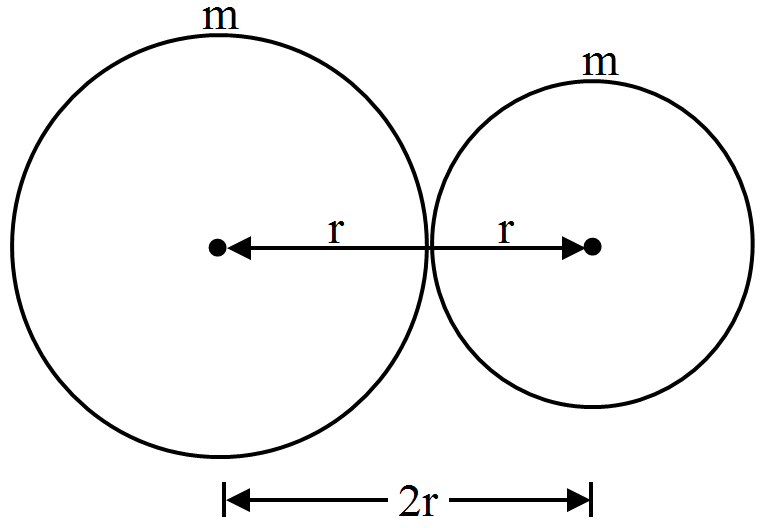 $\text{F}=\frac{\text{Gm}\times\text{m}}{(2\text{r})^2}=\frac{\text{Gm}^2}{4\text{r}^2}$
But, m = volume × density
$=\frac{4}{3}\pi\text{r}^3\rho$
$\therefore\ \text{F}=\frac{\text{G}\times\frac{16}{9}\pi^2\text{r}^6\rho^2}{4\text{r}^2}=\frac{4}{9}\pi^2\text{G}\rho^2\text{r}^4$
Since $\frac{4}{9}\pi^2\text{G}\rho^2=$ constant
$\therefore\ \text{F}\propto\text{r}^4.$ View full question & answer→Question 513 Marks
Show graphically how gravitational field strength varies with distance from the centre of earth, outwards. Give the relation also.
AnswerFor points inside the earth, $\text{E}_{\text{gi}}=\frac{\text{G}\frac{4}{3}\pi\text{x}^3}{\text{x}^2}=\frac{4\text{G}}{3}\pi\text{x}\rho$ 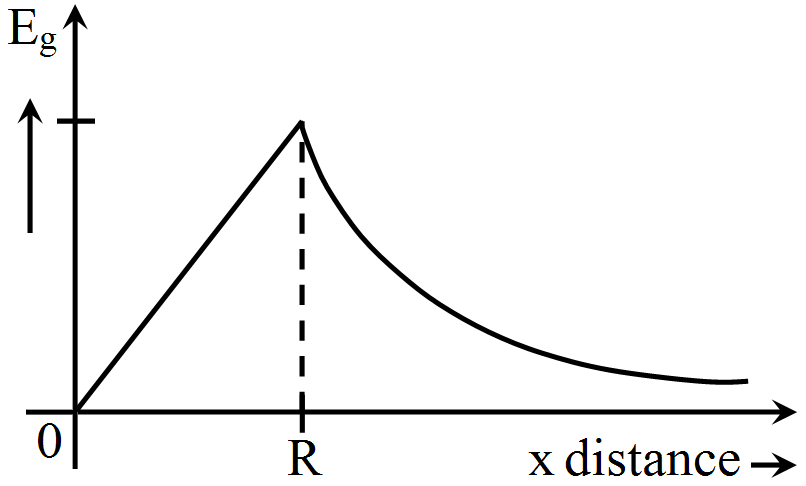 For points outside the earth, $\text{E}_{\text{go}}=\frac{\text{G}\frac{4}{3}\pi\text{R}^3\rho}{\text{x}^2}=\frac{\text{GM}}{\text{x}^2}$
 View full question & answer→Question 523 Marks
A sphere of mass $40kg$ is attracted by another mass of $15kg$ when their centres are $20cm$ apart, with a force of $1 \times 10^{-6} N$. Calculate the value of gravitational constant.
AnswerGiven: $\text{m}=40\text{kg}$
$\text{m}_2=15\text{kg}$
$\text{r}=20\text{cm}=0.2\text{m}$
$\text{F}=1\times10^{-6}\text{N}$
$\text{G}=?$
$\text{F}=\text{G}\frac{\text{m}_1\text{m}_2}{\text{r}^2}$
$1\times10^{-6}=\text{G}\ \times\frac{40\times15}{(0.2)^2}$
$\text{G}=\frac{1\times10^{-6}\times(0.2)^2}{15\times140}$
$=\frac{0.04\times10^{-6}}{600}$
$=6.66\times10^{-11}\ \text{Nm}^2/\text{Kg}^2$
View full question & answer→Question 533 Marks
The planet Saturn has a mass $95$ times that of the earth, and its radius is $9.5$ times the earth's radius. Calculate the escape speed of a body from Saturn's surface, if the escape speed from the earth's surface is $11.2kms^{-1}$.
AnswerEscape speed from the earth's surface is, $\text{v}_\text{e}=\Big[\frac{2\text{GM}}{\text{R}}\Big]^\frac{1}{2}$ or $\Big[\frac{2\text{GM}}{\text{R}}\Big]^\frac{1}{2}=11.2$ Escape speed from Saturn's surface will be,$\text{v}=\Big[\frac{2\text{GM}'}{\text{R}'}\Big]^\frac{1}{2}$
Now, $\text{M}'=95\text{M},\text{ R}'=9.5\text{R}$
$\text{v}=\Big[\frac{2\times95\text{GM}}{9.5\text{R}}\Big]^\frac{1}{2}=3.16\times\sqrt{2\frac{\text{GM}}{\text{R}}}$
But $\Big[\frac{2\text{GM}}{\text{R}}\Big]^\frac{1}{2}=11.2\text{km s}^{-1}$
$\therefore\ \text{v}=3.16\times11.2=35.4\text{km s}^{-1}.$
View full question & answer→Question 543 Marks
Find an expression for the orbital velocity of a satellite revolving around the earth in a circular orbit at a height h above the surface of earth.
AnswerConsider a satellite of mass m revolving around the earth at a height h from its surface so that radius of its orbit r = R + h. If $v_0$ be the orbital velocity of satellite then centripetal force needed by it for its uniform circular motion is, $\text{F}=\frac{\text{mv}_0^2}{\text{r}}$ This value of centripetal force is provided by the gravitational pull of the earth acting on the satellite i.e., $\text{F}=\frac{\text{GMm}}{\text{r}^2}$ For equilibrium, $\frac{\text{mv}^2_0}{\text{r}}=\frac{\text{GMm}}{\text{r}^2}$$\Rightarrow\ \text{v}_0=\sqrt{\frac{\text{GM}}{\text{r}}}=\sqrt{\frac{\text{GM}}{(\text{R}+\text{h})}}$
But $\text{g}=\frac{\text{GM}}{\text{R}^2},$ hence $GM = gR^2$
$\therefore\ \text{v}_0=\sqrt{\frac{\text{gR}^2}{(\text{R}+\text{h})}}=\text{R}\sqrt{\frac{\text{g}}{(\text{R}+\text{h})}}.$
View full question & answer→Question 553 Marks
Satellite $A$ is in a certain circular orbit about a planet, while satellite $B$ is in a larger circular orbit. Which satellite has $(i)$ the longer period and $(ii)$ the greater speed?
Answer
- $\text{T}=2\pi\sqrt{\frac{\text{r}}{\text{GM}}}$
$\therefore$ larger $'r\ '$,larger $T$
$\therefore$ Satellite B has longer period.
- $\text{v}_{\text{o}}=\sqrt{\frac{\text{GM}}{\text{r}}},$ lesser $r, $ more $v_o$
$\therefore$ Satellite $A$ has greater speed. View full question & answer→Question 563 Marks
While approaching a planet circling a distant star, a space traveller determines the planet's radius to be half that of the earth. After landing on the surface, he finds the acceleration due to gravity to be twice that on the surface of the earth. Find the ratio of the mass of the planet to that of the earth.
AnswerIn case of the earth, $\frac{\text{GM}_{\text{e}}\text{m}}{\text{r}^2_{\text{e}}}=\text{mg}_{\text{e}}$ In case of the planet, $\frac{\text{GM}_{\text{p}}\text{m}}{\text{r}^2_{\text{p}}}=\text{mg}_{\text{p}}$ Dividing these two equations, we get $\Big(\frac{\text{M}_{\text{p}}}{\text{M}_{\text{e}}}\Big)\Big(\frac{\text{r}^2_{\text{e}}}{\text{r}^2_{\text{p}}}\Big)=\frac{\text{g}_{\text{p}}}{\text{g}_{\text{e}}},$ $\text{but }\text{g}_{\text{p}}=2\text{g}_{\text{e}}\text{ and }\text{r}_{\text{p}}=\frac{\text{r}_{\text{e}}}{2}$ $\therefore\frac{\text{M}_{\text{p}}}{\text{M}_{\text{e}}}=\frac{2}{4}=\frac{1}{2}$ Thus the ratio of the mass of the planet to the mass of the earth is $\frac{1}{2}.$
View full question & answer→Question 573 Marks
The mass of a spaceship is $1000kg$. It is to be launched from the earth's surface out into free space. The value of g and R (radius of earth) are $10m/ s^2$ and $6400km$, respectively. What is the required energy for this work done?
Answer$\text{W}=0-\Big[\frac{-\text{GMm}}{\text{R}}\Big]=\frac{\text{GMm}}{\text{R}}$
$=\text{gR}^2\times\frac{\text{m}}{\text{R}}=\text{mgR}$
$=1000\times10\times6400\times10^3$
$=64\times10^9\text{J}=6.4\times10^{10}\text{J}$
View full question & answer→Question 583 Marks
Derive an expression for work done against gravity.
AnswerPotential energy of the body on the surface of the earth $=\frac{-\text{GMm}}{\text{R}}$ Potential energy of the body at a heighth from the surface of the earth $=-\frac{\text{GMm}}{(\text{R}+\text{h})}$ Work done $=\Big(-\frac{\text{GMm}}{\text{R}+\text{h}}\Big)-\Big(-\frac{\text{GMm}}{\text{R}}\Big)$ $=\frac{\text{GMm}}{\text{R}}-\frac{\text{GMm}}{\text{R}+\text{h}}$ $=\text{GMm}\Big(\frac{1}{\text{R}}-\frac{1}{\text{R}+\text{h}}\Big)$ $=\frac{\text{GMm}}{\text{R}}-\frac{\text{GMm}}{\text{R}+\text{h}}$ $=\text{GMm}\Big(\frac{1}{\text{R}}-\frac{1}{\text{R}+\text{h}}\Big)$ $=\frac{\text{GMmh}}{\text{R}(\text{R}+\text{h})}=\frac{\text{MgR}^2\text{h}}{\text{R}(\text{R}+\text{h})}$ $\Big[\because\text{g}=\frac{\text{GM}}{\text{R}^2}\Big]$ $=\frac{(\text{Mgh})}{(\text{R}+\text{h})}=\frac{\text{Mgh}}{1+\frac{\text{h}}{\text{R}}}$
View full question & answer→Question 593 Marks
A body is released at a distance r from the centre of the earth. Prove that the velocity v of the body when it strikes the surface of the earth is given by, $\text{v}=\text{R}\Big[2\text{g}\Big(\frac{1}{\text{R}}-\frac{1}{\text{r}}\Big)\Big]^{\frac{1}{2}}$ where R is the radius of the earth r > R.
AnswerP.E. at A = (P.E. + K.E.) at B 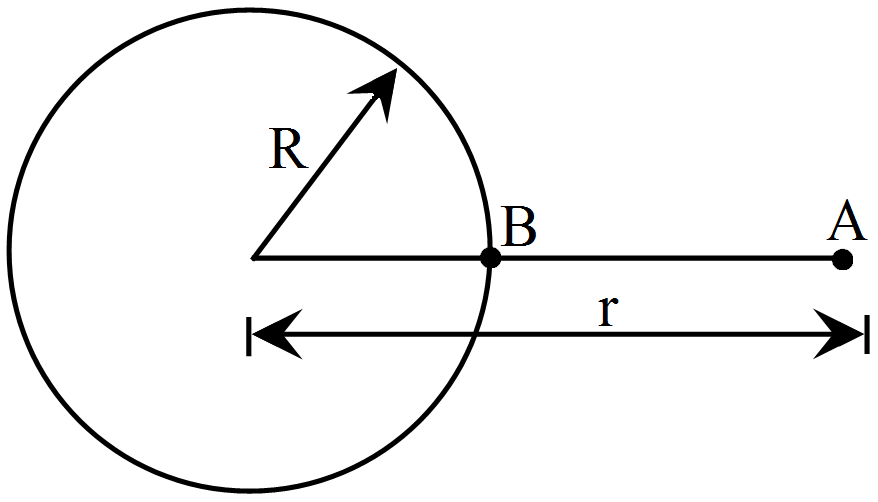 $-\frac{\text{GMm}}{\text{r}}=-\frac{\text{GMm}}{\text{R}}+\frac{1}{2}\text{mv}^2$ $\text{v}^2=\frac{2\text{GM}}{\text{R}}-\frac{2\text{GM}}{\text{R}}$ $=\frac{2\text{GMR}}{\text{R}^2}-\frac{2\text{GM}}{\text{R}^2}\frac{\text{R}^2}{\text{r}}$ $=2\text{gR}\big(1-\frac{\text{R}}{\text{r}}\Big)$ $\text{v}=\sqrt{2\text{gR}\Big(1-\frac{\text{R}}{\text{r}}\Big)}$ $=\sqrt{2\text{gR}^2\Big(\frac{1}{\text{R}}-\frac{1}{\text{r}}\Big)}$ $=\text{R}\sqrt{2\text{g}\Big(\frac{1}{\text{R}}-\frac{1}{\text{r}}\Big)}$
 View full question & answer→Question 603 Marks
What is gravitational potential energy at a point? How much of work is done in shifting a mass from the surface to a height equal to its radius?
AnswerGravitational potential energy is the work done in shifting a mass m from one point to the other. At any distance x from the centre of earth (M), the gravitational force is, $\frac{\text{GMm}}{\text{x}^2}$ $\therefore$ Work done in shifting (m) from the surface to a height equal to the radius, then, $\text{W}=\int^\limits{2\text{R}}_\limits{\text{R}}\frac{\text{GMm}}{\text{x}^2}\text{dx}$$=\text{GMm}\Big[-\frac{1}{\text{x}}\Big]^{2\text{R}}_{\text{R}}=-\frac{\text{GMm}}{\text{2R}}$
View full question & answer→Question 613 Marks
Two planets have masses in the ratio $1 : 10$ and radii in the ratio $2 : 5$. Compare:
- Their densities.
- The acceleration due to gravity on their surface.
- Escape velocities from their surfaces.
- The periods of revolutions of satellites near to their surfaces.
AnswerLet $M_1, M_2$ by the masses and $R_1, R_2$ be the radii of the planets.
$\Rightarrow \frac{\text{M}_1}{\text{M}_2}=\frac{1}{10}$ and $\frac{\text{R}_1}{\text{R}_2}=\frac{2}{5}$
- Ratio of densities $=\frac{\text{d}_1}{\text{d}_2}$
$\frac{\text{d}_1}{\text{d}_2}=\bigg[\frac{\text{M}_1}{\frac{4}{3}\pi\text{R}_1^3}\bigg]\bigg[\frac{\frac{4}{3}\pi\text{R}^3_2}{\text{M}_2}\bigg]$
$\frac{\text{d}_1}{\text{d}_2}=\frac{\text{M}_1}{\text{M}_2}\Big[\frac{\text{R}_2}{\text{R}_1}\Big]^3$
$\frac{\text{d}_1}{\text{d}_2}=\Big[\frac{1}{10}\Big]\Big[\frac{5}{2}\Big]^3=\frac{25}{16}$
- Acceleration due to gravity at the surface $=\text{g}=\frac{\text{GM}}{\text{R}^2}$
$\therefore\ \frac{\text{g}_1}{\text{g}_2}=\frac{\text{M}_1}{\text{M}_2}\Big[\frac{\text{R}_2}{\text{R}_1}\Big]^2$
$=\frac{1}{10}\Big[\frac{5}{2}\Big]^2=\frac{5}{8}$
- Escape velocity $=\sqrt{\frac{2\text{GM}}{\text{R}}}$
$\Rightarrow\frac{\text{v}_1}{\text{v}_2}=\sqrt{\frac{\text{M}_1}{\text{M}_2}}\sqrt{\frac{\text{R}_2}{\text{R}_1}}=\sqrt{\frac{1}{10}\times\frac{5}{2}}=\frac{1}{2}$
- Time period of a satellite near the surface $($orbit radius $= R) =\frac{2\pi}{\sqrt{\text{GM}}}\text{R}\sqrt{\text{R}}$
$\Rightarrow\frac{\text{T}_1}{\text{T}_2}=\sqrt{\frac{\text{M}_2}{\text{M}_1}}\Big[\frac{\text{R}_1}{\text{R}_2}\Big]\Big[\sqrt{\frac{\text{R}_1}{\text{R}_2}}\Big]$
$=\sqrt{\frac{10}{1}}\Big[\frac{2}{5}\Big]\Big[\sqrt{\frac{2}{5}}\Big]=\frac{4}{5}$ View full question & answer→Question 623 Marks
- According to Kepler's second law, the radius vector to a planet from the sun sweeps out equal areas in equal interval of time. The law is consequence of which conservation law?
- State Kepler's third law.
Answer
- Law of conservation of angular momentum.
- Kepler's third law is also known as law of periods, the square of the period of revolution of a planet around the Sun is proportional to the cube of semi major axis of elliptical orbit.
View full question & answer→Question 633 Marks
The change in the value of g at a height h above the earth is same as at a depth d below it. If h and d are small as compared to the radius of the earth, what is the ratio $\Big(\frac{\text{h}}{\text{d}}\Big)?$
Answer$\text{g}_{\text{h}}=\frac{\text{gR}^2}{(\text{R}+\text{h})^2}=\frac{\text{gR}^2}{\text{R}^2\Big(1+\frac{\text{h}}{\text{R}}\Big)^2}$ $=\text{g}\Big(1+\frac{\text{h}}{\text{R}}\Big){-2}=\text{g}\Big(1-\frac{2\text{h}}{\text{R}}\Big)$ $\text{g}_{\text{d}}=\text{g}\Big(1-\frac{\text{d}}{\text{R}}\Big)\dots(2)$ $\text{But }\text{g}\Big(1-\frac{2\text{h}}{\text{R}}\Big)=\text{g}\Big(1-\frac{\text{d}}{\text{R}}\Big)$ $\text{ or }1-\frac{2\text{h}}{\text{R}}=1-\frac{\text{d}}{\text{R}}\text{ or }\frac{\text{h}}{\text{d}}=\frac{1}{2}$
View full question & answer→Question 643 Marks
If the earth has a mass $9$ times and radius twice of the planet Mars, calculate the minimum speed required by a rocket to pull out of the gravitational force of Mars. Escape speed on the surface of the earth is $11.2km s^{-1}$.
AnswerEscape speed on the surface of earth is, $\text{v}_\text{e}=\sqrt{\frac{2\text{GM}}{\text{R}}}=11.2\text{km s}^{-1}$ Now, Mass of Mars $=\frac{\text{M}}{9}$ Radius of Mars $=\frac{\text{R}}{2}$ $\therefore$ Escape speed on the surface of Mars is,$\text{v}_\text{m}=\sqrt{\frac{2\text{G}\big(\frac{\text{M}}{9}\big)}{\frac{\text{R}}{2}}}$
$=\sqrt{\frac{4}{9}\frac{\text{GM}}{\text{R}}}=\frac{\sqrt{2}}{3}\times\text{v}_\text{e}$
$=\frac{1.414}{3}\times11.2\text{km s}^{-1}=5.279\text{km s}^{-1}$
View full question & answer→Question 653 Marks
What is escape velocity. Derive an expression for the same.
AnswerThe minimum velocity required to escape from the gravitational force of earth is called escape velocity. Total energy is the sum of P.E. and K.E. $\text{T.E}=-\frac{\text{GMm}}{\text{R}}+\frac{1}{2}\text{mv}^2$ To escape K.E should be greater than P.E., i.e.. $\frac{1}{2}\text{mv}^2\geq-\frac{\text{GMm}}{\text{R}}$ $\text{v}_{\text{e}}=\sqrt{2\frac{\text{GM}}{\text{R}}}=\sqrt{2\text{gR}}$
View full question & answer→Question 663 Marks
A projectile is fired vertically upward from the surface of earth with a speed $kv_e$, where $v_e$. is the escape speed and $k < 1$. Neglecting air resistance show that the maximum height to which it will rise measured from the centre of earth is $\frac{\text{R}}{(1-\text{k}^2)},$ where R is the radius of the earth.
AnswerLet a body of mass m be projected from the surface of earth with speed v and it reaches to a height h. Using law of conservation of energy (relative to surface of earth) we have, $\frac{1}{2}\text{mv}^2=\frac{\text{mgh}}{1+\frac{\text{h}}{\text{R}}}$ In this problem, $\text{v}=\text{kv}_\text{e}=\text{k}\sqrt{2\text{gR}}$ and h = r - R So, $\frac{1}{2}\text{mk}^22\text{gR}=\frac{\text{mg(r}-\text{R})}{\Big[1+\frac{(\text{r}-\text{R})}{\text{R}}\Big]}$
$\text{k}^2=\frac{\text{r}-\text{R}}{\text{r}}=1-\frac{\text{R}}{\text{r}}$
$\Rightarrow\ \text{r}=\frac{\text{R}}{1-\text{k}^2}.$
View full question & answer→Question 673 Marks
Out of aphelion and perihelion, where is the speed of the earth more and why?
AnswerThe earth revolves around the sun in an elliptical orbit or by Kepler’s first law and sun remains at its one focus. The position of earth at P and A at shortest and longest distance are called perihelion and Aphelion respectively. 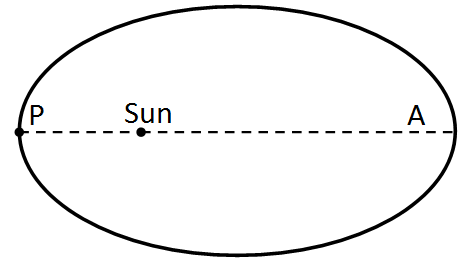 According to the second law of kepler’s the areal velocity of planet around the sun is constant. $\frac{\text{dA}}{\text{dt}}=\frac{\text{L}}{2\text{m}}=\frac{\text{r}\times\text{p}}{2\text{m}}=\frac{\text{r}\times\text{mv}}{2\text{m}}=\frac{1}{2}\text{r}\times\text{v}$ Hence, if r increases at Aphelion the v decreases and vice - versa at p.
 View full question & answer→Question 683 Marks
Define gravitational potential and gravitational field intensity. Give their units. Also write the relation between them.
AnswerGravitational potential at a point in gravitational field of the body is defined as the amount of work done in bringing a body of unit mass from infinity to that point without acceleration. It has units of J/ kg. Gravitational field intensity is defined as the force experienced by a body of unit mass placed at that point provided the presence of unit mass does not disturb the original gravitational field. It is expressed in N/ kg. $\text{I}=\frac{\text{V}_{\text{p}}}{\text{r}}$
View full question & answer→Question 693 Marks
An astronaut, on his journey between the earth and the moon experience weightlessness at a point $P$. Find the distance of the point $P$ from the centre of the earth. (Given: mass of earth is 80 times the mass of the moon and the distance between them is $3.84 \times 10^5 \mathrm{~km}$ ).
AnswerLet the distance between P and the centre of earth be x. At this point the gravitational pull due to earth on a mass m balances the gravitational pull due to the moon. $\text{F}=\text{G}\frac{\text{M}_{\text{E}}\text{m}}{(\text{d}-\text{x})^2}$
$\text{or }\frac{\text{M}_{\text{E}}}{\text{x}^2}=\frac{\text{M}_{\text{m}}}{(\text{d}-\text{x})^2}$
$\frac{(\text{d}-\text{x})^2}{\text{x}^2}=\frac{\text{M}_{\text{m}}}{\text{M}_{\text{E}}}$
$\frac{\text{d}-\text{x}}{\text{x}}=\frac{1}{\sqrt{80}}$
$\frac{\text{d}-\text{x}}{\text{x}}=\frac{1}{8.94}$
$\text{x}=8.94\text{d}-8.94\text{x}$
$9.94\text{x}=8.94\text{d}$
$\text{x}=\frac{8.94\times3.84\times10^5}{9.94}$
$(\dots\text{d}=3.84\times10^5\text{km})$
$=3.4\times10^5\text{km}.$
View full question & answer→Question 703 Marks
The acceleration due to gravity on the moon is only one-sixth of that on earth. Suppose the average density of both are same, what would be the ratio of the radii of the moon and the earth?
Answer$\text{g}=\frac{\text{GM}}{\text{R}^2}$ $\frac{1}{6}=\frac{\text{g}_{\text{moon}}}{\text{g}_{earth}}=\frac{\text{R}^2_{\text{e}}\text{M}_{\text{m}}}{\text{R}^2_{\text{m}}\text{M}_{\text{e}}}$ $=\frac{\text{R}^2_{\text{e}}}{\text{R}^2_{\text{m}}}\times\frac{\frac{4}{3}\pi\text{R}^3_{\text{m}}\rho}{\frac{4}{3}\pi\text{R}^3_{\text{e}}\rho}=\frac{\text{R}_{\text{m}}}{\text{R}_{\text{e}}}$ $\therefore\text{R}_{3}=\frac{1}{6}\text{R}_{\text{e}}.$
View full question & answer→Question 713 Marks
Taking the moon's orbit around earth to be r and mass of earth 81 times the mass of the moon. Find the position of the point from the earth, where the net gravitational field is zero.
AnswerLet x be the distance of a point from the earth where resultant gravitational field intensity is zero. So, $\frac{\text{GM}_\text{e}}{\text{x}^2}=\frac{\text{GM}_\text{e}}{(\text{r}-\text{x})^2}$ $\frac{81\text{M}_\text{m}}{\text{x}^2}=\frac{\text{M}_\text{m}}{(\text{r}-\text{x})^2}$ $\frac{9}{\text{x}}=\frac{1}{(\text{r}-\text{x})}$ $9\text{r}=10\text{x}$ $\text{x}=\frac{9\text{r}}{10}=0.9\text{r}$
View full question & answer→Question 723 Marks
What is the direction of areal velocity of the earth around the sun?
AnswerAreal velocity of the earth around the sun is given by $\frac{\vec{\text{dA}}}{\text{dt}}=\frac{\vec{\text{L}}}{2\text{M}}$ 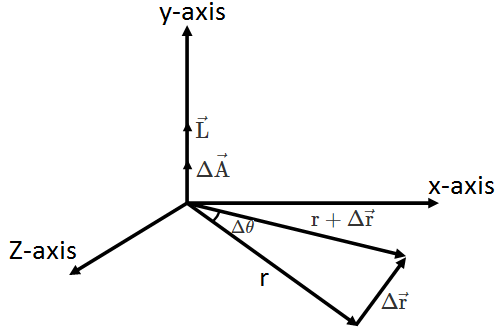 where, L is the angular momentum and M is the mass of the earth. But angular momentum $\vec{\text{L}}=\vec{\text{r}}\times\vec{\text{p}}=\vec{\text{r}}\times\text{m}\vec{\text{v}}$ Therefore, the direction of a real velocity$\Big(\frac{\vec{\text{dA}}}{\text{dt}}\Big)$is in the direction of $(\vec{\text{r}}\times\vec{\text{v}}),$ i.e., perpendicular to the plane containing r and v and directed as given by right hand rule. So, areal velocity is normal to the plane containing Earth and Sun as shown in the figure.
 View full question & answer→Question 733 Marks
The mass and diameter of a planet are twice of those of the earth. What will be the period of oscillation of a pendulum on this planet, if it is a second's pendulum on the earth?
AnswerWe know, $\text{g}=\frac{\text{GM}_{\text{e}}}{\text{R}^2}$
$\therefore\text{g}_{\text{e}}=\frac{\text{GM}_{\text{e}}}{\text{R}^2_{\text{e}}}$ $\text{and }\text{g}_{\text{p}}=\frac{\text{GM}_{\text{p}}}{\text{R}^2_{\text{p}}}$ Given : $M_p = 2M_e and R_p = 2Re$
$\therefore\frac{\text{g}_{\text{p}}}{\text{g}_{\text{e}}}=\frac{1}{2}$
The time period of a simple pendulum is given by $\text{T}_{\text{e}}=2\pi\sqrt{\frac{\text{l}}{\text{g}_{\text{e}}}}$ $\text{and }\text{T}_{\text{p}}=2\pi\sqrt{\frac{\text{l}}{\text{g}_{\text{p}}}}$ $\text{For }\text{T}_{\text{e}}=1\text{s},\text{T}_{\text{p}}=\sqrt{2}\text{s}.$
View full question & answer→Question 743 Marks
A rocket is fired from the earth towards the sun. At what distance from the earth’s centre is the gravitational force on the rocket zero? Mass of the sun $= 2 \times 10^{30}kg$, mass of the earth $= 6\times 10^{24}kg$. Neglect the effect of other planets etc. (orbital radius $= 1.5 \times 10^{11}m).$
AnswerGiven: Mass of Sun $M = 2 \times 10^{30}kg$ Mass of the earth $m = 6 \times 10^{24}kg$
Distance between Sun and Earth $r = 1.5 \times 10^{11}m$ Consider a point R,
where the gravitational force on the rocket due to earth = gravitational force on the rocket due to sun.
Distance of point R from the Earth = x
Therefore, $\frac{(\text{Gm})}{(\text{r}^2)}=\frac{(\text{GM})}{(\text{r}-\text{x})^2}$
$\frac{(\text{r}-\text{x})^2}{(\text{x})^2}=\Big(\frac{\text{M}}{\text{m}}\Big)$
$=\frac{(2\times10^{30})}{(6\times10^{24})}$
$=\frac{(10^{6})}{(3)}$
$=\frac{(\text{r}-\text{x})}{(\text{x})}=\frac{(10)^3}{(\sqrt{3})}$
$\big(\frac{\text{r}}{\text{x}}\big)=\frac{(10)^3}{(\sqrt{3})+1}$
$\approx\frac{(10)^3}{(\sqrt{3})}$
$\text{x}=\frac{(\sqrt{3})\text{r}}{(10)^3}$
$=\frac{(1.732\times1.5\times10^{11})}{(10^3)}\text{m}$
$=2.6\times10^8\text{m}$
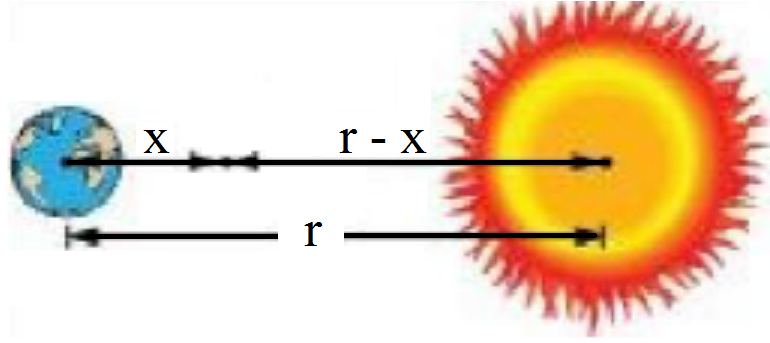
View full question & answer→Question 753 Marks
The magnitude of gravitational field at distances $r_1$ and $r_2$ from the centre of a uniform sphere of radius $R$ and mass $M$ are $I_1$ and $I_2$ respectively. Find the ratio of $\left(\frac{I_1}{I_2}\right)$ if $r_1>R$ and $r_2<R$.
AnswerWhen $r_1 > R$, the point lies outside the sphere. Then sphere can be considered to be a point mass body whose whole mass can be supposed to be concentrated at its centre. Then gravitational intensity at a point distance $r_1$ from the centre of sphere will be, $\text{I}_1=\frac{\text{GM}}{\text{r}^2_1}\dots(\text{i})$ When $r_2 < R$, the point P lies inside the sphere. The unit mass body placed at P, will experience gravitational pull due to sphere of radius $r_2$_, whose mass is $\text{M}'=\frac{\text{M}\times\frac{4}{3}\pi\text{r}^3_2}{\frac{4}{3}\pi\text{R}^3}=\frac{\text{Mr}_2^3}{\text{R}^3}.$
Therefore the gravitational intensity at P will be $\text{I}_2=\frac{\text{GM r}_2^3}{\text{R}^3}\times\frac{1}{\text{r}_2^2}$
$=\frac{\text{GM r}_2}{\text{R}^3}\dots(\text{ii})$ So, $\frac{\text{I}_1}{\text{I}_2}=\frac{\text{GM}}{\text{r}^2_1}\times\frac{\text{R}^3}{\text{GM r}_2}=\frac{\text{R}^3}{\text{r}_1^2\text{r}_2}.$
View full question & answer→Question 763 Marks
Find an expression for the weight of a body at the centre of the Earth.
AnswerWe know that value of acceleration due to gravity at a depth'd below the surface of Earth is given by $\mathrm{g}_{\mathrm{d}}=\mathrm{g}\left(1-\frac{\mathrm{d}}{\mathrm{R}}\right)$ At the centre of Earth $\mathrm{d}=\mathrm{R}$ and hence, $\mathrm{g}_{\text {centre }}=\mathrm{g}\left(1-\frac{\mathrm{R}}{\mathrm{R}}\right)=\mathrm{g}(1-1)=0 $
$\therefore$ Weight of a body at the centre of Earth $=\mathrm{mg}_{\text {centre }}=\mathrm{m} \times 0=0 \mathrm{It}$ means that at the centre of Earth a body will be weightless.
View full question & answer→Question 773 Marks
What is the angular velocity at any point on the equator so that the body feels weightlessness?
AnswerAt any point on the surface of earth, the acceleration due to gravity is, $\text{g}'=\text{g}\Big(1-\frac{\text{R}\omega^2}{\text{g}}\cos^2\alpha\Big),$ where $\alpha$ is the latitude. For equator, $\alpha=0$ To feel weightlessness $\text{g}'=0$ $\therefore\text{g}\Big(1-\frac{\text{R}\omega^2}{\text{g}}\Big)=0$ $\therefore\omega=\sqrt{\frac{\text{g}}{\text{R}}}$
View full question & answer→Question 783 Marks
A high jumper can jump $1.5m$ on earth. With the same effort, how high will he be able to jump on a planet whose density is one-third and radius is one-fourth of that of the earth?
AnswerLet $h_e$ be the height in metre, the man jumps on the earth and $h_p$ on the planet. If the effort is same, the P.E. gained is same. Therefore, $\text{Mg}_{\text{p}}\text{h}_{\text{p}}=\text{Mg}_{\text{e}}\text{h}_{\text{e}}$ $\text{h}_{\text{p}}=\frac{\text{g}_{\text{e}}\text{h}_{\text{e}}}{\text{g}_{\text{p}}}$ We know, $\text{g}_{\text{e}}=\frac{\text{GM}_{\text{e}}}{\text{R}_{\text{e}}}=\text{G}\frac{4}{3}\pi\text{R}_{\text{e}}\rho_{\text{e}}$ $\frac{\text{g}_{\text{e}}}{\text{g}_{p}}=\frac{\text{R}_{\text{e}}\rho_{\text{e}}}{\text{R}_{\text{e}}\rho_{\text{e}}}=12$ $\therefore\text{h}_{\text{p}}=12\times\text{h}_{\text{e}}=12\times1.5=18\text{m}$
View full question & answer→Question 793 Marks
A particle is projected vertically upwards from the surface of Earth of radius R with a kinetic energy equal to half of the minimum value needed for it to escape. Find the height to which it rises above the surface of Earth.
AnswerWe know that escape velocity from the surface of Earth is given by, $\text{v}_\text{es}=\sqrt{\frac{2\text{GM}}{\text{R}}}$ and corresponding K.E. of a body $\text{K}_\text{es}=\frac{1}{2}\text{mv}^2_\text{es}=\frac{\text{GMm}}{\text{R}}$ As in present problem, the body is projected from the surface of Earth with a kinetic energy half of that needed to escape from Earth's surface, hence Initial kinetic energy of body $\text{K}=\frac{\text{K}_\text{es}}{2}=\frac{\text{GMm}}{2\text{R}}$ and its potential energy at surface of Earth $\text{U}=-\frac{\text{GMm}}{\text{R}}$ $\therefore$ Total initial energy of body $\text{K}+\text{U}=\frac{\text{GMm}}{2\text{R}}-\frac{\text{GMm}}{\text{R}}$ $=-\frac{\text{GMm}}{2\text{R}}$ Let the body goes up to a maximum height h from surface of Earth, where its final K.E. = 0 and $\text{P.E.}=-\frac{\text{GMm}}{(\text{R}+\text{h})}$ $\therefore$ Total energy now $=0-\frac{\text{GMm}}{(\text{R}+\text{h})}=-\frac{\text{GMm}}{(\text{R}+\text{h})}$ From conservation law of mechanical energy, we have $-\frac{\text{GMm}}{2\text{R}}=-\frac{\text{GMm}}{(\text{R}+\text{h})}$ On simplification it leads to the result h = R.
View full question & answer→Question 803 Marks
If a satellite is revolving around a planet of mass M in an elliptical orbit of semi major axis a, show that orbital speed v of the satellite when at a distance r from the focus will be given by $\text{v}^2=\text{GM}\Big(\frac{2}{\text{r}}-\frac{1}{\text{a}}\Big)$
AnswerIn case of elliptical orbit of a satellite, its mechanical energy (i.e., sum of K.E. and P.E.) remains constant at any position of satellite in the orbit, which is given by K.E. + P.E. $=\frac{\text{GMm}}{2\text{a}}$ If at a position r, v is the orbital speed of satellite, then $\text{K.E.}=\frac{1}{2}\text{mv}^2$ $\text{and }\text{P.E.}=-\frac{\text{GMm}}{\text{r}}\dots(2)$ From (1) and (2), we have $\frac{1}{2}\text{mv}^2-\frac{\text{GMm}}{\text{r}}=-\frac{\text{GMm}}{2\text{a}}$ $\text{or }\text{v}^2=\text{GM}\Big[\frac{2}{\text{r}}-\frac{1}{\text{a}}\Big]$
View full question & answer→Question 813 Marks
Calculate the minimum energy required to launch a 250kg satellite from earth's surface at an altitude of 2R when R is the radius of the earth and is equal to 6400km.
AnswerThe total energy of a satellite of mass m in a circular orbit of radius r is where r is $\frac{1}{2}\text{mv}^2-\text{G}\frac{\text{Mm}}{\text{r}}$Where r is measured from the centre of the earth. Total mechanical energy in the orbit is $\text{E}=\text{G}\frac{\text{mM}}{2\text{r}}-\text{G}\frac{\text{Mm}}{\text{r}}$
$=-\text{G}\frac{\text{mM}}{2\text{r}}$
$\text{r}=2\text{R}+\text{R}=3\text{R}$
$\text{E}=-\text{G}\frac{\text{mM}}{6\text{R}}$
The potential energy on the surface of the earth $=-\text{G}\frac{\text{mM}}{\text{R}}$ Minimum energy required $=-\frac{1}{6}\text{G}\frac{\text{mM}}{\text{R}}-\Big(-\text{G}\frac{\text{Mm}}{\text{R}}\Big)$ $=\frac{5}{6}\text{G}\frac{\text{mM}}{\text{R}}$ $=\frac{5}{6}\text{mg R}=\frac{5}{6}\times250\times9.8\times6.4\times10^6\text{J}$ $=1.3\times10^{10}\text{J}.$
View full question & answer→Question 823 Marks
What is the period of revolution of Neptune around the sun, given that the diameter of its orbit is 30 times the diameter of the earth's orbit around the sun, both orbits being assumed to be circular? Taking the moon's orbit around earth to be r and mass of earth 81 times the mass of the moon, find the position of the point from the earth where the net gravitational field is zero.
AnswerAccording to Kepler's law, $\text{T}^2\propto\text{r}^3$ $\text{T}^2_2=\text{T}^2_1\Big(\frac{\text{r}^2}{\text{r}_1}\Big)^3;$Taking $\text{T}_1=1\text{ year}$
$\text{T}^2_2=(1)^2\ (30)^3=27000$ or $\text{T}_2=\sqrt{27000}=164.3\text{ year}.$
View full question & answer→Question 833 Marks
Two stationary particles of masses $M_1$ and $M_2$ are a distance d apart. A third particle lying on the line joining the particles, experiences no resultant gravitational force. What is the distance of this particle from $M_1$?
AnswerThe force on m towards $M_1$ is $\text{F}=\text{G}\frac{\text{M}_1\text{m}}{\text{r}^2}$ The force on m toward $M_2$ is $\text{F}=\text{F}\frac{\text{M}_2\text{m}}{(\text{d}-\text{r})^2}$
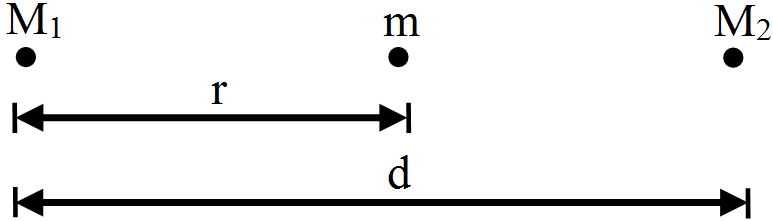
Equating two forces, we have, $\text{G}=\frac{\text{M}_1\text{m}}{\text{r}^2}=\text{G}\frac{\text{M}_2\text{m}}{(\text{d}-\text{r})^2}$ $\Big(\frac{\text{d}-\text{r}}{\text{r}}\Big)^2=\frac{\text{M}_2}{\text{M}_1}$ or $\frac{\text{d}}{\text{r}}-1=\frac{\sqrt{\text{M}_2}}{\sqrt{\text{M}_1}}$ $\Rightarrow\frac{\text{d}}{\text{r}}=\frac{\sqrt{\text{M}_2}+\sqrt{\text{M}_1}}{\sqrt{\text{M}_1}}$ So, distance of an particle from m is, $\text{r}=\text{d}\Big(\frac{\text{M}_1}{\sqrt{\text{M}_1}+\sqrt{\text{M}_2}}\Big)$ View full question & answer→Question 843 Marks
Find the angular velocity for an object to experience weightlessness at the equator of earth. Under this condition, also find the duration of a day.
AnswerDue to the rotation $\text{g}'=\text{g}\Big(1-\frac{\text{R}\omega^2}{\text{g}}\cos^2\theta\Big)$ where $\theta$ is the latitude. For weightlessness, g' = 0. At the equator, $\theta=0^\circ$ $\therefore1-\frac{\text{R}\omega^2}{\text{g}}\cos^20^\circ=0$ $\text{or }\omega=\sqrt{\frac{\text{g}}{\text{R}}}$ $\Rightarrow\omega=\sqrt{\frac{10}{6400\times10^3}}=\frac{1}{800}$ $\omega=\frac{2\pi}{\text{T}}$ $\Rightarrow=\frac{2\text{x}}{\omega}=\frac{2\times3.14}{\frac{1}{800}}$ $=5024\text{sec.}$
View full question & answer→Question 853 Marks
If the radius of the earth were increased by a factor of 3, by what factor would its density have to be changed to keep 'g' the same?
Answer$\text{g}=\frac{\text{GM}}{\text{R}^2}$ Let $\rho$ be the density of earth. $\rho=\frac{\text{M}}{\text{Volume of earth}}=\frac{\text{M}}{\frac{4}{3}\pi\text{R}^3}$ $\text{or }\text{M}=\frac{4}{3}\pi\text{R}\rho$ $\text{g}=\frac{\text{G}}{\text{R}^2}\times\frac{4}{3}\pi\text{R}\rho=\frac{4}{3}\pi\text{G}\rho\text{R}$ Since $\frac{4}{3},\pi,\text{G}$ are constants. For no change in value of $'\text{g}'\text{R}\propto\frac{1}{\rho}$ If R is made $3\text{R, }\rho$ must become $\frac{\rho}{3}.$
View full question & answer→Question 863 Marks
The planet Mars has two moons, phobos and Deimos.
- Phobos has a period $7$ hours, $39$ minutes and an orbital radius of $9.4 \times 10^3km$. Calculate the mass of mars.
- Assume that earth and mars move in circular orbits around the sun, with the Martian orbit being $1.52$ times the orbital radius of the earth. What is the length of the Martian year in days?
Answer
- The Sun's mass replaced by the martian mass $M_m$.
$\text{T}^2=\frac{4\pi^2}{\text{GM}_\text{m}}\text{R}^3$
$\text{M}_\text{m}=\frac{4\pi^2}{\text{G}}\times\frac{\text{R}^3}{\text{T}^2}$
$\text{M}_\text{m}=\frac{4\times(3.14)^2\times(9.4)^3\times10^{18}}{6.67\times10^{-11}\times(459\times60)^2}$
$=\frac{4\times(3.14)^2\times(9.4)^3\times10^{18}}{6.67\times(4.59\times6)^2\times10^{-5}}$
$=6.48\times10^{23}\text{kg}$
- Using Kepler's third law,
$\frac{\text{T}^2_\text{M}}{\text{T}^2_\text{E}}=\frac{\text{R}^3_\text{MS}}{\text{R}^3_\text{ES}}$
where $R_{MS} (R_{ES})$ is the Mars $($Earth$) -$ Sun distance.
$\text{T}_\text{M}=\Big(\frac{\text{R}_\text{MS}}{\text{R}_\text{ES}}\Big)^\frac{3}{2}\times\text{T}_\text{E}$
$=(1.52)^\frac{3}{2}\times365=684\text{ days}$ View full question & answer→Question 873 Marks
Two bodies of m and 4m are placed at a distance. The gravitational field is zero at a point on the line joining the two masses. What will be the gravitational potential at this point?
Answer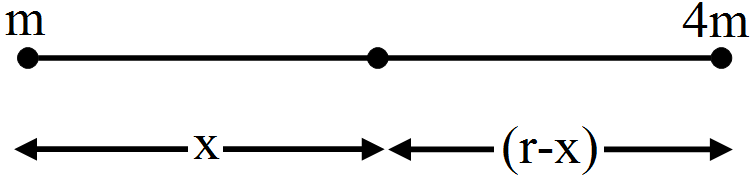 $\Rightarrow\text{3x}=\text{r}$ $\Rightarrow\text{x}=\frac{\text{r}}3{}$ $\therefore$ The gravitational potential $=\frac{-\text{Gm}}{\frac{\text{r}}{3}}\frac{-\text{(4m)}}{\frac{2\text{r}}{3}}$ $=\frac{-3\text{Gm}}{\text{r}}\frac{-6\text{Gm}}{\text{r}}=\frac{-9\text{Gm}}{\text{r}}$
 View full question & answer→Question 883 Marks
What is escape velocity. Derive an expression for the same.
AnswerThe minimum velocity required to escape from the gravitational force of earth is called escape velocity. Total energy is the sum of P.E. and K.E. $\text{T.E}=-\frac{\text{GMm}}{\text{R}}+\frac{1}{2}\text{mv}^2$ To escape K.E should be greater than P.E., i.e.. $\frac{1}{2}\text{mv}^2\geq-\frac{\text{GMm}}{\text{R}}$ $\text{v}_{\text{e}}=\sqrt{2\frac{\text{GM}}{\text{R}}}=\sqrt{2\text{gR}}$
View full question & answer→Question 893 Marks
Draw areal velocity versus time graph for mars.
AnswerAreal velocity of Mars revolving around the Sun does not change with time according to Kepler’s law, i.e. it is constant with time. Then graph of a real velocity versus time is a straight line parallel to time axis.
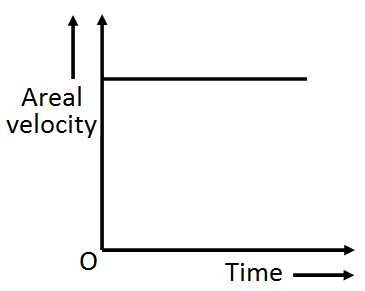
View full question & answer→Question 903 Marks
If a body is taken to a height equal to the radius of earth from its surface, how much the weight of a body will decrease?
AnswerOn the surface of the earth,$\text{g}=\text{G}.\frac{\text{M}}{\text{R}^2}\dots(\text{i})$
and on the height where h = R $\text{g}'=\text{G}.\frac{\text{M}}{(\text{R}+\text{R})^2}=\text{G}.\frac{\text{M}}{4\text{R}^2}\dots(\text{ii})$ Dividing (ii) by (i) we get $\frac{\text{g}'}{\text{g}}=\frac{\text{G}.\frac{\text{M}}{4\text{R}^2}}{\text{G}.\frac{\text{M}}{\text{R}^2}}$ $\therefore\ \frac{\text{g}'}{\text{g}}=\frac{1}{4}\Rightarrow\ \text{g}'=\frac{\text{g}}{4}$ Hence the weight of the body will reduce to one-fourth of its original weight on the surface of the earth.
View full question & answer→Question 913 Marks
Can a satellite be in an orbit in a plane not passing through the earth's centre? Explain your answer.
Answer The centripetal force required for the orbital motion of the satellite is provided by the gravitational force of attraction. Gravitational force is a central force, i.e., it passes through the centre of mass of the earth and the satellite. Hence, the plane of orbit of the satellite has to pass through the earth’s centre.
View full question & answer→Question 923 Marks
A satellite is revolving around the earth, close to the surface of earth with a kinetic energy E. How much kinetic energy should be given to it so that it escapes from the surface of earth?
AnswerLet $v_0, v_e$ be the orbital and escape speeds of the satellite, then $\text{v}_\text{e}=\sqrt{2}\text{v}_0.$ Energy in the given orbit, $\text{E}_1=\frac{1}{2}\text{mv}_0^2=\text{E}\dots(\text{i})$ Energy for the escape speed, $\text{E}_2=\frac{1}{2}\text{mv}_\text{e}^2=\frac{1}{2}\text{m}(\sqrt{2}\text{v}_0)^2=2\text{E}$
$\therefore$ Energy required to be supplied =$E_2 - E_1 = E$.
View full question & answer→Question 933 Marks
A stationary object is released from a point P a distance 3R from the centre of the moon which has radius R and mass M. Calculate the speed of the object on hitting the moon.
AnswerGain in kinetic energy by the object = Loss in gravitational potential $\frac{1}{2}\text{mv}^2=\Big(-\frac{\text{GMm}}{\text{3R}}\Big)-\Big(-\frac{\text{GMm}}{\text{R}}\Big)$ $\Rightarrow\frac{1}{2}\text{v}^2=\frac{2\text{GM}}{3\text{R}}$ 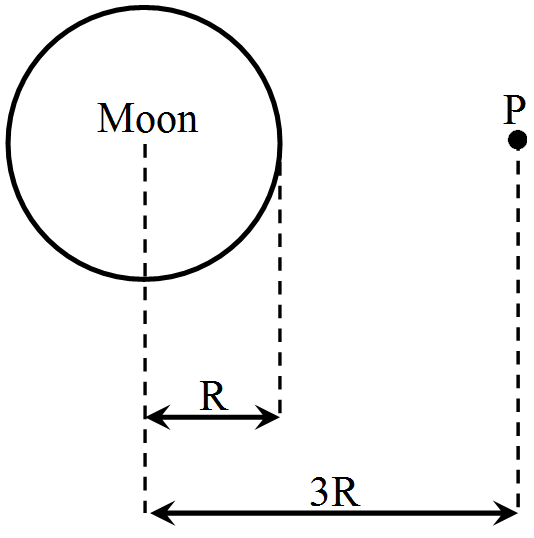 ⇒ Speed of the object $=\text{v}=\sqrt{\frac{4\text{GM}}{3\text{R}}}$
 View full question & answer→Question 943 Marks
Calculate the change in the energy of a $500kg$ satellite when it falls from an altitude of $200km$ to $199km$. If this change takes place during one orbit. Calculate the retarding force on the satellite. Given, mass of the earth = $6 \times 10^{24}kg$ and radius of the earth = $6400km$.
AnswerGiven, $M_e = 6 \times 10^{24}kg, r_e = 6400km r_1 = 6400 + 200 = 6600km = 6.6 \times 10^6m r_2 = 6400 + 199 = 6599km = 6.599 \times 10^6m$ Change in energy $=\text{GMm}\Big(\frac{1}{\text{r}_1}-\frac{1}{\text{r}_2}\Big)$
$=6.67\times10^{-11}\times6\times10^{24}\times500$
$\Big(\frac{1}{6.6\times10^6}-\frac{1}{6.599\times10^6}\Big)$
$=2\times10^{17}(1.5152\times10^{-7}-1.5154\times10^7)\text{J}$
$=-4\times10^6\text{J}$ If this occurs during one orbit, then the energy lost = force \times distance. If we take the distance as beiag the circumference of one orbit. Then, Retarding force $=\frac{4\times10^6}{2\pi\times6.6\times10^6}=\frac{4\times10^6}{2\times6.6\times3.14\times10^6}=0.1\text{N}$
View full question & answer→Question 953 Marks
A $400 kg$ satellite is in a circular orbit of radius $2 R_E$ about the Earth. How much energy is required to transfer it to a circular orbit of radius $4 R_E$ ? What are the changes in the kinetic and potential energies?
AnswerInitially,
$
E_i=-\frac{G M_E m}{4 R_E}
$
While finally
$
E_f=-\frac{G M_E m}{8 R_E}
$
The change in the total energy is
$
\begin{array}{c}
\Delta E=E_f-E_i \\
=\frac{G M_E m}{8 R_E}=\left(\frac{G M_E}{R_E^2}\right) \frac{m R_E}{8} \\
\Delta E=\frac{g m R_E}{8}=\frac{9.81 \times 400 \times 6.37 \times 10^6}{8}=3.13 \times 10^9 J
\end{array}
$
The kinetic energy is reduced and it mimics $\Delta E$, namely, $\Delta K=K_f-K_i=-3.13 \times 10^9 J$.
The change in potential energy is twice the change in the total energy, namely
$
\Delta V=V_f-V_i=-6.25 \times 10^9 J
$
View full question & answer→Question 963 Marks
Weighing the Earth : You are given the following data: $g=9.81\ ms ^{-2}, R_E=6.37 \times 10^6 m$, the distance to the moon $R =3.84 \times 10^8 m$ and the time period of the moon's revolution is $27.3$ days. Obtain the mass of the Earth $M_E$ in two different ways.
AnswerFrom Eq. $(7.12)$ we have
$M_E=\frac{g R_E^2}{G}$
$=\frac{9.81 \times\left(6.37 \times 10^6\right)^2}{6.67 \times 10^{-11}}$
$=5.97 \times 10^{24} \ kg .$
The moon is a satellite of the Earth. From the derivation of Kepler's third law $[$see Eq. $(7.38)]$
$T^2=\frac{4 \pi^2 R^3}{G M_E}$
$M_E=\frac{4 \pi^2 R^3}{G T^2}$
$=\frac{4 \times 3.14 \times 3.14 \times(3.84)^3 \times 10^{24}}{6.67 \times 10^{-11} \times(27.3 \times 24 \times 60 \times 60)^2}$
$=6.02 \times 10^{24} \ kg$
Both methods yield almost the same answer, the difference between them being less than $1 \%$.
View full question & answer→Question 973 Marks
The planet Mars has two moons, phobos and delmos.
$(i)$ phobos has a period $7$ hours$, 39$ minutes and an orbital radius of $9.4 \times 10^3 \ km$. Calculate the mass of mars.
$(ii)$ Assume that earth and mars move in circular orbits around the sun, with the martian orbit being $1.52$ times the orbital radius of the earth. What is the length of the martian year in days?
Answer$(i)$ We employ Eq. $(7.38)$ with the sun's mass replaced by the martian mass $M_m$
$T^2=\frac{4 \pi^2}{G M_m} R^3$
$M _m=\frac{4 \pi^2}{G} \frac{R^3}{T^2}$
$=\frac{4 \times(3.14)^2 \times(9.4)^3 \times 10^{18}}{6.67 \times 10^{-11} \times(459 \times 60)^2}$
$M _m=\frac{4 \times(3.14)^2 \times(9.4)^3 \times 10^{18}}{6.67 \times(4.59 \times 6)^2 \times 10^{-5}}$
$=6.48 \times 10^{23} \ kg .$
$(ii)$ Once again Kepler's third law comes to our aid,
$\frac{T_M^2}{T_E^2}=\frac{R_{M S}^3}{R_{E S}^3}$
where $R_{M S}$ is the mars $-$ sun distance and $R_{E S}$ is the earth$-$sun distance.
$\therefore T_M =(1.52)^{3 / 2} \times 365$
$ =684 \text { days }$
We note that the orbits of all planets except Mercury and Mars are very close to being circular.
For example, the ratio of the semiminor to semi-major axis for our Earth is, $b / a=0.99986$.
View full question & answer→Question 983 Marks
Find the potential energy of a system of four particles placed at the vertices of a square of side $l$. Also obtain the potential at the centre of the square.
AnswerConsider four masses each of mass $m$ at the corners of a square of side $l$; See Fig. $7.9$.
We have four mass pairs at distance $l$ and two diagonal pairs at distance $\sqrt{2} t$
Hence,
$W(r)=-4 \frac{G m^2}{l}-2 \frac{G m^2}{\sqrt{2} l}$
$=-\frac{2 G m^2}{l}\left(2+\frac{1}{\sqrt{2}}\right)=-5.41 \frac{G m^2}{l}$
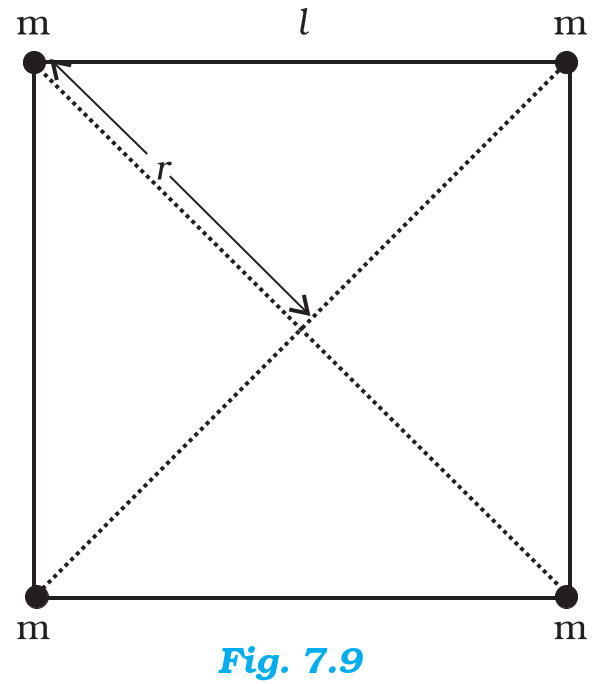
The gravitational potential at the centre of the square $(r=\sqrt{2} l / 2)$ is
$
U(r)=-4 \sqrt{2} \frac{ Gm }{l} .
$ View full question & answer→