Question 12 Marks
Explain the following with suitable examples:
Antiferromagnetism.
AnswerAntiferromagnetism:Antiferromagnetic substanceshave domain structures similar to ferromagnetic substances, but are oppositely-oriented. The oppositely-oriented domains cancel out each other's magnetic moments.
Schematic alignment of magnetic moments in antiferromagnetic substances.
View full question & answer→Question 22 Marks
A compound forms hexagonal close-packed structure. What is the total number of voids in 0.5 mol of it? How many of these are tetrahedral voids?
AnswerNumber of closed packed particles $= 0.5 \times 6.022 \times 10^{23} = 3.011 \times 10^{23}$
$0.5 \times 6.022 \times 1023 = 3.011 \times 1023$
Therefore number of octhahedral voids $= 3.011 \times 10^{23}\times 1023$
and number of tetrahedral voids $= 2 \times 3.011 \times 10^{23}$
$= 6.022 \times 10^{23}2 \times 3.011 \times 1023$
$= 6.022 \times 1023$
Therefore total number of voids $= 3.011 \times 10^{23} + 6.022\times 10^{23}$
$ = 9.033 \times 10^{23}3.011 \times 1023 + 6.022 \times 1023$
$= 9.033 \times 1023.$
View full question & answer→Question 32 Marks
Explain the following with suitable examples:
Ferromagnetism.
AnswerFerromagnetism:Few substances like iron, cobalt, nickel, gadolinium and $CrO_2$ are strongly attracted by a magnetic field. Such substances are known as ferromagnetic substances. These substances can be permanently magnetised with the help of strong electrostatic field. The metal ions of ferromagnetic substances are grouped together into small regions called domains in solid state. So that each domain acts as a tiny magnet. The domains of un magnetized piece of a ferromagnetic are randomly oriented so that their magnetic moments get cancelled out. When such substance is placed in a magnetic field, all the domains get oriented in the direction of the magnetic field and a strong magnetic effect is produced. This ordering of domains remains same even when the magnetic field is removed and the ferromagnetic substance becomes a permanent magnet.
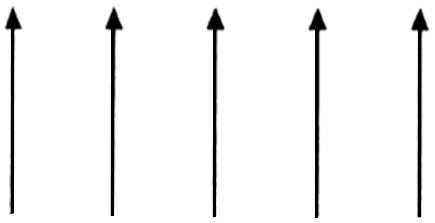
Fig. Schematic alignments of magnetic moments in ferromagnetism. View full question & answer→Question 42 Marks
Distinguish between:
- Hexagonal and monoclinic unit cells.
- Face-centred and end-centred unit cells.
Answer
-
| Hexagonal unit cell |
Monoclinic unit cell |
| a=b≠c |
a≠b≠c |
| α = β = 90° |
α = γ = 90° |
| γ = 120° |
β ≠ 90° |
-
| Face-centred unit cell |
End-centred unit cell |
| A Face-centred unit cell the constituent particles are present at the corners and one at the centre of each face. |
An End-centred unit cell contains particles at the corners and one at the centre of any two opposite faces. |
| Total no of particles in a face centered unit cell= 4 |
Total no. of particles in an end centered unit cell = 2 |
View full question & answer→Question 52 Marks
Gold (atomic radius = 0.144 nm) crystallises in a face-centred unit cell. What is the length of a side of the cell?
AnswerRadius, r = 0.144 nm, Unit cell is fcc, edge of unit cell, a = ? In face centered unit cell, diagonal of face = $4\text{r}=\text{a}\sqrt{2}\text{a}2$ $[\because\ \text{face diagonal}=\text{a}\sqrt{2}\text{a}2]$$\therefore\ \text{a}=4\text{r}\sqrt{2}=\sqrt{2}\text{r}\text{a}=4\text{r}2=2\text{r}$
$=2\times1.4142\times0.144\text{ nm}=0.4073\text{ nm.}$
Length of side of unit cell, a = 0.4073 nm.
View full question & answer→Question 62 Marks
Non-stoichiometric cuprous oxide, $Cu_2O$ can be prepared in laboratory. In this oxide, copper to oxygen ratio is slightly less than 2:1. Can you account for the fact that this substance is a p-type semiconductor?
AnswerIn the cuprous oxide $(Cu_2O)$ prepared in the laboratory, copper to oxygen ratio is slightly less than $2 : 1.$ This means that the number of $Cu^+$ ions is slightly less than twice the number of $O_2$ −ions. This is because some $Cu^+$ ions have been replaced by $Cu^{2+}$ ions. Every $Cu^{2+}$ ion replaces two $Cu^+$ ions, thereby creating holes. As a result, the substance conducts electricity with the help of these positive holes. Hence, the substance is a p-type semiconductor.
View full question & answer→Question 72 Marks
Explain the following with suitable examples:
Paramagnetism.
AnswerParamagnetism:Few substances like $O_2, Cu^{2+}, Fe^{3+}, Cr^{3+}$ are weekly attracted by a magnetic field.
These substabces are magnetised in a magnetic field in the same direction. When we remove magnetic field ,they lose their magnetism. paramagnetism is takes place due to presence of one or more unpaired electrons. These unpaired electron are attracted by the magnetic field.
View full question & answer→Question 82 Marks
Explain how vacancies are introduced in an ionic solid when a cation of higher valence is added as an impurity in it.
AnswerIf we mix a small amount of molten strontium chloride $(SrCl_2)$ with molten sodium chloride (NaCl) and the resulting solution is cooled, in the crystals of NaCl some $Na^+$ ions will get replaced by $Sr^{2+}$ ions. In order to maintain electron neutrality too $Na^+$ ions are to leave their respective lattice sites. However, one out of them will be occupied by the $Sr^{2+}$ ion while the other will remain unoccupied or it will be vacant. Thus vacancies are introduced in an ionic solid.
View full question & answer→Question 92 Marks
Name the parameters that characterise a unit cell.
AnswerA unit cell is characterised by following parameters:
- The dimensions of unit cell along three edges: a, b and c.
- The angles between the edges: α (between b and c); β (between a and c) and γ (between a and b).
View full question & answer→Question 102 Marks
A cubic solid is made of two elements P and Q. Atoms of Q are at the corners of the cube and P at the body-centre. What is the formula of the compound? What are the coordination numbers of P and Q?
AnswerAs atoms Q are present at the eight comers of the cube, therefore, the contribution of atoms of
Q in the unit cell = 1/8 x 8 = 1.
As atom P is present at the body centre, therefore, the contribution of atoms of P in the unit cell = 1.
$\therefore$ Ratio of atoms of P: Q = 1:1
Hence, the formula of the compound = PQ The coordination number of each P and Q = 8.
View full question & answer→Question 112 Marks
Classify each of the following solids as ionic, metallic, molecular, network (covalent) or amorphous.
- Tetra phosphorus decoxide $(P_4O_{10})$
- Ammonium phosphate $(NH_4)_3PO_4$
- SiC
- $I_2$
- $P_4$
- Plastic
- Graphite
- Brass
- Rb
- LiBr
- Si
Answer
- Tetra phosphorous decoxide $(P_4O_{10}) –$ Molecular
- Ammonium phosphate $(NH_4)_3PO_4 –$ Ionic
- SiC - Covalent (network)
- $I_2$ - Molecular
- $P_4$ – Molecular
- Plastic – Amorphous
- Graphite – Covalent (network)
- Brass – Metallic
- Rb – Metallic
- LiBr – Ionic
- Si – Covalent (network)
View full question & answer→Question 122 Marks
Ionic solids, which have anionic vacancies due to metal excess defect, develop colour. Explain with the help of a suitable example.
AnswerThe colour develops because of the presence of electrons in the anionic sites. These electrons absorb energy from the visible part of radiation and get excited.For example, when crystals of NaCl are heated in an atmosphere of sodium vapours, the sodium atoms get deposited on the surface of the crystal and the chloride ions from the crystal diffuse to the surface to form NaCl with the deposited Na atoms. During this process, the Na atoms on the surface lose electrons to form Na ions and the released electrons diffuse into the crystal to occupy the vacant anionic sites. These electrons get excited by absorbing energy from the visible light and impart yellow colour to the crystals.
View full question & answer→Question 132 Marks
- What is meant by the term 'coordination number'?
- What is the coordination number of atoms:
- In a cubic close-packed structure?
- In a body-centred cubic structure?
Answer
- The number of nearest neighbours of any constituent particle present in the crystal lattice is called its coordination number.
- The coordination number of atoms:
- In a cubic close-packed structure is 12, and
- In a body-centred cubic structure is 8.
View full question & answer→Question 142 Marks
Explain the following term with suitable examples:
Frenkel defect.
Answer Frenkel defect:It is a type of vacancy defect. In ionic compounds, some of the ions (usually smaller in size) get dislocated from their original site and create defect. This defect is known as Frenkel Defects. Since this defect arises because of dislocation of ions, thus it is also known as Dislocation Defects. As there are a number of cations and anions (which remain equal even because of defect); the density of the substance does not increase or decrease.
Ionic compounds; having large difference in the size between their cations and anions; show Frenkel Defects, such as ZnS, AgCl, AgBr, AgI, etc. These compounds have smaller size of cations compared to anions.
View full question & answer→Question 152 Marks
What makes a glass different from a solid such as quartz? Under what conditions could quartz be converted into glass?
Answer The arrangement of the constituent particles makes glass different from quartz. In glass, the constituent particles have short-range order, but in quartz, the constituent particles have both long range and short range orders. Quartz can be converted into glass by heating and then cooling it rapidly.
View full question & answer→Question 162 Marks
Calculate the efficiency of packing in case of a metal crystal for:
Face-centred cubic (with the assumptions that atoms are touching each other).
AnswerIn fcc: Let the edge length of unit cell = a 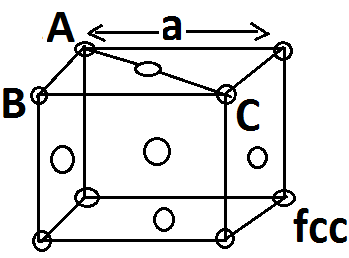 Let the radius of each sphere = r $\therefore\ \text{AC}=4\text{r}$ From right angle triangle ABC,$\text{AC}=\sqrt{\text{AB}^2+\text{BC}^2}=\sqrt{\text{a}^2+\text{a}^2}=\sqrt{2\text{a}^2}=\sqrt{2}\text{a}$
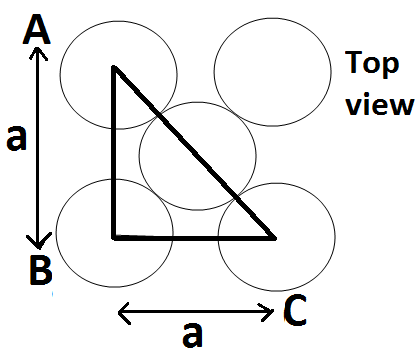
$\therefore\ \sqrt{2}\text{a}=4\text{r}$
$\therefore\ \text{a}=\frac{4\text{r}}{\sqrt{2}}$
$\therefore$ Volume of the unit cell
$=\text{a}^3=\Big(\frac{4}{\sqrt{2}}\text{r}\Big)^3=\frac{64\text{r}^3}{2\sqrt{2}}=\frac{32\text{r}^3}{\sqrt{2}}$
No. of unit cell in fcc = 4 $\therefore\ \text{Volume of four spheres}=4\times\frac{4}{3}\pi\text{r}^3=\frac{16}{3}\pi\text{r}^3$ $\therefore$ Packing efficiency$=\frac{\frac{16\pi\text{r}^3}{3}}{\frac{64\text{r}^3}{3}\sqrt{3}}=0.74, \text{i.e.}, 74\%$ View full question & answer→Question 172 Marks
Explain the following term with suitable examples:
Schottky defect.
AnswerSchottky defects:When cations and anions both are missing from regular sites, the defect is called Schottky Defect. In Schottky Defects, the number of missing cations is equal to the number of missing anions in order to maintain the electrical neutrality of the ionic compound.
Schottky Defect is type of simple vacancy defect and shown by ionic solids having cations and anions; almost similar in size, such as NaCl, KCl, CsCl, etc. AgBr shows both types of defects, i.e. Schottky and Frenkel Defects.
Since, Schottky Defects arises because of mission of constituent particles, thus it decreases the density of ionic compound.
View full question & answer→Question 182 Marks
Explain the following with suitable examples:
12-16 and 13-15 group compounds.
Answer12-16 and 13-15 group compounds:The 12-16 group compounds are prepared by combining group 12 and group 16 elements and the 13-15 group compounds are prepared by combining group 13 and group15 elements. These compounds are prepared to stimulate average valence of four as in Ge or Si. Indium (III) antimonide (IrSb), aluminium phosphide (AlP), and gallium arsenide (GaAS) are typical compounds of groups 13-15. GaAs semiconductors have a very fast response time and have revolutionised the designing of semiconductor devices. Examples of group 12-16 compounds include zinc sulphide (ZnS), cadmium sulphide (CdS), cadmium selenide (CdSe), and mercury (II) telluride (HgTe). The bonds in these compounds are not perfectly covalent. The ionic character of the bonds depends on the electronegativities of the two elements.
View full question & answer→Question 192 Marks
Calculate the efficiency of packing in case of a metal crystal for:
Simple cubic.
AnswerIn simple cubic lattice:
Here $a = 2r$
No. of spheres per unit cell $= 1$
Volume of spheres = $\frac{4}{3}\pi\text{r}^3$
Volume of cube $= a^3= (2r)^3= 8r^3$
$\therefore$ Pacing efficiency
$= \frac{\frac{4}{3}\pi\text{r}^3}{8\text{r}^3}=0.524, \text{i.e.}, 52.4\%.$
View full question & answer→Question 202 Marks
Classify each of the following as being either a p-type or a n-type semiconductor:
- Ge doped with In.
- B doped with Si.
Answer
- Ge (a group 14 element) is doped with In (a group 13 element). Therefore, a hole will be created and the semiconductor generated will be a p-type semiconductor.
- B (a group 13 element) is doped with Si (a group 14 element). Thus, a hole will be created and the semiconductor generated will be a p-type semiconductor.
View full question & answer→Question 212 Marks
Classify the following as amorphous or crystalline solids: Polyurethane, naphthalene, benzoic acid, teflon, potassium nitrate, cellophane, polyvinyl chloride, fibre glass, copper.
AnswerAmorphous solids: Polyurethane, teflon, cellophane, polyvinyal chloride, fibre glass.Crystalline solids: naphthlene, benzoic acid, potassium nitrate, copper.
View full question & answer→Question 222 Marks
Ferric oxide crystallises in a hexagonal close-packed array of oxide ions with two out of every three octahedral holes occupied by ferric ions. Derive the formula of the ferric oxide.
AnswerLet the number of oxide $(O_{2-})$ ions be x.
So, number of octahedral voids $= x.$
It is given that two out of every three octahedral holes are occupied by ferric ions. So, number of ferric $(Fe^{3+})$ ions $= 23x$
Therefore, ratio of the number of $Fe^{3+}$ ions to the number of $O_{2−}$ ions, $Fe^{3+}Fe^{3+} : O_{2-} = 23 x : x$
$= 23 : 1$
$= 2 : 3$
Hence, the formula of the ferric oxide is $Fe_2O_3.$
View full question & answer→Question 232 Marks
Explain the following term with suitable examples:
Interstitials.
AnswerInterstitials:Interstitials – Sometime in the formation of lattice structure some of the atoms or ions occupy vacant interstitial site, and are known as interstitials. These interstitials are generally small size non-metals, such as H, B, C, etc. Defect arises because of interstitials is called interstitial defect.
View full question & answer→Question 242 Marks
Calculate the efficiency of packing in case of a metal crystal for:
Body-centred cubic.
AnswerIn bcc: AD = 4r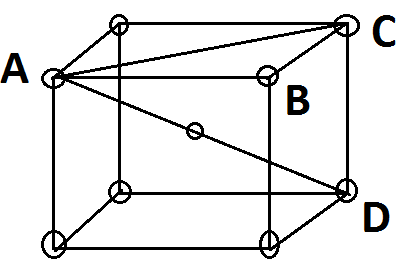
From right angled triangle ABC,$\text{AC}=\sqrt{\text{AB}^2+\text{BC}^2}=\sqrt{\text{a}^2+\text{a}^2}=\sqrt{2}\text{a}$
Body diagonal, AD $=\sqrt{\text{AC}^2+\text{CD}^2}=\sqrt{2\text{a}^2+\text{a}^2}=\sqrt{3\text{a}^2}=\sqrt{3}\text{a}$ $\therefore\ \sqrt{3}\text{a}=4\text{r}\ \ \ \text{a}=\frac{4\text{r}}{\sqrt{3}}$ $\therefore\ \text{Volume of unit cell}=\text{a}^3=\Big(\frac{4\text{r}}{\sqrt{3}}\Big)^3=\frac{64\text{r}^3}{3\sqrt{3}}$ No. of spheres per unit cell = 2 $\therefore\ \text{Volume of two spheres}=2\times\frac{4}{3}\pi\text{r}^3=\frac{8}{3}\pi\text{r}^3$ $\therefore$ Packing efficiency $=\frac{\frac{8}{3}\pi\text{r}^3}{\frac{64\text{r}^3}{3}\sqrt{3}}=0.68, \text{i.e.}, 68\%$ View full question & answer→Question 252 Marks
In term of band theory, what is the difference:
Between a conductor and a semiconductor.
AnswerDifference between conductors and semiconductor:In conductors there is no energy gap between the valence band and conduction band, which facilitates the flow of electrons easily under an applied electric field and metals show conductivity.
While in semi conductors, there is small energy gap between valence bond and conduction band. The small gap between band facilitates some electrons to jump to the conduction band by acquiring extra energy.
View full question & answer→Question 262 Marks
Explain the following with suitable examples:
Ferrimagnetism.
AnswerFerrimagnetism:
This effect is observed when the magnetic moments of the domains in the substance are aligned in parallel and anti–parallel directions in unequal numbers. Ferrimagnetic substances are weakly attracted by magnetic field as compared to ferromagnetic substances. Magnetite like $Fe_3O_4$ and ferrites like $MgFe_2O_4$ and $ZnFe_2O_4$ are examples.
View full question & answer→Question 272 Marks
Explain the following term with suitable examples:
F-centres.
AnswerF-centres:F-centres – This is type of defect and called metal excess defect. These type of defects seen because of missing of anions from regular site leaving a hole which is occupied by electron to maintain the neutrality of the compound. Hole occupied by electron is called F-centre and responsible for showing colour by the compound. example sodium chloride impart yellow colour beacuse of F centre.
View full question & answer→Question 282 Marks
Silver crystallises in fcc lattice. If edge length of the cell is $4.07 \times 10^{-8} \mathrm{~cm}$ and density is $10.5 \mathrm{~g} \mathrm{~cm}^{-3}$, calculate the atomic mass of silver.
Answer$\text{M}=\frac{\text{d.a}^3\text{.N}_a}{\text{Z}}=\frac{10.5\times(4.07\times10^{-8})^3\times6.023\times10^{23}}{4}$$=107.09 \text{ g mol}^{-1}.$
View full question & answer→Question 292 Marks
Niobium crystallises in body-centred cubic structure. If density is $8.55 \mathrm{~g} \mathrm{~cm}^{-3}$, calculate atomic radius of niobium using its atomic mass 93 u.
Answer$\text{a}^3=\frac{\text{M.Z}}{\text{d.N}_a\times10^{-30}}=\frac{93\times2}{8.55\times6.02\times10^{23}\times10^{-30}}$$=3.61\times10^7$
$\therefore\ \text{a}=(3.61\times10^7)^\frac{1}{3}=(36.1\times10^6)\frac{1}{3}$
$=3.304\times10^2\text{pm}=330.4\text{pm}$
View full question & answer→Question 302 Marks
Copper crystallises into a fcc lattice with edge length $3.61 \times 10^{-8} \mathrm{~cm}$. Show that the calculated density is in agreement with its measured value of $8.92 \mathrm{~g} \mathrm{~cm}^{-3}$.
Answer$\text{d}=\frac{\text{Z}\times\text{M}}{\text{a}^3\times\text{N}_\text{a}}$$=\frac{4\times63.5}{(3.61\times10^{-8})^3\times6.023\times10^{23}}\ \{{\text{M}=63.5 \text{ for Cu}}\}$
$=8.96 \text{ g cm}^{-3}$
This calculated value of density is closely in agreement with its measured value of $=8.96 \text{ g cm}^{-3}$.
View full question & answer→Question 312 Marks
Refractive index of a solid is observed to have the same value along all directions. Comment on the nature of this solid. Would it show cleavage property?
AnswerAs the solid has same value of refractive index along all directions, it is isotropic in nature and hence amorphous. Being amorphous solid, it will not show a clean cleavage and when cut, it will break into pieces with irregular surfaces.
View full question & answer→Question 322 Marks
In term of band theory, what is the difference:
Between a conductor and an insulator.
AnswerDifference between conductor and insulator:In conductors there is no energy gap between the valence band, which facilitates the flow of electrons easily under an applied electric field and metals show conductivity.
While in insulators there is large energy gap between the valence band and electrons cannot jump to it i.e. large energy gap prevents the flow of electricity.
View full question & answer→Question 332 Marks
Classify the following solids in different categories based on the nature of intermolecular forces operating in them:
Potassium sulphate, tin, benzene, urea, ammonia, water, zinc sulphide, graphite, rubidium, argon, silicon carbide.
AnswerMolecular solids: Water, argon.
Ionic solids: Potassium sulphate, zinc sulphate.
Metallic solids: Tin, rubidium.
Covalent or network: Benzene, urea, ammonia, graphite, silicon carbide.
View full question & answer→Question 342 Marks
Calculate the number of unit cells in 8·1 g of aluminium if it crystallizes in a face-centred cubic (f.c.c.) structure. $($Atomic mass of $Al = 27$ g mol$^{-1})$
Answern = given mass/molar mass
$= 8.1/27$ mol
Number of atoms = $\frac{8.1}{27}\times6.022\times10^{23}$
Number of atoms in one unit cell = 4(fcc)
Number of unit cells $=\frac{\big[\frac{8.1}{27}\times6.022\times10^{23}\big]}{4}\\=4.5\times10^{22}$
Or
27g of Al contains $= 6.022x10^{23}$ atoms
8.1g of Al contains $= (6.022x10^{23} / 27) \times 8.1$
No of unit cells = total no of atoms /4
$=\frac{\big[\frac{8.1}{27}\times6.022\times10^{23}\big]}{4}\\=4.5\times10^{22}$
View full question & answer→Question 352 Marks
An element with density $2.8\ g\ cm^{–3}$ forms a f.c.c. unit cell with edge length $4\times 10^{–8}\ cm.$ Calculate the molar mass of the element.
$($Given: $N_A = 6.022 \times 10^{23}\ mol ^{–1})$
AnswerGiven; $d = 2.8g/cm^3;$ $Z = 4; a = 4 x 10^{–8}$ cm $N_A= 6.022 \times 10^{23}$ per mol
$\text{d}=\frac{\text{Z}\times\text{M}}{\text{a}^{3}\times\text{N}_{A}}$ OR
$\text{M}=\frac{\text{d}\times\text{a}^{3}\times\text{N}_{A}}{\text{z}}$
$\Rightarrow$$\text{M}=\frac{\text{2.8 g cm}^{-3}\times\text{(4}\times\text{10}^{-8}\text{cm})^{3}\times\text{6.022}\times\text{10}^{23}}{\text{4}}$
$M = 2.8 \times 16 \times 10^{–1} \times 6.022 = 26.97$ g/mol.
View full question & answer→Question 362 Marks
- Write the type of magnetism observed when the magnetic moments are aligned in parallel and anti-parallel directions in unequal numbers.
- Which stoichiometric defect decreases the density of the crystal?
Answer
- Ferrimagnetism.
- Schottky defect.
View full question & answer→Question 372 Marks
Calculate the number of unit cells in 8·1 g of aluminium if it crystallises in a face-centered cubic (f.c.c.) structure. $($Atomic mass of Al $= 27$ g mol$^{-1})$
Answer$n =$ given mass/molar mass
$= 8.1/27$ mol
Number of atoms $=\frac{8.1}{27}\times6.022\times10^{23}$
Number of atoms in one unit cell = 4 (fcc)
Number of unit cells $=[\frac{8.1}{27}\times6.022\times10^{23}]/4$
$=4.5\times10^{22}$
Alternate Answer
27g of $\text{A}l$ contains $=6.022\times10^{23}$ atoms
8.1g of $\text{A}l$ contains $=(6.022\times10^{23}/27)\times8.1$
No of unit cells = total no of atoms /4
$=[\frac{8.1}{27}\times6.022\times10^{23}]/4$
$=4.5\times10^{22}$
View full question & answer→Question 382 Marks
- Write the type of magnetism observed when the magnetic moments are oppositively aligned and cancel out each other.
- Which stoichiometric defect does not change the density of the crystal?
Answer
- Antiferromagnetism.
- Frenkel defect.
View full question & answer→Question 392 Marks
An element with density $2.8\ g\ cm^{–3}$ forms a f.c.c. unit cell with edge length $4 \times 10^{–8}\ cm.$ Calculate the molar mass of the element.
$($Given: $N_A = 6.022 \times 10^{23}\ mol ^{–1})$
AnswerGiven; $d = 2.8g/cm^3;\ Z = 4;\ a = 4 x 10^{–8}\ cm\ \ N_A= 6.022 x 10^{23}$ per mol
$\text{d}=\frac{\text{Z}\times\text{M}}{\text{a}^{3}\times\text{N}_{A}}$ OR
$\text{M}=\frac{\text{d}\times\text{a}^{3}\times\text{N}_{A}}{\text{z}}$
$\Rightarrow$$\text{M}=\frac{\text{2.8 g cm}^{-3}\times\text{(4}\times\text{10}^{-8}\text{cm})^{3}\times\text{6.022}\times\text{10}^{23}}{\text{4}}$
$M = 2.8 \times 16 \times 10^{–1} \times 6.022 = 26.97$ g/mol.
View full question & answer→Question 402 Marks
Calculate the number of unit cells in 8·1 g of aluminium if it crystallises in a face-centered cubic (f.c.c.) structure. $($Atomic mass of $Al = 27$ g mol$^{-1})$
Answern = given mass/molar mass
= 8.1/27 mol
Number of atoms $=\frac{8.1}{27}\times6.022\times10^{23}$
Number of atoms in one unit cell = 4 (fcc)
Number of unit cells $=[\frac{8.1}{27}\times6.022\times10^{23}]/4$
$=4.5\times10^{22}$
Alternate Answer
27g of $\text{A}l$ contains $=6.022\times10^{23}$ atoms
8.1g of $\text{A}l$ contains $=(6.022\times10^{23}/27)\times8.1$
No of unit cells = total no of atoms /4
$=[\frac{8.1}{27}\times6.022\times10^{23}]/4$
$=4.5\times10^{22}$
View full question & answer→Question 412 Marks
An element with density $2.8\ g\ cm^{–3}$ forms a f.c.c. unit cell with edge length $4 $\times$ 10^{–8} cm.$ Calculate the molar mass of the element.
$($Given: $N_A = 6.022 \times 10^{23}\ mol^{–1})$
AnswerGiven; $d = 2.8g/cm^3; Z = 4; a = 4 \times 10^{–8}$ cm $N_A= 6.022 \times 10^{23}$ per mol
$\text{d}=\frac{\text{Z}\times\text{M}}{\text{a}^{3}\times\text{N}_{A}}$ OR
$\text{M}=\frac{\text{d}\times\text{a}^{3}\times\text{N}_{A}}{\text{z}}$
$\Rightarrow$$\text{M}=\frac{\text{2.8 g cm}^{-3}\times\text{(4}\times\text{10}^{-8}\text{cm})^{3}\times\text{6.022}\times\text{10}^{23}}{\text{4}}$
$M = 2.8\times 16\times 10^{–1} \times 6.022 = 26.97$ g/mol.
View full question & answer→Question 422 Marks
Account for the following:
- Schottky defects lower the density of related solids.
- Conductivity of silicon increases on doping it with phosphorus.
Answer
- In Schottky defect some ions are missing (or due to vacancies) from their normal lattice sites due to which density decreases.
- This is due to availability of unpaired or odd electron provided by P.
View full question & answer→Question 432 Marks
Aluminium crystallises in an fcc structure. Atomic radius of the metal is 125 in. What is the length of the side of the unit cell of the metal?
Answer$\text{For f.c.c. unit cell r=}\frac{\text{a}}{\text{2}\sqrt{2}}$
$\text{a = 2 r}\times\sqrt{2}$
= 2 x 125 pm x 1.414
=353.5 pm
View full question & answer→Question 442 Marks
Calculate the packing efficiency of a metal crystal for a simple cubic lattice.
AnswerPacking efficiency
$=\frac{\text{Z}\ \times\ \text{volume of one atom}}{\text{volume of cubic cell unit}}$
$=\frac{\text{1}\ \times\ \text{4/3}\pi\text{r}^{3}}{\text{a}^{3}}$
For simple cubic lattice a = 2r
Therefore packing effieciency $=\frac{\text{1}\ \times\ \text{4/3}\pi\text{r}^{3}}{\text{8r}^{3}}$
= 0.524 or 52.4%.
View full question & answer→Question 452 Marks
Explain how you can determine the atomic mass of an unknown metal if you know its mass density and the dimensions of unit cell of its crystal.
AnswerWe can determine the atomic mass of an unknown by using the formula.
$\text{M}=\frac{\text{d}\times\text{a}^{3}\times\text{N}_{A}}{Z}$
By knowing $d, a, N_A\ \&\ Z$ We can calculate the M
Where
$d =$ Density of the element.
$N_A =$ Avogadro number.
$a =$ Cell edge or edge length.
$Z = $ No. of atoms present in one unit cell.
View full question & answer→Question 462 Marks
An element with density $11.2\ g\ cm^{-3}$ forms a f.c.c. lattice with edge length of $4 \times 10^{-8} $ cm.
Calculate the atomic mass of the element.
$($Given: $N_A= 6.022\times 10^{23}\ mol^{-1})$
Answer$d = 11.2\ g/cm^3$
$z = 4$
$a = 4x10^{-8}\ cm$
$\text{d}=\frac{\text{Z}\times{M}}{\text{N}_{a}\times\text{a}^{3}}$
$\text{11.2}=\frac{\text{4}\times{M}}{\text{6.022}\times\text{10}^{23}}\times{(4}\times{10}^{-8})^{3}$
$\text{M}=\frac{\text{11.2}\times\text{6.022}\times\text{10}^{23}\times\text{4}\times\text{10}^{-8}\times\text{4}\times\text{10}^{-8}\times\text{4}\times\text{10}^{-8}}{\text{4}}$
$M = 11.2\times 6.022\times 16\times 10^{-1}$
$M = 107.9\ g\ mol^{-1}$ or $107.9$ u
View full question & answer→Question 472 Marks
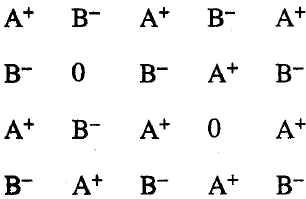
Examine the given defective crystal:
Answer the following questions:
- What type of stoichiometric defect is shown by the crystal?
- How is the density of the crystal affected by this defect?
- What type of ionic substances show such defect?
Answer
- Schottky defect.
- Decreases.
- Alkali metal halides/Ionic substances having almost similar size of cations and anions (NaCl/KCl).
View full question & answer→Question 482 Marks
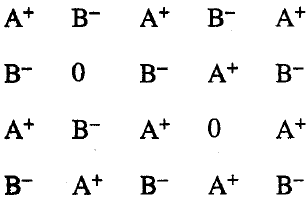
Examine the given defective crystal:
Answer the following questions:
- What type of stoichiometric defect is shown by the crystal?
- How is the density of the crystal affected by this defect?
- What type of ionic substances show such defect?
Answer
- Schottky defect.
- Decreases.
- Alkali metal halides/Ionic substances having almost similar size of cations and anions (NaCl/KCl).
View full question & answer→Question 492 Marks
An element with density $11.2\ g\ cm^{-3}$ forms a f.c.c. lattice with edge length of $4 \times 10^{-8}$ cm.
Calculate the atomic mass of the element.
$($Given:$ N_A= 6.022\times 10^{23}\ mol^{-1})$
Answer$d = 11.2\ g/cm^3$
$z = 4$
$a = 4x10^{-8}$ cm
$\text{d}=\frac{\text{Z}\times{M}}{\text{N}_{a}\times\text{a}^{3}}$
$\text{11.2}=\frac{\text{4}\times{M}}{\text{6.022}\times\text{10}^{23}}\times{(4}\times{10}^{-8})^{3}$
$\text{M}=\frac{\text{11.2}\times\text{6.022}\times\text{10}^{23}\times\text{4}\times\text{10}^{-8}\times\text{4}\times\text{10}^{-8}\times\text{4}\times\text{10}^{-8}}{\text{4}}$
$M = 11.2\times 6.022\times 16\times 10^{-1}$
$M = 107.9\ g\ mol^{-1}$ or $107.9$ u
View full question & answer→Question 502 Marks
An element with density $11.2\ g\ cm^{-3}$ forms a f.c.c. lattice with edge length of $4\times 10^{-8}\ cm.$
Calculate the atomic mass of the element.
$($Given: $N_A= 6.022\times 10^{23}\ mol^{-1})$
Answer$d = 11.2 g/cm^3$
$z = 4$
$a = 4\times 10^{-8} cm$
$\text{d}=\frac{\text{Z}\times{M}}{\text{N}_{a}\times\text{a}^{3}}$
$\text{11.2}=\frac{\text{4}\times{M}}{\text{6.022}\times\text{10}^{23}}\times{(4}\times{10}^{-8})^{3}$
$\text{M}=\frac{\text{11.2}\times\text{6.022}\times\text{10}^{23}\times\text{4}\times\text{10}^{-8}\times\text{4}\times\text{10}^{-8}\times\text{4}\times\text{10}^{-8}}{\text{4}}$
$M = 11.2\times 6.022\times 16\times 10^{-1}$
$M = 107.9\ g\ mol^{-1}$or $107.9\ u$
View full question & answer→Question 512 Marks
Examine the given defective crystal:
|
$A^+$
|
$B^-$
|
$A^+$
|
$B^-$
|
$A^+$
|
|
$B^-$
|
$0$
|
$B^-$
|
$A^+$
|
$B^-$
|
|
$A^+$
|
$B^-$
|
$A^+$
|
$0$
|
$A^+$
|
|
$B^-$
|
$A^+$
|
$B^-$
|
$A^+$
|
$B^-$
|
Answer the following questions:
- What type of stoichiometric defect is shown by the crystal?
- How is the density of the crystal affected by this defect?
- What type of ionic substances show such defect?
Answer
- Schottky defect.
- Decreases.
- Alkali metal halides/Ionic substances having almost similar size of cations and anions $(NaCl/KCl).$
View full question & answer→Question 522 Marks
Why does white $\mathrm{ZnO}(\mathrm{s})$ becomes yellow upon heating?
AnswerOn heating ZnO loses oxygen according to the following reaction.
$\text{ZnO}\rightarrow\text{Zn}^{2+}+\frac{1}{2}\text{O}_2+2\text{e}^1$
$\mathrm{Zn}^{2+}$ ions and electrons move to interstitial sites and F -centres are created which impart yellow colour to $\mathrm{ZnO}(\mathrm{s})$.
View full question & answer→Question 532 Marks
Explain the following with suitable examples:
Antiferromagnetism.
AnswerAntiferromagnetism:Antiferromagnetic substanceshave domain structures similar to ferromagnetic substances, but are oppositely-oriented. The oppositely-oriented domains cancel out each other's magnetic moments.
Schematic alignment of magnetic moments in antiferromagnetic substances.
View full question & answer→Question 542 Marks
A compound forms hexagonal close-packed structure. What is the total number of voids in 0.5 mol of it? How many of these are tetrahedral voids?
Answer$\text { Number of closed packed particles }=0.5 \times 6.022 \times 10^{23}=3.011 \times 10^{23} 0.5 \times 6.022 \times 1023=3.011 \times 1023 \text { Therefore }$
$\text { number of octhahedral voids }=3.011 \times 10^{23} \times 1023$
$\text { and number of tetrahedral voids }=2 \times 3.011 \times 10^{23}=6.022 \times 10^{23} 2 \times 3.011 \times 1023=6.022 \times 1023 \text { Therefore total }$
$\text { number of voids }=3.011 \times 10^{23}+6.022 \times 10^{23}=9.033 \times 10^{23} 3.011 \times 1023+6.022 \times 1023=9.033 \times 1023$
View full question & answer→Question 552 Marks
Explain the following with suitable examples:
Ferromagnetism.
AnswerFerromagnetism:Few substances like iron, cobalt, nickel, gadolinium and $\mathrm{CrO}_2$ are strongly attracted by a magnetic field. Such substances are known as ferromagnetic substances. These substances can be permanently magnetised with the help of strong electrostatic field. The metal ions of ferromagnetic substances are grouped together into small regions called domains in solid state. So that each domain acts as a tiny magnet. The domains of un magnetized piece of a ferromagnetic are randomly oriented so that their magnetic moments get cancelled out. When such substance is placed in a magnetic field, all the domains get oriented in the direction of the magnetic field and a strong magnetic effect is produced. This ordering of domains remains same even when the magnetic field is removed and the ferromagnetic substance becomes a permanent magnet.
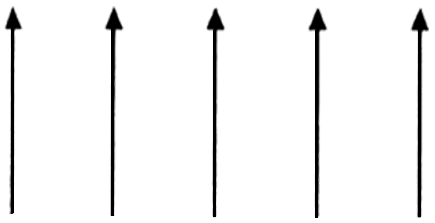
Fig. Schematic alignments of magnetic moments in ferromagnetism. View full question & answer→Question 562 Marks
Distinguish between:
- Hexagonal and monoclinic unit cells.
- Face-centred and end-centred unit cells.
Answer
-
| Hexagonal unit cell |
Monoclinic unit cell |
| a=b≠c |
a≠b≠c |
| α = β = 90° |
α = γ = 90° |
| γ = 120° |
β ≠ 90° |
-
| Face-centred unit cell |
End-centred unit cell |
| A Face-centred unit cell the constituent particles are present at the corners and one at the centre of each face. |
An End-centred unit cell contains particles at the corners and one at the centre of any two opposite faces. |
| Total no of particles in a face centered unit cell= 4 |
Total no. of particles in an end centered unit cell = 2 |
View full question & answer→Question 572 Marks
Gold (atomic radius = 0.144 nm) crystallises in a face-centred unit cell. What is the length of a side of the cell?
AnswerRadius, r = 0.144 nm, Unit cell is fcc, edge of unit cell, a = ? In face centered unit cell, diagonal of face = $4\text{r}=\text{a}\sqrt{2}\text{a}2$ $[\because\ \text{face diagonal}=\text{a}\sqrt{2}\text{a}2]$$\therefore\ \text{a}=4\text{r}\sqrt{2}=\sqrt{2}\text{r}\text{a}=4\text{r}2=2\text{r}$
$=2\times1.4142\times0.144\text{ nm}=0.4073\text{ nm.}$
Length of side of unit cell, a = 0.4073 nm.
View full question & answer→Question 582 Marks
Non-stoichiometric cuprous oxide, $\mathrm{Cu}_2 \mathrm{O}$ can be prepared in laboratory. In this oxide, copper to oxygen ratio is slightly less than 2:1. Can you account for the fact that this substance is a p-type semiconductor?
AnswerIn the cuprous oxide $\left(\mathrm{Cu}_2 \mathrm{O}\right)$ prepared in the laboratory, copper to oxygen ratio is slightly less than $2: 1$. This means that the number of $\mathrm{Cu}^{+}$ions is slightly less than twice the number of $\mathrm{O}_2$-ions. This is because some $\mathrm{Cu}^{+}$ions have been replaced by $\mathrm{Cu}^{2+}$ ions. Every $\mathrm{Cu}^{2+}$ ion replaces two $\mathrm{Cu}^{+}$ions, thereby creating holes. As a result, the substance conducts electricity with the help of these positive holes. Hence, the substance is a p-type semiconductor.
View full question & answer→Question 592 Marks
Explain the following with suitable examples:
Paramagnetism.
AnswerParamagnetism:Few substances like $\mathrm{O}_2, \mathrm{Cu}^{2+}, \mathrm{Fe}^{3+}, \mathrm{Cr}^{3+}$ are weekly attracted by a magnetic field.
These substabces are magnetised in a magnetic field in the same direction. When we remove magnetic field ,they lose their magnetism. paramagnetism is takes place due to presence of one or more unpaired electrons. These unpaired electron are attracted by the magnetic field.
View full question & answer→MCQ 602 Marks
Note: In the following questions a statement of assertion followed by a statement of reason is given. Choose the correct answer out of the following choices.
Assertion: The packing efficiency is maximum for the fcc structure.
Reason: The cordination number is $12$ in $fcc$ structures.
- A
Assertion and reason both are correct statements and reason is correct explanation for assertion.
- ✓
Assertion and reason both are correct statements but reason is not correct explanation for assertion.
- C
Assertion is correct statement but reason is wrong statement.
- D
Assertion is wrong statement but reason is correct statement.
AnswerCorrect option: B. Assertion and reason both are correct statements but reason is not correct explanation for assertion.
In fee unit cell, there is cep arrangement with packing efficiency of $74.01\%$ which is maximum. In cep arrangement, coordination number is $12.$
View full question & answer→Question 612 Marks
In terms of band theory, what is the difference between:
- A conductor and an insulator?
- A conductor and a semiconductor?
Answer
- The energy gap between the valence band and conduction band in an insulator is very large while in a conductor, the energy gap is very small or there is overlapping between valence band and conduction band.
- In a conductor, there is a very small energy gap or there is overlapping between valence band and conduction band whereas in semiconductor there is always a small energy gap between them.
View full question & answer→MCQ 622 Marks
Note: In the following questions a statement of assertion followed by a statement of reason is given. Choose the correct answer out of the following choices.
Assertion: Graphite is a good conductor of electricity however diamond belongs to the category of insulators.
Reason: Graphite is soft in nature on the other hand diamond is very hard and brittle.
- A
Assertion and reason both are correct statements and reason is correct explanation for assertion.
- ✓
Assertion and reason both are correct statements but reason is not correct explanation for assertion.
- C
Assertion is correct statement but reason is wrong statement.
- D
Assertion is wrong statement but reason is correct statement.
AnswerCorrect option: B. Assertion and reason both are correct statements but reason is not correct explanation for assertion.
Diamond is bad conductor of electricity because all valence e of carbon are involved in bonding. In graphite however $3$ out of $4$ valence electrons are involved in bonding, fourth electron remains free between adjacent layers which makes it a good conductor.
Graphite is soft because parallel layers are held together by week van der Waals force. However, diamond is hard due to compact three-dimensional network of bonding.
View full question & answer→MCQ 632 Marks
Note: In the following questions a statement of assertion followed by a statement of reason is given. Choose the correct answer out of the following choices.
Assertion: The total number of atoms present in a simple cubic unit cell is one.
Reason: Simple cubic unit cell has atoms at its corners, each of which is shared between eight adjacent unit cells.
- ✓
Assertion and reason both are correct statements and reason is correct explanation for assertion.
- B
Assertion and reason both are correct statements but reason is not correct explanation for assertion.
- C
Assertion is correct statement but reason is wrong statement.
- D
Assertion is wrong statement but reason is correct statement.
AnswerCorrect option: A. Assertion and reason both are correct statements and reason is correct explanation for assertion.
In simple cubic unit cell total no. of atoms $=8\times\frac{1}{8}=1$
View full question & answer→MCQ 642 Marks
Note: In the following questions a statement of assertion followed by a statement of reason is given. Choose the correct answer out of the following choices.
Assertion: Semiconductors are solids with conductivities in the intermediate range from $10^{-6}-10^4 \mathrm{ohm}^{-1} \mathrm{\sim m}^{-1}$.
Reason: Intermediate conductivity in semiconductor is due to partially filled valence band.
- A
Assertion and reason both are correct statements and reason is correct explanation for assertion.
- B
Assertion and reason both are correct statements but reason is not correct explanation for assertion.
- ✓
Assertion is correct statement but reason is wrong statement.
- D
Assertion is wrong statement but reason is correct statement.
AnswerCorrect option: C. Assertion is correct statement but reason is wrong statement.
Intermediate conductivity in semiconductor is due to small energy gap between valence band and conduction band. Therefore, Assertion is correct, but the reason is wrong.
View full question & answer→Question 652 Marks
Explain how vacancies are introduced in an ionic solid when a cation of higher valence is added as an impurity in it.
AnswerIf we mix a small amount of molten strontium chloride $\left(\mathrm{SrCl}_2\right)$ with molten sodium chloride $(\mathrm{NaCl})$ and the resulting solution is cooled, in the crystals of NaCl some $\mathrm{Na}^{+}$ions will get replaced by $\mathrm{Sr}^{2+}$ ions. In order to maintain electron neutrality too $\mathrm{Na}^{+}$ions are to leave their respective lattice sites. However, one out of them will be occupied by the $\mathrm{Sr}^{2+}$ ion while the other will remain unoccupied or it will be vacant. Thus vacancies are introduced in an ionic solid.
View full question & answer→Question 662 Marks
Name the parameters that characterise a unit cell.
Answer A unit cell is characterised by following parameters:
- The dimensions of unit cell along three edges: a, b and c.
- The angles between the edges: α (between b and c); β (between a and c) and γ (between a and b).
View full question & answer→Question 672 Marks
A cubic solid is made of two elements P and Q. Atoms of Q are at the corners of the cube and P at the body-centre. What is the formula of the compound? What are the coordination numbers of P and Q?
Answer As atoms Q are present at the eight comers of the cube, therefore, the contribution of atoms of
Q in the unit cell = 1/8 x 8 = 1.
As atom P is present at the body centre, therefore, the contribution of atoms of P in the unit cell = 1.
$\therefore$ Ratio of atoms of P: Q = 1:1
Hence, the formula of the compound = PQ The coordination number of each P and Q = 8.
View full question & answer→Question 682 Marks
Classify each of the following solids as ionic, metallic, molecular, network (covalent) or amorphous.
- Tetra phosphorus decoxide $(P_4O_{10})$
- Ammonium phosphate $(NH_4)_3PO_4$
- SiC
- $I_2$
- $P_4$
- Plastic
- Graphite
- Brass
- Rb
- LiBr
- Si
Answer
- Tetra phosphorous decoxide $(P_4O_{10}) –$ Molecular
- Ammonium phosphate $(NH_4)_3PO_4 –$ Ionic
- SiC - Covalent (network)
- $I_2 -$ Molecular
- $P_4 –$ Molecular
- Plastic – Amorphous
- Graphite – Covalent (network)
- Brass – Metallic
- Rb – Metallic
- LiBr – Ionic
- Si – Covalent (network)
View full question & answer→Question 692 Marks
Ionic solids, which have anionic vacancies due to metal excess defect, develop colour. Explain with the help of a suitable example.
Answer The colour develops because of the presence of electrons in the anionic sites. These electrons absorb energy from the visible part of radiation and get excited.For example, when crystals of NaCl are heated in an atmosphere of sodium vapours, the sodium atoms get deposited on the surface of the crystal and the chloride ions from the crystal diffuse to the surface to form NaCl with the deposited Na atoms. During this process, the Na atoms on the surface lose electrons to form Na ions and the released electrons diffuse into the crystal to occupy the vacant anionic sites. These electrons get excited by absorbing energy from the visible light and impart yellow colour to the crystals.
View full question & answer→Question 702 Marks
What is the difference between 13-15 and 12-16 compounds?
Answer Group 13-15 compounds, viz., AlP, GaAs, etc. have large covalent character whereas Group 12-16 compounds, viz., ZnS, CdS, HgTe, etc. do not possess covalent character but have sufficient ionic character. However, all of them are semiconductors.
View full question & answer→Question 712 Marks
- What is meant by the term 'coordination number'?
- What is the coordination number of atoms:
- In a cubic close-packed structure?
- In a body-centred cubic structure?
Answer
- The number of nearest neighbours of any constituent particle present in the crystal lattice is called its coordination number.
- The coordination number of atoms:
- In a cubic close-packed structure is 12, and
- In a body-centred cubic structure is 8.
View full question & answer→Question 722 Marks
Why is Frenkel defect found in AgCl?
AnswerThis is because the cation $Ag^+ $ and anion $Cl^- $ differ in their size to a larger extent, therefore cations occupy voids due to its smaller size.
View full question & answer→Question 732 Marks
Explain the following term with suitable examples:
Frenkel defect.
AnswerFrenkel defect:It is a type of vacancy defect. In ionic compounds, some of the ions (usually smaller in size) get dislocated from their original site and create defect. This defect is known as Frenkel Defects. Since this defect arises because of dislocation of ions, thus it is also known as Dislocation Defects. As there are a number of cations and anions (which remain equal even because of defect); the density of the substance does not increase or decrease.
Ionic compounds; having large difference in the size between their cations and anions; show Frenkel Defects, such as ZnS, AgCl, AgBr, AgI, etc. These compounds have smaller size of cations compared to anions.
View full question & answer→Question 742 Marks
What makes a glass different from a solid such as quartz? Under what conditions could quartz be converted into glass?
Answer The arrangement of the constituent particles makes glass different from quartz. In glass, the constituent particles have short-range order, but in quartz, the constituent particles have both long range and short range orders. Quartz can be converted into glass by heating and then cooling it rapidly.
View full question & answer→Question 752 Marks
Calculate the efficiency of packing in case of a metal crystal for:
Face-centred cubic (with the assumptions that atoms are touching each other).
AnswerIn fcc: Let the edge length of unit cell = a 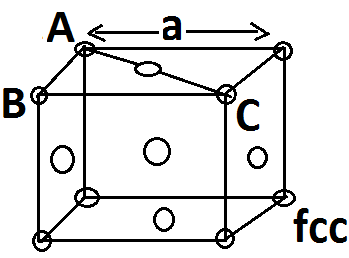 Let the radius of each sphere = r $\therefore\ \text{AC}=4\text{r}$ From right angle triangle ABC,$\text{AC}=\sqrt{\text{AB}^2+\text{BC}^2}=\sqrt{\text{a}^2+\text{a}^2}=\sqrt{2\text{a}^2}=\sqrt{2}\text{a}$
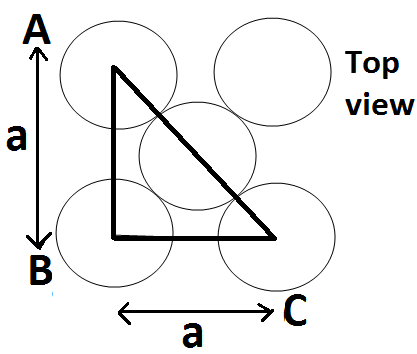
$\therefore\ \sqrt{2}\text{a}=4\text{r}$
$\therefore\ \text{a}=\frac{4\text{r}}{\sqrt{2}}$
$\therefore$ Volume of the unit cell
$=\text{a}^3=\Big(\frac{4}{\sqrt{2}}\text{r}\Big)^3=\frac{64\text{r}^3}{2\sqrt{2}}=\frac{32\text{r}^3}{\sqrt{2}}$
No. of unit cell in fcc = 4 $\therefore\ \text{Volume of four spheres}=4\times\frac{4}{3}\pi\text{r}^3=\frac{16}{3}\pi\text{r}^3$ $\therefore$ Packing efficiency$=\frac{\frac{16\pi\text{r}^3}{3}}{\frac{64\text{r}^3}{3}\sqrt{3}}=0.74, \text{i.e.}, 74\%$ View full question & answer→Question 762 Marks
Write the coordination number of each ion in the following crystals:
- NaCl
- CsCl
Answer
- $Na^+ = 6, Cl^- = 6$
- $Cs^+ = 8, Cl^- = 8$
View full question & answer→Question 772 Marks
Explain the following term with suitable examples:
Schottky defect.
AnswerSchottky defects:When cations and anions both are missing from regular sites, the defect is called Schottky Defect. In Schottky Defects, the number of missing cations is equal to the number of missing anions in order to maintain the electrical neutrality of the ionic compound.
Schottky Defect is type of simple vacancy defect and shown by ionic solids having cations and anions; almost similar in size, such as NaCl, KCl, CsCl, etc. AgBr shows both types of defects, i.e. Schottky and Frenkel Defects.
Since, Schottky Defects arises because of mission of constituent particles, thus it decreases the density of ionic compound.
View full question & answer→MCQ 782 Marks
Note: In the following questions a statement of assertion followed by a statement of reason is given. Choose the correct answer out of the following choices.
Assertion: Total number of octahedral voids present in unit cell of cubic close packing including the one that is present at the body centre, is four.
Reason: Besides the body centre there is one octahedral void present at the centre of each of the six faces of the unit cell and each of which is shared between two adjacent unit cells.
- A
Assertion and reason both are correct statements and reason is correct explanation for assertion.
- B
Assertion and reason both are correct statements but reason is not correct explanation for assertion.
- ✓
Assertion is correct statement but reason is wrong statement.
- D
Assertion is wrong statement but reason is correct statement.
AnswerCorrect option: C. Assertion is correct statement but reason is wrong statement.
The correct statement for reason is, "Besides the body centre there is one octahedral void at the centre of each $12$ edges which is shared between four adjacent unit cells".Thus, Octahedral voids present at the body centre of the cube $= 1$
$12$ ocahedral voids located at each edge and shared between four unit cells $= \Big(12 \times \frac{1}{4}\Big) = 3$
Total number of octahedral voids $= 4.$
View full question & answer→Question 792 Marks
Explain the following with suitable examples:
12-16 and 13-15 group compounds.
Answer 12-16 and 13-15 group compounds:The 12-16 group compounds are prepared by combining group 12 and group 16 elements and the 13-15 group compounds are prepared by combining group 13 and group15 elements. These compounds are prepared to stimulate average valence of four as in Ge or Si. Indium (III) antimonide (IrSb), aluminium phosphide (AlP), and gallium arsenide (GaAS) are typical compounds of groups 13-15. GaAs semiconductors have a very fast response time and have revolutionised the designing of semiconductor devices. Examples of group 12-16 compounds include zinc sulphide (ZnS), cadmium sulphide (CdS), cadmium selenide (CdSe), and mercury (II) telluride (HgTe). The bonds in these compounds are not perfectly covalent. The ionic character of the bonds depends on the electronegativities of the two elements.
View full question & answer→Question 802 Marks
Sodium crystallises in a bcc unit cell. Calculate the approximate number of unit cells in 9.2g of sodium. (Atomic Mass of Na = 23u)
Answer For bcc structure $\text{r}=\frac{\sqrt{3}}{4}\text{a}$
$\text{r}=\frac{1.732}{4}\times316.5\text{pm}=137.04\text{pm}$
View full question & answer→Question 812 Marks
Calculate the efficiency of packing in case of a metal crystal for:
Simple cubic.
AnswerIn simple cubic lattice:
Here a = 2r
No. of spheres per unit cell = 1
Volume of spheres = $\frac{4}{3}\pi\text{r}^3$
Volume of cube $= a^3= (2r)^3= 8r^3$
$\therefore$ Pacing efficiency
$= \frac{\frac{4}{3}\pi\text{r}^3}{8\text{r}^3}=0.524, \text{i.e.}, 52.4\%.$
View full question & answer→Question 822 Marks
Classify each of the following as being either a p-type or a n-type semiconductor:
- Ge doped with In.
- B doped with Si.
Answer
- Ge (a group 14 element) is doped with In (a group 13 element). Therefore, a hole will be created and the semiconductor generated will be a p-type semiconductor.
- B (a group 13 element) is doped with Si (a group 14 element). Thus, a hole will be created and the semiconductor generated will be a p-type semiconductor.
View full question & answer→Question 832 Marks
What type of substances exhibit antiferromagnetism?
Answer Substances in which domains are oppositely oriented and cancel out each other’s magnetic moments exhibit antiferromagnetism.

View full question & answer→Question 842 Marks
Classify the following as amorphous or crystalline solids: Polyurethane, naphthalene, benzoic acid, teflon, potassium nitrate, cellophane, polyvinyl chloride, fibre glass, copper.
Answer Amorphous solids: Polyurethane, teflon, cellophane, polyvinyal chloride, fibre glass.Crystalline solids: naphthlene, benzoic acid, potassium nitrate, copper.
View full question & answer→Question 852 Marks
Ferric oxide crystallises in a hexagonal close-packed array of oxide ions with two out of every three octahedral holes occupied by ferric ions. Derive the formula of the ferric oxide.
AnswerLet the number of oxide $(O_{2-})$ ions be $x.$
So, number of octahedral voids $= x.$
It is given that two out of every three octahedral holes are occupied by ferric ions. So, number of ferric $(Fe^{3+})$ ions $= 23x$
Therefore, ratio of the number of $Fe^{3+}$ ions to the number of $O_{2−}$ ions, $Fe^{3+}\ Fe^{3+} : O_{2-} = 23 x : x$
$= 23 : 1$
$= 2 : 3$
Hence, the formula of the ferric oxide is $Fe_2O_3.$
View full question & answer→Question 862 Marks
Explain the following term with suitable examples:
Interstitials.
Answer Interstitials:Interstitials – Sometime in the formation of lattice structure some of the atoms or ions occupy vacant interstitial site, and are known as interstitials. These interstitials are generally small size non-metals, such as H, B, C, etc. Defect arises because of interstitials is called interstitial defect.
View full question & answer→Question 872 Marks
Calculate the efficiency of packing in case of a metal crystal for:
Body-centred cubic.
AnswerIn bcc: AD = 4r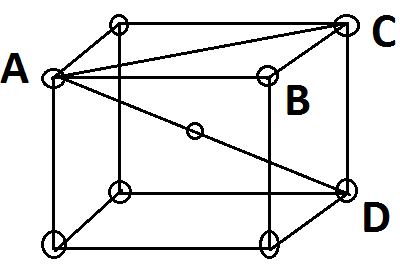
From right angled triangle ABC,$\text{AC}=\sqrt{\text{AB}^2+\text{BC}^2}=\sqrt{\text{a}^2+\text{a}^2}=\sqrt{2}\text{a}$
Body diagonal, AD $=\sqrt{\text{AC}^2+\text{CD}^2}=\sqrt{2\text{a}^2+\text{a}^2}=\sqrt{3\text{a}^2}=\sqrt{3}\text{a}$ $\therefore\ \sqrt{3}\text{a}=4\text{r}\ \ \ \text{a}=\frac{4\text{r}}{\sqrt{3}}$ $\therefore\ \text{Volume of unit cell}=\text{a}^3=\Big(\frac{4\text{r}}{\sqrt{3}}\Big)^3=\frac{64\text{r}^3}{3\sqrt{3}}$ No. of spheres per unit cell = 2 $\therefore\ \text{Volume of two spheres}=2\times\frac{4}{3}\pi\text{r}^3=\frac{8}{3}\pi\text{r}^3$ $\therefore$ Packing efficiency $=\frac{\frac{8}{3}\pi\text{r}^3}{\frac{64\text{r}^3}{3}\sqrt{3}}=0.68, \text{i.e.}, 68\%$ View full question & answer→Question 882 Marks
In term of band theory, what is the difference:
Between a conductor and a semiconductor.
Answer Difference between conductors and semiconductor:In conductors there is no energy gap between the valence band and conduction band, which facilitates the flow of electrons easily under an applied electric field and metals show conductivity.
While in semi conductors, there is small energy gap between valence bond and conduction band. The small gap between band facilitates some electrons to jump to the conduction band by acquiring extra energy.
View full question & answer→Question 892 Marks
Explain the following with suitable examples:
Ferrimagnetism.
AnswerFerrimagnetism:
This effect is observed when the magnetic moments of the domains in the substance are aligned in parallel and anti–parallel directions in unequal numbers. Ferrimagnetic substances are weakly attracted by magnetic field as compared to ferromagnetic substances. Magnetite like $Fe_3O_4$ and ferrites like $MgFe_2O_4$ and $ZnFe_2O_4$ are examples.
View full question & answer→Question 902 Marks
Lithium metal crystal has body-centred cubic structure. Its density is $0.53g/\ cm^{-3}$ and its molar mass is $6.94g/ \ mol^{-1}.$ Calculate the volume of a unit cell of lithium metal. $[N_A = 6.023 \times 10^{23}\ mol^{-1}]$
AnswerVolume of the crystal, $\text{a}^3=\frac{\text{z}\times\text{M}}{\text{d}\times\text{N}_{\text{A}}}$
$\text{a}^3=\frac{2\times6.94}{0.53\times0.023\times10^{23}}=4.348\times10^{-23}\text{cm}^3$
View full question & answer→Question 912 Marks
In a compound, nitrogen atoms (N) make cubic close packed lattice and metal atoms (M) occupy one-third of the tetrahedral voids present. Determine the formula of the compound formed by M and N?
AnswerIn ccp, no. of atoms per unit cell $= 4$
Thus, of tetrahedral voids $= 2 ×$ No. of atoms in ccp $=2 × 4 = 8$
Only one-third of tetrahedral voids are occupied by metal M. No. of
No. of metal atoms, $\text{M}=\frac{1}{3}\times8$
$\text{M}:\text{N}=\frac{8}{3}:4=2:3$
Thus, formula is $M_2N_3.$
View full question & answer→Question 922 Marks
Why are liquids and gases categorised as fluids?
Answer The liquids and gases have a property to flow i.e. the molecules can move past and tumble over one another freely. Hence, they have been categorised as fluids.
View full question & answer→Question 932 Marks
Explain the following term with suitable examples:
F-centres.
Answer F-centres:F-centres – This is type of defect and called metal excess defect. These type of defects seen because of missing of anions from regular site leaving a hole which is occupied by electron to maintain the neutrality of the compound. Hole occupied by electron is called F-centre and responsible for showing colour by the compound. example sodium chloride impart yellow colour beacuse of F centre.
View full question & answer→Question 942 Marks
In NaCl crystal, $Cl^-$ ions are in fcc arrangement. Calculate the number of $Cl^-$ ions in its unit cell.
Answer$Cl^-$ ions per unit cell $=8\times\frac{1}{8}$ (from corners) $+6\times\frac{1}{2}$ (From face corners) = 4.
View full question & answer→Question 952 Marks
Silver crystallises in fcc lattice. If edge length of the cell is $4.07 \times 10^{–8}$ cm and density is $10.5 $g cm$^{–3}$, calculate the atomic mass of silver.
Answer$\text{M}=\frac{\text{d.a}^3\text{.N}_a}{\text{Z}}=\frac{10.5\times(4.07\times10^{-8})^3\times6.023\times10^{23}}{4}$$=107.09 \text{ g mol}^{-1}.$
View full question & answer→Question 962 Marks
Niobium crystallises in body-centred cubic structure. If density is $8.55\ g\ cm^{–3},$ calculate atomic radius of niobium using its atomic mass 93 u.
Answer$\text{a}^3=\frac{\text{M.Z}}{\text{d.N}_a\times10^{-30}}=\frac{93\times2}{8.55\times6.02\times10^{23}\times10^{-30}}$$=3.61\times10^7$
$\therefore\ \text{a}=(3.61\times10^7)^\frac{1}{3}=(36.1\times10^6)\frac{1}{3}$
$=3.304\times10^2\text{pm}=330.4\text{pm}$
View full question & answer→Question 972 Marks
Why are solids incompressible?
Answer The constituent particles (atoms, molecules or ions) have fixed positions and can only oscillate about their mean positions, hence solids are incompressible and rigid.
View full question & answer→Question 982 Marks
Copper crystallises into a fcc lattice with edge length $3.61 \times 10^{–8}$ cm. Show that the calculated density is in agreement with its measured value of $8.92\ g\ cm^{–3}.$
Answer$\text{d}=\frac{\text{Z}\times\text{M}}{\text{a}^3\times\text{N}_\text{a}}$$=\frac{4\times63.5}{(3.61\times10^{-8})^3\times6.023\times10^{23}}\ \{{\text{M}=63.5 \text{ for Cu}}\}$
$=8.96 \text{ g cm}^{-3}$
This calculated value of density is closely in agreement with its measured value of $8.92\ g\ cm^3.$
View full question & answer→Question 992 Marks
Refractive index of a solid is observed to have the same value along all directions. Comment on the nature of this solid. Would it show cleavage property?
Answer As the solid has same value of refractive index along all directions, it is isotropic in nature and hence amorphous. Being amorphous solid, it will not show a clean cleavage and when cut, it will break into pieces with irregular surfaces.
View full question & answer→Question 1002 Marks
In term of band theory, what is the difference:
Between a conductor and an insulator.
Answer Difference between conductor and insulator:In conductors there is no energy gap between the valence band, which facilitates the flow of electrons easily under an applied electric field and metals show conductivity.
While in insulators there is large energy gap between the valence band and electrons cannot jump to it i.e. large energy gap prevents the flow of electricity.
View full question & answer→Question 1012 Marks
Why is FeO(s) not formed in stoichiometric composition?
AnswerIn the crystals of FeO , some of the $\mathrm{Fe}^{2+}$ cations are replaced by $\mathrm{Fe}^{3+}$ ions. Three $\mathrm{Fe}^{2+}$ ions are replaced by two $\mathrm{Fe}^{3+}$ ions to make up for the loss of positive charge. Eventually there would be less amount of metal as compared to stoichiometric proportion.
View full question & answer→Question 1022 Marks
Classify the following solids in different categories based on the nature of intermolecular forces operating in them:
Potassium sulphate, tin, benzene, urea, ammonia, water, zinc sulphide, graphite, rubidium, argon, silicon carbide.
Answer Molecular solids: Water, argon.
Ionic solids: Potassium sulphate, zinc sulphate.
Metallic solids: Tin, rubidium.
Covalent or network: Benzene, urea, ammonia, graphite, silicon carbide.
View full question & answer→