Questions

Case study (4 Marks)

Take a timed test

19 questions · self-marked practice — reveal the answer and mark yourself.

Question 14 Marks
A magnetic field set up using Helmholtz coils (described in Exercise 4.16) is uniform in a small region and has a magnitude of 0.75 T. In the same region, a uniform electrostatic field is maintained in a direction normal to the common axis of the coils. A narrow beam of (single species) charged particles all accelerated through 15 kV enters this region in a direction perpendicular to both the axis of the coils and the electrostatic field. If the beam remains undeflected when the electrostatic field is $9.0 \times 10^{–5} V m^{–1},$ make a simple guess as to what the beam contains. Why is the answer not unique?
Answer
Magnetic field, B = 0.75 T
Accelerating voltage, $V = 15\ kV = 15 \times 10^3\ V$
Electrostatic field, $E = 9.0 \times 10^{-5}\ V\ m^{-1}$
Mass of the electron = m
Charge of the electron = e
Velocity of the electron = v
Kinetic energy of the electron = eV
$\Rightarrow\frac{1}{2}\text{mv}^{2}=\text{eV}$
$\therefore\frac{\text{e}}{\text{m}}=\frac{\text{v}^{2}}{2\text{V}}....(1)$
Since the particle remains undeflected by electric and magnetic fields, we can infer that the electric field is balancing the magnetic field.
$\therefore\text{eE}=\text{evB}$
$\text{v}=\frac{\text{E}}{\text{B}}...........(2)$
Putting equation (2) in equation (1), we get;
$\frac{\text{e}}{\text{m}}=\frac{1}{2}\frac{\Big(\frac{\text{E}}{\text{B}}\Big)^{2}}{\text{V}}=\frac{\text{E}^{2}}{2\text{VB}^{2}}$
$=\frac{(9.0\times10^{5})^{2}}{2\times15000\times(0.75)^{2}}$
$=4.8\times10^{7}\text{C/ kg}$
This value of specific charge e/m is equal to the value of deuteron or deuterium ions. This is not a unique answer. Other possible answers are $He^{++}, Li^{++},$ etc.
View full question & answer
Question 24 Marks
A uniform magnetic field of 1.5 T exists in a cylindrical region of radius10.0 cm, its direction parallel to the axis along east to west. A wire carrying current of 7.0 A in the north to south direction passes through this region. What is the magnitude and direction of the force on the wire if,
  1. The wire intersects the axis,
  2. The wire is turned from N-S to northeast-northwest direction,
  3. The wire in the N-S direction is lowered from the axis by a distance of 6.0 cm?
Answer
Magnetic field strength, B = 1.5 T
Radius of the cylindrical region, r = 10 cm = 0.1 m
Current in the wire passing through the cylindrical region, I = 7 A
  1. If the wire intersects the axis, then the length of the wire is the diameter of the cyhndrtcal region.
Thus, I= 2r = 0.2 m
Angle between magnetic field and current, $\theta$ = 90°
Magnetic force acting on the wire is given by the relation,
$\text{F}=\text{BIl}\sin\theta$
$=1.5\times7\times0.2\times\sin90^{o}$
$=2.1\ \text{N}$
$\text{F}=\frac{\mu_{0}\text{I}^{2}}{2\pi\text{r}}$
Where,
$\mu_{0}=\text{Permeability of free space}=4\pi\times10^{-7}\text{T m A}^{-1}$
$\therefore\text{F}=\frac{4\pi\times10^{-7}\times(300)^{2}}{2\pi\times0.015}$
$=1.2\ \text{N/m}$
Hence, a force of 2.1 N acts on the wire in a vertically downward direction.
  1. New length of the wire after turning it to the Northeast-Northwest direction can be given as:
$\text{l}_{1}=\frac{\text{l}}{\sin\theta}$
Angle between magnetic field and current, $\theta$ = 45°
Force on the wire,
$\text{F}=\text{BIl}_{1}\sin\theta$
$=\text{BIl}$
$=1.5\times7\times0.2$
$=2.1\ \text{N}$
Hence, a force of 2.1 N acts vertically downward on the wire. This is independent of angle $\theta$ because/ $\sin\theta$ is fixed.
  1. The wire is lowered from the axis by distance, d = 6.0 cm Let $l_2$ be the new length of the wire.
$\therefore\Big(\frac{\text{l}_{2}}{2}\Big)^{2}=4(\text{d+r})$
$=4(10+6)=4(16)$
$\therefore=8\times2=16\text{cm}=0.16\text{m}$
Magnetic force exerted on the wire,
$\text{F}_{2}=\text{BIl}_{2}$
$=1.5\times7\times0.16$
$=1.68\ \text{N}$
Hence, a force of 1.68 N acts in a vertically downward direction on the wire.
View full question & answer
Question 34 Marks
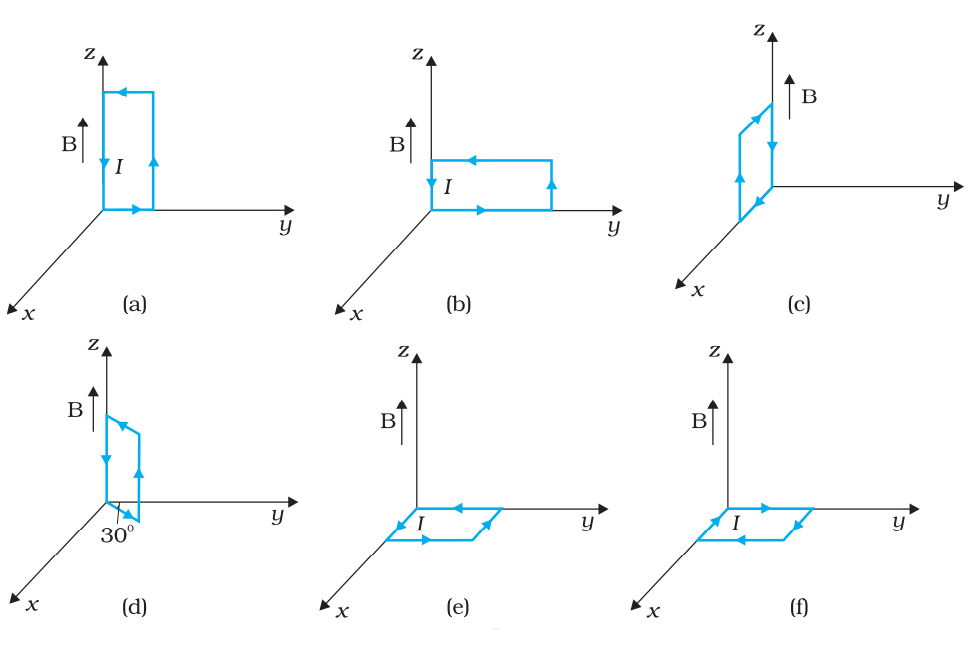
A uniform magnetic field of 3000 G is established along the positive z-direction. A rectangular loop of sides 10 cm and 5 cm carries a current of 12 A. What is the torque on the loop in the different cases shown in Fig.? What is the force on each case? Which case corresponds to stable equilibrium?
Answer
Magnetic field strength, $B = 3000\ G = 3000 \times 10^{-4}\ T = 0.3\ T$
Length of the rectangular loop, I = 10 cm
Width of the rectangular loop, b = 5 cm
Area of the loop,
$A = I \times b = 10 \times 5 = 50 cm^2 = 50 \times 10^{-4} m^2$
Current in the loop, I = 12 A
Now, taking the anti-clockwise direction of the current as positive and vise-versa:
  1. Torque, $\vec{\tau} =\text{I}\vec{\text{A}}\times\vec{B}$
    From the given figure, it can be observed that A is normal to the y-z plane and Bis directed along the z-axis.
$\therefore\tau=12\times(50\times10^{-4})\hat{\text{i}}\times0.3\hat{\text{k}}$

$=-1.8\times10^{-2}\hat{\text{j}}\ \text{Nm}$

The torque is $1.8 \times I0^{-2}$ N m along the negative y-direction. The force on the loop is zero because the angle between A and B is zero.
  1. This case is similar to case (a). Hence, the answer is the same as (a).
  2. Torque $\vec{\tau} =\text{I}\vec{\text{A}}\times\vec{\text{B}}$
From the given figure, it can be observed that A is normal to the x-z plane and B is directed along the z-axis.

$\therefore\tau=-12\times(50\times10^{-4})\hat{\text{i}}\times0.3\hat{\text{k}}$

$=-1.8\times10^{-2}\hat{\text{j}}\ \text{Nm}$

The torque is $1.8 \times 10^{-2}$ N m along the negative x direction and the force is zero.
  1. Magnitude of torque is given as:
$|\tau|=\text{lAB}$

$=12\times50\times10^{-4}\times0.3$

$=1.8\times10^{-2}\ \text{N m}$

Torque is $1.8 \times 10^{-2}$ N m at an angle of 240° with positive x direction. The force is zero.
  1. Torque $\vec{\tau} =\text{I}\vec{\text{A}}\times\vec{B}$
$=(50\times10^{-4}\times12)\hat{\text{k}}\times0.3\hat{\text{k}}$

$=0$

Hence, the torque is zero. The force is also zero.
  1. Torque $\vec{\tau} =\text{I}\vec{\text{A}}\times\vec{B}$
$=(50\times10^{-4}\times12)\hat{\text{k}}\times0.3\hat{\text{k}}$

$=0$

Hence, the torque is zero. The force is also zero.

In case (e), the direction of $I\vec{\text{A}}$ and $\vec{\text{B}}$ is the same and the angle between them is zero. If displaced, they come back to an equilibrium. Hence, its equilibrium is stable. whereas, in case (f), the direction of $I\vec{\text{A}}$ and $\vec{\text{B}}$ is opposite. The angle between them is 180°. If disturbe, it does not come back to its original position. Hence, its equilibriun is unstable.
View full question & answer
Question 44 Marks
For a circular coil of radius R and N turns carrying current I, the magnitude of the magnetic field at a point on its axis at a distance x from its centre is given by,
$\text{B}=\frac{\mu_{0}\text{IR}^{2}\text{N}}{2(\text{x}^{2}+\text{R}^{2})^{\frac{3}{2}}}$
  1. Show that this reduces to the familiar result for field at the centre of the coil.
  2. Consider two parallel co-axial circular coils of equal radius R, and number of turns N, carrying equal currents in the same direction, and separated by a distance R. Show that the field on the axis around the mid-point between the coils is uniform over a distance that is small as compared to R, and is given by,$\text{B}=0.72\frac{\mu_{0}\text{NI}}{\text{R}}$, approximately.
[Such an arrangement to produce a nearly uniform magnetic field over a small region is known as Helmholtz coils.]
Answer
Radius of circular coil = R
Number of turns on the coil = N
Current in the coil = I
Magnetic field at a point on its axis at distance x is given by the relation,
$\text{B}=\frac{\mu_{0}\text{IR}^{2}\text{N}}{2(\text{x}^{2}+\text{R}^{2})^{\frac{3}{2}}}$
Where,
$\mu_{0}=​\text{​​​​​​ Permeability of free space}$
  1. If the magnetic field at the centre of the coil is considered, then x = 0.
$\therefore\text{B}=\frac{\mu_{0}\text{IR}^{2}\text{N}}{2\text{R}^{3}}=\frac{\mu_{0}\text{IN}}{2\text{R}}$

This is the familiar result for magnetic field at the centre of the coil.
  1. Radis of two parallel co-axial circular coils = R
Number of turns on each coil = N

Current in both coils = I

Distance between both the coils = R

Let us consider point Q at distance d from the centre.

Then, one coil is at a distance of $\frac{\text{R}}{2}+\text{d}$ from point Q.

$\therefore$ Magnetic field at point Q is given as:

$\text{B}_{1}=\frac{\mu_{0}\text{NIR}^{2}}{2\Big[\Big(\frac{\text{R}}{2}+\text{d}\big)^{2}+\text{R}^{2}\Big]^{\frac{3}{2}}}$

Also, the other coil is at a distance of $\frac{\text{R}}{2}-\text{d}$ from point Q.

$\therefore$ Magnetic field due to this coil is given as:

$\text{B}_{2}=\frac{\mu_{0}\text{NIR}^{2}}{2\Big[\Big(\frac{\text{R}}{2}-\text{d}\big)^{2}+\text{R}^{2}\Big]^{\frac{3}{2}}}$

Total magnetic field, $\text{B}=\text{B}_{1}+\text{B}_{2}$

$=\frac{\mu_{0}\text{IR}^{2}}{2}\bigg[\Big\{\Big(\frac{\text{R}}{2}-\text{d}\Big)^{2}+\text{R}^{2}\Big\}^{-\frac{3}{2}}+\Big\{\Big(\frac{\text{R}}{2}+\text{d}\Big)^{2}+\text{R}^{2}\Big\}^{-\frac{3}{2}}\Bigg]$

$=\frac{\mu_{0}\text{IR}^{2}}{2}\times\Big(\frac{5\text{R}^{2}}{4}\Big)^{-\frac{3}{2}}\bigg[\Big(1+\frac{4}{5}\frac{\text{d}^{2}}{\text{R}^{2}}-\frac{4}{5}\frac{\text{d}}{\text{R}}\Big)^{-\frac{3}{2}}+\Big(1+\frac{4}{5}\frac{\text{d}^{2}}{\text{R}^{2}}+\frac{4}{5}\frac{\text{d}}{\text{R}}\Big)^{-\frac{3}{2}}\Bigg]$

For d << R, neglecting the factor$\frac{\text{d}^{2}}{\text{R}^{2}}$, we get:

≈$\frac{\mu_{0}\text{IR}^{2}}{2}\times\Big(\frac{5\text{R}^{2}}{4}\Big)^{-\frac{3}{2}}\bigg[\Big(1-\frac{4\text{d}}{5\text{R}}\Big)^{-\frac{3}{2}}+\Big(1+\frac{4\text{d}}{5\text{R}}\Big)^{-\frac{3}{2}}\Bigg]$

≈$\frac{\mu_{0}\text{IR}^{2}\text{N}}{2\text{R}^{3}}\Big(\frac{4}{5}\Big)^{\frac{3}{2}}\bigg[\Big(1-\frac{4\text{d}}{5\text{R}}\Big)^{\frac{3}{2}}+\Big(1+\frac{4\text{d}}{5\text{R}}\Big)^{\frac{3}{2}}\Bigg]$

$\text{B}=\Big(\frac{4}{5}\Big)^{\frac{3}{2}}\frac{\mu_{0}\text{IN}}{\text{R}}=0.72\Big(\frac{\mu_{0}\text{IN}}{\text{R}}\Big)$

Hence, it is proved that the field on the axis around the mid-point between the coils is uniform.
View full question & answer
Question 54 Marks
A solenoid 60 cm long and of radius 4.0 cm has 3 layers of windings of 300 turns each. A 2.0 cm long wire of mass 2.5 g lies inside the solenoid (near its centre) normal to its axis; both the wire and the axis of the solenoid are in the horizontal plane. The wire is connected through two leads parallel to the axis of the solenoid to an external battery which supplies a current of 6.0 A in the wire. What value of current (with appropriate sense of circulation) in the windings of the solenoid can support the weight of the wire? $g = 9.8\ m\ s^{–2}.$
Answer
Length of the solenoid, L = 60 cm = 0.6 m
Radius of the solenoid, r = 4.0 cm = 0.04 m
It is given that there are 3 layers of windings of 300 turns each.
$\therefore$ Total number of turns, n = 3 × 300 = 900
Length of the wire, I = 2 cm = 0.02 m
Mass of the wire, $m = 2.5 g = 2.5 \times 10^{-3}\ kg$
current flowing through the wire, i = 6 A
Acceleration due to gravity, $g = 9.8\ m/s^2$
Magnetic field produced inside the solenoid, $\text{B}=\frac{\mu_{0}\text{nl}}{\text{L}}$
where,
$\mu_{0}=\text{Permeability of free space}=4\pi\times10^{-7}\text{T m A}^{-1}$
I = Current flowing through the windings of the solenoid
Magnetic force is given by the relation,
$\text{F}=\text{Bil}$
$=\frac{\mu_{0}\text{nl}}{\text{L}}\text{il}$
Also, the force on the wire is equal to the weight of the wire.
$\therefore\text{mg}=\frac{\mu_{0}\text{nIil}}{\text{L}}$
$\text{I}=\frac{\text{mgL}}{{\mu_{0}\text{nil}}}$
$=\frac{2.5\times10^{-3}\times9.8\times0.6}{4\pi\times10^{-7}\times900\times0.02\times6}=108\text{A}$
Hence, the current flowing through the solenoid is 108 A.
View full question & answer
Question 64 Marks
An electron emitted by a heated cathode and accelerated through a potential difference of 2.0 kV, enters a region with uniform magnetic field of 0.15 T. Determine the trajectory of the electron if the field,
  1. is transverse to its initial velocity,
  2. makes an angle of 30º with the initial velocity.
Answer
Magnetic field strength, B = 0.15 TCharge on the electron, $e = 1.6 \times 10^{-19} C$
Mass of the electron, $m = 9.1 \times 10^{-31} kg$
Potential difference, $V = 2.0 kV = 2 \times 10^3 V$
Thus, kinetic energy of the electron = eV
$\Rightarrow\text{eV}=\frac{1}{2}\text{mv}^{2}$
$\text{v}=\sqrt\frac{2\text{ev}}{\text{m}}.........(1)$
Where,
v = velocity of the electron
  1. Magnetic force on the electron provides the required centripetal force of the electron. Hence, the electron traces a circular path of radius r.
Magnetic force on the electron is given by the relation,
$\text{B ev}$
$\text{Centripetal force}=\frac{\text{mv}^{2}}{\text{r}}$
$\therefore\text{Bev}=\frac{\text{mv}^{2}}{\text{r}}$
$\text{r}=\frac{\text{mv}}{\text{Be}}.........(2)$
From equations (1) and (2), we get
$\text{r}=\frac{\text{m}}{\text{Be}}\Big[\frac{2\text{ev}}{\text{m}}\Big]^{\frac{1}{2}}$
$=\frac{9.1\times10^{-31}}{0.15\times1.6\times10^{-19}}\times\Big(\frac{2\times1.6\times10^{-19}\times2\times10^{3}}{9.1\times10^{-31}}\Big)^{\frac{1}{2}}$
$=100.55\times10^{-5}$
$=1.01\times10^{-3}\text{m}$
$=1\text{mm}$
Hence, the electron has a circular trajectory of radius 1.0 mm normal to the magnetic field.
  1. When the field makes an angle θ of 30° with initial velocity, the initial velocity will be,
$\text{v}_{1}=\text{v}\sin\theta$
From equation (2), we can write the expression for new radius as: $\text{r}_{1}=\frac{\text{mv}_{1}}{\text{Be}}$
$=\frac{\text{mv}\sin\theta}{\text{Be}}$
$=\frac{9.1\times10^{-31}}{0.15\times1.6\times10^{-19}}\times\Big(\frac{2\times1.6\times10^{-19}\times2\times10^{3}}{9\times10^{-31}}\Big)^{\frac{1}{2}}\times\sin30^{\circ}$
$=0.5\times10^{-31}\text{m}$
$=0.5\text{mm}$
Hence, the electron has a helical trajectory of radius 0.5 mm along the magnetic field direction.
View full question & answer
Question 74 Marks
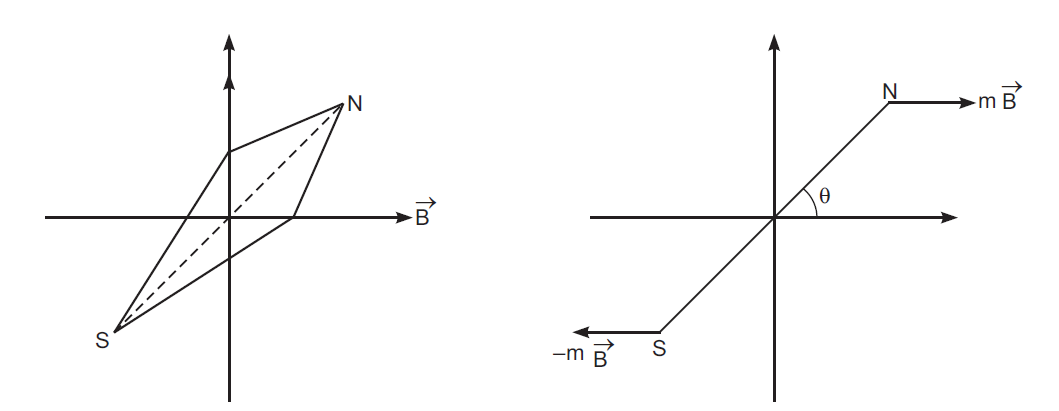
  1. A small compass needle of magnetic moment ‘m’ is free to turn about an axis perpendicular to the direction of uniform magnetic field ‘B’. The moment of inertia of the needle about the axis is ‘I’. The needle is slightly disturbed from its stable position and then released. Prove that it executes simple harmonic motion. Hence deduce the expression for its time period.
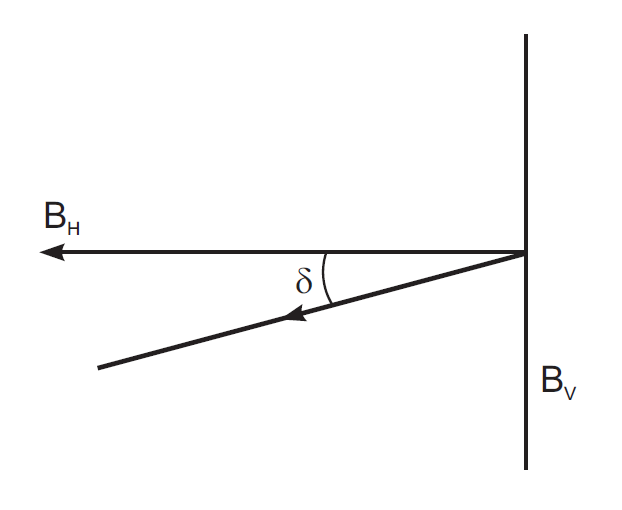
  2. A compass needle, free to turn in a vertical plane orients itself with its axis vertical at a certain place on the earth. Find out the values of (i) horizontal component of earth’s magnetic field and (ii) angle of dip at the place.
Answer
  1. If magnetic compass of dipole moment $\overrightarrow{\text{m}}$ is placed at angle $\theta$ in uniform magnetic field, and released it experiences a restoring torque.

$\overrightarrow{\tau} = - \text{magnetic force}\times\text{ perpendicular distance}$
$ = - |\text{mB}|.( 2 \text{ a }\sin\theta)$
$\overrightarrow{\tau} = - \overrightarrow{\text{m}}\times\overrightarrow{\text{B}}$
where m = pole strength
$|\tau| = - \text{m}|\text{B}|.\sin\theta $
In equilibrium, the equation of motion,
$\Rightarrow\text{I}\frac{\text{d}^{2}\theta}{\text{dt}^{2}} = -|\text{m}||\text{B}|\theta$
$\Rightarrow\frac{\text{d}^{2}\theta}{\text{dt}^{2}} = - \frac{|\text{M}||\text{B}|}{\text{I}}\theta$ $\text{(For small angle} \sin \theta \approx \theta)$
$\Rightarrow\frac{\text{d}^{2}\theta}{\text{dt}^{2}} = - \frac{\text{|M}||\text{B}|}{\text{I}}\theta$
$\Rightarrow\frac{\text{d}^{2}\theta}{\text{dt}^{2}} = - \bigg(\frac{\text{MB}}{\text{I}}\bigg)\theta$
Since $\frac{\text{d}^{2}\theta}{\text{dt}^{2}}\propto\theta$
It represents the simple harmonic motion with angular frequency
$\omega^{2} = \frac{\text{|M|}\text{B}|}{\text{I}}$
$\Rightarrow\text{T} = \frac{2\pi}{\omega} = 2\pi\sqrt{\frac{\text{I}}{\text{MB}}}$
  1. If compass needle orients itself with its axis vertical at a place, then
    1. $B_H = 0$ because $B_V = |B|$
    2. Angle of dip $\delta = 90^{o}$
$\tan\delta = \frac{\text{B}_{V}}{\text{B}_{H}} = \infty$
$\Rightarrow\text{Angle }\delta = 90^{o}.$

Concept - It is possible only on magnetic north or south poles.
View full question & answer
Question 84 Marks
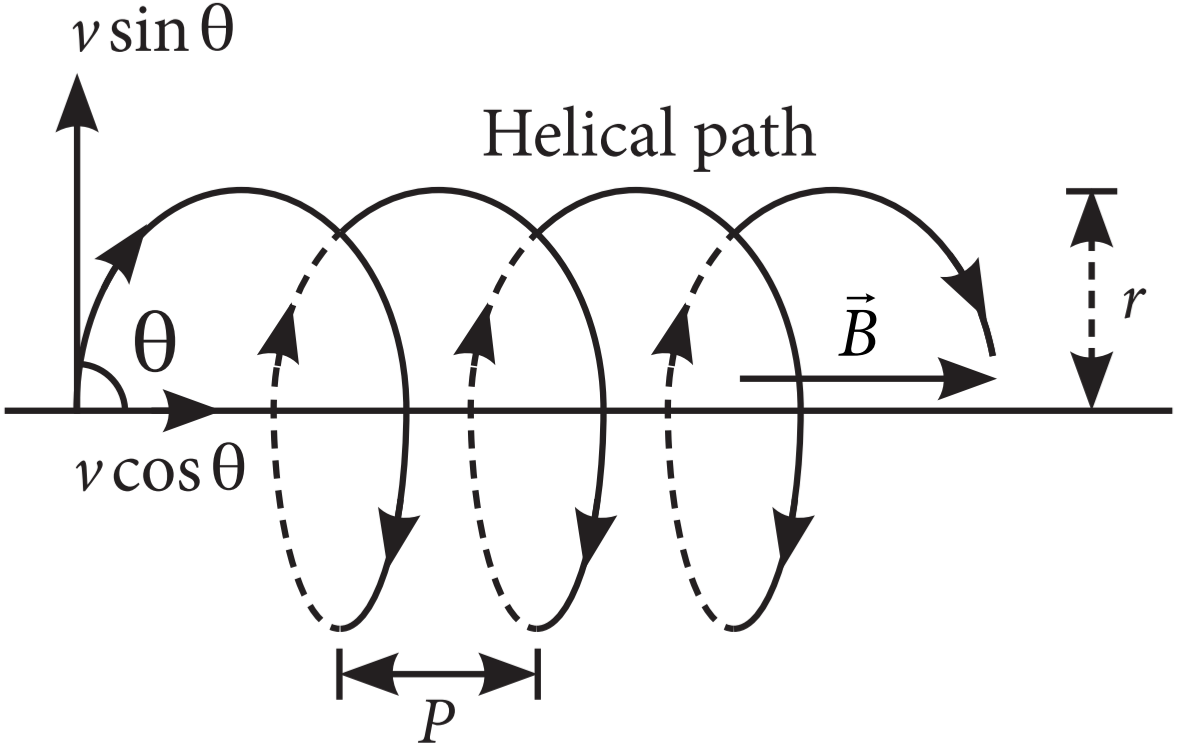
The path of a charged particle in magnetic field depends upon angle between velocity and magnetic field. If velocity $\vec{\text{v}}$ is at angle $\theta$ to $\vec{\text{B}},$ component of velocity parallel to magnetic field $(\text{v}\cos\theta)$ remains constant and component of velocity perpendicular to magnetic field $(\text{v}\sin\theta)$ is responsible for circular motion, thus the charge particle moves in a helical path.

The plane of the circle is perpendicular to the magnetic field and the axis of the helix is parallel to the magnetic field. The charged particle moves along helical path touching the line parallel to the magnetic field passing through the starting point after each rotation. Radius of circular path is $\text{r}=\frac{\text{mv}\sin\theta}{\text{qB}}$ Hence the resultant path of the charged particle will be a helix, with its axis along the direction of $\vec{\text{B}}$ as shown in figure.
  1. When a positively charged particle enters into a uniform magnetic field with uniform velocity, its trajectory can b:
  1. A straight line.
  2. A circle.
  3. A helix.
  1. (i) Only
  2. (i) or (ii)
  3. (i) or (iii)
  4. Any one of (i), (ii) and (iii)
  1. Two charged particles A and B having the same charge, mass and speed enter into a magnetic field in such a way that the initial path of A makes an angle of 30º and that of B makes an angle of 90º with the field. Then the trajectory of:
  1. B will have smaller radius of curvature than that of A.
  2. Both will have the same curvature.
  3. A will have smaller radius of curvature than that of B.
  4. Both will move along the direction of their original velocities.
  1. An electron having momentum $2.4 \times 10^{-23}kg$ m/ s enters a region of uniform magnetic field of 0.15T. The field vector makes an angle of 30º with the initial velocity vector of the electron. The radius of the helical path of the electron in the field shall be:
  1. mm
  2. 1mm
  3. $\frac{\sqrt{3}}{2}\text{mm}$
  4. 0.5mm
  1. The magnetic field in a certain region of space is given by $\vec{\text{B}}=8.35\times10^{-2}\hat{\text{i}}\text{T}.$ A proton is shot into the field with velocity $\vec{\text{v}}=(2\times10\hat{\text{i}}+4\times10^5\hat{\text{j}.}$ The proton follows a helical path in the field. The distance moved by proton in the x-direction during the period ofone revolution in the yz-plane will be:
$($Mass of proton $= 1.67 \times 10^{-27}kg)$
  1. 0.053m
  2. 0.136m
  3. 0.157m
  4. 0.236m
  1. The frequency of revolution of the particle is:
  1. $\frac{\text{m}}{\text{pB}}$
  2. $\frac{\text{qB}}{2\pi\text{m}}$
  3. $\frac{2\pi\text{R}}{\text{v}\cos\theta}$
  4. $\frac{2\pi\text{R}}{\text{v}\sin\theta}$
Answer
  1. (d) Any one of (i), (ii) and (iii)
  1. (a) B will have smaller radius of curvature than that of A.
Explanation:
Using, $\text{qv}\text{B}\sin\theta=\frac{\text{mv}^2}{\text{r}}$
$\text{r}\propto\frac{1}{\sin\theta}$ for the same values of m, v, q and B
$\therefore\frac{\text{r}_\text{A}}{\text{r}_\text{B}}=\frac{\sin90^\circ}{\sin30^\circ}=2$ or $\text{r}_\text{A}=2\text{r}_\text{B}$ or $\text{r}_\text{B}<\text{r}_\text{A}$
  1. (d) 0.5mm
Explanation:
The radius of the helical path of the electron in the uniform magnetic field is:
$\text{r}=\frac{\text{mv}\perp}{\text{eB}}=\frac{\text{mv}\sin\theta}{\text{eB}}=\frac{(2.4\times10^{-23}\text{kg m/ s})\times\sin30^\circ}{(1.6\times10^{-19}\text{C})\times0.15\text{T}}$
$=5\times10^{-4}\text{m}=0.5\times10^{-3}\text{m}=0.5\text{mm}$
  1. (c) 0.157m
Explanation:
Here, $\vec{\text{B}}=8.35\times10^{-2}\hat{\text{i}}\text{T}$
$\vec{\text{v}}=2\times10^5\hat{\text{i}}+4\times10^5\hat{\text{j}}\frac{\text{m}}{\ \text{s}},$
$\text{m}=1.67\times10^{-27}\text{kg}$
Pitch of the helix (i.e., the linear distance moved along the magnetic field in one rotation) is given by,
Pitch of the helix $=\frac{2\pi\text{mv}_{||}}{\text{qB}}$
$=\frac{2\times3.14\times1.67\times10^{27}\times2\times10^5}{1.6\times10^{-19}\times8.35\times10^{-2}}=0.157\text{m}$
  1. (b) $\frac{\text{qB}}{2\pi\text{m}}$
Explanation:
Period ofrevolution
$\text{T}=\frac{2\pi\text{R}}{\text{v}\sin\theta}\Rightarrow\text{T}\frac{2\pi(\frac{\text{mv}\sin\theta}{\text{qB}})}{\text{v}\sin\theta}\Rightarrow\text{T}=\frac{2\pi\text{m}}{\text{qB}}$
$\therefore$ Frequency, $\upsilon=\frac{1}{\text{T}}=\frac{\text{qB}}{2\pi\text{m}}$
View full question & answer
Question 94 Marks
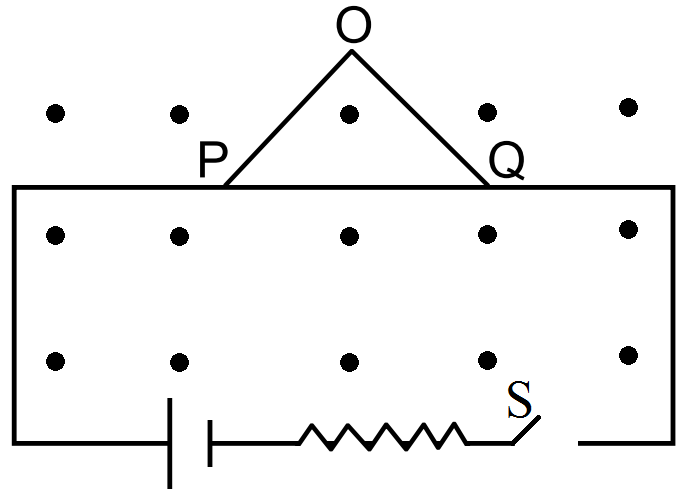
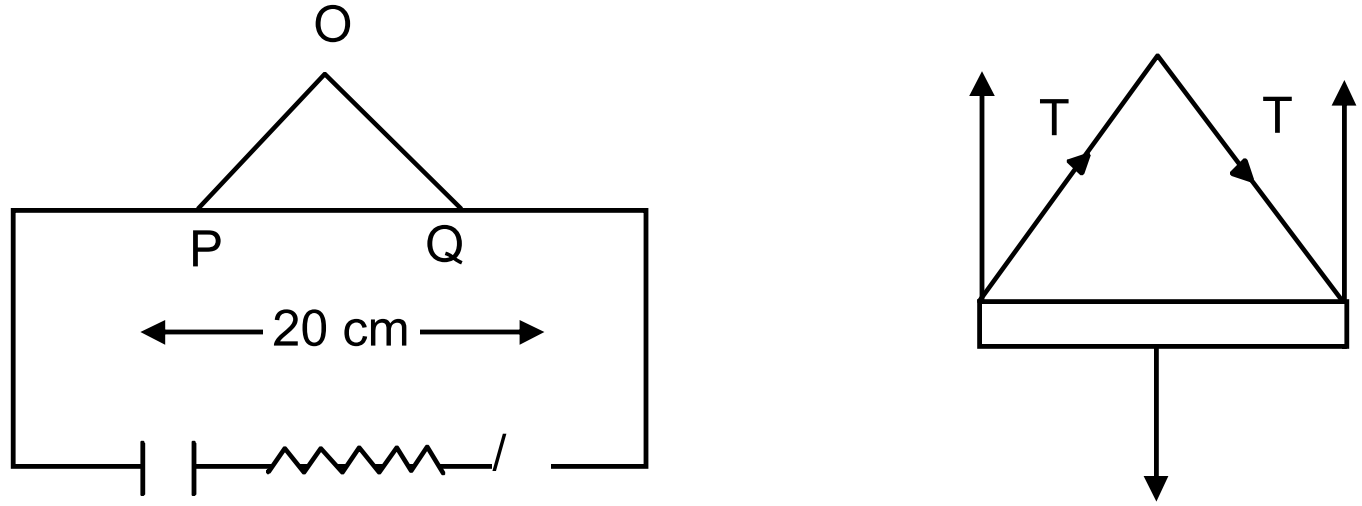
Shows a rod PQ of length 20.0cm and mass 200g suspended through a fixed point O by two threads of lengths 20.0cm each. A magnetic field of strength 0.500T exists in the vicinity of the wire PQ, as shown in the figure. The wires connecting PQ with the battery are loose and exert no force on PQ.
  1. Find the tension in the threads when the switch S is open.
  2. A current of 2.0A is established when the switch S is closed. Find the tension in the threads now.
Answer

  1. When switch S is open
2T cos 30° = mg

$\Rightarrow\text{T}=\frac{\text{mg}}{2\cos30^\circ}$

$=\frac{200\times10^{-3}\times9.8}{2\sqrt{\frac{3}{2}}}=1.13$
  1. When the switch is closed and a current passes through the circuit = 2A
Then,

$\Rightarrow2\text{T}\cos30^\circ=\text{mg}+\text{ilB}$

$=200\times10^{-3}9.8+2\times0.2\times0.5$

$=1.96+0.2=2.16$

$\Rightarrow2\text{T}=\frac{2.16\times2}{\sqrt{3}}=2.49$

$\Rightarrow\text{T}=\frac{2.49}{2}=1.245\approx1.25$
View full question & answer
Question 104 Marks
The reduction factor K of a tangent galvanometer is written on the instrument. The manual says that the current is obtained by multiplying this factor to tane. The procedure works well at Bhuwaneshwar. Will the procedure work if the instrument is taken to Nepal? If there is some error, can it be corrected by correcting the manual or the instrument will have to be taken back to the factory?
Answer
$\tan\theta$ can be different at different positions.
As by multiplying tan Theta of the place we can obtain right value so we do not need to take manual back to factory we only need to calculate angle of nepal w.r.t. equator.
View full question & answer
Question 114 Marks
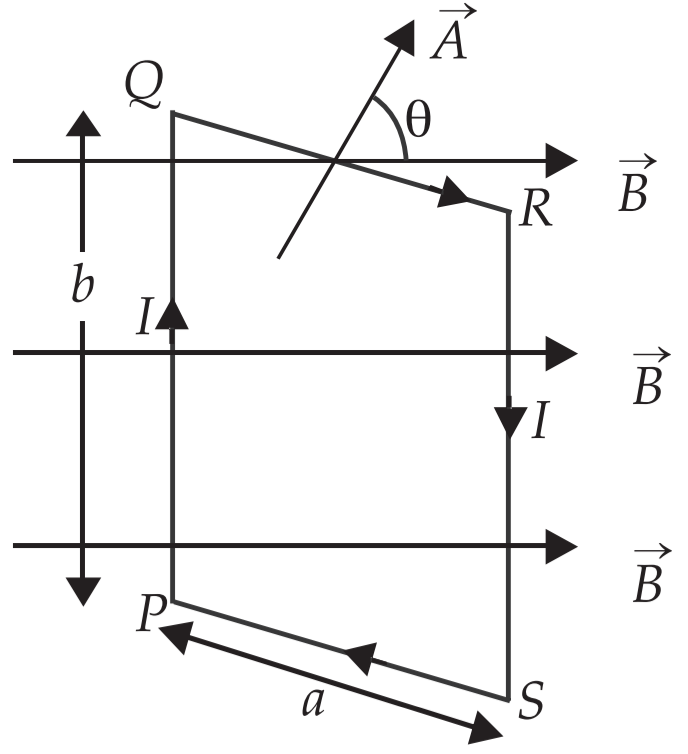
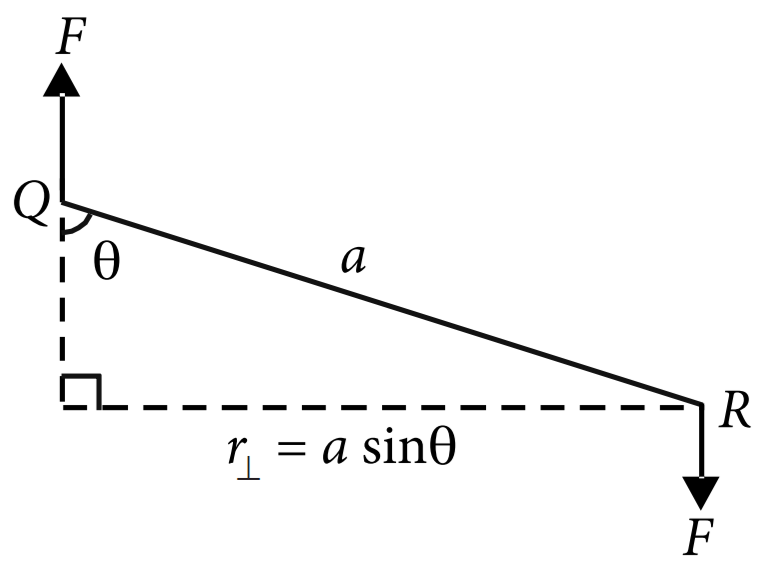
When a rectangular loop PQRS of sides' a' and' b' carrying current I is placed in uniform magnetic field B, such that area vector ii makes an angle 8 with direction of magnetic field, then forces on the arms QR and SP of loop are equal, opposite and collinear, thereby perfectly cancel each other, whereas forces on the arms PQ and RS of loop are equal and opposite but not collinear, so they give rise to torque on the loop.

Force on side PQ or RS of loop is F = JbB sin 90º = lb B and perpendicular distance between two non-collinear forces is $\text{r}_\bot=\text{a}\sin\theta$
So, torque on the loop. $\tau=\text{IAB}\sin\theta$ In vector form torque, $\vec{\tau}=\vec{\text{M}}\times\vec{\text{B}}$ Where $\vec{\text{M}}=\text{NI}\vec{\text{A}}$ is called magnetic dipole moment of current loop and is directed in direction of area vector $\vec{\text{A}}$ i.e., normal to the plane ofloop.
  1. A circular loop of area $1cm^2,$ carrying a current of 10A is placed in a magnetic field of 0.1T perpendicular to the plane of the loop. The torque on the loop due to the magnetic field is:
  1. Zero
  2. $10^{-4}Nm$
  3. $10^{-2}Nm$
  4. 1Nm
  1. Relation between magnetic moment and angular velocity is:
  1. $\text{m}\propto\omega$
  2. $\text{m}\propto\omega^2$
  3. $\text{m}\propto\sqrt{\omega}$
  4. None of these.
  1. A current loop in a magnetic field:
  1. Can be in equilibrium in two orientations, both the equilibrium states are unstable.
  2. Can be in equilibrium in two orientations, one stable while the other is unstable.
  3. Experiences a torque whether the field is uniform or non uniform in all orientations.
  4. Can be in equilibrium in one orientation.
  1. The magnetic moment of a current I carrying circular coil of radius rand number of turns N varies as:
  1. $\frac{1}{\text{r}^2}$
  2. $\frac{1}{\text{r}}$
  3. $\text{r}$
  4. $\text{r}^2$
  1. A rectangular coil carrying current is placed in a non-uniform magnetic field. On that coil the total:
  1. Force is non-zero.
  2. Force is zero.
  3. Torque is zero.
  4. ZNone of these.
Answer
  1. (a) Zero
Explanation:

Torque on a current carrying loop in magnetic field, $\tau=\text{IBA}\sin\theta$

Here, $\text{I}=10\text{A},\text{B}=0.1\text{T},\text{A}=1\text{cm}^2=10^{-4}\text{m}^2,\theta=0^0$

$\therefore\tau=10\times0.1\times10^{-4}\sin0^0=0$
  1. (a) $\text{m}\propto\omega$
Explanation:

Magnetic moment, $\text{M}=\text{IA}=\text{I}(\pi\text{r}^2)=\frac{\text{q}}{T}\times\pi\text{r}^2$

As, $\omega=\frac{2\pi}{\text{T}}\ \therefore\text{ M}=\frac{\text{q}\omega\text{r}^2}{2}\ \text{ or }\text{ M}\propto\omega$
  1. (b) Can be in equilibrium in two orientations, one stable while the other is unstable.
Explanation:

When a current loop is placed in a magnetic field it experiences a torque. It is given by,

$\vec{\tau}=\vec{\text{M}}\times\vec{\text{B}}$

Where M is the magnetic moment of the loop and B is the magnetic field.

or $\tau=\text{MB}\sin\theta$ where $\theta$ is angle between M and B When $\vec{\text{M}}$ and $\vec{\text{B}}$ are parallel $(i.e. \theta = 0^{0)}$ the equilibrium is stable and when they are antiparallel (i.e. $\theta$) the equilibrium is unstable.
  1. (d) $\text{r}^2$
Explanation:

Magnetic moment, $\text{M}=\text{NIA}=\text{NI}\pi\text{r}^2\text{ i.e., }\text{M}\propto\text{r}^2$
  1. (a) Force is non-zero.
View full question & answer
Question 124 Marks
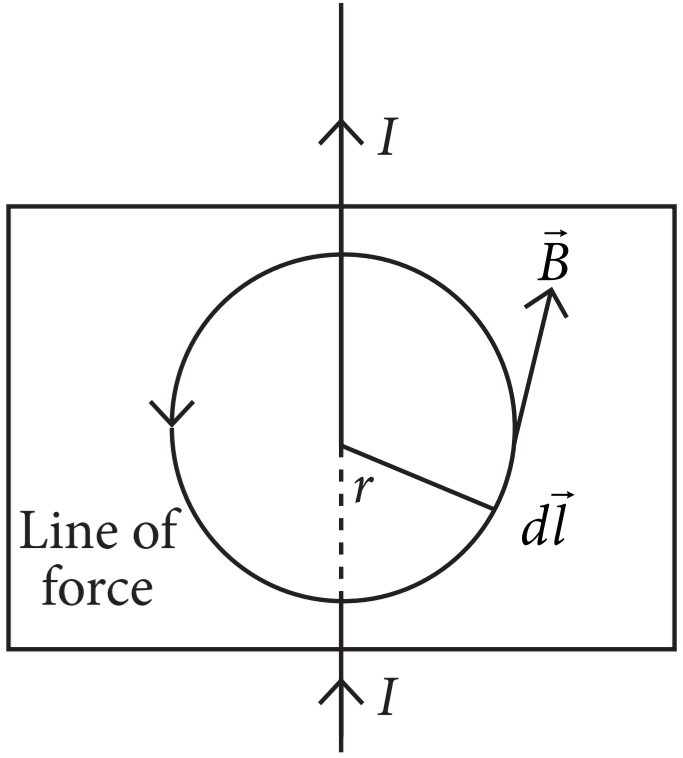
Ampere's law gives a method to calculate the magnetic field due to given current distribution. According to it, the circulation $\oint\vec{\text{B}}.\text{d}\vec{\text{l}}$ di of the resultant magnetic field along a closed plane curve is equal to $\mu_0$ times the total current crossing the area bounded by the closed curve provided the electric field inside the loop remains constant. Ampere's law is more useful under certain synunetrical conditions. Consider one such case of a long Straight wire with circular cross-section (radius R) carrying current f uniformly distributed across this cross-section.
  1. The magnetic field at a radial distance r from the centre of the wire in the region r > R, is:
  1. $\frac{\mu_0\text{I}}{2\pi\text{r}}$
  2. $\frac{\mu_0\text{I}}{2\pi\text{R}}$
  3. $\frac{\mu_0\text{IR}^2}{2\pi\text{r}}$
  4. $\frac{\mu_0\text{Ir}^2}{2\pi\text{R}}$
  1. The magnetic field at a distance r in the region r < R is:
  1. $\frac{\mu_0\text{I}}{2\text{r}}$
  2. $\frac{\mu_0\text{Ir}^2}{2\pi\text{R}^2}$
  3. $\frac{\mu_0\text{I}}{2\pi\text{r}}$
  4. $\frac{\mu_0\text{Ir}}{2\pi\text{R}^2}$
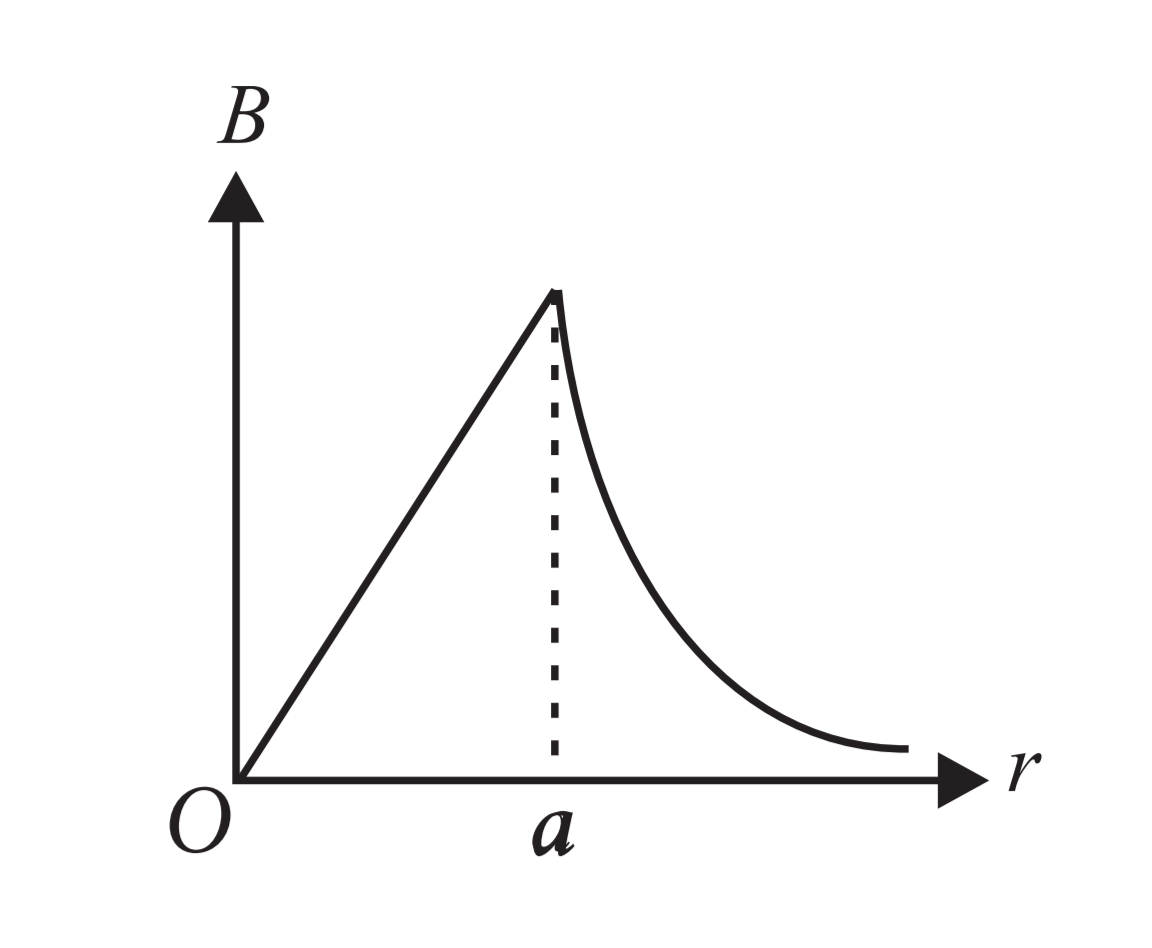
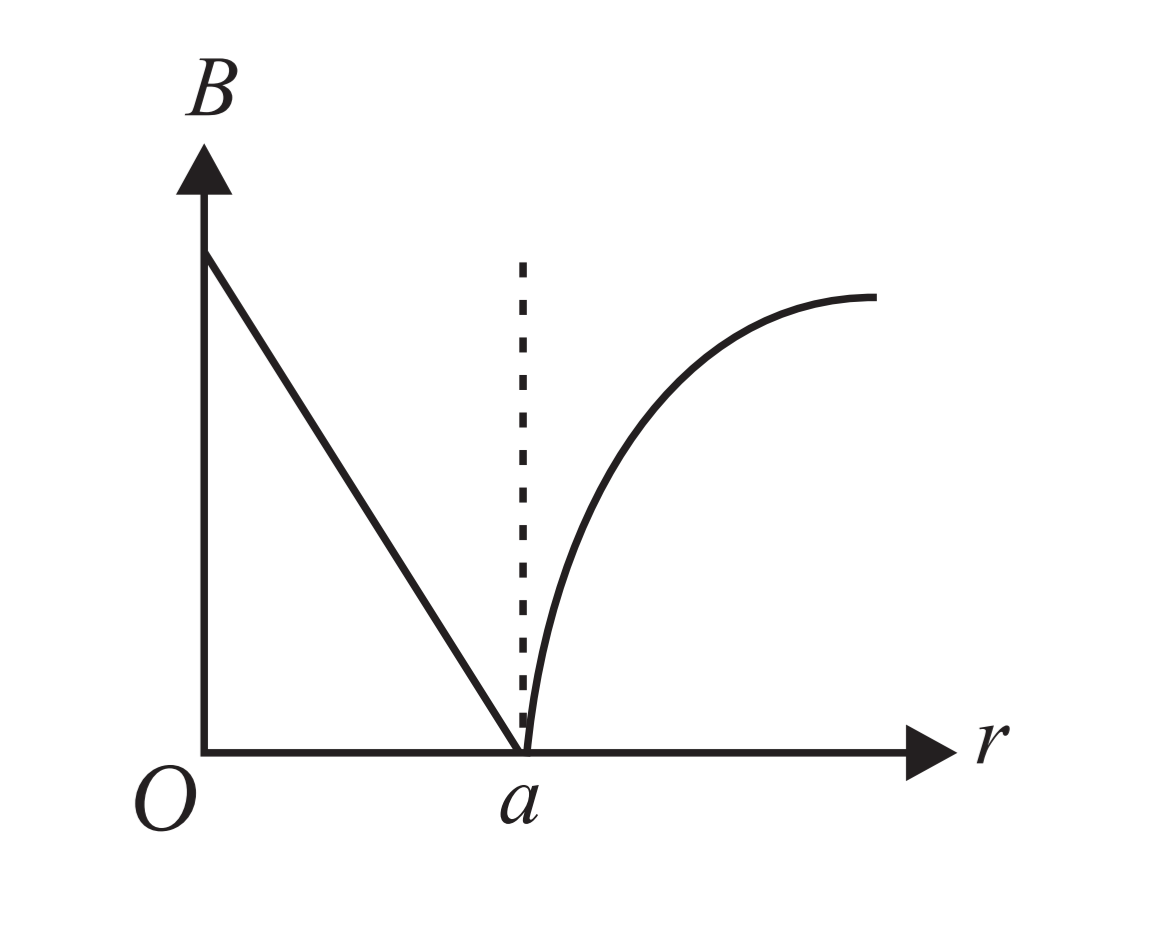
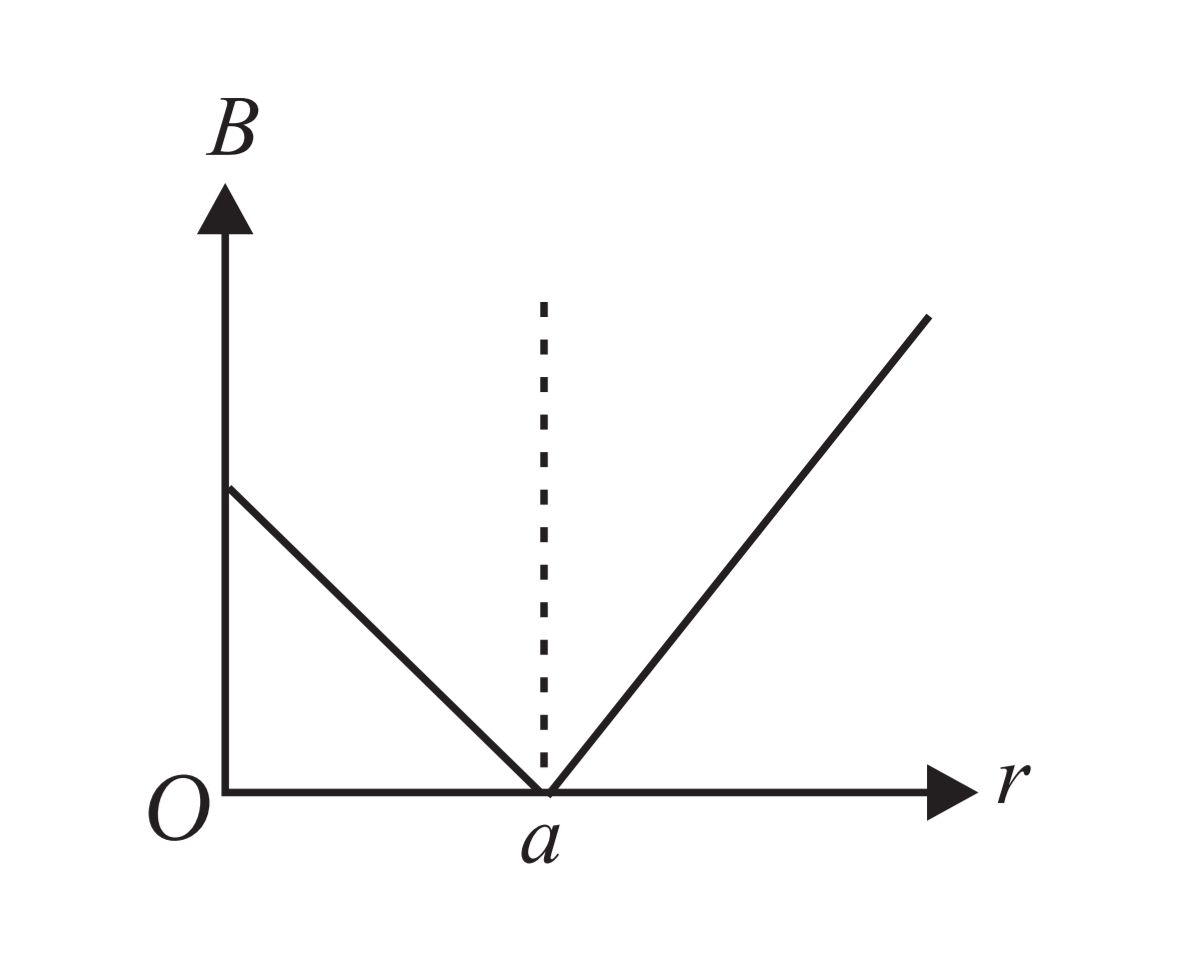
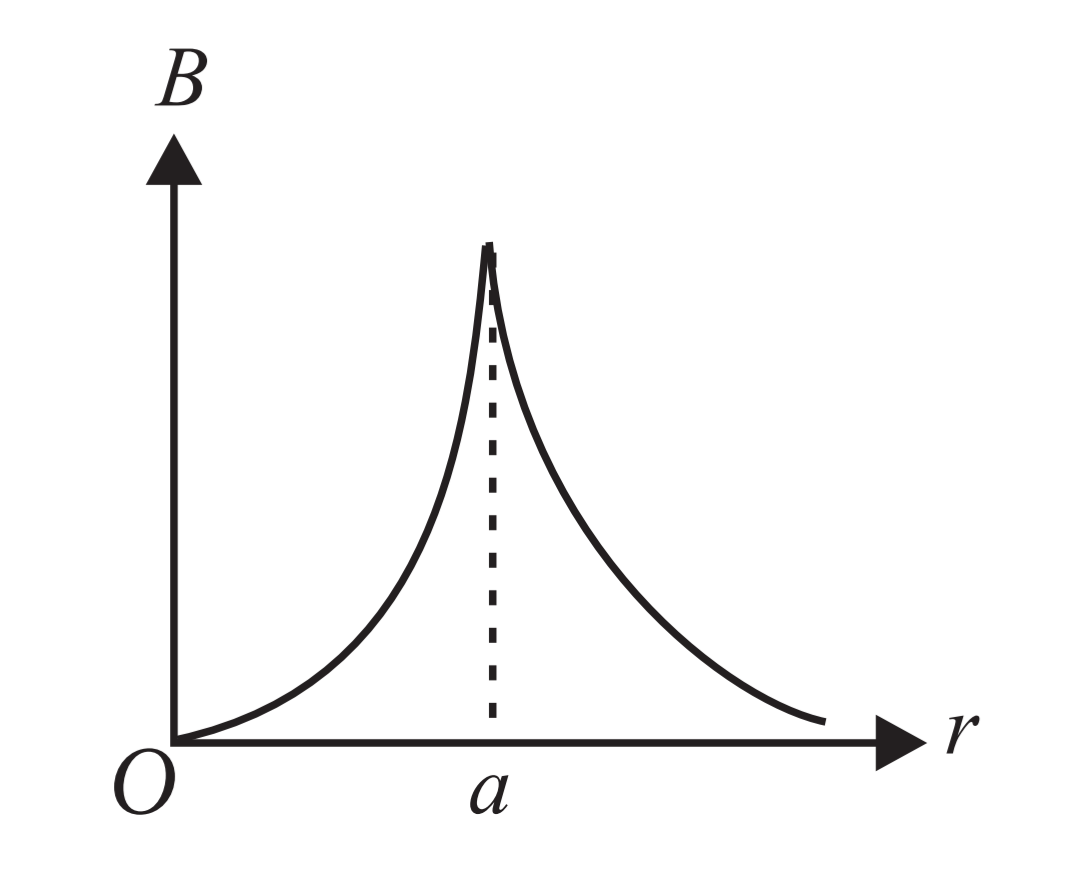
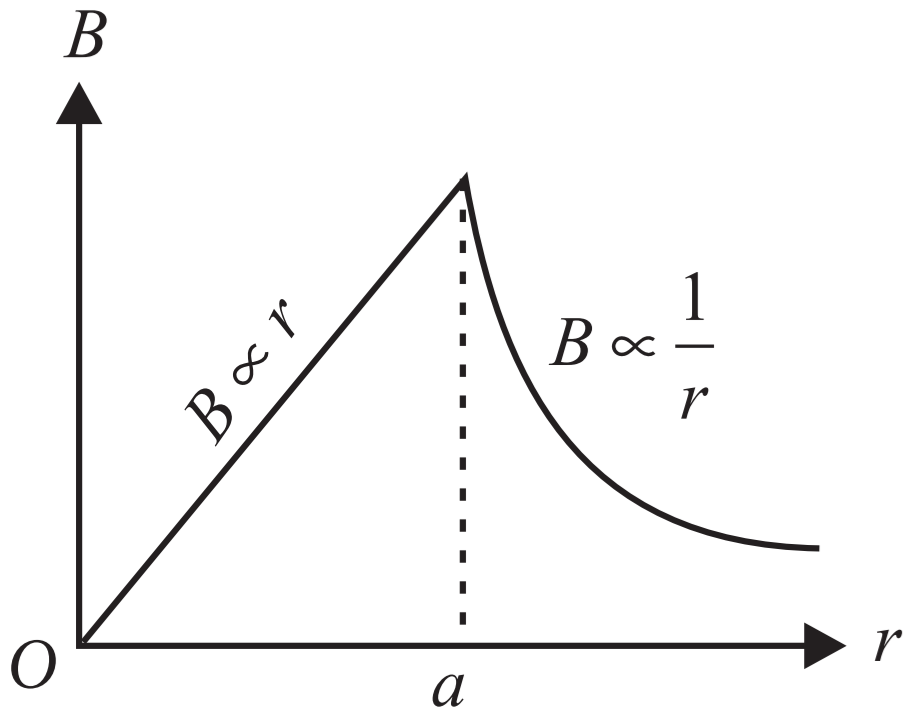
  1. A long straight wire of a circular cross section (radius a) carries a steady current I and the current I is uniformly distributed across this cross-section. Which of the following plots represents the variation of magnitude of magnetic field B with distance r from the centre of the wire?
  1.  
  1.  
  1.  
  1.  
  1. A long straight wire of radius R carries a steady current I. The current is uniformly distributed across its cross-section. The ratio of magnetic field at $\frac{\text{R}}{2}$ and 2R is:
  1. $\frac{\text{1}}{\text{2}}$
  2. $2$
  3. $\frac{\text{1}}{\text{4}}$
  4. $1$
  1. A direct current I flows along the length of an infinitely long straight thin walled pipe, then the magnetic field is:
  1. Uniform throughout the pipe but not zero.
  2. Zero only along the axis of the pipe.
  3. Zero at any point inside the pipe.
  4. Maximum at the centre and minimum at the edges.
Answer
  1. (a) $\frac{\mu_0\text{I}}{2\pi\text{r}}$
Explanation:

Magnetic field due to a long current carrying wire at r.

$\text{B}=\frac{\mu_0\text{I}}{2\pi\text{r}}$
  1. (d) $\frac{\mu_0\text{Ir}}{2\pi\text{R}^2}$
Explanation:

Let I' be the current in region r < R

Then, $\text{I}'=\frac{\text{I}}{\pi\text{R}^2}\pi(\text{r}^2)$ or $\text{I'}=\frac{\text{Ir}^2}{\text{R}^2}$

So, magnetic field, $\text{B}=\frac{\mu_0\text{I}'}{2\pi\text{r}}=\frac{\mu_0\text{Ir}^2}{2\pi\text{R}^2\text{r}}=\frac{\text{Ir}}{\text{R}^2}$
  1. (a) Proton
Explanation:

Magnetic field due to a long straight wire of radius a carrying current I at a point distant rfrom the centre of the wire is given as follows

$\text{B}=\frac{\mu_0\text{Ir}}{2\pi\text{a}^2}\ \ \ \ \text{for}\text{ r}<\text{a}$

$\text{B}=\frac{\mu_0\text{I}}{2\pi\text{a}}\ \ \ \ \text{for}\text{ r}=\text{a}$

$\text{B}=\frac{\mu_0\text{I}}{2\pi\text{r}}\ \ \ \ \text{for}\text{ r}>\text{a}$


The variation of magnetic field B with distance r from the centre of wire is shown in the figure.
  1. (d) $1$
Explanation:

Let the magnetic fields due to a long straight wire of radius Rcarrying a steady current lat a distance r from the centre of the wire are.

$\text{B}_1\frac{\mu_0\text{Ir}}{2\pi\text{R}^2}\ \ \ (\text{for }\text{r}<\text{R})$

and $\text{B}_2\frac{\mu_0\text{I}}{2\pi\text{R}}\ \ \ (\text{for r}>\text{R})$

So, the magnetic field at $\text{r}=\frac{\text{R}}{2}$ is $\text{B}_1=\frac{\mu_0\text{I}}{2\pi\text{r}^2}(\frac{\text{R}}{2})=\frac{\mu_0\text{I}}{4\pi\text{R}}$

and at r = 2 is $\text{B}_2=\frac{\mu_0\text{I}}{2\pi(2\text{R})}=\frac{\mu_0\text{I}}{4\pi\text{R}}$

$\therefore$ Their corresponding ratio is $\frac{\text{B}_1}{\text{B}_2}=\frac{\frac{\mu_0\text{I}}{4\pi\text{R}}}{\frac{\mu_0\text{I}}{4\pi\text{R}}}=1$
  1. (c) Zero at any point inside the pipe.
View full question & answer
Question 134 Marks
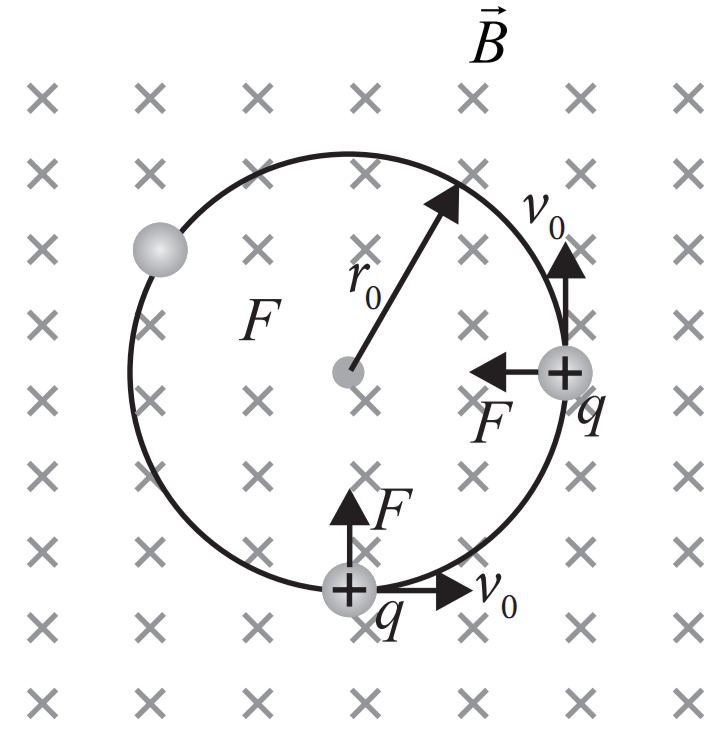
An electron with speed $v_0 << c$ moves in a circle of radius $r_0$ in a uniform magnetic field. This electron is able to traverse a circular path as magnetic field is perpendicular to the velocity of the electron. A force acts on the particle perpendicular to both $\vec{\text{v}}_0$ and $\vec{\text{B}},$ This force continuously deflects the particle sideways without changing its speed and the particle will move along a circle perpendicular to the field. The time required for one revolution of the electron is $T_0.$
  1. If the speed of the electron is now doubled to $2v_0$. The radius of the circle will change to:
  1. $4r_0$
  2. $2r_0$
  3. $r_0$
  4. $\frac{\text{r}_0}{2}$
  1. If $v_0 = 2v_0$ then the time required for one revolution of the electron will change to:
  1. $4T_0$
  2. $2T_0$
  3. $T_0$
  4. $\frac{\text{T}_0}{2}$
  1. A charged particles is projected in a magnetic field $\vec{\text{B}}=(2\hat{\text{i}}+4\hat{\text{j}})\times10^2\text{ T}.$ The acceleration of the particle is found to be $\vec{\text{a}}=(\text{x}\hat{\text{i}}+2\hat{\text{j}})\text{m s}^{-2}$ Find the value of x.
  1. $4ms^{-2}$
  2. $-4ms^{-2}$
  3. $-2ms^{-2}$
  4. $2ms^{-2}$
  1. If the given electron has a velocity not perpendicular to B, then trajectory of the electron is:
  1. Straight line.
  2. Circular.
  3. Helical.
  4. Zig-zag.
  1. If this electron of charge (e) is moving parallel to uniform magnetic field with constant velocity v, the force acting on the electron is:
  1. Bev
  2. $\frac{\text{Be}}{\text{v}}$
  3. $\frac{\text{B}}{\text{ev}}$
  4. Zero
Answer
  1. (b) $2r_0$
Explanation:

As, $\text{r}_0=\frac{\text{mv}}{\text{qB}}\Rightarrow\text{r}'=\frac{\text{m}(2\text{v}_0)}{\text{qB}}=2\text{r}_0$
  1. (c) $T_0$
Explanation:

As, $\text{T}=\frac{2\pi\text{m}}{\text{qB}}$

Thus, it remains same as it is independent of velocity.
  1. (b) $-4ms^{-2}$
Explanation:

As, $\text{F}\bot\text{B}$

Hence, $\text{a}\bot\text{B}$

$\therefore\vec{\text{a}}.\vec{\text{B}}=0$

$\Rightarrow(\text{x}\hat{\text{i}}+2\hat{\text{j}}=0)$

$2\text{x}+8=0\Rightarrow\text{x}=-4\text{ms}^{-2}$
  1. (c) Helical.
If the charged particle has a velocity not perpendicular to $\vec{\text{B}},$ then component of velocity along $\vec{\text{B}}$ remains unchanged as the motion along the $\vec{\text{B}}$ will not be affected by $\vec{\text{B}}.$

Then, the motion of the particle in a plane perpendicular to $\vec{\text{B}},$ is as before circular one. Thereby, producing helical motion.
  1. (d) Zero
Explanation:

The force on electron $\text{F}=\text{qv}\text{B}\sin\theta$

As the electron is moving parallel to B

So, $\theta=0^\circ\Rightarrow\text{qv}\text{B}\sin\theta$
View full question & answer
Question 144 Marks
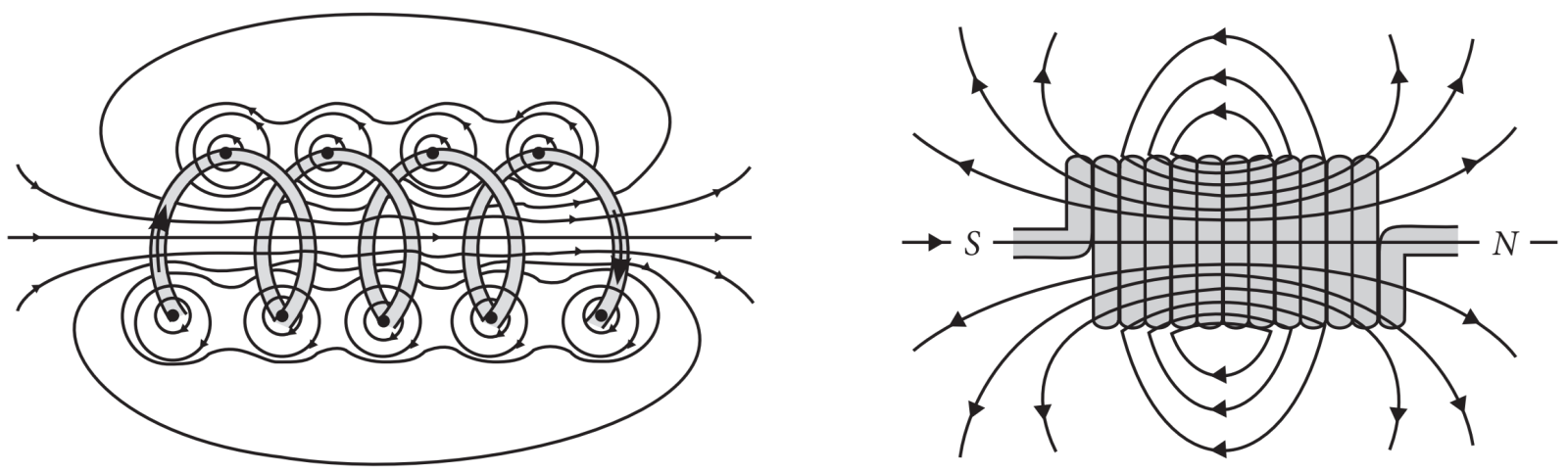
A solenoid is a long coil of wire tightly wound in the helical form. Solenoid consists of closely stacked rings electrically insulated from each other wrapped around a non-conducting cylinder.
Figure below shows the magnetic field lines of a solenoid carrying a steady current I. We see that if the turns are closely spaced, the resulting magnetic field inside the solenoid becomes fairly uniform, provided that the length of the solenoid is much greater than its diameter. for an "ideal" solenoid, which is infinitely long with turns tightly packed, the magnetic field inside the solenoid is uniform and parallel to the axis, and vanishes outside the solenoid.
  1. A long solenoid has 800 turns per metre length of solenoid. A current of 1.6A flows through it. The magnetic induction at the end of the solenoid on its axis is
  1. $10 \times 10^{-4}T$
  2. $8 \times 10^{-4}T$
  3. $32 \times 10^{-4}T$
  4. $4 \times 10^{-4}T$
  1. Choose the correct statement in the following.
  1. The magnetic field inside the solenoid is less than that of outside.
  2. The magnetic field inside an ideal solenoid is not at all uniform.
  3. The magnetic field at the centre, inside an ideal solenoid is almost twice that at the ends.
  4. The magnetic field at the centre, inside an ideal solenoid is almost half of that at the ends.
  1. The magnetic field (B) inside a long solenoid having n turns per unit length and carrying current I when iron core is kept in it is ($\mu_0$ = permeability of vacuum, = magnetic susceptibility)
  1. $\mu_0\text{ nI}(\text{l}-\chi)$
  2. $\mu_0\text{ nI }\chi$
  3. $\mu_0\text{ nI}^2(\text{1}+\chi)$
  4. $\mu_0\text{ nI}(\text{1}+\chi)$
  1. A solenoid oflength land having l turns carries a current I is in anticlockwise direction. The magnetic field is:
  1. $\mu_0\text{ nI}$
  2. $\mu_0\frac{\text{ nI}}{\text{l}^2}$
  3. A​​​​​​along the axis of solenoid.
  4. Perpendicular to the axis of coil.
  1. The magnitude of the magnetic field inside a long solenoid is increased by:
  1. Decreasing its radius.
  2. Decreasing the current through it.
  3. Increasing its area of cross-section.
  4. Introducing a medium of higher permeability.
Answer
  1. (b) $8 \times 10^{-4}T$
Explanation:

As, $\text{B}=\frac{\mu_0\text{nl}}{2}=\frac{(4\pi\times10^{-7})\times800\times1.6}{2}$

$=8\times10^{-4}\text{T}$
  1. (c) The magnetic field at the centre, inside an ideal solenoid is almost twice that at the ends.
Explanation:

Magnetic field at one end of a solenoid carrymg current is $\text{B}=\frac{\mu_0\text{nl}}{2}$ Magnetic field inside the solenoid is uniform and is given by $\text{B}_\text{c}=\mu_0\text{nl}$
  1. (d) $\mu_0\text{ nI}(\text{1}+\chi)$
Explanation:

Magnetic field inside a long solenoid with an iron core inside it is $\text{B}=\mu\text{nl}$

But $\mu=\mu_0(1+\chi)\therefore\text{B}\mu_0(1+\chi)\text{nl}$
  1. (c) A​​​​​​along the axis of solenoid.
Explanation:

A solenoid of length l and having n turns carries a current I in anticlockwise direction. The magnetic field is $\frac{\mu_0\text{nl}}{\text{l}}.$ Its direction will be along the axis of solenoid.
  1. (d) Introducing a medium of higher permeability.
View full question & answer
Question 154 Marks
A magnetic field can be produced by moving, charges or electric currents. The basic equation governing the magnetic field due to a current distribution is the Biot-Savart law. Finding the magnetic field resulting from a current distribution involves the vector product, and is inherently a calculas problem when the distance from the current to the field point is continuously changing. According to this law, the magnetic field at a point due to a current element of length $\text{d}\vec{\text{I}}$ carrying current I, at a distance r from the element is $\text{dB}=\frac{\mu_0}{4\pi}\frac{\text{I}(\text{d}{\vec{\text{I}}\times\vec{\text{r}}})}{\text{r}^3}$Biot-Savart law has certain similarities as well as difference with Coloumb's law for electrostatic field e.g., there is an angle dependence in Biot-Savart law which is not present in electrostatic case.
  1. The direction of magnetic field $\text{d}\vec{\text{B}}$ due to a current element $\text{Id}\vec{\text{l}}$ at a point of distance $\vec{\text{r}}$ from it, when a current I passes through a long conductor is in the direction
  1. Of position vector $\vec{\text{r}}$ of the point.
  2. Of current element $\text{Id}\vec{\text{l}}$
  3. Perpendicular to both $\text{d}\vec{\text{l}}$ and $\vec{\text{r}}$
  4. Perpendicular to $\text{d}\vec{\text{l}}$ only.
  1. The magnetic field due to a current in a straight wire segment of length Lat a point on its perpendicular bisector at a distance r (r >> L)
  1. Decreases as $\frac{1}{\text{r}}$
  2. Decreases as $\frac{1}{\text{r}^2}$
  3. Decreases as $\frac{1}{\text{r}^3}$
  4. approaches a finite limit as $\text{r}\rightarrow\infty$
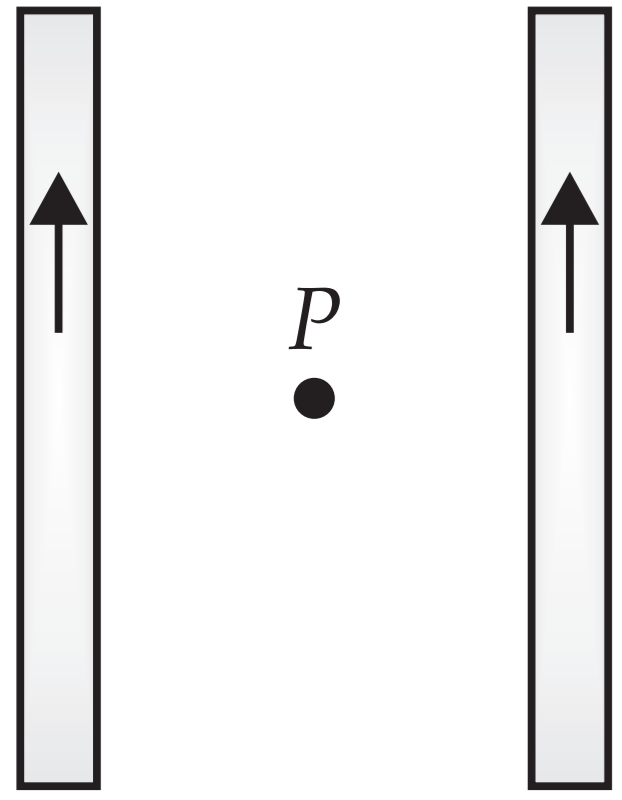
  1. Two long straight wires are set parallel to each other. Each carries a current i in the same direction and the separation between them is 2r. The intensity of the magnetic field midway between them is:
  1. $\mu_0\frac{\text{i}}{\text{r}}$
  2. $4\mu_0\frac{\text{i}}{\text{r}}$
  3. $\text{Zero}$
  4. $\mu_0\frac{\text{i}}{\text{4r}}$
  1. A long straight wire carries a current along the z-axis for any two points in the x - y plane. Which of the following is always false?
  1. The magnetic fields are equal.
  2. The directions of the magnetic fields are the same.
  3. The magnitudes of the magnetic fields are equal.
  4. The field at one point is opposite to that at the other point.
  1. Biot-Savart law can be expressed alternatively as:
  1. Coulomb's Law.
  2. Ampere's circuital law.
  3. Ohm's Law.
  4. Gauss's Law.
Answer
  1. (c) Perpendicular to both $\text{d}\vec{\text{l}}$ and $\vec{\text{r}}$
Explanation:

According to Biot-Savart's law, the magnetic induction due to a current element is given by,

$\text{d}\vec{\text{B}}=\frac{\mu_0}{4\pi}\frac{\text{Id}\vec{\text{l}\times\text{r}}}{\text{r}^3}$

This is perpendicular to both $\text{d}\vec{\text{l}}$ and $\vec{\text{r}}.$
  1. (b) Decreases as
Explanation:

From Biot-savart's law, $\text{dB}=\frac{\mu_0}{4\pi}\frac{\text{Idl}}{\text{r}^2}\text{i.e. dB}\propto\frac{1}{\text{r}^2}$
  1. (c) $\text{Zero}$
Explanation:

$\text{B}=\frac{\mu_0}{2\pi}.\frac{\text{i}}{\text{r}}-\frac{\mu_0}{2\pi}.\frac{\text{i}}{\text{r}}=0$
  1. (a) The magnetic fields are equal.
  1. (b) Ampere's circuital law.
Explanation:

Biot-Savart law can be expressed alternatively as Ampere circuital law.
View full question & answer
Question 164 Marks
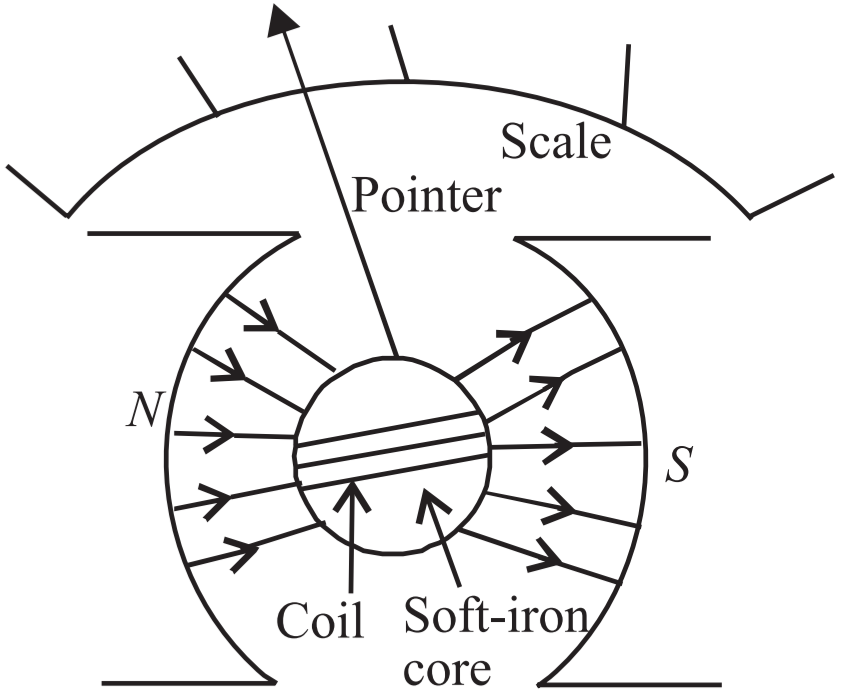
Moving coil galvanometer operates on Permanent Magnet Moving Coil (PMMC) mechanism and was designed by the scientist D'arsonval. Moving coil galvanometers are of two types.
  1. Suspended coil.
  2. Pivoted coil type or tangent galvanometer.
Its working is based on the fact that when a current carrying coil is placed in a magnetic field, it experiences a torque. This torque tends to rotate the coil about its axis of suspension in such a way that the magnetic flux passing through the coil is maximum.
  1. A moving coil galvanometer is an instrument which:
  1. Is used to measure emf.
  2. Is used to measure potential difference.
  3. Is used to measure resistance.
  4. Is a deflection instrument which gives a deflection when a current flows through its coil.
  1. To make the field radial in a moving coil galvanometer.
  1. Number of turns of coil is kept small.
  2. Magnet is taken in the form of horse-shoe.
  3. Poles are of very strong magnets.
  4. Poles are cylindrically cut.
  1. The deflection in a moving coil galvanometer is:
  1. Directly proportional to torsional constant of spring.
  2. Directly proportional to the number of turns in the coil.
  3. Inversely proportional to the area of the coil.
  4. Inversely proportional to the current in the coil.
  1. In a moving coil galvanometer, having a coil of N-turns of area A and carrying current I is placed in a radial field of strength B.
The torque acting on the coil is:
  1. $NA^2B^2I$
  2. $NABI^2$
  3. $N^2ABI$
  4. $NABI$
  1. To increase the current sensitivity of a moving coil galvanometer, we should decrease:
  1. Strength of magnet.
  2. Torsional constant of spring.
  3. Number of turns in coil.
  4. Area of coil.
Answer
  1. (d) Is a deflection instrument which gives a deflection when a current flows through its coil.
Explanation:
A moving coil galvanometer is a sensitive instrument which is used to measure a deflection when a current flows th rough its coil.
  1. (d) Poles are cylindrically cut.
Explanation:
Uniform field is made radial by cutting pole pieces cylindrically.
  1. (b) Directly proportional to the number of turns in the coil.
Explanation:
The deflection in a moving coil galvanometer, $\phi=\frac{\text{NAB}}{\text{K}}.\text{I}$ or $\phi\propto\text{N,}$ N, where N is number of turns in a oil, Bis magnetic field and A is area of cross-section.
  1. (d) NABI
Explanation:
The deflecting torque acting on the coil. $\tau_{\text{deflection}}=\text{NIAB}$
  1. (b) Torsional constant of spring.
Explanation:
Current sensitivity of galvanometer,
$\frac{\phi}{\text{I}}=\text{S}_\text{i}=\frac{\text{NBA}}{\text{K}}$
Hence, to increase (current sensitivity) S;, (torsional constant of spring) k must be decrease.
View full question & answer
Question 174 Marks
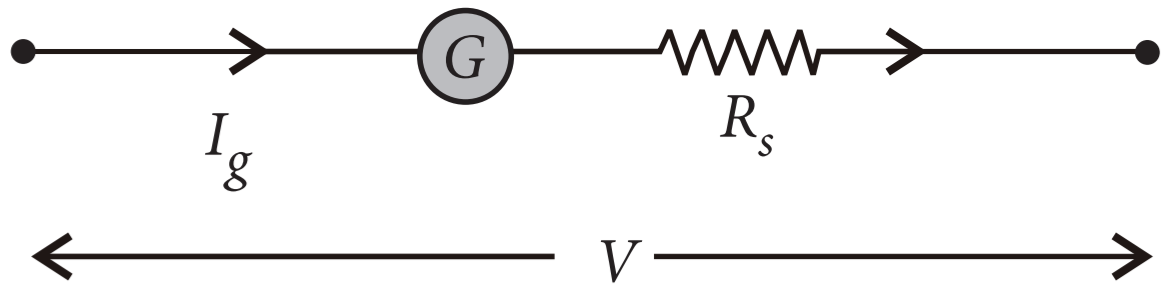
A galvanometer can be converted into voltmeter of given range by connecting a suitable resistance R, in series with the galvanometer, whose value is given by,
$\text{R}_\text{s}=\frac{\text{V}}{\text{I}_\text{g}}-\text{G}$
where Vis the voltage to be measured, lg is the current for full scale deflection of galvanometer and G is the resistance of galvanometer.

Series resistor(R,) increases range of voltmeter and the effective resistance of galvanometer. It also protects the galvanometer from damage due to large current. Voltmeter is a high resistance instrument and it is always connected in parallel with the circuit element across which potential difference is to be measured. An ideal voltmeter has infinite resistance. In order to increase the range of voltmeter n times the value of resistance to be connected in series with galvanometer is $R_s = (n - 1)G.$
  1. 10mA current can pass through a galvanometer of resistance $25\Omega$ What resistance in series should be connected through it, so that it is converted into a voltmeter of 100V?
  1. $0.975\Omega$
  2. $99.75\Omega$
  3. $975\Omega$
  4. $9975\Omega$
  1. There are 3 voltmeter A, B, C having the same range but their resistance are $15000\Omega,10000\Omega$, and $5000\Omega$ respectively. 'Tile best voltmeter amongst them is the one whose resistance is
  1. $5000\Omega$
  2. $10000\Omega$
  3. $15000\Omega$
  4. all are equally good.
  1. A milliammeter of range 0 to 25mA and resistance of $10\Omega$ is to be converted into a voltmeter with a range of 0 to 25V. 'Tile resistance that should be connected in series will be:
  1. $930\Omega$
  2. $960\Omega$
  3. $990\Omega$
  4. $1010\Omega$
  1. To convert a moving coil galvanometer (MCG) into a voltmeter:
  1. A high resistance R is connected in parallel with MCG.
  2. A low resistance R is connected in parallel with MCG.
  3. A low resistance R is connected in series with MCG.
  4. A high resistance R is connected in series with MCG.
  1. To increase the current sensitivity of a moving coil galvanometer, we should decrease:
  1. Zero.
  2. Low.
  3. High.
  4. Infinity.
Answer
  1. (d) $9975\Omega$
Explanation:

A galvanometer can be converted into a voltmeter of given range by connecting a suitable high resistance R in series of galvanometer, which is given by,

$\text{R}=\frac{\text{V}}{\text{I}_\text{g}}-\text{G}=\frac{100}{10\times10^{-3}}-25=10000-25=9975\Omega$
  1. (c) $15000\Omega$
Explanation:

An ideal voltmeter should have a very high resistance.
  1. (c) $990\Omega$
Explanation:

Resistance of voltmeter $=\frac{25}{25\times10^{-3}}=1000\Omega$

$\therefore\text{X}=1000-10=990\Omega$
  1. (d) A high resistance R is connected in series with MCG.
Explanation:

To convert a moving coil galvanometer into a voltmeter, it is connected with a high resistance in series. The voltmeter is connected in parallel to measure the potential difference. As the resistance is high, the voltmeter itself does not consume current.
  1. (d) Infinity.
Explanation:

The resistance of an ideal voltmeter is infinity.
View full question & answer
Question 184 Marks
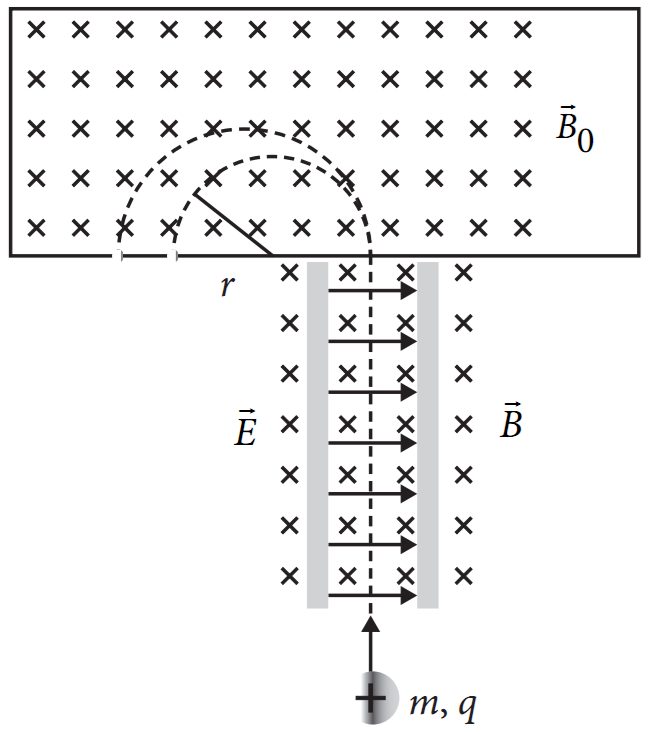
Various methods can be used to measure the mass of an atom. One possibility is through the use of a mass spectrometer. The basic feature of a Banbridge mass spectrometer is illustrated in figure. A particle carrying a charge +q is first sent through a velocity selector and comes out with velocity $\text{v}=\frac{\text{E}}{\text{B}}.$
The applied electric and magnetic fields satisfy the relation E = vB so that the trajectory of the particle is a straight line. Upon entering a region where a second magnetic field $\vec{\text{B}}_0$ pointing into the page has been applied, the particle will move in a circular path with radius rand eventually strike the photographic plate.
  1. In mass spectrometer, the ions are sorted out in which of the following ways?
  1. By accelerating them through electric field.
  2. By accelerating them through magnetic field.
  3. By accelerating them through electric and magnetic field.
  4. By applying a high voltage.
  1. Radius of particle in second magnetic field $B_0$ is:
  1. $\frac{2\text{mv}}{\text{qE}_0}$
  2. $\frac{\text{mv}}{\text{qE}_0}$
  3. $\frac{\text{mv}}{\text{qB}_0}$
  4. $\frac{2\text{mE}_0\text{v}}{\text{qB}_0}$
  1. Which of the following will trace a circular trajectory with largest radius?
  1. Proton
  2. ct-particle
  3. Electron
  4. A particle with charge twice and mass thrice that of electron.
  1. Mass of the particle in terms $q, B_0, B$, rand E is:
  1. $\frac{\text{qbr}}{\text{E}}$
  2. $\frac{\text{qbr}}{\text{E}}$
  3. $\frac{\text{qbr}}{\text{E}}$
  4. $\frac{\text{qbr}}{\text{E}}$
  1. The particle comes out of velocity selector along a straight line, because:
  1. Electric force is less than magnetic force.
  2. Electric force is greater than magnetic force.
  3. Electric and magnetic force balance each other.
  4. Can't say.
Answer
  1. (c) By accelerating them through electric and magnetic field.
Explanation:

In mass spectrometer, the ions are sorted out by accelerating them through electric and magnetic field.
  1. (c) $\frac{\text{mv}}{\text{qB}_0}$
Explanation:

As $\frac{\text{mv}^2}{\text{r}}=\text{qvB}_0\ \therefore\text{r}=\frac{\text{mv}}{\text{qB}_0}$
  1. (b) ct-particle
Explanation:

As radius $\text{r}\propto\frac{\text{m}}{\text{q}}.$

$\therefore$ r will be maximum for a - particle.
  1. (b) $\frac{\text{qbr}}{\text{E}}$
Explanation:

Here, $\text{r}\propto\frac{\text{mv}}{\text{qB}_0}.$ or $\text{m}=\frac{\text{rqB}_0}{\text{v}}$

As $\text{v}=\frac{\text{E}}{\text{B}},\ \therefore\text{m}=\frac{\text{qB}_0\text{Br}}{\text{v}}$
  1. (c) Electric and magnetic force balance each other.
Explanation:

From the relation $\text{v}=\frac{\text{E}}{\text{B}},$ it is clear electric and magnetic force balance each other.
View full question & answer
Question 194 Marks
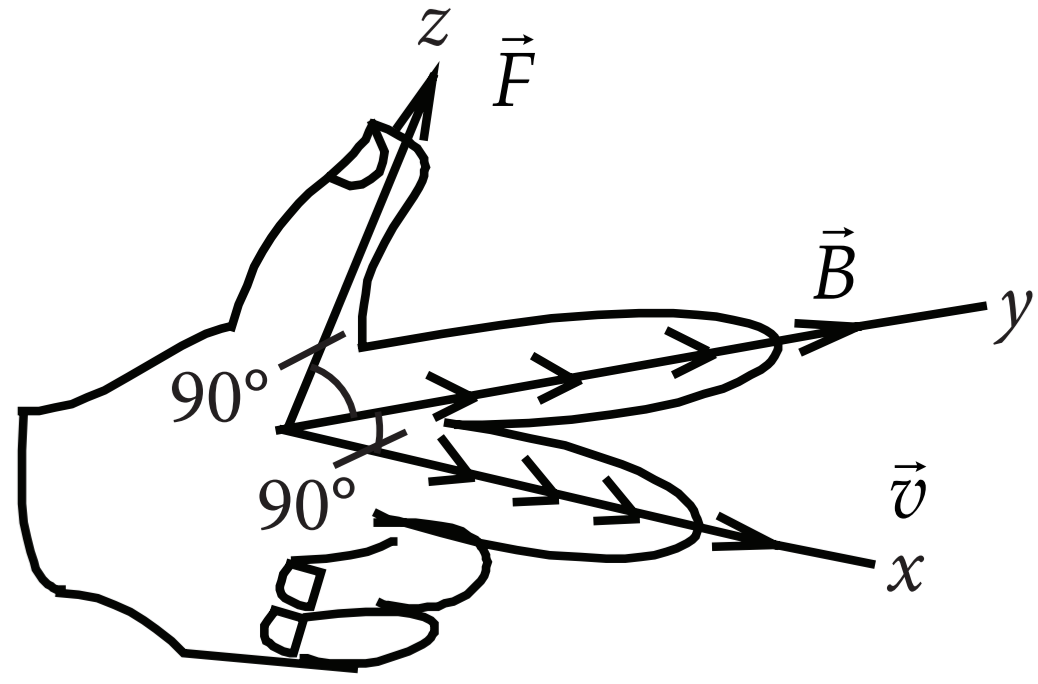
A charged particle moving in a magnetic field experiences a force that is proportional to the strength of the magnetic field, the component of the velocity that is perpendicular to the magnetic field and the charge of the particle. This force is given by $\vec{\text{F}}=\text{q}(\vec{\text{v}}\times\vec{\text{B}})$ where q is the electric charge of the particle, v is the instantaneous velocity of the particle, and Bis the magnetic field (in tesla). The direction of force is determined by the rules of cross product of two vectors. Force is perpendicular to both velocity and magnetic field. Its direction is same as $\vec{\text{v}}\times\vec{\text{B}}$ if q is positive and opposite of $\vec{\text{v}}\times\vec{\text{B}}$ if q is negative. The force is always perpendicular to both the velocity of the particle and the magnetic field that created it. Because the magnetic force is always perpendicular to the motion, the magnetic field can do no work on an isolated charge. It can only do work indirectly, via the electric field generated by a changing magnetic field.
  1. When a magnetic field is applied on a stationary electron, it:
  1. Remains stationary.
  2. Spins about its own axis.
  3. Moves in the direction of the field.
  4. Moves perpendicular to the direction of the field.
  1. A proton is projected with a uniform velocity v along the axis of a current carrying solenoid, then,
  1. The proton will be accelerated along the axis.
  2. The proton path will be circular about the axis.
  3. The proton moves along helical path.
  4. The proton will continue to move with velocity v along the axis.
  1. A charged particle experiences magnetic force in the presence of magnetic field. Which of the following statement is correct?
  1. The particle is stationary and magnetic field is perpendicular.
  2. The particle is moving and magnetic field is perpendicular to the velocity.
  3. The particle is stationary and magnetic field is parallel.
  4. The particle is moving and magnetic field is parallel to velocity.
  1. A charge q moves with a velocity $2m\ s^{-1}$ along x-axis in a uniform magnetic field $\vec{\text{F}}=(\vec{\text{i}}+2\vec{\text{j}}+3\vec{\text{k}})\text{T,}$ charge will experience a force.
  1. In z-y plane.
  2. Along -y axis.
  3. Along +z axis.
  4. Along -z axis.
  1. Moving charge will produce.
  1. Electric field only.
  2. Magnetic field only.
  3. Both electric and magnetic field.
  4. None of these.
Answer
  1. (a) Remains stationary.
Explanation:
For stationary electron, $\vec{\text{v}}=0$
$\therefore$ Force on the electron is, $\vec{\text{F}}_\text{m}=-\text{e}(\vec{\text{v}}\times\vec{\text{B}})=0$
  1. (d) The proton will continue to move with velocity v along the axis.
Explanation:
Force on the proton, $\vec{\text{F}}_\text{B}=\text{e}(\vec{\text{v}}\times\vec{\text{B}})$
Since, $\vec{\text{v}}$ is parallel to $\vec{\text{B}}$
$\therefore\vec{\text{F}}_\text{B}=0$
Hence proton will continue to move with velocity v along the axis of solenoid.
  1. (b) The particle is moving and magnetic field is perpendicular to the velocity.
Explanation:
Magnetic force on the charged particle q is,
$\vec{\text{F}}_\text{m}=\text{q}(\vec{\text{v}}\times\vec{\text{B}})$ or $\text{F}_\text{m}=\text{qv}\text{B}\sin\theta$
where $\theta$ is the angle between $\vec{\text{v}}$ and $\vec{\text{B}}.$
Out of the given cases, only in case (b) it will experience the force while in other cases it will experience no force.
  1. (a) In z-y plane.
Explanation:
$\vec{\text{F}}=\text{q}(\vec{\text{v}}\times\vec{\text{B}})$
$=\text{q[}2\vec{\text{i}}\times(\vec{\text{i}}+2\vec{\text{j}}+3\vec{\text{k}})]=(4\text{q})\vec{\text{k}}-(6\text{q})\vec{\text{j}}$
  1. (c) Both electric and magnetic field.
Explanation:
When an electric charge is moving both electric and magnetic fields are produced, whereas a static charge produces only electric field.
View full question & answer