The angular speed of a motor wheel is increased from $1200$ rpm to $3120$ rpm in $16$ seconds. $(i)$ What is its angular acceleration, assuming the acceleration to be uniform? $(ii)$ How many revolutions does the engine make during this time?
Example-(6.11)
Download our app for free and get started
$(i)$ We shall use $\omega=\omega_0+\alpha t$
$\omega_0=$ initial angular speed in $rad / s$
$=2 \pi \times \text { angular speed in rev } / s$
$=\frac{2 \pi \times \text { angular speed in rev } / min }{60 s / min }$
$=\frac{2 \pi \times 1200}{60}\ rad / s$
$=40 \pi\ rad / s$
Similarly$\omega=$ final angular speed in $rad / s$
$=\frac{2 \pi \times 3120}{60}\ rad / s$
$=2 \pi \times 52\ rad / s$
$=104 \pi\ rad / s$
$\therefore$ Angular acceleration
$\alpha=\frac{\omega-\omega_0}{t} \quad=4 \pi\ rad / s ^2$
The angular acceleration of the engine $=4 \pi\ rad / s ^2$
$(ii)$ The angular displacement in time $t$ is given by
$\theta=\omega_0 t+\frac{1}{2} \alpha t^2$
$= \left(40 \pi \times 16+\frac{1}{2} \times 4 \pi \times 16^2\right)\ rad$
$= (640 \pi+512 \pi)\ rad$
$= 1152 \pi\ rad$
Number of revolutions $=\frac{1152 \pi}{2 \pi}=576$
$\omega_0=$ initial angular speed in $rad / s$
$=2 \pi \times \text { angular speed in rev } / s$
$=\frac{2 \pi \times \text { angular speed in rev } / min }{60 s / min }$
$=\frac{2 \pi \times 1200}{60}\ rad / s$
$=40 \pi\ rad / s$
Similarly$\omega=$ final angular speed in $rad / s$
$=\frac{2 \pi \times 3120}{60}\ rad / s$
$=2 \pi \times 52\ rad / s$
$=104 \pi\ rad / s$
$\therefore$ Angular acceleration
$\alpha=\frac{\omega-\omega_0}{t} \quad=4 \pi\ rad / s ^2$
The angular acceleration of the engine $=4 \pi\ rad / s ^2$
$(ii)$ The angular displacement in time $t$ is given by
$\theta=\omega_0 t+\frac{1}{2} \alpha t^2$
$= \left(40 \pi \times 16+\frac{1}{2} \times 4 \pi \times 16^2\right)\ rad$
$= (640 \pi+512 \pi)\ rad$
$= 1152 \pi\ rad$
Number of revolutions $=\frac{1152 \pi}{2 \pi}=576$

Download our appand get started for free
Experience the future of education. Simply download our apps or reach out to us for more information. Let's shape the future of learning together!No signup needed.*
Similar Questions
- 1A circular hole of radius $1m$ is cut off from a disc of radius $6m$. The centre of the hole is $3m$ from the centre of the disc. Find the centre of mass of the remaining disc.View Solution
- 2Two cylindrical hollow drums of radii R and 2R, and of a common height h, are rotating with angular velocities $\omega$ (anti-clockwise) and $\omega$ (clockwise), respectively. Their axes, fixed are parallel and in a horizontal plane separated by $(3\text{R}+\delta).$ They are now brought in contact $(\delta\rightarrow0){:}$View Solution
- Show the frictional forces just after contact.
- Identify forces and torques external to the system just after contact.
- What would be the ratio of final angular velocities when friction ceases?
- 3View SolutionExplain why friction is necessary to make the disc in roll in the direction indicated.
- Give the direction of frictional force at B, and the sense of frictional torque, before perfect rolling begins.
- What is the force of friction after perfect rolling begins?
- 4View SolutionA uniform rod of length L lies on a smooth horizontal table. A particle moving on the table strikes the rod perpendicularly at an end and stops. Find the distance travelled by the centre of the rod by the time it turns through a right angle. Show that if the mass of the rod is four times that of the particle, the collision is elastic.
- 5A $2kg$ body and a $3kg$ body are moving along the x-axis. At a particular instant, the $2kg$ body is $1m$ from the origin and has a velocity of $3ms^{-1}$ and the $3kg$ body is $2m$ from the origin and has velocity of $-1 ms^{-1}$. Find the position and velocity of the centre of mass and also find the total momentum.View Solution
- 6View SolutionA 3m long ladder weighing 20 kg leans on a frictionless wall. Its feet rest on the floor 1 m from the wall as shown in Fig.6.27. Find the reaction forces of the wall and the floor.
- 7View SolutionA metre stick is balanced on a knife edge at its centre. When two coins, each of mass 5g are put one on top of the other at the 12.0cm mark, the stick is found to be balanced at 45.0cm. What is the mass of the metre stick?
- 8The oxygen molecule has a mass of $5.30 \times 10^{-26}kg$ and a moment of inertia of $1.94 \times 10^{-46}kgm^2$ about an axis through its centre perpendicular to the lines joining the two atoms. Suppose the mean speed of such a molecule in a gas is $500m/s$ and that its kinetic energy of rotation is two thirds of its kinetic energy of translation. Find the average angular velocity of the molecule.View Solution
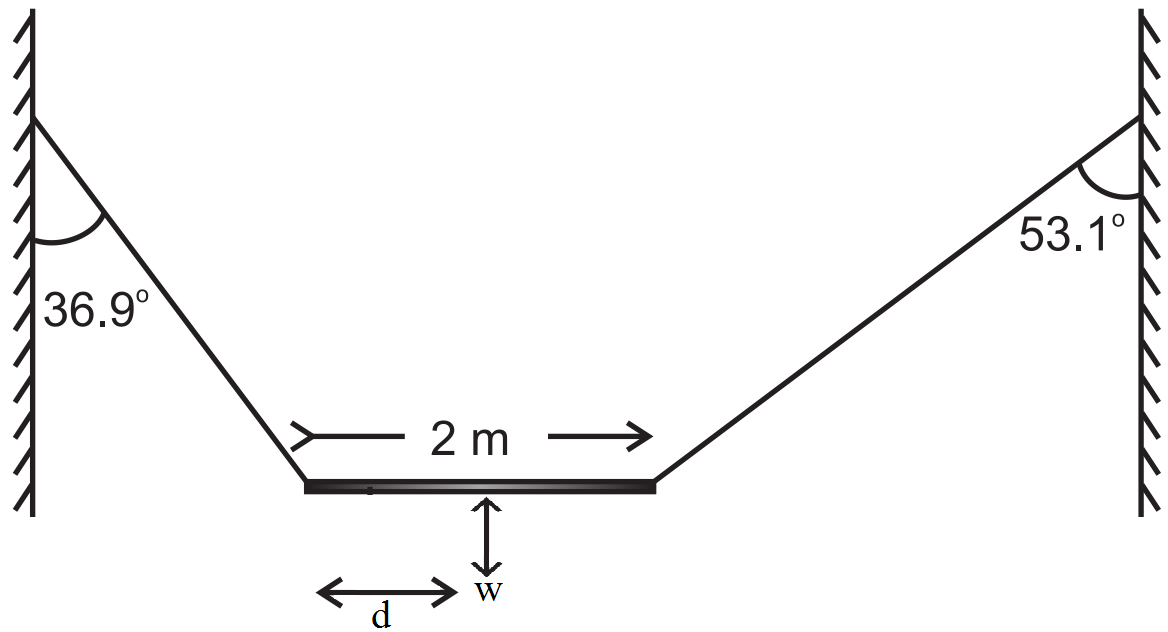
- 9A non-uniform bar of weight W is suspended at rest by two strings of negligible weight as shown in. The angles made by the strings with the vertical are $36.9°$ and $53.1°$ respectively. The bar is $2m$ long. Calculate the distance d of the centre of gravity of the bar from its left end.View Solution
- 10$(n - 1)$ equal point masses each of mass m are placed at the vertices of a regular n-polygon. The vacant vertex has a position vector a with respect to the centre of the polygon. Find the position vector of centre of mass.View Solution