A solid disc and a ring, both of radius $10cm$ are placed on a horizontal table simultaneously, with initial angular speed equal to $10 π$ rad $s^{-1}$. Which of the two will start to roll earlier? The co-efficient of kinetic friction is $\mu_\text{k}=0.2$
Exercise
Download our app for free and get started
Given, Radii of the ring and the disc, r = 5cm = 0.05m Initial angular speed, $\omega_0=8\pi\text{rads}^{-1}$ Coefficient of kinetic friction, $\mu_\text{k}=0.2$ Initial velocity of both the objects, u = 0a Motion of the two objects is caused by force of friction. According Newton’s second, force of friction, $\text{f}=\text{ma}$
$\mu_\text{k}\text{mg}=\text{ma}$ Where, a = Acceleration produced in the disc and the ring m = Mass $\therefore\ \text{a}=\mu_{\text{k}}\text{g}\ ...(\text{i})$ Using the first equation of motion, $\text{v}=\text{u}+\text{at}$
$=0+\mu_\text{k}\text{gt}$
$=\mu_\text{k}\text{gt}\ ...(\text{ii})$ The frictional force applies a torque in perpendicularly outward direction and reduces the initial angular speed. Torque, $\text{T}=-\text{I}\alpha$ Where, $\alpha=$ Angular acceleration $\mu_\text{k}\text{mgr}=-\text{I}\alpha$
$\therefore\alpha=\frac{-\mu_\text{k}\text{mgr}}{\text{I}}\ ...(\text{iii})$ According to the first equation of rotational motion, we have, $\omega=\omega_0+\alpha\text{t}$
$=\omega_0+\Big(\frac{-\mu_\text{k}\text{mgr}}{\text{I}}\Big)\text{t}\ ...(\text{iv})$ Rolling starts when linear velocity, $\text{v}=\text{r}\omega$
$\therefore\ \text{v}=\text{r}\Big(\omega_0-\frac{\mu_\text{k}\text{mgrt}}{\text{I}}\Big)\ ...(\text{v})$ Using equation (ii) and equation (v), we have, $\mu_\text{k}\text{gt}=\text{r}\Big(\omega_0-\frac{\mu_\text{k}\text{mgrt}}{\text{I}}\Big)$
$=\text{r}\omega_0-\frac{\mu_\text{k}\text{mgr}^2\text{t}}{\text{I}}\ ....(\text{vi})$ For the ring, $\text{I}=\text{mr}^2$
$\therefore\ \mu_\text{k}\text{gt}=\text{r}\omega_0-\frac{\mu_\text{k}\text{mgr}^2\text{t}}{\text{mr}^2}$
$=\text{r}\omega_0-\mu_\text{k}\text{gt}$
$2\mu_\text{k}\text{gt}=\text{r}\omega_0$
$\therefore\ \text{t}=\frac{\text{r}\omega_0}{2\mu_\text{k}\text{g}}$
$=\frac{(0.05\times8\times3.14)}{(2\times0.2\times9.8)}=0.32\text{s}\ ...(\text{vii})$ For the disc, $\text{I}=\Big(\frac{1}{2}\Big)\text{mr}^2$
$\therefore\ \mu_\text{k}\text{gt}=\text{r}\omega_0-\frac{\mu_\text{k}\text{mgr}^2\text{t}}{\big(\frac{1}{2}\big)\text{mr}^2}$
$=\text{r}\omega_0-2\mu_\text{k}\text{gt}$
$3\mu_\text{k}\text{gt}=\text{r}\omega_0$
$\therefore\ \text{t}=\frac{\text{r}\omega_0}{3\mu_\text{k}\text{g}}$
$=\frac{(0.05)\times8\times3.14}{(3\times0.2\times9.8)}=0.213\text{s}\ ...(\text{viii})$ Since $\text{t}_\text{D}>\text{t}_\text{R},$ the disc will start rolling before the ring.
$\mu_\text{k}\text{mg}=\text{ma}$ Where, a = Acceleration produced in the disc and the ring m = Mass $\therefore\ \text{a}=\mu_{\text{k}}\text{g}\ ...(\text{i})$ Using the first equation of motion, $\text{v}=\text{u}+\text{at}$
$=0+\mu_\text{k}\text{gt}$
$=\mu_\text{k}\text{gt}\ ...(\text{ii})$ The frictional force applies a torque in perpendicularly outward direction and reduces the initial angular speed. Torque, $\text{T}=-\text{I}\alpha$ Where, $\alpha=$ Angular acceleration $\mu_\text{k}\text{mgr}=-\text{I}\alpha$
$\therefore\alpha=\frac{-\mu_\text{k}\text{mgr}}{\text{I}}\ ...(\text{iii})$ According to the first equation of rotational motion, we have, $\omega=\omega_0+\alpha\text{t}$
$=\omega_0+\Big(\frac{-\mu_\text{k}\text{mgr}}{\text{I}}\Big)\text{t}\ ...(\text{iv})$ Rolling starts when linear velocity, $\text{v}=\text{r}\omega$
$\therefore\ \text{v}=\text{r}\Big(\omega_0-\frac{\mu_\text{k}\text{mgrt}}{\text{I}}\Big)\ ...(\text{v})$ Using equation (ii) and equation (v), we have, $\mu_\text{k}\text{gt}=\text{r}\Big(\omega_0-\frac{\mu_\text{k}\text{mgrt}}{\text{I}}\Big)$
$=\text{r}\omega_0-\frac{\mu_\text{k}\text{mgr}^2\text{t}}{\text{I}}\ ....(\text{vi})$ For the ring, $\text{I}=\text{mr}^2$
$\therefore\ \mu_\text{k}\text{gt}=\text{r}\omega_0-\frac{\mu_\text{k}\text{mgr}^2\text{t}}{\text{mr}^2}$
$=\text{r}\omega_0-\mu_\text{k}\text{gt}$
$2\mu_\text{k}\text{gt}=\text{r}\omega_0$
$\therefore\ \text{t}=\frac{\text{r}\omega_0}{2\mu_\text{k}\text{g}}$
$=\frac{(0.05\times8\times3.14)}{(2\times0.2\times9.8)}=0.32\text{s}\ ...(\text{vii})$ For the disc, $\text{I}=\Big(\frac{1}{2}\Big)\text{mr}^2$
$\therefore\ \mu_\text{k}\text{gt}=\text{r}\omega_0-\frac{\mu_\text{k}\text{mgr}^2\text{t}}{\big(\frac{1}{2}\big)\text{mr}^2}$
$=\text{r}\omega_0-2\mu_\text{k}\text{gt}$
$3\mu_\text{k}\text{gt}=\text{r}\omega_0$
$\therefore\ \text{t}=\frac{\text{r}\omega_0}{3\mu_\text{k}\text{g}}$
$=\frac{(0.05)\times8\times3.14}{(3\times0.2\times9.8)}=0.213\text{s}\ ...(\text{viii})$ Since $\text{t}_\text{D}>\text{t}_\text{R},$ the disc will start rolling before the ring.

Download our appand get started for free
Experience the future of education. Simply download our apps or reach out to us for more information. Let's shape the future of learning together!No signup needed.*
Similar Questions
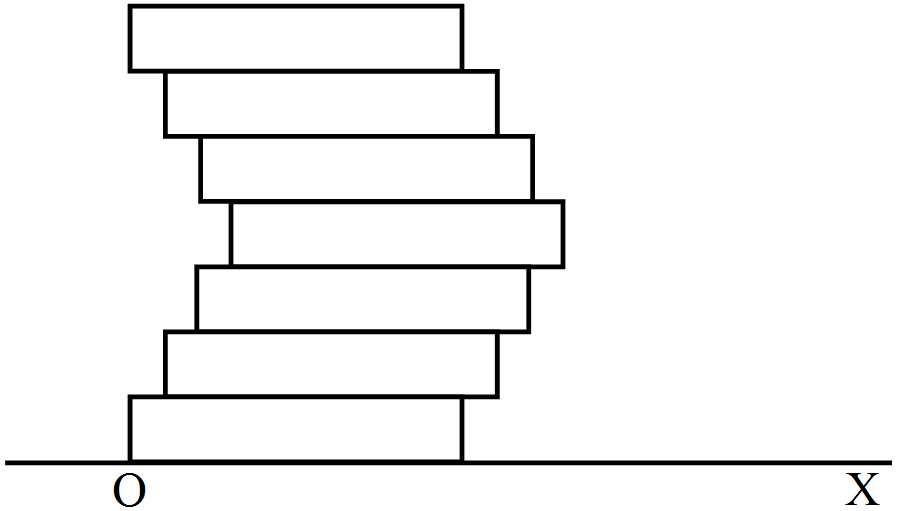
- 1Seven homogeneous bricks, each of length L, are arranged as shown in figure. Each brick is displaced with respect to the one in contact by $\frac{\text{L}}{10}.$ Find the x-coordinate of the centre of mass relative to the origin shown.View Solution
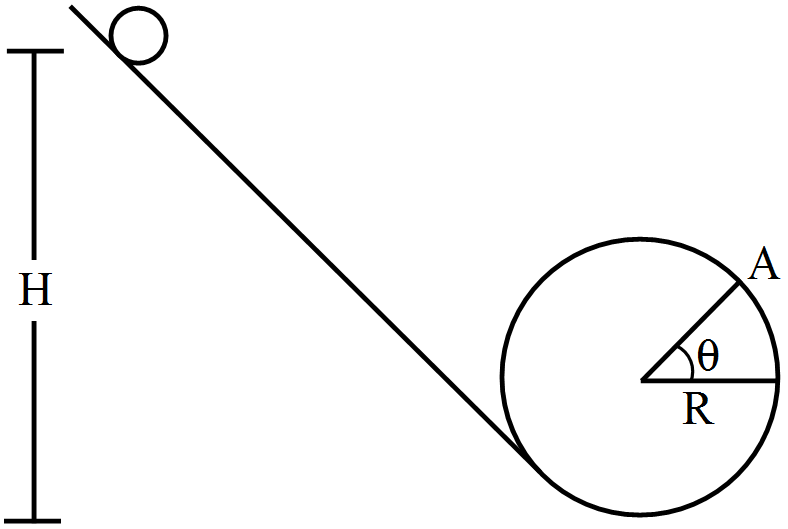
- 2Figure shows a small spherical ball of mass m rolling down the loop track. The ball is released on the linear portion at a vertical height H from the lowest point. The circular part shown has a radius R.View Solution
- Find the kinetic energy of the ball when it is at a point A where the radius makes an angle $\theta$ with the horizontal.
- Find the radial and the tangential accelerations of the centre when the ball is at A.
- Find the normal force and the frictional force acting on the ball if H = 60cm, R = 10cm, $\theta=0 $ and m = 70g.
- 3View SolutionA particle of mass m is projected from origin O with speed u at an angle with positive x-axis. Find the angular momentum of particle at any time t about O before the particle strikes the ground again.
- 4Separation of Motion of a system of particles into motion of the centre of mass and motion about the centre of mass: Show $\text{K}=\text{K}'+\frac{1}{2}\text{M}\text{V}^2$ where K' is the total kinetic energy of the system of particles, K′ is the total kinetic energy of the system when the particle velocities are taken with respect to the centre of mass and $\frac{\text{MV}^2}{2}$ is the kinetic energy of the translation of the system as a whole (i.e. of the centre of mass motion of the system). The result has been used in $\sec7.14$View Solution
- 5View SolutionShow that a(b × c) is equal in magnitude to the volume of the parallelepiped formed on the three vectors a, b and c.
- 6Separation of Motion of a system of particles into motion of the centre of mass and motion about the centre of mass: Show $\text{L}=\text{L}'+\text{R}\times\text{MV}$ where $\text{L}'=\sum\text{r}'_\text{i}\times\text{p}'_\text{i}$ is the angular momentum of the system about the centre of mass with velocities taken relative to the centre of mass. Remember $\text{r}'_\text{i}=\text{r}_\text{i}-\text{R},$ rest of the notation is the standard notation used in the chapter.View Solution
Note: $\text{L}'$ and $\text{MR}\times\text{V}$ can be said to be angular momenta, respectively, about and of the centre of mass of the system of particles. - 7Three point masses m,, m, and m, are located at the vertices of an equilateral triangle of side length a. What is the moment of inertia about an axis along the altitude of the triangle passing through $m_1$?View Solution
- 8View SolutionA metre stick is balanced on a knife edge at its centre. When two coins, each of mass 5g are put one on top of the other at the 12.0cm mark, the stick is found to be balanced at 45.0cm. What is the mass of the metre stick?
- 9View SolutionA wheel in uniform motion about an axis passing through its centre and perpendicular to its plane is considered to be in mechanical (translational plus rotational) equilibrium because no net external force or torque is required to sustain its motion. However, the particles that constitute the wheel do experience a centripetal acceleration directed towards the centre.How do you reconcile this fact with the wheel being in equilibrium? How would you set a half-wheel into uniform motion about an axis passing through the centre of mass of the wheel and perpendicular to its plane? Will you require external forces to sustain the motion?
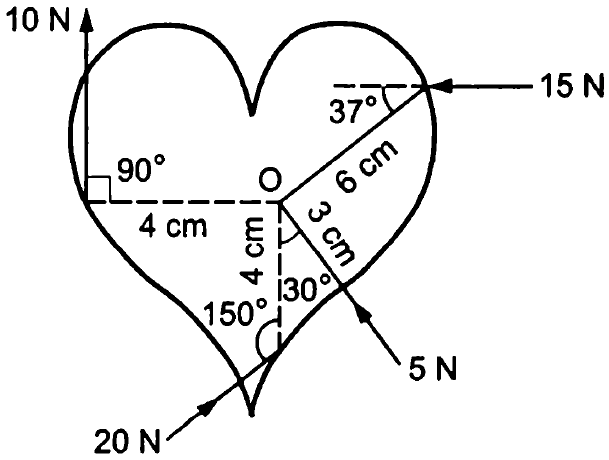
- 10View SolutionCalculate the total torque acting on the body shown in figure about the point O.