Separation of Motion of a system of particles into motion of the centre of mass and motion about the centre of mass: Show $\text{p}=\text{p}'_\text{i}+\text{m}_\text{i}\text{V}$ where $p_i$ is the momentum of the ith particle (of mass $m_i$ ) and $p′_i = m_iv′_i$. Note: $v′_i$ is the velocity of the ith particle relative to the centre of mass. Also, prove using the definition of the centre of mass.
Download our app for free and get started
Take a system of i moving particles. Mass of the $i^{th}$ particle = $m_i$ Velocity of the $i^{th}$ particle =$ v_i$ Hence, momentum of the $i^{th}$ particle, $\text{p}_\text{i}=\text{m}_\text{i}\text{v}_{\text{i}}$ Velocity of the centre of mass = V The velocity of the $i^{th}$ particle with respect to the centre of mass of the system is given as, $\text{v}'_{\text{i}}=\text{v}_\text{i}-\text{V}\ ...(\text{i})$ Multiplying $m_i$ throughout equation (i), we get, $\text{m}_\text{i}\text{v}'_\text{i}=\text{m}_\text{i}\text{v}_\text{i}-\text{m}_\text{i}\text{V}$
$\text{p}'_\text{i}-\text{m}_\text{i}\text{V}$ Where, $\text{p}'_\text{i}=\text{m}_\text{i}\text{v}_\text{i}'=$ Momentum of the $i^{th}$ particle with respect to the centre of mass of the system, $\therefore\text{ p}_\text{i}=\text{p}'_\text{i}+\text{m}_\text{i}\text{V}$ We have the relation, $\text{p}'_\text{i}=\text{m}_\text{i}\text{v}_\text{i}'$ Taking the summation of momentum of all the particles with respect to the centre of mass of the system, we get $\sum_\limits\text{i}\text{p}'_\text{i}=\sum_\limits\text{i}\text{m}_\text{i}\text{v}'_\text{i}=\sum\limits_\text{i}\frac{\text{dr}'_\text{i}}{\text{dt}}$ Where, $\text{r}'_\text{i}=$ Position vector of $i^{th}$ particle with respect to the centre of mass. $\text{v}'_\text{i}=\frac{\text{dr}'_\text{i}}{\text{dt}}$ As per the definition of the centre of mass, we have, $\sum\limits_\text{i}\text{m}_\text{i}\text{r}'_\text{i}=0$
$\therefore\ \sum\limits_\text{i}\text{m}_\text{i}\frac{\text{dr}'_\text{i}}{\text{dt}}=0$
$\sum\limits_\text{i}\text{p}'_\text{i}=0$
$\text{p}'_\text{i}-\text{m}_\text{i}\text{V}$ Where, $\text{p}'_\text{i}=\text{m}_\text{i}\text{v}_\text{i}'=$ Momentum of the $i^{th}$ particle with respect to the centre of mass of the system, $\therefore\text{ p}_\text{i}=\text{p}'_\text{i}+\text{m}_\text{i}\text{V}$ We have the relation, $\text{p}'_\text{i}=\text{m}_\text{i}\text{v}_\text{i}'$ Taking the summation of momentum of all the particles with respect to the centre of mass of the system, we get $\sum_\limits\text{i}\text{p}'_\text{i}=\sum_\limits\text{i}\text{m}_\text{i}\text{v}'_\text{i}=\sum\limits_\text{i}\frac{\text{dr}'_\text{i}}{\text{dt}}$ Where, $\text{r}'_\text{i}=$ Position vector of $i^{th}$ particle with respect to the centre of mass. $\text{v}'_\text{i}=\frac{\text{dr}'_\text{i}}{\text{dt}}$ As per the definition of the centre of mass, we have, $\sum\limits_\text{i}\text{m}_\text{i}\text{r}'_\text{i}=0$
$\therefore\ \sum\limits_\text{i}\text{m}_\text{i}\frac{\text{dr}'_\text{i}}{\text{dt}}=0$
$\sum\limits_\text{i}\text{p}'_\text{i}=0$

Download our appand get started for free
Experience the future of education. Simply download our apps or reach out to us for more information. Let's shape the future of learning together!No signup needed.*
Similar Questions
- 1In the HCl molecule, the separation between the nuclei of the two atoms is about $1.27\mathring{\text{A}}\big(1\mathring{\text{A}}= 10^{-10} \text{m}\big).$ Find the approximate location of the CM of the molecule, given that a chlorine atom is about 35.5 times as massive as a hydrogen atom and nearly all the mass of an atom is concentrated in its nucleus.View Solution
- 2View SolutionA ball is whirled in a circle by attaching it to a fixed point with a string. Is there an angular rotation of the ball about its centre? If yes, is this angular velocity equal to the angular velocity of the ball about the fixed point?
- 3Two blocks of masses $400g$ and $200g$ are connected through a light string going over a pulley which is free to rotate about its axis. The pulley has a moment of inertia $1.6 \times 10^{-4}kg-m^2$ and a radius 2.0cm. Find:View Solution
- The kinetic energy of the system as the $400g$ block falls through $50cm$.
- The speed of the blocks at this instant.
- 4Separation of Motion of a system of particles into motion of the centre of mass and motion about the centre of mass: Show $\text{K}=\text{K}'+\frac{1}{2}\text{M}\text{V}^2$ where K' is the total kinetic energy of the system of particles, K′ is the total kinetic energy of the system when the particle velocities are taken with respect to the centre of mass and $\frac{\text{MV}^2}{2}$ is the kinetic energy of the translation of the system as a whole (i.e. of the centre of mass motion of the system). The result has been used in $\sec7.14$View Solution
- 5View SolutionWhat do you mean by the term "equilibrium"? What are equilibrium of rest and equilibrium of motion? State the conditions for complete equilibrium of a body.
- 6View SolutionSuppose the particle of the previous problem has a mass m and a speed v before the collision and it sticks to the rod after the collision. The rod has a mass M:
- Find the velocity of the centre of mass C of the system constituting ''The rod plus the particle''.
- Find the velocity of the particle with respect to C before the collision.
- Find the velocity of the rod with respect to C before the collision.
- Find the angular momentum of the particle and of the rod about the centre of mass C before the collision.
- Find the moment of inertia of the system about the vertical axis through the centre of mass C after the collision.
- Find the velocity of the centre of mass C and the angular velocity of the system about the centre of mass after the collision.
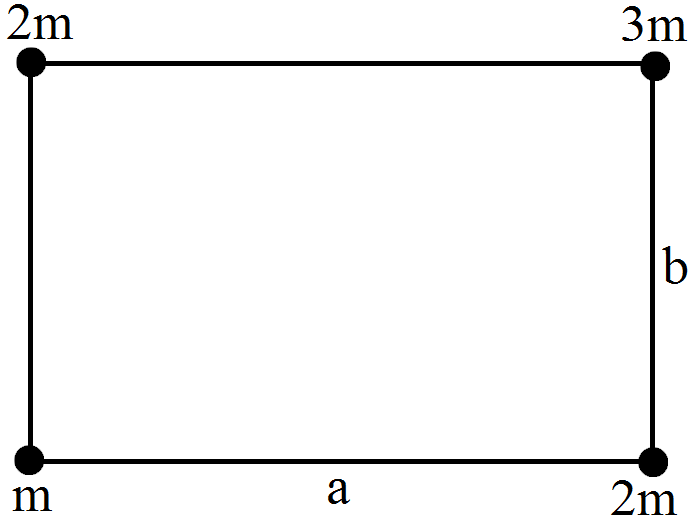
- 7View SolutionFour bodies have been arranged at the corners of a rectangle shown in figure. Find the centre of mass of the system.
- 8Suppose the smaller pulley of the previous problem has its radius $5.0cm$ and moment of inertia $0.10kg-m^2$. Find the tension in the part of the string joining the pulleys.View Solution
- 9A cord of negligible mass is wound round the rim of a fly wheel of mass $20 \ kg$ and radius $20 \ cm$. A steady pull of $25 N$ is applied on the cord as shown in Fig. $6.31$. The flywheel is mounted on a horizontal axle with frictionless bearings.View Solution
$(a)$ Compute the angular acceleration of the wheel.
$(b)$ Find the work done by the pull, when $2m$ of the cord is unwound.
$(c)$ Find also the kinetic energy of the wheel at this point. Assume that the wheel starts from rest.
$(d)$ Compare answers to parts $(b)$ and $(c).$ - 10Find the centre of mass of a uniform plate having semicircular inner and outer boundaries of radii $R_1$ and $R_2$.View Solution