A car weighs $1800kg$. The distance between its front and back axles is $1.8m$. Its centre of gravity is $1.05m$ behind the front axle. Determine the force exerted by the level ground on each front wheel and each back wheel.
Download our app for free and get started
Mass of the car, m = 1800kg Distance between the front and back axles, d = 1.8m Distance between the C.G. (centre of gravity) and the back axle = 1.05m The various forces acting on the car are shown in the following figure: 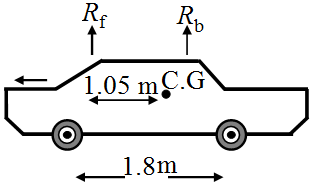
$R_f$ and $R_b$ are the forces exerted by the level ground on the front and back wheels respectively. At translational equilibrium: $R_f+R_b=m g=1800 \times 9.8=17640 N \ldots$...(i) For rotational equilibrium, on taking the torque about the C.G., We have, $R_f(1.05)=R_b(1.8-1.05) \frac{R_b}{R_f}=\frac{7}{5} R_b=1.4 R_f \ldots$...(ii) Solving equations (i) and (ii), we get $1.4 R_f+R_f=$ $17640 R_f=7350 \mathrm{~N} \therefore R_b=17640-7350=10290 \mathrm{NT}$
Therefore, the force exerted on each front wheel $=\frac{7350}{2}=3675 \mathrm{~N}$ and, The force exerted on each back wheel $=\frac{10290}{2}=5145 \mathrm{~N}$
$R_f$ and $R_b$ are the forces exerted by the level ground on the front and back wheels respectively. At translational equilibrium: $R_f+R_b=m g=1800 \times 9.8=17640 N \ldots$...(i) For rotational equilibrium, on taking the torque about the C.G., We have, $R_f(1.05)=R_b(1.8-1.05) \frac{R_b}{R_f}=\frac{7}{5} R_b=1.4 R_f \ldots$...(ii) Solving equations (i) and (ii), we get $1.4 R_f+R_f=$ $17640 R_f=7350 \mathrm{~N} \therefore R_b=17640-7350=10290 \mathrm{NT}$
Therefore, the force exerted on each front wheel $=\frac{7350}{2}=3675 \mathrm{~N}$ and, The force exerted on each back wheel $=\frac{10290}{2}=5145 \mathrm{~N}$

Download our appand get started for free
Experience the future of education. Simply download our apps or reach out to us for more information. Let's shape the future of learning together!No signup needed.*
Similar Questions
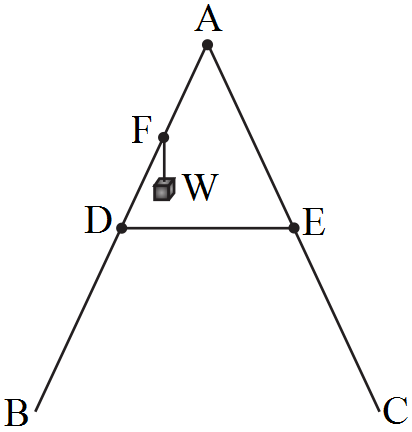
- 1As shown in the two sides of a step ladder BA and CA are 1.6m long and hinged at A. A rope DE, 0.5m is tied half way up. A weight 40kg is suspended from a point F, 1.2m from B along the ladder BA. Assuming the floor to be frictionless and neglecting the weight of the ladder, find the tension in the rope and forces exerted by the floor on the ladder. (Take $g = 9.8m/s^2$) (Hint: Consider the equilibrium of each side of the ladder separately).View Solution
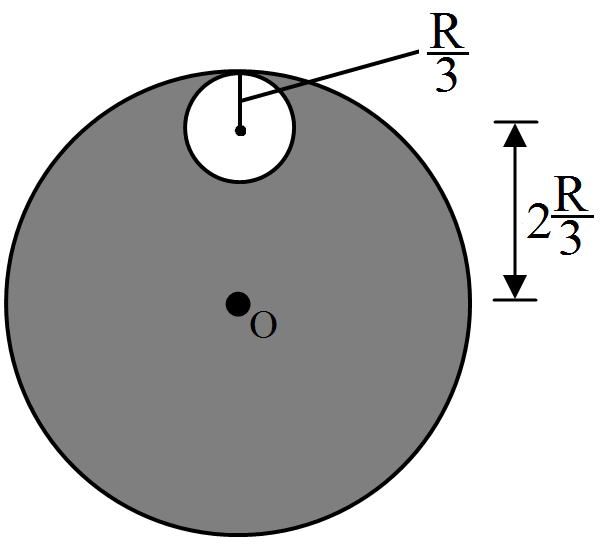
- 2From a circular disc of radius R and mass 9M, a small disc of radius $\frac{\text{R}}{3}$ is removed as shown in Fig. Find the moment of inertia of the remaining disc about an axis perpendicular to the plane of the disc and passing through the point O.View Solution
- 3View SolutionThe door of an almirah is 6ft high, 1.5ft wide and weighs 8kg. The door is supported by two hinges situated at a distance of 1ft from the ends. If the magnitudes of the forces exerted by the hinges on the door are equal, find this magnitude.
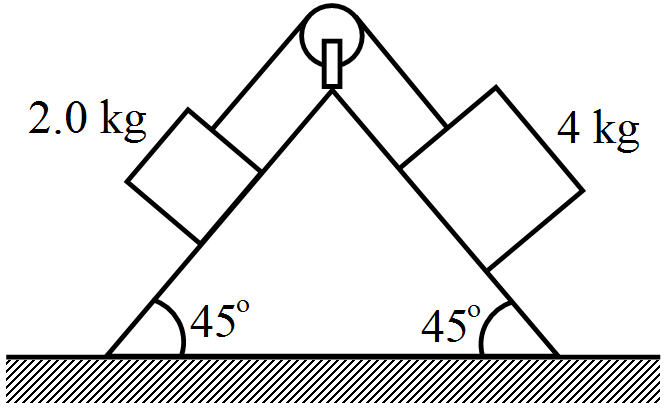
- 4The pulley shown in figure has a radius $10cm$ and moment of inertia $0.5kg-m^2$ about its axis. Assuming the inclined planes to be frictionless, calculate the acceleration of the $4.0kg$ block.View Solution
- 5The descending pulley shown in figure has a radius $20cm$ and moment of inertia $0.20kg-m^2$. The fixed pulley is light and the horizontal plane frictionless. Find the acceleration of the block if its mass is $1.0kg$.View Solution
- 6Separation of Motion of a system of particles into motion of the centre of mass and motion about the centre of mass: Show $\text{L}=\text{L}'+\text{R}\times\text{MV}$ where $\text{L}'=\sum\text{r}'_\text{i}\times\text{p}'_\text{i}$ is the angular momentum of the system about the centre of mass with velocities taken relative to the centre of mass. Remember $\text{r}'_\text{i}=\text{r}_\text{i}-\text{R},$ rest of the notation is the standard notation used in the chapter.View Solution
Note: $\text{L}'$ and $\text{MR}\times\text{V}$ can be said to be angular momenta, respectively, about and of the centre of mass of the system of particles. - 7A disc of mass $5kg$ and radius $50cm$ rolls on the ground at the rate of $10ms^{-1}$. Calculate the K.E. of the disc. $\Big(\text{Given}:\text{I}=\frac{1}{2}\text{MR}^2\Big)$View Solution
- 8From a uniform disk of radius R, a circular hole of radius $\frac{\text{R}}{2}$ is cut out. The centre of the hole is at $\frac{\text{R}}{2}$ from the centre of the original disc. Locate the centre of gravity of the resulting flat body.View Solution
- 9View SolutionA disc of radius R is cut out from a larger disc of radius 2R in such a way that the edge of the hole touches the edge of the disc. Locate the centre of mass of the residual disc.
- 10Two masses $M_1$ and $M_2$ are separated by a distance r. Find the moment of inertia of this arrangement about an axis passing through the centre of mass and perpendicular to the line joining them.View Solution