A condenser has a capacity $2\,\mu \,F$ and is charged to a voltage of $50\, V$. The energy stored is
Easy
Download our app for free and get started
(d) $U = \frac{1}{2}C{V^2} = \frac{1}{2} \times 2 \times {10^{ - 6}} \times {(50)^2} = 25 \times {10^{ - 4}}\,J$
$ = 25 \times {10^3}\,erg$
$ = 25 \times {10^3}\,erg$

Download our appand get started for free
Experience the future of education. Simply download our apps or reach out to us for more information. Let's shape the future of learning together!No signup needed.*
Similar Questions
- 1Three capacitors $2,\, 3$ and $6\ \mu F$ are joined in series with each other. What is the minimum effective capacitance......$\mu \,F$View Solution
- 2A $6\,\mu F$ capacitor is charged from $10\;volts$ to $20\;volts$. Increase in energy will beView Solution
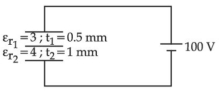
- 3A composite parallel plate capacitor is made up of two different dielectric materials with different thickness $\left(t_{1}\right.$ and $\left.t_{2}\right)$ as shown in figure. The two different dielectric material are separated by a conducting foil $F$. The voltage of the conducting foil is $.....V$View Solution
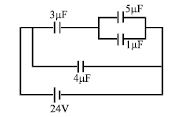
- 4In the circuit shown, the energy stored in $1\,\mu F$ capacitor is.....$\mu J$View Solution
- 5A bullet of mass $2\, gm$ is having a charge of $2\,\mu C$. Through what potential difference must it be accelerated, starting from rest, to acquire a speed of $10\,m/s$View Solution
- 6View SolutionAn uncharged capacitor is connected to a battery. On charging the capacitor
- 7Two metallic plates form a parallel plate capacitor. The distance between the plates is $'d'.$ A metal sheet of thickness $\frac{d}{2}$ and of area equal to area of each plate is introduced between the plates. What will be the ratio of the new capacitance to the original capacitance of the capacitor $?$View Solution
- 8In one design of capacitor thin sheets ot metal of area $80\ mm \times 80\ mm$ sandwich between them a piece of paper whose thickness is $40\ μm$. The relative permittivity of the paper is $4.0$ and its dielectric strength is $20\ MVm^{-1}$. Calculate the maximum charge that can be put on the capacitorView Solution
[permittivity of free space $ = 9 \times 10^{-12}\ Fm^{-1}$]
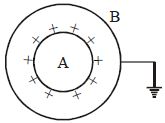
- 9$A$ and $B$ are two concentric spheres. If $A$ is given a charge $Q$ while $B$ is earthed as shownView Solution
- 10Two charged spherical conductors of radius $R_{1}$ and $\mathrm{R}_{2}$ are connected by a wire. Then the ratio of surface charge densities of the spheres $\left(\sigma_{1} / \sigma_{2}\right)$ is :View Solution