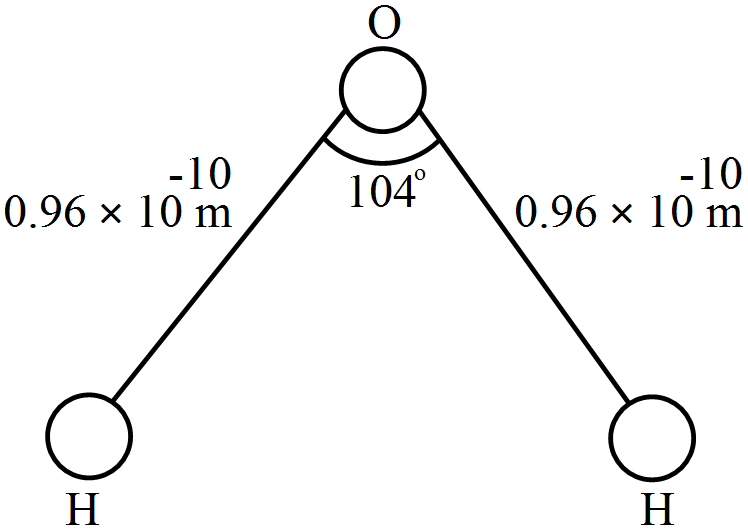
The structure of a water molecule is shown in figure. Find the distance of the centre of mass of the molecule from the centre of the oxygen atom.
Download our app for free and get started
Let OX be the x-axis, OY be the Y-axis and O be the origin. Mass of O atom, $m_1 = 16$ unit Let the position of oxygen atom be origin $\Rightarrow\text{x}_1=\text{y}_1=0$ Mass of H atom, $m_2 = 1$ unit $\text{x}_2=-0.96\times10^{-10}\text{sim}52^\circ$ $\text{y}_2=-0.96\times10^{-10}\cos52^\circ$ Now, $m_3 = 1$ unit $\text{x}_3=0.96\times10^{-10}\sin52^\circ$ $\text{y}_3=-0.96\times10^{-10}\cos52^\circ$ The X coordinate of the center or mass is given by: $\text{x}_\text{cm}=\frac{\text{m}_1\text{x}_1+\text{m}_2\text{x}_2+\text{m}_3\text{x}_3}{\text{m}_1+\text{m}_2+\text{m}_3}$ $=\frac{16\times0\times1\times(-0.96\times10^{-10}\text{sin}52^\circ)+1\times0.96\times10^{10}\sin52^\circ}{1+1+16}=0$ The Y coordinate of the center of mass is given by: $\text{y}_\text{cm}=\frac{\text{m}_1\text{y}_1+\text{m}_2\text{y}_2+\text{m}_3\text{y}_3}{\text{m}_1+\text{m}_2+\text{m}_3}$ $=\frac{16\times0+2\times0.96\times10^{10}\cos52^\circ}{1+1+16}$ $=\frac{2\times0.96\times10^{-10}\cos52^\circ}{18}$ $=6.4\times10^{-12}\text{m}$ Hence, the distance of centre of mass of the molecule from the centre of the oxygen atom is $\text{s}(=6.4\times10^{1-12}\text{m})$

Download our appand get started for free
Experience the future of education. Simply download our apps or reach out to us for more information. Let's shape the future of learning together!No signup needed.*
Similar Questions
- 1Suppose the smaller pulley of the previous problem has its radius $5.0cm$ and moment of inertia $0.10kg-m^2$. Find the tension in the part of the string joining the pulleys.View Solution
- 2View SolutionDiscuss the rolling motion of a cylinder on an inclined plane.
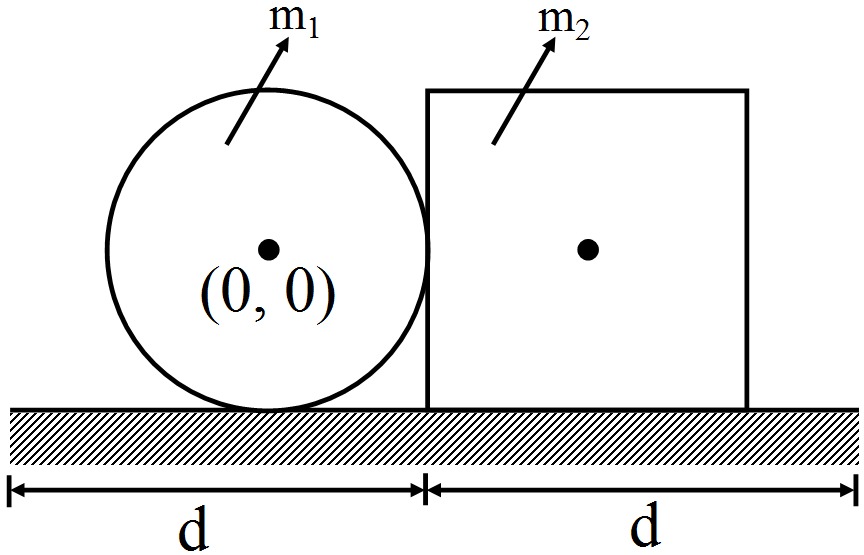
- 3View SolutionA square plate of edge d and a circular disc of diameter d are placed touching each other at the midpoint of an edge of the plate as shown in figure. Locate the centre of mass of the combination, assuming same mass per unit area for the two plates.
- 4Two cylindrical hollow drums of radii R and 2R, and of a common height h, are rotating with angular velocities $\omega$ (anti-clockwise) and $\omega$ (clockwise), respectively. Their axes, fixed are parallel and in a horizontal plane separated by $(3\text{R}+\delta).$ They are now brought in contact $(\delta\rightarrow0){:}$View Solution
- Show the frictional forces just after contact.
- Identify forces and torques external to the system just after contact.
- What would be the ratio of final angular velocities when friction ceases?
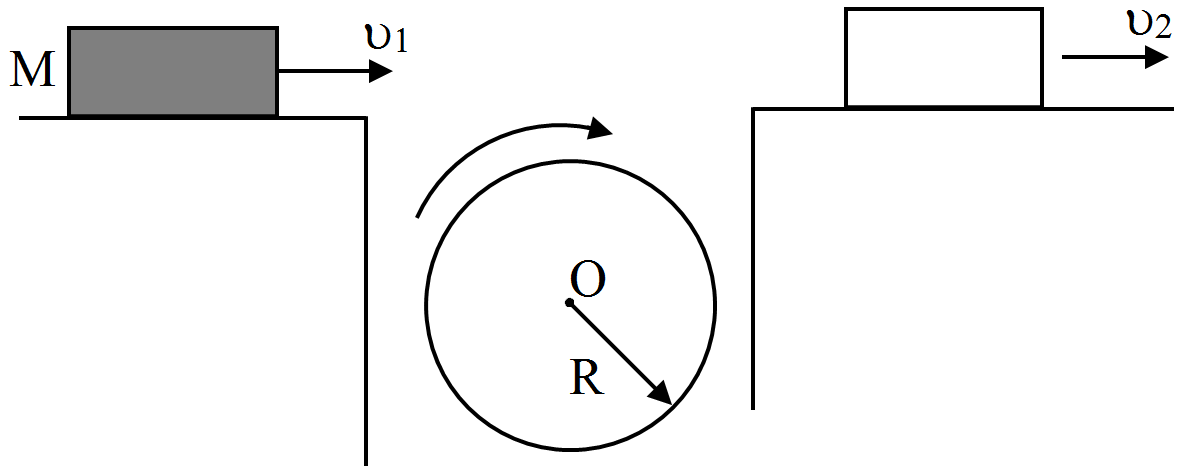
- 5A block of mass M is moving with a velocity $v_1$ on a frictionless surface as shown in fig. It passes over to a cylinder of radius R and moment of inertia I which has fixed axis and is initially at rest. When it first makes contact with the cylinder, it slips on the cylinder, but the friction is large enough so that slipping ceases before it losses contact with the cylinder. Finally it goes to the dotted position with velocity $v_2$ compute $v_2$ in terms of $v_1, M, I$ and $R$.View Solution
- 6Two discs of moments of inertia $I_1$ and $I_2$ about their respective axes (normal to the disc and passing through the centre), and rotating with angular speed $\omega_1$ and $\omega_2$ are brought into contact face to face with their axes of rotation coincident.View Solution
- Does the law of conservation of angular momentum apply to the situation? why?
- Find the angular speed of the two-disc system.
- Calculate the loss in kinetic energy of the system in the process.
- Account for this loss.
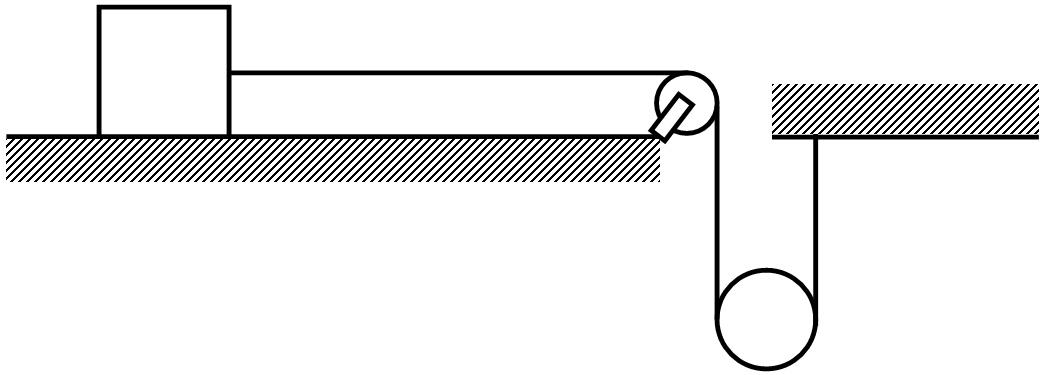
- 7The descending pulley shown in figure has a radius $20cm$ and moment of inertia $0.20kg-m^2$. The fixed pulley is light and the horizontal plane frictionless. Find the acceleration of the block if its mass is $1.0kg$.View Solution
- 8A $2kg$ body and a $3kg$ body are moving along the x-axis. At a particular instant, the $2kg$ body is $1m$ from the origin and has a velocity of $3ms^{-1}$ and the $3kg$ body is $2m$ from the origin and has velocity of $-1 ms^{-1}$. Find the position and velocity of the centre of mass and also find the total momentum.View Solution
- 9A uniform cube of mass m and side a is placed on a frictionless horizontal surface. A vertical force F is applied to the edge as shown in match the following (most appropriate choice):View Solution
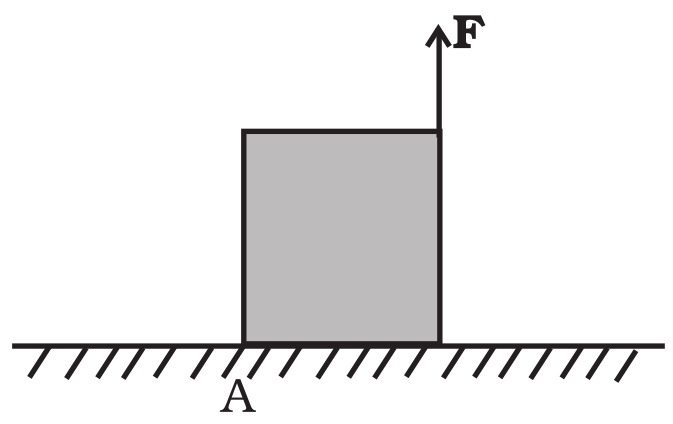
a. $\frac{\text{mg}}{4}<\text{F}<\frac{\text{mg}}{2}$ i. Cube will move up. b. $\text{F}>\frac{\text{mg}}{2}$ ii. Cube will not exhibit motion. c. $\text{F}>\text{mg}$ iii. Cube will begin to rotate and slip at A. d. $\text{F}=\frac{\text{mg}}{4}$ iv. Normal reaction effectively at $\frac{\text{a}}{3}$ - 10Two discs of moments of inertia $I_1$ and $I_2$ about their respective axes (normal to the disc and passing through the centre), and rotating with angular speeds $\omega_1$ and $\omega_2$ are brought into contact face to face with their axes of rotation coincident.View Solution
- What is the angular speed of the two-disc system?
- Show that the kinetic energy of the combined system is less than the sum of the initial kinetic energies of the two discs. How do you account for this loss in energy? Take $\omega_1\neq\omega_2$