A metal bar 70 cm long and 4.00 kg in mass supported on two knifeedges placed 10 cm from each end. A 6.00 kg load is suspended at 30 cm from one end. Find the reactions at the knife-edges. (Assume the bar to be of uniform cross section and homogeneous.)
Example-(6.8)
Download our app for free and get started
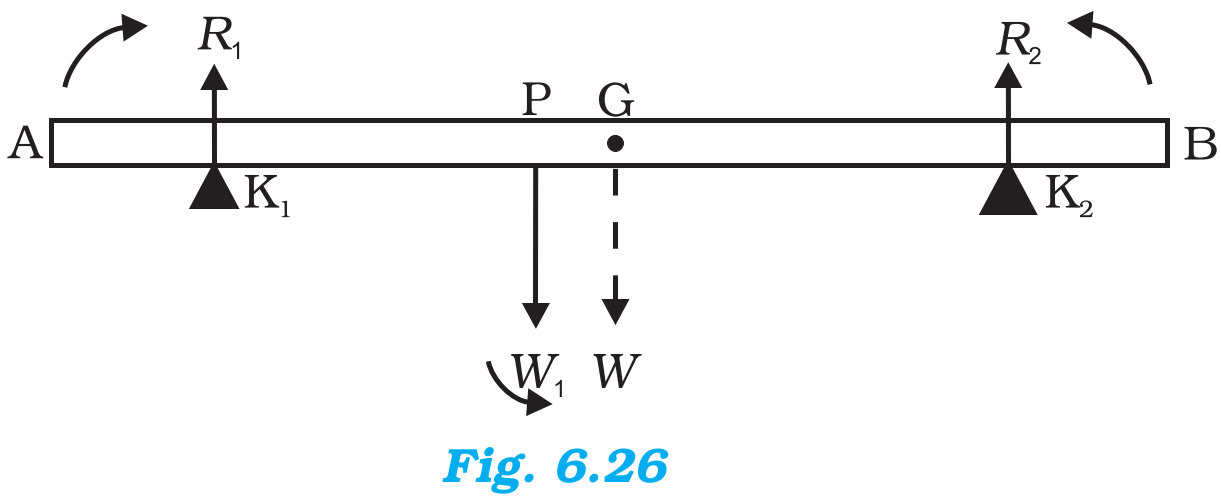
Figure 6.26 shows the rod $AB$, the positions of the knife edges $K_1$ and $K_2$, the centre of gravity of the rod at G and the suspended load at $P$.
Note the weight of the rod $W$ acts at its centre of gravity G. The rod is uniform in cross section and homogeneous; hence G is at the centre of the rod; $AB =70 cm . AG =35 cm , AP$ $=30 cm , PG =5 cm , AK _1= BK _2=10 cm$ and $K _1 G =$ $K _2 G =25 cm$. Also, $W=$ weight of the $rod =4.00$ $kg$ and $W_1=$ suspended load $=6.00 kg$; $R_1$ and $R_2$ are the normal reactions of the support at the knife edges.
For translational equilibrium of the rod,
$
R_1+R_2-W_1-W=0
$
Note $W_1$ and $W$ act vertically down and $R _1$ and $R _2$ act vertically up.
For considering rotational equilibrium, we take moments of the forces. A convenient point to take moments about is G. The moments of $R _2$ and $W _1$ are anticlockwise (+ve), whereas the moment of $R _1$ is clockwise (-ve).
For rotational equilibrium,
$
-R_1\left( K _1 G \right)+W_1( PG )+R_2\left( K _2 G \right)=0
$
It is given that $W=4.00 g N$ and $W_1=6.00 g$ $N$, where $g=$ acceleration due to gravity. We take $g=9.8 m / s ^2$.
With numerical values inserted, from (i)
$
\begin{array}{c}
R_1+R_2-4.00 g-6.00 g=0 \\
\text { or } R_1+R_2=10.00 g N \\
=98.00 N
\end{array}
$
From (ii), $-0.25 R_1+0.05 W_1+0.25 R_2=0$
or $R_1-R_2=1.2 g N =11.76 N$
From (iii) and (iv), $R_1=54.88 N$,
$
R_2=43.12 N
$
Thus the reactions of the support are about $55 N$ at $K _1$ and $43 N$ at $K _2$.

Download our appand get started for free
Experience the future of education. Simply download our apps or reach out to us for more information. Let's shape the future of learning together!No signup needed.*
Similar Questions
- 1Separation of Motion of a system of particles into motion of the centre of mass and motion about the centre of mass: Show $\text{L}=\text{L}'+\text{R}\times\text{MV}$ where $\text{L}'=\sum\text{r}'_\text{i}\times\text{p}'_\text{i}$ is the angular momentum of the system about the centre of mass with velocities taken relative to the centre of mass. Remember $\text{r}'_\text{i}=\text{r}_\text{i}-\text{R},$ rest of the notation is the standard notation used in the chapter. Note: $\text{L}'$ and $\text{MR}\times\text{V}$ can be said to be angular momenta, respectively, about and of the centre of mass of the system of particles.View Solution
- 2Separation of Motion of a system of particles into motion of the centre of mass and motion about the centre of mass: Show $\text{K}=\text{K}'+\frac{1}{2}\text{M}\text{V}^2$ where K' is the total kinetic energy of the system of particles, K′ is the total kinetic energy of the system when the particle velocities are taken with respect to the centre of mass and $\frac{\text{MV}^2}{2}$ is the kinetic energy of the translation of the system as a whole (i.e. of the centre of mass motion of the system). The result has been used in $\sec7.14$View Solution
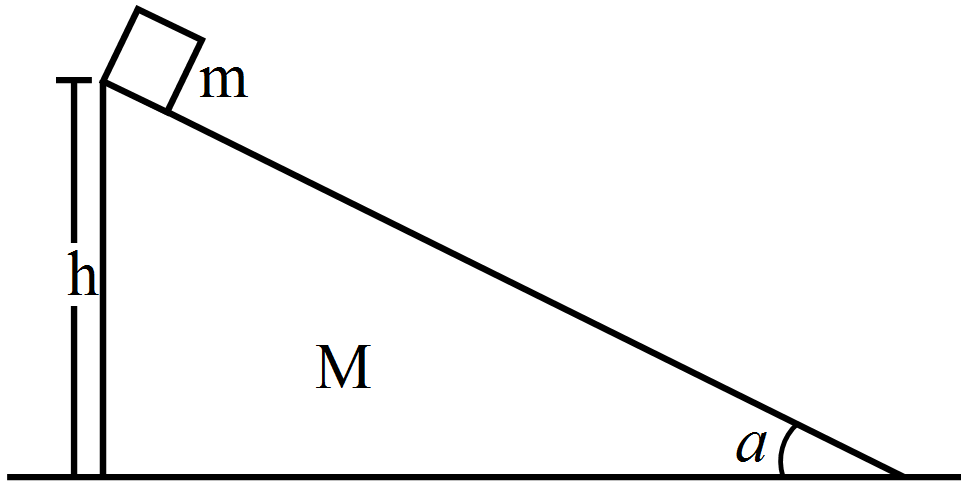
- 3View SolutionA block of mass m is placed on a triangular block of mass M, which in turn is placed on a horizontal surface as shown in figure. Assuming frictionless surfaces find the velocity of the triangular block when the smaller block reaches the bottom end.
- 4View SolutionA metre stick is balanced on a knife edge at its centre. When two coins, each of mass 5g are put one on top of the other at the 12.0cm mark, the stick is found to be balanced at 45.0cm. What is the mass of the metre stick?
- 5View SolutionA uniform rod of length L lies on a smooth horizontal table. A particle moving on the table strikes the rod perpendicularly at an end and stops. Find the distance travelled by the centre of the rod by the time it turns through a right angle. Show that if the mass of the rod is four times that of the particle, the collision is elastic.
- 6View SolutionSuppose the particle of the previous problem has a mass m and a speed v before the collision and it sticks to the rod after the collision. The rod has a mass M:
- Find the velocity of the centre of mass C of the system constituting ''The rod plus the particle''.
- Find the velocity of the particle with respect to C before the collision.
- Find the velocity of the rod with respect to C before the collision.
- Find the angular momentum of the particle and of the rod about the centre of mass C before the collision.
- Find the moment of inertia of the system about the vertical axis through the centre of mass C after the collision.
- Find the velocity of the centre of mass C and the angular velocity of the system about the centre of mass after the collision.
- 7View SolutionExplain why friction is necessary to make the disc in roll in the direction indicated.
- Give the direction of frictional force at B, and the sense of frictional torque, before perfect rolling begins.
- What is the force of friction after perfect rolling begins?
- 8The distance between the centres of carbon and oxygen atoms in carbon monoxide gas molecules is $=1.13\mathring{\text{A}}.$ Locate the centre of mass of the molecules relative to carbon atom.View Solution
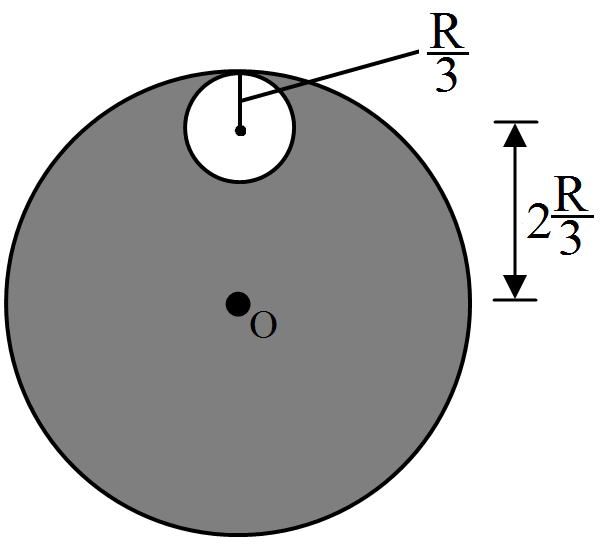
- 9From a circular disc of radius R and mass 9M, a small disc of radius $\frac{\text{R}}{3}$ is removed as shown in Fig. Find the moment of inertia of the remaining disc about an axis perpendicular to the plane of the disc and passing through the point O.View Solution
- 10View SolutionFind the components along the x, y, z axes of the angular momentum l of a particle, whose position vector is r with components x, y, z and momentum is p with components px, py and pz. Show that if the particle moves only in the x-y plane the angular momentum has only a z-component.