A metre stick is balanced on a knife edge at its centre. When two coins, each of mass 5g are put one on top of the other at the 12.0cm mark, the stick is found to be balanced at 45.0cm. What is the mass of the metre stick?
Download our app for free and get started
Let W and W′ be the respective weights of the metre stick and the coin. 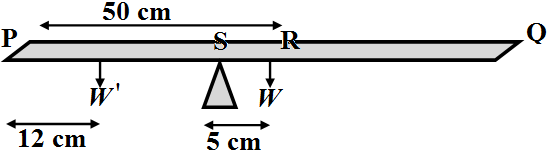 The mass of the metre stick is concentrated at its mid-point, i.e., at the 50cm mark. Mass of the meter stick = m' Mass of each coin, m = 5g When the coins are placed 12cm away from the end P, the centre of mass gets shifted by 5cm from point R toward the end P. The centre of mass is located at a distance of 45cm from point P. The net torque will be conserved for rotational equilibrium about point R. $10\times\text{g}(45-12)-\text{m}'\text{g}(50-45)=0$ $\therefore\ \text{m}'=\frac{10\times33}{5}=66\text{g}$ Hence, the mass of the metre stick is 66g.
The mass of the metre stick is concentrated at its mid-point, i.e., at the 50cm mark. Mass of the meter stick = m' Mass of each coin, m = 5g When the coins are placed 12cm away from the end P, the centre of mass gets shifted by 5cm from point R toward the end P. The centre of mass is located at a distance of 45cm from point P. The net torque will be conserved for rotational equilibrium about point R. $10\times\text{g}(45-12)-\text{m}'\text{g}(50-45)=0$ $\therefore\ \text{m}'=\frac{10\times33}{5}=66\text{g}$ Hence, the mass of the metre stick is 66g.
Download our appand get started for free
Experience the future of education. Simply download our apps or reach out to us for more information. Let's shape the future of learning together!No signup needed.*
Similar Questions
- 1View SolutionTorques of equal magnitude are applied to a hollow cylinder and a solid sphere, both having the same mass and radius. The cylinder is free to rotate about its standard axis of symmetry, and the sphere is free to rotate about an axis passing through its centre. Which of the two will acquire a greater angular speed after a given time.
- 2View SolutionA cylinder is suspended by two strings wrapped around the cylinder near each end, the free ends of the string being attached to hooks on the ceiling, such that the length of the cylinder is horizontal. From the position of rest, the cylinder is allowed to roll down as suspension strings unwind. Calculate: (i) the downward linear acceleration of the cylinder and (ii) tension in the strings. Mass of cylinder is 12kg.
- 3View SolutionTwo particles, each of mass m and speed v, travel in opposite directions along parallel lines separated by a distance d. Show that the angular momentum vector of the two particle system is the same whatever be the point about which the angular momentum is taken.
- 4From a uniform disk of radius R, a circular hole of radius $\frac{\text{R}}{2}$ is cut out. The centre of the hole is at $\frac{\text{R}}{2}$ from the centre of the original disc. Locate the centre of gravity of the resulting flat body.View Solution
- 5Two particles of mass $2kg$ and $1kg$ are moving along the same line with speeds $2ms-1$ and $5ms^{-1}$ respectively. What is the speed of the centre of mass of the system if both the particles are moving (a) in same direction (b) in opposite direction?View Solution
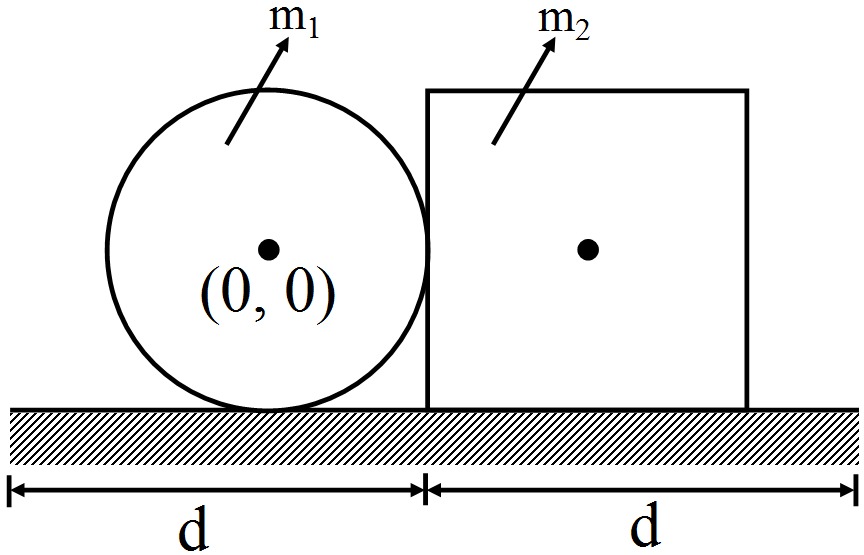
- 6View SolutionA square plate of edge d and a circular disc of diameter d are placed touching each other at the midpoint of an edge of the plate as shown in figure. Locate the centre of mass of the combination, assuming same mass per unit area for the two plates.
- 7Two masses $M_1$ and $M_2$ are separated by a distance r. Find the moment of inertia of this arrangement about an axis passing through the centre of mass and perpendicular to the line joining them.View Solution
- 8The angular speed of a motor wheel is increased from $1200$ rpm to $3120$ rpm in $16$ seconds. $(i)$ What is its angular acceleration, assuming the acceleration to be uniform? $(ii)$ How many revolutions does the engine make during this time?View Solution
- 9View Solution
- Prove the theorem of perpendicular axes.
- Prove the theorem of parallel axes.
- 10View SolutionTorques of equal magnitude are applied to a hollow cylinder and a solid sphere, both having the same mass and radius. The cylinder is free to rotate about its standard axis of symmetry, and the sphere is free to rotate about an axis passing through its centre. Which of the two will acquire a greater angular speed after a given time.