Torques of equal magnitude are applied to a hollow cylinder and a solid sphere, both having the same mass and radius. The cylinder is free to rotate about its standard axis of symmetry, and the sphere is free to rotate about an axis passing through its centre. Which of the two will acquire a greater angular speed after a given time.
Download our app for free and get started
Let m and r be the respective masses of the hollow cylinder and the solid sphere. The moment of inertia of the hollow cylinder about its standard axis, $I_I = mr^2$ The moment of inertia of the solid sphere about an axis passing through its centre, $I_{II} = 2/5mr^2$ We have the relation: $\text{T} =\text{I}α$ Where, $\alpha$ = Angular acceleration T = Torque I = Moment of inertia For the hollow cylinder, $\text{T}_{\text{I}}=\text{I}_{\text{I}}\alpha_{\text{I}}$ For the solid sphere, $\text{T}_\text{II}=\text{I}_\text{II}\alpha_\text{II}$ As an equal torque is applied to both the bodies, $T_I = T_2$
$\therefore\frac{\alpha_{\text{II}}}{\alpha_{\text{I}}}=\frac{\text{I}_\text{I}}{\text{I}_\text{II}}$ $=\frac{\text{mr}^2}{\frac{2}{5\text{mr}^2}} = \frac{2}{5}$ $\alpha_{\text{II}}>\alpha_\text{I}\ ...(\text{i})$ Now, using the relation, $\omega=\omega_0 +α\text{t}$ Where, $\omega_0$ = Initial angular velocity t = Time of rotation $\omega=$ Final angular velocity For equal $\omega_0$ and t, we have, $\omega∝\alpha ...(\text{ii})$ From equations (i) and (ii), we can write, $\omega_\text{II}>\omega_\text{I}$ Hence, the angular velocity of the solid sphere will be greater than that of the hollow cylinder.
$\therefore\frac{\alpha_{\text{II}}}{\alpha_{\text{I}}}=\frac{\text{I}_\text{I}}{\text{I}_\text{II}}$ $=\frac{\text{mr}^2}{\frac{2}{5\text{mr}^2}} = \frac{2}{5}$ $\alpha_{\text{II}}>\alpha_\text{I}\ ...(\text{i})$ Now, using the relation, $\omega=\omega_0 +α\text{t}$ Where, $\omega_0$ = Initial angular velocity t = Time of rotation $\omega=$ Final angular velocity For equal $\omega_0$ and t, we have, $\omega∝\alpha ...(\text{ii})$ From equations (i) and (ii), we can write, $\omega_\text{II}>\omega_\text{I}$ Hence, the angular velocity of the solid sphere will be greater than that of the hollow cylinder.

Download our appand get started for free
Experience the future of education. Simply download our apps or reach out to us for more information. Let's shape the future of learning together!No signup needed.*
Similar Questions
- 1$(n - 1)$ equal point masses each of mass m are placed at the vertices of a regular n-polygon. The vacant vertex has a position vector a with respect to the centre of the polygon. Find the position vector of centre of mass.View Solution
- 2View SolutionA 6.5m long ladder rests against a vertical wall reaching a height of 6.0m. A 60kg man stands half way up the ladder.
- Find the torque of the force exerted by the man on the ladder about the upper end of the ladder.
- Assuming the weight of the ladder to be negligible as compared to the man and assuming the wall to be smooth, find the force exerted by the ground on the ladder.
- 3The oxygen molecule has a mass of $5.30 \times 10^{-26}kg$ and a moment of inertia of $1.94 \times 10^{-46}kgm^2$ about an axis through its centre perpendicular to the lines joining the two atoms. Suppose the mean speed of such a molecule in a gas is $500m/s$ and that its kinetic energy of rotation is two thirds of its kinetic energy of translation. Find the average angular velocity of the molecule.View Solution
- 4View SolutionTorques of equal magnitude are applied to a hollow cylinder and a solid sphere, both having the same mass and radius. The cylinder is free to rotate about its standard axis of symmetry, and the sphere is free to rotate about an axis passing through its centre. Which of the two will acquire a greater angular speed after a given time.
- 5Establish the relation $\theta=\omega_0\text{t}+\frac{1}{2}\alpha\text{t}^2$ where the letters have their usual meanings.View Solution
- 6View SolutionA uniform rod of mass m and length l is struck at an end by a force F perpendicular to the rod for a short time interval t. Calculate:
- The speed of the centre of mass.
- The angular speed of the rod about the centre of mass.
- The kinetic energy of the rod.
- The angular momentum of the rod about the centre of mass after the force has stopped to act. Assume that t is so small that the rod does not appreciably change its direction while the force acts.
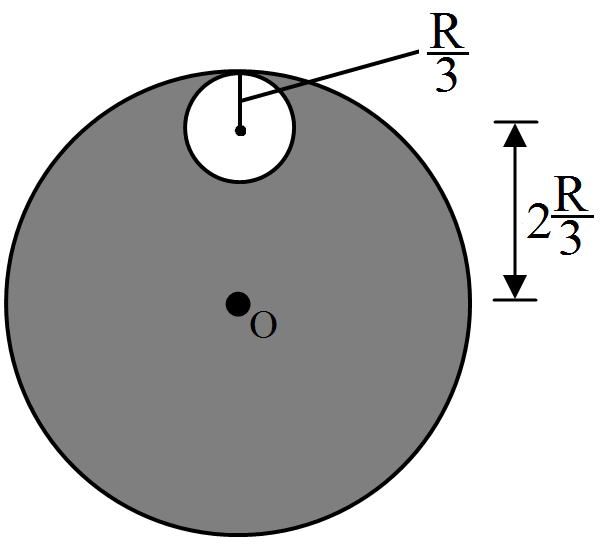
- 7From a circular disc of radius R and mass 9M, a small disc of radius $\frac{\text{R}}{3}$ is removed as shown in Fig. Find the moment of inertia of the remaining disc about an axis perpendicular to the plane of the disc and passing through the point O.View Solution
- 8A uniform rod pivoted at its upper end hangs vertically. It is displaced through an angle of $60°$ and then released. Find the magnitude of the force acting on a particle of mass dm at the tip of the rod when the rod makes an angle of $37°$ with the vertical.View Solution
- 9View SolutionA metal bar 70 cm long and 4.00 kg in mass supported on two knifeedges placed 10 cm from each end. A 6.00 kg load is suspended at 30 cm from one end. Find the reactions at the knife-edges. (Assume the bar to be of uniform cross section and homogeneous.)
- 10View SolutionHow much fraction of the kinetic energy of rolling is purely:
- Translational.
- Rotational.