The pulleys in figure are identical, each having a radius R and moment of inertia I. Find the acceleration of the block M. 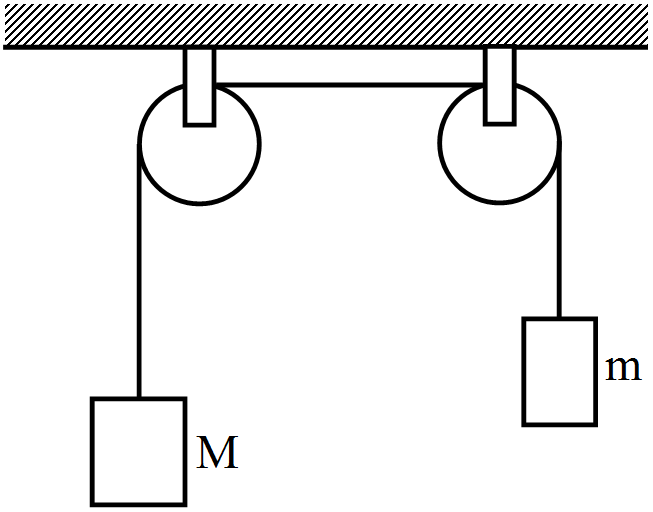
Download our app for free and get started
According to the question
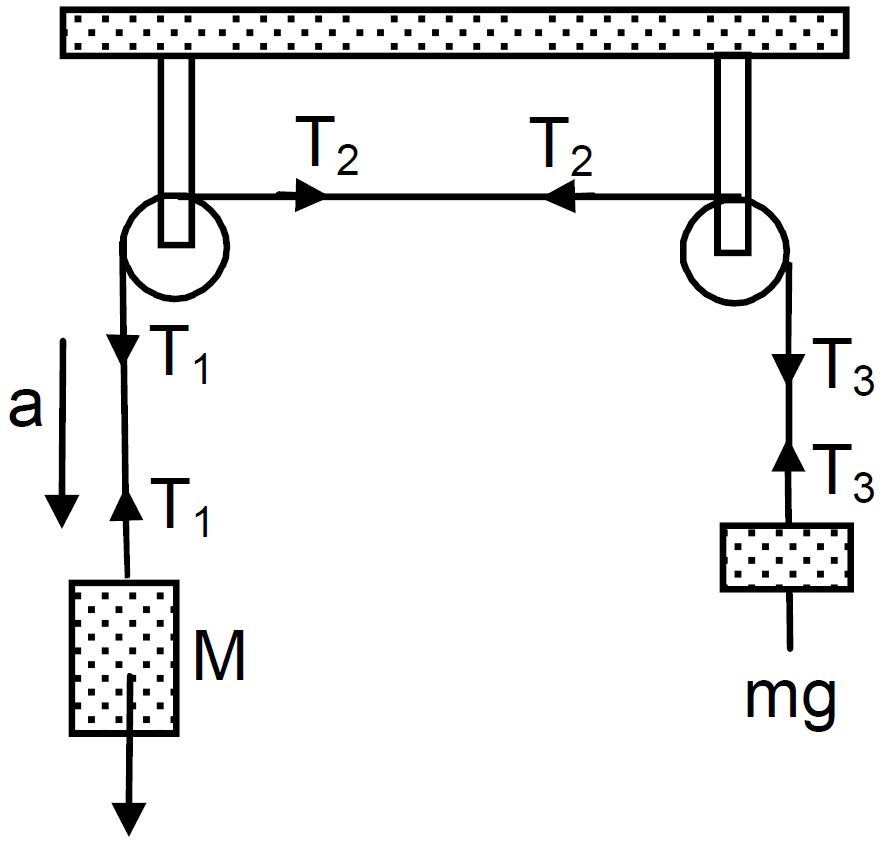
$\text{Mg}-\text{T}_1=\text{Ma}\ \dots(1)$
$(\text{T}_1-\text{T}_2)\text{R}=\frac{\text{la}}{\text{R}}$
$\Rightarrow(\text{T}_2-\text{T}_1)=\frac{\text{la}}{\text{R}^2}\ \dots(2)$
$(\text{T}_2-\text{T}_3)\text{R}=\frac{\text{la}}{\text{R}^2}\ \dots(3)$
$\Rightarrow\text{T}_3-\text{mg}=\text{ma}\ \dots(4)$ By adding equation (2) and (3) we will get, $\Rightarrow(\text{T}_1-\text{T}_3)=2\frac{\text{la}}{\text{R}^2}\ \dots(5)$ By adding equation (1) and (4) we will get, $-\text{mg}+\text{Mg}+(\text{T}_3-\text{T}_1)=\text{Ma}+\text{ma}\ \dots(6)$ Substituting the value for $T_3 - T_1$ we will get $\Rightarrow\text{Mg}-\text{mg}=\text{Ma}+\text{ma}+\frac{2\text{la}}{\text{R}^2}$
$\Rightarrow\text{a}=\frac{(\text{M}-\text{m})\text{G}}{\big(\text{M}+\text{m}+\frac{\text{2l}}{\text{R}^2}\big)}$
$\text{Mg}-\text{T}_1=\text{Ma}\ \dots(1)$
$(\text{T}_1-\text{T}_2)\text{R}=\frac{\text{la}}{\text{R}}$
$\Rightarrow(\text{T}_2-\text{T}_1)=\frac{\text{la}}{\text{R}^2}\ \dots(2)$
$(\text{T}_2-\text{T}_3)\text{R}=\frac{\text{la}}{\text{R}^2}\ \dots(3)$
$\Rightarrow\text{T}_3-\text{mg}=\text{ma}\ \dots(4)$ By adding equation (2) and (3) we will get, $\Rightarrow(\text{T}_1-\text{T}_3)=2\frac{\text{la}}{\text{R}^2}\ \dots(5)$ By adding equation (1) and (4) we will get, $-\text{mg}+\text{Mg}+(\text{T}_3-\text{T}_1)=\text{Ma}+\text{ma}\ \dots(6)$ Substituting the value for $T_3 - T_1$ we will get $\Rightarrow\text{Mg}-\text{mg}=\text{Ma}+\text{ma}+\frac{2\text{la}}{\text{R}^2}$
$\Rightarrow\text{a}=\frac{(\text{M}-\text{m})\text{G}}{\big(\text{M}+\text{m}+\frac{\text{2l}}{\text{R}^2}\big)}$

Download our appand get started for free
Experience the future of education. Simply download our apps or reach out to us for more information. Let's shape the future of learning together!No signup needed.*
Similar Questions
- 1View SolutionShow that a(b × c) is equal in magnitude to the volume of the parallelepiped formed on the three vectors a, b and c.
- 2View SolutionDiscuss the rolling motion of a cylinder on an inclined plane.
- 3Separation of Motion of a system of particles into motion of the centre of mass and motion about the centre of mass: Show $\text{L}=\text{L}'+\text{R}\times\text{MV}$ where $\text{L}'=\sum\text{r}'_\text{i}\times\text{p}'_\text{i}$ is the angular momentum of the system about the centre of mass with velocities taken relative to the centre of mass. Remember $\text{r}'_\text{i}=\text{r}_\text{i}-\text{R},$ rest of the notation is the standard notation used in the chapter. Note: $\text{L}'$ and $\text{MR}\times\text{V}$ can be said to be angular momenta, respectively, about and of the centre of mass of the system of particles.View Solution
- 4A uniform rod of length L rests against a smooth roller as shown in figure. Find the friction coefficient between the ground and the lower end if the minimum angle that the rod can make with the horizontal is $\theta.$View Solution
- 5Seven homogeneous bricks, each of length L, are arranged as shown in figure. Each brick is displaced with respect to the one in contact by $\frac{\text{L}}{10}.$ Find the x-coordinate of the centre of mass relative to the origin shown.View Solution
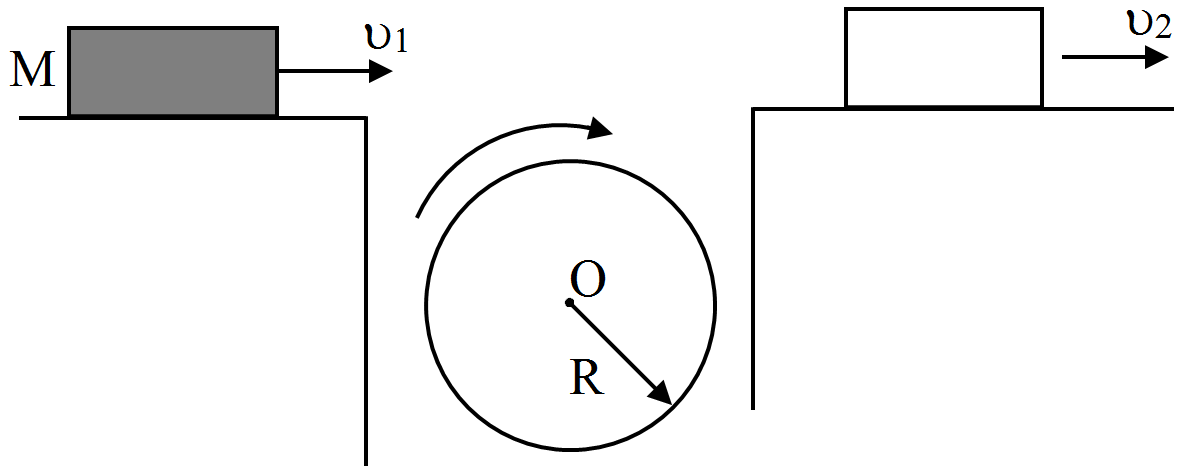
- 6A block of mass M is moving with a velocity $v_1$ on a frictionless surface as shown in fig. It passes over to a cylinder of radius R and moment of inertia I which has fixed axis and is initially at rest. When it first makes contact with the cylinder, it slips on the cylinder, but the friction is large enough so that slipping ceases before it losses contact with the cylinder. Finally it goes to the dotted position with velocity $v_2$ compute $v_2$ in terms of $v_1, M, I$ and $R$.View Solution
- 7View SolutionA solid sphere rolls down two different inclined planes of the same heights but different angles of inclination.
- Will it reach the bottom with the same speed in each case?
- Will it take longer to roll down one plane than the other?
- If so, which one and why?
- 8Suppose the smaller pulley of the previous problem has its radius $5.0cm$ and moment of inertia $0.10kg-m^2$. Find the tension in the part of the string joining the pulleys.View Solution
- 9View SolutionA uniform rod of length L lies on a smooth horizontal table. A particle moving on the table strikes the rod perpendicularly at an end and stops. Find the distance travelled by the centre of the rod by the time it turns through a right angle. Show that if the mass of the rod is four times that of the particle, the collision is elastic.
- 10A disc of radius R is rotating with an angular speed $\omega_\text{o}$ about a horizontal axis. It is placed on a horizontal table. The coefficient of kinetic friction is $\mu_\text{k}{:}$View Solution
- What was the velocity of its centre of mass before being brought in contact with the table?
- What happens to the linear velocity of a point on its rim when placed in contact with the table?
- What happens to the linear speed of the centre of mass when disc is placed in contact with the table?
- Which force is responsible for the effects in (b) and (c).
- What condition should be satisfied for rolling to begin?
- Calculate the time taken for the rolling to begin.