Calculate the work done in moving a charge of $4$ coulombs from a point at $220$ volts to another point at $230$ volts.
Download our app for free and get started
$V_1 = 220 V, V_2 = 230V$,
Charge moved $= 4C$
Thus, the potential difference $= V_2 - V_1 = 230 - 220 =10.$
We know that,
Work done = Potential difference $\times $ Charge moved
$= 10 \times 4$
Work done =$40$ joules.
Charge moved $= 4C$
Thus, the potential difference $= V_2 - V_1 = 230 - 220 =10.$
We know that,
Work done = Potential difference $\times $ Charge moved
$= 10 \times 4$
Work done =$40$ joules.

Download our appand get started for free
Experience the future of education. Simply download our apps or reach out to us for more information. Let's shape the future of learning together!No signup needed.*
Similar Questions
- 1View SolutionTen bulbs are connected in a series circuit to a power supply line. Ten identical bulbs are connected in a Parallel circuit to an identical power supply line.
- Which circuit would have the highest voltage across each bulb?
- In which circuit would the bulbs be brighter?
- In which circuit, if one bulb blows out, all others will stop glowing
- Which circuit would have less current in it?
- 2View SolutionHow does the resistance of a conductor depend on:
- Length of the conductor?
- Area of cross-section of the conductor?
- Temperature of the conductor?
- 3View SolutionA p.d. of 10V is needed to make a current of 0.02A flow through a wire. What p.d. is needed to make a current of 250mA flow through the same wire?
- 4A resistance of $40$ ohms and one of $60$ ohms are arranged in series across $220$ volt supply. Find the heat in joules produced by this combination of resistances in half a minute.View Solution
- 5View SolutionDistinguish between resistance and resistivity.
- 6The electrical resistivities of five substances A, B, C, D and E are given below:View Solution
$\begin{matrix}\text{B}&110\times10^{-8}\Omega\text{ m}\\\text{C}&2.60\times10^{-8}\Omega\text{ m}\\\text{D}&10.0\times10^{-8}\Omega\text{ m}\\\text{E}&1.70\times10^{-8}\Omega\text{ m}\end{matrix}$ - 7The electrical resistivities of four materials $A, B, C$ and $D$ are given below:View Solution
$\text{A}\ -110\times10^{-8}\Omega\text{ m}$
$\text{B}-\ 1.0\times10^{10}\Omega\text{ m}$
$\text{C}-\ 10.0\times10^{-8}\Omega\text{ m}$
$\text{D}-\ 2.3\times10^{3}\Omega\text{ m}$
Which material is:- Good conductor.
- Resistor.
- Insulator, and
- Semiconductor
- 8View SolutionShow how you would connect two 4 ohm resistors to produce a combined resistance of:
- 2 ohms.
- 8 ohms.
- 9Calculate the power used in the $2Ω$ resistor in each of the following circuits:View Solution
- A $6V$ battery in series with $1Ω$ and $2Ω$ resistors.
- A $4V$ battery in parallel with $12Ω$ and $2Ω$ resistors.
- 10The resistors $R_1 , R_2 , R_3$ and $R_4$ in the figure given below are all equal in value.View Solution
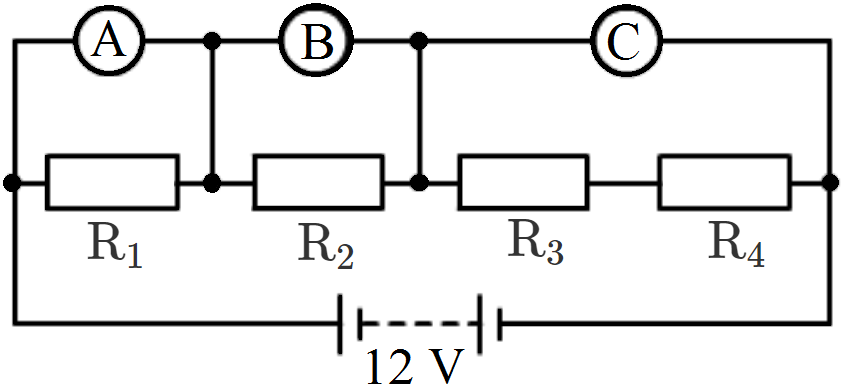
What would you expect the voltmeters $A, B$ and $C$ to read assuming that the connecting wires in the circuit have negligible resistance?