How does the resistance of a conductor depend on:
- Length of the conductor?
- Area of cross-section of the conductor?
- Temperature of the conductor?
Download our app for free and get started
- Resistance of a conductor increases (or decreases) with increase (or decrease) in the length of the conductor.
- Resistance of a conductor decreases (increases) with increase (decrease) in the area of cross-section of the conductor.
- Resistance of a conductor increases on raising the temperature and decreases on lowering the temperature.

Download our appand get started for free
Experience the future of education. Simply download our apps or reach out to us for more information. Let's shape the future of learning together!No signup needed.*
Similar Questions
- 1In the circuit shown below, the voltmeter reads $10V.$View Solution
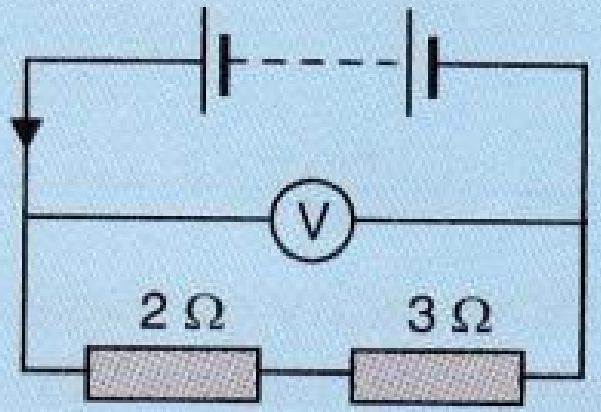
- What is the combined resistance?
- What current flows?
- What is the p.d. across $ 2 Ω$ resistor?
- What is the p.d. across $3 Ω$ resistor?
- 2Calculate the power used in the $2Ω$ resistor in each of the following circuits:View Solution
- A $6V$ battery in series with $1Ω$ and $2Ω$ resistors.
- A $4V$ battery in parallel with $12Ω$ and $2Ω$ resistors.
- 3What is, highest, and lowest, resistance which can be obtained by combining Com resistors having the following resistances?View Solution
$4 Ω, 8 Ω, 12 Ω, 24 Ω$ - 4What will be the resistance of a metal wire of length $2$ metres and area of cross-section $1.55 \times 10m $, if the resistivity of the metal be $2.8 \times 10 m?$View Solution
- 5View SolutionA resistor has a resistance of 176 ohms. How many of these resistors should be connected in parallel so that their combination draws a current of 5 amperes from a 220 volt supply line?
- 6The electrical resistivities of four materials $A, B, C$ and $D$ are given below:View Solution
$\text{A}\ -110\times10^{-8}\Omega\text{ m}$
$\text{B}-\ 1.0\times10^{10}\Omega\text{ m}$
$\text{C}-\ 10.0\times10^{-8}\Omega\text{ m}$
$\text{D}-\ 2.3\times10^{3}\Omega\text{ m}$
Which material is:- Good conductor.
- Resistor.
- Insulator, and
- Semiconductor
- 7An electric iron is connected to the mains power supply of $220V$. When the electric iron is adjusted at ‘minimum heating’ it consumes a power of $360W$ but at ‘maximum heating’ it takes a power of $840W$. Calculate the current and resistance in each case.View Solution
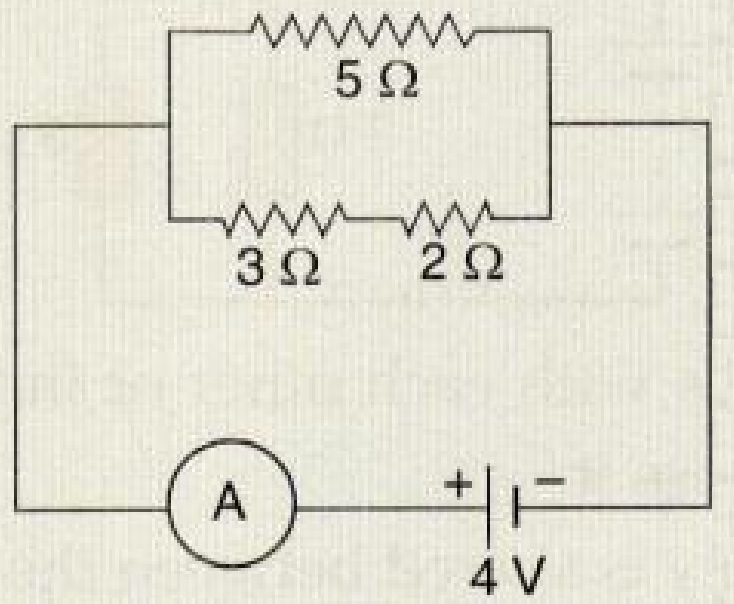
- 8With the help of a circuit diagram, obtain the relation for the equivalent resistance of two resistances connected in parallel. In the circuit diagram shown below, find:View Solution
- Total resistance.
- Current shown by the ammeter $A$
- 9The resistors $R_1 , R_2 , R_3$ and $R_4$ in the figure given below are all equal in value.View Solution
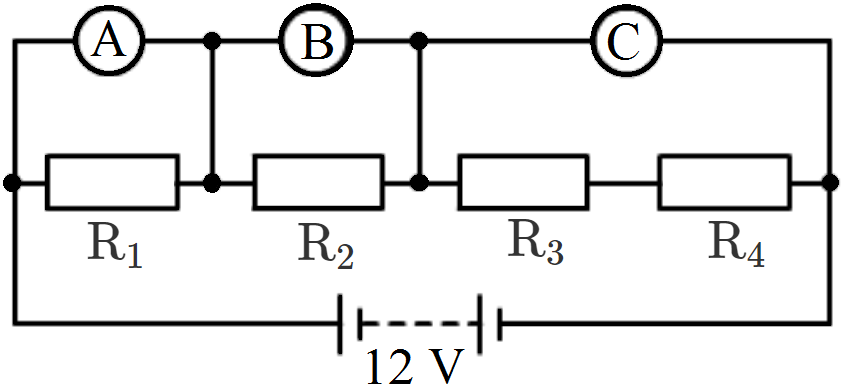
What would you expect the voltmeters $A, B$ and $C$ to read assuming that the connecting wires in the circuit have negligible resistance? - 10View SolutionConsider the circuit given below where A, B and C are three identical light bulbs of constant resistance.
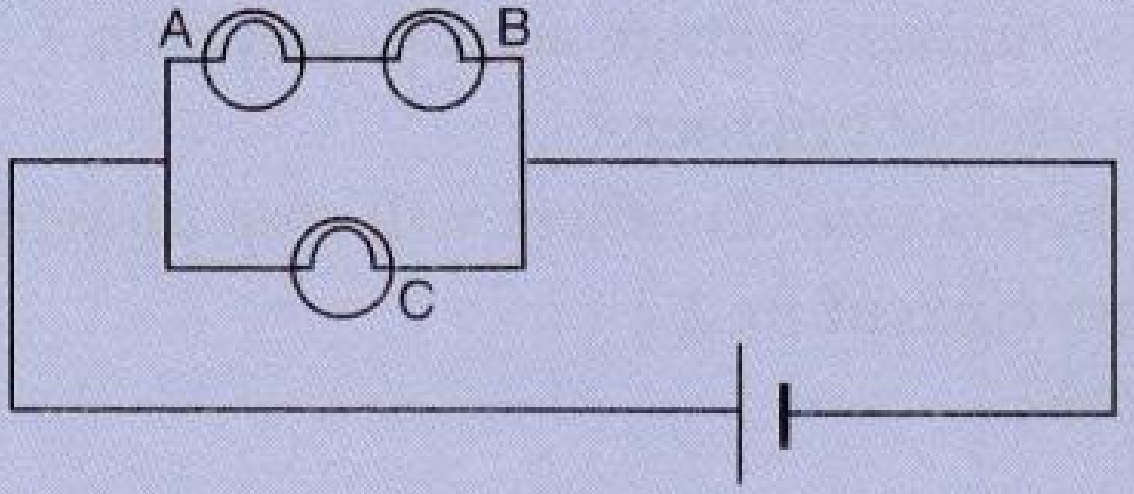
- List the bulbs in order of increasing brightness.
- If C burns out, what will be the brightness of A now compared with before?
- If B burns out instead, what will be the brightness of A and C compared with before?