A resistance of $40$ ohms and one of $60$ ohms are arranged in series across $220$ volt supply. Find the heat in joules produced by this combination of resistances in half a minute.
Download our app for free and get started
Given: $R 1=40$ ohms, $R 2=60$ ohms (in series), $V=220 V, t =30 sec$ we know that
Total resistance, $R=40+60=100$ ohms
By ohm's law
$V=IR$
$I=\frac{V}{R}$
$I=\frac{220}{100}=2.2 amp$
Putting the value of $I , R$ and t in eq. $H = I ^2 R T$
$H=2.2^2 \times 100 \times 30$
$H=14520 J$
Total resistance, $R=40+60=100$ ohms
By ohm's law
$V=IR$
$I=\frac{V}{R}$
$I=\frac{220}{100}=2.2 amp$
Putting the value of $I , R$ and t in eq. $H = I ^2 R T$
$H=2.2^2 \times 100 \times 30$
$H=14520 J$

Download our appand get started for free
Experience the future of education. Simply download our apps or reach out to us for more information. Let's shape the future of learning together!No signup needed.*
Similar Questions
- 1View SolutionShow how you would connect two 4 ohm resistors to produce a combined resistance of:
- 2 ohms.
- 8 ohms.
- 2View SolutionState three factors on which the heat produced by an electric current depends. How does it depend on these factors?
- 3Two resistances when connected in parallel give resultant value of $2$ ohm; when connected in series the value becomes $9$ ohm. Calculate the value of each resistance.View Solution
- 4For the circuit shown in the diagram below:View Solution
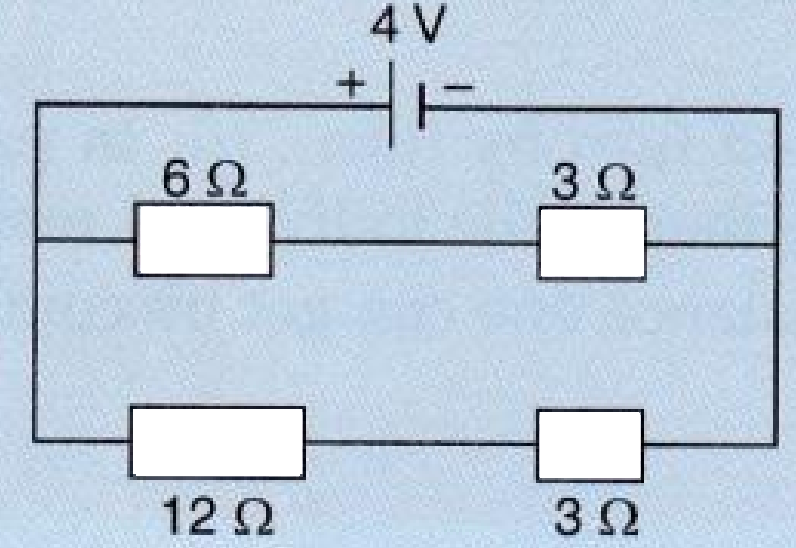
What is the value of :
Current through $6 Ω$ resistor?
Potential difference across $12 Ω$ resistor? - 5View SolutionThree 2V cells are connected in series and used as a battery in a circuit.
- What is the p.d. at the terminals of the battery?
- How many joules of electrical energy does 1C gain on passing through
- One cell.
- All three cells?
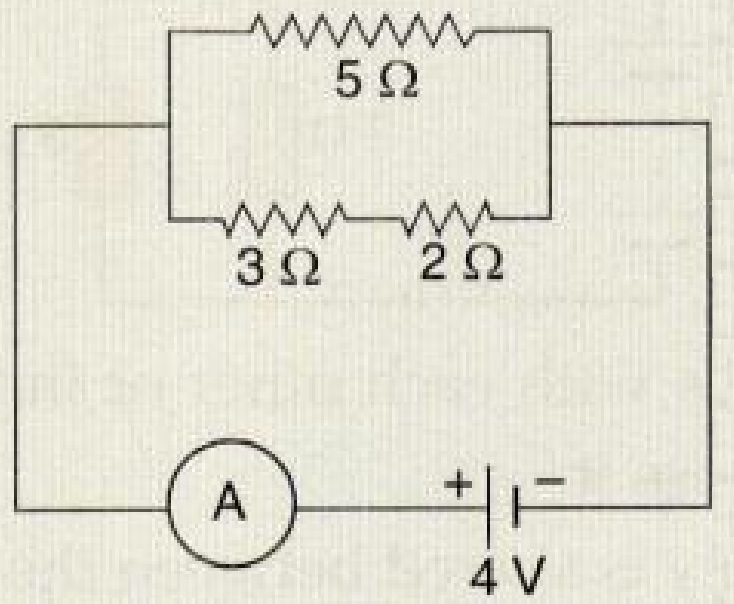
- 6With the help of a circuit diagram, obtain the relation for the equivalent resistance of two resistances connected in parallel. In the circuit diagram shown below, find:View Solution
- Total resistance.
- Current shown by the ammeter $A$
- 7View SolutionHow does the resistance of a conductor depend on:
- Length of the conductor?
- Area of cross-section of the conductor?
- Temperature of the conductor?
- 8View SolutionTwo exactly similar electric lamps are arranged (i) in parallel, and (ii) in series. If the parallel and series combination of lamps are connected to 220V supply line one by one, what will be the ratio of electric power consumed by them?
- 9View SolutionWhat is a voltmeter? How is a voltmeter connected in the circuit to measure the potential difference between two points. Explain with the help of a diagram.
- 10How will you connect three resistors of resistances $2Ω, 3Ω$ and $6Ω $ obtain a total n si stance of:View Solution
- $4 Ω,$
- $1Ω$