An electron of mass $9 \times 10^{-31}kg$ revolves in a circle of radius $0.53\mathring{\text{A}}$ around the nucleus of hydrogen with a velocity of $2.2 \times 10^6ms$. Show that angular momentum of elect ron is $\frac{\text{h}}{2\pi}$ where h is Planck's constant.
Download our app for free and get started
Here, $\text{m}=9\times10^{-31}\text{kg}$
$\text{r}=0.53\mathring{\text{A}}$
$=053\times10^{-10}\text{m}$
$\text{v}=2.2\times10^6\text{m/s}$ Angular momentum, L = mvr $=9\times10^{-31}\times2.2\times10^6 \times0.53\times10^{-10} \text{L}=1.0494\times10^{-34}\text{Js}$
Also, $\frac{\text{h}}{2\pi}=\frac{6.6\times10^{-34}}{2\times\frac{22}{7}}$
$=1.05\times10^{-34}\text{Js}$
$\text{Hence,L}=\frac{\text{h}}{2\pi}.$
$\text{r}=0.53\mathring{\text{A}}$
$=053\times10^{-10}\text{m}$
$\text{v}=2.2\times10^6\text{m/s}$ Angular momentum, L = mvr $=9\times10^{-31}\times2.2\times10^6 \times0.53\times10^{-10} \text{L}=1.0494\times10^{-34}\text{Js}$
Also, $\frac{\text{h}}{2\pi}=\frac{6.6\times10^{-34}}{2\times\frac{22}{7}}$
$=1.05\times10^{-34}\text{Js}$
$\text{Hence,L}=\frac{\text{h}}{2\pi}.$

Download our appand get started for free
Experience the future of education. Simply download our apps or reach out to us for more information. Let's shape the future of learning together!No signup needed.*
Similar Questions
- 1A star of mass twice the solar mass and radius $106km$ rotates about its axis with an angular speed of $10^{‑6}$ rad per sec. What is the angular speed of the star when it collapses (due to inward gravitational forces) to a radius of $10^4km$? Solar mass = $1.99 \times 10^{23}kg$.View Solution
- 2A uniform sphere of mass m and radius R is placed on a rough horizontal surface. The sphere is struck horizontally at a height h from the floor. Match the following:View Solution
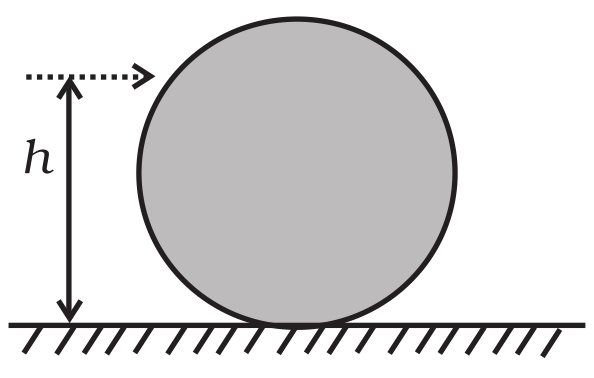
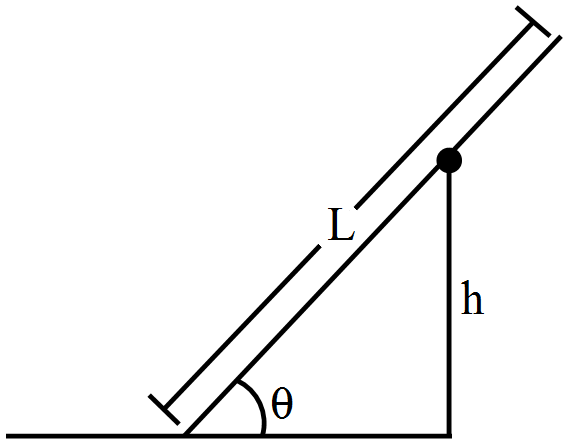
a. $\text{h}=\frac{\text{R}}{2}$ i. Sphere rolls without slipping with a constant velocity and no loss of energy. b. $\text{h}=\text{R}$ ii. Sphere spins clockwise, loses energy by friction. c. $\text{h}=\frac{3\text{R}}{2}$ iii. Sphere spins anti-clockwise, loses energy by friction. d. $\text{h}=\frac{7\text{R}}{5}$ iv. Sphere has only a translational motion, looses energy by friction. - 3A uniform rod of length L rests against a smooth roller as shown in figure. Find the friction coefficient between the ground and the lower end if the minimum angle that the rod can make with the horizontal is $\theta.$View Solution
- 4View SolutionWhat do you mean by the term "equilibrium"? What are equilibrium of rest and equilibrium of motion? State the conditions for complete equilibrium of a body.
- 5A uniform wheel of radius R is set into rotation about its axis at an angular speed $\omega.$ This rotating wheel is now placed on a rough horizontal surface with its axis horizontal. Because of friction at the contact, the wheel accelerates forward and its rotation decelerates till the wheel starts pure rolling on the surface. Find the linear speed of the wheel after it starts pure rolling.View Solution
- 6View SolutionA uniform rod of mass m and length l is struck at an end by a force F perpendicular to the rod for a short time interval t. Calculate:
- The speed of the centre of mass.
- The angular speed of the rod about the centre of mass.
- The kinetic energy of the rod.
- The angular momentum of the rod about the centre of mass after the force has stopped to act. Assume that t is so small that the rod does not appreciably change its direction while the force acts.
- 7View SolutionDiscuss the rolling motion of a cylinder on an inclined plane.
- 8A disc of mass $5kg$ and radius $50cm$ rolls on the ground at the rate of $10ms^{-1}$. Calculate the K.E. of the disc. $\Big(\text{Given}:\text{I}=\frac{1}{2}\text{MR}^2\Big)$View Solution
- 9View SolutionThe door of an almirah is 6ft high, 1.5ft wide and weighs 8kg. The door is supported by two hinges situated at a distance of 1ft from the ends. If the magnitudes of the forces exerted by the hinges on the door are equal, find this magnitude.
- 10The angular speed of a motor wheel is increased from $1200$ rpm to $3120$ rpm in $16$ seconds. $(i)$ What is its angular acceleration, assuming the acceleration to be uniform? $(ii)$ How many revolutions does the engine make during this time?View Solution