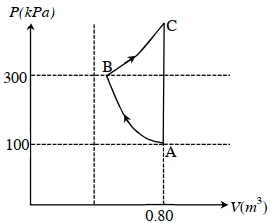
In the given $P$-V diagram, a monoatomic gas $\left(\gamma=\frac{5}{3}\right)$ is first compressed adiabatically from state $A$ to state $B$. Then it expands isothermally from state $B$ to state $C$. [Given: $\left(\frac{1}{3}\right)^{0.6} \simeq 0.5, \ln 2 \simeq 0.7$ ].

Which of the following statement($s$) is(are) correct?

$(A)$ The magnitude of the total work done in the process $A \rightarrow B \rightarrow C$ is $144 kJ$.

$(B)$ The magnitude of the work done in the process $B \rightarrow C$ is $84 kJ$.

$(C)$ The magnitude of the work done in the process $A \rightarrow B$ is $60 kJ$.

$(D)$ The magnitude of the work done in the process $C \rightarrow A$ is zero.
IIT 2022, Medium
Download our app for free and get startedPlay store
For adiabaric process $( A \rightarrow B )$

$P_A V_x^t=P_x V_x^t$

$10^2 \times(0.8)^{\frac{2}{2}}=3 \times 10^2\left(V_n\right)^{\frac{2}{1}}$

$\Rightarrow V_x=0.8 \times\left(\frac{1}{3}\right)^{0.2}=0.4$

Wodk doue in process $A \rightarrow B$

$W_{c x}=\frac{P_s V_0-P_x V_x}{\gamma-1}$

$\Rightarrow W_{\text {sx }}=\frac{10^2 \times 0.8-3 \times 10^2 \times 0.4}{\frac{5}{3}-1}$

$\Rightarrow W_{\text {As }}=-60 lJ =\Rightarrow\left|W_{\lambda \Omega}\right|=60 lJ$

Work done in process $B \rightarrow C$ (Isothermal process)

$W_{x=}=n R T / n \frac{V_8}{V_x}=P_x V_x \ell m \frac{V_8}{V_x}$

$\Rightarrow W_{x c}=3 \times 10^2 \times 0.4 \ln \frac{0.8}{0.4}$

$\Rightarrow W_{s c}=34 kJ$

Wodk doue in process $C \rightarrow A$

$W_{C_A}=P \Delta V=0 \quad(\because \Delta V=0)$

So toral work done in the process $A \rightarrow B \rightarrow C$

$W_{A B C}=W_{A \triangle}+W_{y C}+W_{C A}=-60+84+0$

$W_{A B C}=24 kJ$

So comect options are $(B,C.D)$

art

Download our app
and get started for free

Experience the future of education. Simply download our apps or reach out to us for more information. Let's shape the future of learning together!No signup needed.*

Similar Questions

  • 1
    Which of the following statements is correct for any thermodynamic system
    View Solution
  • 2
    $P-V$ plots for two gases during adiabatic process are shown in the figure. Plots $1$ and $2$ should correspond respectively to
    View Solution
  • 3
    In a cyclic process, the internal energy of the gas
    View Solution
  • 4
    Determine efficiency of carnot cycle if in adiabatic expansion volume $3$ times of initial value and $\gamma =1.5$
    View Solution
  • 5
    In the following figure, four curves $A, B, C$ and $D$ are shown. The curves are
    View Solution
  • 6
    A sample of an ideal gas is taken through the cyclic process $abca$ as shown in the figure. The change in the internal energy of the gas along the path $ca$ is $-180\, J$. The gas absorbs $250\, J$ of heat along the path $ab$ and $60\, J$ along the path $bc$. The work done by the gas along the path $abc$ is ..... $J$
    View Solution
  • 7
    Two Carnot engines $A$ and $B$ are operated in series. The first one, $A,$ receives heat at $T_1(= 600\,K)$ and rejects to a reservoir at temperature $T_2.$ The second engine $B$ receives heat rejected by the first engine and, in turns, rejects to a heat reservoir at $T_3 (=400\,K).$ Calculate the temperature $T_2$ if the work outputs of the two engines are equal   ..... $K$
    View Solution
  • 8
    A cyclic process $ABCA$ is shown in the $V-T $ diagram. Process on the $P-V$ diagram is
    View Solution
  • 9
    Diatomic gas is used in carnot heat engine. If efficiency of given carnot heat engine is $80\%$ , then find the ratio of initial volume to final volume of gas during adiabatic expansion
    View Solution
  • 10
    The state of an ideal gas was changed isobarically. The graph depicts three such isobaric lines. Which of the following is true about the pressures of the gas?
    View Solution