In which of the following cases more electrical energy is consumed per hour?
- A current of $1$ ampere passed through a resistance of $300$ ohms.
- A current of $2$ amperes passed through a resistance of $100$ ohms.
Download our app for free and get started
- $R = 300$ ohm, $I = 1A, t = 1h$
$E = P \times t = 300 \times 1 = 300Wh$
- $R = 100 $ ohm, $I = 2A, t = 1h$
$E = P \times t = 400 \times 1 = 400Wh$
Hence, in case (ii), the electrical energy consumed per hour is more.

Download our appand get started for free
Experience the future of education. Simply download our apps or reach out to us for more information. Let's shape the future of learning together!No signup needed.*
Similar Questions
- 1If the charge on an electron is $1.6 \times 10$ coulombs, how many electrons should pass through a conductor in $1$ second to constitute $1$ ampere current?View Solution
- 2View SolutionTwo exactly similar electric lamps are arranged (i) in parallel, and (ii) in series. If the parallel and series combination of lamps are connected to 220V supply line one by one, what will be the ratio of electric power consumed by them?
- 3View SolutionIf a potential difference of 10V causes a current of 2A to flow for 1 minute, how much energy is transferred?
- 4The electrical resistivities of three materials P, Q and R are given below:$\begin{matrix}\text{P}&2.3\times10^{3}\Omega\text{ m}\\\text{Q}&2.63\times10^{-8}\Omega\text{ m}\\\text{R}&1.0\times10^{15}\Omega\text{ m}\end{matrix}$View Solution
Which material will you use for making:- Electric wires.
- Handle for soldering iron, and
- Solar cells?
- 5View SolutionWhat is Ohm’s law? Explain how it is used to define the unit of resistance.
- 6The electrical resistivities of four materials $A, B, C$ and $D$ are given below:View Solution
$\text{A}\ -110\times10^{-8}\Omega\text{ m}$
$\text{B}-\ 1.0\times10^{10}\Omega\text{ m}$
$\text{C}-\ 10.0\times10^{-8}\Omega\text{ m}$
$\text{D}-\ 2.3\times10^{3}\Omega\text{ m}$
Which material is:- Good conductor.
- Resistor.
- Insulator, and
- Semiconductor
- 7View SolutionGive three reasons why different electrical appliances in a domestic circuit are connected in parallel.
- 8For the circuit shown in the diagram below:View Solution
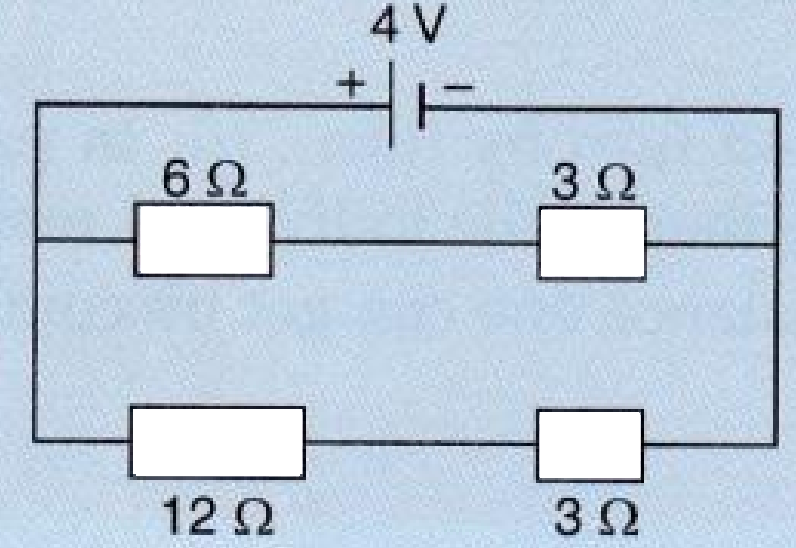
What is the value of :
Current through $6 Ω$ resistor?
Potential difference across $12 Ω$ resistor? - 9A resistance of $40$ ohms and one of $60$ ohms are arranged in series across $220$ volt supply. Find the heat in joules produced by this combination of resistances in half a minute.View Solution
- 10What is, highest, and lowest, resistance which can be obtained by combining Com resistors having the following resistances?View Solution
$4 Ω, 8 Ω, 12 Ω, 24 Ω$