Three 2V cells are connected in series and used as a battery in a circuit.
- What is the p.d. at the terminals of the battery?
- How many joules of electrical energy does 1C gain on passing through
- One cell.
- All three cells?
Download our app for free and get started
- If three cells of 2 volt each are connected in series to make a battery, then the total potential difference between terminals of the battery will be 6V.
- Given: p.d. = 2V, Charge moved = 1C
Work done = p.d × charge moved
= 2 × 1
Work done = 2 joules
- Given: p.d = 6V, Charge moved = 1C
= 6 × 1
Work done = 6 joule.

Download our appand get started for free
Experience the future of education. Simply download our apps or reach out to us for more information. Let's shape the future of learning together!No signup needed.*
Similar Questions
- 1An electric iron is connected to the mains power supply of $220V$. When the electric iron is adjusted at ‘minimum heating’ it consumes a power of $360W$ but at ‘maximum heating’ it takes a power of $840W$. Calculate the current and resistance in each case.View Solution
- 2View SolutionShow how you would connect two 4 ohm resistors to produce a combined resistance of:
- 2 ohms.
- 8 ohms.
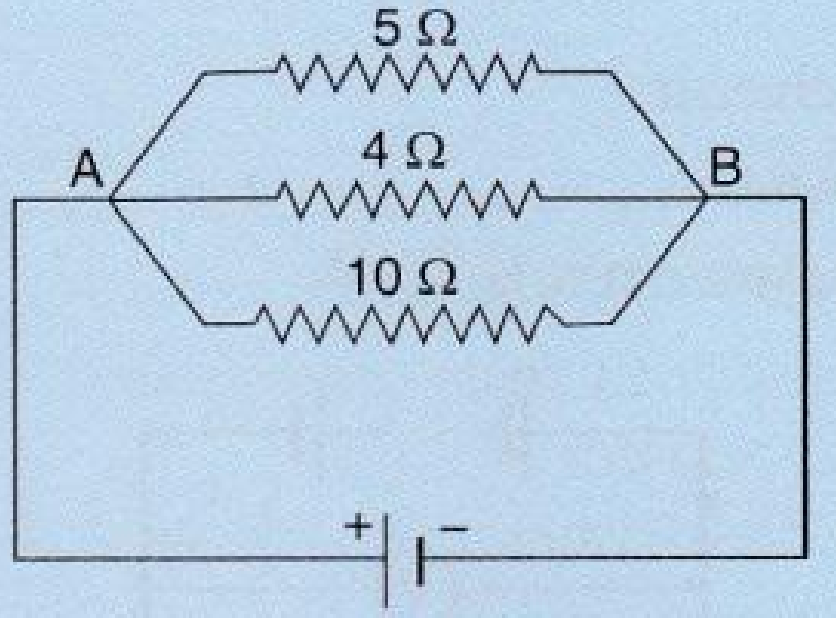
- 3View SolutionIn the circuit diagram given below, the current flowing across 5 ohm resistor is 1 amp. Find the current flowing through the other two resistors.
- 4Calculate the resistance of an aluminium cable of length $10\ km$ and diameter $2.0\ mm$ if the resistivity of aluminium is $2.7\times10 Ω\ \text{m}.$View Solution
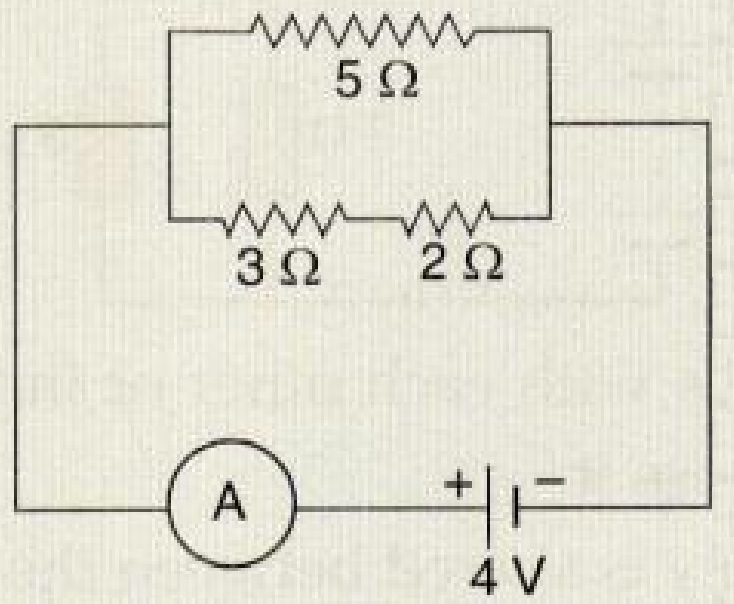
- 5With the help of a circuit diagram, obtain the relation for the equivalent resistance of two resistances connected in parallel. In the circuit diagram shown below, find:View Solution
- Total resistance.
- Current shown by the ammeter $A$
- 6View SolutionHow does the resistance of a conductor depend on:
- Length of the conductor?
- Area of cross-section of the conductor?
- Temperature of the conductor?
- 7Calculate the work done in moving a charge of $4$ coulombs from a point at $220$ volts to another point at $230$ volts.View Solution
- 8View SolutionAn electric heater is connected to the 230V mains supply. A current of 8A flows through the heater.
- How much charge flows around the circuit each second?
- How much energy is transferred to the heater each second?
- 9A resistance of $40$ ohms and one of $60$ ohms are arranged in series across $220$ volt supply. Find the heat in joules produced by this combination of resistances in half a minute.View Solution
- 10The electrical resistivities of five substances A, B, C, D and E are given below:View Solution
$\begin{matrix}\text{B}&110\times10^{-8}\Omega\text{ m}\\\text{C}&2.60\times10^{-8}\Omega\text{ m}\\\text{D}&10.0\times10^{-8}\Omega\text{ m}\\\text{E}&1.70\times10^{-8}\Omega\text{ m}\end{matrix}$