A $2kg$ body and a $3kg$ body are moving along the x-axis. At a particular instant, the $2kg$ body is $1m$ from the origin and has a velocity of $3ms^{-1}$ and the $3kg$ body is $2m$ from the origin and has velocity of $-1 ms^{-1}$. Find the position and velocity of the centre of mass and also find the total momentum.
Download our app for free and get started
The x-coordinate of the COM is given by, $\text{x}=\frac{\text{m}_1\text{x}_1+\text{m}_2\text{x}_2}{\text{m}_1+\text{m}_2}$ $=\frac{2\times1+3\times2}{2+3}=\frac{8}{5}=1.6\text{m}$ Velocity of the COM is given by, $\text{V}=\frac{\text{m}_1\text{v}_1+\text{m}_2\text{v}_2}{\text{m}_1+\text{v}_1}$ $=\frac{2\times3+3\times(-1)}{2+3}=\frac{3}{5}=0.6\text{ms}^{-1}$ Total momentum $=(\text{m}_1+\text{m}_2)\text{V}$ $=(2+3)\times0.6=3\text{kg ms}^{-1}$

Download our appand get started for free
Experience the future of education. Simply download our apps or reach out to us for more information. Let's shape the future of learning together!No signup needed.*
Similar Questions
- 1A solid disc and a ring, both of radius $10cm$ are placed on a horizontal table simultaneously, with initial angular speed equal to 10 π rad $s^{-1}$. Which of the two will start to roll earlier? The co-efficient of kinetic friction is $\mu_\text{k}=0.2$View Solution
- 2The descending pulley shown in figure has a radius $20cm$ and moment of inertia $0.20kg-m^2$. The fixed pulley is light and the horizontal plane frictionless. Find the acceleration of the block if its mass is $1.0kg$.View Solution
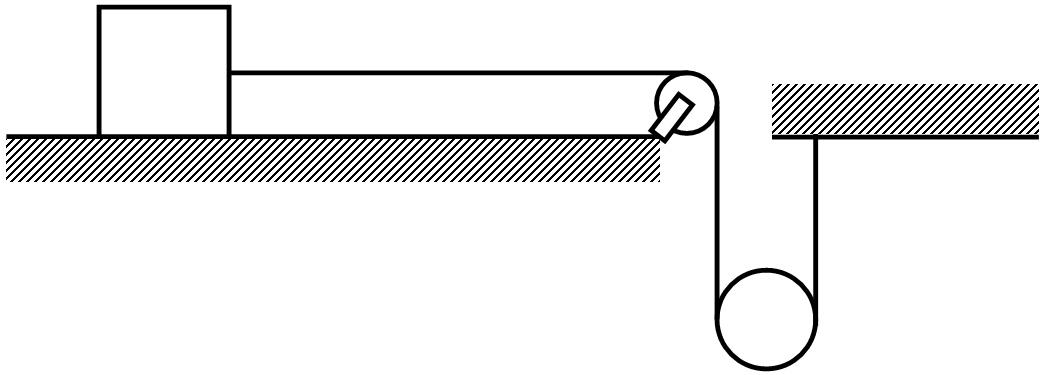
- 3Suppose the smaller pulley of the previous problem has its radius $5.0cm$ and moment of inertia $0.10kg-m^2$. Find the tension in the part of the string joining the pulleys.View Solution
- 4View SolutionA body is in translational equilibrium under the action of coplanar forces. If the torque of these forces is zero about a point, is it necessary that it will also be zero about any other point?
- 5View SolutionDefine radius of gyration and give the physical significance of moment of inertia.
- 6A car weighs $1800kg$. The distance between its front and back axles is $1.8m$. Its centre of gravity is $1.05m$ behind the front axle. Determine the force exerted by the level ground on each front wheel and each back wheel.View Solution
- 7View SolutionFind the centre of mass of a uniform:
- Half-disc.
- Quarter-disc.
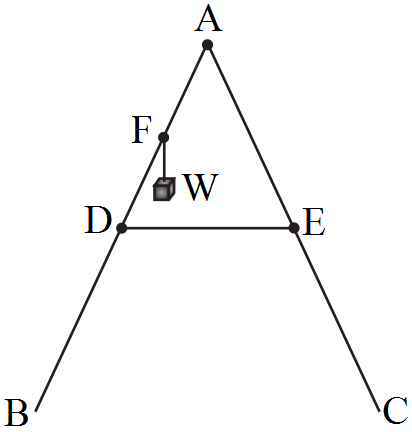
- 8As shown in the two sides of a step ladder BA and CA are $1.6m$ long and hinged at A. A rope DE, $0.5m$ is tied half way up. A weight $40kg$ is suspended from a point F, 1.2m from B along the ladder BA. Assuming the floor to be frictionless and neglecting the weight of the ladder, find the tension in the rope and forces exerted by the floor on the ladder. (Take $g = 9.8m/s^2$) (Hint: Consider the equilibrium of each side of the ladder separately).View Solution
- 9Calculate the angular momentum and rotational kinetic energy of earth about its own axis. How long could this amount of energy supply one kilowatt power to each of the $3.5 \times 10^9$ persons on earth? (Mass of earth = $6.0 \times 1024kg$ and radius = $6.4 \times 10^{24}km)$.View Solution
- 10View SolutionDiscuss the rolling motion of a cylinder on an inclined plane.