A star of mass twice the solar mass and radius $106km$ rotates about its axis with an angular speed of $10^{‑6}$ rad per sec. What is the angular speed of the star when it collapses (due to inward gravitational forces) to a radius of $10^4km$? Solar mass = $1.99 \times 10^{23}kg$.
Download our app for free and get started
According to the law of conservation of angular momentum, $\text{I}_1\omega_1=\text{I}_2\omega_2$ Since sun is a asphere, so $\text{I}_1=\frac{2}{5}\text{MR}^2_1, R_1$ = Radius of sun M.I. of star $\text{I}_2\frac{2}{5}2\text{M}\text{R}^2_2,R_2$ = radius of star
$\therefore\frac{3}{5}\text{MR}^2_1\omega_1=\frac{4}{5}\text{MR}^2_2\omega_2$
$\text{or }\omega_2=\frac{\text{R}^2_1}{2\text{R}^2_2}\omega_1$ Since $R_1 = 10^6km; R_2 = 10^4km$; $\omega_1=10^{-6}\text{/sec}$
$\therefore\omega_2=\frac{(10^6)^2}{2(10^4)^2}\times10^{-6}$
$=5\times10^{-3}\text{rad/sec.}$
$\therefore\frac{3}{5}\text{MR}^2_1\omega_1=\frac{4}{5}\text{MR}^2_2\omega_2$
$\text{or }\omega_2=\frac{\text{R}^2_1}{2\text{R}^2_2}\omega_1$ Since $R_1 = 10^6km; R_2 = 10^4km$; $\omega_1=10^{-6}\text{/sec}$
$\therefore\omega_2=\frac{(10^6)^2}{2(10^4)^2}\times10^{-6}$
$=5\times10^{-3}\text{rad/sec.}$

Download our appand get started for free
Experience the future of education. Simply download our apps or reach out to us for more information. Let's shape the future of learning together!No signup needed.*
Similar Questions
- 1What is Mechanical Advantage (M.A.) in the principle of moments for a lever? Find the reactions forces at knife edge as shown in the figure:View Solution
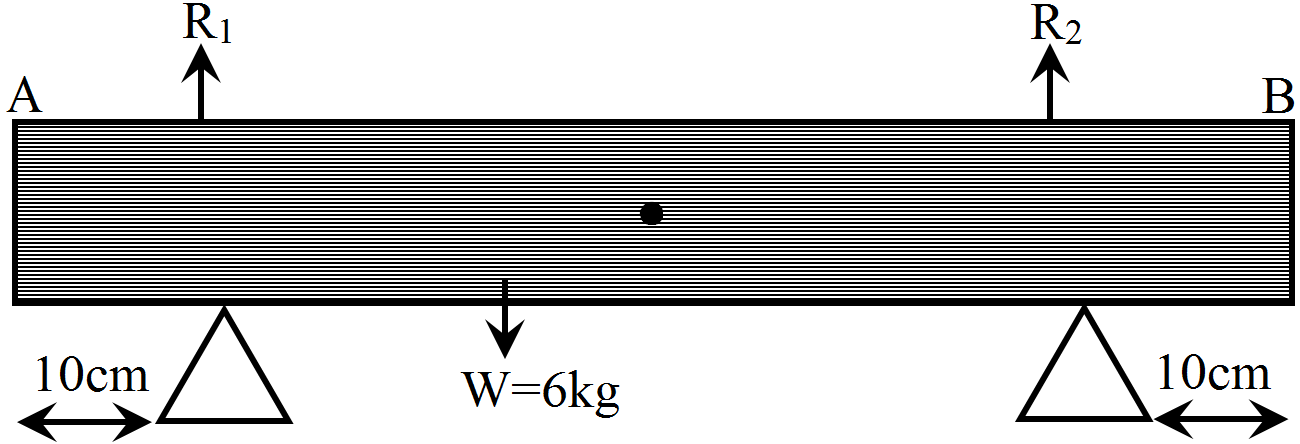
Where AB is a metal bar of $70cm$ length having mass $4kg$ and a $6kg$ load is suspended from $30cm$ from the end A. - 2Separation of Motion of a system of particles into motion of the centre of mass and motion about the centre of mass: Show $\text{L}=\text{L}'+\text{R}\times\text{MV}$ where $\text{L}'=\sum\text{r}'_\text{i}\times\text{p}'_\text{i}$ is the angular momentum of the system about the centre of mass with velocities taken relative to the centre of mass. Remember $\text{r}'_\text{i}=\text{r}_\text{i}-\text{R},$ rest of the notation is the standard notation used in the chapter. Note: $\text{L}'$ and $\text{MR}\times\text{V}$ can be said to be angular momenta, respectively, about and of the centre of mass of the system of particles.View Solution
- 3Particles of masses $1g, 2g, 3g, ........, 100g$ are kept at the marks $1cm, 2cm, 3cm, ........, 100cm$ respectively on a metre scale. Find the moment of inertia of the system of particles about a perpendicular bisector of the metre scale.View Solution
- 4An electron of mass $9 \times 10^{-31}kg$ revolves in a circle of radius $0.53\mathring{\text{A}}$ around the nucleus of hydrogen with a velocity of $2.2 \times 10^6ms$. Show that angular momentum of elect ron is $\frac{\text{h}}{2\pi}$ where h is Planck's constant.View Solution
- 5View SolutionShow that a(b × c) is equal in magnitude to the volume of the parallelepiped formed on the three vectors a, b and c.
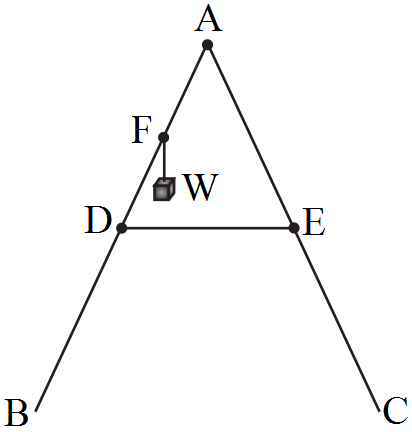
- 6As shown in the two sides of a step ladder BA and CA are $1.6m$ long and hinged at A. A rope DE, $0.5m$ is tied half way up. A weight $40kg$ is suspended from a point F, 1.2m from B along the ladder BA. Assuming the floor to be frictionless and neglecting the weight of the ladder, find the tension in the rope and forces exerted by the floor on the ladder. (Take $g = 9.8m/s^2$) (Hint: Consider the equilibrium of each side of the ladder separately).View Solution
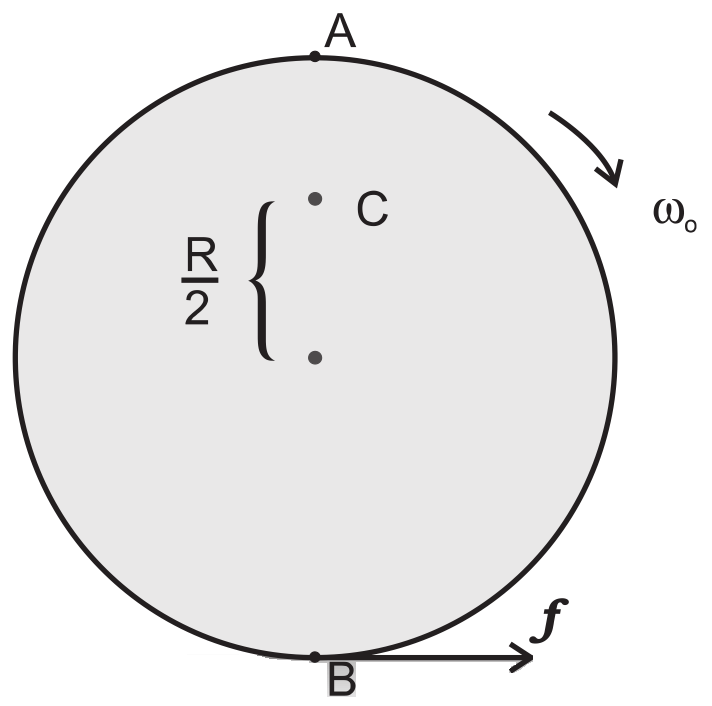
- 7A disc rotating about its axis with angular speed $\omega_0$ is placed lightly (without any translational push) on a perfectly frictionless table. The radius of the disc is R. What are the linear velocities of the points A, B and C on the disc shown in will the disc roll in the direction indicated?View Solution
- 8View SolutionA 3m long ladder weighing 20 kg leans on a frictionless wall. Its feet rest on the floor 1 m from the wall as shown in Fig.6.27. Find the reaction forces of the wall and the floor.
- 9View SolutionA metal bar 70 cm long and 4.00 kg in mass supported on two knifeedges placed 10 cm from each end. A 6.00 kg load is suspended at 30 cm from one end. Find the reactions at the knife-edges. (Assume the bar to be of uniform cross section and homogeneous.)
- 10View SolutionA cylinder is suspended by two strings wrapped around the cylinder near each end, the free ends of the string being attached to hooks on the ceiling, such that the length of the cylinder is horizontal. From the position of rest, the cylinder is allowed to roll down as suspension strings unwind. Calculate: (i) the downward linear acceleration of the cylinder and (ii) tension in the strings. Mass of cylinder is 12kg.