One mole of an ideal gas undergoes two different cyclic processes I and II, as shown in the $P-V$ diagrams below. In cycle I, processes $a, b, c$ and $d$ are isobaric, isothermal, isobaric and isochoric, respectively. In cycle II, processes $a^{\prime}, b^{\prime}, c^{\prime}$ and $d^{\prime}$ are isothermal, isochoric, isobaric and isochoric, respectively. The total work done during cycle I is $W_I$ and that during cycle II is $W_{I I}$. The ratio $W_I / W_{I I}$ is . . . .
(image)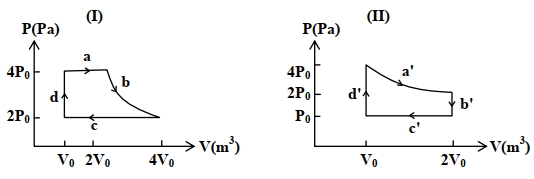
IIT 2023, Advanced
Download our app for free and get started
$\frac{\mathrm{W}_{\mathrm{I}}}{\mathrm{W}_{\mathrm{II}}}=\frac{4 \mathrm{P}_0 \mathrm{~V}_0+8 \mathrm{P}_0 \mathrm{~V}_0 \ell \mathrm{n} 2-6 \mathrm{P}_0 \mathrm{~V}_0-0}{4 \mathrm{P}_0 \mathrm{~V}_0 \ln 2-0-\mathrm{P}_0 \mathrm{~V}_0+0}$
$=\frac{8 \ell \mathrm{n} 2-2}{4 \ell \mathrm{n} 2-1}=2$

Download our appand get started for free
Experience the future of education. Simply download our apps or reach out to us for more information. Let's shape the future of learning together!No signup needed.*
Similar Questions
- 1View SolutionThe ratio of work done by an ideal monoatomic gas to the heat supplied to it in an isobaric process is
- 2In an adiabatic process, the state of a gas is changed from ${P_1},{V_1},{T_1} $ to ${P_2},{V_2},{T_2}$. Which of the following relation is correctView Solution
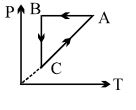
- 3A cyclic process $ABCA$ is shown in $PT$ diagram. When presented on $PV$, it wouldView Solution
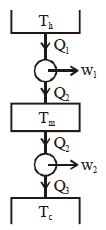
- 4Suppose that two heat engines are connected in series, such that the heat exhaust of the first engine is used as the heat input of the second engine as shown in figure. The efficiencies of the engines are $\eta_1$ and $\eta_2$, respectively. The net efficiency of the combination is given byView Solution
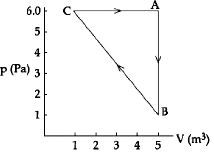
- 5For the given cyclic process $CAB$ as shown for a gas, the work done is ..... $J$View Solution
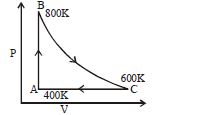
- 6One mole of diatomic ideal gas undergoes a cyclic process $ABC$ as shown in figure. The process $BC$ is adiabatic. The temperatures at $A, B$ and $C$ are $400\,K, 800\,K$ and $600\,K$ respectively. Choose the correct statementView Solution
- 7One mole of an ideal gas $(\gamma = 1.4)$ is adiabatically compressed so that its temperature rises from $27\,^oC$ to $35\,^oC$ . The change in the internal energy of the gas is .... $J$. (given $R = 8.3\,J/mole-K$ )View Solution
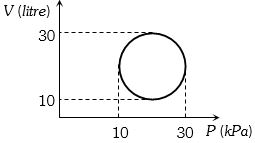
- 8View SolutionHeat energy absorbed by a system in going through a cyclic process shown in figure is
- 9A cylinder of mass $1\,kg$ is given heat of $20000\, J$ at atmospheric pressure. If initially temperature of cylinder is $20\,^oC$, then work done by the cylinder will be .......$J$ (Given that Specific heat of cylinder $= 400 \,J\, kg^{-1}$, Coefficient of volume expansion $= 9 \times {10^{-5}}\,^o C^{-1}$, Atmospheric pressure $= 10^5 \,N/m^2$ and density of cylinder $9000\,kg/m^3$)View Solution
- 10View SolutionThe temperature of an ideal gas is kept constant as it expands. The gas does external work. During this process, the internal energy of the gas