Prove that the velocity v of translation of a rolling body (like a ring, disc, cylinder or sphere) at the bottom of an inclined plane of height h is given by:$\text{v}^2=\frac{2\text{gh}}{\big(1+\frac{\text{K}^2}{\text{R}^2}\big)}$
Note K is the radius of gyration of the body about its symmetry axis, and R is the radius of the body. The body starts from rest at the top of the plane.
Note K is the radius of gyration of the body about its symmetry axis, and R is the radius of the body. The body starts from rest at the top of the plane.
Download our app for free and get started
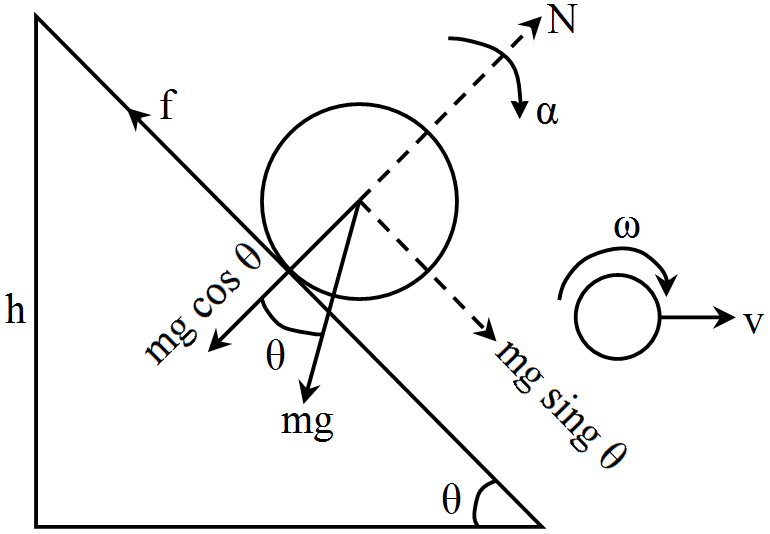 $\text{Ma}=\text{Mg}\sin\theta-\text{f}\dots(1)$
$\tau=\text{f}\times\text{R}=\text{ I }\alpha=\text{MK}^2\Big(\frac{\text{a}}{\text{R}}\Big)$
$\Rightarrow\text{f}=\frac{\text{MK}^2}{\text{R}^2}\text{a}$
$\Rightarrow\text{Ma}=\text{Mg}\sin \theta-\frac{\text{MK}^2}{\text{R}^2}\text{a}$
[Substituting the value of f in (i)]
$\Rightarrow\text{a}\Big(1+\frac{\text{K}^2}{\text{R}^2}\Big)=\text{g}\sin\theta$
$\Rightarrow\text{a}=\frac{\text{g}\sin\theta}{\Big(1+\frac{\text{K}^2}{\text{R}^2}\Big)}$
$\text{v}^2-\text{u}^2=2\text{as}[\text{u}=0,\frac{\text{h}}{\text{s}}=\sin\theta]$
$\text{v}=\sqrt{\frac{2\text{ah}}{\sin\theta}}$
$\Rightarrow\text{v}=\sqrt{\frac{2\times\text{g}\sin\theta}{\sin\theta\Big(1+\frac{\text{K}^2}{\text{R}^2}\Big)}}$
$\Rightarrow\text{v}=\sqrt{\frac{2\text{gh}}{\Big(1+\frac{\text{K}^2}{\text{R}^2}\Big)}}$
Where, K = radius of gyration of the body about its symmetry axis.
R = Radius of the body.

Download our appand get started for free
Experience the future of education. Simply download our apps or reach out to us for more information. Let's shape the future of learning together!No signup needed.*
Similar Questions
- 1Establish the relation $\theta=\omega_0\text{t}+\frac{1}{2}\alpha\text{t}^2$ where the letters have their usual meanings.View Solution
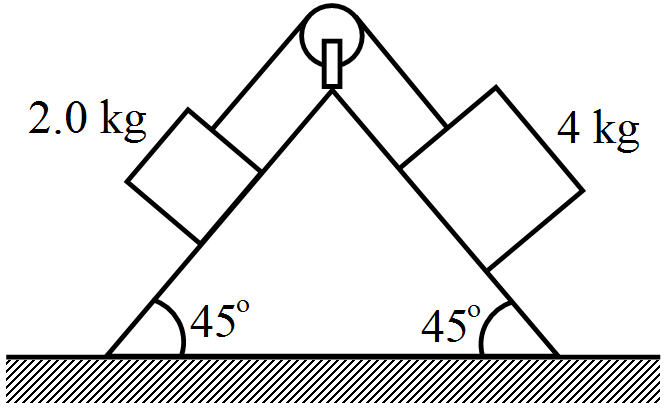
- 2The pulley shown in figure has a radius $10cm$ and moment of inertia $0.5kg-m^2$ about its axis. Assuming the inclined planes to be frictionless, calculate the acceleration of the $4.0kg$ block.View Solution
- 3The angular speed of a motor wheel is increased from $1200$ rpm to $3120$ rpm in $16$ seconds. $(i)$ What is its angular acceleration, assuming the acceleration to be uniform? $(ii)$ How many revolutions does the engine make during this time?View Solution
- 4In the HCl molecule, the separation between the nuclei of the two atoms is about $1.27\mathring{\text{A}}\big(1\mathring{\text{A}}= 10^{-10} \text{m}\big).$ Find the approximate location of the CM of the molecule, given that a chlorine atom is about 35.5 times as massive as a hydrogen atom and nearly all the mass of an atom is concentrated in its nucleus.View Solution
- 5A car weighs $1800kg$. The distance between its front and back axles is $1.8m$. Its centre of gravity is $1.05m$ behind the front axle. Determine the force exerted by the level ground on each front wheel and each back wheel.View Solution
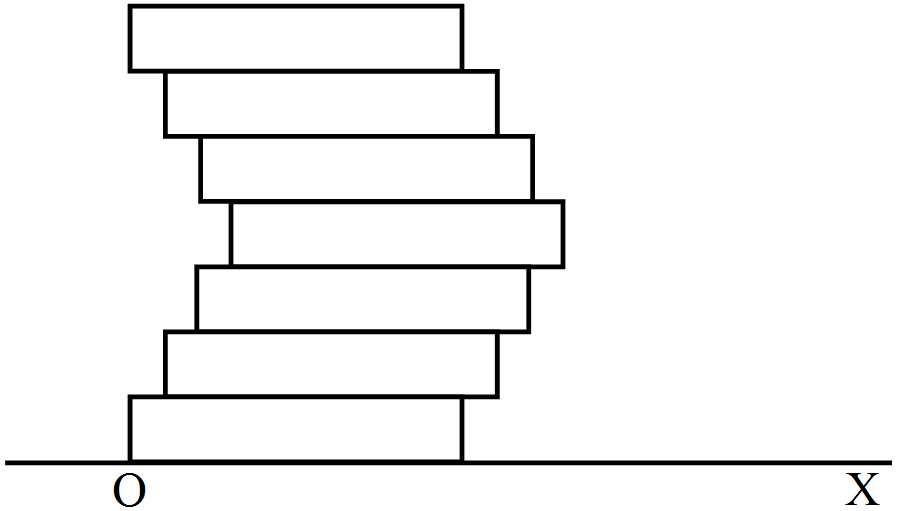
- 6Seven homogeneous bricks, each of length L, are arranged as shown in figure. Each brick is displaced with respect to the one in contact by $\frac{\text{L}}{10}.$ Find the x-coordinate of the centre of mass relative to the origin shown.View Solution
- 7View SolutionA 6.5m long ladder rests against a vertical wall reaching a height of 6.0m. A 60kg man stands half way up the ladder.
- Find the torque of the force exerted by the man on the ladder about the upper end of the ladder.
- Assuming the weight of the ladder to be negligible as compared to the man and assuming the wall to be smooth, find the force exerted by the ground on the ladder.
- 8View SolutionA solid sphere rolls down two different inclined planes of the same heights but different angles of inclination.
- Will it reach the bottom with the same speed in each case?
- Will it take longer to roll down one plane than the other?
- If so, which one and why?
- 9View SolutionA ball is whirled in a circle by attaching it to a fixed point with a string. Is there an angular rotation of the ball about its centre? If yes, is this angular velocity equal to the angular velocity of the ball about the fixed point?
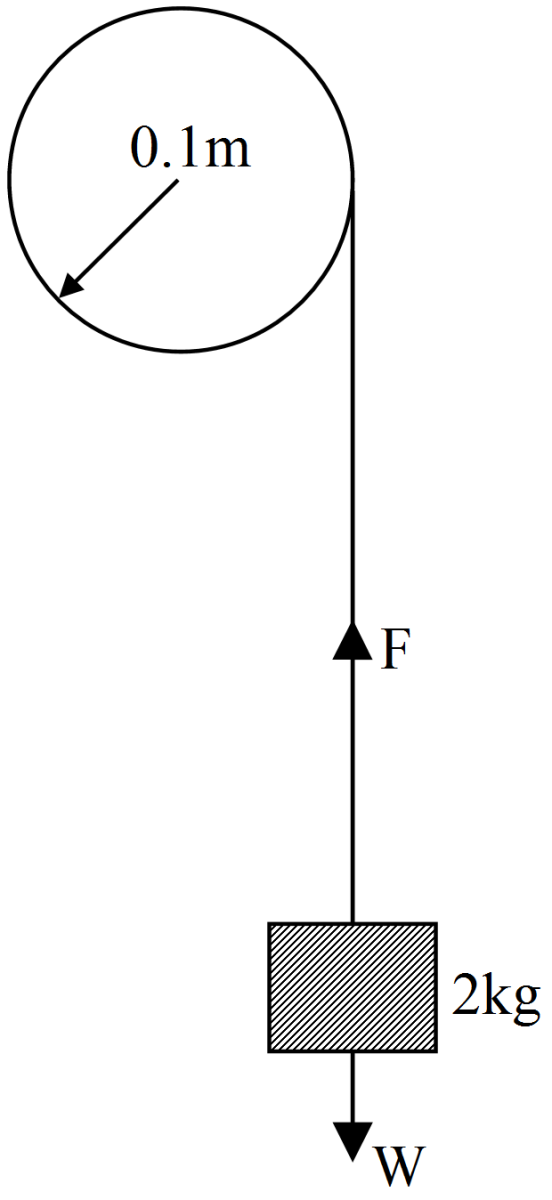
- 10The moment of inertia of a solid flywheel about its axis is $0.1kg-m^2$. A tangential force of $2kg/ wt$ is applied round the circumference of the flywheel with the help of a string and mass arrangement as shown in Fig. If the radius of the wheel is $0.1m$, find the acceleration of the mass.View Solution