In the HCl molecule, the separation between the nuclei of the two atoms is about $1.27\mathring{\text{A}}\big(1\mathring{\text{A}}= 10^{-10} \text{m}\big).$ Find the approximate location of the CM of the molecule, given that a chlorine atom is about 35.5 times as massive as a hydrogen atom and nearly all the mass of an atom is concentrated in its nucleus.
Exercise
Download our app for free and get started
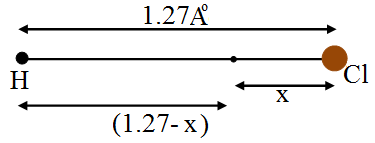 Distance between H and Cl atoms $=1.27\mathring{\text{A}}$
Mass of H atom = m
Mass of Cl atom = 35.5m
Let the centre of mass of the system lie at a distance x from the Cl atom.
Distance of the centre of mass from the H atom = (1.27 - x)
Let us assume that the centre of mass of the given molecule lies at the origin. Therefore, we can have,
[m(1.27 - x) + 35.5mx] / (m + 35.5m) = 0
m(1.27 - x) + 35.5mx = 0
1.27 - x = -35.5x
$\therefore\text{ x}=-1.27/(35.5-1)=-0.37\mathring{\text{A}}$
Here, the negative sign indicates that the centre of mass lies at the left of the molecule. Hence, the centre of mass of the HCl molecule lies $0.37\mathring{\text{A}}$ from the Cl atom.

Download our appand get started for free
Experience the future of education. Simply download our apps or reach out to us for more information. Let's shape the future of learning together!No signup needed.*
Similar Questions
- 1View SolutionA disc of radius R is cut out from a larger disc of radius 2R in such a way that the edge of the hole touches the edge of the disc. Locate the centre of mass of the residual disc.
- 2View SolutionA 6.5m long ladder rests against a vertical wall reaching a height of 6.0m. A 60kg man stands half way up the ladder.
- Find the torque of the force exerted by the man on the ladder about the upper end of the ladder.
- Assuming the weight of the ladder to be negligible as compared to the man and assuming the wall to be smooth, find the force exerted by the ground on the ladder.
- 3View SolutionSuppose the particle of the previous problem has a mass m and a speed v before the collision and it sticks to the rod after the collision. The rod has a mass M:
- Find the velocity of the centre of mass C of the system constituting ''The rod plus the particle''.
- Find the velocity of the particle with respect to C before the collision.
- Find the velocity of the rod with respect to C before the collision.
- Find the angular momentum of the particle and of the rod about the centre of mass C before the collision.
- Find the moment of inertia of the system about the vertical axis through the centre of mass C after the collision.
- Find the velocity of the centre of mass C and the angular velocity of the system about the centre of mass after the collision.
- 4Locate the centre of mass of a system of particles of mass $m_1 = 1kg, m_2 = 2kg$ and $m_3 = 3kg$, situated at the corners of an equilateral triangle of side 1.0 metre.View Solution
- 5Find the centre of mass of a uniform $L-$shaped lamina $($a thin flat plate$)$ with dimensions as shown. The mass of the lamina is $3 \ kg.$View Solution
- 6From a uniform circular disc of diameter d, a circular hole of diameter $\frac{\text{d}}{6}$ and having its centre at a distance of $\frac{\text{d}}{4}$ from the centre of the disc is scooped out. Find the centre of mass of the remaining portion.View Solution
- 7View SolutionA hoop of radius 2m weighs 100kg. It rolls along a horizontal floor so that its centre of mass has a speed of 20cm/s. How much work has to be done to stop it?
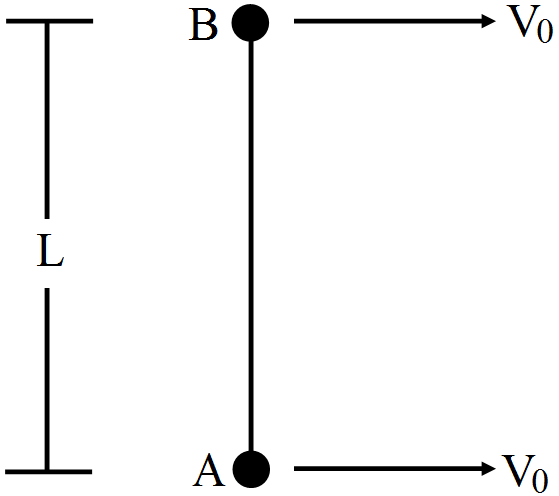
- 8View SolutionTwo small balls A and B, each of mass m, are joined rigidly to the ends of a light rod of lengh L (figure). The system translates on a frictionless horizontal surface with a velocity vo in a direction perpendicular to the rod. A particle P of mass m kept at rest on the surface sticks to the ball A as the ball collides with it. Find:
- The linear speeds of the balls A and B after the collision.
- The velocity of the centre of mass C of the system A + B + P.
- The angular speed of the system about C after the collision.
- 9A circular hole of radius $1m$ is cut off from a disc of radius $6m$. The centre of the hole is $3m$ from the centre of the disc. Find the centre of mass of the remaining disc.View Solution
- 10A mass m is allowed to roll down an inclined plane $(\theta)$ If the vertical height is h, find.View Solution
- Acceleration along the inclined plane.
- Velocity down the plane.