Separation of Motion of a system of particles into motion of the centre of mass and motion about the centre of mass: Show $\frac{\text{dL}}{\text{dt}}=\sum\text{r}'_\text{i}\times\frac{\text{dp}'}{\text{dt}}$ Further, show that $\frac{\text{dL}'}{\text{dt}}=\tau'_\text{ext}$ where $\tau'_\text{ext}$ is the sum of all external torques acting on the system about the centre of mass.
(Hint: Use the definition of centre of mass and third law of motion. Assume the internal forces between any two particles act along the line joining the particles)
(Hint: Use the definition of centre of mass and third law of motion. Assume the internal forces between any two particles act along the line joining the particles)
Download our app for free and get started
We have the relation, $\text{L}'=\sum\limits_\text{i}\text{r}'_\text{i}\times\text{p}'_\text{i }$
$\frac{\text{dL}'}{\text{dt}}=\frac{\text{d}}{\text{dt}}\Big(\sum\limits_\text{i }\text{r}'_\text{i}\times\text{p}'_\text{i}\Big)$
$=\frac{\text{d}}{\text{dt}}\Big(\sum\limits_\text{i }\text{r}'_\text{i}\Big)\times\text{p}'_\text{i }+\sum\limits_\text{i}\text{r}'_\text{i}\times\frac{\text{d}}{\text{dt}}(\text{p}'_\text{i})$
$=\frac{\text{d}}{\text{dt}}\Big(\sum\limits_\text{i}\text{m}_\text{i}\text{r}'_\text{i}\Big)\times\text{v}'_\text{i}+\sum\limits\limits\text{r}'_\text{i} \times\frac{\text{d}}{\text{dt}}(\text{p}'_\text{i})$ Where, $r'_i$ is the position vector with respect to the centre of mass of the system of particles. $\therefore\ \sum\limits_\text{i}\text{m}_\text{i}\text{r}'_\text{i}=0$
$\therefore\ \frac{\text{dL}'}{\text{dt}}=\sum\limits_\text{i}\text{r}'_\text{i}\times\frac{\text{d}}{\text{dt}}(\text{p}'_\text{i})$ We have the relation, $\frac{\text{dL}'}{\text{dt}}=\sum\limits_\text{i}\text{r}'_\text{i}\times\frac{\text{d}}{\text{dt}}(\text{p}'_\text{i})$
$=\sum_\limits{\text{i}}\text{r}'_\text{i}\times\text{m}_\text{i}\frac{\text{d}}{\text{dt}}(\text{v}'_\text{i})$ Where, $\frac{\text{d}}{\text{dt}}(\text{v}'_\text{i})$ is the rate of change of velocity of the $i^{th}$^ particle with respect ot the centre of mass of the system. Therefore, according to Newton's third law of motion, we can write, $\text{m}_\text{i}\frac{\text{d}}{\text{dt}}(\text{v}'_\text{i})$ = Extrenal force acting on the ith particle $=\sum\limits_\text{i}(\tau'_\text{i})_\text{ext}$ i.e., $\sum\limits_\text{i}\text{r}'\times\text{m}_\text{i}\frac{\text{d}}{\text{dt}}(\text{v}'_\text{i})=\tau'_\text{ext}=$ External torque acting on the system as a whole, $\therefore\ \frac{\text{dL}'}{\text{dt}}=\tau'_\text{ext}$
$\frac{\text{dL}'}{\text{dt}}=\frac{\text{d}}{\text{dt}}\Big(\sum\limits_\text{i }\text{r}'_\text{i}\times\text{p}'_\text{i}\Big)$
$=\frac{\text{d}}{\text{dt}}\Big(\sum\limits_\text{i }\text{r}'_\text{i}\Big)\times\text{p}'_\text{i }+\sum\limits_\text{i}\text{r}'_\text{i}\times\frac{\text{d}}{\text{dt}}(\text{p}'_\text{i})$
$=\frac{\text{d}}{\text{dt}}\Big(\sum\limits_\text{i}\text{m}_\text{i}\text{r}'_\text{i}\Big)\times\text{v}'_\text{i}+\sum\limits\limits\text{r}'_\text{i} \times\frac{\text{d}}{\text{dt}}(\text{p}'_\text{i})$ Where, $r'_i$ is the position vector with respect to the centre of mass of the system of particles. $\therefore\ \sum\limits_\text{i}\text{m}_\text{i}\text{r}'_\text{i}=0$
$\therefore\ \frac{\text{dL}'}{\text{dt}}=\sum\limits_\text{i}\text{r}'_\text{i}\times\frac{\text{d}}{\text{dt}}(\text{p}'_\text{i})$ We have the relation, $\frac{\text{dL}'}{\text{dt}}=\sum\limits_\text{i}\text{r}'_\text{i}\times\frac{\text{d}}{\text{dt}}(\text{p}'_\text{i})$
$=\sum_\limits{\text{i}}\text{r}'_\text{i}\times\text{m}_\text{i}\frac{\text{d}}{\text{dt}}(\text{v}'_\text{i})$ Where, $\frac{\text{d}}{\text{dt}}(\text{v}'_\text{i})$ is the rate of change of velocity of the $i^{th}$^ particle with respect ot the centre of mass of the system. Therefore, according to Newton's third law of motion, we can write, $\text{m}_\text{i}\frac{\text{d}}{\text{dt}}(\text{v}'_\text{i})$ = Extrenal force acting on the ith particle $=\sum\limits_\text{i}(\tau'_\text{i})_\text{ext}$ i.e., $\sum\limits_\text{i}\text{r}'\times\text{m}_\text{i}\frac{\text{d}}{\text{dt}}(\text{v}'_\text{i})=\tau'_\text{ext}=$ External torque acting on the system as a whole, $\therefore\ \frac{\text{dL}'}{\text{dt}}=\tau'_\text{ext}$

Download our appand get started for free
Experience the future of education. Simply download our apps or reach out to us for more information. Let's shape the future of learning together!No signup needed.*
Similar Questions
- 1A uniform sphere of mass m and radius R is placed on a rough horizontal surface. The sphere is struck horizontally at a height h from the floor. Match the following:View Solution
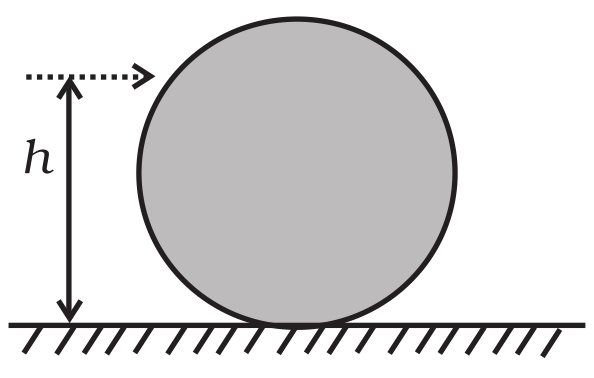
a. $\text{h}=\frac{\text{R}}{2}$ i. Sphere rolls without slipping with a constant velocity and no loss of energy. b. $\text{h}=\text{R}$ ii. Sphere spins clockwise, loses energy by friction. c. $\text{h}=\frac{3\text{R}}{2}$ iii. Sphere spins anti-clockwise, loses energy by friction. d. $\text{h}=\frac{7\text{R}}{5}$ iv. Sphere has only a translational motion, looses energy by friction. - 2The distance between the centres of carbon and oxygen atoms in carbon monoxide gas molecules is $=1.13\mathring{\text{A}}.$ Locate the centre of mass of the molecules relative to carbon atom.View Solution
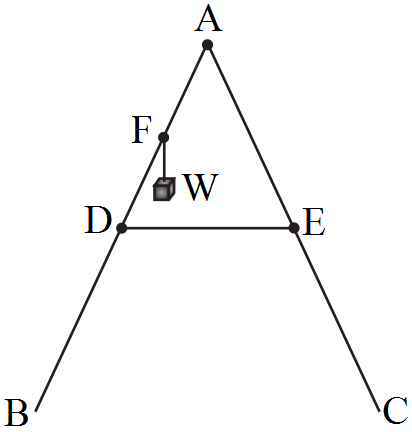
- 3As shown in the two sides of a step ladder BA and CA are $1.6m$ long and hinged at A. A rope DE, $0.5m$ is tied half way up. A weight $40kg$ is suspended from a point F, 1.2m from B along the ladder BA. Assuming the floor to be frictionless and neglecting the weight of the ladder, find the tension in the rope and forces exerted by the floor on the ladder. (Take $g = 9.8m/s^2$) (Hint: Consider the equilibrium of each side of the ladder separately).View Solution
- 4View SolutionA uniform disc of radius R and mass M is mounted on an axis supported in fixed frictionless bearing. A light chord is wrapped around the rim of the wheel and suppose that we hang a body of mass m from the chord. Find the angular acceleration of the disc and tangential acceleration of point on the rim.
- 5View SolutionExplain why friction is necessary to make the disc in roll in the direction indicated.
- Give the direction of frictional force at B, and the sense of frictional torque, before perfect rolling begins.
- What is the force of friction after perfect rolling begins?
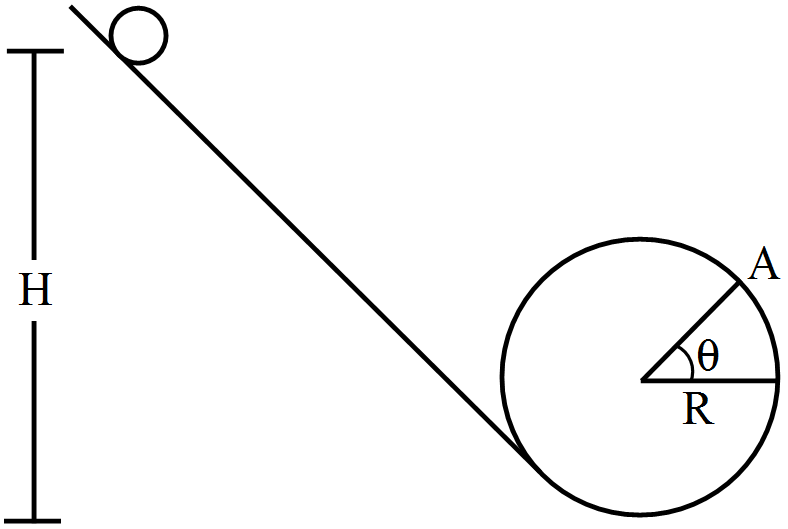
- 6Figure shows a small spherical ball of mass m rolling down the loop track. The ball is released on the linear portion at a vertical height H from the lowest point. The circular part shown has a radius R.View Solution
- Find the kinetic energy of the ball when it is at a point A where the radius makes an angle $\theta$ with the horizontal.
- Find the radial and the tangential accelerations of the centre when the ball is at A.
- Find the normal force and the frictional force acting on the ball if H = 60cm, R = 10cm, $\theta=0 $ and m = 70g.
- 7View SolutionObtain an expression for linear acceleration of a cylinder rolling down an inclined plane and hence find the condition for the cylinder to roll down the inclined plane without slipping.
- 8View SolutionFig. shows two blocks of masses 5kg and 2kg placed on a frictionless surface and connected by a spring. An external kick gives a velocity 14 m/ s to the heavier block in the direction of lighter one. Deduce (i) the velocity gained by the centre of mass and (ii) the separate velocities of the two blocks in the centre of mass coordinates just after the kick.
- 9View SolutionThe door of an almirah is 6ft high, 1.5ft wide and weighs 8kg. The door is supported by two hinges situated at a distance of 1ft from the ends. If the magnitudes of the forces exerted by the hinges on the door are equal, find this magnitude.
- 10From a uniform disk of radius R, a circular hole of radius $\frac{\text{R}}{2}$ is cut out. The centre of the hole is at $\frac{\text{R}}{2}$ from the centre of the original disc. Locate the centre of gravity of the resulting flat body.View Solution