The area of the glass of a window of a room is $10\;{m^2}$ and thickness $2mm$. The outer and inner temperature are ${40^o}C$ and ${20^o}C$ respectively. Thermal conductivity of glass in $MKS$ system is $0.2$. The heat flowing in the room per second will be
Easy


Download our appand get started for free
Experience the future of education. Simply download our apps or reach out to us for more information. Let's shape the future of learning together!No signup needed.*
Similar Questions
- 1The only possibility of heat flow in a thermos flask is through its cork which is $75 cm^2$ in area and $5 cm$ thick. Its thermal conductivity is $0.0075 cal/cmsec^oC$. The outside temperature is$ 40^oC$ and latent heat of ice is $80 cal g^{-1}$. Time taken by $500 g$ of ice at $0^oC$ in the flask to melt into water at $0^oC$ is ....... $hr$View Solution
- 2There is formation of layer of snow $x\,cm$ thick on water, when the temperature of air is $ - {\theta ^o}C$ (less than freezing point). The thickness of layer increases from $x$ to $y$ in the time $t$, then the value of $t$is given byView Solution
- 3View SolutionMode of transmission of heat, in which heat is carried by the moving particles, is
- 4A composite rod made of three rods of equal length and cross-section as shown in the fig. The thermal conductivities of the materials of the rods are $K/2, 5K$ and $K$ respectively. The end $A$ and end $B$ are at constant temperatures. All heat entering the face Agoes out of the end $B$ there being no loss of heat from the sides of the bar. The effective thermal conductivity of the bar isView Solution

- 5Temperature of water at the surface of lake is $ - {20^o}C$ Then temperature of water just below the lower surface of ice layer is ...... $^oC$View Solution
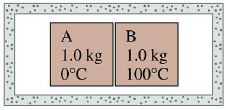
- 6Objects $A$ and $B$ that are initially separated from each other and well isolated from their surroundings are then brought into thermal contact. Initially $T_A= 0^oC$ and $T_B = 100^oC$. The specific heat of $A$ is less than the specific heat of $B$. After some time, the system comes to an equilibrium state. The final temperatures are :View Solution
- 7View SolutionIn Searle's method for finding conductivity of metals, the temperature gradient along the bar
- 8A black body is at a temperature of $2880\;K$. The energy of radiation emitted by this object with wavelength between $499\;nm$ and $500\;nm$ is ${U_1}$, between $999\;nm$ and $1000\;nm$ is ${U_2}$ and between $1499\;nm$ and $1500\;nm$ is ${U_3}$. The Wein's constant $b = 2.88 \times {10^6}\;nm\,K$. ThenView Solution
- 9A body takes $5$ minutes to cool from $90^oC$ to $60^oC$. If the temperature of the surroundings is $20^oC$, the time taken by it to cool from $60^oC$ to $30^oC$ will be ...... $\min.$View Solution
- 10A cylinder of radius $R$ is surrounded by a cylindrical shell of inner radius $R$ and outer radius $2R$. The thermal conductivity of the material of the inner cylinder is $K_1$ and that of the outer cylinder is $K_2$. Assuming no loss of heat, the effective thermal conductivity of the system for heat flowing along the length of the cylinder isView Solution