Question
Two gases have the same initial pressure, volume and temperatue. They expand to the same final volume, one adiabatically and the other isothermally, if the two gases are compressed to the same final volume
For isothermal process: $T_2=T_0$
For adibatic process: $T_0\left(V_0\right)^{\gamma-1}=T(V)^{\gamma-1}$
As $V > V _0 \Rightarrow T < T _0$
Thus final temp. is greater for isothermal process.
For isothermal process: $P_0 V_0=P_i V \Rightarrow P_1=P_0 \frac{V_0}{V}$
For adibatic process: $P_0\left( V _0\right)^\gamma= P _2( V )^y$
$\Rightarrow P _2= P _0\left(\frac{ V _0}{ V }\right)^\gamma$
As $\gamma > 1$ (always) $\Rightarrow P_1 > P_2$
Generate a complete, print-ready paper with questions like this in minutes — across 16+ boards, with answer keys.
$B=\frac{4}{\pi} \times 10^{-3}\, {T}\left(1-\frac{{t}}{100}\right)$
The energy dissipated by the coil before the magnetic field is switched off completely is $E=.....\,{m} J.$
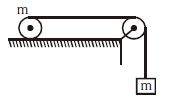
$(i)$ acceleration of the centre of mass of ring is $\frac{g}{3}$
$(ii)$ acceleration of the hanging particle is $\frac{2g}{3}$
$(iii)$ frictional force (on the ring) acts along forward direction
$(iv)$ frictional force (on the ring) acts along backward direction