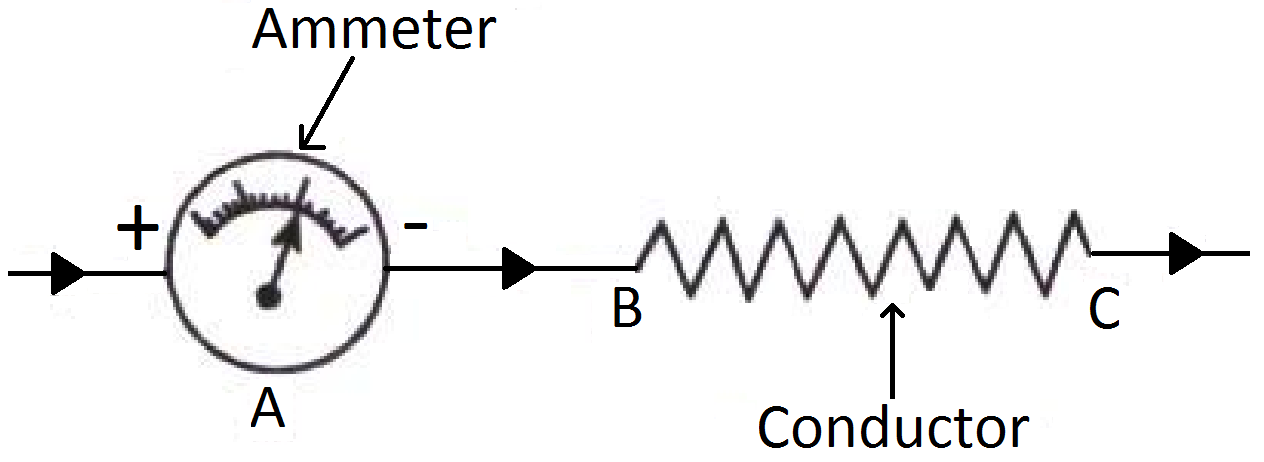
What is an ammeter? How is it connected in a circuit? Draw a diagram to illustrate your answer.
Download our app for free and get started
Ammeter is a device used for the measurement of electric current. It is always connected in series with the circuit in which the current is to be measured.

Download our appand get started for free
Experience the future of education. Simply download our apps or reach out to us for more information. Let's shape the future of learning together!No signup needed.*
Similar Questions
- 1A flash of lightning carries $10\ C$ of charge which flows for $0.01\ s$. What is the current? If the voltage is $10MV$, what is the energy?View Solution
- 2Two resistances when connected in parallel give resultant value of $2$ ohm; when connected in series the value becomes $9$ ohm. Calculate the value of each resistance.View Solution
- 3You are given one hundred $1 \Omega $ resister. What is the smallest and largest resistance you can make in a circuit using these?View Solution
- 4The electrical resistivities of three materials P, Q and R are given below:$\begin{matrix}\text{P}&2.3\times10^{3}\Omega\text{ m}\\\text{Q}&2.63\times10^{-8}\Omega\text{ m}\\\text{R}&1.0\times10^{15}\Omega\text{ m}\end{matrix}$View Solution
Which material will you use for making:- Electric wires.
- Handle for soldering iron, and
- Solar cells?
- 5In which of the following cases more electrical energy is consumed per hour?View Solution
- A current of $1$ ampere passed through a resistance of $300$ ohms.
- A current of $2$ amperes passed through a resistance of $100$ ohms.
- 6View SolutionCalculate the cost of operating a heater of 500W for 20hours at the rate of? ₹3.90 per unit.
- 7View SolutionAn electric heater is connected to the 230V mains supply. A current of 8A flows through the heater.
- How much charge flows around the circuit each second?
- How much energy is transferred to the heater each second?
- 8The electrical resistivities of four materials P, Q, R and S are given below:View Solution
$\begin{matrix}\text{P}&6.84\times10^{-8}\Omega\text{m}\\\text{Q}&1.70\times10^{-8}\Omega\text{m}\\\text{R}&1.0\times10^{15}\Omega\text{m}\\\text{S}&11.0\times10^{-7}\Omega\text{m}\end{matrix}$
Which material will you use for making:- Heating element of electric iron.
- Connecting wires of electric iron.
- Covering of connecting wires?
- 9View SolutionTwo exactly similar electric lamps are arranged (i) in parallel, and (ii) in series. If the parallel and series combination of lamps are connected to 220V supply line one by one, what will be the ratio of electric power consumed by them?
- 10View SolutionConsider the circuit given below where A, B and C are three identical light bulbs of constant resistance.
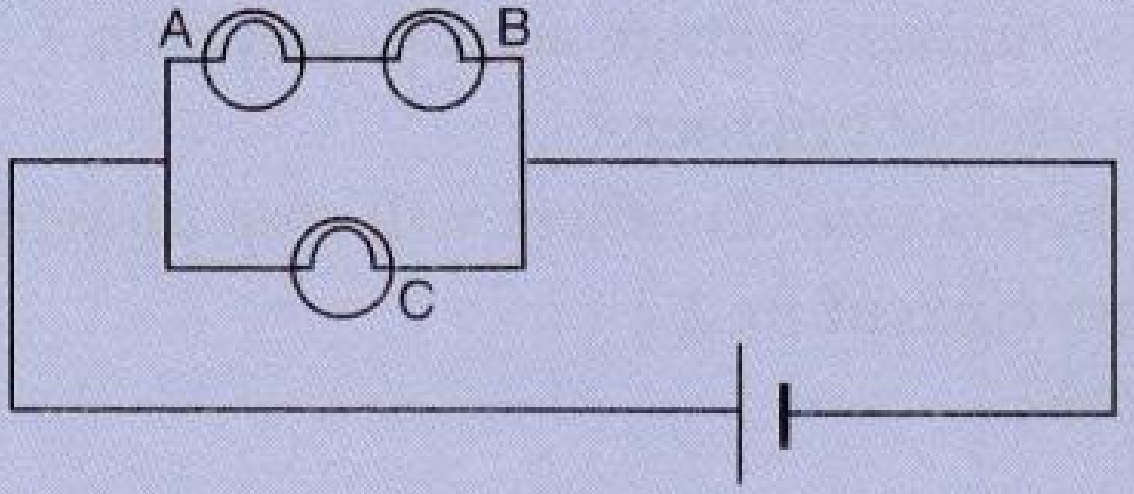
- List the bulbs in order of increasing brightness.
- If C burns out, what will be the brightness of A now compared with before?
- If B burns out instead, what will be the brightness of A and C compared with before?