You are given one hundred $1 \Omega $ resister. What is the smallest and largest resistance you can make in a circuit using these?
Download our app for free and get started
Given: $n = 100$, $R = 1\ ohm$
For obtaining the smallest resistance, these resistance are connected in parallel:
Equivalent resistance $=\frac{1}{1}+\frac{1}{1}+\frac{1}{1}....100\ \text{times}=\frac{100}{1}$
$R_{eq}$ $=\frac{1}{100}=0.01\ \text{ohm}$
For obtaining the largest resistance, these are connected in series:
Equivalent reisistance $= 1 + 1 + 1 .........100$ Times $= 100$
$R_{eq} = 100 ohm$
For obtaining the smallest resistance, these resistance are connected in parallel:
Equivalent resistance $=\frac{1}{1}+\frac{1}{1}+\frac{1}{1}....100\ \text{times}=\frac{100}{1}$
$R_{eq}$ $=\frac{1}{100}=0.01\ \text{ohm}$
For obtaining the largest resistance, these are connected in series:
Equivalent reisistance $= 1 + 1 + 1 .........100$ Times $= 100$
$R_{eq} = 100 ohm$

Download our appand get started for free
Experience the future of education. Simply download our apps or reach out to us for more information. Let's shape the future of learning together!No signup needed.*
Similar Questions
- 1View SolutionDerive the expression for the heat produced due to a current ‘I’ flowing for a time interval ‘t’ through a resistor ‘R’ having a potential difference ‘V’ across its ends. With which name is this relation known?
- 2Calculate the area of cross-section of a wire if its length is 1.0m, its resistance is $23 Ω$ and the resistivity of the material of the wire is $1.84\times10 Ω\ \text{m}.$View Solution
- 3What will be the resistance of a metal wire of length $2$ metres and area of cross-section $1.55 \times 10m $, if the resistivity of the metal be $2.8 \times 10 m?$View Solution
- 4A flash of lightning carries $10\ C$ of charge which flows for $0.01\ s$. What is the current? If the voltage is $10MV$, what is the energy?View Solution
- 5View SolutionShow how you would connect two 4 ohm resistors to produce a combined resistance of:
- 2 ohms.
- 8 ohms.
- 6View SolutionHow does the resistance of a conductor depend on:
- Length of the conductor?
- Area of cross-section of the conductor?
- Temperature of the conductor?
- 7View SolutionConsider the circuit given below where A, B and C are three identical light bulbs of constant resistance.
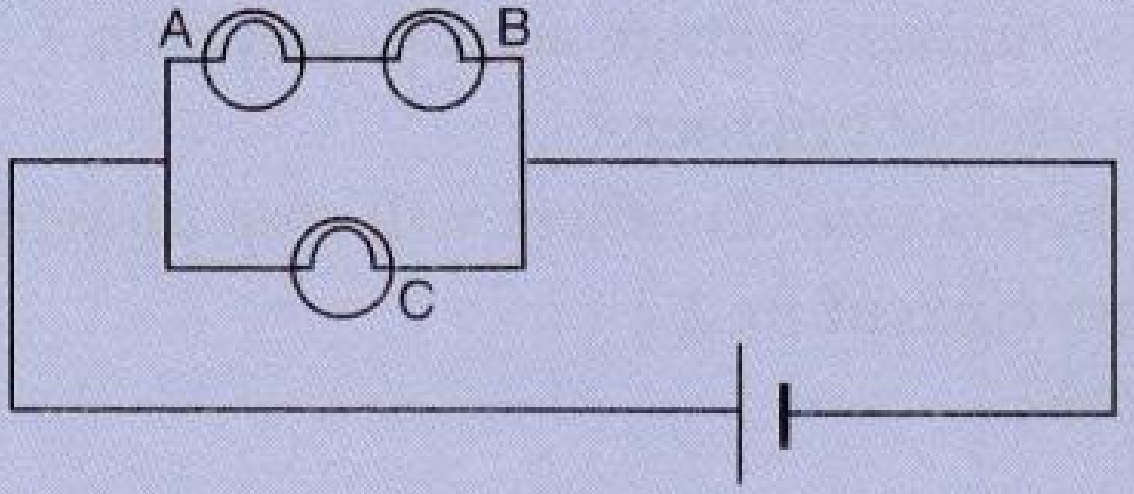
- List the bulbs in order of increasing brightness.
- If C burns out, what will be the brightness of A now compared with before?
- If B burns out instead, what will be the brightness of A and C compared with before?
- 8The electrical resistivities of three materials P, Q and R are given below:$\begin{matrix}\text{P}&2.3\times10^{3}\Omega\text{ m}\\\text{Q}&2.63\times10^{-8}\Omega\text{ m}\\\text{R}&1.0\times10^{15}\Omega\text{ m}\end{matrix}$View Solution
Which material will you use for making:- Electric wires.
- Handle for soldering iron, and
- Solar cells?
- 9View SolutionWhat is an ammeter? How is it connected in a circuit? Draw a diagram to illustrate your answer.
- 10A $4 Ω$ coil and a $2 Ω$ coil are connected in parallel. What is their combined resistance? A total current of 3A passes through the coils. What current passes through the $2 Ω$ coil?View Solution