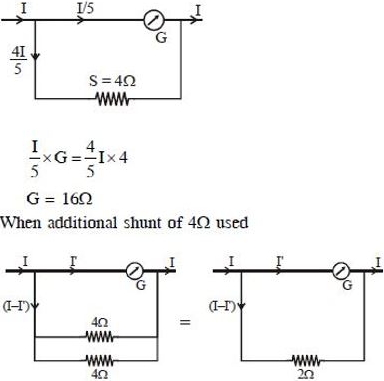
When a shunt of $4\,\Omega $ is attached to a galvanometer the deflection reduces to $\frac{1}{5} th$. If an additional shunt of $4\,\Omega $ is attached. What will be the deflection.
Diffcult


Download our appand get started for free
Experience the future of education. Simply download our apps or reach out to us for more information. Let's shape the future of learning together!No signup needed.*
Similar Questions
- 1A current of $10\, ampere$ is flowing in a wire of length $1.5\, m$. A force of $15\, N$ acts on it when it is placed in a uniform magnetic field of $2$ $tesla$. The angle between the magnetic field and the direction of the current is.....$^o$View Solution
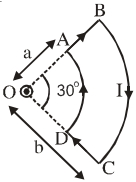
- 2A current loop $ABCD$ is held fixed on the plane of the paper as shown in the figure. The arcs $ BC$ (radius $= b$) and $DA $ (radius $= a$) of the loop are joined by two straight wires $AB $ and $CD$. A steady current $I$ is flowing in the loop. Angle made by $AB$ and $CD$ at the origin $O$ is $30^o $. Another straight thin wire with steady current $I_1$ flowing out of the plane of the paper is kept at the origin.View Solution
Due to the presence of the current $I_1$ at the origin
- 3the magnetic induction at $O$ due to the whole length of the conductor isView Solution
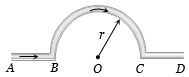
- 4A charged particle of mass $m$ and charge $q$ travels on a circular path of radius $r$ that is perpendicular to a magnetic field $B$. The time taken by the particle to complete one revolution isView Solution
- 5To convert a $800\, mV$ range milli voltmeter of resistance $40 \,\Omega$ into a galvanometer of $100\, mA$ range, the resistance to be connected as shunt is .............. $\Omega $View Solution
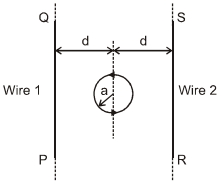
- 6The figure shows a circular loop of radius a with two long parallel wires (numbered $1$ and $2$) all in the plane of the paper. The distance of each wire from the centre of the loop is $d$. The loop and the wires are carrying the same current $I$. The current in the loop is in the counterclockwise direction if seen from above.$Image$View Solution
$1.$ When $d \approx$ a but wires are not touching the loop, it is found that the net magnetic filed on the axis of the loop is zero at a height $h$ above the loop. In that case
$(A)$ current in wire $1$ and wire $2$ is the direction $P Q$ and $R S$, respectively and $h \approx a$
$(B)$ current in wire $1$ and wire $2$ is the direction $PQ$ and $SR$, respectively and $h \approx a$
$(C)$ current in wire $1$ and wire $2$ is the direction $PQ$ and $SR$, respectively and $h \approx 1.2 a$
$(D)$ current in wire $1$ and wire $2$ is the direction $PQ$ and $RS$, resepectively and $h \approx 1.2 a$
$2.$ Consider $d \gg a$, and the loop is rotated about its diameter parallel to the wires by $30^{\circ}$ from the position shown in the figure. If the currents in the wires are in the opposite directions, the torque on the loop at its new position will be (assume that the net field due to the wires is constant over the loop)
$(A)$ $\frac{\mu_0 I^2 a^2}{d}$ $(B)$ $\frac{\mu_0 I^2 a^2}{2 d}$ $(C)$ $\frac{\sqrt{3} \mu_0 I^2 a^2}{d}$ $(D)$ $\frac{\sqrt{3} \mu_0 I^2 a^2}{2 d}$
Give the answer question $1$ and $2.$
- 7The magnetic field at the centre of a circular coil of radius $I$, due to current I flowing through it, is $B$. The magnetic field at a point along the axis at a distance $\frac{r}{2}$ from the centre isView Solution
- 8The magnetic field at the origin due to a current element $i\,\overrightarrow {dl} $ placed at position $\vec r$ isView Solution
$(i)\,\,\left( {\frac{{{\mu _0}i}}{{4\pi }}} \right)\left( {\frac{{d\vec l\, \times \,\vec r}}{{{r^3}}}} \right)$
$(ii)\,\, - \left( {\frac{{{\mu _0}i}}{{4\pi }}} \right)\left( {\frac{{d\vec l\, \times \,\vec r}}{{{r^3}}}} \right)$
$(iii)\,\left( {\frac{{{\mu _0}i}}{{4\pi }}} \right)\left( {\frac{{\,\vec r \times d\vec l}}{{{r^3}}}} \right)$
$(iv)\, - \left( {\frac{{{\mu _0}i}}{{4\pi }}} \right)\left( {\frac{{\,\vec r \times d\vec l}}{{{r^3}}}} \right)$
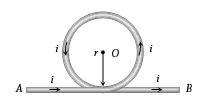
- 9A part of a long wire carrying a current $i$ is bent into a circle of radius $r$ as shown in figure. The net magnetic field at the centre $O$ of the circular loop isView Solution
- 10A coil carrying a heavy current and having large number of turns mounted in a $N-S$ vertical plane and $a$ current flows in clockwise direction. A small magnetic needle at its cente will have its north pole inView Solution