MCQ 11 Mark
A capillary tube of radius $R$ is immersed in water and water rises in it to a height $H.$ Mass of water in capillary tube is $M$. If the radius of the tube is doubled, mass of water that will rise in capillary will be:
- ✓
$2M.$
- B
$M.$
- C
$\frac{\text{M}}{2}$
- D
$4M.$
AnswerSince, $\text{h}=2\text{T}\cos\frac{\theta}{\text{r}\rho\text{g}}$
i.e.,$\text{ h}\propto\frac{1}{\text{r}};$
Therefore if $r$ becomes $2r, h$ becomes $\frac{\text{h}}{2}.$
Mass of the water in tube $=$ Volume $\times$ Density
$=\pi(2\text{r}0^2\frac{\text{h}}{2}\rho=2\pi\text{r}^2\text{h}\rho=2\text{M}$
View full question & answer→MCQ 21 Mark
For a ball falling in a liquid with constant velocity, ratio of resistance force due to the liquid to that due to gravity is:
AnswerWhen a body while falling in a viscous liquid moves with a constant velocity $($i.e., attains terminal velocity$),$ the resultant force on the body is zero.
So the viscous force acting upwards is equal to the gravity pull acting downwards.
View full question & answer→MCQ 31 Mark
When a large bubble rises from the bottom of a lake to the surface, its radius doubles. One atmosphere is equal to that of a column of water of height $H.$ The depth of the lake is:
AnswerSince the radius of the bubble becomes double on reaching surface, its volume $\Big[\frac43\pi(2\text{r})^3\Big]$ becomes $8$ times.
It means the pressure at the bottom of the lake is $8$ times the pressure at the surface.
Therefore the pressure due to depth of lake.
$= 8H - H = 7H$
View full question & answer→MCQ 41 Mark
The value of surface tension of water is minimum at:
- A
$4^\circ C.$
- B
$25^\circ C.$
- C
$50^\circ C.$
- ✓
$75^\circ C.$
AnswerCorrect option: D. $75^\circ C.$
Value of surface tension decreases with increase in temperature.
So, it is minimum at $75^\circ C.$
View full question & answer→MCQ 51 Mark
What is the shape when a non$-$wetting liquid in displaced in a capillary tube?
View full question & answer→MCQ 61 Mark
Streamline flow is more likely for liquids with:
AnswerExplanation:
Streamline flow is more likely for liquids having low density. We know that greater the coefficient of viscosity of a liquid more will be the velocity gradient, hence each line of flow can be easily differentiated. Streamline flow is related with critical velocity. The critical velocity is that velocity of liquid flow up to which its flow is streamlined and above which its flow becomes turbulent.
As the critical velocity is related to viscosity $(\eta)$ and density $(\rho)$ of the liquid as,
$(\text{V}_\text{c})\ \alpha\ \frac{\eta}{\rho}$
Hence if the density will be low and viscosity will be high, the value of critical velocity will be more.
View full question & answer→MCQ 71 Mark
The force required to separate two glass plates of $10^{-2}m^2$ with a film of water $0.05\ mm$ thick between them, is $($surface tension of water is $70 \times 10^{-3} \mathrm{Nm}^{-1}):$
View full question & answer→MCQ 81 Mark
Radius of a soap bubble is increased from $R$ to $2R.$ Work done in this process in terms of surface tension is:
- ✓
$24\pi\text{R}^2\text{S}$
- B
$48\pi\text{R}^2\text{S}$
- C
$12\pi\text{R}^2\text{S}$
- D
$36\pi\text{R}^2\text{S}$
AnswerCorrect option: A. $24\pi\text{R}^2\text{S}$
$\text{W}=8\pi\text{T}(\text{R}^2_2-\text{R}^2_1)$
$=8\pi\text{S}[(2\text{R})^2-(\text{R}^2)]$
$=24\pi\text{R}^2\text{S}$
View full question & answer→MCQ 91 Mark
Two water pipes of diameters $2\ cm$ and $4\ cm$ are connected with the main supply line. The velocity of flow of water in the pipe of $2\ cm$ diameter is:
- ✓
$4$ times that in the other pipe.
- B
$\frac14$ times that in the other pipe.
- C
$2$ times that in the other pipe.
- D
$\frac12$ times that in the other pipe.
AnswerCorrect option: A. $4$ times that in the other pipe.
From equation of continuity, $av =$ constant
$d_A = 2\ cm$ and $d_B = 4\ cm$
$\therefore\text{r}_\text{A}=1\text{cm}$ and $\text{r}_\text{B}=2\text{cm}$
$\therefore\frac{\text{v}_\text{A}}{\text{v}_\text{B}}=\frac{\text{a}_\text{B}}{\text{a}_\text{A}}=\frac{\pi(\text{r}_\text{B})^2}{\pi\text{(r}_\text{A})^2}$
$=\Big(\frac21\Big)^2$
$\Rightarrow\text{v}-\text{A}=4\text{v}_\text{B}$
View full question & answer→MCQ 101 Mark
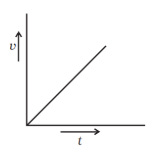
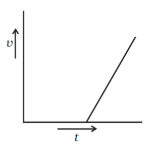
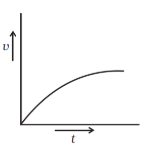
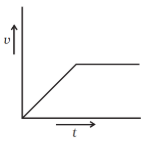
A tall cylinder is filled with viscous oil. A round pebble is dropped from the top with zero initial velocity. From the plot shown in indicate the one that represents the velocity (v) of the pebble as a function of time (t):
AnswerIn fluids, when the pebble is dropped from the top of a tall cylinder filled with viscous oil, a variable force called viscous force will act which increases with increase in speed. And at equilibrium this velocity becomes constant, that constant velocity is called terminal velocity.
When the pebble is falling through the viscous oil, the viscous force is $\text{F}= 6\pi\eta\text{rv}$ where r is the radius of the pebble, v is instantaneous speed, $\eta$ is coefficient of viscosity. As the force is variable, hence acceleration is also variable so v-t graph will not be a straight line. First velocity increases and then becomes constant known as terminal velocity.
View full question & answer→MCQ 111 Mark
Reynold's number $(R_e)$ can be defined as:
- A
$\frac{\rho\eta}{\text{vd}}$
- B
$\frac{\text{vd}}{\rho}$
- C
$\frac{\rho\text{vd}}{\eta\text{d}}$
- ✓
$\text{d}\rho\frac{\text{v}}{\eta}$
AnswerCorrect option: D. $\text{d}\rho\frac{\text{v}}{\eta}$
View full question & answer→MCQ 121 Mark
Three liquids of densities $d, 2d$ and $3d$ are mixed in equal proportion of weights. If density of water is $d,$ then the specific gravity of the mixture is:
- A
$\frac{11}7$
- ✓
$\frac{18}{11}$
- C
$\frac{13}{9}$
- D
$\frac{23}{18}$
AnswerCorrect option: B. $\frac{18}{11}$
$\text{w}_1=\text{w}_2=\text{w}_3$
$\Rightarrow\text{m}=\text{m}_2=\text{m}_3=\text{m}(\text{say})$
Then $\text{V}_1=\frac{\text{m}}{\text{d}},\text{V}_2=\frac{\text{m}}{2\text{d}},$ $\text{V}_3=\frac{\text{m}}{\text{3d}}$
$\therefore\text{d}_\text{mix}=\frac{\text{Mass}}{\text{Volume}}$
$=\frac{\text{3m}}{\text{V}_1+\text{V}_2+\text{V}_3}=\frac{18}{11}\text{d}$
So, specific gravity of mixture $=\frac{\text{d}_\text{mix}}{\text{d}_\text{water}}=\frac{18}{11}$
View full question & answer→MCQ 131 Mark
Pressure is a scalar quantity because:
- A
it is the ratio of force to area and both force and area are vectors.
- B
It is the ratio of the magnitude of the force to area.
- ✓
It is the ratio of the component of the force normal to the area.
- D
It does not depend on the size of the area chosen.
AnswerCorrect option: C. It is the ratio of the component of the force normal to the area.
What makes pressure a scalar quantity is the fact that it is the component of force along the direction of area that is taken into account while defining pressure. Thus the direction of quantities involved remain fixed and pressure becomes a scalar quantity.
View full question & answer→MCQ 141 Mark
Why are drops and bubbles spherical?
- ✓
Surface with minimum energy.
- B
Surface with maximum energy.
- C
- D
AnswerCorrect option: A. Surface with minimum energy.
View full question & answer→MCQ 151 Mark
If two liquids of same volume but different densities $\rho_1$ and $\rho_2$ are mixed, then density of mixture is given by:
- ✓
$\rho=\frac{\rho_1+\rho_2}{2}$
- B
$\rho=\frac{\rho_1+\rho_2}{2\rho_1+\rho_2}$
- C
$\rho=\frac{2\rho_1\rho_2}{\rho_1+\rho_2}$
- D
$\rho=\frac{\rho_1\rho_2}{\rho_1+\rho_2}$
AnswerCorrect option: A. $\rho=\frac{\rho_1+\rho_2}{2}$
View full question & answer→MCQ 161 Mark
An ideal fluid flows through a pipe of circular cross$-$section made of two sections with diameters $2.5\ cm$ and $3.75\ cm.$ The ratio of the velocities in the two pipes is:
- ✓
$9:4$
- B
$3:2$
- C
$\sqrt{3}:\sqrt{2}$
- D
$\sqrt{2}:\sqrt{3}$
AnswerAccording to continuity equation $($Law of Conservation of mass$)$
$\text{a}_1\text{v}_1=\text{a}_2\text{v}_2$
$\frac{\text{v}_1}{\text{v}_2}=\frac{\text{a}_2}{\text{a}_1}=\frac{\pi\big(\frac{\text{d}_2}{2}\big)^2}{\pi\big(\frac{\text{d}_1}{2}\big)^2}=\frac{\text{d}^2_2}{4}\cdot\frac{4}{\text{d}^2_1}=\frac{\text{d}^2_2}{\text{d}^2_1}$
$\frac{\text{v}_1}{\text{v}_2}=\frac{(3.75)^2}{(2.50)^2}=\Big[\frac{3}{2}\Big]^2$
$\frac{\text{v}_1}{\text{v}_2}=\frac{9}{4}$
or ${\text{v}_1}:{\text{v}_2}:9:4$
View full question & answer→MCQ 171 Mark
A spherical liquid drop of radius $R$ is divided into eight equal droplets. If surface tension is $T$, then work done in the process will be:
- A
$2\pi\text{R}^2\text{T}$
- B
$3\pi\text{R}^2\text{T}$
- ✓
$4\pi\text{R}^2\text{T}$
- D
$2\pi\text{R}\text{T}^2$
AnswerCorrect option: C. $4\pi\text{R}^2\text{T}$
Volume of $8$ small droplets each of radius $r =$ Volume of big drop of radius $R$ i.e.
$8\times\frac43\pi\text{r}^3=\frac43\pi\text{R}^3$
$\text{r}=\frac{\text{R}}{2}$
Work done $=$ Surface tension $\times$ Increase in surface area
$=\text{T}\times[8\times4\pi\text{r}^3-4\pi\text{R}^3]$
$=\text{T}\Big[32\pi\Big(\frac{\text{R}}{2}\Big)^2-4\pi\text{R}^2\Big]$
$=4\pi\text{R}^2\text{T}$
View full question & answer→MCQ 181 Mark
The density of water at $4^\circ C$ is:
- ✓
$1.0 \times 10^3 \mathrm{~kg} \mathrm{~m}^{-3}$
- B
$4 \times 10^2 \mathrm{~kg} \mathrm{~m}^{-3}$
- C
$6 \times 10^3 \mathrm{~kg} \mathrm{~m}^{-3}$Z
- D
$3.2 \times 10^3 \mathrm{~kg} \mathrm{~m}^{-3}$
AnswerCorrect option: A. $1.0 \times 10^3 \mathrm{~kg} \mathrm{~m}^{-3}$
The density of water at $4^\circ C (277K)$ is $1.0 \times 10^3 \mathrm{~kg} \mathrm{~m}^{-3}$.
View full question & answer→MCQ 191 Mark
The angle of contact at the interface of water$-$glass is $0^\circ ,$ Ethylalcohol$-$glass is $0^\circ ,$ Mercury$-$glass is $140^\circ$ and Methyliodideglass is $30^\circ .$ A glass capillary is put in a trough containing one of these four liquids. It is observed that the meniscus is convex. The liquid in the trough is:
AnswerMeniscus of liquid is convex so angle of contact will be obtuse angle which happens in case of mercury$-$glass.
View full question & answer→MCQ 201 Mark
The mass of water rises in capillary tube of radius $R$ is $M.$ The mass of water that rises in tube of radius $2R$ is:
- A
$M$
- ✓
$\frac{\text{M}}{2}$
- C
$2M$
- D
$4M$
AnswerCorrect option: B. $\frac{\text{M}}{2}$
$\text{h}=\frac{2\text{S}\cos\theta}{\text{r}\rho\text{g}}$
i.e.,$\text{ h}\propto\frac{1}{\text{r}}$
$\therefore\frac{\text{h}_1}{\text{h}}=\frac{\text{R}}{\text{2R}}=\frac12$ or $\text{h}_1=\frac{\text{h}}{2}$
$\text{M}=\text{Ah}\rho$
and $\text{M}_1=\text{Ah}_1\rho=\text{A}\Big(\frac{\text{h}}{2}\Big)\rho=\frac{\text{M}}{2}$
View full question & answer→MCQ 211 Mark
As the temperature of water increases, its viscosity:
- A
- ✓
- C
- D
Increases or decreases depending on the external pressure.
View full question & answer→MCQ 221 Mark
Application of Bernaull's Theorem can be seen in:
- ✓
Dynamic lift of aeroplane.
- B
- C
- D
AnswerCorrect option: A. Dynamic lift of aeroplane.
View full question & answer→MCQ 231 Mark
What change in surface energy will be noticed when a drop of radius $R$ splits up into $1000$ droplets of radius $r,$ surface tension is $T.$
AnswerCorrect option: D. $36\pi\text{R}^2\text{T}$
As, $\frac43\pi\text{R}^3=1000\times\frac43\pi\text{r}^3$ or $\text{r}=\frac{\text{R}}{10}$
$\therefore$ Energy spet $= S.T. \times$ Increase in surface area.
View full question & answer→MCQ 241 Mark
- A
The speed of a particle always remains same.
- ✓
The velocity of a particle always remains same.
- C
The kinetic energies of all the particles arriving at a given point are the same.
- D
The potential energies of all the particles arriving at a given point are the same.
AnswerCorrect option: B. The velocity of a particle always remains same.
Both velocity and direction of flow remain same.
View full question & answer→MCQ 251 Mark
A gale blows over the house. The force due to gale on the roof is:
- A
In the downward direction.
- ✓
- C
- D
AnswerThere will be less pressure on the roof and more below the roof due to gale blowing.
Hence thrust acts upwards.
View full question & answer→MCQ 261 Mark
A hydraulic lift has $2$ limbs of areas $A$ and $2A$. Force $F$ is applied over limb of area $A$ to lift a heavy car. If distance moved by piston $P_1$ is $x$, then distance moved by piston $P_2$ is:
- A
$x$
- B
$2x$
- ✓
$\frac{\text{x}}2$
- D
$4x $
AnswerCorrect option: C. $\frac{\text{x}}2$
As, $\text{V}_1=\text{V}_2$
$\Rightarrow\text{A}_1\text{x}_1=\text{A}_2\text{x}_2$
$\Rightarrow\text{x}_2=\frac{\text{A}_1}{\text{A}_2}\text{x}_1$
$=\frac{\text{Ax}}{2\text{A}}=\frac{\text{x}}{2}$
View full question & answer→MCQ 271 Mark
A cylindrical vessel is filled with water up to height $H.$ A hole is bored in the wall at a depth $h$ from the free surface of water. For maximum angle $h$ is equal to:
- A
$\frac{\text{H}}{4}$
- ✓
$\frac{\text{H}}{2}$
- C
$\frac{\text{3H}}{4}$
- D
$\text{H}$
AnswerCorrect option: B. $\frac{\text{H}}{2}$
View full question & answer→MCQ 281 Mark
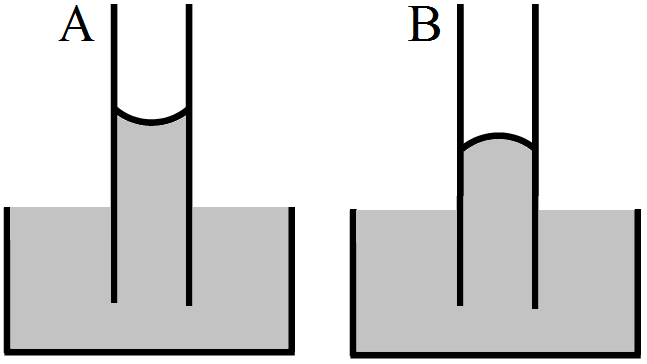
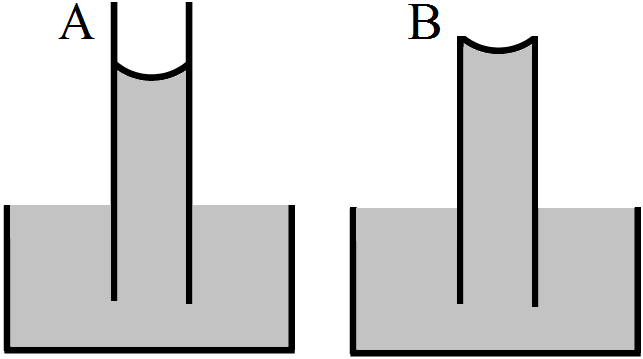
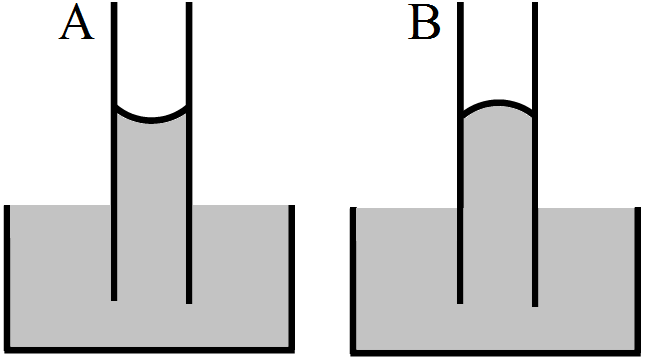
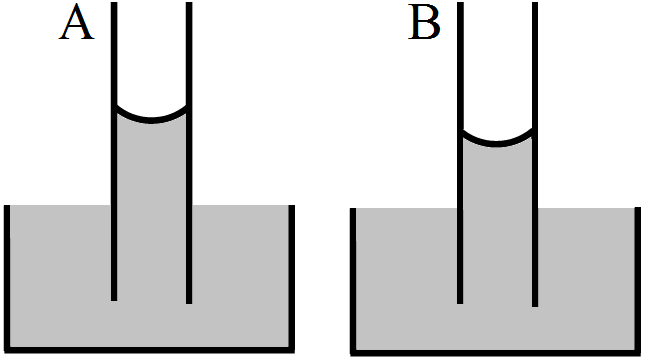
A capillary tube $A$ is dipped in water. Another identical tube $B$ is dipped in soap$-$water solution. Which of the following shows the relative nature of the liquid columns in the two tubes?
View full question & answer→MCQ 291 Mark
In a container having water filled upto a height $h,$ a hole is made in the bottom, the velocity of water following out of the hole is:
AnswerCorrect option: C. Proportional to $\text{h}^{\frac12}$
According to Torricelli's theorem,
$\text{u}\sqrt{2\text{gh}},$
i.e.$\text{ u}\propto\text{h}^{\frac12}.$
View full question & answer→MCQ 301 Mark
Pascal's law states that pressure in a fluid at rest is the same at all points, if:
- ✓
They are at the same height.
- B
They are along same plane.
- C
They are along same line.
- D
Both $(a)$ and $(b).$
AnswerCorrect option: A. They are at the same height.
View full question & answer→MCQ 311 Mark
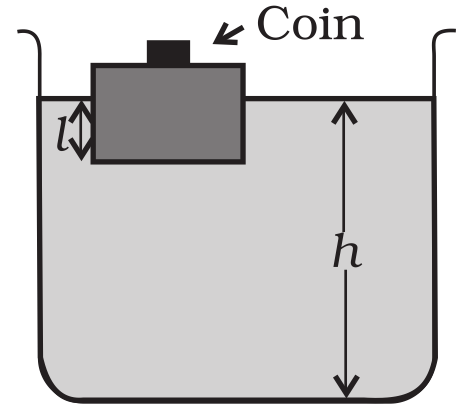
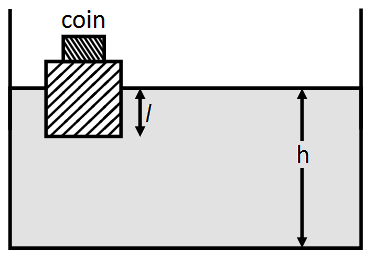
A wooden block with a coin placed on its top, floats in water as shown in the distance $l$ and $h$ are shown in the figure. After some time the coin falls into the water. Then:
- A
$l$ decreases.
- B
$h$ decreases.
- ✓
Both $A$ and $B$
- D
$h$ increase.
AnswerCorrect option: C. Both $A$ and $B$
According to law of floatation weight of floating body is equal to weight of displaced fluid. When coin falls into the water, net weight of floating body is decreased so the floating body will displace less amount of water so block rises up and I will decreases. But height h of water will decrease as less water is displaced now.
View full question & answer→MCQ 321 Mark
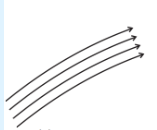
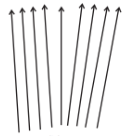
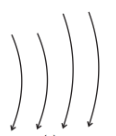
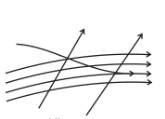
Which of the following diagrams does not represent a streamline flow?
AnswerIn streamlined flow the velocity of fluid at any given point remains constant (at a particular line) across any cross-sectional area. Hence is streamline flow layers do not cross each other. Hence option (d) is not streamline.
View full question & answer→MCQ 331 Mark
In figure, pressure inside a spherical drop is more than pressure outside. $(S =$ surface tension and $r =$ radius of bubble$):$
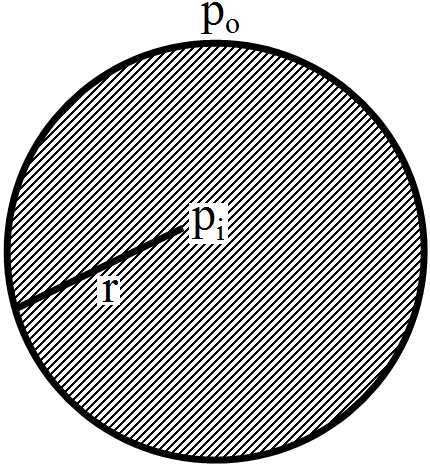
The extra surface energy if radius of bubble is increased by $\Delta\text{r}$ is: - A
$4\pi\text{rS}$
- ✓
$8\pi\text{r}\Delta\text{rS}$
- C
$2\pi\text{r}\Delta\text{rS}$
- D
$10\pi\text{r}\Delta\text{rS}$
AnswerCorrect option: B. $8\pi\text{r}\Delta\text{rS}$
Suppose a spherical drop of radius $r$ is in equilibrium.
If its radius increases by $\Delta\text{r}.$ The extra surface energy is,
$|4\pi\text{(r}+\Delta\text{r})^2-4\pi\text{r}^2|\text{ S}$
$=8\pi\text{r}\Delta\text{rS}$
View full question & answer→MCQ 341 Mark
Pressure is applied to an enclosed fluid. It is:
- A
Increased and applied to every part of the fluid.
- B
Diminished and transmitted to the walls of the container.
- C
Increased in proportion to the mass of the fluid and then transmitted.
- ✓
Transmitted unchanged to every portion of the fluid and the walls of container.
AnswerCorrect option: D. Transmitted unchanged to every portion of the fluid and the walls of container.
View full question & answer→MCQ 351 Mark
An air bubble of radius $r$ in water is at a depth $h$ below the water surface at some instant. If $P$ is atmospheric pressure and $d$ and $T$ are the density and surface tension of water respectively. The pressure inside the bubble will be:
- A
$\text{P}+\text{h}\rho\text{g}-\big(\frac{4\text{T}}{\text{r}}\big)$
- B
$\text{p}+\text{h}\rho\text{g}-\big(\frac{2\text{T}}{\text{r}}\big)$
- ✓
$\text{P}+\text{h}\rho\text{g}+\big(\frac{2\text{T}}{\text{r}}\big)$
- D
$\text{P}+\text{h}\rho\text{g}\big(\frac{4\text{T}}{\text{r}}\big)$
AnswerCorrect option: C. $\text{P}+\text{h}\rho\text{g}+\big(\frac{2\text{T}}{\text{r}}\big)$
Excess of pressure inside the air bubble in water $=\frac{\text{2T}}{\text{r}}$
Total pressure inside the air bubble,
$=$ Atmospheric pressure $+$ Pressure due to liquid column $+$ Excess pressure due to $S.T.$
$=\text{p}+\text{h}\rho\text{g}+\big(\frac{2\text{T}}{\text{r}}\big)$
View full question & answer→MCQ 361 Mark
Two small drops of mercury, each of radius $R,$ coalesce to form a single large drop. The ratio of the total surface energies before and after the change is:
- A
$1:2^{\frac13}$
- ✓
$2^\frac13:1$
- C
$2:1$
- D
$1:2$
AnswerCorrect option: B. $2^\frac13:1$
View full question & answer→MCQ 371 Mark
According to Bernoulli's equation, $\frac{\text{P}}{\rho\text{g}}+\text{h}+\frac{1\text{v}^2}{2\text{g}}=\text{constant}.$ The term, $\frac{\text{P}}{\rho\text{g}},\text{h}$ and $\frac{1\text{v}^2}{\text{2g}}$ are generally called respectively:
- A
Gravitational head, pressure head and velocity head.
- B
Gravity, gravitational head and velocity head.
- ✓
Pressure head, gravitational head and velocity head.
- D
Gravity, pressure and velocity head.
AnswerCorrect option: C. Pressure head, gravitational head and velocity head.
View full question & answer→MCQ 381 Mark
Two water pipes $P$ and $Q$ having diameters of $2 \times 10^{-2}m$ and $4 \times 10^{-2}$m respectively are joined in series with the main supply line of water. The velocity of water following in pipe $P$ is:
AnswerCorrect option: A. $4$ times that of $Q.$
Using theorem of continuity;
$\pi\text{D}^2_\text{p}\text{v}_\text{p}=\pi\text{D}^2_\text{Q}\text{v}_\text{Q}$
$\text{v}_\text{P}=\Big(\frac{\text{D}_\text{Q}}{\text{D}_\text{P}}\Big);$
$\text{v}_\text{P}=\Big(\frac{4\times10^{-2}}{2\times10^{^{-2}}}\Big)^2\times\text{v}_\text{Q}=4\text{v}_\text{Q}$
View full question & answer→MCQ 391 Mark
Two water droplets merge with each other to form a larger droplet. In this process:
- ✓
- B
- C
Energy is neither liberated nor absorbed.
- D
Some mass is converted into energy.
AnswerThe surface area of two drops is more than the surface area of one big drop formed by combination.
Hence the surface energy of big drop becomes less than that of two small drops.
Therefore the energy is released.
View full question & answer→MCQ 401 Mark
Water stands upto a height $h$ behind the vertical wall of a dam. What is the net horizontal force pushing the dam down by the stream, if width of the dam is $\sigma?(\rho =$ density of water $).$
- A
$\text{2h}\sigma\text{g}$
- ✓
$\frac{\text{h}^2\sigma\rho\text{g}}{2}$
- C
$\frac{\text{h}^2\sigma\rho\text{g}}{4}$
- D
$\frac{\text{h}\sigma\rho\text{g}}{4}$
AnswerCorrect option: B. $\frac{\text{h}^2\sigma\rho\text{g}}{2}$
Mean pressure on vertical wall due to water
$\text{P}=\Big(\frac{0+\text{h}\rho\text{g}}{2}\Big)=\frac{1}{2}\text{g}\rho\text{g}$
Horizontal force, $\text{F}=\text{P}\times(\text{h}\times\sigma)$
$=\Big(\frac12\text{h}\rho\text{g}\Big)\times\text{h}\sigma$
$=\frac12\text{h}^2\sigma\rho\text{g}$
View full question & answer→MCQ 411 Mark
A liquid film is formed over a frame $\text{ABCD}$ as shown in figure. Wire $\text{CD}$ can slide without friction. Maximum value of mass that can be hanged from $\text{CD}$ without breaking the liquid film is: 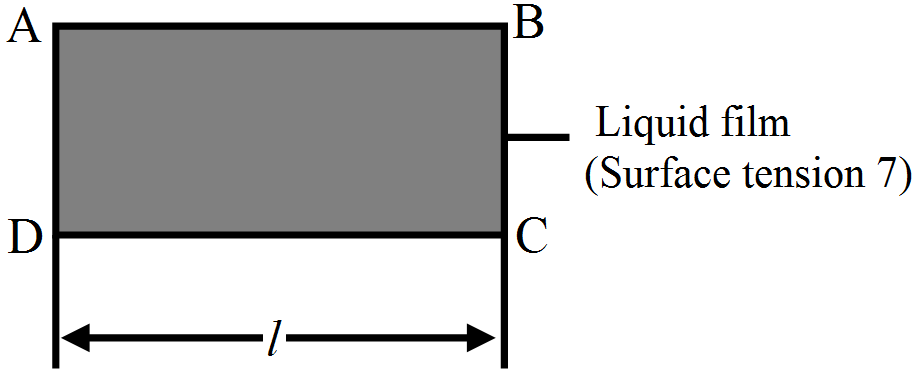
- A
$\frac{\text{Tl}}{\text{g}}$
- ✓
$\frac{2\text{Tl}}{\text{g}}$
- C
$\frac{\text{g}}{2\text{Tl}}$
- D
$\text{T}\times\text{l}$
AnswerCorrect option: B. $\frac{2\text{Tl}}{\text{g}}$
View full question & answer→MCQ 421 Mark
What is the shape when a non-wetting liquid is displaced in a capillary tube?
Answerb. Convex upwards.
Explanation:
As the liquid does not wet the sides of capillary tube (i.e., mercury and glass) has a meniscus convex upwards.
The value of angle of contact is greater than 90°.
View full question & answer→MCQ 431 Mark
The surface tension of a liquid at its boiling point:
- ✓
- B
- C
Is equal to the value at room temperature.
- D
Is half to the value at the room temperature.
View full question & answer→MCQ 441 Mark
If two liquids of same masses but densities $\rho_1$ and $\rho_2,$ respectively are mixed, then density of mixture is given by:
- A
$\rho=\frac{\rho_1+\rho_2}{2}$
- B
$\rho=\frac{\rho_1+\rho_2}{2\rho_1+\rho_2}$
- ✓
$\rho=\frac{2\rho_1\rho_2}{\rho_1+\rho_2}$
- D
$\rho=\frac{\rho_1\rho_2}{\rho_1+\rho_2}$
AnswerCorrect option: C. $\rho=\frac{2\rho_1\rho_2}{\rho_1+\rho_2}$
View full question & answer→MCQ 451 Mark
The volume of an air bubble becomes three times as it rises from the bottom of a lake to its surface. Assuming atmospheric pressure to be $75\ cm$ of mercury and density of water to be $\frac{1}{10}$ of the density of mercury, the depth of the lake is:
- A
$4m.$
- B
$10m.$
- ✓
$15m.$
- D
$20m.$
AnswerCorrect option: C. $15m.$
$3\text{V}\times\text{P}=\text{V}(\text{P}+\text{P}_1)$ or $2\text{P}=\text{P}_1$
$2\times75\times\rho\times\text{g}=\text{h}\times\frac{\rho}{10}\times\text{g}$
$\text{h}=1500\text{cm}=15\text{m}$
View full question & answer→MCQ 461 Mark
The work done in increasing the size of a soap film from $10 \mathrm{~cm} \times 6 \mathrm{~cm}$ to $10 \mathrm{~cm} \times 11 \mathrm{~cm}$ is $3 \times 10^{-4} \mathrm{~J}$ The surface tension of the film is:
- A
$1.5 \times 10^{-2} \mathrm{~N} / \mathrm{m}$
- ✓
$3.0 \times 10^{-2} \mathrm{~N} / \mathrm{m}$
- C
$6.0 \times 10^{-2} \mathrm{~N} / \mathrm{m}$
- D
$11.0 \times 10^{-2} \mathrm{~N} / \mathrm{m}$
AnswerCorrect option: B. $3.0 \times 10^{-2} \mathrm{~N} / \mathrm{m}$
View full question & answer→MCQ 471 Mark
For a ball falling in a liquid with constant velocity, ratio of resistance force due to the liquid to that due to gravity is:
MCQ 481 Mark
With increase in temperature, the viscosity of:
AnswerCorrect option: C. $A$ and $B$
The viscosity of gases increases with increase of temperature, because on increasing temperature the rate of diffusion increases.
The viscosity of liquid decreases with increase of temperature, because the cohesive force between the liquid molecules decreases with increase of temperature.
Relation between coefficient of viscosity and temperature (Andrade formula)
$\eta=\frac{\text{Ae}^{\frac{\text{C}\rho}{\text{T}}}}{\rho^{\frac{-1}{3}}}$
where $T =$ Absolute temperature of liquid, $p =$ density of liquid, $A$ and $C$ are constants.
Important point: With increase in temperature, the coefficient of viscosity of liquids decreases but that of gases increases. The reason is that as temperature rises, the atoms of the liquid become more mobile, whereas in case of a gas, the collision frequency of atoms increases as their motion becomes more random.
View full question & answer→MCQ 491 Mark
Let $W$ be the work done, when a bubble of volume $V$ is formed from a give solution. How much work is required to be done to form a bubble of volume $2V?$
- A
$\text{W}$
- B
$2\text{W}$
- C
$2^\frac13\text{W}$
- ✓
$4^\frac13\text{W}$
AnswerCorrect option: D. $4^\frac13\text{W}$
View full question & answer→MCQ 501 Mark
If $T$ is the surface tension of soap solution, the amount of work done in blowing a soap bubble from a diameter $D$ to a diameter $2D$ is:
- A
$2\pi\text{D}^2\text{T}$
- B
$4\pi\text{D}^2\text{T}$
- ✓
$6\pi\text{D}^2\text{T}$
- D
$8\pi\text{D}^2\text{T}$
AnswerCorrect option: C. $6\pi\text{D}^2\text{T}$
A soap bubble has two free surfaces.
Therefore increase in area of soap bubble
$\therefore\frac{656.5}{1425}=1.25\text{e}^{-\frac{\text{y}}{8000}}$
$\text{e}^{-\frac{\text{y}}{8000}}=\frac{656.5}{14.25\times1.25}$
$\text{e}^{-\frac{\text{y}}{8000}}=\frac{1425\times1.25}{656.5}=2.7132$
Taking $\log$ on both sides,
$\frac{\text{y}}{8000}=\log\text{e }2.7132=2.3026\log102.7132$
$=2.3026\times0.4335\approx1$
$\text{y}=8000\times1$
$=8000\text{m}$
$=8\text{km}$
$=2\Big[\frac4\pi\frac{(2\text{D})^2}{4}-\text{4}\pi\frac{\text{D}^2}{4}\Big]$
$=6\pi\text{D}^2$
Work done $=6\pi\text{D}^2\text{T}$
View full question & answer→