Questions · Page 2 of 5

M.C.Q (1 Marks)

MCQ 511 Mark
Radiocarbon is produced in the atmosphere as a result of:
  • A
    Collision between fast neutrons and nitrogen nuclei present in the atmosphere.
  • B
    Action of ultraviolet light from the sun on atmospheric oxygen.
  • C
    Action of solar radiations particularly cosmic rays on carbon dioxide present in the atmosphere.
  • D
    Lightning discharge in atmosphere.
Answer
  1. Collision between fast neutrons and nitrogen nuclei present in the atmosphere.

Explanation:

Radiocarbon is produced in the atmosphere as result of collision between fast neutrons and nitrogen nuclei present in the atmosphere.

Nuclear reaction is given as:

7​N14 + 0​n1 → 6​C14 + 1​H1

View full question & answer
MCQ 521 Mark
In a Bainbridge mass spectrometer positive rays of the same element produce different traces. The traces correspond to:
  • A
    Isotopes
  • B
    Isobars
  • C
    Isotones
  • D
    None of the above
Answer
  1. Isotopes

Explanation:

In a Bainbridge mass spectrometer positive rays of the same element produce different traces. The traces correspond to isotopes. Isotopes are atoms of same element. They have same atomic number (nuclear charge) but different mass number (number of neutrons). Positive rays (or anode rays or canal rays) contains ions obtained by knocking out electrons from gaseous atoms.

View full question & answer
MCQ 531 Mark
The half-life period and the mean life period of a radioactive element are denoted respectively by Th and Tm Then?
  • A
    Th = Tm.
  • B
    Th > Tm.
  • C
    Th < Tm.
  • D
    Th ≥ Tm.
Answer
  1. Th < Tm.
View full question & answer
MCQ 541 Mark
What is the molar mass of ammonium carbonate (NH4​)2​CO3​?
  • A
    48 g/mol
  • B
    96 g/mol
  • C
    78 g/mol
  • D
    192 g/mol
Answer
  1. 96 g/mol

Explanation:

(NH4​)2​CO3​ is the chemical formula of ammonium carbonate.

N = 14 × (2) = 28

H = 1 × (4×2) = 8

C = 12 × 1 = 12

O = 16 × 3 = 48

Molar mass = 28 + 8 + 12 + 48 = 96 g/mol

View full question & answer
MCQ 551 Mark
Magnetic field does not cause deflection in:
  • A
    $\alpha-\text{rays}$
  • B
     $\beta^+-\text{rays}$
  • C
     $\beta^--\text{rays}$
  • D
     $\gamma-\text{rays}$
Answer
  1. $\gamma-\text{rays}$

Explanation:

Magnetic force acts on a charged particle, due to which it deflects from its path. The magnitude of this force is measured as $\Big|\overrightarrow{\text{F}}\Big|=\Big|\text{q}\Big(\overrightarrow{\text{v}}\times\overrightarrow{\text{B}}\Big)\Big|.$

Here, q is the charge on the particle that is moving with speed v in a uniform magnetic field B.

Since alpha, beta-plus and beta-minus are charged particles, they suffer deflection due to the field applied. On the other hand, gamma rays are photons and due to zero charge, they do not suffer any deflection.

View full question & answer
MCQ 561 Mark
Which of the following is correct?
  • A
    There are 78 neutrons in 78​Pt192
  • B
    84​Po214 → 82​Pb210 + $\beta$
  • C
    92​U238 → 90​Th234 + 2​He4
  • D
    90​Th234 → 91​Pa2342​He4
Answer
  1. 92​U238 → 90​Th234 + 2​He4

Explanation:

After release of helium, there will be decrease in atomic number by 2 and mass number by 4.

View full question & answer
MCQ 571 Mark
In a nuclear reaction some mass converts into energy. In this reaction total B.E of reactants when compared with that of products is:
  • A
    Always greater
  • B
    Always less
  • C
    Either greater or less
  • D
    Always equal
Answer
  1. Always less

Explanation:

The difference in mass between the separate particles and the nuclide is called the mass defect. This 'missing mass' accounts for the binding energy.

Binding energy of the products is always greater than the binding energy of the reactants and the difference is released as energy.

View full question & answer
MCQ 581 Mark
A moderator is used in nuclear reactors in order to:
  • A
    Slow down the speed of the nuetrons.
  • B
    Acceleerate the neutrons.
  • C
    Increase the number of neutrons.
  • D
    Decrease the number of neutrons.
Answer
  1. Increase the number of neutrons.
View full question & answer
MCQ 591 Mark
Which of the following isotopes is used for treatment of cancer?
  • A
    Co60
  • B
    K40
  • C
    Sr90
  • D
    I131
Answer
  1. Co60

Explanation:

Cobalt therapy or cobalt -60 therapy is the medical use of gamma rays from the radioisotope cobalt 60 to treat conditions such as cancer.

View full question & answer
MCQ 601 Mark
Which of the following subatomic particle is lightest?
  • A
    Neutron
  • B
    Alpha particle
  • C
    Electron
  • D
    Deuterium
Answer
  1. Electron

Explanation:

Alpha particle has highest mass of the given option which is he rest mass of the alpha particle amounts to 6.64424 × 10⁻²⁷kg.

Mass of neutron is 1.0086654 a.m.u.

Mass of electrons = 9.10938291 × 10⁻³¹ kilograms.

Hence mass of alpha particle is greatest.

View full question & answer
MCQ 611 Mark
As compared to 12C atom, 14C atom has:
  • A
    Two extra protons and two extra electrons.
  • B
    Two extra protons but no extra electron.
  • C
    Two extra neutrons and no extra electron.
  • D
    Two extra neutrons and two extra electrons.
Answer
  1. Two extra neutrons and no extra electron.

Explanation:

12C and 14C are the two isotopes of carbon atom that have same atomic number, but different mass numbers. This means that they have same number of protons and electrons, but different number of neutrons. Therefore, ​12​C has 6 protons, 6 electrons and 6 neutrons, whereas ​14C has 6 electrons, 6 protons and 8 neutrons.

View full question & answer
MCQ 621 Mark
After losing two electrons, an atom of Helium becomes equivalent to:
  • A
    $\alpha$ -particle
  • B
    $\beta$ -particle
  • C
    $\gamma$ -particle
  • D
    Deuterium nucleus
Answer
  1. $\alpha$ -particle

Explanation:

$^4_2$He→$^4_2$He+2+2e

$^4_2$​He+2 is alpha particle. Because it has charge equal to +2e and mass is four times the mass of one proton.

View full question & answer
MCQ 631 Mark
A nuclei having same number of neutron but different number of protons/ atomic number are called:
  • A
    Isobars.
  • B
    Isomers.
  • C
    Isotones.
  • D
    Isotopes.
Answer
  1. Isotones.
View full question & answer
MCQ 641 Mark
The mass number of a nucleus is:
  • A
    Always less than its atomic number.
  • B
    Always more than its atomic number.
  • C
    Equal to its atomic number.
  • D
    Sometimes more than and sometimes equal to its atomic number.
Answer
  1.  Sometimes more than and sometimes equal to its atomic number.

Explanation:

Mass number of a nucleus is defined as the sum of the number of neutron and protons present in the nucleus, i.e. the number of nucleons in the nucleus, whereas atomic number is equal to the number of protons present. Therefore, the atomic number is smaller than the mass number. But in the nucleus (like that of hydrogen 1H​1), only protons are present. Due to this, the mass number is equal to the atomic number.

View full question & answer
MCQ 651 Mark
In the options below which one of the isotope of the uranium can cause fission reaction?
  • A
    U234​
  • B
    U235​
  • C
    U237​
  • D
    U238​
Answer
  1. U235​

Explanation:

2.5 neutrons on the average are released by the fission of each Uranium-235 nucleus that absorbs a low energy neutron.

View full question & answer
MCQ 661 Mark
Which of the following is wrong statement about binding energy?
  • A
    It is the sum of the rest mass energies of nucleons minus the rest mass energy of the nucleus.
  • B
    It is the energy released when the nucleons combine to form a nucleus.
  • C
    It is the energy required to break a given nucleus into its constituent nucleons.
  • D
    It is the sum of the kinetic energies of all the nucleons in the nucleus.
Answer
  1. It is the sum of the kinetic energies of all the nucleons in the nucleus.

Explanation:

The first three options are correct from the definition of Binding energy.

B.E. has nothing to do with K.E. of the nucleons in nucleus.

View full question & answer
MCQ 671 Mark
M, Mn​ and Mp​ denotes the masses of a nucleus of Z​XA, a neutron, and a proton respectively. If the nucleus is separated into its individual protons and neutrons then,
  • A
    M = (A−Z)Mn​ + ZMp
  • B
    M = ZMn​ + (A−Z)Mp​
  • C
    M>(A−Z)Mn​+ZMp​
  • D
    M<(A−Z)Mn​+ZMp​
     
Answer
  1. M<(A−Z)Mn​+ZMp​

Explanation:

Mc+ Bindingenergy=[(A−Z)Mn+ZMp]c2

Therefore, mass of nucleus is less than total mass of its free nucleons.

View full question & answer
MCQ 681 Mark
Which of the following is the radio isotope in this pair?$12\text{C}\\\ 2$,$14\text{C}\\\ 2$
  • A
    $12\text{C}\\\ 2$
  • B
    $14\text{C}\\\ 2$
  • C
    Both of them
  • D
    None of them
Answer
  1. $14\text{C}\\\ 2$

Explanation:

The $14\text{C}\\\ 2$ has more number of neutrons than protons, so it is the radio isotope in this pair.

View full question & answer
MCQ 691 Mark
Find x in the following nuclear reaction.
2​He13​Al27 → x​P30 0​n1
  • A
    14
  • B
    13
  • C
    15
  • D
    11
Answer
  1. 15

Explanation:

2​He13​Al27 → 15​P30 0​n1

View full question & answer
MCQ 701 Mark
When the number of nucleons in a nucleus increases, the binding energy per nucleon:
  • A
    Increases continuously with mass number.
  • B
    Decreases continuously with mass number.
  • C
    Remains constant with mass number.
  • D
    First increases and then decreases with increase in mass number.
Answer
  1. First increases and then decreases with increase in mass number.

Explanation:

The binding energy is the energy released when a nucleus is assembled from its constituent nucleons. It is thus a measure of the amount of energy held within the bonds of the atom and corresponds to the energy required to be put in again to pull the nucleons apart. Hence, the energy equivalent of the mass-defect is called the binding-energy of the nucleus.

The larger the nucleus, the greater is the internal repulsive forces due to the greater number of protons and less energy must be applied to remove a nucleon from the nucleus, hence the binding energy is lower. The greater the binding energy, the more stable the atom is.

This variation in the binding energy per nucleon $(\frac{\text{BE}}{\text{A}})$ is easily seen when the average $\frac{\text{BE}}{\text{A}}$​ is plotted versus atomic mass number (A), as shown in the figure, as the atomic mass number increases i.e. the number of particles in a nucleus increases, the total binding energy also increases first and then decreases for A > 56.

View full question & answer
MCQ 711 Mark
A freshly prepared radioactive source of half-life 2h emits radiation of intensity which is 64 times the permissible safe level. The minimum time after which it would be possible to work safely with this source is:
  • A
    6h
  • B
    12h
  • C
    24h
  • D
    128h
Answer
  1. 12h

Explanation:

A freshly prepared radioactive source emits radiation of intensity that is 64 times the permissible level. This means that it is possible to work safely till 6 half-lives (as 26 = 64) of the radioactive source. Since the half-life of the source is 2h, the minimum time after which it would be possible to work safely with this source is 12h.

View full question & answer
MCQ 721 Mark
In which of the following decays the element does not change?
  • A
    $\alpha-\text{decay}$
  • B
    $\beta^+-\text{decay}$
  • C
    $\beta^--\text{decay}$
  • D
    $\gamma-\text{decay}$
Answer
  1. $\gamma-\text{decay}$

Explanation:

In alpha particle decay, the unstable nucleus emits an alpha particle reducing its proton number Z by 4 and neutron number N by 2 such that the element gets changed.

$\text{ }^{\text{A}}_{\text{Z}}\text{X}\rightarrow\text{ }^{\text{A}-4}_{\text{Z}-2}\text{Y}+\text{ }^4_2\text{He}$

During $\beta^--\text{decay},$ a neutron is converted to a proton​, an electron and an antineutrino, i.e. an active nucleus gets converted to one of its isobars and hence the element gets changed.

$\text{ }^{\text{A}}_{\text{Z}}\text{X}\rightarrow\text{ }^{\text{A}}_{\text{Z}+1}\text{Y}+\text{e}+\bar{\text{v}}$

During $\beta^+-\text{decay},$ a proton in the nucleus is converted to a neutron​, a positron and a neutrino in order to maintain the stability of the nucleus, i.e. an active nucleus gets converted to one of its isobars and hence the element gets changed.

$\text{ }^{\text{A}}_{\text{Z}}\text{X}\rightarrow\text{ }^{\text{A}}_{\text{Z}-1}\text{Y}+\beta^++\text{v}$

When a nucleus is in higher excited state or has excess of energy, it comes to the ground state in order to become stable and release energy in the form of electromagnetic radiation called gamma ray. Hence, the element in gamma decay doesn't change.

View full question & answer
MCQ 731 Mark
Which of the following is a fusion reaction?
  • A
    1​H+ 1​H2​He4
  • B
    1​H+ 1​H→ 21​He2
  • C
    1​H+ 1​H2​He4
  • D
    1​H+ 1​H2​He+n
Answer
  1. 1​H+ 1​H2​He4

Explanation:

1​H+ 1​H2​He4 is a fusion reaction because here two smaller nuclei fuse together to form a single stable nuclei.

View full question & answer
MCQ 741 Mark
The two elements, with same number of electrons but different mass number, are known as:
  • A
    isotopes
  • B
    isomers
  • C
    isotones
  • D
    isobars
Answer
  1. isotopes

Explanation:

Two or more forms of the same element that contain equal numbers of protons but different numbers of neutrons in their nuclei, and hence differ in relative atomic mass but not in chemical properties; in particular, a radioactive form of an element.

View full question & answer
MCQ 751 Mark
In the process of fission, the binding energy per nucleon:
  • A
    Increases
  • B
    Decreases
  • C
    Remains unchanged
  • D
    Increases for mass number A<56 nuclei but decreases for mass number A>56 nuclei
Answer
  1. Increases

Explanation:

For fission, energy to be realeased

E = (BE)products​ − (BE)reactants​

If products have to be more stable than the reactant, the BE per nucleon has to be higher for products.
Hence, it releases the energy and reaction continues.

View full question & answer
MCQ 761 Mark
Critical mass is minimum mass necessary for:
  • A
    Chain reaction
  • B
    Fusion
  • C
    Hydrogen bomb
  • D
    All of the above
Answer
  1. Chain reaction

Explanation:

The minimum amount of fissile material needed to maintain a nuclear chain reaction.

View full question & answer
MCQ 771 Mark
The two alpha particles are released along with energy, when Li-7 is bombarded with a proton. It was found that the mass of the two alpha particles weighs less that the original product in the reaction. Now the mass that was converted to energy is called as:
  • A
    Einstein conversion
  • B
    Mass defect
  • C
    Theory of relativity
  • D
    Natural transmutation
Answer
  1. Mass defect

Explanation:

The two alpha particles are released along with energy when Li−7 is bombarded with a proton. It was found that the mass of the two alpha particles weighs less that the original product in the reaction. Now, the mass that was converted to energy is called as Mass defect.

The difference between the expected mass and the actual mass of an isotope is called mass defect.

The expected mass is calculated by adding the masses of protons, neutrons and electrons present.

View full question & answer
MCQ 781 Mark
Find the value of x in the following nuclear reaction.
7​N14 2​He→ x​O17 1​H1
  • A
    6
  • B
    8
  • C
    9
  • D
    7
Answer
  1. 8

Explanation:

From conservation of charge

7 + 2 = x + 1

9 = x + 1

x = 8

View full question & answer
MCQ 791 Mark
A certain mass of Hydrogen is changed to Helium by the process of fusion. The mass defect in fusion reaction is 0.02866u. The energy liberated per u is (Given 1 u = 931MeV)
  • A
    2.67MeV
  • B
    26.7MeV
  • C
    6.675MeV
  • D
    13.35MeV
Answer
  1. 6.675MeV
View full question & answer
MCQ 801 Mark
Which atom contains exactly 15 neutrons?
  • A
    P32 (atomic number =17)
  • B
    S32 (atomic number =16)
  • C
    O15 (atomic number =8)
  • D
    N15 (atomic number =7)
Answer
  1. P32 (atomic number =17)

Explanation:

mass number = no.of protons + no.of neutrons

Given that mass number of P = 32

Atomic number (no. of electrons = no. of protons) = 17

Number of neutrons = 32 − 17 = 15

Hence, P satisfies the requirement.

View full question & answer
MCQ 811 Mark
When two light nuclei fuse to form a relatively heavier nucleus, the specific binding energy of the product nucleus is:
  • A
    Lower than that of the reacting nuclei
  • B
    Equal to that of the reacting nuclei
  • C
    Greater than that of the reacting nuclei
  • D
    Equal to exactly half of either of the reacting nuclei
Answer
  1. Greater than that of the reacting nuclei

Explanation:

The binding energy of the product nucleus will be greater than that of the reacting nuclei, because when two light nuclei fuse to form relatively heavier nucleus, energy is released. And the higher the binding energy, the more stable the nucleus is.

View full question & answer
MCQ 821 Mark
The rate of disintegration at a given instant, is directly proportional to the number of atoms present at that instant. This is the statement of:
  • A
    Law of radioactive decay.
  • B
    Half life.
  • C
    Law of radioactive transformation.
  • D
    Group displacement law.
Answer
  1. Law of radioactive decay.
View full question & answer
MCQ 831 Mark
The binding energy of a nucleus is equivalent to:
  • A
    The mass of nucleus
  • B
    The mass of proton
  • C
    The mass of neutron
  • D
    The mass defect of nucleus
Answer
  1. The mass defect of nucleus

Explanation:

To find the binding energy, add the masses of the individual protons, neutrons, and electrons, subtract the mass of the atom, and convert that mass difference to energy.

View full question & answer
MCQ 841 Mark
Binding energy of a nucleus is of the order of.
  • A
    Electron volt (eV)
  • B
    Kilo electron volt (KeV)
  • C
    Mega electron volt (MeV)
  • D
    A joule (J)
Answer
  1. Mega electron volt (MeV)

Explanation:

Atomic energies are of order of electron volts and kilo electron volts but binding energy of nucleus that is energy required to keep the nucleus together has very high magnitude. It is of the order of Mega electron volt.

View full question & answer
MCQ 851 Mark
Neutron decay in free space is given as follows n1 → 1H1 + e-1 + [] Then the parenthesis [] represents a:
  • A
    Neutrino.
  • B
    Photon.
  • C
    Antineutrino.
  • D
    Graviton.
Answer
  1. Antineutrino.
View full question & answer
MCQ 861 Mark
The mass of an atomic nucleus is less than the sum of the masses of its constituents. This mass defect is converted into?
  • A
    Heat energy.
  • B
    Light energy.
  • C
    Electrical energy.
  • D
    Eenergy which binds nucleons together.
Answer
  1. Eenergy which binds nucleons together.
View full question & answer
MCQ 871 Mark
Six protons and six neutrons are brought together to form a carbon nucleus, but the mass of the carbon nucleus is less than the sum of the masses of the individual particles due to the mass defect, This deducted mass has been:
  • A
    Converted into the binding energy of the nucleus.
  • B
    Converted into electrons.
  • C
    Converted into energy to hold the electrons in orbit.
  • D
    Emitted as light.
Answer
  1. Converted into the binding energy of the nucleus.

Explanation:

Nuclear binding energy accounts for a noticeable difference between the actual mass of an atom's nucleus and its expected mass based on the sum of the masses of its non-bound components. The release in energy accounts for the stability of the bound atom.

Quantitatively, mass defect = $Δ$M = Mprotons ​+ Mneutrons​ − Matom

View full question & answer
MCQ 881 Mark
Atomic mass of an element is:
  • A
    Actual mass of one atom of the element.
  • B
    Average mass of an atom of different atoms of the element.
  • C
    Always a whole number.
  • D
    None of these.
Answer
  1. Average mass of an atom of different atoms of the element.

Explanation:

Atomic mass is an average mass of different atoms of an element, as most elements have different isotopes. Atomic mass is usually not a whole number. It can be a fraction.

View full question & answer
MCQ 891 Mark
When a radioactive substance is kept in a vessel, the atmosphere around it is rich with:
  • A
    Ne
  • B
    Ar
  • C
    Xe
  • D
    He
Answer
  1. He

Explanation:

A radioactive substance will emit $\alpha$ radiation and alpha radiation is nothing but nucleus of Helium atom so the atmosphere will be rich with He.

View full question & answer
MCQ 901 Mark
The fusion of light elements take place at about the temperatures of about:
  • A
    30°C 
  • B
    100°C 
  • C
    10,000°C 
  • D
    2×10°C
Answer
  1. 2×10°C

Explanation:

Thermonuclear reaction, fusion of two light atomic nuclei into a single heavier nucleus by a collision of the two interacting particles at extremely high temperatures, with the consequent release of a relatively large amount of energy.

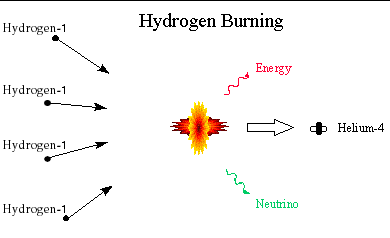
The Sun is a main-sequence star, and thus generates its energy by nuclear fusion of hydrogen nuclei into helium. In its core, the Sun fuses 620 million metric tons of hydrogen each second.

as shown in the figure that hydrogen atom are fusses to helium atom.

View full question & answer
MCQ 911 Mark
The energy needed to break a nucleus into its individual nucleons in a nuclear reaction is called:
  • A
    Nuclear binding energy
  • B
    Ionization energy
  • C
    Free energy
  • D
    Fission energy
Answer
  1. Nuclear binding energy

Explanation:

The protons and the neutrons exist together inside the nucleus due to attractive nuclear forces, thus some energy is required to break the nuclear forces.

Hence the binding energy is defined as the energy needed to break the nucleus into its individual nucleons in a nuclear reaction.

View full question & answer
MCQ 921 Mark
Heavy stable nucle have more neutrons than protons. This is because of the fact that:
  • A
    Neutrons are heavier than protons.
  • B
    Electrostatic force between protons are repulsive.
  • C
    Neutrons decay into protons through beta decay.
  • D
    Nuclear forces between neutrons are weaker than that between protons.
Answer
  1. Electrostatic force between protons are repulsive.

Solution:

Key concept:

Neutron-protob ratio $\Big(\frac{\text{N}}{2}\text{ ratio}\Big)$: The chemical properties of an atom are governed entirely by the number of protons (Z) in the nucleus, the stability of an atom appears to depend on both the number of protons and the number of neutrons.

  1. For lighter nuclei, the greatest atablity is achieved when the number of protons and neutrins are approximately equal (N ≈ Z), i.e. $\frac{\text{N}}{\text{Z}}=1$.
  2. Heavy nuclei are stable olny when they have more neutrons than protons. Thus heavy nuclei are neutron rich compared to lighter nuclei (for heavy nuclei, more is the number of protons in the nucleus, greater is the elelctrical repulsive force between them. Therefore more neutrons are added to provide the strong attractive forces necessary to keep the nucleus stable.)
View full question & answer
MCQ 931 Mark
The short range attractive nuclear forces that are responsible for the binding of nucleons in a nucleus are supposed to be caused by the role played by the particles called:
  • A
    Positron
  • B
    m-Meson
  • C
    K-Meson
  • D
    $\pi$- Meson
Answer
  1. $\pi$- Meson

Explanation:

The nuclear force between a neutron and proton is the result of the exchange of charged mesons ($\pi^+\pi^-$) between them.

View full question & answer
MCQ 941 Mark
Back isotopes of hydrogen has ________ proton. Fill in the blank.
  • A
    0 (zero)
  • B
    1 (one)
  • C
    2 (two)
  • D
    3 (three)
Answer
  1. 1 (one)

Explanation:

Each isotopes in the nucleus of hydrogen has one proton (Z = 1). but protium has no neutron, deutrium has 1 neutron and tritium has 2 neutrons.

View full question & answer
MCQ 951 Mark
Beta rays emitted by a radioactive material are:
  • A
    Electromagnetic radiations.
  • B
    The electrons orbiting around the nucleus.
  • C
    Charged particles emitted by nucleus.
  • D
    Neutral particles.
Answer
  1. Charged particles emitted by nucleus.
View full question & answer
MCQ 971 Mark
A proton and a neutron combine to give a deuterium nucleus.If mo​ and mp​ be the mass of neutron and proton respectively, then mass of deuterium nucleus is:
  • A
    Equal to mo ​+ mp​
  • B
    More than mo ​+ mp
  • C
    Less than mo + mp​
  • D
    Can be less than or more than mo​ + mp​
Answer
  1. Less than mo + mp​

Explanation:

The energy released during this during this in form of gamma photon comes from mass defect (i.e., E = mc2, where m is the mass defect). 

The mass of the deuterium nucleus (2.01355 u) is less than the sum of the masses of the proton (1.00728 u) and the neutron (1.00866 u), which is 2.01594 u.

View full question & answer
MCQ 981 Mark
Suppose we consider a large number of containers each containing initially 10000 atoms of a radioactive material with a half life of 1 year. After 1 year:
  • A
    All the containers will have 5000 atoms of the material.
  • B
    All the containers will contain the same number of atoms of the material but that number will only be approximately 5000.
  • C
    The containers will in general have different numbers of the atoms of the material but their average will be close to 5000.
  • D
    None of the containers can have more than 5000 atoms.
Answer
  1. The containers will in general have different numbers of the atoms of the material but their average will be close to 5000.

Solution:

Key concept:

Half life ( T1/2): Radioactivity is a process due to which a radioactive material spontaneously decays. Time interval in which the mass of a radioactive substance or the number of its atom reduces to half of its initial value is called the half life of the substance.

i.e., if $\text{N}=\frac{\text{N}_0}{2}$

Then $\text{t}=\text{T}_\frac{1}{2}$

Hence from $\text{N}=\text{N}_0\text{e}^{-\lambda\text{t}}$

$\frac{\text{N}_0}{2}=\text{N}_0\text{e}^{-\lambda\Big(\text{T}_\frac{1}{2}\Big)}\Rightarrow\ \text{T}_\frac{1}{2}=\frac{\log_\text{e}2}{\lambda}=\frac{0.693}{\lambda}$

In half-life (t = 1yr) of the material on the average half the number of atoms will decay. Therefore, the containers will in general have different number of atoms of the material, but their average will be approx 5000.

View full question & answer
MCQ 991 Mark
When an atom undergoes $\beta$-decay, its atomic number:
  • A
    Does not change
  • B
    Increases by 1
  • C
    Decreases by 1
  • D
    Increases by 2
Answer
  1. Increases by 1

Explanation:

When an atom undergoes $\beta$-decay the atomic number increases by 1.

When an atom undergoes $\beta$-decay, one of the neutrons breaks into one proton and one electron. The resultant electron is then ejected out of the nucleus and this is called as the $\beta$ particle.

While the resultant proton stays inside the nucleus which results in increase of atomic number by 1, whereas the atomic mass remains invariant.

View full question & answer
MCQ 1001 Mark
Which of the following represents the binding energy of a nucleus:
  • A
    The average energy of each nucleon.
  • B
    The energy needed to split the nucleus into its parts.
  • C
    The energy necessary to overcome the neutron-neutron repulsion.
  • D
    The energy required to remove a proton from the nucleu.
Answer
  1. The energy needed to split the nucleus into its parts.

Explanation:

It is observed that mass of a stable nucleus is always less than the total mass of constituent nucleons.This difference of mass is known as mass defect. When a nucleus is formed from the free nucleons mass defect is released in the form of energy by Einstein's mass-energy relation.

This energy is used to bind the nucleons to form a nucleus therefore an equivalent amount of energy is required to split the nucleus into its parts, that is called binding energy of nucleus.

View full question & answer