Question 12 Marks
Find
$\frac{7}{9}-\frac{2}{5}$
AnswerGiven, $\frac{7}{9}-\frac{2}{5}=\frac{7}{9}+$ Additive inverse of $\left(\frac{2}{5}\right)=\frac{7}{9}+\left(-\frac{2}{5}\right)$
$\because$ LCM of 9 and $5=45$
$
\therefore
\frac{7}{9}=\frac{7 \times 5}{9 \times 5}=\frac{35}{45}, \frac{-2}{5}=\frac{-2 \times 9}{5 \times 9}=\frac{-18}{45}
$
Now, $\frac{7}{9}-\frac{2}{5}=\frac{35}{45}+\left(\frac{-18}{45}\right)=\frac{35-18}{45}=\frac{17}{45}$
View full question & answer→Question 22 Marks
Find
$\frac{-3}{7}+\frac{2}{3}$
AnswerGiven, $\frac{-3}{7}+\frac{2}{3}$
$\because$ LCM of 7 and $3=21$
So, $\frac{-3}{7}=\frac{-3 \times 3}{7 \times 3}=\frac{-9}{21}$ and $\frac{2}{3}=\frac{2 \times 7}{3 \times 7}=\frac{14}{21}$
$\therefore \frac{-3}{7}+\frac{2}{3}=\frac{-9}{21}+\frac{14}{21}=\frac{-9+14}{21}=\frac{5}{21}$
View full question & answer→Question 32 Marks
Find the standard form of
$\frac{-18}{45}$
AnswerWe have, $\frac{-18}{45}$
$
\because 18=2 \times 3 \times 3 \text { and } 45=3 \times 3 \times 5
$
$\therefore$ HCF of 18 and $45=3 \times 3=9$
On dividing numerator and denominator by their HCF, we get
$\frac{-18}{45}=\frac{-18÷9}{45÷9}=\frac{-2}{5}$
Hence, the standard form of $\frac{-18}{45}$ is $\frac{-2}{5}$.
View full question & answer→Question 42 Marks
Find the value of :
$\frac{3}{13}÷\left(\frac{-4}{65}\right)$
AnswerWe have, $\frac{3}{13} \div\left(\frac{-4}{65}\right)=\frac{3}{13} \times$ Reciprocal of $\left(\frac{-4}{65}\right)$
$=\frac{3}{13} \times\left(\frac{65}{-4}\right)=\frac{3 \times 65}{13 \times(-4)}$
$=\frac{3 \times 5}{(-4)}=\frac{15}{-4}=\frac{-15}{4}$
View full question & answer→Question 52 Marks
Find the value of :
$\frac{-7}{12}÷\left(\frac{-2}{13}\right)$
AnswerWe have, $\frac{-7}{12} \div\left(\frac{-2}{13}\right)=\frac{-7}{12} \times$ Reciprocal of $\left(\frac{-2}{13}\right)$
$=\frac{-7}{12} \times \frac{13}{(-2)}$
$=\frac{-7 \times 13}{12 \times(-2)}=\frac{-91}{-24}=\frac{91}{24}$
View full question & answer→Question 62 Marks
Find the value of :
$\frac{-1}{8}÷\frac{3}{4}$
AnswerWe have, $\frac{-1}{8} \div \frac{3}{4}=\frac{-1}{8} \times$ Reciprocal of $\frac{3}{4}$
$=\frac{-1}{8} \times \frac{4}{3}=\frac{(-1) \times 4}{8 \times 3}=\frac{-4}{24}=\frac{-1}{6}$
View full question & answer→Question 72 Marks
Find the value of :
$\frac{-4}{5} \div(-3)$
AnswerWe have, $\frac{-4}{5}\div(-3)=\frac{-4}{5}\div\frac{(-3)}{1}=\frac{-4}{5}$x Reciprocal of(-3)
$=\frac{-4}{5} \times \frac{1}{(-3)}=\frac{(-4) \times 1}{5 \times(-3)}=\frac{-4}{-15}=\frac{4}{15}$
View full question & answer→Question 82 Marks
Find the value of :
$\frac{-3}{5} \div 2$
AnswerWe have, $\frac{-3}{5} \div 2=\frac{-3}{5} \div \frac{2}{1}=\frac{-3}{5} \times$ Reciprocal of 2
$=\frac{-3}{5} \times \frac{1}{2}=\frac{(-3) \times(1)}{5 \times 2}=\frac{-3}{10}$
View full question & answer→Question 92 Marks
Find the value of :
$(-4)÷\frac{2}{3}$
AnswerWe have, $(-4) \div \frac{2}{3}=\frac{(-4)}{1} \div \frac{2}{3}$
$=\frac{-4}{1} \times$ Reciprocal of $\frac{2}{3}$
$=\frac{(-4)}{1} \times \frac{3}{2}=\frac{(-4) \times 3}{1 \times 2}=\frac{-12}{2}=-6$
View full question & answer→Question 102 Marks
Find the product.
$\frac{3}{10} \times(-9)$
Answer$\frac{3}{10} \times(-9)=\frac{3 \times(-9)}{10 \times 1}=\frac{-27}{10}$
View full question & answer→Question 112 Marks
Find the sum
$-2 \frac{1}{3}+4 \frac{3}{5}$
AnswerWe have,$-\left(2 \frac{1}{3}\right)+\left(4 \frac{3}{5}\right)=-\left(\frac{2 \times 3+1}{3}\right)+\frac{4 \times 5+3}{5}$$=\frac{-7}{3}+\frac{23}{5}$
$\because $ LCM of 3 and $5=15$
$
\therefore
\frac{-7}{3}=\frac{-7 \times 5}{3 \times 5}=\frac{-35}{15} \text { and } \frac{23}{5}=\frac{23 \times 3}{5 \times 3}=\frac{69}{15}
$
Now, $-2 \frac{1}{3}+4 \frac{3}{5}=\frac{-35}{15}+\frac{69}{15}=\frac{-35+69}{15}$
$=\frac{34}{15}=2 \frac{4}{15}$
View full question & answer→Question 122 Marks
Find the sum
$\frac{-3}{-11}+\frac{5}{9}$
AnswerWe have, $\frac{-3}{-11}+\frac{5}{9}$ or $\frac{3}{11}+\frac{5}{9}$
$\because$ LCM of 11 and $9=99$
$\therefore \frac{3}{11}=\frac{3 \times 9}{11 \times 9}=\frac{27}{99}$ and $\frac{5}{9}=\frac{5 \times 11}{9 \times 11}=\frac{55}{99}$
Now, $\frac{-3}{-11}+\frac{5}{9}=\frac{27}{99}+\frac{55}{99}=\frac{27+55}{99}=\frac{82}{99}$
View full question & answer→Question 132 Marks
Find the sum
$\frac{-9}{10}+\frac{22}{15}$
AnswerWe have, $\frac{-9}{10}+\frac{22}{15}$
$\because$ LCM of denominators 10 and $15=30$
$
\therefore
\frac{-9}{10}=\frac{-9 \times 3}{10 \times 3}=\frac{-27}{30}
$
and $\frac{22}{15}=\frac{22 \times 2}{15 \times 2}=\frac{44}{30}$
$\therefore
\frac{-9}{10}+\frac{22}{15}=\frac{-27}{30}+\frac{44}{30}=\frac{-27+44}{30}=\frac{17}{30}$
View full question & answer→Question 142 Marks
Write the following rational numbers in ascending order.
$\frac{-3}{5}, \frac{-2}{5}, \frac{-1}{5}$
AnswerGiven, $\frac{-3}{5}, \frac{-2}{5}, \frac{-1}{5}$
Clearly, the given rational numbers have a common and positive denominators.
We observe that $1<2<3 \Rightarrow \frac{1}{5}<\frac{2}{5}<\frac{3}{5}$
Now, reversing the order, we get $\frac{-1}{5}>\frac{-2}{5}>\frac{-3}{5}$
Hence, the required ascending order is $\frac{-3}{5}, \frac{-2}{5}, \frac{-1}{5}$
View full question & answer→Question 152 Marks
Which is greater in each of the following:
$\frac{-1}{4}, \frac{1}{4}$
AnswerGiven, $\frac{-1}{4}, \frac{1}{4}$
We know that every positive rational number is greater than every negative rational number.
Hence, $\frac{1}{4}$ is greater than $\frac{-1}{4}$.
View full question & answer→Question 162 Marks
Which is greater in each of the following:
$\frac{-5}{6}, \frac{-4}{3}$
AnswerGiven, $\frac{-5}{6}, \frac{-4}{3}$
$\because$ LCM of the denominators 6 and $3=6$
$\therefore \quad \frac{-5}{6}=\frac{-5 \times 1}{6 \times 1}=\frac{-5}{6}$ and $\frac{-4}{3}=\frac{-4 \times 2}{3 \times 2}=\frac{-8}{6}$
On comparing the numerators, we get $-5>-8$
$\therefore \frac{-5}{6} > \frac{-8}{6}$ or $\frac{-5}{6} > \frac{-4}{3}$
Hence, $\frac{-5}{6}$ is greater than $\frac{-4}{3}$.
View full question & answer→Question 172 Marks
Which is greater in each of the following:
$\frac{2}{3}, \frac{5}{2}$
AnswerGiven $\frac{2}{3}, \frac{5}{2}$
$\because$ LCM of the denominators 3 and $2=6$
$\therefore \frac{2}{3}=\frac{2 \times 2}{3 \times 2}=\frac{4}{6} \quad$ [an equivalent rational number]
$\frac{5}{2}=\frac{5 \times 3}{2 \times 3}=\frac{15}{6} \quad$ [an equivalent rational number]
On comparing the numerators, we get $15>4$
$\Rightarrow \frac{15}{6}>\frac{4}{6} \Rightarrow \frac{5}{2}>\frac{2}{3}$
Hence, $\frac{5}{2}$ is greater than $\frac{2}{3}$.
View full question & answer→Question 182 Marks
Fill in the boxes with the correct symbol out $>$, < and =.
0 $\square$ $\frac{-7}{6}$
AnswerGiven, $0 \square \frac{-7}{6}$
We know that a negative rational number is always to the left of zero. So, zero is always greater than any negative rational number.
Hence, $0>\frac{-7}{6}$
View full question & answer→Question 192 Marks
Fill in the boxes with the correct symbol out $>$, < and =.
$\frac{-5}{7}$$\square$ $\frac{2}{3}$
AnswerHere, $\frac{-5}{7}$ is a negative rational number and $\frac{2}{3}$ is a positive rational number.
We know that a negative rational number is always less than a positive rational number.
So, $\frac{-5}{7}<\frac{2}{3}$
View full question & answer→Question 202 Marks
Rewrite the following rational numbers in the simplest form.
$\frac{25}{45}$
AnswerGiven, $\frac{25}{45}$
$
\because
25=5 \times 5 \text { and } 45=5 \times 3 \times 3
$
$\therefore$ HCF of 25 and $45=5$
On dividing the numerator and denominator by 5,
we get
$\frac{25}{45}=\frac{25÷5}{45÷5}=\frac{5}{9}$
Hence, the simplest form of $\frac{25}{45}$ is $\frac{5}{9}$
View full question & answer→Question 212 Marks
Rewrite the following rational numbers in the simplest form.
$\frac{-8}{6}$
AnswerGiven, $\frac{-8}{6}$
$\because 6=2 \times 3$ and $8=2 \times 2 \times 2$
$\therefore HCF$ of 8 and $6=2$
On dividing the numerator and denominator by 2,
we get
$\frac{-8}{6}=\frac{-8÷2}{6÷2}=\frac{-4}{3}$
Hence, the simplest form of $\frac{-8}{6}$ is $\frac{-4}{3}$.
View full question & answer→Question 222 Marks
Which of the following pairs represent the same rational number?
$\frac{1}{3}$ and $\frac{-1}{9}$
AnswerGiven, $\frac{1}{3}$ and $\frac{-1}{9}$
Here, $\frac{1}{3}$ is a positive rational number and $\frac{-1}{9}$ is a
negative rational number. So, these rational numbers can not be equivalent. Hence, given pair cannot represent same rational numbers.
View full question & answer→Question 232 Marks
Which of the following pairs represent the same rational number?
$\frac{-7}{21}$ and $\frac{3}{9}$
AnswerHere, $\frac{-7}{21}$ is a negative rational number and $\frac{3}{9}$ is a positive rational number. So, these rational numbers cannot be equivalent. Hence, the given pair cannot represent the same rational number.
View full question & answer→Question 242 Marks
Draw the number line and represent the following rational numbers on it.
$\frac{7}{8}$
AnswerDo same as above
Points $D$ on the number line represents the rational number $\frac{7}{8}$ as shown below.

View full question & answer→Question 252 Marks
Draw the number line and represent the following rational numbers on it.
$\frac{-7}{4}$
AnswerDo same as above
Point $C$ on the number line represents the rational number $\frac{-7}{4}$ as shown below

View full question & answer→Question 262 Marks
Draw the number line and represent the following rational numbers on it.
$\frac{-5}{8}$
AnswerHere, $\frac{-5}{8}$ is less than 0 and greater than -1 . So, it will lie on the left of 0 on the number line at the same distance as $\frac{5}{8}$ from 0 to the right.
Firstly, draw the number line and mark $0,-1$ on it at unit distance divide the gap between 0 and -1 into 8 equal parts and show 1 part as $\frac{-1}{8}$. Now, $\frac{-5}{8}$ means 5 parts out of 8 parts to the left of 0.
Thus, the point $B$ on the number line represents the rational number $\frac{-5}{8}$ as shown below

View full question & answer→Question 272 Marks
Draw the number line and represent the following rational numbers on it.
$\frac{3}{4}$
AnswerFirstly, draw a number line and mark 0 and 1 on it at
unit distance, divide the gap between 0 and 1 into
4 equal parts and show 1 part as $\frac{1}{4}$. Now, $\frac{3}{4}$ means
3 parts out of 4 parts to the right of 0 . Thus, point $A$ on the number line represents the rational number $\frac{3}{4}$

View full question & answer→Question 282 Marks
List five rational numbers between:
-1 and 0
AnswerGiven, -1 and 0
Let -1 and 0 be rational numbers with denominator 6 .
Then, we have $-1=\frac{-6}{6}$ and $0=\frac{0}{6}$
$\begin{array}{l}\text { So, } \frac{-6}{6}<\frac{-5}{6}<\frac{-4}{6}<\frac{-3}{6}<\frac{-2}{6}<\frac{-1}{6}<\frac{0}{6} \\ \text { or }-1<\frac{-5}{6}<\frac{-2}{3}<\frac{-1}{2}<\frac{-1}{3}<\frac{-1}{6}<0\end{array}$
Hence, the five rational numbers between -1 and 0 are
$\frac{-5}{6}, \frac{-2}{3}, \frac{-1}{2}, \frac{-1}{3}$ and $\frac{-1}{6}$.
View full question & answer→Question 292 Marks
Simplify
$\frac{13}{11} \times \frac{-14}{5}+\frac{13}{11} \times \frac{-7}{5}+\frac{-13}{11} \times \frac{34}{5}$
AnswerGiven,
$\frac{13}{11} \times \frac{-14}{5}+\frac{13}{11} \times \frac{-7}{5}+\frac{-13}{11} \times \frac{34}{5}$
$\therefore$ Product of rational numbers $=\frac{\text { Product of numerators }}{\text { Product of denominators }}$
$=\frac{13 \times(-14)}{11 \times 5}+\frac{13 \times(-7)}{11 \times 5}+\frac{(-13) \times(34)}{11 \times 5}$
$=\frac{(-182)}{55}+\frac{(-91)}{55}+\frac{(-442)}{55}$
$=\frac{-182+(-91)+(-442)}{55}$
$=\frac{-715}{55}=\frac{-143}{11}$
$=\frac{-13}{1}=-13$
View full question & answer→Question 302 Marks
Rajan is a fatty person. His weight is around 82 kg. He wants to lose his weight in 8 months. So, regularly he goes for early morning exercise and take very balanced diet after consulting to physician.After 8 months, Rajan's weight decreased by $\frac{3}{20}$ of his original weight (before 8 months). Find the current weight of Rajan.
AnswerRajan's weight 8 months ago was 82 kg.
After regular scheduled diet and exercise his weight
reduced to $\frac{3}{20}$ of his original weight.
Reduced weight $=\frac{3}{20} \times 82$
$=3 \times 4.1=12.3$ kg = 12kg and 300 g
New weight $=82-12.3 kg=69.7 kg=69 kg$ and 700 g
View full question & answer→Question 312 Marks
Addition of a rational number to its additive inverse results in 0.
Is this statement true for all rational numbers? give examples to support your answer.
AnswerIts correct
Let us take a rational number $\frac{2}{8}$.
Additive inverse of $\frac{2}{8}$ is $-\frac{2}{8}$
$\therefore$ Number + Additive inverse $=\frac{2}{8}+\left(-\frac{2}{8}\right)$
$=\frac{2}{8}-\frac{2}{8}=\frac{2-2}{8}=0$
Thus, the statement is true for all rational number.
View full question & answer→Question 322 Marks
The product of a negative rational number with its multiplicative inverse is -1. Do you agree? give examples to support your answer.
AnswerNo, its incorrect.
Let us take a rational number $\frac{-3}{7}$
Its reciprocal $=\frac{7}{-3}=\frac{-3}{7} \times \frac{7}{-3}=1$, which is an identity.
This is true for all rational number.
Therefore, the product of a negative rational number and its multiplicative inverse is 1, not-1
View full question & answer→Question 332 Marks
Find three rational numbers between 3 and 4
AnswerThe numbers are 3 and 4.
$\Rightarrow \frac{3}{1}$ and $\frac{4}{1}$
Multiplying numerator and denominator by 10.
$\Rightarrow \frac{3 \times 10}{1 \times 10}$ and $\frac{4 \times 10}{1 \times 10} \Rightarrow \frac{30}{10}$ and $\frac{40}{10}$
Now, three rational number between them is $\frac{32}{10}, \frac{35}{10}$ and $\frac{37}{10}$.
View full question & answer→Question 342 Marks
Convert the following rational numbers to rational numbers having same denominator.
$\frac{-3}{4}, \frac{2}{3}, \frac{5}{6}, \frac{7}{-8}$
AnswerFor same/common denominators, LCM of 4, 3, 6, 8 is 24,
$\frac{-3 \times 6}{4 \times 6}, \frac{2 \times 8}{3 \times 8}, \frac{5 \times 4}{6 \times 4}, \frac{7 \times 3}{(-8) \times 3}$
So, $\frac{-18}{24}, \frac{16}{24}, \frac{20}{24}, \frac{-21}{24}$
View full question & answer→Question 352 Marks
If 12 shirts of equal size can be prepared from 27 m cloth, then what is the length of cloth required for each shirt?
AnswerTotal size of available cloth is 27 m.
12 shirts can be made from 27 m long cloth.
$\therefore$ Length of the cloth required for each shirt $=\frac{\text { Total available cloth }}{\text { Number of the shirts }}$
$\frac{27}{5}=\frac{9}{12}=$=2.25
Hence, 2.25 m cloth required for each shirt.
View full question & answer→Question 362 Marks
Simplify
$\frac{6}{5} \times \frac{3}{7}-\frac{1}{5} \times \frac{3}{7}$
Answer$\frac{6}{5} \times \frac{3}{7}-\frac{1}{5} \times \frac{3}{7}$
$\therefore$ Product of rational numbers $=\frac{\text { Product of numerators }}{\text { Product of denominators }}$
$=\frac{6 \times 3}{5 \times 7}-\frac{1 \times 3}{5 \times 7}=\frac{18}{35}-\frac{3}{35}$
$=\frac{18-3}{35}=\frac{15}{35}=\frac{3}{7}$
View full question & answer→Question 372 Marks
Simplify $\frac{11}{18} \times \frac{12}{33} \times \frac{(-6)}{25}$
AnswerGiven,$\frac{11}{18} \times \frac{12}{33} \times \frac{(-6)}{25}$
$\therefore$ Product of rational numbers $=\frac{\text { Product of numerators }}{\text { Product of denominators }}$
$\frac{11 \times 12 \times(-6)}{18 \times 33 \times 25}=\frac{11 \times(-72)}{18 \times 825}=\frac{-792}{14850}=\frac{-4}{75}$
View full question & answer→Question 382 Marks
Write the following as rational numbers in their standard forms.
115÷207
AnswerGiven,
$\because \quad 115=5 \times 23$
$\Rightarrow \quad 207=3 \times 23 \times 3$
$\therefore$ HCF of 115 and 207= 23
On dividing numerator and denominator by their HCF, we get
$\frac{115 \div 23}{207 \div 23}=\frac{5}{9}$
View full question & answer→Question 392 Marks
Write the following as rational numbers in their standard forms.
240÷(-840)
AnswerGiven, $240 \div(-840)=\frac{240}{-840}$
$\because$ HCF of 240 and $840=120$
On dividing numerator and denominator by their HCF, we get $\frac{240 \div 120}{-840 \div 120}=\frac{2}{-7}$
In standard form,
$\frac{2}{-7} \times \frac{(-1)}{(-1)}=\frac{-2}{7}$
View full question & answer→Question 402 Marks
Write the following as rational numbers in their standard forms.
35%
AnswerGiven, $35 \%=\frac{35}{100}$
$\because 35=7 \times 5$ and $100=2 \times 2 \times 5 \times 5$
$\therefore$ HCF of 35 and $100=5$
On dividing numerator and denominator by their HCF, we get
$\frac{35 \div 5}{100 \div 5}=\frac{7}{20}$
View full question & answer→Question 412 Marks
Add the following rational numbers.
$\frac{2}{4}+\frac{2}{10}$
AnswerWe have, $\frac{2}{4}+\frac{2}{10}$
LCM of 4 and 10 is 20
$\frac{2 \times 5}{4 \times 5}=\frac{10}{20}, \frac{2 \times 2}{10 \times 2}=\frac{4}{20}$
So, $\frac{10}{20}+\frac{4}{20}=\frac{10+4}{20}=\frac{14}{20}=\frac{7}{10}$
View full question & answer→Question 422 Marks
Add the following rational numbers.
$\frac{1}{3}+\frac{2}{6}$
AnswerWe have,$\frac{1}{3}+\frac{2}{6}$
LCM of 3 and 6 is 6,
$\frac{1 \times 2}{3 \times 2}=\frac{2}{6}$ and $\frac{2 \times 1}{6 \times 1}=\frac{2}{6}$
So, $\frac{2}{6}+\frac{2}{6}=\frac{2+2}{6}=\frac{4}{6}=\frac{2}{3}$.
View full question & answer→Question 432 Marks
If $p=m \times t$ and $q=n \times t$, then 
AnswerGiven, $p=m \times t$ and $q=n \times t$
$\therefore \quad \frac{p}{q}=\frac{m \times t}{n \times t} \Rightarrow \frac{p}{q}=\frac{m}{n}$
View full question & answer→Question 442 Marks
Which of the two rational numbers $\frac{-5}{12}$ and $\frac{-7}{-18}$ is greater?
AnswerGiven rational numbers are $\frac{-5}{12}$ and $\frac{7}{-18}$.
For the same/common denominator,
LCM of 12 and 18 is 36,
$\frac{(-5) \times 3}{12 \times 3}=\frac{-15}{36}$ and $\frac{7 \times 2}{(-18) \times 2}=\frac{14}{-36}=\frac{-14}{36}$
-14 is greater than -15.
So, $\frac{-14}{36}>\frac{-15}{36}$ or $\frac{-7}{18}>\frac{-5}{12}$
View full question & answer→Question 452 Marks
Express each of the following in standard form.
$\frac{-22}{40}$
AnswerWe have,$\frac{-22}{40}$
$\because$ HCF of 22 and 40 is 2.
Then, $\frac{-22÷2}{40÷2}=\frac{-11}{20}$
Hence, the standard form of $\frac{-22}{40}$ is $\frac{-11}{20}$
View full question & answer→Question 462 Marks
Express each of the following in standard form.
$\frac{27}{33}$
AnswerWe have,$\frac{27}{33}$
$\because$ HCF of 27 and 33 is 3.
Then, $\frac{27÷3}{33÷3}=\frac{9}{11}$
Hence, the standard form of $\frac{27}{33}$ is $\frac{9}{11}$.
View full question & answer→Question 472 Marks
Draw the number line and represent the following rational numbers on it.
$\frac{-6}{7}$
AnswerRepresentation of rational number $\frac{-6}{7}$ on number line,
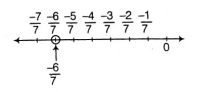
View full question & answer→Question 482 Marks
Draw the number line and represent the following rational numbers on it.
$\frac{3}{4}$
AnswerRepresentation of rational number $\frac{3}{4}$, on number line,
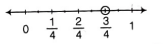
View full question & answer→Question 492 Marks
Find xsuch that $\frac{-3}{4}$and $\frac{x}{-36}$ are equivalent rational numbers.
AnswerSince, $\frac{-3}{4}$ and $\frac{x}{-36}$ are equivalent rational numbers.
$\therefore \frac{-3}{4}=\frac{x}{-36} \Rightarrow x=\frac{-36 \times(-3)}{4} \Rightarrow x=-9 \times(-3)=27$
Hence, the value of x is 27.
View full question & answer→Question 502 Marks
Find the standard/simplest form of $\frac{-21}{27}$.
AnswerGiven rational number is $\frac{-21}{27}$.
For standard/simplest form,
$\frac{-21 \div 3}{27÷3}=\frac{-7}{9}$ $[\because HCF$ of 21 and 27 is 3$]$
The standard form of $\frac{-21}{27}$ is $\frac{-7}{9}$.
View full question & answer→