MCQ 11 Mark
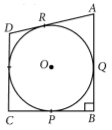
In a right triangle $\text{ABC},$ right $-$ angled at $B, BC = 12\ cm$ and $AB = 5 \ cm.$ The radius of the circle inscribed in the triangle $($in $\ cm)$ is :
AnswerLet $r$ is the radius of the circle.
From the figure,
$OP = OQ = OR = r$
In triangle $\text{ABC},$
From Pythagoras Theorem,
$\Rightarrow A C^2=A B^2+B C^2 $
$ \Rightarrow A C^2=5^2+(12)^2 $
$ \Rightarrow A C^2=25+144 $
$ \Rightarrow A C^2=169 $
$\Rightarrow AC = 13$
Now,
$\text{area}(\triangle\text{AOB})+\text{area}(\triangle\text{BOC})+\text{area}(\triangle\text{AOC})=\text{area}(\text{AOB})$
Now,
$\text{s}=\frac{(5+12+13)}{2}=\frac{30}{2}=15$
So, $\text{area}(\triangle\text{AOB})+\text{area}(\triangle\text{BOC})+\text{area}(\triangle\text{AOC})=\text{area}(\text{AOB})$
$\Rightarrow\frac{(\text{OP}\times\text{AB})}{2}+\frac{(\text{OP}\times\text{AB})}{2}+\frac{(\text{OP}\times\text{AB})}{2}=\sqrt{\{\text{s}\times(\text{s}-\text{a})\times(\text{s}-\text{b})\times(\text{s}-\text{c})\}}$
$\Rightarrow\frac{\{(\text{OP}\times\text{AB})+(\text{OP}\times\text{AB})+(\text{OP}\times\text{AB})\}}{2}=\sqrt{\{15\times(15-5)\times(15-13)\times(15-13)\}}$
$\Rightarrow\frac{\{15+12\text{r}+13\text{r}\}}{2}=\sqrt{\{15\times10\times3\times2\}}$
$\Rightarrow\frac{30\text{r}}{2}=\sqrt{900}$
$\Rightarrow15\text{r}=30$
$\Rightarrow\text{r}=\frac{30}{15}$
$\Rightarrow\text{r}=2$
So, the radius of the circle is $2\ cm.$
View full question & answer→MCQ 21 Mark
Two circles touch each other externally at $P. AB$ is a common tangent to the circles touching them at $A$ and $B$. The value of $\angle\text{APB}$ is :
- A
$30^{\circ}$
- B
$45^{\circ}$
- C
$60^{\circ}$
- ✓
$90^{\circ}$
AnswerCorrect option: D. $90^{\circ}$
Given $X$ and $Y$ are two circles touch each other externally at $P. $
$AB$ is the common tangent to the circles $X$ and $Y$ at point $A$ and $B$ respectively.
To find : $\angle\text{APB}$
Proof : Let $\angle\text{CAP}=\alpha$ and $\angle\text{CPB}=\beta$
$CA = CP \ [$Length of the tangents from an external point $C]$
In a triangle $\text{PAC},$
$\angle\text{CAP}=\angle\text{APC}=\alpha$
Similarly $CB = CP$ and $\angle\text{CPB}=\angle\text{PBC}=\beta$
Now in the triangle $\text{APB},$
$\angle\text{PAB}+\angle\text{PBA}+\angle\text{APB}=180^\circ \ [$Sum of the interior angles in a triangle$]$
$\alpha+\beta+(\alpha+\beta)=180^\circ$
$2\alpha+2\beta=180^\circ$
$\alpha+\beta=90^\circ$
$\therefore\ \angle\text{APB}=\alpha+\beta=90^\circ$
View full question & answer→MCQ 31 Mark
In a right triangle $\text{ABC},$ right $-$ angled at $B, BC = 12\ cm$ and $AB = 5\ cm.$ The radius of the circle inscribed in the triangle $($in $\ cm)$ is :
AnswerLet $r$ is the radius of the circle.
From the figure,
$OP = OQ = OR = r$
In triangle $\text{ABC},$
From Pythagoras Theorem,
$\Rightarrow A C^2=A B^2+B C^2 $
$ \Rightarrow A C^2=5^2+(12)^2 $
$ \Rightarrow A C^2=25+144 $
$ \Rightarrow A C^2=169 $
$\Rightarrow AC = 13$
Now,
$\text{area}(\triangle\text{AOB})+\text{area}(\triangle\text{BOC})+\text{area}(\triangle\text{AOC})=\text{area}(\text{AOB})$
Now,
$\text{s}=\frac{(5+12+13)}{2}=\frac{30}{2}=15$
So, $\text{area}(\triangle\text{AOB})+\text{area}(\triangle\text{BOC})+\text{area}(\triangle\text{AOC})=\text{area}(\text{AOB})$
$\Rightarrow\frac{(\text{OP}\times\text{AB})}{2}+\frac{(\text{OP}\times\text{AB})}{2}+\frac{(\text{OP}\times\text{AB})}{2}=\sqrt{\{\text{s}\times(\text{s}-\text{a})\times(\text{s}-\text{b})\times(\text{s}-\text{c})\}}$
$\Rightarrow\frac{\{(\text{OP}\times\text{AB})+(\text{OP}\times\text{AB})+(\text{OP}\times\text{AB})\}}{2}=\sqrt{\{15\times(15-5)\times(15-13)\times(15-13)\}}$
$\Rightarrow\frac{\{15+12\text{r}+13\text{r}\}}{2}=\sqrt{\{15\times10\times3\times2\}}$
$\Rightarrow\frac{30\text{r}}{2}=\sqrt{900}$
$\Rightarrow15\text{r}=30$
$\Rightarrow\text{r}=\frac{30}{15}$
$\Rightarrow\text{r}=2$
So, the radius of the circle is $2\ cm.$
View full question & answer→MCQ 41 Mark
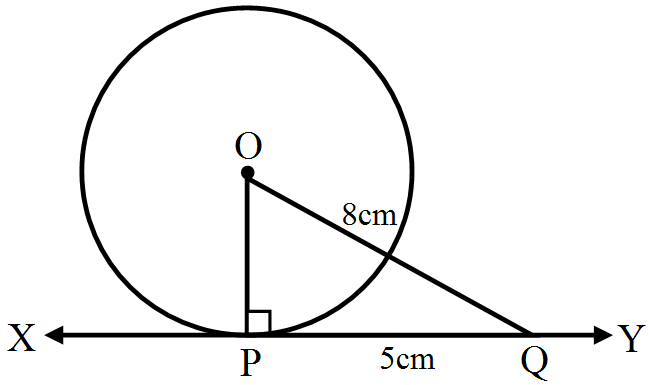
From a point $Q, 13\ cm$ away from the centre of a circle, the length of tangent $PQ$ to the circle is $12\ cm$. The radius of the circle $($in $\ cm)$ is :
- A
$25$
- B
$\sqrt{313}$
- ✓
$5$
- D
$1$
AnswerAccording to questions,
$PQ\ ($tangent$)\ = 12\ cm$
$OQ = 13\ cm$
$OP \ ($radius$) = ?$
By Pythagoras theorem
$ P Q^2=P O^2+O Q^2 $
$ 144=P Q^2+169 $
$ P O^2=169-144 $
$\text{PO}=\sqrt{25}$
$PO = 5\ cm$
View full question & answer→MCQ 51 Mark
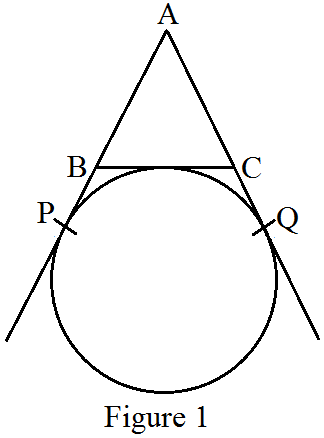
In Figure $1, AP, AQ$ and $BC$ are tangents to the circle. If $AB = 5\ cm, AC = 6\ cm$ and $BC = 4\ cm,$ then the length of $AP\ ($in $\ cm)$ is :
Answer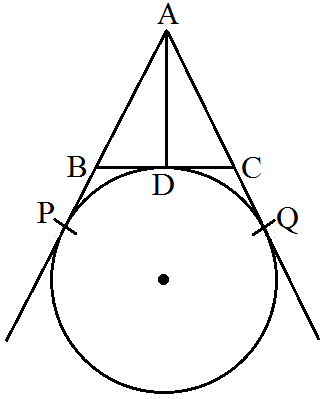
We know that tangent segments to a circle from the same external point are congruent
Therefore, we have
$AP = AQ$
$BP = BD$
$CQ = CD$
Now,
$AB + BC + AC = 5 + 4 + 6$
$\Rightarrow AB + BD + DC + AC = 15\ cm$
$\Rightarrow AB + BP + CQ + AC = 15\ cm$
$\Rightarrow AP + AQ = 15\ cm$
$\Rightarrow 2AP = 15\ cm$
$\Rightarrow AP = 7.5\ cm$ View full question & answer→MCQ 61 Mark
The perimeter $($in $\ cm)$ of a square circumscribing a circle of radius a $cm,$ is
AnswerSide of a square $= a + a = 2a \ cm$
perimeter of square $= 4 \ \times$ side
$= 4 \times 2a$
$= 8a$
View full question & answer→MCQ 71 Mark
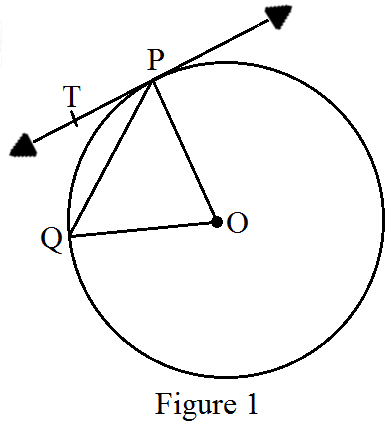
In Figure $1, O$ is the centre of a circle $,PQ$ is a chord and $PT$ is the tangent at $P$. If $\angle\text{POQ}=70^\circ,$ then $\angle\text{TPQ}$ is equal to :
- A
$55^{\circ}$
- B
$70^{\circ}$
- C
$45^{\circ}$
- ✓
$35^{\circ}$
AnswerCorrect option: D. $35^{\circ}$
We know that the radius and tangent are perpendicular at their point of contact.
Since $,OP = OQ$
$\text{POQ}$ is a isosceles right triangle
Now, in isosceles right triangle $\text{POQ},$
$\angle\text{POQ}+\angle\text{OPQ}+\angle\text{OQP}=180^\circ$
$\Rightarrow70^\circ+2\angle\text{OPQ}=180^\circ$
$\Rightarrow\angle\text{OPQ}=55^\circ$
Now, $\angle\text{TPQ}+\angle\text{OPQ}=90^\circ$
$\Rightarrow\angle\text{TPQ}=35^\circ$
View full question & answer→MCQ 81 Mark
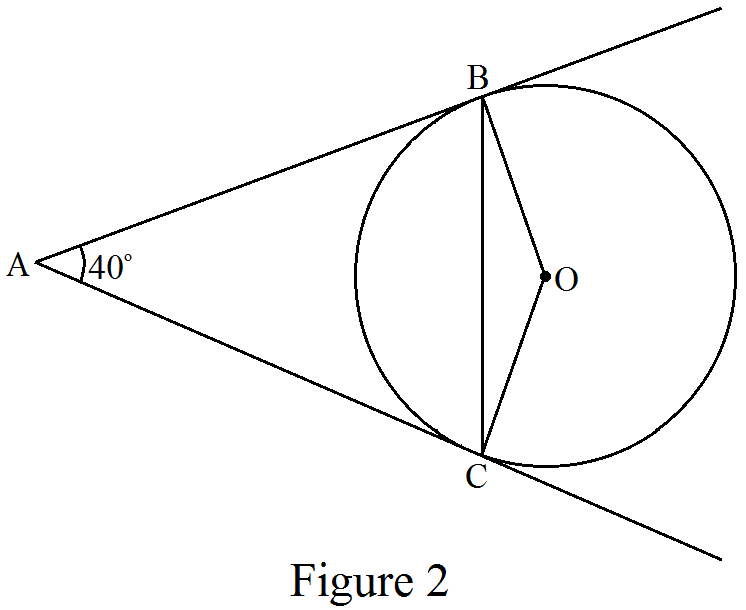
In Figure $2, AB$ and $AC$ are tangents to the circle with centre $O$ such that$\angle\text{BAC}=40^\circ.$ Then $\angle\text{BOC}$ is equal to :
- A
$40^{\circ}$
- B
$50^{\circ}$
- ✓
$140^{\circ}$
- D
$150^{\circ}$
AnswerCorrect option: C. $140^{\circ}$
$AB$ and $AC$ are tangents
$\therefore \text{ABO} = \text{ACO} = 90^\circ $
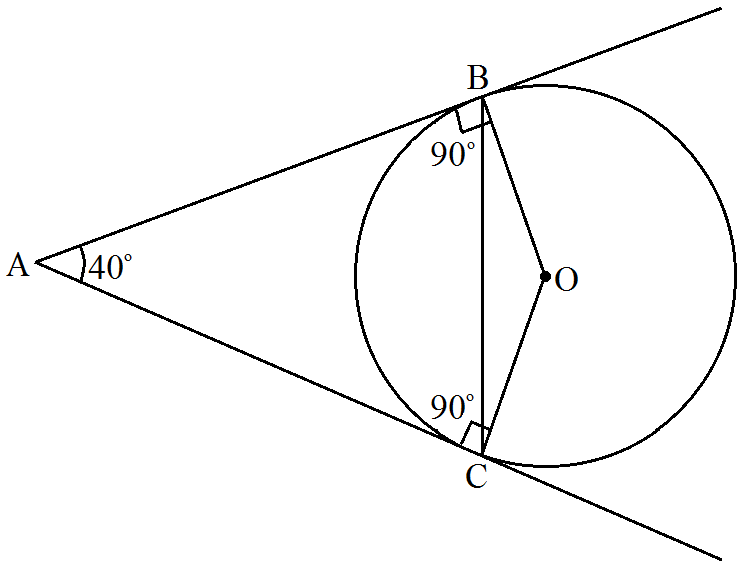
In $\text{ABOC}$
$\angle\text{ABO}+\angle\text{ACO}+\angle\text{BAC}+\angle\text{BOC}=360^\circ$
$90^\circ+90^\circ+40^\circ+\angle\text{BOC}=360^\circ$
$\angle\text{BOC}=360^\circ-220^\circ=140^\circ$ View full question & answer→MCQ 91 Mark
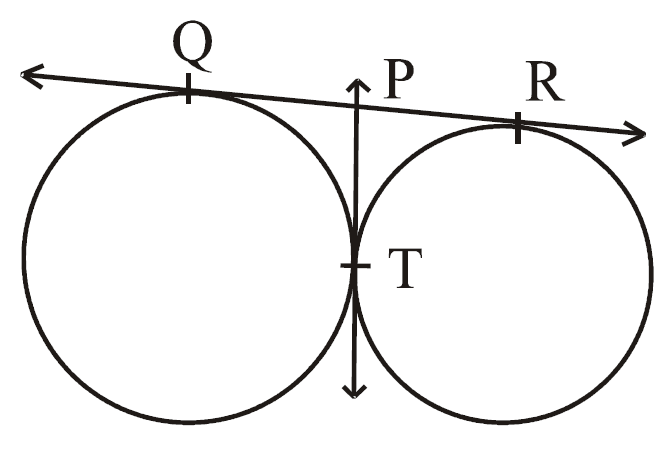
In Fig. $1, QR$ is a common tangent to the given circles, touching externally at the point $T$. The tangent at $T$ meets $QR$ at $P$. If $PT = 3.8\ cm,$ then the length of $QR\ ($in $\ cm)$ is :
Answer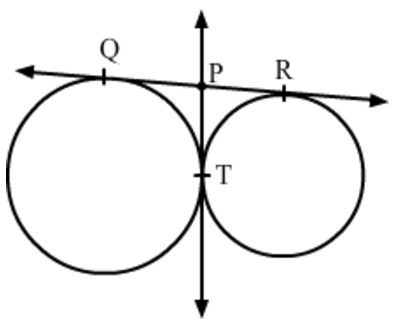
It is known that the length of the tangents drawn from an external point to a circle are equal.
$\therefore QP = PT = 3.8\ cm ....(1)$
$PR = PT = 3.8\ cm ....(2)$
From equations $(1)$ and $(2),$ we get:
$QP = PR = 3.8\ cm$
Now $, QR = QP + PR$
$= 3.8\ cm + 3.8\ cm$
$= 7.6\ cm$
Hence, the correct option is $B$. View full question & answer→MCQ 101 Mark
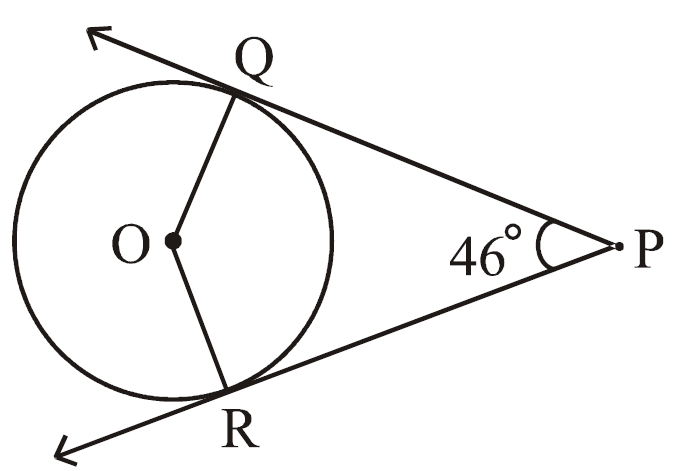
In Fig. $2, PQ$ and $PR$ are two tangents to a circle with centre $O$. If $\angle\text{QPR}=46^\circ,$ then $\angle\text{QOR}$ equals :
- A
$67^\circ$
- ✓
$134^\circ$
- C
$44^\circ$
- D
$46^\circ$
AnswerCorrect option: B. $134^\circ$
Given : $\angle\text{QPR}=46^\circ,$
$PQ$ and $PR$ are tangents.
Therefore, the radius drawn to these tangents will be perpendicular to the tangents.
So, we have $OQ \perp PQ$ and $OR \perp RP.$
$\Rightarrow\angle\text{OQP} = \angle\text{PRO} = 90^{o}$
So, in quadrilateral $\text{PQOR},$ we have
$\angle \text{OQP} + \angle \text{QPR} + \angle\text{PRO} + \angle\text{ROQ} =360^\circ$
$\Rightarrow90^\circ + 46^\circ + 90^\circ + \angle\text{ROQ}= 360^\circ$
$\Rightarrow\angle\text{ROQ} = 360^\circ -226^\circ = 134^\circ$
Hence, the correct option is $B$.
View full question & answer→MCQ 111 Mark
In Fig.$2,$ a circle with centre $O$ is inscribed in a quadrilateral $\text{ABCD}$ such that, it touches the sides $BC, AB, AD$ and $CD$ at points $P, Q, R$ and $S$ respectively, If $AB = 29\ cm, AD = 23\ cm,$ $\angle\text{B}=90^\circ$ and $DS = 5\ cm,$ then the radius of the circle $($in $\ cm.)$ is :
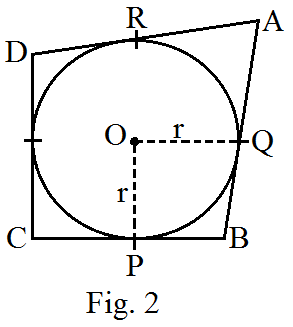
AnswerGiven that $DS = 5\ cm,$
Since $DS$ and $DR$ are tangents from the same external point to the circle, $DS = DR = 5\ cm$
Since $AD = 23\ cm, AR = AD - DR = 23 - 5 = 18\ cm.$
Similarly, $AR$ and $AQ$ are the tangents from the same external point to the circle and hence $AR = AQ = 18\ cm.$
Since $AB = 29\ cm, BQ = AB - AQ = 29 - 18 = 11\ cm.$
Since $CB$ and $AB$ are the tangents to the circle, angle $\text{OPB}$ and angle $\text{OQB}$ is equal to $900.$
Given that angle $B$ is $900$ and hence angle $\text{POQ}$ is also equal to $900$ and hence $\text{OQBP}$ is a square.
Since $BQ$ is $11\ cm,$ the side of the square $\text{OQBP}$ is $11\ cm$
From the figure it is clear that the side of the square is the radius of the circle and hence radius of the circle is $11\ cm.$
View full question & answer→MCQ 121 Mark
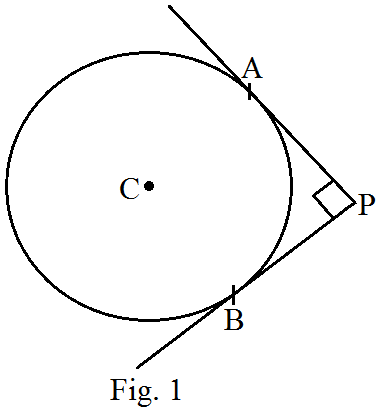
In fig. $1, PA$ and $PB$ are two tangents drawn from an external point $P$ to a circle with centre $C$ and radius $4\ cm$. If $\text{PA}\bot\text{PB},$ then the length of each tangent is :
- A
$3\ cm$
- ✓
$4\ cm$
- C
$5\ cm$
- D
$6\ cm$
AnswerCorrect option: B. $4\ cm$
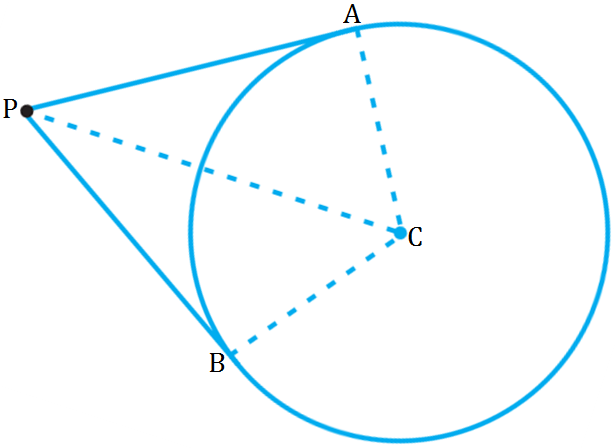
Given $PA$ and $PB$ are two tangents. $PA$ is perpendicular to $PB$. In triangles $\text{PAC}$ and $\text{PBC},$
$PA = PB \ [$tangents drawn from external point are equal in length$]$
$CP$ is common.
$CA = CB =$ radius
Therefore by $\text{SSS}$ triangles are congruent.
$\angle\text{APC}=\angle\text{BPC}=\frac{90}{2}=45^\circ$
In right angled triangle $\text{CAP},$
$\angle\text{APC}=\angle\text{ACP}=\frac{(180-90)}{2}=45$
$PA = CA = 4\ cm$
Therefore the length of the tangent is $4\ cm.$ View full question & answer→MCQ 131 Mark
In Fig. $1,$ the sides $AB, BC$ and $CA$ of a triangle $\text{ABC},$ touch a circle at $P, Q$ and $R$ respectively. If $PA = 4\ cm, BP = 3\ cm$ and $AC = 11\ cm,$ then the length of $BC\ ($in $\ cm)$ is :
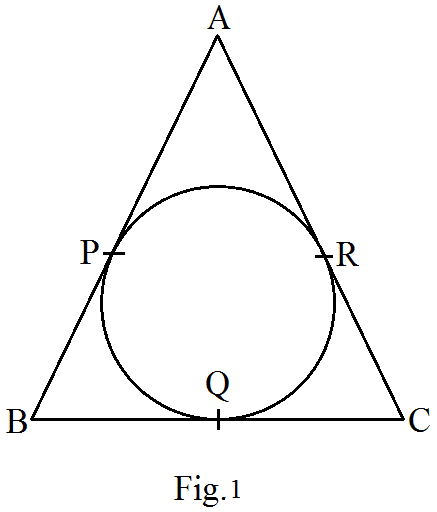
AnswerTriangle $\text{ABC},$ we have
$BP= BQ = 3\ cm$
$AP= AR = 4\ cm$
$($Tangents drawn from an external point to the circle are equal.$)$
So, $RC = AC - AR$
$= 11 - 4 = 7\ cm$
Hence $RC = CQ = 7 \ cm$
Then $,BC = BQ + QC$
$7 + 3 = 10\ cm$
View full question & answer→MCQ 141 Mark
In Fig $2,$ a circle touches the side $DF$ of $\angle\text{EDF}$ at hand touches $ED$ and $EF$ produced at $K$ and $M$ respectively. If $EK = 9\ cm,$ then the perimeter of $\triangle\text{EDF}\ ($in $\ cm)$ is :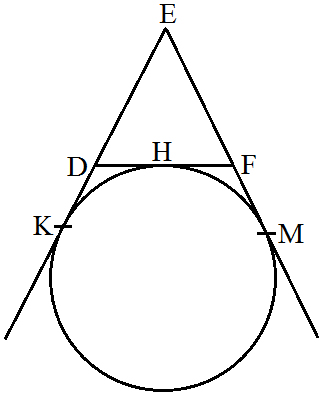
AnswerWe know that tangent segments to a circle from the same external point are congruent.
Therefore, we have $EK = EM = 9\ cm$
Now, $EK + EM = 18\ cm$
$\Rightarrow ED + DK + EF + FM = 18\ cm$
$\Rightarrow ED + DH + EF + HF = 18\ cm$
$\Rightarrow ED + DF + EF = 18\ cm$
$\Rightarrow$ Perimeter of $\triangle\text{EDF}=18\text{ cm}$
View full question & answer→MCQ 151 Mark
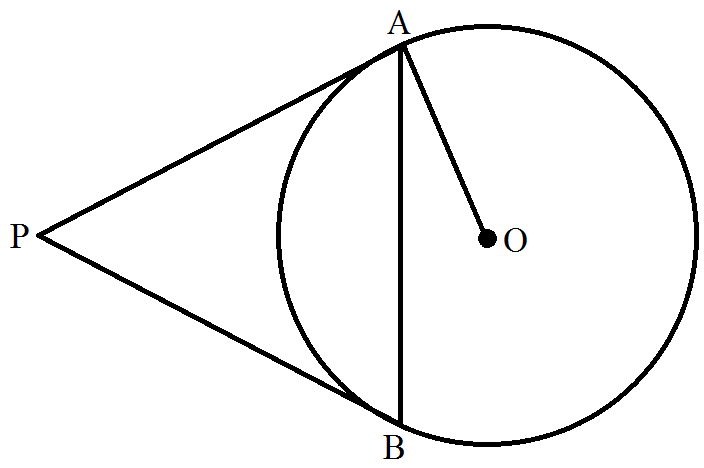
In Fig. $2, PA$ and $PB$ are tangents to the circle with centre $O$. If $\angle\text{APB}=60^\circ$ then $\angle\text{OAB}$ is :
- ✓
$30^\circ$
- B
$60^\circ$
- C
$90^\circ$
- D
$15^\circ$
AnswerCorrect option: A. $30^\circ$
Construction : Join $OB.$
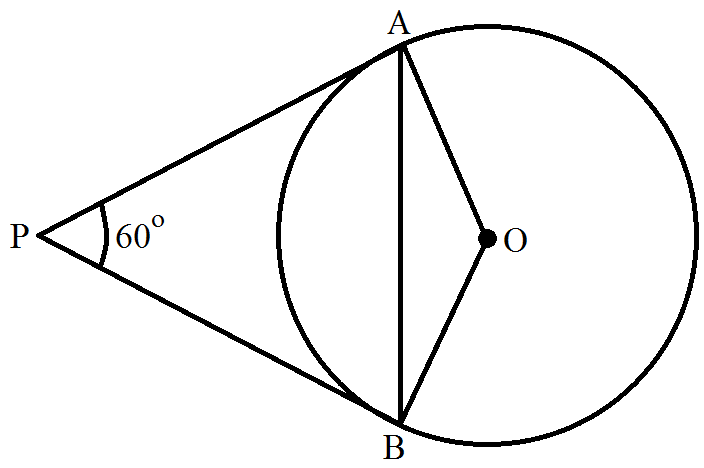
We know that the radius and tangent are perpendicular at their point of contact
$\because\ \angle\text{OBP}=\angle\text{OAP}=90^\circ$
Now, in quadrilateral $\text{AOBP}$
$\angle\text{AOB}+\angle\text{OBP}+\angle\text{APB}+\angle\text{OAP}=360^\circ$
$\Rightarrow\angle\text{AOB}+90^\circ+60^\circ+90^\circ=360^\circ$
$\Rightarrow240^\circ+\angle\text{AOB}=360^\circ$
$\Rightarrow\angle\text{AOB}=120^\circ$
Now, in isosceles triangle $\text{AOB}$
$\angle\text{AOB}+\angle\text{OAB}+\angle\text{OBA}=180^\circ$
$\Rightarrow120^\circ+2\angle\text{OAB}=180^\circ$
$\Rightarrow\angle\text{OAB}=30^\circ$ View full question & answer→MCQ 161 Mark
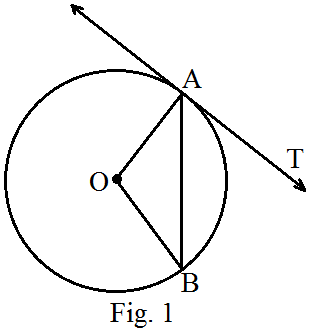
In Fig. $1, O$ is the centre of a circle, $AB$ is a chord and $AT$ is the tangent at. If $\angle\text{AOB}=100^\circ$ then $\angle\text{BAT}$ is equal to :
- A
$100^\circ$
- B
$40^\circ$
- ✓
$50^\circ$
- D
$90^\circ$
AnswerCorrect option: C. $50^\circ$
In $\angle\text{OAB},$
$OA = OB \ ($radii$)$
$\Rightarrow\angle\text{OAB}=\angle\text{OBA}$
But, $\angle\text{OBA}+\angle\text{OBA}+\angle\text{AOB}=180^\circ$
$\angle\text{AOB}=180^\circ-100^\circ$
$\angle\text{OAB}=40^\circ$
$\angle\text{OAB}+\angle\text{BAT}=90^\circ \ ($Radius is perpendicular to tangent$)$
$40^\circ+\angle\text{BAT}=90^\circ$
$\angle\text{BAT}=50^\circ$
View full question & answer→MCQ 171 Mark
In Figure, from an external point $P,$ two tangents $PQ$ and $PR$ are drawn to a circle of radius $4\ cm$ with centre $O$. If $\angle\text{QPR} = 90^\circ,$ then length of $PQ$ is :
- A
$3\text{ cm}$
- ✓
$4\text{ cm}$
- C
$2\text{ cm}$
- D
$2\sqrt{2}\text{ cm}$
AnswerCorrect option: B. $4\text{ cm}$
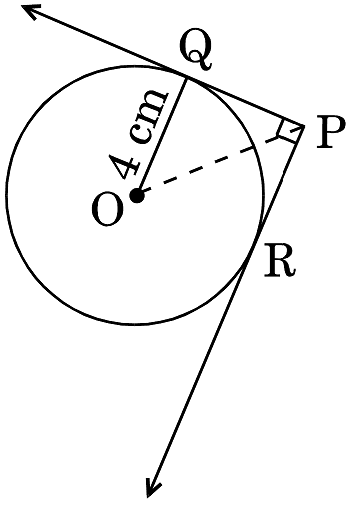
Tangents make $90^\circ$ at the point of intersection.
Thus $\text{PQO}$ and $\text{PRO}$ are $90^\circ$
$\text{QPR}$ is given $90^\circ$
Therefore,
$\text{QOR = 360 $-$ (PQR + PRO + QPR)}$
$= 360 - (90 + 90 + 90)$
$= 90$
Thus $,\text{PQOR}$ is a square.
with each side equal to $4\ cm \ ($radius of circle $- QO)$ View full question & answer→MCQ 181 Mark
In Figure, $PQ$ is tangent to the circle with centre at $O,$ at the point $B$. If $\angle\text{AOB} = 100^\circ,$ then $\angle\text{ABP}$ is equal to :
- ✓
$50^\circ$
- B
$40^\circ$
- C
$60^\circ$
- D
$80^\circ$
AnswerCorrect option: A. $50^\circ$
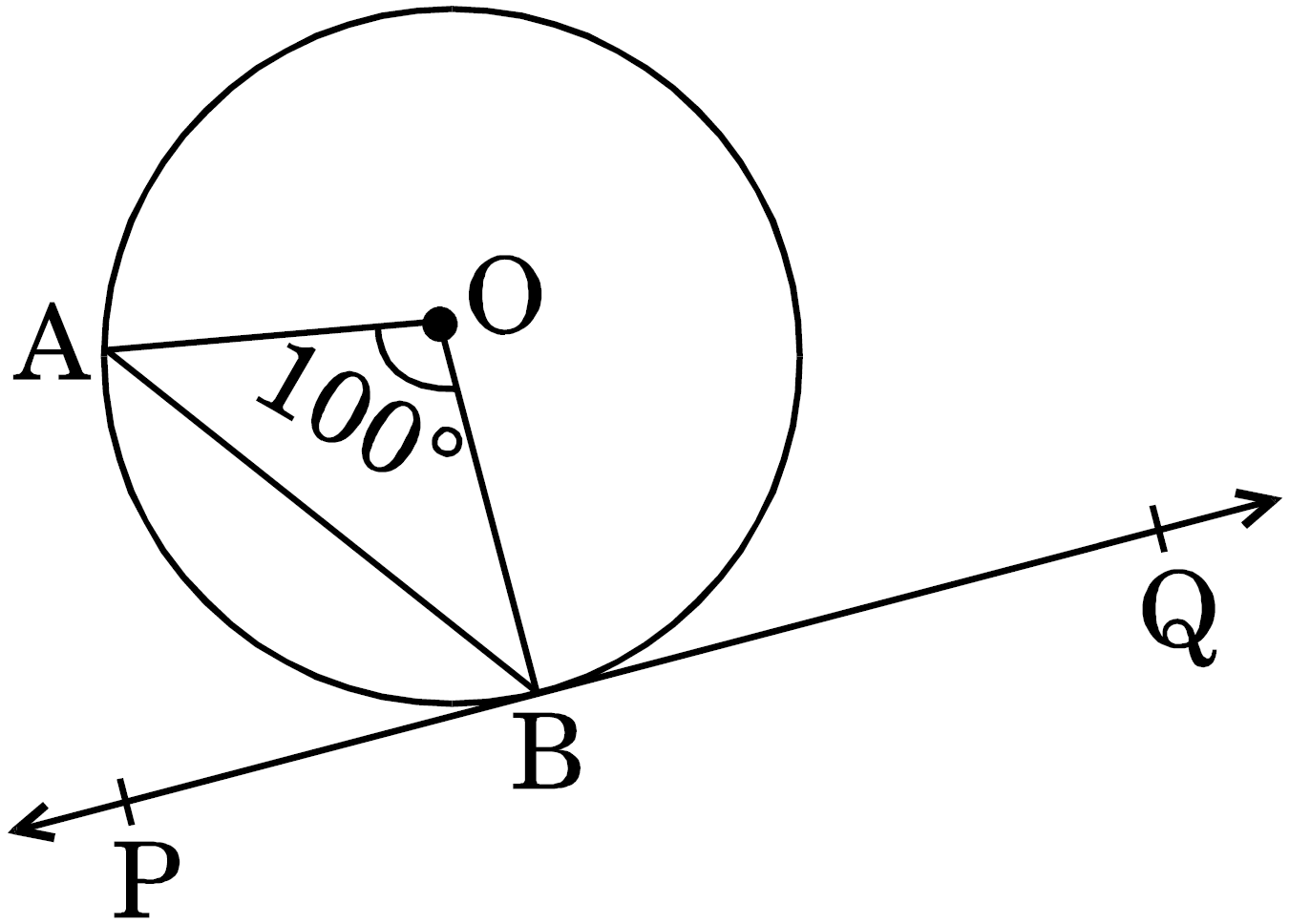
Circle,
$\text{OA = OB} \ ($radius of circle isosceles triangle$)$
$\triangle\text{OAB}$
$\angle\text{OAB}=\angle\text{OBA}$
$PQ$ is a tangent touches circle at $b$
$\text{OB}\bot\text{PQ}$
$\angle\text{OBP}=90^\circ$
$\angle\text{OBP}=\angle\text{OBA}+\angle\text{ABP}\ \dots(1)$
$\triangle\text{OAB}$
$\text{DA = OB}$
$\angle\text{OAB}=\angle\text{OBA}=\text{x}\ ($let's say$)$
Angle sum proportional,
$100+\text{x}+\text{x}=180^\circ$
$100+2\text{x}=180^\circ$
$\text{x}=\frac{80}{2} = 40$
Put the value in eq. $1^{st}$
$9 = 40 + \angle\text{ABP}$
$\angle\text{ABP} = 50^{\circ}$ View full question & answer→MCQ 191 Mark
The value of $\theta$ for which $\cos(10^\circ+\theta)=\sin30^\circ,$ is :
- ✓
$50^\circ$
- B
$40^\circ$
- C
$80^\circ$
- D
$20^\circ$
AnswerCorrect option: A. $50^\circ$
To find the value of $\theta$ in $\cos(10^\circ+\theta)=\sin30^\circ$
Now as we know
$\sin\theta=\cos(90^\circ-\theta)$
therefore; we have,
$\cos(10^\circ+\theta)=\sin30^\circ$
$\Rightarrow\cos(10^\circ+\theta)=\cos(90^\circ-30^\circ)\ \dots(1)$
Now if $\sin\text{A}=\sin\text{B}$ then $A = B$
$10+\theta=90^\circ-30^\circ$
$\Rightarrow10+\theta=60^\circ$
$\Rightarrow\theta=60^\circ-10$
$\Rightarrow\theta=50^\circ$
Hence the value of $\theta$ is $50^\circ$ View full question & answer→MCQ 201 Mark
In the given figure $,QR$ is a common tangent to the given circles touching externally at the point $T$. The tangent at $T$ meets $QR$ at $P$. If $PT = 3.8\ cm,$ then the length of $QR\ ($in $\ cm)$ is :
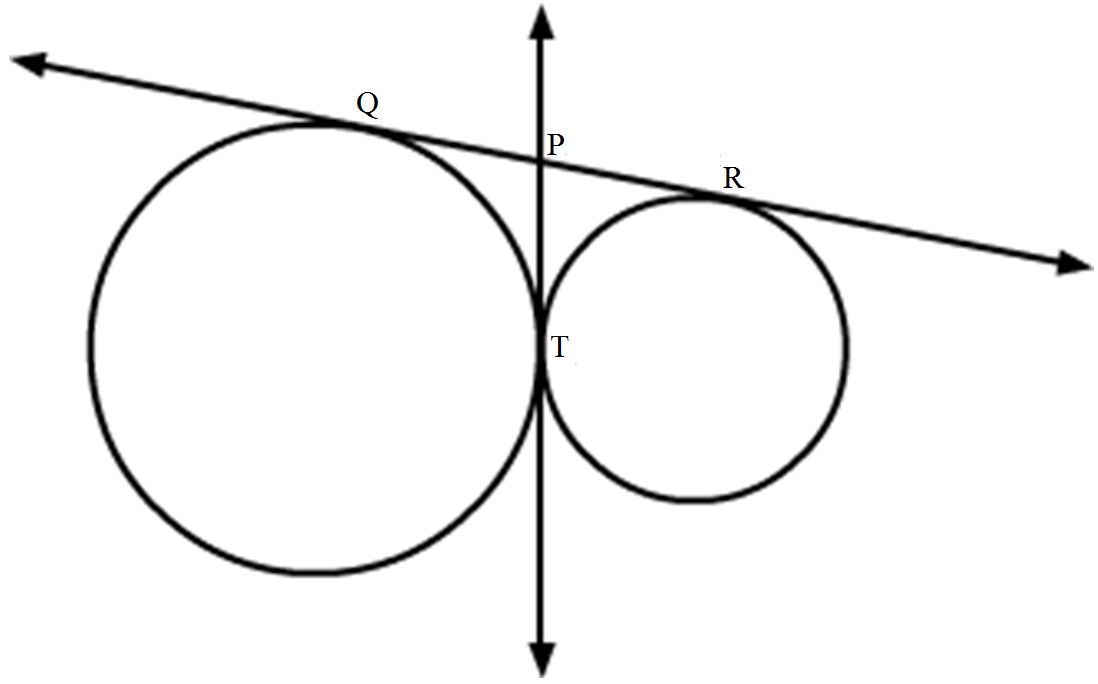
AnswerIt is given that $QR$ is a common tangent to the given circles touching externally at the point $T$.
Also, the tangent at $T$ meets $QR$ at $P$ such that $PT = 3.8\ cm.$
Now, $PQ$ and $PT$ are tangents drawn to the same circle from an external point.
$\therefore PQ = PT = 3.8\ cm\ ($Lengths of tangents drawn from an external point to a circle are equal$)$
$PR$ and $PT$ are tangents drawn to the same circle from an external point $T$.
$\therefore PR = PT = 3.8\ cm \ ($Lengths of tangents drawn from an external point to a circle are equal$)$
Now,
$QR = PQ + PR $
$= 3.8\ cm + 3.8\ cm = 7.6\ cm$
Thus, the length of $QR$ is $7.6\ cm.$
View full question & answer→MCQ 211 Mark
In the figure, a quadrilateral $\text{ABCD}$ is drawn to circumscribe a circle such that its sides $AB, BC, CD$ and $AD$ touch the circle at $P, Q, R$ and $S$ respectively. If $AB = x \ cm, BC= 7\ cm, CR = 3\ cm$ and $AS = 5\ cm,$ then $x =$
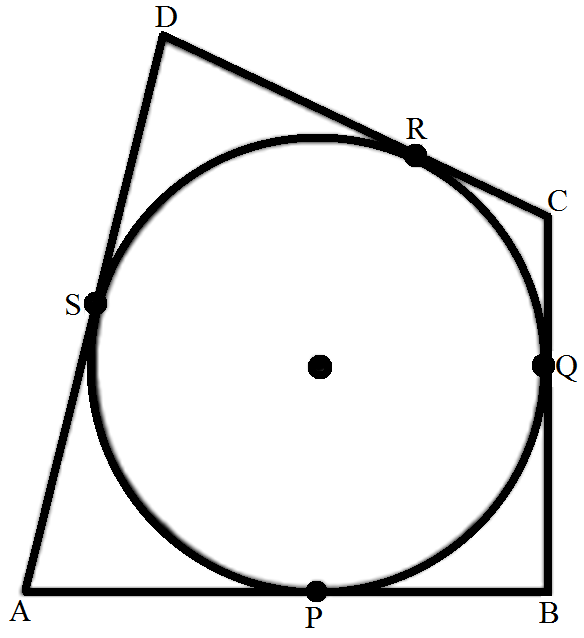
AnswerIn the given figure,
$\text{ABCD}$ is a quadrilateral circumscribe a circle and its sides $AB, BC, CD$ and $DA$ touch the circle at $P, Q, R$ and $S$ respectively.
$AB = x \ cm, BC = 7\ cm, CR = 3\ cm, AS = 5\ cm$
$CR$ and $CQ$ are tangents to the circle from $C$
$CR = CQ = 3\ cm$
$BQ = BC – CQ = 7 – 3 = 4\ cm$
$BQ =$ and $BP$ are tangents from $B$
$BP = BQ = 4\ cm$
$AS$ and $AP$ are tangents from $A$
$AP = AS = 5\ cm$
$AB = AP + BP $
$= 5 + 4 = 9\ cm$
$x = 9\ cm$
View full question & answer→MCQ 221 Mark
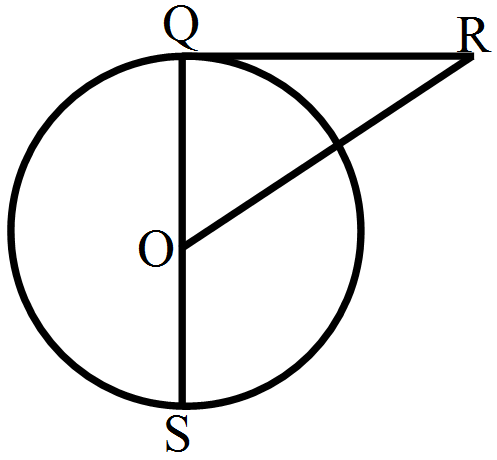
In the given figure $,RQ$ is a tangent to the circle with centre $O$. If $SQ = 6\ cm$ and $QR = 4\ cm,$ then $OR$ is equal to :
- A
$2.5\ cm$
- B
$3\ cm$
- ✓
$5\ cm$
- D
$8\ cm$
AnswerCorrect option: C. $5\ cm$
$SQ = 6\ cm $
$\Rightarrow OQ = 3\ cm$
$QR = 4\ cm$
Since $RQ$ is a tangent to the circle at $Q$.
$\angle\text{RQO}=90^\circ ....($tangent is perpendicular to the radius of a circle$)$
In $\triangle\text{RQO},$
By using Pythagoras theorem,
$O R^2=R Q^2+O Q^2 $
$ =4^2+3^2 $
$ =16+9 $
$ =25 $
$ \therefore O R^2=25 $
$\Rightarrow OR = 5\ cm$
View full question & answer→MCQ 231 Mark
Choose the correct option and give justification. If tangents PA and PB from a point P to a circle with centre O are inclined to each other at angle of 80°, then $\angle$POA is equal to:
Answera. 50°
$\because\angle$OAP = 90°
[The tangent at any point of a circle is $\perp$ to the radius through the point of contact]
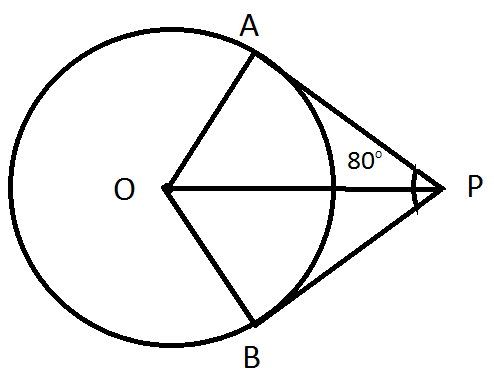
$\angle$OPA = $\frac{1}{2}\angle$BPA = $\frac{1}{2}\times$ 80° = 40°
[Centre lies on the bisector of the angle between the two tangents]
In $\triangle$OPA,
$\angle$OAP + $\angle$OPA + $\angle$POA = 180°
[Angle sum property of a triangle]
$\Rightarrow$ 90° + 40° + $\angle$POA = 180°
$\Rightarrow$ 130° + $\angle$POA = 180°
$\Rightarrow$ $\angle$POA = 50° View full question & answer→MCQ 241 Mark
Each question consists of two statements, namely, Assertion $(A)$ and Reason $(R)$. for selecting the correct answer, use the following code:
|
Assertion $(A)$
|
Reason $(R)$
|
|
At a point $P$ of a circle with centre $O$ and radius $12\ cm,$ a tangent $PQ$ of length $16\ cm$ is drawn. Then, the point of contact. $OQ = 20\ cm.$
|
The tangent at any point of a circle is perpendicular to the radius through the point of contact.
|
- ✓
Both Assertion $(A)$ and Reason $(R)$ are true and Reason $(R)$ is a correct explanation of Assertion $(A)$.
- B
Both Assertion $(A)$ and Reason $(R)$ are true but Reason $(R)$ is not a correct explanation of Assertion $(A).$
- C
Assertion $(A)$ is true and Reason $(R)$ is false.
- D
Assertion $(A)$ is false and Reason $(R)$ is true.
AnswerCorrect option: A. Both Assertion $(A)$ and Reason $(R)$ are true and Reason $(R)$ is a correct explanation of Assertion $(A)$.
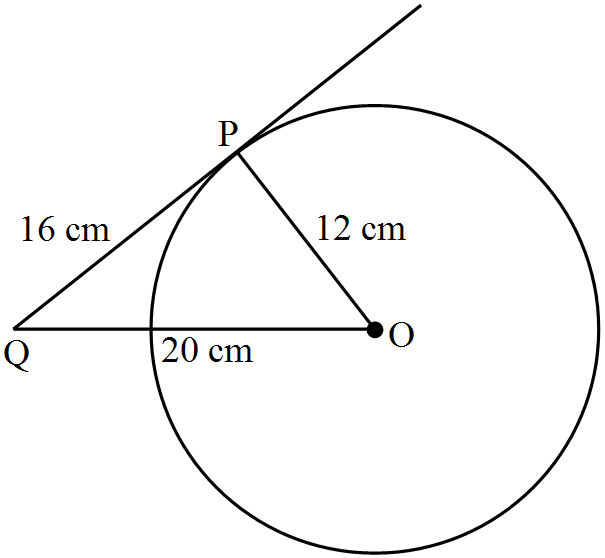
We know that the tangent is perpendicular to the radius of a circle.
In $\triangle\text{OPQ},$
By Pythagoras theorem,
$ \mathrm{OQ}^2=\mathrm{QP}^2+\mathrm{OP}^2 $
$ \Rightarrow \mathrm{OP}^2=16^2+12^2 $
$ \Rightarrow O P^2=256+144 $
$ \Rightarrow O P^2=400 $
$\Rightarrow OP = 20\ cm$
So, the Assertion $(A)$ is true.
The Reason $(R)$ is true and is the correct explanation for the Assertion $(A).$ View full question & answer→MCQ 251 Mark
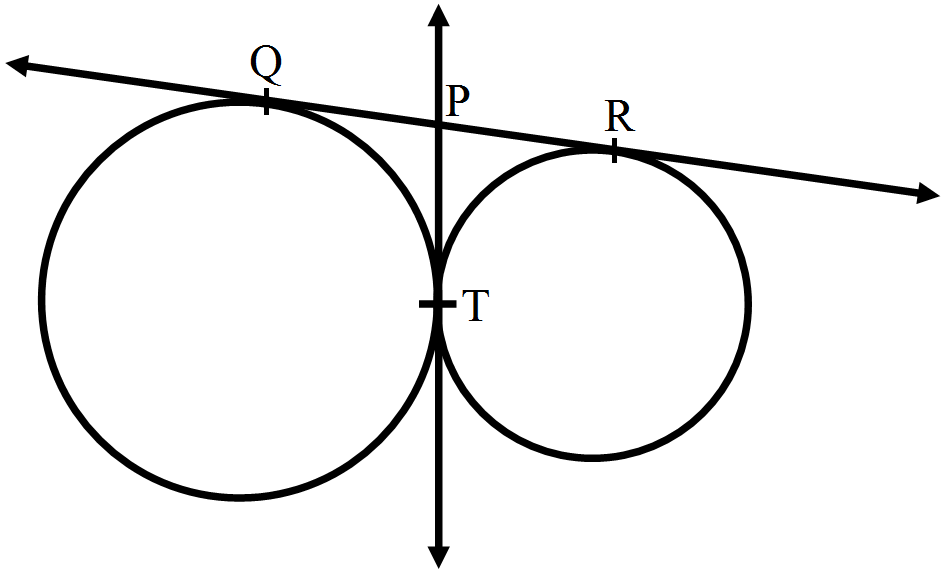
In the given figure, $QR$ is a common tangent to the given circle, touching externally at the point $T$. The tangent at $T$ meets $QR$ at $P$. If $PT = 3.8\ cm$ then the length of $QR$ is :
- A
$1.9\ cm$
- B
$3.8\ cm$
- C
$5.7\ cm$
- ✓
$7.6\ cm$
AnswerCorrect option: D. $7.6\ cm$
We know that tangent from an external point to the circle are equal.
$PQ = PT = 3.8\ cm$
$PR = PT = 3.8\ cm$
$QR = PQ + PR$
$= 3.8 +3.8$
$=7.6\ cm$
View full question & answer→MCQ 261 Mark
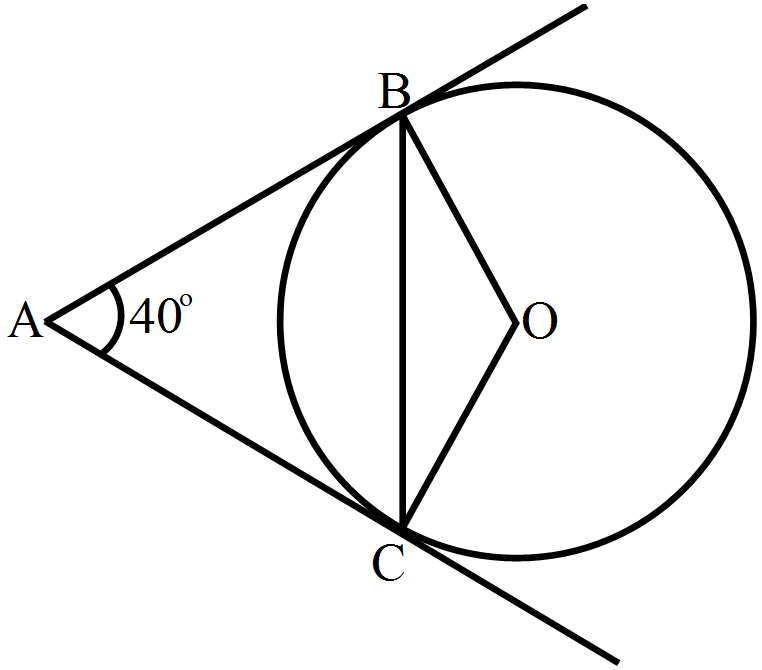
In the given figure, $AB$ and $AC$ are tangent to the circle with centre $O$ such that $\angle\text{BAC}=40^\circ.$ Then, $\angle\text{BOC}$ is equal to :
- A
$80^\circ$
- B
$100^\circ$
- C
$120^\circ$
- ✓
$140^\circ$
AnswerCorrect option: D. $140^\circ$
Since $AB$ and $AC$ are the tangent to the circle.
$\angle\text{OBA}=\angle\text{BAC}=90^\circ....($tangent is perpendicular to the radius of a circle$)$
In $\text{ABOC}$
$\angle\text{OBA}+\angle\text{BAC}+\angle\text{OCA}+\angle\text{BOC}=360^\circ$
$\Rightarrow90^\circ+40^\circ+90^\circ+\angle\text{BOC}=360^\circ$
$\Rightarrow\angle\text{BOC}=140^\circ$
View full question & answer→MCQ 271 Mark
In the given figure, quadrilateral $\text{ABCD}$ is circumscribed, touching the circle at $P, Q, R$ and $S$. If $AP = 5\ cm, BC = 7\ cm$ and $CS = 3\ cm, AB =?$
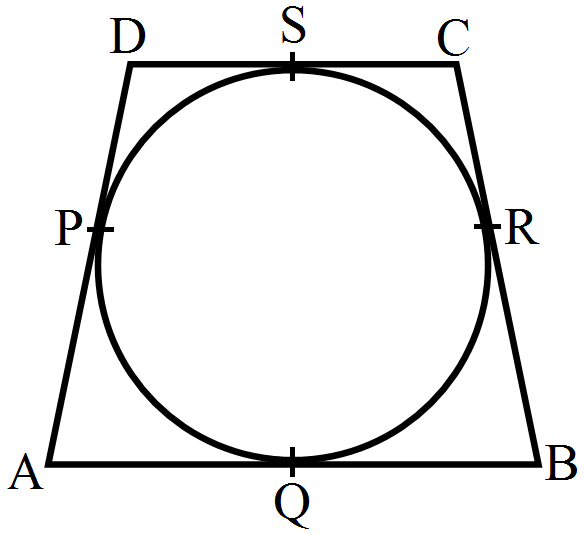
- ✓
$9\ cm$
- B
$10\ cm$
- C
$12\ cm$
- D
$8\ cm$
AnswerCorrect option: A. $9\ cm$
We know that tangent from an external point to the circle are equal.
$AP = AQ = 5\ cm$
$CS = CR = 3\ cm$
$RB = BC - CR$
$= 7 +3$
$=4\ cm$
So $,BQ = RB = 4\ cm$
Thus $, AB = AQ + RB$
$ = 5 + 4 = 9\ cm$
View full question & answer→MCQ 281 Mark
In Figure, if $O$ is the centre of a circle $,PQ$ is a chord and the tangent $PR$ at $P$ makes an angle of $50^\circ$ with $PQ,$ then $\angle\text{POQ}$ is equal to :
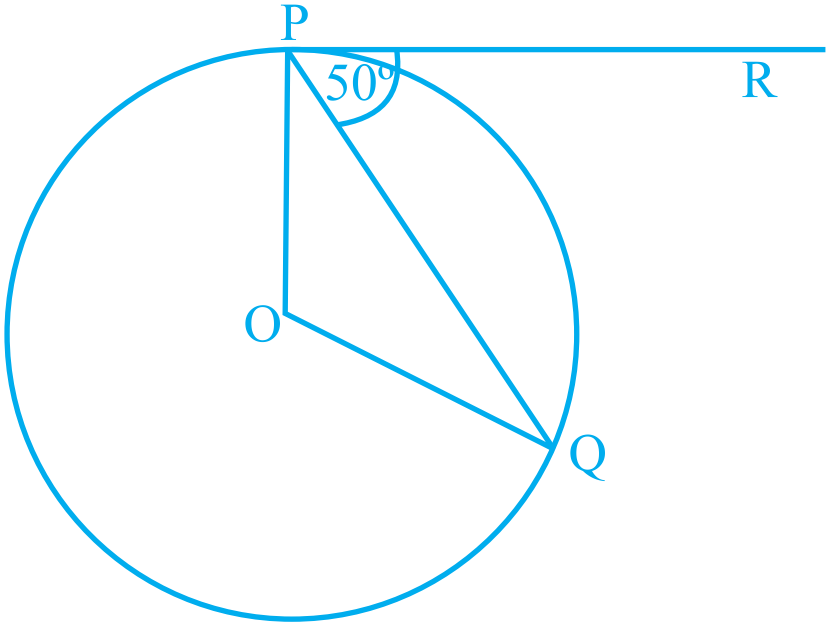
- ✓
$100^\circ$
- B
$80^\circ$
- C
$90^\circ$
- D
$75^\circ$
AnswerCorrect option: A. $100^\circ$
Given, $\angle\text{QPR}=50^\circ$
We know that, the tangent at any point of a circle is perpendicular to the radius through the point of contact.
$\therefore\ \angle\text{OPR}=90^\circ$
$\Rightarrow\ \angle\text{OPQ}+\angle\text{QPR}=90^\circ\ \ [$from figure$]$
$\Rightarrow\ \angle\text{OPQ}=90^\circ-50^\circ=40^\circ\ \ [\because\angle\text{QPR}=50^\circ]$
Now $,OP = OQ =$ Radius of circle
$\therefore\ \angle\text{OQP}=\angle\text{OPQ}=40^\circ$
$[$since, angles opposite to equal sides are equal$]$
In $\triangle\text{OPQ},\ \ \angle\text{O}+\angle\text{P}+\angle\text{Q}=180^\circ$
$[$since, sum of angles of a triangle $= 180^\circ ]$
$\Rightarrow\ \angle\text{O}=180^\circ-(40^\circ+40^\circ)\ \ [\because\angle\text{P}=40^\circ=\angle\text{Q}]$
$= 180^\circ - 80^\circ = 100^\circ$
View full question & answer→MCQ 291 Mark
In the given figure, if $AD, AE$ and $BC$ are tangents to the circle at $D, E$ and $F$ respectively, Then :
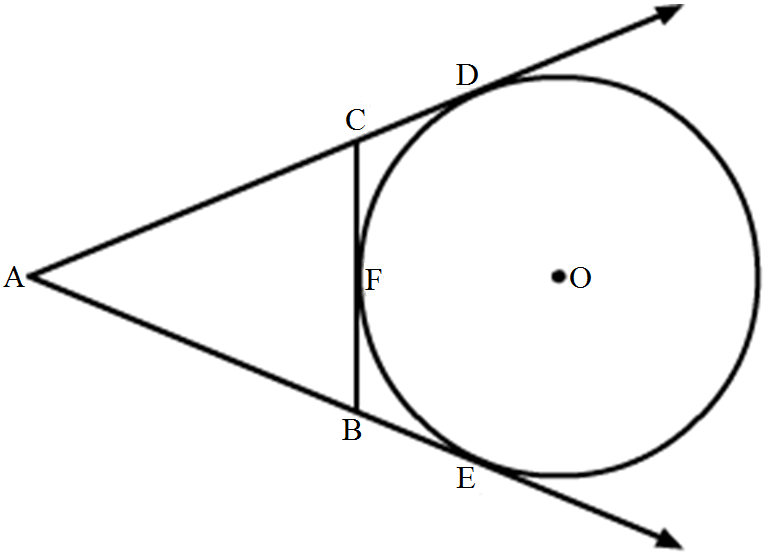
- A
$AD = AB + BC + CA$
- ✓
$2AD = AB + BC + CA$
- C
$3AD = AB + BC + CA$
- D
$4AD = AB + BC + CA$
AnswerCorrect option: B. $2AD = AB + BC + CA$
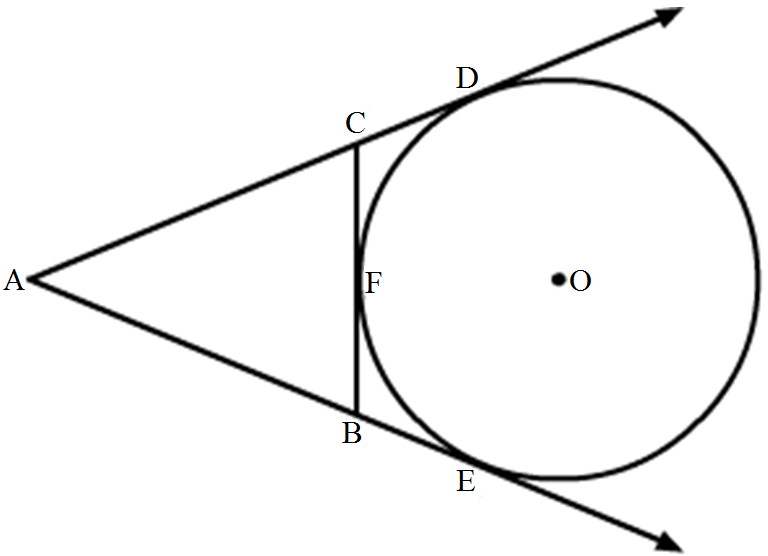
By the property of tangent
$AC = AB \ ($tangent from $A)...(i)$
$CD = CF \ ($tangent from $C)...(ii)$
$BF = BE \ ($tangent from $B)...(iii)$
Now taking $\text{RHS},$
$AB + BC + CA = AB + BF + FC + CA$
$AB + BC + CA = AB + BE + CD + CA \ [$from $(ii) $ and $ (iii) ]$
$AB + BC + CA = AE + AD$
$AB + BC + CA = 2AD$ View full question & answer→MCQ 301 Mark
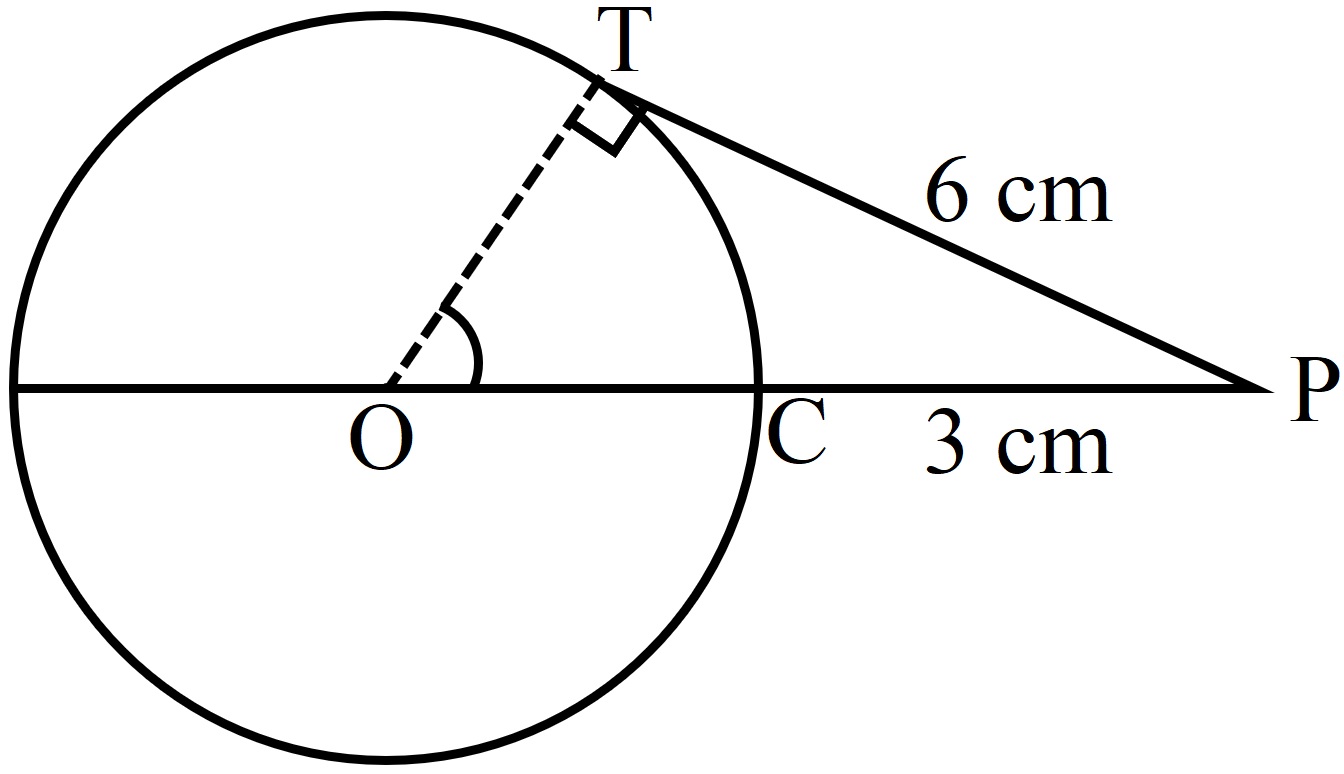
In the given figure $,O$ is the centre of the circle and $PT$ is a tangent at $T$. If $PC = 3\ cm$ and $PT = 6\ cm,$ then the radius of the circle is equal to :
- A
$6\ cm$
- B
$5\ cm$
- C
$7\ cm$
- ✓
$4.5\ cm$
AnswerCorrect option: D. $4.5\ cm$
In right angled triangle $\text{OTP},$
Let the radius of the circle be $r \ cm,$ then $OT = OC = r$
$OP^2= OT^2+ PT^2$
$\Rightarrow (r + 3)^2= r^2+ 6^2$
$\Rightarrow r^2+ 6r + 9 = r^2+ 36$
$\Rightarrow 6r = 27$
$ \Rightarrow r = 4.5\ cm$
View full question & answer→MCQ 311 Mark
The length of the tangent from a point $A$ at a circle, of radius $3 \ cm,$ is $4 \ cm$. The distance of $A$ from the centre of the circle is :
- A
$\sqrt{7}\text{ cm}$
- B
$7\ cm$
- ✓
$5\ cm$
- D
$25\ cm$
AnswerCorrect option: C. $5\ cm$
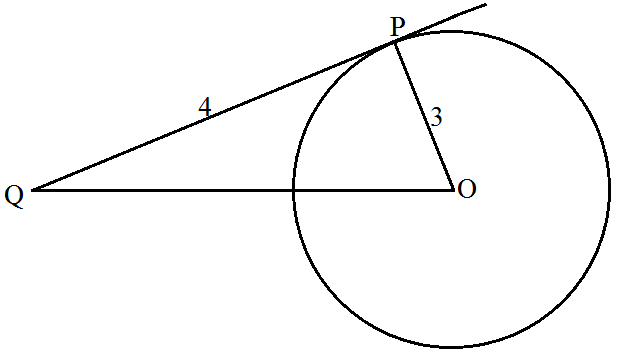
We know, radius always perpendicular to tangent so we say $\triangle\text{OPA}$ is right angle triangle then $\angle\text{OPA}=90^{\circ}$
Now, we have to find $OA$
$ \Rightarrow O A^2=A P^2+O P^2 $
$ \Rightarrow O A^2=4^2+3^2 $
$ \Rightarrow O A^2=16+9 $
$\Rightarrow OA = \sqrt{25}$
$\Rightarrow OA = 5$
Hence, correct choice is $(c)$ View full question & answer→MCQ 321 Mark
If $PT$ is tahgent drawn froth a point $P$ to a circle touching it at $T$ and $O$ is the centre of the circle, then $\angle OPT + \angle POT =$
- A
$30^\circ$
- B
$60^\circ$
- ✓
$90^\circ$
- D
$180^\circ$
AnswerCorrect option: C. $90^\circ$
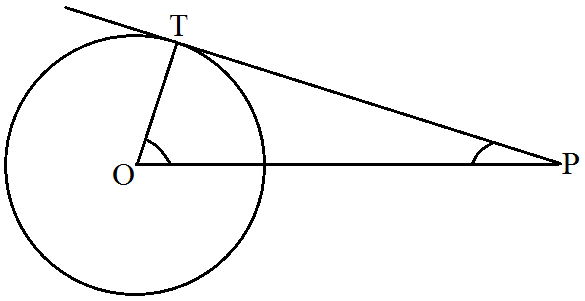
In the figure, $PT$ is the tangent to the circle with centre $O$.
$OP$ and $OT$ are joined
$PT$ is tangent and $OT$ is the radius
$OT \perp PT$
Now in right $\triangle\text{OTP}$
$\angle\text{OTP}=90^{\circ}$
$\angle\text{OPT}+\angle\text{POT}$
$=180^{\circ}-90^{\circ}=90^{\circ}$ View full question & answer→MCQ 331 Mark
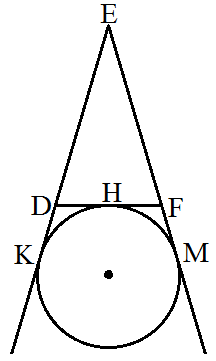
In the figure, a circle touches the side $DF$ of $\triangle\text{EDF}$ at $H$ and touches $ED$ and $EF$ produced at $K$ and $M$ respectively. If $EK = 9\ cm,$ then the perimeter $\triangle\text{EDF}$ of is :
- ✓
$18\ cm$
- B
$13.5\ cm$
- C
$12\ cm$
- D
$9\ cm$
AnswerCorrect option: A. $18\ cm$
In $\triangle\text{DEF}\ \ DF$ touches the circle at $H$ and circle touches $ED$ and $EF$ Produced at $K$ and $M$ respectively.
$EK = 9\ cm$
$EK$ and $EM$ are the tangents to the circle.
$EM = EK = 9\ cm$
Similarly $DH$ and $DK$ are the tangent.
$DH = DK$ and $FH$ and $FM$ are tangents.
$FH = FM$
Now, perimeter of $\triangle\text{DEF}$
$= ED + DF + EF$
$= ED + DH + FH + EF$
$= ED + DK + EM + EF$
$= EK + EM$
$= 9 + 9$
$= 18\ cm.$
View full question & answer→MCQ 341 Mark
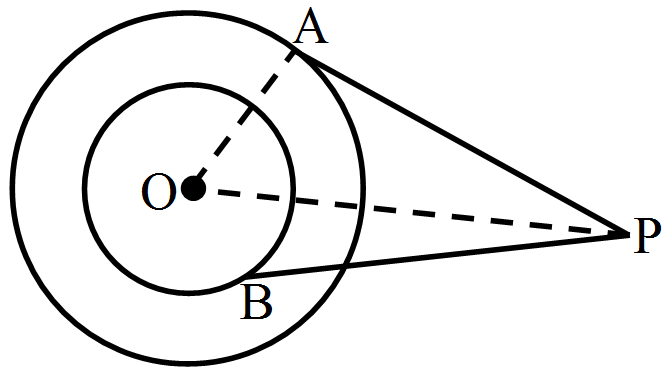
In the given figure, $O$ is the centre of two concentric circles of radii $5\ cm$ and $3\ cm$. From an external point $P$ tangents $PA$ and $PB$ are drawn to these circles. If $PA = 12\ cm$ then $PB$ is equal to :
- A
$5\sqrt{2}\text{ cm}$
- B
$3\sqrt{5}\text{ cm}$
- ✓
$4\sqrt{10}\text{ cm}$
- D
$5\sqrt{10}\text{ cm}$
AnswerCorrect option: C. $4\sqrt{10}\text{ cm}$
Construction : Join $OB.$
We know that tangent is perpendicular to the radius of a circle.
In $\triangle\text{OPA},$
By Pythagoras theorem,
$OP^2= OA^2+ AP^2$
$\Rightarrow OP^2= 5^2+ 12^2$
$\Rightarrow OP^2= 169$
$\Rightarrow OP = 13\ cm$
In $\triangle\text{OPB},$
By Pythagoras theorem,
$OP^2= OB^2+ PB^2$
$\Rightarrow PB^2= OP^2- OB^2$
$\Rightarrow PB^2= 13^2- 3^2$
$\Rightarrow PB^2= 160$
$\Rightarrow \text{PB} =4\sqrt{10}\text{ cm} $
View full question & answer→MCQ 351 Mark
In the given figure, there are two concentric circles with centre $O. PR$ and $\text{PQS}$ are tangents to the inner circle from point plying on the outer circle. If $PR = 7.5\ cm,$ then $PS$ is equal to :
- A
$10\ cm$
- B
$12\ cm$
- ✓
$15\ cm$
- D
$18\ cm$
AnswerCorrect option: C. $15\ cm$
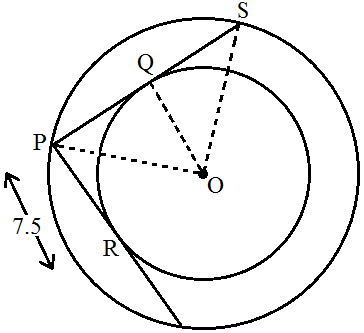
Here$, PO = OS\ ($radius$)$
then $\triangle\text{POS}$ called isosceles triangle.
We know, In isosceles triangle line drawn from vertex to base, then line bisects the base in equal parts.
so we say,
$PQ = QS ...(i)$
From the property of tangent
$PR = PQ = 7.5\ cm\ [$tangent from point $P] ...(ii)$
Now we have to find $PS,$
$PS = PQ + QS$
$\Rightarrow PS = PQ + PQ \ [$from eq $.(i)]$
$\Rightarrow PS = 7.5 + 7.5\ [$fromeq $.(ii)]$
$\Rightarrow PS =15\ cm$ View full question & answer→MCQ 361 Mark
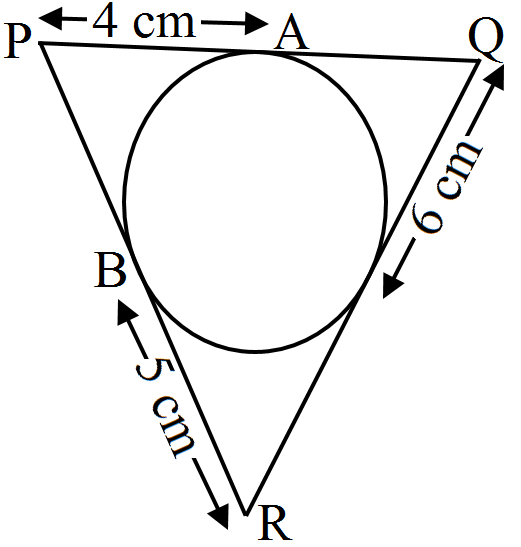
The perimeter of $\triangle\text{PQR}$ in the given figure is :
- A
$15\ cm$
- B
$60\ cm$
- C
$45\ cm$
- ✓
$30\ cm$
AnswerCorrect option: D. $30\ cm$
Since Tangents from an external point to a circle are equal.
$\therefore\text{PA}=\text{PB}=4\text{ cm,}$
$\text{BR} = \text{CR} = 5\text{ cm}$
$\text{CQ} = \text{AQ }= 6 \text{ cm}$
Perimeter of $ \angle\text{PQR} = \text{PQ} + \text{QR} + \text{RP}$
$= PA + AQ + QC + CR + BR + PB$
$= 4 + 6 + 6 + 5 + 5 + 4 = 30\ cm$
View full question & answer→MCQ 371 Mark
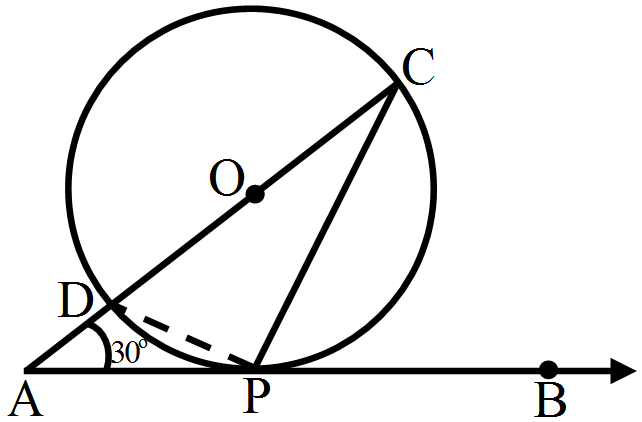
In the given figure $,O$ is the centre of the circle. $AB$ is the tangent to the circle at the point $P$. If $\angle\text{PAO} = 30^\circ$ then $\angle\text{CPB} + \angle\text{ACP}$ is equal to :
- A
$60^\circ$
- ✓
$90^\circ$
- C
$120^\circ$
- D
$150^\circ$
AnswerCorrect option: B. $90^\circ$
Since $\text{APB}$ is a straight line,
$\angle\text{APD}+\angle\text{DPC}+\angle\text{CPB}=180^\circ $
We know that angles that subtend the same arc are equal.
$\Rightarrow\angle\text{APD}=\angle\text{ACP}$
$\Rightarrow\angle\text{ACP}+90^\circ+\angle\text{CPB}=180^\circ ....($Since $\angle\text{DPC}$ is inscribed in a semicircle$)$
$\Rightarrow\angle\text{CPB}+\angle\text{ACP}=90^\circ$
View full question & answer→MCQ 381 Mark
In figure $,PA$ and $PB$ are two tangents drawn from an external point $P$ to a circle with centre $C$ and radius $4 \ cm$. If $\text{PA} \bot\text{PB} ,$ then the length of each tangent is :
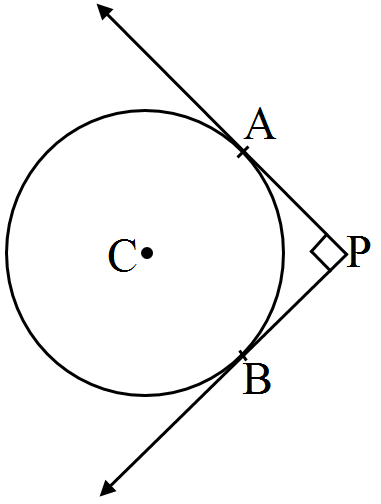
- A
$5\ cm$
- B
$3\ cm$
- ✓
$4\ cm$
- D
$8\ cm$
AnswerCorrect option: C. $4\ cm$
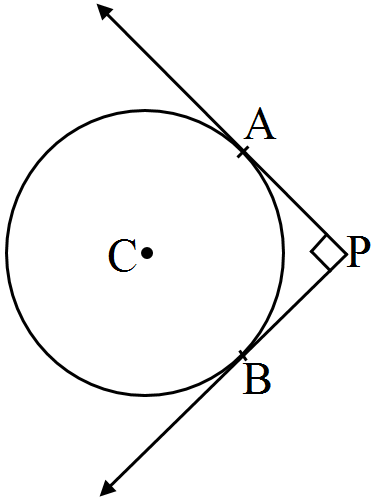
Construction: Joined $AC$ and $BC$.
Here $\text{CA}\bot\text{AP}$ and $\text{CB} \bot \text{BP}$ and $\text{PA} \bot\text{PB} $ Also $AP = PB$
Therefore $,\text{BPAC}$ is a square.
$\Rightarrow AP = PB = BC = 4\ cm$ View full question & answer→MCQ 391 Mark
Each question consists of two statements, namely, Assertion $(A)$ and Reason $(R)$. for selecting the correct answer, use the following code :
|
Assertion $(A)$
|
Reason $(R)$
|
| If two tangent are drawn to a circle from an external point then they subtend equal angles at the centre. |
A parallelogram circumscribing a circle is a rhombus. |
- A
Both Assertion $(A)$ and Reason $(R)$ are true and Reason $(R)$ is a correct explanation of Assertion $(A)$.
- ✓
Both Assertion $(A)$ and Reason $(R)$ are true but Reason $(R)$ is not a correct explanation of Assertion $(A).$
- C
Assertion $(A)$ is true and Reason $(R)$ is false.
- D
Assertion $(A)$ is false and Reason $(R)$ is true.
AnswerCorrect option: B. Both Assertion $(A)$ and Reason $(R)$ are true but Reason $(R)$ is not a correct explanation of Assertion $(A).$
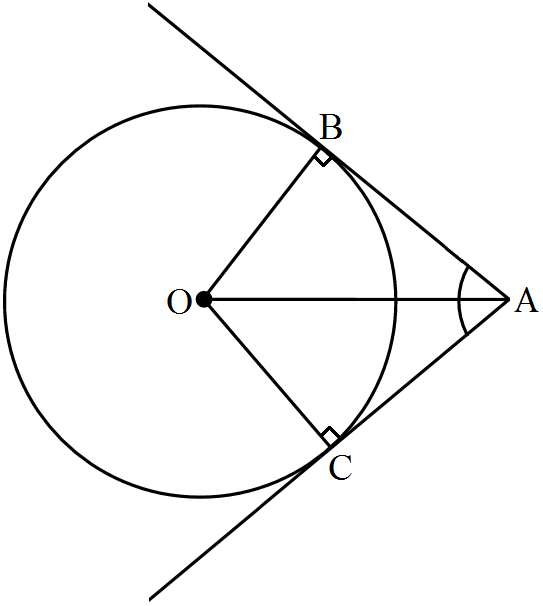
Consider tangent $AB$ and $AC$ drawn to the circle with centre $O$.
In $\triangle\text{OBA}$ and $\triangle\text{OCA},$
$\text{AO}=\text{AO} ....($common side$)$
$\text{OB}=\text{OC} .....($radii of the same circle$)$
$\angle\text{B}=\angle\text{C}=90^\circ$
$\Rightarrow\triangle\text{OBA}\cong\triangle\text{OCA} ....(\text{RHS}$ congruence criterion$)$
So, $\angle\text{OBA}=\angle\text{COA} ....(\text{cpct})$
Thus, the $(R)$ is also true and can be proved using the property, 'tangent from an external point to a circle are equal'
But, the Reason $(R)$ is not the correct explanation for the Assertion $(A).$ View full question & answer→MCQ 401 Mark
In figure, $ AB$ is a chord of a circle and $AT$ is a tangent at $A$ such that $\angle\text{BAT}=60^\circ,$ measure of $\angle\text{ACB}$ is :
- A
$110^\circ$
- B
$90^\circ$
- C
$150^\circ$
- ✓
$120^\circ$
AnswerCorrect option: D. $120^\circ$
Since $OA$ is perpendicular to $AT,$ then $\angle\text{OAT}=90^\circ$
$\Rightarrow\angle \text{OAB}+\angle\text{BAT}=90^\circ$
$\angle \text{OAB}+60^\circ=90^\circ$
$\Rightarrow\angle\text{OAB}=30^\circ$
$\therefore\angle\text{OAB}=\angle\text{OAB}=30^\circ\ [$Angles opposite to radii$]$
$\therefore\angle\text{OBA}=180^\circ-(30^\circ+30^\circ)=120^\circ\ [$Angles sum property of a triangle$]$
$\therefore \text{Reflex}\ \angle\text{AOB}=360^\circ-120^\circ=240^\circ$
Now, since the arc $AB$ of a circle makes an angle which is equal to twice the angle $\text{ACB}$ subtended by it at the circumference.
$\therefore \text{Reflex}\ \angle\text{AOB}=\angle\text{ACB}$
$\Rightarrow240^\circ=2\angle\text{ABC}$
$\therefore\angle \text{ABC}=120^\circ$
View full question & answer→MCQ 411 Mark
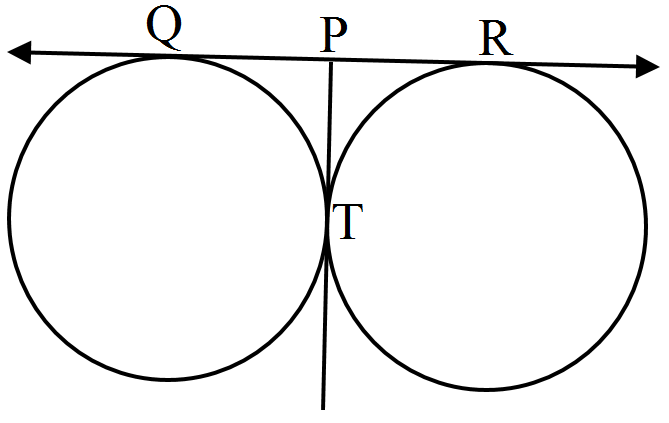
In the given figure if $QP = 4.5\ cm,$ then the measure of $QR$ is equal to :
- A
$15\ cm$
- ✓
$9\ cm$
- C
$18\ cm$
- D
$13.5\ cm$
AnswerCorrect option: B. $9\ cm$
Here $QP = PT = 4.5\ cm \ [$Tangents to a circle from an external point $P]$
Also $PT = PR = 4.5\ cm \ [$Tangents to a circle from an external point $P]$
$\therefore QR = QP + PQ $
$= 4.5 + 4.5 = 9\ cm$
View full question & answer→MCQ 421 Mark
In the given figure, $O$ is the centre of the circle $AB$ is a chord and $AT$ is the tangent at $A$. If $\angle\text{AOB} = 100^\circ$ then $\angle\text{BAT} $ is equal to :
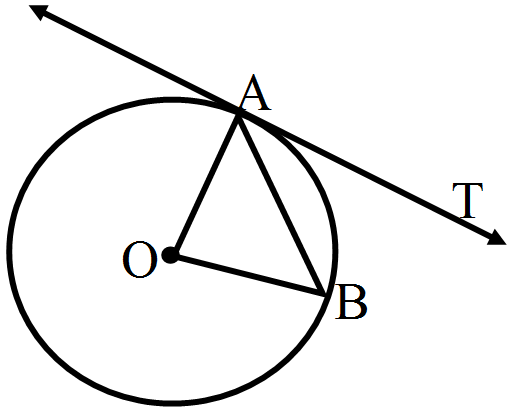
- A
$40^\circ$
- ✓
$50^\circ$
- C
$90^\circ$
- D
$100^\circ$
AnswerCorrect option: B. $50^\circ$
In $\triangle\text{OAB},$
$\text{OA}=\text{OB} ....($radii of the same circle$)$
$\Rightarrow\angle\text{OAB}=\angle\text{OAB} ....($angles opposite equal sides are equal$)$
$\angle\text{AOB}+\angle\text{OAB}+\angle\text{OBA}=180^\circ\ ($Angle Sum Property$)$
$\Rightarrow\angle\text{AOB}+\angle\text{OAB}+\angle\text{OAB}=180^\circ$
$\Rightarrow100^\circ+2\angle\text{OAB}=180^\circ$
$\Rightarrow2\angle\text{OAB}=80^\circ$
$\Rightarrow\angle\text{OAB}=40^\circ$
Since $AT$ is the tangent,
$\angle\text{OAT}=90^\circ$
$\Rightarrow\angle\text{OAB}+\angle\text{BAT}=90^\circ$
$\Rightarrow40^\circ+\angle\text{BAT}=90^\circ$
$\Rightarrow\angle\text{BAT}=50^\circ$
View full question & answer→MCQ 431 Mark
In the given figure, if $AB = 8\ cm$ and $PE = 3\ cm,$ then $AE =$
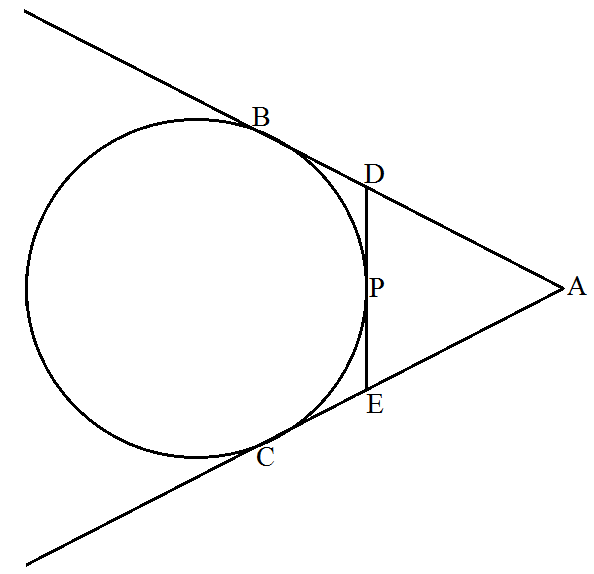
- A
$11\ cm$
- B
$7\ cm$
- ✓
$5\ cm$
- D
$3\ cm$
AnswerCorrect option: C. $5\ cm$
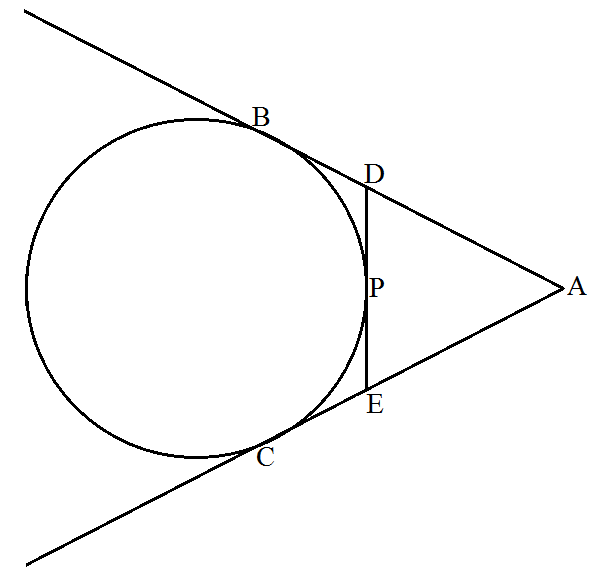
We know that tangents drawn from the same external point will be equal in length.
Therefore,
$AB = AC$
It is given that,
$AB = 8\ cm$
Hence,
$AC = 8\ cm …… (1)$
Similarly,
$PE = CE$
It is given that,
$PE = 3\ cm$
Therefore,
$CE = 3\ cm …… (2)$
Subtracting equations $(1)$ and $(2),$ we get,
$AC − CE = 8 − 3$
From the figure we can see that,
$AC − CE = AE$
Therefore,
$AE = 8 − 3$
$AE = 5\ cm$ View full question & answer→MCQ 441 Mark
In the given figure $,RQ$ is a tangent to the circle with centre $O$. If $SQ = 6\ cm$ and $QR = 4\ cm,$ then $OR =$
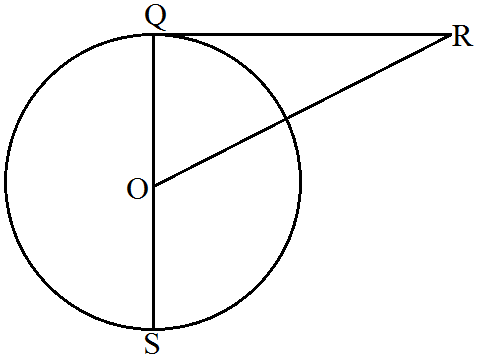
- A
$8\ cm$
- B
$3\ cm$
- C
$2.5\ cm$
- ✓
$5\ cm$
AnswerCorrect option: D. $5\ cm$
In the figure $, O$ is the centre of the circle $QR$ is tangent to the circle and $\text{QOS}$ is a diameter $SQ = 6\ cm, QR = 4\ cm$
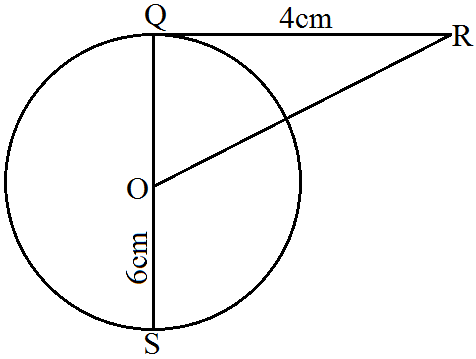
$\text{OQ}=\ \frac{1}{2}\ \text{QS}=\frac{1}{2}\times6=3\text{ cm}$
$OQ$ is radius
$OQ \perp QR$
Now in right $\triangle\text{OQR}$
$\mathrm{OR}^2=\mathrm{QR}^2+\mathrm{QO}^2$
$=(3)^2+(4)^2$
$=9+16=25=(5)^2$
$OR = 5\ cm$
View full question & answer→MCQ 451 Mark
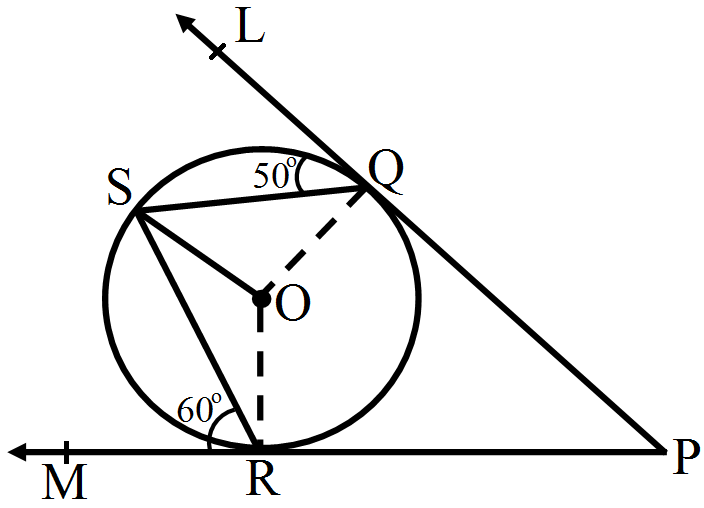
In the given figure $,O$ is the centre of a circle; $\text{PQL}$ and $\text{PRM}$ are the tangents at the points $Q$ and $R$ respectively, and $S$ is a point on the circle, such that $\angle\text{SQL} = 50^\circ.$ and $\angle\text{SRM} = 60^\circ.$ Find $ \angle\text{QSR}=?$
- A
$40^\circ$
- B
$50^\circ$
- C
$60^\circ$
- ✓
$70^\circ$
AnswerCorrect option: D. $70^\circ$
Since $PL$ and $PM$ are the tangent to the circle.
$\angle\text{OQL}=\angle\text{ORM}=90^\circ \ ($tangent is perpendicular to the radius of a circle$)$
So,
$\angle\text{OQL}+\angle\text{SQL}+\angle\text{OQS}$
$\Rightarrow90^\circ=50^\circ+\angle\text{OQS}$
$\Rightarrow\angle\text{OQC}=40^\circ$
Similarly, we can find $\angle\text{ORS}=30^\circ.$
In $\triangle\text{OQS},$
$\text{OQ}=\text{OS}$
$\angle\text{OQS}=\angle\text{OSQ}=40^\circ ...($angles opposite equal sides are equal$)$
In $\triangle\text{ORS},$
$\text{OR}=\text{OS}$
$\angle\text{ORS}=\angle\text{OSR}=30^\circ$
So, $\angle\text{QSR}=\angle\text{OSQ}+\angle\text{OSR}$
$=40^\circ+30^\circ=70^\circ.$
View full question & answer→MCQ 461 Mark
If two tangents inclined at a angle of $60^\circ$ are drawn to a circle of radius $3\ cm,$ then length of each tangent is equal to :
AnswerCorrect option: D. $3\sqrt{3}\text{ cm}$
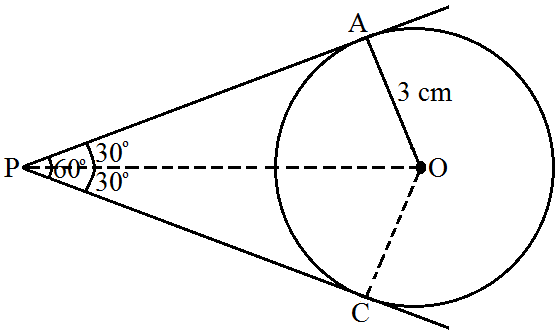
Let $P$ be an external point and a pair of tangents is drawn from point $P$ and angle between these two tangents is $60^\circ $. Join $OA$ and $OP.$
Also, $OP$ is a bisector of line.
$\angle\text{APO}=\angle\text{CPO}=30^\circ$
Also $, OA \perp AP$
Tangent at any point of a circle is perpendicular to the radius through the point of contact.
In right angled $\triangle\text{OAP},\tan30^\circ=\frac{\text{OA}}{\text{AP}}=\frac{3}{\text{AP}}$
$\Rightarrow\frac{1}{\sqrt{3}}=\frac{3}{\text{AP}}$
$\Rightarrow\text{AP}=3\sqrt{3}\text{ cm}$
Hence, the length of each tangent is $3\sqrt{3}\text{ cm}$ View full question & answer→MCQ 471 Mark
If angle between two radii of a circle is $130^\circ,$ the angle between the tangent at the ends of radii is :
- A
$90^\circ$
- ✓
$50^\circ$
- C
$70^\circ$
- D
$40^\circ$
AnswerCorrect option: B. $50^\circ$
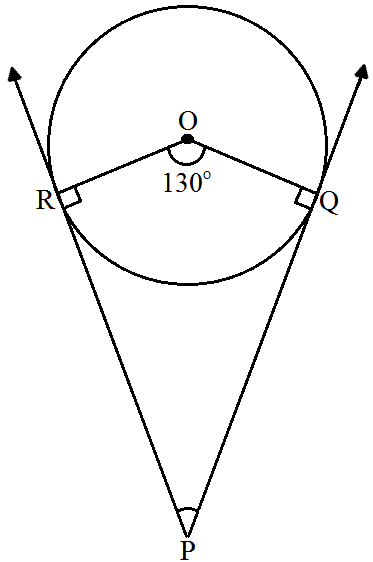
Let $PQ$ and $RP$ be the radii of the circle with the centre $O$.
$\angle\text{ROQ}=130^\circ$
$\text{RP}\bot\text{OR}$ and $ \text{PQ}\bot\text{OQ} \ ($Radii are perpendicular to the tangent$)$
In quadilateral $\text{ROQP},$
$\angle\text{ORP}+\angle\text{RPQ}+\angle\text{PQO}+\angle\text{QOR}=360^\circ$
$\Rightarrow90^\circ+\angle\text{RPQ}+90^\circ+130^\circ=360^\circ$
$\Rightarrow\angle\text{RPQ}=50^\circ$
View full question & answer→MCQ 481 Mark
In the figure, if $PR$ is tangent to the circle at $P$ and $Q$ is the centre of the circle, then $\angle POQ =$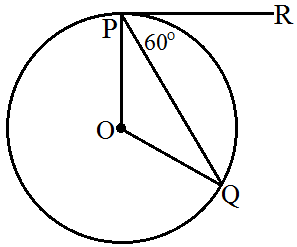
- A
$110^\circ$
- B
$100^\circ$
- ✓
$120^\circ$
- D
$90^\circ$
AnswerCorrect option: C. $120^\circ$
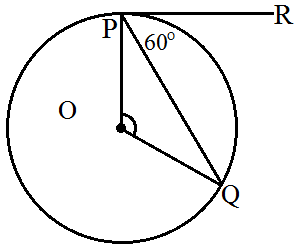
We know, radius $OP\bot $ to tangent $PR$ then $\angle\text{OPR}=90^{\circ}$
Now,
$\angle\text{OPQ}=\angle\text{OPR}-\angle\text{QPR}$
$\angle\text{OPQ}=90^{\circ}-60^{\circ}$
$\angle\text{OPQ}=30^{\circ}$
In $\triangle\text{OPQ},$
$OP = OQ\ ($radius of circle$)$
$\angle\text{OPQ}=\angle\text{OQP}=30^{\circ}\ ($opposite angle of same side$)$
we also know that sum of all angle of triangle is $180^\circ ,$ then
$\angle\text{OPQ}+\angle\text{OQP}+\angle\text{POQ}=180^{\circ}$
$\Rightarrow30^{\circ}+30^{\circ}+\angle\text{POQ}=180^{\circ}$
$\Rightarrow\angle\text{POQ}=120^{\circ}$ View full question & answer→MCQ 491 Mark
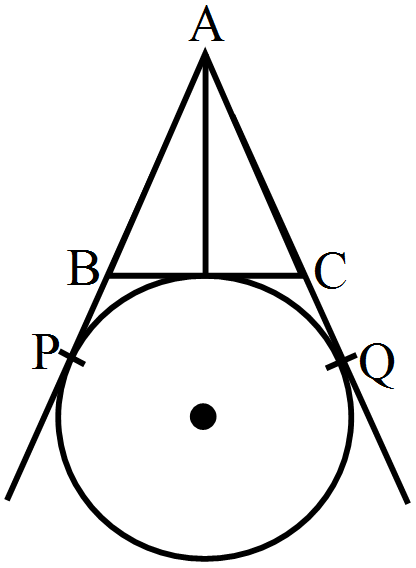
In the given figure, $AP, AQ$ and $BC$ are tangents to the circle. If $AB = 5\ cm, AC = 6\ cm$ and $BC = 4\ cm$ then the length of $AP$ is :
- A
$15\ cm$
- B
$10\ cm$
- C
$9\ cm$
- ✓
$7.5\ cm$
AnswerCorrect option: D. $7.5\ cm$
Let $BC$ intersect the circle at $D$.
We know that tangent from an external point to the circle are equal.
$BP = BD$
$CD = CQ$
$AP = AQ$
perimeter of $\triangle\text{ABC}$
$= AB + BC + AC$
$= AB + (BD + CD) + AC$
$= AB + (BP + CQ) + AC$
$= (AB + BP) + (AC + CQ)$
$= AP + AQ$
Since perimeter of $\triangle\text{ABC} = AB + BC + AC $
$= 5 + 6 + 4 = 15\ cm$
$\Rightarrow AP + AQ = 15$
$\Rightarrow 2AP = 15$
$\Rightarrow AP = 7.5\ cm$
View full question & answer→MCQ 501 Mark
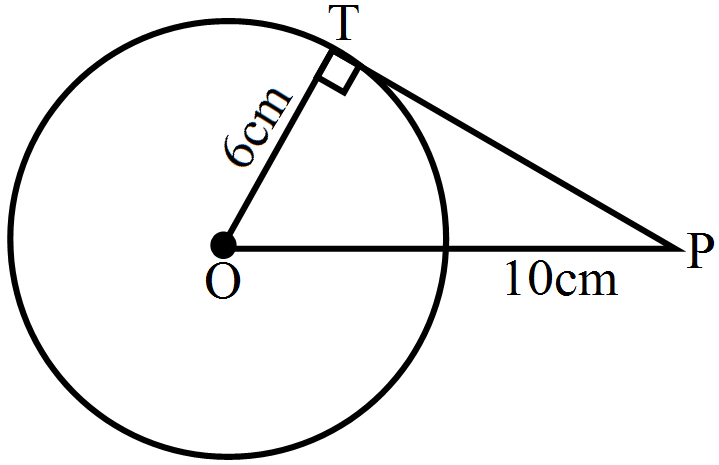
In the given figure $,PT$ is a tangent to a circle with centre $O$. If $OT = 6\ cm$ and $OP = 10\ cm,$ then the length of tangent $PT$ is :
- ✓
$8\ cm$
- B
$10\ cm$
- C
$12\ cm$
- D
$16\ cm$
AnswerCorrect option: A. $8\ cm$
$OT = 6\ cm$
$OP = 10\ cm$
Since $PT$ is a tangent to the circle at $T$.
$\angle\text{PTO}=90^\circ....($tangent is perpendicular to the radius of a circle$)$
In $\triangle\text{PTO},$
By Pythagoras theorem,
$ \mathrm{OP} 2=\mathrm{PT}^2+\mathrm{OT}^2 $
$ \Rightarrow \mathrm{PT}^2=\mathrm{OP}^2-\mathrm{OT}^2 $
$ \Rightarrow \mathrm{PT}^2=10^2-6^2 $
$ \Rightarrow \mathrm{PT}^2=100-36 $
$\Rightarrow PT = 8\ cm$
View full question & answer→MCQ 511 Mark
In the given figure, a circle is inscribed in a quadrilateral $\text{ABCD}$ touching its sides $AB, BC, CD$ and $AD$ at $P, Q, R$ and $S$ respectively. If the radius of the circle is $10\ cm, BC = 38\ cm, PB = 27\ cm$ and $\text{AD} \perp \text{CD}$ then the length of $CD$ is :
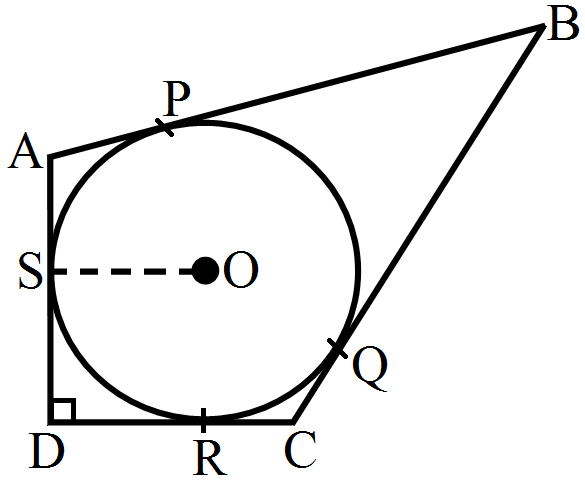
- A
$11\ cm$
- B
$15\ cm$
- C
$20\ cm$
- ✓
$21\ cm$
AnswerCorrect option: D. $21\ cm$
We know that tangles from an external point to the circle are equal.
$BQ = PB = 27\ cm$
So $, CQ = BC - BQ $
$= 38 - 27 = 11\ cm$
$\Rightarrow CR = CQ = 11\ cm$
In quad. $\text{SORD},$
$\angle\text{SDR}=90^\circ....(\therefore\text{AD}\perp\text{CD})$
$\Rightarrow\angle\text{OSD}=\angle\text{ORD}=90^\circ$
Also $, OS = OR$ and $SD = SR$
So, quad. $\text{SORD}$ is a square.
Thus $, DR = SO = 10\ cm$
Hence $, CD = DR + CR $
$= 10 + 11 = 21\ cm.$
View full question & answer→MCQ 521 Mark
From a point $Q,$ the length of the tangent to a circle is $24\ cm$ and the distance of $Q$ from the centre is $25\ cm.$ The radius of the circle is :
- ✓
$7\ cm$
- B
$12\ cm$
- C
$15\ cm$
- D
$24.5\ cm$
AnswerCorrect option: A. $7\ cm$
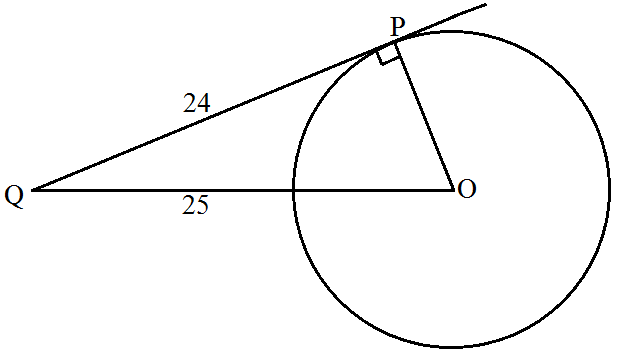
We know, radius always perpendicular to tangent so we say $\triangle\text{OPQ}$ is right angle triangle
then $\angle\text{OPQ}=90^{\circ}$
Now, we have to find $OP$
$ \Rightarrow O P^2=O Q^2-P Q^2$
$ \Rightarrow O P^2=25^2-24^2 $
$ \Rightarrow O P^2=625-576 $
$\Rightarrow\text{OP}=\sqrt{49}$
$\Rightarrow OP = 7\ cm$
Hence, correct choice is $(A)$ View full question & answer→MCQ 531 Mark
In the given figure $,O$ is the centre of a circle. $\text{AOC}$ is its diameter, such that $\angle\text{ACB} = 50^\circ.$ If $AT$ is the tangent to the circle at the point $A,$ then $\angle \text{BAT} = ?$
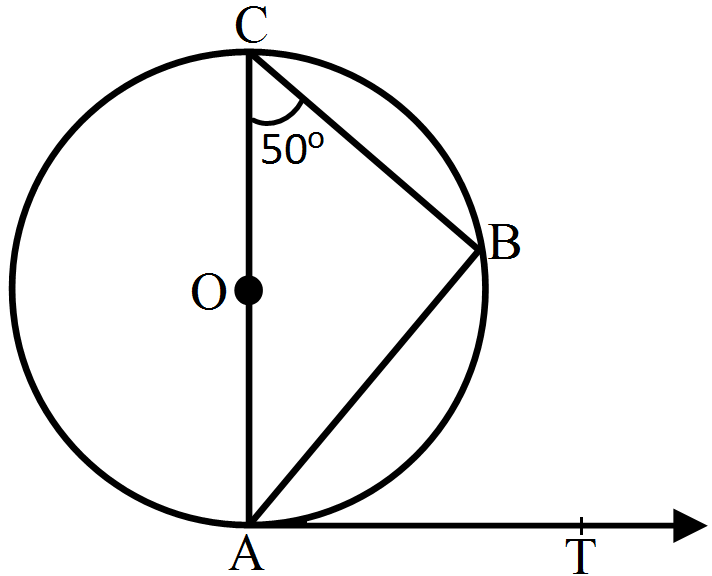
- A
$40^\circ$
- ✓
$50^\circ$
- C
$60^\circ$
- D
$65^\circ$
AnswerCorrect option: B. $50^\circ$
Construction : Join $OC$.
Since $AC$ is a diameter of the circle.
$\angle\text{ABC}=90^\circ ....($angle in a semicircle is $90^\circ )$
In $\triangle\text{ABC},$
$\angle\text{ABC}+\angle\text{BCA}+\angle\text{BAC}=180^\circ ......($Angle Sum Property$)$
$\Rightarrow90^\circ+50^\circ+\angle\text{BAC}=180^\circ$
$\Rightarrow\angle\text{BAC}=40^\circ$
Since $AC$ is a tangent to the inner circle.
$\Rightarrow\angle\text{OAT}=90^\circ .....($Tangent is perpendicular to the radius of a circle$)$
$\Rightarrow\angle\text{BAO}+\angle\text{BAT}=90^\circ$
$\Rightarrow40^\circ+\angle\text{BAT}=90^\circ$
$\Rightarrow\angle\text{BAT}=50^\circ$
View full question & answer→MCQ 541 Mark
$PQ$ is a tangent to a circle with centre $O$ at the point $P$. If $\triangle\text{OPQ}$ is an isosceles triangle, then $\angle\text{OQP}$ is equal to :
- A
$30^\circ$
- ✓
$45^\circ$
- C
$60^\circ$
- D
$90^\circ$
AnswerCorrect option: B. $45^\circ$
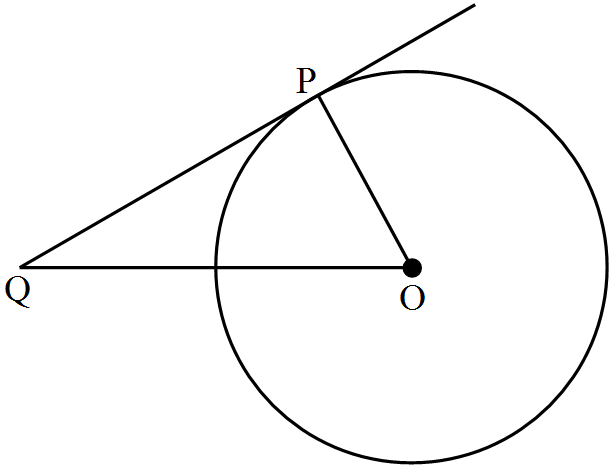
Given that $\triangle\text{PQO}$ is an isosceles triangle.
Since $PQ$ is a tangent to the circle at $P$.
Sunce $PQ$ is a tangent to the circle at $P.$
$\angle\text{OPQ}=90^\circ .....($tangent is perpendicular to the radius of a circle$)$
In $\triangle\text{OPQ},$
$OP = OQ$
$\Rightarrow\angle\text{OQP}=\angle\text{POQ}$
Using Angle Sum Property,
$\angle\text{OQP}+\angle\text{POQ}+\angle\text{OPQ}=180^\circ$
$\Rightarrow\angle\text{OQP}+\angle\text{OQP}+90^\circ=180^\circ$
$\Rightarrow2\angle\text{OQP}=90^\circ$
$\Rightarrow\angle\text{OQP}=45^\circ$ View full question & answer→MCQ 551 Mark
From a point $P$ which is at a distance $13\ cm$ from the centre $O$ of a circle of radius $5\ cm,$ the pair of tangent $PQ$ and $PR$ to the circle are drawn. Then the area of the quadrilateral $\text{PQOR}$ is :
- ✓
$60\ cm^2$
- B
$65\ cm^2$
- C
$30\ cm^2$
- D
$32.5\ cm^2$
AnswerCorrect option: A. $60\ cm^2$
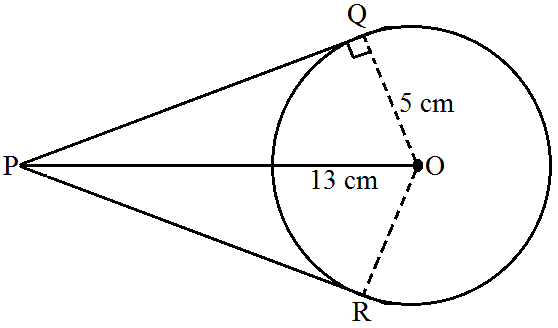
Firstly, draw a circle of radius $5\ cm$ having centre $O$.
$P$ is a point at a distance of $13\ cm$ from $O$.
$A$ pair of tangents $PQ$ and $PR$ are drawn.
Thus, quadrilateral $\text{PQOR}$ is formed.
$OQ \perp QP \ [$since, $AP$ is a tangent line$]$
In right angled $\triangle\text{POQ}$
$ \Rightarrow O P^2=O Q^2+Q P^2 $
$ \Rightarrow 13^2=5^2+Q P^2 $
$ \Rightarrow Q P^2=169-25=144=12^2 $
$\Rightarrow QP = 12\ cm$
Now, $\text{area}\ \text{of}\triangle\text{OQP}$
$=\frac{1}{2}\times\text{QP}\times\text{QO}=\frac{1}{2}\times12\times5=30\text{ cm}^2$
Area of quadilateral $\text{QORP} = 2\triangle\text{OQP}=2\times30=60\text{ cm}^2$ View full question & answer→MCQ 561 Mark
If $TP$ and $TQ$ are two tangents to a circle with centre $O$ so that $\angle\text{POQ}=110^{\circ},$ then, $\angle\text{PTQ}$ is equal to :
- A
$60^\circ$
- ✓
$70^\circ$
- C
$80^\circ$
- D
$90^\circ$
AnswerCorrect option: B. $70^\circ$
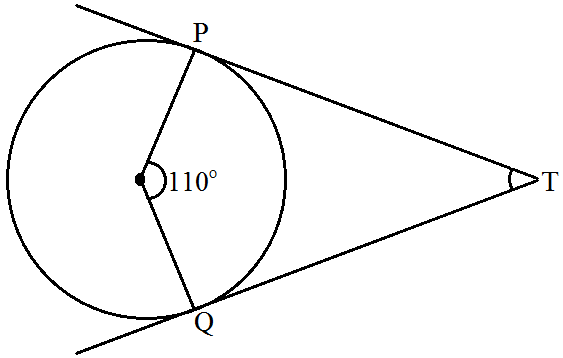
$TP$ and $TQ$ are the tangents from $T$ to the circle with centre $O$ and $OP, OQ$ are joined and $\angle\text{POQ}=110^{\circ},$
But $\angle\text{POQ}+\angle\text{PTQ}=180^{\circ}$
$\Rightarrow110^{\circ}+\angle\text{PTQ}=180^{\circ}$
$\Rightarrow\angle\text{PTQ}=180^{\circ}-110^{\circ}=70^{\circ}$ View full question & answer→MCQ 571 Mark
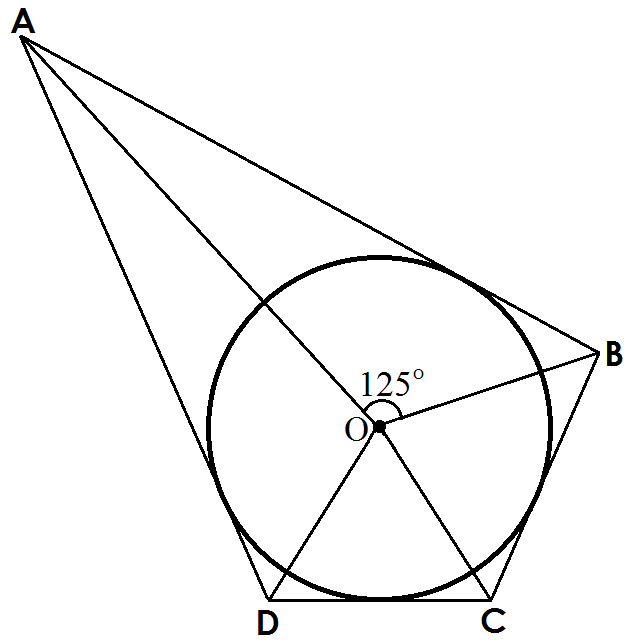
In the figure, if $\angle\text{AOB}=125^\circ$ then $\angle\text{COD}$ is equal to :
- A
$45^\circ$
- B
$35^\circ$
- ✓
$55^\circ$
- D
$62\frac{1}{2}^\circ$
AnswerCorrect option: C. $55^\circ$
We know that, the opposite sides of a quadrilateral circumscribing a circle subtend supplementary angles at the centre of the circle
$\angle\text{AOB}+\angle\text{COD}=180^\circ$
$\Rightarrow\angle\text{COD}=180^\circ-\angle\text{AOB}$
$=180^\circ-125^\circ=55^\circ$
View full question & answer→MCQ 581 Mark
If tangents $PA$ and $PB$ from a point $P$ to a circle with centre $O$ are inclined to each other at
- ✓
$50^\circ$
- B
$60^\circ$
- C
$70^\circ$
- D
$80^\circ$
AnswerCorrect option: A. $50^\circ$
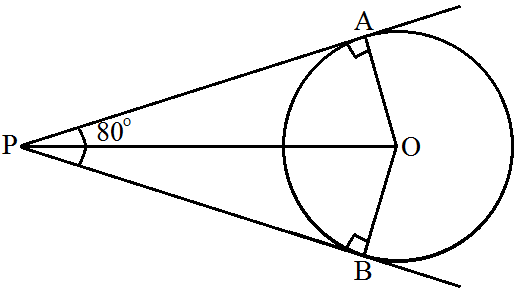
We know, radius is always perpendicular to tangent
then,
$\angle\text{OAP}=90^{\circ}(\text{OA}\bot\text{PA})$
$\angle\text{OBP}=90^{\circ}(\text{OB}\bot\text{PB})$
$\angle\text{APB}=80^{\circ}\ ($given$)$
We also know that sum of all angles of a quadilateral is $360^\circ $ then,
$\angle\text{OAP}+\angle\text{OBP}+\angle\text{APB}+\angle\text{AOB}=360^{\circ}$
$\Rightarrow90^{\circ}+90^{\circ}+80^{\circ}+\angle\text{AOB}=360^{\circ}$
$\Rightarrow260^{\circ}+\angle\text{AOB}=360^{\circ}$
$\Rightarrow\angle\text{AOB}=100^{\circ}...(\text{i})$
Now, consider $\triangle\text{POA}$ and $ \triangle\text{POB},$
$OA = OB \ ($Radius of circle$)$
$PA = PB\ ($tangent grom external point $P)$
$OP = OP\ ($commom$)$
So, By using $\text{SSS}$ congurancy,
$\triangle\text{POA}\cong\triangle\text{POB}$
then $\angle\text{POA}=\triangle\text{POB}...(\text{ii})$
By eq. $(i)$ and $(ii)$
$\Rightarrow\angle\text{AOB}=100^{\circ}$
$\Rightarrow\angle\text{POA}+\angle\text{POB}=100^{\circ}$
$\Rightarrow2\angle\text{POA}=100^{\circ}$
$\Rightarrow\angle\text{POA}=50^{\circ}$
Hence, correct choice is $(A)$ View full question & answer→MCQ 591 Mark
Each question consists of two statements, namely, Assertion $(A)$ and Reason $(R)$. for selecting the correct answer, use the following code :
|
Assertion $(A)$
|
Reason $(R)$
|
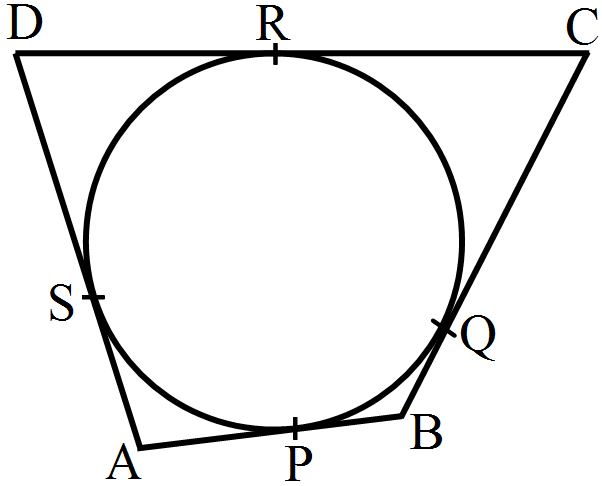
In the given figure, a quad. $\text{ABCD}$ is drawn to circumscribe a given circle as shown. Then $, AB + BC = AD + DC.$
 |
In two concentric circles, the chord of the larger circle, which to uches the smaller circle, is bisected at the point of contact. |
- A
Both Assertion $(A)$ and Reason $(R)$ are true and Reason $(R)$ is a correct explanation of Assertion $(A)$.
- B
Both Assertion $(A)$ and Reason $(R)$ are true but Reason $(R)$ is not a correct explanation of Assertion $(A).$
- C
Assertion $(A)$ is true and Reason $(R)$ is false.
- ✓
Assertion $(A)$ is false and Reason $(R)$ is true.
AnswerCorrect option: D. Assertion $(A)$ is false and Reason $(R)$ is true.
The Assertion $(A)$ is false since sum of the opposite sides of a quadrilateral circumscribing a circle are equal, and not the adjacent sides.
The chord of the larger circle is the tangent to the smaller circle.
We know that the perpendicular drawn from the centre to the chord
So, the Reason $(R)$ is true.
But is not the correct explanation for the Assertion $(A).$
View full question & answer→MCQ 601 Mark
The length of the tangent drawn from a point $8 \ cm$ away from the centre of a circle of radius $6 \ cm$ is :
- A
$\sqrt{7}\text{ cm}$
- ✓
$2\sqrt{7}\text{ cm}$
- C
$10\text{ cm}$
- D
$5\text{ cm}$
AnswerCorrect option: B. $2\sqrt{7}\text{ cm}$
Let us first put the given data in the form of a diagram.
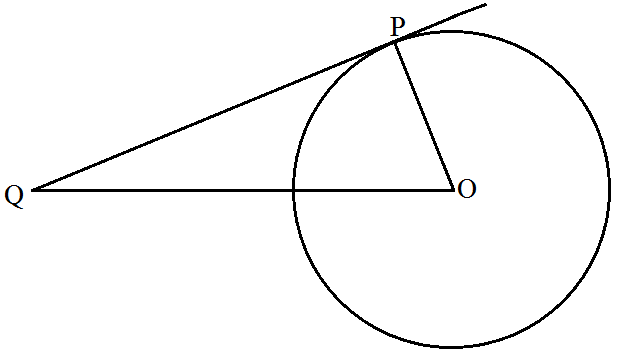
We know that the radius of a circle will always be perpendicular to the tangent at the point of contact.
Therefore, $OP$ is perpendicular to $QP$.
We can now use Pythagoras theorem to find the length of $QP.$
$ \mathrm{QP}^2=\mathrm{OQ}^2-\mathrm{OP}^2 $
$ \mathrm{QP}^2=8^2-6^2 $
$ \mathrm{QP}^2=64-36 $
$ \mathrm{QP}^2=28 $
$QP = \sqrt{28}$
$QP = 2\sqrt{7}$ View full question & answer→MCQ 611 Mark
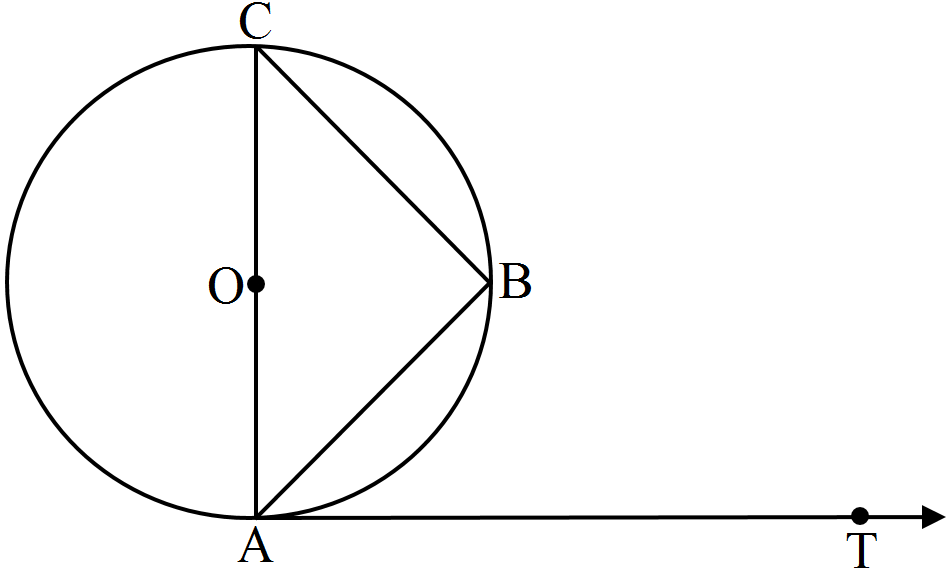
$AB $ is a chord of circle and $\text{AOC}$ is its diameter such that $\angle\text{ACB} = 40^\circ$. If $AT$ is the tangent to the circle at the point $A,$ then $\angle\text{BAT}$ is equal to :
- A
$60^\circ$
- B
$55^\circ$
- C
$45^\circ$
- ✓
$40^\circ$
AnswerCorrect option: D. $40^\circ$
Here $\angle\text{B}=90^\circ \ [$ Angle of semicircle$]$
Now, in triangle $\text{ABC},\angle\text{CAB}+\angle\text{B}+\angle\text{C}=180^\circ$
$\Rightarrow\angle\text{CAB}+90^\circ+40^\circ=180^\circ$
$\Rightarrow\angle\text{CAB}=180^\circ-130^\circ=50^\circ$
Now,$\angle\text{CAT}=90^\circ\ [$Angle between tangent and redius through the point of contact$]$
$\therefore\angle\text{CAB}+\angle\text{BAT}=90^\circ$
$\Rightarrow50+\angle\text{BAT}=90^\circ$
$\Rightarrow\text{BAT}=40^\circ$
View full question & answer→MCQ 621 Mark
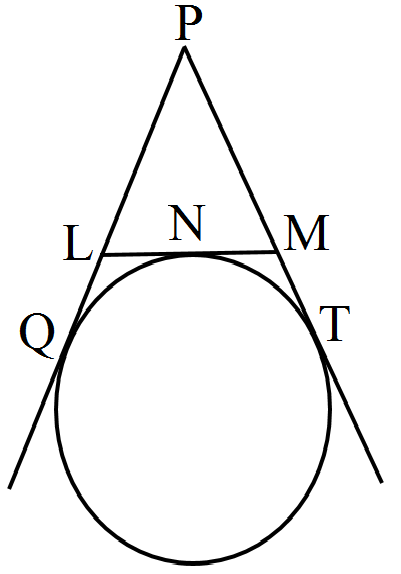
If $PQ = 28\ cm,$ then the perimeter of $\triangle\text{PLM}$ is :
- A
$48\ cm$
- ✓
$56\ cm$
- C
$42\ cm$
- D
$28\ cm$
AnswerCorrect option: B. $56\ cm$
We know that $ ,PQ =\frac{1}{2}(\text{perimeter of }\triangle \text{ PLM})$
$\Rightarrow 28$
$=\frac{1}{2}$
$(\text{Perimeter of }\triangle\text{PLM)}$
$\Rightarrow (\text{Perimeter of}\triangle\text{PLM)} = 28 \times 2 = 56 \text{ cm}$
View full question & answer→MCQ 631 Mark
In the figure $, PR =$
- A
$20\ cm$
- ✓
$26\ cm$
- C
$24\ cm$
- D
$28\ cm$
AnswerCorrect option: B. $26\ cm$
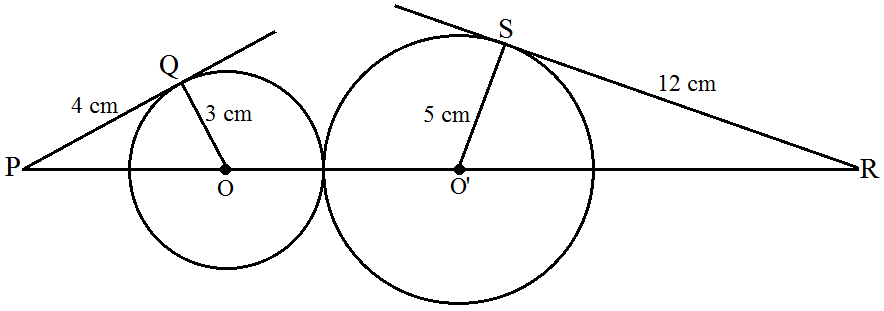
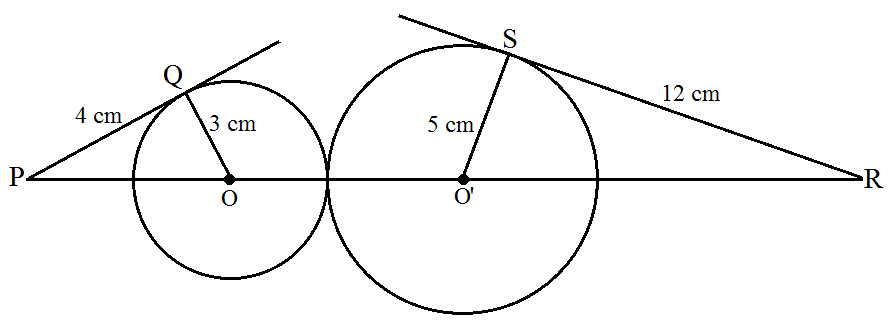
In the figure, two circles with centre $O$ and $O\ ’$ touch each other externally $PQ$ and $RS$ are the tangents drawn to the circles.
$OQ$ and $O’S$ are the radii of these circles and $OQ = 3\ cm, PQ = 4\ cm O’S = 5\ cm$ and $SR = 12\ cm$.
Now in right $\triangle\text{OQP}$
$OP^2= (OQ)^2+ PQ^2= (3)^2+ (4)^2$
$= 9 + 16 = 25 = (5)^2$
$OP = 5\ cm$
Similarly in right $\triangle\text{RSO}$
$(O’R)^2= (RS)^2+ (O’S)^2= (12)^2+ (5)^2$
$= 144 + 25 = 169 = (13)^2$
$O’R = 13\ cm$
Now $PR = OP + OO’ + O’R$
$ = 5 + (3 + 5) + 13 = 26\ cm.$ View full question & answer→MCQ 641 Mark
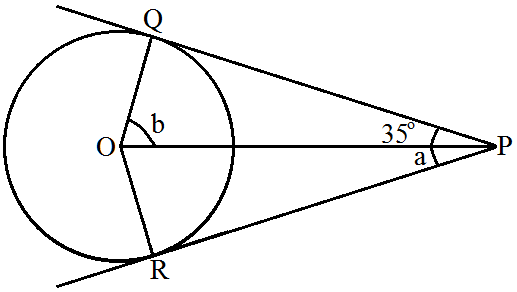
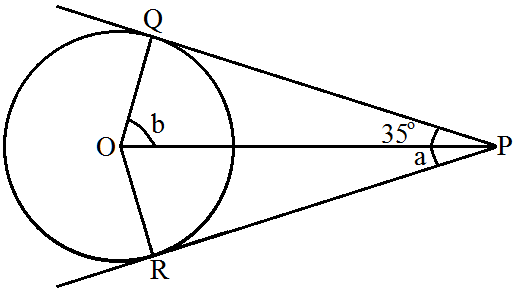
In the given figure $,PQ$ and $PR$ are tangents drawn from $P$ to a circle with centre $O$. If $\angle\text{OPQ}=35^\circ$, then :
- A
$a= 30^\circ , b= 60^\circ$
- ✓
$a= 35^\circ , b = 55^\circ$
- C
$a= 40^\circ , b = 50^\circ$
- D
$a= 45^\circ , b = 45^\circ$
AnswerCorrect option: B. $a= 35^\circ , b = 55^\circ$
We know, radius always $\bot \ TP$ tangent
$\text{OQ}\bot\text{QP}$
$\text{OR}\bot\text{RP}$
From above eq. $\triangle\text{OQP}$ and $\triangle\text{ORP}$ is right angle triangle then,
$\angle\text{OQP}=\angle\text{ORP}=90^\circ$
$\triangle\text{OQP}\sim\triangle\text{ORP}$
then $\angle\text{QPO}=\angle\text{RPO}=35^\circ=\angle\text{a}$
sum of all angles in $\triangle\text{OQP}$ is $180^\circ$
$\angle\text{OQP}+\angle\text{QPO}+\angle\text{QOP}=180^\circ$
$\Rightarrow90^\circ+35^\circ+\angle\text{b}=180^\circ$
$\Rightarrow\angle\text{b}=55^\circ$ View full question & answer→MCQ 651 Mark
If the angle between two radii of a circle is $130^\circ ,$ then the angle between the tangent at the ends of the radii is :
- A
$65^\circ$
- B
$40^\circ$
- ✓
$50^\circ$
- D
$90^\circ$
AnswerCorrect option: C. $50^\circ$
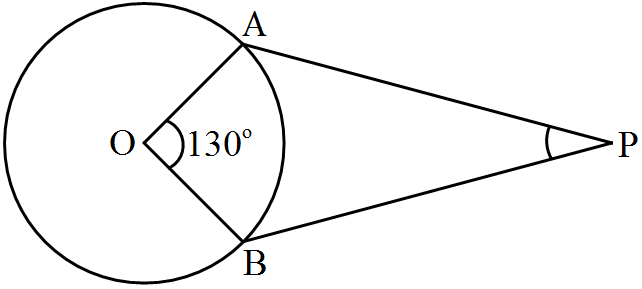
In quad. $\text{AOBP}$
$\angle\text{PAO}+\angle\text{PBO}+\angle\text{AOB}+\angle\text{APB}=360^\circ....($Angle Sum Property$)$
$\Rightarrow90^\circ+90^\circ+130^\circ+\angle\text{APB}=360^\circ....($Since radius of a circle is perpendicular to the tangent$)$
$\Rightarrow\angle\text{APB}=50^\circ$ View full question & answer→MCQ 661 Mark
In figure, if $\angle\text{AOB}=125^\circ,$ then $\angle\text{COD}$ is equal to :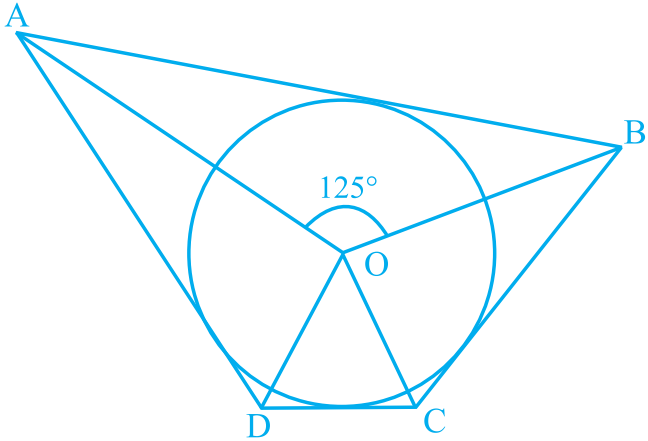
- A
$62.5^\circ$
- B
$45^\circ$
- C
$35^\circ$
- ✓
$55^\circ$
AnswerCorrect option: D. $55^\circ$
we know that, the opposite sides of a quadrilateral circumscribing a circle subtend supplementary angles at the centre of the circle.
i.e., $\angle\text{AOB}+\angle\text{COD}=180^\circ$
$\Rightarrow\ \angle\text{COD}=180^\circ-\angle\text{AOB}$
$=180^\circ - 125^\circ = 55^\circ$
View full question & answer→MCQ 671 Mark
Two circles touch each other externally at $P. AB$ is a common tangent to the circle touching them at $A$ and $B$. The value of $\angle\text{APB}$ is :
- A
$30^\circ$
- B
$45^\circ$
- C
$60^\circ$
- ✓
$90^\circ$
AnswerCorrect option: D. $90^\circ$
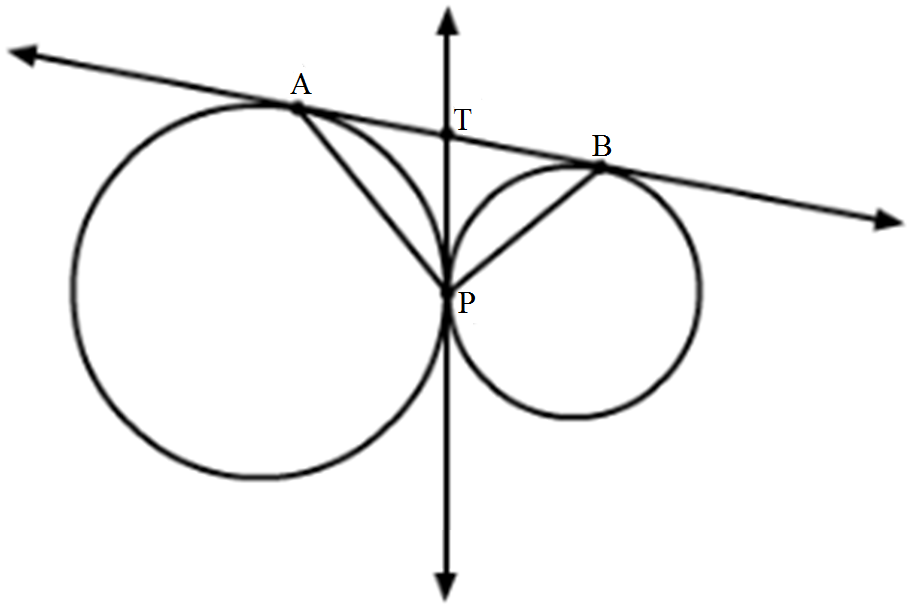
It is given that two circles touch each other externally at $P.$
$ AB$ is a common tangent to the circle touching them at $A$ and $B$.
Draw a tangent to the circle at $P,$ intersecting $AB$ at $T.$
Now, $TA$ and $TP$ are tangent drawn to the same circle from an external point $T.$
$\therefore TA = TP \ ($Length of tangents drawn from an external point to a circle are equal$)$
$TB$ and $TP$ are tangent drawn to the same circle from an external point $T$.
$\therefore TB = TP \ ($Length of tangents drawn from an external point to a circle are equal$)$
In $\triangle\text{ATP}$
$TA = TP$
$\therefore\angle\text{APT}=\angle\text{PAT}...(1)\ ($In a triangle, equal sides have equal angles opposite to them$)$
In $\triangle\text{BTP},$
$TB = TP$
$\therefore\angle\text{BPT}=\angle\text{PBT}...(2)\ ($In a triangle, equal sides have equal angles opposite to them$)$
Now, in $\triangle\text{APB},$
$\Rightarrow\angle\text{APB}+\angle\text{PAB}+\angle\text{PBA}=180^\circ\ ($Angle sum property$)$
$\Rightarrow\angle\text{APB}+\angle\text{APT}+\angle\text{BPT}=180^\circ\ [$From $(1)$ and $(2)]$
$\Rightarrow\angle\text{APB}+\angle\text{APB}=180^\circ$
$\Rightarrow2\angle\text{APB}=180^\circ$
$\Rightarrow\angle\text{APB}=90^\circ$
Thus, the value of $\angle\text{APB}\ \text{is}\ 90^\circ$ View full question & answer→MCQ 681 Mark
The pair of tangents $AP$ and $AQ$ drawn from an external point to a circle with centre $O$ are perpendicular to each other and length of each tangent is $5\ cm$. The radius of the circle is :
- A
$10\ cm$
- B
$7.5\ cm$
- ✓
$5\ cm$
- D
$2.5\ cm$
AnswerCorrect option: C. $5\ cm$
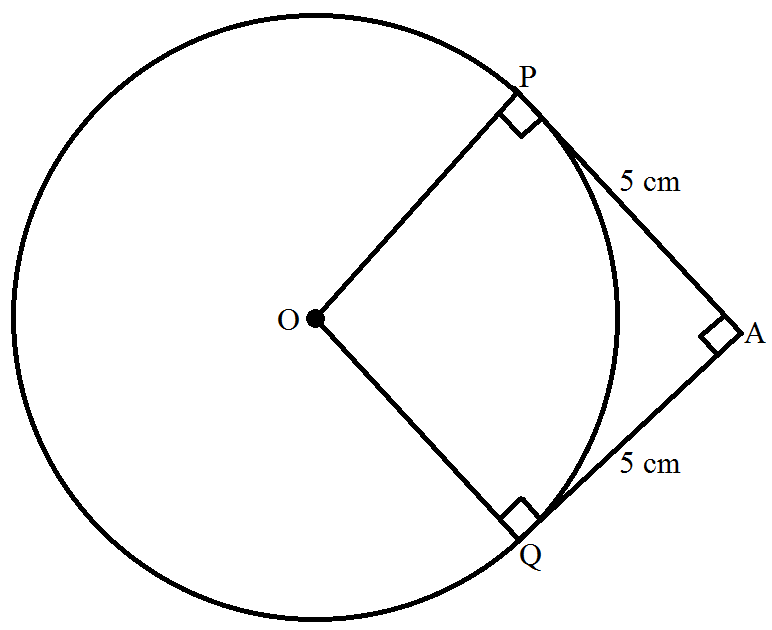
Given : $AP$ and $AQ$ are tangents to the ciecle with centre $O, AP \bot AQ$ and $AP = AQ = 5\ cm$
We know that radius of a circle is perpendicular to the tangent at the point of contact.
$\Rightarrow\text{OP}\bot\text{AP}$ and $ \text{OQ}\bot\text{AQ}$
Also sum of all angles of a quadilateral is $360^\circ $
$\Rightarrow\angle\text{O}+\angle\text{P}+\angle\text{A}+\angle\text{Q}=360^\circ$
$\Rightarrow\angle\text{O}+90^\circ+90^\circ=360^\circ$
$\Rightarrow\angle\text{O}=360^\circ-270^\circ=90^\circ$
Thus$\angle\text{O}=\angle\text{P}=\angle\text{A}=\angle\text{Q}=90^\circ$
$\Rightarrow \text{OPAQ}$ is a rectangle.
Since adjacent sides of $\text{OPAQ}$
i.e. $AP$ and $AQ$ are equal.
Thus $\text{OPAQ}$ is a square radius $= OP = OQ = AP = AQ = 5\ cm$ View full question & answer→MCQ 691 Mark
If $PA$ and $PB$ are tangents to the circle with centre $O$ such that $\angle\text{APB}=50^\circ$ then $\angle\text{OAB}$ is equal to :
- ✓
$25^\circ$
- B
$30^\circ$
- C
$40^\circ$
- D
$50^\circ$
AnswerCorrect option: A. $25^\circ$
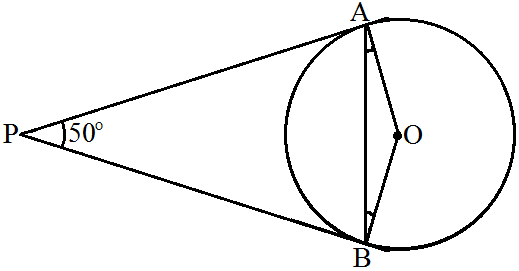
Given, $PA$ and $PB$ are tangent lines.
$PA = PB \ [$Since, the length of tangents drawn from an$\angle\text{PAB}=\angle\text{PBA}=\theta$ say$]$
In $\triangle\text{PAB},$
$\angle\text{P}+\angle\text{A}+\angle\text{B}=180^\circ \ [$since, sum of angles of a triangle $= 180^\circ $
$50^\circ+\theta+\theta=180^\circ$
$2\theta=180^\circ-50^\circ=130^\circ$
$\theta=65^\circ$
Also, $OA \perp PA \ [$Since, tangent at any point of a circle is perpendicular to the radius through the point of contact $.]$
$\angle\text{PAO}=90^\circ$
$\Rightarrow\angle\text{PAB}+\angle\text{BAO}=90^\circ$
$\Rightarrow65^\circ+\angle\text{BAO}=90^\circ$
$\Rightarrow\angle\text{BAO}=90^\circ-65=25^\circ$
View full question & answer→MCQ 701 Mark
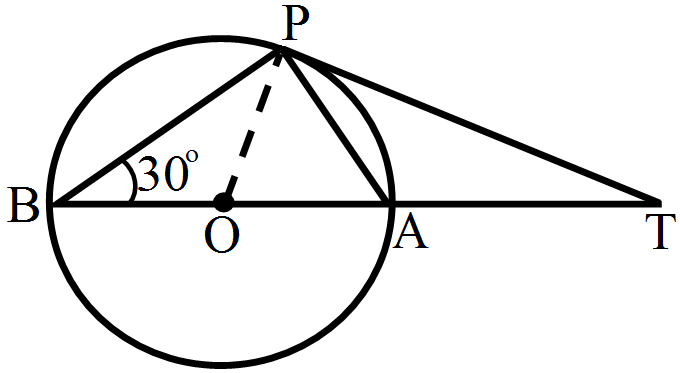
In the given figure, $O$ is the centre of a circle, $\text{BOA}$ is its diameter and the tangent at the point $P$ meets $BA$ extended at $T. \angle\text{PBO} = 30^\circ$ then $\angle\text{PTA} =?$
- A
$60^\circ$
- ✓
$30^\circ$
- C
$15^\circ$
- D
$45^\circ$
AnswerCorrect option: B. $30^\circ$
In $\triangle\text{OBP},$
$\text{OB} = \text{OP} ....($radii of the circle$)$
$\Rightarrow\angle\text{OBP}=\angle\text{OPB}=30^\circ ....($angles opposite equal sides are equal$)$
Since $PT$ is a tangent,
$\angle\text{OPT}=90^\circ$
In $\triangle\text{BPT},$
$\angle\text{BPT}+\angle\text{PBT}+\angle\text{PTB}=180^\circ....($Angle Sum Property$)$
$\Rightarrow(30^\circ+90^\circ)+30^\circ+\angle\text{PTB}=180^\circ$
$\Rightarrow\angle\text{PTB}=30^\circ$
That is, $\angle\text{PTA}=30^\circ$
View full question & answer→MCQ 711 Mark
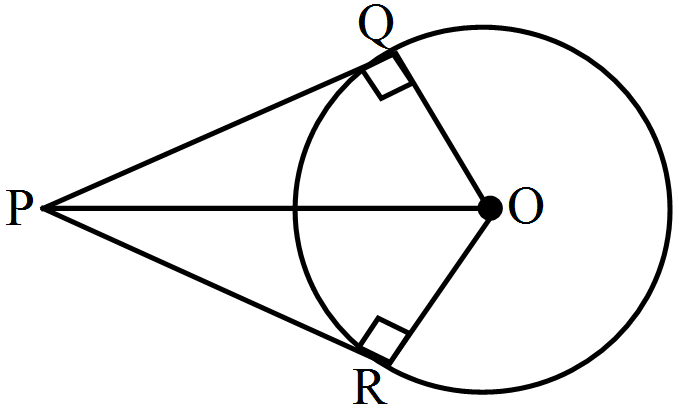
$O$ is the centre of a circle of radius $5\ cm$. At a distance of $13\ cm$ from $O,$ a point $P$ is taken. From this point, two tangents $PQ$ and $PR$ are drawn to the circle. Then, the area of quadrilateral $\text{PQOR}$ is :
- ✓
$60 \mathrm{~cm}^2 $
- B
$ 32.5 \mathrm{~cm}^2 $
- C
$ 65 \mathrm{~cm}^2 $
- D
$ 30 \mathrm{~cm}^2 $
AnswerCorrect option: A. $60 \mathrm{~cm}^2 $
In $\triangle\text{OPQ}$ and $\triangle\text{ORP},$
$\angle\text{OQP}=\angle\text{ORP}=90^\circ ....($Since $OP$ and $RP$ are tangent to the circle$)$
$\text{OP}=\text{OP} ....($common side$)$
$\text{OQ}=\text{OR} ....($radii of the same circle$)$
$\Rightarrow\triangle\text{OPQ}\cong\triangle\text{ORP} ....(\text{RHS}$ congruence criterion$)$
So, the areas of both the triangle will be the swame.
In $\triangle\text{OPQ},$
By Pythagoras theorem,
$\text{OP}^2=\text{OQ}^2+\text{PQ}^2$
$\Rightarrow\text{PQ}^2=\text{OP}^2-\text{OQ}^2$
$\Rightarrow\text{PQ}^2=\text{13}^2-\text{5}^2$
$\Rightarrow\text{PQ}^2=144$
$\Rightarrow\text{PQ}=12\text{ cm}$
$\text{ar}(\triangle\text{OPQ})=\frac{1}{2}\times\text{PQ}\times\text{OQ}$
$=\frac{1}{2}\times\text{12}\times5$
$=30\text{ cm}^2$
$\text{ar}(\text{quad PQOR})=\text{ar}(\triangle\text{OPQ})+\text{ar}(\triangle\text{ORP})$
$\Rightarrow\text{ar}(\text{quad PQOR})=30\text{ cm}^2+30\text{ cm}^2$
$\Rightarrow\text{ar}(\text{quad PQOR})=60\text{ cm}^2$
View full question & answer→MCQ 721 Mark
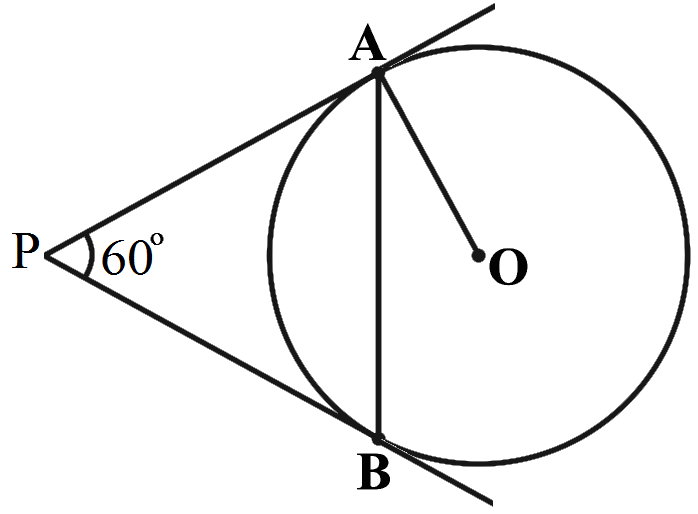
In the given figure, $PA$ and $PB$ are two tangents to the circle with centre $O$. If $\angle\text{APB}=60^\circ$ then $\angle\text{OAB}$ is :
- A
$15^\circ$
- ✓
$30^\circ$
- C
$60^\circ$
- D
$90^\circ$
AnswerCorrect option: B. $30^\circ$
We know that tangent from an external point to a circle are equal.
So,
$\text{PA}=\text{PB}$
$\Rightarrow\angle\text{PAB}+\angle\text{PBA} ....($angles opposite equal sides are equal$)$
Now in $\triangle\text{PAB},$
$\angle\text{PAB}+\angle\text{PBA}+\angle\text{APB}=180^\circ ...($angles Sum Property$)$
$\Rightarrow\angle\text{PAB}+\angle\text{PAB}+60^\circ=180^\circ$
$\Rightarrow2\angle\text{PAB}+60^\circ=180^\circ$
$\Rightarrow2\angle\text{PAB}=120^\circ$
$\Rightarrow\angle\text{PAB}=60^\circ$
Since $AP$ is a tangent to the circle,
$\angle\text{OAP}=90^\circ$
$\Rightarrow\angle\text{OAB}+\angle\text{PAB}=90^\circ$
$\Rightarrow\angle\text{OAB}+60^\circ=90^\circ$
$\Rightarrow\angle\text{OAB}=30^\circ$
View full question & answer→MCQ 731 Mark
Directions : In the following questions, a statement of assertion $(A)$ is followed by a statement of reason $(R)$. Mark the correct choice as:
Assertion : Figure, $\text{AOB}$ is a diameter of a circle with centre $O$ and $AC$ is a tangent to the circle at $A$ .If $\angle\text{BOC}=125^\circ,$ then $\angle\text{ACO}=35^\circ$
Reason : $\angle\text{ACO}$ and $\angle\text{BOC}$ form a linear pair.
- A
Assertion and Reason both are correct statements and Reason is the correct explanation of Assertion.
- B
Assertion and Reason both are correct statements but Reason is not the correct explanation of Assertion.
- ✓
Assertion is correct statement but Reason is wrong statement.
- D
Assertion is wrong statement but Reason is correct statement.
AnswerCorrect option: C. Assertion is correct statement but Reason is wrong statement.
$\angle\text{BOC}=125^\circ$
Since, $AC$ is a tangent to the circle at $A$
$\therefore\angle\text{OAC}=90^\circ \ [\because$ Radius is perpendicular to the tangent at point of contact$]$
Now, $\angle\text{AOC} + \angle\text{BOC} = 180^\circ \ [$Linear pair$]$
In $\triangle\text{AOC}, \angle\text{AOC} +\angle\text{ACO} +\angle\text{OAC} = 180^\circ \ [$By angle sum property$]$
$\Rightarrow55^\circ+\angle\text{ACO}+90^\circ=180^\circ$
$\Rightarrow\angle\text{ACO} = 180^\circ - 55^\circ - 90^\circ = 35^\circ$
$\therefore$ Assertion is correct but Reason is wrong.
View full question & answer→MCQ 741 Mark
In the given figure, point $P$ is $26\ cm$ away from the centre $O$ of a circle and the length $PT$ of the tangent drawn from $P$ to the circle is $24\ cm$. Then the radius ofthe circle is :
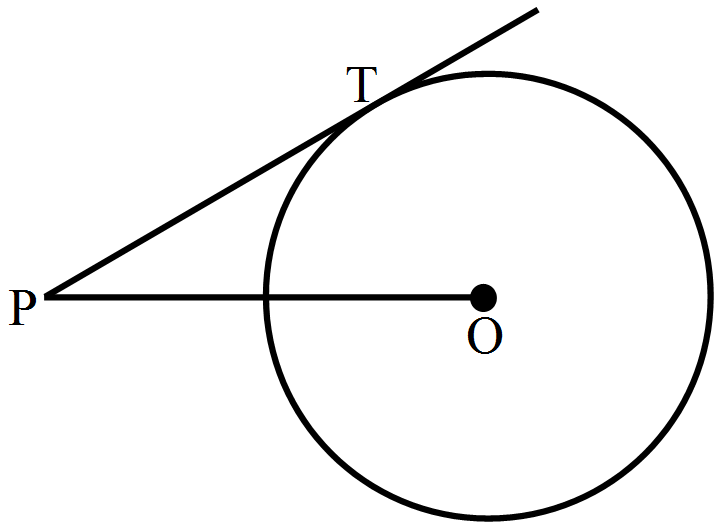
- ✓
$10\ cm$
- B
$12\ cm$
- C
$13\ cm$
- D
$15\ cm$
AnswerCorrect option: A. $10\ cm$
Construction : Join $OT$.
$PT = 24\ cm$
$OP = 26\ cm$
Sunce $PT$ is a tangent to the circle at $T.$
$\angle\text{PTO}=90^\circ .....($tangent is perpendicular to the radius of a circle$)$
In $\triangle\text{PTO},$
By Pythagoras theorem,
$ \mathrm{OP}^2=\mathrm{PT}^2+\mathrm{OT}^2 $
$ \Rightarrow \mathrm{OT}^2=\mathrm{OP}^2-\mathrm{PT}^2 $
$ \Rightarrow \mathrm{OT}^2=26^2-24^2 $
$ \Rightarrow \mathrm{OT}^2=676-576 $
$ \Rightarrow \mathrm{OT}^2=100 $
$ \Rightarrow \mathrm{OT}^2=10 \mathrm{~cm} $
View full question & answer→MCQ 751 Mark
In the given figure, $AD$ and $AE$ are the tangents to a circle with centre $O$ and $BC$ touches the circle at $F$. If $AE = 5\ cm,$ then perimeter of $\triangle\text{ABC}$ is :
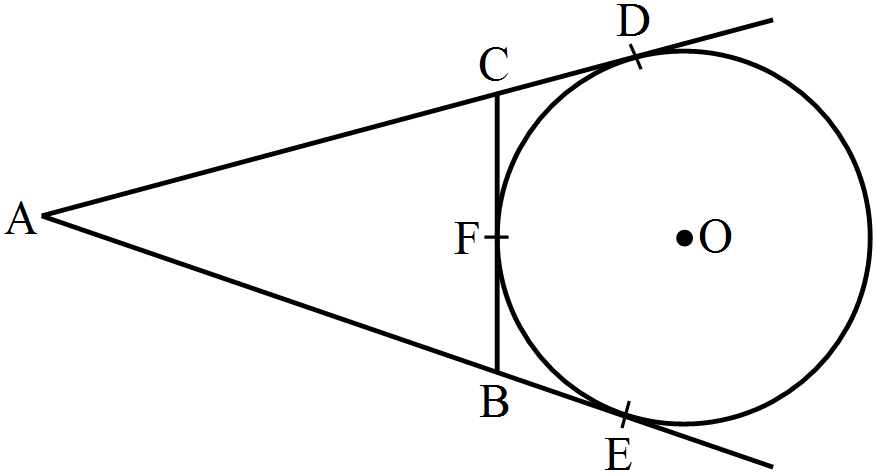
- A
$15\ cm$
- ✓
$10\ cm$
- C
$22.5\ cm$
- D
$20\ cm$
AnswerCorrect option: B. $10\ cm$
We know that tangent from an external point to the circle equal.
So,
$AE = AD = 5\ cm$
$BF = BE$
$CF = CD$
Perimeter of $\triangle\text{ABC}$
$= AB + BC + AC$
$= AB + (BE + DC) + AC$
$= AB + (BE + DC) + AC$
$= (AB + BE) + (AC + DC)$
$= AE + AD$
$= 5 + 5$
$= 10\ cm$
View full question & answer→MCQ 761 Mark
In the given figure, a circle with centre $O$ is inscribed in a quadrilateral $\text{ABCD}$ such that, it touches sides $BC, AB, AD$ and $CD$ at points $P, Q, R $ and $S$ respectively. If $AB$
$= 29\ cm, AD = 23\ cm, \angle\text{B}=90^\circ$ and $DS = 5\ cm,$ then the radius of the circle $($in $cm)$ is :
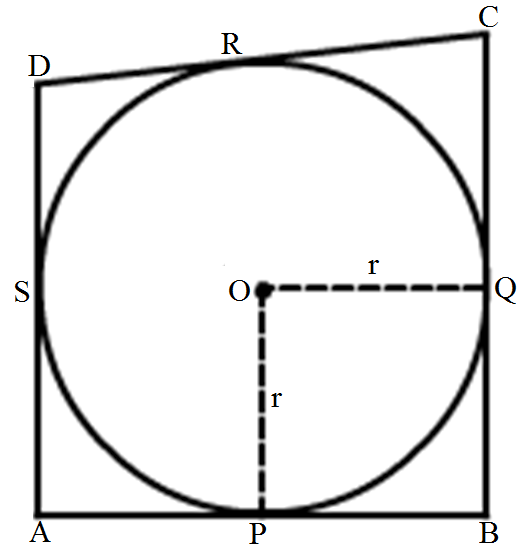
AnswerIn the figure, a circle touches the sides of a quadrilateral $\text{ABCD}.$$\angle\text{B}=90^\circ, OP = OQ = r$
$AB = 29\ cm, AD = 23\ cm, DS = 5\ cm$
$\angle\text{B}=90^\circ,$
$BA$ is tangent and $OQ$ is radius
$\angle\text{QPB}=90^\circ$
Similarly $OP$ is radius and $BC$ is tangents.
$\angle\text{OPB}=90^\circ$
But $\angle\text{B}=90^\circ, ($given$)$
$\text{PBQO}$ is a square.
$DS = 5\ cm$
But $DS$ and $DR$ are tangents to the circles.
$DR = 5\ cm$
But $AD = 23\ cm$
$AR = 23 – 5= 18\ cm$
$AR = AQ\ ($tangents to the circle from $A.)$
$AQ = 18\ cm$
But $AB = 29 \ cm$
$BQ = 29 – 18 = 11\ cm$
$\text{OPBQ}$ is a square.
$OQ = BQ = 11\ cm$
Radius of the circle $= 11\ cm.$
View full question & answer→MCQ 771 Mark
If four sides of a quadrilateral $\text{ABCD}$ are tangential to a circle, then :
- A
$AC + AD = BD + CD$
- ✓
$AB + CD = BC + AD$
- C
$AB + CD = AC + BC$
- D
$AC + AD = BC + DB$
AnswerCorrect option: B. $AB + CD = BC + AD$
A circle is inscribed in a quadrilateral $\text{ABCD}$ which touches the sides $AB, BC, CD$ and $DA$ at $P, Q, R$ and $S$ respectively then the sum of two opposite sides is equal
to the sum of other two opposite sides
$AB + CD = BC + AD$
View full question & answer→MCQ 781 Mark
Which of the following statements is not true?
- A
A line which intersects a circle at two points, is called a secant of the circle.
- B
A line intersecting a circle at one point only, is called a tangent to the circle.
- C
The point at which a line touches the circle, is called the point of contact.
- ✓
A tangent to the circle can be drawn from a point inside the circle.
AnswerCorrect option: D. A tangent to the circle can be drawn from a point inside the circle.
Options $(a), (b)$ and $(c)$ are all true.
However, Option $(d)$ is false since it is not possible to draw a tangent from a point inside a circle.
View full question & answer→MCQ 791 Mark
In the given figure, $AB$ and $AC$ are tangents to a circle with centre $O$ and radius $8\ cm$. If $OA = 17\ cm,$ then the length of $AC ($in $\ cm)$ is :
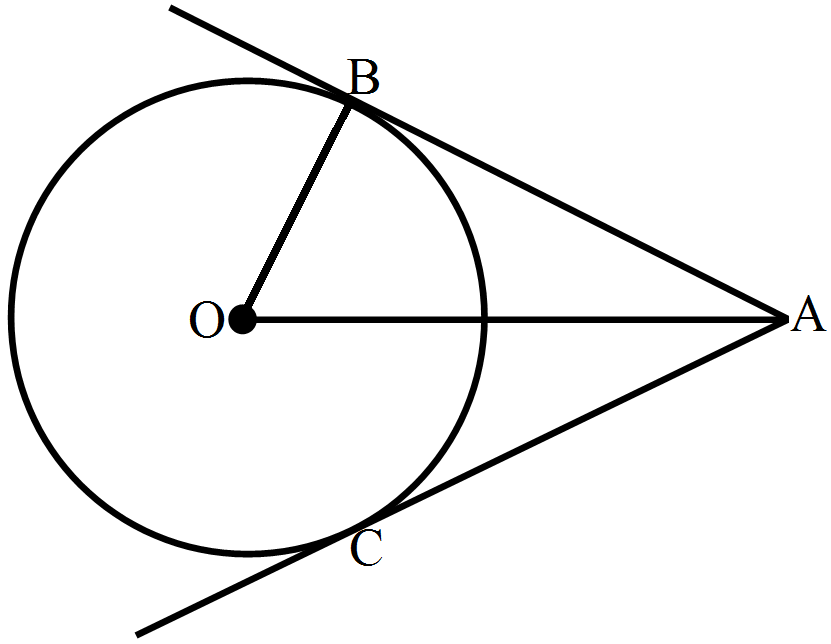
- A
$9$
- ✓
$15$
- C
$\sqrt{353}$
- D
$25$
Answer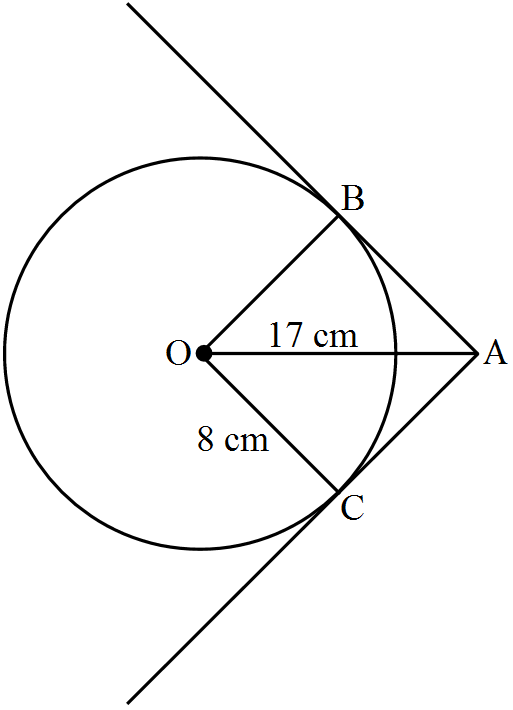
Construction : Join $OC.$
Since $AC$ is a tangent to the circle.
$\angle\text{OCA}=90^\circ ....($tangent is perpendicular to the radius of a circle$)$
In $\triangle\text{OCA},$
By Pythagoras theorem,
$ O A^2=O C^2+A C^2 $
$ \Rightarrow 17^2=8^2+A C^2 $
$ \Rightarrow A C^2=289-64 $
$ \Rightarrow A C^2=225 $
$\Rightarrow AC = 15\ cm$ View full question & answer→MCQ 801 Mark
If $PT$ is a tangent to the circle with centre $O,$ then $x + y$ is equal to :
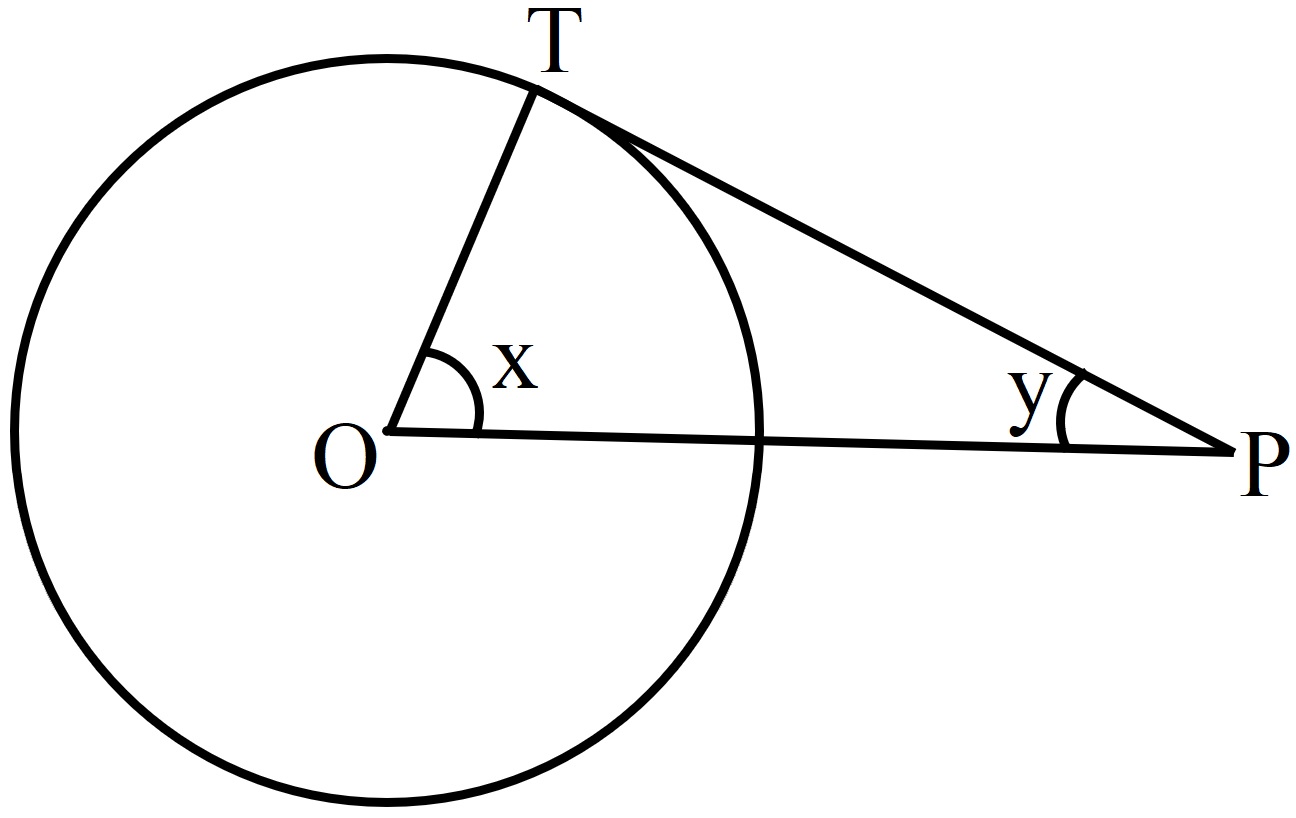
- ✓
$90^\circ$
- B
$60^\circ$
- C
$75^\circ$
- D
$100^\circ$
AnswerCorrect option: A. $90^\circ$
Here $\angle\text{T} = 90^\circ \ [$Angle between tangent and radius through the point of contact$]$
Now, in triangle $\text{OPT}$, we know that
$\angle\text{O} + \angle\text{P} + \angle\text{T} = 180^\circ$
$[$Angle sum property of a triangle$]$
$\Rightarrow x + y + 90^\circ = 180^\circ $
$\Rightarrow x + y = 180^\circ $
$\Rightarrow x + y = 90^\circ $
View full question & answer→MCQ 811 Mark
Two equal circles touch each other externally at $C$ and $AB$ is a common tangent to the circles. Then, $\angle\text{ACB}=$
- A
$60^\circ$
- B
$45^\circ$
- C
$30^\circ$
- ✓
$90^\circ$
AnswerCorrect option: D. $90^\circ$
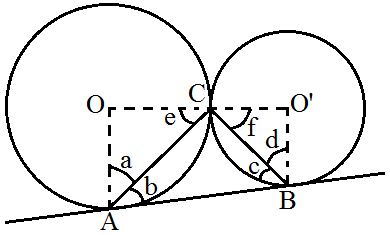
we know, radius always $\bot$ to tangent then,
$\angle\text{OAB}=\angle\text{a}+\angle\text{b}=90^{\circ}[\because\text{OA}\bot\text{AB}]$
$\Rightarrow\angle\text{a}=90^{\circ}=\angle\text{b}...(\text{i})$
$\angle\text{O'BA}=\angle\text{C}+\angle\text{d}=90^{\circ}$
$\Rightarrow\angle\text{d}=90^{\circ}-\angle\text{c}...(\text{ii})$
Here, redius are equal.
$\angle\text{a}=\angle\text{e} \ ($opposite angle of same side$)$
$\angle\text{d}=\angle\text{f} \ ($opposite angle of same side$)$
Now,
$\Rightarrow\angle\text{ACB}=\angle\text{OCO'}-\angle\text{e}-\angle\text{f}$
$\Rightarrow\angle\text{ACB}=180^{\circ}-\angle\text{a}-\angle\text{d}$
Put the value from eq. $(i)$ and $(ii)$
$\Rightarrow\angle\text{ACB}=180^{\circ}-(90-\angle\text{b})-(90-\angle\text{c})$
$\Rightarrow\angle\text{ACB}=180^{\circ}-90-\angle\text{b}-90-\angle\text{c}$
$\Rightarrow\angle\text{ACB}=\angle\text{b}+\angle\text{c}...(\text{iii})$
Now In $\triangle\text{ACB}$
$\angle\text{b}+\angle\text{c}+\angle\text{ACB}=180^{\circ}$
from eq $....(iii)$
$\Rightarrow\angle\text{ACB}+\angle\text{ACB}=180^{\circ}$
$\Rightarrow2\angle\text{ACB}=180^{\circ}$
$\Rightarrow\angle\text{ACB}=90^{\circ}$ View full question & answer→MCQ 821 Mark
In a circle of radius $7\ cm,$ tangent $PT$ is drawn from a point $P,$ such that $PT = 24\ cm$. If $O$ is the centre of the circle, then $OP =?$
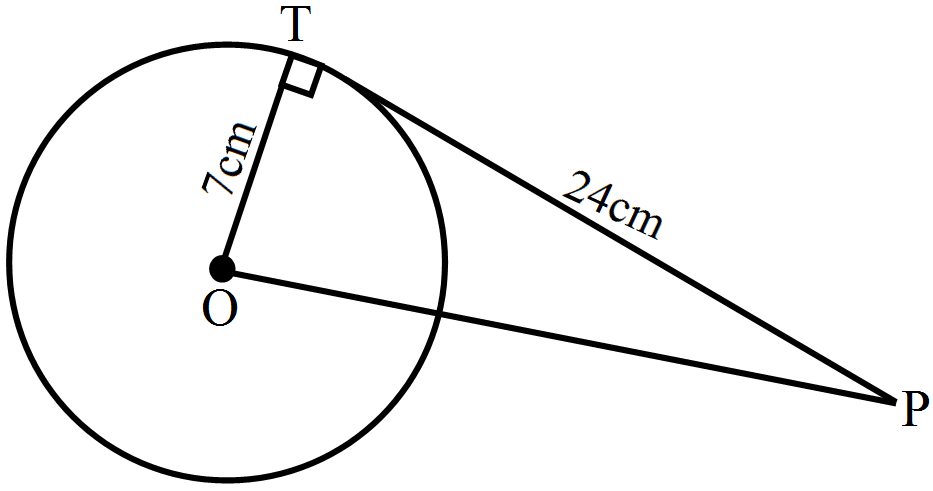
- A
$30\ cm$
- B
$28\ cm$
- ✓
$25\ cm$
- D
$18\ cm$
AnswerCorrect option: C. $25\ cm$
$PT = 24\ cm, OT = 7\ cm.$
Since $PT$ is a tangent to the circle at $T$.
$\angle\text{PTO}=90^\circ ....($tangent is perpendicular to the radius of a circle$)$
In $\triangle\text{PTO},$
By using Pythagoras theorem,
${OP}^2={PT}^2+{OT}^2$
$ \Rightarrow {OP}^2=24^2+7^2 $
$ \Rightarrow O P^2=576+49 $
$ \Rightarrow O P^2=625$
$\Rightarrow OP = 25\ cm.$
View full question & answer→MCQ 831 Mark
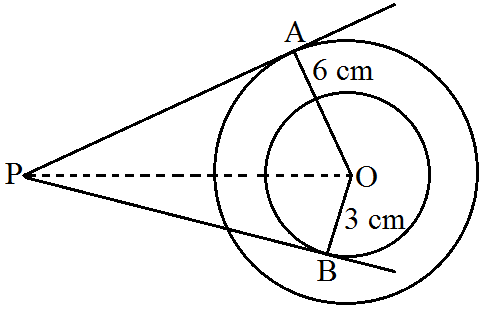
In the figure, if $AP = 10\ cm,$ then $BP =$
- A
$\sqrt{91}\text{ cm}$
- ✓
$\sqrt{127}\text{ cm}$
- C
$\sqrt{119}\text{ cm}$
- D
$\sqrt{109}\text{ cm}$
AnswerCorrect option: B. $\sqrt{127}\text{ cm}$
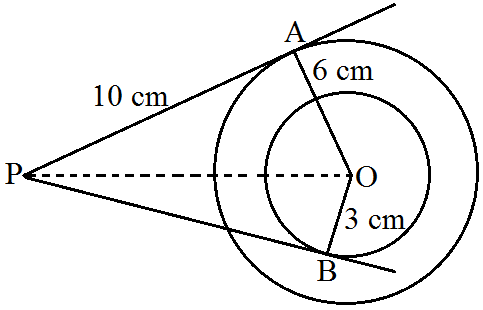
In the figure,
$OA = 6\ cm, OB = 3\ cm$ and $AP = 10\ cm$
$OA$ is radius and $AP$ is the tangent
$OA \perp AP$
Now in right $\triangle\text{OAP}$
$O P^2=A P^2+O A^2=(10)^2+(6)^2$
$=100+36=136$
Similarly $BP$ is tangent and $OB$ is radius
$ O P^2=O B^2+B P^2 $
$ 136=(3)^2+B P^2$
$136=9+B P^2$
$\Rightarrow BP^2= 136 – 9 = 127$
$BP = \sqrt{127}\text{ cm}$ View full question & answer→MCQ 841 Mark
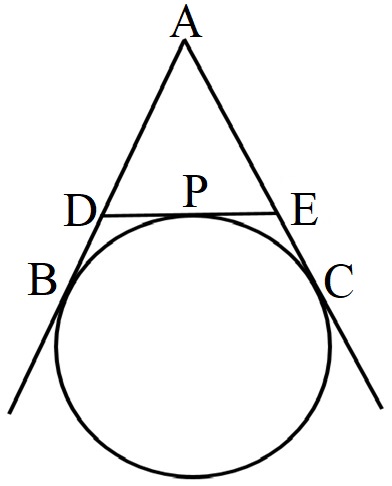
In the given figure, $AB = 8\ cm$. If $PE = 3\ cm,$ then the measure of $AE$ is :
- ✓
$5\ cm$
- B
$7\ cm$
- C
$9\ cm$
- D
$4.5\ cm$
AnswerCorrect option: A. $5\ cm$
Since Tangents from an external point to a circle are equal.
$\therefore PE = EC = 3\ cm$ and $AB = AE = 8\ cm$
Therefore $, AE = AC - EC = 8 - 3 = 5\ cm$
View full question & answer→MCQ 851 Mark
Choose the correct option and give justification. From a point $Q,$ the length of the tangent to a circle is $24 \ cm$ and the distance of $Q$ from the centre is $25 \ cm$. The radius of the circle is :
- ✓
$7 \ cm.$
- B
$12 \ cm.$
- C
$15 \ cm.$
- D
$24.5 \ cm.$
AnswerCorrect option: A. $7 \ cm.$
$\because\angle\text{OPQ}=90^\circ$
$[$The tangent at any point of a circle is $\perp$ to the radius through the point of contact$]$
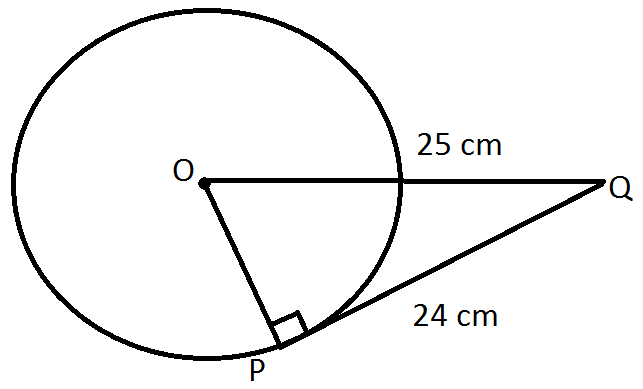
$\therefore$ In right triangle $\text{OPQ},$
$O Q^2=O P^2+P Q^2$
$[$By Pythagoras theorem$]$
$ \Rightarrow(25)^2=O P^2+(24)^2 $
$ \Rightarrow 625=O P^2+576$
$ \Rightarrow O P^2=625-576=49$
$\Rightarrow OP = 7\ cm.$ View full question & answer→MCQ 861 Mark
In the given figure, two circles touch each other at $C$ and $AB$ is a tangent to both the circles. The measure of $\angle\text{ACB}$ is :
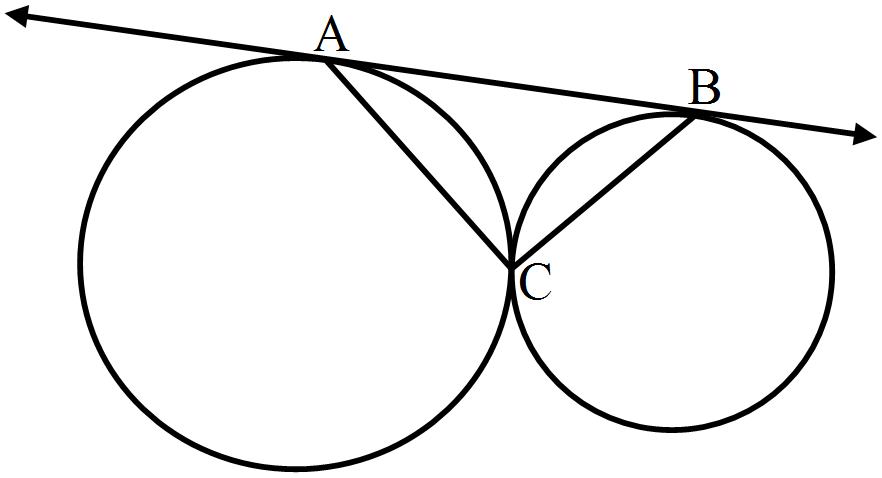
- A
$45^\circ$
- B
$60^\circ$
- ✓
$90^\circ$
- D
$120^\circ$
AnswerCorrect option: C. $90^\circ$
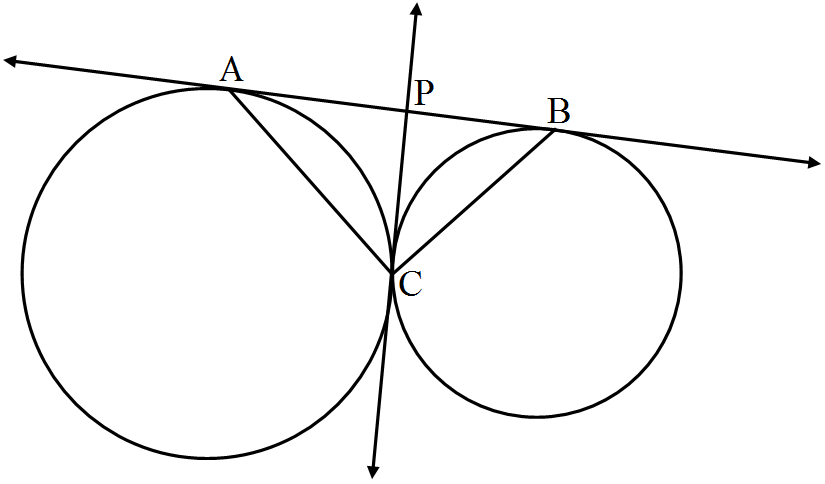
Draw a tangent to the circle at point $C$ meet $AB$ at $P$.
Then,
$PA = PC$
$\Rightarrow \angle\text{PAC}=\angle\text{PCA}$
And $PB = PC$
$\Rightarrow\angle\text{PBC}=\angle\text{PCB}$
$\therefore\angle\text{PAC}+\angle\text{PBC}=\angle\text{PCA}+\angle\text{PCB}=\angle\text{ACB}$
$\Rightarrow\angle\text{PAC}+\angle\text{PBC}+\angle\text{ACB}=2\angle\text{ACB}$
$\Rightarrow180^\circ=2\angle\text{ACB}$
$\Rightarrow\angle\text{ACB}=90^\circ$ View full question & answer→MCQ 871 Mark
In the given figure $,O$ is the centre of the circle, $PQ$ is a chord and $PT$ is the tangent at $P$. If $ \angle\text{POQ} = 70^\circ$ then $\angle\text{TPQ} $ is equal to :
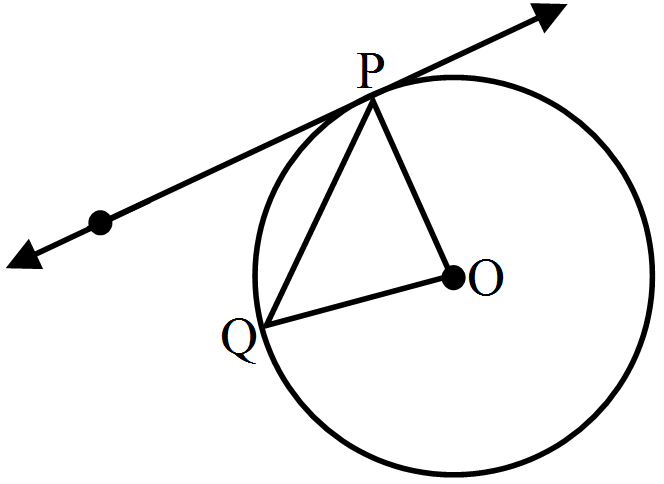
- ✓
$35^\circ$
- B
$45^\circ$
- C
$55^\circ$
- D
$70^\circ$
AnswerCorrect option: A. $35^\circ$
In $\triangle\text{OPQ},$
$\text{OP}=\text{OQ} ....($radii of the same circle$)$
$\Rightarrow\angle\text{OQP}=\angle\text{OPQ} ....($angles opposite equal sides are equal$)$
$\triangle\text{OPQ},$
$\angle\text{OQP}+\angle\text{OPQ}+\angle\text{POQ}=180^\circ ......($Angle Sum Property$)$
$\Rightarrow\angle\text{OPQ}+\angle\text{OPQ}+70^\circ=180^\circ$
$\Rightarrow2\angle\text{OPQ}=110^\circ$
$\Rightarrow\angle\text{OPQ}=55^\circ$
Since $PT$ is a tangent to the inner circle.
$\Rightarrow\angle\text{OPT}=90^\circ .....($Tangent is perpendicular to the radius of a circle$)$
$\Rightarrow\angle\text{OPQ}+\angle\text{TPQ}=90^\circ$
$\Rightarrow55^\circ+\angle\text{TPQ}=90^\circ$
$\Rightarrow\angle\text{TPQ}=35^\circ$
View full question & answer→MCQ 881 Mark
The number of tangents that can be drawn from an external point to a circle is :
Answer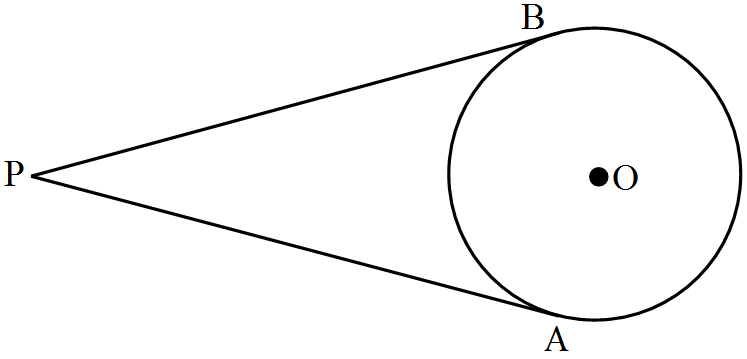
We can draw only two tangents from an external point to a circle.
View full question & answer→MCQ 891 Mark
$TP$ and $TQ$ are tangents from an external point $T,$ to a circle with centre $\text{O} \angle\text{TPQ} = 60^\circ$ then the measure of $ \angle\text{OPQ}$ is :
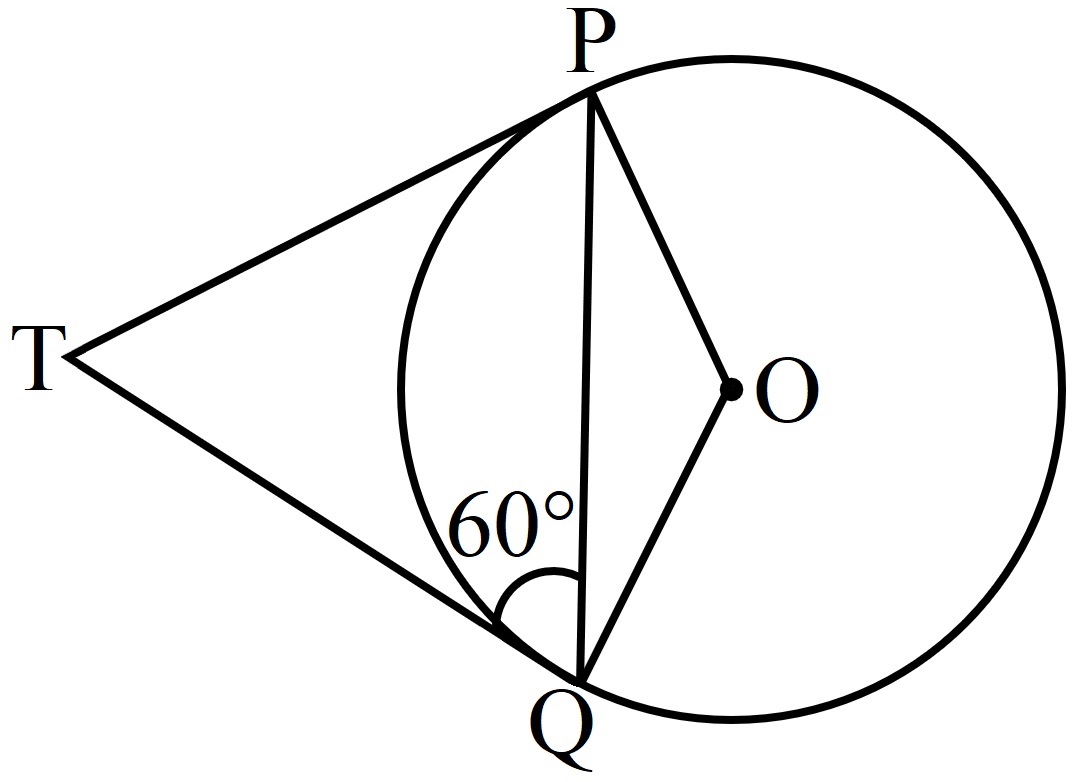
- A
$40^\circ$
- B
$90^\circ$
- ✓
$30^\circ$
- D
$60^\circ$
AnswerCorrect option: C. $30^\circ$
Here $\angle\text{QPT} = 60\ [$Angles opposite to equal sides$]$
And$ \angle\text{PTQ} = 180^\circ - (60^\circ + 60^\circ) = 60^\circ\ [$Angle sum property of a triangle$]$
$\angle\text{POQ} = 180^\circ - 60^\circ = 120^\circ$
Let $\angle\text{OPQ} = \text{OQP} = \text{x}\ [$Angles opposite to equal sides $($Radii$)]$
$\therefore$ In triangle $\text{OPQ},$
$\angle\text{POQ} +\text{x}+\text{x} =180^\circ$
$\Rightarrow 120^\circ + 2\text{x} = 180^\circ$
$\Rightarrow 2\text{x} = 60^\circ$
$\Rightarrow \text{x} = 30^\circ$
Therefore $,\angle\text{OPQ} = 30^\circ$
View full question & answer→MCQ 901 Mark
In the given figure, if $\angle\text{AOD}=135^\circ$ then $\angle\text{BOC}$ is equal to :
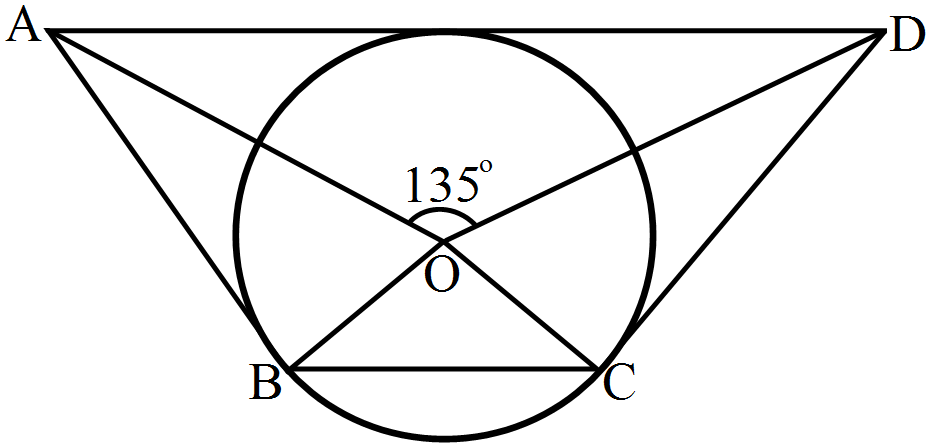
- A
$25^\circ$
- ✓
$45^\circ$
- C
$52.5^\circ$
- D
$62.5^\circ$
AnswerCorrect option: B. $45^\circ$
We know that sum of the angles subtended by opposite sides of a quadrilateral having a circumscribed circle is $180^\circ .$
$\Rightarrow\angle\text{AOD}+\angle\text{BOC}=180^\circ$
$\Rightarrow135^\circ+\angle\text{BOC}=180^\circ$
$\Rightarrow\angle\text{BOC}=45^\circ$
View full question & answer→MCQ 911 Mark
In the given figure, the length of $BC$ is :
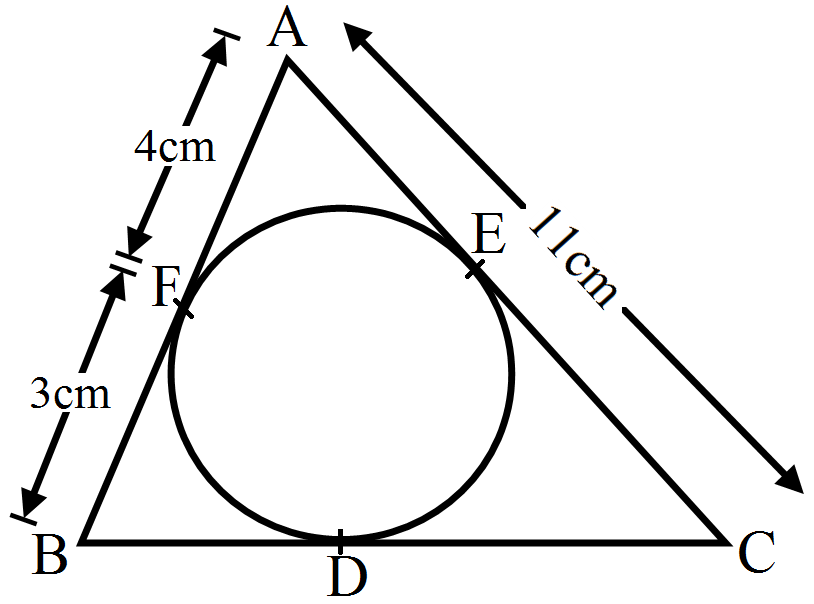
- A
$7\ cm$
- ✓
$10\ cm$
- C
$14\ cm$
- D
$15\ cm$
AnswerCorrect option: B. $10\ cm$
We know that tangent from an external point to a circle are equal.
So,
$AF = AE = 4\ cm$
$\Rightarrow EC = AC - AE $
$= 11 - 4 = 7\ cm$
Now,
$CD = CE = 7\ cm$
and $BF = BD = 3\ cm$
$BD = BD + CD$
$\Rightarrow BD = 3 + 7$
$\Rightarrow BD = 10\ cm$
View full question & answer→MCQ 921 Mark
Choose the correct option and give justification. In Fig., if $TP$ and $TQ$ are the two tangents to a circle with centre $O$ so that $\angle POQ = 110^\circ ,$ then $\angle PTQ$ is equal to :
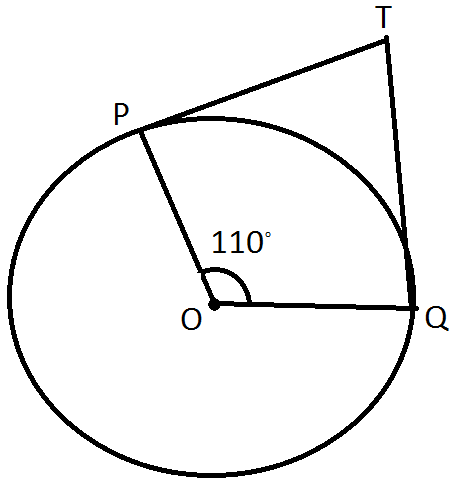
- A
$60^\circ$
- ✓
$70^\circ$
- C
$80^\circ$
- D
$90^\circ$
AnswerCorrect option: B. $70^\circ$
$\angle POQ = 110^\circ , \angle OPT = 90^\circ $ and $\angle OQT = 90^\circ$
$[$The tangent at any point of a circle is $\perp$ to the radius through the point of contact$]$
In quadrilateral $\text{OPTQ},$
$\angle POQ + \angle OPT + \angle OQT + \angle PTQ = 360^\circ$
$[$Angle sum property of quadrilateral$]$
$\Rightarrow 110^\circ + 90^\circ + 90^\circ + \angle PTQ = 360^\circ$
$\Rightarrow 290^\circ + \angle PTQ = 360^\circ$
$\Rightarrow \angle PTQ = 360^\circ - 290^\circ$
$\Rightarrow \angle PTQ = 70^\circ$
View full question & answer→MCQ 931 Mark
In the given figure $,PQ$ is a tangent to a circle with centre $O. A$ is the point of contact. If $\angle\text{PAB} = 67^\circ$ then the measure of $\angle\text{AQB} $ is :
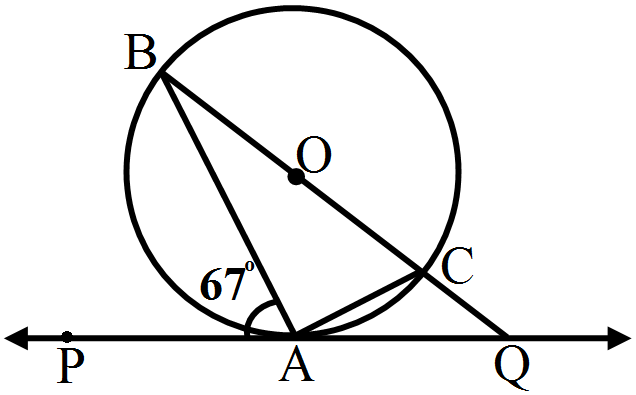
- A
$73^\circ$
- B
$64^\circ$
- C
$53^\circ$
- ✓
$44^\circ$
AnswerCorrect option: D. $44^\circ$
Since $\angle\text{BAC}$ is inscribed in a semicircle, $\angle\text{BAC}=90^\circ.$
Since $\text{PAQ}$ is a straight line,
$\angle\text{PAB}+\angle\text{BAC}+\angle\text{CAQ}=180^\circ $
$\Rightarrow67^\circ+90^\circ+\angle\text{CAQ}=180^\circ$
$\Rightarrow\angle\text{CAQ}=23^\circ$
We know that angles that subtend the same arc are equal.
$\Rightarrow\angle\text{CBA}=\angle\text{CAQ}=23^\circ$
In $\triangle\text{BAQ},$
$\angle\text{BAQ}+\angle\text{QBA}+\angle\text{AQB}=180^\circ ....($Angle Sum Property$)$
$\Rightarrow(90^\circ+23^\circ)+23^\circ+\angle\text{AQB}=180^\circ$
$\Rightarrow\angle\text{AQB}=44^\circ$
View full question & answer→MCQ 941 Mark
Which of the following statment is not true ?
- A
If a point $P$ lies inside a circle, no tangent can be drawn to the circle passing through $P$.
- B
If a point $P$ lies on a circle, then one and only one tangent can be drawn to the circle at $P$.
- C
If a point $P$ lies outside a circle, then only two tangents can be drawn to the circle from $P$.
- ✓
A circle can have more than two parallel tangents parallel to a given line.
AnswerCorrect option: D. A circle can have more than two parallel tangents parallel to a given line.
Options $(a), (b)$ and $(c)$ are all true.
However, Option $(d)$ is false since we can draw only parallel tamngent on either side of the diameter,
which would be parallel to a given line.
View full question & answer→MCQ 951 Mark
In the figure, if tangents $PA$ and $PB$ are drawn to a circle such that $\angle\text{APB}=30^\circ$ and chord $AC$ is drawn parallel to the tangent $PB,$ then $\angle\text{ABC} =$
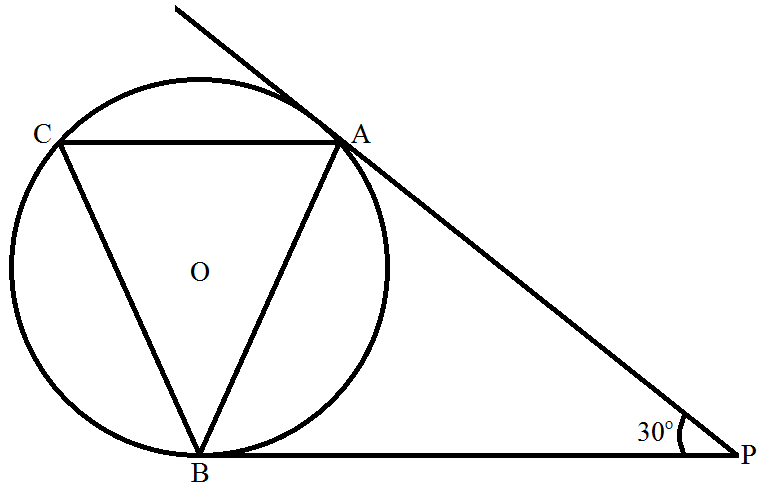
- A
$60^\circ$
- B
$90^\circ$
- ✓
$30^\circ$
- D
AnswerCorrect option: C. $30^\circ$
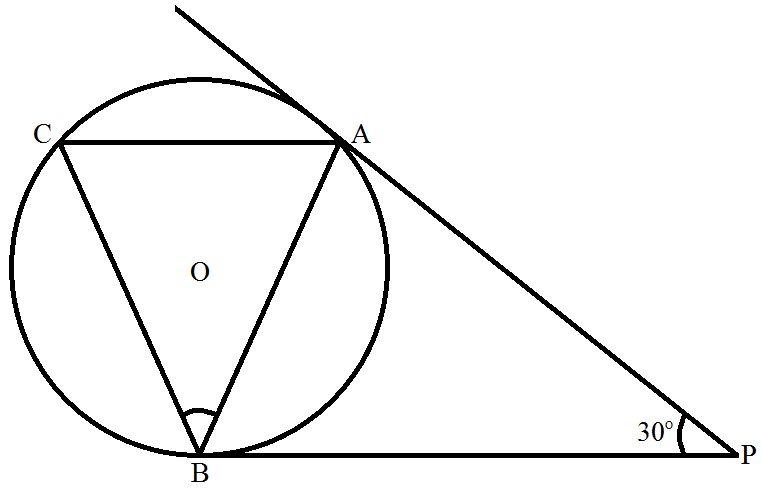
By property of tangent $PA = PB\ ($tangent from $P)$
then, In $\triangle\text{ABP}$
$PA = PB$ and $\angle\text{PAB}=\angle\text{ABP}$
Sum of all angles of triangle $\text{APB}$ is $180^\circ $
$\angle\text{PAB}+\angle\text{ABP}+\angle\text{APB}=180^\circ$
$\Rightarrow\angle\text{ABP}+\angle\text{ABP}+30^\circ=180^\circ$
$\Rightarrow2\angle\text{ABP}=150^\circ$
$\Rightarrow\angle\text{ABP}=75^\circ$
$\angle\text{ABP}=\angle\text{BAC}=75^\circ\ ($Alternate algles$)$
$\angle\text{ABP}=\angle\text{ACB}=75^\circ\ ($Alternate segment theorem$)$
Now, sum of all angles of $\triangle\text{ABC} 180^\circ $
$\Rightarrow\angle\text{BAC}+\angle\text{ACB}+\angle\text{ABC}=180^\circ$
$\Rightarrow75^\circ+75^\circ+\angle\text{ABC}=180^\circ$
$\Rightarrow\angle\text{ABC}=30^\circ$ View full question & answer→MCQ 961 Mark
In the given figure, if quadrilateral $\text{PQRS}$ circumscribes a circle, then $PD + QB =$ 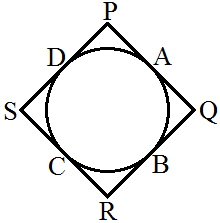
Answer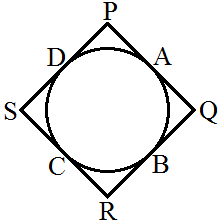
We know that tangents drawn to a circle from the same external point will be equal in length.
Therefore,
$PD = PA …… (1)$
$QB = QA …… (2)$
Adding equations $(1)$ and $(2),$ we get,
$PD + QB = PA + QA$
By looking at the figure we can say,
$PD + QB = PQ.$ View full question & answer→MCQ 971 Mark
In figure, $AB$ is a chord of the circle and $\text{AOC}$ is its diameter such that $\angle\text{ACB}=50^\circ.$ If $AT$ is the tangent to the circle at the point $A,$ then $\angle\text{BAT}$ is equal to :
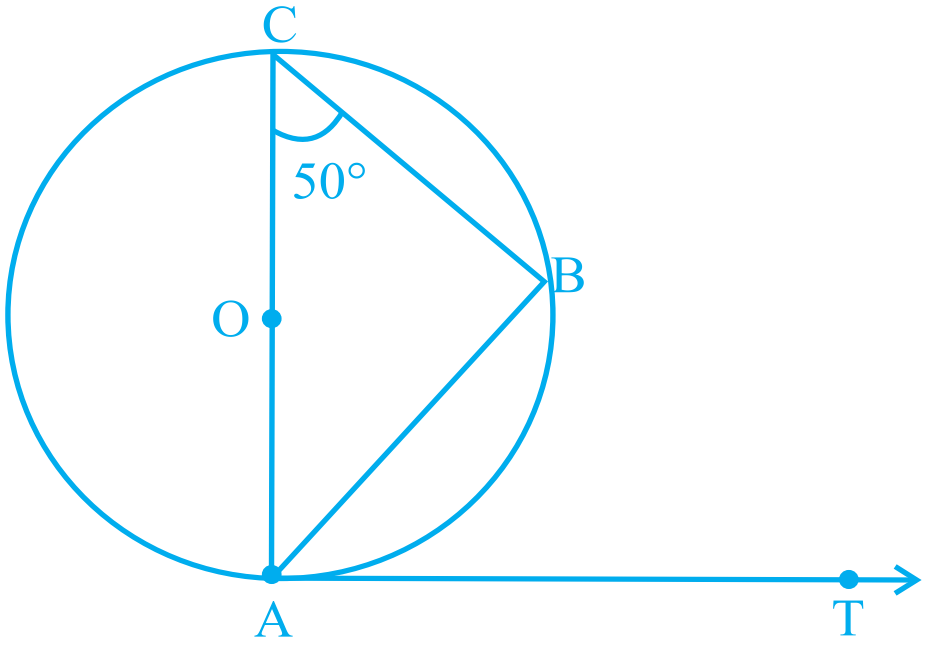
- A
$65^\circ$
- B
$60^\circ$
- ✓
$50^\circ$
- D
$40^\circ$
AnswerCorrect option: C. $50^\circ$
In figure, $\text{AOC}$ is a diameter of the circle.
We know that, diameter subtends an angle $90^\circ$ at the circle.
So, $\angle\text{ABC}=90^\circ$
In $\triangle\text{ACB},\ \angle\text{A}+\angle\text{B}+\angle\text{C}=180^\circ$
$[$Since, sum of all angles of a triangle is $180^\circ ]$
$\Rightarrow\ \angle\text{A}+90^\circ+50^\circ=180^\circ$
$\Rightarrow\ \angle\text{A}+140=180$
$\Rightarrow\ \angle\text{A}=180^\circ-140^\circ=40^\circ$
$\angle\text{A}\text{ or }\angle\text{OAB}=40^\circ$
Now, $AT$ is the tangent to the circle at point $A$.
So, $OA$ is perpendicular to $AT.$
$\therefore\ \angle\text{OAT}=90^\circ\ \ [\text{from figure}]$
$\Rightarrow\ \angle\text{OAB}+\angle\text{BAT}=90^\circ$
On putting $\angle\text{OAB}=40^\circ,$ we get
$\Rightarrow\ \angle\text{BAT}=90^\circ-40^\circ=50^\circ$
Hence, the value of $\angle\text{BAT}$ is $50^\circ .$
View full question & answer→MCQ 981 Mark
In Figure, if $\text{PQR}$ is the tangent to a circle at $Q$ whose centre is $O, AB$ is a chord parallel to $PR$ and $\angle\text{BQR}=70^\circ,$ then $\angle\text{AQB}$ is equal to :
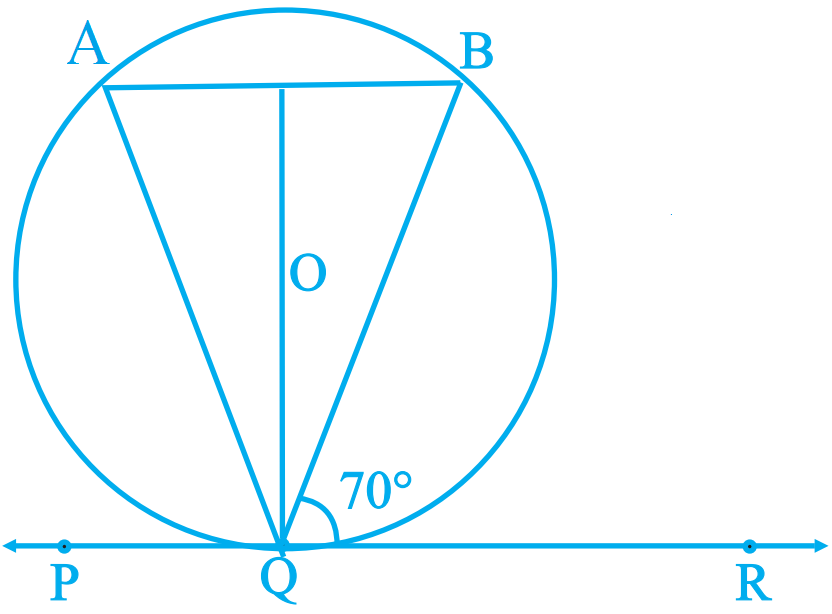
- A
$20^\circ$
- ✓
$40^\circ$
- C
$35^\circ$
- D
$45^\circ$
AnswerCorrect option: B. $40^\circ$
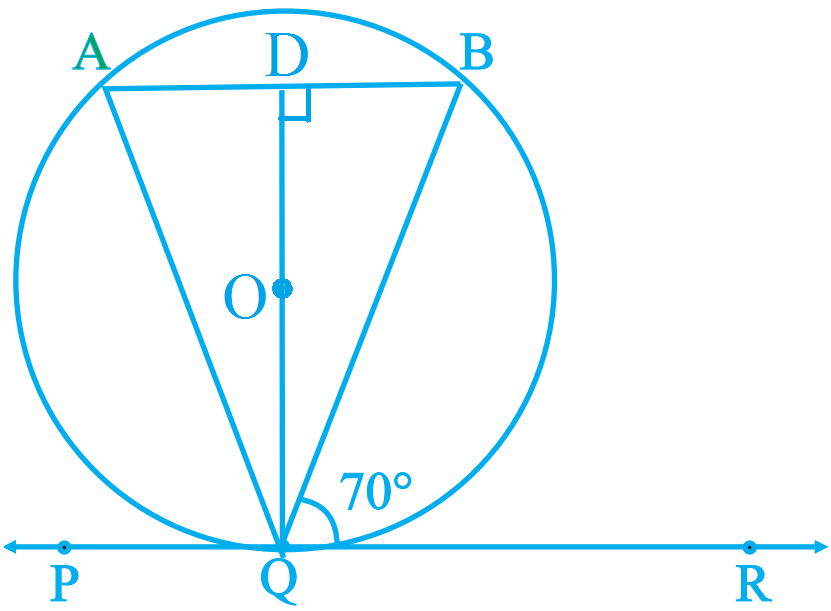
Given $, AB \| PR$
$\therefore\ \angle\text{ABQ}=\angle\text{BQR}=70^\circ \ [$alternate angles$]$
Also, $QD$ is perpendicular to $AB$ and $QD$ bisects $AB$.
In $\triangle\text{QDA } $ and $\triangle\text{QDB},\ \ \angle\text{QDA}=\angle\text{QDB}\ \ [\text{each }90^\circ]$
$AD = BD$
$QD = QD\ [$common side$]$
$\therefore\ \triangle\text{ADQ}\cong\triangle\text{BDQ} \ [$by $\text{SAS}$ similarity criterion$]$
Then $\angle\text{QAD}=\angle\text{QBD}\ \ [\text{CPCT}] ...(\text{i})$
Also $\angle\text{ABQ}=\angle\text{BQR} \ [$alternate interior angle$]$
$\therefore\ \angle\text{ABQ}=70^\circ\ \ [\because\angle\text{BQR}=70^\circ]$
Hence, $\angle\text{QAB}=70^\circ\ \ [\text{from Eq. (i})]$
Now, in $\triangle\text{ABQ},\ \angle\text{A}+\angle\text{B}+\angle\text{Q}=180^\circ$
$\Rightarrow\ \angle\text{Q}=180^\circ-(70^\circ+70^\circ)=40^\circ$ View full question & answer→MCQ 991 Mark
$AB$ and $CD$ are two common tangents to circles which touch each other at $C$. If $D$ lies on $AB$ such that $CD = 4\ cm,$ then $AB$ is equal to :
- A
$4\ cm$
- B
$6\ cm$
- ✓
$8\ cm$
- D
$12\ cm$
AnswerCorrect option: C. $8\ cm$
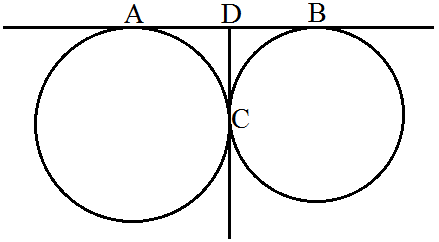
By property of tangent,
$AD = DC \ ($tangent from $D)$
$DB = DC \ ($tangent from $D)$
Given $, DC = 4\ cm$
Now, we have to find $AB$
$AB = AD + DB$
$\Rightarrow AB = DC + DC$
$\Rightarrow AB = 2DC$
$\Rightarrow AB = 2 \times 4$
$\Rightarrow AB = 8\ cm$ View full question & answer→MCQ 1001 Mark
To draw a pair of tangents to a circle, which are inclined to each other at angle of $45^\circ,$ we have to draw the tangents at the end points of those two radii, the angle between which is :
- A
$105^\circ$
- ✓
$135^\circ$
- C
$140^\circ$
- D
$145^\circ$
AnswerCorrect option: B. $135^\circ$
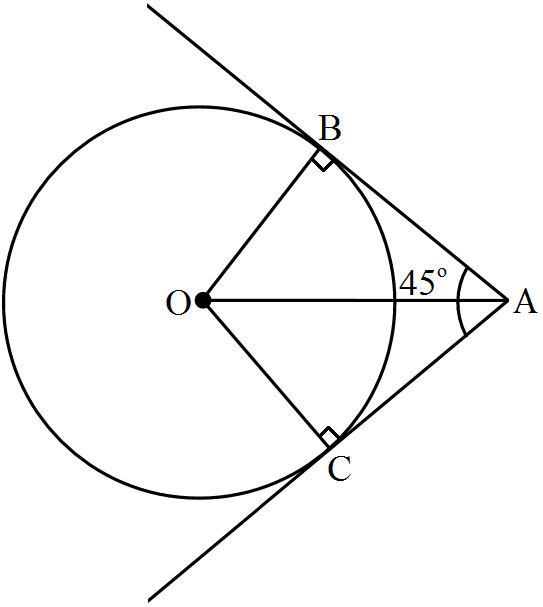
Since $AB$ and $AC$ are the tangent to the circle.
$\angle\text{OBA}=\angle\text{OCA}=90^\circ ($tangent is perpendicular to the radius of a circle$)$
In $\text{ACOB},$
$\angle\text{OBA}+\angle\text{BAC}+\angle\text{OCA}+\angle\text{BOC}=360^\circ$
$\Rightarrow90^\circ+45^\circ+45^\circ+\angle\text{BOC}=360^\circ$
$\Rightarrow\angle\text{BOC}=135^\circ$ View full question & answer→MCQ 1011 Mark
If two tangents inclined at an angle of $60^\circ$ are drawn to a circle of radius $3\ cm,$ then the length of each tangent is :
AnswerCorrect option: C. $3\sqrt{3}\text{ cm}$
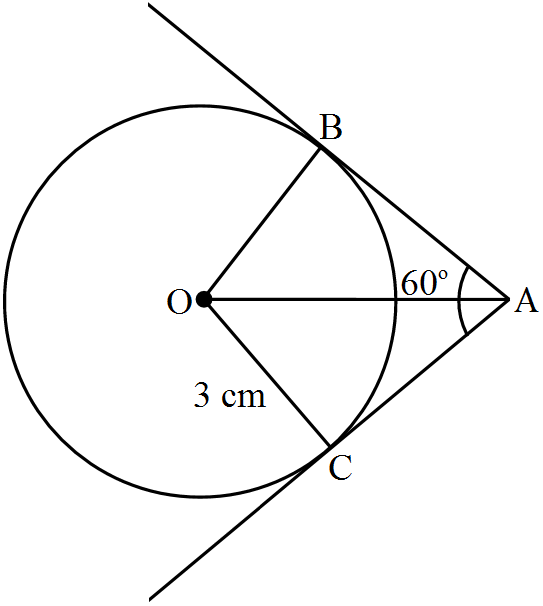
In $\triangle\text{BAO}$ and $\triangle\text{CAO},$
$\angle\text{OBA}=\angle\text{OCA}=90^\circ ....($Since $AB$ and $AC$ are tangent to the circle$)$
$\text{OA}=\text{OA} ....($common side$)$
$\text{OB}=\text{OC} ....($radii of the same circle$)$
$\Rightarrow\triangle\text{BAO}\cong\triangle\text{CAO} ....(\text{RHS}$ congruence criterion$)$
$\angle\text{OAB}=\angle\text{OAC} ....(\text{cpct})$
$\Rightarrow\angle\text{OAB}=\frac{1}{2}\angle\text{BAC}=30^\circ$
So, $\triangle\text{BAO}$ is a $30-60-90$ triangle.
side opposite $30^\circ=\frac{1}{2}$ hypotenuse
$\Rightarrow\text{OB}=\frac{1}{2}$ hypotenuse
$\Rightarrow $ hypotene $= 2OB = 2(3) = 6\ cm$
side opposite $60^\circ=\frac{\sqrt{3}}{2}$ hypotenuse
$\Rightarrow\text{AB}=\frac{\sqrt{3}}{2}(6)=3\sqrt{3}\text{ cm}$
$\text{AB}=\text{AC}=3\sqrt{3}\text{ cm} ....($Since tangents from an external point to the circle are equal$)$
Hence, the length of each tangent is $3\sqrt{3}\text{ cm}.$ View full question & answer→MCQ 1021 Mark
Two concentric circles of radii $3\ cm $ and $5\ cm$ are given. Then length of chord $BC$ which touches the inner circle at $P$ is equal to :
- A
$4\ cm$
- B
$6\ cm$
- ✓
$8\ cm$
- D
$10\ cm$
AnswerCorrect option: C. $8\ cm$
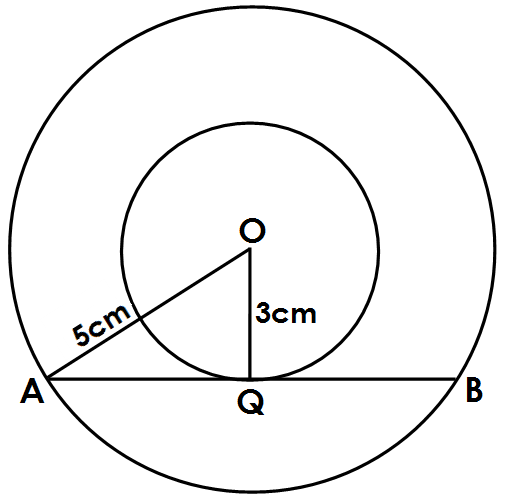
Here, radius $OQ \bot$ to tangent $AB$ then we say,
$\angle\text{OQA}=\angle\text{OQB}=90^\circ$
and $\triangle\text{OQA}$ is right angle triangle then,
$A Q^2=O A^2-O Q^2 $
$ \Rightarrow A Q^2=5^2-3^2 $
$ \Rightarrow A Q^2=25-9$
$\Rightarrow\text{AQ}^2=\sqrt{16}$
$\Rightarrow AQ = 4\ cm$
By property of tangent.
$BQ = BP\ ($tangent from point $B)$
$\because OQ$ bisects $AB$ then $AQ = QB = 4\ cm$
$OP$ bisects $AB$ then $BP = PC = 4\ cm$
Now, we have to find $BC,$
$BC = BP + PC$
$\Rightarrow BC = 4 + 4$
$\Rightarrow BC = 8\ cm.$ View full question & answer→MCQ 1031 Mark
At one end of a diameter $PQ$ of a circle of radius $5\ cm,$ tangent $\text{XPY}$ is drawn to the circle. The length of chord $AB$ parallel to $XY$ and at distance of $8\ cm$ from $P$ is :
- A
$5\ cm$
- B
$6\ cm$
- C
$7\ cm$
- ✓
$8\ cm$
AnswerCorrect option: D. $8\ cm$
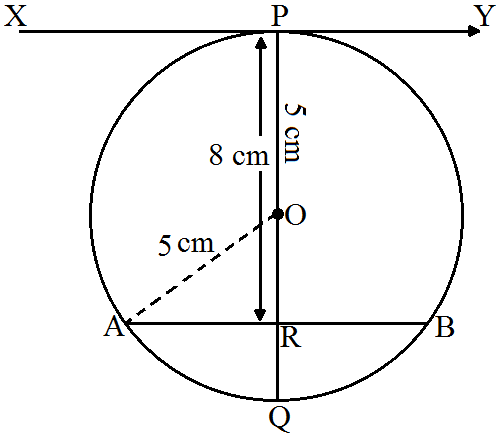
In the figure, $PQ$ is diameter $\text{XPY}$ is tangent to the circle with centre $O$ and radius $5\ cm$
From $P,$ at a distance of $8\ cm AB$ is a chord drawn parallel to $XY.$
To find the length of $AB$ Join $OA$
$XY$ is tangent and $OP$ is the radius.
$OP \perp XY$ or $PQ \perp XY$$AB \| XY$
$OQ$ is $\perp AB$ which meets $AB$ at $R$
Now in right $\triangle\text{OAR}$
$O A^2=O R^2+A R^2 $
$ (5)^2=(3)^2+A R^2 $
$25 = 9 + AR^2$
$\Rightarrow AR^2= 25 – 9 = 16 = (4)^2$
$AR = 4\ cm$
But $R$ is mid $-$ point of $AB$
$AB = 2 AR = 2 x \ \ 4 = 8\ cm$
View full question & answer→MCQ 1041 Mark
In the figure, if $TP$ and $TQ$ are tangents drawn from an external point $T$ to a circle with centre $O$ such that $\angle\text{TQP}=60^\circ,$ then :
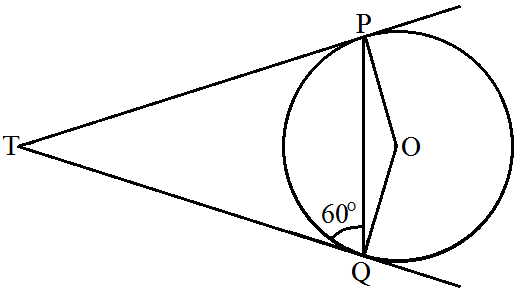
- A
$25^\circ$
- ✓
$30^\circ$
- C
$40^\circ$
- D
$60^\circ$
AnswerCorrect option: B. $30^\circ$
In the figure $, TP$ and $TQ$ are the tangents drawn from $T$ to the circle with centre $O. OP, OQ$ and $PQ$ are joined.$\angle\text{TQP}=60^\circ$
$TP = TQ \ ($Tangents from T to the circle$)$
$\angle\text{TPQ}=\angle\text{TQP}=60^\circ$
$\angle\text{PTQ}=180^\circ-(60^\circ+60^\circ)$
$=180^\circ-120^\circ=60^\circ$
and $\angle\text{PTQ}=180^\circ-(60^\circ+60^\circ)$
$=180^\circ-120^\circ=60^\circ$
But $OP = OQ ($radii of the same circle.$)$
$\angle\text{OPQ}=\angle\text{OQP}$
But $\angle\text{OPQ}+\angle\text{OQP}$
$=180^\circ-120^\circ=60^\circ$
But $\angle\text{OQP}=30^\circ$
View full question & answer→MCQ 1051 Mark
A tangent $PQ$ at a point $P$ of a circle of radius $5 \ cm$ meets a line through the centre $O$ at a point $Q$ so that $OQ = 12 \ cm$. Length $PQ$ is :
- A
$12 \ cm$
- B
$13 \ cm$
- C
$8.5 \ cm$
- ✓
$\sqrt{119} \ cm.$
AnswerCorrect option: D. $\sqrt{119} \ cm.$
$\sqrt{119} \ cm.$
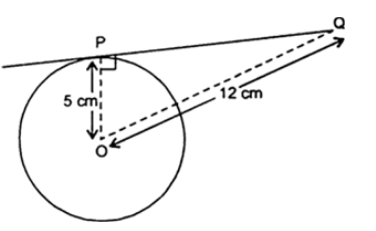
View full question & answer→MCQ 1061 Mark
A tangent $PQ$ at point of contact $P$ to a circle of radius $12\ cm$ meets the line through centre $O$ to a point $Q$ such that $OQ = 20\ cm,$ length of tangent $PQ$ is :
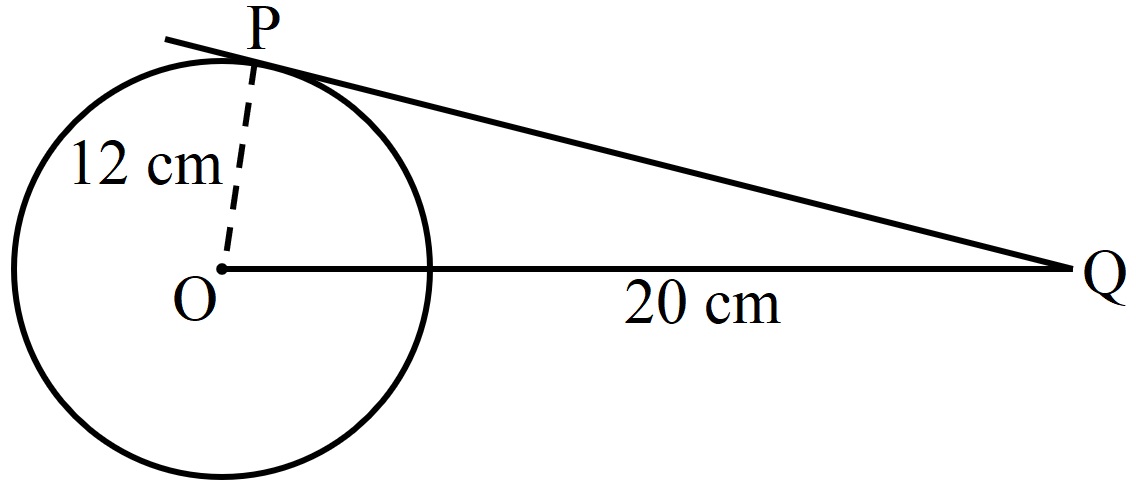
- A
$12\ cm$
- B
$13\ cm$
- C
$15\ cm$
- ✓
$16\ cm$
AnswerCorrect option: D. $16\ cm$
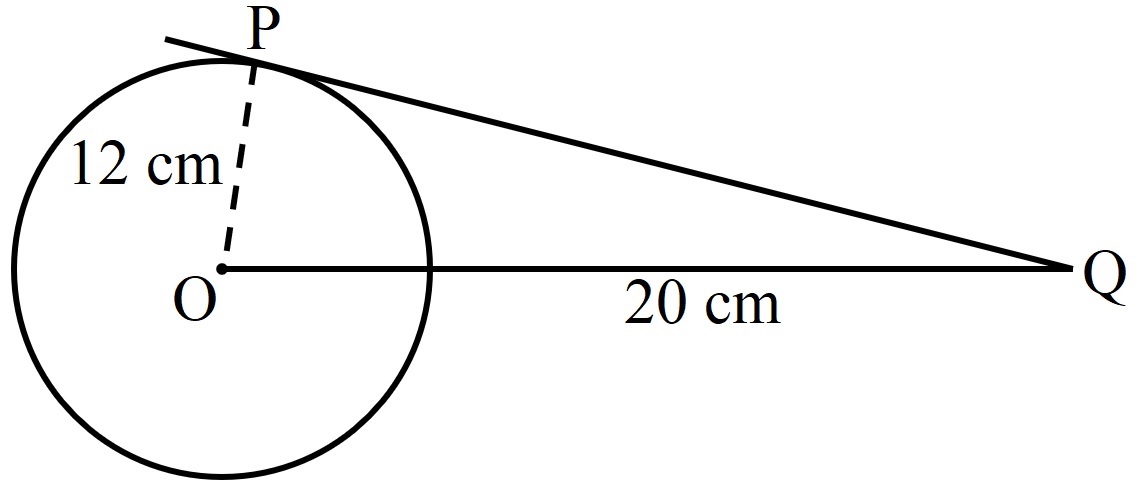
Since op is perpendicular to $PQ,$ the $\angle\text{OPQ}=90^\circ$
Now, in right angled triangle $\text{OPQ},$
$\text{OQ}^2=\text{OP}^2+\text{PQ}^2$
$\Rightarrow(20)^2=(12)^2+\text{PQ}^2$
$\Rightarrow\text{PQ}^2=400-144$
$\Rightarrow\text{PQ}^2=256$
$\Rightarrow\text{PQ}=16\text{ cm}$ View full question & answer→MCQ 1071 Mark
In the given figure $,PQ$ and $PR$ are tangents to a circle with centre $A$. If $\angle\text{QPA}=27^\circ$ then $\angle\text{QAR}$ equals :
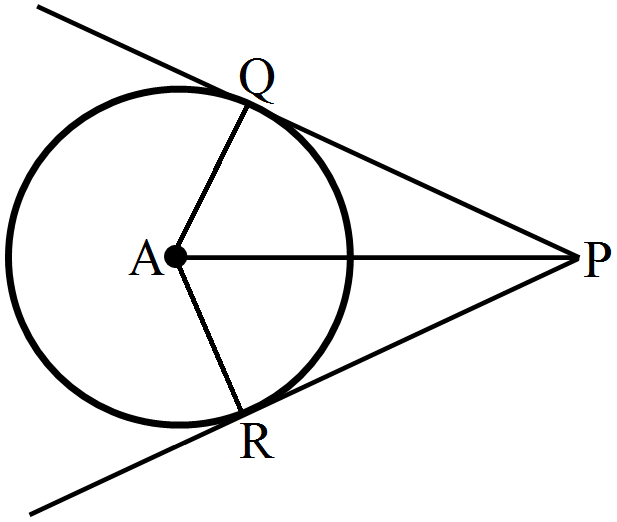
- A
$63^\circ$
- B
$117^\circ$
- ✓
$126^\circ$
- D
$153^\circ$
AnswerCorrect option: C. $126^\circ$
In $\triangle\text{PAQ}$ and $\triangle\text{PAR},$
$\angle\text{PQA}=\angle\text{PRA} ....($Since $PQ$ and $PR$ are tangent to the circle$)$
$\text{AP}=\text{AP} ....($common side$)$
$\text{AQ}=\text{AR} ....($radii of the same circle$)$
$\Rightarrow\triangle\text{PAQ}\cong\triangle\text{PAR} ....(\text{RHS}$ congruence criterion$)$
$\angle\text{OAP}=\angle\text{RAP} ....(\text{cpct})$
In $\triangle\text{PAQ},$
$\angle\text{QAP}+\angle\text{PQA}+\angle\text{APQ}=180^\circ ....($Angle Sum property$)$
$\Rightarrow\angle\text{QAP}+90^\circ+27^\circ=180^\circ.....(\angle\text{PQA}=90^\circ,$ since radius is perpendicular to the tangent $)$
$\Rightarrow\angle\text{QAP}=63^\circ$
So, $\angle\text{QAR}=\angle\text{QAP}+\angle\text{RAP}$
$\Rightarrow\angle\text{QAR}=63^\circ+63^\circ$
$\Rightarrow\angle\text{QAR}=126^\circ$
View full question & answer→MCQ 1081 Mark
In the given figure $,DE$ and $DF$ are tangents from an external point $D$ to a circle with centre $A$. If $DE = 5\ cm$ and $DE \perp DF,$ then the radius of the circle is :
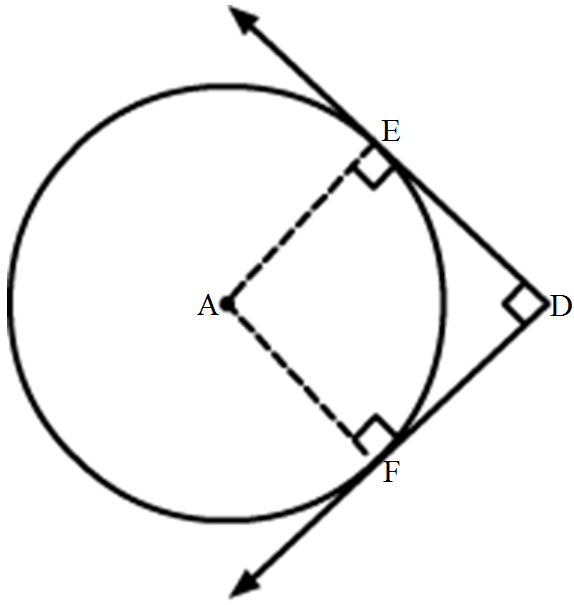
- A
$3\ cm$
- ✓
$5\ cm$
- C
$4\ cm$
- D
$6\ cm$
AnswerCorrect option: B. $5\ cm$
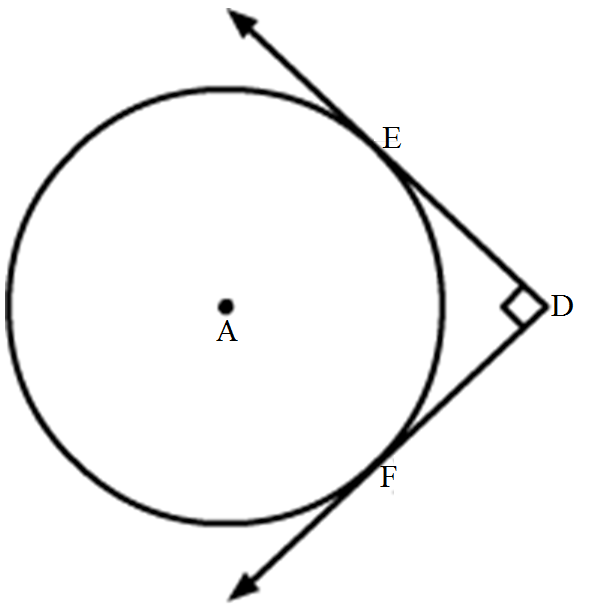
join $AE$ and $AF$.
Now $,DE$ is a tangent at $E$ and $AE$ is the radius through the point of contact $E$.
$\therefore\angle\text{AED}=90^\circ\ ($Tangent at any point of a circle is perpendicular to the radius through the point of contact$)$
Also $,DF$ is a tangent at $F$ and $AF$ is the radius through the point of contct $F.)$
$\therefore\angle\text{AFD}=90^\circ\ ($Tangent at any point of a circle is perpendicular to the radius through the point of contact$)$
$\therefore\angle\text{EDF}=90^\circ\ (\text{DE}\bot\text{DF})$
Also $, DF = DE \ ($length of tangents drawn from an external point to a circle are equal$)$
so $, \text{AEDF}$ is a square.
$\therefore AE = AF = DE = 5\ cm \ ($sides if square are equal$)$
Thus, the radius of the circle is $5\ cm.$ View full question & answer→MCQ 1091 Mark
In the given figure,$ \triangle\text{ABC}$ is right $-$ angled at $B,$ such that $BC = 6\ cm$ and $AB = 8\ cm.$ A circle with centre $O$ has been inscribed in the triangle. $\text{OP} \perp \text{AB}, \text{OQ} \perp \text{BC} $ and $\text{OR} \perp \text{AC}.$ If $OP = OQ = OR = x \ cm,$ then $x =?$
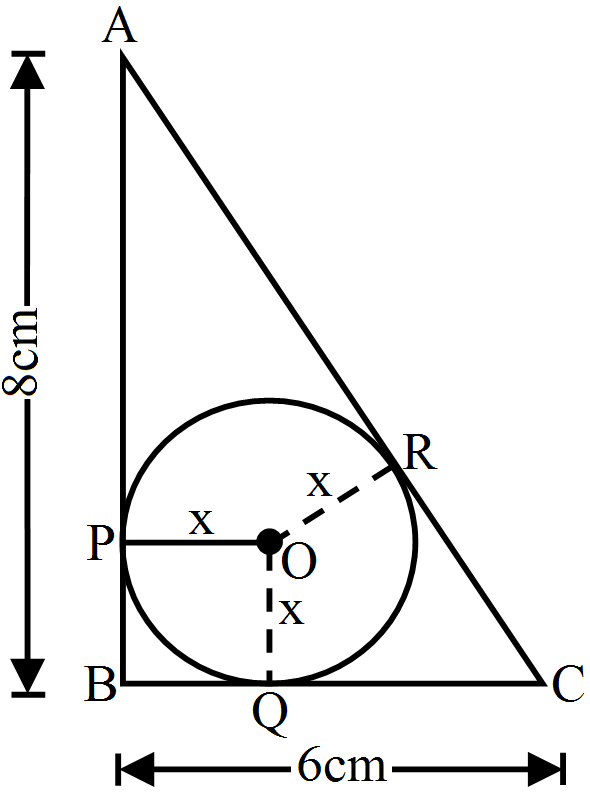
- ✓
$2\ cm$
- B
$2.5\ cm$
- C
$3\ cm$
- D
$3.5\ cm$
AnswerCorrect option: A. $2\ cm$
In right $\triangle\text{ABC},$
$\text{AC}^2=\text{AB}^2+\text{BC}^2 ....($By Pythagoras theorem$)$
$\Rightarrow\text{AC}^2=8^2+6^2$
$\Rightarrow\text{AC}^2=64+36$
$\Rightarrow\text{AC}=100$
$\Rightarrow\text{AC}=10\text{ cm}$
We know that tangent from an external poit to the circle are equal.
$\Rightarrow\text{CR}=\text{CQ}=\text{BC}-\text{BQ}=(6-\text{x})\text{ cm}$
$\Rightarrow\text{AR}=\text{AP}=\text{AB}-\text{BP}=(8-\text{x})\text{ cm}$
$\text{AC}=(\text{AR}+\text{CR})=(8-\text{x})+(6-\text{x})=(14-2\text{x})\text{ cm}$
$\Rightarrow14-2\text{x}=10$
$\Rightarrow2\text{x}=4$
$\Rightarrow\text{x}=2$
View full question & answer→MCQ 1101 Mark
A tangent $PQ$ at a point $P$ of a circle of radius $5\ cm$ meets a line through the centre $O$ at a point $Q$ such that $OQ = 12\ cm$. Length $PQ$ is :
- A
$12\ cm$
- B
$13\ cm$
- C
$8.5\ cm$
- ✓
$\sqrt{119}\text{ cm}$
AnswerCorrect option: D. $\sqrt{119}\text{ cm}$
Let us first put the given data in the form of a diagram.
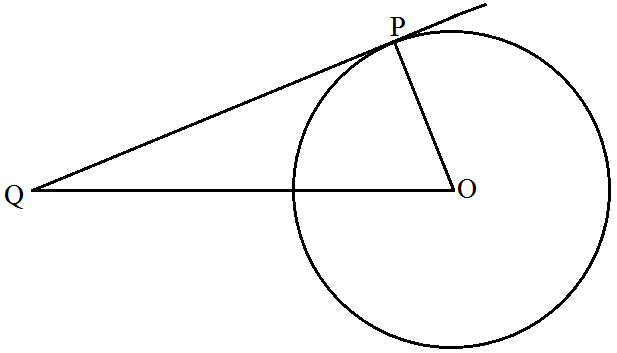
Given data is as follows:
$OQ = 12\ cm$
$OP = 5\ cm$
We have to find the length of $QP.$
We know that the radius of a circle will always be perpendicular to the tangent at the point of contact.
Therefore $,OP$ is perpendicular to $QP$.
We can now use Pythagoras theorem to find the length of $QP$.
$\mathrm{QP}^2=\mathrm{O} \mathrm{Q}^2-\mathrm{OP}^2 $
$ \mathrm{QP}^2=12^2-5^2 $
$ \mathrm{QP}^2=144-25 $
$ \mathrm{QP}^2=119$
$\text{QP}\sqrt{119}$
Therefore the correct answer is choice $(d). View full question & answer→MCQ 1111 Mark
In the given figure $,DE$ and $DF$ are tangents from an external point $D$ to a circle with centre $A$. If $DE = 5\ cm.$ and $\text{DE}\perp\text{DF}$ then the radius of the circle is :
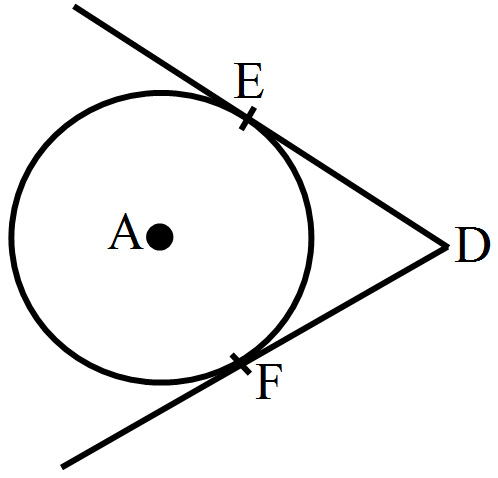
- A
$3\ cm$
- B
$4\ cm$
- ✓
$5\ cm$
- D
$6\ cm$
AnswerCorrect option: C. $5\ cm$
Construction : Join $AE$ and $AF$.
Since $DE$ and $DF$ are tangent to the circle,
$\angle\text{AED}=\angle\text{AFD}=\angle\text{EDF}=90^\circ$
Also, $AE = AF .....($radii of the same circle$)$
and $ED = EF ....($Since tangent drawn from an external point to the circle are equal$)$
So, quadrilateral $\text{AEDF}$ is a square.
Thus $, AE = DF = 5\ cm$
Hence, the length of the radius is $5\ cm.$
View full question & answer→MCQ 1121 Mark
In the given figure, $O$ is the centre of a circle, $PQ$ is a chord and the tangent $PT$ at $P$ makes an angle of $50^\circ$ with $PQ$. Then,$ \angle\text{POQ} = ?$
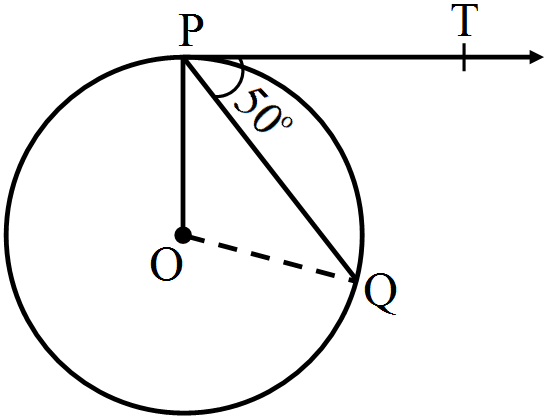
- A
$130^\circ$
- ✓
$100^\circ$
- C
$90^\circ$
- D
$75^\circ$
AnswerCorrect option: B. $100^\circ$
Since $PT$ is the tangent to the circle.
$\angle\text{OPT}=90^\circ$
$\Rightarrow\angle\text{TPQ}+\angle\text{OPQ}=90^\circ$
$\Rightarrow50^\circ+\angle\text{OPQ}=90^\circ$
$\Rightarrow\angle\text{OPQ}=40^\circ$
In $\triangle\text{OPQ},$
$\text{OP}=\text{OQ} ....($radii of the same circle$)$
$\Rightarrow\angle\text{OPQ}=\angle\text{OQP}=40^\circ....($angles opposite equal sides are equal$)$
Now,
$\angle\text{OPQ}+\angle\text{OQP}+\angle\text{POQ}=180^\circ....($Angle Sum Property$)$
$\Rightarrow40^\circ+40^\circ+\angle\text{POQ}=180^\circ$
$\Rightarrow\angle\text{POQ}=100^\circ$
View full question & answer→MCQ 1131 Mark
In the given figure, if $AQ = 4\ cm, QR = 7\ cm, DS = 3\ cm,$ then $x$ is equal to :
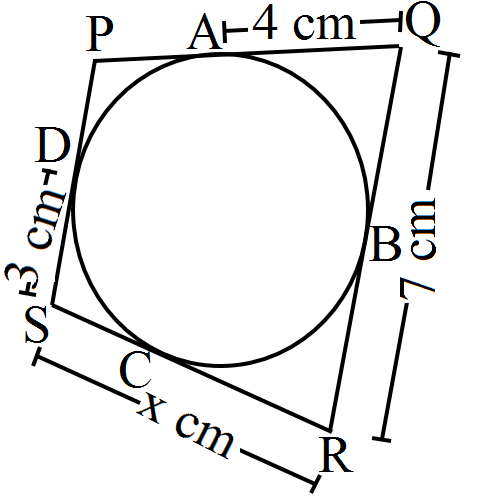
- ✓
$6\ cm$
- B
$10\ cm$
- C
$11\ cm$
- D
$8\ cm$
AnswerCorrect option: A. $6\ cm$
Here $AQ = 4\ cm$
$\therefore QB = AQ = 4\ cm\ [$Tangents from an external point$]$
$\therefore BR = 7 - 4 = 3\ cm$
$\therefore BR = CR = 3\ cm\ [$Tangents from an external point$]$
Also $SD = SC = 3\ cm\ [$Tangents from an external point$]$
Therefore $, x = CS + CR $
$= 3 + 3 = 6$ units
View full question & answer→MCQ 1141 Mark
Which of the following pairs of lines in a circle cannot be parallel ?
AnswerTwo diameter of the circle always passes through the centre.
This means all the diameters of a given circle will intersect at the centre, and hence they cannot be parallel.
View full question & answer→MCQ 1151 Mark
In the given figure, a triangle $\text{PQR}$ is drawn to circumscribe a circle of radius $6\ cm$ such that the segments $QT$ and $TR$ into which $QR$ is divided by the point of contact $T$ are of lengths $12\ cm$ and $9\ cm$ respectively. If the area of $\triangle\text{PQR} = 189 \text{ cm}^2 $ then the length of side $PQ$ is :
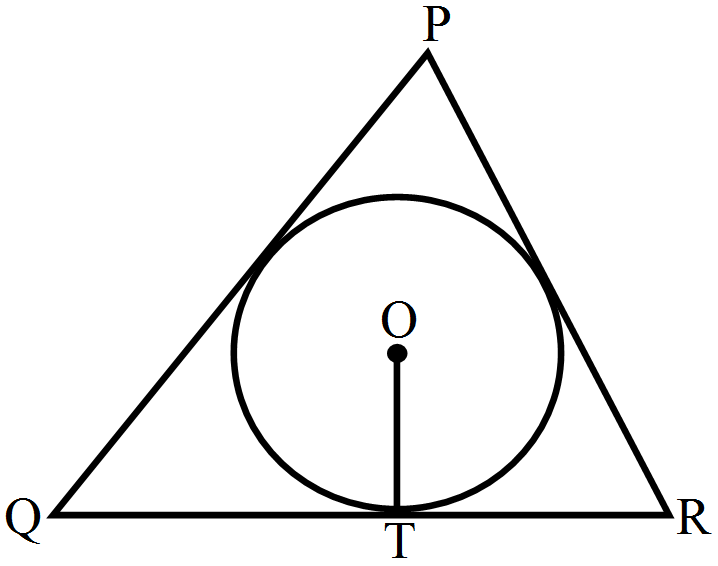
- A
$17.5\ cm$
- B
$20\ cm$
- ✓
$22.5\ cm$
- D
$25\ cm$
AnswerCorrect option: C. $22.5\ cm$
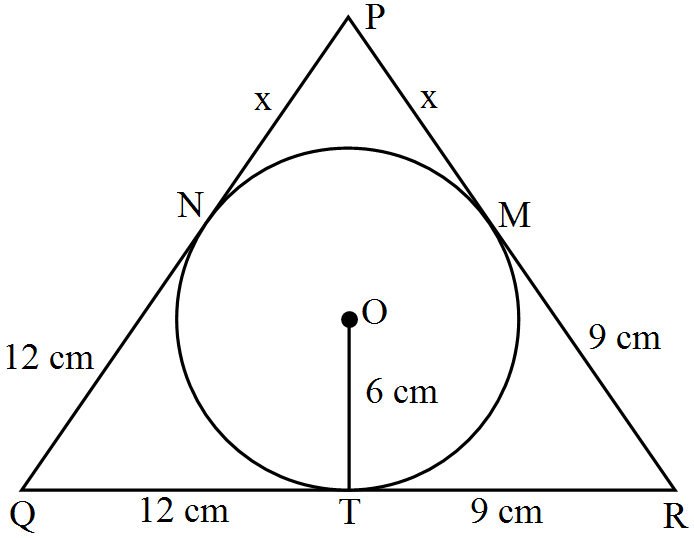
We know that tangent from an external point to the circle are equal.
So,
$QT = QN = 12\ cm$
$TR = RM = 9\ cm$
Now,
$\text{ar}(\triangle\text{PQR})=\frac{1}{2}(\text{Perimeter of }\triangle\text{PQR})\times\text{r}$
$\Rightarrow\text{ar}(\triangle\text{PQR})=\frac{1}{2}(12+12+9+9+\text{x}+\text{x})\times\text{r}$
$\Rightarrow\text{ar}(\triangle\text{PQR})=\frac{1}{2}(42+2\text{x})\times6$
$\Rightarrow189=3(42+2\text{x})$
$\Rightarrow63=42+2\text{x}$
$\Rightarrow2\text{x}=21$
$\Rightarrow\text{x}=10.5$
So $, PQ = 12 + 10.5 = 22.5\ cm$ View full question & answer→MCQ 1161 Mark
If tangents $PA$ and $PB$ from a point $P$ to a circle with centre $O$ are drawn, so that $\angle\text{APB} = 80^\circ, $ then $\angle\text{POA} = ?$
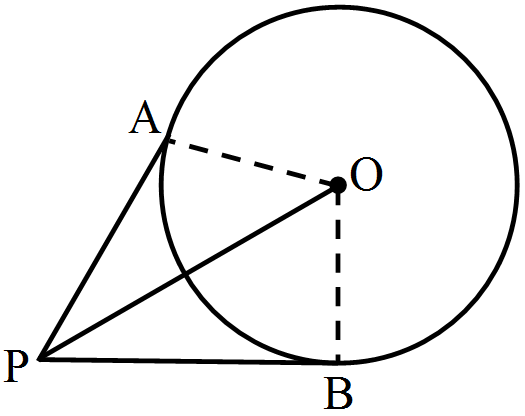
- A
$40^\circ$
- ✓
$50^\circ$
- C
$80^\circ$
- D
$60^\circ$
AnswerCorrect option: B. $50^\circ$
In $\triangle\text{PAO}$ and $\triangle\text{PBO},$
$\angle\text{PAO}+\angle\text{PBO}=90^\circ....($Since $PQ$ and $PR$ are tangent to the circle$)$
$\text{OP}=\text{OP} ....($Common side$)$
$\text{AO}=\text{OB} ....($radii of the same circle$)$
$\Rightarrow\triangle\text{PAO}\cong\triangle\text{PBO} ....(\text{RHS}$ congruence criterion$)$
$\angle\text{POA}=\angle\text{BOP} ....\text{(cpct)}$
In quad. $\text{AOBP}$
$\angle\text{PAO}+\angle\text{PBO}+\angle\text{AOB}+\angle\text{APB}=360^\circ$
$\Rightarrow90^\circ+90^\circ+\angle\text{AOB}+80^\circ=360^\circ$
$\Rightarrow\angle\text{AOB}=100^\circ$
So, $\angle\text{POA}=50^\circ$
View full question & answer→MCQ 1171 Mark
In the figure, if $AP = PB,$ then :
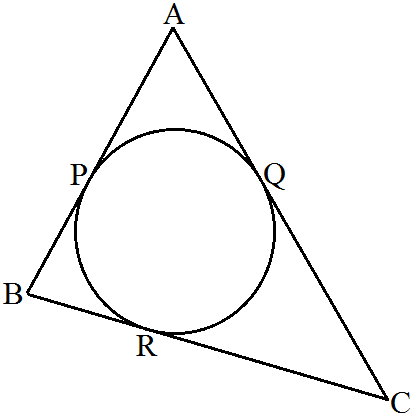
- A
$AC = AB$
- ✓
$AC = BC$
- C
$AQ = QC$
- D
$AB = BC$
AnswerCorrect option: B. $AC = BC$
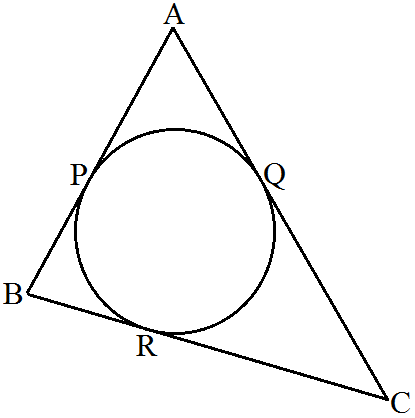
In the figure $, AP = PB$
But $AP$ and $AQ$ are the tangent from $A$ to the circle.
$AP = AQ$ Similarly $PB = BR$
But $AP = PB \ ($given$)$
$AQ = BR ….(i)$
But $CQ$ and $CR$ the tangents drawn from $C$ to the circle
$CQ = CR$
Adding in $(i)$
$AQ + CQ = BR + CR$
$AC = BC$ View full question & answer→MCQ 1181 Mark
If angle between two radii of a circle is $130^\circ,$ the angle between tangents at ends of radii is :
- A
$60^\circ$
- ✓
$50^\circ$
- C
$90^\circ$
- D
$70^\circ$
AnswerCorrect option: B. $50^\circ$
If the angle between two radii of a circle is $130^\circ$, the angle between tangents at ends of radii is $\angle\text{APB} = 50^\circ$.
Because the angle between the two tangents drawn from an external point to a circle is supplementary of the angle between the radii of the circle through the point of contact.
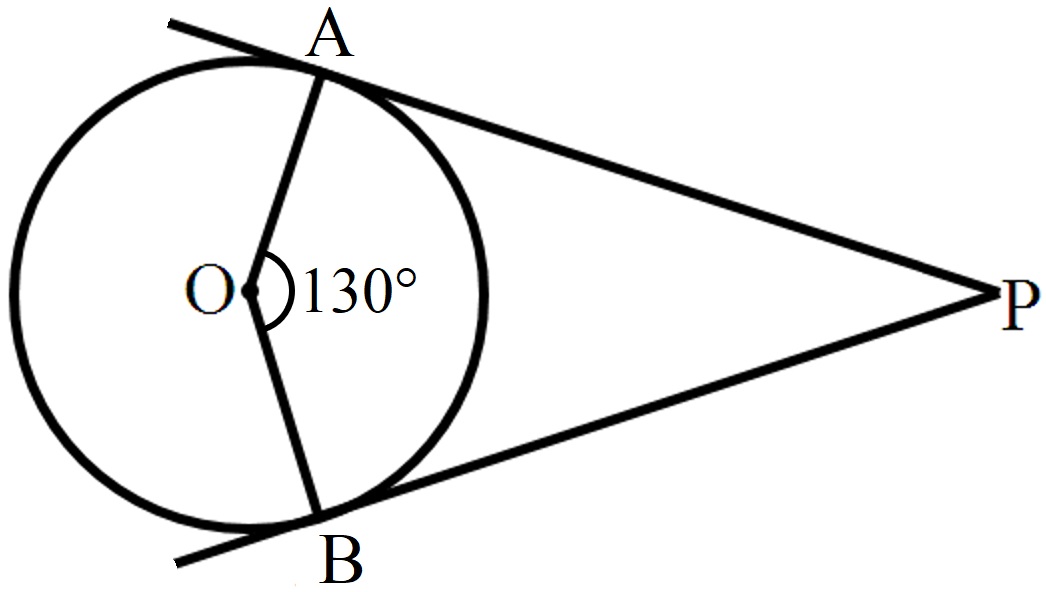
View full question & answer→MCQ 1191 Mark
In figure $,PT$ is tangent to the circle with centre $O$ such that $OP$ is $4\ cm$ and $ \angle\text{OPT}=30^\circ$ length of tangent is given by :
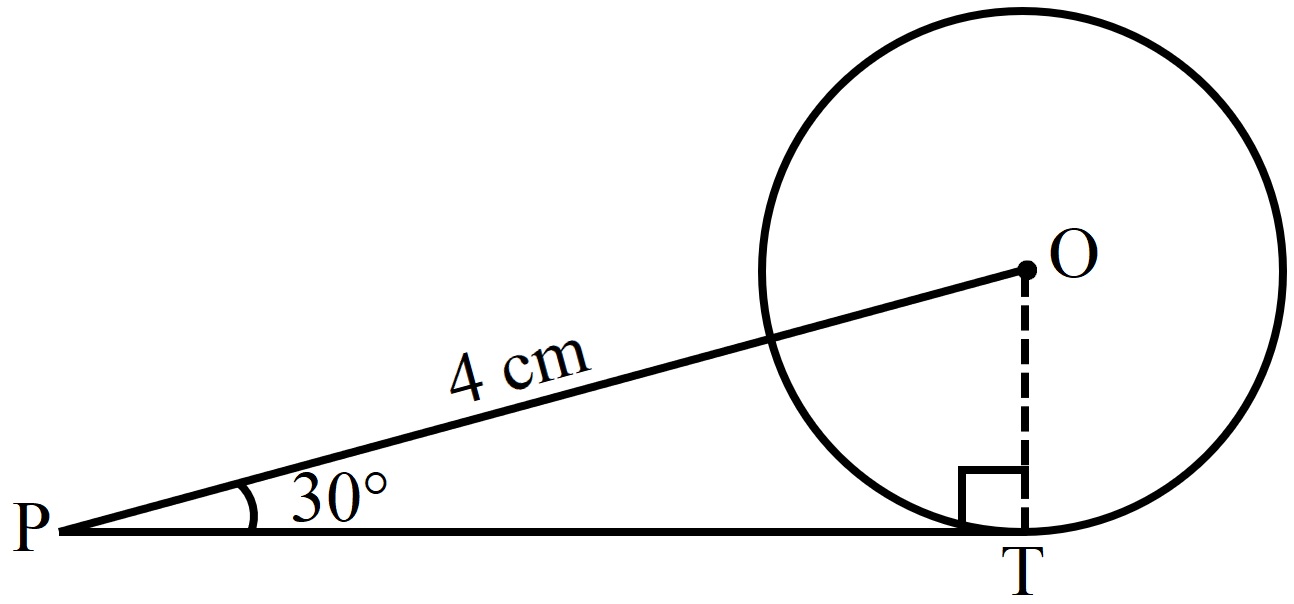
- A
$4\sqrt{3}\text{ cm}$
- B
$7\text{ cm}$
- C
$5\text{ cm}$
- ✓
$2\sqrt{3}\text{ cm}$
AnswerCorrect option: D. $2\sqrt{3}\text{ cm}$
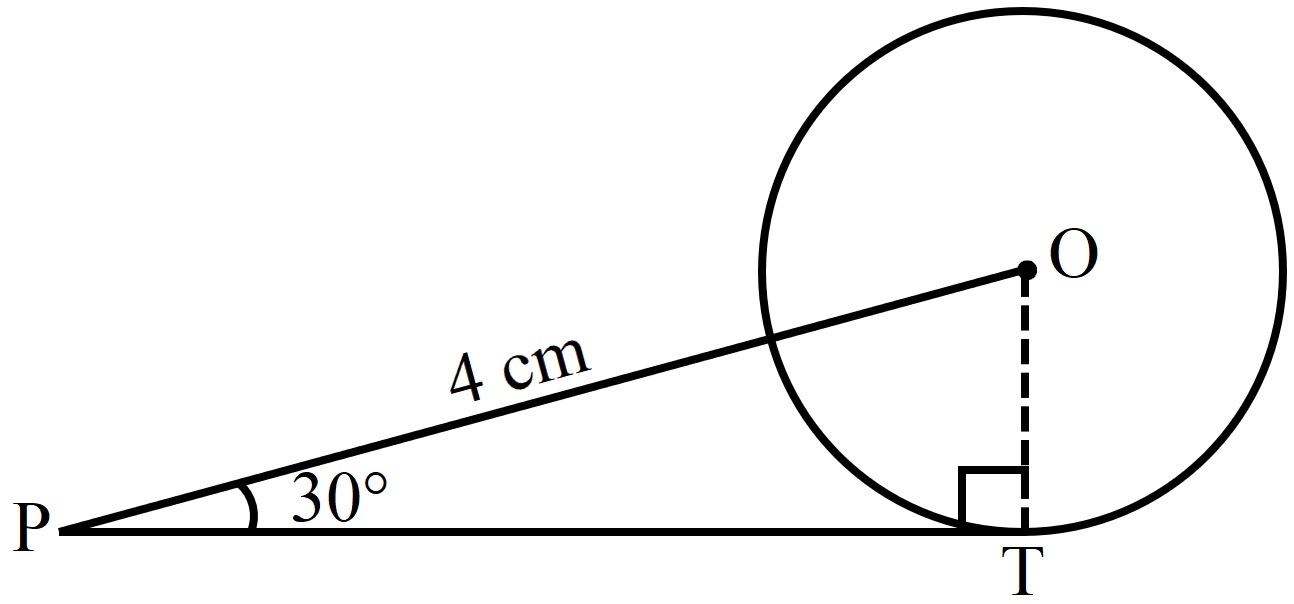
In right angled triangle $OPT,$
$\cos30^\circ=\frac{\text{PT}}{\text{PO}}$
$ \Rightarrow \frac{\sqrt{3}}{2}=\frac{\text{PT}}{4}$
$=\text{PT}=2\sqrt{3\text{ cm}}$ View full question & answer→MCQ 1201 Mark
In the given figure, the sides $AB, BC$ and $CA$ of triangle $\text{ABC},$ touch a circle at $P, Q$ and $R$ respectively. If $PA = 4\ cm, BP = 3\ cm$ and $AC = 11\ cm,$ then length of $BC$ is :
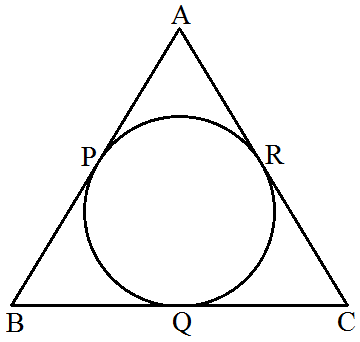
- A
$11\ cm$
- ✓
$10\ cm$
- C
$14\ cm$
- D
$15\ cm$
AnswerCorrect option: B. $10\ cm$
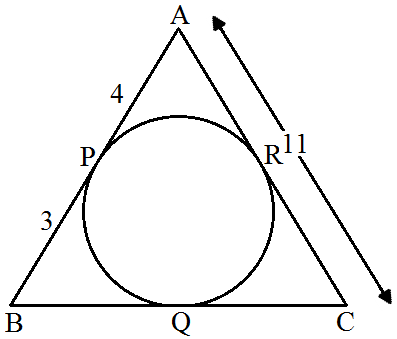
By property of tangent
$AP = AR = 4\ cm\ ($tangent from $A) ...(i)$
$BP = BQ = 3\ cm\ (t$angent from $B) ...(ii)$
$RC = QC\ ($tangent from $C) ...(iii)$
$AC = 11\ cm\ ($given$)$
Now, we have to find $BC$
$BC = BQ + QC$
$\Rightarrow BC = 3 + RC\ [$from eq. $(ii)$ and $(iii)]$
$\Rightarrow BC = 3 + (AC + AR)\ [$from fig$]$
$\Rightarrow BC = 3 + (11 - 4)\ [$from eq. $(i)]$
$\Rightarrow BC = 3 + 7$
$\Rightarrow BC = 10\ cm$ View full question & answer→MCQ 1211 Mark
Quadrilateral $\text{PQRS}$ circumscribes a circle as shown in the figure. The side of the quadrilateral which is equal to $PD + QB$ is :
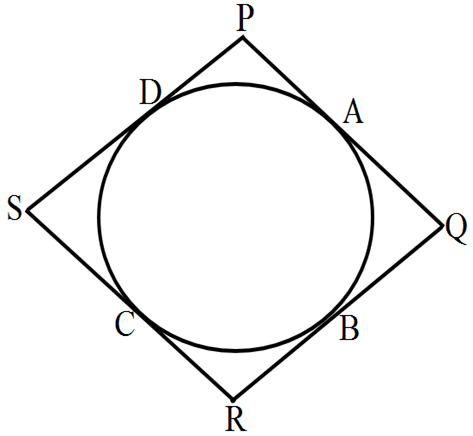
Answer$PD + QB = PA + QA \ [$Tangents from an external point to a circle are equal$]$
$\Rightarrow PD + QB = PQ$
View full question & answer→MCQ 1221 Mark
In figure, if $PA$ and $PB$ are tangents to the circle with centre $O$ such that $\angle\text{APB}=50^\circ,$ then $\angle\text{OAB}$ is equal to :
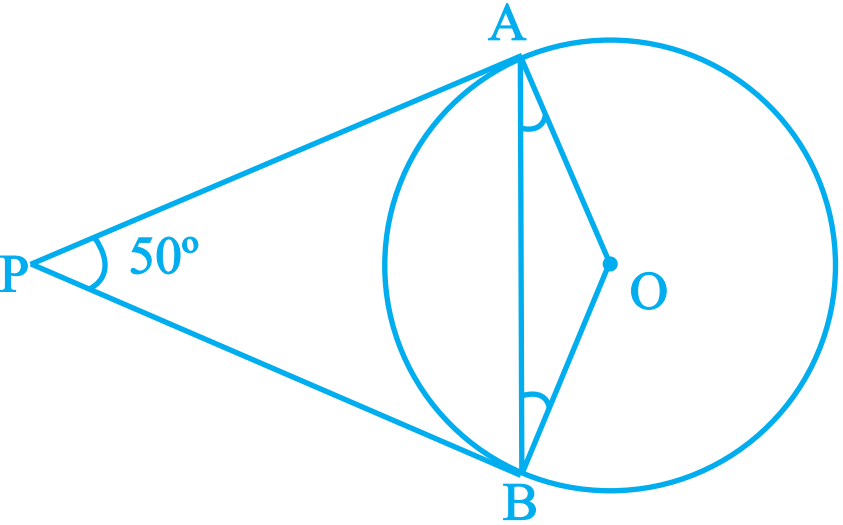
- ✓
$25^\circ$
- B
$30^\circ$
- C
$40^\circ$
- D
$50^\circ$
AnswerCorrect option: A. $25^\circ$
Given, $PA$ and $PB$ are tangent lines.
$\therefore\ \text{PA}=\text{PB}$
$[$since, the length of tangents drawn from an external point to a circle is equal$]$
$\Rightarrow\ \angle\text{PBA}=\angle\text{PAB}=\theta\ \ [\text{say}]$
In $\triangle\text{PAB},\ \angle\text{P}+\angle\text{A}+\angle\text{B}=180^\circ$
$[$since, sum of angles of a triangle $= 180^\circ ]$
$\Rightarrow\ 50^\circ+\theta+\theta=180^\circ$
$\Rightarrow\ 2\theta=180^\circ-50^\circ=130^\circ$
$\Rightarrow\ \theta=65^\circ$
Also, $\text{OA}\perp\text{PA}$
$[$since, tangent at any point of a circle is perpendicular to the radius through the point of contact$]$
$\therefore\ \angle\text{PAO}=90^\circ$
$\Rightarrow\ \angle\text{PAB}+\angle\text{BAO}=90^\circ$
$\Rightarrow\ 65^\circ+\angle\text{BAO}=90^\circ$
$\Rightarrow\ \angle\text{BAO}=90^\circ-65^\circ=25^\circ$
View full question & answer→MCQ 1231 Mark
In the given figure, $O$ is the centre of a circle and $PT$ is the tangent to the circle. If $PQ$ is a chord such that $\angle\text{QPT}=50^\circ$ then $\angle\text{POQ}=?$
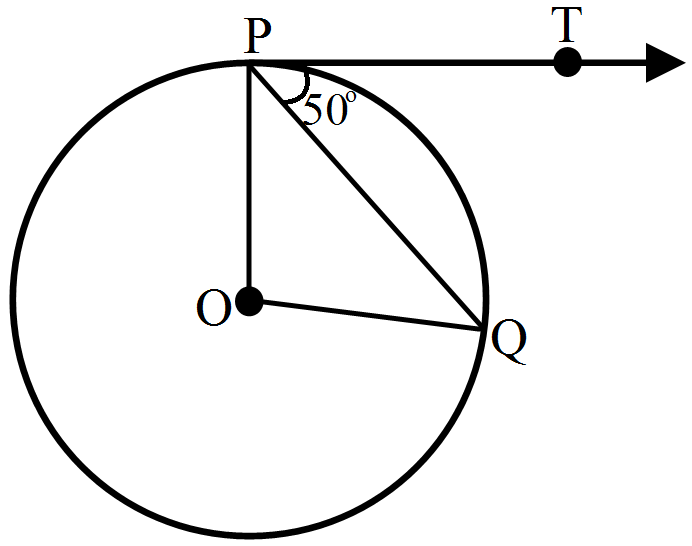
- ✓
$100^\circ$
- B
$90^\circ$
- C
$80^\circ$
- D
$75^\circ$
AnswerCorrect option: A. $100^\circ$
Since $PT$ is the tangent to the circle,
$\angle\text{TPQ}=90^\circ$
$\Rightarrow\angle\text{TPQ}+\angle\text{OPQ}=90^\circ$
$\Rightarrow50^\circ+\angle\text{OPQ}=90^\circ$
$\Rightarrow\angle\text{OPQ}=40^\circ$
In $\triangle\text{OPQ},$
$\text{OP}=\text{OQ} ....($radii of the same circle$)$
$\Rightarrow\angle\text{OPQ}=\angle\text{OQP}=40^\circ ....($angles opposite equal sides are equal$)$
Now,
$\angle\text{OPQ}+\angle\text{OQP}+\angle\text{POQ}=180^\circ ....($Angle Sum Property$)$
$\Rightarrow40^\circ+40^\circ+\angle\text{POQ}=180^\circ$
$\Rightarrow\angle\text{POQ}=100^\circ$
View full question & answer→MCQ 1241 Mark
$PQ$ is a tangent drawn from a point $P$ to a circle with centre $O$ and $\text{QOR}$ is a diameter of the circle such that $\angle\text{POR}=120^{\circ}$ then $\angle\text{OPQ}$ is :
- A
$60^\circ$
- B
$45^\circ$
- ✓
$30^\circ$
- D
$90^\circ$
AnswerCorrect option: C. $30^\circ$
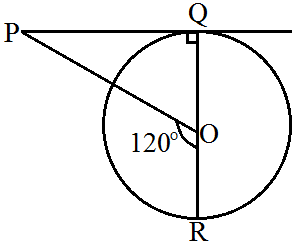
we know, radius always $\bot$ to tangent, then
$\angle\text{PQO}=90^{\circ}(\text{OQ}\bot\text{PQ})$
Given, $\angle\text{POR}=120^{\circ}$
then, $\angle\text{POQ}=\angle\text{QOR}-\angle\text{POR}$
$\Rightarrow\angle\text{POQ}=180^{\circ}-120^{\circ}$
$\Rightarrow\angle\text{POQ}=60^{\circ}$
Now, In $\triangle\text{OPQ}$
Sum of all angles are equal to $180^{\circ}$
then,
$\angle\text{OPQ}+\angle\text{POQ}+\angle\text{PQO}=180^{\circ}$
$\Rightarrow\angle\text{OPQ}+90^{\circ}+60^{\circ}=180^{\circ}$
$\Rightarrow\angle\text{OPQ}+150^{\circ}=180^{\circ}$
$\Rightarrow\angle\text{OPQ}=30^{\circ}$ View full question & answer→MCQ 1251 Mark
$AP$ and $AQ$ are tangents drawn from a point $A$ to a circle with centre $O$ and radius $9\ cm$. If $OA = 15\ cm, $ then $AP + AQ =$
- A
$12\ cm$
- B
$18\ cm$
- ✓
$24\ cm$
- D
$36\ cm$
AnswerCorrect option: C. $24\ cm$
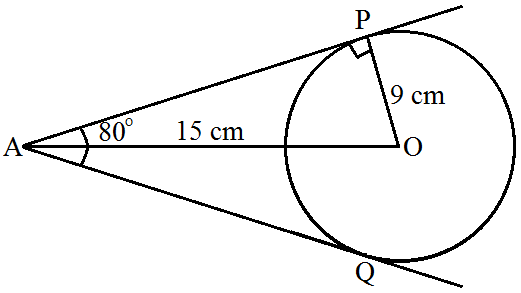
By the property of tangent
$AP = AQ \ ($tangent from $ A)...(i)$
We know, radius always $\bot$ to tangent then $\triangle\text{OPQ}$ is right angle triangle the $\angle\text{OPA}=90^{\circ}$
Now,$A P^2=O A^2-O P^2 $
$ \Rightarrow A P^2=15^2-9^2 $
$ \Rightarrow A P^2=225-81$
$\Rightarrow AP = \sqrt{144}$
$\Rightarrow AP = 12\ cm$
we have to find $AP + AQ = 12 + 12 = 24\ cm\ [$from $(i)]$ View full question & answer→MCQ 1261 Mark
The distance between two parallel tangents of a circle of radius $3\ cm$ is :
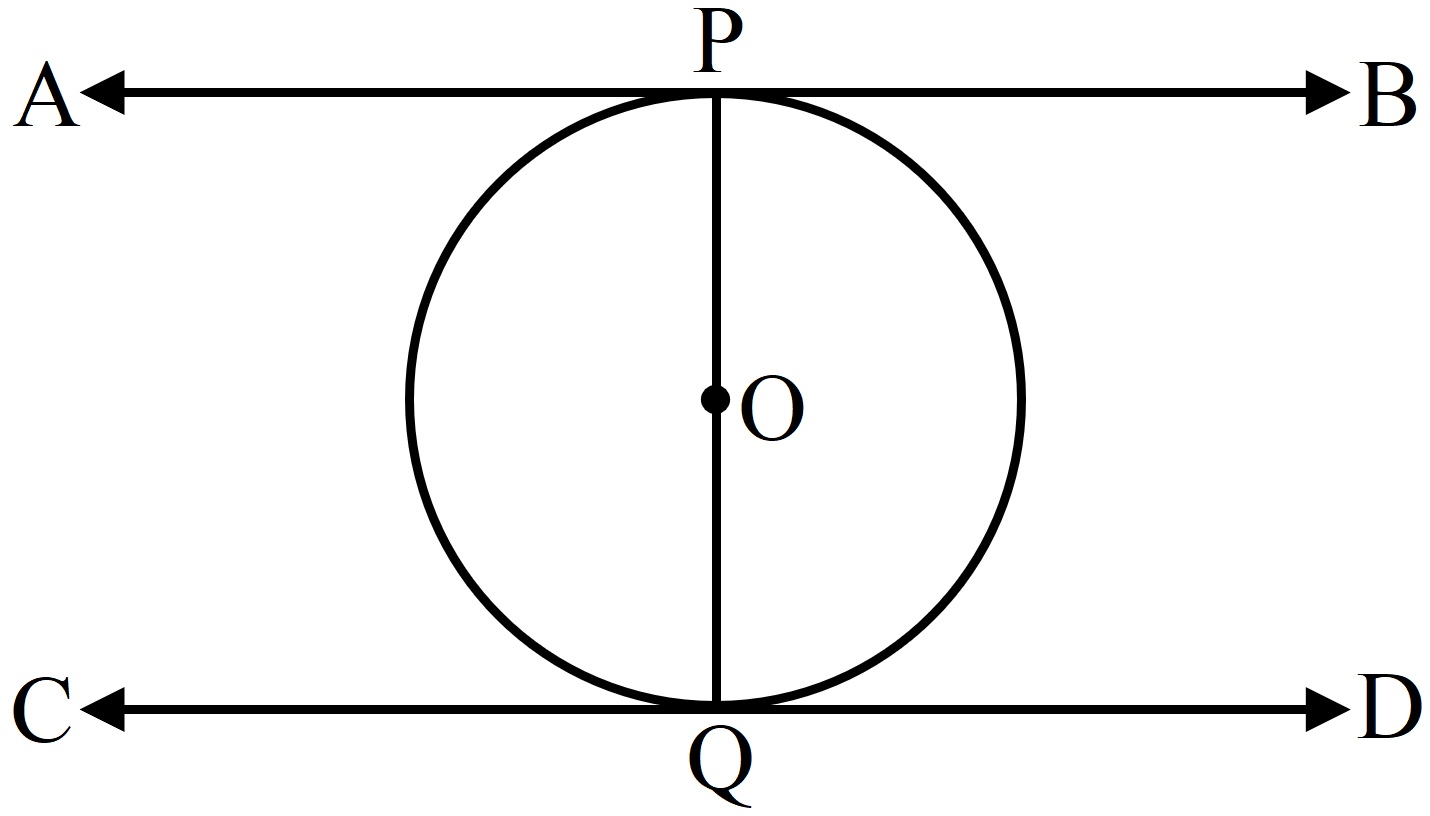
- ✓
$6\ cm$
- B
$4.5\ cm$
- C
$12\ cm$
- D
$3\ cm$
AnswerCorrect option: A. $6\ cm$
Since the distance between two parallel tangents of a circle is equal to the diameter of the circle.
Given : Radius $(OP) = 3\ cm$
$\therefore$ Diameter $= 2 \times \text{Radius} $
$= 2 \times 3 = 6\ cm$
View full question & answer→MCQ 1271 Mark
In the given figure, if $AP = PB,$ then $AC =$
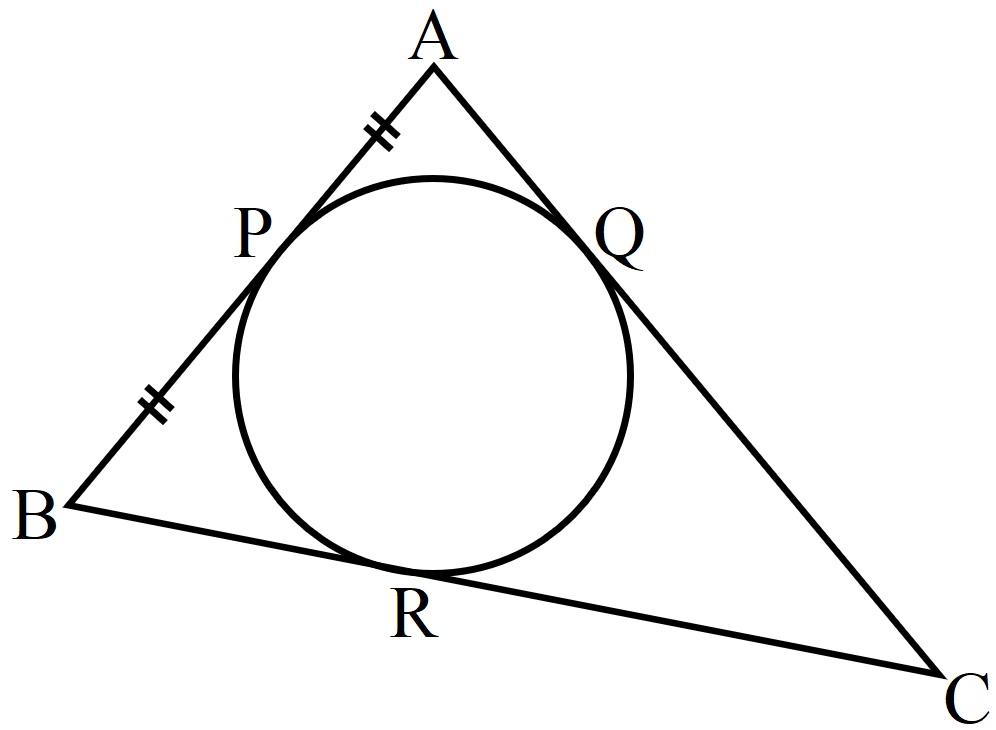
- ✓
$AC = BC$
- B
$AB = BC$
- C
$AQ = QC$
- D
$AC = AB$
AnswerCorrect option: A. $AC = BC$
Since Tangents from an external point to a circle are equal
$\therefore PB = BR …(i)$
$PA = AQ …(ii)$
$CQ = CR ...(iii)$
Adding eq. $(i)$ and $(iii),$ we get
$PB + CQ = BR + CR$
$\Rightarrow AP + CQ = BC \ [$Given : $PB = AP]$
$\Rightarrow AQ + CQ = BC\ [$From eq. $(ii) \ AP = AQ]$
$\Rightarrow AC = BC$
View full question & answer→MCQ 1281 Mark
In the given figure, a circle touches the side $DF$ of $\triangle\text{EDF}$ at $H$ and touches $ED$ and $EF$ produced at $K$ and $M$ respectively. If $EK = 9\ cm$ then the perimeter of $\triangle\text{EDF}$ is :
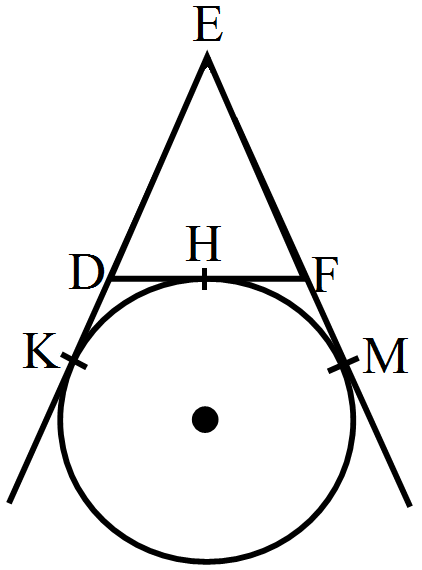
- A
$9\ cm$
- B
$12\ cm$
- C
$13.5\ cm$
- ✓
$18\ cm$
AnswerCorrect option: D. $18\ cm$
We know that tangents from an external point to the circle are equal.
So,
$EK = EM = 9\ cm$
$DK = DH$
$FH = FM$
perimeter of $\triangle\text{EDF}$
$= ED + EF + DF$
$= ED + EF + DH + HF$
$= (ED + DH) + (EF + HF)$
$= (ED + DK) + (EF + FM)$
$= EK + EM$
$= 9 + 9$
$= 18\ cm.$
View full question & answer→MCQ 1291 Mark
In the given figure, $O$ is the centre of two concentric circles of radii $6\ cm$ and $10\ cm. AB$ is a chord of outer circle which touches the inner circle. The length of $AB$ is :
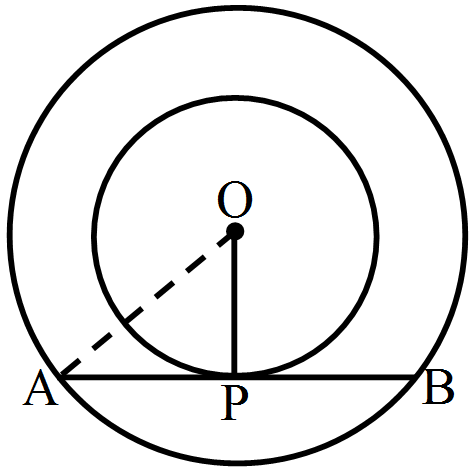
- A
$8\ cm$
- B
$14\ cm$
- ✓
$16\ cm$
- D
$\sqrt{136}\text{ cm}$
AnswerCorrect option: C. $16\ cm$
Since $AB$ is a tangent to the circle.
$\angle\text{OPA}=90^\circ ....($tangent is perpendicular to the radius of a circle$)$
$AB$ is a chord of the outer circle
We know that of the perpendicular drawn from the centre to a chord of a circle of a circle, bisects the chord.
In $\triangle\text{OPA},$
$A O^2=O P^2+A P^2 $
$ \Rightarrow 10^2=6^2+A P^2 $
$\Rightarrow A P^2=10^2-6^2 $
$ \Rightarrow P A^2=64 $
$\Rightarrow PA = 8\ cm$
$AB = 2AP$
$ = 2(8) = 16\ cm.$
View full question & answer→MCQ 1301 Mark
At one end $A$ of a diameter $AB$ of a circle of radius $5\ cm,$ tangent $\text{XAY}$ is drawn to the circle. The length of the chord $CD$ parallel to $XY$ and at a distance $8\ cm$ from $A$ is :
- A
$4\ cm$
- B
$5\ cm$
- C
$6\ cm$
- ✓
$8\ cm$
AnswerCorrect option: D. $8\ cm$
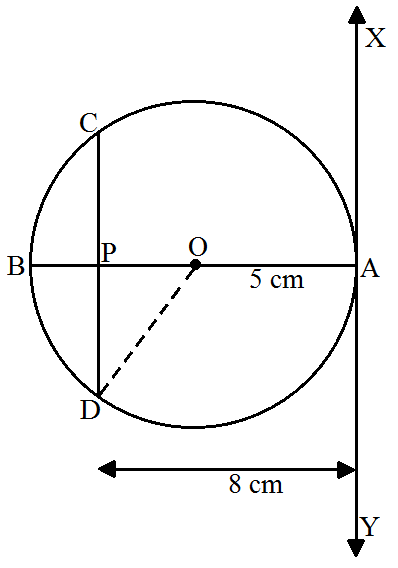
$XY$ is the tangent to the circle with centre $O$.
$CD$ is the chord.
$OA = OB = OD = 5\ cm\ ($radii$)$
$PA = 8\ cm$
$PO = 3\ cm$
In $\triangle\text{POD},$
$\Rightarrow P D^2+P O^2=O D^2$
$\Rightarrow 3^2+P D^2=5^2 $
$ \Rightarrow P D^2=25-9=16 $
$\Rightarrow PD = 4\ cm$
Hence $, CD = CP + PD $
$= 4 + 4 = 8\ cm.$ View full question & answer→MCQ 1311 Mark
In the given figure $, AT$ is a tangent to the circle with centre $O,$ such that $OT = 4\ cm$ and $\angle\text{OTA} = 30^\circ. $ Then $, AT =?$
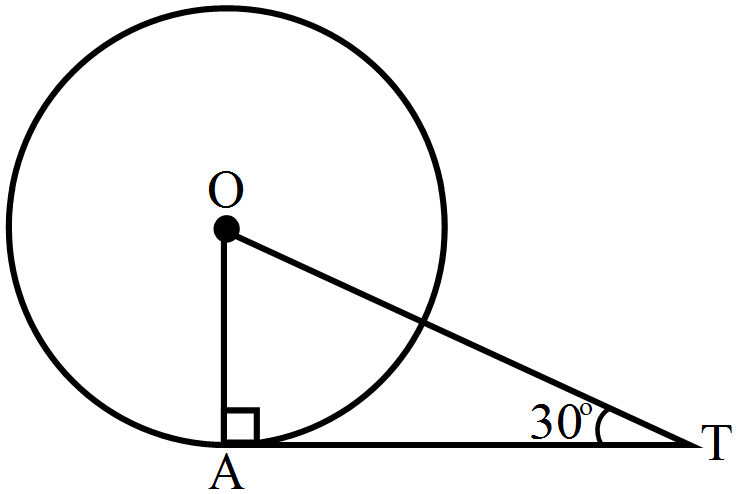
- A
$4\text{ cm}$
- B
$2\text{ cm}$
- ✓
$2\sqrt{3}\text{ cm}$
- D
$4\sqrt{3}\text{ cm}$
AnswerCorrect option: C. $2\sqrt{3}\text{ cm}$
Since $\angle\text{OAT}=90^\circ$ and $\angle\text{OTQ}=30^\circ$
Clearly, $\angle\text{AOT}=60^\circ$
So, $\triangle\text{AOT}$ is a $30^\circ - 60^\circ - 90^\circ $ triangle.
Side opposite $60^\circ=\frac{\sqrt{3}}{2}$ hypotenuse
$\Rightarrow\text{AT}=\frac{\sqrt{3}}{2}(\text{OT})$
$\Rightarrow\text{AT}=\frac{\sqrt{3}}{2}(4)$
$\Rightarrow\text{AT}=2\sqrt{3}\text{ cm}$
View full question & answer→MCQ 1321 Mark
In the adjacent figure, if $AB = 12\ cm, BC = 8\ cm $ and $AC = 10\ cm,$ then $AD =$
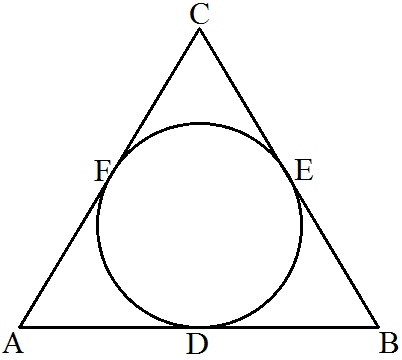
- A
$5\ cm$
- B
$4\ cm$
- C
$6\ cm$
- ✓
$7\ cm$
AnswerCorrect option: D. $7\ cm$
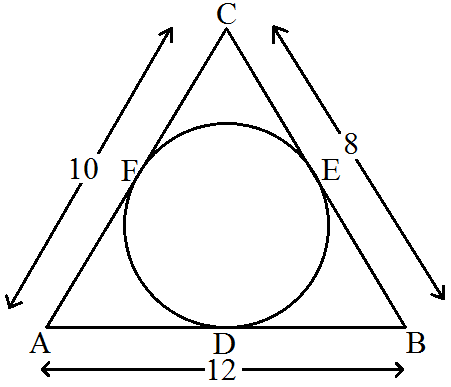
Given,
$AB = AD + DB = 12\ cm...(i)$
$BC = BE + EC = 8\ cm...(ii)$
$CA + CF + FA = 10\ cm...(iii)$
from the property of tangent
$AD = AF \ ($ tangent from $A ) ...(iv)$
$DB = BE \ ($ tangent from $A ) ...(v)$
$CF = CE \ ($ tangent from $A ) ...(vi)$
Now, we have to find $AD$
By substracting eq. $(ii)$ from eq. $(i),$ then
$\Rightarrow AD + DB - (BE + EC) = 12 - 8$
$\Rightarrow AD + BE - BE - CF = 4 [$ from eq.$(v) ]$
$\Rightarrow AD - CF = 4$
$\Rightarrow AD - (10 - AF) = 4 [$ from eq $,(iii) ]$
$\Rightarrow AD - 10 + AF = 4$
$\Rightarrow AD - 10 + AD = 4$
$\Rightarrow 2AD = 14$
$\Rightarrow AD = 7$ View full question & answer→MCQ 1331 Mark
Which of the following statements is not true?
- A
A tangent to a circle intersects the circle exactly at one point.
- B
The point common to a circle and its tangent is called the point of contact.
- C
The tangent at any point of a circle is perpendicular to the radius of the circle through the point of contact.
- ✓
A straight line can meet a circle at one point only.
AnswerCorrect option: D. A straight line can meet a circle at one point only.
Options $(a), (b)$ and $(c)$ are all true.
However, Option $(d)$ is false since a straight line can meet a circle at two points even as shown below.
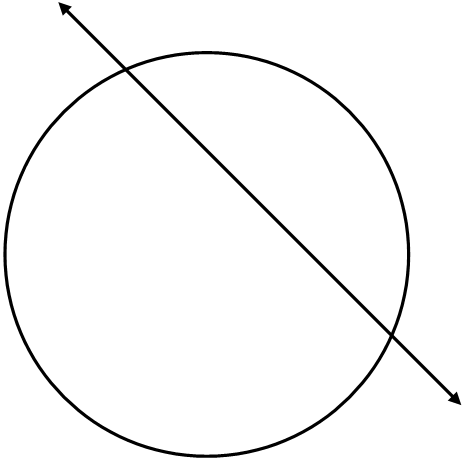
View full question & answer→MCQ 1341 Mark
Directions : In the following questions, a statement of assertion $(A)$ is followed by a statement of reason $(R).$ Mark the correct choice as:
Assertion : The length of tangents drawn from an external point to a circle are not always equal in length.
Reason : The tangent is always perpendicular to the radius through the point of contact.
- A
Assertion and Reason both are correct statements and Reason is the correct explanation of Assertion.
- B
Assertion and Reason both are correct statements but Reason is not the correct explanation of Assertion.
- C
Assertion is correct statement but Reason is wrong statement.
- ✓
Assertion is wrong statement but Reason is correct statement.
AnswerCorrect option: D. Assertion is wrong statement but Reason is correct statement.
Assertion is wrong as length of tangents drawn from an external point to a circle are always equal.
But Reason is correct.
View full question & answer→MCQ 1351 Mark
Two circles of same radii r and centres $O$ and $O'$ touch each other at $P$ as shown in. If $O O'$ is produced to meet the circle $C (O', r)$ at $A$ and $AT$ is a tangent to the circle $C (O,r)$ such that $O'Q \perp AT$. Then $AO: AO' =$
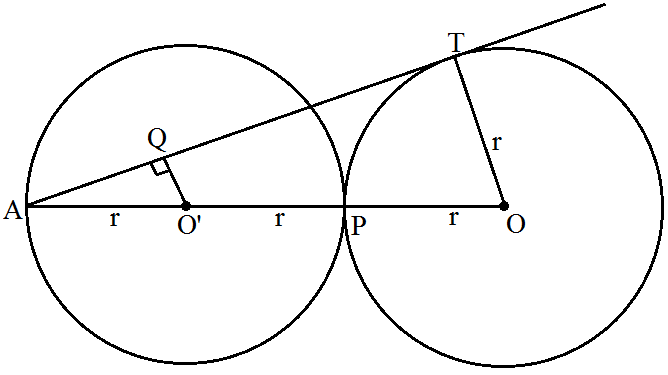
Answer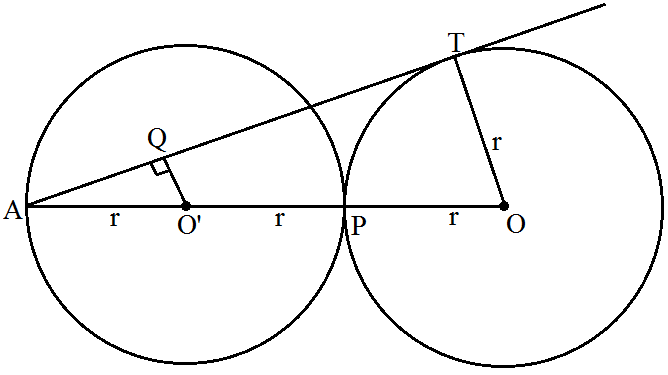
From the given figure we have,
$AO = r + r + r$
$AO = 3r$
$AO’ = r$
Therefore,
$\frac{\text{AO}}{\text{AO'}}=\frac{3\text{r}}{\text{r}}$
$\frac{\text{AO}}{\text{AO'}}=3$
Also as $\text{O'Q}\parallel\text{OT}$
therefore $\frac{\text{AT}}{\text{AQ}}=\frac{\text{AO}}{\text{AO'}}$ View full question & answer→MCQ 1361 Mark
In the figure $,AP$ is a tangent to the circle with centre $O$ such that $OP = 4\ cm$ and $\angle\text{OPA}=30^{\circ}$. Then $,AP =$
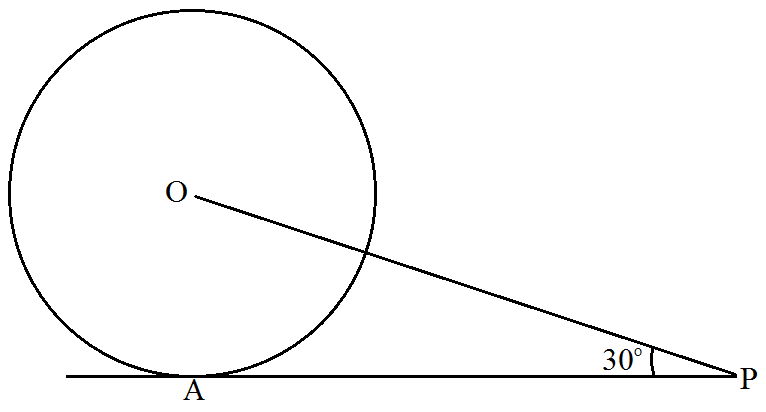
- A
$2\sqrt{2}\text{ cm}$
- B
$2\text{ cm}$
- ✓
$2\sqrt{3}\text{ cm}$
- D
$3\sqrt{2}\text{ cm}$
AnswerCorrect option: C. $2\sqrt{3}\text{ cm}$
In the figure $,AP$ is the tangent to the circle with centre $O$ such that $OP = 4\ cm,$
$\angle\text{OPA}=30^{\circ}$
Join $OA,$ let $AP = x$
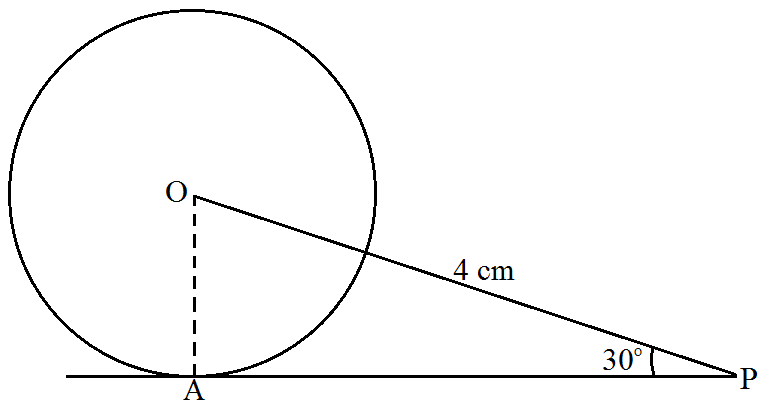
$\cos30^{\circ}=\frac{\text{AP}}{\text{OP}}$
$\Rightarrow\frac{\sqrt{3}}{2}=\frac{\text{x}}{4}$
$\Rightarrow\text{x}=\frac{4\times\sqrt{3}}{2}$
$=2\sqrt{3}\text{ cm}$ View full question & answer→MCQ 1371 Mark
In figure, $AT$ is a tangent to the circle with centre $O$ such that $OT = 4\ cm$ and $\angle\text{OTA}=30^\circ.$ Then $AT$ is equal to :
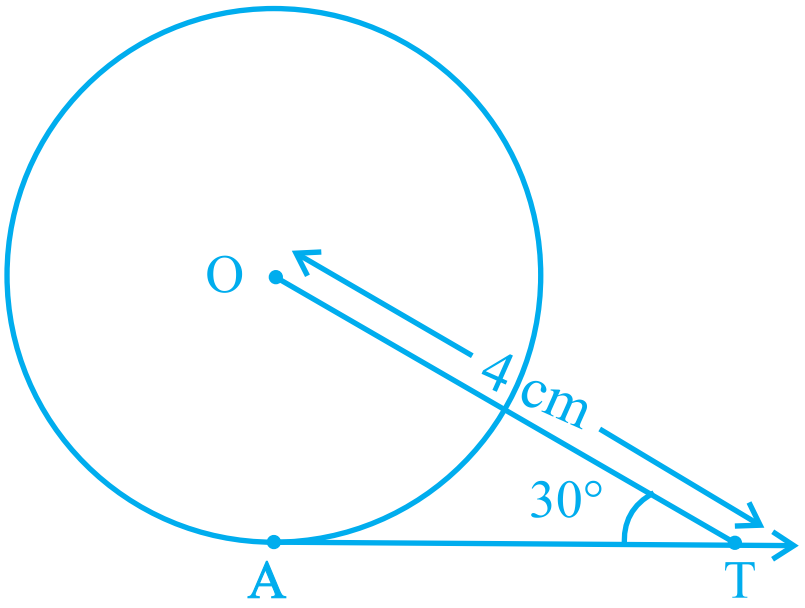
- A
$4\text{ cm}$
- B
$2\text{ cm}$
- ✓
$2\sqrt{3}\text{ cm}$
- D
$4\sqrt{3}\text{ cm}$
AnswerCorrect option: C. $2\sqrt{3}\text{ cm}$
Join $OA$
We know that, the tangent at any point of a circle is perpendicular to the radius through the point of contact.
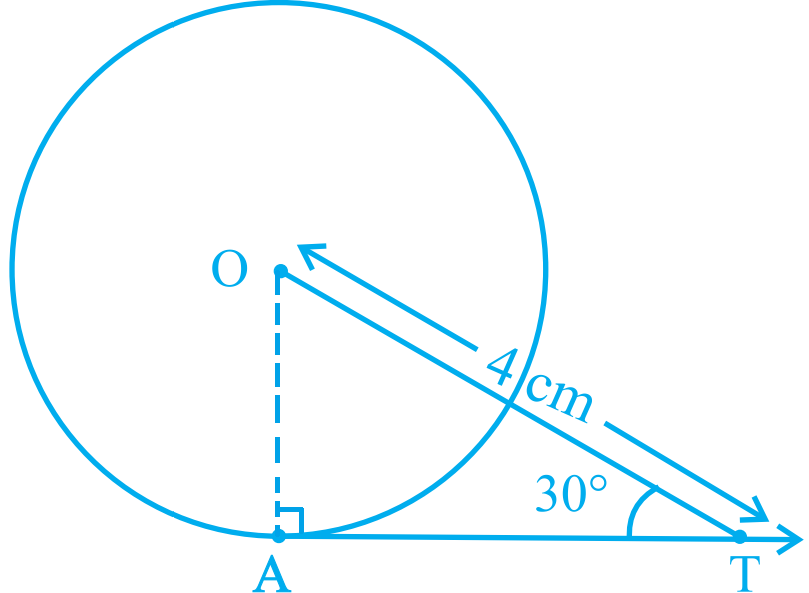
$\therefore\ \angle\text{OAT}=90^\circ$
In $\triangle\text{OAT},\ \cos30^\circ=\frac{\text{AT}}{\text{OT}}$
$\Rightarrow\ \frac{\sqrt{3}}{2}=\frac{\text{AT}}{4}$
$\Rightarrow\ \text{AT}=2\sqrt{3}\text{ cm}.$ View full question & answer→MCQ 1381 Mark
Quadrilateral $\text{ABCD}$ is circumscribed to a circle. If $AB = 6\ cm, BC = 7\ cm$ and $CD = 4\ cm,$ then the length of $AD$ is :
- ✓
$3\ cm$
- B
$4\ cm$
- C
$6\ cm$
- D
$7\ cm$
AnswerCorrect option: A. $3\ cm$
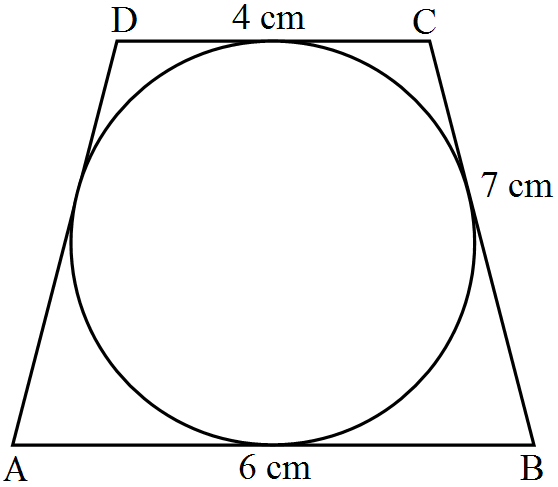
Using the property, tangent from an external point to the circle are equal.
We can say $, AB + CD = AD + BC$
$\Rightarrow AD = AB + CD - BC$
$\Rightarrow AD = 6 + 4 - 7$
$\Rightarrow AD = 3\ cm$ View full question & answer→MCQ 1391 Mark
The chord of a circle of radius $10\ cm$ subtends a right angle at its centre. The length of the chord $($in $cm)$ is :
AnswerCorrect option: C. $10\sqrt{2}\text{ cm}$
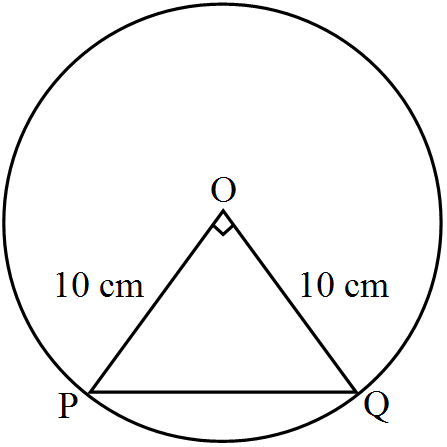
In $\triangle\text{POQ},$
By using Pythagoras theorem,
$P Q^2=P O^2+O Q^2 $
$ \Rightarrow P Q^2=10^2+10^2 $
$ \Rightarrow P Q^2=100+100 $
$ \Rightarrow P Q^2=200 $
$ \Rightarrow P Q^2=200 $
$\Rightarrow\text{PQ}=10\sqrt{2}\text{ cm}$
So, the length of the chord is $10\sqrt{2}\text{ cm}$ View full question & answer→MCQ 1401 Mark
In the given figure $, \text{PQR}$ is a tangent to the circle at $Q,$ whose centre is $O$ and $AB$ is a chord parallel to $PR,$ such that$ \angle\text{BQR} = 70^\circ.$ Then, $\angle\text{AQB}=?$
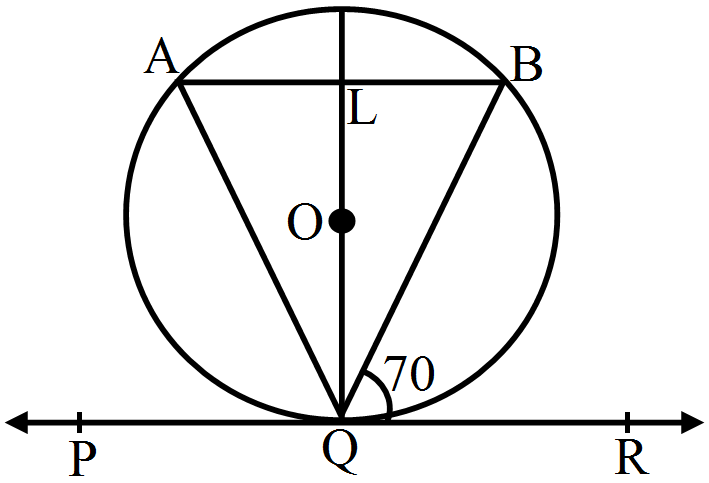
- A
$20^\circ$
- B
$35^\circ$
- ✓
$40^\circ$
- D
$45^\circ$
AnswerCorrect option: C. $40^\circ$
Since $AB \| PQ$
$\angle\text{BQR}=\angle\text{ABQ}=70^\circ ....($alternate angles$)$
and $\angle\text{PQA}=\angle\text{BAQ}=70^\circ....($alternate angles$)$
In $\triangle\text{ABQ},$
$\angle\text{ABQ}+\angle\text{BAQ}+\angle\text{AQB}=180^\circ....($angle Sum Property$)$
$\Rightarrow70^\circ+70^\circ+\angle\text{AQB}=180^\circ$
$\Rightarrow\angle\text{AQB}=40^\circ$
View full question & answer→MCQ 1411 Mark
In the given figure, three circles with centres $A, B, C,$ respectively, touch each other externally. If $AB = 5\ cm, BC = 7\ cm$ and $CA = 6\ cm, $ the radius of the circle with centre $A$ is :
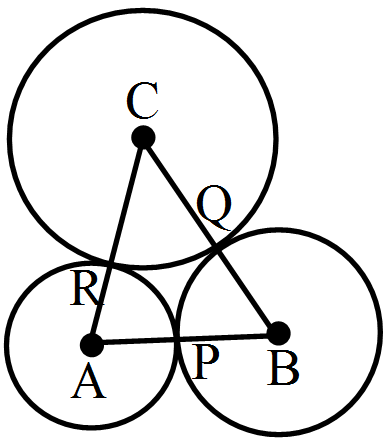
- A
$1.5\ cm$
- ✓
$2\ cm$
- C
$2.5\ cm$
- D
$3\ cm$
AnswerCorrect option: B. $2\ cm$
Let the radii of the circle with centres $A, B$ and $C$ be $x, y,$ and $z$ respectively.
We know that radii of the same circle are equal.
$x + y = 5$
$y + z = 7$
$z + x = 6$
Adding the three equation, we get
$2(x + y + z) = 18$
$\Rightarrow x + y + z = 9$
$\Rightarrow x = 2$
So, the radius of the circle with centre $A$ is $2\ cm.$
View full question & answer→MCQ 1421 Mark
In the given figure $,PA$ and $PB$ are two tangents drawn from an external point $P$ to a circle with centre $C$ and radius $4\ cm$. If $\text{PA}\perp \text{PB}$ then the length of each tangent.
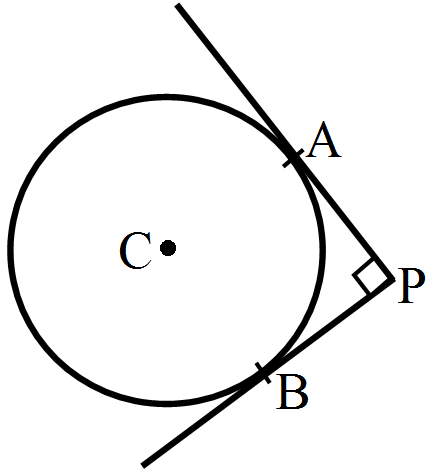
- A
$3\ cm$
- ✓
$4\ cm$
- C
$5\ cm$
- D
$6\ cm$
AnswerCorrect option: B. $4\ cm$
Construction : Join $CA$ and $CB$.
Since $AP$ and $PB$ are tangent to the circle,
$\angle\text{CAP}=\angle\text{CBA}=90^\circ$
Given that $\angle\text{APB}=90^\circ$
We know that tangents drawn from an external point to the circle are equal.
$\Rightarrow\text{AP}=\text{PB}$
Also, $\text{CA}=\text{CB} ....($radii of the same circle$)$
So, quadrilateral $\text{APBC}$ is a square.
Thus $, AP = PB = CA = CB = 4\ cm.$
View full question & answer→MCQ 1431 Mark
If a chord $AB$ subtends an angle of $60^\circ$ at the centre of a circle, then the angle between the tangents to the circle drawn from $A$ and $B$ is :
- A
$30^\circ$
- B
$60^\circ$
- C
$90^\circ$
- ✓
$120^\circ$
AnswerCorrect option: D. $120^\circ$
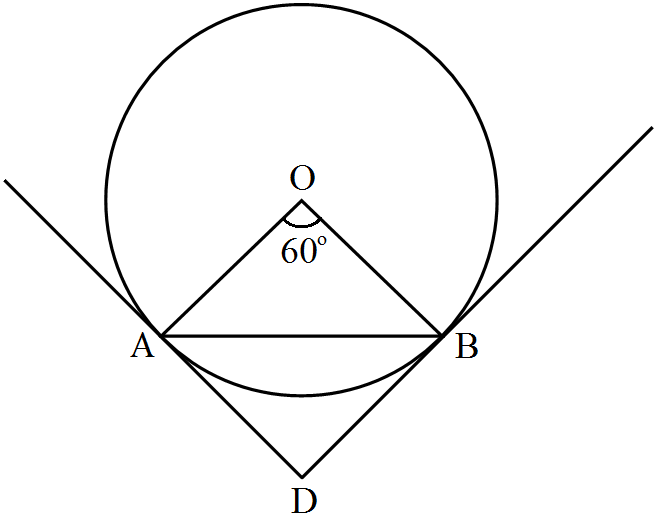
Since $AD$ and $DB$ are the tangent to the circle.
$\angle\text{OAD}=\angle\text{OBD}=90^\circ....($tangent is perpendicular to the radius of a circle$)$
In $\text{ABOD}$
$\angle\text{OAD}+\angle\text{ADB}+\angle\text{OBD}+\angle\text{AOB}=360^\circ$
$\Rightarrow90^\circ+\angle\text{ADB}+90^\circ+60^\circ=360^\circ$
$\Rightarrow\angle\text{ADB}=120^\circ$ View full question & answer→MCQ 1441 Mark
In the figure, two equal circles touch each other at $T,$ if $QP = 4.5\ cm$, then $QR =$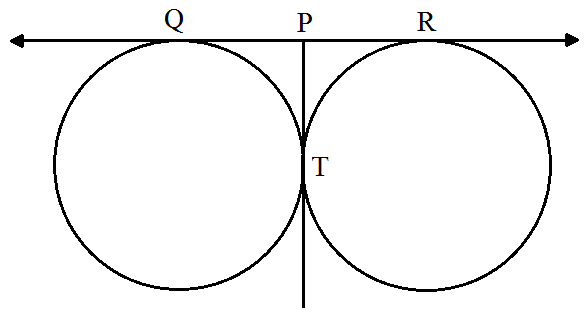
- ✓
$9\ cm$
- B
$18\ cm$
- C
$15\ cm$
- D
$13.5\ cm$
AnswerCorrect option: A. $9\ cm$
$9\ cm$
View full question & answer→MCQ 1451 Mark
$\text{ABC}$ is a right angled triangle, right angled at $B$ such that $BC = 6\ cm$ and $AB = 8\ cm. A$ circle with centre $O$ is inscribed in $\triangle ABC$. The radius of the circle is :
- A
$1\ cm$
- ✓
$2\ cm$
- C
$3\ cm$
- D
$4\ cm$
AnswerCorrect option: B. $2\ cm$
In a right $\triangle\text{ABC},$
$\angle\text{B}=90^{\circ}$
$BC = 6\ cm, AB = 8\ cm$
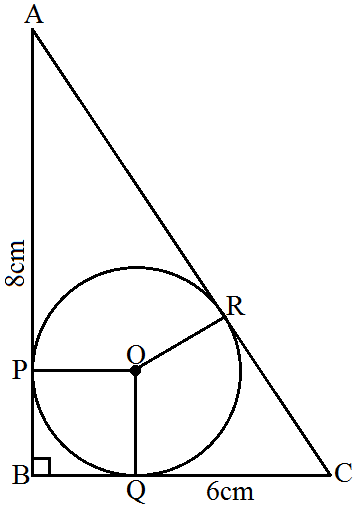
$A C^2=A B^2+B C^2 \ ($Pythagoras Theorem$)$
$=(8)^2+(6)^2=64+36=100=(10)^2$$AC = 10\ cm$
An incircle is drawn with centre 0 which touches the sides of the triangle $\text{ABC}$ at $P, Q$ and $\text{ROP}, OQ$ and $OR$ are radii and $AB, BC$ an $CA$ are the tangents to the circle.
$OP \perp AB, OQ \perp BC$ and $OR \perp CA$
$\text{OPBQ}$ is a square.
Let $r$ be the radius of the incircle.
$PB = BQ = r$
$AR = AP = 8 – r,$
$CQ = CR = 6 – r$
$AC = AR + CR$
$\Rightarrow 10 = 8 – r + 6 – r$
$\Rightarrow 10 = 14 – 2r$
$\Rightarrow 2r = 14 – 10 = 4$
$\Rightarrow r = 2$
Radius of the incircle $= 2\ cm$.
View full question & answer→MCQ 1461 Mark
In the figure, $\text{APB}$ is a tangent to a circle with centre $O$ at point $P$. If $\angle\text{QPB}=50^\circ$ then the measure of $\angle\text{POQ}$ is :
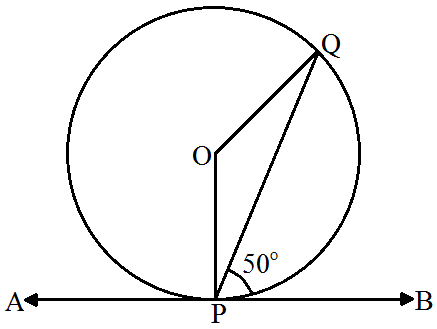
- ✓
$100^\circ$
- B
$120^\circ$
- C
$140^\circ$
- D
$150^\circ$
AnswerCorrect option: A. $100^\circ$
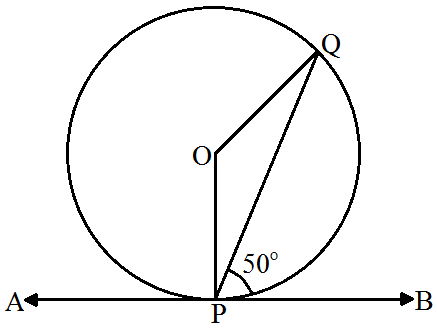
In the figure $, \text{APB}$ is a tangent to the circle with centre $O$.
$\angle\text{QPB}=50^\circ$
$OP$ is radius and $\text{APB}$ is a tangent.
$OP \perp AB$
$\Rightarrow\text{OPB}=90^\circ$
$\Rightarrow\angle\text{OPQ}+\angle\text{QPB}=90^\circ$
$\angle\text{OPQ}+50^\circ=90^\circ$
$\Rightarrow\angle\text{OPQ}=90^\circ-50^\circ=40^{\circ}$
But $OP = OQ$
$\angle\text{OPQ}=\angle\text{OQP}=40^{\circ}$
$\angle\text{POQ}=180^{\circ}-(40^{\circ}+40^{\circ})$
$=180^{\circ}-80^{\circ}=100^{\circ}$
View full question & answer→MCQ 1471 Mark
From a point $Q,$ the length of tangent to a circle is $24\ cm$ and the distance of $Q$ from the centre is $25\ cm,$ radius of circle is :
- A
$10\ cm$
- B
$8\ cm$
- C
$6\ cm$
- ✓
$7\ cm$
AnswerCorrect option: D. $7\ cm$
Here $\angle\text{OPQ} = 90^\circ$
$ [$Tangent makes right angle with the radius at the point of contact$]$
In right angled triangle $\text{OPQ}$
$\therefore O Q^2=O P^2+P Q^2 $
$\Rightarrow(25)^2=O P^2+(24)^2 $
$ \Rightarrow O P^2=625-576 $
$\Rightarrow OP = 7\ cm$
Therefore, the radius of the circle is $7\ cm$.
View full question & answer→MCQ 1481 Mark
If radii of two concentric circles are $4\ cm$ and $5\ cm,$ then the length of each chord of one circle which is tangent to the other circle is :
- A
$3\ cm$
- ✓
$6\ cm$
- C
$9\ cm$
- D
$1\ cm$
AnswerCorrect option: B. $6\ cm$
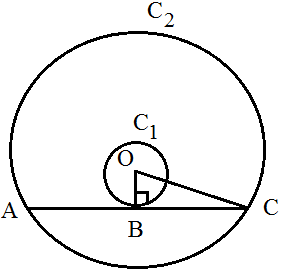
Let $O$ be the centre of two concentric circles $C_2$ and $C_2,$
whose radil are $r_1= 4\ cm$ and $r_2= 5\ cm.$
Now, we draw a chord AC of circle $C_2$, which touches the circle $C_1$ at $B$.
Also, join $OB,$ which is perpendicular to $AC. $
$[$Tangent at any point of circle is perpendicular to radius throughly the point of contact$]$
Now, in right angled $\triangle\text{OBC},$ by using pythagoras theorem,
$OC^2= BC^2+ BO^2$
$[\because \mathrm{(hypotenuse)^2= (base)^2+ (perpendicular)^2}]$
$\Rightarrow 5^2= BC^2+ 4^2$
$\Rightarrow BC^2= 25 - 16 = 9$
$\Rightarrow BC = 3\ cm$
$\because$ Length of chord $AC = 2BC = 2 \times 3 = 6\ cm.$ View full question & answer→MCQ 1491 Mark
In the adjacent figure, if $TP$ and $TQ$ are two tangents to a circle with centre $O,$ so that $\angle\text{POQ}=100^\circ,$ then $\angle\text{PTQ}$ is equal to :
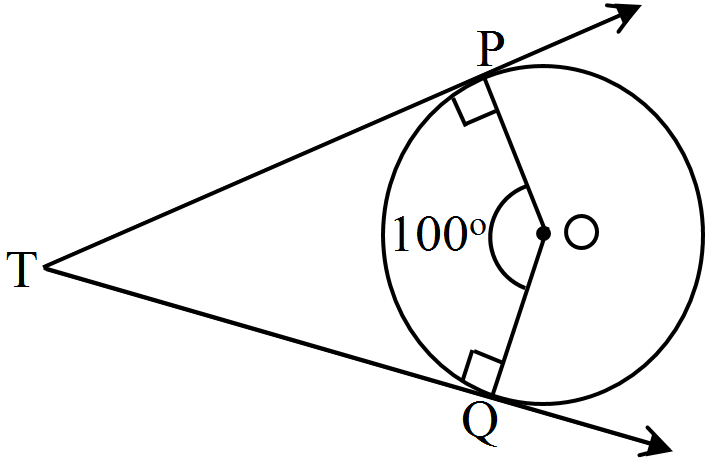
- A
$60^\circ$
- B
$40^\circ$
- ✓
$80^\circ$
- D
$90^\circ$
AnswerCorrect option: C. $80^\circ$
Since the angle between the two tangents drawn from an external point to a circle in supplementary of the angle between the radii of the circle through the points of contact.
$\therefore \angle \text{PTQ} = 180^\circ- 100^\circ= 80^\circ$
View full question & answer→MCQ 1501 Mark
In the figure $,PQ$ and $PR$ are two tangents to a circle with centre $O$. If $\angle\text{QPR}=46^\circ$ then $\angle\text{QOR}$ equals :
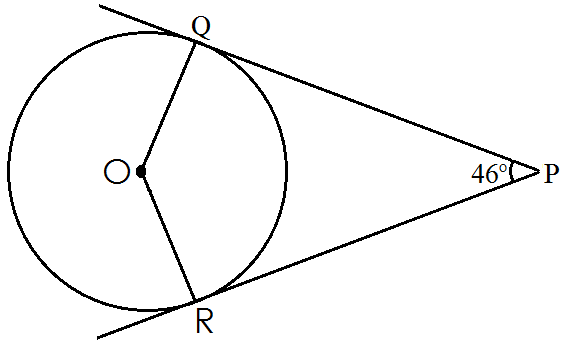
- A
$67^\circ$
- ✓
$134^\circ$
- C
$44^\circ$
- D
$46^\circ$
AnswerCorrect option: B. $134^\circ$
$\angle\text{OQP}=90^\circ \ [$Tangent is $\perp$ to the radius through the point of contact$]$
$\angle\text{ORP}=90^\circ$
$\angle\text{OQP}+\angle\text{QPR}+\angle\text{ORP}+\angle\text{QOR}=360^\circ \ [$Angle sum property of a quad.$]$
$90^\circ+46^\circ+90^\circ+\angle\text{QOR}=360^\circ$
$\angle\text{QOR}=360^\circ-90^\circ-46^\circ-90^\circ=134^\circ$
View full question & answer→MCQ 1511 Mark
In a right triangle $\text{ABC},$ right angled at $B, BC = 12\ cm$ and $AB = 5\ cm$. The radius of the circle inscribed in the triangle is :
- A
$1\ cm$
- ✓
$2\ cm$
- C
$3\ cm$
- D
$4\ cm$
AnswerCorrect option: B. $2\ cm$
In right $\triangle\text{ABC},$
$\text{AC}^2=\text{AB}^2+\text{BC}^2 ....($By Pythagoras theorem$)$
$\Rightarrow\text{AC}^2=5^2+12^2$
$\Rightarrow\text{AC}^2=169$
$\Rightarrow\text{AC}=13\text{ cm}$
We know that,
$\text{ar}(\triangle\text{ABC})=\frac{1}{2}\times(\text{perimeter of }\triangle\text{ABC})\times\text{r}$
$\Rightarrow\frac{1}{2}\times\text{base}\times\text{height}=\frac{1}{2}\times(\text{perimeter of }\triangle\text{ABC})\times\text{r}$
$\Rightarrow\frac{1}{2}\times12\times5=\frac{1}{2}\times(5+12)\times\text{r}$
$\Rightarrow\frac12\times5=30\times\text{r}$
$\Rightarrow\text{r}=2\text{ cm}$
View full question & answer→MCQ 1521 Mark
In the given figure if $QP = 4.5\ cm,$ then the measure of $QR$ is equal to :
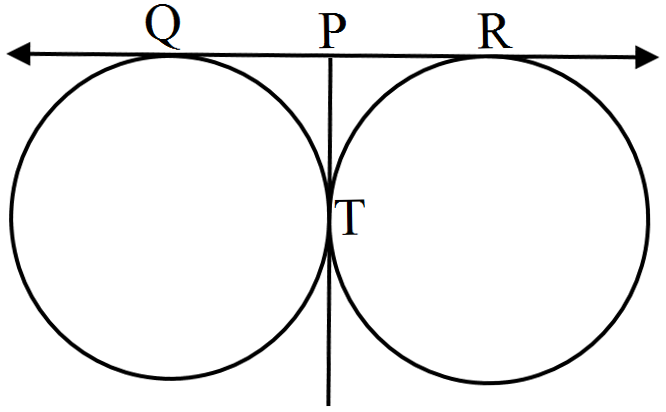
- A
$13.5\ cm$
- B
$18\ cm$
- C
$15\ cm$
- ✓
$9\ cm$
AnswerCorrect option: D. $9\ cm$
Here $QP = PT = 4.5\ cm \ [$Tangents to a circle from an external point $P]$
Also $PT = PR = 4.5\ cm\ [$Tangents to a circle from an external point $P]$
$\therefore QR = QP + PQ $
$= 4.5 + 4.5 = 9\ cm$
View full question & answer→MCQ 1531 Mark
In the given figure, quadrilateral $\text{ABCD}$ is circumscribed, touching the circle at $P, Q, R$ and $S$. If $AP = 6\ cm, BP = 5\ cm, CQ = 3\ cm$ and $DR = 4\ cm,$ then the perimeter of quadrilateral $\text{ABCD}$ is :
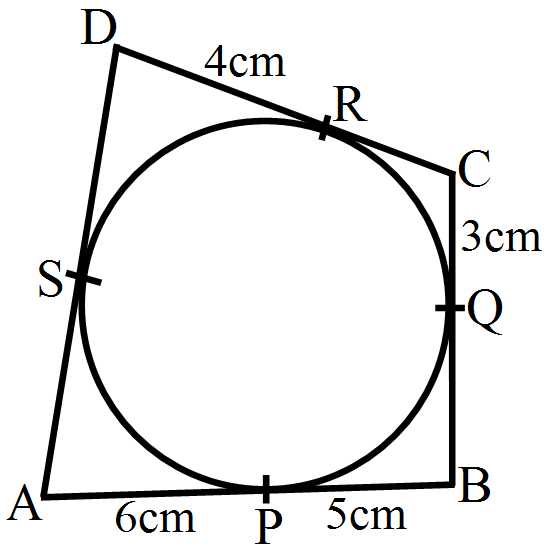
- A
$18\ cm$
- B
$27\ cm$
- ✓
$36\ cm$
- D
$32\ cm$
AnswerCorrect option: C. $36\ cm$
We know that tangent from an external point to the circle are equal.
$RC = QC = 3\ cm$
$PB = BQ = 5\ cm$
$AP = AS = 6\ cm$
$SD = DR = 4\ cm$
Perimeter of quad. $\text{ABCD}$
$= AB + BC + CD + AD$
$= (AP + PB) + (BQ + CQ) + (CR + DR) + (AS + SD)$
$= (6 + 5) + (5 + 3) + (3 + 4) + (6 + 4)$
$= 36\ cm$
View full question & answer→MCQ 1541 Mark
In the given figure $,O$ is the centre of the circle. $AB$ is the tangent to the circle at the point $P$. If $\angle\text{APQ}=58^\circ$ then the measure of $\angle\text{PQB}$ is :
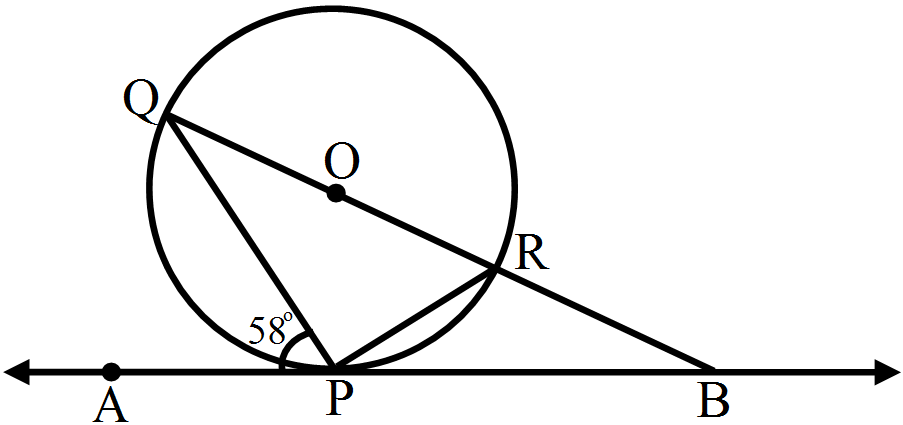
- ✓
$32^\circ$
- B
$58^\circ$
- C
$122^\circ$
- D
$132^\circ$
AnswerCorrect option: A. $32^\circ$
$\angle\text{APQ}=58^\circ$
$\angle\text{QPR}=90^\circ ....($angle inscribed a semicircle$)$
Since $\text{APB}$ is a straight line,
$\angle\text{APQ}+\angle\text{QPR}+\angle\text{RPB}=180^\circ$
$\Rightarrow58^\circ+90^\circ+\angle\text{RPB}=180^\circ$
$\Rightarrow\angle\text{RPB}=32^\circ$
We know that angle that subtend the same arc are equal.
So, $\angle\text{RPB}=\angle\text{RPB}=32^\circ$
View full question & answer→MCQ 1551 Mark
In the given figure, $PA$ and $PB$ are tangents to the given circle, such that $PA = 5\ cm$ and $\angle\text{APB} = 60^\circ.$ The length of chord $AB$ is :
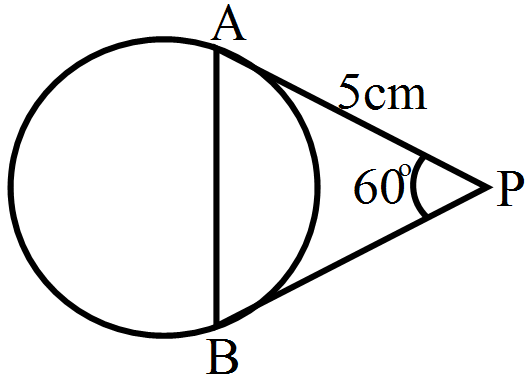
- A
$5\sqrt{2}\text{ cm}$
- ✓
$5\text{ cm}$
- C
$5\sqrt{3}\text{ cm}$
- D
$7.5\text{ cm}$
AnswerCorrect option: B. $5\text{ cm}$
We know that tangents from an external point to the circle are equal.
$\text{PA}=\text{PB}$
$\Rightarrow\angle\text{PBA}=\angle\text{PAB}=\text{x}^\circ$
In $\triangle\text{PAB},$
$\angle\text{PBA}+\angle\text{PAB}+\angle\text{APB}=180^\circ....($Angle Sum Property$)$
$\Rightarrow\angle\text{PAB}+\angle\text{PAB}+60^\circ=180^\circ$
$\Rightarrow2\angle\text{PAB}=120^\circ$
$\Rightarrow\angle\text{PAB}=60^\circ=\angle\text{PBA}$
So, $\triangle\text{PAB}$ is an equilateral triangle.
thus $, AB = PA = 5\ cm.$
View full question & answer→MCQ 1561 Mark
In the figure, the perimeter of $\triangle\text{ABC}$ is :
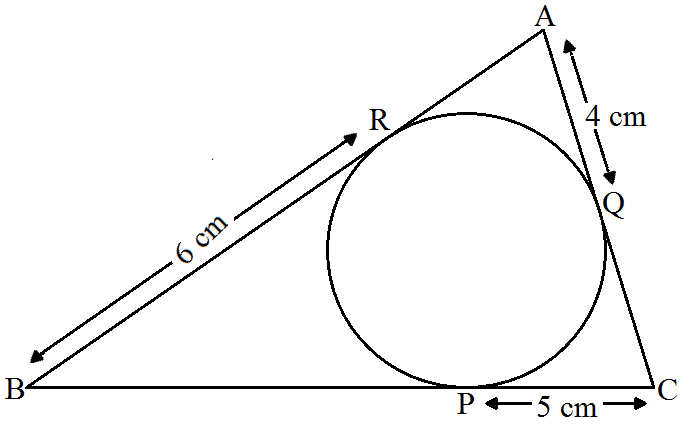
- ✓
$30\ cm$
- B
$60\ cm$
- C
$45\ cm$
- D
$15\ cm$
AnswerCorrect option: A. $30\ cm$
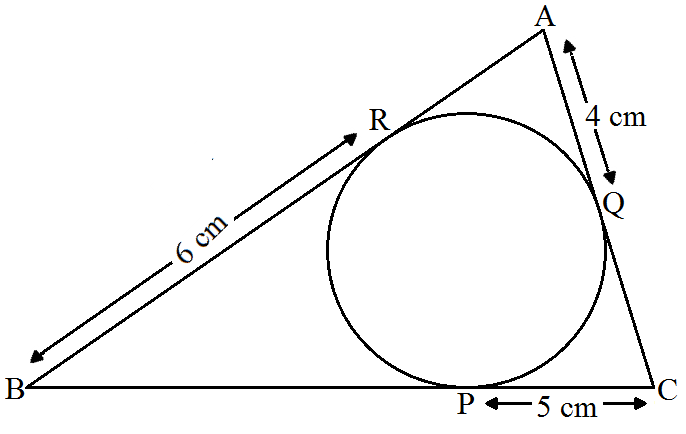
By the property of tangent
$AO = AR = 4\ cm\ ($tangent from $A)$
$BR = BP = 6\ cm\ ($tangent from $B)$
$PC = CQ = 5\ cm\ ($tangent from $C)$
Perimeter of $\triangle\text{ABC} = AB + BC + CA$
Perimeter of $\triangle\text{ABC} = AR + BR + BP + PC + CQ + QA$
Perimeter of $\triangle\text{ABC} = 4 + 6 + 6 + 5 + 5 + 4$
Perimeter of $\triangle\text{ABC} = 30\ cm$ View full question & answer→MCQ 1571 Mark
If $PA$ and $PB$ are two tangents to a circle with centre $O,$ such that $\angle\text{AOB} = 110^\circ,$ find $ \angle\text{APB}$ is equal to
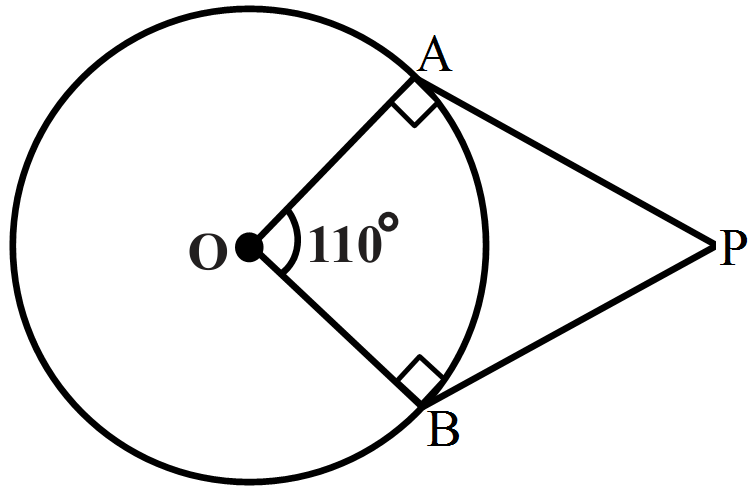
- A
$55^\circ$
- B
$60^\circ$
- ✓
$70^\circ$
- D
$90^\circ$
AnswerCorrect option: C. $70^\circ$
Since $PA$ and $PB$ are the tangent to the circle.
$\angle\text{OAP}=\angle\text{OBP}=90^\circ ...($tangent is perpendicular to the radius of a circle$)$
In $\text{AOBP},$
$\angle\text{OAP}+\angle\text{APB}+\angle\text{OBP}+\angle\text{AOB}=360^\circ$
$\Rightarrow90^\circ+\angle\text{APB}+90^\circ+110^\circ=360^\circ$
$\Rightarrow\angle\text{APB}=70^\circ$
View full question & answer→MCQ 1581 Mark
From a point $P$ which is at a distance of $13\ cm$ from the centre $O$ of a circle of radius $5\ cm,$ the pair of tangents $PQ$ and $PR$ to the circle are drawn. Then the area of the quadrilateral $\text{PQOR}$ is :
- ✓
$60 \mathrm{~cm}^2 $
- B
$ 65 \mathrm{~cm}^2 $
- C
$ 30 \mathrm{~cm}^2 $
- D
$ 32.5 \mathrm{~cm}^2 $
AnswerCorrect option: A. $60 \mathrm{~cm}^2 $
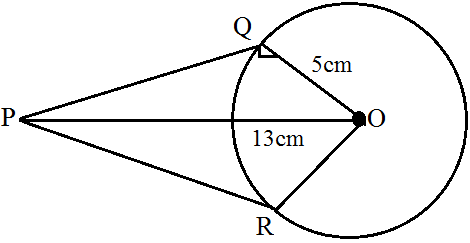
Firstly, draw a circle of radius $5\ cm$ having centre $O.P$ is a point at a distance of $13\ cm$ from $O$.
A pair of tangents $PQ$ and $PR$ are drawn.
Thus, quadrilateral $\text{POOR}$ is formed.
$\because\ \text{OQ}\perp\text{QP}\ [$since $,AP$ is a tangent line$]$
In right angled $\triangle\text{PQO},\ \text{OP}^2=\text{OQ}^2+\text{QP}^2$
$\Rightarrow\ 13^2=5^2+\text{QP}^2$
$\Rightarrow\ \text{QP}^2=169-25=144$
$\Rightarrow\ \text{QP}=12\text{ cm}$
Now, area of $\triangle\text{OQP}=\frac{1}{2}\times\text{QP}\times\text{QO}$
$=\frac{1}{2}\times12\times5=30\text{ cm}^2$
$\therefore$ Area of quadrilateral $\text{QORP}=2\triangle\text{OQP}$
$= 2 \times 30 = 60\mathrm{~cm}^2 $ View full question & answer→MCQ 1591 Mark
The length of the tangent from an external point $P$ to a circle of radius $5\ cm$ is $10\ cm$. The distance of the point from the centre of the circle is :
- A
$8\text{ cm}$
- B
$\sqrt{104}\text{ cm}$
- C
$12\text{ cm}$
- ✓
$\sqrt{125}\text{ cm}$
AnswerCorrect option: D. $\sqrt{125}\text{ cm}$
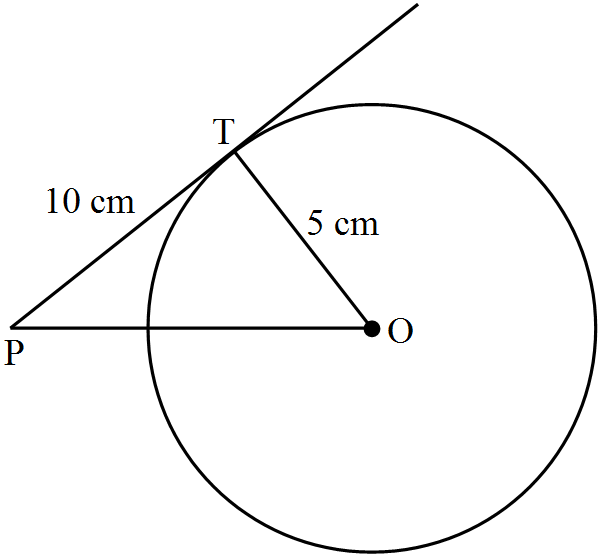
In $\triangle\text{PTO}$
By Pythagoras theorem,
$\text{OP}^2=\text{PT}^2+\text{OT}^2$
$\Rightarrow\text{OP}^2=10^2+5^2$
$\Rightarrow\text{OP}^2=100+25$
$\Rightarrow\text{OP}=\sqrt{125}\text{ cm}$
Hence, the distance of the point from the centre of the circle is $\sqrt{125}\text{ cm}.$ View full question & answer→MCQ 1601 Mark
If $PA$ and $PB$ are two tangent to a circle with centre $O$ such that $\angle\text{APB}=80^\circ.$ Then, $\angle\text{AOP}=?$
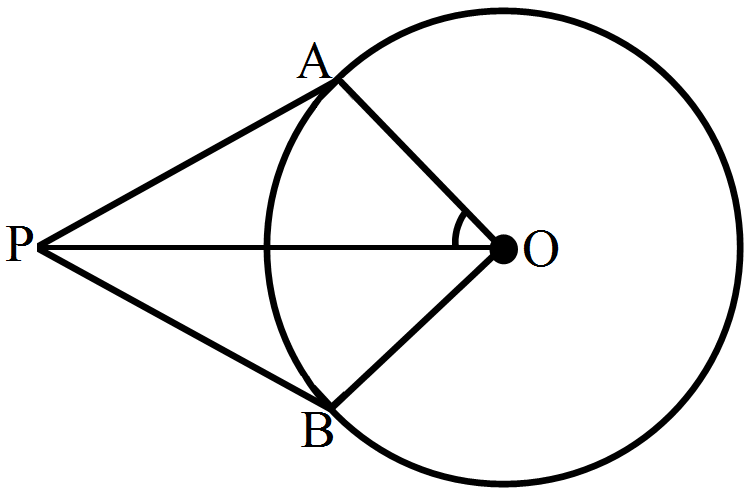
- A
$40^\circ$
- ✓
$50^\circ$
- C
$60^\circ$
- D
$70^\circ$
AnswerCorrect option: B. $50^\circ$
Construction : Join $CA$ and $CB$.
In $\triangle\text{PAO}$ and $\triangle\text{PBO},$
$\angle\text{OAP}=\angle\text{OBP}=90^\circ....($Since $AP$ and $PB$ are tangent to the circle$)$
$\text{OP}=\text{OP} ....($common side$)$
$\text{AO}=\text{BO} ....($radii of the same circle$)$
$\Rightarrow\triangle\text{PAO}\cong\triangle\text{PBO} ....(\text{RHS}$ congruence criterion$)$
$\angle\text{OPA}=\angle\text{OPB} ....(\text{cpct})$
$\Rightarrow\angle\text{OPA}=\frac{1}{2}\angle\text{APB}=40^\circ$
In $\triangle\text{PAO},$
$\angle\text{OPA}+\angle\text{PAO}+\angle\text{AOP}=180^\circ ....($Angle Sum Property$)$
$\Rightarrow40^\circ+90^\circ+\angle\text{AOP}=180^\circ$
$\Rightarrow\angle\text{AOP}=50^\circ$
View full question & answer→MCQ 1611 Mark
In the following figure, find the length of the chord $A B$ if $P A=6 cm$ and $\angle P A B=60^{\circ}$.
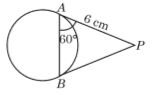
Answer(c) : $P B=P A=6 cm \quad[\because$ Tangents drawn from an external point to a circle are equal in length]
$
\therefore \quad \angle P B A=\angle P A B=60^{\circ}
$
(Angles opposite to sides are equal)
$
\therefore \quad \angle A P B=180^{\circ}-60^{\circ}-60^{\circ}=60^{\circ}
$
[Angle sum property of a triangle]
$\therefore \quad \triangle A P B$ is an equilateral triangle.
$
\therefore \quad A B=P A=P B=6 cm
$
View full question & answer→MCQ 1621 Mark
From an external point $P$, tangents $P A$ and $P B$ are drawn to a circle with centre $O$. If $C D$ is the tangent to the circle at a point $E$ and $P A=14 \ cm$, find the perimeter of $\triangle \text{P C D}$.
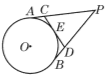
- A
$26 \ cm$
- ✓
$14 \ cm$
- C
$28 \ cm$
- D
$21 \ cm$
AnswerCorrect option: B. $14 \ cm$
Since the tangents drawn from an external point to a circle are equal.
$\therefore P A=P B, C A=C E$ and $D B=D E$
Perimeter of $\triangle P C D=P C+C D+P D$
$=(P A-C A)+(C E+D E)+(P B-D B)$
$=(P A-C E)+(C E+D E)+(P B-D E)$
$=P A+P B=2 P A=(2 \times 14) \ cm =28 \ cm$
View full question & answer→MCQ 1631 Mark
A circle is inscribed in a $\triangle A B C$ having sides $8 cm , 10 cm$ and $12 cm$ as shown in given figure. The length of $A D, B E$ and $C F$ (in $cm$ ) respectively are
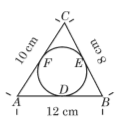
- ✓
$2,8,4$
- B
$7,5,3$
- C
$8,4,2$
- D
$6,6,4$
AnswerCorrect option: A. $2,8,4$
(a) : Let $A D=x cm$
Then $A F=x cm$
$
\begin{aligned}
\therefore \quad F C & =A C-A F=(10-x) cm \\
\text { and } C E & =F C=(10-x) cm \\
E B & =B C-C E=8-(10-x)=8-10+x=(x-2) cm \\
D B & =A B-A D=(12-x) cm
\end{aligned}
$
Now, $D B=E B \Rightarrow 12-x=x-2 \Rightarrow x=7$
$
\therefore A D=7 cm , B E=7-2=5 cm \text { and } C F=10-7=3 cm
$
View full question & answer→MCQ 1641 Mark
In the given figure, $P Q$ is the common tangent to both the circles. $S R$ and $P T$ are also tangents. If $S R=4 cm , P T=7 cm$, then find $R P$.
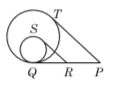
- ✓
$2 cm$
- B
$3 cm$
- C
$5 cm$
- D
$3.5 cm$
AnswerCorrect option: A. $2 cm$
(a) : Since tangents drawn from an external point to a circle are equal in length.
$
\therefore P Q=P T=7 cm \text { and } R Q=R S=4 cm
$
Now, $R P=P Q-R Q=(7-4) cm =3 cm$
View full question & answer→MCQ 1651 Mark
In the adjoining figure, if $P C$ is the tangent at $A$ of the circle with $\angle P A B$ $=72^{\circ}$ and $\angle A O B=132^{\circ}$, then $\angle A B C=$
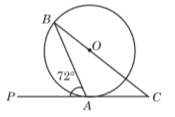
- A
- ✓
$18^{\circ}$
- C
$30^{\circ}$
- D
$60^{\circ}$
AnswerCorrect option: B. $18^{\circ}$
(b) : Here, $\angle P A B=72^{\circ}$
$
\therefore \angle O A B=90^{\circ}-72^{\circ}=18^{\circ}
$Also, $\angle A O B=132^{\circ}$
[Given]
Now, in $\triangle O A B, \angle A B C=180^{\circ}-132^{\circ}-18^{\circ}=30^{\circ}$
View full question & answer→MCQ 1661 Mark
In the diagram, $P Q$ and $Q R$ are tangents to the circle with centre $O$. Find the value of $x$.
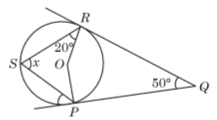
- A
$55^{\circ}$
- B
$25^{\circ}$
- ✓
$35^{\circ}$
- D
$65^{\circ}$
AnswerCorrect option: C. $35^{\circ}$
(c) : $\angle P O R+\angle P Q R=180^{\circ}$
$
\angle O P Q=\angle O R Q=90^{\circ}
$
$
\therefore \angle P O R=180^{\circ}-50^{\circ}=130^{\circ}
$Also, $\angle P S R=\frac{1}{2} \angle P O R$
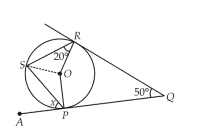
$[\because$ Angle made by an arc at the centre of a circle is twice the angle subtended by the same arc at any point on the remaining part of the circle]
$
\therefore \quad \angle P S R=\frac{1}{2} \times 130^{\circ}=65^{\circ}
$ View full question & answer→MCQ 1671 Mark
In the given diagram, $P Q$ and $R S$ are common tangents to the two circles with centres $C$ and $D$. The value of $R S$ is
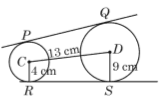
- A
$12 \ cm$
- B
$9 \ cm$
- C
$5 \ cm$
- ✓
$15 \ cm$
AnswerCorrect option: D. $15 \ cm$
We have $C R=4 \ cm$,
$D S=9 \ cm$ and $C D=13 \ cm
$Draw $A C \| R S$
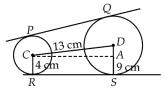
$\therefore D A=D S-S A[S A=C R]$
$=9-4=5 \ cm$
In $\triangle C A D$, right angled at $D$
$C A^2=C D^2-D A^2=13^2-5^2=144$
$\Rightarrow C A=\sqrt{144}=12 \ cm$
$\Rightarrow C A=R S=12 \ cm$ View full question & answer→MCQ 1681 Mark
If $\text{AB}$ is chord of a circle with centre $O$ and $\text{PQ}$ is a tangent to the circle at $B$ with reflex $\angle \text{AOB}=210^{\circ}$, then $\angle \text{OBA}=$
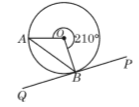
- ✓
$15^{\circ}$
- B
$75^{\circ}$
- C
$150^{\circ}$
- D
$210^{\circ}$
AnswerCorrect option: A. $15^{\circ}$
Since, angle about a point is $360^{\circ}$.
$\therefore \angle \text{AOB}=360^{\circ}-\text { reflex } \angle \text{AOB}=360^{\circ}-210^{\circ}=150^{\circ}$
In $\triangle \text{AOB,} \angle \text{OAB} +\angle \text{ABO}+\angle \text{AOB}=180^{\circ}$
$\Rightarrow \angle \text{ABO} +\angle \text{ABO}=180^{\circ}-150^{\circ}$
$\left.\Rightarrow 2 \angle \text{OBA}=30^{\circ} [\angle OAB=\angle OBA \text { and } \angle \text{AOB}=150^{\circ}\right]$
$\Rightarrow 2 \text{OBA}=15^{\circ}$
View full question & answer→MCQ 1691 Mark
If four sides of a quadrilateral $\text{A B C D}$ are tangent to a circle, then

- A
$\text{A C+A D=B C+D B}$
- B
$\text{A C+A D=B D+C D}$
- ✓
$\text{A B+C D=B C+A D}$
- D
$\text{A B+C D=A C+B C}$
AnswerCorrect option: C. $\text{A B+C D=B C+A D}$
Since the lengths of tangents to a circle from an external point are equal.

$\therefore A P=A S$
$B P=B Q$
$C R=C Q$
$D R=D S$
Adding $(i), (ii), (iii)$ and $(iv),$ we get
$(A P+B P)+(C R+D R)=A S+B Q+C Q+D S$
$\Rightarrow A B+C D=B C+A D$ View full question & answer→MCQ 1701 Mark
Two parallel lines touch the circle at points $A$ and $B$. If area of the circle is $16 \pi \ cm ^2$, then $A B$ is equal to
- A
$16 \ cm$
- ✓
$5 \ cm$
- C
$8 \ cm$
- D
$10 \ cm$
AnswerCorrect option: B. $5 \ cm$
$[$Given$]$ Let the radius of the circle be $r \ cm$.
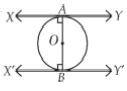
Area of circle $=16 \pi$
$\Rightarrow \pi r^2=16 \pi$
$\Rightarrow r^2=16$
$ \Rightarrow r=4$
$\therefore A B=2 O A=2 r=8 \ cm$ View full question & answer→MCQ 1711 Mark
Two tangents $BC$ and $BD$ are drawn to a circle with centre $O$ such that $\angle \text{CBD}=120^{\circ}$. Then $OB=$

- ✓
$BC / 2$
- B
$2 B C$
- C
$B C$
- D
$3 B C$
AnswerCorrect option: A. $BC / 2$
Since, tangents from an external point $B$ to a circle are equally inclined to $O B$
$\therefore \angle \text{CBO}=\frac{1}{2} \angle \text{CBD}$
$=\frac{1}{2} \times 120^{\circ}=60^{\circ}$
Also, $\angle \text{OCB}=90^{\circ}[\because OC \perp CB]$
In $\triangle \text{OCB,} \frac{BC}{OB}=\cos 60^{\circ}=\frac{1}{2}$
$\Rightarrow \text{OB=2BC}$
View full question & answer→MCQ 1721 Mark
In the given figure, a quadrilateral $A B C D$ is drawn to circumscribe a circle such that its sides $A B, B C, C D$ and $A D$ touch the circle at $P, Q, R$ and $S$ respectively. If $A B=x cm$, $B C=7 cm , C R=3 cm$ and $A S=5 cm$, find $x$.
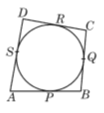
- A
$7 cm$
- ✓
$10 cm$
- C
$9 cm$
- D
$8 cm$
AnswerCorrect option: B. $10 cm$
(b) : $A P=A S, B P=B Q, C Q=C R, D R=D S$
[Tangents drawn from an external point to the circle are equal in Length]
So, $C R=C Q \Rightarrow C Q=3 cm$
Now, $B C=7 cm \Rightarrow C Q+B Q=7 cm$
$\Rightarrow B Q=(7-3) cm =4 cm$
Also, $B Q=B P \Rightarrow B P=4 cm$
Also, $A S=A P$ and $A S=5 cm \Rightarrow A P=5 cm$
$
\therefore \quad A B=A P+P B=(5+4) cm =9 cm
$So, $x=9$
View full question & answer→MCQ 1731 Mark
In the given figure, $Q R$ is a common tangent to the given circles, touching externally at the point $T$. The tangent at $T$ meets $Q R$ at $P$. If $P T=3.8 cm$, then the length of $Q R($ in $cm )$ is
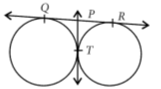
Answer(b) : It is known that the length of the tangents drawn from an external point to a circle are equal.
$\therefore \quad Q P=P T=3.8 cm$ and $P R=P T=3.8 cm$
Now, $Q R=Q P+P R=3.8 cm +3.8 cm =7.6 cm$
View full question & answer→MCQ 1741 Mark
Two circles touch internally at point $Q$. From an external point $R$, two tangents $R M$ and $R N$ are drawn to the two circles. Then,
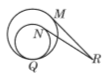
Answer(a) : Join RQ.Since tangents drawn from an external point to a circle are equal in length.
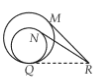
$
\therefore R Q=R N
$
$
\text { (i) and } R Q=R M
$
$
\Rightarrow R N=R M
$ View full question & answer→MCQ 1751 Mark
There are two concentric circles with centre $O$ and of diameters $10 cm$ and $6 cm$ respectively. $A B$, a chord of outer circle touches the inner circle at $T$. The length of $B T$ is
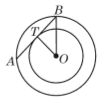
- A
$6 cm$
- B
$7 cm$
- ✓
$4 cm$
- D
$10 cm$
AnswerCorrect option: C. $4 cm$
(c) : In $\triangle O B T, \angle O T B=90^{\circ}$
[Tangent of a circle is perpendicular to the radius]
$\therefore \quad O B^2=O T^2+B T^2$
[By Pythagoras theorem]
$
\Rightarrow\left(\frac{10}{2}\right)^2=\left(\frac{6}{2}\right)^2+B T^2 \Rightarrow 25=9+B T^2
$
$
\Rightarrow B T^2=16 \Rightarrow B T=4 cm
$
View full question & answer→MCQ 1761 Mark
Two circles with centres $O$ and $P$, and radii $8 \ cm$ and $4 \ cm$ touch each other externally. Find the length of their common tangent $Q R$.
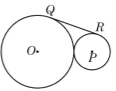
- A
$16 \ cm$
- ✓
$8 \sqrt{2} \ cm$
- C
$4 \ cm$
- D
$4 \sqrt{2} \ cm$
AnswerCorrect option: B. $8 \sqrt{2} \ cm$
As $\text{S P=Q R}$, as they are opposite sides of rectangle $\text{P R Q S}$.
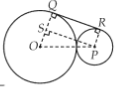
$O P=8 \ cm +4 \ cm =12 \ cm$
$O S=8 \ cm -4 \ cm =4 \ cm$
Now, in $\triangle \text{O S P, O P}^2=O S^2+S P^2$
$\Rightarrow Q R=S P=\sqrt{O P^2-O S^2}=\sqrt{12^2-4^2} \ cm =8 \sqrt{2} \ cm$ View full question & answer→MCQ 1771 Mark
How many tangents can a circle have from a point lying inside the circle ?
Answer(d) : There is no tangent to a circle passing through a point lying inside the circle.
View full question & answer→MCQ 1781 Mark
If two tangents inclined at an angle $60^{\circ}$ are drawn to a circle of radius $3 cm$, then length of each tangent is equal to
AnswerCorrect option: D. $3 \sqrt{3} cm$
(d) : As $O P$ is a bisector of $\angle A P C$.
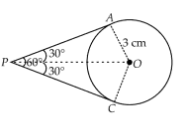
$
\therefore \angle A P O=\angle C P O=30^{\circ}
$Also, $O A \perp A P$
$[\because$ Tangent at any point of a circle is perpendicular to the radius through the point of contact.]
$
\therefore \angle O A P=90^{\circ}
$
In right angled $\triangle O A P, \tan 30^{\circ}=\frac{O A}{A P}=\frac{3}{A P}$
$\Rightarrow \frac{1}{\sqrt{3}}=\frac{3}{A P} \Rightarrow$ Length of tangent $A P=3 \sqrt{3} cm$ View full question & answer→MCQ 1791 Mark
In the given figure, $O$ is the centre of two concentric circles of radii $5 \ cm$ and $3 \ cm$. From an external point $P$, tangents $PA$ and $PB$ are drawn to these circles. If $PA=12 \ cm$, then $PB=$
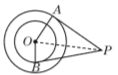
- A
$5 \sqrt{2} \ cm$
- B
$3 \sqrt{5} \ cm$
- ✓
$4 \sqrt{10} \ cm$
- D
$5 \sqrt{10} \ cm$
AnswerCorrect option: C. $4 \sqrt{10} \ cm$
In right $\triangle \text{PAO, PA}=12 \ cm$ and $OA=5 \ cm$.
$\therefore$ By Pythagoras theorem,
$\ce{OP^2=OA^2 + PA^2}=5^2+(12)^2=25+144=169$
$\Rightarrow \text{OP}=\sqrt{169}=13 \ cm$ In right $\triangle \ce{PBO, PB^2=OP^2 - OB^2}$
$=13^2-3^2=169-9=160$
$\Rightarrow \text{PB}=\sqrt{160} \ cm =4 \sqrt{10} \ cm$
View full question & answer→MCQ 1801 Mark
$O$ is the centre of the circle. $P Q$ is tangent to the circle and secant $P A B$ passes through the centre $O$. If $P Q=5 cm$ and $P A=1 cm$, then radius of the circle is
- A
$8 cm$
- ✓
$12 cm$
- C
$10 cm$
- D
$6 cm$
AnswerCorrect option: B. $12 cm$
(b) : $O Q=O A=r$
[radii of circle]In
$\triangle O P Q, \angle Q=90^{\circ}$
$O P^2=O Q^2+P Q^2$
$(r+1)^2=r^2+(5)^2$
$\Rightarrow r^2+2 r+1=r^2+25$
$\Rightarrow 2 r=24 \Rightarrow r=12 cm$
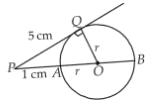
View full question & answer→MCQ 1811 Mark
In the given figure, $A D=8 cm , A C=6 cm$ and $T B$ is the tangent at $B$ to the circle with centre $O$. Find $O T$, if $B T$ is $4 cm$.
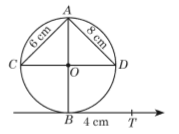
- ✓
$\sqrt{41} cm$
- B
$\sqrt{43} cm$
- C
$\sqrt{39} cm$
- D
$\sqrt{47} cm$
AnswerCorrect option: A. $\sqrt{41} cm$
(a): Clearly, $\angle C A D=90^{\circ}$ [angle in a semi-circle]
$
\therefore \text { In } \triangle A C D, C D^2=A C^2+A D^2=36+64=100
$
[by Pythagoras theorem]
$
\Rightarrow C D=10 cm
$Therefore, $O C=O D=O B=\frac{10}{2} cm =5 cm$
So, in right $\triangle O B T, O T^2=O B^2+B T^2=25+16=41$
[by Pythagoras theorem]
$
\Rightarrow O T=\sqrt{41} cm
$
View full question & answer→MCQ 1821 Mark
If the angle between two radii of a circle is $140^{\circ}$, then the angle between the tangents at the ends of the radii is
- A
$90^{\circ}$
- B
$50^{\circ}$
- C
$70^{\circ}$
- ✓
$40^{\circ}$
AnswerCorrect option: D. $40^{\circ}$
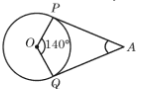
$\angle \text{OPA}=90^{\circ}$ and $\angle \text{OQA}=90^{\circ}$
$[\because$ Angle between tangent and radius through the point of contact is $90^{\circ} ]$ In quadrilateral $\text{OPAQ}$,
$\angle \ce{OQ + \angle OPA + \angle OQA + \angle PAQ}=360^{\circ}$
$[$Angle sum property of a quadrilateral$]$
$\Rightarrow 140^{\circ}+90^{\circ}+90^{\circ}+\angle\text{PAQ}=360^{\circ}$
$\Rightarrow \angle \text{PAQ}=360^{\circ}-320^{\circ}=40^{\circ}$ View full question & answer→MCQ 1831 Mark
A tangent to a circle is a line that touches the circle at exactly
Answer(c) : A tangent to a circle is a line that intersects or touches the circle at exactly one point.
View full question & answer→MCQ 1841 Mark
In the given figure, $P Q$ and $P R$ are tangents drawn from point $P$ to a circle with centre $O$. If $\angle O P Q=35^{\circ}$, then value of $a$ and $b$ are
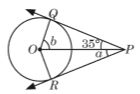
- A
$30^{\circ}, 60^{\circ}$
- ✓
$35^{\circ}, 55^{\circ}$
- C
$40^{\circ}, 50^{\circ}$
- D
$55^{\circ}, 45^{\circ}$
AnswerCorrect option: B. $35^{\circ}, 55^{\circ}$
(b) : Since $P Q$ is a tangent.
$
\therefore \angle O Q P=90^{\circ}
$In $\triangle P Q O, \angle O Q P+\angle O P Q+\angle Q O P=180^{\circ}$
[By angle sum property]
$
\Rightarrow 90^{\circ}+35^{\circ}+b=180^{\circ} \Rightarrow b=180^{\circ}-125^{\circ}=55^{\circ}
$
Since the tangents from an external point $P$ to the circle are equally inclined to $O P$.
$
\therefore \quad \angle R P O=\angle O P Q \Rightarrow a=35^{\circ}
$
View full question & answer→MCQ 1851 Mark
In the given figure, three circles with centres $A, B, C$ respectively touch each other externally. If $A B=5 cm , B C=7 cm$ and $C A=6 cm$, then the radius of the circle with centre $A$ is
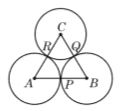
- A
$1.5 cm$
- ✓
$2 cm$
- C
$2.5 cm$
- D
$3 cm$
AnswerCorrect option: B. $2 cm$
(b) : Let the radii of the three circles with centre $A$, $B$ and $C$ be $x, y, z$ respectively. Then,
$
x+y=5, y+z=7 \text { and } z+x=6
$Adding all three equations, we get
$
\begin{aligned}
& 2(x+y+z)=18 \Rightarrow x+y+z=9 \\
\therefore \quad & x=(x+y+z)-(y+z)=(9-7)=2 cm
\end{aligned}
$
View full question & answer→MCQ 1861 Mark
Two tangents, drawn at the end points of diameter of a given circle are always
Answer(a): Two tangents drawn at the end points of diameter are always parallel.
View full question & answer→MCQ 1871 Mark
What is the distance between two parallel tangents of a circle of radius $4 cm$ ?
AnswerCorrect option: B. $8 cm$
View full question & answer→MCQ 1881 Mark
In the given circle, $O$ is a centre and $\angle B D C=42^{\circ}$, then $\angle A C B$ is equal to
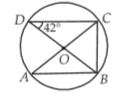
- A
$42^{\circ}$
- B
$45^{\circ}$
- ✓
$48^{\circ}$
- D
$60^{\circ}$
AnswerCorrect option: C. $48^{\circ}$
(c) : $B D$ is a diameter of circle
$
\therefore \angle B C D=90^{\circ}
$
[angle in a semicircle]
In $\triangle O C D$,
$
O D=O C
$
[radii of circle]
$\angle O D C=\angle O C D=42^{\circ}$
Now, $\angle O C D+\angle O C B=90^{\circ}$
$\Rightarrow \angle O C B=90^{\circ}-42^{\circ}=48^{\circ}$
$\Rightarrow \angle A C B=\angle O C B=48^{\circ}$
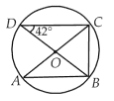
View full question & answer→MCQ 1891 Mark
In figure, if $\angle \text{A O B} =125^{\circ}$, then $\angle \text{C O D}$ is equal to
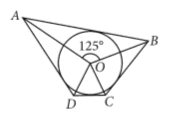
- A
$62.5^{\circ}$
- B
$45^{\circ}$
- C
$35^{\circ}$
- ✓
$55^{\circ}$
AnswerCorrect option: D. $55^{\circ}$
We know that the opposite sides of a quadrilateral circumscribing a circle subtend supplementary angles at the centre of the circle.
$\Rightarrow \angle A O B+\angle C O D=180^{\circ}$
$\Rightarrow \angle C O D=180^{\circ}-\angle A O B=180^{\circ}-125^{\circ}=55^{\circ}$
View full question & answer→MCQ 1901 Mark
Two concentric circles of radii $13 cm$ and $5 cm$ are given. The length of the chord of the larger circle which touches the smaller circle is
- A
$16 cm$
- B
$4 cm$
- C
$24 cm$
- D
$10 cm$
View full question & answer→MCQ 1911 Mark
In the given figure, point $P$ is $26 cm$ away from the centre $O$ of a circle and the length PT of the tangent drawn from $P$ to the circle is $24 cm$. Then the radius of the circle is
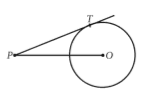
- A
$25 cm$
- B
$26 cm$
- C
$24 cm$
- ✓
$10 cm$
AnswerCorrect option: D. $10 cm$
(d) : Let us join $O T$
We have, $O P=26 cm , P T=24 cm$
Since, radius is perpendicular to the tangent at the point of contact.
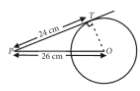
$
\therefore \angle P T O=90^{\circ}
$In right $\triangle P T O$, using Pythagoras theorem, we get
$
\begin{aligned}
& O P^2=P T^2+O T^2 \\
\Rightarrow & (26)^2=(24)^2+O T^2 \\
\Rightarrow & O T^2=676-576=100 \\
\Rightarrow & O T=10 cm
\end{aligned}
$
Hence, radius of the circle is $10 cm$. View full question & answer→MCQ 1921 Mark
Two concentric circles are of radii $5 cm$ and $3 cm$. Find the length of the chord of the larger circle which touches the smaller circle.
- ✓
$8 cm$
- B
$4 cm$
- C
$10 cm$
- D
$6 cm$
AnswerCorrect option: A. $8 cm$
(a): Here, $O A^2=O D^2+A D^2$
$
\Rightarrow A D=\sqrt{25-9}=4 cm
$As $O D$ bisects $A B$, then
$
A B=2 A D=2 \times 4=8 cm
$
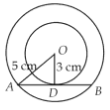
View full question & answer→MCQ 1931 Mark
Answer(a): We know that the length of the tangents drawn from an external point to a circle are equal.
$
\begin{aligned}
\therefore \quad & A Q=A R, D R=D S, B Q=B P, C S=C P \\
& S o, D S=D R=5 cm \\
& A Q=A R=A D-D R=23-5=18 cm \\
& B P=Q B=A B-A Q=29-18=11 cm
\end{aligned}
$
Since, $O Q B P$ is a square
$\Rightarrow$ Radius of circle $(O P)=11 cm$.
View full question & answer→MCQ 1941 Mark
In the given figure, $A P, A Q$ and $B C$ are tangents to the circle. If $A B=5 \ cm , A C=6 \ cm$ and $B C=4 \ cm,$ then the length of $A P ($in $cm)$ is

AnswerAs, length of tangents drawn from an external point to a circle are equal.
$\therefore A P=A Q \ldots \text { (i), } P B=B R \ldots \text { (ii), } C Q=C R \ldots \text { (iii) }$
Now $, 2 A P=A P+A P$
$\Rightarrow 2 A P=A P+A Q$
$\Rightarrow 2 A P=(A B+P B)+(A C+C Q)$
$\Rightarrow 2 A P=(A B+B R)+(A C+C R) \ [$Using $(ii)$ and $(iii)]$
$\Rightarrow 2 A P=A B+B C+A C=5+4+6$
$\Rightarrow A P=7.5 \ cm$
$[$Using $(i)]$
View full question & answer→MCQ 1951 Mark
Two concentric circles of radii $a$ and $b$ where $a>b$, are given, the length of a chord of the larger circle which touches the other circle is
- A
$\sqrt{a^2-b^2}$
- ✓
$2 \sqrt{a^2-b^2}$
- C
$\sqrt{a^2+b^2}$
- D
$2 \sqrt{a^2+b^2}$
AnswerCorrect option: B. $2 \sqrt{a^2-b^2}$
(b) : Radius of larger circle $=a$Radius of smaller circle $=b$
$\because \quad$ In $\triangle O A M$, we have
$
\begin{aligned}
& O A^2=O M^2+A M^2 \\
\Rightarrow & a^2=b^2+A M^2 \\
\Rightarrow & A M^2=a^2-b^2 \\
\Rightarrow & A M=\sqrt{a^2-b^2}
\end{aligned}
$
Now, length of chord of larger circle is $A B=2 A M$
$
=2 \sqrt{a^2-b^2}
$
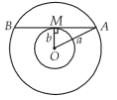
View full question & answer→MCQ 1961 Mark
From a point $Q$, the length of the tangent to a circle is $12 cm$ and the distance of $Q$ from the centre is $15 cm$. The radius of the circle is
- ✓
$9 cm$
- B
$12 cm$
- C
$15 cm$
- D
$24.5 cm$
AnswerCorrect option: A. $9 cm$
(a) : $Q P$ is a tangent at $P$
$
\therefore \angle P=90^{\circ}
$In $\triangle O P Q$, by Phythagoras theorem
$
\begin{aligned}
& O Q^2=O P^2+P Q^2 \\
\Rightarrow & (15)^2=O P^2+12^2 \\
\Rightarrow & O P^2=225-144=81 \Rightarrow O P=9 cm
\end{aligned}
$
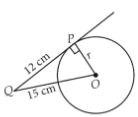
View full question & answer→MCQ 1971 Mark
In the given figure, $P Q$ and $P R$ are two tangents to a circle with centre $O$. If $\angle Q P R=46^{\circ},$ then $\angle Q O R$ equals
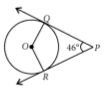
- A
$67^{\circ}$
- ✓
$134^{\circ}$
- C
$44^{\circ}$
- D
$46^{\circ}$
AnswerCorrect option: B. $134^{\circ}$
Given, $\angle Q P R=46^{\circ}$
We have, $O Q \perp P Q$ and $O R \perp R P$
$[\because$ Radius is perpendicular to the tangent through the point of contact$]$
$\Rightarrow \angle O Q P=\angle O R P=90^{\circ}$
In quadrilateral $\text{PQOR},$ we have
$\angle O Q P+\angle Q P R+\angle P R O+\angle R O Q=360^{\circ}$
$\Rightarrow 90^{\circ}+46^{\circ}+90^{\circ}+\angle R O Q=360^{\circ}$
$\Rightarrow \angle R O Q=360^{\circ}-226^{\circ}=134^{\circ}$
View full question & answer→MCQ 1981 Mark
In figure, $P Q$ is tangent to the circle with centre at $O$, at the point $B$. If $\angle A O B=100^{\circ},$ then $\angle A B P$ is equal to
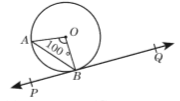
- ✓
$50^{\circ}$
- B
$40^{\circ}$
- C
$60^{\circ}$
- D
$80^{\circ}$
AnswerCorrect option: A. $50^{\circ}$
In $\triangle O A B, O A=O B$
$(\because$ Radii of same circle$)$
$\therefore \angle O A B=\angle O B A$
$(\because$ Angles opposite to equal sides are equal$)$
Now, by applying angle sum property in $\triangle O A B$
$\angle O A B+\angle A B O+\angle A O B=180^{\circ}$
$\Rightarrow \angle A B O=40^{\circ}$
Here, $\angle O B P=90^{\circ}$
$($Radius is perpendicular to tangent at point of contact$)$
$\Rightarrow \angle O B A+\angle A B P=90^{\circ}$
$\Rightarrow 40^{\circ}+\angle A B P=90^{\circ} $
$\Rightarrow \angle A B P=90^{\circ}-40^{\circ}=50^{\circ}$
View full question & answer→MCQ 1991 Mark
In the given figure, $P A$ and $P B$ are tangents to the circle from an external point $P . C D$ is another tangent touching the circle at $Q$. If $P A=12 cm , Q C=Q D=3 cm$ then the value of $P C$ is
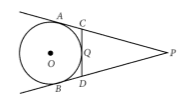
- A
$6 cm$
- ✓
$9 cm$
- C
$12 cm$
- D
$3 cm$
AnswerCorrect option: B. $9 cm$
(b) : As we know that tangents drawn from an external point are equal in length.
$
\therefore \quad Q C=C A ; Q D=B D \text { and } P A=P B
$
Since $Q C=Q D=3 cm$
(Given)
$
\Rightarrow C A=B D=3 cm
$
Also, $P C=P A-A C=(12-3) cm =9 cm$
View full question & answer→MCQ 2001 Mark
The length of the tangent drawn from a point $8 cm$ away from the centre of circle of radius $6 cm$ is
- A
$\sqrt{7} cm$
- ✓
$2 \sqrt{7} cm$
- C
$10 cm$
- D
$5 cm$
AnswerCorrect option: B. $2 \sqrt{7} cm$
(b) : Since tangent to a circle is perpendicular to the radius through the point of contact.
$
\therefore \angle O T P=90^{\circ}
$
In $\triangle O T P$, by Phthagoras theorem, we have
$
\begin{aligned}
& O P^2=O T^2+P T^2 \\
\Rightarrow & (8)^2=(6)^2+P T^2 \\
\Rightarrow & P T^2=64-36=28 \\
\Rightarrow & P T=\sqrt{28}=2 \sqrt{7} cm
\end{aligned}
$
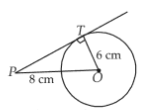
View full question & answer→MCQ 2011 Mark
In the given figure, there are two concentric circles of radii $6 \ cm$ and $4 \ cm$ with centre $O$. If $A P$ is a tangent to the larger circle and $B P$ to the smaller circle and length of $A P$ is $8 \ cm$, then the length of $B P$ is

- A
$21 \ cm$
- B
$26$
- ✓
$2 \sqrt{21} cm$
- D
AnswerCorrect option: C. $2 \sqrt{21} cm$
In right $\triangle \text{A O P, O P}^2=A P^2+O A^2$
$=8^2+6^2=100$
In right $\triangle B O P, O P^2=B P^2+O B^2$
$\Rightarrow 100=B P^2+4^2$
$\Rightarrow B P^2=100-16=84$
$\Rightarrow B P=2 \sqrt{21} \ cm$
View full question & answer→MCQ 2021 Mark
A chord of a circle of radius $10 \ cm$ subtends a right angle at its centre. The length of the chord $($in $cm)$ is
- A
$5 \sqrt{2}$
- ✓
$10 \sqrt{2}$
- C
$\frac{5}{\sqrt{2}}$
- D
$10 \sqrt{3}$
AnswerCorrect option: B. $10 \sqrt{2}$
Let $A B$ is a chord of circle which subtends right angle at its centre.
$\therefore$ In $\triangle \text{O A B}$, by Pythagoras theorem, we have
$(A B)^2=(O A)^2+(O B)^2$
$\Rightarrow(A B)^2=(10)^2+(10)^2$
$\Rightarrow(A B)^2=200$
$\Rightarrow A B=10 \sqrt{2} \ cm$
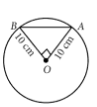
View full question & answer→MCQ 2031 Mark
In the given figure, $O$ is the centre of a circle, $P Q$ is a chord and $P T$ is the tangent at $P, \angle P O Q=70^{\circ}$, then $\angle T P Q$ is equal to
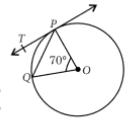
- A
$55^{\circ}$
- B
$70^{\circ}$
- C
$45^{\circ}$
- ✓
$35^{\circ}$
AnswerCorrect option: D. $35^{\circ}$
(d) : In $\triangle O P Q, O P=O Q \quad$ (Radii of same circle)
$
\Rightarrow \angle O Q P=\angle O P Q
$
(Angles opposite to equal sides are equal)
$
\Rightarrow \angle O Q P=\angle O P Q=55^{\circ}
$
[By using angle sum property]
Also, $\angle O P T=90^{\circ}$
$[\because$ Tangent is perpendicular to the radius through the point of contact.]
$
\Rightarrow \angle T P Q=90^{\circ}-55^{\circ}=35^{\circ}
$
[From (i) and (ii)]
View full question & answer→