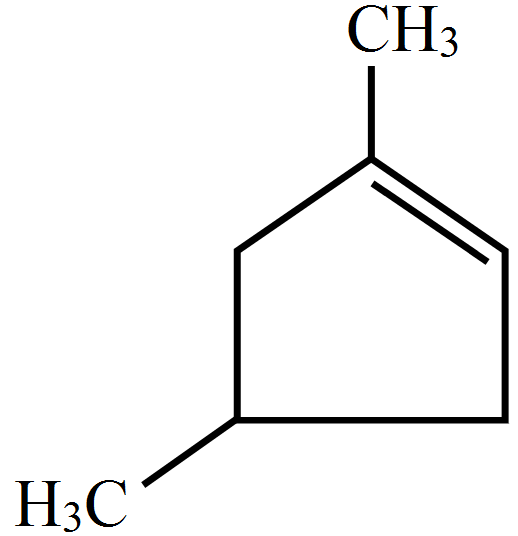
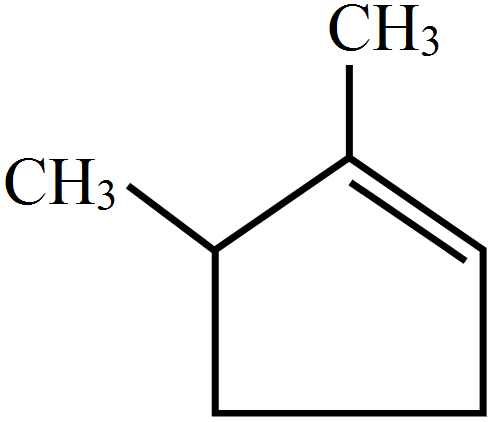
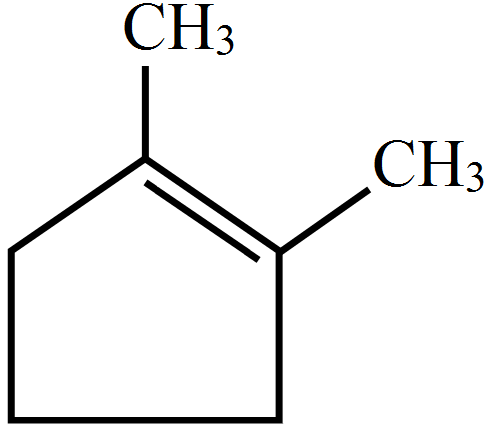
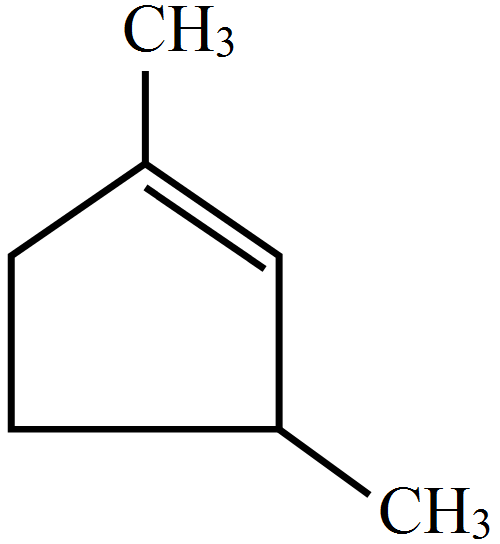
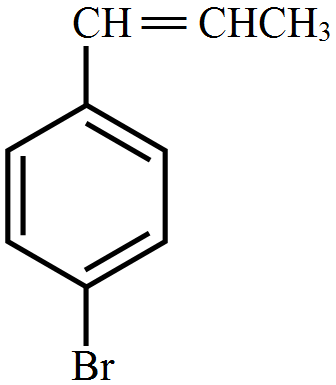
MCQ 11 Mark
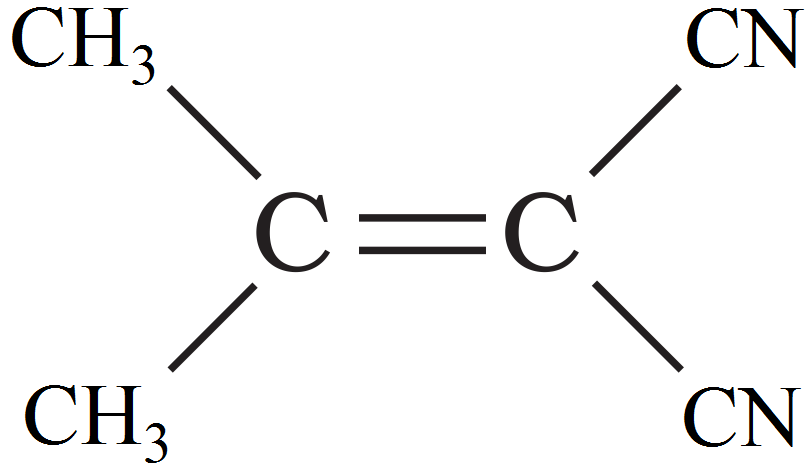
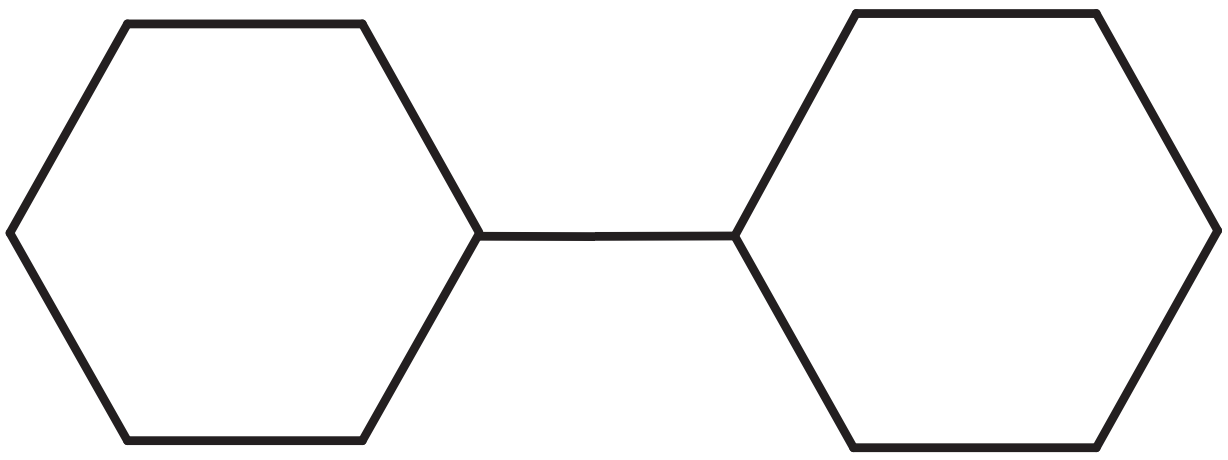
Among the following, which hydrocarbon is not produced by Wurtz reaction?
- ✓
- B
- C
- D
All given options can be prepared.
AnswerBy Wurtz reaction, higher alkanes are prepared.
i.e., $\text{R}-\text{Cl}+2\text{Na}+\text{R}-\text{Cl}\overrightarrow{\ \ \ \ \ }\ \text{R}-\text{R}+2\text{NaCl}\\ \ \ \ \ \ \ \ \ \ \ \ \ \ \ \ \ \ \ \ \ \ \ \ \ \ \ \ \ \ \ \ \ \ \ \ \ \ \ \ \ \ \ \ \ \ \ \ \ _{\text{Alkane}}$
Thus, methane cannot be prepared by this reaction.
View full question & answer→MCQ 21 Mark
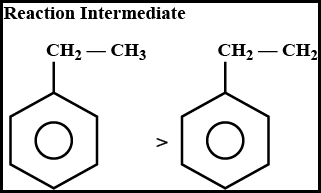
Monochlorination of ethylbenzene $\left(\mathrm{PhCH}_2 \mathrm{CH}_3\right) $ with $\mathrm{Cl}_2$ under heat produces $ ..........$
- A
$\mathrm{PhCH}_2 \mathrm{CH}_2 \mathrm{Cl}$
- B
$\mathrm{PhCHClCH}_3$
- C
Both $(a)$ and $(b)$ in equal amounts
- ✓
None of $(b)$ and less of $(a)$
AnswerCorrect option: D. None of $(b)$ and less of $(a)$
More stable due to resonance and hyper conjugate.
Hence none of $(b)$ and less of $(a)$ for free radial will go in resonance.
View full question & answer→MCQ 31 Mark
Phenyl magnesium bromide reacts with methanol to give :
MCQ 41 Mark
The $\text{IUPAC}$ name of given compound is : $\mathrm{CH}_3-\mathrm{C} \equiv \mathrm{C}-\mathrm{C}\left(\mathrm{CH}_3\right)_2-\mathrm{CH}_3$
- A
$4, 4-$ dimethyl $-2-$ heptene $-5-$ yne
- B
$4, 4-$ dimethyl $-2-$ heptene $-6-$ yne
- C
$4, 4-$ dimethyl $-5-$ heptene $-2-$ yne
- ✓
Answer$\mathrm{CH}_3-\mathrm{C} \equiv \mathrm{C}-\mathrm{C}\left(\mathrm{CH}_3\right)_2-\mathrm{CH}_3$
$\text{IUPAC}$ name : $4,4-$ dimethyl $-$ pent $-2-$ yne
View full question & answer→MCQ 51 Mark
The major product formed when $3, 3-$ dimethyl butan $-2-$ ol is heated with concentrated sulphuric acid is :
- A
$2, 3-$ dimethylbut $-1-$ ene
- ✓
$2, 3-$ dimethylbut $-2-$ ene
- C
$3, 3-$ dimethylbut $-1-$ ene
- D
$C$ is and trans $-$ isomers of $2, 3-$ dimethylbut $-1-$ ene
AnswerCorrect option: B. $2, 3-$ dimethylbut $-2-$ ene
$ \ \ \ \ \ \ \ \ \ \ \ \ \ \text{OH}\ \ \ \ \text{CH}_3\ \ \ \ \ \ \ \ \ \ \ \ \ \ \ \ \ \ \ \ \ \ \ \ \ \ \ \ \ \ \ \ \ \ \ \ \text{CH}_3 \ \text{CH}_3\\ \ \ \ \ \ \ \ \ \ \ \ \ \ \ | \ \ \ \ \ \ \ \ \ | \ \ \ \ \ \ \ \ \ \ \ \ \ \ \ \ \ \ \ \ \ \ \ \ \ \ \ \ \ \ \ \ \ \ \ \ \ \ \ \ \ \ \ | \ \ \ \ \ \ \ |\\\text{CH}_3-\text{CH}-\text{C}-\text{CH}_3\xrightarrow[(\text{conc.})]{\Delta,\ \text{H}_2\text{SO}_4}\text{H}_3\text{C}-\text{C}=\text{C}-\text{CH}_3\\ \ \ \ \ \ \ \ \ \ \ \ \ \ \ \ \ \ \ \ \ \ \ \ \ | \ \ \ \ \ \ \ \ \ \ \ \ \ \ \ \ \ \ \ \ \ \ \ \ \ \ \ \ \ \ \ \ \ \ \ \ \ \ \ _{(\text{Major product})}\\ \ \ \ \ \ \ \ \ \ \ \ \ \ \ \ \ \ \ \ \ \ \ \ \text{CH}_3 \ \ \ \ \ \ \ \ \ \ \ \ \ \ \ \ \ \ \ \ \ \ \ \ \ \ \ \ _{(2,3-\text{dimethylbut-2-ene})}\\ \ \ \ _{(3,3-\text{dimethyl, butan-2-ol})}$
View full question & answer→MCQ 61 Mark
Here $,A$ refers to :

- ✓
$\text{CH}\equiv\text{CH}$
- B
$\text{CH}_3-\text{C}\equiv\text{CH}$
- C
$\text{CH}_3-\text{CH}_3$
- D
$\text{CH}\equiv\text{C}-\text{NH}_2$
AnswerCorrect option: A. $\text{CH}\equiv\text{CH}$
View full question & answer→MCQ 71 Mark
Which of the following reactions of methane is incomplete combustion :
- A
$2\text{CH}_4+\text{O}_2\xrightarrow{\text{Cu/523K/100atm}}2\text{CH}_3\text{OH}$
- B
$\text{CH}_4+\text{O}_2\xrightarrow{\text{Mo}_2\text{O}_3}\text{HCHO}+\text{H}_2\text{O}$
- ✓
$\text{CH}_4+\text{O}_2\xrightarrow{\ \ \ \ \ \ \ \ \ \ }\text{C(s)}+2\text{H}_2\text{O}(\text{l})$
- D
$\text{CH}_4+2\text{O}_2\xrightarrow{\ \ \ \ \ \ \ \ \ \ \ }\text{CO}_2\text{(g)}+2\text{H}_2\text{O}(\text{l})$
AnswerCorrect option: C. $\text{CH}_4+\text{O}_2\xrightarrow{\ \ \ \ \ \ \ \ \ \ }\text{C(s)}+2\text{H}_2\text{O}(\text{l})$
During incomplete combustion carbon black is formed. It takes place when there is insufficient supply of air or oxygen.
$\text{CH}_4+\text{O}_2\xrightarrow{\ \ \ \ \ \ \ \ \ \ }\text{C(s)}+2\text{H}_2\text{O}(\text{l})$
View full question & answer→MCQ 81 Mark
Aromatic compounds containing benzene ring are termed as :
MCQ 91 Mark
Arrange the following hydrogne halides in order of their decreasing reactivity with propene.
- A
$\text{HCl > HBr > HI}$
- B
$\text{HBr > HI > HCl}$
- ✓
$\text{HI > HI > HCl}$
- D
$\text{HCl > HI > HBr}$
AnswerCorrect option: C. $\text{HI > HI > HCl}$
View full question & answer→MCQ 101 Mark
Which one of the following compound will give addition reaction?
- A
$\mathrm{CH}_4$
- B
$\mathrm{C}_2 \mathrm{H}_6$
- ✓
$\mathrm{C}_2 \mathrm{H}_4$
- D
$\mathrm{C}_3 \mathrm{H}_8$
AnswerCorrect option: C. $\mathrm{C}_2 \mathrm{H}_4$
$\mathrm{CH}_4, \mathrm{C}_2 \mathrm{H}_6$ and $\mathrm{C}_3 \mathrm{H}_8$ are saturated hydrocarbons.
Hence, they will give substitution reaction.
$\mathrm{C}_2 \mathrm{H}_4$ on the other hand is an unsaturated hydrocarbon.
It will give addition reaction.
For example, catalytic hydrogenation of ethylene gives ethane. A molecule of hydrogen is added across $C=C$ double bond.
$\mathrm{C}_2 \mathrm{H}_4+\mathrm{H}_2 \xrightarrow{\text{Ni/Pt/Pd}}$ $\mathrm{C}_2 \mathrm{H}_6$
View full question & answer→MCQ 111 Mark
$\mathrm{CH}_3 \mathrm{CH}=\mathrm{CH}_2+\mathrm{HBr}$ gives :
- ✓
$ \mathrm{CH}_2=\mathrm{CH}-\mathrm{CH}_2-\mathrm{Br} $
- B
$ \mathrm{CH}_3-\mathrm{CH}_2-\mathrm{CH}_2-\mathrm{Br} $
- C
$ \mathrm{CH}_3 \mathrm{CH}(\mathrm{Br})-\mathrm{CH}_3 $
- D
$ \mathrm{CH}_3-\mathrm{CH}_2-\mathrm{CH}_3 $
AnswerCorrect option: A. $ \mathrm{CH}_2=\mathrm{CH}-\mathrm{CH}_2-\mathrm{Br} $
This is an example of addition reaction.
The double bond is broken and hydrogen and bromine are added to the given compound.
Bromine will add up on secondary carbon. $($Markovnikov's Rule$)\mathrm{CH}_3 \mathrm{CH}=\mathrm{CH}_2+\mathrm{HBr} \rightarrow \mathrm{CH}_3 \mathrm{CH}(\mathrm{Br})-\mathrm{CH}_3$.
View full question & answer→MCQ 121 Mark
Ethylbenzene reacts with $\ce{Cl_2}$ in sunlight to give :
AnswerCorrect option: A. $1-$ Chloro $-1-$ phenylethane
$\mathrm{ph}-\mathrm{CH}_2 \mathrm{CH}_3+\mathrm{Cl}_2$ $\xrightarrow{\text{sunlight}} \ \mathrm{ph}-\mathrm{CH}(\mathrm{Cl})-\mathrm{CH}_3$
This is a substitution reaction where chlorine replaces one hydrogen atom to form $1-$ chloro $-1-$ phenylethane.
View full question & answer→MCQ 131 Mark
The discovery that chlorofluorocarbons initiate a radical $-$ chain reaction that catalytically destroys ozone won the $1995$ Nobel prize in chemistry Given the initiation step below which of the following reactions is the most likely to serve as one of the propagation steps?
$\mathrm{CCl}_2 \mathrm{~F}_2+\mathrm{hv} \rightarrow{ }^* \mathrm{CCIF}_2+{ }^* \mathrm{Cl}$
- A
$ { }^* \mathrm{Cl}+{ }^* \mathrm{Cl} \rightarrow \mathrm{Cl}_2 $
- ✓
$ { }^* \mathrm{Cl}+\mathrm{O}_3 \rightarrow{ }^* \mathrm{OCl}+\mathrm{O}_2 $
- C
$ { }^* \mathrm{CClF}_2+{ }^* \mathrm{Cl} \rightarrow \mathrm{CCl}_2 \mathrm{~F}_2 $
- D
$ 2{ }^* \mathrm{CClF}_2+2 \mathrm{O}_3 \rightarrow 2 \mathrm{COF}_2+\mathrm{Cl}_2+2 \mathrm{O}_2$
AnswerCorrect option: B. $ { }^* \mathrm{Cl}+\mathrm{O}_3 \rightarrow{ }^* \mathrm{OCl}+\mathrm{O}_2 $
The ultraviolet light, as it hits the atmosphere, makes $\text{CFCs}$ break up to form free radicals like this: $\mathrm{CCl}_2 \mathrm{~F}_2 \rightarrow{ }^* \mathrm{CCIF}_2+\mathrm{Cl}^*$ Chlorine free radicals will then go on to react with the ozone in the stratosphere: $\mathrm{O}_3+\mathrm{Cl}^* \rightarrow \mathrm{ClO}^*+\mathrm{O}_2\ ($Propagation step$)$ The chlorine oxide molecule $(\mathrm{ClO})$ is very reactive, and it then proceeds to react with ozone to make two oxygen molecules and a $\text{Cl}*$ free radical : $\mathrm{ClO}^*+\mathrm{O}_3 \rightarrow 2 \mathrm{O}_2+\mathrm{Cl}^*$
That $\text{Cl}*$ free radical will then go on and react with another ozone molecule, resulting in a chain reaction between the last two equations that theoretically never stops, due to their unreactive nature and thus their inability to be easily removed from the atmosphere.
The chlorine atoms aren’t used up, which means they are free to carry on breaking down the ozone.
View full question & answer→MCQ 141 Mark
A single substitution of $H$ atom in an alkane of molar mass by $72\text{ g/mole}$ on chlorination produces only one product. The alkane is :
- A
$n-$ pentane
- B
$2-$ methyl butane
- ✓
$2, 2-$ dimethyl propane
- D
$n-$ butane
AnswerCorrect option: C. $2, 2-$ dimethyl propane
In $2,2-$ Dimethylpropane the central carbon atom is quaternary, meaning all four of its valencies are satisfied by Carbon atoms; which implies that there are no Hydrogen atoms which can be substituted by Chlorine $($or halogen$),$ and all the remaining $4$ carbon atoms are identical, so substitution on any one of those will result in the same compound.
View full question & answer→MCQ 151 Mark
Which of the following compounds is insoluble even in hot concentrated $\mathrm{H}_2 \mathrm{SO}_4\ ?$
AnswerHexane is an alkane which is also called as paraffin or less reactive.
Thus they are not soluble in concentrated $\mathrm{H}_2 \mathrm{SO}_4$
Also, hexane is non $-$ polar and concentrated $\mathrm{H}_2 \mathrm{SO}_4$ is polar, thus hexane is not soluble in $\mathrm{H}_2 \mathrm{SO}_4$.
View full question & answer→MCQ 161 Mark
Trans $-3, 6-$ Dimethyl oct $-4-$ ene $(A)$ exists in two diastereomers $(I)$ and $(II).$ The total number of stereoisomers for $(A)$ is :
AnswerTwo asymmetric $C$ atoms with the same terminal group $(n =$ number of asymmetric $C$ atom and is even$)$
Number of $\text{O. A. I}. =2^{n-1}=2$
Number of mcso forms $=2^{(n-2) / 2}=I$
Total optical isomers $= 3$
One double bond $= 2$ disteromers
Totalstereoisomers $=3 \times 2 = 6$
View full question & answer→MCQ 171 Mark
In the reaction, $\ \ \ \ \ \ \ \ \ \ \ \ \ \text{Br}\\ \ \ \ \ \ \ \ \ \ \ \ \ \ |\\\text{CH}_3-\text{CH}_2\xrightarrow[\Delta]{\text{alc. KOH}}\text{A,} A$ is :
- ✓
$ \mathrm{CH}_2=\mathrm{CH}_2 $
- B
$ \mathrm{CH}_3 \mathrm{CH}_3 $
- C
$\text{CH}\equiv\text{CH}$
- D
Both $(a)$ and $(b)$
AnswerCorrect option: A. $ \mathrm{CH}_2=\mathrm{CH}_2 $
View full question & answer→MCQ 181 Mark
The highest boiling point is expected for :
AnswerCorrect option: B. $n-$ Octane
Boiling point is characterized as the specific temperature at which the vapour pressure of the fluid is equivalent to the environmental pressure.
Among the given options
$n-$ Octane is a straight $-$ chain exacerbate that has a very large surface area.
Along these lines, there are more van der Waals forces of attraction, bringing about high boiling points.
View full question & answer→MCQ 191 Mark
Ethylene is prepared by :
AnswerCorrect option: B. Pyrolysis of ethane at $450^\circ C$
Decomposition of the compound by heat is called pyrolysis or thermal decomposition.
When Ethane is heated in absence of air at $450^\circ C$ gives Ethylene and Hydrogen.
$\ce{CH_3−CH_3}\ \xrightarrow{450^\circ \text{C}} \ \ce{CH_2 = CH_2 + H_2}$
When Alkanes are heated to high temperature in absence of air, the higher alkane molecules break up into smaller molecules of lower alkanes, alkanes, and hydrogen.
Remaining all reactions gives alkanes.
View full question & answer→MCQ 201 Mark
Arrange the following hydrogen halides in order of their decreasing reactivity with propene :
- A
$\text{HCl > HBr > HI}.$
- B
$\text{HBr > HI > HCl}.$
- ✓
$\text{HI > HBr > HCl}.$
- D
$\text{HCl > HI > HBr}.$
AnswerCorrect option: C. $\text{HI > HBr > HCl}.$
The decreasing order of reactivity of hydrogen halides with propene is $\text{HI > HBr > HCl}$.
As the size of halogen increases, the strength of $H–X$ bond decreases and hence, reactivity increases.
View full question & answer→MCQ 211 Mark
The hydrocarbon obtained by treating sodium ethanoate with soda lime is $ ..........$
Answer$\mathrm{CH}_3 \mathrm{COONa}+\mathrm{NaOH} \rightarrow \mathrm{CH}_4+\mathrm{Na}_2 \mathrm{CO}_3$
$\mathrm{CH}_3 \mathrm{COONa}=$ Sodium ethanoate
$\mathrm{NaOH}=$ Soda lime
$\mathrm{CH}_4=$ Methane
$\mathrm{Na}_2 \mathrm{CO}_3=$ Sodium carbonate
View full question & answer→MCQ 221 Mark
Which of the following can be used as the halide $($electrophile provider$)$ for Friedel crafts reaction :
Answer$\because$ Others have double bond character between which is deficient to break. 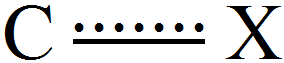
View full question & answer→MCQ 231 Mark
The given reaction, $\text{CH}_3-\text{Cl}+\text{H}_2\xrightarrow{\text{Zn, H}^+}\text{CH}_4+\text{HCl}$ is an example of :
View full question & answer→MCQ 241 Mark
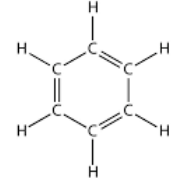
The ratio of sigma and pi bonds in benzene is :
AnswerThe molecular formula of benzene is $\mathrm{C}_6 \mathrm{H}_6$.
Benzene molecule contains $12 \sigma$ and $3 \pi$ bonds.
Hence, the ratio is $4:1.$
View full question & answer→MCQ 251 Mark
Name the $\text{IUPAC}$ nomenclature of $\mathrm{CH}_3-\mathrm{CH}_2-\mathrm{CH}_2-\mathrm{CH}=\mathrm{CH}_2$ :
- ✓
$1-$ Pentene
- B
$2-$ Propene
- C
$3-$ Propene
- D
AnswerCorrect option: A. $1-$ Pentene
Chain of five carbons with double bond on $1, 2$ carbons, $1-$ pentene.
View full question & answer→MCQ 261 Mark
$2-$ methyl propan $-2-$ ol is obtained by the reaction of $X$ with water in the presence of conc. $\mathrm{H}_2 \mathrm{SO}_4$. The $X$ is :
- A
$1-$ methylpropene.
- B
$2, 2-$ dimethylhexane.
- ✓
$2-$ methylpropene.
- D
$2-$ methylbutane.
AnswerCorrect option: C. $2-$ methylpropene.
View full question & answer→MCQ 271 Mark
The energy barrier to free rotation about carbon carbon bond of ethane is about :
- A
$30 \mathrm{~kJ} \mathrm{~mol}^{-1}$
- B
$3 \mathrm{~kJ} \mathrm{~mol}^{-1}$
- ✓
$3 \ \mathrm{kcal}\ \mathrm{mol}^{-1}$
- D
$40 \mathrm{~kJ} \mathrm{~mol}^{-1}$
AnswerCorrect option: C. $3 \ \mathrm{kcal}\ \mathrm{mol}^{-1}$
The staggered structure is the structure of lower energy than eclipsed structure.
The relative energy required for complete a rotation in ethane is called the energy barrier to rotation, and it is about $\text{3 kcal/mol.}$
That is, the eclipsed structure is $3 \text{ kcal}$ higher in energy than the staggered structure.
View full question & answer→MCQ 281 Mark
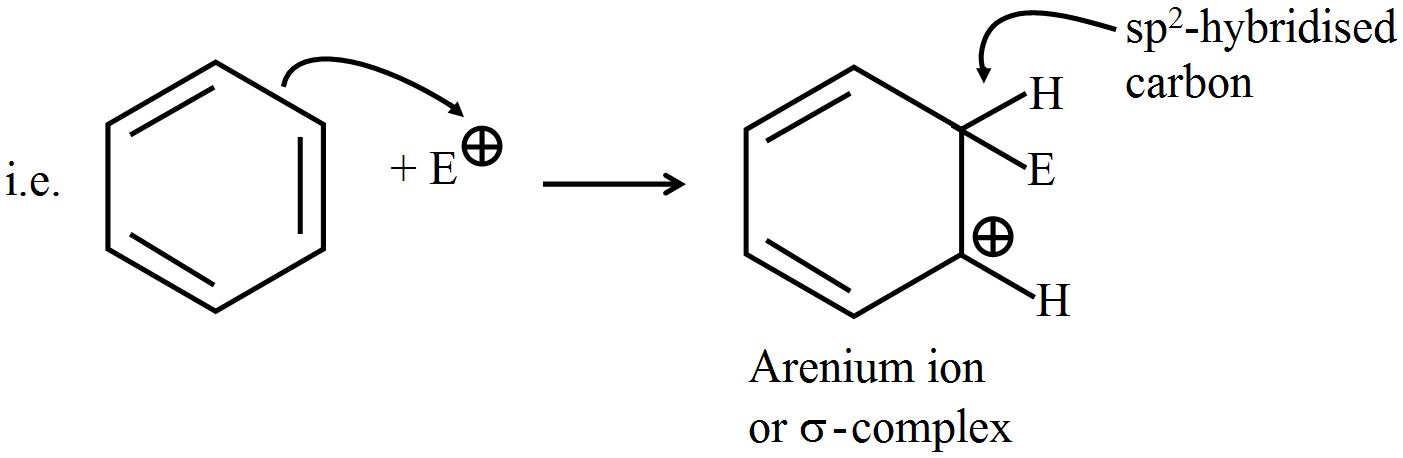
Attack of electrophile on benzene results in the formation of :
- A
$\sigma$ complex
- B
- C
$\pi$ complex.
- ✓
Both $(a)$ and $(b).$
AnswerCorrect option: D. Both $(a)$ and $(b).$
Attack of electrophile on benzene nucleus results in the formation of $\sigma-$ complex or arenium ion, in which one of the carbon is $sp^2-$ hybridised.
View full question & answer→MCQ 291 Mark
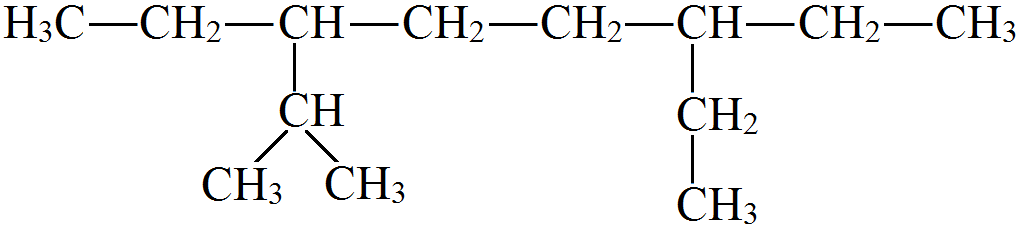
The correct $\text{IUPAC}$ name of the following alkane is :
- ✓
$3, 6-$ Diethyl $-2-$ methyloctane
- B
$5-$ Isopropyl $-3-$ ethyloctane
- C
$3-$ Ethyl $-$ isopropyloctane
- D
$3-$ Isopropyl $-6-$ ethyloctane
AnswerCorrect option: A. $3, 6-$ Diethyl $-2-$ methyloctane
$\text{CH}_3-\text{CH}_2-\stackrel{{3}}{\hbox{ CH}}-\stackrel{{4}}{\hbox{ CH}}_2-\stackrel{{5}}{\hbox{ CH}}_2-\stackrel{{6}}{\hbox{ CH}}-\stackrel{{7}}{\hbox{ CH}}_2-\stackrel{{8}}{\hbox{ CH}}_3\\ \ \ \ \ \ \ \ \ \ \ \ \ \ \ \ \ \ \ \ \ \ \ \ \ \ \ | \ \ \ \ \ \ \ \ \ \ \ \ \ \ \ \ \ \ \ \ \ \ \ \ \ \ \ \ \ \ \ \ \ \ \ \ \ |\\ \ \ \ \ \ \ \ \ \ \ \ \ \ \ \ \ \ \ \ \ \ \ \ 2\text{CH}-\text{CH}_3\ \ \ \ \ \ \ \ \ \ \ \ \ \ \ \ \ \ \ \ \text{CH}_2\\ \ \ \ \ \ \ \ \ \ \ \ \ \ \ \ \ \ \ \ \ \ \ \ \ \ \ |\ \ \ \ \ \ \ \ \ \ \ \ \ \ \ \ \ \ \ \ \ \ \ \ \ \ \ \ \ \ \ \ \ \ \ \ \ |\\ \ \ \ \ \ \ \ \ \ \ \ \ \ \ \ \ \ \ \ \ \ \ \ 1\text{CH}_3\ \ \ \ \ \ \ \ \ \ \ \ \ \ \ \ \ \ \ \ \ \ \ \ \ \ \ \ \ \ \ \text{CH}_3\\ \ \ \ \ \ \ \ \ \ \ \ \ \ \ \ \ \ \ \ \ \ _{3,\ 6-\text{Diethyl-2-methyl octane}}$
View full question & answer→MCQ 301 Mark
There is no ring strain in cyclohexane, but cyclobutane has an angle strin of $9^\circ 44\ ′$. If $\Delta\text{H}_\text{C}^\circ $ of cyclohexane per $\ce{(CH_2)}$ group is $660\text{ kJ mol}^{-1}$ and $\Delta\text{H}_\text{C}^\circ $ of cyclobutane is $2744 \text{ kJ mol}^{-1}$, what is the ring strain in $\text{kJ mol}^{-1}$ of cyclobutane?
- A
$-104$
- ✓
$104$
- C
$-2084$
- D
$2084$
AnswerThe $\Delta\text{H}_\text{C}^\circ $ value of cyclobutane is given. From this if we substract the $\Delta\text{H}_\text{C}^\circ $ value of cyclobutane calculated when there is no angle strain, we will get the value of ring strain of cyclobutane.
The $\Delta\text{H}_\text{C}^\circ $ value of cyclobutane when there is no ring strain can be calculated from $\Delta\text{H}_\text{C}^\circ $ value of cyclohexane per $\ce{CH}_2$ group.
Ring strain $= (\Delta\text{H}_\text{C}^\circ $ of cyclobutane $- 4 \times \Delta\text{H}_\text{C}^\circ $ of per $\ce{(CH_2)}$ group of cyclohexane $) $
$= 2744 - (4 \times 660) = 104 \text{ kJ mol}^{-1}$.
View full question & answer→MCQ 311 Mark
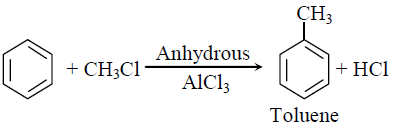
Benzene reacts with $\ce{CH_3Cl}$ in the presence of anhydrous $\ce{AlCl_3}$ to form :
AnswerBenzene reacts with $\ce{CH_3Cl}$ in presence of anhydrous $\ce{AlCl_3}$ to give Toulene.
This is fridel crafts Alkylation and an electrophillic substitution.
View full question & answer→MCQ 321 Mark
The process of elimination of carbon dioxide from carboxylic acid is termed as :
MCQ 331 Mark
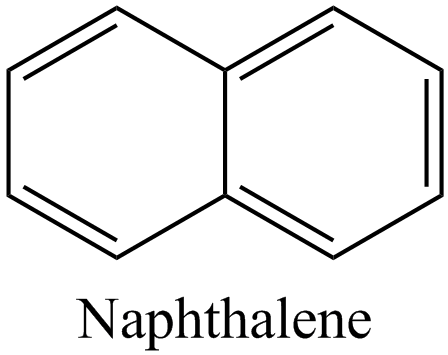
Which content $(s)$ of middle oil separate on cooling?
AnswerThe content of middle oil separate on cooling is naphthalene.
View full question & answer→MCQ 341 Mark
The reaction of Toluene with $\ce{Cl_2}$ in presence of $\ce{FeCl_3}$ predominanly gives :
View full question & answer→MCQ 351 Mark
Alkynes on reduction with sodium in liquid ammonia forms :
- A
Cis $-$ alkene.
- B
- ✓
Trans $-$ alkene.
- D
Both $(a)$ and $(c).$
AnswerCorrect option: C. Trans $-$ alkene.
View full question & answer→MCQ 361 Mark
The reaction of propene with $\mathrm{HOCl}\left(\mathrm{Cl}_2+\mathrm{H}_2 \mathrm{O}\right)$ proceeds through intermediate :
- A
$\ \ \ \ \ \ \ \ \ \ \ \ \oplus\\\text{CH}_3-\text{C}\text{H}-\text{CH}_2\text{OH}$
- ✓
$\ \ \ \ \ \ \ \ \ \ \ \ \oplus\\\text{CH}_3-\text{C}\text{H}-\text{CH}_2-\text{Cl}$
- C
$ \ \ \ \ \ \ \ \ \ \ \ \ \ \ \ \ \ \ \ \ \ \ \ \ \ \ \ \oplus\\ \text{CH}_3-\text{CH(OH)}\text{CH}_2$
- D
$\ \ \ \ \ \ \ \ \ \ \ \ \ \ \ \ \ \ \oplus\\ \text{CH}_3\text{CHCl }\text{CH}_2$
AnswerCorrect option: B. $\ \ \ \ \ \ \ \ \ \ \ \ \oplus\\\text{CH}_3-\text{C}\text{H}-\text{CH}_2-\text{Cl}$
$\ \ \ \ \ \ \ \ \ \ \ \ \ \ \ \ \ \ \ \ominus\\\text{HOCl}\rightarrow\text{OCH}+\text{Cl}^+$

View full question & answer→MCQ 371 Mark
Nitration and chlorination of benzene are :
- A
Nucleophilic and electrophilic substitution respectively.
- B
Electrophilic and nucleophilic substitution respectively.
- ✓
Electrophilic substitution in both the reactions.
- D
Nucleophilic substitution in both the reactions.
AnswerCorrect option: C. Electrophilic substitution in both the reactions.
Since nitration and halogenation, both are carried out by the help of electrophile $\mathrm{NO}^{2+} \ \mathrm{Cl}^{+}$.
Hence, both reactions are electrophilic substitution reactions.
View full question & answer→MCQ 381 Mark
Conformations of ethane in which hydrogen atoms attached to two carbon atoms are closest to each other are known as :
AnswerConformation in which hydrogen atoms attached to two carbons are as closed together as possible is called eclipsed conformation and the other in which hydrogen’s are as far apart as possible is known as the staggered conformation. Any other intermediate conformation is called a skew conformation.
View full question & answer→MCQ 391 Mark
Which compound would give $5-$ keto $ 2-$ methyl hexanal upon ozonolysis followed by reaction with $\frac{\text{Zn}}{\text{H}_2\text{O}}?$
View full question & answer→MCQ 401 Mark
Which of the following organic materials damage $\text{DNA}$ of our body?
AnswerTabacco, coal and petroleum damages $\text{DNA}$ of our body and causes cancer.
View full question & answer→MCQ 411 Mark
Arrange the halogens $\mathrm{F}_2, \mathrm{Cl}_2, \mathrm{Br}_2, \mathrm{I}_2$, in order of their increasing reactivity with alkanes :
- ✓
$ \mathrm{I}_2 < \mathrm{Br}_2 < \mathrm{Cl}_2 < \mathrm{F}_2 $
- B
$ \mathrm{Br}_2 < \mathrm{Cl}_2 < \mathrm{F}_2 < \mathrm{I}_2 $
- C
$ \mathrm{~F}_2 < \mathrm{Cl}_2 < \mathrm{Br}_2 < \mathrm{I}_2 $
- D
$ \mathrm{Br}_2 < \mathrm{I}_2 < \mathrm{Cl}_2 < \mathrm{F}_2 $
AnswerCorrect option: A. $ \mathrm{I}_2 < \mathrm{Br}_2 < \mathrm{Cl}_2 < \mathrm{F}_2 $
Fluorine is highly electronegative element. Electronegativity of halogens decreases down the group. As the electronegativity of halogens decreases, reactivity with alkanes, decreases. Therefore, $F_2$ reacts vigorously and $I_2$ reacts too slow.
View full question & answer→MCQ 421 Mark
The $\ce{C−C}$ bond length of the following molecules is in the order :
- A
$ \mathrm{CH}_2 > \mathrm{C}_2 \mathrm{H}_4 > \mathrm{C}_6 \mathrm{H}_6 < \mathrm{C}_2 \mathrm{H}_2 $
- ✓
$ \mathrm{C}_2 \mathrm{H}_2 < \mathrm{C}_2 \mathrm{H}_4 < \mathrm{C}_6 \mathrm{H}_6 < \mathrm{C}_2 \mathrm{H}_6 $
- C
$ \mathrm{C}_2 \mathrm{H}_6 < \mathrm{C}_2 \mathrm{H}_2 < \mathrm{C}_6 \mathrm{H}_6 < \mathrm{C}_2 \mathrm{H}_4 $
- D
$ \mathrm{C}_2 \mathrm{H}_4 < \mathrm{C}_2 \mathrm{H}_6 < \mathrm{C}_2 \mathrm{H}_2 < \mathrm{C}_6 \mathrm{H}_6 $
AnswerCorrect option: B. $ \mathrm{C}_2 \mathrm{H}_2 < \mathrm{C}_2 \mathrm{H}_4 < \mathrm{C}_6 \mathrm{H}_6 < \mathrm{C}_2 \mathrm{H}_6 $
Bond length is related to bond order, when more electrons participate in bond formation the bond is shorter. By approximation, the bond lengths of two different atoms are the sum of the two individual covalent radii.
The bond length of carbon $-$ carbon triple bond is shorter than carbon $-$ carbon double bond and is shorter than resonance bonding in benzene and is shorter than carbon $-$ carbon single bond.
Therefore, $ \mathrm{C}_2 \mathrm{H}_2 < \mathrm{C}_2 \mathrm{H}_4 < \mathrm{C}_6 \mathrm{H}_6 < \mathrm{C}_2 \mathrm{H}_6 $
View full question & answer→MCQ 431 Mark
The least reactive alkane towards free $-$ radical substitution reactions is :
- ✓
$ \mathrm{CH}_4 $
- B
$ \left(\mathrm{CH}_3\right)_3 \mathrm{CH} $
- C
$ \mathrm{CH}_3 \mathrm{CH}_3 $
- D
$ \mathrm{CH}_3 \mathrm{CH}_2 \mathrm{CH}_3$
AnswerCorrect option: A. $ \mathrm{CH}_4 $
Methane is less reactive towards free $-$ radical mechanism as it has only one carbon and no substituted alkyl group.
Thus it does not have extra carbon atom to make free radical.
View full question & answer→MCQ 441 Mark
Compound $A\ ($molecular formula $\mathrm{C}_5 \mathrm{H}_{10})$ gives only one monochlorinated product. Write the structure of compound $A$.
- A
$1-$ pentene
- B
$2-$ pentene
- C
$1-$ methyl cyclobutane
- ✓
AnswerCyclopentane $\xrightarrow{\text{Cl}_2+\text{hv}}$ Cyclopentylchloride
Compound $A$ has molecular formula $\mathrm{C}_5 \mathrm{H}_{10}$.
The degree of unsaturation is $1$. It should have either one double bond or should be a cyclic compound. If it has one double bond, then it will give many monochlorinated products.
However, it gives only one monochlorinated product.
So, it is a cyclic compound. Thus, it should be cyclopentane.
View full question & answer→MCQ 451 Mark
What happens when calcium carbide is treated with water?
- A
- B
Methane and ethane are formed.
- ✓
- D
Ethene and ethyne are formed.
AnswerIf we mix calcium carbide with water ethyne is released due to endothermic reaction between them.
This is the industrial method of producing ethyne.
$\mathrm{Ca}^{2+}[\mathrm{C} \equiv \mathrm{C}]^{2-}+2 \mathrm{H}_2 \mathrm{O} \rightarrow \mathrm{CH} \equiv \mathrm{CH}+\mathrm{Ca}(\mathrm{OH})_2$
View full question & answer→MCQ 461 Mark
When cyclohexane is poured on water, it floats because cyclohexane is :
MCQ 471 Mark
Which of the following is properly matched?
- A
Kerosene $-\mathrm{C}_5-\mathrm{C}_{10}$
- B
Diesel oil $-\mathrm{C}_5-\mathrm{C}_6$
- ✓
Petrol $-\mathrm{C}_7-\mathrm{C}_9$
- D
AnswerCorrect option: C. Petrol $-\mathrm{C}_7-\mathrm{C}_9$
The number of carbon atoms in Petrol is $-\mathrm{C}_7-\mathrm{C}_9$.
View full question & answer→MCQ 481 Mark
Which type of isomerism is shown by But $-1-$ yne and cyclobutene?
AnswerRing chain isomerism is shown by But $-1-$ yne and cyclobutene.
Alkynes are isomeric with cycloalkenes containing the same number of carbon atoms.
One compound is open chain and other is cyclic and both have same molecular formula that is $\mathrm{C}_4 \mathrm{H}_6$.
Also, the both have different functional groups, so they are functional isomers.
All ring chain isomers are functional isomers but all functional isomers are not ring chain isomers.
View full question & answer→MCQ 491 Mark
Propene is allowed to react with $\text{B}_2 , \text{D}_6$ and the product is treated with acetic acid. The final product obtained is :
- A
$1-$ deuteriopropane
- ✓
$2-$ deuteriopropane
- C
$1-$ deuteriopropene
- D
$2-$ deuteriopropene
AnswerCorrect option: B. $2-$ deuteriopropane
This is an example of hydroboration reaction $($followed by hydrolysis$)$ in which diborane is isotopically labeled.
A molecule of $\text{HD}$ is added across the double bond of propene to form $2-$ deuteriopropane.
$\text{CH}_2\text{CHCH}_3\xrightarrow[\text{CH}_3\text{COOH}]{\text{B}_2\text{D}_6}\text{CH}_3−\text{CHDCH}_3$.
View full question & answer→MCQ 501 Mark
Which one of the following compounds gives methane on treatment with water?
- ✓
$\ce{Al_4C_3}$
- B
$\ce{CaC_2}$
- C
$\text{VC}$
- D
$\text{SiC}$
AnswerCorrect option: A. $\ce{Al_4C_3}$
$\ce{Al_4C_3}$ gives methane on treatment with water.
$\mathrm{Al}_4 \mathrm{C}_3+12 \mathrm{H}_2 \mathrm{O} \rightarrow 4 \mathrm{Al}(\mathrm{OH})_3+3 \mathrm{CH}_4$
View full question & answer→MCQ 511 Mark
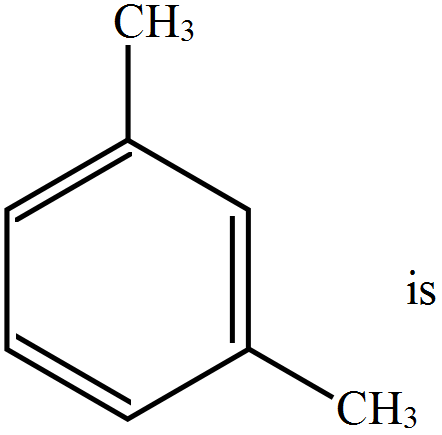
The $\text{IUPAC}$ name of
- A
- B
- ✓
$1, 3-$ dimethylbenzene.
- D
$1, 4-$ dimethylbenzene.
AnswerCorrect option: C. $1, 3-$ dimethylbenzene.
View full question & answer→MCQ 521 Mark
AnswerEthylene is an alkene $($unsaturated hydrocarbon$)$ with the structure; $\mathrm{CH}_2=\mathrm{CH}_2$.
View full question & answer→MCQ 531 Mark
The $\text{IUPAC}$ name of $\left(\mathrm{CH}_3\right)_3 \mathrm{C}-\mathrm{CH}=\mathrm{CH}_2$ is :
- A
$1, 1, 1-$ trimethyl $-2-$ propene
- B
$3, 3, 3-$ trimethyl $-2-$ propene
- C
$2, 2-$ dimethyl $-3-$ butene
- ✓
$3, 3-$ Dimethyl $-1-$ butene
AnswerCorrect option: D. $3, 3-$ Dimethyl $-1-$ butene
The $\text{IUPAC}$ name of $\left(\mathrm{CH}_3\right)_3 \mathrm{C}-\mathrm{CH}=\mathrm{CH}_2$ is $3, 3-$ dimethyl $-1-$ butene.
The parent hydrocarbon contains $4 C$ atoms and a $C=C$ double bond.
Hence, it is a butene. Two methyl groups are present as substituents on third $C$ atom.
Prefix di indicates two methyl groups.
View full question & answer→MCQ 541 Mark
Which of the following deactivates the benzene ring towards electrophilic substitution and is o/ p directing?
- ✓
$-\text{Cl}^{\ominus}$
- B
$-\ce{OCH}_3$
- C
$-\text{CHO}$
- D
AnswerCorrect option: A. $-\text{Cl}^{\ominus}$
View full question & answer→MCQ 551 Mark
How many isomers are possible in $\mathrm{C}_4 \mathrm{H}_8\ ?$
AnswerThere are five constitutional isomers with the formula $\mathrm{C}_4 \mathrm{H}_8$. They are :
But $-1-$ ene
But $-2-$ ene
$2-$ Methylpropane
Cyclobutane
methylcyclopropane
View full question & answer→MCQ 561 Mark
Consider the nitration of benzene using conc. $\mathrm{H}_2 \mathrm{SO}_4$ and conc. $\mathrm{HNO}_3$. If large amount of $\mathrm{KHSO}_4$ is added to mixture, the rate of nitration will be :
Answer$\because$ Less $\text{NO}^+_2$ will be formed. $\text{HNO}_3+\text{H}_2\text{SO}_4\rightleftharpoons\text{NO}_2^++\text{HSO}_4^-+\text{H}_2\text{O}$
Presence of $\text{K}^+\text{HSO}_4^-$ will shift the equilibrium backwards.
View full question & answer→MCQ 571 Mark
Which of the following will not show geometrical isomerism?
Answer
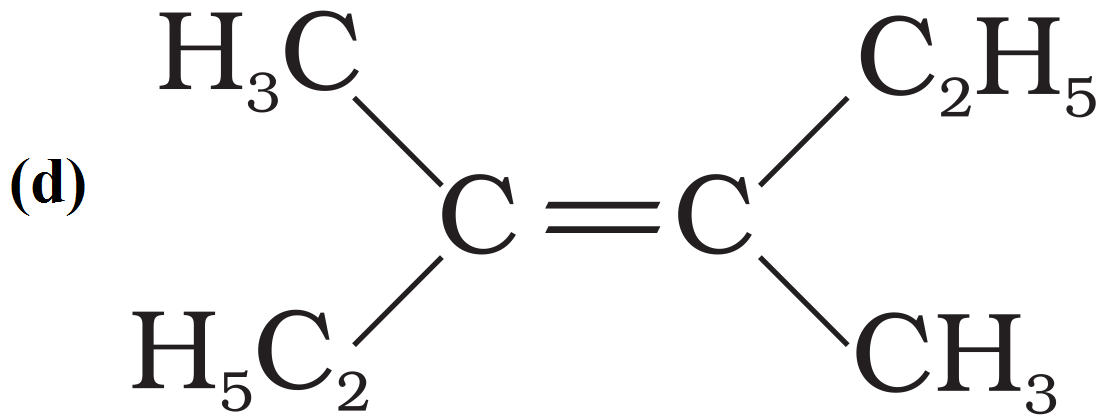 Explanation:
Geometrical isomerism is shown by the alkenes in which double bonded carbons must have different atoms of groups. In structure (iv), double bonded carbons have 3 groups same and one is different.
View full question & answer→MCQ 581 Mark
The possible rotamers of ethane is/ are
AnswerCorrect option: D. $\infty$
View full question & answer→MCQ 591 Mark
Which of the following statement $(s)$ is/are not correct?
AnswerCorrect option: C. Straight chain alkanes have lesser boiling point than corresponding branched chain isomers.
Alkanes are made of $C$ and $H$ only, so, they are non polar in nature and also due to non polar nature they dissolved in non polar solvent only.
Branched alkanes have lower boiling point than straight $-$ chain alkanes.
Melting point increases with increase in mass.
View full question & answer→MCQ 601 Mark
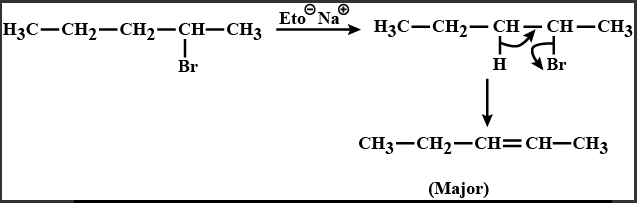
$2-$ Bromopentane is heated with $\mathrm{EtO}^{-} \mathrm{Na}^{+}$ in ethanol. The major product obtained is:
- A
$2-$ ethoxypentane.
- B
pent $-1-$ ene.
- C
- ✓
pent $-2-$ ene.
AnswerCorrect option: D. pent $-2-$ ene.
Product obtained is Pent $-2-$ ene.
View full question & answer→MCQ 611 Mark
The correct $\text{IUPAC}$ name of the given structure $\text{H}_3\text{C}-\text{CH}-\text{C}\equiv\text{CH}\\ \ \ \ \ \ \ \ \ \ \ \ \ \ |\\ \ \ \ \ \ \ \ \ \ \ \ \ \text{CH}_3$ is :
- A
$2-$ methylbut $-1-$ yne
- B
$1-$ methylbut $-3-$ yne
- C
$2-$ methylbut $-3-$ yne
- ✓
$3-$ methylbut $-1-$ yne
AnswerCorrect option: D. $3-$ methylbut $-1-$ yne
$\text{H}_3\stackrel{{4}}{\hbox{C}}-\stackrel{{3 \ \ \ \ }}{\hbox{CH}}-\stackrel{{2}}{\hbox{C}}\equiv\stackrel{{1 \ \ \ \ }}{\hbox{CH}}\\ \ \ \ \ \ \ \ \ \ \ \ \ \ \ \ |\\ \ \ \ \ \ \ \ \ \ \ \ \ \ \ \text{CH}_3\\ \ \ \ \ \ \ _{3-\text{methylbut-1-yne}}$
View full question & answer→MCQ 621 Mark
In Pyridine number of conjugated electrons are :
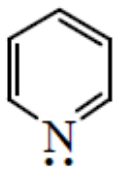
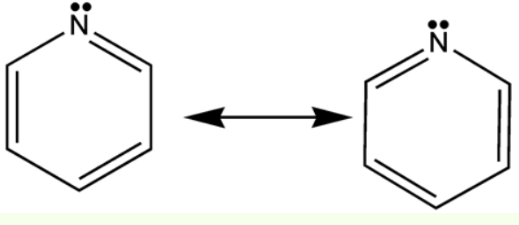
AnswerPyridine is an aromatic compound because it follows Huckel's rule $(4n + 2)\pi$ electrons with 6\pi electrons within the ring.
These $6\pi$ are responsible for conjugation over the ring by delocalization, therefore, it has a total of $6$ conjugated electrons.
There is one lone pair present on $N$ but if we consider those electrons in conjugation then total electrons would be $8$ and the compound will become antiaromatic and least stable.
Hence, lone of electrons of $N$ does not contribute in conjugation, hence not count.
View full question & answer→MCQ 631 Mark
When $\text{CH}_3-\text{C}\equiv\text{CH}$ reacts with one mole of $\text{HBr}$ then product obtained is :
- A
- B
- ✓
$2-$ bromopropene.
- D
$1-$ bromopropane.
AnswerCorrect option: C. $2-$ bromopropene.
$ \ \ \ \ \ \ \ \ \ \ \ \ \ \ \ \ \ \ \ \ \ \ \ \ \ \ \ \ \ \ \ \ \ \ \ \ \ \ \ \ \ \ \ \ \ \ \ \ \ \ \ \ \ \ \ \ \ \ \text{Br}\\ \ \ \ \ \ \ \ \ \ \ \ \ \ \ \ \ \ \ \ \ \ \ \ \ \ \ \ \ \ \ \ \ \ \ \ \ \ \ \ \ \ \ \ \ \ \ \ \ \ \ \ \ \ \ \ \ \ \ \ |\\\text{CH}_3-\text{C}\equiv\text{CH}+\text{HBr}\rightarrow\text{CH}_2=\text{C}-\text{CH}_3\\ \ \ \ \ \ \ \ \ \ \ \ \ \ \ \ \ \ \ \ \ \ \ \ \ \ \ \ \ \ \ \ \ \ \ \ \ \ \ \ \ \ \ \ \ \ \ \ \ \ _{2-\text{bromopropene}}$
View full question & answer→MCQ 641 Mark
Bond angle in planar ring of cyclopropane is :
- A
$90^\circ $
- B
$108^\circ$
- ✓
$60^\circ$
- D
$120^\circ$
AnswerCorrect option: C. $60^\circ$
Arrangement of the three carbon atoms of the cyclopropane ring is of the form of an equilateral triangle thus bonds angles are $60$ degrees each.
View full question & answer→MCQ 651 Mark
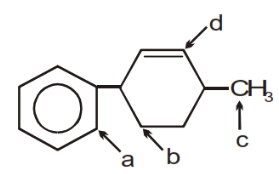
Write hybridisation of carbon atoms as indicated :
- ✓
$ a=s p^2, b=s p^3, c=s p^3, d=s p^2 $
- B
$ b=s p^2, a=s p^3, c=s p^3, d=s p^2$
- C
$ c=s p^2, b=s p^3, a=s p^3, d=s p^2$
- D
AnswerCorrect option: A. $ a=s p^2, b=s p^3, c=s p^3, d=s p^2 $
Carbon $(a)$ forms $2$ sigma bond and $1$ pi bond, So it is $\mathrm{sp}^2$
Carbon $(b)$ forms $4$ sigma bond, so it is $\mathrm{sp}^3$
Carbon $(c)$ forms $4$ sigma bond, so it is $\mathrm{sp}^3$
Carbon $(d)$ forms $1$ pi bond and $2$ sigma bond, So it is $\mathrm{sp}^2$
View full question & answer→MCQ 661 Mark
Which of the following is Aromatic Hydrocarbon?
- A
$ \mathrm{C}_2 \mathrm{H}_2$
- B
$ \mathrm{C}_3 \mathrm{H}_8 $
- C
$ \mathrm{C}_5 \mathrm{H}_{12} $
- ✓
$ \mathrm{C}_6 \mathrm{H}_6$
AnswerCorrect option: D. $ \mathrm{C}_6 \mathrm{H}_6$
$\mathrm{C}_2 \mathrm{H}_2$ is called acetylene. It is an aliphatic alkyne. So it is not aromatic.
$\mathrm{C}_3 \mathrm{H}_8$ is called propane. It is a simple alkane. So, it is not aromatic.
$\mathrm{C}_5 \mathrm{H}_{12}$ is called pentane. It is a simple alkane. So, It is also not aromatic.
$\mathrm{C}_6 \mathrm{H}_6$ is a cyclic, planar, and has a complete conjugated system.
Also, it has $6 \pi$ electrons. Hence it follows Huckel's rule.Therefore, it is aromatic.
View full question & answer→MCQ 671 Mark
In commercial gasolines the type of hydrocarbons which are more desirable, is :
- ✓
- B
Straight chain hydrocarbon.
- C
Automatic hydrocarbon such as toluene.
- D
Linear unsaturated hydrocarbon.
AnswerBranched hydrocarbons are more desirable in commercial gasolines because they are more volatile and have high octane number.
View full question & answer→MCQ 681 Mark
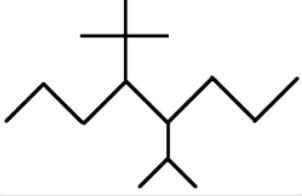
Give the $\text{IUPAC}$ name of above given compound.
- A
$2, 2-$ Dimethyl $-3-$ propyl $-4-$ isopropyl heptane.
- B
$4-$ lsopropyl $-5-t-$ butyl octane.
- ✓
$4-t-$ Butyl $-5-$ isopropyl octane.
- D
$2-$ Methyl $-3 -$propyl $-4-$ isopropyl heptane.
AnswerCorrect option: C. $4-t-$ Butyl $-5-$ isopropyl octane.
View full question & answer→MCQ 691 Mark
The reaction of $\mathrm{C}_6 \mathrm{H}_5 \mathrm{CH}=\mathrm{CHCH}_3$ with $\text{HBr}$ produces :
- ✓
$\text{C}_6\text{H}_5\text{CHCH}_2\text{CH}_3\\ \ \ \ \ \ \ \ \ \ \ |\\ \ \ \ \ \ \ \ \ \ \text{Br}$
- B
$\text{C}_6\text{H}_5\text{CH}_2\text{CHCH}_3\\ \ \ \ \ \ \ \ \ \ \ \ \ \ \ \ \ \ \ |\\ \ \ \ \ \ \ \ \ \ \ \ \ \ \ \ \ \ \text{Br}$
- C
$\text{C}_6\text{H}_5\text{CH}_2\text{CH}_2\text{CH}_2\text{Br}\\ \ \ \ \ \ \ \ \ \ \ \ \ \ \ \ \ \ \ \ \ \ \ \ \ \ \ \ \ \ \ \downarrow$
- D
AnswerCorrect option: A. $\text{C}_6\text{H}_5\text{CHCH}_2\text{CH}_3\\ \ \ \ \ \ \ \ \ \ \ |\\ \ \ \ \ \ \ \ \ \ \text{Br}$
View full question & answer→MCQ 701 Mark
Secondary butyl chloride will undergo alkaline hydrolysis in the polar solvent by the mechanism :
- A
$\mathrm{S}_{\mathrm{N}} 2$
- ✓
$\mathrm{S}_{\mathrm{N}} 1$
- C
$\mathrm{S}_{\mathrm{N}} 1$ and $\mathrm{S}_{\mathrm{N}} 2$
- D
AnswerCorrect option: B. $\mathrm{S}_{\mathrm{N}} 1$
$\mathrm{S}_{\mathrm{N}} 1$ mechanism is favored by polar solvents like water, in which the rate of the reaction only depends on the concentration of the alkyl halide.
View full question & answer→MCQ 711 Mark
In the reaction,
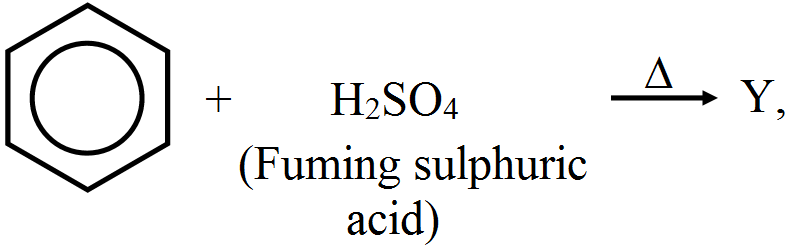
- ✓
$ \mathrm{C}_6 \mathrm{H}_5 \mathrm{SO}_3 \mathrm{H} $
- B
$ \mathrm{C}_6 \mathrm{H}_5 \mathrm{OH} $
- C
$ \mathrm{C}_6 \mathrm{H}_5 \mathrm{SO}_2 $
- D
$ \mathrm{C}_6 \mathrm{H}_5 \mathrm{CHO}$
AnswerCorrect option: A. $ \mathrm{C}_6 \mathrm{H}_5 \mathrm{SO}_3 \mathrm{H} $
View full question & answer→MCQ 721 Mark
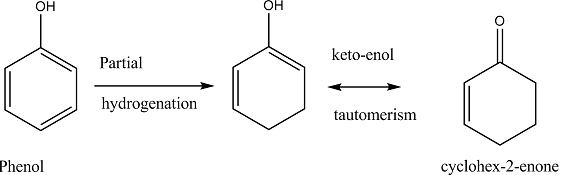
The degree of unsaturation of the compound formed by the partial hydrogenation of phenol is :
AnswerThe degree of unsaturation of the compound formed by the partial hydrogenation of phenol is $2.$
Phenol has $3\ C=C$ double bonds. During the partial hydrogenation of phenol, one $C=C$ double is hydrogenated and two $C=C$ double bonds remain.
View full question & answer→MCQ 731 Mark
$X$ compound reacts with $\text{Na}$ to give $\mathrm{CH}_3 \mathrm{CH}_2 \mathrm{CH}_2 \mathrm{CH}_3$. The compound $X$ is :
- A
$ \mathrm{CH}_3 \mathrm{CH}_2 \mathrm{OH} $
- ✓
$ \mathrm{CH}_3 \mathrm{CH}_2-\mathrm{Cl} $
- C
$ \mathrm{CH}_3-\mathrm{CH}_3 $
- D
$ \mathrm{CH}_3-\mathrm{CH}_2-\mathrm{CH}_2-\mathrm{CH}_2-\mathrm{OH}$
AnswerCorrect option: B. $ \mathrm{CH}_3 \mathrm{CH}_2-\mathrm{Cl} $
$\mathrm{CH}_3 \mathrm{CH}_2 \mathrm{Cl}+2 \mathrm{Na}+\mathrm{ClCH}_2 \mathrm{CH}_3 \rightarrow \mathrm{CH}_3-\mathrm{CH}_2-\mathrm{CH}_2 \mathrm{CH}_3+2 \mathrm{NaCl}$
This is Wurtz reaction.
View full question & answer→MCQ 741 Mark
The compound formed as a result of oxidation of propyl benzene by hot alkaline $\mathrm{KMnO}_4$ is :
View full question & answer→MCQ 751 Mark
Which of the compound does not dissolve in concentrated $\mathrm{H}_2 \mathrm{SO}_4\ ?$
AnswerHexane does not dissolve in concentrated $\mathrm{H}_2 \mathrm{SO}_4$.
Hexane is nonpolar hydrocarbon. Polar compound such as benzene, ethylene and aniline dissolve in concentrated $\mathrm{H}_2 \mathrm{SO}_4$ as they donate their $\pi$ electrons to $H^+$ ions of concentrated $\mathrm{H}_2 \mathrm{SO}_4$.
View full question & answer→MCQ 761 Mark
The deviation of bond angle in cyclopropane :
- ✓
$49^\circ .5\ '$
- B
$24^\circ .44\ '$
- C
$−5^\circ .16\ '$
- D
$−9^\circ .33\ '$
AnswerCorrect option: A. $49^\circ .5\ '$
Deviation of the bond angle in cyclopropane is $109.5 - 60 = 49.5.$
View full question & answer→MCQ 771 Mark
Alkane which is liquid at room temperature is :
- A
$ \mathrm{C}_2 \mathrm{H}_6$
- B
$ \mathrm{C}_3 \mathrm{H}_8 $
- C
$\mathrm{C}_4 \mathrm{H}_{10} $
- ✓
$\mathrm{C}_8 \mathrm{H}_{18} $
AnswerCorrect option: D. $\mathrm{C}_8 \mathrm{H}_{18} $
Alkane from $\mathrm{C}_1-\mathrm{C}_4$ are gases.
Alkane from $\mathrm{C}_5-\mathrm{C}_{17}$ are liquids.
Alkane from $\mathrm{C}_{18}$ onwards is solids.
View full question & answer→MCQ 781 Mark
The given structures, $\ \ \ \ \ \ \ \ \ \ \ \ \text{CH}_3\\ \ \ \ \ \ \ \ \ \ \ \ \ \ |\\\text{CH}_3-\text{CH}-\text{CH}_3$ and $\mathrm{CH}_3 \mathrm{CH}_2 \mathrm{CH}_2 \mathrm{CH}_3$ are :
Answer$\ \ \ \ \ \ \ \ \ \ \ \ \text{CH}_3\\ \ \ \ \ \ \ \ \ \ \ \ \ \ |\\\text{CH}_3-\text{CH}-\text{CH}_3,\ \text{CH}_3-\text{CH}_2-\text{CH}_2-\text{CH}_3\\ \ \ \ \ _{2-\text{methylpropane}} \ \ \ \ \ \ \ \ \ \ \ \ \ \ \ \ _{\text{n-butane}}$
Molecular formula $\rightarrow$ Same
Chain of $C-$ atom $\rightarrow$ Different
Hence, these are chain isomers.
View full question & answer→MCQ 791 Mark
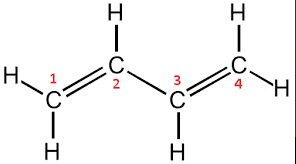
What is the name of the alkene $\mathrm{H}_2 \mathrm{C}=\mathrm{CH}-\mathrm{CH}=\mathrm{CH}_2\ ?$
- ✓
$1, 3-$ butadiene
- B
$1, 3-$ butanediene
- C
$1, 3-$ dibutene
- D
$1, 3-$ dibutadiene
AnswerCorrect option: A. $1, 3-$ butadiene
The name of the given compound is $1, 3-$ butadiene.
View full question & answer→MCQ 801 Mark
Which of the following gives propyne on hydrolysis?
- A
$ \mathrm{Al}_4 \mathrm{C}_3 $
- ✓
$ \mathrm{Mg}_2 \mathrm{C}_3 $
- C
$ \mathrm{~B}_4 \mathrm{C} $
- D
$ \mathrm{La}_4 \mathrm{C}_3 $
AnswerCorrect option: B. $ \mathrm{Mg}_2 \mathrm{C}_3 $
$\mathrm{Mg}_2 \mathrm{C}_3$ on hydrolysis gives propyne and $\mathrm{Mg}(\mathrm{OH})_2$.
$\mathrm{Mg}_2 \mathrm{C}_3+4 \mathrm{H}_2 \mathrm{O} \rightarrow 2 \mathrm{Mg}(\mathrm{OH})_2+\mathrm{C}_3 \mathrm{H}_4$
View full question & answer→MCQ 811 Mark
Arrange the following carbanions in order of their decreasing stability.
- $ \ \ \ \ \ \ \ \ \ \ \ \ \ \text{H}\\\ \ \ \ \ \ \ \ \ \ \ \ \ \ |\\\text{CH}_3-\text{C}-\text{CH}_2\text{Br}\\\ \ \ \ \ \ \ \ \ \ \ \ \ \ |\\ \ \ \ \ \ \ \ \ \ \ \ \ \ \text{CH}_3$
- $\text{CH}_3-\text{CH}_2-\text{Br}$
- $\text{CH}_3-\text{CH}_2-\text{C}{\text{H}}_2-\text{Br}$
- ✓
$\text{A} > \text{B} > \text{C}$
- B
$\text{C} > \text{B} > \text{A}$
- C
$\text{B} > \text{C} > \text{A}$
- D
$\text{A} > \text{C} > \text{B}$
AnswerCorrect option: A. $\text{A} > \text{B} > \text{C}$
$\ \ \ \ \ \ \ \ \ \ \ \ \ \text{H}\\\ \ \ \ \ \ \ \ \ \ \ \ \ \ |\\\text{CH}_3-\text{C}-\text{CH}_2\text{Br}>\text{CH}_3\text{CH}_2\text{CH}_2\text{Br}>\text{CH}_3\text{CH}_2\text{Br}\\\ \ \ \ \ \ \ \ \ \ \ \ \ \ |\\\ \ \ \ \ \ \ \ \ \ \ \ \ \text{CH}_3$
is the order of rate of $\beta$-elimination with alcoholic $\text{KOH}.$
$\ \ \ \ \ \ \ \ \ \ \ \ \ \ \ \ \text{H}\\\ \ \ \ \ \ \ \ \ \ \ \ \ \ \ \ |\\\text{CH}_3-\ ^\beta\text{C}-\ ^\alpha\text{CH}_2\text{Br}\ \ \ \ \ \ \ \ ^\beta\text{CH}_3-\ ^\alpha\text{CH}_2-\text{Br}\\\ \ \ \ \ \ \ \ \ \ \ \ \ \ \ \ |\\\ \ \ \ \ \ \ \ \ \ \ \ \ \ \ \text{CH}_3\ \ \ \ \ \ \ \ \ \ \ \ \ \ \ \ \ \ \ \ \ \ \ \ \ \ \ \ \ \ \ \ \ \ \ \ \ \ \ \ \ \ \ \ \ \ (\text{B})\ \text{has }2\ \beta-\text{substituents})\ \ \ \ \ \ \ \ (\text{has no }\beta-\text{substituent})$
$\text{CH}_3-\ ^\beta\text{CH}_2-\ ^\alpha\text{CH}_2-\text{Br}\\\ \ \ \ \ \ \ \ \ \ \ \ \ \ \ \ (\text{C})\\\ \ \ \ \ \ (\text{has}1\ \beta-\text{substituent})$
More the number of $\beta-$ substituents $($alkyl groups$),$ more stable alkene will be formed on $\beta- $elimination and more will be the reactivity. Thus, the decreasing order of the rate of $\beta-$ elimination reaction with alcoholic $\text{KOH}$ is : $\text{A > C > B}.$
View full question & answer→MCQ 821 Mark
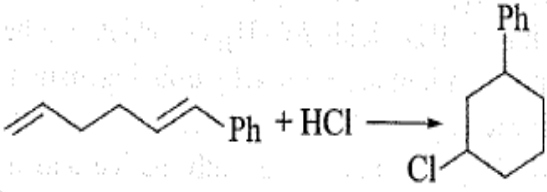
The above reaction proceeds through :
- A
- B
Electrophilic substitution
- ✓
- D
Nucleophilic substitution
View full question & answer→MCQ 831 Mark
Which one of the following is expected to have minimum boiling point?
- ✓
$n-$ Butane
- B
$n-$ Pentane
- C
$2-$ Methylbutane
- D
$2, 2 -$ Dimethylpropane
AnswerCorrect option: A. $n-$ Butane
The boiling point is directly proportional to molecular mass.
So $n-$ butane among given will have a minimum boiling point.
View full question & answer→MCQ 841 Mark
Which of the following reactions follows Markovnikovs rule?
- A
$ \mathrm{C}_2 \mathrm{H}_4+\mathrm{HBr} $
- B
$ \mathrm{C}_3 \mathrm{H}_6+\mathrm{Cl}_2$
- ✓
$ \mathrm{C}_3 \mathrm{H}_6+\mathrm{HBr} $
- D
$ \mathrm{CH}_6+\mathrm{Br}_2 $
AnswerCorrect option: C. $ \mathrm{C}_3 \mathrm{H}_6+\mathrm{HBr} $
When $\text{HBr}$ is added to an alkene in the absence of peroxides it obey Markovnikovs rule.
When $\text{HBr}$ reacts with unsymmetrical alkene in the presence of peroxides $\text{HBr}$ adds in the opposite direction to that predicted by Markovnikov's rule.
$\mathrm{CH}_3 \mathrm{CH}=\mathrm{CH}_2+\mathrm{HBr}$
View full question & answer→MCQ 851 Mark
Which of the following is highly inflammable?
AnswerOn comparing Alkanes, Alkenes, Alkynes, saturated hydrocarbons are highly reactive so they catch fire easily.
Reason : Reactivity of alkene and alkynes is lower than alkane as there are multiple bonds are present in the unsaturated compounds $($alkene and alkynes$)$ that needs to break before the reaction occurs.
Hydrogen is highly flammable gas.
View full question & answer→MCQ 861 Mark
Which of the following carbides produces propyne on reaction with water?
- A
$\mathrm{CaC}_2$
- B
$\mathrm{Be}_2 \mathrm{C}$
- C
$\mathrm{Al}_4 \mathrm{C}_3$
- ✓
$\mathrm{Mg}_2 \mathrm{C}_3$
AnswerCorrect option: D. $\mathrm{Mg}_2 \mathrm{C}_3$
$ \mathrm{CaC}_2+\mathrm{H}_2 \mathrm{O} \rightarrow \mathrm{Ca}(\mathrm{OH})_2+\mathrm{HC} \equiv \mathrm{CH} \uparrow $
$ \mathrm{Be}_2 \mathrm{C}+2 \mathrm{H}_2 \mathrm{O} \rightarrow 2 \mathrm{BeO}+\mathrm{CH}_4 \uparrow $
$ \mathrm{Al}_4 \mathrm{C}_3+12 \mathrm{H}_2 \rightarrow 4 \mathrm{Al}(\mathrm{OH})_3+3 \mathrm{CH}_4 \uparrow $
$ \mathrm{Mg}_2 \mathrm{C}_3+4 \mathrm{H}_2 \mathrm{O}_2+\mathrm{Mg}(\mathrm{OH})_2+\mathrm{H}_3 \mathrm{C}-\mathrm{C} \equiv \mathrm{CH} \uparrow$
View full question & answer→MCQ 871 Mark
Dehydrohalogenation of an alkyl halide is a/an :
- A
Nucleophilic substitution reaction.
- ✓
- C
Both nucleophilic substitution and elimination reaction.
- D
AnswerDehydrohalogenation is an elimination reaction. In this reaction, hydrogen and halogen atoms get eliminated from alkyl halide to give an alkene or alkynes.
For example : When chloropropane is heated with alcoholic $\text{KOH}$ gives Propene.
Reaction : $\mathrm{CH}_3 \mathrm{CH}_3 \mathrm{CH}_2 \mathrm{Cl}+\mathrm{KOH} \xrightarrow{\text { heat }} \mathrm{CH}_3 \mathrm{CH}=\mathrm{CH}_2+\mathrm{KCl}+\mathrm{H}_2 \mathrm{O}$.
View full question & answer→MCQ 881 Mark
The $\text{IUPAC}$ name of the compound $\mathrm{CH} \equiv \mathrm{C}-\mathrm{CH}_2-\mathrm{CH}_2-\mathrm{CH}=\mathrm{CH}_2$ is :
- ✓
Hex $-1-$ en $-5-$ yne
- B
Hexyn $-5-$ ene
- C
Hex $-5-$ en $-2-y$ ne
- D
Hex $-5-$ en $-1-$ yne
AnswerCorrect option: A. Hex $-1-$ en $-5-$ yne
$\mathrm{CH} \equiv \mathrm{C}-\mathrm{CH}_2-\mathrm{CH}_2-\mathrm{CH}=\mathrm{CH}_2$
$\text{IUPAC}$ name : Hex $-1-$ en $-5-$ yne.
Numbering starts from the double bond bearing carbon, as alkenes are higher priority functional groups than alkynes $($triple bond$).$
View full question & answer→MCQ 891 Mark
Arrange the halogens $\mathrm{F}_2, \mathrm{Cl}_2, \mathrm{Br}_2, \mathrm{I}_2$, in order of their increasing reactivity with alkanes.
- ✓
$ \mathrm{I}_2 < \mathrm{Br}_2 < \mathrm{Cl}_2 < \mathrm{F}_2$
- B
$ \mathrm{Br}_2 < \mathrm{Cl}_2 < \mathrm{F}_2 < \mathrm{I}_2 $
- C
$ \mathrm{~F}_2 < \mathrm{Cl}_2 < \mathrm{Br}_2 < \mathrm{I}_2 $
- D
$ \mathrm{Br}_2 < \mathrm{I}_2 < \mathrm{Cl}_2 < \mathrm{F}_2 $
AnswerCorrect option: A. $ \mathrm{I}_2 < \mathrm{Br}_2 < \mathrm{Cl}_2 < \mathrm{F}_2$
Since reactivity decreases down the group as the electronegativity of the halogen decreases down the group.
Thus, rate of reaction of alkanes with halogens is $ \mathrm{I}_2 < \mathrm{Br}_2 < \mathrm{Cl}_2 < \mathrm{F}_2$
View full question & answer→MCQ 901 Mark
$\text{H}-\text{C}\equiv\text{C}-\text{H}\xrightarrow[(\text{ii})\ \text{CH}_3\text{CH}_2\text{Br}]{(\text{i})\ \text{NaNH}_2/\text{liq NH}_3}\text{X}\xrightarrow[(\text{ii})\ \text{CH}_3\text{CH}_2\text{Br}]{(\text{i})\ \text{NaNH}_2/\text{liq NH}_3}\text{Y}$
- A
$X$ is $2-$ butyne $Y$ is $2$ hexyne.
- B
$X$ is $1-$ butyne, $Y$ is $2-$ hexyne.
- ✓
$X$ is $1-$ butyne $Y$ is $3-$ hexyne.
- D
$X$ is $2-$ butyne, $Y$ is $3-$ hexyne.
AnswerCorrect option: C. $X$ is $1-$ butyne $Y$ is $3-$ hexyne.
$\text{HC}\equiv\text{C}-\text{CH}_2-\text{CH}_3+\text{NaNH}_2\xrightarrow{\text{liq NH}_3}\text{NaC}\equiv\text{C}-\text{CH}_2\text{CH}_3$
$+\text{CH}_3-\text{CH}_2-\text{Br}\rightarrow\text{CH}_3-\text{CH}_2-\text{C}\equiv\text{C}-\text{CH}_2-\text{CH}_3$
View full question & answer→MCQ 911 Mark
In benzene, carbon uses $ ........ p-$ orbitals for hybridization.
AnswerIn benzene, each carbon atom is $\mathrm{sp}^2-$ hybridized; hence, carbon uses only two $p-$ orbitals for hybridization.
View full question & answer→MCQ 921 Mark
Pyrolysis of ethyl acetate gives :
- A
$ \mathrm{CH}_3 \mathrm{COCH}_3 $
- ✓
$ \mathrm{CH}_2=\mathrm{CH}_2 $
- C
$ \mathrm{CH}_2=\mathrm{CO}=\mathrm{O} $
- D
$ \mathrm{CH}_3-\mathrm{CHO} $
AnswerCorrect option: B. $ \mathrm{CH}_2=\mathrm{CH}_2 $
Pyrolysis of ethyl acetate gives ethylene $\left(\mathrm{CH}_2=\mathrm{CH}_2\right)$
$\mathrm{CH}_3 \mathrm{COOC}_2 \mathrm{H}_5 \xrightarrow[\text{Pyrolysis}]{\text{Heat}} \mathrm{CH}_2=\mathrm{CH}_2+\mathrm{CH}_3 \mathrm{COOH}$
Ethyl acetate is heated in presence of liquid nitrogen and glass wool.
View full question & answer→MCQ 931 Mark
In an alkane if the value of $n = 19,$ it is :
AnswerThe homologous of alkanes larger than hexadecane are solids, solid alkanes are normally soft, with low melting points. These characteristics are due to strong repulsive forces generated between electrons on neighboring atoms, which are in close proximity in crystalline solids.
The strong repulsive forces counterbalance the weak van der Waals forces of attraction, alkanes are almost completely insoluble in water. If $n = 19,$ then the alkane $\mathrm{C}_{19} \mathrm{H}_{40}$ is a solid.
View full question & answer→MCQ 941 Mark
Which of the following correctly explains the stability of benzene molecule?
MCQ 951 Mark
Arrange the following carbanions in order of their decreasing stability.
- $\text{H}_3\text{C}-\text{C}\equiv\text{C}^-$
- $\text{H}-\text{C}\equiv\text{C}^-$
- $\text{H}_3\text{C}-\text{C}{\text{H}}_2^-$
- A
$\text{A} > \text{B} > \text{C}$
- ✓
$\text{B} > \text{A} > \text{C}$
- C
$\text{C} > \text{B} > \text{A}$
- D
$\text{C} > \text{A} > \text{B}$
AnswerCorrect option: B. $\text{B} > \text{A} > \text{C}$
The order of decreasing stability of carbanions is :
$\text{H}-\text{C}\equiv\text{C}^- > \text{CH}_3-\text{C}\equiv\text{C}^- > \text{CH}_3-\text{CH}^-$
$\ \ \ \ \ \ \ \ \ \ \ (\text{B})\ \ \ \ \ \ \ \ \ \ \ \ \ \ \ \ \ \ \ \ \ \ \ \ \ \text{(A)}\ \ \ \ \ \ \ \ \ \ \ \ \ \ \ \ \ \ (\text{C})$
$\text{sp}-$ hybridised carbon atom is more electronegative than $\mathrm{sp}^3-$ hybridised carbon atom and hence, can accommodate the negative charge more effectively. $-\mathrm{CH}_3$ group has $+\ 1$ effect, therefore, it intensifies the negative charge and, hence, destabilises the carbanion $\mathrm{CH}_3 \rightarrow \mathrm{C}=\mathrm{C}^{-}$.
View full question & answer→MCQ 961 Mark
Even though the rings are different size, cyclopropane and cyclobutane have similar overall strain energy. This is because :
AnswerCorrect option: C. Cyclobutane has more eclipsing interactions but less angle strain.
Even though the rings are different size, cyclopropane and cyclobutane have similar overall strain energy. This is because cyclobutane has more eclipsing interactions than cyclopropane but less angle strain.
View full question & answer→MCQ 971 Mark
The increasing order of reduction of alkyl halides with zinc and dilute $\text{HCl}$ is :
- A
$\text{R−Cl < R−I < R−Br}$
- ✓
$\text{R−Cl < R−Br < R−I}$
- C
$\text{R−I < R−Br < R−Cl}$
- D
$\text{R−Br < R−I < R−Cl}$
AnswerCorrect option: B. $\text{R−Cl < R−Br < R−I}$
As the size of the halogen increases down the group, the strength of $C−X$ bond decreases, as a result, reactivity increases.
Hence, The increasing order of reduction of alkyl halides with zinc and dil. $\text{HCl}$ is $\text{R−Cl < R−Br < R−I}.$
View full question & answer→MCQ 981 Mark
Acidic potassium permanganate/ potassium dichromate oxidises alkenes to produce :
MCQ 991 Mark
Predict the correct intermediate, and product in the following reaction $\text{H}_3\text{C}-\text{C}\equiv\text{CH}\xrightarrow[\text{HgSO}_4]{\text{H}_2\text{O},\text{ H}_2\text{SO}_4}\text{intermediate}\rightarrow\text{product}\\ \ \ \ \ \ \ \ \ \ \ \ \ \ \ \ \ \ \ \ \ \ \ \ \ \ \ \ \ \ \ \ \ \ \ \ \ \ \ \ \ \ \ \ \ \ \ \ \ \ \ \ \ \ \text{'A'}\ \ \ \ \ \ \ \ \ \ \ \ \ \ \ \ \ \ \ \ \text{'B'}$
- A
$\text{'A' is H}_3\text{C}-\text{C}=\text{CH}_2\\\ \ \ \ \ \ \ \ \ \ \ \ \ \ \ \ \ \ \ \ \ \ \ |\\ \ \ \ \ \ \ \ \ \ \ \ \ \ \ \ \ \ \ \ \ \ \ \text{SO}_3\ \text{'B' is H}_3\text{C}-\text{C}-\text{CH}_3\\ \ \ \ \ \ \ \ \ \ \ \ \ \ \ \ \ \ \ \ \ \ \ \ ||\\ \ \ \ \ \ \ \ \ \ \ \ \ \ \ \ \ \ \ \ \ \ \ \ \text{O}$
- B
$\text{'A' is H}_3\text{C}-\text{C}=\text{CH}_2\\\ \ \ \ \ \ \ \ \ \ \ \ \ \ \ \ \ \ \ \ \ \ \ |\\ \ \ \ \ \ \ \ \ \ \ \ \ \ \ \ \ \ \ \ \ \ \ \text{OH}$ $\text{'B' is H}_3\text{C}-\text{C}-\text{CH}_2\\ \ \ \ \ \ \ \ \ \ \ \ \ \ \ \ \ \ \ \ \ \ \ \ |\\ \ \ \ \ \ \ \ \ \ \ \ \ \ \ \ \ \ \ \ \ \ \ \ \text{SO}_4$
- C
$\text{'A' is CH}_3-\text{C}-\text{CH}_3\\\ \ \ \ \ \ \ \ \ \ \ \ \ \ \ \ \ \ \ \ \ \ \ ||\\ \ \ \ \ \ \ \ \ \ \ \ \ \ \ \ \ \ \ \ \ \ \ \ \text{O}$ $\text{'B' is H}_3\text{C}-\text{C}\equiv\text{CH}$
- ✓
$\text{'A' is H}_3\text{C}-\text{C}=\text{CH}_2\\\ \ \ \ \ \ \ \ \ \ \ \ \ \ \ \ \ \ \ \ \ \ \ |\\ \ \ \ \ \ \ \ \ \ \ \ \ \ \ \ \ \ \ \ \ \ \ \text{OH} \ \text{'B' is H}_3\text{C}-\text{C}-\text{CH}_3\\ \ \ \ \ \ \ \ \ \ \ \ \ \ \ \ \ \ \ \ \ \ \ \ ||\\ \ \ \ \ \ \ \ \ \ \ \ \ \ \ \ \ \ \ \ \ \ \ \ \text{O}$
AnswerCorrect option: D. $\text{'A' is H}_3\text{C}-\text{C}=\text{CH}_2\\\ \ \ \ \ \ \ \ \ \ \ \ \ \ \ \ \ \ \ \ \ \ \ |\\ \ \ \ \ \ \ \ \ \ \ \ \ \ \ \ \ \ \ \ \ \ \ \text{OH} \ \text{'B' is H}_3\text{C}-\text{C}-\text{CH}_3\\ \ \ \ \ \ \ \ \ \ \ \ \ \ \ \ \ \ \ \ \ \ \ \ ||\\ \ \ \ \ \ \ \ \ \ \ \ \ \ \ \ \ \ \ \ \ \ \ \ \text{O}$
$\text{H}_3\text{C}-\text{C}\equiv\text{CH}\xrightarrow[\text{HgSO}_4]{\text{H}_2\text{O, H}_2\text{SO}_4}\text{H}_3\text{C}-\text{C}=\text{CH}_2\rightleftharpoons\text{CH}_3-\text{C}-\text{CH}_3\\ \ \ \ \ \ \ \ \ \ \ \ \ \ \ \ \ \ \ \ \ \ \ \ \ \ \ \ \ \ \ \ \ \ \ \ \ \ \ \ \ \ \ \ \ \ \ \ \ \ \ \ \ \ \ \ \ \ \ \ |\ \ \ \ \ \ \ \ \ \ \ \ \ \ \ \ \ \ \ \ \ \ \ \ \ \ \ \ \ \ \ \ \ \ ||\\ \ \ \ \ \ \ \ \ \ \ \ \ \ \ \ \ \ \ \ \ \ \ \ \ \ \ \ \ \ \ \ \ \ \ \ \ \ \ \ \ \ \ \ \ \ \ \ \ \ \ \ \ \ \ \ \ \ \ \text{OH}\ \ \ \ \ \ \ \ \ \ \ \ \ \ \ \ \ \ \ \ \ \ \ \ \ \ \ \ \ \ \text{O}\\ \ \ \ \ \ \ \ \ \ \ \ \ \ \ \ \ \ \ \ \ \ \ \ \ \ \ \ \ \ \ \ \ \ \ \ \ \ \ \ \ \ \ \ \ \ \ \ \ \ \ \ \ \ \ \ \ \ \ \text{'A'}\ \ \ \ \ \ \ \ \ \ \ \ \ \ \ \ \ \ \ \ \ \ \ \ \ \ \ \ \ \ \ \text{'B'}$
View full question & answer→MCQ 1001 Mark
Which of the following is most reactive?
AnswerBecause it has torsinal strain $($Bond angle $60^\circ)$
$\therefore$ bond breaks easily.
View full question & answer→MCQ 1011 Mark
Eclipsed and the staggered conformations can be represented by :
- A
- B
- ✓
Both $(a)$ and $(b).$
- D
AnswerCorrect option: C. Both $(a)$ and $(b).$
View full question & answer→MCQ 1021 Mark
AnswerCorrect option: D. Undergo substitution reactions
"Benzene decolourise bromine water". Discharge colour of $\mathrm{KMnO}_4$. Both are incorrect and also it doesn't undergo polymerization.
Because it does not undergo addition reaction as it is highly saturated due to presence of electron cloud above and below it. $($aromatic system is more stable$)$
But it undergo substitution reactions.
View full question & answer→MCQ 1031 Mark
Although benzene is highly unsaturated it does not undergo addition reactions. The explanation of this can be suggested as :
- ✓
$\pi-$ electrons of benzene ring are delocalised.
- B
Since $\pi-$ electrons are present inside the ring, addition cannot take place.
- C
Cyclic structures do not show addition reactions
- D
Benzene is not a reactive compound.
AnswerCorrect option: A. $\pi-$ electrons of benzene ring are delocalised.
$\pi-$ electrons of the benzene ring are delocalised.
There are delocalised $\pi -$ electrons above and below the plane of the ring. The presence of the delocalised $\pi-$ electrons makes benzene particularly stable.
Benzene resists addition reactions because that would involve breaking the delocalisation and losing that stability.
View full question & answer→MCQ 1041 Mark
Which of the following compounds represents $2,2,3-$ trimethyl hexane?
- A
$ \mathrm{CH}_3 \mathrm{C}\left(\mathrm{CH}_3\right) 2 \mathrm{CH}_2 \mathrm{CH}_2 \mathrm{CH}\left(\mathrm{CH}_3\right)_2$
- B
$ \mathrm{CH}_3 \mathrm{C}\left(\mathrm{CH}_3\right) 2 \mathrm{CH}_2 \mathrm{CH}(\mathrm{CH}) \mathrm{CH}_2 \mathrm{CH}_3 $
- ✓
$ \mathrm{CH}_3 \mathrm{C}\left(\mathrm{CH}_3\right) 2 \mathrm{CH}\left(\mathrm{CH}_3\right) \mathrm{CH}_2 \mathrm{CH}_2 \mathrm{CH}_3 $
- D
$ \mathrm{CH}_3 \mathrm{C}\left(\mathrm{CH}_3\right) 2 \mathrm{CH}_2 \mathrm{C}\left(\mathrm{CH}_3\right)_2 \mathrm{CH}_3 $
AnswerCorrect option: C. $ \mathrm{CH}_3 \mathrm{C}\left(\mathrm{CH}_3\right) 2 \mathrm{CH}\left(\mathrm{CH}_3\right) \mathrm{CH}_2 \mathrm{CH}_2 \mathrm{CH}_3 $
The compound of the option $C$ represents $2,2,3-$ trimethyl hexane.
It is $ \mathrm{CH}_3 \mathrm{C}\left(\mathrm{CH}_3\right) 2 \mathrm{CH}\left(\mathrm{CH}_3\right) \mathrm{CH}_2 \mathrm{CH}_2 \mathrm{CH}_3 $. The parent hydrocarbon contains $6\ C$ atoms.
Hence, it is hexane. three methyl groups are present as substituents on second, second and third carbon atoms.
View full question & answer→MCQ 1051 Mark
$2-$ Methyl butane reacting with $\ce{Br_2}$ in sunlight mainly gives :
- A
$1-$ Bromo $-2-$ methyl butane
- ✓
$2-$ Bromo $-2-$ methyl butane
- C
$2-$ Bromo $-3-$ methyl butane
- D
$1-$ Bromo $-3-$ methyl butane
AnswerCorrect option: B. $2-$ Bromo $-2-$ methyl butane
View full question & answer→MCQ 1061 Mark
The increasing order of reduction of alkyl halides with zinc and dilute $\ce{HCl}$ is :
- A
$\text{R–Cl < R–I < R–Br.}$
- ✓
$\text{R–Cl < R–Br < R–I}.$
- C
$\text{R–I < R–Br < R–Cl}.$
- D
$\text{R–Br < R–I < R–Cl}.$
AnswerCorrect option: B. $\text{R–Cl < R–Br < R–I}.$
The reactivity of reduction bf alkyl halides with $\text{Zn/ HCl}$ increases as the strength of the $C–X$ bond decreases, i.e., $\text{R–Cl < R–Bf < R–I}.$
View full question & answer→MCQ 1071 Mark
Identify $'X\ '$ in the following sequence of reaction $\text{CH}_3-\text{CH}-\text{CH}-\text{CH}_2-\text{CH}_2-\text{CH}_3\xrightarrow[(\text{ii})\ \text{Na in liq. NH}_3]{(\text{i})\ \text{NaNH}_2}\text{X}$
- ✓
- B
$\text{CH}_3-\text{CH}-\text{CH}-\text{CH}_2-\text{CH}_2-\text{CH}_3\\ \ \ \ \ \ \ \ \ \ \ \ \ \ | \ \ \ \ \ \ \ \ \ \ |\\ \ \ \ \ \ \ \ \ \ \ \ \ \text{Br}\ \ \ \ \ \ \ \text{NH}_2$
- C
- D
$\text{CH}_3-\text{CH}-\text{CH}-\text{CH}_2-\text{CH}_2-\text{CH}_3\\ \ \ \ \ \ \ \ \ \ \ \ \ \ | \ \ \ \ \ \ \ \ \ \ |\\ \ \ \ \ \ \ \ \ \ \ \ \ \text{NH}_2\ \ \ \ \text{NH}_2$
View full question & answer→MCQ 1081 Mark
Which of the following alkanes can be synthesized by the Wurtz reaction in good yield?
- A
$ \left(\mathrm{CH}_3\right)_2 \mathrm{CH}-\mathrm{CH}_2-\mathrm{CH}\left(\mathrm{CH}_3\right)_2 $
- ✓
$ \left(\mathrm{CH}_3\right)_2 \mathrm{CH}-\mathrm{CH}_2-\mathrm{CH}_2-\mathrm{CH}\left(\mathrm{CH}_3\right)_2 $
- C
$ \mathrm{CH}_3-\mathrm{CH}_2-\mathrm{C}\left(\mathrm{CH}_3\right)_2 \mathrm{CH}_2-\mathrm{CH}_3 $
- D
$ \left(\mathrm{CH}_3\right)_3 \mathrm{C}-\mathrm{CH}_2-\mathrm{CH}_2-\mathrm{CH}_3 $
AnswerCorrect option: B. $ \left(\mathrm{CH}_3\right)_2 \mathrm{CH}-\mathrm{CH}_2-\mathrm{CH}_2-\mathrm{CH}\left(\mathrm{CH}_3\right)_2 $
An even number of symmetrical alkyl halides can easily undergo Wurtz reaction as these form symmetrical alkanes which have uniform physical or chemical properties.
A general form of Wurtz reaction is
$\ce{2RX + 2Na \rightarrow R−R + 2NaX}$
Here, $R$ denotes any alkyl group, and $X$ is a halogen atom.
Asymmetric alkanes are not favorable to prepare by Wurtz reaction as the mixture of different products formed which are very difficult to seperate.
In the given options, $B$ is a symmetric alkane that can be easily prepared by the Wurtz reaction.
View full question & answer→MCQ 1091 Mark
Electrophile that participates in sulphonation of benzene is :
AnswerCorrect option: C. $ \mathrm{SO}_3 $
It is electrophile in sulphonation.
View full question & answer→MCQ 1101 Mark
When $\ce{CH_4}$ reacts with steam at $1273K$ in the presence of nickel catalyst to form $\ce{CO}$ and :
- A
$\ce{H_2O}$
- B
$\ce{O_2}$
- ✓
$\ce{H_2}$
- D
$\ce{CO_2}$
AnswerCorrect option: C. $\ce{H_2}$
View full question & answer→MCQ 1111 Mark
Sodium acetate can be converted to ethane by which of the following method?
- A
- ✓
- C
Decarboxylation in presence of soda lime.
- D
Answer$2 \mathrm{CH}_3 \mathrm{COO}-\mathrm{Na}^{+}+2 \mathrm{H}_2 \mathrm{O} \rightarrow \mathrm{CH}_3 \mathrm{CH}_3+2 \mathrm{CO}_2+\mathrm{H}_2+2 \mathrm{NaOH}$
This reaction is called Kolbe's electrolysis.
View full question & answer→MCQ 1121 Mark
View full question & answer→MCQ 1131 Mark
When sodium propionate is heated with soda lime, the product formed is :
AnswerWhen sodium propionate is heated with soda lime ethane is formed.
This reaction is known as Decarboxylation reaction.
$\text{CH}_3\text{COONa} + \text{NaOH}\xrightarrow{\text{CaO}}\text{C}_2\text{H}_6 + \text{Na}_2\text{CO}_3$
View full question & answer→MCQ 1141 Mark
Bromination of an alkane as compared to chlorination proceeds $ ..........$
AnswerBromination of an alkane occurs at a slower rate than chlorination of an alkane.
As we know that halogenation involves the formation of a carbon $-$ halogen bond.
Now, the ease of halogenation will certainly depend on the carbon $-$ halogen bond strength.
Bond formation energy of $\ce{C−Cl}$ is higher than that of $\ce{C−Br}$ bond.
So, the ease of bromination is lower than the ease of chlorination.
View full question & answer→MCQ 1151 Mark
$1-$ Methylcyclopentene can be converted into the given compound by the use of which of the following reagents?
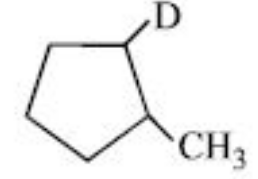
- A
$\ce{BD_3}$ followed by $\text{HCOOH}$
- ✓
$\text{BH}_3$ followed $\text{HCOOD}$
- C
$\ce{BD_3}$ followed by $\text{HCOOD}$
- D
$\ce{BH_3}$ followed by $\text{DCOOH}$
AnswerCorrect option: B. $\text{BH}_3$ followed $\text{HCOOD}$
$1-$ Methylcyclopentene can be converted to the given compound by the use of $\ce{BH_3}$ followed by $\text{HCOOD}.$
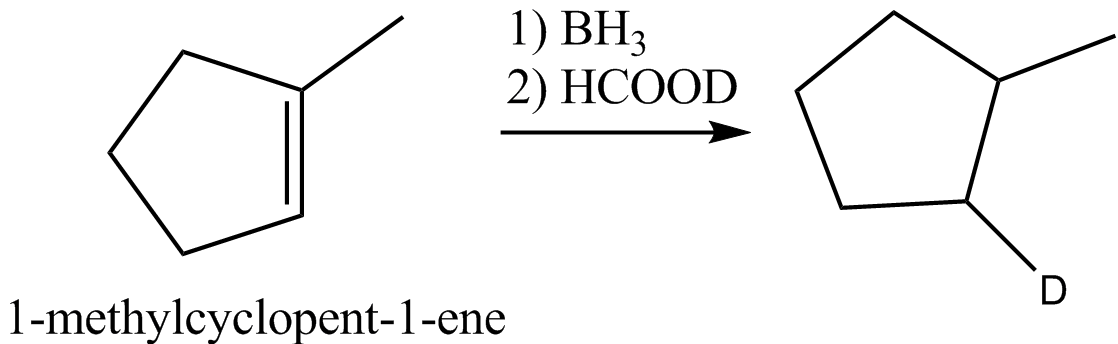
View full question & answer→MCQ 1161 Mark
Identify the correct order of reactivity towards electrophilic substitution reaction.
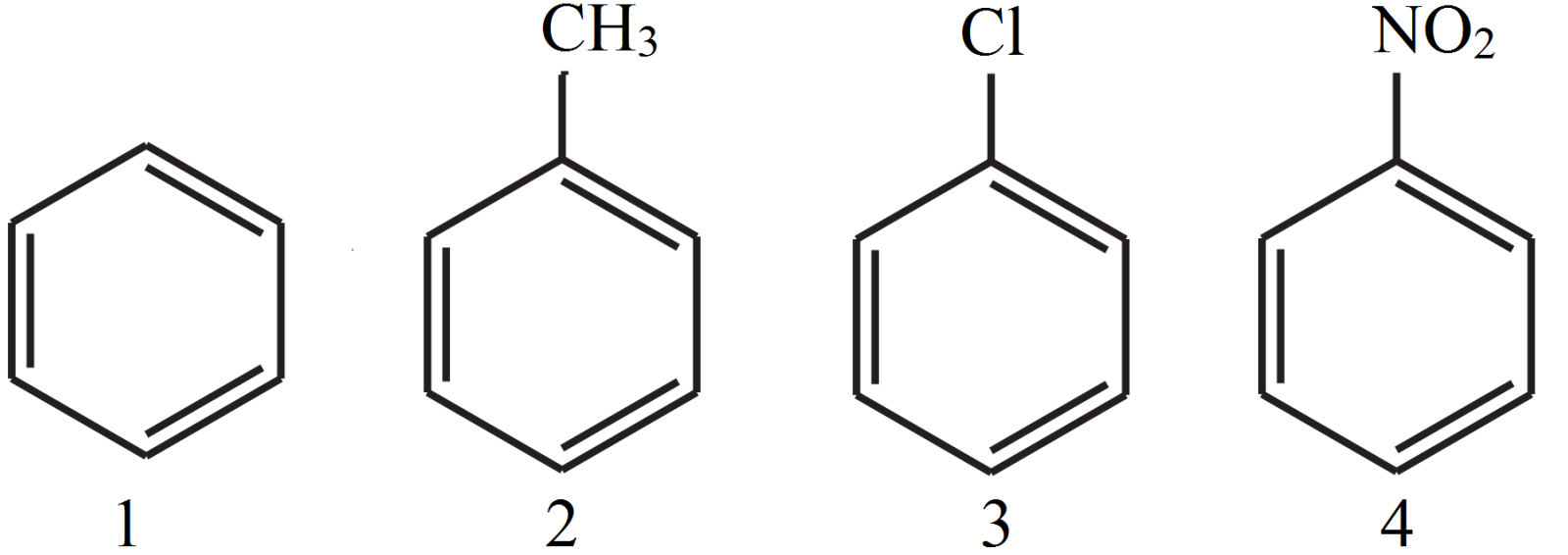
- A
$1 > 2 > 3 > 4$
- B
$4 > 3 < 2 > 1$
- ✓
$2 > 1 > 3 > 4$
- D
$2 > 3 > 1 > 4$
AnswerCorrect option: C. $2 > 1 > 3 > 4$
Toluene is most reactive.
$\because - \ce{CH}_3$ is electron releasing $o$ and $p-$ directing.
Chlorobenzene is more reactive than nitro benzene due to $+\ R$ effect.
View full question & answer→MCQ 1171 Mark
Consider the following reaction $,\mathrm{CaC}_2+\mathrm{H}_2 \mathrm{O} \rightarrow \mathrm{X}$ Here $X$ refers to :
Answer$\text{CaC}_2+2\text{H}_2\text{O}\overrightarrow{ \ \ \ \ }\text{Ca(OH)}_2+\text{C}_2\text{H}_2$
$\ \ \ \ \ \ \ \ \ \ \ \ \ \ \ \ \ \ \ \ \ \ \ \ \ \ \ \ \ \ \ \ \ \ \ \ \ \ \ \ \ \ \ \ \ \ \ \ \ _{\text{Ethyne}}$
View full question & answer→MCQ 1181 Mark
Vicinal dihalides undergo double dehydrohalogenation to give terminal alkyne. How many moles of $\ce{NaNH}_2$ are used in the overall reaction?
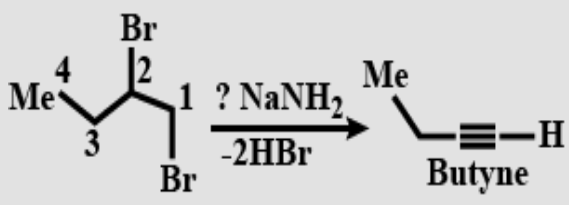
AnswerIn the first step, one mole $\ce{NaNH}_2$ is the base in an elimination reaction to give the alkenyl bromide.
In the second reaction, likewise a second equivalent of $\ce{NaNH}_2$ performs a second elimination reaction to form the alkyne.
For a terminal alkyne, any excess $\ce{NaNH}_2$ will remove the acidic hydrogen from terminal $\ce{C−H}$ and give the alkynyl anion.
So if a terminal alkyne is formed, three equivalents of $\ce{NaNH}_2$ will be consumed; the alkyne is protonated upon workup, usually by adding water.
View full question & answer→MCQ 1191 Mark
Which of the following compounds would have the same vapour pressure?
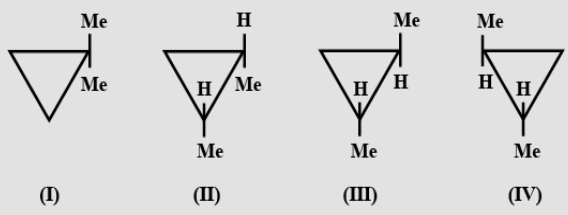
- A
$(I)$ and $(II)$
- B
$(II)$ and $(III)$
- ✓
$(III)$ and $(IV)$
- D
$(II)$ and $(IV)$
AnswerCorrect option: C. $(III)$ and $(IV)$
$(III)$ and $(IV)$ are enantiomers and have the same physical and chemical properties.
So they will have the same vapour pressure.
View full question & answer→MCQ 1201 Mark
When ethene undergoes addition reaction with chlorine, it gives :
AnswerWhen ethene undergoes addition reaction with chlorine, it gives dichloroethane.
$\mathrm{CH}_2=\mathrm{CH}_2+\mathrm{Cl}_2 \rightarrow \mathrm{ClCH}_2-\mathrm{CH}_2 \mathrm{Cl}+\mathrm{H}_2$
View full question & answer→MCQ 1211 Mark
Aromatic hydrocarbons are the derivatives :
AnswerParaffins are alkanes. Aromatic compounds are derivatives of benzene. Aromatic compounds are made from benzene and its derivatives. It is a six $-$ membered ring with three double bonds.
View full question & answer→MCQ 1221 Mark
Methane with the Molecular formula $"\ce{CH_4}"$ has
- ✓
$4$ Covalent bonds
- B
$8$ Covalent bonds
- C
$6$ Covalent bonds
- D
$2$ Covalent bonds
AnswerCorrect option: A. $4$ Covalent bonds
Structure of methane $ \ \ \ \ \ \ \ \ \text{H}\\ \ \ \ \ \ \ \ \ \ |\\\text{H}-\text{C}-\text{H}\\ \ \ \ \ \ \ \ \ \ | \\ \ \ \ \ \ \ \ \ \text{H}$ It has $4$ covalent bonds.
View full question & answer→MCQ 1231 Mark
The $\text{IUPAC}$ name of $\text{CH}_2=\text{C}-\text{CH}_3\\ \ \ \ \ \ \ \ \ \ \ \ \ \ \ |\\ \ \ \ \ \ \ \ \ \ \ \ \ \ \text{CH}_3$ is :
AnswerCorrect option: D. $2-$ methylprop $-1-$ ene.
$\stackrel{{1\ \ \ }}{\hbox{CH}}_2=\stackrel{{2}}{\hbox{C}}-\stackrel{{3\ \ \ }}{\hbox{CH}}_3\\ \ \ \ \ \ \ \ \ \ \ \ \ \ |\\ \ \ \ \ \ \ \ \ \ \ \ \ \text{CH}_3\\ \ \ \ \ \ _{2-\text{methylprop-1-ene}}$
View full question & answer→MCQ 1241 Mark
Ethylidene dichloride is obtained by the reaction of excess of $\text{HCl}$ with.
AnswerAlkenes due to presence of only $1^\circ $ of unsaturation, form only monochloro derivative.
View full question & answer→MCQ 1251 Mark
Which of the following set of functional groups is meta $-$ directing group?
- A
$ -\mathrm{NO}_2,-\mathrm{NH}_2,-\mathrm{COOH},-\mathrm{COOR} $
- ✓
$ -\mathrm{NO}_2,-\mathrm{CHO},-\mathrm{SO}_3 \mathrm{H},-\mathrm{COR}$
- C
$ -\mathrm{CN},-\mathrm{CHO},-\mathrm{NHCOCH}_3,-\mathrm{COOR} $
- D
$ -\mathrm{CN},-\mathrm{NH}_2,-\mathrm{NHR},-\mathrm{OCH}_3 $
AnswerCorrect option: B. $ -\mathrm{NO}_2,-\mathrm{CHO},-\mathrm{SO}_3 \mathrm{H},-\mathrm{COR}$
The groups which direct the incoming group to meta $-$ position are called meta $-$ directing groups. Some examples of meta $-$ directing groups are $-\mathrm{NO}_2,-\mathrm{CN},-\mathrm{CHO},-\mathrm{COR},-\mathrm{COOH},-\mathrm{COOR},-\mathrm{SO}_3 \mathrm{H}$ etc.
View full question & answer→MCQ 1261 Mark
Number of $\sigma-$bonds and $\pi-$bonds present in
 is:
is: - ✓
|
|
$\sigma-\text{bond}$
|
$\pi-\text{bond}$
|
|
(a)
|
17
|
4
|
- B
- C
- D
AnswerCorrect option: A.
|
|
$\sigma-\text{bond}$
|
$\pi-\text{bond}$
|
|
(a)
|
17
|
4
|
A single bond is always a $\sigma-\text{bond}$ and a double bond contains one $\sigma$ and one $\pi-\text{bond}.$
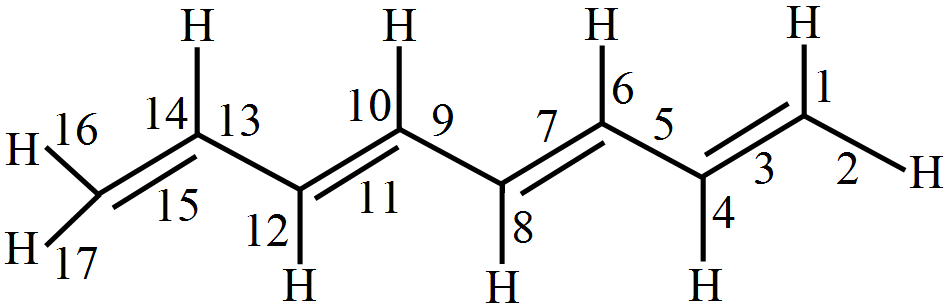
Hence, $17\sigma-\text{bonds}$ are present.

Hence, $4\pi-\text{bonds}$ are present. View full question & answer→MCQ 1271 Mark
Arrange the following in decreasing order of their boiling points.
- $n-$ butane.
- $2-$ methylbutane.
- $n-$ pentane.
- $2, 2-$ dimethylpropane.
- A
$\text{A > B > C > D}.$
- B
$\text{B > C > D > A}.$
- C
$\text{D > C > B > A}.$
- ✓
$\text{C > B > D > A}.$
AnswerCorrect option: D. $\text{C > B > D > A}.$
Boiling point is directly proportional to molar mass and surface area. It decreases on branching because surface area decreases.
Hence, $n-$ pentane has the highest and $n-$ butane has the lowest boiling points and in rest two branching is there, therefore, $2-$ methyl butane has higher boiling point than $2, 2-$ dimethylpropane.
View full question & answer→MCQ 1281 Mark
Alkane with more boiling point is :
- A
$\mathrm{C}_2 \mathrm{H}_6$
- B
$\mathrm{C}_4 \mathrm{H}_{10}$
- C
$\mathrm{C}_5 \mathrm{H}_{12}$
- ✓
$\mathrm{C}_6 \mathrm{H}_{14}$
AnswerCorrect option: D. $\mathrm{C}_6 \mathrm{H}_{14}$
Alkane with the maximum molar mass $($and hence maximum vandewaal's forces of attraction between the molecules$)$ has the maximum boiling point.
View full question & answer→MCQ 1291 Mark
The reaction of one mol of bromine with ethyne yields :
- A
$ \mathrm{BrCH}_2-\mathrm{CH}_2 \mathrm{Br} $
- ✓
$ \mathrm{BrCH}=\mathrm{CHBr} $
- C
$ \mathrm{Br}_2 \mathrm{CH}-\mathrm{CHBr}_2 $
- D
$ \mathrm{CH}_3-\mathrm{CH}_2 \mathrm{Br} $
AnswerCorrect option: B. $ \mathrm{BrCH}=\mathrm{CHBr} $
Halogens, especially chlorine and bromine on reaction with alkynes readily produces tetra $-$ halogen derivatives of alkane. The reaction is carried out in inert solvent like carbon tetrachloride.
Due to the presence of two $n-$ bonds, each molecule of the alkyne can react with two molecules of the halogen.
One mole of Bromine with ethyne gives $1, 2-$ dibromoethene.
View full question & answer→MCQ 1301 Mark
Polynuclear hydrocarbons are formed by an incomplete process of organic materials. This process is termed as :
MCQ 1311 Mark
On passing vapours of phenol over heated zinc dust it gets reduced to :
MCQ 1321 Mark
The aromatic compound among the following is :
AnswerA planar cyclic molecule having $(4n+ 2)$ electrons is generally aromatic.
Thus, all given options because of the presence of $6\pi$ electrons are aromatic.
View full question & answer→MCQ 1331 Mark
Soda lime is a mixture of :
AnswerCorrect option: C. $\ce{NaOH + CaO}$
Soda lime $= \ce{NaOH + CaO}$
View full question & answer→MCQ 1341 Mark
Potassium acetate on Koble's electrolysis produces :
- A
$\mathrm{C}_2 \mathrm{H}_4$
- B
$\mathrm{CH}_4$
- ✓
$\mathrm{C}_2 \mathrm{H}_6$
- D
$\mathrm{C}_3 \mathrm{H}_8$
AnswerCorrect option: C. $\mathrm{C}_2 \mathrm{H}_6$
$\mathrm{RCOOK} / \mathrm{Na}$ on electrolysis yields $\mathrm{R}-\mathrm{R}+\mathrm{CO}_2+\mathrm{NaOH}+\mathrm{H}_2$.
View full question & answer→MCQ 1351 Mark
Which of the following is the most stable cycloalkane?
AnswerSix membered rings are the most stable. As the ring size decreases the stability decreases. This stability of the six $-$ membered ring is due to the chair conformation of cyclohexane as shown in the figure.
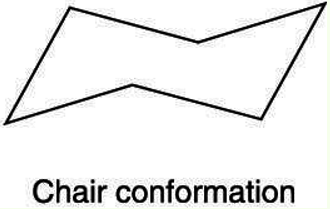
Step $1 :$ Identification of ring size in each option
Cyclopropane : three $-$ membered ring.
Cyclobutane : four $-$ membered ring.
Cyclopentane : five $-$ membered ring.
Cyclohexane : Six membered ring.
Step $2 :$ So stability order will be $\text{D > C > B > A}.$ View full question & answer→MCQ 1361 Mark
Nodal planes of $\pi$ bonds in benzene are located in :
- ✓
- B
One in a molecular plane and two in a plane perpendicular to the molecular plane which contains $\text{C C}$ one in the molecular plane and two in the plane perpendicular to the molecular plane which contains $C$ Cone in the molecular plane and two in plane perpendicular to molecular plane which contains $\text{C C} \sigma$ bonds.
- C
One in molecular plane and two in plane perpendicular to molecular plane which contain $\text{C C} \sigma$ bond and $\text{C - H} \sigma$ bond.
- D
Perpendicular to molecular plane which bisect benzene ring in two equal half.
AnswerNodal planes of $\pi$ bonds in benzene are located in the molecular plane.
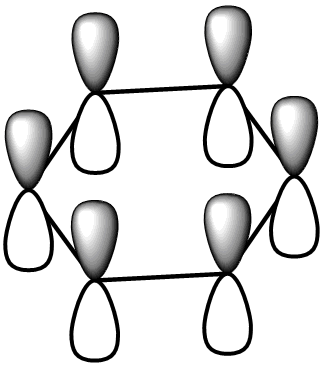
View full question & answer→MCQ 1371 Mark
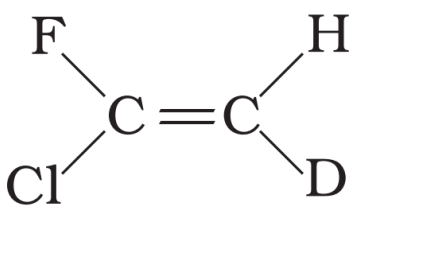
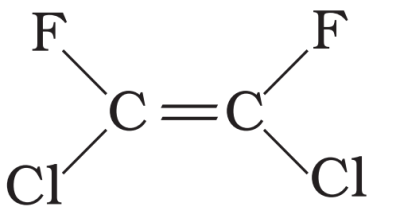
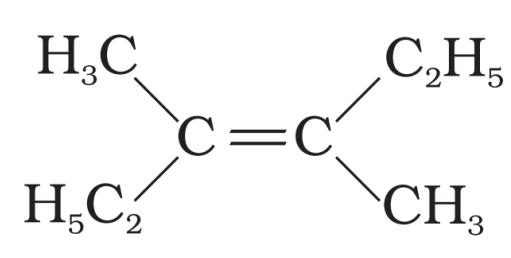
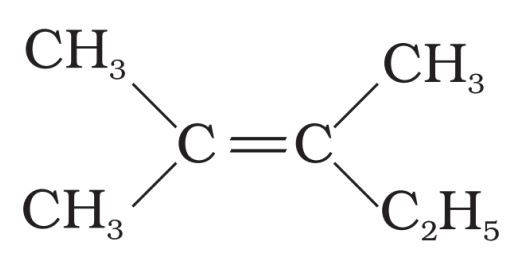
Which of the following has higher dipole moment; cis $-2-$ butene and trans $-2-$ butene?
- ✓
Cis $-$ but $-2-$ ene.
- B
Trans $-$ but $-2-$ ene.
- C
Both have same dipole moment.
- D
AnswerCorrect option: A. Cis $-$ but $-2-$ ene.
Cis form of alkene is found to be more polar than the transform. e.g. dipole moment of cis $-$ but $-2-$ ene is $0.33$ Debye, whereas, dipole moment of the transform is almost zero or it can be said that trans $-$ but $-2-$ ene is non $-$ polar.
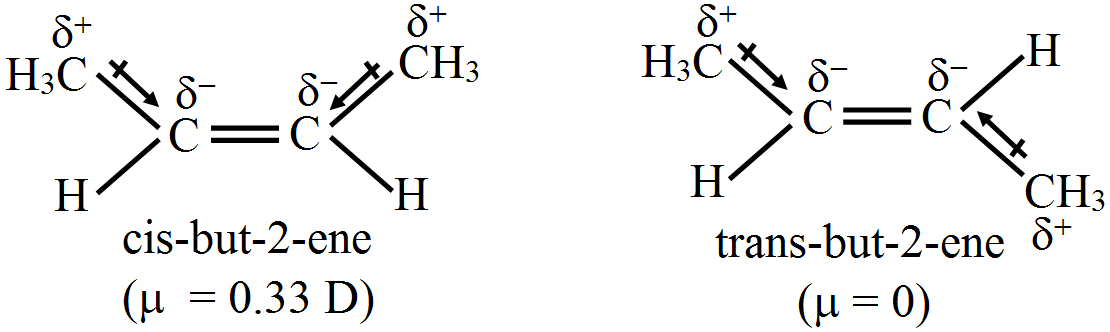
View full question & answer→MCQ 1381 Mark
Torsional strain in eclipsed conformations of a molecule is due to :
AnswerCorrect option: B. Repulsion between aligned electron pairs of the eclipsed bond.
The eclipsed bonds are parallel to each other facing repulsions due to aligned electron pairs in the bonds.
View full question & answer→MCQ 1391 Mark
Which of the following having delocalised electrons?
AnswerPresence of delocalised $\pi$ electrons is characteristic of aromatic compounds.
Benzene is an aromatic compound having 6 delocalised electrons.
View full question & answer→MCQ 1401 Mark
The molecules having dipole moment are $ ...........$
- A
$2, 2-$ Dimethylpropane.
- ✓
Trans $-$ Pent $-2-$ ene.
- C
Cis $-$ Hex $-3-$ ene.
- D
$2, 2, 3, 3 -$ Tetramethylbutane.
AnswerCorrect option: B. Trans $-$ Pent $-2-$ ene.
Trans $-$ pent $-2-$ ene shows net dipole moment because of different groups attached and cis $-$ Hex $-3-$ ene shows dipole moment because of $\mathrm{C}_2 \mathrm{H}_5$ groups are inclined to each other at an angle of $60^\circ$ so, has resultant dipole moment.
View full question & answer→MCQ 1411 Mark
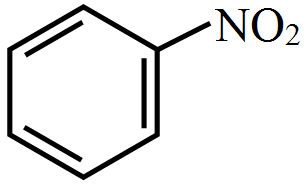
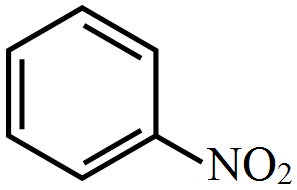
Answer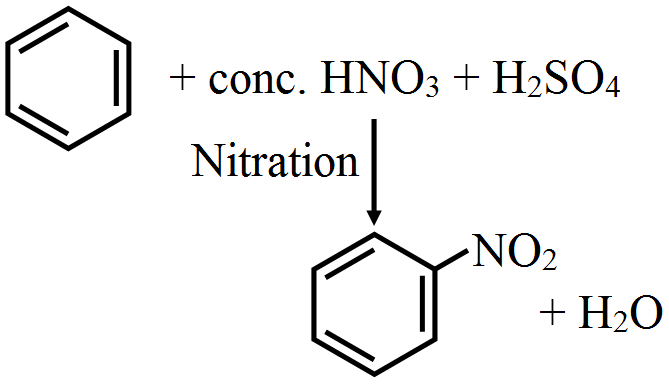
Options $(a), (b)$ and $(c)$ are same molecule, i.e. nitrobenzene. View full question & answer→MCQ 1421 Mark
Mark the incorrect statement from the following.
- A
Benzene has a planar structure.
- ✓
Benzene is an unsaturated hydrocarbon and shows addition reactions like alkenes.
- C
In benzene carbon uses two p-orbitals for hybridisation.
- D
Aromatic hydrocarbons contain high percentage of carbon hence burn with sooty flame.
AnswerCorrect option: B. Benzene is an unsaturated hydrocarbon and shows addition reactions like alkenes.
The statement given in the second option is incorrect.
Benzene can show both additions as well substitution reaction. It does not show an addition reaction like alkene.
This is because, if it shows an addition reaction like alkene, then it will lose its aromaticity and become less stable.
View full question & answer→MCQ 1431 Mark
On heating sodium propionate with sodalime the hydrocarbon obtained is :
AnswerSodium propionate reacts with soda lime $\ce{(NaOH + CaO)}$ to form ethane.
View full question & answer→MCQ 1441 Mark
$\mathrm{CH}_3-\mathrm{C} \equiv \mathrm{C} \ \text{MgBr}$ can be prepared by the reaction of $ ..........$
- A
$\mathrm{CH}_3-\mathrm{C} \equiv \mathrm{C}-\mathrm{Br}$ with $\mathrm{MgBr}_2$
- B
$\mathrm{CH}_3-\mathrm{C} \equiv \mathrm{CH}$ with $\mathrm{MgB}_2$
- C
$\mathrm{CH}_2-\mathrm{C} \equiv \mathrm{CH}$ with $\text{KBr}$ and $\text{Mg}$ metal
- ✓
$\mathrm{CH}_3-\mathrm{C} \equiv \mathrm{CH}$ with $\mathrm{CH}_3 \mathrm{MgBr}$
AnswerCorrect option: D. $\mathrm{CH}_3-\mathrm{C} \equiv \mathrm{CH}$ with $\mathrm{CH}_3 \mathrm{MgBr}$
$\mathrm{CH}_3-\mathrm{C} \equiv \mathrm{C}-\mathrm{H}+\mathrm{CH}_3 \mathrm{MgBr} \rightarrow \mathrm{CH}_3-\mathrm{C} \equiv \mathrm{CMgBr}+\mathrm{CH}_4$.
View full question & answer→MCQ 1451 Mark
Addition to an alkyne is a :
AnswerAddition to an alkyne is a two $-$ stage process.
alkyne $\rightarrow $ alkene $\rightarrow $ alkane
View full question & answer→MCQ 1461 Mark
Examples of addition reactions include all but one of the following. Which is the odd one out?
AnswerCombustion reaction involves the complete burning of a compound in the presence of excess of oxygen to give carbon dioxide and water.
Whereas addition reaction involves the addition of smaller molecules across the double bond to give the addition product.
View full question & answer→MCQ 1471 Mark
Which of the following exhibit geometrical isomerism?
AnswerCorrect option: C. But $-2-$ ene.
View full question & answer→MCQ 1481 Mark
A direct iodination of benzene is not possible because :
AnswerCorrect option: B. Resulting $\mathrm{C}_6 \mathrm{H}_5 \mathrm{I}$ is reduced to $\mathrm{C}_6 \mathrm{H}_6$ by $\text{HI}.$
The direct iodination reaction of benzene is, $\mathrm{C}_6 \mathrm{H}_6+\mathrm{I}_2 \rightleftharpoons \mathrm{C}_6 \mathrm{H}_5 \mathrm{I}+\mathrm{HI}$
This reaction is a reversible reaction. The product $\ce{HI}$ reacts with iodobenzene to get back benzene.
Hence, direct iodination of benzene is not possible because the product $\ce{C_6H_5 I}$ is reduced by $\ce{HI}.$
View full question & answer→MCQ 1491 Mark
Addition of cold conc. $\mathrm{H}_2 \mathrm{SO}_4$ with alkenes is an example of :
- A
Electrophilic substitution reaction.
- B
Nucleophilic substitution reaction.
- ✓
Electrophilic addition reaction.
- D
Nucleophilic addition reaction.
AnswerCorrect option: C. Electrophilic addition reaction.
View full question & answer→MCQ 1501 Mark
Metal carbides on reaction with $\mathrm{H}_2 \mathrm{O}$ forms $\ce{CH_4}$.Carbide can be :
AnswerCorrect option: C. $\mathrm{Be}_2 \mathrm{C}$
Different metal carbides react with $\mathrm{H}_2 \mathrm{O}$, give the following compounds.
$ \mathrm{Be}_2 \mathrm{C}(\mathrm{s})+4 \mathrm{H}_2 \mathrm{O}(\mathrm{l}) \rightarrow 2 \mathrm{Be}(\mathrm{OH})_2(\mathrm{~s})+\mathrm{CH}_4(\mathrm{~g})$
$ \mathrm{CaC}_2+2 \mathrm{H}_2 \mathrm{O} \rightarrow \mathrm{C}_2 \mathrm{H}_2+\mathrm{Ca}(\mathrm{OH})_2 $
$ \mathrm{Mg}_3 \mathrm{C}_2+4 \mathrm{H}_2 \mathrm{O} \rightarrow 2 \mathrm{Mg}(\mathrm{OH})_2+\mathrm{C}_3 \mathrm{H}_4$
Here, beryllium carbide is a metal carbide that forms methane.
View full question & answer→MCQ 1511 Mark
The correct $\text{IUPAC}$ name of the following alkane is :
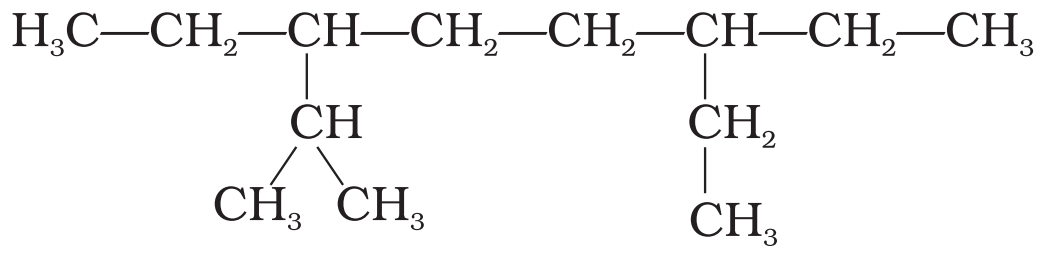
- ✓
$3, 6 –$ Diethyl $– 2 –$ methyloctane.
- B
$5 –$ Isopropyl $– 3 –$ ethyloctane.
- C
$3 –$ Ethyl $– 5 –$ isopropyloctane.
- D
$3 –$ Isopropyl $– 6 –$ ethyloctane.
AnswerCorrect option: A. $3, 6 –$ Diethyl $– 2 –$ methyloctane.
$\ \ \ \ \ \ \ \ \ \ \ \ \ \ \ \ \ \ \ \ \ \ \ \ \ \ \ \ 3\ \ \ \ \ \ \ \ \ \ 4\ \ \ \ \ \ \ \ \ \ 5\ \ \ \ \ \ \ \ \ \ 6\ \ \ \ \ \ \ \ \ \ 7\ \ \ \ \ \ \ \ \ \ 8\\\text{H}_3\text{C}\ \ -\ \text{CH}_2-\text{CH}-\text{CH}_2-\text{CH}_2-\text{CH}-\text{CH}_2-\text{CH}_3\\ \ \ \ \ \ \ \ \ \ \ \ \ \ \ \ \ \ \ \ \ \ \ \ \ \ \ \ \ \ |\ \ \ \ \ \ \ \ \ \ \ \ \ \ \ \ \ \ \ \ \ \ \ \ \ \ \ \ \ \ \ \ \ \ \ |\\\ \ \ \ \ \ \ \ \ \ \ \ \text{CH}_3-\ ^2\text{CH}\ \ \ \ \ \ \ \ \ \ \ \ \ \ \ \ \ \ \ \ \ \ \ \ \ \ \ \ \ \ \ \text{CH}_2\\\ \ \ \ \ \ \ \ \ \ \ \ \ \ \ \ \ \ \ \ \ \ \ \ \ \ \ \ |\ \ \ \ \ \ \ \ \ \ \ \ \ \ \ \ \ \ \ \ \ \ \ \ \ \ \ \ \ \ \ \ \ \ \ \ |\\\ \ \ \ \ \ \ \ \ \ \ \ \ \ \ \ \ \ \ \ \ \ \ \ \ ^1\text{CH}_3\ \ \ \ \ \ \ \ \ \ \ \ \ \ \ \ \ \ \ \ \ \ \ \ \ \ \ \ \ \ \text{CH}_3\\\ \ \ \ \ \ \ \ \ \ \ \ \ \ \ \ \ \ \ \ \ \ \ 3,6-\text{Diethyl}-2-\text{methyloctane}$
View full question & answer→MCQ 1521 Mark
Which of the following is not a cumulated diene?
- A
Hexa $−1, 2−$ diene
- B
Hexa $−2, 3−$ diene
- C
Penta $−2, 3−$ diene
- ✓
Penta $−1, 3−$ diene
AnswerCorrect option: D. Penta $−1, 3−$ diene
View full question & answer→MCQ 1531 Mark
How many chain isomers can be formed by butane?
MCQ 1541 Mark
The addition of $\text{HBr}$ to $1-$ butene gives a mixture of products $A, B$ and $C$ The mixture consists of :
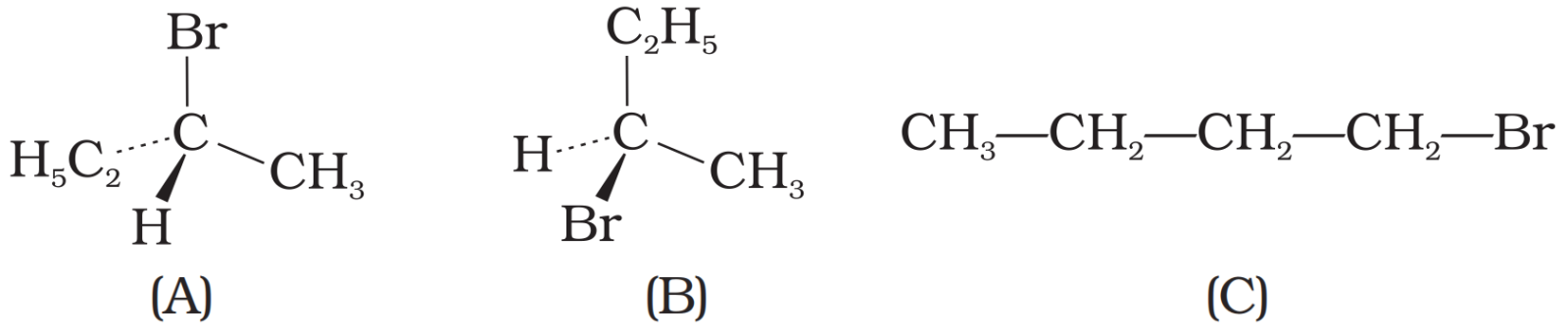
- ✓
$A$ and $B$ as major and $C$ as minor products.
- B
$B$ as major, $A$ and $C$ as minor products.
- C
$B$ as minor, $A$ and $C$ as major products.
- D
$A$ and $B$ as minor and $C$ as major products.
AnswerCorrect option: A. $A$ and $B$ as major and $C$ as minor products.
The alkene is unsymmetrical, hence will follow Markovnikov rule to give major product.
$\text{CH}_3-\text{CH}_2-\text{CH}=\text{CH}_2+\text{H}-\text{Br}\rightarrow\text{CH}_3-\text{CH}_2-\text{CHBr}-\text{CH}_3+\\\ \ \ \ \ \ \ \ \ \ 1-\text{Butene}\ \ \ \ \ \ \ \ \ \ \ \ \ \ \ \ \ \ \ \ \ \ \ \ \ \ \ \ \ \ \ \ \ \ \ \ \ \ \ \ \ \ \ \ \ \ \ \ \ \text{I (major product)}\\ \\ \ \ \ \\ \ \ \ \ \ \ \ \ \ \ \ \ \ \ \ \text{Br}\\ \ \ \ \ \ \ \ \ \ \ \ \ \ \ \ \ |\\\text{C}_2\text{H}_5-\text{C}^*-\text{CH}_3 \ \ \ \ \ \ \ \ \ \ \ +\text{CH}_3-\text{CH}_2-\text{CH}_2-\text{CH}_2\text{Br}\\ \ \ \ \ \ \ \ \ \ \ \ \ \ \ \ | \ \ \ \ \ \ \ \ \ \ \ \ \ \ \ \ \ \ \ \ \ \ \ \ \ \ \ \ \ \ \ \ \ \ \ \ \ \ \ \ \ \ \ \ \text{(C) (minor product)}\\ \ \ \ \ \ \ \ \ \ \ \ \ \ \ \text{H}\\ \ \ \ \ \ \ \ \ \ \ \ \ \ \text{(I)}$
Since $I$ contains a chiral carbon, it exists in two enantiomers $(A$ and $B)$ which are mirror image of each other.
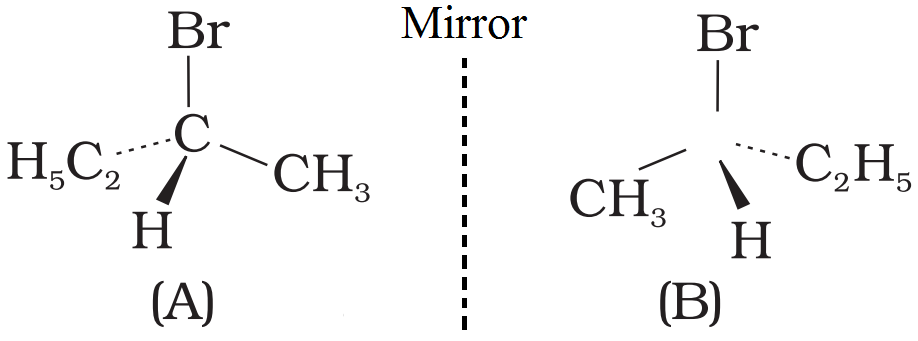
View full question & answer→MCQ 1551 Mark
The percentage of isomers formed during monobromination of $2,3−$ dimethyl butane at room temperature relative to $\text{1, 2, 3 H}$ atoms to chlorination is $(1.0 : 3.8 : 5.0):$
- A
$81\%$
- B
$56\%$
- C
$15\%$
- ✓
$22\%$
AnswerCorrect option: D. $22\%$
$(A)$ is obtained from the reaction of $12$ equivalent $\text{1 H}$ atoms.
$(B)$ is obtained from the reaction of two equivalent $\text{3 H}$ atoms.
Percentage of $(A) = \frac{12 \times 100}{33} = 54.5\%$
Percentage of $(B) = \frac{10 \times 100}{22} = 45.5$
$12 \times 1 = 12.0$
$2 \times 5 = 10.0$
Total $= 22.0$
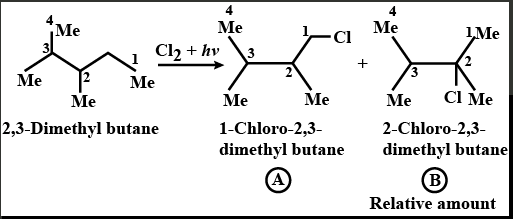
View full question & answer→MCQ 1561 Mark
Cycloalkanes are isomeric with :
MCQ 1571 Mark
Calcium heptane dioate on distillation produces :
AnswerCalcium salts of saturated dicarboxylic acids on heating give corresponding cyclic ketones.
The Clemmenson reduction of cyclic ketones results in the formation of corresponding cycloakanes.
The reaction is best used for the synthesis of cyclopentane, cyclohexane, and cycloheptane.
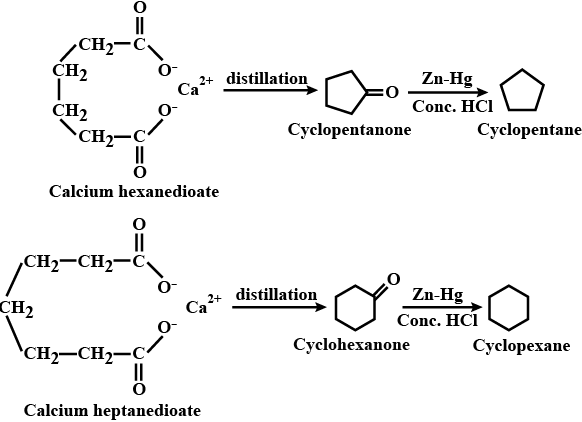
View full question & answer→MCQ 1581 Mark
$C- H$ bond type in benzene is :
- A
$\sigma\ sp−s$
- ✓
$\sigma \ sp^2−s$
- C
$\sigma\ sp^3−s$
- D
$\sigma\ p−p$
AnswerCorrect option: B. $\sigma \ sp^2−s$
In benzene molecule, six carbon atoms are in $sp^2$ hybridization and hydrogen atoms have pure $'s\ '$ orbitals. Overlap is $sp^2−s$ overlap with formation of a sigma bond.
View full question & answer→MCQ 1591 Mark
An optically active hydrocarbon $(X)$ on catalytic hydrogenation gives an optically inactive compound $(Y),$
$\mathrm{C}_6 \mathrm{H}_{14}$. The hydrocarbon $(X)$ is $-$
AnswerCorrect option: A. $3-$ methyl $-1-$ pentene
The optically active hydrocarbon $X$ is $3-$ methyl $-1-$ pentene $\mathrm{CH}_2=\mathrm{CH}-\mathrm{CH}\left(\mathrm{CH}_3\right) \mathrm{CH}_2 \mathrm{CH}_3$.
On catalytic hydrogenation, it forms, $3-$ methyl pentane $\mathrm{CH}_3 \mathrm{CH}_2 \mathrm{CH}\left(\mathrm{CH}_3\right) \mathrm{CH}_2 \mathrm{CH}_3$, which is optically inactive.
View full question & answer→MCQ 1601 Mark
The reaction of propene with $\text{HBr}$ in presence of peroxide proceeds through the intermediate :
- A
$\text{CH}_3-{\stackrel{{\bullet}}{\ \hbox{ CH}}}-\text{CH}_3$
- ✓
$\text{CH}_3-{\stackrel{{\bullet}}{\ \hbox{ CH}}}-\text{CH}_2\text{Br}$
- C
$\ \ \ \ \ \ \ \ \ \ \ \ \ \text{Br}\\ \ \ \ \ \ \ \ \ \ \ \ \ \ |\\\text{CH}_3-\text{CH}-{\stackrel{{\bullet}}{\ \hbox{ CH}}}_2$
- D
$\text{CH}_3-\text{CH}_2-{\stackrel{{\bullet}}{\ \hbox{ CH}}}_2$
AnswerCorrect option: B. $\text{CH}_3-{\stackrel{{\bullet}}{\ \hbox{ CH}}}-\text{CH}_2\text{Br}$
$\text{CH}_3-\text{CH}=\text{CH}_2+{\stackrel{{\bullet}}{\ \hbox{ Br}}}\rightarrow\text{CH}_3-{\stackrel{{\bullet}}{\ \hbox{ CH}}}-\text{CH}_2\text{Br}$
$\because 2^\circ$ free radical is more stable.
View full question & answer→MCQ 1611 Mark
$\text{IUPAC}$ name of the first member of alkyne is $ .........$
AnswerAlkynes are carbon compounds with general formula $\mathrm{CnH}_{2 n-2}$
The first member of alkyne series is $\mathrm{C}_2 \mathrm{H}_2 \ ($ethyne$)$
$\mathrm{H}-\mathrm{C} \equiv \mathrm{C}-\mathrm{H}$
Alkyne series : $\mathrm{C}_2 \mathrm{H}_2, \mathrm{C}_3 \mathrm{H}_4, \mathrm{C}_4 \mathrm{H}_6, \mathrm{C}_5 \mathrm{H}_8$.
View full question & answer→MCQ 1621 Mark
The geometry of ethyne molecule is :
MCQ 1631 Mark
$2.84\ \text{gms}$ of methyl iodide was completely converted into $\ce{CH_3MgI}$ and the product was decomposed by the excess of ethanol. The volume of the gaseous hydrocarbon produced at $\ce{NTP}$ will be $ .........$
- A
$22.4$ lit.
- B
$2240$ lit.
- ✓
$0.448$ lit.
- D
$224$ lit.
AnswerCorrect option: C. $0.448$ lit.
In this reaction, one mole of Grignard reagent reacts with one mole of alcohol to produce hydrocarbon.
$\mathrm{CH}_3 \mathrm{I} \rightarrow \mathrm{CH}_3 \mathrm{MgI}+\mathrm{C}_2 \mathrm{H}_5 \mathrm{OH} \rightarrow \mathrm{CH}_4+\mathrm{C}_2 \mathrm{H}_5 \mathrm{OMgI}$
Mass of methyl iodide $= 2.84 \text{ gm}\ ($given$)$
No. of mole of methyl iodide $=\frac{2.84}{142 } = 0.02$
So hydrocarbon produced $= 0.02$ mole
So the volume of produced hydrocarbon $= 0.448$ lit
$($one mole produced $22.4$ lit$).$
View full question & answer→MCQ 1641 Mark
What are A and B in following reaction? $ \ \ \ \ \ \ \ \ \ \ \ \ \ \text{H}\\ \ \ \ \ \ \ \ \ \ \ \ \ \ |\\\text{H}_2\text{C}-\text{C}-\text{H}+\text{KOH}\xrightarrow{\text{Alcohol}}\text{A}\xrightarrow{\text{NaNH}_2}\text{B}\\ \ \ \ \ \ \ | \ \ \ \ \ \ |\\ \ \ \ \ \ \text{Br} \ \ \ \text{Br}$
- A
|
|
A
|
B
|
| (a) |
$\text{H}_2\text{C}=\text{CH}_2$ |
$\text{CH}\equiv\text{CH}$ |
- ✓
| (b) |
$\text{CH}_2=\text{CHBr}$ |
$\text{CH}\equiv\text{CH}$ |
- C
| (c) |
$\text{CH}_2=\text{CHBr}$ |
$\text{CH}_2=\text{CH}_2$ |
- D
| (d) |
$\text{CH}_2=\text{CH}_2$ |
$\text{CH}\equiv\text{CBr}$ |
AnswerCorrect option: B.
| (b) |
$\text{CH}_2=\text{CHBr}$ |
$\text{CH}\equiv\text{CH}$ |
|
(b)
|
$\text{CH}_2=\text{CHBr}$
|
$\text{CH}\equiv\text{CH}$ |
View full question & answer→MCQ 1651 Mark
Which one of the following is the most important halogen in terms of preparation of halogen derivatives of alkane?
MCQ 1661 Mark
Which of the following compounds will exhibit geometrical isomerism?
- A
$2-$ Phenyl $-1-$ butene.
- B
$1, 1-$ Diphenyl propane.
- ✓
$1-$ Phenyl $-2-$ butene.
- D
$3-$ phenyle butane.
AnswerCorrect option: C. $1-$ Phenyl $-2-$ butene.
View full question & answer→MCQ 1671 Mark
The bond order of individual carbon $-$ carbon bonds in benzene is :
AnswerBenzene is a resonance hybrid of two resonating structures. Bon dorder can be calculated as :
$\text{Bond Order}=\frac{\text{Number of Resonating bonds}}{\text{Number of resonating structures}}=\frac{3}{2}=1.5$
The correct answer is between one and two.
View full question & answer→MCQ 1681 Mark
In which of the following, all atoms are coplanar?
Answer$\because$ All $'C\ ' $ are $sp^2$ hybridised, all lie in one plane.
View full question & answer→