Question 12 Marks
Expand the following:
$\Big(\frac{1}{\text{x}}+\frac{\text{y}}{3}\Big)^3$
Answer$\Big(\frac{1}{\text{x}}+\frac{\text{y}}{3}\Big)^3=\Big(\frac{1}{\text{x}}\Big)^3 + \Big(\frac{\text{y}}{3}\Big)^3 + 3\Big(\frac{1}{\text{x}}\Big)\Big(\frac{\text{y}}{3}\Big)\Big(\frac{1}{\text{x}}+\frac{\text{y}}{3}\Big)$
${\left[\text { Using identity, }(a-b)^3=a^3-b^3+3 a(-b)(a-b)\right]}$
$=\frac{1}{x^3}+\frac{y^3}{27}+\frac{y}{x}=\left(\frac{1}{x}+\frac{y}{3}\right)$
$=\frac{1}{x^3}+\frac{y^3}{27}+\frac{y}{x^2}+\frac{y^2}{3 x}$
View full question & answer→Question 22 Marks
If $a, b, c$ are all non-zero and $a+b+c=0$, prove that $\frac{a^2}{b c}+\frac{b^2}{c a}+\frac{c^2}{a b}=3$.
AnswerWe have $a, b, c$ are all non-zero and $a+b+c=0$, therefore
$a^3+b^3+c^3=3 a b c$
Now, $\frac{\mathrm{a}^2}{\mathrm{bc}}+\frac{\mathrm{b}^2}{\mathrm{ca}}+\frac{\mathrm{c}^2}{\mathrm{ab}}=\frac{\mathrm{a}^3+\mathrm{b}^3+\mathrm{c}^3}{\mathrm{abc}}=\frac{3 \mathrm{abc}}{\mathrm{abc}}=3$
View full question & answer→Question 32 Marks
Factorise the following:
$8\text{p}^3+\frac{12}{5}\text{p}^2+\frac{6}{25}\text{p}+\frac{1}{125}$
Answer$8\text{p}^3+\frac{12}{5}\text{p}^2+\frac{6}{25}\text{p}+\frac{1}{125}$
$=(2\text{p})^3+3\times(2\text{p})^2\times\frac{1}{5}+3\times(2\text{p})\times\Big(\frac{1}{5}\Big)^2+\Big(\frac{1}{5}\Big)^3$
$=\Big(2\text{p}+\frac{1}{5}\Big)^3$
$\left[\right.$ Using identity, $\left.(a-b)^3=a^3-b^3+3 a(-b)(a-b)\right]$
$=\Big(2\text{p}+\frac{1}{5}\Big)\Big(2\text{p}+\frac{1}{5}\Big)\Big(2\text{p}+\frac{1}{5}\Big)$
$=\Big(2\text{p}+\frac{1}{5}\Big)^3$
View full question & answer→Question 42 Marks
Expand the following:
$(3 a-2 b)^3$
Answer$(3 a-2 b)^3=(3 a)^3+(-2 b)^3+3(3 a)(-2 b)(3 a-2 b)$
${\left[\text { Using identity, }(a-b)^3=a^3-b^3+3 a(-b)(a-b)\right]}$
$=27 a^3-8 b^3-18 a b(3 a-2 b)$
$=27 a^3-8 b^3-54 a^2 b+36 a b^2$
$=27 a^3-54 a^2 b+36 a b^2-8 b^3$
View full question & answer→Question 52 Marks
Factorise the following:
$16 x^2+4 y^2+9 z^2-16 x y-12 y z+24 x z$
Answer$16 x^2+4 y^2+9 z^2-16 x y-12 y z+24 x z$
$=(4 x)^2+(-2 y)^2+(3 z)^2+2(4 x)(-2 y)+2(-2 y)(3 z)+2(3 z)(4 x)$
$=\{4 x+(-2 y)+3 z\}^2\left[\therefore a^2+b^2+c^2+2 a b+2 b c+2 c a=(a+b+c)^2\right]$
$=(4 x-2 y+3 z)^2$
$=(4 x-2 y+3 z)(4 x-2 y+3 z)$
View full question & answer→Question 62 Marks
Without finding the cubes, factorise:
$(x-2 y)^3+(2 y-3 z)^3+(3 z-x)^3$
AnswerWe know that,
$a^3+b^3+c^3-3 a b c=(a+b+c)\left(a^2+b^2+c^2-a b-b c-c a\right)$
Also, if $a+b+c=0$, then $a^3+b^3+c^3=3 a b c$
Here, we see that $(x-2 y)+(2 y-3 z)+(3 z-x)=0$
Therefore, $(x-2 y)^3+(2 y-3 z)^3+(3 z-x)^3=3(x-2 y)(2 y-3 z)(3 z-x)$.
View full question & answer→Question 72 Marks
If $\text{p(x)}= \text{x}^2-4\text{x}+3,$ evaluate: $\text{p}(2)-\text{p}(-1)+\text{p}\big(\frac{1}{2}\big).$
AnswerWe have $\text{p(x)}= \text{x}^2-4\text{x}+3$ $\therefore$ $\text{p}(2)-\text{p}(-1)+\text{p}\Big(\frac{1}{2}\Big)$ $=(2^2-4\times2+3)-\big\{(-1)^2-4(-1)+3\big\}+\Big\{\Big(\frac{1}{2}\Big)^2-4\times\frac{1}{2}+3\Big\}$ $=(4-8+3)-(1+4+3)+\Big(\frac{1}{4}-2+3\Big)$ $=-1-8+\frac{5}{4}$ $=-9+\frac{5}{4}=\frac{-36+5}{4}=\frac{-31}{4}$
View full question & answer→Question 82 Marks
Check whether $p(x)$ is a multiple of $g(x)$ or not:
$p(x)=x^3-5 x^2+4 x-3, g(x)=x-2$
Answer$p(x)$ will be a multiple $g(x)$ if $g(x)$ divides $p(x)$.
Now, $g(x)=x-2$ gives $x=2$
$\text { Remainder }=p(2)=(2)^3-5(2)^2+4(2)-3$
$=8-5(4)+8-3=8-20+8-3$
$=-7$
Since remainder $\neq 0$, So $p(x)$ is not a multiple of $g(x)$.
View full question & answer→Question 92 Marks
Without actually calculating the cubes, find the value of:
$\Big(\frac{1}{2}\Big)^3+\Big(\frac{1}{3}\Big)^3-\Big(\frac{5}{6}\Big)^3$
AnswerGiven, $\Big(\frac{1}{2}\Big)^3+\Big(\frac{1}{3}\Big)^3-\Big(\frac{5}{6}\Big)^3$ or $\Big(\frac{1}{2}\Big)^3+\Big(\frac{1}{3}\Big)^3+\Big(-\frac{5}{6}\Big)^3$
Here, we see that, $\frac{1}{2}+\frac{1}{3}-\frac{5}{6}=\frac{3+2-5}{6}=\frac{5-5}{6}=0$
$\therefore \ \Big(\frac{1}{2}\Big)^3+\Big(\frac{1}{3}\Big)^3-\Big(\frac{5}{6}\Big)^3=3\times\frac{1}{2}\times\frac{1}{3}\times\Big(-\frac{5}{6}\Big)=-\frac{5}{12}$
[Using identity, if $a+b+c=0$, then $a^3+b^3+c^3=3 a b c$ ]
View full question & answer→Question 102 Marks
Find the following product:
$\left(x^2-1\right)\left(x^4+x^2+1\right)$
Answer$\left(x^2-1\right)\left(x^4+x^2+1\right)$
$=\left(x^2-1\right)\left\{\left(x^2\right)^2+\left(x^2\right)(1)+(1)^2\right\}$
$=\left(x^2\right)^3-(1)^3$
${\left[\therefore(a+b)\left(a^2-a b+b^2\right)=a^3+b^3\right]}$
$=x^6-1$
View full question & answer→Question 112 Marks
Expand the following:
$(3 a-5 b-c)^2$
Answer$(3 a-5 b-c)^2=(3 a)^2+(-5 b)^2+(-c)^2+2(3 a)^2-5 b+2(-5 b)(-c)+2(-c)(3 a)$
${\left[\therefore a^2+b^2+c^2+2 a b+2 b c+2 c a=(a+b+c)^2\right]}$
$=9 a^2+25 b^2+c^2-30 a b+10 b c+6 c a .$
View full question & answer→Question 122 Marks
Expand the following:
$(4 a-b+2 c)^2$
Answer$(4 a-b+2 c)^2=(4 a)^2+(-b)^2+(2 c)^2+2(4 a)(-b)+2(-b)(2 c)+2(2 c)(4 a)$
${\left[\therefore a^2+b^2+c^2+2 a b+2 b c+2 c a=(a+b+c)^2\right]}$
$=16 a^2+b^2+4 c^2-8 a b-4 a c+16 c a$
View full question & answer→Question 132 Marks
Find the value of: $x^3-8 y^3-36 x y-216$, when $x=2 y+6$
AnswerHere, we see that, $x-2 y-6=0$
$\therefore x^3+(-2 y)^3+(-6)^3=3 x(-2 y)(-6)$
[Using identity, if $a+b+c=0$, then $a^3+b^3+c^3=3 a b c$]
$\Rightarrow x^3-8 y^3-216=36 x y \ldots \text { (i) }$
Now, $x^3-8 y^3-36 x y-216$
$=x^3-8 y^3-216-36 x y$
$=36 x y-36 x y=0[\text { From Eq } \ldots \text { (i) }]$
View full question & answer→Question 142 Marks
By Remainder Theorem find the remainder, when p(x) is divided by $g(x)$, where: $\text{p(x)}=\text{x}^3-6\text{x}^2+2\text{x}-4,$ and $\text{g(x)}=1-\frac{3}{2}\text{x} $
AnswerGiven, $\text{p(x)}=\text{x}^3-6\text{x}^2+2\text{x}-4,$ and $\text{g(x)}=1-\frac{3}{2}\text{x} $
Here, zero of g(x) is $\frac{2}{3}.$ When we divide $p(x)$ by $g(x)$ using remainder theorem,
we get the remainder $\text{p}\big(\frac{2}{3}\big)$
$\therefore =\frac{8}{27}-6\times\frac{4}{9}+2\times\frac{2}{3}-4=\frac{8}{27}-\frac{24}{9}+\frac{4}{3}-4$
$=\frac{8-72+36-108}{27}=\frac{-136}{27}$
Hence, remainder is $\frac{-136}{27}.$
View full question & answer→Question 152 Marks
Factorise:
$a^3-8 b^3-64 c^3-24 a b c$
AnswerWe have,
$a^3-8 b^3-64 c^3-24 a b c$
$=\left\{(a)^3+(-2 b)^3+(-4 c)^3-3(a)(-2 b)(-4 c)\right\}$
$=\{a+(-2 b)+(-4 c)\}\left\{a^2+(-2 b)^2+(-4 c)^2-a(-2 b)-(-2 b)(-4 c)-(-4 c) a\right\}$
${\left[\therefore a^3+b^3+c^3-3 a b c=(a+b+c)\left(a^2+b^2+c^2-a b-b c-c a\right)\right]}$
$=(a+-2 b+-4 c)\left(a^2+4 b^2+16 c^2+2 a b+8 b c+4 c a\right)$
View full question & answer→Question 162 Marks
Factorise the following:
$9 x^2+4 y^2+16 z^2+12 x y-16 y z-24 x z$
Answer$9 x^2+4 y^2+16 z^2+12 x y-16 y z-24 x z$
$=(3 x)^2+(2 y)^2+(-4 z)^2+2(3 x)(2 y)+2(y)(-4 z)+2(-4 z)(3 x)$
$=\{3 x+2 y(-4 z)\}^2\left[\because a^2+b^2+c^2+2 a b+2 b c+2 c a=(a+b+c)^2\right]$
$=(3 x+2 y-4 z) 2=(3 x+2 y-4 z)(3 x+2 y-4 z)$
View full question & answer→Question 172 Marks
Factorise the following:
$25 x^2+16 y^2+4 z^2-40 x y+16 y z-20 x z$
Answer$25 x^2+16 y^2+4 z^2-40 x y+16 y z-20 x z$
$=(-5 x)^2+(4 y)^2+(2 z)^2+2(-5 x)(4 y)+2(4 y)(2 z)+2(2 z)(-5 x)$
$=(-5 x+4 y+2 z)^2$
View full question & answer→Question 182 Marks
By actual division, find the quotient and the remainder when the first polynomial is divided by the second polynomial :
$x^4+1 ; x-1$
AnswerBy acute division, we have
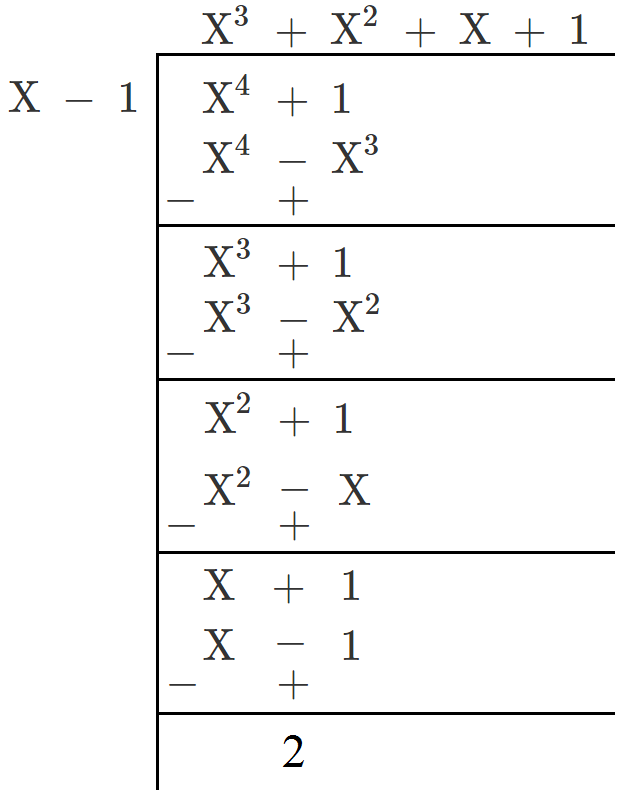
quotient $=x^3+x^2+x+1$
remainder $= 2$ View full question & answer→Question 192 Marks
Factorise the following:
$\Big(2\text{x}+\frac{1}{3}\Big)^2-\Big(\text{x}-\frac{1}{2}\Big)^2$
Answer$\Big(2\text{x}+\frac{1}{3}\Big)^2-\Big(\text{x}-\frac{1}{2}\Big)^2$
$=\Bigg[\Big(2\text{x}+\frac{1}{3}\Big)-\Big(\text{x}-\frac{1}{2}\Big)\Bigg]\Bigg[\Big(2\text{x}+\frac{1}{3}\Big)+\Big(\text{x}-\frac{1}{2}\Big)\Bigg]$
[Using identity, $\mathrm{a}^2-\mathrm{b}^2=(\mathrm{a}-\mathrm{b})(\mathrm{a}+\mathrm{b})$ ]
$=\Big(2\text{x}-\text{x}+\frac{1}{3}+\frac{1}{2}\Big)\Big(2\text{x}+\text{x}+\frac{1}{3}-\frac{1}{2}\Big)$
$=\Big(\text{x}+\frac{2+3}{6}\Big)\Big(3\text{x}+\frac{2-3}{6}\Big)$
$=\Big(\text{x}+\frac{5}{6}\Big)\Big(3\text{x}-\frac{1}{6}\Big)$
View full question & answer→Question 202 Marks
Give possible expressions for the length and breadth of the rectangle whose area is given by $4 a^2+4 a-3$.
Answer$\text { Given, area of rectangle }=4 a^2+6 a-2 a-3$
$=4 a^2+4 a-3[\text { by splitting middle term] }$
$=2 a(2 a+3)-1(2 a+3)=(2 a-1)(2 a+3)$
Hence, possible length $=2 a-1$ and breadth $=2 a+3$
View full question & answer→Question 212 Marks
Find the following product:
$\text{a}^3 - 2\sqrt{2}\text{b}^3$
Answer$\text{a}^3 - 2\sqrt{2}\text{b}^3=(\text{a})^3 - (\sqrt{2}\text{b})^3$
$(\text{a} - \sqrt{2}\text{b})\big\{(\text{a})^2 +(\text{a}) (\sqrt{2}\text{b})+(\sqrt{2}\text{b})^2\big\}$
$\left[\therefore a^3-b^3=(a-b)\left(a^2+a b+b^2\right)\right]$
$(\text{a} - \sqrt{2}\text{b})(\text{a}^2 + \sqrt{2}\text{ab}+2\text{b}^2)$
View full question & answer→Question 222 Marks
Show that:
$x+3$ is a factor of $69+11 x-x^2+x^3$
AnswerLet $p(x)=69+11 x-x^2+x^3, g(x)=x+3$.
$g(x)=x+3=0$ gives $x=-3$
$g(x)$ will be a factor of $p(x)$ if $p(-3)=0$ (Factor theorem)
Now, $p(-3)=69+11(-3)-(-3)^2+(-3)^3$
$=69-33-9-27$
$=0$
Since, $p(-3)=0$, So $g(x)$ is a factor of $p(x)$.
View full question & answer→Question 232 Marks
Factorise:
$1+64 x^3$
AnswerWe have,
$1+64 x^3=(1)^3+(4 x)^3$
$=(1+4 x)\left\{(1)^2-(1)(4 x)+(4 x)^2\right\}$
${\left[\therefore a^3+b^3=(a+b)\left(a^2-a b+b^2\right)\right]}$
$=(1+4 x)\left(1-4 x+16 x^2\right)$
$=(1+4 x)\left(16 x^2-4 x+1\right)$
$=(4 x+1)\left(16 x^2-4 x+1\right)$
View full question & answer→Question 242 Marks
Find the zeroes of the polynomial:
$p(x)=(x-2)^2-(x+2)^2$
AnswerGiven, polynomial is $p(x)=(x-2)^2-(x+2)^2$
For zeroes of polynomial, put $p(x)=0$
$(x-2)^2-(x+2)^2=0$
$(x-2+x+2)(x-2-x-2)=0\left[\right.$ using identity, $\left.a^2-b^2=(a-b)(a+b)\right] \Rightarrow(2 x)(-4)=0$
View full question & answer→Question 252 Marks
Using suitable identity, evaluate the following:
$101 \times 102$
Answer$101 \times 102=(100+1)(100+2)$
Now using identity $(x+a)(x+b)=x^2+(a+b) x+a b$, we have
$(100+1)(100+2)=(100)^2+(1+2) 100+(1)(2)$
$=10000+(3) 100+2=10000+300+2$
$=10302$
View full question & answer→Question 262 Marks
Factorise the following:
$9 x^2-12 x+4$
Answer$9 x^2-12 x+4=(3 x)^2-2(3 x)(2)+(2)^2$
$=(3 x-2)^2\left[\therefore a^2-2 a b+b^2=(a-b)^2\right]$
$=(3 x-2)(3 x-2)$
View full question & answer→Question 272 Marks
Factorise: $2\sqrt{2}\text{a}^3 + 8\text{b}^3 - 27\text{c}^3 + 18\sqrt{2}\text{abc}.$
AnswerWe have, $2\sqrt{2}\text{a}^3 + 8\text{b}^3 - 27\text{c}^3 + 18\sqrt{2}\text{abc}.$ $=\big\{(\sqrt{2}\text{a})^3 + (2\text{b})^3 + (-3\text{c})^3 - 3(\sqrt{2}\text{a})(2\text{b})(-3\text{c})\big\}$ $=\big\{\sqrt{2}\text{a} + 2\text{b} -3\text{c}\big\}\big\{(\sqrt{2}\text{a})^2+(2\text{b})^2+(-3\text{c})^2-(\sqrt{2}\text{a})(2\text{b})-(2\text{b})(-3\text{c})(\sqrt{2}\text{a})\big\}$ $=(\sqrt{2}\text{a} + 2\text{b} -3\text{c})(2\text{a}^2+4\text{b}^2+9\text{c}^2-2\sqrt{2}\text{ab}+6\text{bc}+3\sqrt{2}\text{ca})$
View full question & answer→Question 282 Marks
For what value of m is $x^3-2 m x^2+16$ divisible by $x + 2$ ?
AnswerLet $p(x)=x^3-2 m x^2+16$
Since, $p(x)$ is divisible by $(x+2)$, then remainder $=0$
$P(-2)=0$
$\Rightarrow(-2)^3-2 \mathrm{~m}(-2)^2+16=0$
$\Rightarrow-8-8 \mathrm{~m}+16=0$
$\Rightarrow 8=8 \mathrm{~m}$
$\mathrm{~m}=1$
Hence, the value of $m$ is $1 .$
View full question & answer→Question 292 Marks
Find the following product:
$\Big(\frac{\text{x}}{2}+2\text{y}\Big)\Big(\frac{\text{x}^2}{4}-\text{xy}+4\text{y}^2\Big)$
Answer$\Big(\frac{\text{x}}{2}+2\text{y}\Big)\Big(\frac{\text{x}^2}{4}-\text{xy}+4\text{y}^2\Big)$
$=\Big(\frac{\text{x}}{2}+2\text{y}\Big)\Big\{\Big(\frac{\text{x}}{2}\Big)^2-\Big(\frac{\text{x}}{2}\Big)(\text{2y})+(2\text{y})^2\Big\}$
$=\Big(\frac{\text{x}}{2}\Big)^3+(2\text{y})^3 \left[\therefore(a+b)\left(a^2-a b+b^2\right)=a^3+b^3\right]$
$=\frac{\text{x}}{8}^3+8\text{y}^3$
View full question & answer→Question 302 Marks
Factorise the following:
$9 x^2-12 x+3$
Answer$9 x^2-12 x+3=9 x^2-9 x-3 x+3$
$=9 x(x-1)-3(x-1)$
$=(9 x-3)(x-1)$
$=3(3 x-1)(x-1)$
View full question & answer→Question 312 Marks
By Remainder Theorem find the remainder, when $p(x)$ is divided by $g(x)$, where:
$p(x)=4 x^3-12 x^2+14 x-3, g(x)=2 x-1$
AnswerGiven, $p(x)=4 x^3-12 x^2+14 x-3, g(x)=2 x-1$
Here, zero of $g(x)$ is $\frac{1}{2}$.
When we divide $p(x)$ by $g(x)$ using remainder theorem, we get the remainder $p\left(\frac{1}{2}\right)$
$\therefore \mathrm{p}\left(\frac{1}{2}\right)=4\left(\frac{1}{2}\right)^3-12\left(\frac{1}{2}\right)^2+14\left(\frac{1}{2}\right)-3$
$=4 \times \frac{1}{8}-12 \times \frac{1}{4}+14 \times \frac{1}{2}-3$
Hence, remainder is $\frac{3}{2}$.
View full question & answer→Question 322 Marks
Find the value of: $x^3+y^3-12 x y+64$, when $x+y=-4$
AnswerHere, we see that, $x+y+4=0 \therefore x^3+y^3+(4)^3=3 x y(4)$ [Using identity, if $a+b+c=0$,
then $\left.a^3+b^3+c^3=3 a b c\right]=12 x y \ldots (i)$
Now, $x^3+y^3-12 x y+64=x^3+y^3+64-12 x y=12 x y-12 x y=0[$ From Eq$...(i) ]$
View full question & answer→Question 332 Marks
Using suitable identity, evaluate the following:
$103^3$
Answer$103^3=(100+3)^3$
Now using identity $(a+b)^3=a^3+b^3+3 a b(a+b)$, we have
$(100+3)^3=(100)^3+(3)^3+3(100)(3)(100+3)$
$=1000000+27+900(100+3)$
$=1000000+27+90000+2700$
$=1092727$
View full question & answer→Question 342 Marks
By Remainder Theorem find the remainder, when $p(x)$ is divided by $g(x)$, where: $p(x)=x^3-2 x^2-4 x-1, g(x)=x+1$
AnswerGiven, $p(x)=x^3-2 x^2-4 x-1$ and $g(x)=x+1$ Here, zero of $g(x)$ is $-1$ .
When we divide $p(x)$ by $g(x)$ using remainder theorem,
we get the remainder $p(-1) \therefore p(-1)=(-1)^3-2(-1)^2-4(-1)-1=-1-2+4-1=4-4=0$
Hence, remainder is $0 .$
View full question & answer→Question 352 Marks
Expand the following:
$(-x+2 y-3 z)^2$
Answer$(-x+2 y-3 z)^2=\{(-x)+2 y+(-3 z)\}^2$
$=(-x)^2+(2 y)^2+(-3 z)^2+2(-x)(2 y)+2(2 y)(-3 z)+2(-3 y z)(-x)$
$=x^2+4 y^2+9 z^2-4 x y-12 y z+6 x z$.
View full question & answer→Question 362 Marks
Without actually calculating the cubes, find the value of:
$(0.2)^3-(0.3)^3+(0.1)^3$
AnswerGiven, $(0.2)^3-(0.3)^3+(0.1)^3$ or $(0.2)^3+(-0.3)^3+(0.1)^3$
Here, we see that, $0.2-0.3+0.1=0.3-0.3=0$
$\therefore(0.2)^3-(0.3)^3+(0.1)^3=3 \times(0.2) \times(-0.3) \times(0.1)$
[Using identity, if $a+b+c=0$, then $a^3+b^3+c^3=3 a b c$ ]
$=-0.6 \times 0.003=-0.018$
View full question & answer→Question 372 Marks
By Remainder Theorem find the remainder, when $p(x)$ is divided by $g(x)$, where:
$p(x)=x^3-3 x^2+4 x+50, g(x)=x-3$
AnswerGiven, $p(x)=x^3-3 x^2+4 x+50, g(x)=x-3$
Here, zero of $\mathrm{g}(\mathrm{x})$ is $3 .$
When we divide $p(x)$ by $g(x)$ using remainder theorem, we get the remainder $p(3)$
$\therefore \mathrm{p}(3)=(3)^3-3(3)^2+4(3)+50$
$=27-27+12+50=62$
Hence, remainder is $62 .$
View full question & answer→Question 382 Marks
Expand the following:
$\Big(4-\frac{1}{3{\text{x}}}\Big)^3$
Answer$\Big(4-\frac{1}{3{\text{x}}}\Big)^3=(4)^3+\Big(-\frac{1}{3\text{x}}\Big)^3+ 3(4)\Big(-\frac{1}{3\text{x}}\Big)\Big(4-\frac{1}{3{\text{x}}}\Big)$
[Using identity, $\left.(a-b)^3=a^3-b^3+3 a(-b)(a-b)\right]$
$= 64 - \frac{1}{27\text{x}^3}-\frac{4}{\text{x}}\Big(4-\frac{1}{3\text{x}}\Big)$
$= 64 - \frac{1}{27\text{x}^3}-\frac{16}{\text{x}}+\frac{4}{3\text{x}^2}$
View full question & answer→