Question 13 Marks
For the reaction $2A + B \rightarrow C$, rate of disappearance of A $0.076\ mol\ s ^{–1}.$
- What is the rate of formation of C?
- What is the rate of consumption of B?
- What is the rate of the overall reaction?
AnswerGiven: Rate of disappearance of $A=-\frac{ d [ A ]}{ dt }=0.076 \ mol \ s ^{-1}$
To find:
1. Rate of formation of $C$
2. Rate of consumption of $B$
3. Rate of the overall reaction
Calculation:
Rate of reaction $=-\frac{1}{2} \frac{ d [ A ]}{ dt }=-\frac{ d [ B ]}{ dt }=\frac{ d [ C ]}{ dt }$
Rate of formation of $C =\frac{ d [ C ]}{ dt }=-\frac{1}{2} \frac{ d [ A ]}{ dt }$
$ =\frac{1}{2} \times 0.076 mol s ^{-1}$
$=0.038 mol s ^{-1} $
Rate of consumption of $B =-\frac{ d [ B ]}{ dt }=-\frac{1}{2} \frac{ d [ A ]}{ dt }$
$=\frac{1}{2} \times 0.076 \ mol\ s ^{-1}$
$=0.038 \ mol\ s ^{-1}$
$\text { Rate of reaction }=\frac{ d [ C ]}{ dt }= 0 . 0 3 8 mol s ^{-1}$
1. Rate of formation of $C= 0 . 0 3 8 m o l ~ s ^{- 1 }$
2. Rate of consumption of $B= 0 . 0 3 8 ~ m o l ~ s ^{- 1 }$
3. Rate of the overall reaction $= 0 . 0 3 8 ~ m o l ~ s ^{-1}$
View full question & answer→Question 23 Marks
Write a mathematical formula for mole ratio. How long will it take to produce $2.415g$ of Ag metal from its salt solution by passing a current of $3A$? Molar mass of $Ag= 107.9\ g\ mol^{-1}$.
AnswerA mathematical formula for mole ratio:
Mole ratio $=\frac{\text { Moles of product formed in half-reaction }}{\text { Moles of electrons required in half-reaction }}$
Given: Mass of silver deposited $( W )=2.415 g$, Current $( I )=3 A$, Molar mass of silver $=107.9 g mol ^{-1}$
To find: Time ( $t$ )
Formulae:
1. Mole ratio $=\frac{\text { Moles of product formed in half-reaction }}{\text { Moles of electrons required in half-reaction }}$
2. $W =\frac{ I ( A ) \times t ( s )}{96500\left( C / mole e ^{-}\right)} \times$mole ratio $\times$molar mass
Calculation:
Stoichiometry:
$\operatorname{Ag}_{( aq )}^{+}+ e ^{-} \longrightarrow \operatorname{Ag}_{( s )}$
Using formula (1),
Mole ratio $=\frac{1 mol }{1 mole \ e ^{-}}$
Using formula (2),
$ W =\frac{ I ( A ) \times t ( s )}{96500\left( C / mole e ^{-}\right)} \times \text {mole ratio } \times \text { molar mass of } Ag$
$2.415 g ^{\prime}=\frac{3 A \times t }{96500\left( C / mol ^{-}\right)} \times \frac{1 mol }{1 mole ^{-}} \times 107.9 g mol ^{-1}$
$t =\frac{2.415 \times 96500( C =A s )}{3 A \times 107.9}=720 s =12 min . $
Time taken to produce $2.415 g$ of $Ag$ at the cathode is $1 2 \sim m i n$.
View full question & answer→Question 33 Marks
For a zero-order reaction, molecularity can never be equal to zero. Explain.
Answer - The order of a chemical reaction is experimentally determined. Hence, the order can be zero.
- Molecularity refers to how many reactant molecules are involved in reactions.
- The number of molecules in any reaction cannot be zero.
Hence, for a zero-order reaction molecularity can never be equal to zero.
View full question & answer→Question 43 Marks
Draw a well labelled diagram of a conductivity cell. Also write net cell reactions involved in electrolysis of aqueous NaCl.
Answer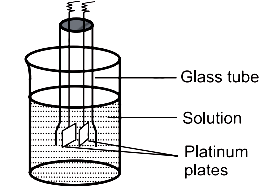
Conductivity cell
Net cell reaction in electrolysis of aqueous NaCl:
The net cell reaction is the sum of two electrode reactions.| $2 Cl _{( aq )}^{-} \longrightarrow Cl _{(2( g ))}+2 e ^{-}$ | (Oxidation half reaction at anode) |
| $2 H _2 O _{( l )}+2 e ^{-} \longrightarrow H _{2( g )}+2 OH _{( aq )}^{-}$ | (Reduction half reaction at cathode) |
| $2 Cl _{( aq )}^{-}+2 H _2 O _{( l )} \longrightarrow Cl _{2( g )}+ H _{2( g )}+2 OH _{( aq )}^{-}$ | (overall cell reaction) |
View full question & answer→Question 53 Marks
Answer the following.
Explain in detail free radical mechanism involved during preparation of addition polymer.
AnswerThe free radical mechanism is most common in addition to polymerization. It is also called a chain reaction which involves three distinct steps. These are as follows:
i) Step 1: Chain initiation:
a. The chain reaction is initiated by a free radical which is formed from an initiator (catalyst) such as benzoyl peroxide, acetyl peroxide, tert-butyl peroxide, etc.
b. For example, acetyl peroxide generates methyl radical as shown below:

c. The free radical (say $R ^{\bullet}$ ) so formed attaches itself to the olefin (vinyl monomer) and produces a new radical, made up of two parts, namely, the attached radical and the monomer unit.
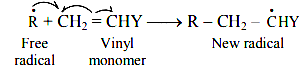
ii. Step 2: Chain propagation:
a. The new radical formed in the initiation step reacts with another molecule of vinyl monomer, forming another still bigger sized radical, which in turn reacts with another monomer molecule.
b. The repetition of this sequence takes place very rapidly. It is called chain propagation.

c. This step is very rapid and leads to high molecular mass radical.
iii. Step 3: Chain termination:
a. At some stage, termination of the growing chain takes place. It may occur by several processes.
b. One mode of termination is by combination of two growing chain radicals.

View full question & answer→Question 63 Marks
Why is molecularity applicable for only elementary reactions whereas order of a reaction is applicable for elementary and complex reactions? Explain with suitable examples.
Answer- Reactions occuring in a single step which cannot be broken down further into simpler reactions are called elementary reactions. Molecularity refers to how many reactant molecules are involved in reactions. Hence, the molecularity of each elementary reaction is fixed.
- A number of chemical reactions are complex. They take place as a series of elementary steps. The molecularity of each step in a complex reaction may be different. Hence, the concept of molecularity is meaningless for complex reactions.
- The slowest step in a complex reaction determines the rate of the overall reaction. Hence, the order of the reaction is applicable for both; elementary and complex reactions.
Example :
Consider the reaction:
$2 NO _2 Cl _{( g )} \longrightarrow 2 NO _{2( g )}+ Cl _{2( g )}$
The reaction takes place in two steps:
1. $NO _2 Cl _{( g )} \stackrel{ k _1}{\longrightarrow} NO _{2( g )}+ Cl _{( g )}$ (slow)
2. $NO _2 Cl _{( g )}+ Cl \stackrel{ k _2}{\longrightarrow} NO _{2( g )}+ Cl _{2( g )}$ (fast)
Overall:
$
2 NO _2 Cl _{( g )} \longrightarrow 2 NO _{2( g )}+ Cl _{2( g )}
$
The molecularity of elementary reaction (1) is 1 and that of elementary reaction (2) is 2. The first step being slower than the second and is the rate determining step. Hence, the reaction is of first order. View full question & answer→Question 73 Marks
Calculate the voltage of the cell $Sn _{( s )} / Sn ^{2+}(0.02 M ) / / Ag ^{+}(0.01 M ) / Ag _{( s )}$ at $25^{\circ} C$.
Given: $E _{ Sn }^{\circ}=-0.136, E _{ Ag }^{\circ}=0.800 V$
AnswerGiven: $E _{ Sn }^{\circ}=-0.136, E _{ Ag }^{\circ}=0.800 V$
To find: Voltage of the cell ( $\left.E _{\text {cell }}\right)$
Formulae:
1. $E _{\text {cell }}^{\circ}= E _{\text {cathode }}^{\circ}- E _{\text {anode }}^{\circ}$
2. $E _{\text {cell }}= E _{\text {cell }}^{\circ}-\frac{0.0592 V }{ n } \log _{10} \frac{[\text { Product }]}{[\text { Reactant }]}$
Calculation: First we write the cell reaction.
| $Sn _{( s )} \longrightarrow Sn ^{2+}(0.02 M )+2 e ^{-}$ |
(oxidation at anode) |
| $\left[ Ag ^{+}(0.01 M )+ e ^{-} \rightarrow Ag _{( s )}\right] \times 2$ |
(reduction at cathode) |
Overall reaction:
$Sn _{( s )}+2 Ag ^{+}(0.01 M ) \longrightarrow Sn ^{2+}(0.02 M )+2 Ag _{( s )}$ |
Using formula (1),
$E _{\text {cell }}^{\circ}= E _{ Ag }^{\circ}- E _{ Sn }^{\circ}=0.800 V -(-0.136 V )=0.936 V$
Using formula (2),
The cell potential is given by
$E _{\text {cell }}= E _{\text {cell }}^{\circ}-\frac{0.0592 V }{ n } \log _{10} \frac{\left[ Sn ^{2+}\right]}{\left[ Ag ^{+}\right]^2}$
$\therefore E _{\text {cell }}=0.936 V -\frac{0.0592 V }{2} \log _{10} \frac{0.02}{(0.01)^2}$
$=0.936 V -\frac{0.0592 V }{2} \log _{10} 200$
$=0.936 V -\frac{0.0592 V }{2} \times 2.301$
Calculation using log table:
$0.0592 \times 2.303$
$=\text { Antilog }_{10}\left[\log _{10} 0.0592+\log _{10} 2.303\right]$
$=\text { Antilog }_{10}[\overline{2} .7723+0.3623]$
$=\text { Antilog }_{10}[\overline{1} .1346]$
$=0.1363$
$=0.936 V -\frac{0.1363 V }{2} \text { (Using log table) }$
$=0.936 V -0.0681 V$
$=0.8679 V$
The voltage of cell is $0 . 8 6 7 9 V$. View full question & answer→Question 83 Marks
The vapour pressure of a pure solvent at a certain temperature is $0.0227$ bar. What is the vapour pressure of a solution containing $6$ g of solute (M $= 60$ g/mol) in $50$ g of solvent?
AnswerGiven: Vapour pressure of pure solvent $= P _1^0=0.0227$ bar
Mass of solute $=6 g$
Molar mass of solute $=60 \ g \ mol ^{-1}$
Mass of solvent $=50 g$
To find: Vapour pressure of the solution
Formula: $\frac{ P _1^0- P _1}{ P _1^0}=\frac{ W _2 M _1}{ M _2 W _1}$
Calculation: Molar mass of solvent $=18 \ g \ mol ^{-1}$ (Assuming water as the solvent)
Using formula,
$ \frac{ P _1^0- P _1}{ P _1^0}=\frac{ W _2 M _1}{ M _2 W _1}$
$\frac{0.0227 bar - P _1}{0.0227 bar }=\frac{6 g \times 18 \ g \ mol ^{-1}}{50 g \times 60 g mol ^{-1}}$
$\therefore \frac{0.0227 bar - P _1}{0.0227 bar }=0.036$
$\therefore 0.0227 bar - P _1=0.036 \times 0.0227 bar$
$\therefore P _1=0.0227 bar -8.172 \times 10^{-4} bar =0.022 bar $
Vapour pressure of the given solution is $0.022\ bar.$
View full question & answer→Question 93 Marks
State Disadvantages of nanoparticles and nanotechnology.
AnswerDisadvantages of nanoparticles and nanotechnology: - Nanotechnology has raised the standard of living but at the same time, it has increased pollution which includes air pollution. The pollution caused by nanotechnology is known as nano pollution. This kind of pollution is very dangerous for living organisms.
- Nanoparticles can cause lung damage. Inhaled particulate matter may get deposited throughout the human respiratory tract and then in the lungs.
- The characteristics of nanoparticles that are relevant for health effects are size, chemical composition, and shape.
View full question & answer→Question 103 Marks
How are amines classified depending on the functional group? Give one example of each class of amines.
AnswerClassification of amines:
- Amines are classified as primary $(1^\circ )$, secondary $(2^\circ )$ and tertiary $(3^\circ )$ amines.
- Their structures are obtained in a simple way by replacing one, two, or three hydrogen atoms of $NH_3$ molecule by alkyl/aryl groups.
- The functional group present in primary amines is referred to as an amino group $(–NH_2)$.
e.g. Ethylamine $[C_2H_5 – NH_2]$
- The functional group present in secondary amines is referred to as the imino group $(>NH)$.
e.g. Dimethylamine $[(CH_3)_2NH]$
- The functional group present in tertiary amines is tertiary nitrogen represented as:

e.g. Trimethylamine $[(CH_3)_3N]$
View full question & answer→Question 113 Marks
An organic compound A with molecular formula $C_4H_{10}O$ on treatment with phosphorus pentachloride gives alkyl chloride. Alkyl chloride on treatment with Mg in presence of dry ether gives a highly reactive compound B.
Compound B reacts with water to give hydrocarbon C. Alkyl chloride on treatment with Na in dry ether as a solvent gives alkane, $2,2,3,3$-tetramethylbutane. Identify ‘A’, ‘B’, ‘C’
Answer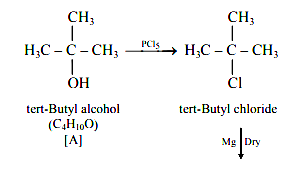
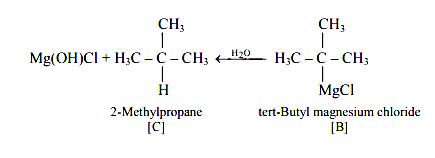
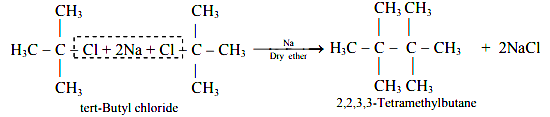
∴
Compound (A): tert-Butyl alcohol;
Compound (B): tert-Butyl magnesium chloride;
Compound (C): 2-Methylpropane
View full question & answer→Question 123 Marks
Explain with one example each, the diamagnetic, paramagnetic and ferromagnetic substances.
Answer
- The substances with all electrons paired, are weakly repelled by magnetic fields. Such substances are called as diamagnetic substances. In these substances, pairing of electrons balances the spins and hence, cancels their magnetic moments.
e.g. $N_2$
- The substances with unpaired electrons are weakly attracted by magnetic field. Such substances are called as paramagnetic substances. In these substances, the spinning of unpaired electron gives rise to a magnetic moment due to which it is attracted by a magnetic field. These substances exhibit magnetism in presence of an external magnetic field only. They lose magnetism when the external magnetic field is removed.
e.g. Oxygen
- The substances containing a large number of unpaired electrons are attracted strongly by the magnetic field. Such substances are called as ferromagnetic substances. These substances can be permanently magnetised. They retain magnetism even after the removal of an external magnetic field.
e.g. Fe
View full question & answer→Question 133 Marks
Write any two uses of actinides.
AnswerUses of actinides:
- The half-lives of natural thorium and uranium isotopes are so long that we get very negligible radiation from these elements. So, we find them in everyday use.
- Th(IV) oxide, ThO2 with $1 \%$ $CeO_2$ was used as a major source of indoor lighting before incandescent lamps came into existence only because these oxides convert heat energy from burning natural gas to intense light. Even today, there is a great demand for these lights for outdoor camping.
View full question & answer→Question 143 Marks
Why work done in vacuum is zero?
AnswerA free expansion means expansion against zero opposing force. Such expansion occurs in a vacuum. When the gas expands in a vacuum, there is no opposing force, that is, $P_{ext} = 0$. The work done by a system during such expansion is $W = – P_{ext} \triangle V = 0$.
Thus, work done in a vacuum is zero.
View full question & answer→Question 153 Marks
Write chemical reactions to convert –COOH group of acetic acid into the following.
$CH_3COCl$
Answer$\underset{\text { Acetic acid }}{3 CH _3 COOH }+\underset{\text { Phosphorous trichloride }}{ PCl _3} \stackrel{\Delta}{\rightarrow} \underset{\text { Acetyl chloride }}{3 CH _3 COCl }+ H _3 PO _3$
View full question & answer→Question 163 Marks
Draw optical isomers of $[Co(en)_3]^{3+}$.
View full question & answer→Question 173 Marks
Write any two properties actinides.
AnswerProperties of actinides: - Similar to lanthanoids, they appear silvery-white in colour.
- These are highly reactive radioactive elements.
- Except promethium (Pm), all are nonradioactive in nature.
- They experience decrease in the atomic and ionic radii from actinium (Ac) to lawrencium (Lr), known as actinoid contraction.
- They usually exhibit +3 oxidation state. Elements of the first half of the series usually exhibit higher oxidation states.
View full question & answer→Question 183 Marks
Write three uses of sulfuric acid.
AnswerSulfuric acid is a very important industrial chemical.
It is used:
- in the manufacture of fertilizers. For example, ammonium sulfate, superphosphate, etc.
- in the manufacture of pigments, paints and dyestuff intermediates.
- in petroleum refining.
- in detergent industry.
- in metallurgy, for cleaning of metals electroplating and galvanising.
- in storage batteries.
- as a laboratory reagent.
- in the manufacture of nitrocellulose products.
View full question & answer→Question 193 Marks
Define the Standard enthalpy of combustion.
AnswerThe standard enthalpy of combustion of a substance is the standard enthalpy change accompanying a reaction in which one mole of the substance in its standard state is completely oxidized.
View full question & answer→Question 203 Marks
Explain vulcanization of rubber.
AnswerVulcanization of rubber: - The process by which a network of cross-links is introduced into an elastomer is called vulcanization.
- Vulcanization of rubber is carried out to improve the physical properties of natural rubber.
- The profound effect of vulcanization enhances the properties like tensile strength, stiffness, elasticity, toughness, etc. of natural rubber.
- Most frequently the used process of vulcanization is sulfur vulcanization. Sulfur forms crosslinks between polyisoprene chains which results in improved properties of natural rubber.
View full question & answer→Question 213 Marks
Write a commercial method for preparation of glucose.
AnswerCommercial method for preparation of glucose: Commercially glucose is obtained by hydrolysis of starch by boiling it with dilute sulphuric acid at 393K under 2 to 3 atm pressure.
$\left( C _6 H _{10} O _5\right)_{ n }+ nH _2 O \underset{393 K , 2-3 atm}{\stackrel{H^+} {\longrightarrow}} \underset{ Glucose } {nC _6 H _{12} O _6}$
View full question & answer→Question 223 Marks
Write chemical reactions to convert –COOH group of acetic acid into the following.
$C_2H_5OH$
Answer$\underset{\text { Acetic acid }}{ CH _3- COOH }+ LiAlH _4 \underset{\text { ether }}{\stackrel{\text { dry }}{\rightleftharpoons}} CH _{\text {Ethanol }}^{ CH _2 OH }$
View full question & answer→Question 233 Marks
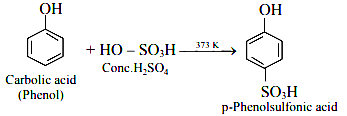
What is the action of conc. $H_2SO_4$ on carbolic acid at $373\ K$.
AnswerAt $373\ K$, carbolic acid (phenol) reacts with concentrated sulphuric acid to form p-phenolsulfonic acid.
View full question & answer→Question 243 Marks
Define coordination number.
AnswerCoordination number (C.N.) of metal ion in a complex is the number of ligand donor atoms directly attached to it or the number of electron pairs involved in the coordinate bond.
View full question & answer→Question 253 Marks
Define Anionic sphere complex.
AnswerA negatively charged coordination sphere or a coordination compound having a negatively charged coordination sphere is called anionic complex or anionic sphere complex.
View full question & answer→Question 263 Marks
What are rare earth elements?
Answer
- Although, historically, lanthanoids are termed as rare earth elements, they are fairly abundant in earth’s crust.
e.g. Thulium is found more in abundance than silver $(4.5 \times 10^{–5}$ vs $0.79 \times 10–5$ percent by mass).
- The names rare earth elements was coined because of difficulty in extracting them economically in pure form from other lanthanoids having similar chemical properties. Now, due to newer separation methods like ion exchange resins, the separation of these elements has become easier and more economical.
View full question & answer→Question 273 Marks
Write three physical properties of sulfuric acid.
AnswerPhysical properties of sulfuric acid are-
- Sulfuric acid is a colourless, dense, oily liquid.
- It has a density (specific gravity) of $1.84\ g/cm^3$ at $298\ K$.
- It freezes at $283\ K$ and boils at $611\ K$.
- It is highly corrosive and produces severe burns on the skin.
View full question & answer→Question 283 Marks
Define the Enthalpy of vaporization.
AnswerEnthalpy of vaporization is the enthalpy change accompanying the vaporization of one mole of liquid without changing its temperature at constant pressure.
View full question & answer→Question 293 Marks
AnswerPolymeric solids which form threads are called fibres.
View full question & answer→Question 303 Marks
Explain the primary structure of proteins.
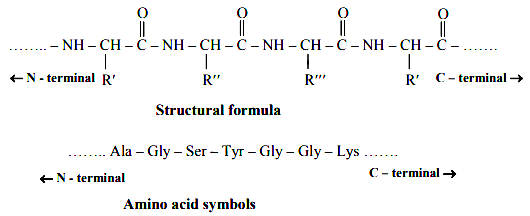
AnswerPrimary structure of proteins:- Primary structure of proteins is the sequence of constituent α-amino acid residues linked by peptide bonds.
- Any change in the sequence of amino acid residues results in a different protein.
- Primary structure of proteins is represented by writing the three-letter symbols of amino acid residues as per their sequence in the concerned protein.
- The symbols are separated by dashes. According to the convention, the N-terminal amino acid residue is written at the left end and the C-terminal amino acid residue at the right end.
View full question & answer→Question 313 Marks
Write chemical reactions to convert –COOH group of acetic acid into the following.
$CH_4$
View full question & answer→Question 323 Marks
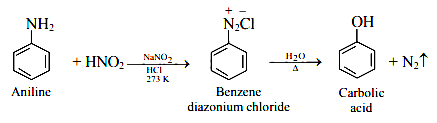
Write the reactions for the preparation of carbolic acid from aniline.
AnswerAniline is treated with nitrous acid $[NaNO_2 + HCl]$ at low temperature to obtain benzene diazonium chloride, which on hydrolysis gives carbolic acid (phenol).
View full question & answer→Question 333 Marks
Write an expression for instantaneous rate of reaction:$2 N_2 O _{( g )} \rightarrow 4 NO _{2(g)}+ O _{2(g)}$.
What is the order of reaction?
Answer1. Expression for instantaneous rate of reaction:
$
\text { Rate of reaction }=-\frac{1}{2} \frac{ d \left[ N _2 O \right]}{ dt }=\frac{1}{4} \frac{ d \left[ NO _2\right]}{ dt }=\frac{ d \left[ O _2\right]}{ dt }
$
2. The given reaction is of first order.
View full question & answer→Question 343 Marks
$0.022\ kg$ of $CO_2$ is compressed isothermally and reversibly at $298\ K$ from an initial pressure of $100\ kPa$ when the work obtained is $1200\ J$, calculate the final pressure.
AnswerGiven: Mass of $CO _2=0.022 kg =22 g$
Temperature $= T =298 K$
Initial pressure $=P_1=100 kPa$
Work done on system $=W_{\max }=1200 J$
To find: Final pressure $= P _2$
Formula: $W _{\max }=-2.303 nRT \log _{10} \frac{ P _1}{ P _2}$
Calculation: Number of moles of $CO _2= n =\frac{22 g }{44 g mol ^{-1}}=0.5 mol$
Gas constant $= R =8.314 J K ^{-1} mol ^{-1}$
Now, using formula,
$W _{\max }=-2.303 nRT \log _{10} \frac{ P _1}{ P _2}$
$1200 J =-2.303 \times 0.5 mol \times 8.314 J K ^{-1} mol ^{-1} \times 298 K \times \log _{10} \frac{100 kPa }{ P _2}$
$\therefore \frac{\log _{10}(100 kPa )}{ P _2}=\frac{-1200}{2.303 \times 0.5 \times 8.314 \times 298}$
Calculation using log table:
$ \frac{1200}{2.303 \times 0.5 \times 8.314 \times 298}$
$=\text { Antilog }_{10}\left[\log _{10} 1200-\left(\log _{10} 2.303+\log _{10} 0.5+\log _{10} 8.314+\log _{10} 298\right)\right]$
$=\text { Antilog }_{10}[3.0792-(0.3623+\overline{1} .6990+0.9198+2.4742)]$
$=\text { Antilog }_{10}[3.0792-(3.7563+\overline{1} .6990)]$
$=\text { Antilog }_{10}[1.6239]=0.4207$
$=-0.4207$
$\therefore \frac{100 kPa }{ P _2}=\text { antilog }$
$\therefore P _2=\frac{100 kPa }{0.3796}$
$=263.4 kPa $
The final pressure is $2 6 3 . 4 ~ k P a$.
View full question & answer→Question 353 Marks
The solubility of AgBr in water is $1.20 \times 10^{–5}$ mol $dm^{–3}$. Calculate the solubility product of AgBr.
AnswerGiven: Solubility of $AgBr =1.20 \times 10^{-5}$
To find: Solubility product of $AgBr$
Formula: $K _{ sp }= x ^{ x } y ^{ y } S ^{ x + y }$
Calculation: The solubility equilibrium of $AgBr$ is:
$ \operatorname{AgBr}_{( s )} \rightleftharpoons \operatorname{Ag}_{( aq )}^{+}+ Br _{( aq )}^{-}$
$x =1, y =1$
$K _{ sp }= x ^{ x } y ^{ y } s ^{ x + y }=(1)^1(1)^1 S ^{1+1}= S ^2$
$K _{ sp }=\left(1.20 \times 10^{-5}\right)^2$
$=1.44 \times 10^{-10} $
Solubility product of $AgBr$ is $1.44 \times 10^{-10}$
View full question & answer→Question 363 Marks
$A$ solution containing $3\ g$ of solute A ($M = 60\ g/mol$) in $1\ L$ solution is isotonic with a solution containing $8.55\ g$ of solute $B$ in $500\ mL$ solution. What is the molar mass of $B?$
AnswerGiven: Mass of solute $A=\left(W_2\right)_A=3 g$
Volume $= V _{ A }=1 L$
Molar mass of solute $A=\left(M_2\right)_A=60 \ g \ mol _{-1}$
Mass of solute $B=\left( W _2\right)_B=8.55 g$
Volume $=V_B=500 mL =0.5 L$
To find: Molar mass of solute $B=\left(M_2\right)_B$
Formula: $\pi=\frac{ W _2 RT }{ M _2 V }$
Calculation: For solution containing $3 g$ of solute $A$,
$\pi_{ A }=\frac{\left( W _2\right)_{ A } RT }{\left( M _2\right)_{ A } V _{ A }} \cdots(i)$
For solution containing $8.55 g$ of solute $B$,
$\pi_{ B }=\frac{\left( W _2\right)_{ B } RT }{\left( M _2\right)_{ B } V _{ B }}\cdots(ii)$
Since both the solutions are isotonic, $\pi_A=\pi_B$
$\therefore \frac{\left( W _2\right)_{ A } RT }{\left( M _2\right)_{ A } V _{ A }}=\frac{\left( W _2\right)_{ B } RT }{\left( M _2\right)_{ B } V _{ B }}$
$\therefore\left( M _2\right)_{ B }=\frac{\left( W _2\right)_{ B } \times\left( M _2\right)_{ A } \times V _{ A }}{\left( W _2\right)_{ A } \times V _{ B }}$
$=\frac{8.55 \times 60 \times 1}{3 \times 0.5}=342 \ g \ mol ^{-1}$
The molar mass of solute $B$ is $342 \ g \ mol ^{-1}$
View full question & answer→Question 373 Marks
Explain any three characteristic features of nanoparticles.
AnswerFollowing are the characteristic features of nanoparticles:
- Colour: It is an optical property that is different at nanoscale.
e.g. Elemental gold has a shining yellow colour. However, if only $100$ gold atoms are arranged in a cube, its colour would be much more red.
- Surface area: High surface-to-volume ratio is a very important characteristic of nanoparticles. If a bulk material is a sub divided into a group of individual nanoparticles, the total volume remains the same, but the collective surface area is largely increased. With a large surface area for the same volume, these small particles react much faster because more surface area provides more number of reaction sites, leading to more chemical reactivity.
- Catalytic activity:
a. Due to an increase in surface area with the decrease in particle size, nanomaterial-based catalysts show increased catalytic activity.
b. Usually, they are heterogeneous catalysts that mean catalysts are in solid form and the reactions occur on the surface of the catalyst.
c. Nanoparticle catalysts can be easily separated and can be recycled.
e.g. Pd, Pt metal nanoparticles used in hydrogenation reactions.
$TiO_2, ZnO$ are used in photocatalysis.
Gold in bulk form is unreactive, but gold nanoparticles are found to be a very good catalyst for various organic reactions.
View full question & answer→Question 383 Marks
Explain the classification of polymers on the basis of origin.
AnswerOn the basis of the source or origin, polymers are classified into three categories:
- Natural polymers: The polymers obtained from natural source are said to be natural polymers.
e.g. cotton and linen.
Natural polymers are further subdivided into two types: Plant polymer and animal polymers. - Synthetic polymers: These polymers are artificially prepared by polymerization of one monomer or copolymerization of two or more monomers.
e.g. nylon and terylene.
Synthetic polymers are further divided into three subtypes: fibres, synthetic rubbers, and plastics. - Semisynthetic polymers: Polymers which are derived from natural polymers are called semisynthetic polymers. These are also called regenerated fibres.
e.g. cellulose acetate rayon and cellulose nitrate.
View full question & answer→Question 393 Marks
How are nonstoichiometric point defects classified? Explain with diagram the metal deficiency defect.
Answer
- Nonstoichiometric point defects are classified into following two types:
- Metal deficiency defect
- Metal excess defect
- This defect is possible only in compounds of metals that show variable oxidation states.
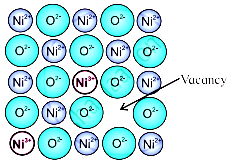
- In some crystals, positive metal ions are missing from their original lattice sites. The extra negative charge is balanced by the presence of cation of the same metal with higher oxidation state than that of missing cation.
e.g.: In the compound $NiO$, one $Ni^{2+}$ ion is missing creating a vacancy at its lattice site. The deficiency of two positive charges is made up by the presence of two $Ni^{3+}$ ions at the other lattice sites of $Ni^{2+}$ ions. The composition of NiO then becomes $Ni_{0.97}O_{1.0}$.
View full question & answer→Question 403 Marks
Write any two uses of alloy.
Answer - Bronze, an alloy of copper and tin is tough, strong, and corrosion-resistant. It is used for making statues, medals, and trophies.
- Cupra-nickel, an alloy of copper and nickel is used for making machinery parts of marine ships, boats. For example, marine condenser tubes.
- Stainless steels are used in the construction of the outer fuselage of ultra-high-speed aircraft.
- Nichrome, an alloy of nickel and chromium in the ratio 80 : 20 has been developed specifically for gas turbine engines.
- Titanium alloys withstand stress up to high temperatures and are used for ultrahigh-speed flight, fireproof bulkheads, and exhaust shrouds.
View full question & answer→Question 413 Marks
Draw the structure of Haworth formula of sucrose.
Question 423 Marks
Write chemical equations indicating the action of following on bromobenzene.
conc. $HNO _3 /$ conc. $H _2 SO _4$
View full question & answer→Question 433 Marks
Explain the magnetic properties of $[Ni(CN_4)]^{2–}$.
AnswerMagnetic properties of $[Ni(CN_4)]^{2–}$:
- In $\left[ Ni \left( CN _4\right)\right]^{2-}$ ion, $Ni ^{2+}$ undergoes $dsp ^2$ hybridization.
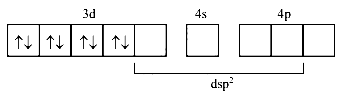
- Four vacant $dsp ^2$ hybrid orbitals of $Ni ^{2+}$ overlap with four orbitals of $CN ^{-}$ions to form $Ni - CN$ coordinate bonds. Configuration after the complex formation becomes:
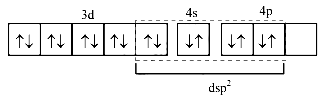
- The complex has no unpaired electrons and hence, diamagnetic.
View full question & answer→Question 443 Marks
What is a non-ferrous alloy?
AnswerNonferrous alloys are formed by mixing atoms of transition metal other than iron with a non-transition element.
e.g. Brass, which is an alloy of copper and zinc.
View full question & answer→Question 453 Marks
Discuss industrial method of preparation of sulfur dioxide from zinc sulfide and iron pyrites.
Answer$\underset{\text{Zinc sulfide}}{2 ZnS _{( s )}}+3 O _{2( g )} \stackrel{\Delta}{\rightarrow} 2 ZnO _{( s )}+\underset{\text { Sulfur dioxide }}{2 SO _{2( g )}}$
$\underset{\text{Iron pyrites}}{4 FeS _{2( s )}}+11 O _{2( g )} \stackrel{\text { Delta }}{\longrightarrow} 2 Fe _2 O _{3( s )}+\underset{\text { Sulfur dioxide }}{8 SO _{2( g )}}$
View full question & answer→Question 463 Marks
Write two applications of electrochemical series.
AnswerApplications of electrochemical series: - The relative strength of reducing agents:
- The species on the right side of half-reactions are reducing agents.
- The species appearing at the bottom right side of half-reactions associated with large negative E° values are the effective electron donors. They serve as strong reducing agents.
- The strength of reducing agents increases from top to bottom as E° values decrease.
- Spontaneity of redox reactions:
- Spontaneity of redox reactions can be predicted from values of electrode potential in electrochemical series.
- If the species with a higher E° value is reduced (accepts electrons) and that with a lower E° value is oxidized (donates electrons), then the redox reaction in a galvanic cells is spontaneous.
- The standard cell potential must be positive for a cell reaction to be spontaneous under the standard conditions.
View full question & answer→Question 473 Marks
Write the structure of Zwitterion of alanine.
Question 483 Marks
Write the use of aryl diazonium salts.
AnswerAryl diazonium salts are useful as versatile intermediates to obtain a variety of products.
View full question & answer→Question 493 Marks
What is the action of following reagents on acetaldehyde?
Acidified potassium dichromate
AnswerAcetaldehyde is oxidized to the acetic acid by potassium dichromate in an acidic medium.
$\underset{\text { Acetaldehyde }}{ H _3 C - CHO } \underset{\text { dil } \cdot H _2 SO _4}{\stackrel{ K _2 Cr _2 O _7}{\longrightarrow}} \underset{\text { Acetic acid }}{ H _3 C - COOH }$
View full question & answer→Question 503 Marks
What is the action of following on proponal?
Hydroxyl amine
AnswerPropanal will undergo an addition elimination reaction with hydroxyl amine to give corresponding oxime derivative containing C = N bonds (imine).

View full question & answer→Question 513 Marks
Write the reaction between ethanol and acetic anhydride.
AnswerEthanol reacts with acetic anhydride in presence of an acid catalyst to form a corresponding ester.
$\begin{array}{cc}
\phantom{................}\ce{O}\phantom{.................}\ce{O}\phantom{.......................}\ce{O}\phantom{}\\
\phantom{................}||\phantom{..................}||\phantom{.......................}||\phantom{}\\
\ce{\underset{\text{Ethanol}}{C2H5 - OH} + \underset{\text{Acetic anhydride}}{(CH3 - C -)2O} ⇌[H+] \underset{\text{Ethyl ethanoate}}{CH3 - C - O - C2H5} + \underset{\text{Ethanoic acid}}{CH3 - C - OH}}
\end{array}$
View full question & answer→Question 523 Marks
Write chemical equations indicating the action of following on bromobenzene.
fuming $H_2SO_4$
View full question & answer→Question 533 Marks
Answer the following question. What are ligands?
AnswerIn the coordination compound, the species surrounding the central metal atom or ion are called ligands.
View full question & answer→Question 543 Marks
AnswerFerrous alloys have atoms of other elements distributed randomly in atoms of iron in the mixture. As the percentage of iron is more, they are termed ferrous alloys.
e.g. Nickel steel, chromium steel, stainless steel etc. All steels have 2% carbon.
View full question & answer→Question 553 Marks
AnswerLarge numbers of metal ores are oxides or sulfides. Hence, group 16 elements are called chalcogens or ore forming elements.
View full question & answer→Question 563 Marks
Define Reference electrode
AnswerIt is an electrode whose potential is arbitrarily taken as zero or is exactly known. Standard Hydrogen Electrode (SHE), calomel electrode, silver-silver chloride electrode and glass electrode are some examples of reference electrode.
View full question & answer→Question 573 Marks
Answerα-Amino acids are carboxylic acids having an amino $(–NH_2)$ group bonded to the α-carbon, that is, the carbon next to the carboxyl $(–COOH)$ group.
View full question & answer→Question 583 Marks
Draw resonance structures of aryl diazonium salts.
AnswerThe resonance structures of aryl diazonium salt can be given as,

View full question & answer→Question 593 Marks
Write the IUPAC name of mesityl oxide.
AnswerIUPAC name of mesityl oxide: 4-Methylpent-3-en-2-one
View full question & answer→Question 603 Marks
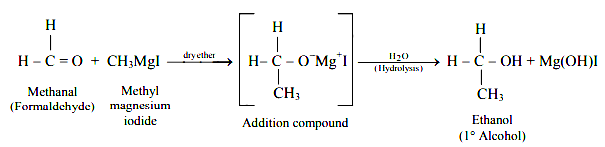
Write the preparation of ethanol from methyl magnesium iodide.
AnswerMethyl magnesium iodide reacts with formaldehyde to form an adduct which on hydrolysis with dilute acid gives ethanol.
View full question & answer→Question 613 Marks
Write chemical equations indicating the action of following on bromobenzene.
$CH _3 COCl /$ anhy. $AlCl _3$
View full question & answer→Question 623 Marks
Draw a neat and well labelled diagram of Standard Hydrogen Electrode. Also write its one application.
AnswerStandard hydrogen electrode
Application of Standard Hydrogen Electrode (SHE):
SHE is used as a primary reference electrode to determine the standard potentials of other electrodes.
e.g. To determine the standard potential of $Zn ^{2+}(1 M ) \mid Zn _{( s )}$ electrode, it is combined with SHE to a galvanic cell.
$
Zn _{( s )}\left| Zn ^{2+}(1 M ) \| H ^{+}(1 M )\right| H _2( g , 1 atm ) \mid Pt
$
The standard cell potential, $E _{\text {cell }}^{\circ}$, is measured.
$E _{\text {cell }}^{\circ}= E _{ H _2}^{\circ}- E _{ Zn }^{\circ}=- E _{ Zn ^{\prime}}^{\circ}$, because $E _{ H _2}^{\circ}$ is zero.
Thus, the measured emf of the cell is equal to standard potential of $Z^{2+}(1 M) \mid Z n_{(s)}$ electrode.
View full question & answer→Question 633 Marks
Define standard enthalpy of formation.
AnswerThe standard enthalpy of formation of a compound is the enthalpy change that accompanies a reaction in which one mole of pure compound in its standard state is formed from its elements in their standard states.
View full question & answer→Question 643 Marks
A buffer solution contains $0.3 mol dm ^{-3} NH _4 OH \left( K _{ b }=1.8 \times 10^{-5}\right)$ and $0.4 mol dm ^{-3} NH _4 Cl$. Calculate pOH of the solution.
AnswerGiven: $\left[\right.$ Base] $=0.3 mol dm ^{-3}$,
$[$ Salt $]=0.4 mol dm ^{-3}$,
$K _{ b }=1.8 \times 10^{-5}$ for the weak base
To find: $pOH$ of the buffer solution
Formula: $pOH = pK _{ b }+\log _{10} \frac{[\text { salt }]}{[\text { base }]}$
Calculation: $pOH$ of basic buffer is given by Henderson-Hasselbalch equation:
$pOH = pK _b+\log _{10} \frac{[\text { salt }]}{[\text { base }]}$
$pK _b=-\log _{10} K _b$
$=-\log _{10}\left(1.8 \times 10^{-5}\right)=5-\log _{10} 1.8$
$=5-0.2553=4.7447$
Substitution in the Henderson-Hasselbalch equation gives
$pOH =4.7447+\log _{10} \frac{0.4}{0.3}=4.7447+\log _{10} 1.333$
$=4.7447+0.1248=4.8695$
The pOH of the given buffer solution is 4.8695.
View full question & answer→Question 653 Marks
With the help of vapour pressure-temperature curves for solution and solvent, explain why boiling point of solvent is elevated when a nonvolatile solute is dissolved into it.
Answer- The vapour pressures of solution and of pure solvent are plotted as a function of temperature in the given diagram.
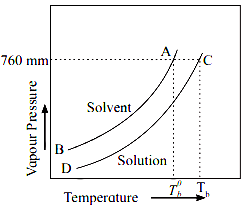
- At any temperature, the vapour pressure of the solution is lower than that of the pure solvent. Hence, the vapour pressure-temperature curve of solution (CD) lies below that of the solvent (AB).
- The difference between the two vapour pressures increases as temperature and vapour pressure increase as predicted by the equation,
$\Delta P = P _1^0 x _2$ - The intersection of the curve CD with the line corresponding to 760 mm is the boiling point of the solution. The similar intersection of the curve AB is the boiling point of the pure solvent. It is clear from the diagram that the boiling point of the solution (Tb) is higher than that of pure solvent $\left( T _{ b }^0\right)$.
- At the boiling point of a liquid, its vapour pressure is equal to 1 atm.
- In order to reach boiling point, the solution and solvent must be heated to a temperature at which their respective vapour pressures attain 1 atm.
- At any given temperature the vapour pressure of the solution is lower than that of the pure solvent. Hence, the vapour pressure of the solution needs a higher temperature to reach 1 atm than that needed for the vapour pressure of the solvent.
- In other words, the solution must be heated to a higher temperature to cause it to boil than the pure solvent. Thus, the solution containing nonvolatile solute boils at a temperature higher than the boiling point of the pure solvent i.e. $T _{ b }> T _{ b }^0$
View full question & answer→Question 663 Marks
Answer the following
Explain the role of green chemistry.
AnswerThe green chemistry approach recognizes that the Earth does have a natural capacity for dealing with much of the waste and pollution that society generates. It is only when that capacity is exceeded that we become unsustainable.
Following is the role of Green Chemistry:
i. To promote innovative chemical technologies that reduce or eliminate the use or generation of hazardous substances in the design, manufacture, and use of chemical products.
ii. The green chemistry helps to reduce capital expenditure, to prevent pollution.
iii. Green chemistry incorporates pollution prevention practices in the manufacture of chemicals and promotes pollution prevention and industrial ecology.
iv. Green chemistry is a new way of looking at chemicals and their manufacturing process to minimize any negative environmental effects.
v. Green chemistry helps to protect the presence of ozone in the stratosphere essential for the survival of life on the earth.
vi. Green chemistry is useful to control the greenhouse effect (Global warming).
View full question & answer→Question 673 Marks
Answer the following.
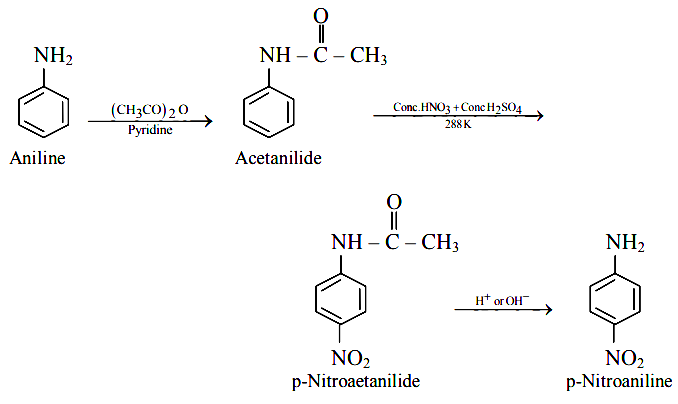
Write a reaction to bring about the following conversions: Aniline into p-nitroaniline
AnswerNitration: Direct nitration of aniline yields (p-nitroaniline) a mixture of ortho, meta, and para nitroanilines. In an acidic medium the $- NH _2$ group is protonated to the $- N ^{+} H _3$ पgroup which is meta-directing and deactivating. Hence, a considerable amount of m-nitroaniline is obtained.
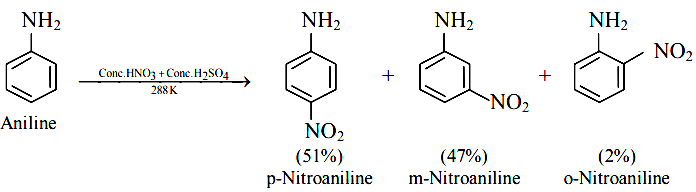
Preparation of p-nitroaniline: However, to get p-nitroaniline as a major product, the $–NH_2$ group is first protected by acetylation and then nitration is carried followed by hydrolysis amide.
View full question & answer→Question 683 Marks
Compound ‘A’ with molecular formula $C_6H_5Cl$ is fused with $NaOH $at high temperature under pressure to give compound ‘B’. Compound ‘B’ on treatment with dil.$HCl$ gives compound C having characteristic carbolic odour. Write the chemical equations in support of this. Name the process and give uses of compound C.
Answer
- The chemical equation can be represented as:
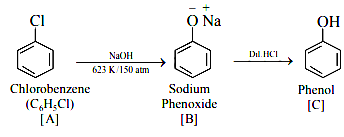
- The process involved in the Dow process.
- Uses of phenols:
a. Phenol is used in the preparation of phenol-formaldehyde resin. For example, bakelite.
b. Phenols are used as antiseptic in common products like air fresheners, deodorants, mouthwash, calamine lotions, floor cleaners, etc.
View full question & answer→Question 693 Marks
What is Grignard reagent? How is it prepared? Why are they prepared under anhydrous condition?
Answer- Grignard reagent: When alkyl halide is treated with magnesium in the dry ether as the solvent, it gives alkyl magnesium halide. This is known as the Grignard reagent.
- The Grignard reagent can be prepared as,
$\underset{\text { Alkyl halide }}{ R - X }+ Mg \stackrel{\text { dry ether }}{\longrightarrow} \underset{\text { Alkyl magnesium halide (Grignard reagent) }}{ R - Mg - X }$ - Grignard reagents are highly reactive compounds.
- They react with water or compounds containing hydrogen attached to the electronegative element.
Hence, reactions involving Grignard reagent must be carried out under anhydrous condition.
View full question & answer→Question 703 Marks
The unit cell of Na is bcc and its density is $0.97 g/cm^3.$ What is the radius of a sodium atom if the molar mass of Na is $23 g/mol$?
View full question & answer→Question 713 Marks
Explain the trend in the following atomic properties of group 16 elements: Electron gain enthalpy
AnswerElectron gain enthalpy becomes less negative down the group.
View full question & answer→Question 723 Marks
Draw the geometrical isomers of the following complexes $[Pt(NH_3)(H_2O)Cl_2]$ and $[Co(NH_3)_4Cl_2]^+$
AnswerGeometrical isomers of $[Pt(NH_3)(H_2O)Cl_2]$:

Cis isomer Trans isomer
Geometrical isomers of $[Co(NH_3)_4Cl_2]^+$:
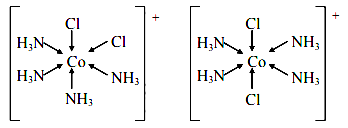
Cis isomer Trans isomer View full question & answer→Question 733 Marks
Write any four properties of interstitial compounds.
AnswerProperties of interstitial compounds: - They are hard and good conductors of heat and electricity.
- Their chemical properties are similar to the parent metal.
- Their melting points are higher than the pure metals.
- Their densities are less than the parent metal.
View full question & answer→Question 743 Marks
Explain the trend in following atomic properties of group 16 elements: Electronegativity
AnswerThe electronegativity decreases down the group. Oxygen has the highest electronegativity next to fluorine amongst all the elements.
View full question & answer→Question 753 Marks
Write units of rate constants for:
- First-order reaction
- Zero-order reaction
AnswerUnits of rate constants:
a. First-order reaction: $s ^{-1}, min^{-1}$ or hour ${ }^{-1}$
b. Zero-order reaction: $mol dm ^{-3} s^{-1}$
View full question & answer→Question 763 Marks
Mention two properties and two uses of nylon 6, 6 polymers.
AnswerProperties of nylon 6, 6: - Nylon 6, 6 is a linear condensation polymer with high molecular mass (12000 u to 50000 u).
- It possesses high tensile strength.
- It does not soak in water.
Uses of nylon 6, 6: It is used for
- making sheets,
- bristles for brushes,
- surgical sutures,
- textile fabrics, etc.
View full question & answer→Question 773 Marks
Write a chemical reaction to convert glucose into glucose cyanohydrin.
AnswerGlucose forms cyanohydrin on reaction with hydrogen cyanide:
$\begin{array}{cc}
\phantom{...........}\ce{CN}\\
\phantom{.........}|\\
\phantom{}\ce{CHO}\phantom{..........}\ce{CHOH}\phantom{..}\\
\phantom{}|\phantom{...............}|\phantom{.......}\\
\phantom{}\ce{(CHOH)4 ->[HCN] (CHOH)4}\phantom{}\\
\phantom{}|\phantom{...............}|\phantom{.......}\\
\phantom{..........}\ce{\underset{\text{Glucose}}{CH2OH} \phantom{....}\underset{\text{Glucose cyanohydrin}}{CH2OH}}\phantom{........}
\end{array}$
View full question & answer→Question 783 Marks
Write a reaction to distinguish acetaldehyde from acetone
AnswerTollens’ reagent test: Acetaldehyde being an aldehyde reduces Tollens’ reagent to shining silver mirror, whereas propanone being acetone does not.
$
\begin{array}{c}
\underset{\text { Acetaldehyde }}{ CH _3 CHO }+\underset{\text { Tollens' reagent }}{2\left[ Ag \left( NH _3\right)_2\right]^{+}}+3 OH ^{-} \longrightarrow \underset{\text { Acetate ion }}{ CH _3 COO ^{-}}+\underset{\text { Silver metal }}{2 Ag \downarrow}+4 NH _3+2 H _2 O \\
\underset{\text { Acetone }}{ CH _3 COCH _3 \stackrel{\text { Tollens 'reagent }}{\longrightarrow} \text { No silver mirror }}
\end{array}
$
View full question & answer→Question 793 Marks
Write the $IUPAC$ name of $[Ni(CN)_4]^{2–}$.
Answer$IUPAC$ name of $[Ni(CN)_4]^{2–}$: Tetracyanonickelate(II) ion
View full question & answer→Question 803 Marks
What are interstitial compounds?
AnswerWhen small atoms like hydrogen, carbon or nitrogen are trapped in the interstitial spaces within the crystal lattice, the compounds formed are called interstitial compounds.
View full question & answer→Question 813 Marks
Explain the trend in following atomic properties of group 16 elements: Atomic radii
AnswerThe atomic radii increase down the group, as a result of an increase in the number of quantum shells.
View full question & answer→Question 823 Marks
Define half life of a reaction.
AnswerThe half life of reaction is the time required for the reactant concentration to fall to one half of its initial value.
View full question & answer→Question 833 Marks
Write the preparation of nylon 6, 6.
AnswerPreparation of nylon 6, 6:- Nylon 6, 6 is obtained by polymerization reaction between the monomers adipic acid and hexamethylenediamine.
- Mixing of the two monomers forms nylon salt, which upon condensation polymerization under conditions of high temperature and pressure give the polyamide fibre, nylon 6, 6.
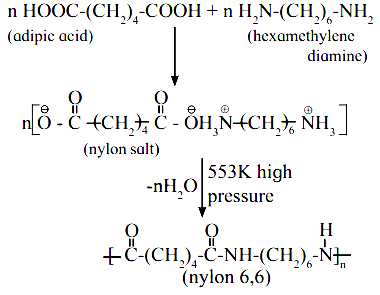
View full question & answer→Question 843 Marks
Explain D and L configuration in sugars.
AnswerD and L configuration in sugars: - Conventionally (+)-glyceraldehyde is represented by the Fischer projection formula having –OH group attached to C-2 on the right side and this configuration is denoted by symbol ‘D’.
- Similarly, the configuration of (–) glyceraldehyde is denoted by the symbol ‘L’.
- All the compounds which can be correlated by a series of chemical reactions to (+)-glyceraldehyde are said to have D-configuration.
- And compounds which are chemically correlated to (–)-glyceraldehyde are said to have L-configuration. This is the system of the relative configuration of chiral compounds.
- A monosaccharide is assigned D/L configuration on the basis of the configuration of the lowest chiral carbon in its Fischer projection formula.
- Relative configuration of (+)-glucose with respect to (+)-glyceraldehyde can be drawn as follows:
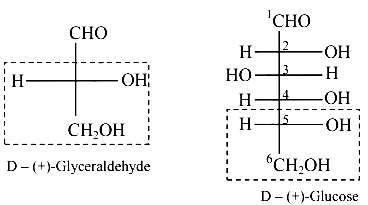
View full question & answer→Question 853 Marks
Explain haloform reaction with suitable example.
Answer
- This reaction is given by acetaldehyde, all methyl ketones $(CH_3–CO–R)$, and all alcohols containing $CH_3(CHOH)–$ group.
- When an alcohol or methyl ketone is warmed with sodium hydroxide and iodine, a yellow precipitate is formed. Here the reagent sodium hypoiodite is produced in situ.
- During the reaction, the sodium salt of the carboxylic acid is formed which contains one carbon atom less than the substrate.
- The methyl group is converted into haloform $(CHX_3)$.
e.g. Acetone is oxidized by sodium hypoiodite to give sodium salt of acetic acid and yellow precipitate of iodoform.
$\begin{array}{cc}
\phantom{..}\ce{O}\phantom{.......................................}\ce{O}\phantom{..........................}\\
\phantom{..}||\phantom{.......................................}||\phantom{..........................}\\
\ce{\underset{\text{Acetone}}{CH3 - C - CH3} + \underset{\text{Sodium hypoiodite}}{3NaOI} ->[NaOH/I2][\Delta] \underset{\text{Sodium acetate}}{CH3 - C - O- Na+} + \underset{\text{Iodoform}}{CHI3 ↓} + 2NaOH}
\end{array}$
View full question & answer→Question 863 Marks
Write formula to calculate $EAN$ with the significance of terms involved in it. Calculate $EAN$ of $[Fe(CN)_6]^{3–}$.
AnswerFormula to calculate $EAN$:
$EAN$ = Number of electrons of metal $ion +$ total number of electrons donated by ligands
= Atomic number of metal $(Z)$ – Number of electrons lost by metal to form the ion $(X)$ + Number of electrons donated by ligands $(Y)$.
$= Z – X + Y$
EAN of $[Fe(CN)_6]^{3–}$:
Oxidation state of $Fe$ is $+3$ and ligands donate $12$ electrons.
Z$ = 26, X = 3, Y = 12$
EAN of $Fe^{3+}= Z – X + Y$
$= 26 – 3 + 12$
$= 35$
View full question & answer→Question 873 Marks
Calculate magnetic moment of thorium $(Z=90)$. Is this element diamagnetic or paramagnetic?
AnswerThe electronic configuration of thorium is $[Rn] 5f^0 6d^2 7s^2$.
the condensed electronic configuration for its divalent cation will be
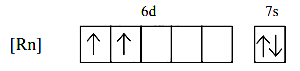
There are $2$ unpaired electrons, so $n = 2$.
$\therefore \mu=\sqrt{2(2+2)}=\sqrt{8} BM =2.83\ BM$
Spin only magnetic moment of the given ion is $2.83\ BM$. This element contains two unpaired electrons and hence, it is paramagnetic. View full question & answer→Question 883 Marks
Answer the following.Distinguish between rhombic sulfur and monoclinic sulfur.
AnswerThe following are the points of difference between rhombic (α-sulfur) and monoclinic ($\beta$ - sulfur):
Rhombic sulfur
(α-sulfur) |
Monoclinic sulfur
(β- sulfur) |
| 1. It is a pale yellow coloured solid. |
1. It is bright yellow solid |
| 2. It forms orthorhombic crystals |
2. It forms needle-shaped monoclinic crystals |
| 3. Its melting point is $385.8\ K.$ |
3. Its melting point is $393 K$. |
| 4. Its density is $2.06 g/cm^3$ |
4. Its density is $1.98 g/cm^3$ |
| 5. It is insoluble in water and soluble in $CS_2$ |
5. Soluble in $CS_2$ |
| 6. It is stable below $369 K$ and transforms to β-sulfur above this temperature |
6. It is stable above $369\ K$ and transforms into α-sulfur below this temperature. |
| 7. It is prepared by the evaporation of rolls sulfur in $CS_2$. |
7. It is prepared from rhombic sulfur. |
View full question & answer→Question 893 Marks
A reaction occurs in the following steps:
Step 1:
$
NO _{2( g )}+ F _2 \longrightarrow NO _2 F _{( g )}+ F _{( g )}
$
(slow)
Step 2:
$
F _{( g )}+ NO _{2( g )} \longrightarrow NO _2 F
$
(Fast)
1. Write the equation of overall reaction.
2. Write the rate law.
3. Identify reaction intermediate.
Answer1. Overall reaction:
$
2 NO _{2( g )}+ F _{2( g )} \longrightarrow 2 NO _2 F _{( g )}
$
2. Step 1 is slow. The rate law of the reaction is predicted from its stoichiometry. Thus, rate $=k\left[ NO _2\right]$ $\left[ F _2\right]$
3. $F$ is produced in step 1 and consumed in step 2 . Hence, $F$ is the reaction intermediate.
View full question & answer→Question 903 Marks
Write three important steps required to determine molar conductivity.
Answer1. Determination of cell constant:
Cell constant is determined by using $KCl$ solution of known concentration in the conductivity cell. The resistance of this $KCl$ solution is measured by Wheatstone bridge.
Now, cell constant $= k _{ KCl } \times R _{\text {solution }}$
Conductivity of $KCl$ solution is known. Thus, cell constant is calculated.
2. Determination of conductivity of given solution:
$KCl$ solution in the conductivity cell in step (1) is replaced by the given solution whose conductivity is to be measured. Its resistance is measured by the Wheatstone bridge. The conductivity of given solution is then calculated as:
$
k =\frac{\text { Cell constant }}{ R _{\text {solution }}}
$
3. Calculation of molar conductivity:
The molar conductivity of the given solution is then calculated using equation:
$
\Lambda=\frac{1000 k }{ c }
$
View full question & answer→Question 913 Marks
Derive the expression for work done in chemical reaction. Write the relationship between $\triangle H$ and $\triangle U$ for an isochoric process.
AnswerExpression for work done in a chemical reaction:
The work done by a system at constant temperature and pressure is given by
$W=-P_{\text {ext }} \Delta V . . . . .(1)$
Assuming $P _{\text {ext }}= P$,
$W=-P \Delta V$
$=-P\left(V_2-V_1\right) W$
$=-P V_2+P V_1 \ldots \ldots$
If the gases were ideal, at constant temperature and pressure.,
$P V_1=n_1 R T \text { and } P V_2=n_2 R T \ldots(3)$
Substitution of equation (3) into equation (2) yields
$W=-n_2 R T+n_1 R T$
$=-\left(n_2-n_1\right) R T$
$=-\Delta n_g R T \ldots(4)$
Equation (4) gives the work done by the system in chemical reactions.
Relationship between $\Delta H$ and $\Delta U$ for an isochoric process:
For an isochoric process, $\Delta V =0$.
$\Delta H=\Delta U+P \Delta V=\Delta U+0=\Delta U$
$\therefore \Delta H=\Delta U$
View full question & answer→Question 923 Marks
Derive the equation which implies that the degree of dissociation of weak acid is inversely proportional to the square root of its concentration.
AnswerConsider an equilibrium of weak acid HA that exists in solution partly as the undissociated species $HA$ and partly $H ^{+}$and $A ^{-}$ions. Then
$HA _{( aq )} \rightleftharpoons H _{( aq )}^{+}+ A _{( aq )}^{-}$
The acid dissociation constant is given as:
$K _{ a }=\frac{\left[ H ^{+}\right]\left[ A ^{-}\right]}{ HA } \cdots(1)$
Suppose $1 mol$ of acid HA is initially present in volume $V dm ^3$ of the solution. At equilibrium, the fraction dissociated would be $\alpha$, where $\alpha$ is a degree of dissociation of the acid. The fraction of an acid that remains undissociated would be $(1-\alpha)$.
| $HA _{( aq )} \rightleftharpoons H _{( aq )}^{+}+ A _{( aq )}^{-}$ |
| Amount present at equilibrium (mol) |
$(1 - \alpha )$ |
$\alpha $ |
$\alpha $ |
| Concentration at equilibrium (mol \ dm −3) |
$\frac{1-\alpha}{V}$ |
$\frac{\alpha}{V}$ |
$\frac{\alpha}{V}$ |
Thus, at equilibrium $[ HA ]=\frac{1-\alpha}{ V } mol dm ^{-3}$
$\left[ H ^{+}\right]=\left[ A ^{-}\right]=\frac{\alpha}{ V } mol \ dm ^{-3}$
Substituting these in equation (1),
$K _{ a }=\frac{(\alpha / V )(\alpha / V )}{(1-\alpha) / V }=\frac{\alpha^2}{(1-\alpha) V } \cdots(2)$
If $c$ is the initial concentration of an acid in $mol dm ^{-3}$ and $V$ is the volume in $dm ^3 mol ^{-1}$ then $c =1 / V$. Replacing $1 / V$ in equation (2) by $c$, we get
$K _{ a }=\frac{\alpha^2 c }{1-\alpha}\cdots(3)$
For the weak acid $HA$, $\alpha$ is very small, or $(1-\alpha) \cong 1$.
With this equation (2) and (3) becomes:
$K_a=\alpha^2 / V \text { and } k_a=\alpha^2 c \cdots(4)$
$\alpha=\frac{\sqrt{K_a}}{c} \text { or } \alpha=\sqrt{K_a \cdot V} \cdots(5)$
The equation (5) implies that the degree of dissociation of a weak acid is inversely proportional to the square root of its concentration. View full question & answer→Question 933 Marks
Explain the phenomenon of osmosis.
Answer1. The net spontaneous flow of solvent molecules into the solution or from more dilute solution to more concentrated solution through a semipermeable membrane is called osmosis.
2. When a solution and pure solvent or two solutions of different concentrations are separated by a semipermeable membrane, the solvent molecules pass through the membrane. However, the rate of passage of solvent molecules into the solution or from a more dilute solution to more concentrated solution is found to be greater than the rate in the reverse direction. This is favourable since the vapour pressure of the solvent is greater than that of the solution.
3. As a result of osmosis, the amount of liquid on the pure solvent side or more dilute solution side decreases. Consequently, the amount of liquid on the other side increases. This results in decrease of the concentration of solution.
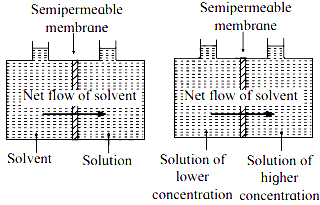 Osmosis
 View full question & answer→Question 943 Marks
Explain Hoffmann’s exhaustive alkylation with suitable reactions.
AnswerHofmann’s exhaustive alkylation of amines:
(i) When a primary amine is heated with excess of primary alkyl halide it gives a mixture of secondary amine, tertiary amine along with tetraalkylammonium halide. This can be given as,
$\underset{1^{\circ} \text { Amine }}{ R - NH _2} \underset{- HX }{\stackrel{R - X}{\longrightarrow}} \underset{2^{\circ} \text { Amine }}{ R _2 NH } \underset{-HX}{\stackrel{ R - X }{\longrightarrow}} \underset{3^{\circ} \text { Amine }}{ R _3 N } \underset{-HX}{\stackrel{ R - X }{\longrightarrow}} \underset{\text { Tetraalkyl ammonium halide }}{ R _4 N ^{+} X ^{-}}$
(i) If the excess alkyl halide is used tetraalkylammonium halide is obtained as a major product and the reaction is known as exhaustive alkylation of amines.
(ii) Tetraalkylammonium halides or quaternary ammonium salts are the derivatives of ammonium salts in which all the four hydrogen atoms attached to nitrogen in $N ^{+} H _4$ are replaced by four alkyl groups (same or different).
(iii) Tetraalkylammonium halides are crystalline solids.
(iv) Primary, secondary and tertiary amines consume three, two and one moles of alkyl halide respectively to get converted into quaternary ammonium salt.
(v) The reaction is carried out in presence of mild base $NaHCO _3$, to neutralize the large quantity of HX formed.
(vi) If the alkyl halide is methyl iodide, the reaction is called exhaustive methylation of amines.
e.g. When methylamine is heated with excess methyl iodide, it gives tetramethyl ammonium iodide.
$\underset{\text { Methylamine }}{ CH _3- NH _2}+\underset{\text { Methyl iodide }}{ CH _3- I } \stackrel{\Delta}{\rightarrow} \underset{\text { Dimethylamine }}{\left( CH _3\right)_2 NH }+ HI$
$\left( CH _3\right)_2- NH + CH _3- I \stackrel{\Delta}{\rightarrow} \underset{\text { Trimethyl amine }}{\left( CH _3\right)_3 N }+ HI$
$
\left( CH _3\right)_3 N + CH _3- I \stackrel{\Delta}{\rightarrow} \underset{\text{Tetramethyl ammonium iodide}}{(CH _3)_4 N ^{+} I ^{-}}
$
View full question & answer→Question 953 Marks
A substance crystallizes in fcc structure. The unit cell edge length is $367.8 pm$. Calculate the molar mass of the substance if its density is $21.5 g/cm^3$.
AnswerGiven: Edge length $(a)=367.8 pm =3.678 \times 10^{-8} cm$,
Density $=21.5 g / cm ^3$
To find: Molar mass $(M)$
Formula: Density $(\rho)=\frac{M ~ n}{a^3 N_A}$
Calculation: For an fcc lattice, number of atoms per unit cell is $4$ .
$\therefore n =4$
From formula,
Molar mass, $M =\frac{ a ^3 N _{ A } \rho}{ n }$
$M =\frac{\left(3.678 \times 10^{-8}\right)^3 cm ^3 \times 6.022 \times 10^{23} atom mol ^{-1} \times 21.5 g cm ^{-3}}{4 \text { atom }}$
Calculation using log table:
$ \frac{\left(3.678 \times 10^{-8}\right)^3 \times 6.022 \times 10^{23} \times 21.5}{4}$
$=\frac{(3.678)^3 \times 6.022 \times 2.15}{4} $
$= Antilog_{10} [3 \times log_{10} 3.678 + log_{10} 6.022 + log_{10} 2.15 – log_{10} 4]$
$= Antilog_{10} [3 \times 0.5657 + 0.7797 + 0.3324 – 0.6021]$
$= Antilog_{10} [1.6971 + 0.5100]$
$= Antilog_{10} [2.2071]$
$= 161.1$
$= 161.1 g mol^{−1}$
Molar mass of the substance is $161.1 g\ mol^{−1}$.
View full question & answer→Question 963 Marks
Write one example of nanomaterial used in the following.
ancient glass painting
AnswerNanomaterial used in ancient glass paintings: Gold or silver nanoparticles
View full question & answer→Question 973 Marks
Draw a neat diagram for the following:
Haworth formula of maltose
Question 983 Marks
Write reactions for the following conversions.
4-Nitrobenzoic acid to Nitrobenzene
AnswerSodium salts of 4-nitrobenzoic acid on heating with soda lime give nitrobenzene.
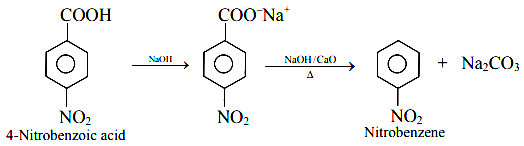
View full question & answer→Question 993 Marks
How will you bring about the following conversions?
acetone to 2-methylpropan-2-ol
AnswerGrignard reagent, methyl magnesium bromide reacts with acetone to form an adduct which on hydrolysis with dilute acid gives 2-methylpropan-2-ol.

View full question & answer→Question 1003 Marks
How are the following conversions carried out?
benzene to biphenyl
Question 1013 Marks
Write one example of nanomaterial used in the following.
Tyre of car
AnswerNanomaterial used in tyres of car: Carbon black
View full question & answer→Question 1023 Marks
Write two uses and two properties of polythene.
AnswerUses of high-density polyethylene: - HDP is used in the manufacture of toys and other household articles like buckets, dustbins, bottles, pipes, etc.
- It is used to prepare laboratory wares and other objects where high tensile strength and stiffness is required.
Properties of high-density polyethylene:
- HDP is crystalline, melting point in the range of 144 - 150 °C.
- It is much stiffer than LDP and has high tensile strength and hardness.
- It is more resistant to chemicals than LDP.
View full question & answer→Question 1033 Marks
Draw the Haworth projection structure of the following.
α-D-(–)-Fructofuranose
AnswerHaworth projection formula of α-D-(–)-fructofuranose: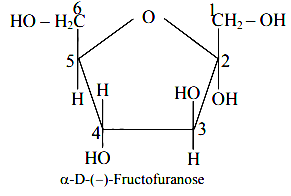
View full question & answer→Question 1043 Marks
Write reactions for the following conversions.
Propanone to Propane
AnswerClemmensen reduction :

View full question & answer→Question 1053 Marks
How will you bring about the following conversions?
2-methyl propan-2-ol to 2-methylpropene
Answer2-Methylpropan-2-ol undergoes dehydration when passed over hot copper at 573 K.
$\begin{array}{cc}
\ce{H3C - C(OH) - CH3 ->[Cu/573K][dehydration] H3C - C = CH2}\\
\phantom{}|\phantom{...............................}|\phantom{.}\\
\phantom{....}\ce{\underset{\text{2-Methylpropan-2-ol}}{CH3}\phantom{..................}\underset{\text{2-Methylpropene}}{CH3}}\phantom{....}
\end{array}$
View full question & answer→Question 1063 Marks
How are the following conversions carried out?
propene to 2-nitropropane
Answer$\begin{array}{cc}
\ce{\underset{\text{Propene}}{HC3 - CH = CH2 + H - Br}-> H3C - CH - CH3 + \underset{\text{Silver nitrite}}{Ag - O - N = O} ->\underset{\text{2-Nitropropane}}{(CH3)2CH - NO2}}\\
|\phantom{}\\
\ce{\phantom{..}\underset{\text{2-Bromopropane(Major)}}{Br}\phantom{.}}
\end{array}$
View full question & answer→Question 1073 Marks
Write the name of nanomaterial which is used in water purification.
AnswerSilver nanoparticles are used in water purification.
View full question & answer→Question 1083 Marks
Write chemical reactions for the preparation of high-density polythene.
AnswerChemical reaction for the preparation of high-density polythene (HDP) is as follows:
View full question & answer→Question 1093 Marks
AnswerAny of a large group of organic compounds occurring in foods and living tissues and including sugars, starch, and cellulose. They contain hydrogen and oxygen in the same ratio as water (2:1) and typically can be broken down to release energy in the animal body. Carbohydrates are polyhydroxy aldehydes or ketones or compounds which give rise to such units on hydrolysis.
View full question & answer→Question 1103 Marks
Write reactions for the following conversions.
Benzene to Benzaldehyde
AnswerGatterman-Koch formylation of benzene will give benzaldehyde.
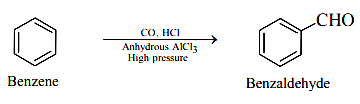
View full question & answer→Question 1113 Marks
How will you bring about the following conversions?
isopropyl alcohol to acetone
AnswerWhen isopropyl alcohol is heated at 573 K in presence of Cu acetopne is formed.
$\begin{array}{cc}
\ce{CH3 - CH - CH3 ->[Cu/573K][Oxidation] CH3 - C - CH3}\\
\phantom{...}|\phantom{..........................}||\phantom{...}\\
\phantom{}\ce{\underset{\text{Isopropyl alcohol}}{OH}\phantom{..................}\underset{\text{Acetone}}{O}}\phantom{...}
\end{array}$
View full question & answer→Question 1123 Marks
How are the following conversions carried out?
propene to 1-iodopropane
Answer$H _3 C -\underset{\text { Propene }}{ CH = CH _2}+ HBr \stackrel{\text { Peroxide }}{\longrightarrow} \underset{\text{1-Iodopropane}}{H _3 C - CH _2- CH _2- CH _2 Br}$
$H _3 C -\underset{\text { 1-Bromopropane }}{ CH _2- CH _2 Br }+ NaI \stackrel{\text { Acetone }}{\longrightarrow} \underset{\text { 1-Iodopropane }}{ CH _3 CH _2 CH _2 I }+ NaBr \downarrow$
View full question & answer→Question 1133 Marks
Discuss the position of d-block elements, lanthanoids and actinoids in the periodic table.
Answer - Position of d-block elements in the modern periodic table:
- The transition elements are placed in the periods 4 to 7 and groups 3 to 12.
- They constitute 3d, 4d, 5d and 6d series.
- They are placed at the centre with s block on one side and p block on the other side.
- The electropositivity, reactivity and other properties show a gradual change from s block to p block through those of the d block elements.
- Position of lanthanoids and actinoids in the modern periodic table:
- Lanthanoids and actinoids are placed separately at the bottom of the periodic table. They are a subset of 6th and 7th periods.
- These elements have 1 to 14 electrons in their f orbital, 0 or 1 in the penultimate energy level and 2 electrons in the outermost orbital.
View full question & answer→Question 1143 Marks
Give the main difference between electrolytic conductivity and molar conductivity with respect to concentration. Also write one application of electrochemical series.
AnswerElectrolytic conductivity decreases with a decrease in concentration of a solution.
Applications of electrochemical series in determining relative strength of oxidising agents: - The species on the left side of half reactions in electrochemical series are oxidizing agents.
- E° value measures the strength of the substances as oxidising agents. Larger the E° value greater is the strength of oxidising agent.
- The species in the top left side of half reactions are strong oxidising agents. As we move down the electrochemical series, E° value and strength of oxidising agents decreases.
View full question & answer→Question 1153 Marks
Explain the osmotic pressure of a solution with the help of a thistle tube.
Answer1. Osmosis can be demonstrated with the following experimental set up in which a semipermeable membrane is firmly fastened across the mouth of thistle tube. The solution of interest is placed inside an inverted thistle tube. This part of the tube and the membrane are then immersed in a container of pure water.
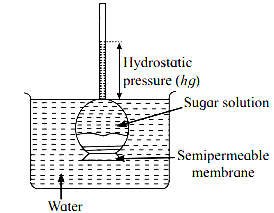
Osmosis and osmotic pressure
2. As a result of osmosis, some of the solvent passes through the membrane into the solution. It causes the liquid level in the tube to rise. The liquid column in the tube creates hydrostatic pressure that pushes the solvent back through the membrane into the container. The column of liquid in the tube continues to rise and eventually stops rising. At this stage hydrostatic pressure developed is sufficient to force solvent molecules back through the membrane into the container at the same rate they enter the solution.
3. Thus, an equilibrium is established where rates of forward and reverse passages are equal. The height of liquid column in the tube remains constant. This implies that the hydrostatic pressure has stopped osmosis.
4. The hydrostatic pressure that stops osmosis is an osmotic pressure $(\pi)$ of the solution. The hydrostatic pressure is equal to hpg, where, $h$ is the height of the liquid column in the tube, $\rho$ is density of solution and $g$ is acceleration due to gravity. View full question & answer→Question 1163 Marks
Write any three advantages of nanoparticles and nanotechnology.
AnswerAdvantages of nanoparticles and nanotechnology: - Revolution in electronics and computing.
- Energy sector:
a. Nanotechnology will make solar power more economical.
b. Energy storage devices will become more efficient. - Medical field:
a. Manufacturing of smart drugs helps cure faster and without side effects.
b. Curing of life-threatening diseases like cancer and diabetes.
View full question & answer→Question 1173 Marks
Explain aldol condensation reaction in detail.
Answer
- Aldehydes containing at least one α–hydrogen atom undergo a reaction in presence of dilute alkali (dilute $NaOH, KOH$, or $Na_2CO_3$) as the catalyst to form $\beta$-hydroxy aldehydes (aldol). This reaction is known as the aldol reaction.
- Formation of aldol is an addition reaction.
- Aldol formed from aldehyde having $\alpha $-hydrogens undergoes subsequent elimination of water molecule on warming. This gives rise to α,β-unsaturated aldehyde.
- The overall reaction is called aldol condensation. It is a nucleophilic addition-elimination reaction.
- The reaction can be given as,
$\begin{array}{cc}
\ce{\underset{\text{Aldehyde}}{2R - CH2 - CHO} ->[aq.NaOH] R - CH2 - CH - CHR - CHO}\\
\phantom{......................}|\\
\phantom{........................}\ce{\underset{\text{Aldol}}{OH}}
\end{array}$
$\begin{array}{cc}
\ce{R - CH2 - CH - CHR - CHO ->[-H2O][warm] \underset{\text{α,β-Unsaturated aldehyde}}{R - CH = CR - CHO}}\\
|\phantom{...................................}\\
\ce{OH}\phantom{...................................}
\end{array}$
e.g.
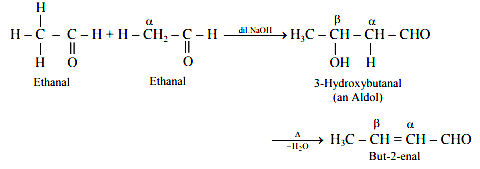
- Ketones containing at least two α-hydrogen also undergo aldol condensation reaction and give an $\alpha ,\beta$-unsaturated ketone.
e.g.

View full question & answer→Question 1183 Marks
An unknown alcohol is treated with Lucas reagent. Explain how you will determine whether the alcohol is primary, secondary or tertiary. Indicate by chemical equation the reaction between isopropyl alcohol and Lucas reagent.
AnswerPrimary, secondary and tertiary alcohols can be distinguished from each other in the laboratory using Lucas reagent (conc. HCl and ZnCl2). (i) An unknown alcohol is treated with Lucas reagent.
The reaction involved is:
$R - OH \underset{ ZnCl _2}{\stackrel{ HCl }{\longrightarrow}} R - Cl$
(ii) Depending on the observation an unknown alcohol can be identified as primary, secondary or tertiary.
| Test | Observation | Inference |
| Unknown Alcohol + Lucas reagent | Reagent turns turbid on heating. | Primary alcohol is present. |
| Unknown Alcohol + Lucas reagent | Reagent turns turbid slowly, without heating. | Secondary alcohol is present. |
| Unknown Alcohol + Lucas reagent | Reagent turns turbid immediately, without heating. | Tertiary alcohol is present. |
(iii) The reaction between isopropyl alcohol and Lucas reagent can be given as:
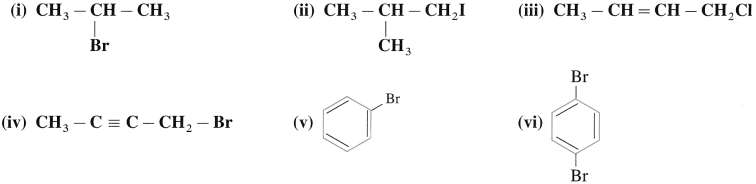
The reagent will turns turbid slowly, without heating. View full question & answer→Question 1193 Marks
Explain aqueous alkaline hydrolysis of tert. butyl bromide.
Answeri. Aqueous alkaline hydrolysis of tert. butyl bromide forms tert-butyl alcohol. The reaction can be given as,
$\begin{array}{cc}
\ce{\phantom{....}CH3\phantom{.........................}}\ce{CH3\phantom{............}}\\
|\phantom{.............................}|\phantom{...........}\\
\ce{CH3 - C - Br +\underset{\text{Nucleophile}}{OH-} ->CH3 - C - OH +\underset{\text{Bromide ion}}{Br-}}\\
|\phantom{.............................}|\phantom{...........}\\
\ce{\underset{\text{Tert-Butyl bromide}}{CH3}\phantom{.................}}
\ce{\underset{\text{tert−Butyl alcohol}}{CH3}}\phantom{.........}\\
\end{array}$
Rate = $k [(CH_3)_3C − Br]$
ii. The reaction follows the first-order kinetics. That is, the rate of this reaction depends on the concentration of only one species, which is the substrate molecule, tert-butyl bromide. Hence, it is called substitution nucleophilic unimolecular, $S_N1$ mechanism.
iii. It can be seen in the reaction that the concentration of the only substrate appears in the rate equation that is, the concentration of the nucleophile does not influence the reaction rate.
iv. In other words, tert-butyl bromide reacts with hydroxide by a two steps mechanism.
In the slow step C–X bond in the substrate undergoes heterolysis and in the subsequent fast step, the nucleophile uses its electron pair to form a new bond with the carbon undergoing change.
v. The $S_N1$ mechanism is represented as,
- Step I:
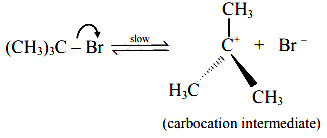
- Step II:
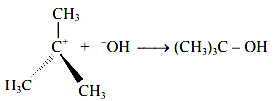
View full question & answer→Question 1203 Marks
In case of hcp structure, how are spheres in first, second and third layers arranged?
Answer - Hexagonal close-packed structure is obtained by stacking two dimensional hexagonal close-packed layers.
- So, the spheres in the first layer are arranged to form two dimensional hexagonal close packing.
- The spheres of the second layer are placed in the depressions of the first layer. If the first layer is labelled as ‘A’ layer, the second layer is labelled as ‘B’ layer because the two layers are aligned differently.
- The spheres of the third layer are aligned with the spheres of the first layer. The resulting pattern of the layers will be ‘ABAB....’. This arrangement results in a hexagonal close-packed (hcp) structure.
View full question & answer→Question 1213 Marks
Write one application of the following buffer:
$NH_4OH + NH_4Cl$
AnswerIn qualitative analysis, a pH of $8$ to $10$ is required for precipitation of cations IIIA group. It is maintained with the use of $(NH_4OH + NH_4Cl)$ buffer.
View full question & answer→Question 1223 Marks
What is the action of the following reagents on glucose?
hydrogen iodide
AnswerGlucose gives n-hexane on prolonged heating with hydrogen iodide, HI.
$\underset{\text { Glucose }}{ CHO ( CHOH )_4 CH _2 OH \stackrel{\Delta, HI }{\longrightarrow}} \underset{\text { n-Hexane }}{ CH _3-\left( CH _2\right)_4}- CH _3$
View full question & answer→Question 1233 Marks
Write reactions to bring about the following conversions.
Acetamide to methylamine
Answer$\begin{array}{cc}
\ce{O}\phantom{.............................................................}\\
||\phantom{.............................................................}\\
\ce{\underset{\text{Acetamide}}{CH3 - C - NH2} + Br2 + 4KOH_{(aq)} ->[\Delta]\underset{\text{Methylamine}}{CH3 - NH2} + 2KBr + K2CO3 + 2H2O}\\\end{array}$
View full question & answer→Question 1243 Marks
Draw structure of cis isomer of $[Co(NH_3)_4Cl_2]^+$
View full question & answer→Question 1253 Marks
Write the chemical reaction of action of $Cl_2$ on excess $NH_3$.
View full question & answer→Question 1263 Marks
The rate constant of the first order reaction is $1.386 min^{–1}$. Calculate the time required for 80% reactant to decompose?
AnswerGiven: $[A]_0=100 \%, k=1.386 min ^{-1}$
To find: Time required for $80 \%$ reactant to decompose
Formula: $t =\frac{2.303}{ k } \log _{10} \frac{[ A ]_{ o }}{[ A ]_{ t }}$
Calculations: The reactant is $80 \%$ decomposed. Hence, $[A]_t=20 \%$.
$t =\frac{2.303}{ k } \log _{10} \frac{[ A ]_{ o }}{[ A ]_{ t }}$
Substituting the values,
$ t =\frac{2.303}{1.386 min ^{-1}} \log _{10} \frac{100}{20}$
$=\frac{2.303}{1.386 min ^{-1}} \times 0.69897$
$=1.16 min \times \frac{60 s }{1 min }$
$=69.6 s $
Time required for reducing concentration of reactant to $20 \%$ is $1 . 1 6 ~ m i n$ or $6 9 . 6 ~ s$.
View full question & answer→Question 1273 Marks
Answer the following question.Derive the expression for the maximum work.
Answer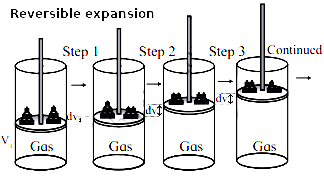
1. Consider n moles of an ideal gas enclosed in a cylinder fitted with a frictionless movable rigid piston. It expands isothermally and reversibly from the initial volume $V_1$ to final volume $V_2 $ at temperature T. The expansion takes place in a number of steps as shown in the figure.
2. When the volume of a gas increases by an infinitesimal amount dV in a single step, the small quantity of work done
$dW = -P_{ext} dV ....(1)$
3. As the expansion is reversible, P is greater by a very small quantity dp than $P_{ext}.$
Thus $P - P_{ext} = dP$ or $P_{ext} = P - dP ....(2)$
Combining equations (1) and (2),
$dW = - (P - dP)dV = - PdV + dP.dV$
Neglecting the product dP.dV which is very small, we get
$dW = - PdV .....(3)$
4. The total amount of work done during the entire expansion from volume $V_1$ to $V_2$ would be the sum of the infinitesimal contributions of all the steps. The total work is obtained by integration of Equation (3) between the limits of initial and final states. This is the maximum work, the expansion being reversible.
Thus,
$\int_{\text {initial }}^{\text {final }} dW =-\int_{ V _1}^{ V _2} PdV$
Hence,
$W _{\max }=- \int_{ V _1}^{ V _2} \operatorname{PdV} \cdots(4)$
5. Using the ideal gas law, $P V=n R T$,
$W _{\max }=- \int_{ V _1}^{ V _2} nRT \frac{ dV }{ V }$
$= -nRT \int_{ V _1}^{ V _2} \frac{ dV }{ V }$
$\ldots(\because T$ is constant.)
$ =-n R T \ln (V)_{V_1}^{V_2}$
$=-n R T\left(\ln V_2-\ln V_1\right)$
$=-n R t \ln \frac{V_2}{V_1}$
$=-2.303 \ n R T \ \log _{10} \frac{V_2}{V_1} \cdots(5) $
6. At constant temperature, $P _1 V _1= P _2 V _2$ or $\frac{ V _2}{ V _1}=\frac{ P _1}{ P _2}$
Replacing $\frac{ V _2}{ V _1}$ in in equation (5) by $\frac{ P _1}{ P _2}$, we get,
$W_{\max }=-2.303 n R T \log \frac{P_1}{P_2} \cdots(6)$
Equations (5) and (6) are expressions for work done in reversible isothermal process. View full question & answer→Question 1283 Marks
Write one application of the following buffer:
$
HCO _3^{-}+ H _2 CO _3
$
Answer$pH$ of blood in our body is maintained at $7.36-7.42$ due to $\left( HCO _3^{-}+ H _2 CO _3\right)$ buffer.
View full question & answer→Question 1293 Marks
Write the name and formulae of the monomers used for the preparation of dacron.
AnswerMonomers used in the preparation of dacron are ethylene glycol and terephthalic acid.
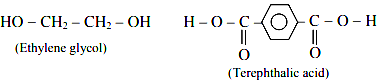
View full question & answer→Question 1303 Marks
What is the action of the following reagents on glucose?
hydroxylamine
AnswerGlucose forms oxime by reaction with hydroxylamine:
$\begin{array}{cc}
\phantom{}\ce{CHO}\phantom{..............}\ce{CH = N - OH}\phantom{..}\\
\phantom{.}|\phantom{..................}|\phantom{...............}\\
\ce{(CHOH)4 ->[NH2 - OH](CHOH)4 + H2O}\\
\phantom{}|\phantom{..................}|\phantom{..............}\\
\phantom{}\ce{\underset{\text{Glucose}}{CH2OH} \phantom{..........}\underset{\text{Oxime}}{CH2OH}}\phantom{........}
\end{array}$
View full question & answer→Question 1313 Marks
Write reactions to bring about the following conversions.
Acetamide to Ethylamine
Answer$\begin{array}{cc}
\ce{O}\phantom{.......................................}\\
||\phantom{.......................................}\\
\ce{\underset{\text{Acetamide}}{CH3 - C - NH2} + 4[H] ->[LiAlH4/ether][or Na/C2H5OH] \underset{\text{Ethylamine}}{CH3 - CH2 - NH2}}
\end{array}$
View full question & answer→Question 1323 Marks
Define the term Hydrated isomers.
AnswerIsomers in which there is exchange of solvent (water) ligands between coordination and ionization spheres are called hydrate isomers.
View full question & answer→Question 1333 Marks
Define the term Co-ordination isomer.
AnswerIsomers which show interchange of ligands between cationic and anionic spheres of different metal ions are called co-ordination isomers.
View full question & answer→Question 1343 Marks
Fluorine shows only –1 oxidation state while other halogens show –1, +1, +3, +5 and +7 oxidation states. Explain.
Answer - The fluorine atom has no d-orbitals in its valence shell and therefore, cannot expand its octet. Thus, fluorine is the most electronegative exhibit –1 oxidation state only.
- Cl, Br, and I exhibit –1, +1, +3, +5, and +7 oxidation states. This is because they are less electronegative than F and possess empty d-orbitals in the valence shell and therefore, can expand the octet.
View full question & answer→Question 1353 Marks
View full question & answer→Question 1363 Marks
Answer the following in one or two sentences. What is enthalpy of fusion?
AnswerEnthalpy change that occurs when one mole of a solid is converted into liquid without a change in temperature at constant pressure is the enthalpy of fusion.
View full question & answer→Question 1373 Marks
Write one application of the following buffer: Citrate buffer
AnswerPenicillin preparations are stabilized by addition of sodium citrate as buffer.
View full question & answer→Question 1383 Marks
Explain the term copolymers with examples.
Answer - The polymers which have two or more types of repeating units are called copolymers.
- They are formed by the polymerization of two or more different types of monomers in presence of each other.
- The different monomer units are randomly sequenced in the copolymer.
e.g. Buna-S, Buna-N
View full question & answer→Question 1393 Marks
What is the action of the following reagents on glucose?
acetic anhydride
AnswerGlucose reacts with acetic anhydride to form glucose pentaacetate.
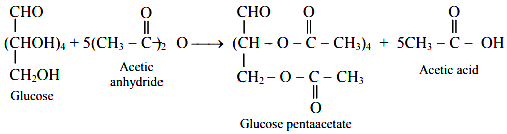
View full question & answer→Question 1403 Marks
Answer the following.
Write the IUPAC name of the following amine.
$H_2N-(CH_2)_6 - NH_2$
View full question & answer→Question 1413 Marks
Answer the following question.What are the types of ligands? Give one example of each type.
AnswerDepending upon the number of electron donor atoms present, ligands are classified as:
i. Monodentate ligands: A monodentate ligand is the one where a single donor atom shares an electron pair to form a coordinate bond with the central metal ion.
e.g. $Cl^–, OH^–, CN^–,$ etc.
ii. Polydentate ligands: A polydentate ligand has two or more donor atoms linked to the central metal ion. Based on the number of donor atoms, polydentate ligands are further classified as:
a. Bidentate ligands: The ligands which bind to central metal through two donor atoms are called bidentate ligands.
e.g.
1. Ethylenediammine binds to the central metal atom through two nitrogen atoms.
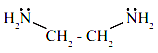
2. Similarly, Oxalate ligand $\left( C _2 O _4^{2-}\right)$ utilizes electron pair on each of its negatively charged oxygen atoms on linking with central metal.
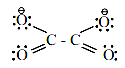
b. Hexadentate ligands: The ligands which bind to central metal through six donor atoms are called hexadentate ligands.
e.g. Ethylenediaminetetraacetate ion $(EDTA)^{4–}$ binds to metal by electron pairs of four oxygen and two nitrogen atoms.
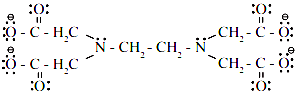
iii. Ambidentate ligands: The ligands which have two donor atoms and use the electron pair of either donor atoms to form a coordinate bond with the metal ion are called ambidentate ligands.
e.g.
a. The ligand $NO _2^{-}$ links to the metal ion through nitrogen or oxygen.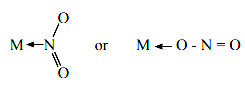
b. $SCN^–$ has two donor atoms nitrogen and sulphur either of which links to metal $M ← SCN^–$ or $M ← NCS^–$. View full question & answer→Question 1423 Marks
Answer the following Give the similarities and differences in elements of 3d, 4d, and 5d series.
Answer - Similarities in physical properties:
-
All d block elements are lustrous and shining.
- They are hard and have a high density.
-
They have high melting and boiling points.
-
They are good electrical and thermal conductors.
-
They have high tensile strength and malleability.
-
They can form alloys with transition and non-transition elements.
-
Many metals and their compounds are paramagnetic.
-
Most of the metals are efficient catalysts.
- Similarities in chemical properties:
- All d block elements are electropositive metals.
- They exhibit variable valencies and form coloured salts and complexes.
- They are good reducing agents.
- They form insoluble oxides and hydroxides.
- Iron, cobalt, copper, molybdenum, and zinc are biologically important metals.
- They catalyse biological reactions.
- Differences:
Although most properties exhibited by d block elements are similar, the elements of the first row differ from second and third rows in the stabilization of higher oxidation states in their compounds.
View full question & answer→Question 1433 Marks
Derive an integrated rate law expression for first order reaction: A → B + C
AnswerConsider first order reaction, $A \rightarrow B+C$
The differential rate law is given by
$
\text { rate }=-\frac{ d [ A ]}{ dt }= k [ A ] \cdots(1)
$
where, $[A]$ is the concentration of reactant at time $t$.
Rearranging Eq. (1)
$
\frac{ d [ A ]}{[ A ]}=- kdt \cdots(2)
$
Let $[A]_0$ be the initial concentration of the reactant $A$ at time $t=0$.
Suppose $[A]_t$ is the concentration of $A$ at time $=t$
The equation (2) is integrated between limits $[A]=[A]_0$ at $t=0$ and $[A]=[A]_t$ at $t=t$
$
\int_{[ A ]_0}^{[ A ]_{ t }} \frac{ d [ A ]}{[ A ]}=- k \int_0^{ t } dt
$
On integration,
$
[\ln [ A ]]_{[ A ]_0}^{[ A ]_{ t }}=- k ( t )_0^{ t }
$
Substitution of limits gives
$
\ln [A]_t-\ln [A]_0=-k t
$
$\operatorname{or} \ln \frac{[ A ]_{ t }}{[ A ]_0}=- kt$
or
$k =\frac{1}{ t } \ln \frac{[ A ]_0}{[ A ]_{ t }}$
Converting In to $\log _{10}$, we write
$
k =\frac{2.303}{ t } \log _{10} \frac{[ A ]_0}{[ A ]_{ t }} \cdots(4)
$
Eq. (4) gives the integrated rate law for the first order reactions.
View full question & answer→Question 1443 Marks
Derive the expression for molar mass of solute in terms of boiling point elevation of solvent.
AnswerThe boiling point elevation is directly proportional to the molality of the solution. Thus,
$
\Delta T _{ b }= K _{ b } m \cdots(1)
$
Suppose we prepare a solution by dissolving $W _2 g$ of solute in $W _1 g$ of solvent. Moles of solute in $W _1$ g of solvent $=\frac{ W _2}{ M _2}$
where, $M _2$ is the molar mass of solute.
Mass of solvent $= W _1 g =\frac{ W _1 g }{1000 g / kg }=\frac{ W _1}{1000} kg$
The molality is expressed as,
$
\begin{aligned}
m & =\frac{\text { Moles of solute }}{\text { Mass of solvent in } kg } \\
m & =\frac{ W _2 / M _2 mol }{ W _1 / 1000 kg } \\
m & =\frac{1000 W _2}{ M _2 W _1} mol\ kg ^{-1} \cdots(2)
\end{aligned}
$
Substituting equation (2) in equation (1), we get,
$
\Delta T _{ b }=\frac{1000 K _{ b } W _2}{ M _2 W _1}
$
Hence,
$
M _2=\frac{1000 K _{ b } W _2}{\Delta T _{ b } W _1}
$
View full question & answer→Question 1453 Marks
Explain prevention of waste or by products which is one of the principles of green chemistry.
AnswerPrevention of waste or by products: - According to this principle of green chemistry, priority is given for the prevention of waste rather than cleaning up and treating waste after it has been generated.
- Illustration: To develop zero waste technology (ZWT).
As per ZWT, in chemical synthesis, the waste products should be zero or minimum. - It also aims to use the waste product of one system as the raw material for other systems.
For example:
a. Bottom ash of thermal power station can be used as a raw material for cement and brick industry.
b. Effluent coming out from cleansing of machinery parts may be used as coolant water in a thermal power station.
View full question & answer→Question 1463 Marks
Explain the classification of polymers on the basis of structures.
AnswerDepending upon how the monomers are linked together, that is, the chain configuration, polymers are classified into three types:
- Linear or straight chain polymers: When the monomer molecules are joined together in a linear arrangement the resulting polymer is a straight chain polymer. It is obtained from bifunctional monomers or alkenes.
e.g. PVC, high-density polythene. - Branched chain polymers: Monomers having 3 functional groups or already having side chains give rise to branched chain polymers.
e.g. Low-density polythene. - Three dimensional cross-linked polymers: Third type of arrangement is said to be cross-linked or network polymers where cross-links are produced between linear chains. Cross-linking results from polyfunctional monomers.
e.g. Bakelite, melamine.
View full question & answer→Question 1473 Marks
Explain the classification of carbohydrates with examples.
AnswerClassification of carbohydrates: Carbohydrates are classified into three broad groups in accordance with their behaviour on hydrolysis as monosaccharides, oligosaccharides, and polysaccharides.
- Monosaccharides: Monosaccharides are carbohydrates which do not hydrolyse further into smaller units of polyhydroxy aldehydes or ketones.
e.g. Glucose, fructose, ribose - Oligosaccharides: Oligosaccharides are carbohydrates which on hydrolysis yield two to ten units of monosaccharides and accordingly they are further classified as disaccharides, trisaccharides, and so on.
a. Disaccharides yield two monosaccharide units on hydrolysis.
e.g. Sucrose
b. Trisaccharides yield three monosaccharide units on hydrolysis.
e.g. Raffinose
c. Tetrasaccharides yield four monosaccharide units on hydrolysis.
e.g. Stachyose - Polysaccharides: Polysaccharides give very large number of monosaccharide units on complete hydrolysis.
e.g. Starch, glycogen, cellulose
View full question & answer→Question 1483 Marks
Distinguish between methanamine, dimethanamine and trimethanamine using Hinsberg’s reagent.
Answer(i) Methanamine reacts with benzenesulphonyl chloride (Hinsberg’s reagent) to give N-methyl benzenesulphonamide which is soluble in alkali.
$\underset{\text { Methanamine }}{ CH _3 NH _2}+ C _6 H _5 SO _2 Cl \stackrel{ OH ^{-}}{\longrightarrow} \underset{\text { N-Methyl benzenesulphonamide (Soluble in alkali) }}{ C _6 H _5 SO _2 NHCH _3}$
(ii) Dimethanamine reacts with benzenesulphonyl chloride (Hinsberg’s reagent) to give a compound which does not dissolve in alkali.
$\underset{\text { Dimethanamine }}{\left( CH _3\right)_2 NH }+ C _6 H _5 SO _2 Cl \stackrel{ OH ^{-}}{\longrightarrow} \underset{ N , N \text {-Dimethylbenzene sulphonamide (Insoluble in alkali) }}{ C _6 H _5 SO _2 N \left( CH _3\right)_2}$
(iii) Trimethanamine does not react with benzenesulphonyl chloride (Hinsberg’s reagent) due to the absence of H-atom attached N-atom.
View full question & answer→Question 1493 Marks
What is the action of following on phenol at low temperature?
a. dil. $HNO _3$
b. conc. $H _2 SO _4$
c. $Br _2 / CS _2$
Answer
- Dilute $HNO _3$ : Phenol reacts with dilute nitric acid at low temperature to give a mixture of ortho- and paranitrophenol.
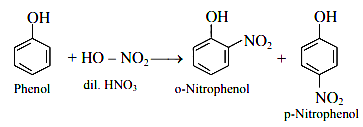
- $Conc. H_2SO_4$: At room temperature $(298 K)$, phenol reacts with concentrated sulphuric acid to form o-phenolsulphonic acid.
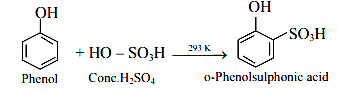
- $Br_2$ in $CS_2$: When a reaction is carried out in a solvent of lower polarity like $CS_2$ a mixture of ortho- and para-bromophenol is formed.
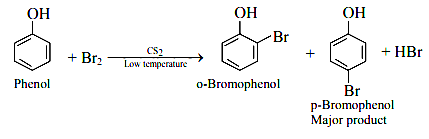
View full question & answer→Question 1503 Marks
Explain the factors affecting $S_N1$ and $S_N2$ mechanism.
AnswerFactors that affect the $S_N1$ and $S_N2$ mechanisms:
- Nature of substrate
- Nucleophilicity of the reagent
- Solvent polarity
i. Nature of substrate:
- $S_N2$ mechanism: The transition state (T.S.) of the $S_N2$ mechanism is pentacoordinate and thus crowded. As a result, $S_N2$ mechanism is favoured in primary halides and least favoured in tertiary halides. Reactivity order of alkyl halides towards $S_N2$ mechanism: $3^\circ < 2^\circ < 1^\circ < CH_3X.$
- $S_N1$ mechanism: A planar carbocation intermediate is formed in the $S_N1$ reaction. It has no steric crowding as bulky alkyl groups can be easily accommodated in planar carbocation.
Formation of planar carbocation intermediate results in a relief from steric crowding present in the tertiary halide substrate.
Secondly, the carbocation intermediate is stabilized by +I effect of alkyl substituents and by the hyperconjugation effect of alkyl substituents containing $\alpha -$hydrogens.
As a result, $S_N1$ mechanism is most favoured in tertiary halides and least favoured in primary halides.
Reactivity order of alkyl halides towards $S_N1$ mechanism: $3^\circ > 2^\circ > 1^\circ > CH_3X.$
ii. Nucleophilicity of the reagent:
- $S_N2$ mechanism: A more powerful nucleophile attacks the substrate faster and favours the $S_N2$ mechanism.
- $S_N1$ mechanism: The rate of the $S_N1$ mechanism is independent of the nature of nucleophile as nucleophile does not react in the slow step of $S_N1.$ It waits till the carbocation intermediate is formed, and reacts fast with it.
iii. Solvent polarity:
- $S_N2$ mechanism: Polar protic solvents usually decrease the rate of an $S_N2$ reaction. In the rate-determining step of the $S_N2 $ mechanism, the substrate, as well as nucleophile, is involved.
A polar solvent stabilizes nucleophile (one of the reactants) by solvation. Thus, solvent deactivates the nucleophile by stabilizing it. Hence, aprotic solvents or solvents of low polarity will favour the $S_N2$ mechanism.
- $S_N1$ mechanism: $S_N1$ mechanism proceeds via the formation of a carbocation intermediate. A good ionizing solvent, polar solvent, stabilizes the ions by solvation.
Solvation of carbocation is relatively poor and solvation of anion is particularly important. Anions are solvated by hydrogen-bonding solvents, that is, protic solvents.
Thus, the $S_N1$ reaction proceeds more rapidly in polar protic solvents than in aprotic solvents.
View full question & answer→Question 1513 Marks
Calculate the packing efficiency for bcc lattice.
AnswerPacking efficiency of metal crystal in body-centred cubic (bcc) lattice:
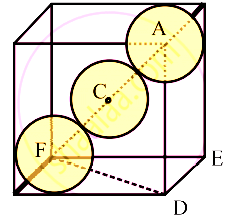
- Step 1: Radius of sphere (particle):
In bcc unit cell, particles occupy the corners and in addition one particle is at the centre of the cube. The particle at the centre of the cube touches two corner particles along the diagonal of the cube. To obtain radius of the particle (sphere) Pythagoras theorem is applied. For triangle FED, $\angle FED =90^{\circ}$.
$\left.\therefore F D^2=F E^2+E D^2=a^2+a^2=2 a^2 \text { (because } F E=E D=a\right)$
For triangle $A F D, \angle A D F=90^{\circ}$
$\therefore A F^2=A D^2+F D^2$
Substitution of equation (1) into (2) yields
$\left.A F^2=a^2+2 a^2=3 a^2 \text { (because } A D=a\right)$
or $AF =\sqrt{3} a$
From the figure, $A F=4 r$.
Substitution for AF from equation (3) gives
$\sqrt{3} a =4 r \text { and hence, } r =\frac{\sqrt{3}}{4} a$
- Step 2: Volume of sphere:
Volume of sphere particle $=\frac{4}{3} \pi r^3$
Substitution for $r$ from equation (4) gives
Volume of one particle $=\frac{4}{3} \pi \times\left(\frac{\sqrt{3}}{4} a \right)^3=\frac{4}{3} \pi \times \frac{(\sqrt{3})^3}{64} a ^3=\frac{\sqrt{3} \pi a ^3}{16}$
- Step 3: Total volume of particles:
Unit cell bcc contains 2 particles.
Hence, volume occupied by particles in bcc unit cell
$=\frac{2 \sqrt{3} \pi a ^3}{16}=\frac{\sqrt{3} \pi a ^3}{8} \cdots(5)$
- Step 4: Packing efficiency:
$ \text { Packing efficiency }=\frac{\text { Volume occupied by particles in unit cell }}{\text { total volume of unit cell }} \times 100$
$=\frac{\sqrt{3} \pi a ^3}{8 a ^3} \times 100=68 \% $
Thus, $68 \%$ of the total volume in bcc unit lattice is occupied by atoms and $32 \%$ is empty space or void volume. View full question & answer→Question 1523 Marks
What is oxidation state of sulfur in the following?
Peroxymonosulfuric acid
AnswerPeroxymonosulfuric acid, $H_2SO_5$:
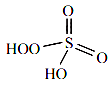
$2 \times (+1)$ + (Oxidation state of S) + $3 \times (−2) + 2 \times (−1) = 0$
$2$+ (Oxidation state of S) $− 6 – 2 = 0$
Hence, oxidation state of ‘S’ in $H_2SO_{5 =}+8$ View full question & answer→Question 1533 Marks
What is the action of following reagents on ethanoic acid?
$P_2O_5$/heat
AnswerEthanoic acid on heating with strong dehydrating agent $P_2O_5$ forms acetic anhydride.
$\begin{array}{cc}
\phantom{............}\ce{O}\phantom{........}\ce{O}\phantom{}\\
\phantom{............}||\phantom{........}||\phantom{}\\
\ce{\underset{\text{Ethanoic acid}}{2CH3COOH} ->[\ce{P2O5}/\Delta] \underset{\text{Acetic anhydride}}{CH3 _ C - O - C - CH3} + H2O}
\end{array}$
View full question & answer→Question 1543 Marks
What is oxidation state of sulfur in the following? Sulfuric acid
AnswerSulfuric acid, $H_2SO_4$:
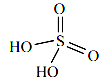
$2 \times(+1)+($ Oxidation state of $S)+4 \times(-2)=0$
$2+$ (Oxidation state of S $)-8=0$
Hence, oxidation state of ' $S ^{\prime}$ in $H _2 SO _4=+ 6$ View full question & answer→Question 1553 Marks
Derive the relationship between Gibbs energy of cell reaction and cell potential.
Answer1. The electrical work done in a galvanic cell is the electricity (charge) passed multiplied by the cell potential.
Electrical work $=$ amount of charge $\times$ cell potential
2. Charge of one mole electrons is $F$ coulombs.
For the cell reaction involving $n$ moles of electrons, Charge passed $= nF$ coulombs
3. Hence, electrical work $= nFE _{\text {cell }}$
Electrical work done in a galvanic cell is equal to the decrease in Gibbs energy, $-\Delta G$, of cell reaction.
It then follows that
Electrical work done $=-\Delta G$
4. Therefore, $-\Delta G=n F_{\text {cell }}$
or
$\Delta G =- nFE _{\text {cell }}$
Under standard state conditions, we write
$\Delta G ^{\circ}=- nFE _{\text {cell }}^0$
View full question & answer→Question 1563 Marks
Three moles of an ideal gas are expanded isothermally from $15\ dm^3$ to $20\ dm^3$ at a constant external pressure of $1.2$ bar, calculate the amount of work in Joules.
AnswerGiven: Initial volume $\left(V_1\right)=15 dm ^3$
Final volume $\left(V_2\right)=20 dm ^3$
External pressure $\left( P _{\text {ext }}\right)=1.2 bar$
To find: Amount of work in Joules
Formula: $W =- P _{\text {ext }} \Delta V =- P _{\text {ext }}\left( V _2- V _1\right)$
Calculation: From formula,
$ W=-P_{\text {ext }} \Delta V=-P_{\text {ext }}\left(V_2-V_1\right)$
$W=-1.2 \operatorname{bar}\left(20 dm ^3-15 dm ^3\right)$
$=-1.2 \text { bar } \times 5 dm ^3=-6 dm ^3 \text { bar } $
Now, $1 dm ^3$ bar $=100 J$
Hence, $W=-6 dm ^3$ bar $\times \frac{100 J }{1 dm ^3 \text { bar }}=-600 J$
The work done is $- 6 0 0 J$.
View full question & answer→Question 1573 Marks
Explain the types of buffer solutions.
AnswerThere are two types of buffer solutions:
- Acidic buffer:
A solution containing a weak acid and its salts with strong base is called an acidic buffer solution. It maintains an acidic pH.
e.g. A solution containing weak acid such as $CH_3COOH$ and its salt such as $CH_3COONa$ is an acidic buffer solution.
- Basic buffer:
A solution containing a weak base and its salt with strong acid is the basic buffer solution. It maintains an alkaline pH.
e.g. A solution containing a weak base such as $NH_4OH$ and its salt such as $NH_4Cl$ is a basic buffer solution.
View full question & answer→Question 1583 Marks
What is the action of following reagents on ethanoic acid?
sodalime/heat
AnswerSodium salts of ethanoic acid on heating with soda lime give methane which contains one carbon atom less than the ethanoic acid.
$\underset{\text { Ethanoic acid }}{ CH _3- COOH \stackrel{ NaOH }{\longrightarrow}} \underset{\text {Sodium acetate }}{CH _3- COO ^{-} Na ^{+}+ NaOH} \underset{\Delta}{\stackrel{\text{CaO}}{\longrightarrow}} \underset{\text { Methane }}{ CH _4}+ Na _2 CO _3$
View full question & answer→Question 1593 Marks
What is the oxidation state of sulfur in the following? Sulfurous acid
AnswerSulfurous acid, $H_2SO_3$:
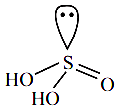
$2 \times(+1)+($ Oxidation state of S) $+3 \times(-2)=0$
$2+$ (Oxidation state of S $)-6=0$
Hence, oxidation state of ' $S$ ' in $H _2 SO _3=+4$ View full question & answer→Question 1603 Marks
State Kohlrausch law of independent migration of ions.
AnswerKohlrausch law states that “at infinite dilution each ion migrates independent of co-ion and contributes to total molar conductivity of an electrolyte irrespective of the nature of other ion to which it is associated.”
View full question & answer→Question 1613 Marks
Define an isolated system.
AnswerA system that does not allow the exchange of either energy or matter with the surroundings is called an isolated system.
View full question & answer→Question 1623 Marks
AnswerBuffer solution is defined as a solution which resists drastic changes in pH when a small amount of strong acid or strong base or water is added to it.
View full question & answer→Question 1633 Marks
What is the action of following reagents on ethanoic acid?
$SOCl _2$ /heat
Answer\Ethanoic acid on heating with $SOCl _2$ gives the corresponding acyl chloride.
$\underset{\text { Ethanoic acid }}{CH_3 COOH}+\underset{\text { Thionyl chloride }}{SOCl_2} \xrightarrow{\Delta} \underset{\text { Acetyl chloride }}{CH_3 COCl}+HCl \uparrow+SO_2 \uparrow$
View full question & answer→