Question 12 Marks
Assign oxidation number to the underlined elements in the following species: $\mathrm{H}_2 \mathrm{S}_2 \mathrm{O}_7$
Answer$\begin{matrix} +1&\text{x}&-2\\\text{H}_2&\text{ S}_2&\ \text{ O}_7\end{matrix}$Then, we have
2(+1) + 2(x) + 7(-2) = 0
⇒ 2 + 2x - 14 = 0
⇒ 2x = 12
⇒ x = +6
Hence, the oxidation number of S is +6.
View full question & answer→Question 22 Marks
Assign oxidation number to the underlined elements in the following species:$\text{H}_4\text{P}_2\text{O}_7$
Answer$\begin{matrix} +1&\text{x}&-2\\\text{H}_4&\text{ P}_2&\ \text{ O}_7\end{matrix}$Then, we have
4(+1) + 2(x) + 7(-2) = 0
⇒ 4 + 2x - 14 = 0
⇒ 2x = +10
⇒ x = +5
Hence, the oxidation number of P is +5.
View full question & answer→Question 32 Marks
Assign oxidation number to the underlined elements in the following species:$\text{Na}\text{H}_2\text{P}\text{O}_4$
AnswerLet the oxidation number of P be x. We know that, Oxidation number of Na = +1 Oxidation number of H = +1 Oxidation number of O = -2 $\begin{matrix}\ \ +1&+1&\text{x}&-2\\\Rightarrow\ \text{Na}& \ \ \text{ H}_2 &\text{P}&\ \text{ O}_4\end{matrix}$ Then, we have 1(+1) + 2(+1) + 1(x) + 4(-2) = 0 ⇒ 1 + 2 + x - 8 = 0 ⇒ x = +5Hence, the oxidation number of P is +5.
View full question & answer→Question 42 Marks
Assign oxidation number to the underlined elements in the following species:$\text{Ca}\text{O}_2$
Answer$\begin{matrix} +2&\text{x}\\\text{Ca}&\text{ O}_2\end{matrix}$Then, we have
(+2) + 2(x) = 0
⇒ 2 + 2x = 0
⇒ x = -1
Hence, the oxidation number of O is -1.
View full question & answer→Question 52 Marks
Consider the elements: Cs, Ne, I and FIdentify the element that exhibits both positive and negative oxidation states.
AnswerI. Because of the presence of seven electrons in the valence shell, I shows an oxidation state of -1 (in compounds of I with more electropositive elements such as H, Na, K, Ca, etc.) or an oxidation state of +1 compounds of I with more electronegative elements, i.e., O, F, etc.) and because of the presence of d-orbitals it also exhibits +ve oxidation states of +3, +5 and +7.
View full question & answer→Question 62 Marks
Assign oxidation number to the underlined elements in the following species:$\text{Na}\text{B}\text{H}_4$
Answer$\begin{matrix} +1&\text{x}&-1\\\text{Na}&\text{ B}&\ \text{ H}_4\end{matrix}$Then, we have
1(+1) + 1(x) + 4(-1) = 0
⇒ 1 + x - 4 = 0
⇒ x = +3
Hence, the oxidation number of B is +3.
View full question & answer→Question 72 Marks
Assign oxidation number to the underlined elements in the following species:$KAl(SO_4)_2 .12 H_2O$
Answer$\stackrel{{+1}}{\hbox{k}}\ \stackrel{\ {3+}}{\hbox{Al}}\Big(\stackrel{{\text{x}}}{\hbox{S}}\ \stackrel{{2-}}{\hbox{O}_4}\Big)_2.12\stackrel{{+1}}{\ \hbox{H}_2}\stackrel{{-2}}{\ \ \hbox{O}}$
Then, we have
$1(+1)+1(+3)+2(x)+8(-2)+24(+1)+12(-2)=0$
$\Rightarrow 1+3+2 x-16+24-24=0$
$\Rightarrow 2 x=12$
$\Rightarrow x=+6$
Or,
We can ignore the water molecule as it is a neutral molecule. Then, the sum of the oxidation numbers of all atoms of the water molecule may be taken as zero. Therefore, after ignoring the water molecule, we have
$1(+1)+1(+3)+2(x)+8(-2)=0$
$\Rightarrow 1+3+2 x-16=0$
$\Rightarrow 2 x=12$
$\Rightarrow x=+6$
Hence, the oxidation number of $S$ is $+6$ .
View full question & answer→Question 82 Marks
Assign oxidation number to the underlined elements in the following species:$\text{K}_2\text{Mn}\text{O}_4$
Answer$\begin{matrix} +1&\text{x}&-2\\\text{K}_2&\text{ Mn}&\ \text{ O}_4\end{matrix}$Then, we have
2(+1) + x + 4(-2) = 0
⇒ 2 + x - 8 = 0
⇒ x = +6
Hence, the oxidation number of Mn is +6.
View full question & answer→Question 92 Marks
The compound $\mathrm{AgF}_2$ is unstable compound. However, if formed, the compound acts as a very strong oxidising agent. Why?
AnswerThe oxidation state of $\mathrm{Ag}$ in $\mathrm{AgF}_2$ is +2 . But, +2 is an unstable oxidation state of Ag . Therefore, whenever $\mathrm{AgF}_2$ is formed, silver readily accepts an electron to form $\mathrm{Ag}^{+}$. This helps to bring the oxidation state of Ag down from +2 to a more stable state of +1 . As a result, $\mathrm{AgF}_2$ acts as a very strong oxidizing agent.
View full question & answer→Question 102 Marks
Assign oxidation number to the underlined elements in the following species:$\mathrm{NaHSO}_4$
Answer$\begin{matrix}\ \ +1&+1&\text{x}&-2\\\Rightarrow\ \text{Na}& \ \ \text{ H} &\text{S}&\ \text{ O}_4\end{matrix}$Then, we have
1(+1) + 1(+1) + 1(x) + 4(-2) = 0
⇒ 1 + 1 + x - 8 = 0
⇒ x = +6
Hence, the oxidation number of S is +6.
View full question & answer→Question 112 Marks
Given the standard electrode potentials,
$K^+/K = –2.93V, Ag^+/Ag = 0.80V,$
$Hg^{2+}/Hg = 0.79V$
$Mg^{2+}/Mg = –2.37V. Cr^{3+}/Cr = -0.74V$
arrange these metals in their increasing order of reducing power.
AnswerLower the electrode potential better is the reducing agent.
Since the electrode potentials increase in the Oder;
$K^+/K (-2.93 V), Mg^{2+}/Mg (-2.37 V), Cr^{3+}/Cr (-0.74 V), Hg^{2+}/Hg (0.79 V), Ag^+/Ag (0.80 V)$, therefore, reducing power of metals decreases in the same order, i.e., $K, Mg, Cr, Hg, Ag.$
View full question & answer→Question 122 Marks
How many millimoles of potassium dichromate is required to oxidise $24mL$ of $0.5M$ Mohr's salt solution in acidic medium?
AnswerNumber of millimoles of $K_2 Cr_2 O_7$ present in 24mL of
$0.5M$ solution = $24 × 0.5 = 12$
The balanced chemical equation for the redox reaction is
$\text{K}_2\text{Cr}_2\text{O}_7+6(\text{NH}_4)_2\text{SO}_4\cdot\text{6H}_2\text{O}+7\text{H}_2\text{SO}_4\\\xrightarrow{\ \ \ \ \ \ }\text{K}_2\text{SO}_4+6(\text{NH}_4)_2\text{SO}_4\\\ \ \ \ \ \ \ +3\text{Fe}_2(\text{SO}_4)_3+\text{Cr}_2(\text{SO}_4)_3+43\text{H}_2\text{O}$
From the balanced equation, 6 moles Mohr's salt are oxidised by 1 mole of $K_2Cr_2O_7$.
$\therefore$ 12 millimoles of Mohr's salt will be oxidised by,
$=\frac12\times12=2$ millimoles $K_2 Cr_2 O_7$
View full question & answer→Question 132 Marks
An iron rod is immersed in solution containing 1.0M $NiSO_4$ and 1.0M $ZnSO_4.$ Predict giving reasons which of the following reactions is likely to proceed?
- Fe reduces $Zn^{2+}$ ions,
- Iron reduces $Ni^{2+}$ ions.
Given,
$\text{E}^\circ_{\frac{\text{Zn}^{2+}}{\text{Zn}}}=-0.76\text{V, E}^{\circ}_{\frac{\text{Fe}^{2+}}{\text{Fe}}}=-0.44\text{V and }$
$\text{E}^\circ_{\frac{\text{Ni}^{2+}}{\text{Ni}}}=-0.25\text{V}$ Answeri. Since, $E ^{\circ}$ of Zn is more negative than that of Fe therefore, Zn will be oxidised to $Zn ^{2+}$ ions while $Fe ^{2+}$ ions will be reduced to Fe. In other words, Fe will no reduce $Zn ^{2+}$ ions.
ii. Since, $E ^{\circ}$ of Fe is more negative than that of Ni therefore, Fe will be oxidised to $Fe ^{2+}$ ions while $Ni ^{2+}$ ions will be reduced to Ni . Thus, Fe reduces $Ni ^{2+}$ ions.
View full question & answer→Question 142 Marks
$\text{MnO}^{2-}_4$ undergoes disproportionation reaction in acidic medium but $\text{MnO}^-_4$ does not. Give reason.
AnswerDisproportionation is a type of redox reaction in which a species is simultaneously reduced and oxidised forming two different products.
In $\text{MnO}^{2-}_4$, the oxidation state of manganese is +6. It can disproportionate to form $\text{MnO}^-_4$ and $\text{MnO}^{2-}_4.$
$3\text{MnO}^{2-}_4+4\text{H}^{+}\xrightarrow{ \ \ \ \ \ \ \ }\text{MnO}_2+2\text{MnO}^{-}_4+2\text{H}_2\text{O}$
However, the oxidation state of Mn in $\mathrm{MnO}_4^{-}$is +7 which is the maximum possible oxidation state of Mn (atomic number $25,1 s^2 2 s^2 2 p^6 3 s^2 3 p^6 3 d^5 4 s^2$ ) and hence it cannot undergo disproportionation reaction.
View full question & answer→Question 152 Marks
Identify the redox reactions out of the following reactions and identify the oxidising and reducing agents in them.
$4\text{NH}_3+3\text{O}_2\text{(g)}\xrightarrow{ \ \ \ \ \ \ \ }2\text{N}_2(\text{g})+6\text{H}_2\text{O(g)}$
Answer$\stackrel{-3+1 \ \ \ \ \ }{\text{4NH}_3\text{(g)}}+\stackrel{0 \ \ \ \ \ \ }{\text{3O}_2\text{(g)}}\xrightarrow{\ \ \ \ \ \ \ \ }\stackrel{0 \ \ \ \ \ \ \ }{\text{2N}_2\text{(g)}}+\stackrel{+1-2 \ \ \ \ \ \ }{\text{6H}_2\text{O}(\text{g})}$
Here. O.N. of N increases from -3 (in $\left.\mathrm{NH}_3\right)$ to 0 in $\left(\mathrm{N}_2\right)$ and therefore, $\mathrm{NH}_3$ acts as a reducing agent. $\mathrm{O} . \mathrm{N}$. of O decreases from $0\left(\right.$ in $\mathrm{O}_2$ ) to -2 (in $\mathrm{H}, \mathrm{O}$ ) and therefore, $\mathrm{O}_2$ acts as an oxidizing agent.
Thus, reaction ( v ) is a redox reaction.
View full question & answer→Question 162 Marks
Explain why $\text{E}^0_\frac{\text{Fe}^{3+}}{\text{Fe}^{2+}}$ and $\text{C}^0_\frac{\text{Cu}^{2+}}{\text{Cu}}$ form a redox of couple?
Answer$\text{E}^0_\text{cell}=\text{E}^0_\frac{\text{Fe}^{3+}}{\text{Fe}^{2+}}-\text{E}^0_\frac{\text{Cu}^{2+}}{\text{Cu}}$
$=+0.77\text{V}-0.34\text{V}$
$=0.43\text{V}$
Since $\text{E}^0_\text{cell}$ is +ve, therefore, it will act as redox couple.
$2\text{Fe}^{3+}+\text{Cu}\xrightarrow{ \ \ \ \ \ \ }\text{Cu}^++2\text{Fe}^{2+}$
View full question & answer→Question 172 Marks
Arrange $HNO_3, NO, NH_4Cl N_2$ in decreasing order of oxidation state of nitrogen.
Answer$+5\ \ \ \ \ +2 \ \ \ -3 \ \ \ \ \ \ \ \ 0$
$\text{HNO}_3,\text{NO}_3,\text{NH}_4\text{Cl},\text{N}_2$ is decreasing order of oxidation state $+1 + x - 2$
- $HNO_3$
$+1 + x - 6 = 0$
$x = +5$
- $NO$
$x - 2 = 0$
$x = +2$
$+1 -1$
- $NH_4Cl$
$x + 4 -1 = 0$
$x = -3$
- $N_2$
$N_2$_ has oxidation state
$HNO_3 > NO > N_2 > NH_4Cl$ View full question & answer→Question 182 Marks
$2 \mathrm{Cu}_2 \mathrm{~S}+3 \mathrm{O}_2 \rightarrow 2 \mathrm{Cu}_2 \mathrm{O}+2 \mathrm{SO}_2$
In this reaction which substance is getting oxidised and which substance is getting reduced? Name reducing agent and oxidising agent.
AnswerSince, oxygen is being added to Cu , therefore $\mathrm{Cu}_2 \mathrm{S}$ is oxidised to $\mathrm{Cu}_2 \mathrm{O}$ and the other reactant i.e. $\mathrm{O}_2$ is getting reduced. Hence, $\mathrm{Cu}_2 \mathrm{S}$ is a reducing agent and $\mathrm{O}_2$ is an oxidising agent.
View full question & answer→Question 192 Marks
On the basis of standard electrode potential values, suggest which of the following reactions would take place? (Consult the book for $\text{E}^\ominus$ value).
- $\text{Cu + Zn}^{2+}\xrightarrow{ \ \ \ \ \ \ \ }\text{Cu}^{2+}+\text{Zn}$
- $\text{Mg + Fe}^{2+}\xrightarrow{ \ \ \ \ \ \ \ \ }\text{Mg}^{2+}+\text{Fe}$
- $\text{Br}_2+\text{2Cl}^-\xrightarrow{ \ \ \ \ \ \ \ \ }\text{Cl}_2+2\text{Br}^-$
- $\text{Fe + Cd}^{2+}\xrightarrow{ \ \ \ \ \ \ \ \ }\text{Cd + Fe}^{2+}$
AnswerOn the basis of standerd reduction potential suggested in the reactivity series (ii) reaction can take place as Mg has more negative value of $\text{E}^\ominus$ cell. Thus, Mg will be oxidized by losing electron and iron will be reduced by gaining electron.
View full question & answer→Question 202 Marks
Find the oxidation state of sulphur in the following compounds:
$\text{H}_2\text{S},$
$\text{H}_2\text{SO}_4,$
$\text{S}_2\text{O}_4^{2-}$
$\text{S}_2\text{O}_8^{2-}$
$\text{HSO}_3^-$
AnswerIn $+1 \text{x} \\ \text{H}_2\text{S}$
$+2+\text{x}=0;$
$\Rightarrow\text{x}=-2$
$+1+\text{x}-2$
In $+1 \ \text{x-2} \\ \text{H}_2\text{SO}_4$
$+2+\text{x}-8=0;$
$\Rightarrow\text{x}=+6$
In $\text{S}_2\text{O}_4^{2-}$
$2\text{x}-8=-2;$
$\Rightarrow2\text{x}=+6$
$\text{x}=+3$
In $\text{S}_2\text{O}_8^{2-}$ There is peroxide linkage, therefore, oxidation state of 'S' is 6 because 'S' has six valence electrons and it can form 6 covalent bonds.
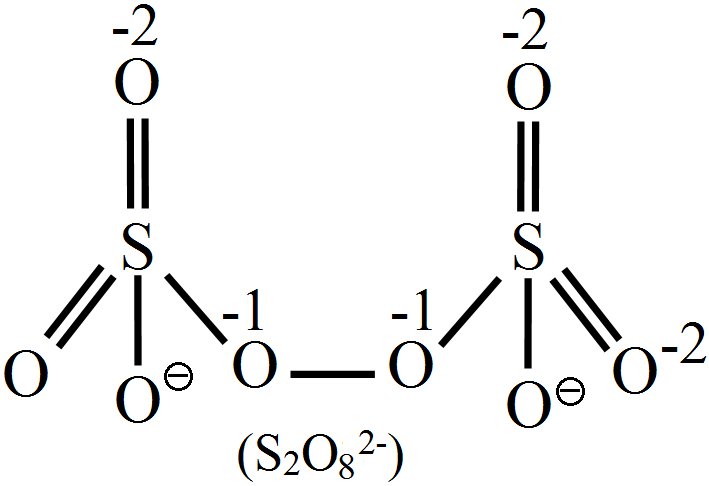
$2\text{x}-2\times6-1-1=-2$
$2\text{x}-14=-2$
$2\text{x}=12$
$\Rightarrow\text{x}=+6$
In $\text{HSO}_3^-$
$+1+\text{x}-6=-1$
$\Rightarrow\text{x}-5=-1$
$\Rightarrow\text{x}=+4$ View full question & answer→Question 212 Marks
- Write the functions of salt bridge in electro chemical cell.
- Give one decomposition reaction which is redox reaction and one which is a redox reaction.
Answer
- Salt bridge.
- Completes internal circuit.
- It maintains electroneutrality.
-
- $\stackrel{{+4}}{\hbox{C}\text{a}}\stackrel{{-2+2}}{\hbox{CO}_3}(\text{s})\xrightarrow{\ \ \ \ \ \ \ \ }\stackrel{{+2}}{\hbox{Ca}}\stackrel{{-2}}{\hbox{O}}(\text{s})+\stackrel{{+4-2}}{\hbox{CO}_2}\text{(g)}$
It is not a redox reaction.
- $\stackrel{{+2+6}}{\hbox{Fe}}\stackrel{{-2}}{\hbox{SO}_4}\xrightarrow{\ \ \ \Delta \ \ \ \ \ }\stackrel{+3}{\hbox{Fe}}\stackrel{-2}{\hbox{O}_3}+\stackrel{{_-2}}{\hbox{SO}_2}+\stackrel{{+6-2}}{\hbox{SO}_3}$
View full question & answer→Question 222 Marks
- The standard electrode potential of two metals 'A' and 'B' are -0.76V and +0.34V respectively. An electrochemical cell is formed using electrodes of these metals.
- Identify the cathode and anode.
- Write the direction of flow of electrons.
- $\mathrm{HNO}_3$ acts as oxidising agent while $\mathrm{HNO}_2$ can act as both oxidising as well as reducing agent, why?
Answer
-
- Zn acts as anode due to lower reduction potential, it undergoes oxidation at anode. Cu acts as cathode due to highes reduction potential.
- Electrons flow from Zn rod to copper.
- HNO, has 'N' is +5 oxidation state (highest). It can gain electrons therefore, acts as oxidising agent only HNO, has 'N' in +3 oxidation state which can increase to +5 and decrease to +2, hence acts as both.
View full question & answer→Question 232 Marks
Balance the following equations by the oxidation number method.
$\text{I}_2+\text{NO}^-_3\xrightarrow{ \ \ \ \ \ \ \ }\text{NO}_2+\text{IO}^-_3$
Answer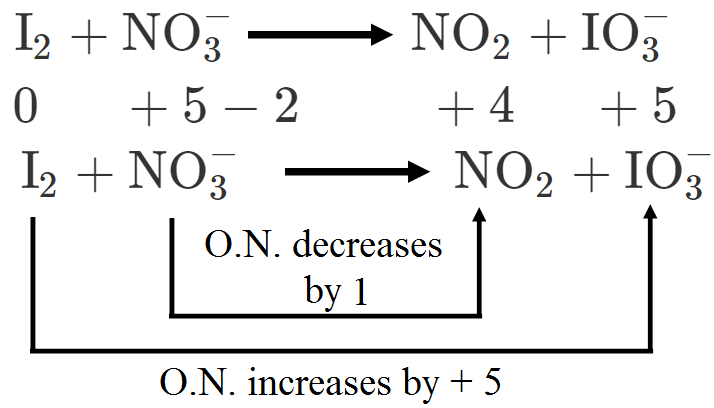
Total increase in O.N. = 5 × 2 = 10
Total decrease in O.N. = 1
To equalize O.N. multiply $\text{NO}^-_3$, by 10
$\text{I}_2+10\text{NO}^-_3\xrightarrow{ \ \ \ \ \ \ }10\text{NO}_2+\text{IO}^-_3$
Balancing atoms other than O and H
$\text{I}_2+10\text{NO}^-_3\xrightarrow{ \ \ \ \ \ \ \ }10\text{NO}_2+2\text{IO}_3^-$
Balanching O and H
$\text{I}_2+\text{IONO}^-_3+8\text{H}^+\xrightarrow{ \ \ \ \ \ \ \ }10\text{NO}_2+2\text{IO}^-_3+4\text{H}_2\text{O}$ View full question & answer→Question 242 Marks
\Dichromate ion in acidic medium reacts with ferrous ion to give ferrie and chromic ions. Write the balanced chemical equation corresponding to the reaction.
AnswerStep 1:$\text{Cr}_2\text{O}_7^{2-}\text{(aq)}+\text{Fe}^{2+}\text{(aq)}\xrightarrow{ \ \ \\ \ \ \\}\text{Cr}^{3+}\text{(aq)}+\text{Fe}^{3+}\text{(aq)}\\ +6\ \ \ \ \ \ \ \ \ \ \ \ \ \ \ \ \ \ +2 \ \ \ \ \ \ \ \ \ \ \ \ \ \ \ \ \ +3\ \ \ \ \ \ \ \ \ \ \ \ \ \ +3$
Step 2: The oxidation state of Cr decreases by 3 per chromium atom, total decrease is 6 for two chromium atoms, oxidation state of Fe changes from +2 to +3, i.e., increases by 1, therefore, to equalize the increase and decrease, we multiply $Fe^{2+}$ by $6$ and $Cr_2O_7^{2-}$ by $1.$
Step 3: Balancing Cr' and Fe on both sides.
$\text{Cr}_2\text{O}_7^{2-}\text{(aq)}+6\text{Fe}^{2+}\text{(aq)}\\\xrightarrow{ \ \ \ \ \ \ }2\text{Cr}^{3+}\text{(aq)}+6\text{Fe}^{3+}\text{(aq)}$
Step 4: To balance oxygen, we add 7 molecules of $H_2O$ on RHS.
$\text{Cr}_2\text{O}_7^{2-}\text{(aq)}+6\text{Fe}^{2+}\text{(aq)}\\\xrightarrow{ \ \ \ \ \ \ }2\text{Cr}^{3+}\text{(aq)}+6\text{Fe}^{3+}\text{(aq)}+7\text{H}_2\text{O}\text{(l)}$
Step 5: To balance hydrogen, we add $14H^+$ on LHS and we get balanced equation.
$\text{Cr}_2\text{O}_7^{2-}\text{(aq)}+6\text{Fe}^{2+}\text{(aq)}+14\text{H}^+\text{(aq)}\\\xrightarrow{ \ \ \ \ \ \ }2\text{Cr}^{3+}\text{(aq)}+6\text{Fe}^{3+}\text{(aq)}+7\text{H}_2\text{O}\text{(l)}$
View full question & answer→Question 252 Marks
Calculate the oxidation number of phosphorus in the following species.
- $\text{HPO}^{2-}_3$
- $\text{PO}^{3-}_4$
Answer
- Let the oxidation number of phosphorus is x.
$\stackrel{\text{x}}{\text{HPO}}^{2-}_3$
+1 + x + (-2) × 3 = -2
+1 + x - 6 = -2
x - 2 = -2
x = -2 + 5
x = +3
Thus, O.S. of phosphorous is +3.
- $\stackrel{\text{x}}{\text{P}}\text{O}^{3-}_4$
x + (-2) × 4 = -3
x - 8 = -3
x = -3 + 8
x = +5
Thus, O.S. of phosphorous in this ion is +5. View full question & answer→Question 262 Marks
Identify the redox reactions out of the following reactions and identify the oxidising and reducing agents in them.
$3\text{HCl(aq)}+\text{HNO}_3\text{(aq)}\xrightarrow{ \ \ \ \ \ \ \ \ }\text{Cl}_2\text{(g)}+\text{NOCl}(\text{g})+2\text{H}_2\text{O(l)}$
Answer$\stackrel{+1-1 \ \ \ \ \ \ \ }{\text{3HCl(aq)}}+\stackrel{+1}{\text{H}}\stackrel{+5}{\text{N}}\stackrel{-2}{\text{O}}_3\text{(aq)}\xrightarrow{ \ \ \ \ \ \ \ \ }\stackrel{0 \ \ \ \ \ \ \ \ \ }{\text{Cl}_2\text{(g)}}+\stackrel{+3}{\text{N}}\stackrel{-2}{\text{O}}\stackrel{-1 \ \ \ \ }{\text{Cl(g)}}+\stackrel{+1 \ \ \ \ \ }{\text{2H}_2}\stackrel{-2 \ \ \ }{\text{O(l)}}$
Here, $\mathrm{O} . \mathrm{N}$. of Cl increases from -1 (in HCl ) to 0 (in $\mathrm{Cl}_2$ ). Therefore, $\mathrm{Cl}^{-}$is oxidized and hence HCl acts as a reducing agent.
The $\mathrm{O} . \mathrm{N}$. of N decreases from +5 (in $\mathrm{HNO}_3$ ) to +3 (in NOCl ) and therefore, $\mathrm{HNO}_3$ acts as an oxidizing agent. Thus, reaction (i) is a redox reaction.
View full question & answer→Question 272 Marks
a. Which of the following does not conduct electric current and why? Molten NaCl , Solid $\mathrm{Pb}, \mathrm{AgNO}_3$ solution and Methanol.
b. Why is anode called oxidation electrode, whereas cathode is called reduction electrode?
c. Why is reduction potential of zinc -0.76 V ?
Answera. Methanol will not conduct electric current because it does not ionise.
b. At anode, loss of electrons takes place, i.e. oxidation takes place, whereas at cathode, gain of electrons takes place, i.e. reduction takes place. Therefore, cathode is called reduction electrode and anode is called oxidation electrode.
c. The reduction potential of Zn is -0.76 V , because the potential difference between Zn electrodes dipped in 1 M $\mathrm{ZnSO}_4$ solution and standard hydrogen electrode is 0.76 V and Zn metal acts as anode, i.e., undergoes oxidation, therefore, its reduction potential is -ve.
View full question & answer→Question 282 Marks
Identify the oxidant and reductant in the following reaction:
$2\text{K}_4[\text{Fe(CN)}_6]\text{(aq)}+\text{H}_2\text{O}_2\text{(aq)}\\\xrightarrow{ \ \ \ \ \ \ }2\text{K}_3[\text{Fe(CN)}_6]\text{(aq)}+2\text{KOH}\text{(aq)}$
Answer$\mathrm{K}_4[\mathrm{FeCN})_6$ ) is a reducing agent (reductant), i.e. undergoes oxidation, whereas $\mathrm{H}_2 \mathrm{O}_2$ is an oxidising agent (oxidant), i.e. undergoes reduction.
View full question & answer→Question 292 Marks
A solution of silver nitrate was stirred with iron rod. Will it cause any change in the concentration of silver and nitrate ions?
AnswerSince, $\mathrm{E}^{\circ}$ of $\mathrm{Fe}^{2+} / \mathrm{Fe}(-0.44 \mathrm{~V})$ is lower than that of $\mathrm{Ag}^{+} / \mathrm{Ag}(+0.80 \mathrm{~V})$ electrode, therefore, $\mathrm{Ag}^{+}$gets reduced and Fe gets oxidised. As a result, concentration of $\mathrm{Ag}^{+}$ions decreases while that of $\mathrm{NO}_3^{-}$ions remain unchanged.
$2 \mathrm{Ag}^{+}(\mathrm{aq})+\mathrm{Fe}(\mathrm{s}) \rightarrow 2 \mathrm{Ag}(\mathrm{s})+\mathrm{Fe}^{2+}(\mathrm{aq})$
View full question & answer→Question 302 Marks
View full question & answer→Question 312 Marks
Explain why?
i. Reaction of $\mathrm{FeSO}_4+\mathrm{Cu} \longrightarrow \mathrm{CuSO}_4(\mathrm{aq})+\mathrm{Fe}$ does not occur.
a. Zinc can displace Cu from aqueous $\mathrm{CuSO}_4$ solution but Ag cannot.
b. Solution of $\mathrm{AgNO}_3$ turns blue when Cu rod dipped in it.
Answeri. It is because 'Cu' is less reactive than Fe , so cannot displace Fe from $\mathrm{FeSO}_4$ solution.
a. Zinc is more reactive than Cu but Ag is less reactive than Cu .
b. because Cu is more reactive than $\left.\mathrm{Ag} ._2\right)_3$ It is due to formation of $\mathrm{Cu}\left(\mathrm{NO}_3\right)_2$ because Cu is more reactive than $\mathrm{Ag}$.
$\mathrm{Cu}(\mathrm{s})+\mathrm{AgNO}_3(\mathrm{aq}) \longrightarrow \mathrm{Cu}\left(\mathrm{NO}_3\right)_2(\mathrm{aq})+2 \mathrm{Ag}(\mathrm{s})$
View full question & answer→Question 322 Marks
Find the oxidation number of carbon in following compounds.
$\mathrm{CH}_3 \mathrm{OH}, \mathrm{CH}_2 \mathrm{O}, \mathrm{HCOOH}, \mathrm{C}_2 \mathrm{H}_2$
AnswerIn $\mathrm{CH}_3 \mathrm{OH}$,
x + 4 - 2 = 0
⇒ x = -2 for carbon
In $\mathrm{CH}_2 \mathrm{O}$,
x + 2 - 2 = 0
⇒ x = +2 for carbon
In HCOOH,
+1 + x - 4 + 1 = 0
⇒ x = +2 for carbon
In $\mathrm{C}_2 \mathrm{H}_2$,
2x + 2 = 0
⇒ x = -1 for carbon
View full question & answer→Question 332 Marks
The reaction
$\text{Cl}_2\text{(g)}+2\text{OH}^-(\text{aq})\xrightarrow{ \ \ \ \ \ \ \ }\text{ClO}^-(\text{aq})+\text{Cl}^-(\text{aq})+\text{H}_2\text{O}(\text{l})$
represents the process of bleaching. Identify and name the species that bleaches the substances due to its oxidising action.
Answer$\stackrel{0}{\text{Cl}}_2(\text{g})+\stackrel{-2+1}{\text{2OH}^-}(\text{aq})\xrightarrow{ \ \ \ \ \ \ }\stackrel{+1-2}{\text{ClO}^-}(\text{aq})+\stackrel{-1}{\text{Cl}^-}(\text{aq})+\stackrel{ +1-2(\text{oxidation number}) \ \ \ \ \ \ \ \ \ \ \ \ \ \ \ \ \ \ \ \ \ \ \ \ \ \ \ \ \ }{\text{H}_2\text{O(1)} \ \ \ \ \ \ \ \ \ \ \ \ \ \ \ \ \ \ \ \ \ \ \ \ \ \ \ \ \ \ \ \ \ \ \ \ \ \ } $
In this reaction, $\mathrm{O} . \mathrm{N}$. of Cl increases from 0 (in $\mathrm{Cl}_2$ ) to +1 (in $\mathrm{ClO}^{-}$) and decreases to -1 (in $\mathrm{Cl}^{-}$). Therefore, $\mathrm{Cl}_2$ is both oxidized to $\mathrm{ClO}^{-}$and reduced to $\mathrm{Cl}^{-}$. Since $\mathrm{Cl}^{-}$ion cannot act as an oxidizing agent (because it cannot decrease its O.N. lower than -1 ), therefore, $\mathrm{Cl}_2$ bleaches substances due to oxidizing action of hypochlorite, ClO ion.
View full question & answer→Question 342 Marks
- What is the oxidation number of Fe in $Fe_3O_4$?
$\text{H}^++\text{MnO}_4^-+\text{Fe}^{2+}\xrightarrow{ \ \ \ \ \\ \ \ }\text{Fe}^{3+}+\text{Mn}^{2+}+\text{H}_2\text{O}\\ \ \ \ \ \ \ \ \ \ \ \ \ \ \ \ \ \ \ \ \ \ \ \ \ \ \ \ \ \ \ \ \ \ \ \ \ \ \ \ \ \ \ \ \ \ \ \ \ \ \ \ \ \ \ \text{(Acidic medium)}$
- Balance the equation.
Answer
- Let oxidation number of Fe in $Fe_3O_4$ be x
$\therefore3\text{x}-8=0$
$\Rightarrow\text{x}=\frac{8}{3}$
It is the average oxidation number of $Fe^{2+}$ and $2Fe^{3+}$
-
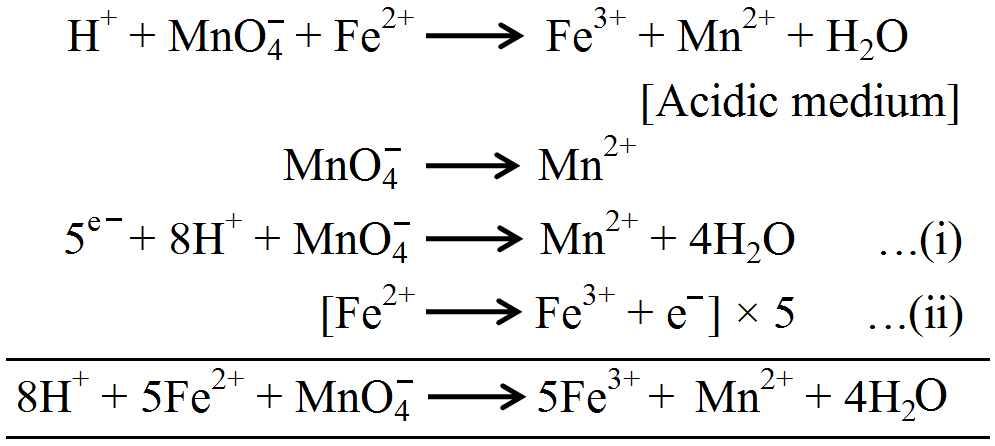
View full question & answer→Question 352 Marks
Balance the following equation:
$\text{Br}_2+\text{H}_2\text{O}_2\xrightarrow{ \ \ \ \ \ \ \ \ }\text{BrO}_3^-+\text{H}_2\text{O}$ (in acidic medium)
Answer$\text{H}_2\text{O}_2\xrightarrow{ \ \ \ \ \ \ \ }\text{H}_2\text{O}$ (Reduction half reaction)
$\text{H}_2\text{O}_2\xrightarrow{ \ \ \ \ \ \ }2\text{H}_2\text{O}$ (Balancing oxygen)
$2\text{H}^++\text{H}_2\text{O}_2\xrightarrow{ \ \ \ \ \ \ }2\text{H}_2\text{O}$ (Balancing hydrogen)
$2\text{e}^-+2\text{H}^++\text{H}_2\text{O}_2\xrightarrow{ \ \ \ \ \ \ }2\text{H}_2\text{O}$ (Balancing charge) ...(i)
$\text{Br}_2\xrightarrow{ \ \ \ \ \ \ }\text{BrO}_3^-$ (Oxidation half reaction)
$\text{Br}_2\xrightarrow{ \ \ \ \ \ \ }2\text{BrO}_3^-$ (Balancing bromine)
$6\text{H}_2\text{O}+\text{Br}_2\xrightarrow{ \ \ \ \ \ \ }2\text{BrO}_3^-$ (Balancing oxygen)
$6\text{H}_2\text{O}+\text{Br}_2\xrightarrow{ \ \ \ \ \ \ }2\text{BrO}_3^-+12\text{H}^+$ (Balancing hydrogen)
$6\text{H}_2\text{O}+\text{Br}_2\xrightarrow{ \ \ \ \ \ \ }2\text{BrO}_3^-+12\text{H}^++10\text{e}^-$ (Balancing charge) ...(ii)
Multiply equation (i) by 5 and the resultant to equation (ii).
$5\text{H}_2\text{O}_2+\text{Br}_2\xrightarrow{ \ \ \ \ \ \ \ \ \ }2\text{H}^++4\text{H}_2\text{O}+2\text{Br}\text{O}_3^-$
View full question & answer→Question 362 Marks
Identify the redox reactions out of the following reactions and identify the oxidising and reducing agents in them.
$\text{PCl}_3(\text{l})+3\text{H}_2\text{O}(\text{l})\xrightarrow{ \ \ \ \ \ \ \ \ }3\text{HCl(aq)}+\text{H}_3\text{PO}_3\text{(aq)}$
Answer$\stackrel{+3-1}{\text{PCl}}_3(\text{l})+\stackrel{+1-2 \ \ \ \ \ }{\text{3H}_2\text{O(l)}}\xrightarrow{ \ \ \ \ \ \ \ \ \ }\stackrel{+1-1 \ \ \ \ \ \ \ \ }{\text{3HCl(aq)}}+\stackrel{+1+3-2 \ \ \ \ \ \ \ \ \ \ \ \ }{\text{H}_3\text{PO}_2\text{(aq)}}$
Here O.N. of none of the atoms undergo a change and therefore, it is not a redox reaction.
View full question & answer→Question 372 Marks
Identify the redox reactions out of the following reactions and identify the oxidising and reducing agents in them.
$\text{HgCl}_2\text{(aq)}+2\text{KI(aq)}\xrightarrow{ \ \ \ \ \ \ \ }\text{HgI}_2\text{(s)}+2\text{KCl(aq)}$
Answer$\stackrel{+2-1}{\text{HgCl}}_2\text{(aq)}+\stackrel{+1-1 \ \ \ \ \ \ \ \ \ }{\text{2KI(aq)}}\xrightarrow{ \ \ \ \ \ \ \ \ }\stackrel{+2-1}{\text{HgI}}_2\text{(aq)}+\stackrel{+1-1 \ \ \ \ \ \ \ \ \ \ }{\text{KCl(aq)}}$
Here O.N. of none of the atoms undergo a change and therefore, this is not a redox reaction.
View full question & answer→Question 382 Marks
Two half cells are $\mathrm{Al}^{3+}(\mathrm{aq}) / \mathrm{Al}$ and $\mathrm{Mg}^{+}(\mathrm{aq}) / \mathrm{Mg}$. The reduction potentials of these half cells are -1.66 V and -2.36 V respectively. Calculate the cell potential. Write the cell reaction also.
AnswerSince, $\mathrm{Mg}^{2+}(\mathrm{aq}) / \mathrm{Mg}$ electrode $=-2.36 \mathrm{~V}$ is at lower potential than $\mathrm{Al}^{3+}(\mathrm{aq}) / \mathrm{Al}$ electrode $=-1.66 \mathrm{~V}$, therefore, $\mathrm{Mg}^{2+}$ (aq)/ Mg electrode acts as the anode and $\mathrm{Al}^{3+}(\mathrm{aq}) / \mathrm{Al}$ acts as the cathode.
In other words, Mg loses electrons and $\mathrm{Al}^{3+}$ ion accepts electrons.
Thus, the cell reaction is,
$3 \mathrm{Mg}+2 \mathrm{Al}^{3+} \rightarrow 3 \mathrm{Mg}^{2+}+2 \mathrm{Al}$
and $\text{E}^\circ_\text{cell}=\text{E}^\circ_{\frac{\text{Al}^{3+}}{\text{Al}}}-\text{E}^\circ_{\frac{\text{Mg}^{2+}}{\text{Mg}}}$
$=-1.66-(-2.36)=+0.70\text{V}$
View full question & answer→Question 392 Marks
Find the oxidation number of Clin $HCl, HClO, CIO_4^-$ and $Ca(OCI)CI.$
AnswerCl in HCl,
$+1 + x = 0$
$\Rightarrow x = -1$
Cl in $HClO,$
$+1 + x - 2 = 0$
$\Rightarrow x = +1$
$Cl$ in $ClO^-_4,$
$x - 8 = -1$
$\Rightarrow x = +7$
In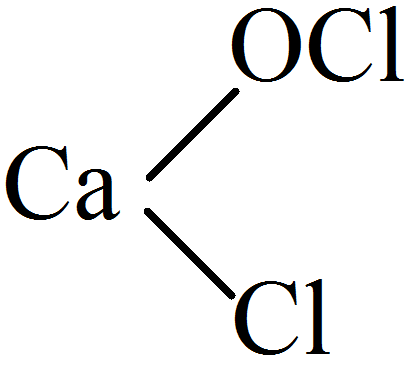
There are two chlorine atoms, one of chlorine is in form of $Cl^-$ whose oxidation state is $-1,$ othere one is in form of $ClO^-$(hypochlorite ion) in which oxidation state is +1
$(x - 2 = -1)$
$\Rightarrow x = +1$
The average oxidation state of two chlorine atoms in $CaOCl_2$ is $0$
$(-1 + 1 = 0)$
$+2 - 2 + 2x = 0$
$\Rightarrow x = 0$ View full question & answer→Question 402 Marks
What are the net charges on the left and right side of the following equations? Add electrons as necessary to make each of them balanced half reactions.
- $\text{NO}^-_310\text{H}^+\xrightarrow{\ \ \ \ \ \ }\text{NH}^+_4+3\text{3H}_2\text{O}$
- $\text{Cl}_2+4\text{H}_2\text{O}\xrightarrow{\ \ \ \ \ \ \ }2\text{ClO}^-_2+\text{8}\text{H}^+$
Answer
- +9 charge on the left, +1 charge on the right; add 8 electrons to the left side.
- O charge on the left, +6 charge on the right; add 6 electrons on the right side.
View full question & answer→Question 412 Marks
What happens when $\text{Cl}_2$ gas is passed through aqueous solution of KBr? What type of redox reaction is it?
Answer$\text{Cl}_2\text{g}+2\text{KBr}\text{(aq)}\xrightarrow{ \ \ \ \ \ \ \ \ }2\text{KCl}\text{(aq)}+\text{Br}_2\text{(l)}$ It is non-metal displacement reaction.
View full question & answer→Question 422 Marks
What is electrochemical series? How can this be used to explain the oxidising and reducing abilities of elements?
AnswerThe series in which elements are arranged in decreasing order of reduction potential is called electrochemical series. $\text{F}_2$ is best oxidising agent because it has highest standard reduction potential. Oxidising power goes on decreasing down the series. Reducing power goes on increasing down the series Lithium is best reducing agent because it has lowest standard reduction potential.
View full question & answer→Question 432 Marks
Calculate oxidation state of V in $\text{VO}_3^-$ and Fe in $\left(\mathrm{FeF}_6\right)^{3-}$
Answer$\stackrel{{\text{x}-2}}{\hbox{VO}_3^-}$
$\text{x}-6=-1$
$\Rightarrow\text{x}=+5$
$[\stackrel{{\text{x}}}{\hbox{ Fe}}\stackrel{{-1}}{\hbox{ F}_6}]^{3-}$
$\text{x}-6=-3$
$\Rightarrow\text{x}=+3$
View full question & answer→Question 442 Marks
Nitric acid acts only as an oxidising agent while nitrous acid acts both as an oxidising as well as reducing agent. Explain.
Answeri. $\mathrm{HNO}_3$
Oxidation number of N in $\mathrm{HNO}_3$ is +5 .
Maximum oxidation number of N is +5 because it has five electrons in the valence shell $\left(2 s^2 2 p^3\right)$.
Minimum oxidation number of N is -3 because it can accept 3 more electrons to get noble gas configuration. Since, oxidation number of N in $\mathrm{HNO}_3$ is maximum, therefore, it can only decrease.
Thus, $\mathrm{HNO}_3$ can act as an oxidising agent.
ii. $\mathrm{HNO}_2$
Oxidation number of $\mathrm{N}=+3$
Maximum oxidation number of $\mathrm{N}=+5$
Minimum oxidation number of $\mathrm{N}=-3$
Therefore, the oxidation number of N can increase by losing electrons or can decrease by accepting electrons. Thus, $\mathrm{HNO}_2$ can act both as an oxidising as well as a reducing agent.
View full question & answer→Question 452 Marks
Balance $\text{P}+\text{HNO}_3\xrightarrow{ \ \ \ \ \ \ \ \ }\text{H}_3\text{PO}_4+\text{NO}_2+\text{H}_2\text{O}$ by oxidation number method.
Answer
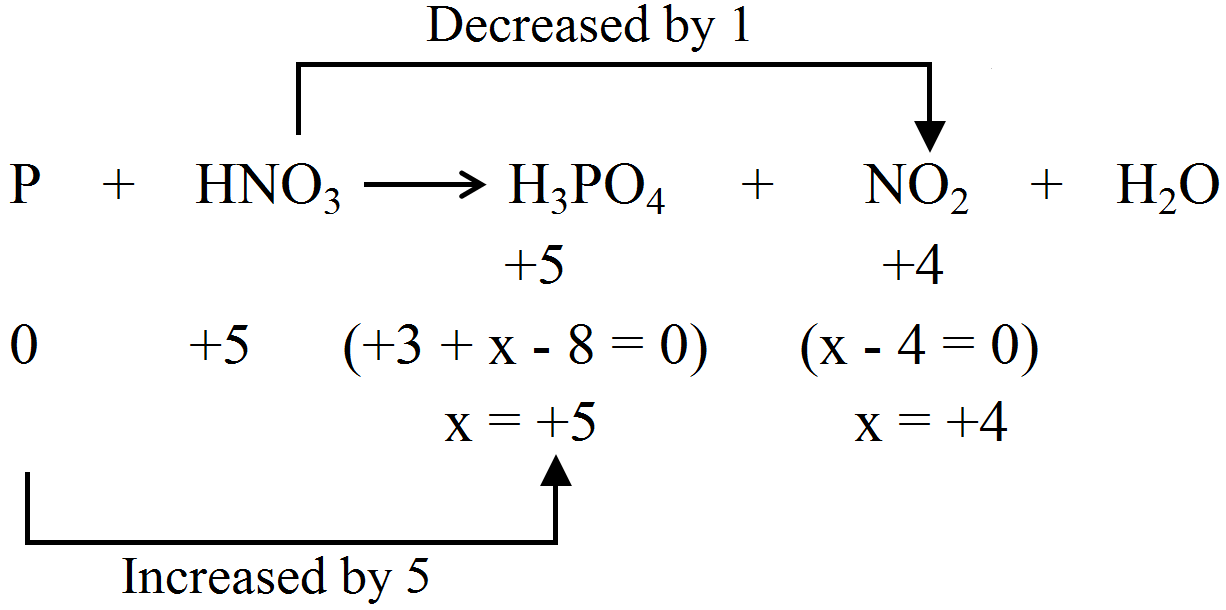
Multiply P by l, $\text{HNO}_3$ by 5, we get$\text{P}+5\text{HNO}_3\xrightarrow{ \ \ \ \ \ \ \ \ }\text{H}_3\text{PO}_4+5\text{NO}_2+\text{H}_2\text{O}$ View full question & answer→Question 462 Marks
- Balance $\text{MnO}_4^-+\text{Fe}^{2+}\xrightarrow{ \ \ \ \ \ \ \ \ }\text{Fe}^{3+}+\text{Mn}^{2+}$ in acidic medium by ion electron method.
- Given the standard electrode potentials:
$\frac{\text{K}_+}{\text{K}}=-2.93\text{V},$
$\frac{\text{Ag}^+}{\text{Ag}}=+0.80\text{V},$
$\frac{\text{Mg}^{2+}}{\text{Mg}}=-2.37\text{V}$
Arrange these metals in order of increasing reducing power.Answer
- $\text{MnO}_4^-+\text{Fe}^{2+}\xrightarrow{ \ \ \ \ \ \ }\text{Fe}^{3+}+\text{Mn}^{2+}$ in acidic medium
$[\text{Fe}^{2+}\xrightarrow{ \ \ \ \ \ \ }\text{Fe}^{3+}+\text{e}^-]\times5\ \cdots\text{(i)}$
$5\text{e}^-+8\text{H}^++\text{MnO}_4^-\xrightarrow{ \ \ \ \ \ \ }\text{Mn}^{2+}+4\text{H}_2\text{O} \ \cdots\text{(ii)}$
Adding (i) and (ii), we get
$5\text{Fe}^{2+}+8\text{H}^++\text{MnO}_4^-\xrightarrow{ \ \ \ \ \ \ }\text{Mn}^{2+}+4\text{H}_2\text{O} \ +5\text{Fe}^{3+}$
- Ag < Mg < K is increasing order of reducing power.
View full question & answer→Question 472 Marks
Identify the redox reactions out of the following reactions and identify the oxidising and reducing agents in them.
$\text{Fe}_2\text{O}_3\text{(s)}+3\text{CO(g)}\xrightarrow{ \ \ \ \Delta\\\ \ \ \ }2\text{Fe(s)}+3\text{CO}_2\text{(g)}$
Answer$\stackrel{+3-2}{\text{Fe}_2\text{O}_3\text{(s)}}+\stackrel{+2-2 \ \ \ }{\text{3CO(g)}}\xrightarrow{ \ \ \Delta \ \ \ }\stackrel{0 \ \ \ \ \ \ \ \ \ \ }{\text{Fe(s)}}+\stackrel{+4-2}{\text{3CO}_2\text{(g)}}$
Here, O.N. of Fe decreases from +3 (in $\mathrm{Fe}_2 \mathrm{O}_3$ ) to 0 (in Fe ) and therefore, $\mathrm{Fe}_2 \mathrm{O}_3$ acts as an oxidizing agent. O.N. of C increases from $+2($ in CO$)$ to $+4\left(\right.$ in $\left.\mathrm{CO}_2\right)$ and therefore, CO acts as a reducing agent. Thus, this is a redox reaction.
View full question & answer→Question 482 Marks
- Identify the oxidant and reductant in the following reactions:
- $10\text{H}^++4\text{Zn}\text{(S)}+\text{NO}_3^-\text{(aq)}\\ \xrightarrow{ \ \ \ \ \ }4\text{Zn}^{2+}\text{(aq)}+\text{NH}_4^+\text{(aq)}+3\text{H}_2\text{O}$
- $\text{I}_2\text{(g)}+\text{H}_2\text{(g)}\xrightarrow{ \ \ \ \ \ }2\text{Hl}\text{(g)}+\text{S}\text{(s)}$
- Write the anode, cathode and net cell reaction for the following cell:
$\text{Zn}\text{(s)}|\text{Zn}\text{(aq)}||\text{Br}^-\text{(aq)}|\text{Br}_2\text{(g)},\text{pt}$
- Give two main functions of salt bridge.
AnswerZn is reducing agent because it is losing electrons to form $Zn ^{2+}$ i.e. oxidation state is increasing from 0 to $+2 . NO _3^{-}$ is oxidising agent because oxidation state of $N$ is decreasing from +5 to -3 , i.e. it is gaining electrons. I is oxidising agent because it is gaining electrons. Its oxidation state is decreasing from 0 to -1 whereas $H _2 S$ is reducing agent, the oxidation state of ' $S$ ' is increasing from -2 to 0 by losing electrons.
-
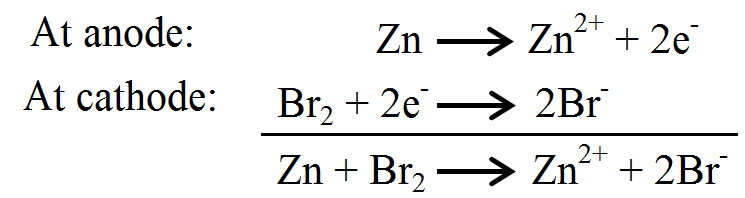
-
- It maintains electroneutrality.
- It completes internal circuit.
View full question & answer→Question 492 Marks
In neutral or faintly alkaline solution '8' moles of peramanganate anions quantitatively oxidise this sulphate anions to produce x' moles of sulphur containing product. What is magnitude of 'X'.
Answer$8\text{MnO}_4^-+3\text{S}_2\text{O}_3^{2-}+\text{H}_2\text{O}\xrightarrow{ \ \ \ \ \ \\ \ \ \ }8\text{MnO}_2+6\text{SO}_4^{2-}+2\text{OH}^-$
6 moles of $\text{SO}_4^{2-}$ will be formed.
View full question & answer→Question 502 Marks
PbO and $\mathrm{PbO}_2$ react with HCl according to following chemical equations:$2\text{PbO}+4\text{HCl}\xrightarrow{ \ \ \ \ \ \ \ }2\text{PbCl}_2+2\text{H}_2\text{O}$
$\text{PbO}_2+4\text{HCl}\xrightarrow{\ \ \ \ \ \ \ \ }\text{PbCl}_2+\text{Cl}_2+2\text{H}_2\text{O}$
Why do these compounds differ in their reactivity?
Answer$2\text{PbO}+4\text{HCl}\xrightarrow{ \ \ \ \ \ \ \ }2\text{PbCl}_2+2\text{H}_2\text{O}\text{(Acid base reaction)}$
$\text{PbO}_2+4\text{HCl}\xrightarrow{\ \ \ \ \ \ \ \ }\text{PbCl}_2+\text{Cl}_2+2\text{H}_2\text{O}\text{(Redox reaction)}$
In reaction (i), O.N. of none of the atoms reaction. It is an acid-base reaction, because PbO is a basic oxide which reacts with HCl acid.undergo a change. Therefore, it is not a redox
The reaction (ii) is a redox reaction in which $\mathrm{PbO}_2$ gets reduced and acts as an oxidizing agent.
View full question & answer→