Question 15 Marks
How many time constants will elapse before the energy stored in the capacitor reaches half of its equilibrium value in a charging RC circuit?
Answer$\text{q}=\text{Q}\big(1-\text{e}^{-\text{n}}\big)$$\frac{1}{2}\frac{\text{Q}^2}{\text{C}}$ = Initial value; $\frac{1}{2}\frac{\text{q}^2}{\text{c}}$ = Final value
$\frac{1}{2}\frac{\text{q}^2}{\text{c}}\times2=\frac{1}{2}\frac{\text{Q}^2}{\text{C}}$
$\Rightarrow\text{q}^2=\frac{\text{Q}^2}{2}\Rightarrow\text{q}=\frac{\text{Q}}{\sqrt{2}}$
$\frac{\text{Q}}{\sqrt{2}}=\text{Q}(1-\text{e}^{\text{n}})$
$\Rightarrow\frac{1}{\sqrt{2}}=1-\text{e}^{-\text{n}}\Rightarrow\text{e}^{-\text{n}}=1-\frac{1}{\sqrt{2}}$
$\Rightarrow\text{n}=\log\Big(\frac{\sqrt{2}}{\sqrt{2}-1}\Big)=1.22$
View full question & answer→Question 25 Marks
Find the potential difference between the points A and B and between the points B and C of the figure. in steady state.
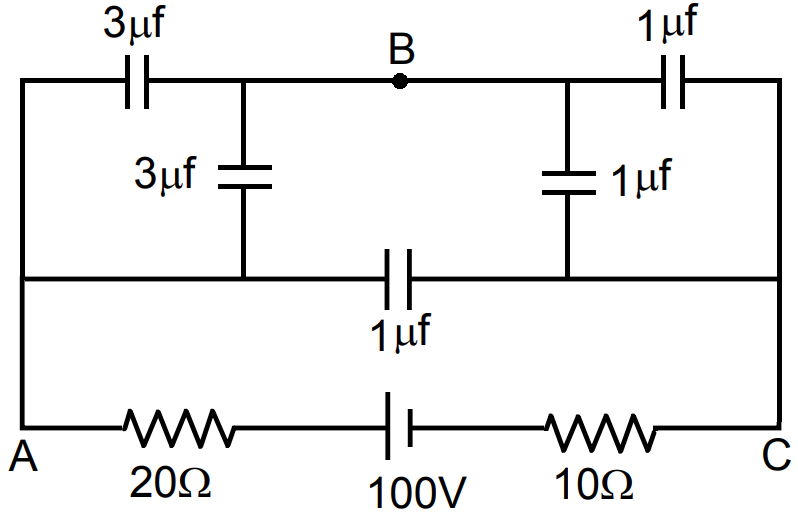
Answer
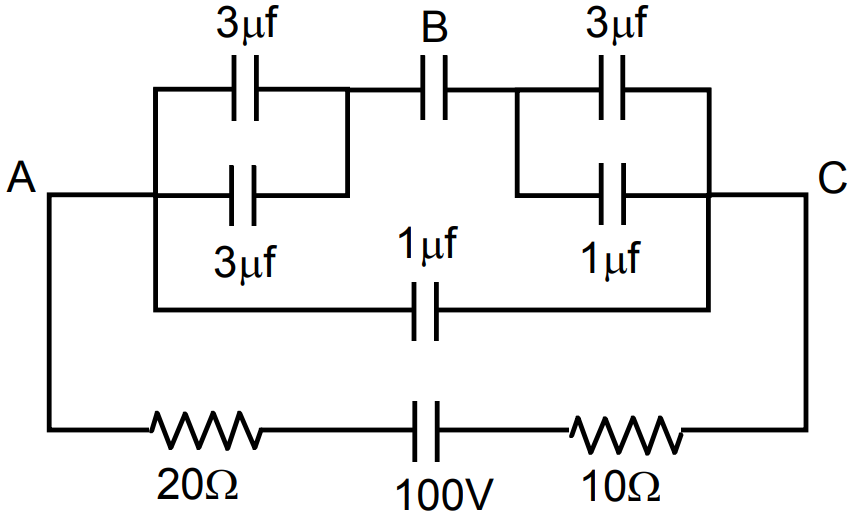
$\text{C}_\text{eq}=\big[(3\mu\text{fp}\ 3\mu\text{f})\text{s}(1\mu\text{f p}1\mu\text{f})\big]\text{p}(1\mu\text{f})$
$=\big[(3+3)\mu\text{f s}(2\mu\text{f})\big]\text{p}1\mu\text{f}$
$=\frac{3}{2}+1=\frac{5}{2}\mu\text{f}$
$\text{V}=100\text{V}$
$\text{Q}=\text{CV}=\frac{5}{2}\times100=250\mu\text{c}$
Charge stored across $1\mu\text{f}$ capacitor $=100\mu\text{C}$
$C_{eq}$ between A and B is $=6\mu\text{f}=\text{C}$
Potential drop across $\text{AB}=\text{V}=\frac{\text{Q}}{\text{C}}=25\text{V}$
Potential drop across BC = 75V. View full question & answer→Question 35 Marks
Calculate the electric field in a copper wire of cross-sectional area $2.0mm^2$ carrying a current of 1A.
The resistivity of copper $=1.7\times10^{-8}\Omega\text{-m}.$
Answer$\text{A}=2\times10^{-6}\text{m}^2,\text{I}=1\text{A}$$\text{f}=1.7\times10^{-8}\Omega\text{-m}$
$\text{E}=?$
$\text{R}=\frac{\text{f}\ell}{\text{A}}=\frac{1.7\times10^{-8}\times\ell}{2\times10^{-6}}$
$\text{V}=\text{IR}=\frac{1\times1.7\times10^{-8}\times\ell}{2\times10^{-6}}$
$\text{E}=\frac{\text{dV}}{\text{dL}}=\frac{\text{V}}{\text{I}}=\frac{1.7\times10^{-8}\times\ell}{2\times10^{-6}\times\ell}=\frac{1.7}{2}\times10^{-2}\text{V}/\ \text{m}$
$=8.5\text{mV}/\text{ m}.$
View full question & answer→Question 45 Marks
The amount of charge that passes in time t through a cross-section of a wire is,
$Q(t) = At^2 + Bt + C$.
- Write the dimensional formulae for A, B and C.
- If the numerical values of A, B and C are 5, 3 and 1, respectively, in S.I units, find the value of the current at t = 5s.
Answer$\text{Q}(\text{t})=\text{At}^2+\text{Bt}+\text{c}$
- $\text{At}^2=\text{Q}$
$\Rightarrow\text{A}=\frac{\text{Q}}{\text{t}^2}=\frac{\text{A}'\text{T}'}{\text{T}^{-2}}=\text{A}^1\text{T}^{-1}$
- $\text{Bt}=\text{Q}$
$\Rightarrow\text{B}=\frac{\text{Q}}{\text{t}}=\frac{\text{A}'\text{T}'}{\text{T}}=\text{A}$
- $\text{C}=[\text{Q}]$
$\Rightarrow\text{C}=\text{A}'\text{T}'$
- Current $\text{t}=\frac{\text{dQ}}{\text{dt}}=\frac{\text{d}}{\text{dt}}(\text{At}^2+\text{Bt}+\text{C})$
$=2\text{At}+\text{B}=2\times5\times5+3=53\text{A}.$ View full question & answer→Question 55 Marks
The plates of a capacitor of capacitance $10\mu\text{F},$ charged to $60\mu\text{C},$ are joined together by a wire of resistance $10\Omega$ at t = 0. Find the charge on the capacitor in the circuit at (a) t = 0 (b) $\text{t}=30\mu\text{s}$ (c) $\text{t}=120\mu\text{s}$ and (d) t = 1.0ms.
Answer$\text{C}=10\mu\text{F},\text{ Q}=60\mu\text{C},\text{ R}=10\Omega$
- $\text{at t}=0,\text{q}=60\mu\text{c}$
- $\text{at t}=30\mu\text{s},\text{ q}=\text{Qe}^{\frac{-\text{t}}{\text{RC}}}$
$=60\times10^{-6}\times\text{e}^{-0.3}=44\mu\text{C}$
- $\text{at t}=120\mu\text{s},\text{ q}=60\times10^{-6}\times\text{e}^{-1.2}=18\mu\text{c}$
- $\text{at t}=1.0\text{ms, q}=60\times10^{-6}\times\text{e}^{-10}$ $=0.00272=0.003\mu\text{C}.$
View full question & answer→Question 65 Marks
An ammeter is to be constructed that can read currents up to 2.0A. If the coil has resistance of $25\Omega$ and takes 1mA for full-scale deflection, what should be the resistance of the shunt used?
Answer
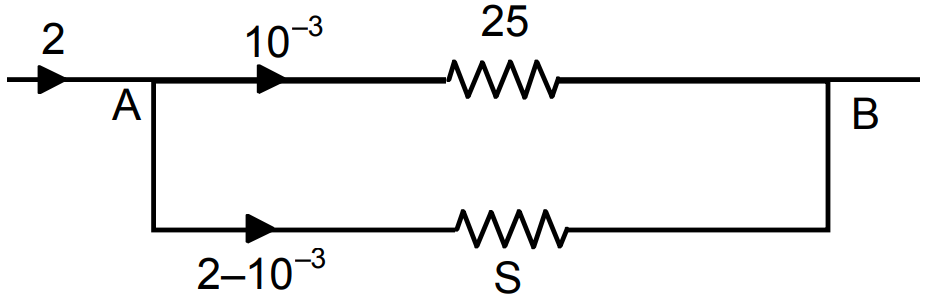 $\text{G}=25\Omega,\text{lg}=1\text{ma},\text{l}=2\text{A},\text{S}=?$
Potential across A B is same
$25\times10^{-3}=(2-10^{-3})\text{S}$
$\Rightarrow\text{S}=\frac{25\times10^{-3}}{2-10^{-3}}=\frac{25\times10^{-3}}{1.999}$
$=12.5\times10^{-3}=1.25\times10^{-2}.$ View full question & answer→Question 75 Marks
If the reading of the ammeter, $A_1$ in the figure. is 2.4A, what will be the readings of ammeters $A_2$ and $A_3$? Neglect the resistances of the ammeters.
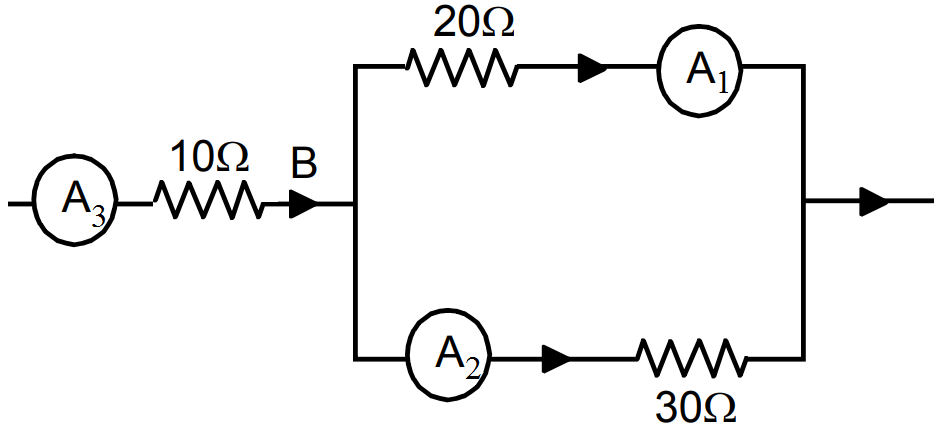
Answer$A_1 = 2.4A$
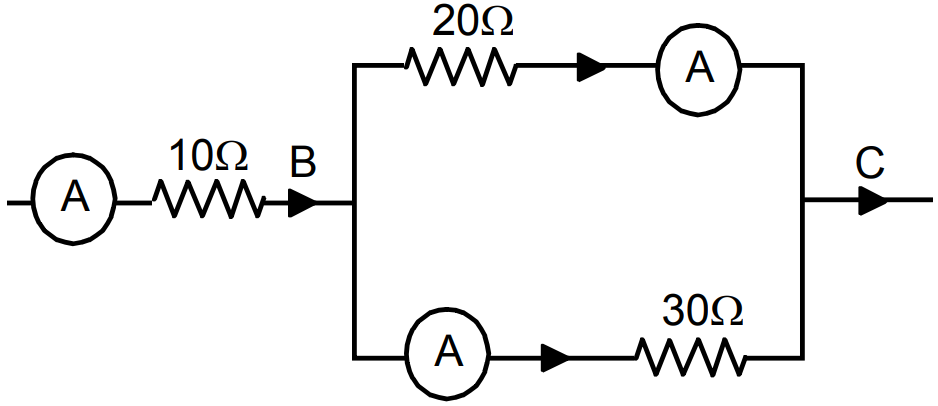
Since $A_1$ and $A_2$ are in parallel,$\Rightarrow20\times2.4=30\times\text{X}$
$\Rightarrow\text{x}=\frac{20\times2.4}{30}=1.6\text{A}.$
Reading in Ammeter $A_2$ is 1.6A.$\text{A}_3=\text{A}_1+\text{A}_2=2.4+1.6=4.0\text{A}.$ View full question & answer→Question 85 Marks
Three bulbs, each with a resistance of $180\Omega,$ are connected in parallel to an ideal battery of emf 60V. Find the current delivered by the battery when.
(a) all the bulbs are switched on, (b) two of the bulbs are switched on and (c) only one bulb is switched on.
Answer
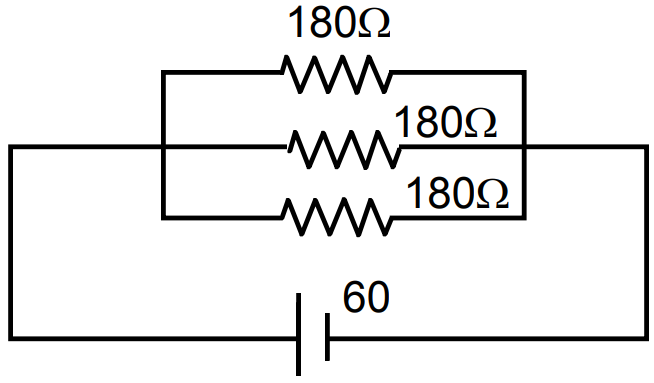
- $\text{R}_\text{eff}=\frac{180}{3}=60\Omega$
$\text{i}=\frac{60}{60}=1\text{A}$
- $\text{R}_\text{eff}=\frac{180}{2}=90\Omega$
$\text{i}=\frac{60}{90}=0.67\text{A}$
- $\text{R}_\text{eff}=180\Omega\Rightarrow\text{i}=\frac{60}{180}=0.33$
View full question & answer→Question 95 Marks
A capacitor of capacitance $8.0\mu\text{F}$ is connected to a battery of emf 6.0V through a resistance of $24\Omega.$ Find the current in the circuit (a) just after the connections are made and (b) one time constant after the connections are made.
Answer$\text{C}=8\mu\text{F},\text{ E}=6\text{V},\text{R}=24\Omega$
- $\text{I}=\frac{\text{V}}{\text{R}}=\frac{6}{24}=0.25\text{A}$
- $\text{q}=\text{Q}\Big(1-\text{e}^{\frac{-\text{t}}{\text{RC}}}\Big)$
$=(8\times10^{-6}\times6)\big[1-\text{c}^{-1}\big]$
$=48\times10^{-6}\times0.63=3.024\times10^{-5}$
$\text{V}=\frac{\text{Q}}{\text{C}}=\frac{3.024\times10^{-5}}{8\times10^{-6}}=3.78$
$\text{E}=\text{V}+\text{iR}$
$\Rightarrow6=3.78+\text{i}24$
$\Rightarrow\text{i}=0.09\mathring{\text{A}}$ View full question & answer→Question 105 Marks
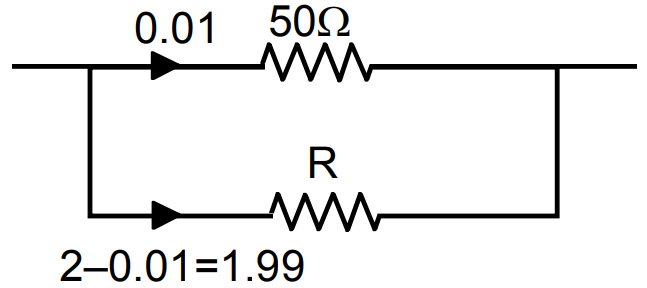
A voltmeter coil has resistance $50.0\Omega$ and a resistor of $1.15\text{k}\Omega$ is connected in series. It can read potential differences up to 12 volts. If this same coil is used to construct an ammeter that can measure currents up to 2.0A, what should be the resistance of the shunt used?
Answer
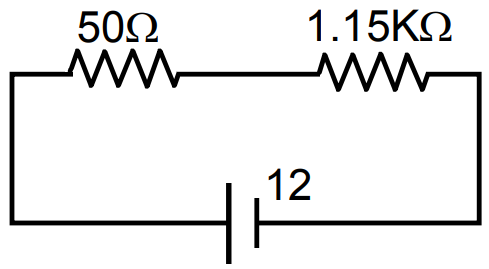
 $\text{R}_\text{eff}=(1150+50)\Omega=1200\Omega$
$\text{i}=\Big(\frac{12}{1200}\Big)\text{A}=0.01\text{A}.$
(The resistor of $50\Omega$ can tolerate)
Let R be the resistance of sheet used.
The potential across both the resistors is same.
$0.01\times50=1.99\times\text{R}$
$\Rightarrow\text{R}=\frac{0.01\times50}{1.99}=\frac{50}{199}=0.251\Omega$ View full question & answer→Question 115 Marks
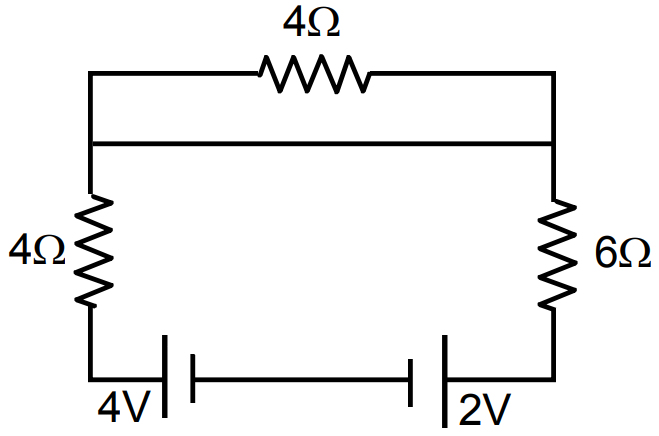
Find the currents through the three reaiators shown in figure.
Answer
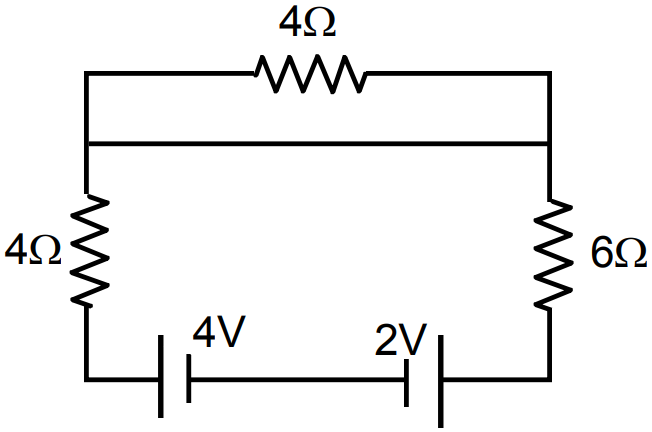
- Current through (1) $4\Omega$ resistor = 0
- Current through (2) and (3)
net E = 4V - 2V = 2V
(2) and (3) are in series,
$\text{R}_\text{eff}=4+6=10\Omega$
$\text{i}=\frac{2}{10}=0.2\text{A}$
Current through (2) and (3) are 0.2A. View full question & answer→Question 125 Marks
Consider a wire of length 4m and cross-sectional area $1mm^2$ carrying a current of 2A. If each cubic metre of the material contains $10^{29}$ free electrons, find the average time taken by an electron to cross the length of the wire.
Answer$\ell=4\text{m},\text{A}=1\text{mm}^2=1\times10^{-6}\text{m}^2$$\text{I}=2\text{A},\text{n/V}=10^{29},\text{t}=?$
$\text{i}=\text{n AV}_\text{d}\text{ e}$
$\Rightarrow\text{e}=10^{29}\times1\times10^{-6}\times\text{V}_\text{d}\times1.6\times10^{-19}$
$\Rightarrow\text{V}_\text{d}=\frac{2}{10^{29}\times10^{-6}\times1.6\times10^{-19}}$
$=\frac{1}{0.8\times10^4}=\frac{1}{8000}$
$\text{t}=\frac{\ell}{\text{V}_\text{d}}=\frac{4}{\frac{1}{8000}}=4\times8000$
$=32000=3.2\times10^4\text{sec}.$
View full question & answer→Question 135 Marks
A parallel-plate capacitor of plate area $40cm^2$ and separation between the plates 0.10mm, is connected to a battery of emf 2.0V through a $16\Omega$ resistor. Find the electric field in the capacitor 10ns after the connections are made.
Answer$\text{A}=40\text{m}^2=40\times10^{-4}$$\text{d}=0.1\text{mm}=1\times10^{-4}\text{m}$
$\text{R}=16\Omega;\text{ emf}=2\text{V}$
$\text{C}=\frac{\text{E}_0\text{A}}{\text{d}}=\frac{8.85\times10^{-12}\times40\times10^{-4}}{1\times10^{-4}}$ $=35.4\times10^{-11}\text{F}$
Now, $\text{E}=\frac{\text{Q}}{\text{AE}_0}\Big(1-\text{e}^{\frac{-\text{t}}{\text{RC}}}\Big)=\frac{\text{CV}}{\text{AE}_0}\Big(1-\text{e}^{\frac{-\text{t}}{\text{RC}}}\Big)$
$=\frac{35.4\times10^{-11}\times2}{40\times10^{-4}\times8.85\times10^{-12}}\Big(1-\text{e}^{-1.76}\Big)$
$=1.655\times10^{-4}=1.7\times10^{-4}\text{V/ m}.$
View full question & answer→Question 145 Marks
A battery of emf 100V and a resistor of resistance $10\text{k}\Omega$ are joined in series. This system is used as a source to supply current to an external resistance R. If R is not greater than $100\Omega,$ the current through it is constant up to two significant digits. Find its value. This is the basic principle of a constant-current source.
Answer$\text{E}=100\text{V},\text{R}'=100\text{k}\Omega=100000\Omega$$\text{R}=1-100$
When no other resister is added or R = 0.
$\text{i}=\frac{\text{E}}{\text{R}'}=\frac{100}{100000}=0.001\text{Amp}$
When R = 1
$\text{i}=\frac{100}{100000+1}=\frac{100}{100001}=0.0009\text{A}$
When R = 100
$\text{i}=\frac{100}{100000+100}=\frac{100}{100100}=0.000999\text{A}.$
Upto R = 100 the current does not upto 2 significant digits. Thus it proved.
View full question & answer→Question 155 Marks
Figure. shows an arrangement to measure the emf $\in$ and internal resistance r of a battery. The voltmeter has a very high resistance and the ammeter also has some resistance. The voltmeter reads 1.52V when the switch S is open. When the switch is closed, the voltmeter reading drops to 1.45V and the ammeter reads 1.0A. Find the emf and the internal resistance of the battery.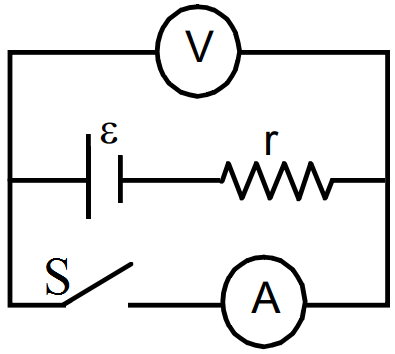
Answer
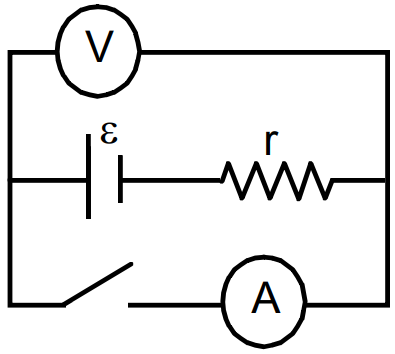
- When switch is open, no current passes through the ammeter. In the upper part of the circuit the Voltmenter has $\infty$ resistance. Thus current in it is 0.
$\therefore$ Voltmeter read the emf. (There is not Pot. Drop across the resistor).
- When switch is closed current passes through the circuit and if its value of i.
The voltmeter reads
$\in-\text{ir}=1.45$
$\Rightarrow1.52-\text{ir}=1.45$
$\Rightarrow\text{ir}=0.07$
$\Rightarrow1\text{r}=0.07\Rightarrow\text{r}=0.07\Omega.$ View full question & answer→Question 165 Marks
A $20\mu\text{F}$ capacitor is joined to a battery of emf 6.0V through a resistance of $100\Omega.$ Find the charge on the capacitor 2.0ms after the connections are made.
Answer$\text{C}=20\times10^{-6}\text{F, E}=6\text{V, R}=100\Omega$$\text{t}=2\times10^{-3}\text{sec}$
$\text{q}=\text{EC}\Big(1-\text{e}^\frac{-\text{t}}{\text{RC}}\Big)$
$=6\times20\times10^{-6}\bigg(1-\text{e}^{\frac{-2\times10^{-3}}{100\times20\times10^{-6}}}\bigg)$
$=12\times10^{-5}(1-\text{e}^{-1})$ $=7.12\times0.63\times10^{-5}=7.56\times10^{-5}$
$=75.6\times10^{-6}=76\mu\text{c}.$
View full question & answer→Question 175 Marks
The resistance of the rheostat shown in the figure. is $30\Omega.$ Neglecting the meter resistance, find the minimum and maximum currents through the ammeter as the rheostat is varied.
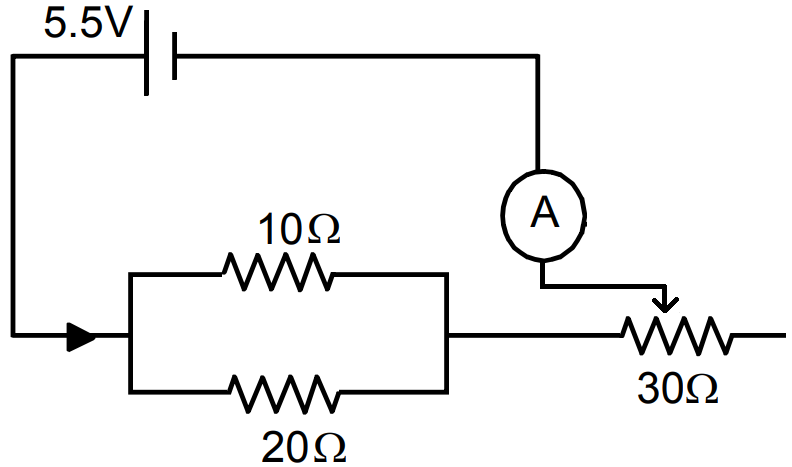
Answer
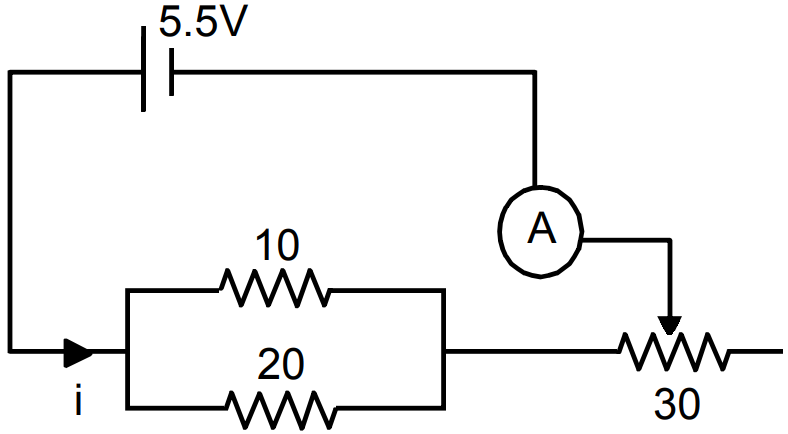
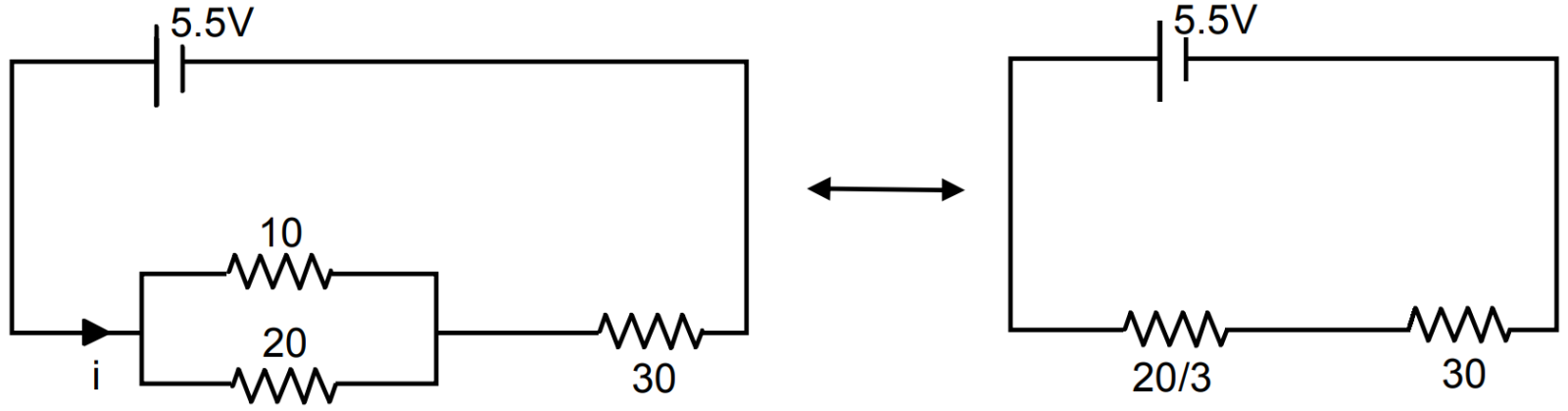 $\text{i}_\text{min}=\frac{5.5\times3}{110}=0.15$
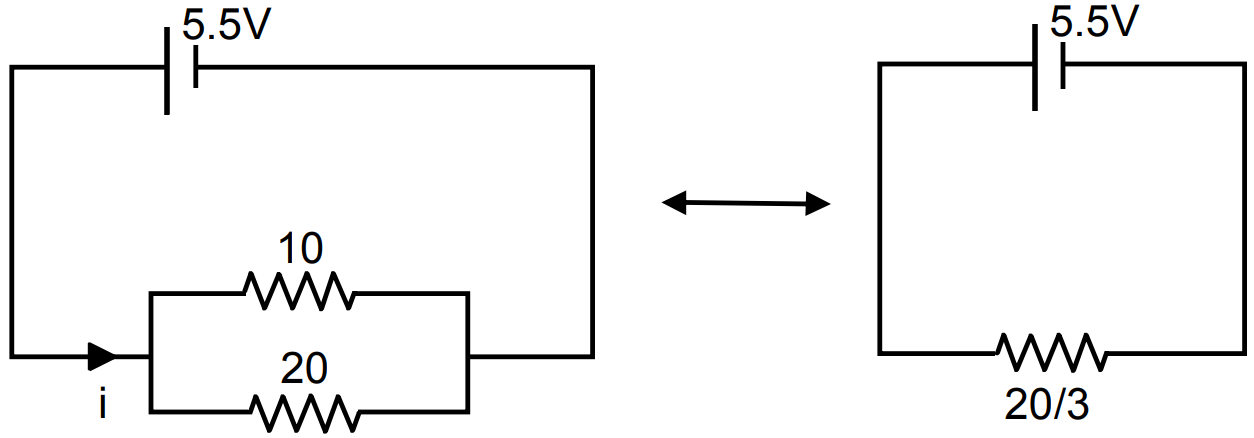
$\text{i}_\text{min}=\frac{5.5\times3}{20}=\frac{16.5}{20}=0.825.$ View full question & answer→Question 185 Marks
The current in a conductor and the potential difference across its ends are measured by an ammeter and a voltmeter. The meters draw negligible currents. The ammeter is accurate but the voltmeter has a zero error (that is, it does not read zero when no potential difference is applied). Calculate the zero error if the readings for two different conditions are 1.75A, 14.4V and 2.75A, 22.4V.
AnswerLet the voltmeter reading when, the voltage is 0 be X.$\frac{\text{l}_1\text{R}}{\text{l}_2\text{R}}=\frac{\text{V}_1}{\text{V}_2}$
$\Rightarrow\frac{1.75}{2.75}=\frac{14.4-\text{V}}{22.4-\text{V}}$
$\Rightarrow\frac{0.35}{0.55}=\frac{14.4-\text{V}}{22.4-\text{V}}$
$\Rightarrow\frac{0.07}{0.11}=\frac{14.4-\text{V}}{22.4-\text{V}}$
$\Rightarrow\frac{7}{11}=\frac{14.4-\text{V}}{22.4-\text{V}}$
$\Rightarrow7(22.4-\text{V})=11(14.4-\text{V})$
$\Rightarrow156.8-7\text{V}=158.4-11\text{V}$
$\Rightarrow(7-11)\text{V}=156.8-158.4\Rightarrow-4\text{V}=-1.6$
$\Rightarrow\text{V}=0.4\text{V}.$
View full question & answer→Question 195 Marks
The potentiometer wire AB shown in figure. is 50cm long. When AD = 30cm, no deflection occurs in the galvanometer. Find R.
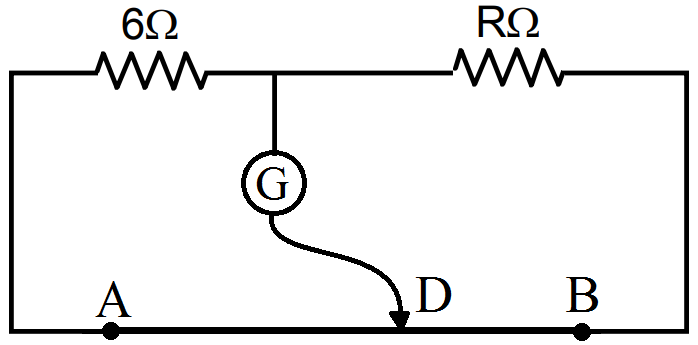
AnswerThe deflections does not occur in galvanometer if the condition is a balanced wheatstone bridge. 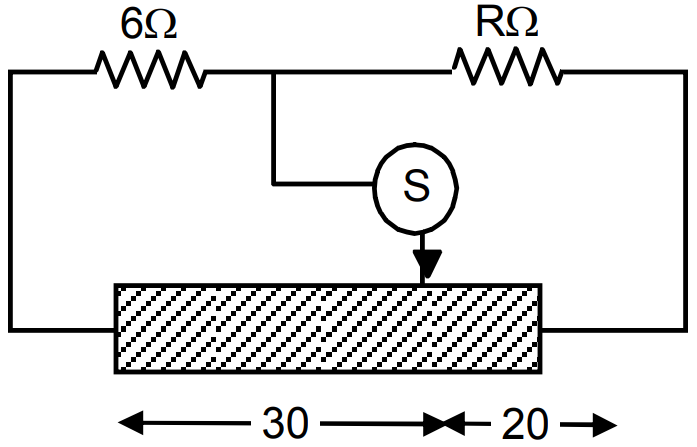 Let Resistance/ unit length = r. Resistance of 30m length = 30r. Resistance of 20m length = 20r. For balanced wheatstones bridge $=\frac{6}{\text{R}}=\frac{30\text{r}}{20\text{r}}$$\Rightarrow30\text{R}=20\times6\Rightarrow\text{R}=\frac{20\times6}{3}=4\Omega.$
 View full question & answer→Question 205 Marks
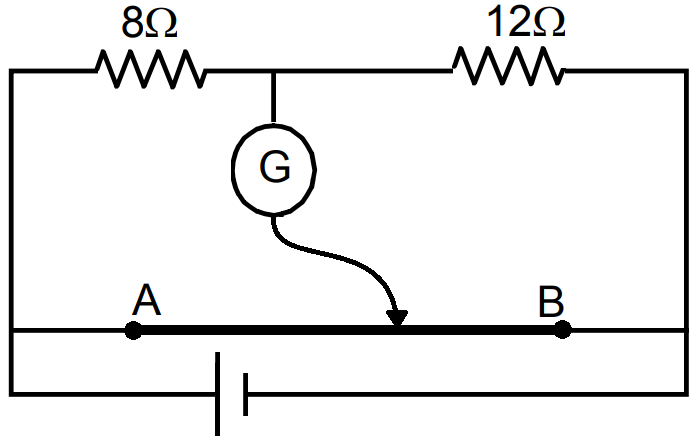
The potentiometer wire AB shown in the figure. is 40cm long. Where should the free end of the galvanometer be connected on AB so that the galvanometer may show zero deflection?
Answer
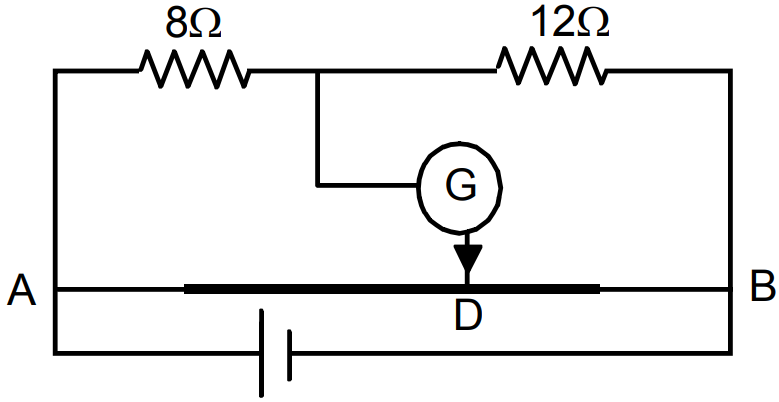 If the wire is connected to the potentiometer wire so that $\frac{\text{R}_\text{AD}}{\text{R}_\text{DB}}=\frac{8}{12},$ then according to wheat stone’s bridge no current will flow through galvanometer.
$\frac{\text{R}_\text{AB}}{\text{R}_\text{DB}}=\frac{\text{L}_\text{AB}}{\text{L}_\text{B}}=\frac{8}{12}=\frac{2}{3}$ (Acc. To principle of potentiometer).
$\text{I}_\text{AB}+\text{I}_\text{DB}=40\text{cm}$
$\Rightarrow\text{I}_\text{DB}\frac{2}{3}+\text{I}_\text{DB}=40\text{cm}$
$\Rightarrow\Big(\frac{2}{3}+1\Big)\text{I}_\text{DB}=40\text{cm}$
$\Rightarrow\frac{5}{3}\text{I}_\text{DB}=40$
$\Rightarrow\text{L}_\text{DB}=\frac{40\times3}{5}=24\text{cm}.$
$\text{I}_\text{AB}=(40-24)\text{cm}=16\text{cm}.$ View full question & answer→Question 215 Marks
Find the current through the $10\Omega$ resistor shown in figure.
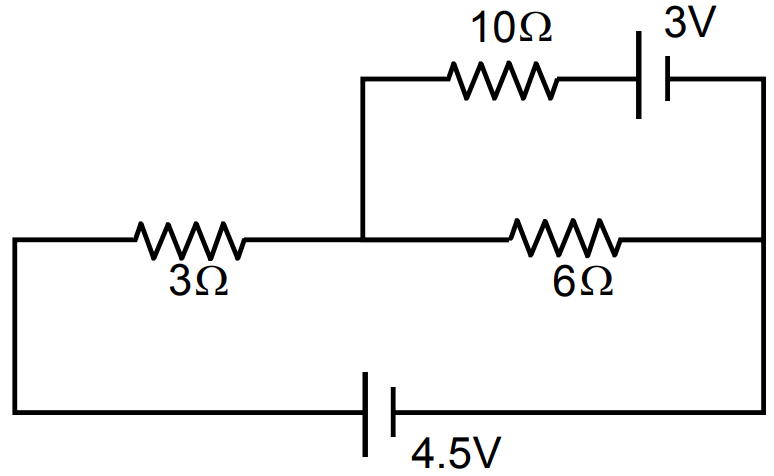
AnswerIn the circuit ADCBA, 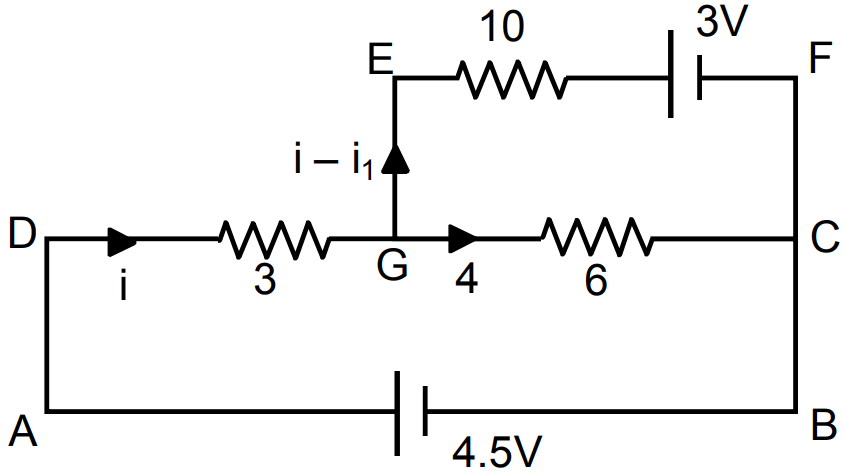 $3\text{i}+6\text{i}_1-4.5=0$
In the circuit GEFCG,$3\text{i}+6\text{i}_1=4.5$
$=10\text{i}-10\text{i}_1-6\text{i}_1=-3$
$\Rightarrow[10\text{i}+16\text{i}_1=-3]3\ ...(1)$
$[3\text{i}+6\text{i}_1=4.5]10\ ...(2)$ From (1) and (2)$-108\text{i}_1=-54$
$\Rightarrow\text{i}_1=\frac{54}{108}=\frac{1}{2}=0.5$
$3\text{i}+6\times\frac{1}{2}-4.5=0$
$3\text{i}-1.5=0\Rightarrow\text{i}=0.5$
Current through $10\Omega$ resistor = 0A. View full question & answer→Question 225 Marks
(a) Find the current in the $20\Omega$ resistor shown in the figure. (b) If a capacitor of capacitance $4\mu\text{F}$ is joined between the points A and B, what would be the electrostatic energy stored in it in steady state?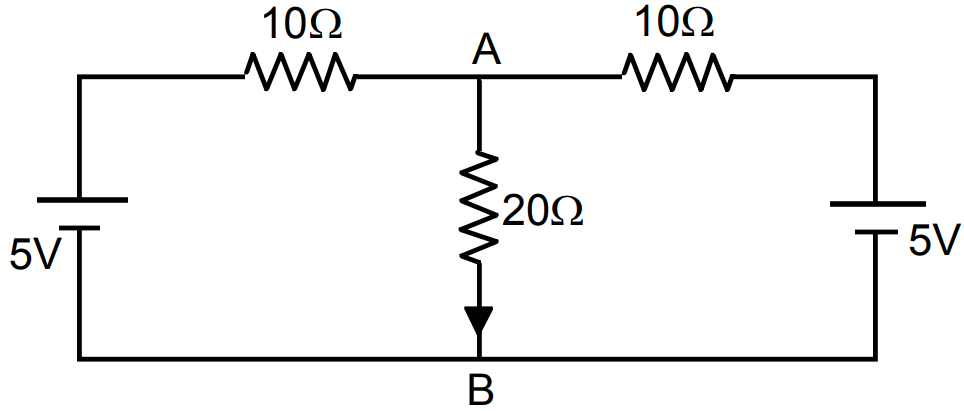
AnswerTaking circuit, ABCDA, 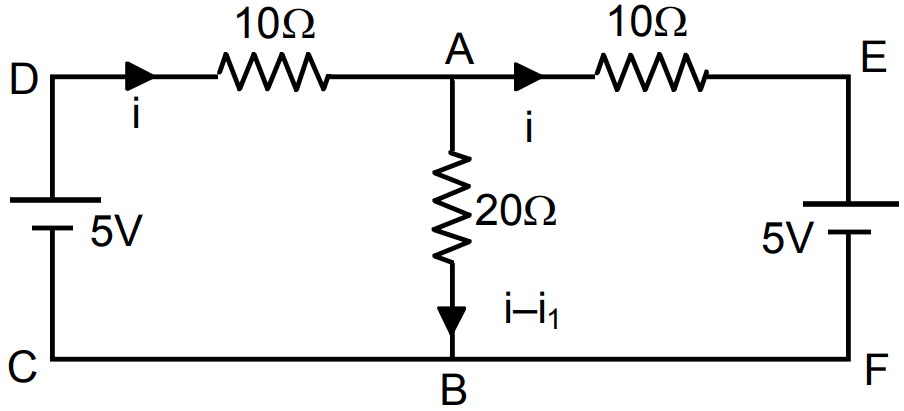 $10\text{i}+20(\text{i}-\text{i}_1)-5=0$
$\Rightarrow10\text{i}+20\text{i}-20\text{i}_1-5=0$
$\Rightarrow30\text{i}-20\text{i}_1-5=0\ ...(1)$
Taking circuit ABFEA,$20\text{i}(\text{i}-\text{i}_1)-5-10\text{i}_1=0$
$\Rightarrow10\text{i}-20\text{i}_1-10\text{i}_1-5=0$
$\Rightarrow20\text{i}-30\text{i}_1-5=0\ ...(2)$
From (1) and (2)$(90-40)\text{i}_1=0$
$\Rightarrow\text{i}_1=0$
$30\text{i}-5=0$
$\Rightarrow\text{i}=\frac{5}{30}=0.16\text{A}$
Current through $20\Omega$ is 0.16A. View full question & answer→Question 235 Marks
A 6 volt battery of negligible internal resistance is connected across a uniform wire AB of length $100cm$. The positive terminal of another battery of emf $4V$ and internal resistance $1\Omega$ is joined to the point A, as shown in the figure. Take the potential at B to be zero. (a) What are the potentials at the points A and C? (b) At which point D of the wire AB, the potential is equal to the potential at C? (c) If the points C and D are connected by a wire, what will be the current through it? (d) If the $4V$ battery is replaced by a $7.5V$ battery, what would be the answers of parts (a) and (b)?
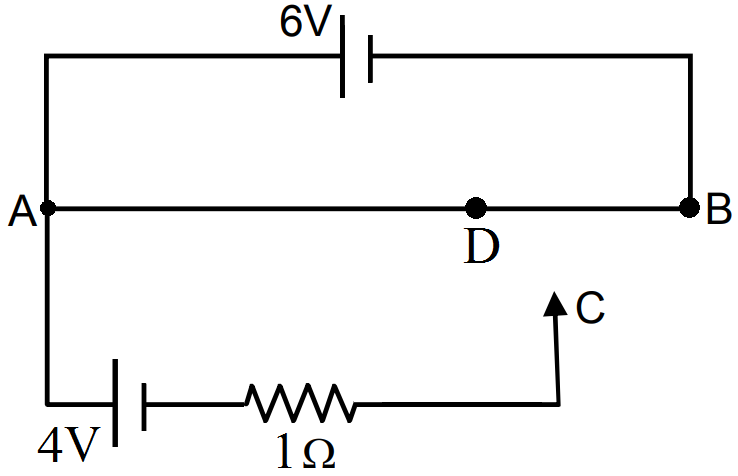
Answer
- Potential difference between A and B is 6V.
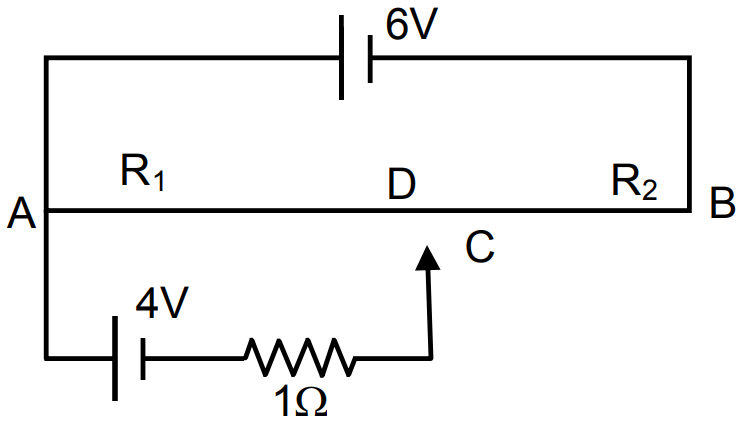
B is at 0 potential.
Thus potential of A point is 6V.
The potential difference between Ac is 4V.
$\text{V}_\text{A}-\text{V}_\text{C}=0.4$
$\text{V}_\text{C}=\text{V}_\text{A}-4=6-4=2\text{V}$
- The potential at $\text{D}=2\text{V},\text{V}_\text{AD}=4\text{V};\text{V}_\text{BD}=\text{OV}$
Current through the resisters $R_1$ and $R_2$ are equal
Thus, $\frac{4}{\text{R}_1}=\frac{2}{\text{R}_2}$
$\Rightarrow\frac{\text{R}_1}{\text{R}_2}=2$
$\Rightarrow\frac{\text{I}_1}{\text{I}_2}=2$ (Acc. to the law of potentiometer)
$\text{I}_1+\text{I}_2=100\text{cm}$
$\Rightarrow\text{I}_1+\frac{\text{I}_1}{2}=100\text{cm}\Rightarrow\frac{3\text{I}_1}{2}=100\text{cm}$
$\Rightarrow\text{I}_1=\frac{200}{3}\text{cm}=66.67\text{cm}.$
$\text{AD}=66.67\text{cm}$
- When the points C and D are connected by a wire current flowing through it is 0 since the points are equipotential.
- Potential at A = 6 v
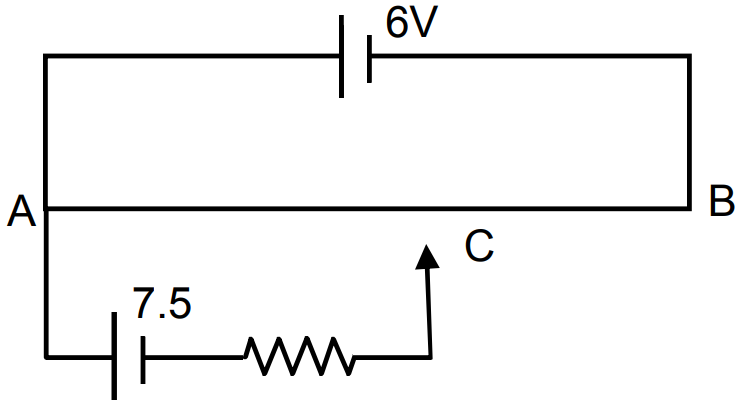
Potential at C = 6 - 7.5 = -1.5V
The potential at B = 0 and towards A potential increases.
Thus -ve potential point does not come within the wire. View full question & answer→Question 245 Marks
Find the circuit in the three resistors shown in the figure.
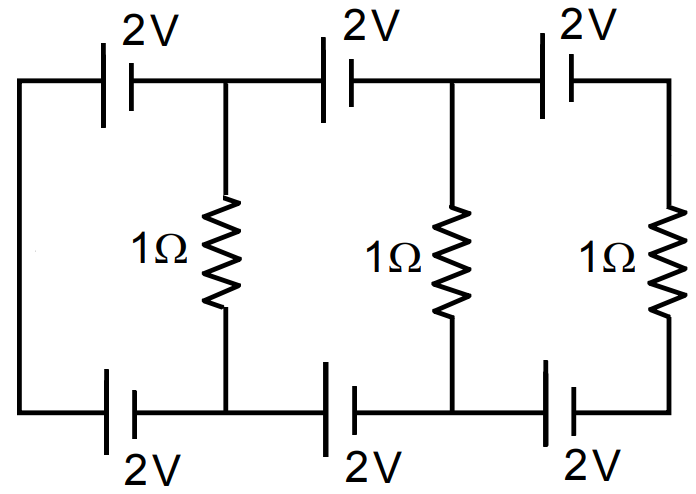
AnswerIn AHGBA, 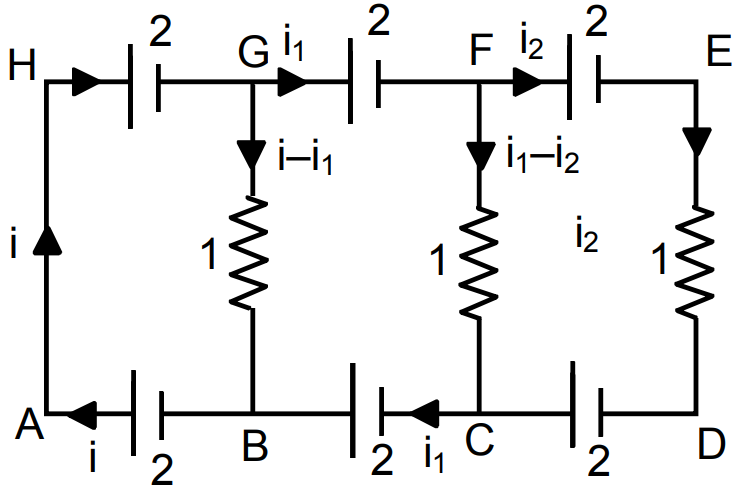 $2+(\text{i}-\text{i}_1)-2=0$
$\Rightarrow\text{i}-\text{i}_1=0$
In circuit CFEDC,$-(\text{i}_1-\text{i}_2)+2+\text{i}_2-2=0$
$\Rightarrow\text{i}_2-\text{i}_1+\text{i}_2=0\Rightarrow2\text{i}_2-\text{i}_1=0$
In circuit BGFCB,$-(\text{i}_1-\text{i}_2)+2+(\text{i}_1-\text{i}_2)-2=0$
$\Rightarrow\text{i}_1-\text{i}+\text{i}_1-\text{i}_2=0$
$\Rightarrow2\text{i}_1-\text{i}-\text{i}_2=0\ ...(1)$
$\Rightarrow\text{i}_1-(\text{i}-\text{i}_1)-\text{i}_2=0$
$\Rightarrow\text{i}_1-\text{i}_2=0\ ...(2)$
$\therefore\text{i}_1-\text{i}_2=0$
From (1) and (2) Current in the three resistors is 0. View full question & answer→Question 255 Marks
Consider $N=n_1 n_2$ identical cells, each of emf $\in$ and internal resistance $r$. Suppose $n_1$ cells are joined in series to form a line and $\mathrm{n}_2$ such lines are connected in parallel. The combination drives a current in an external resistance R.
(a) Find the current in the external resistance. (b) Assuming that $\mathrm{n}_1$ and $\mathrm{n}_2$ can be continuously varied, find the relation between $n_1, n_2, R$ and $r$ for which the current in $R$ is maximum.
Answer
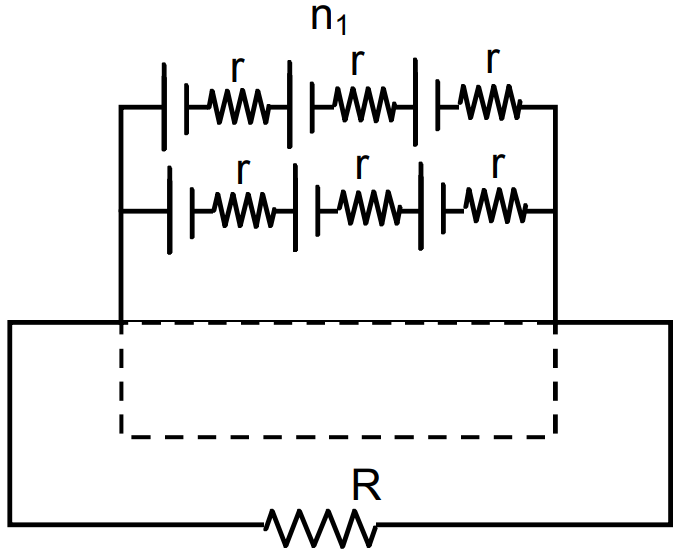
$\quad \text { a. Total emf }=n_1 E$
$\text { in } 1 \text { row }$
$\text { Total emf in all news }=n_1 E$
$\text { Total resistance in one row }=n_1 r$
$\text { Total resistance in all rows }=\frac{n_1 \mathrm{r}}{\mathrm{n}_2}$
$\text { Net resistance }=\frac{\mathrm{n}_1 \mathrm{r}}{\mathrm{n}_2}+R$
$\text { Current }=\frac{\mathrm{n}_1 \mathrm{E}}{\frac{\mathrm{n}_1}{\mathrm{n}_2 \mathrm{r}}+\mathrm{R}}=\frac{\mathrm{n}_1 \mathrm{n}_2 \mathrm{E}}{\mathrm{n}_1 \mathrm{r}+\mathrm{n}_2 \mathrm{R}}$
$\qquad \text { b. } \mathrm{I}=\frac{\mathrm{n}_1 \mathrm{n}_2 \mathrm{E}}{\mathrm{n}_1 \mathrm{r}+\mathrm{n}_2 \mathrm{R}}$
$\text { for } \mathrm{I}=\mathrm{max}$
$\mathrm{n}_1 \mathrm{r}+\mathrm{n}_2 \mathrm{R}=\min$
$\Rightarrow\left(\sqrt{\mathrm{n}_1 \mathrm{r}}-\sqrt{\mathrm{n}_2 \mathrm{R}}\right)^2+2 \sqrt{\mathrm{n}_1 \mathrm{rn}_2 \mathrm{R}}=\min$
it is min , when
$\sqrt{\mathbf{n}_1 \mathbf{r}}=\sqrt{\mathrm{n}_2 \mathrm{R}}$
$\Rightarrow \mathrm{n}_1 \mathrm{r}=\mathrm{n}_2 \mathrm{R}$
$I$ is $\max$ when $\mathrm{n}_1 \mathrm{r}=\mathrm{n}_2 \mathrm{R}$. View full question & answer→Question 265 Marks
Figure. shows a part of a circuit. If a current of 12mA exists in the $5\text{k}\Omega$ resistor, find the currents in the other three resistors. What is the potential difference between the points A and B?
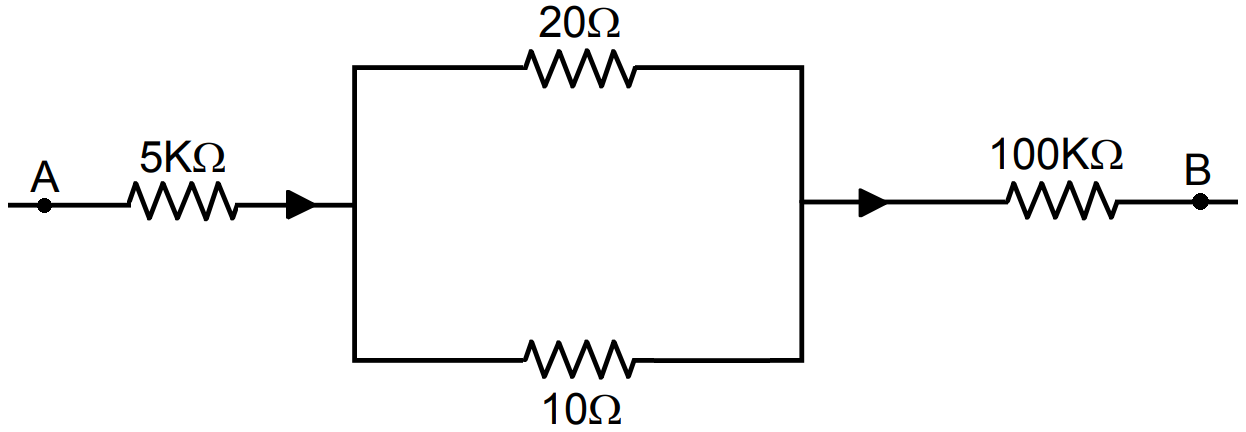
Answer
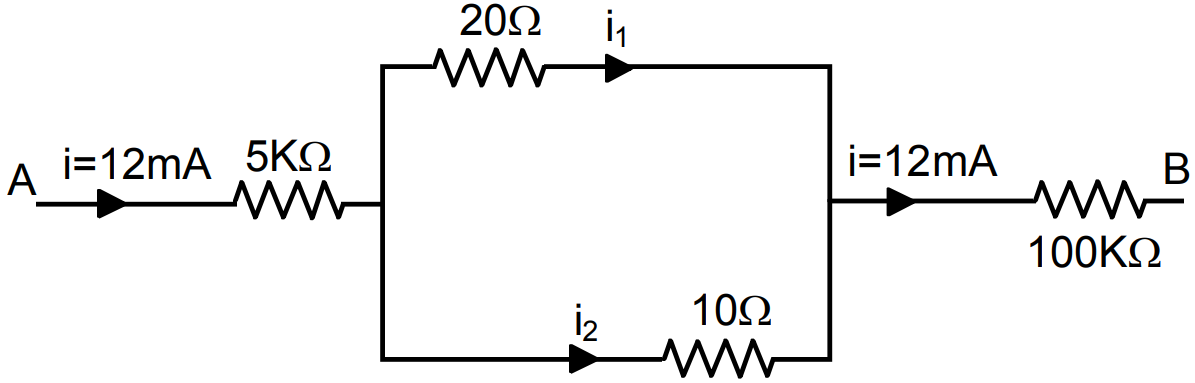
$\text{i}_1\times20=\text{i}_2\times10$
$\Rightarrow\frac{\text{i}_1}{\text{i}_2}=\frac{10}{20}=\frac{1}{2}$
$i_1 = 4mA, i_2 = 8mA$
Current in $20\text{K}\Omega$ resistor = 4mA
Current in $10\text{K}\Omega$ resistor = 8mA
Current in $100\text{K}\Omega$ resistor = 12mA
$\text{V}=\text{V}_1+\text{V}_2+\text{V}_3$
$=5\text{K}\Omega\times12\text{mA}+10\text{K}\Omega\times8\text{mA}\\+100\text{K}\Omega\times12\text{mA}$
$=60+80+1200=1340\text{ volts}.$ View full question & answer→Question 275 Marks
A capacitance C, a resistance R and an emf $\in$ are connected in series at t = 0. What is the maximum value of (a) the potential difference across the resistor (b) the current in the circuit (c) the potential difference across the capacitor (d) the energy stored in the capacitor (e) the power delivered by the battery and (f) the power converted into heat?
Answer
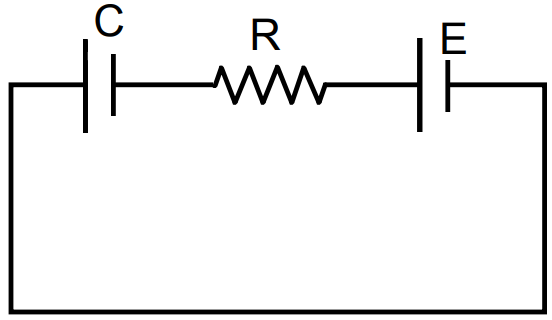
- Potential difference = E across resistor
- Current in the circuit $=\frac{\text{E}}{\text{R}}$
- Pd. Across capacitor $=\frac{\text{E}}{\text{R}}$
- Energy stored in capacitor $=\frac{1}{2}\text{CE}^2$
- Power delivered by battery $=\text{E}\times\text{I}=\text{E}\times\frac{\text{E}}{\text{R}}=\frac{\text{E}^2}{\text{R}}$
- Power converted to heat $=\frac{\text{E}^2}{\text{R}}$
View full question & answer→Question 285 Marks
A copper wire of radius 0.1mm and resistance $1\text{k}\Omega$ is connected across a power supply of 20V.
(a) How many electrons are transferred per second between the supply and the wire at one end? (b) Write down the current density in the wire.
Answer$\text{r}=0.1\text{mm}=10^{-4}\text{m}$$\text{R}=1\text{K}\Omega=10^3\Omega,\text{V}=20\text{V}$
- No.of electrons transferred
$\text{i}=\frac{\text{V}}{\text{R}}=\frac{20}{10^3}=20\times10^{-3}=2\times10^{-2}\text{A}$
$\text{q}=\text{it}=2\times10^{-2}\times1=2\times10^{-2}\text{C}$
No. of electrons transferred $=\frac{2\times10^{-2}}{1.6\times10^{-19}}=\frac{2\times10^{-17}}{1.6}=1.25\times10^{17}.$
- Current density of wire
$=\frac{\text{i}}{\text{A}}=\frac{2\times10^{-2}}{\pi\times10^{-8}}=\frac{2}{3.14}\times10^6$
$=0.6369\times10^6=6.37\times10^5\text{A}/\text{m}^2.$ View full question & answer→Question 295 Marks
The emf $\in$ and the internal resistance r of the battery, shown in the figure. are 4.3V and $1.0\Omega$ respectively. The external resistance R is $50\Omega.$ The resistances of the ammeter and voltmeter are $2.0\Omega$ and $200\Omega$ respectively. (a) Find the readings of the two $200\Omega$ respectively. (a) Find the readings of the two meters. (b) The switch is thrown to the other side. What will be the readings of the two meters now?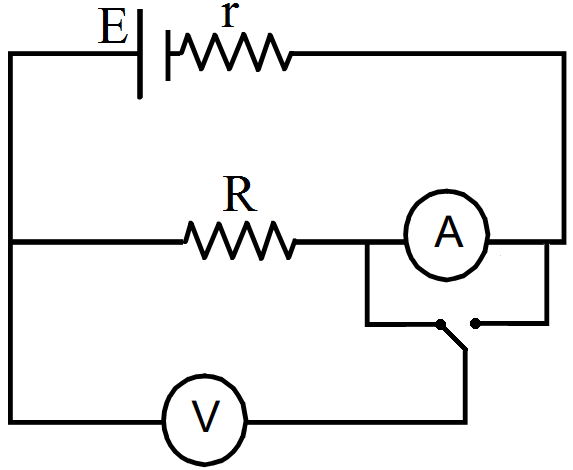
Answer
- In circuit ABFGA,
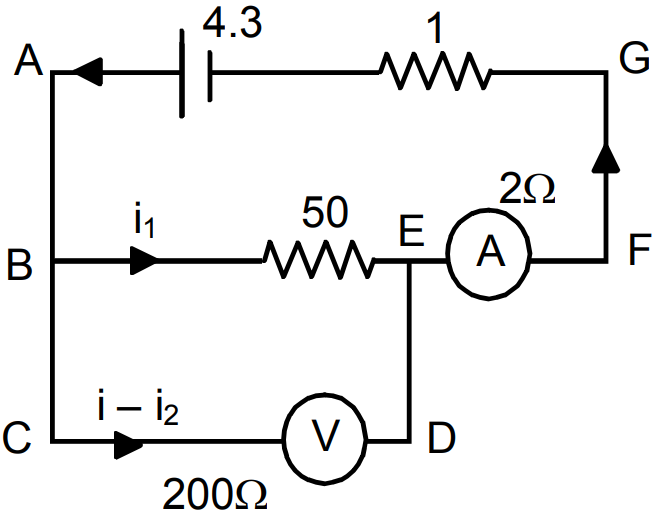
$\text{i}_150+2\text{i}+\text{i}-4.3=0$
$\Rightarrow50\text{i}_1+3\text{i}=4.3\ ...(1)$
In circuit BEDCB,
$50\text{i}-200\text{i}+200\text{i}_1=0$
$\Rightarrow250\text{i}_1-200\text{i}=0$
$\Rightarrow50\text{i}_1-40\text{i}=0\ ...(2)$
From (1) and (2)
$43\text{i}=4.3\Rightarrow\text{i}=0.1$
$5\text{i}_1=4\times\text{i}=4\times0.1$
$\Rightarrow\text{i}_1=\frac{4\times0.1}{5}=0.08\text{A}$
Ammeter reads a current $=\text{i}=0.1\text{A}$
Voltmeter reads a potential difference equal to $\text{i}_1\times50=0.08\times50=4\text{V}.$
- In circuit ABEFA,
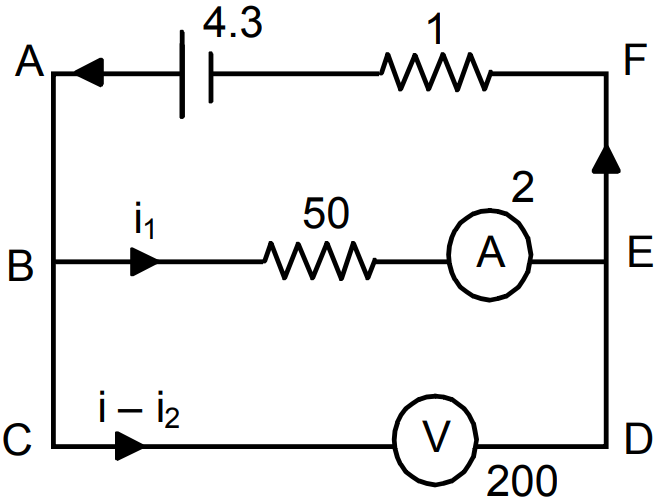
$50\text{i}_1+2\text{i}_1+1\text{i}-4.3=0$
$\Rightarrow52\text{i}_1+\text{i}=4.3$
$\Rightarrow200\times52\text{i}_1+200\text{i}=4.3\times200\ ...(1)$
In circuit BCDEB,
$(\text{i}-\text{i}_1)200-\text{i}_12-\text{i}_150=0$
$\Rightarrow200\text{i}-200\text{i}_1-2\text{i}_1-50\text{i}_1=0$
$\Rightarrow200\text{i}-252\text{i}_1=0\ ...(2)$
From (1) and (2)
$\text{i}_1(10652)=4.3\times2\times100$
$\Rightarrow\text{i}_1=\frac{4.3\times2\times100}{10652}=0.08$
$\text{i}=4.3-52\times0.08=0.14$
Reading of the ammeter = 0.08a
Reading of the voltmeter $=(\text{i}-\text{i}_1)200=(0.14-0.08)\times200=12\text{V}.$ View full question & answer→Question 305 Marks
A voltmeter of resistance $400\Omega$ is used to measure the potential difference across the $100\Omega$ resistor in the circuit shown in the figure. (a) What will be the reading of the voltmeter? (b) What was the potential difference across $100\Omega$ before the voltmeter was connected?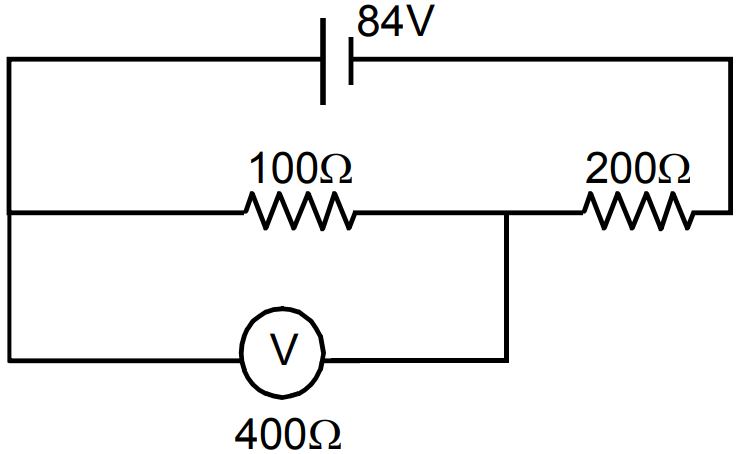
Answer
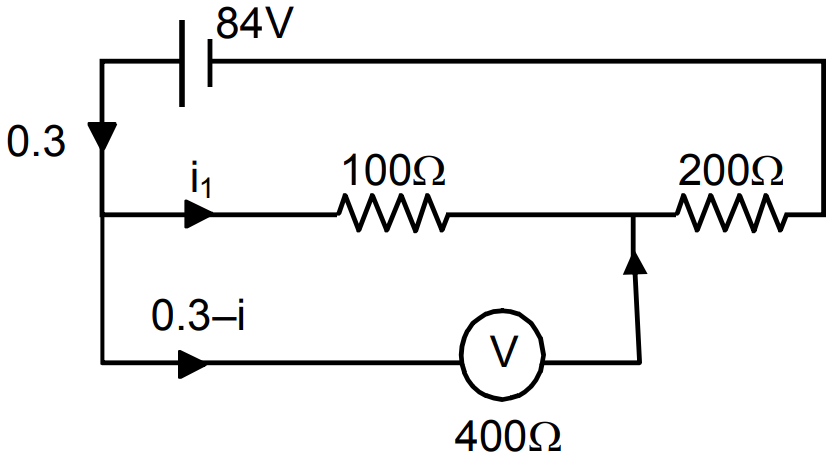
- $\text{R}_\text{eff}=\frac{100\times400}{500}+200=280$
$\text{i}=\frac{84}{280}=0.3$
$100\text{i}=(0.3-\text{i})400$
$\Rightarrow\text{i}=1.2-4\text{i}$
$\Rightarrow5\text{i}=1.2\Rightarrow\text{i}=0.24$
Voltage measured by the voltmeter $=\frac{0.24\times100}{24\text{V}}$
- If voltmeter is not connected
$\text{R}_\text{eff}=(200+100)=300\Omega$
$\text{i}=\frac{84}{300}=0.28\text{A}$
Voltage across $100\Omega=(0.28\times100)=28\text{V}.$ View full question & answer→Question 315 Marks
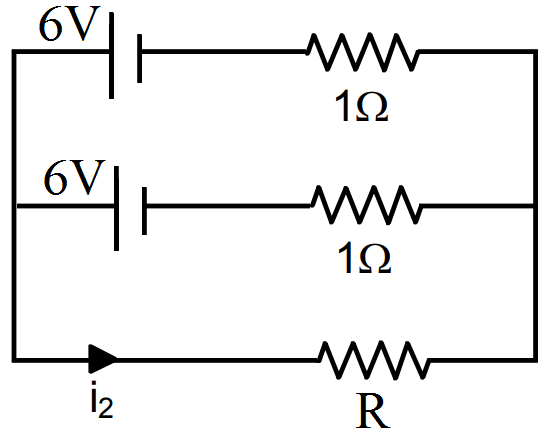
Find the value of $\frac{\text{i}_1}{\text{i}_2}$ in the figure. if (a) $\text{R}=0.1\Omega$ (b) $\text{R}=1\Omega$ and (c) $\text{R}=10\Omega.$ Note from your answers that in order to get more current from a combination of two batteries, they should be joined in parallel if the external resistance is small and in series if the external resistance is large, compared to the internal resistance.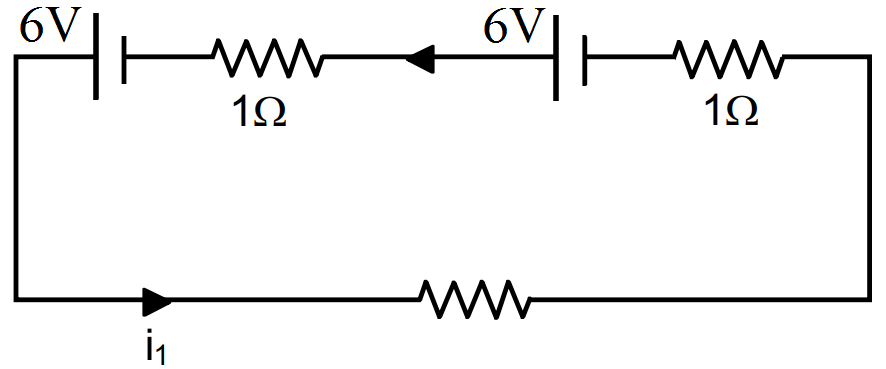
Answer
- $0.1\text{i}_1+1\text{i}_1-6+1\text{i}_1-6=0$
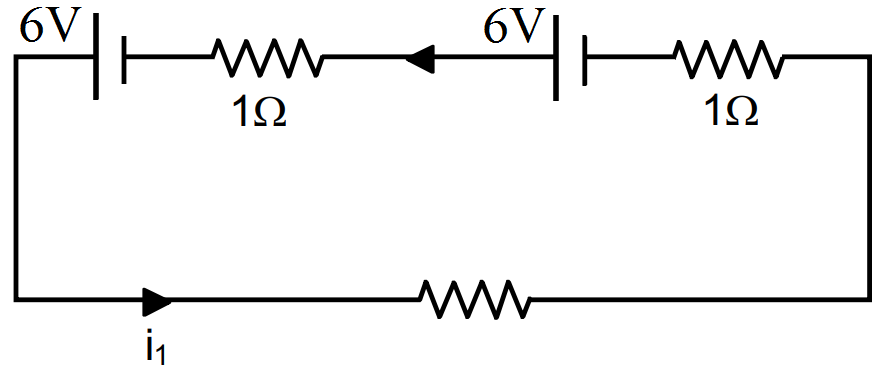
$\Rightarrow0.1\text{i}_1+1\text{i}_1+1\text{i}_1=12$
$\Rightarrow\text{i}_1=\frac{12}{2.1}$
$\text{ABCDA}$
$\Rightarrow0.1\text{i}_2+1\text{i}-6=0$
$\Rightarrow0.1\text{i}_2+1\text{i}$
$\text{ADEFA}$
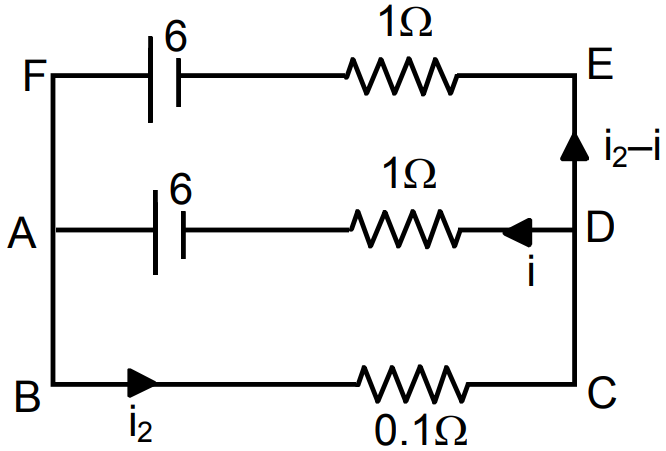
$\Rightarrow\text{i}-6+6-(\text{i}_2-\text{i})1=0$
$\Rightarrow\text{i}-\text{i}_2+\text{i}=0$
$\Rightarrow2\text{i}-\text{i}_2=0\Rightarrow-2\text{i}\pm0.2\text{i}=0$
$\Rightarrow\text{i}_2=0.$
- $1\text{i}_1+1\text{i}_1-6+1\text{i}_1=0$
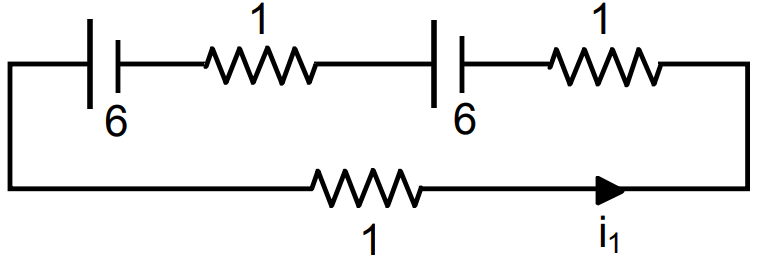
$\Rightarrow3\text{i}_1=12\Rightarrow\text{i}_1=4$
$\text{DCFED}$
$\Rightarrow\text{i}_2+\text{i}-6=0\Rightarrow\text{i}_2+\text{i}=6$
$\text{ABCDA}$
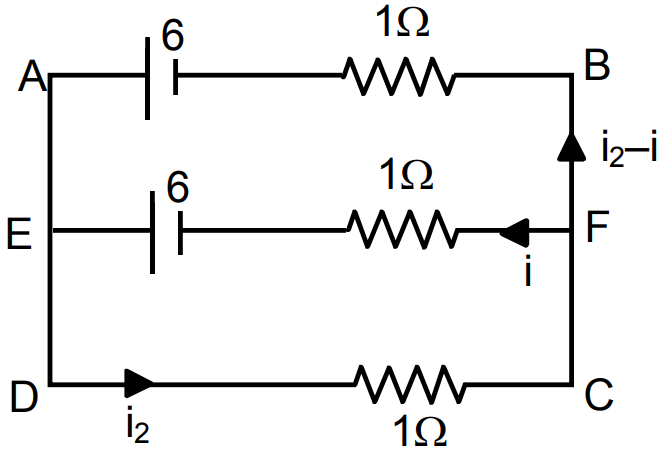
$\text{i}_2+(\text{i}_2-\text{i})-6=0$
$\Rightarrow\text{i}_2+\text{i}_2-\text{i}=6\Rightarrow2\text{i}_2-\text{i}=6$
$\Rightarrow-2\text{i}_2\pm2\text{i}=6\Rightarrow\text{i}=-2\text{i}_2+\text{i}=6$
$\Rightarrow\text{i}_2-2=6\Rightarrow\text{i}_2=8$
$\frac{\text{i}_1}{\text{i}_2}=\frac{4}{8}=\frac{1}{2}.$
- $10\text{i}_1+1\text{i}_1-6+1\text{i}_1-6=0$
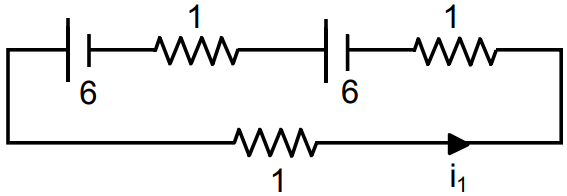
$\Rightarrow12\text{i}_1=12\Rightarrow\text{i}_1=1$
$10\text{i}_2-\text{i}_1-6=0$
$\Rightarrow10\text{i}_2-\text{i}_1=6$
$\Rightarrow10\text{i}_2+(\text{i}_2-\text{i})1-6=0$
$\Rightarrow11\text{i}_2=6$
$\Rightarrow-\text{i}_2=0.$
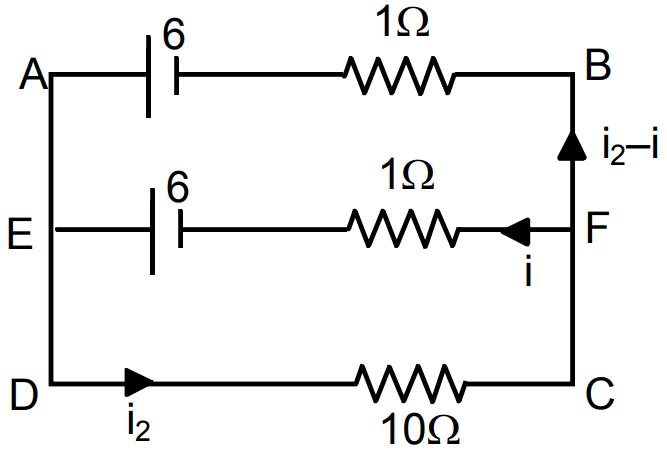
View full question & answer→Question 325 Marks
A $100\mu\text{F}$ capacitor is joined to a 24V battery through a $1.0\text{M}\Omega$ resistor. Plot qualitative graphs (a) between current and time for the first 10 minutes and (b) between charge and time for the same period.
AnswerTime constant $\text{RC} = 1 \times 10^6 \times 100 \times 10^6 = 100 \text{sec}$
- $\text{q}=\text{VC}\Big(1-\text{e}^{\frac{-\text{t}}{\text{CR}}}\Big)$
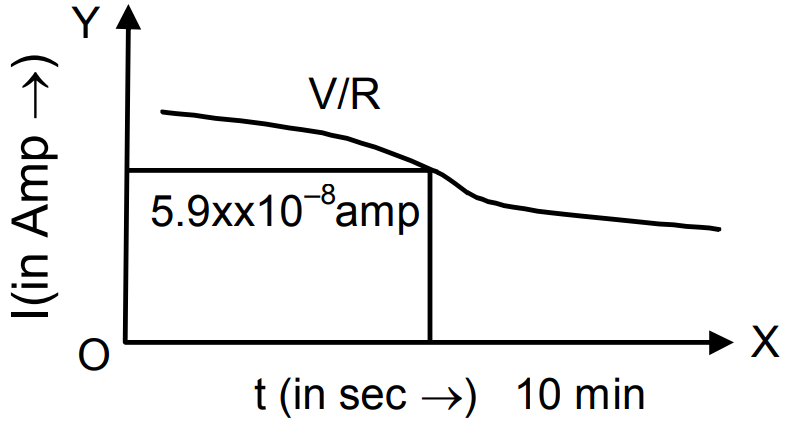
I = Current $=\frac{\text{dq}}{\text{dt}}=\text{VC}.(-)\text{e}^{\frac{-\text{t}}{\text{RC}}},\frac{-1}{\text{RC}}$
$=\frac{\text{V}}{\text{R}}\text{e}^{\frac{-\text{t}}{\text{RC}}}=\frac{\text{V}}{\text{R}\cdot\text{e}^{\frac{\text{t}}{\text{RC}}}}=\frac{24}{10^6}\times\frac{1}{\text{e}^{\frac{\text{t}}{100}}}$
$=24\times10^{-6}\frac{1}{\text{e}^{\frac{\text{t}}{100}}}$
$\text{t}=10\text{min},600\text{sec}.$
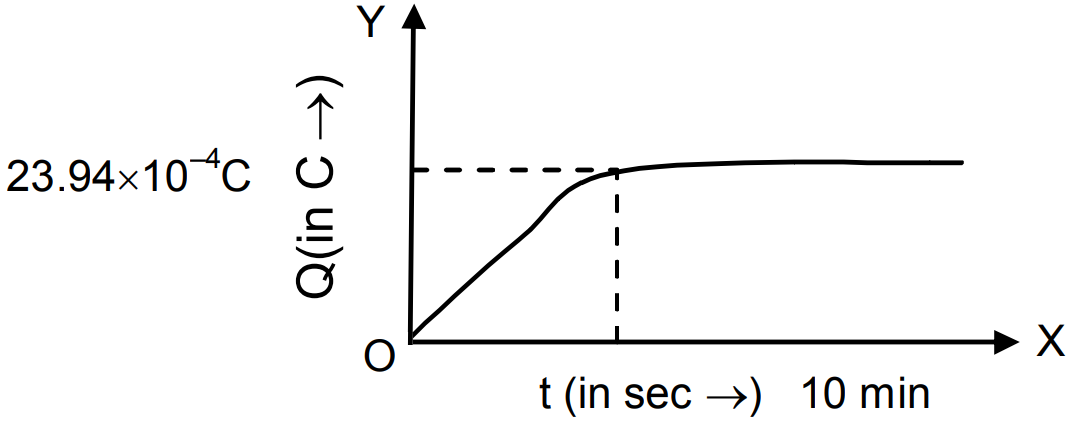
$\text{Q}=24\times10+-4\times\big(1-\text{e}^{-6}\big)=23.99\times10^{-4}$
$\text{I}=\frac{24}{10^6}\times\frac{1}{\text{e}^6}=5.9\times10^{-8}\text{Amp}.$
- $\text{q}=\text{VC}\Big(1-\text{e}^\frac{-\text{t}}{\text{CR}}\Big)$
View full question & answer→Question 335 Marks
Find the current measured by the ammeter in the circuit shown in the figure.
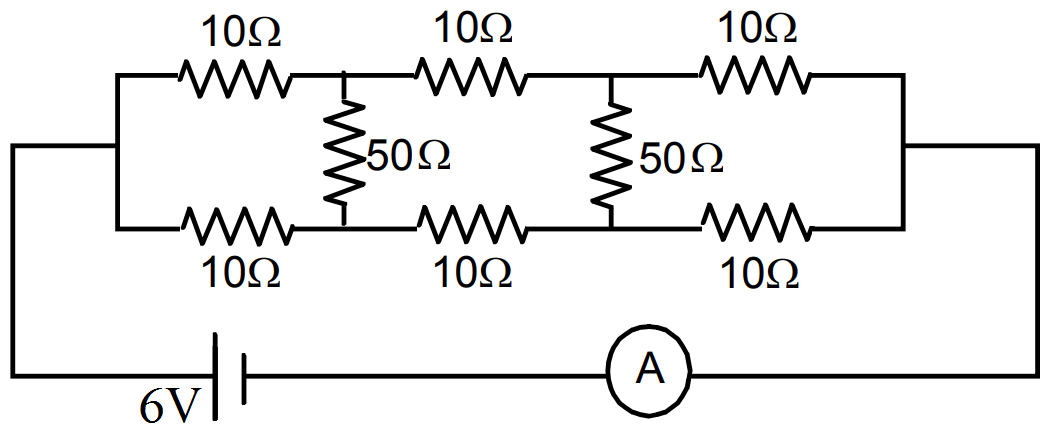
Answer

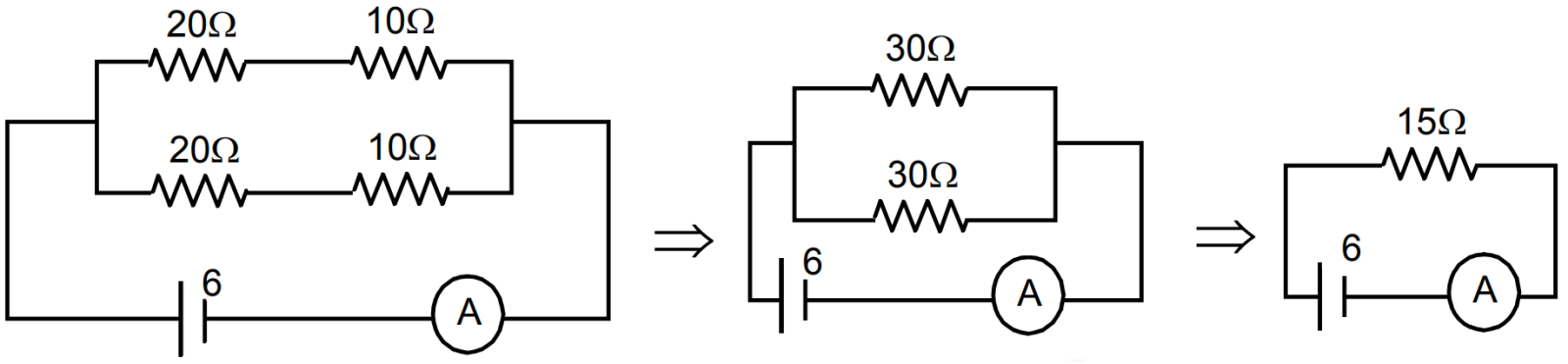 $\text{I}=\frac{6}{15}=\frac{2}{5}=0.4\text{A}.$
 View full question & answer→Question 345 Marks
Twelve wires, each of equal resistance r, are joined to form a cube, as shown in the figure. Find the equivalent resistance between the diagonally opposite points a and f.
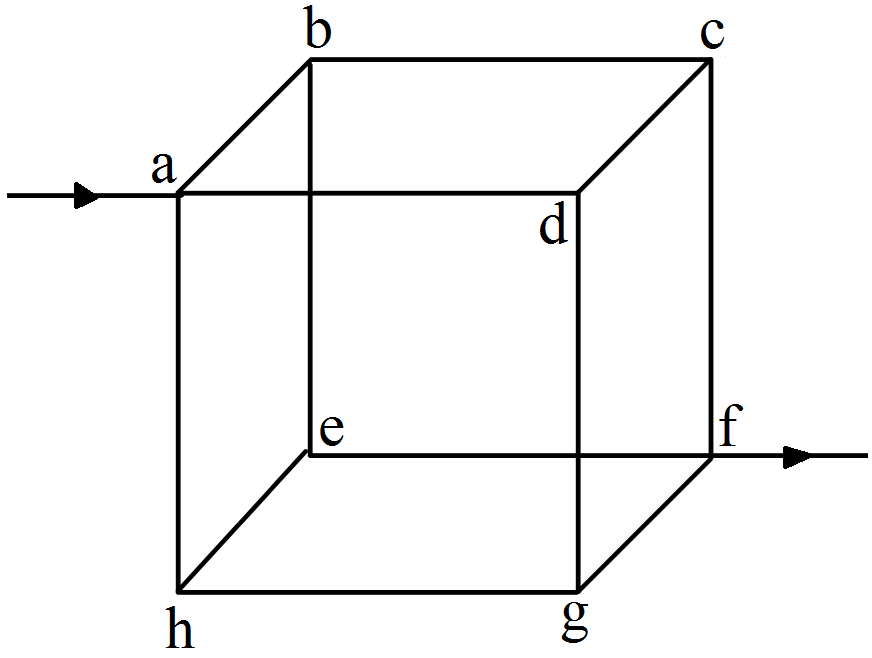
AnswerTaking circuit ABHGA,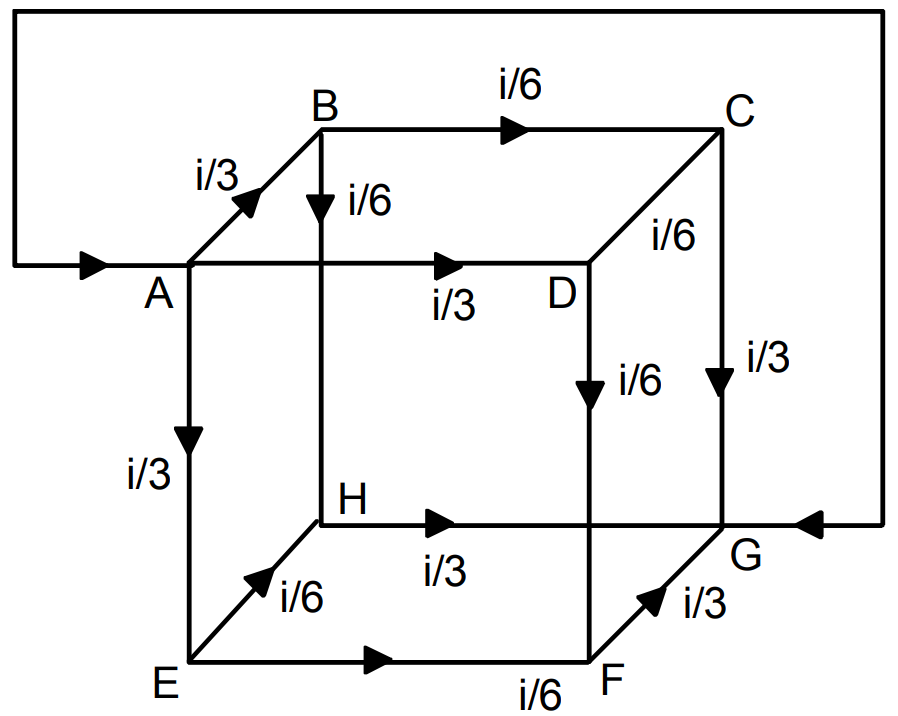
$\frac{\text{i}}{3\text{r}}+\frac{\text{i}}{6\text{r}}+\frac{\text{i}}{3\text{r}}=\text{V}$
$\Rightarrow\Big(\frac{2\text{i}}{3}+\frac{\text{i}}{6}\Big)\text{r}=\text{V}$
$\Rightarrow\text{V}=\frac{5\text{i}}{6}\text{r}$
$\Rightarrow\text{R}_\text{eff}=\frac{\text{V}}{\text{i}}=\frac{5}{6\text{r}}$ View full question & answer→Question 355 Marks
The voltmeter shown in the figure. reads 18V across the $50\Omega$ resistor. Find the resistance of the voltmeter.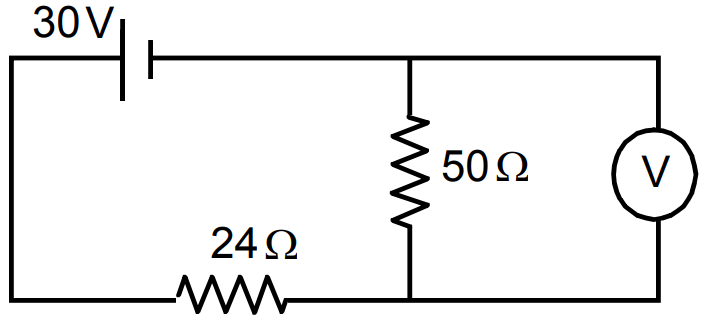
AnswerLet resistance of the voltmeter be $\text{R}\Omega$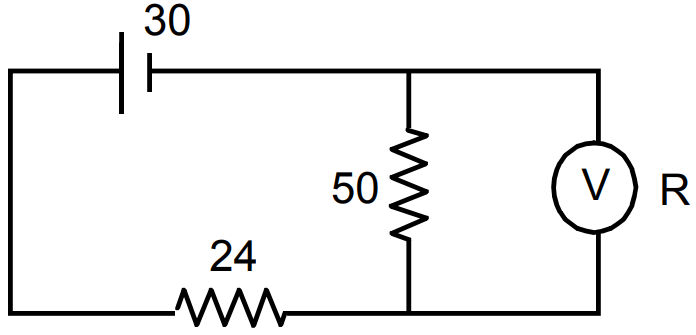
$\text{R}_1=\frac{50\text{R}}{50+\text{R}},\text{R}_2=24$
Both are in series.$30=\text{V}_1+\text{V}_2$
$\Rightarrow30=\text{iR}_1+\text{iR}_2$
$\Rightarrow30-\text{iR}_2=\text{iR}_1$
$\Rightarrow\text{iR}_1=30-\frac{30}{\text{R}_1+\text{R}_2}\text{R}_2$
$\Rightarrow\text{V}_1=30\Big(1-\frac{\text{R}_2}{\text{R}_1+\text{R}_2}\Big)$
$\Rightarrow\text{V}_1=30\Big(\frac{\text{R}_1}{\text{R}_1+\text{R}_2}\Big)$
$\Rightarrow18=30\Bigg(\frac{50\text{R}}{50+\text{R}\Big(\frac{50\text{R}}{50+\text{R}}+24\Big)}\Bigg)$
$\Rightarrow18=30\bigg(\frac{50\text{R}\times(50+\text{R})}{(50+\text{R})+(50\text{R}+24)(50+\text{R})}\bigg)$ $=\frac{30(50\text{R})}{50\text{R}+1200+24\text{R}}$
$\Rightarrow18=\frac{30\times50\times\text{R}}{74\text{R}+1200}=18(74\text{R}+1200)=1500\text{R}$
$\Rightarrow1332\text{R}+21600=1500\text{R}$
$\Rightarrow21600=1.68\text{R}$
$\Rightarrow\text{R}=\frac{21600}{168}=128.57.$ View full question & answer→Question 365 Marks
The switch S shown in figure. is kept closed for a long time and is then opened at t = 0. Find the current in the middle $1.0\Omega$ resistor at t = 1ms.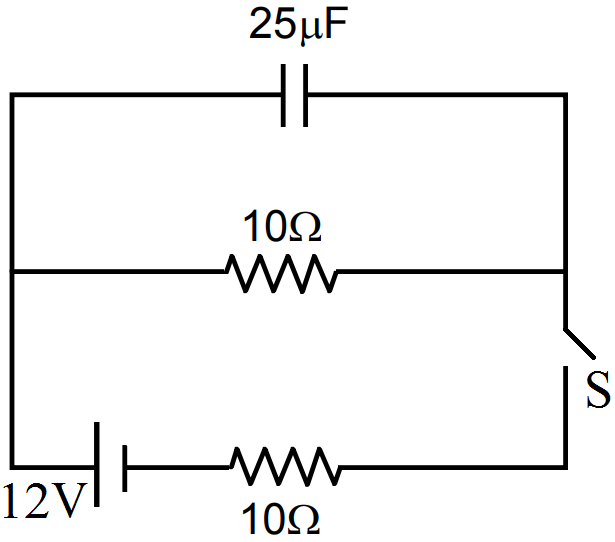
AnswerIn steady state condition, no current passes through the $25\mu\text{F}$ capacitor, 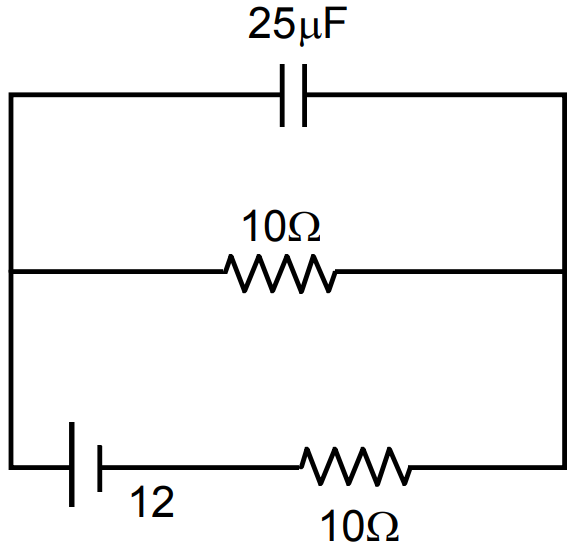 $\therefore$ Net resistance $=\frac{10\Omega}{2}=5\Omega$
Potential difference across the capacitor = 5 Potential difference across the $10\Omega$ resistor$=\frac{12}{5}\times10=24\text{V}$
$\text{q}=\text{Q}\Big(\text{e}^{\frac{-\text{t}}{\text{RC}}}\Big)=\text{V}\times\text{C}\Big(\text{e}^{\frac{-\text{t}}{\text{RC}}}\Big)$ $=24\times25\times10^{-6}\bigg[\text{e}^{\frac{-1\times10^{-3}}{10\times25\times10^{-4}}}\bigg]$
$=24\times25\times10^{-6}\text{e}^{-4}$
$=24\times25\times10^{-6}\times0.0183=10.9\times10^{-6}\text{C}$
Charge given by the capacitor after time t. Current in the $10\Omega$ resistor $=\frac{10.9\times10^{-6}\text{C}}{1\times10^{-3}\text{sec}}=11\text{mA}.$ View full question & answer→Question 375 Marks
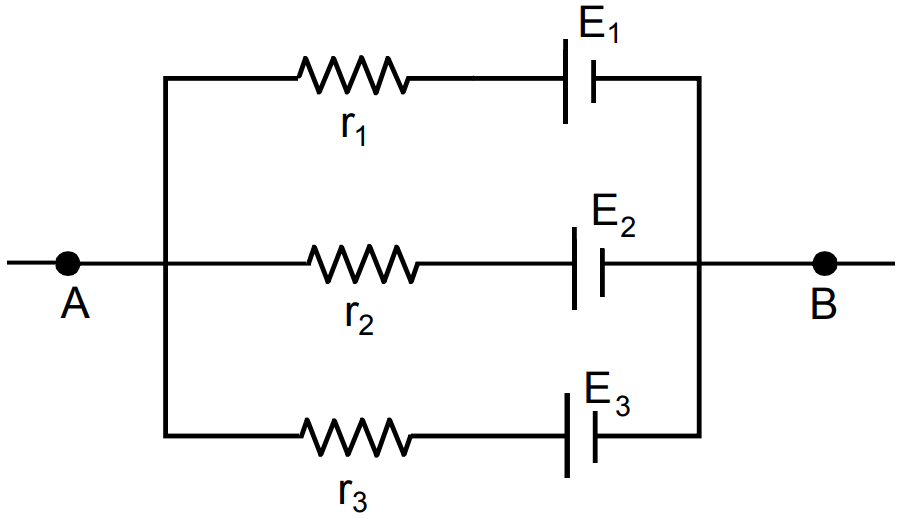
In the circuit shown in the figure. $\in_1=3\text{V},\in_2=2\text{V},\in_3=1\text{V}$ and $\text{r}_1=\text{r}_2=\text{r}_3=1\Omega.$ Find the potential difference between the points A and B and the current through each branch.
AnswerIn circuit ABDCA, 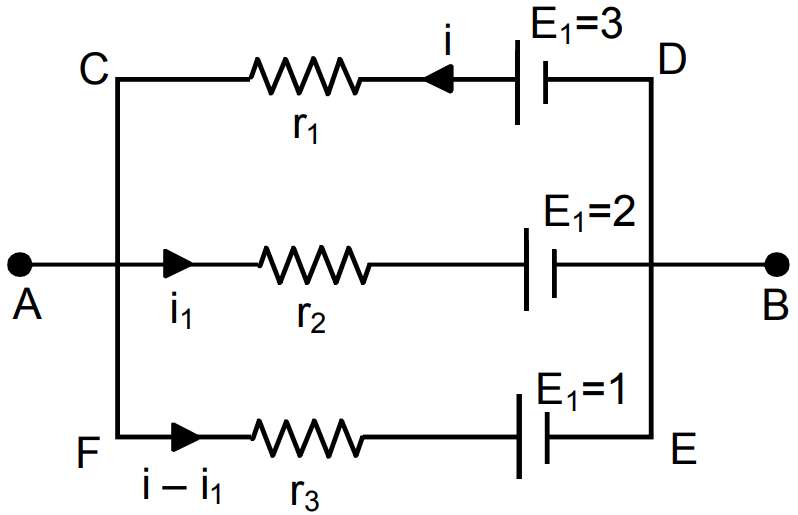 $\text{i}_1+2-3+\text{i}=0$
$\Rightarrow\text{i}+\text{i}_1-1=0\ ...(1)$
In circuit CFEDC,$(\text{i}-\text{i}_1)+1-3+\text{i}=0$
$\Rightarrow2\text{i}-\text{i}_1-2=0\ ...(2)$
From (1) and (2)$3\text{i}=3\Rightarrow\text{i}=1\text{A}$
$\text{i}_1=1-\text{i}=0\text{A}$
$\text{i}-\text{i}_1=1-0=1\text{A}$
Potential difference between A and B$=\text{E}-\text{ir}=3-1.1=2\text{V}.$ View full question & answer→Question 385 Marks
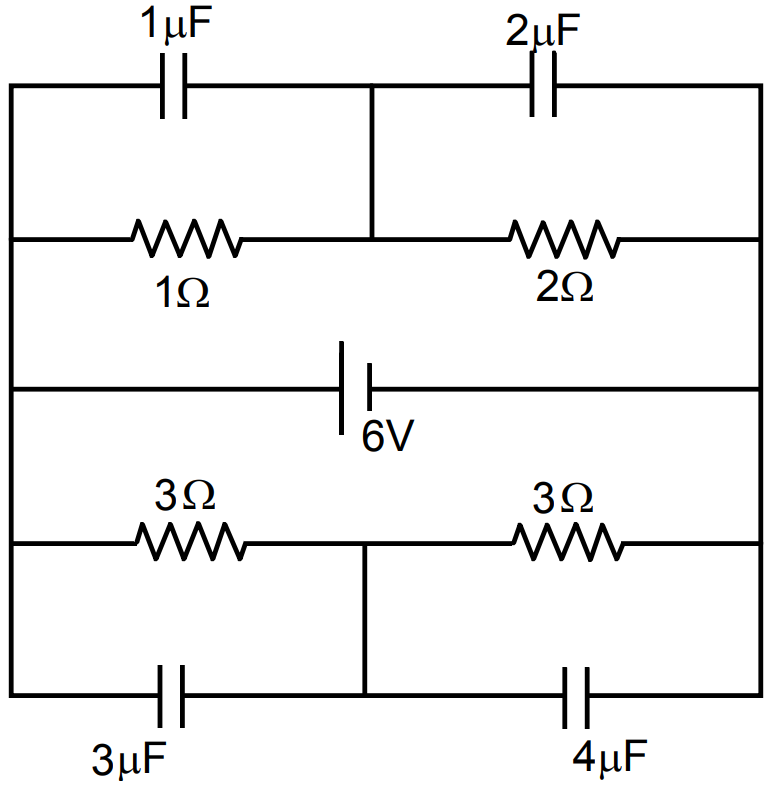
Find the charges on the four capacitors of capacitances $1\mu\text{F},2\mu\text{F},3\mu\text{F}$ and $4\mu\text{F}$ shown in the figure.
AnswerAt steady state no current flows through the capacitor. 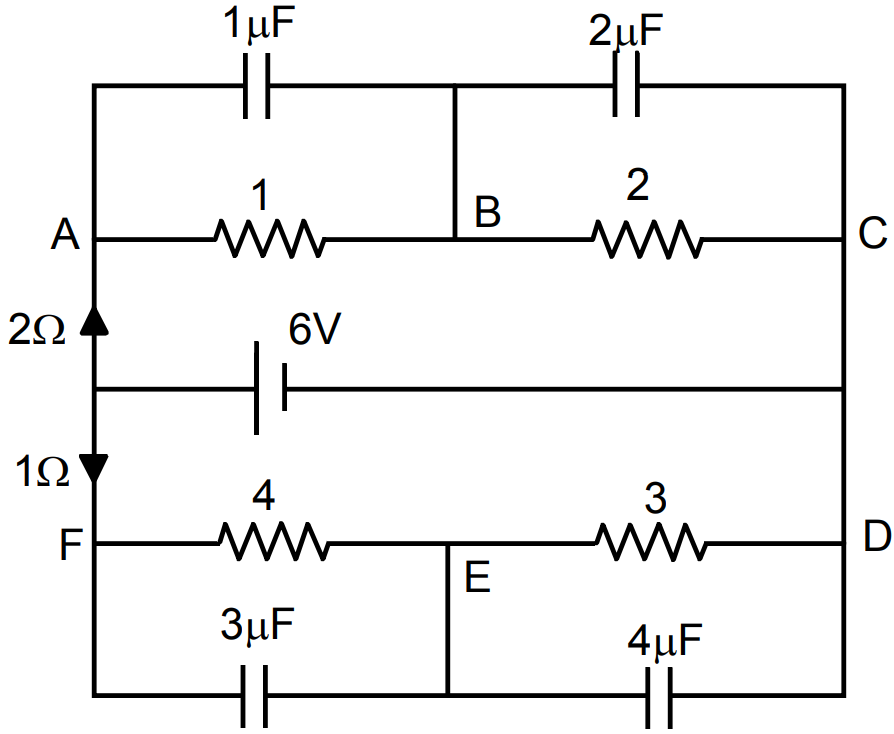 $\text{R}_\text{eq}=\frac{3\times6}{3+6}=2\Omega$
$\text{i}=\frac{6}{2}=3$
Since current is divided in the inverse ratio of the resistance in each branch, thus $2\Omega$ will pass through $1,2\Omega$ branch and 1 through $3,3\Omega$ branch$\text{V}_\text{AB}=2\times1=2\text{V}$
Q on $1\mu\text{F}$ capacitor $=2\times1\mu\text{c}=2\mu\text{C}$$\text{V}_\text{BC}=2\times2=4\text{V}$
Q on $2\mu\text{F}$ capacitor $=4\times2\mu\text{c}=8\mu\text{C}$$\text{V}_\text{DE}=1\times3=2\text{V}$
Q on $4\mu\text{F}$ capacitor $\text{V}_\text{FE}=3\times1=\text{V}$
Q across $3\mu\text{F}$ capacitor $=3\times3\mu\text{c}=9\mu\text{C}.$ View full question & answer→Question 395 Marks
Find the equivalent resistance of the circuits shown in the figure. between the points a and b. Each resistor has resistance r.
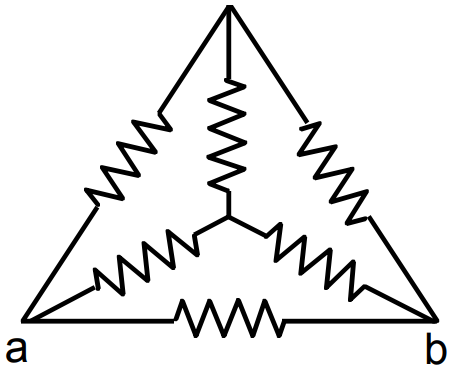
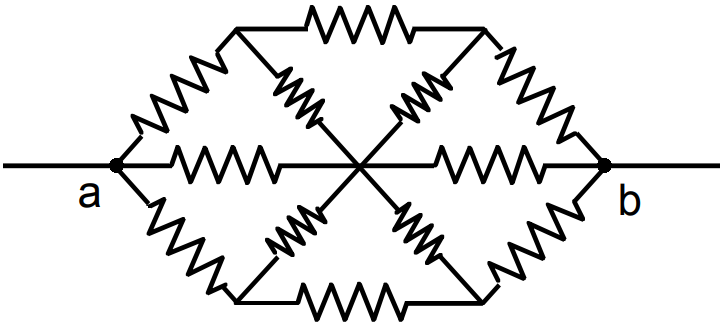
Answer
- $\text{R}_\text{eff}=\frac{\Big(\frac{2\text{r}}{2}\Big)\times\text{r}}{\Big(\frac{2\text{r}}{2}\Big)+\text{r}}$
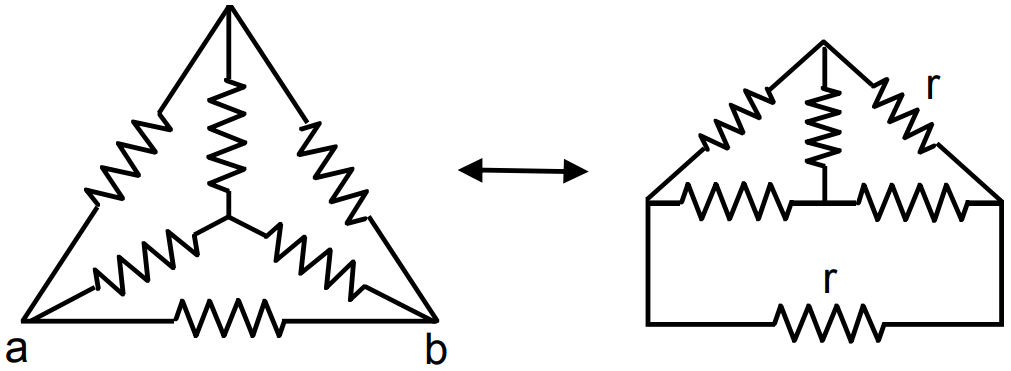
$=\frac{\text{r}^2}{2\text{r}}=\frac{\text{r}}{2}$
- At 0 current coming to the junction is current going from BO = Current going along OE.
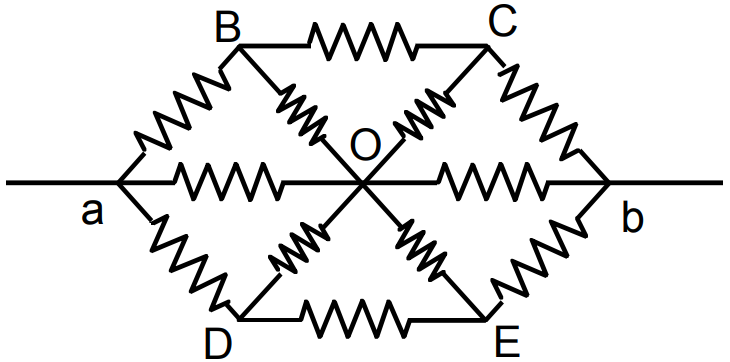
Current on CO = Current on OD
Thus it can be assumed that current coming in OC goes in OB.
Thus the figure becomes
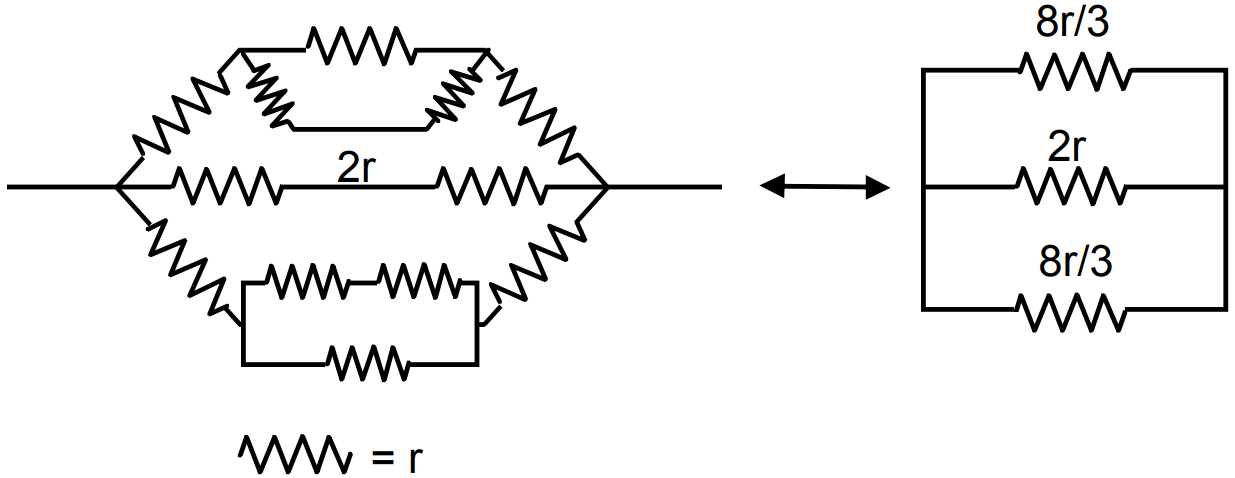
$\Bigg[\text{r}+\Big(\frac{2\text{r}\times\text{r}}{3\text{r}}\Big)+\text{r}\Bigg]=2\text{r}+\frac{2\text{r}}{3}=\frac{8\text{r}}{3}$
$\text{R}_\text{eff}=\frac{\Big(\frac{8\text{r}}{6}\Big)\times2\text{r}}{\Big(\frac{8\text{r}}{6}\Big)+2\text{r}}=\frac{\frac{8\text{r}^2}{3}}{\frac{20\text{r}}{6}}=\frac{8\text{r}^2}{3}\times\frac{6}{20}=\frac{8\text{r}}{10}=4\text{r}.$ View full question & answer→Question 405 Marks
A capacitor of capacitance C is given a charge Q. At t = 0, it is connected to an uncharged capacitor of equal capacitance through a resistance R. Find the charge on the second capacitor as a function of time.
AnswerLet after time t charge on plate B is +Q. 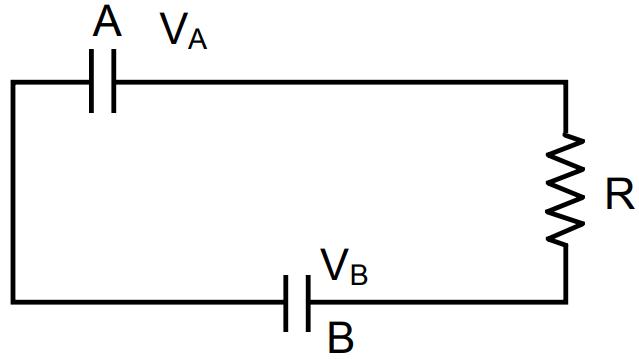 Hence charge on plate A is Q - q.$\text{V}_\text{A}=\frac{\text{Q}-\text{q}}{\text{C}},\text{V}_\text{B}=\frac{\text{q}}{\text{C}}$
$\text{V}_\text{A}-\text{V}_\text{B}=\frac{\text{Q}-\text{q}}{\text{C}}-\frac{\text{q}}{\text{C}}=\frac{\text{Q}-2\text{q}}{\text{C}}$
Current $=\frac{\text{V}_\text{A}-\text{V}_\text{B}}{\text{R}}=\frac{\text{Q}-2\text{q}}{\text{CR}}$ Current $=\frac{\text{dq}}{\text{dt}}=\frac{\text{Q}-2\text{q}}{\text{CR}}$$\Rightarrow\frac{\text{dq}}{\text{q}-2\text{q}}=\frac{1}{\text{RC}}\cdot\text{dt}$
$\Rightarrow\int\limits^\text{q}_0\frac{\text{dq}}{\text{Q}-2\text{q}}=\frac{1}{\text{RC}}\cdot\int\limits^\text{t}_0\text{dt}$
$\Rightarrow-\frac{1}{2}\big[\text{In}(\text{Q}-2\text{q})-\text{InQ}\big]=\frac{1}{\text{RC}}\cdot\text{t}$
$\Rightarrow\text{In}\frac{\text{Q}-2\text{q}}{\text{Q}}=\frac{-2}{\text{RC}}\cdot\text{t}$
$\Rightarrow\text{Q}-2\text{q}=\text{Q e}^\frac{-2\text{t}}{\text{RC}}$
$\Rightarrow2\text{q}=\text{Q}\Big(1-\text{e}^\frac{-2\text{t}}{\text{RC}}\Big)$
$\Rightarrow\text{q}=\frac{\text{Q}}{2}\Big(1-\text{e}^\frac{-2\text{t}}{\text{RC}}\Big).$ View full question & answer→Question 415 Marks
The resistance of an iron wire and a copper wire at 20°C are $3.9\Omega$ and $4.1\Omega,$ respectively. At what temperature will the resistance be equal? Temperature coefficient of resistivity for iron is $5.0\times10^{-3}\text{K}^{-1}$ and for copper, it is $4.0\times10^{-3}\text{K}^{-1}.$ Neglect any thermal expansion.
Answer$\text{R}'_\text{Fe}=\text{R}_\text{Fe}(1+\alpha_\text{Fe}\Delta\theta),\text{R}'_\text{Cu}=\text{R}_\text{Cu}(1+\alpha_\text{Cu}\Delta\theta)$$\text{R}'_\text{Fe}=\text{R}'_\text{Cu}$
$\Rightarrow\text{R}_\text{Fe}(1+\alpha_\text{Fe}\Delta\theta),=\text{R}_\text{Cu}(1+\alpha_\text{Cu}\Delta\theta)$
$\Rightarrow3.9\big[1+5\times10^{-3}(20-\theta)\big]$ $=4.1\big[1+4\times10^{-3}(20-\theta)\big]$
$\Rightarrow3.9+3.9\times5\times10^{-3}(20-\theta)$ $=4.1+4.1\times4\times10^{-3}(20-\theta)$
$\Rightarrow4.1\times4\times10^{-3}(20-\theta)\\-3.9\times5\times10^{-3}(20-\theta)=3.9-4.1$
$\Rightarrow16.4(20-\theta)-19.5(20-\theta)=0.2\times10^3$
$\Rightarrow(20-\theta)(-3.1)=0.2\times10^3$
$\Rightarrow\theta-20=200$
$\Rightarrow\theta=220^\circ\text{C}.$
View full question & answer→Question 425 Marks
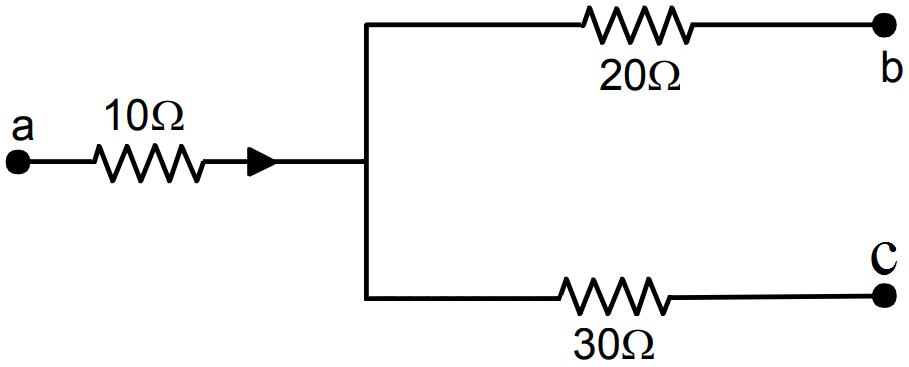
Figure. showa a part of an electric circuit. The potentials at the point a, b and c are 30V, 12V and 2V respectively. Find the currents through the three resistors.
AnswerLet potential at the point be xV 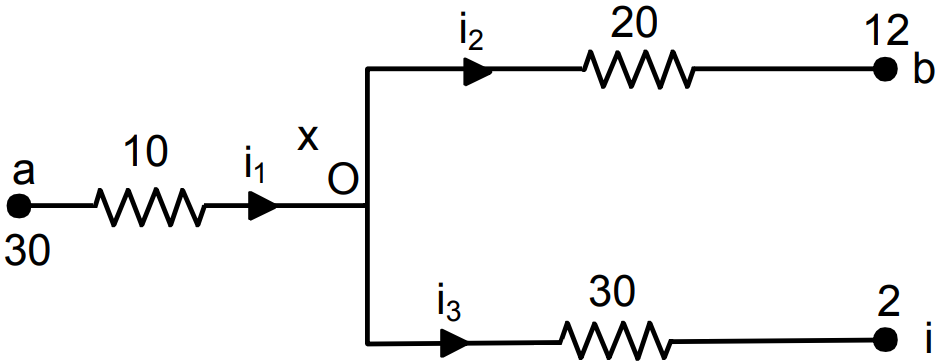 $(30-\text{x})=10\text{i}_1$
$(\text{x}-12)=20\text{i}_2$
$(\text{x}-2)=30\text{i}_3$
$\text{i}_1=\text{i}_2+\text{i}_3$
$\Rightarrow\frac{30-\text{x}}{10}=\frac{\text{x}-12}{20}+\frac{\text{x}-2}{30}$
$\Rightarrow30-\text{x}=\frac{\text{x}-12}{2}+\frac{\text{x}-2}{3}$
$\Rightarrow30-\text{x}=\frac{3\text{x}-36+2\text{x}-4}{6}$
$\Rightarrow180-6\text{x}=5\text{x}-40$
$\Rightarrow11\text{x}=220\Rightarrow\text{x}=\frac{220}{11}=20\text{V}$
$\text{i}_1=\frac{30-20}{10}=1\text{A}$
$\text{i}_2=\frac{20-12}{20}=0.4\text{A}$
$\text{i}_3=\frac{20-2}{30}=\frac{6}{10}=0.6\text{A}$ View full question & answer→Question 435 Marks
A parallel-plate capacitor has plate area $20cm^2$, plate separation 1.0mm and a dielectric slab of dielectric constant 5.0 filling up the space between the plates. This capacitor is joined to a battery of emf 6.0V through a $100\text{k}\Omega$ resistor. Find the energy of the capacitor $8.9\mu\text{s}$ after the connections are made.
Answer$\text{A} = 20\text{cm}^2, \text{d} = 1\text{mm, K} = 5, \text{e} = 6\text{V}$$\text{R}=100\times10^3\Omega,\text{t}=8.9\times10^{-5}\text{s}$
$\text{C}=\frac{\text{KE}_0\text{A}}{\text{d}}=\frac{5\times8.85\times10^{-12}\times20\times10^{-4}}{1\times10^{-3}}$
$=\frac{10\times8.85\times10^{-3}\times10^{-12}}{10^{-3}}=88.5\times10^{-12}$
$\text{q}=\text{EC}\Big(1-\text{e}^{\frac{-\text{t}}{\text{RC}}}\Big)$
$=6\times88.5\times10^{-12}\Big(1-\text{e}^{\frac{-89\times10^{-6}}{88.5\times10^{-12}\times10^4}}\Big)=530.97$
Energy $=\frac{1}{2}\times\frac{500.97\times530}{88.5\times10^{-12}}$
$=\frac{530.97\times530.97}{88.5\times2}\times10^{12}$
View full question & answer→Question 445 Marks
A capacitor of capacitance $12.0\mu\text{F}$ is connected to a battery of emf 6.00V and internal resistance $1.00\Omega$ through resistanceless leads. $12.0\mu\text{s}$ after the connections are made, what will be (a) the current in the circuit (b) the power delivered by the battery (c) the power dissipated in heat and (d) the rate at which the energy stored in the capacitor is increasing.
Answer
- $\text{C} = 12.0 \mu\text{F} = 12 \times 10^{-6}$
$\text{emf} = 6.00 \text{V, R} = 1\Omega$
$\text{t} = 12 \mu\text{c}, \text{ i} = \text{i}_0 \text{e}^{\frac{-\text{t}}{\text{RC}}}$
$=\frac{\text{CV}}{\text{T}}\times\text{e}^\frac{-\text{t}}{\text{RC}}=\frac{12\times10^{-6}\times6}{12\times10^{-6}}\times\text{e}^{-1}$
$=2.207=2.1\text{A}$
- Power delivered by battery
We known, $\text{V}=\text{V}_0\text{e}^{\frac{-\text{t}}{\text{RC}}}$ (where V and $V_0$ are potential VI)
$\text{VI}=\text{V}_0\text{I}\text{e}^{\frac{-\text{t}}{\text{RC}}}$
$\Rightarrow\text{VI}=\text{V}_0\text{I}\times\text{e}^{-1}=6\times6\times\text{e}^{-1}=13.24\text{W}$
- $\text{U}=\frac{\text{CV}^2}{\text{T}}\Big(\text{e}^{\frac{-\text{t}}{\text{RC}}}\Big)^2$ $\Big[\frac{\text{CV}^2}{\text{T}}$ = energy drawing per unit time$\Big]$
$=\frac{12\times10^{-6}\times36}{12\times10^{-6}}\times\big(\text{e}^{-1}\big)^2=4.872.$ View full question & answer→Question 455 Marks
Figure. shows a conductor of length l with a circular cross-section. The radius of the cross-section varies linearly from a to b. The resistivity of the material is ρ. Assuming that b - a << l, find the resistance of the conductor.
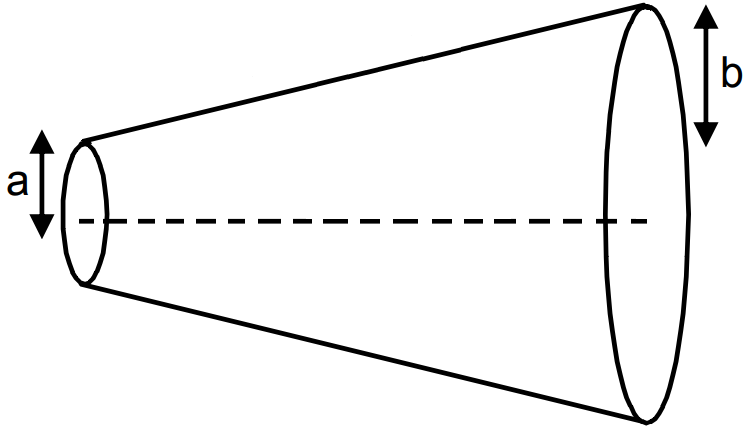
AnswerdR, due to the small strip dx at a distanc $\text{x d}=\text{R}=\frac{\text{fdx}}{\pi\text{y}^2}\ ...(1)$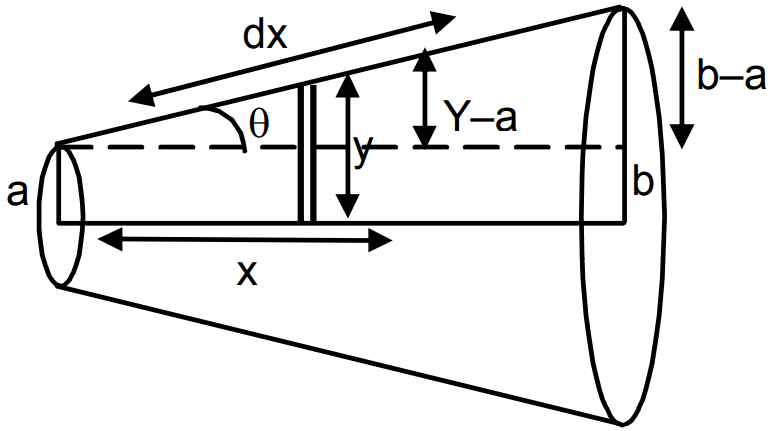
$\tan\theta=\frac{\text{y}-\text{a}}{\text{x}}=\frac{\text{b}-\text{a}}{\text{L}}$
$\Rightarrow\frac{\text{y}-\text{a}}{\text{x}}=\frac{\text{b}-\text{a}}{\text{L}}$
$\Rightarrow\text{L}(\text{y}-\text{a})=\text{x}(\text{b}-\text{a})$
$\Rightarrow\text{Ly}-\text{La}=\text{xb}-\text{xa}$
$\Rightarrow\text{L}\frac{\text{dy}}{\text{dx}}-0=\text{b}-\text{a}\ (\text{diff. w.r.t.x})$
$\Rightarrow\text{L}\frac{\text{dy}}{\text{dx}}=\text{b}-\text{a}$
$\Rightarrow\text{dx}=\frac{\text{Ldy}}{\text{b}-\text{a}}\ ...(2)$
Putting the value of dx in equation (1)$\text{dR}=\frac{\text{fLdy}}{\pi\text{y}^2(\text{b}-\text{a})}$
$\Rightarrow\text{dR}=\frac{\text{fl}}{\pi(\text{b}-\text{a})}\frac{\text{dy}}{\text{y}^2}$
$\Rightarrow\int\limits^\text{R}_0\text{dR}=\frac{\text{fl}}{\pi(\text{b}-\text{a})}\int\limits^\text{b}_\text{a}\frac{\text{dy}}{\text{y}^2}$
$\Rightarrow\text{R}=\frac{\text{fl}}{\pi(\text{b}-\text{a})}\frac{(\text{b}-\text{a})}{\text{ab}}=\frac{\text{fl}}{\pi\text{ab}}.$ View full question & answer→Question 465 Marks
A capacitor of capacitance $10\mu\text{F}$ is connected to a battery of emf 2V. It is found that it takes 50ms for the charge of the capacitor to become $12.6\mu\text{C}.$ Find the resistance of the circuit.
Answer$\text{C}=10\mu\text{F}=10^{-5}\text{F},\text{emf}=2\text{V}$$\text{t}=50\text{ms}=5\times10^{-2}\text{s, q}=\text{Q}\Big(1-\text{e}^{\frac{-\text{t}}{\text{RC}}}\Big)$
$\text{Q}=\text{CV}=10^{-5}\times2$
$\text{q}=12.6\times10^{-6}\text{F}$
$\Rightarrow12.6\times10^{-6}=2\times10^{-5}\Big(1-\text{e}^{\frac{-5\times10^{-2}}{\text{R}\times10^{-5}}}\Big)$
$\Rightarrow\frac{12.6\times10^{-6}}{2\times10^{-5}}=1-\text{e}^{\frac{-5\times10^{-2}}{\text{R}\times10^{-5}}}$
$\Rightarrow1-0.63=\text{e}^{\frac{-5\times10^3}{\text{R}}}$
$\Rightarrow\frac{-5000}{\text{R}}=\text{In}\ 0.37$
$\Rightarrow\text{R}=\frac{5000}{0.9942}$
$=5028\Omega=5.028\times10^3\Omega=5\text{K}\Omega.$
View full question & answer→Question 475 Marks
A current of $1.0A$ exists in a copper wire of cross-section $1.0mm^2$. Assuming one free electron per atom, calculate the drift speed of the free electrons in the wire. The density of copper is $9000kg/m^{-3}$.
Answer$\text{i} = 1\text{A, A} = 1\text{mm}^2 = 1 \times 10^{-6}\text{m}^2$$\text{f' cu} = 9000\text{kg/m}^3$
Molecular mass has $N_0$ atoms
= mKg has ($N_0/M × m$) atoms $=\frac{\text{N}_0\text{Al}9000}{63.5\times10^{-3}}$
No.of atoms = No.of electrons
$\text{n}=\frac{\text{No. of electrons}}{\text{Unit volume}}=\frac{\text{N}_0\text{Af}}{\text{mAl}}=\frac{\text{N}_0\text{f}}{\text{M}}$
$=\frac{6\times10^{23}\times9000}{63.5\times10^{-3}}$
$\text{i}=\text{V}_\text{d}\text{n Ae}.$
$\Rightarrow\text{V}_\text{d}=\frac{\text{i}}{\text{nAe}}=\frac{1}{\frac{6\times10^{23}\times9000}{63.5\times10^{-3}}\times10^{-6}\times1.6\times10^{-19}}$
$=\frac{63.5\times10^{-3}}{6\times10^{23}\times9000\times10^{-6}\times1.6\times10^{-19}}$
$=\frac{63.5\times10^{-3}}{6\times9\times1.6\times10^{26}\times10^{-19}\times10^{-6}}$
$=\frac{63.5\times10^{-3}}{6\times9\times1.6\times10}=\frac{63.5\times10^{-3}}{6\times9\times16}$
$=0.074\times10^{-3}\text{m/s}=0.074\text{mm/ s}.$
View full question & answer→Question 485 Marks
A capacitor of capacitance C is connected to a battery of emf $\in$ at t = 0 through a resistance R. Find the maximum rate at which energy is stored in the capacitor. When does the rate have this maximum value?
AnswerLet at any time $\text{t},\text{q}=\text{EC}\Big(1-\text{e}^{\frac{-\text{t}}{\text{CR}}}\Big)$ E = Energy stored $=\frac{\text{q}^2}{2\text{c}}=\frac{\text{E}^2\text{C}^2}{2\text{c}}\Big(1-\text{e}^{\frac{-\text{t}}{\text{CR}}}\Big)^2=^{\frac{\text{E}^2\text{C}}{2}}\Big(1-\text{e}^{\frac{-\text{t}}{\text{CR}}}\Big)^2$ R = rate of energy stored $=\frac{\text{q}^2}{2\text{c}}=\frac{-\text{E}^2\text{C}}{2}\Big(\frac{-1}{\text{RC}}\Big)^2\Big(1-\text{e}^{\frac{-\text{t}}{\text{RC}}}\Big)\text{e}^{\frac{-\text{t}}{\text{RC}}}$ $=\frac{\text{E}^2}{\text{CR}}\cdot\text{e}^{\frac{-\text{t}}{\text{RC}}}\Big(1-\text{e}^{\frac{-\text{t}}{\text{CR}}}\Big)$$\frac{\text{dR}}{\text{dt}}=\frac{\text{E}^2}{2\text{R}}\bigg[\frac{-1}{\text{RC}}\text{e}^{\frac{-\text{t}}{\text{CR}}}.\big(1-\text{e}^{\frac{-\text{t}}{\text{CR}}}\Big)+(-)\cdot\text{e}^{\frac{-\text{t}}{\text{CR}(1-/\text{RC})}}\cdot\text{e}^{\frac{-\text{t}}{\text{CR}}}\bigg]$
$\frac{\text{E}^2}{2\text{R}}=\bigg(\frac{-\text{e}^{\frac{-\text{t}}{\text{CR}}}}{\text{RC}}+\frac{\text{e}^{\frac{-2\text{t}}{\text{CR}}}}{\text{RC}}+\frac{1}{\text{RC}}\cdot\text{e}^{\frac{-2\text{t}}{\text{CR}}}\bigg)$ $=\frac{\text{E}^2}{2\text{R}}\bigg(\frac{2}{\text{RC}}\cdot\text{e}^{\frac{-2\text{t}}{\text{CR}}}-\frac{\text{e}^{\frac{-\text{t}}{\text{CR}}}}{\text{RC}}\bigg)\ ...(1)$
For $\text{R}_\text{max}\frac{\text{dR}}{\text{dt}}=0$$\Rightarrow2.\text{e}^{\frac{-\text{t}}{\text{RC}}}-1=0\Rightarrow\text{e}^{\frac{-\text{t}}{\text{CR}}}=\frac{1}{2}$
$\Rightarrow\frac{\text{t}}{\text{RC}}=-\text{In}^2\Rightarrow\text{t}=\text{RC In}2$
$\therefore$ Putting t = RC ln 2 in equation (1) We get $\frac{\text{dR}}{\text{dt}}=\frac{\text{E}^2}{4\text{R}}.$
View full question & answer→Question 495 Marks
Consider the circuit shown in the figure. Find (a) the current in the circuit (b) the potential drop across the $5\Omega$ resistor (c) the potential drop across the $10\Omega$ resistor. (d) Answer the parts (a), (b) and (c) with reference to the figure.
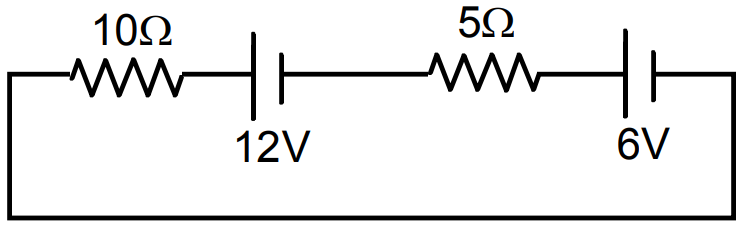
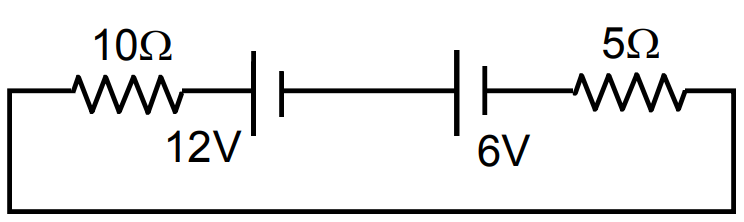
Answer
- Applying Kirchoff’s law,
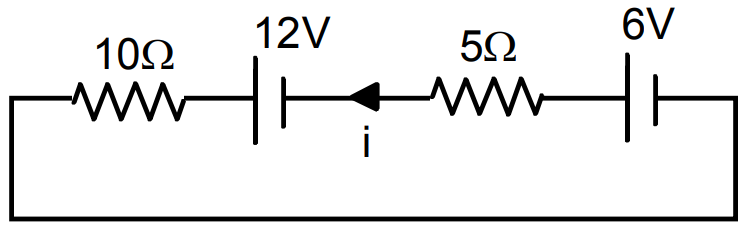
$10\text{i}-6+5\text{i}-12=0$
$\Rightarrow10\text{i}+5\text{i}=18$
$\Rightarrow15\text{i}=18$
$\Rightarrow\text{i}=\frac{18}{15}=\frac{6}{5}=1.2\text{A}.$
- Potential drop across $5\Omega$ resistor,
$\text{i}5=1.2\times5\text{V}=6\text{V}$
- Potential drop across $10\Omega$ resistor
$\text{i}10=1.2\times10\text{V}=12\text{V}$
- $10\text{i}-6+5\text{i}-12=0$
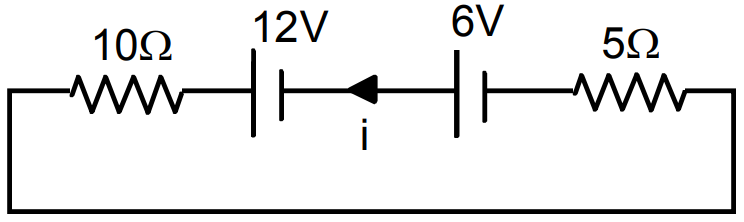
$\Rightarrow10\text{i}+5\text{i}=18$
$15\text{i}=18$
$\Rightarrow\text{i}=\frac{18}{15}=\frac{6}{5}=1.2\text{A}.$
Potential drop across $5\Omega$ resistor = 6V
Potential drop across $10\Omega$ resistor = 12V. View full question & answer→Question 505 Marks
An infinite ladder is constructed with $1\Omega$ and $2\Omega$ resistors, as shown in the figure. (a) Find the effective resistance between the points A and B. (b) Find the current that passes through the $2\Omega$ resistor nearest to the battery.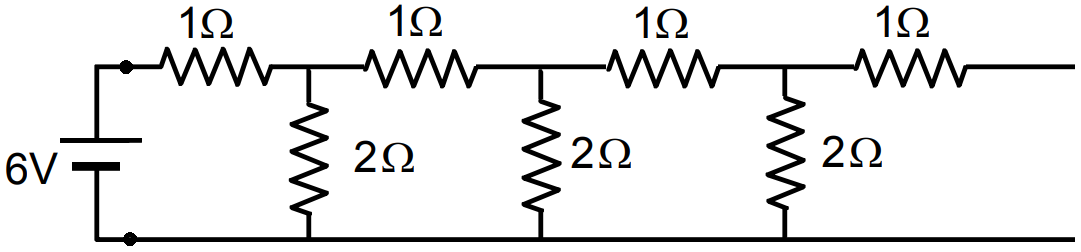
Answer
- Let the equation resistance of the combination be R.
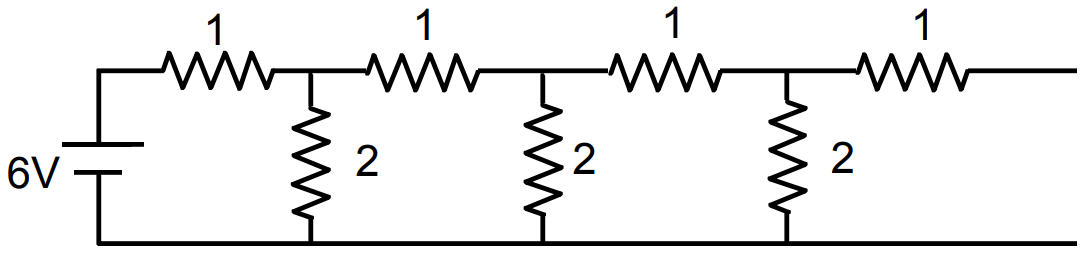
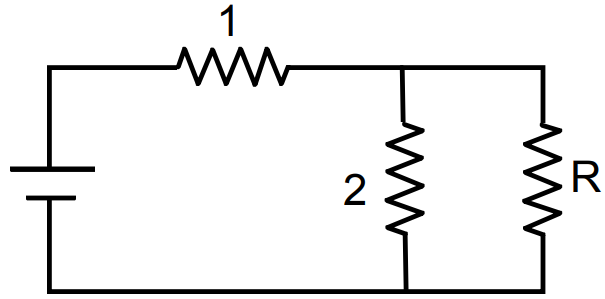
$\Big(\frac{2\text{R}}{\text{R}+2}\Big)+1=\text{R}$
$\Rightarrow\frac{2\text{R}+\text{R}+2}{\text{R}+2}=\text{R}\Rightarrow3\text{R}+2=\text{R}^2+2\text{R}$
$\Rightarrow\text{R}^2-\text{R}-2=0$
$\Rightarrow\text{R}=\frac{+1\pm\sqrt{1+4\times1\times2}}{2.1}$
$=\frac{1\pm\sqrt{9}}{2}=\frac{1\pm3}{2}=2\Omega.$
- Total current sent by battery $=\frac{6}{\text{R}_\text{eff}}=\frac{6}{2}=3$
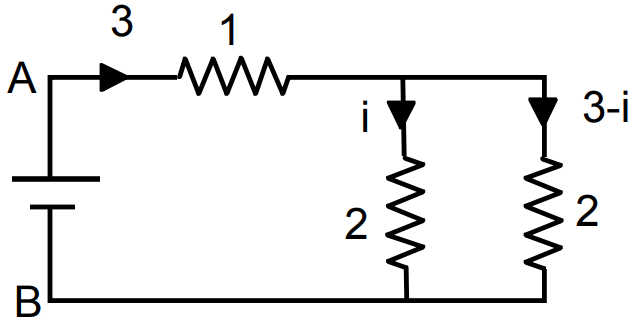
Potential between A and B
$3.1+2\text{i}=6$
$\Rightarrow3+2\text{i}=6\Rightarrow2\text{i}=3$
$\Rightarrow\text{i}=1.5\text{a}$ View full question & answer→