MCQ 511 Mark
A body thrown vertically up with a velocity $'u'$ reaches the maximum height $'h'$ after $'T'$ second. The correct statement among the following is:
- A
At a height $\frac{\text{h}}{2}$ from the ground its velocity is $\frac{\text{u}}{2}.$
- B
At a time $T$ its velocity is $'u'.$
- ✓
At a time $ '2T$' its velocity is $-u.$
- D
At a time $2T$ its velocity is $-6u.$
AnswerCorrect option: C. At a time $ '2T$' its velocity is $-u.$
$c. $ At a time $'2T'$ its velocity is $-u.$
Explanation:
Time taken by the body to reach the maximum height is given as $T$ and the velocity of the body at the time of throw is $u$ (upwards).
After further time $T,$ the body reaches to the ground having same velocity $u$ in the downward direction as that of initial velocity at the time of throw.
Thus, at the instant $2T,$ the velocity of the body is $−u$ (where minus sign represents the velocity to be in downward direction).
View full question & answer→MCQ 521 Mark
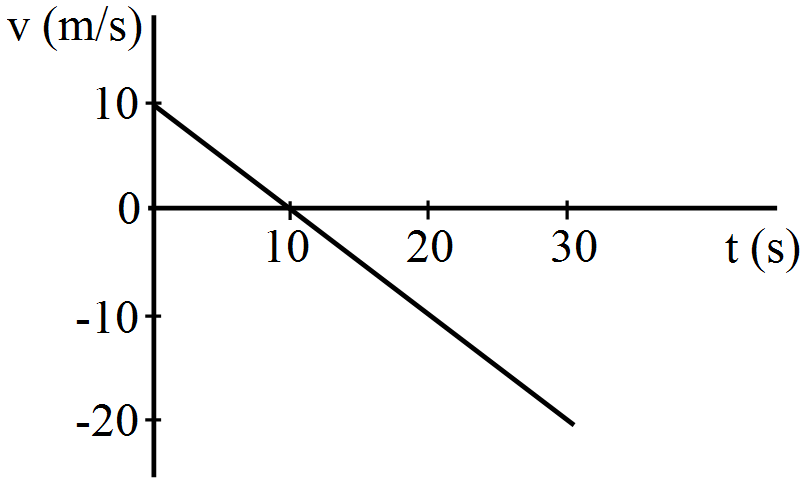
The velocity-time plot for a particle moving on a straight line is shown in the figure:
AnswerCorrect option: A. The particle has a constant acceleration.
$a.$ The particle has a constant acceleration.
$d.$ The average speed in the interval $0$ to $10\ s$ is the same as the average speed in the interval $10\ s$ to $20\ s.$
Explanation:
$a. $ The slope of the $v-t$ graph gives the acceleration. For the given graph, the slope is constant. So, acceleration is constant.
$b. $ From $0$ to $10$ seconds, velocity is in positive direction and then in negative direction. This means that the particle turns around at $t = 10s.$
$c. $ Area in the $ v-t$ curve gives the distance travelled by the particle.
Distance travelled in positive Direction $\neq$ Distance travelled in negative direction
$\therefore\text{Displacement}\neq\text{Zero}$
$d.$ The area of the v-tgraph from $t = 0s$ to $t = 10s$ is the same as that from $t = 10s$ to $t = 20s$.
So, the distance covered is the same. Hence, the average speed is the same.
View full question & answer→MCQ 531 Mark
Which of the following is the correct formula for average velocity?
- A
$\text{v}=\frac{\text{dx}}{\text{dt}}$
- ✓
$\text{v}=\frac{\text{x}}{\text{t}}$
- C
$\text{v}=\text{xt}$
- D
$\text{v}=\frac{\text{t}}{\text{x}}$
AnswerCorrect option: B. $\text{v}=\frac{\text{x}}{\text{t}}$
$b.$ $\text{v}=\frac{\text{x}}{\text{t}}$
Explanation:
The correct formula is $\text{v}=\frac{\text{x}}{\text{t}}.$ Average velocity is total change in displacement divided by total change in time. $\text{v}=\frac{\text{dx}}{\text{dt}}$ is the formula for instantaneous velocity.
View full question & answer→MCQ 541 Mark
Acceleration of a particle which is at rest at $x = 0 $ is $\vec{\text{a}}=(4-2\text{x})\hat{\text{i}}.$ Select the correct alternative(s):
- A
Maximum speed of the particle is $4$ units.
- ✓
Particle further comes to rest at $x = 4.$
- C
Particle oscillates about $x = 2.$
- D
Particle will continuously accelerate along the $x-$axis.
AnswerCorrect option: B. Particle further comes to rest at $x = 4.$
$b.$ Particle further comes to rest at $x = 4.$
$c.$ Particle oscillates about $x = 2.$
View full question & answer→MCQ 551 Mark
Mark the correct statements for a particle going on a straight line:
- A
If the velocity and acceleration have opposite sign, the object is slowing down.
- B
If the position and velocity have opposite sign, the particle is moving towards the origin.
- ✓
If the velocity is zero at an instant, the acceleration should also be zero at that instant.
- D
If the velocity is zero for a time interval, the acceleration is zero at any instant within the time interval.
AnswerCorrect option: C. If the velocity is zero at an instant, the acceleration should also be zero at that instant.
$a.$ If the velocity and acceleration have opposite sign, the object is slowing down.
$b.$ If the position and velocity have opposite sign, the particle is moving towards the origin.
$d.$ If the velocity is zero for a time interval, the acceleration is zero at any instant within the time interval.
Explanation:
$a.$ Acceleration is given by
$-\text{a}=\frac{\text{dv}}{\text{dt}}$
$-\text{a}<0$
$\Rightarrow\frac{\text{dv}}{\text{dt}}<0$
$\Rightarrow\text{V}_{\text{final}}<\text{V}_{\text{initial}}$
$b.$ If the position and velocity have opposite signs, the particle moves towards the origin. It can be explained by following figure:
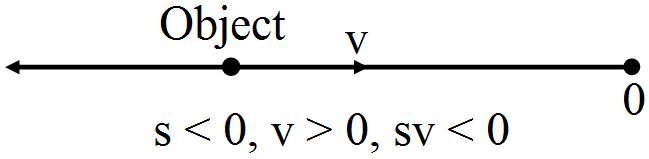
Object is moving toward the origin.
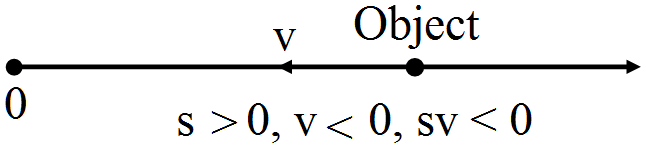
Object is moving toward the origin.
$c.$ If the velocity is zero in a certain time interval, then the change in the velocity in that time interval will also be zero. As acceleration is rate of change of velocity, it will also be zero at an instant in that time interval. View full question & answer→MCQ 561 Mark
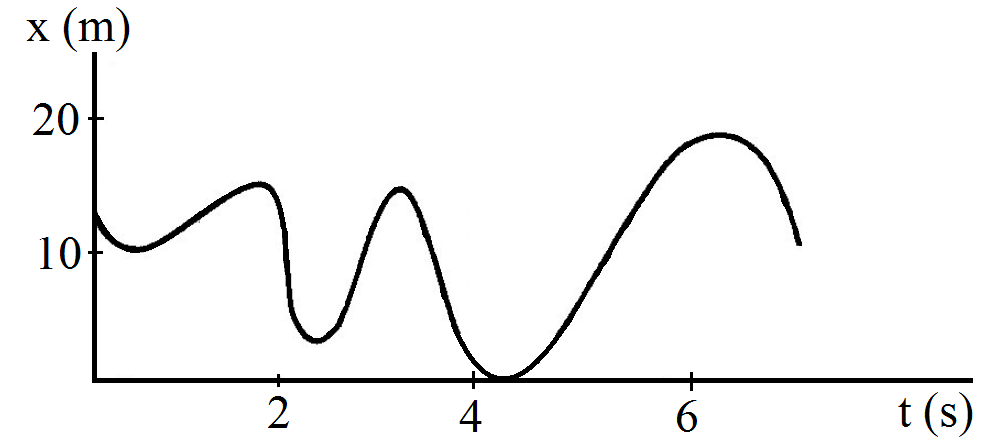
Figure shows the position of a particle moving on the $X-$axis as a function of time.
- ✓
The particle has come to rest $6$ times.
- B
The maximum speed is at $t = 6s.$
- C
The velocity remains positive for $t = 0$ to $t = 6s.$
- D
The average velocity for the total period shown is negative.
AnswerCorrect option: A. The particle has come to rest $6$ times.
$a.$ The particle has come to rest $6$ times.
Explanation:
$a.$ The slope of the x-tgraph gives the velocity. Here, 6 times the slope is zero. So, the particle has come to rest 6 times.
$b.$ As the slope is not maximum at $t = 6s,$ the maximum speed is not at $t = 6s.$
$c.$ As the slope is not positive from $t = 0s$ to $t = 6s,$ the velocity does not remain positive.
$d.$ Average velocity $\frac{\text{Total displacement}}{\text{Total time taken}}=\frac{\text{x final}-\text{x initial}}{\text{t}}$
For the shown time $(r = 6s),$ the displacement of the particle is positive. Therefore, the average velocity is positive.
View full question & answer→MCQ 571 Mark
A driver takes $0.20s$ to apply the brakes after he sees a need for it. This is called the reaction time of the driver. If he is driving a car at a speed of $54km/ h$ and the brakes causes a deceleration of $6.0 m/ s^2$, find the distance traveled by the car after he sees the need to put the brakes on.
- ✓
$18.63m$
- B
$20m$
- C
$26.85m$
- D
$27.67m$
AnswerCorrect option: A. $18.63m$
$a.\ 18.63m$
View full question & answer→MCQ 581 Mark
How does the displacement v/s time graph of a uniformly accelerated motion look like?
Answer$b.$ A parabola
Explanation:
Here we use the second equation of motion. $\text{s}=\text{ut}+\big(\frac{1}{2}\big)\text{at}^2.$ In a uniformly accelerated motion, the acceleration remains constant.
Therefore, the equation for displacement becomes the equation of a parabola.
View full question & answer→MCQ 591 Mark
Find the magnitude of constant acceleration (in $m/ s^2$) needed to allow a car to accelerate in a straight line from a speed of zero to a speed of $30\ m/ s$ in $5\ s:$
Answer$b.\ 6$
Explanation:
Here acceleration, $\text{a}=\frac{\text{dv}}{\text{dt}}=\frac{30-0}{5}=\text{6}\text{m}/\text{s}^2.$
View full question & answer→MCQ 601 Mark
The area under the velocity time graph between any two instants $t = t_1$ and $t = t_2$ gives the distance covered in a time $\Delta\text{t}=\text{t}_2-\text{t}_1:$
- A
Only if the particle moves with a uniform acceleration.
- B
Only if the particle moves with a uniform velocity.
- C
Only if the particle moves with an acceleration increasing at a uniform rate.
- ✓
In all cases irrespective of whether the motion is one of uniform velocity, or of uniform acceleration or of variable acceleration.
AnswerCorrect option: D. In all cases irrespective of whether the motion is one of uniform velocity, or of uniform acceleration or of variable acceleration.
$d.$ In all cases irrespective of whether the motion is one of uniform velocity, or of uniform acceleration or of variable acceleration.
View full question & answer→MCQ 611 Mark
In a uniformly accelerated motion, the speed varies from $0$ to $20m/ s$ in $4s.$ What is the average speed during the motion?
- ✓
$10m/ s$
- B
$20m/ s$
- C
$0m/ s$
- D
$15m/ s$
AnswerCorrect option: A. $10m/ s$
$a. \ 10m/ s$
Explanation:
From first equation of motion we have, $v = u + at,$ which implies that $a = 5\ m/s^2$.
From second equation of motion we have $\text{s}=\text{ut}+\big(\frac{1}{2}\big)\text{at}^2,$ which implies that
$s = 40m.$
Average speed $=\frac{\text{s}}{\text{t}}=\frac{40}{4}=10\text{m}/\ \text{s}.$
View full question & answer→MCQ 621 Mark
If a car at rest accelerates uniformly to a speed of $144\ km/ h$ in $20s$, it covers a distance of:
- ✓
$400m$
- B
$1440\ m$
- C
$2880\ m$
- D
AnswerCorrect option: A. $400m$
$a.\ 400m$
View full question & answer→MCQ 631 Mark
Free $^{238}U$ nuclei kept in a train emit alpha particles. When the train is stationary and a uranium nucleus decays, a passenger measures that the separation between the alpha particles and the recoiling nucleus becomes $x,$ in t time after the decay. If a decay takes places, when the train is moving at a uniform speed $v$, the distance between the alpha particle and the recoiling nucleus at a time $t$ after the decay, as measured by the passenger will be:
- A
$x + vt$
- B
$x − vt$
- ✓
$x$
- D
Depends on the directions of the train
Answer$c.\ x$
Explanation:
Train is moving with constant velocity $v.$
There won't be any relative velocity change between alpha particle and uranium.
Hence, the distance will still be $x.$
View full question & answer→MCQ 641 Mark
In which coordinate system do we use distance from origin and to angles to define the position of a point in space?
Answer$c.$ Spherical
Explanation:
In Spherical system, distance from the center, the angle with the $X$ axis, and the angle with the $Z$ axis are used to define the position of a point. These are respectively represented by $R,$ $\theta$ and $\phi.$
View full question & answer→MCQ 651 Mark
Two cars OF SAME LENGTH move in the same direction along parallel roads. One of them is a $100\ m$ long travelling with a velocity of $7.5\ ms^{−1}.$ How long will it take for the first car to overtake the second car?
View full question & answer→MCQ 661 Mark
What kind of motion is rectilinear motion?
AnswerRectilinear motion happens along a straight line.
A straight line is one dimensional.
Hence, rectilinear motion is one dimensional.
View full question & answer→MCQ 671 Mark
A particle moves along the $X-$axis as $x = u(t - 2s) + a(t - 2s)^2$.
- A
The initial velocity of the particle is $u.$
- B
The acceleration of the particle is $a.$
- ✓
The acceleration of the particle is $2a.$
- D
At $t = 3s$ particle is at the origin.
AnswerCorrect option: C. The acceleration of the particle is $2a.$
$c. $ The acceleration of the particle is $2a..$
Explanation:
Initial velocity $=\Big|\frac{\text{dx}}{\text{dt}}\Big|_{\text{t} = 0}$
$\frac{\text{dx}}{\text{dt}}=\text{u}+2\text{a}(\text{t}-2\text{s})$
$\Big|\frac{\text{dx}}{\text{dt}}\Big|_{\text{t}=0}=\text{u}-4\text{as}\neq\text{u}$
Acceleration $=\frac{\text{d}^2\text{x}}{\text{dt}^2}=2\text{a}$
At $t = 2s,$
$x = u(2s - 2s) + a(2s - 2s)^2 = 0 \ (origin)$
View full question & answer→MCQ 681 Mark
The rate of change of velocity of an object with respect to time is called ..........
Answer$c.$ Acceleration
Explanation:
Acceleration is the rate of change of the velocity of an object with respect to time. Accelerations are vector quantities.
The orientation of an object's acceleration is given by the orientation of the net force acting on that object.
acceleration $\frac{\text{Change in the velociity}}{\text{time}}$
View full question & answer→MCQ 691 Mark
Mark the correct statements:
- ✓
The magnitude of the velocity of a particle is equal to its speed.
- B
The magnitude of average velocity in an interval is equal to its average speed in that interval
- C
It is possible to have a situation in which the speed of a particle is always zero but the average speed is not zero.
- D
It is possible to have a situation in which the speed of the particle is never zero but the average speed in an interval is zero.
AnswerCorrect option: A. The magnitude of the velocity of a particle is equal to its speed.
$a.$ The magnitude of the velocity of a particle is equal to its speed.
Explanation:
$a.$ Velocity being a vector quantity has magnitude as well as direction, and magnitude of velocity is called speed.
$b.$ Average velocity $=\frac{\text{Total displacement}}{\text{Total time taken}}$
Average speed $=\frac{\text{Total distance travelled}}{\text{Total time taken}}$
$\text{Distance}\geq\text{Displacement}$
$\therefore\text{Average speed}\geq\text{Average velocity}$
The magnitude of average velocity in an interval is not always equal to its average speed in that interval.
$c.$ If speed is always zero, then the distance travelled is always zero. Hence, the total distance travelled and the average speed will be zero.
$d.$ If the speed of a particle is never zero, the distance travelled by the particle is never zero. Hence, the average speed will not be zero.
View full question & answer→MCQ 701 Mark
What happen to the instantaneous velocity in a non - uniformly accelerated motion?
- ✓
- B
- C
It varies as the acceleration
- D
Answer$a.$ It increases
Explanation:
The instantaneous velocity will increase with time. If the motion is accelerated, no matter if the acceleration is constant, or variable, the instantaneous velocity will increase. Variation of acceleration describes how to change in velocity is changing.
View full question & answer→MCQ 711 Mark
In case of a freely falling body, the ratio of kinetic energy at the end of the third second increase in kinetic energy in the next three seconds is:
- A
$1 : 1$
- B
$1 : 2$
- ✓
$1 : 3$
- D
$1 : 9$
AnswerCorrect option: C. $1 : 3$
$c.\ 1 : 3$
View full question & answer→MCQ 721 Mark
The coordinates of object with respect to a frame of reference at $t = 0$ are $(-1, 0, 3).$ If $t = 5\ s,$ its coordinates are $(-1, 0, 4),$ then the object is in:
AnswerCorrect option: A. Motion along $z-$axis.
$a.$ Motion along $z-$axis.
Explanation:
Given, at $t = 0\ s,$ position of an object is $(-1, 0, 3)$ and at $t = 5\ s,$ its coordinate is $(-1, 0, 4).$
So, there is no change in $x$ and $y-$coordinates, while $z-$coordinate changes from $3$ to $4.$ So, the object is in motion along $z-$axis.
View full question & answer→MCQ 731 Mark
Which of the following statements is true for a car moving on the road?
- A
With respect to the frame of reference attached to the ground, the car is at rest.
- ✓
With respect to the frame of reference attached to the person sitting in the car, the car is at rest.
- C
With respect to the frame of reference attached to the person outside the car, the car is at rest.
- D
AnswerCorrect option: B. With respect to the frame of reference attached to the person sitting in the car, the car is at rest.
For a car in motion, if we describe this event w.r.t. a frame of reference attached to the person sitting inside the car, the car will appear to be at rest as the person inside the car $($observer$)$ is also moving with same velocity and in the same direction as car.
View full question & answer→MCQ 741 Mark
The time after which they are closet to each other:
- A
$\frac{1}{3}\text{s}$
- B
$\frac{8}{3}\text{s}$
- C
$\frac{1}{5}\text{s}$
- ✓
$\frac{8}{5}\text{s}$
AnswerCorrect option: D. $\frac{8}{5}\text{s}$
$d. \frac{8}{5}\text{s}$
View full question & answer→MCQ 751 Mark
Which one of the following relations is true?
- A
Distance $>$ Displacement
- B
Distance $<$ Displacement
- ✓
Distance $>=$ Displacement
- D
Distance $<=$ Displacement
AnswerCorrect option: C. Distance $>=$ Displacement
$c.$ Distance $>=$ Displacement
Explanation:
Displacement is the shortest distance between two points. Hence displacement $ <=$ distance or vice versa. If the path followed is the path of shortest distance or displacement, then displacement $=$ distance.
View full question & answer→MCQ 761 Mark
When an object is accelerated:
- A
Its direction must be constant
- ✓
Its velocity is necessarily changing
- C
- D
Its speed is necessarily changing
AnswerCorrect option: B. Its velocity is necessarily changing
$b.$ Its velocity is necessarily changing
Explanation:
Acceleration is the time rate of change of velocity.
View full question & answer→MCQ 771 Mark
A stone is released with acceleration $'a'$ from an upwardy moving left. Find out the acceleration and direction of the stone.
- ✓
- B
$(g + a)$ in downward direction.
- C
$(g - a)$ in upward direction.
- D
$g$ in downward direction.
Answer$a.$ A in upward direction.
View full question & answer→MCQ 781 Mark
A man runs at a speed of $4.0\ m/ s$ to overtake a standing bus. When he is 6.0m behind the door $(at t = 0),$ then bus moves forward and continues with a constant acceleration of $1.2\ m/ s^2$. The man shall access the door at time t equal to:
- A
$5.2s$
- ✓
$4.3s$
- C
$2.3s$
- D
The man shall never gain the door
AnswerCorrect option: B. $4.3s$
$b. \ 4.3\ s$
Explanation:
Suppose the man gets the bus after time t from the start of the bus.
Then the man needs to cover the distance BY bus $+ 6$ meter to catch the Bus
so the distance by man, $XM = 4\times t$ should be equal to $6\text{m}+\frac{1}{2}\text{at}^2$ or $4t = 6 + 0.6t^2$on solving it we get $t = 4.38\ sec$
Just employ the Shridharchcarya Formula $\text{t}= \frac{-\text{b}\pm\sqrt{\text{b}^2-4\text{ac}}}{2\text{a}}$
Where $t$ is root of at$^2+ bt + c = 0$
View full question & answer→MCQ 791 Mark
The rate of change of velocity is:
MCQ 801 Mark
A body starts from rest and moves with uniform acceleration for $3\ s.$ It then decelerates uniformly for $2\ s.$ and stops. If the deceleration is $3 \ ms^{-2}$ the maximum velocity of the body is$. . . ms^{-1}$
Answer$c.\ 6$
Explanation:
Velocity will be maximum before the deceleration starts.
Given Final Velocity $v = 0,$ acceleration $a = −3ms^{-2}$ and time $t = 3s,$
Let maximum velocity is $u_{max}$,
Using $v = u + at$
$⇒ 0 = u_{max} −3 \times 2$
$⇒ u_{max} = 6ms^{-1}$
View full question & answer→MCQ 811 Mark
What is the rate of change of rate of change of displacement of a body?
AnswerThe rate of change of displacement of a body is velocity.
The rate of change of rate of displacement of a body, or rate of change of velocity is acceleration.
View full question & answer→MCQ 821 Mark
Velocity $-$ time graph of a body with uniform velocity is a straight line:
- ✓
Parallel to $x -$ axis
- B
Parallel to $y -$ axis
- C
Inclined to $x -$ axis
- D
Inclined to $y -$ axis
AnswerCorrect option: A. Parallel to $x -$ axis
Velocity $-$ time graph of an object moving with uniform velocity. The slope of a Velocity–time graph of an object moving in rectilinear motion with uniform velocity is straight line and parallel to $x -$ axis when velocity is taken along $y -$ axis and time is taken along $x -$ axis.
View full question & answer→MCQ 831 Mark
A stone is just released from the window of a moving train moving along a horizontal straight track. When observed by a person on the ground, the stone will hit the ground following a:
AnswerThe stone will follow the motion of a projectile, because:
It has a initial horizontal velocity, which is same as that of the train. it acquires a vertical component under the force of gravity.
Since it has a constant speed on horizontal direction and a constant acceleration in vertical direction, the trajectory is parabolic.
View full question & answer→MCQ 841 Mark
Which of the following types of motion can be used for describing the motion of a car on a straight road?
AnswerThe motion of a car on straight road is happening along a straight line. Hence the motion can be called rectilinear as rectilinear motion happens along a straight line. Rest all are non rectilinear motions.
View full question & answer→MCQ 851 Mark
The body will speed up if $.............$
- ✓
Velocity and acceleration are in same direction.
- B
Velocity and acceleration are in opposite direction.
- C
Velocity and acceleration are in perpendicular direction.
- D
AnswerCorrect option: A. Velocity and acceleration are in same direction.
A body will speed up if both velocity and acceleration are in same direction. If they are in opposite directions it results in slowing down the motion. And if they are perpendicular then there will be no effect on magnitude of velocity.
View full question & answer→MCQ 861 Mark
The velocity of a truck changes form $3\ m/ s$ to $5\ m/ s$ in $5\ s.$ What is the acceleration in $m/s^2$?
Answer$a.\ 0.4$
Explanation:
Acceleration is the rate of change of velocity. Here, the velocity changes form $3\ m/ s$ to $5\ m/ s$ in $5\ s.$
Hence, acceleration $=\frac{(5-3)}{5}=0.4\text{m}/\text{s}^2.$
View full question & answer→MCQ 871 Mark
Which of the following can be used to describe how fast an object is moving along with the direction of motion at a given instant of time?
AnswerInstantaneous velocity describes the velocity of an object at a given time instant.
Average speed is the speed at which the object travels throughout the time period and not an instant.
Speed is a scalar quantity; hence it cannot show the direction of motion.
View full question & answer→MCQ 881 Mark
- A
Varying speed without having varying velocity.
- B
Varying velocity without having varying speed.
- C
Nonzero acceleration without having varying speed.
- ✓
$B$ and $C$
AnswerCorrect option: D. $B$ and $C$
Velocity and acceleration are vector quantities that can be changed by changing direction only $($keeping magnitude constant$).$
View full question & answer→MCQ 891 Mark
Two stones are dropped down simultaneously from different heights. At the starting time, the distance between them is $30\ cm.$ After $1\ s,$ the distance between the two stones will be $(g = 10\ ms^{-2}).$
- A
$10\ cm$
- B
$20\ cm$
- ✓
$30\ cm$
- D
$0\ cm$
AnswerCorrect option: C. $30\ cm$
$c. 10\ cm$
Explanation:
After $2\ s$ or any difference in seconds, separation will be $30\ cm$ only as both bodies covers same distance for same time interval under gravity.
View full question & answer→MCQ 901 Mark
A particle of mass $'m'$ moving with a velocity $v$ strikes a stationary particle of mass $2m$ and sticks to it. The speed of the system will be:
- A
$\frac{\text{v}}{2}$
- B
$2\text{v}$
- ✓
$\frac{\text{v}}{3}$
- D
$3\text{v}$
AnswerCorrect option: C. $\frac{\text{v}}{3}$
$c.\ \frac{\text{v}}{3}$
View full question & answer→MCQ 911 Mark
A stone is dropped into well in which the level of water is at a distance $h$ below the top of well. If $y$ is the velocity of sound, the time $T$ after which the splash is heard is given by:
- A
$\text{T}=\frac{2\text{h}}{\text{v}}$
- ✓
$\text{T}=\sqrt{\frac{2\text{h}}{\text{g}}}+\frac{\text{h}}{\text{v}}$
- C
$\text{T}=\sqrt{\frac{2\text{h}}{\text{v}}}+\frac{\text{h}}{\text{g}}$
- D
$\text{T}=\sqrt{\frac{\text{h}}{2\text{g}}}+\frac{2\text{h}}{\text{v}}$
AnswerCorrect option: B. $\text{T}=\sqrt{\frac{2\text{h}}{\text{g}}}+\frac{\text{h}}{\text{v}}$
$b.\ \text{T}=\sqrt{\frac{2\text{h}}{\text{g}}}+\frac{\text{h}}{\text{v}}$
Explanation:
$\text{T}=\text{t}_1+\text{t}_2=\sqrt{\frac{2\text{h}}{\text{g}}}+\frac{\text{h}}{\text{v}}$
View full question & answer→MCQ 921 Mark
Consider two observers moving with respect to each other at a speed $v$ along a straight line. They observe a block of mass $m$ moving a distance $l$ on a rough surface. The following quantities will be same as observed by the two observers.
AnswerCorrect option: D. Acceleration of the block
Acceleration of the block is same in both frames as they are only moving in different velocities $($but constant$).$
$KE$ is dependent of $v_{rel}$. Work done on block by forces changes as position vector changes differently in each frame.
View full question & answer→MCQ 931 Mark
A balloon is going upwards with velocity $12\ m/sec.$ It releases a packet when it is at a height $65\ m$ from the ground. How much time the packet will take to reach the ground? $(g = 10m/s^2):$
- ✓
$5\ sec$
- B
$6\ sec$
- C
$7\ sec$
- D
$8\ sec$
AnswerCorrect option: A. $5\ sec$
$a.\ 5 \ sec$
Explanation:
As $\text{s}=\text{ut}+\frac{1}{2}\text{at}^2$
$\therefore 65=-12\text{t}+\frac{1}{2}\times10\times\text{t}^2$
$=-12\text{t}+5\text{t}^2$
$5\text{t}^2-12\text{t}-65=0$
On solving, $t = 10s$ or $-26s$
View full question & answer→MCQ 941 Mark
A ball dropped from some height coves half of its total during the last second of its free fall. Find:
- ✓
- B
- C
Speed with which it strikes the ground.
- D
View full question & answer→MCQ 951 Mark
Velocity at the top of vertical journey under gravity when a body is projected upward with velocity $1000\ m/ s$ is:
- ✓
- B
$10\ m/ s$
- C
$100\ m/ s$
- D
$1000\ m/ s$
Answera. Zero
Explanation:
As body goes upwards, due to gravitational force the body will stop at the maximum height and fall towards the ground.
Hence, the velocity at the maximum height is zero.
$v_m = 0\ m/ s$
View full question & answer→MCQ 961 Mark
An iron sphere of mass 10kg has the same diameter as an aluminium sphere of mass is $3.5\ kg.$ Both spheres are dropped simultaneously from a tower. When they are $10\ m$ above the ground, the have the same:
Answer$a. $ Acceleration
Explanation:
Momentum, potential energy and kinetic energy depend on the mass of the object; as well as on some other factors. But acceleration, in this case, is the acceleration due to gravity; which does not depend on mass or velocity.
View full question & answer→MCQ 971 Mark
A car moves for $60\ s$ covering a distance of $3600\ m$ with zero initial velocity. What is the acceleration in $m/ s^2?$
Answer$a.\ 2$
Explanation:
Here we will use the second equation of motion, $\text{s}=\text{ut}+\big(\frac{1}{2}\big)\text{at}^2.$
Here,$ u = 0, s = 3600, t = 60s.$
On solving, we will get $a = 2 m/s^2.$
View full question & answer→MCQ 981 Mark
How long will a train, running at a speed of $45\ kmph$ cross a standing man, given the length of the train is $450\ m\ ?$
- A
$100\ sec$
- B
$150\ sec$
- C
$50\ sec$
- ✓
$36\ sec$
AnswerCorrect option: D. $36\ sec$
$d. \ 36\ sec$
View full question & answer→MCQ 991 Mark
A body released from the top of alls through a height of $5\ m$ during the first second of its fall and $35\ m$ during the last second of its fall. The height of the tower is:
- ✓
$80\ m$
- B
$60\ m$
- C
$40\ m$
- D
$20\ m$
AnswerCorrect option: A. $80\ m$
$a.80\ m$
View full question & answer→MCQ 1001 Mark
For ordinary terrestrial experiments, the observer in an inertial frame in the following cases is:
AnswerCorrect option: B. A driver in a sports car moving with a. constant high speed of $200kmh^{-1}$ on a straight road.
$b.$ A driver in a sports car moving with a. constant high speed of $200kmh^{-1}$ on a straight road.
Explanation:
$A$ and $D$ options experience centripetal acceleration. $C$ experience linear acceleration and a inertial frame $n =$ must be non $-$ accelerating.
$B$ is non $-$ accelerating hence correct answer.
View full question & answer→