MCQ 1011 Mark
A ball is thrown up in the sky. After reaching a height, the ball falls back. What can be said about the average velocity?
AnswerThe average velocity is zero. The ball covers positive displacement when it goes up and negative displacement when it comes down. Hence the total displacement is zero.
Therefore, the average velocity is zero.
View full question & answer→MCQ 1021 Mark
A stone is allowed to fall freely from rest. The ratio of the time taken to fall through the first meter and the second meter distance is:
- A
$\sqrt{2}-1$
- ✓
$\sqrt{2}+1$
- C
$\sqrt{2}$
- D
$\text{None of these}$
AnswerCorrect option: B. $\sqrt{2}+1$
View full question & answer→MCQ 1031 Mark
In one dimensional motion, instantaneous speed $v$ satisfies $0\le\text{v}<\text{v}_0.$
- A
The displacement in time $T$ must always take non$-$negative values.
- ✓
The displacement $x$ in time $T$ satisfies $\text{v}_0\text{ T}<\text{x}<\text{v}_0\text{ T}.$
- C
The acceleration is always a non$-$negative number.
- D
The motion has no turning points.
AnswerCorrect option: B. The displacement $x$ in time $T$ satisfies $\text{v}_0\text{ T}<\text{x}<\text{v}_0\text{ T}.$
Key concept: Instantaneous speed: It is the speed of a particle at a particular instant of time. When we say “speed”, it usually means instantaneous speed.
The instantaneous speed is average speed for infinitesimally small time interval $($i.e., $\Delta>0).$
Thus, Instantaneous speed $\text{v}=\DeclareMathOperator*{\median}{\text{lim}} \median\limits_{\Delta\text{t}\rightarrow0}\frac{\Delta\text{s}}{\Delta\text{t}}=\frac{\text{ds}}{\text{dt}}$
As instantaneous speed is less than maximum speed.
Then either the velocity is increasing or it is decreasing.
For maximum and minimum displacement we have to keep in mind the magnitude and direction of maximum velocity.
As maximum velocity in positive direction is $v_0$, magnitude of maximum velocity in opposite direction is also $v_0$.
Maximum displacement in one direction $=\text{v}_0\text{T}$ Maximum displacement in opposite directions $=-\text{v}_0\text{T}$
Hence, $-\text{v}_0\text{T}<\text{x}<\text{v}_0\text{T}.$
View full question & answer→MCQ 1041 Mark
A ball of mass $0.2\ kg$ is thrown vertically upwards by applying a force by hand. If the hand moves $0.2m$ which applying the force and the ball goes upto $2m$ height further, find the magnitude of the force. Consider $g = 10\ m/ s^2$
Answer$(i)\ v^2= u^2 + 2ay$
$0 = v^2 - 2(g)2$
$(ii)\ v^2 = 0 + 2a(0.2)$
$a = 100$
$(iii)\ F = ma = 0.2 \times 100 = 20N$
View full question & answer→MCQ 1051 Mark
A uniformly accelerated body has $..........$
AnswerSince the body is accelerated, the speed and velocity will vary.
Momentum depends on velocity;
hence the momentum will also vary.
The force remains constant as $F = ma.$
View full question & answer→MCQ 1061 Mark
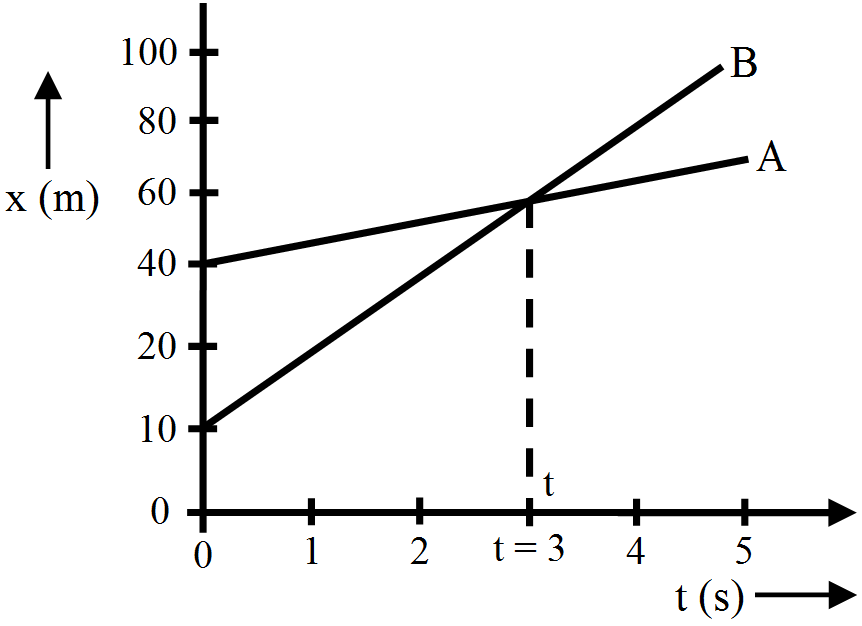
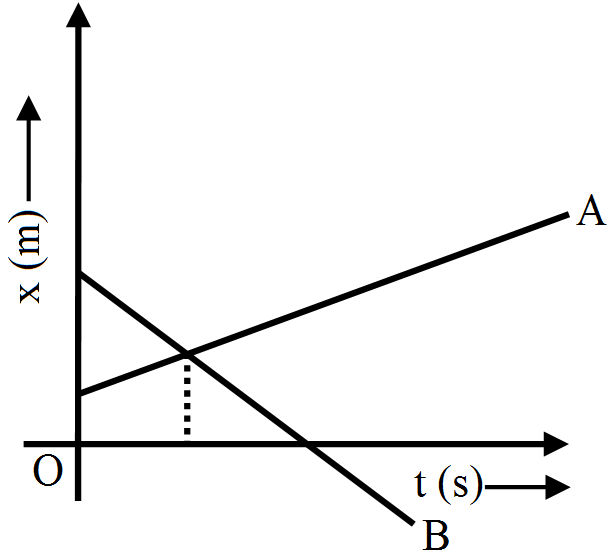
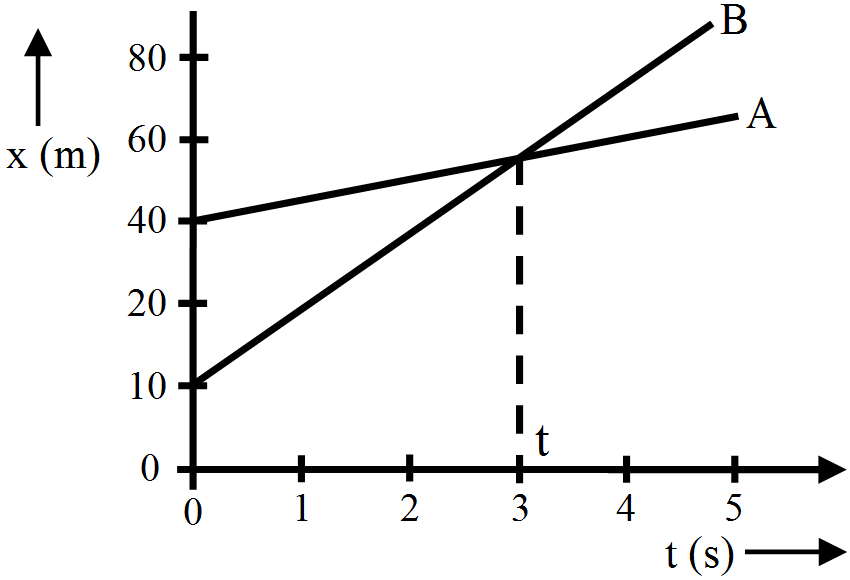
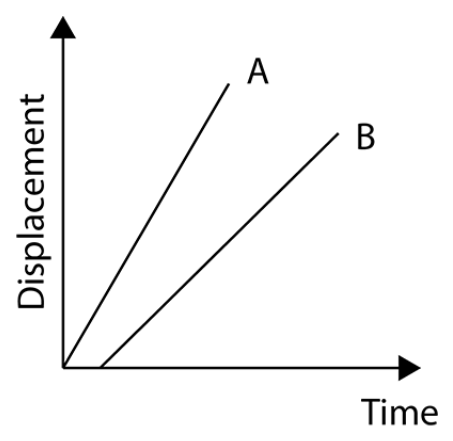
The average velocities of the objects $A$ and $B$ are $V_A$ and $V_B$, respectively. The velocities are related such that $V_A>V_B$. The position$-$time graph for this situation can be represented as:
AnswerSince, the velocities of the particles are positive, the slope of the straight line in $(x-t)$ graph must be positive. Since, $V_A>V_B$, the slope of straight line representing $A$ must be greater than the slope of the straight line representing $B$
i.e., graph representing $A$ is more steeper. Even though, $A$ starts with lower value of position coordinate than $B$, it overtakes, $B$ at $t = 3s.$
View full question & answer→MCQ 1071 Mark
A stone is released from an elevator going up with an acceleration a. The acceleration of the stone after the release is:
- A
$a$ upward.
- B
$(g - a)$ upward.
- C
$(g - a)$ downward.
- ✓
$g$ downward.
AnswerCorrect option: D. $g$ downward.
Gravity is the only force acting on the stone when it is released. And, we know that gravity is always in the downward direction.
View full question & answer→MCQ 1081 Mark
A stone falls from a balloon that is descending at a uniform rate of $12m/ s.$ the displacement of the stone from the point of release $10\sec$ is:
- ✓
$490m$
- B
$510m$
- C
$610m$
- D
$725m$
AnswerCorrect option: A. $490m$
View full question & answer→MCQ 1091 Mark
A gun is fired at a target. At the moment of firing, the target is released and allowed to fall freely under gravity. Then the bullet:$($Assume zero air resistance$)$
- A
Misses the target by passing above it
- ✓
- C
Misses the target by passing below it
- D
AnswerInitial vertical component of the velocities $($in downward direction$)$ of both the bullet and the target are zero.
So, the bullet and the target fall down by equal amount and thus the bullet hits the target.
View full question & answer→MCQ 1101 Mark
A ball is thrown from rear end of the compartment of train to the front end which is moving at a constant horizontal velocity. An observer $A$ sitting in compartment and another observer $B$ standing on the ground draw the trajectory. They will have:
- A
Equal horizontal and equal vertical ranges.
- ✓
Equal vertical ranges but different horizontal ranges.
- C
Different vertical ranges but equal horizontal ranges.
- D
Different vertical ranges and different horizontal ranges.
AnswerCorrect option: B. Equal vertical ranges but different horizontal ranges.
In vertical direction, ball has zero initial velocity but same value of $g$ w.r.t observer $A\ \&\ B$,
so they will draw trajectory of equal vertical range But along horizontal direction, for observer $A,$ ball is moving with velocity at which it is thrown w.r.t. train while for $B$, it is moving with a velocity equal to train $+$ velocity at which it is thrown w.r.t groundtrain.
View full question & answer→MCQ 1111 Mark
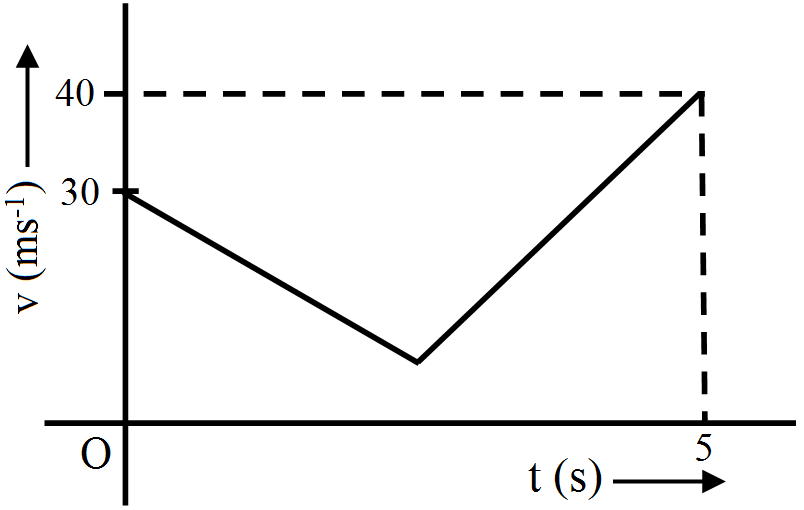
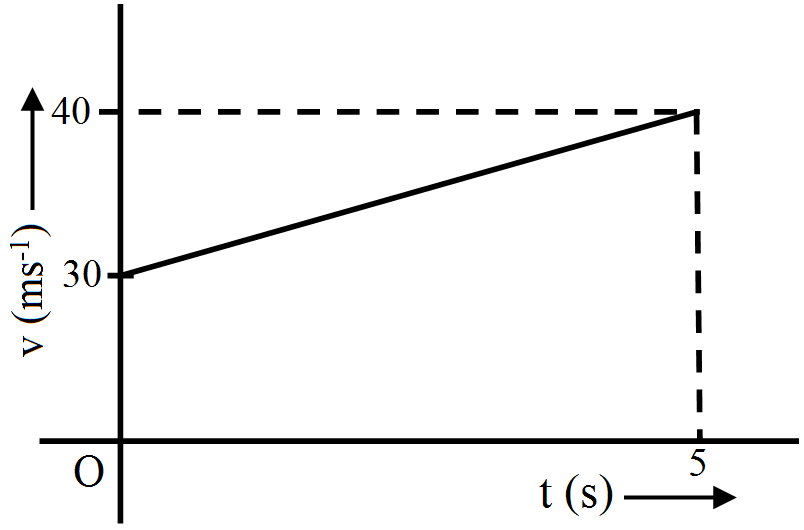
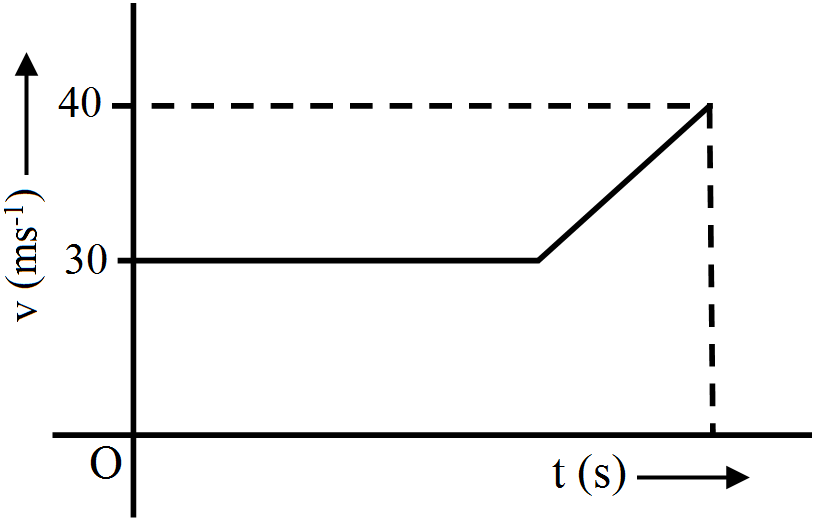
An object is moving with an initial velocity of $30ms^{-1}$ with uniform acceleration. The velocity of object increases to $40ms^{-1}$ in next $5s.$ The $v-t$ graph which least represents this situation is:
View full question & answer→MCQ 1121 Mark
Figure shows the $V−T$ graph for two particles $P$ and $Q$. The relative velocity of $P$ w.r.t. $Q$ is: 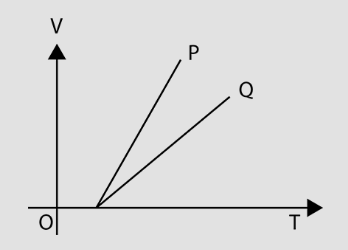
AnswerThe difference in velocities is increasing with time as both of them have more constant but different acceleration.
View full question & answer→MCQ 1131 Mark
Two particle $P$ and $Q$ are initially $40m$ apart $P$ behind $Q$. Particle $P$ starts moving with a uniform velocity $10m/ s$ towards $Q.$ Particle $Q$ starting from rest has an acceleration $2ms^2$ in the direction of velocity of $P.$ Then the minimum distance between $P$ and $Q$ will be: 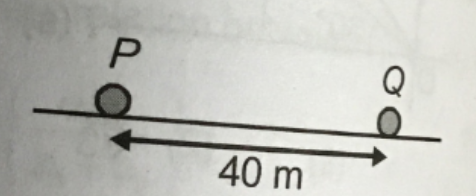
View full question & answer→MCQ 1141 Mark
A vehicle travels half the distance $L$ with speed $V_1$ and the other half with speed $V_2$, then its average speed is:
- A
$\frac{\text{v}_1+\text{v}_2}{2}$
- B
$\frac{2\text{v}_1+\text{v}_2}{\text{v}_1+\text{v}_2}$
- ✓
$\frac{2\text{v}_1\text{v}_2}{\text{v}_1+\text{v}_2}$
- D
$\frac{\text{L}(\text{v}_1+\text{v}_2)}{\text{v}_1\text{v}_2}$
AnswerCorrect option: C. $\frac{2\text{v}_1\text{v}_2}{\text{v}_1+\text{v}_2}$
View full question & answer→MCQ 1151 Mark
If, in the following diagram, distance between each circle is $1$ unit, what is the displacement between $A$ and $B?$ 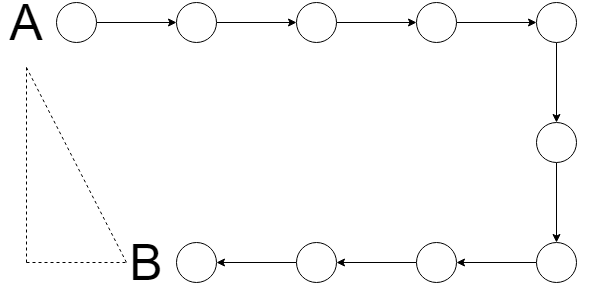
- A
$5$ units
- ✓
Square root $(5)$ units
- C
$2$ units
- D
$1$ unit
AnswerCorrect option: B. Square root $(5)$ units
The vertical distance between $A$ and $B$ is of $2$ units and the horizontal distance is $1$ unit.
Hence, to calculate the displacement, we can make a right$-$angled triangle as shown and can find the distance $(AB)$ by Pythagoras theorem.
Distance $(AB) =$ Square root $(22 + 12) =$ Square root $(5).$
View full question & answer→MCQ 1161 Mark
From a $200m$ high tower, one ball is thrown upwards with speed of $10m/ s$ and another is thrown vertically downwards at the same speed simultaneously. The time difference of their reaching the ground will be nearest to:
AnswerThe ball thrown upward will have zero velocity in $1s.$ It returns back to thrown point in another $1s$ with the same velocity as second.
Thus the difference will be $2s.$
View full question & answer→MCQ 1171 Mark
A particle moving with a uniform acceleration travels $24$ metre and $64$ metre in first two consecutive intervals of $4$ seconds each. Its initial velocity is:
- ✓
$1m/ \sec.$
- B
$2m/ \sec.$
- C
$5m/ \sec.$
- D
$10m/ \sec.$
AnswerCorrect option: A. $1m/ \sec.$
$24=\text{u}\times4+\frac{1}{2}\text{a}\times4^2$
$=4\text{u}+8\text{a}$
$6=\text{u}+2\text{a}$
$(24+64)=\text{u}\times8+\frac{1}{2}\text{a}\times8^2$
$=8\text{u}+32\text{a}$
$11=\text{u}+4\text{a}$
On solving $(i)$ and $(ii),$ we get $u = 1m/s$
View full question & answer→MCQ 1181 Mark
A ship is moving due east with a velocity of $12 m/ \sec.$ A truck is moving across on the ship with a velocity of $4m/\sec.$ A monkey is climbing a vertical pole mounted on the truck, with a velocity of $3m/ \sec.$ Find the velocity of the monkey, as observed by a man on the shore. $(m/ \sec).$
View full question & answer→MCQ 1191 Mark
A stone is released from a hot air balloon which is rising steadily with a velocity of $4ms^{-1}.$ The velocity of the stone at the end of $3s$ after it is released is $......... ms^{-1}$
- A
$29.4$
- ✓
$25.4$
- C
$32.5$
- D
$62.7$
AnswerCorrect option: B. $25.4$
Let the upward direction to be negative.
Initial velocity of stone $u = -4m/s$
Acceleration of the stone $a = g = 9.8m/s^2$
Velocity of stone $v = u + at$
$\therefore v = -4 + 9.8 \times 3 = 25.4m/ s$
View full question & answer→MCQ 1201 Mark
The displacement of a car is given as $- 240m.$ Here, negative sign indicates:
AnswerCorrect option: A. Direction of displacement.
View full question & answer→MCQ 1211 Mark
Which of the following vehicles is undergoing a deacceleration?
- A
A car driving straight to the east on a road at a constant speed.
- B
A truck rounding a corner at a constant speed.
- ✓
A van slowing down as it approaches a stop sign.
- D
AnswerCorrect option: C. A van slowing down as it approaches a stop sign.
A object is said to have an acceleration if it changes its velocity either by increasing its speed, decreasing its speed or changing the direction of its velocity.
Since the car and the truck move with constant speed,
thus they have zero acceleration.
But the van is slowing down its speed,
thus it has deacceleration.
View full question & answer→MCQ 1221 Mark
A hollow iron ball $(A)$ and a solid iron ball $(B)$ and cricket ball $(C)$ are dropped from the same height. Which among the three balls reaches the ground first? Assuming there is no resistance due to air.
- A
$A$
- B
$B$
- C
$C$
- ✓
All the three balls reaches ground simultaneously.
AnswerCorrect option: D. All the three balls reaches ground simultaneously.
Since all the balls have have zero velocity initially and they experience equal acceleration due to gravity and travel equal distance.
Thus all the balls take equal time to reach the ground.
View full question & answer→MCQ 1231 Mark
Three particles start from origin at the same time with a velocity $2ms^{-1}$ along positive $x-$axis the second with a velocity $6ms^{-1}$ aling negative $y -$ axis. Find the velocity of the third particle along $x = y$ line so that the three particles may always lie in a straight line:
- A
$-3\sqrt{3}$
- ✓
$3\sqrt{2}$
- C
$-3\sqrt{2}$
- D
$2\sqrt{2}$
AnswerCorrect option: B. $3\sqrt{2}$
View full question & answer→MCQ 1241 Mark
Which of the following are obtained by dividing total displacement by total time taken?
AnswerThe average velocity is obtained by dividing total displacement by total time taken.
Instantaneous velocity is calculated at an instant and not over a period of time.
Speed is distance divided by time. Velocity is said to be uniform when velocity at every instant is equal to the average velocity.
View full question & answer→MCQ 1251 Mark
A parachutist after bailing out falls $50m$ without friction. When parachute opens, it decelerate at $2m/ s^2.$ He reaches the ground with a speed of $3m/ s.$ At what height, did he bail out nearly.
- ✓
$298m$
- B
$111m$
- C
$91m$
- D
$182m$
AnswerCorrect option: A. $298m$
View full question & answer→MCQ 1261 Mark
A ball is thrown up, it reaches a maximum height and then comes down. If $t_1(t_2 > t_1)$ are the times that the ball takes to be at a particular height then the time taken by the ball to reach the highest point is:
- A
$(\text{t}_1+\text{t}_2)$
- B
$(\text{t}_1-\text{t}_2)$
- C
$\frac{(\text{t}_2-\text{t}_1)}{2}$
- ✓
$\frac{(\text{t}_2+\text{t}_1)}{2}$
AnswerCorrect option: D. $\frac{(\text{t}_2+\text{t}_1)}{2}$
Let $s$ be the height of a particular point where the ball crosses in time $t_1$ and $t_2$ seconds while going upwards and coming downwards.
If $u$ is the initial velocity of projection of ball, then
$\text{s}=\text{ut}_1-\frac{1}{2}\text{gt}^2_1=\text{ut}_2-\frac{1}{2}\text{gt}^2_2$
$\text{u}(\text{t}_2-\text{t}_1)=\frac{1}{2}\text{g}(\text{t}^2_2-\text{t}_1)$
$\text{u}=\frac{1}{2}\text{g}(\text{t}_2+\text{t}_1)$
If $T$ is the time taken by ball to reach to its highest point then using the relation $v = u + at,$ we have $0 = u + (-g)T$
$\text{T}=\frac{\text{u}}{\text{g}}=\frac{1}{2}\frac{\text{g}(\text{t}_2+\text{t}_1)}{\text{g}}$
$=\frac{1}{2}(\text{t}_2+\text{t}_1)$
View full question & answer→MCQ 1271 Mark
A car starts from rest and has an acceleration $a = 1\ m/ s^2.$ A truck is moving with a uniform velocity of $6\ m/ s.$ At what distance will the car overtake the truck? direction $($at $t = 0$ both start their motion in the same direction from the same position$)$
AnswerAt the moment when the car will be overtaking the truck their velocitis will be same.
So suppose after t second from the start of the motion the car overtake the truck then the velocity of the car at that moment will be $v = 0 + at = t \times 1\ m/ s^2= t\ m/ s$ and the velocity of the truck at that moment will be $u = 6\ m/ s($constant$)$ both should be same
i.e $u = v$ or $6 = t$ or $t = 6$ second so the distance covered by truck
i.e car because both will be at same place ast that point of time in this time will be $s = vt = 6 \times 6 = 36$ meter
View full question & answer→MCQ 1281 Mark
A particle is dropped from a tower. It is found that it travels $55m$ in the last second of its journey. Then height of the tower is $(g = 10\ m/s^2g = 10\ m/s^2)?$
- A
$125m$
- ✓
$180m$
- C
$100m$
- D
$55m$
AnswerCorrect option: B. $180m$
View full question & answer→MCQ 1291 Mark
In case of a moving body:
- A
Displacement $ > $ distance.
- B
Displacement $ < $ distance.
- C
Displacement $\geq$ distance.
- ✓
Displacement $\leq$ distance.
AnswerCorrect option: D. Displacement $\leq$ distance.
View full question & answer→MCQ 1301 Mark
A bullet is fired from the cart vertically at the same instant cart begins to accelerate forward. Which of the following best describes the subsequent motion of the bullet?
- A
The bullet goes up and then straight back down into the cart.
- B
The bullet goes up and lands in front of the cart.
- ✓
The bullet goes up and lands behind the cart.
- D
The bullet stops in the air as the cart is accelerating and "floats" until the cart stops accelerating.
AnswerCorrect option: C. The bullet goes up and lands behind the cart.
As the bullet is fired vertically upwards, thus the bullet does not have velocity in horizontal forward direction and hence it has zero horizontal displacement.
Also the cart has acceleration in forward direction, thus the cart has finite displacement in forward direction.
Hence the bullet goes up and lands behind the cart.
View full question & answer→MCQ 1311 Mark
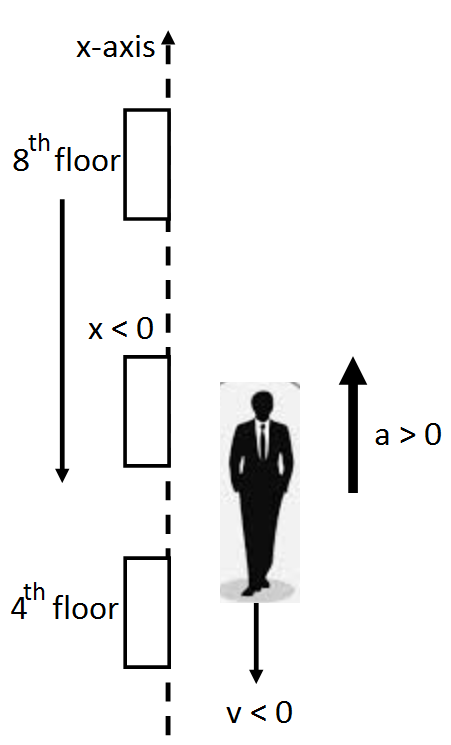
A lift is coming from $8^{th}$ floor and is just about to reach $4^{th}$ floor. Taking ground floor as origin and positive direction upwards for all quantities, which one of the following is correct?
- ✓
$x < 0, v < 0, a > 0.$
- B
$x > 0, v < 0, a < 0.$
- C
$x > 0, v < 0, a > 0.$
- D
$x > 0, v > 0, a < 0.$
AnswerCorrect option: A. $x < 0, v < 0, a > 0.$
Key concept: The time rate of change of velocity of an object is called acceleration of the object.
It is a vector quantity. Its direction is same as that of change in velocity $($Not of the velocity$).$
In the table: Possible ways of velocity change.
|
When only direction of velocity changes.
|
When only magnitude of velocity changes.
|
When both magnitude and direction of velocity change.
|
|
Acceleration perpendicular to velocity.
|
Acceleration parallel or antiparallel to velocity.
|
Acceleration has two components-one is perpendicular to velocity and another parallel or antiparallel to velocity.
|
|
E.g.: Uniform circular motion
|
E.g.: Motion under gravity.
|
E.g.: Projectile motion.
|
Here we will take upward direction positive. As. the lift is coming in downward direction, the displacement will be negative. We have to see whether the motion is accelerating or retarding.
We know that due to downward motion displacement will be negative. When the lift reaches $4^{th}$ floor and is about to stop velocity is decreasing with time, hence motion is retarding in nature.
Thus, $x < 0; a > 0.$
As displacementisinnegativedirection, velocity will also be negative, i.e. $v < 0.$
The motion of lift will be shown like this.
View full question & answer→MCQ 1321 Mark
A balloon starts rising from the ground with an acceleration of $1.25\ m/s^2.$ After $8$ seconds, a stone is released from the balloon. The stone will $($use $g = 10\ m/s^2):$
- A
Cover a distance of $40m.$
- B
Have displacement of $50m.$
- ✓
Reach the ground in $4$ second.
- D
Begin to move downward after being released.
AnswerCorrect option: C. Reach the ground in $4$ second.
Taking upward motion of balloon for $8$ seconds; we have
$u = 0; a = 1.25\ m/s^2; t = 8 s; v = ?; s = ?.$
Here $v = u + at = 0 + 1.25 \times 8 = 10\ m/s$
$\text{s}=\text{ut}+\frac{1}{2}\text{at}^2$
$=0+\frac{1}{2}\times1.25\times8^2=40\text{m}$
Taking downward motion of released stone from balloon at height $40m$ we have,
$a = -10\ m/s; a = 10\ m/s^2; s = 40m; t = ?$
As, $\text{s}=\text{ut}+\frac{1}{2}\text{at}^2$
so, $40=-10\text{t}+\frac{1}{2}\times10\times\text{t}^2$
or $t^2 - 2t - 8 = 0$ On solving $t = 4s.$
View full question & answer→MCQ 1331 Mark
A person travelling on a straight line moves with a uniform velocity $v_1$ for a distance $x$ and with a uniform velocity $v-2$ for the next equal distance. The average velocity $v$ is given by:
- A
$\text{v}=\frac{\text{v}_1+\text{v}_2}{2}$
- B
$\text{v}=\sqrt{\text{v}_1\text{v}_2}$
- ✓
$\frac{2}{\text{v}}=\frac{1}{\text{v}_1}+\frac{1}{\text{v}_2}$
- D
$\frac{1}{\text{v}}=\frac{1}{\text{v}_1}+\frac{1}{\text{v}_2}$
AnswerCorrect option: C. $\frac{2}{\text{v}}=\frac{1}{\text{v}_1}+\frac{1}{\text{v}_2}$
Velocity is uniform in both cases; that is, acceleration is zero.
$\text{x = v}_1\text{t}_1$
$\Rightarrow\text{t}_1=\frac{\text{x}}{\text{v}_1}$
$\text{x = v}_2\text{t}_2$
$\Rightarrow\text{t}_2=\frac{\text{x}}{\text{v}_2}$
Total displacement, $\text{x}'=\text{2x}$
Total time, $\text{t}=\text{t}_1+\text{t}_2$
$\therefore$ Average velocity, $\text{v}=\frac{\text{x}'}{\text{t}}=\frac{2\text{v}_1\text{v}_2}{\text{v}_1+\text{v}_2}$
$\Rightarrow\frac{2}{\text{v}}=\frac{1}{\text{v}_1}+\frac{1}{\text{v}_2}$
View full question & answer→MCQ 1341 Mark
What happens to the average velocity when a body falls under gravity with terminal velocity?
AnswerWhen the body is moving with terminal velocity, the velocity does not change. It means that equal displacement is being covered in equal time intervals. Hence the average velocity remains constant.
View full question & answer→MCQ 1351 Mark
The sign (+ve or -ve) of the average velocity depends only upon:
- ✓
The sign of displacement.
- B
The initial position of the object.
- C
The final position of the object.
- D
AnswerCorrect option: A. The sign of displacement.
Explanation:
Since, average velocity, $\text{v}=\frac{\Delta \text{x}}{\Delta \text{t}}=\frac{\text{Displacement}}{\text{Time interval}}$
Thus, average velocity depends on the displacement and hence it depends on the sign of the displacement.
View full question & answer→MCQ 1361 Mark
A stone is thrown with an initial speed of $4.9\ m/s$ from a bridge in vertically upward direction. It falls down in water after $2$ seconds. The height of the bridge is:
- A
$4.9m$
- ✓
$9.8m$
- C
$19.8m$
- D
$24.7m$
AnswerCorrect option: B. $9.8m$
Talking vertical downward motion of stone, we have
$u = -4.9\ m/s, a = 9.8\ m/s^2, t = 2s. s = ?$
Now, $\text{s}=\text{t=ut}+\frac{1}{2}\text{at}^2$
$=-4.9\times2+\frac{1}{2}\times9.8\times2^2$
$=9.8\text{m}$
View full question & answer→MCQ 1371 Mark
According to the following graph, what happens to the distance covered by the body from $0 -10$ minutes?
- ✓
- B
- C
It first increases and then decreases
- D
It first decreases and then increases
AnswerWe know that distance traveled by an object is the area under it speed time graph.
Now, in this case, as the area under the speed$-$time graph is increasing from $0 - 10$ minutes.
So, the distance will keep on increasing from $0 - 10$ minutes.
View full question & answer→MCQ 1381 Mark
The displacement of a particle is given by $x = (t - 2)^2$ where $x$ is in metres and $t$ in seconds. The distance covered by the particle in first $4$ seconds is:
- A
$4m.$
- ✓
$8m.$
- C
$12m.$
- D
$16m.$
AnswerKey concept: Instantaneous velocity : Instantaneous velocity is defined as the rate of change of position vector of particles with time at a certain instant of time.
Instantaneous velocity $\vec{\text{v}}=\DeclareMathOperator*{\median}{\text{lim}} \median\limits_{\Delta\text{t}\rightarrow0}\frac{\Delta\vec{\text{r}}}{\Delta\text{t}}=\frac{\text{d}\vec{\text{r}}}{\text{dt}}$
Instantaneous acceleration $=\vec{\text{a}}=\DeclareMathOperator*{\median}{\text{lim}} \median\limits_{\Delta\text{t}\rightarrow0}\frac{\Delta\vec{\text{v}}}{\Delta\text{t}}=\frac{\text{d}\vec{\text{v}}}{\text{dt}}$
By definition $\vec{\text{a}}=\frac{\text{d}\vec{\text{v}}}{\text{dt}}=\frac{\text{d}^2\vec{\text{x}}}{\text{dt}^2}\Big[\text{As}\ \vec{\text{v}}=\frac{\text{d}\vec{\text{x}}}{\text{dt}}\Big]$
i.e., if $x$ is given as a function of time, second time derivative of displacement gives acceleration.
In such type of problems we have to analyze whether the motion is accelerating or retarding. When acceleration is parallel to velocity, velocity of particle increases with time, i.e. motion is accelerated. And when acceleration is anti$-$parallel to velocity, velocity of particle decreases with time, i.e. motion is retarded. During retarding journey, particle will stop in between.
According to the problem, displacement of the particle is given as a function of time.
$\text{x}=(\text{t}-2)^2$
By differentiating this equation w.r.t. time we get velocity of the particle as a function of time.
$\text{v}=\frac{\text{dx}}{\text{dt}}=\frac{\text{d}}{\text{dt}}(\text{t}-2)^2=2(\text{t}-2)\text{m/s}$
If we again differentiate this equation w.r.t. time we will get acceleration of the particle as a function of time.
Acceleration, $\text{a}=\frac{\text{dv}}{\text{dt}}=\frac{\text{d}}{\text{dt}}[2(\text{t}-2)]$
$=2[1-0]=2\text{m/s}^2$
When $\text{t}=0;\ \ \text{v}=-4\text{m/s}$
$\text{t}=2\text{s};\ \ \text{v}=0\text{m/s}$
$\text{t}=4\text{s};\ \ \ \text{v}=4\text{m/s}$
That means particle starts moving towards negative axis, then $at = 0,$ with a speed $4\ m/s,$ at $t = 2$ it stops and start coming backward.
At $t = 4$ its speed is $+4\ m/s.$
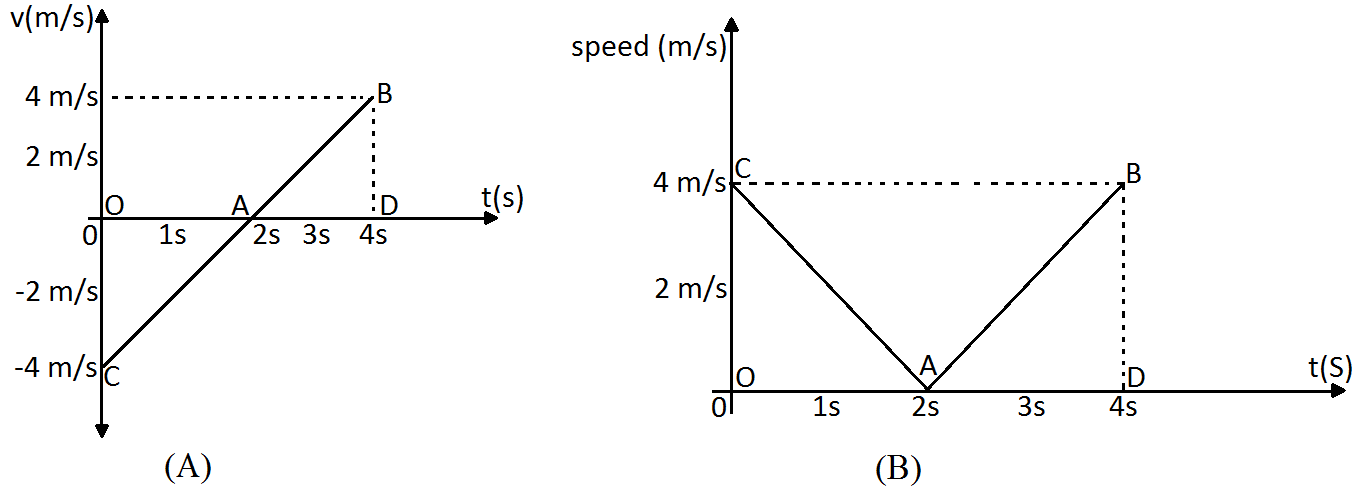
$v - t$ graph is shown in graph $(a)$ and speed$-$time graph of the same situation is shown in graph $(b).$
Distance travelled $=$ Area of the speed$-$time graph
$=$ area $\text{OAC} +$ area $\text{ABD}$
$=\frac{4\times2}{2}+\frac{1}{2}\times2\times4$
$=8\text{m}$ View full question & answer→MCQ 1391 Mark
When a body is in the state of complete rest, what kind of energy does it possess?
AnswerWhen the body is in the state of rest, there is no motion.
Hence there is no kinetic energy, hence the total energy of the body is stored as its potential energy.
The total energy is the sum of kinetic and potential energies.
View full question & answer→MCQ 1401 Mark
A particle is found to be at rest when seen from a frame $S_1$ and moving with a constant velocity when seen from another frame $S_2.$ Mark out the possible options.
AnswerCorrect option: A. Both the frames are inertal.
View full question & answer→MCQ 1411 Mark
An airplane must reach a take of speed of $80\ m/ s$ in a $1000m$ long runway. What minimum constant acceleration is required$? ($in $m/ s^2):$
AnswerHere, initial velocity is $u = 0\ m/ s ($as airplane starts from rest$)$
Final velocity is $v = 80\ m/ s$ and distance traveled, $S = 1000m.$
Let a be the required acceleration.
Using formula $v^2 − u^2 = 2aS,$
$(80)^2 − 0^2= 2a(1000)$
So, we get $a = 3.2\ m/ s^2$
View full question & answer→MCQ 1421 Mark
A ball falls from a building and covers $5m$ in $10s.$ What is the acceleration?
- ✓
$0.1\ m/ s^2$
- B
$0.2\ m/ s^2$
- C
$9.81\ m/ s^2$
- D
$10\ m/ s^2$
AnswerCorrect option: A. $0.1\ m/ s^2$
Assuming the ball falls with zero initial velocity, then according to the second equation of motion, $\text{s}=\text{ut}+\big(\frac{1}{2}\big)\text{at}^2=\big(\frac{1}{2}\big)\text{at}^{2}.$
When we put $t = 10s,$ we get $a = 0.1\ m/ s^2$.
View full question & answer→MCQ 1431 Mark
A car is moving around a tree in a circular path. What can be said about the average velocity?
AnswerExplanation:
Take any point on the circular path. The car moves in a circle and hence will come back to the same point after a definite time interval.
Therefore, the displacement is 0. Hence, the average velocity is zero.
View full question & answer→MCQ 1441 Mark
Which of the following statements is incorrect?
AnswerCorrect option: C. The kinematic equations for uniform acceleration can be applied in case of uniform circular motion.
The kinematic equations for uniform acceleration do not apply in case of uniform circular motion because in this case the magnitude of acceleration is constant but its direction is changing.
View full question & answer→MCQ 1451 Mark
The velocity $-$ time graph below represents the velocity of a toy train as it moves north and south with velocity near the middle of the vertical axis. During which, Interval$(s)$ is the toy train speeding up?
AnswerCorrect option: B. $0$ to $A$ and $D$ to $E$
The toy train will speed up if the rate of change of velocity will increases with respect to time.
Therefore, the train will speed up in the intervals $0$ to $A$ and $D$ to $E.$
View full question & answer→MCQ 1461 Mark
Rana moves with uniform velocity on a bike. He throws a stone in air, the stone falls:
MCQ 1471 Mark
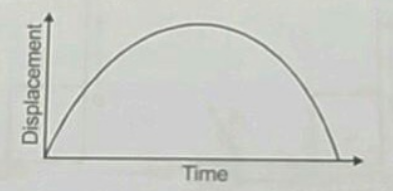
The graph predicts the condition of:
- A
Body is undergoing positive acceleration.
- ✓
Body is undergoing negative acceleration.
- C
- D
AnswerCorrect option: B. Body is undergoing negative acceleration.
View full question & answer→MCQ 1481 Mark
A stone is thrown vertically up from a bridge with velocity $3\ ms^{-1}$ if it strikes the water under the bridge after $2s,$ the bridge is at a height of $(g = 10\ m/s^2)$
View full question & answer→MCQ 1491 Mark
A ball is thrown up in the sky, at what position will the instantaneous speed be minimum?
- A
- B
- ✓
Halfway through the whole trajectory
- D
After covering one fourth of the whole trajectory
AnswerCorrect option: C. Halfway through the whole trajectory
When the ball rises up, there will be a point where it will be in the state of instantaneous rest.
At the this position the speed of the ball will be $0.$
Speed is maximum at the initial and final points.
View full question & answer→MCQ 1501 Mark
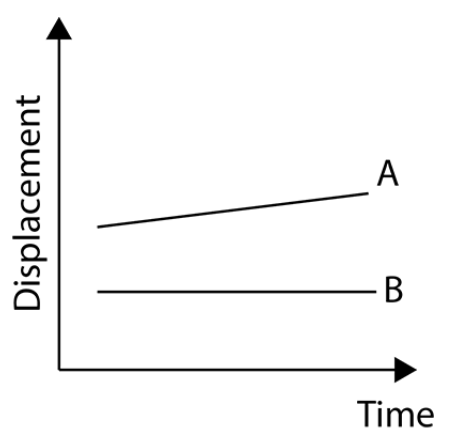
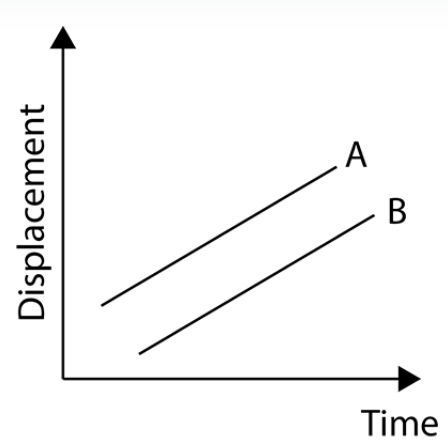
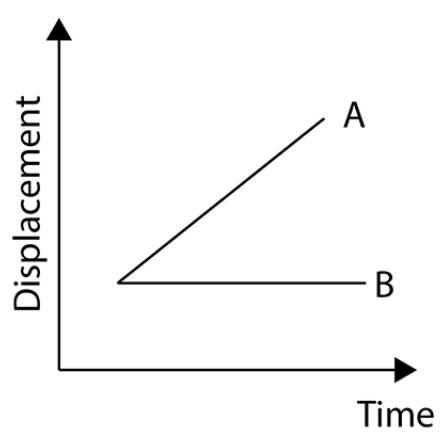
Which one of the following represents the displacement time graph of two objects $A$ and $B$ moving with zero relative speed?
AnswerIf relative speed $= 0$ then velocity of $A =$ velocity of $B.$
So displacement time graphs of $A$ and $B$ must have same slope $($other than zero$).$
View full question & answer→