MCQ 511 Mark
A mass of $5\ kg$ is moving along a circular path of radius $1m.$ If the mass moves with $300$ revolutions per minute, its kinetic energy would be:
- ✓
$250\pi^2$
- B
$100\pi^2$
- C
$5\pi^2$
- D
$0$
AnswerCorrect option: A. $250\pi^2$
According to the problem, Radius $= 1m,$ mass $= m = 5\ kg$
$\text{f}=\frac{300}{60}$
Angular velocity will be
$=2\pi\text{f}=(300\times2\pi)\text{rad/ min}$
$=(300\times3.14)\text{rad/ 60s}$
$=\frac{300\times2\times3.14}{60}\text{rad/ s}$
$=10\pi\text{rad/ s}$
And relation between linear velocity and angular velocity is $\text{v}=\omega\text{R}$
$=\Big(\frac{300\times2\pi}{60}\Big)(1\text{m})$
$=10\pi\text{m/ s}$
And kinetic energy $=\frac{1}{2}\text{mv}^2$
$=\frac{1}{2}\times5\times(10\pi^2)$
$=100\pi^2\times5\times\frac{1}{2}$
$=250\pi^2\text{J}$
View full question & answer→MCQ 521 Mark
In a shotput event an athlete throws the shotput of mass $10\ kg$ with an initial speed of $1\ m s^{-1}$ at $45^\circ$ from a height $1.5m$ above ground. Assuming air resistance to be negligible and acceleration due to gravity to be $10\ m s^{-2}$, the kinetic energy of the shotput when it just reaches the ground will be:
- A
$20.5J$
- B
$5.0J$
- C
$52.5J$
- ✓
$155.0J$
AnswerCorrect option: D. $155.0J$
If air resistance is negligible, total mechanical energy of the system will remain constant.
And let us take ground as a reference where potential energy will be zero.
According to the problem, $h = 1.5 m, v = 1\ m/ s, m = 10 \ kg, g = 10\ m s^{-2}$
Initial energy of the shotput $=(\text{PE})_\text{i}+(\text{KE})_\text{i}$
$=\text{mgh}+\frac{1}{2}\text{mv}^2$
$=10\times10\times1.5+\frac{1}{2}\times10\times(1)^2$
$=150+5$
$=155.0\text{J}$
From conservation of mechanical energy,
$\text{(PE)}_\text{i}+\text{(KE)}_\text{i}=\text{(PE)}_\text{f}+\text{(KE)}_\text{f}$
So, final kinetic energy of the shotput is $155J$
View full question & answer→MCQ 531 Mark
A sphere of mass $m,$ moving with a speed $v,$ strikes a wall elastically at an angle of incidence $I$. If the speed of the sphere before and after collision is the same and the angle of incidence and velocity normally towards the wall the angle of rebound is equal to the angle of incidence and velocity normally towards the wall is taken as negative then, the change in the momentum parallel to wall is:
- A
$mv \cos I$
- B
$2mv \cos I$
- C
$-2mv \cos I$
- ✓
AnswerSince the sphere collided elastically and there was no friction there was no impulse on the sphere along the wall. The only contact force acted was normal and that obviously was perpendicular to surface. NO change in momentum parallel to wall.
View full question & answer→MCQ 541 Mark
In the phenomenon of work done by variable forces, the forces:
AnswerThe variable forces are the non-constant forces that changes with maybe time, distance or any other variable.
View full question & answer→MCQ 551 Mark
A ball kept in a closed box moves in the box making collisions with the walls. The box is kept on a smooth surface. The velocity of the centre of mass:
- A
Of the box remains constant.
- ✓
Of the box plus the ball system remains constant.
- C
Of the ball remains constant.
- D
Of the ball relative to the box remains constant.
AnswerCorrect option: B. Of the box plus the ball system remains constant.
Consider the box and the ball a system. As no external force acts on this system, the velocity of the centre of mass of the system remains constant.
View full question & answer→MCQ 561 Mark
A particle of mass, $m,$ is tied to a light string and rotated with a speed, $v,$ along a circular path of radius, $r.$ If $T =$ tension in the string and $mg =$ gravitational force on the particle, then the actual forces acting on the particle are:
- ✓
$Mg$ and $T$ only.
- B
$\ce{Mg, T}$ and an additional force of $\ce{mv2/ r}$ directed inwards.
- C
$\ce{Mg, T}$ and an additional force of $\ce{mv2/ r}$ directed outwards.
- D
Only a force $\ce{mv2/ r}$ directed outwards.
AnswerCorrect option: A. $Mg$ and $T$ only.
The force $\ce{mv2/ r}$ directed outwards, called centrifugal force, is not a real force.
At $\ce{A, mv12/ l = T_1 + mg}$
View full question & answer→MCQ 571 Mark
Name the type of energy $($kinetic energy $K$ or potential energy $U)$ possessed in a compressed spring:
- ✓
$U$
- B
$K$
- C
Both $U$ and $K$
- D
AnswerWhen you compress a spring, it possess potential energy. The force of compression is proportional to the compression, according to Hooke's Law. Releasing the spring turns the potential energy into kinetic energy. The spring can be then used to propel some object.
View full question & answer→MCQ 581 Mark
A particle is rotated in a vertical circle by connecting it to a string of length $l$ and keeping the other end of the string fixed. The minimum speed of the particle when the string is horizontal for which the particle will complete the circle is:
- A
$\sqrt{\text{gl}}$
- B
$\sqrt{2\text{gl}}$
- ✓
$\sqrt{3\text{gl}}$
- D
$\sqrt{5\text{gl}}$
AnswerCorrect option: C. $\sqrt{3\text{gl}}$
Suppose that one end of an extensible string is attached to a mass $m,$ while the other end is fixed. The mass moves with a velocity $v$ in a vertical circle of radius $R.$ At some instant, the string makes an angle $\theta$ with the vertical as shown in the figure.
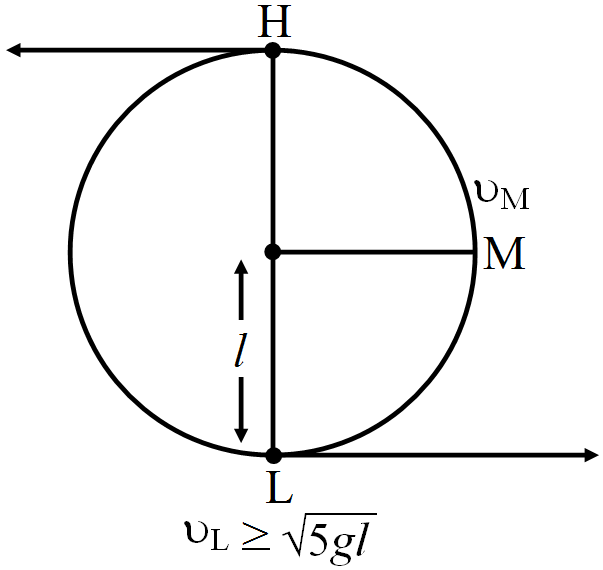
For a complete circle, the minimum velocity at $L$ must be $\nu_\text{L}=\sqrt{5\text{gl}}.$
Applying the law of conservation of energy, we have:
Total energy at $M =$ total energy at $L$
i.e., $\frac{1}{2}\text{m}\nu_{\text{M}^2}+\text{mgl}=\frac{1}{2}\text{m}\nu_{\text{L}^2}$
$\Rightarrow\frac{1}{2}\text{m}\nu_{\text{M}^2}=\frac{1}{2}\text{m}\nu_{\text{L}^2}-\text{mgl}$
Using $\nu_\text{L}\geq\sqrt{5\text{gl}},$ we have:
$\frac{1}{2}\text{m}\nu_{\text{M}^2}\geq\frac{1}{2}\text{m}(5\text{gl})-\text{mgl}$
$\therefore\ \nu_\text{M}=\sqrt{3\text{gl}}$ View full question & answer→MCQ 591 Mark
Which of the following is not conserved in inelastic collision?
- A
- ✓
- C
Both momentum and kinetic energy.
- D
Neither momentum nor kinetic energy
AnswerKinetic energy is not conserved in an inelastic collision.
View full question & answer→MCQ 601 Mark
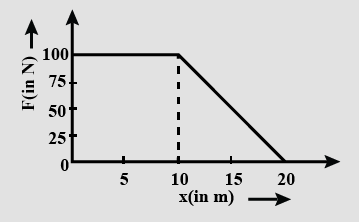
A force $F$ acting on an object varies with distance $x$ as shown in the figure. The work done by the force in moving the object from $x = 0$ and $x = 20m$ is:
- A
$500J$
- B
$1000D$
- ✓
$1500J$
- D
$2000D$
AnswerCorrect option: C. $1500J$
Area under force displacement curve is the work done in that interval
Area under the given figure Area of surface Area of triangle. $= +$
Work done $= 10\times 100+\frac{1}{2}\times 10\times 100$
$= 1000 + 500$
$= 1500J$
View full question & answer→MCQ 611 Mark
A body of mass $1\ kg$ is rotating in a vertical circle of radius $1m.$ What will be the difference in its kinetic energy at the top and bottom of the circle?
Take $g = 10\ m/ s^2$
AnswerAccording to work energy theorem, $\triangle K.$ And, $\ce{uh.= In}$ and
here work is done by the gravitational force.
$\Rightarrow \triangle K.$ And, $\ce{uh. = In = mg(2r) = 1 \times 10 \times 2(1) = 20D}$
View full question & answer→MCQ 621 Mark
Consider two observers moving with respect to each other at a speed $v$ along a straight line. They observe a block of mass $m$ moving a distance $l$ on a rough surface. The following quantities will be same as observed by the two observers.
AnswerCorrect option: D. Total work done on the block.
When two observers are moving with respect to each other at a speed $v$ along a straight line, acceleration of block, if any, will be same. Distance moved may be different. Therefore, work done/$K.E$. of the block may appear different.
View full question & answer→MCQ 631 Mark
A molecule in a gas container hits a horizontal wall with speed $200\ ms^{-2}$ and angle ${30}^\circ$ with the normal and rebounds with the same speed. Which statement is true?
- A
- B
- C
- ✓
Both $(a)$ and $(b).$
AnswerCorrect option: D. Both $(a)$ and $(b).$
View full question & answer→MCQ 641 Mark
If the force and displacement of particle in the direction of force are doubled, then work done would be:
AnswerCorrect option: B. $4$ times.
$\because$ Work $=$ Force $\times$ Displacement $…(i)$
View full question & answer→MCQ 651 Mark
A body is moving along a circular path. How much work is done by the centripetal force?
AnswerFor a body moving along a circular path, the centripetal force acts along the radius while the displacement is tangential, i.e. $\theta=90^\circ$,
therefore, $\text{W}=\text{Fs}\cos90^\circ=0$.
View full question & answer→MCQ 661 Mark
In an inelastic collision:
- A
The initial kinetic energy is equal to the final kinetic energy.
- ✓
The final kinetic energy is less than the initial kinetic energy.
- C
The kinetic energy remains constant.
- D
The kinetic energy first increases then decreases.
AnswerCorrect option: B. The final kinetic energy is less than the initial kinetic energy.
As some energy is loss into heat in an inelastic collision, the final kinetic energy is less than the initial kinetic energy.
View full question & answer→MCQ 671 Mark
Two masses of $1g$ and $4g$ are moving with equal kinetic energy. The ratio of the magnitudes of their momentum is:
- A
$4 : 1$
- B
$2 : 1$
- ✓
$1 : 2$
- D
$1 : 1$
AnswerCorrect option: C. $1 : 2$
As we know that linear momentum
$=\sqrt{2\text{mk}}$
$\Big(\therefore\text{K}=\frac{\text{P}^2}{2\text{m}}\Big)$
For same Kinetic energy, $\text{P}\propto\sqrt{\text{m}}$
$\frac{\text{P}_1}{\text{P}_2}=\sqrt{\frac{\text{m}_1}{\text{m}_2}}=\sqrt{\frac{1}{4}}=\frac{1}{2}=1:2$
View full question & answer→MCQ 681 Mark
Two springs $A$ and $B(k_A = 2k_B)$ are stretched by applying forces of equal magnitudes at the four ends. If the energy stored in $A$ is $E,$ that in $B$ is:
- A
$\frac{\text{E}}{2}$
- ✓
$2\text{E}$
- C
$\text{E}$
- D
$\frac{\text{E}}{4}$
AnswerCorrect option: B. $2\text{E}$
Let $x_A$ and $x_B$ be the extensions produced in springs $A$ and $B,$ respectively.
Restoring force on spring $A, F = k_Ax_A ...(1)$
Restoring force on spring $B, F = k_Bx_B ...(2)$
From $(1)$ and $(2),$ we get:
$k_Ax_A = k_Bx_B$
It is given that $k_A = 2k_B$
$\therefore\ \text{x}_\text{B}=2\text{x}_\text{A}$
Energy stored in spring $A:$
$\text{E}=\frac{1}{2}\text{k}_\text{A}\text{x}_\text{A}^2\ \dots(3)$
Energy stored in spring $B:$
$\text{E}'=\frac{1}{2}\text{k}_\text{B}\text{x}_\text{B}^2=\frac{1}{2}\Big(\frac{\text{k}_\text{A}}{2}\Big)(2\text{x}_\text{A})^2$
$\therefore\ \text{E}'=2\times\Big(\frac{1}{2}\text{k}_\text{A}\text{x}_\text{A}^2\Big)=2\text{E} [$From $(3)]$
View full question & answer→MCQ 691 Mark
What is work done in holding a body of mass $20\ kg$ at a height of $2m$ above the ground? $(g = 10m/ s^2)$
AnswerA body of mass $20\ kg$ is held at a height of $2m$ above the ground means there is no displacement because of which there is no change in its potential energy.
View full question & answer→MCQ 701 Mark
A crane pulls up a car of mass $500\ kg$ to a vertical height of $4m.$ So, work done by the crane is:
- A
$19.6J$
- ✓
$19.6kJ$
- C
$19600kJ$
- D
$4900J$
AnswerCorrect option: B. $19.6kJ$
To raise the car, the crane has to do work against the force of gravity.
Therefore, the force required to lift the car, $F = mg = 500 \times 9. 8N = 4900N$
Displacement, $S =$ vertical height raised $= 4m.$
$\therefore$ Work done, In $= F. S = 4900 \times 4J = 19600J = 19.6kJ$
View full question & answer→MCQ 711 Mark
A body is initially at rest. It undergoes one$-$dimensional motion with constant acceleration. The power delivered to it at time $t$ is proportional to:
- A
$\text{t}^{\frac{1}{2}}$
- ✓
$\text{t}$
- C
$\text{t}^\frac{3}{2}$
- D
$\text{t}^2$
AnswerCorrect option: B. $\text{t}$
From,
$V = u + at$
$V = 0 + at = at$
As power, $P = F \times V$
$\therefore P = (ma) \times at = ma^2t$
As m and a are constants, therefore, $\text{P}\propto\text{t}$
Hence, right choice is $(ii)\ t.$
View full question & answer→MCQ 721 Mark
The velocity of a bus, moving on a smooth road, is increased from $8\ m/ s$ to $32\ m/ s$ in $120s.$ During this process, the potential energy of the bus:
- ✓
- B
Becomes twice that of initial potential energy.
- C
Becomes four times that of initial potential energy.
- D
Becomes sixteen times that of initial potential energy.
AnswerAs potential energy, $\ce{P = mgh}$
Since, there is no vertical displacement so, $h = 0.$
Hence, potential energy change $\ce{P = mgh = 0}$
The moving bus has only change in its Kinetic energy.
View full question & answer→MCQ 731 Mark
Does not vary from point to point in space Which pair of the following forces will never give resultant force of $2N?$
- A
$1N$ and $3N$
- B
$2N$ and $2N$
- C
$1N$ and $1N$
- ✓
$1N$ and $4N$
AnswerCorrect option: D. $1N$ and $4N$
$1N$ and $4N$ will never give $2N$
mind it, if the side lengths of a triangle is $a, b, c$
$a + b > = c$
$b + c > = a$
$c + a > = b$
View full question & answer→MCQ 741 Mark
A heavy object has $.......$ gravitational potential energy than a lighter one.
AnswerGravitational potential energy is given by
$\ce{EP = mgh}$
where m is mass so heavy object means more mass and more mass means more potential energy.
View full question & answer→MCQ 751 Mark
A car is accelerated on a leveled road and attains a velocity $4$ times its initial velocity. In this process, the potential energy of the car:
AnswerPotential energy depends on the height at which the object is situated. Where potential energy is measured by the product of the mass of the object, gravity, and height. In this case, there is no change in height of the object.
View full question & answer→MCQ 761 Mark
A uniform metal chain is placed on a rough table such that one end of it hangs down over the edge of the table. When one third of its length hangs over the edge, the chain starts sliding. Then the coefficient of static friction is:
- A
$\frac{3}{4}$
- B
$\frac{1}{4}$
- C
$\frac{2}{3}$
- ✓
$\frac{1}{2}$
AnswerCorrect option: D. $\frac{1}{2}$
The chain starts sliding, when applied force $=$ force of friction
$($due to hanging part$) ($between chain and table$)$
$\frac{1}{3}\text{mg}=\text{f}=\mu\text{R}=\mu\Big(\frac{2}{3}\text{mg}\Big)$
$\mu=\frac{1}{2}$
View full question & answer→MCQ 771 Mark
The energy directly related to the speed of a moving body and its mass is:
AnswerThe kinetic energy of a body is the energy by virtue of its motion $K.$
And $=\frac{1}{2}\text{min}^2$
where $m$ is mass and in is velocity.
View full question & answer→MCQ 781 Mark
If the linear momentum is increased by $50\%,$ then kinetic energy will be increased by:
- A
$50\%$
- B
$100\%$
- ✓
$125\%$
- D
$25\%$
AnswerCorrect option: C. $125\%$
View full question & answer→MCQ 791 Mark
What are conservative forces? Distinguish the conservative and non$-$conservative forces among the following:
AnswerConservative forces are those forces in which work done $(i)$ in a closed path is zero and $(ii)$ is independent of path.
Conservative forces: Gravitational and Electrostatic force.
Non-conservative forces: Frictional force and air resistance.
View full question & answer→MCQ 801 Mark
A one kilowatt motor is used to pump water from a well $10m$ deep. The quantity of water pumped out per second is nearly:
- A
$1\ kg.$
- ✓
$10\ kg.$
- C
$100\ kg.$
- D
$1000\ kg.$
AnswerCorrect option: B. $10\ kg.$
View full question & answer→MCQ 811 Mark
By stretching the rubber strings of a catapult we store $..........$ energy in it.
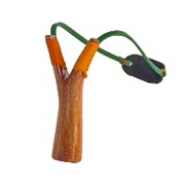
AnswerThe energy exerted or work done by our muscles on the rubber band is consumed in changing its shape. It gets stored in the stretched rubber band as its potential energy. It is this stored energy that is used by the rubber band to move to its original state, shape, and size. When the rubber band is released, this stored potential energy gets converted into kinetic energy.
If a pebble is placed in contact with the stretched rubber band, this kinetic energy is transferred to the pebble. This kinetic energy of the pebble is enough to do some destructive work, like breaking a glass window, injuring someone, etc.
View full question & answer→MCQ 821 Mark
- A
The kinetic energy remains constant.
- B
The final linear momentum is equal to the initial linear momentum.
- C
The final kinetic energy is equal to the initial kinetic energy.
- ✓
AnswerDuring an elastic collision, all of the above statements are valid.
View full question & answer→MCQ 831 Mark
The $K.E.$ of a body can be increased maximum by doubling its:
Answer$\text{K.E}=\frac{1}{2}\text{mv}^2$
$\text{K.E}\propto\text{m}\text{ &}\text{ K.E}\propto\text{v}^2$
So doubling mass will double the kinetic energy and doubling speed will make kinetic energy $4$ times.
View full question & answer→MCQ 841 Mark
During inelastic collision between two bodies, which of the following quantities always remain conserved
AnswerIf in a collision kinetic energy after collision is not equal to kinetic energy before collision, the collision is said to inelastic. Coefficient of restitution $0 < e < 1$ When we are considering the two bodies as system the total external force on the system will be zero.
Hence, total linear momentum of the system remain conserved.
Here kinetic energy appears in other forms,
i.e. energy may be lost in the form of heat and sound etc.
In some cases $\ce{(KE)_{final} < (KE)_{initial}}$such as when initial $KE$ is converted into intertial energy of the product $($as heat, elastic or excitation$)$ while in other cases $\ce{(KE)_{final} > (KE)_{initial}}$ such as when internal energy stored in the colliding particles is released.
Examples:
Collision between two billiard balls.
Collision between two automobiles on a road.
In fact all majority of collisions belong to this category.
View full question & answer→MCQ 851 Mark
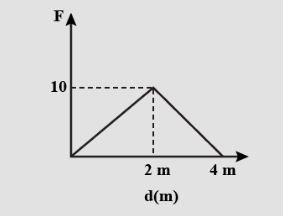
Work done from $d = 0m$ to $d = 4m$
- A
$12.5J$
- B
$15D$
- C
$17.5J$
- ✓
$20D$
View full question & answer→MCQ 861 Mark
$(i)$ What is the work done by the porter when he climbs up a height of $10m (g = 10\ ms^{-2})?$
- A
$5\ kJ^2$
- B
$50\ kJ$
- C
$100\ kJ^2$
- ✓
$5\ kJ$
AnswerCorrect option: D. $5\ kJ$
The work done by the potter is defined as the product of the force and the displacement.
Work done $=$ force $\times$ displacement
$= m \times g \times 10 ($ Since force $=$ mass $\times$ gravity$)$
$= 50 \times 10 \times 10$
$= 5KJ$
View full question & answer→MCQ 871 Mark
The speed of a motor increases from $1200$ rpm to $1800$ rpm in $20s.$ How many revolutions does it make during these second?
View full question & answer→MCQ 881 Mark
A fruit hanging from the top branch of a tree possesses:
- ✓
Gravitational potential energy.
- B
Elastic potential energy.
- C
- D
AnswerCorrect option: A. Gravitational potential energy.
A fruit, hanging from the top branch of a tree, is at rest at a certain height from the earth"s surface.
View full question & answer→MCQ 891 Mark
The first ball of mass $m$ moving with the velocity $v$ collides head on with the second ball of mass $m$ at rest. If the coefficient of restitution is $e$, then the ratio of the velocities of the first and the second ball after the collision is:
AnswerCorrect option: A. $\frac{1-\text{ e}}{1+\text{ e}}$
Here, $\text{m}_1=\text{m}_2=\text{m},\text{u}_1=\text{u},\text{u}_2=0$.
Let $\text{v}_1,\text{v}_2$ be their velocities after collision.
According to principle of conservation of linear momentum.
$\text{mu}+0=\text{m}(\text{v}_1+\text{v}_2)$ or $\text{ v}_1+\text{v}_2=\text{u}\dots\text{(i})$
By definition,
$\text{e}=\frac{\text{v}_2-\text{v}_1}{\text{u}-0}$ or $\text{ v}_2-\text{v}_1=\text{eu}\dots\text{(ii)}$
Add $(i)$ and $(ii),$
$\text{v}_2=\frac{\text{u(1+ e)}}{2}$
$\therefore\frac{\text{v}_1}{\text{v}_2}=\frac{1-\text{ e}}{1+\text{ e}}$
View full question & answer→MCQ 901 Mark
The hydroelectric plants do not produce electricity, if the water level in the dam is less than $34m.$
View full question & answer→MCQ 911 Mark
What is the dimensions of power:
- A
$\ce{[MLT^{-2}]}$
- B
$\ce{[ML^2T]}$
- C
$\ce{[ML^2T^2]}$
- ✓
$\ce{[MLT^{-3}]}$
AnswerCorrect option: D. $\ce{[MLT^{-3}]}$
View full question & answer→MCQ 921 Mark
A ball of mass $m$ moving with velocity in collides elastically with wall and rebounds. The change in momentum of the ball will be:
- A
$4\ce{min}$
- ✓
$2\ce{min}$
- C
$\ce{min}$
- D
$\ce{zero}$
AnswerCorrect option: B. $2\ce{min}$
Here, a ball of mass $m$ moving with velocity in collides elastically with wall hence, momentum is.
$\ce{pi = min}$
The ball rebounds from wall hence, final momentum is.
$\ce{pf = −min}$
Change in momentum is.
$\ce{\triangle p = pi − pf}$
$\ce{\triangle p = mv − (−min) = 2min}$
View full question & answer→MCQ 931 Mark
How many collision are possible between the blocks?
AnswerAs the distance keeps on decreasing and there will be a deceleration in the blocks.
In further results, collision increases frequently many times and slowly come in contact.
View full question & answer→MCQ 941 Mark
Name the type of energy $($kinetic energy $K$ or potential energy In the$)$ possessed in the following case.
A piece of stone placed on the roof.
AnswerWhen a stone is placed at the roof it is at a certain height that is given by In the $= m \times g \times h$
As we have a certain value for $h$ there would be some value for potential energy.
As the stone is at rest at the roof it will not have any kinetic energy as its velocity is zero, $\text{K}=\frac{1}{2}(\text{m}\times\text{in}^2)=0$
View full question & answer→MCQ 951 Mark
A body of mass $5\ kg$ is thrown vertically up with a kinetic energy of $490J.$ The height at which the kinetic energy of the body becomes half of the original value is:
- A
$12.5m$
- B
$10m$
- C
$2.5m$
- ✓
$5m$
AnswerAccording to the law of conservation of energy,
$\frac{1}{2}\text{Mv}^2=\frac{1}{2}\Big(\frac{1}{2}\text{mv}^2\Big)+\text{mgh}$
$\Rightarrow490+245+5\times9.8\times\text{h}$
$\text{h}=\frac{245}{49}=5\text{m}$
View full question & answer→MCQ 961 Mark
What is potential energy?
- ✓
Energy of an object due to its position or arrangement in a system.
- B
Energy of an object due to its nature or arrangement in a system.
- C
Energy of an object due to its shape or arrangement in a system.
- D
AnswerCorrect option: A. Energy of an object due to its position or arrangement in a system.
The potential energy is the stored energy of an object due to its position. some examples of potential energies are gravitational potential energy, Electrostatic potential energy and elastic energy etc.
A body placed at ground will have less gravitational potential energy than a body placed at some height. therefore, potential energy changes by changing the position of object.
View full question & answer→MCQ 971 Mark
A car is accelerated on a levelled road and attains a velocity $4$ times of its initial velocity. In this process, the potential energy of the car?
AnswerThe potential energy is the energy that an object has due to its position in a force field or that a system has due to the configuration of its parts. The potential energy of the car remains the same and will not change as the road is leveled and the height of the body remains the same, although its speed increases.
View full question & answer→MCQ 981 Mark
The energy stored in wound watch spring is:
AnswerCorrect option: B. $P.E.$
Energy stored in spring is potential energy, and it is defined as.
$\text{E}=\frac{1}{2}\text{Kx}^2$
where $k$ is spring constant, and $x$ is the extension/compression in spring.
View full question & answer→MCQ 991 Mark
A force $\text{F}=-\text{kx}^2(\text{x}\neq0)$ acts on a particle in $X-$direction. Find the work done by the force in displacing the particle from $x = -a$ to $x = 2a.$
- ✓
$\frac{3\text{k}}{2\text{a}}$
- B
$\frac{4\text{k}}{\text{a}^2}$
- C
$\frac{-3\text{k}}{2\text{a}^2}$
- D
$\frac{-9\text{k}}{\text{a}^2}$
AnswerCorrect option: A. $\frac{3\text{k}}{2\text{a}}$
View full question & answer→MCQ 1001 Mark
A block of mass $m$ is oscillating on smooth between two light springs of spring constant $K$ separated by a distance $I$ colliding elastically with the spring. If the velocity of the blocks is increased by an external impulse when it is not touching either of the spring then time period.
View full question & answer→