Questions · Page 2 of 4

M.C.Q (1 Marks)

MCQ 511 Mark
What type of lens from the following would you have in your magnifying lens to read a page in small print?
  • A
    A convex lens of focal length $80\ cm.$
  • B
    A concave lens of focal length $80\ cm.$
  • C
    A concave lens of focal length $4\ cm.$
  • A convex lens of focal length of $4\ cm.$
Answer
Correct option: D.
A convex lens of focal length of $4\ cm.$

A concave lens always produces virtual, erect and diminished images and the decrease in the size of the image depends on the position of the object.
Concave lens will shrink the size of the already small letters. Hence, it is undesirable.
A convex lens produces real and virtual, erect and inverted, diminished, same sized and magnified image of the object, depending upon the position of the object on the principal axis.
When the object is placed at a distance less than the focal length of convex lens, an enlarged and erect image of the object is formed, which will make it easier to read small letters.
View full question & answer
MCQ 521 Mark
The phenomenon due to which a ray of light $.........$ from its path while travelling from one optical medium to another optical medium is called refraction.
  • A
    Reflected
  • Deviates
  • C
    Normally
  • D
    Less
Answer
Correct option: B.
Deviates

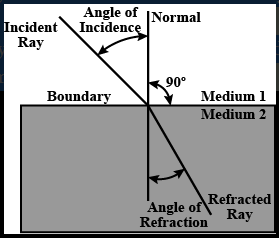
Refraction is a phenomenon in which when a ray passes from one medium to another it bends away from its straight$-$line path due to the difference in optical densities or refractive indices of the two mediums. This bending is known as deviation.

View full question & answer
MCQ 531 Mark
A glass slab is placed in the path of beam of convergent light. The point of convergence of light:
  • A
    Moves towards the glass slab
  • Moves away from the glass slab
  • C
    Remains at the same point
  • D
    Undergoes a lateral shift
Answer
Correct option: B.
Moves away from the glass slab

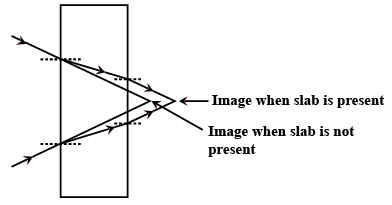
As a glass has refractive index of $\frac{3}{2}$ with respect to air, the convergent light will bend towards the normal in the glass and again bend away from the normal, but in the whole process the beam is displaced parallel to initial path as shown in figure and converge at a greater distance from the glass slab.

View full question & answer
MCQ 541 Mark
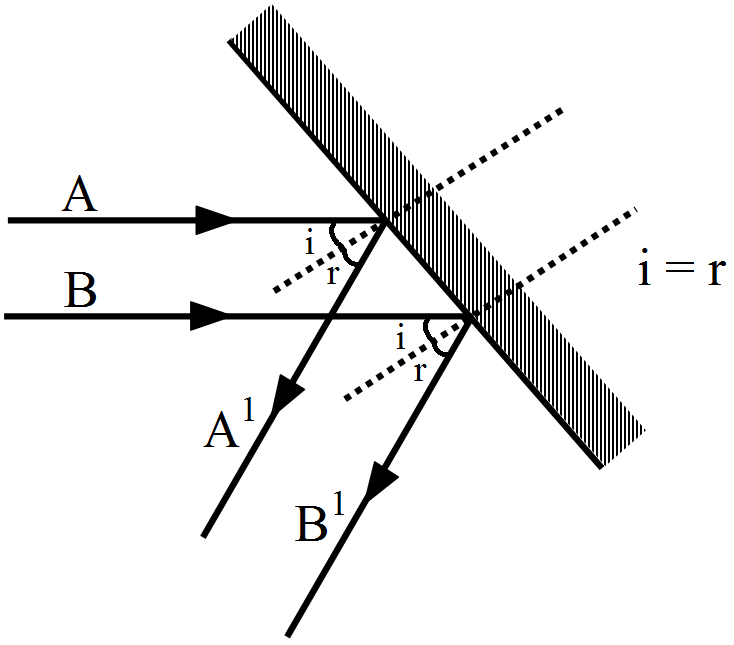
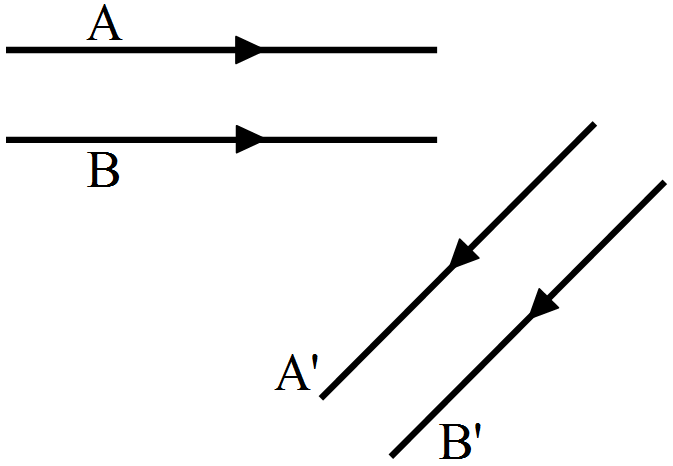
Two rays $A$ and $B$ being reflected by a mirror and going as $A'$ and $B'$. The mirror:
  • Is plane.
  • B
    Is convex.
  • C
    Is concave.
  • D
    May be any spherical mirror.
Answer
Correct option: A.
Is plane.


Here initially $A\ \&\ B$ is parallel to each other after reflection by teh plane mirror $A'\ \&\ B'$ goes Parallel to each other.

View full question & answer
MCQ 551 Mark
The lateral displacement depends on $.........$
  • A
    Thickness of the medium
  • B
    Refractive index of the medium
  • C
    Angle of incidence
  • All the above
Answer
Correct option: D.
All the above

Lateral displacement due to a slab is given by $\delta=\text{t}(\mu−1)$; where t is thickness of the medium and $\mu $ is refractive index of medium.

View full question & answer
MCQ 561 Mark
prism can produce a minimum deviation $\delta$ in a light beam. If three such prisms are combined, the minimum deviation that can be produced in this beam is:
  • A
    $0$
  • $\delta$
  • C
    $2\delta$
  • D
    $3\delta$
Answer
Correct option: B.
$\delta$

In combination $($refractive angles of prisms reversed with respect to each other$)$, the deviations through two prisms cancel out each other and the net deviation is due to the third prism only.

View full question & answer
MCQ 571 Mark
The phenomenon of change in the $.........$ of light when it passes from one transparent medium to another is refraction.
  • A
    Speed
  • B
    Direction
  • Both $A\ \&\ B$
  • D
    None of the above
Answer
Correct option: C.
Both $A\ \&\ B$

The phenomenon of change in the path of light when it passes from one transparent medium to another is refraction. This change in path is due to the change in the speed of light in different media.

View full question & answer
MCQ 581 Mark
If a glass prism is dipped in water, its dispersive power:
  • A
    Increases.
  • Decreases.
  • C
    Does not change.
  • D
    May increase or decrease depending on whether the angle of the prism is less than or greater than 60°.
Answer
Correct option: B.
Decreases.

If $\mu$ is the refractive index and A is the angle of prism, then the angular dispersion produced by the prism will be given by $\delta=(\mu-1)\text{A}.$
Because the relative refractive index of glass with respect to water is small compared to the refractive of glass with respect to air, the dispersive power of the glass prism is more in air than that in water.

View full question & answer
MCQ 591 Mark
If a ray of light goes from a rarer medium to a denser medium, will it bend towards the normal or away from it?
  • A
    Bends away from the normal
  • Bends towards the normal
  • C
    Goes undeviated
  • D
    Is reflected back
Answer
Correct option: B.
Bends towards the normal

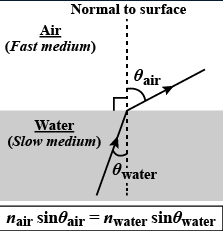
Refraction is the bending of light rays after entering a medium where its speed is different. Due to refraction of light, when a ray of light passes from a rarer medium to a denser medium, bends towards the normal to the boundary between the two media. The amount of bending depends on the indices of refraction of the two media. Hence, when a ray of light from air enters a denser medium, it bends towards the normal.

View full question & answer
MCQ 601 Mark
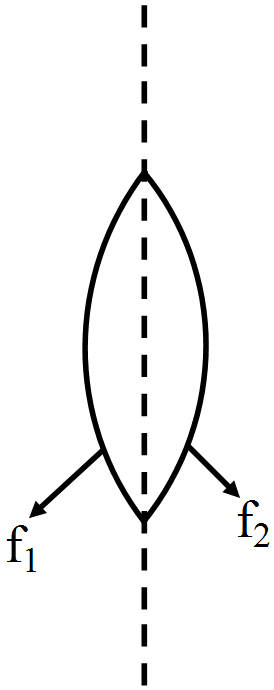
A symmetric double convex lens is cut in two equal parts by a plane containing the principal axis. If the power of the original lens was $4D$, the power of a divided lens will be:
  • $2D$
  • B
    $3D$
  • C
    $4D$
  • D
    $5D.$
Answer
Correct option: A.
$2D$


Before cut
$\frac{1}{\text{f}}=(\mu-1)\Big(\frac{2}{\text{R}}\Big)=4\text{D}$
After cut
$\frac{1}{\text{f}_1}=(\mu-1)\Big(\frac{1}{\text{R}}\Big)=\text{P}_1$
$\&\frac{1}{\text{f}_2}=(\mu-1)\Big(\frac{1}{\text{R}}\Big)=\text{P}_2$
Power of a divided lens will be = $P_1 + P_2$
$=(\mu-1)\Big(\frac{2}{\text{R}}\Big)$
$=4\text{D}$

View full question & answer
MCQ 611 Mark
The rays of different colors fail to converge at a point after going through a converging lens. This defect is called $.........$.
  • A
    Spherical aberration
  • B
    Distortion
  • C
    Coma
  • Chromatic aberration
Answer
Correct option: D.
Chromatic aberration

Chromatic aberation is the defect due to which rays of different wavelength converge at various point after passing through converging lens. It is due to varying refractive index for various wavelength.

View full question & answer
MCQ 621 Mark
In producing a pure spectrum, the incident light is passed through a narrow slit placed in the focal plane of an achromatic lens because a narrow slit:
  • A
    Produces less diffraction.
  • B
    Increases intensity.
  • C
    Allows only one colour at a time.
  • Allows a more parallel beam when it passes through the lens.
Answer
Correct option: D.
Allows a more parallel beam when it passes through the lens.

To produce a pure spectrum, a parallel light beam is required to be incident on the dispersing element. So, the incident light is passed through a narrow slit placed in the focal plane of an achromatic lens.

View full question & answer
MCQ 631 Mark
In case of a virtual and erect image, the magnification created by the mirror is:
  • Positive
  • B
    Negative
  • C
    Unity
  • D
    Infinity
Answer
Correct option: A.
Positive

Magnifaction of a mirror is defined as
$\text{m}=\frac{\text{size of image​}}{\text{size of object}}$
and since, in case of virtual and errect image, size of image and object both are positive. Hence magnification created by mirror is positive.

View full question & answer
MCQ 641 Mark
A screen is placed a distance $40\ cm$ away from an illuminated object. A converging lens is placed between the source and the screen and it is attempted to form the image of the source on the screen. If no position could be found, the focal length of the lens:
  • A
    Must be less than $10\ cm.$
  • Must be greater than $20\ cm.$
  • C
    Must not be greater than $20\ cm.$
  • D
    Must not be less than $10\ cm.$
Answer
Correct option: B.
Must be greater than $20\ cm.$

$\text{v}=(40-4)$
$\frac{1}{\text{f}}=\frac{1}{40-4}-\frac{1}{(-\text{u})}$
$\frac{\text{df}}{\text{du}}=0$ for f minimum.
$\frac{\text{df}}{\text{du}}=1-\frac{\text{u}}{20}=0$
$\text{u}=20$
$\text{f}_{\text{min}}=10\text{cm}$

View full question & answer
MCQ 651 Mark
The danger signals installed at the top of tall buildings are red in colour. These can be easily seen from a distance because among all other colours, the red light:
  • A
    Is scattered the most by smoke or fog.
  • Is scattered the least by smoke or fog.
  • C
    Is absorbed the most by smoke or fog.
  • D
    Moves fastest in air.
Answer
Correct option: B.
Is scattered the least by smoke or fog.

The amount of scattering is inversely proportional to the fourth power of wavelength. And since the wavelength of red has the longest wavelength, the amount of scattering becomes smaller.
Danger signals installed at the top of tall buildings or traffic signals are red so that they can be easily seen from a distance.

View full question & answer
MCQ 661 Mark
Mark the correct options:
  • A
    If the incident rays are converging, we have a real object.
  • If the final rays are converging, we have a real image.
  • C
    The image of a virtual object is called a virtual image.
  • D
    If the image is virtual, the corresponding object is called a virtual object.
Answer
Correct option: B.
If the final rays are converging, we have a real image.

This is because a real image is formed by converging reflected/ refracted rays from a mirror/ lens.

View full question & answer
MCQ 671 Mark
The angular dispersion produced by a prism:
  • Increases if the average refractive index increases.
  • B
    Increases if the average refractive index decreases.
  • C
    Remains constant whether the average refractive index increases or decreases.
  • D
    Has no relation with average refractive index.
Answer
Correct option: A.
Increases if the average refractive index increases.

If $\mu$ is the average refractive index and A is the angle of prism, then the angular dispersion produced by the prism is given by $\delta=(\mu-1)\text{A}.$

View full question & answer
MCQ 681 Mark
A narrow beam of white light goes through a slab having parallel faces.
  • A
    The light never splits in different colours.
  • B
    The emergent beam is white.
  • C
    The light inside the slab is split into different colours.
  • D
    The light inside the slab is white.
View full question & answer
MCQ 691 Mark
An experiment is performed to find the refractive index of glass using a travelling microscope. In this experiment distances are measured by:
  • A
    A screw gauge provided on the microscope
  • B
    A standard laboratory scale
  • A vernier scale provided on the microscope
  • D
    A meter scale provided on the microscope
Answer
Correct option: C.
A vernier scale provided on the microscope

The travelling microscope moves horizontally on a main scale provided with the vernier scale provided with the microscope that's why, In a travelling microscope to find the refractive index of glass we measure distance by a vernier scale provided on the microscope.

View full question & answer
MCQ 701 Mark
A man is looking at a small object placed at his near point. Without altering the position of his eye or the object, he puts a simple microscope of magnifying power $5X$ before his eyes. The angular magnification achieved is:
  • A
    $5$
  • B
    $2.5$
  • $1$
  • D
    $0.2$
Answer
Correct option: C.
$1$
We have,
$h =$ Object height
$u =$ Object distance $= 25cm$
$D =$ Near point $= 25cm$
Now,
$\text{m}=\frac{\frac{\text{h}}{\text{u}}}{\frac{\text{h}}{\text{D}}}$
$\Rightarrow\text{m}=\frac{\frac{\text{h}}{25}}{\frac{\text{h}}{25}}$
$\Rightarrow \text{m}=1$
View full question & answer
MCQ 711 Mark
A short pulse of white light is incident from air to a glass slab at normal incidence. After travelling through the slab, the first colour to emerge is:
  • A
    Blue.
  • B
    Green.
  • C
    Violet.
  • Red.
Answer
Correct option: D.
Red.

As velocity of wave is given by the relation $\text{v}=\text{f}\lambda$. When light ray goes from one medium to other medium, the frequency of light remains unchanged. Hence $\text{v}\propto\lambda$ or greater the wavelength, greater the speed.
The light of red colour is of highest wavelength and therefore of highest speed. Therefore, after travelling through the slab, the red colour emerges first.

View full question & answer
MCQ 721 Mark
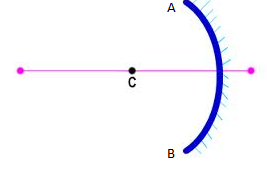
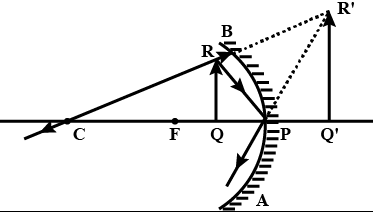
The distance between the extreme points on the periphery of the mirror is called:
  • A
    Focal length
  • B
    Radius of curvature
  • Principal section
  • D
    None of these
Answer
Correct option: C.
Principal section

Principal section is also defined as the normal 'side view' of the mirror for a ray diagram. In the diagram $AB$ is the principal section.

View full question & answer
MCQ 731 Mark
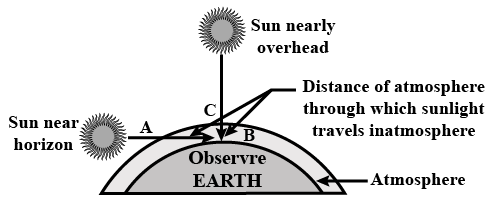
How can we explain the reddish appearance of sun at sunrise or sunset?
  • Scattering of blue light is more than the scattering of red light.
  • B
    Scattering of red light is more than the scattering of blue light.
  • C
    Intensity of sun reduces during sunrise and sunset.
  • D
    Due to the view angle, it appears blue.
Answer
Correct option: A.
Scattering of blue light is more than the scattering of red light.

During sunrise or sunset, the light has to pass through greater distance in the atmosphere. The blue light is removed as it gets scattered the most while the red colour is less scattered and reaches the observer. Thus, we find reddish colour of the sun during sunrise or sunset.

View full question & answer
MCQ 741 Mark
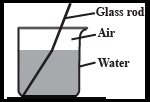
Why does a straight rod appear bent in water?
  • A
    Due to reflection of light
  • Due to refraction of light
  • C
    Due to variable refractive index of water.
  • D
    None of the above
Answer
Correct option: B.
Due to refraction of light

This phenomenon occurs due to the property of light called refraction of light. When a stick is immersed in water, in actually we are putting it from rarer medium to denser medium. So, when the rays of light pass from a rarer medium to the denser medium they move towards the normal, the part of stick immersed in water appears to bend when immersed in water and this refraction causes an apparent shift in the position of the part of the rod within the water.

View full question & answer
MCQ 751 Mark
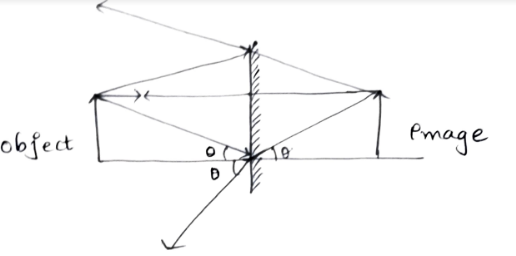
A plane mirror produces an image that is:
  • A
    Real, inverted and larger than the object.
  • B
    Real, upright and same size as the object.
  • C
    Real upright and smaller than the object.
  • Virtual, upright and the same size of the object.
Answer
Correct option: D.
Virtual, upright and the same size of the object.

So a plane mirror always forms a virtual, upright and same sized image. ​

View full question & answer
MCQ 761 Mark
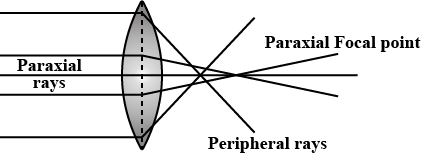
The rays parallel and close to the principal axis are called:
  • A
    Converging rays
  • B
    Diverging rays
  • C
    Coherent rays
  • Paraxial rays
Answer
Correct option: D.
Paraxial rays

The rays parallel and close to the principal axis are called paraxial rays. The rays parallel but not close to the principal axis are called peripheral rays.

View full question & answer
MCQ 771 Mark
When a ray of light passes from a denser to a rarer medium, some part of it gets $.......$ into the denser medium:
  • Reflected
  • B
    Refracted
  • C
    Both
  • D
    None
Answer
Correct option: A.
Reflected
When a ray of light passes from a denser to a rarer medium, some part of it gets refracted into the rarer medium such that it bends away from the normal. Some part of it gets reflected back into the denser medium. The light reflected back into the denser medium is said to be internally reflected.
View full question & answer
MCQ 781 Mark
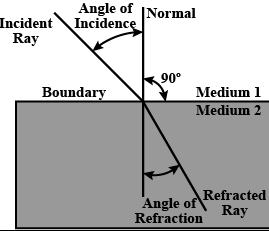
The bending of light as it passes from one medium into another is commonly known as:
  • A
    Reflection
  • Refraction
  • C
    Scattering
  • D
    Dispersion
Answer
Correct option: B.
Refraction

In refraction ray of light passes from one medium to another medium. The ray of light bends towards normal in the denser medium.

View full question & answer
MCQ 791 Mark
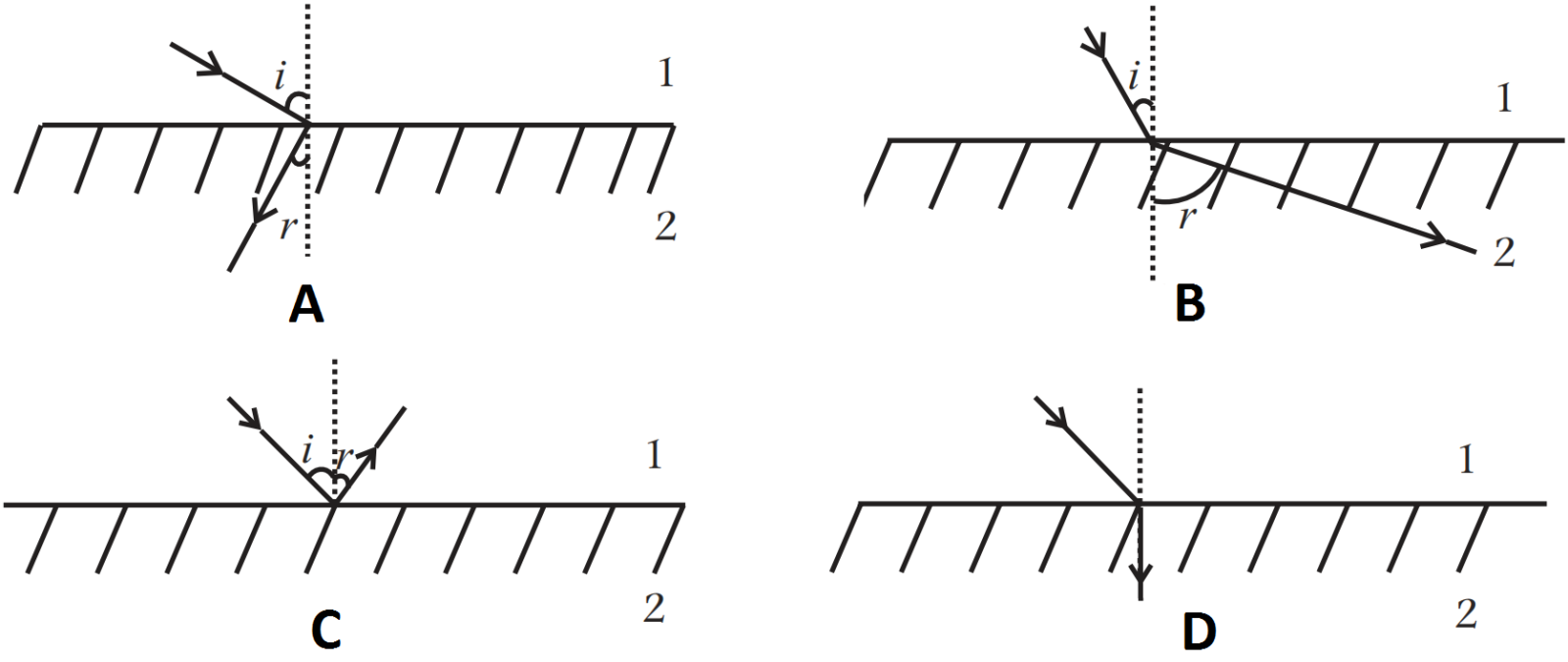
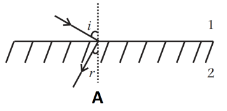
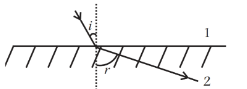
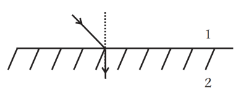
There are certain material developed in laboratories which have a negative refractive index (Fig). A ray incident from air (medium 1) into such a medium (medium 2) shall follow a path given by:
  • B
  • C
  • D
Answer
Correct option: A.
​​​​​​​​​​​​​​
Solution:

The materials with negative refractive index responds to Snell’s law just opposite way. If incident ray from air (Medium 1) incident on those material, the ray refract or bend same side of the normal as in option (a).
View full question & answer
MCQ 801 Mark
The size of an object as perceived by an eye depends primarily on:
  • A
    Actual size of the object.
  • B
    Distance of the object from the eye.
  • C
    Aperture of the pupil.
  • Size of the image formed on the retina.
Answer
Correct option: D.
Size of the image formed on the retina.

An eye consists of a lens that works on the principle on which a glass lens works. It forms the image on the screen called retina. The magnification, in this case, depends on the ratio of the image to the object height.

View full question & answer
MCQ 811 Mark
To increase the angular magnification of a simple microscope, one should increase:
  • A
    The focal length of the lens.
  • The power of the lens.
  • C
    The aperture of the lens.
  • D
    The object size.
Answer
Correct option: B.
The power of the lens.
For a simple microscope in normal adjustment, the object is placed at a distance equal to $f ($the ​focal length$)$ from the lens, And the angular magnification is given by the relation
$\text{m}=\frac{\text{D}}{\text{f}}$
for $\text{u}<\text{f},\text{m}=\frac{\text{D}}{\text{f}}+1$
power of lens $=\frac{1}{\text{f}}$
Angular magnification depends on power.
View full question & answer
MCQ 821 Mark
A ray of light travels from a denser to a rarer medium then, the ray:
  • A
    Doesn't bend at all
  • B
    Bends towards the normal
  • Bends away from the normal
  • D
    Goes along the normal
Answer
Correct option: C.
Bends away from the normal

When light travels from denser to rarer medium, the velocity of light increases which results in bending of light away from the normal.

View full question & answer
MCQ 831 Mark
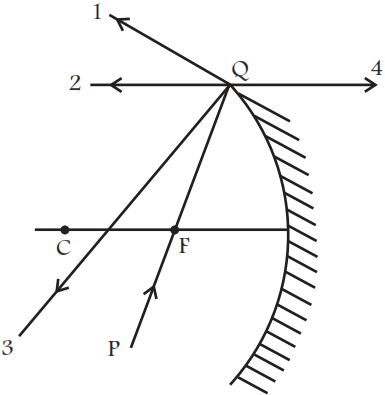
The direction of ray of light incident on a concave mirror is shown by $PQ$ while directions in which the ray would travel after reflection is shown by four rays marked $1, 2, 3$ and $4 (Fig)$. Which of the four rays correctly shows the direction of reflected ray?
  • A
    $1$
  • $2$
  • C
    $3$
  • D
    $4$
Answer
Correct option: B.
$2$

The ray $PQ$ of light passes through focus $F$ and incident on the concave mirror, after reflection, should become parallel to the principal axis and shown by ray $2$ in the figure.
Important points: We can locate the image of any extended object graphically by drawing any two of the following four special rays:
A ray initially parallel to the principal axis is reflected through the focus of the mirror $(1).$
A ray passing through the center of curvature is reflected back along itself $(3).$
A ray initially passing through the focus is reflected parallel to the principal axis $(2).$
A ray incident at the pole is reflected symmetrically.

View full question & answer
MCQ 841 Mark
A manufacturer uses a concave lens instead of a convex lens in a magnifying glass by mistake. What will be the effect on the working of the lens?
  • A
    Images will be blurred.
  • B
    Images will be clearer.
  • Images will be diminished.
  • D
    Images will be further magnified.
Answer
Correct option: C.
Images will be diminished.

Images formed by a concave lens are always diminished.

View full question & answer
MCQ 851 Mark
The refraction of light is commonly known as:
  • Bending
  • B
    Scattering
  • C
    Reflection
  • D
    Interference
Answer
Correct option: A.
Bending

The refraction of light is commonly known as bending.
The refracted rays bend towards the normal when they enter from rarer to denser medium.
The refracted rays bend away from the normal when they enter from denser to rarer medium.

View full question & answer
MCQ 861 Mark
Shift by which the object appears to be raised depends on:
  • A
    The refractive index of the medium
  • B
    The thickness of denser medium
  • C
    Colour of incident light
  • All
Answer
Correct option: D.
All

Shift by which the object appears to be raised depends on these $4$ factors. The shift increases with increase in refraction index of medium and also with the thickness of denser medium.

View full question & answer
MCQ 871 Mark
Which of the following (referred to a spherical mirror) do (does) not depend on whether the rays are paraxial or not?
  • A
    Pole.
  • B
    Focus.
  • C
    Principal axis.
  • All of the above.
Answer
Correct option: D.
All of the above.
Explanation:
If Paraxial rays comes to parallel to the spherical mirror is pasees to the Focus of the spherical mirror.
View full question & answer
MCQ 881 Mark
The apparent vertical shift of the image of a coin placed at the bottom of a water tank having constant depth of water is proportional to $($given refractive index of water $= \mu).$
  • A
    $\mu$
  • $\frac{1}{\mu}$
  • C
    $\mu-1$
  • D
    $\mu+1$
Answer
Correct option: B.
$\frac{1}{\mu}$

The apparent vertical shift is given by the equation $\text{AD}=\frac{\text{RD}}{\mu}$, that is, ​$\mu=\frac{\text{RD}}{\text{AD}}$, where $AD$ is the apparent vertical shift, $RD$ is the real depth of the tank and $n$ is the refractive index of the denser medium, that is, water.
As real depth and refractive index is going to be constant always, the apparent shift or depth will be independent of viewing angle.
From the above equation, we can see that the apparent vertical shift is inversely proportional to the refractive index. That is, $\frac{1}{\mu}$​.

View full question & answer
MCQ 891 Mark
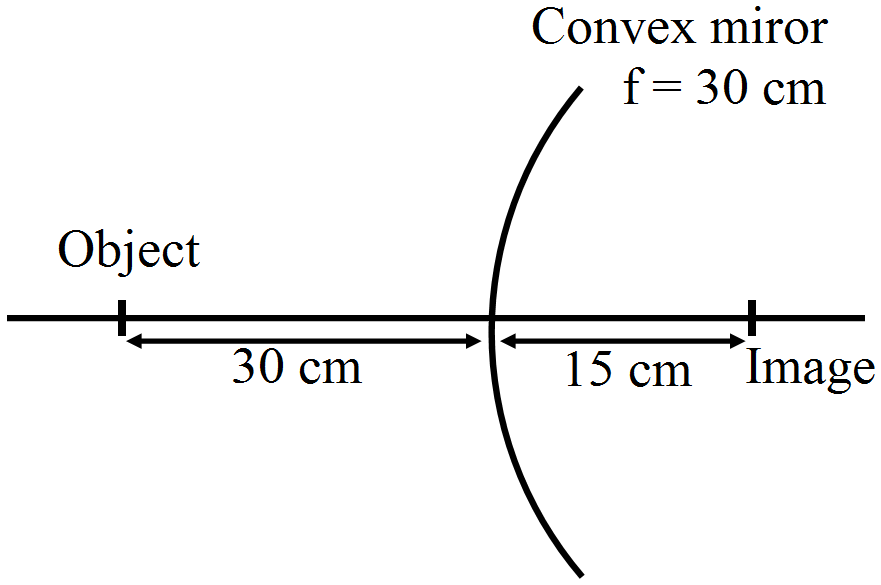
A point object is placed at a distance of $30\ cm$ from a convex mirror of focal length $30\ cm$. The image will form at:
  • Infinity.
  • B
    Pole.
  • C
    Focus.
  • D
    $15\ cm$ behind the mirror.
Answer
Correct option: A.
Infinity.
By mirror formula:
$\frac{1}{\text{V}}+\frac{1}{\text{u}}=\frac{1}{\text{f}}$
Here $ u = -30\ cm$
$f = +30\ cm$
So, $\frac{1}{\text{V}}-\frac{1}{30}=\frac{1}{30}$
$Þ v= 15\ cm$ behind the mirror.
View full question & answer
MCQ 901 Mark
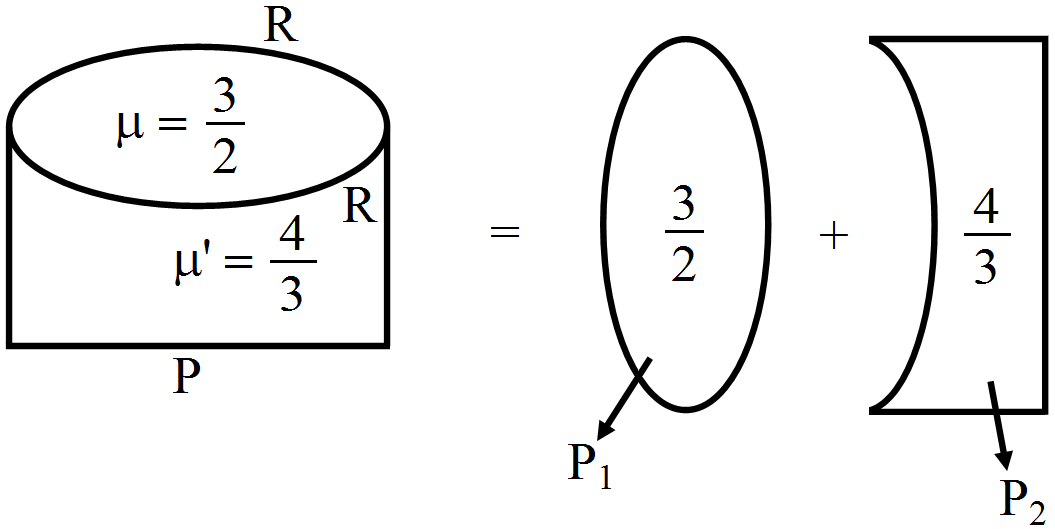
A thin lens is made with a material having refractive index $\mu=1.5.$ Both the sides are convex. It is dipped in water $(\mu=1.33).$ It will behave like:
  • A convergent lens.
  • B
    A divergent lens.
  • C
    A rectangular slab.
  • D
    A prism.
Answer
Correct option: A.
A convergent lens.


Here $P, P_1\ \&\ P_2$ are the power of Lenses.
$P = P_1+P_2$
$\frac{1}{\text{f}}=\frac{1}{\text{f}_1}+\frac{1}{\text{f}_2}$
$=(\mu-1)\Big(\frac{2}{\text{R}}\Big)+(\mu'-1)\Big(\frac{-1}{\text{R}}\Big)$
$=\Big(\frac{3}{2}-1\Big)\Big(\frac{2}{\text{R}}\Big)-\Big(\frac{4}{3}-1\Big)\Big(\frac{1}{\text{R}}\Big)$
$\frac{1}{\text{f}}=\frac{1}{\text{R}}-\frac{1}{3\text{R}}$
$\frac{1}{\text{f}}=\frac{3-1}{3\text{R}}$
$\text{f}=\frac{3\text{R}}{2}$
focal length of combined is positive means it will behave like a canvergent lens.

View full question & answer
MCQ 911 Mark
What are the colours of the Sun observed most during sunrise/sunset and noon?
  • A
    White and red
  • Reddish and orange
  • C
    Yellow and reddish
  • D
    Orange and blue
Answer
Correct option: B.
Reddish and orange
During sunrise and sunset the sun rays have to pass through a larger distance and also a greater thickness of air since it is low in the sky. At t hese positions, the sky looks orange$-$red colour because photons of red and orange light are least scattered through the atmosphere and are able to reach our eyes.
View full question & answer
MCQ 921 Mark
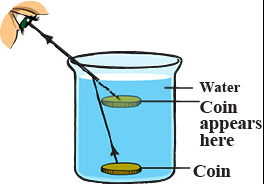
A coin kept in a container and not visible can be viewed by pouring water into the container. It happens because of the:
  • A
    Reflection of light.
  • Refraction of light.
  • C
    Variable refractive index of water.
  • D
    None of the above.
Answer
Correct option: B.
Refraction of light.

When water is poured then it is due to refraction of light the coin becomes visible. When the light rays travel from the water medium $($denser$)$ to the air medium $($rarer$)$ it bends away from the normal due to the refraction. Therefore, an image of the coin is formed at a smaller depth causing it to be visible $($as shown in the figure$)$.

View full question & answer
MCQ 931 Mark
$\mu_\text{V}​>\mu_\text{R}$​ indicates:
  • Shift is more for violet colour
  • B
    Shift is more for red colour
  • C
    Shift is equal for both red and voilet
  • D
    All
Answer
Correct option: A.
Shift is more for violet colour

Since, $\mu_\text{V}​>\mu_\text{R}$​, the shift is more for he violet light than the red light in a given medium.

View full question & answer
MCQ 941 Mark
The image formed behind a mirror and a virtual image:
  • Are of same nature
  • B
    Are of different nature
  • C
    Are of same nature only in space
  • D
    Are of different nature only in space
Answer
Correct option: A.
Are of same nature

The image formed behind a mirror is virtual in nature. So, they are of the same nature always.

View full question & answer
MCQ 951 Mark
Consider the following two statements:
  1. Line spectra contain information about atoms.
  2. Band spectra contain information about molecules.
  • A
    Both $A$ and $B$ are wrong
  • B
    $A$ is correct but $B$ is wrong.
  • C
    $B$ is correct but $A$ is wrong
  • Both $A$ and $B$ are correct.
Answer
Correct option: D.
Both $A$ and $B$ are correct.

Because line spectra contain wavelengths that are absorbed by atoms and band spectra contain bunch wavelengths that are absorbed by molecules, both statements are correct.

View full question & answer
MCQ 961 Mark
The radius of curvature of the curved surface of a plano$-$convex lens is $20\ cm$. If the refractive index of the material of the lens be $1.5,$ it will.
  • A
    Act as a convex lens only for the objects that lie on its curved side.
  • B
    Act as a concave lens for the objects that lie on its curved side.
  • Act as a convex lens irrespective of the side on which the object lies.
  • D
    Act as a concave lens irrespective of side on which the object lies.
Answer
Correct option: C.
Act as a convex lens irrespective of the side on which the object lies.

We know that, $\text{f}=\frac{\text{R}}{\mu-1}$
Substituting $\text{R}=20\text{cm},\mu=1.5,$ we get
$\text{f}=\frac{20}{1.5-1}=40\text{cm}$
Since, the focal length is greater than zero.
Therefore, lens act as a convex lens irrespective of the side on which the object lies.

View full question & answer
MCQ 971 Mark
The ratio of real depth to apparent depth is called the the:
  • Refractive index
  • B
    Lateral displacement
  • C
    Relative density
  • D
    None of these
Answer
Correct option: A.
Refractive index

$\text{refractive index} = \frac{\text{actual depth​}}{\text{apparent depth}}$

View full question & answer
MCQ 981 Mark
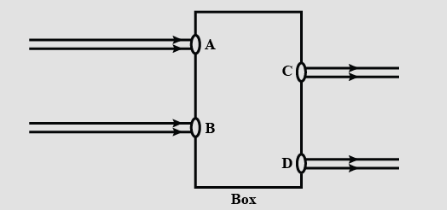
Beams of light are incident through the holes $A$ and $B$ and emerge out of the box through the holes $C$ and $D$ respectively as shown in the Figure. Which of the following could be inside the box?
  • A rectangular glass slab
  • B
    A convex lens
  • C
    A concave lens
  • D
    A glass prism
Answer
Correct option: A.
A rectangular glass slab

Since lateral displacement is taking place in the parallel rays, a rectangular glass slab could be inside the box. Lateral displacement is the distance by which the incident light has been displaced after bending through the glass slab.

View full question & answer
MCQ 991 Mark
As our eyes can not retrace the bent path of light, a stick, dipped in water, appears:
  • Bent upward
  • B
    Bent downward
  • C
    Straight
  • D
    Bent sideways
Answer
Correct option: A.
Bent upward

A straight stick, dipped in water, appears to be bent upward as our eyes can not retrace the bent path of light.

View full question & answer
MCQ 1001 Mark
In image formation from spherical mirrors, only paraxial rays are considered because they:
  • A
    Are easy to handle geometrically.
  • B
    Contain most of the intensity of the incident light.
  • Form nearly a point image of a point source.
  • D
    Show minimum dispersion effect.
Answer
Correct option: C.
Form nearly a point image of a point source.

In Image formation from spherical mirrors, only paraxial rays are considered because they form nearly a point Image of a point source. Angle of Incidence of Paraxial rays is very small.

View full question & answer