Questions

Case study (4 Marks)

Take a timed test

10 questions · self-marked practice — reveal the answer and mark yourself.

Question 14 Marks
Read the passage given below and answer the following questions:
Coordination compounds are formulated and named according to the IUPAC system.
Few rules for naming coordination compounds are:
  1. In ionic complex, the cation is named first and then the anion.
  2. In the coordination entity, the ligands are named first and then the central metal ion.
  3. When more than one type of ligands are present, they are named in alphabetical order of preference without any consideration of charge.
The following questions are multiple choice questions. Choose the most appropriate answer:
  1. The IUPAC name of the complex $[Pt(NH_3)_3Br(NO_2)Cl]Cl$ is:
  1. Triamminechlorobromonitroplatinum (IV) chloride.
  2. Triamminebromonitrochloroplatinum (IV) chloride.
  3. Triamminebromidochloridonitroplatinum (IV) chloride.
  4. Triamminenitrochlorobromoplatinum (IV) chloride.
  1. The IUPAC name of $[Ni(CO)_4]$ is:
  1. Tetracarbonylnickel (II).
  2. Tetracarbonylnickel (0).
  3. Tetracarbonylnickelate (II).
  4. Tetracarbonylnickelate (0).
  1. As per IUPAC nomenclature, the name of the complex $[Co(H_2O)_4(NH_3)_2]Cl_3$ is:
  1. Tetraaquadiamminecobalt (II) chloride.
  2. Tetraaquadiamminecobalt (III) chloride.
  3. Diamminetetraaquacobalt (II) chloride.
  4. Diamminetetraaquacobalt (III) chloride.
  1. Which of the following represents correct formula of dichloridobis(ethane -1, 2-diamine)cobalt (III) ion?
  1. $[CoCl_2(en)]^{2+}$
  2. $[CoCl_2(en)_2]^{2+}$
  3. $[CoCl_2(en)]^+$
  4. $[CoCl_2(en)_2]^+$
  1. Correct formula of pentaamminenitro$-O-$cobalt (III) sulphate is:
  1. $[Co(NO_2)(NH_3)_5]SO_4$
  2. $[Co(ONO)(NH_3)_5]SO_4$
  3. $[Co(NO_2)(NH_3)_4](SO_4)_2$
  4. $[Co(ONO)(NH_3)_4](SO_4)_2$
Answer
  1. (c) Triamminebromidochloridonitroplatinum (IV) chloride.
Explanation:

Ligands are named in alphabetical order irrespective of their charge.
  1. (b) Tetracarbonylnickel $(0).$
  2. (d) Diamminetetraaquacobalt $(III)$ chloride.
  3. (d) $[CoCl_2(en)_2]^+$
  4. (b) $[Co(ONO)(NH_3)_5]SO_4$
Explanation:

Ligand $\text{NO}_2^-$ is ambidentate ligand as it can donate electrons through either nitrogen $(NO_2)$ or oxygen (ONO).
View full question & answer
Question 24 Marks
Read the passage given below and answer the following questions:
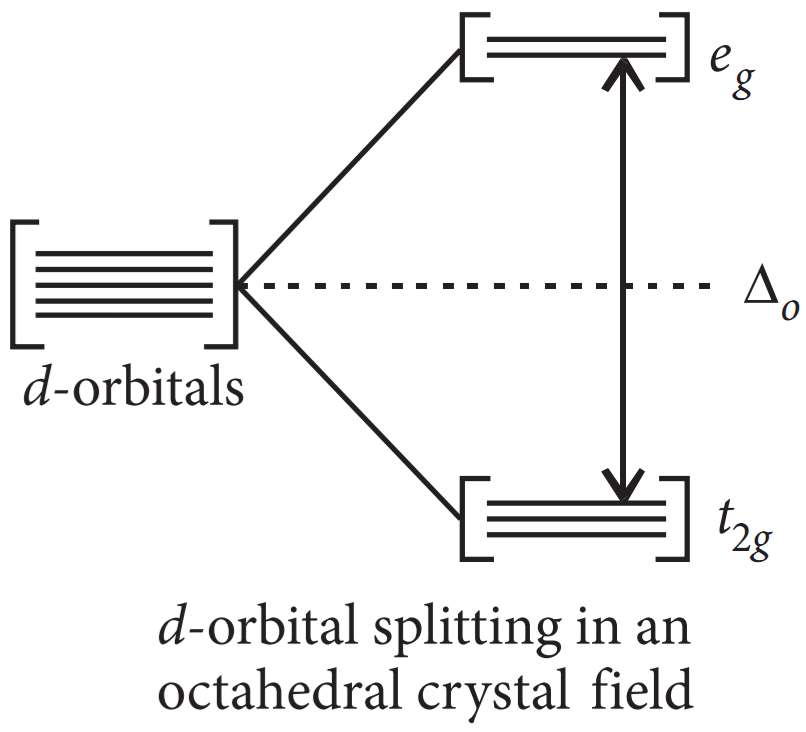
Arrangement of ligands in order of their ability to cause splitting $(\Delta)$ is called spectrochemical series. Ligands which cause large splitting (large $\Delta$) are called strong field ligands while those which cause small splitting (small $\Delta$) are called weak field ligands. When strong field ligands approach metal atom/ ion, the value of $\Delta_0$ is large, so that electrons are forced to get paired up in lower energy $t_{2g}$ orbitals. Hence, a low-spin complex is resulted from strong field ligand. When weak field ligands approach metal atom/ ion, the value of $\Delta_0$ is small, so that electrons enter high energy $e_g$ orbitals rather than pairing in low energy $t_{2g}$ orbitals. Hence, a high-spin complex is resulted from weak field ligands. Strong field ligands have tendency to form inner orbital complexes by forcing the electrons to pair up. Whereas weak field ligands have tendency to form outer orbital complex because inner electrons generally do not pair up.
In these questions (Q. No. i-iv), a statement of assertion followed by a statement ofreason is given. Choose the correct answer out of the following choices.
  1. Assertion and reason both are correct statements and reason is correct explanation for assertion.
  2. Assertion and reason both are correct statements but reason is not correct explanation for assertion.
  3. Assertion is correct statement but reason is wrong statement.
  4. Assertion is wrong statement but reason is correct statement.
The following questions are multiple choice questions. Choose the most appropriate answer:
  1. Assertion: In tetrahedral coordination entity formation, the d orbital splitting is inverted and is smaller as compared to the octahedral field splitting.
Reason: Spectrochemical series is based on the absorption of light by complexes with different ligands.
  1. Assertion: In high spin situation, configuration of $d^5$ ions will be $\text{t}^3_{2\text{g}}\text{e}^2_\text{g}.$
Reason: In high spin situation, pairing energy is less than crystal field energy.
  1. Assertion: $F^-$ ion is a weak field ligand and fonns outer orbital complex.
Reason: $F^-$ ion cannot force the electrons of $d_{z^2}$ and $d_{x^2-y^2}$ orbitals of the inner shell to occupy $d_{xy}, d_{yz}$ and $d_{zx}$ orbitals of the same shell.
  1. Assertion: The crystal field model is successful in explaining the formation, structures, colour and magnetic properties of coordination compounds.
Reason: In spectrochemical series, ligands are arranged in a series of increasing field strength.
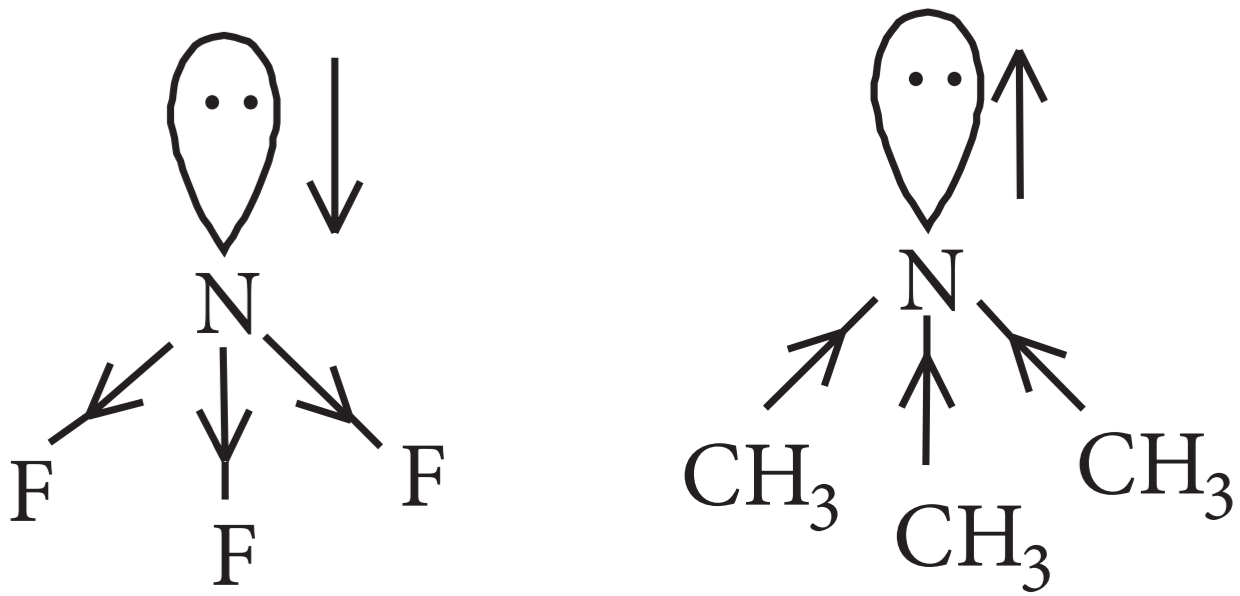
  1. Assertion: $NF_3$ is a weaker ligand than $N(CH_3)_3$.
Reason: $NF_3$ ionizes to give $F^-$ ions in aqueous solution.
Answer
  1. (b) Assertion and reason both are correct statements but reason is not correct explanation for assertion.
  2. (c) Assertion is correct statement but reason is wrong statement.
Explanation:


$\therefore$ In high spin situation, $\Delta_0<\text{P},$ in $d^5$ configuration, $4^{th}$ and $5^{th}$ electron are added to eg rather than $t_{2g}$ So, configuration of $d^5$ ion will be $\text{t}^3_{2\text{g}}\text{e}^2_\text{g}.$
  1. (a) Assertion and reason both are correct statements and reason is correct explanation for assertion.
  1. (b) Assertion and reason both are correct statements but reason is not correct explanation for assertion.
  2. (c) Assertion is correct statement but reason is wrong statement.
Explanation:

Due to high electronegativity of F-atoms, the lone pair of N-atom in $NF_3$ molecule cannot be ligated easily. Whereas in $N(CH_3)_3, CH_3$ group is a electron releasing group, thus lone pair of N-atom in $N(CH_3)_3$ molecule can be ligated easily.


Except, nitrogen fluoride, all other halides hydrolyse in water.
View full question & answer
Question 34 Marks
Read the passage given below and answer the following questions:
Valence bond theory considers the bonding between the metal ion and the ligands as purely covalent. On the other hand, crystal field theory considers the metal-ligand bond to be ionic arising from electrostatic interaction between the metal ion and the ligands. In coordination compounds, the interaction between the ligand and the metal ion causes the five d-orbitals to split-up. This is called crystal field splitting and the energy difference between the two sets of energy level is called crystal field splitting energy. The crystal field splitting energy $(\Delta_0)$ depends upon the nature of the ligand. The actual configuration of complexes is divided by the relative values of $\Delta_0$ and P (pairing energy).
If $\Delta_0<\text{P},$ then complex will be high spin.
If $\Delta_0>\text{P},$ then complex will be low spin
The following questions are multiple choice questions. Choose the most appropriate answer:
  1. Which of the following ligand has lowest $\Delta_0$ value?
  1. $CN^-$
  2. $CO$
  3. $F^-$
  4. $NH_3$
  1. The crystal field splitting energy for octahedral $(\Delta_0)$ and tetrahedral $(\Delta_t)$ complex is related as:
  1. $\Delta_\text{t}=\frac{1}{2}\Delta_0$
  2. $\Delta_\text{t}=\frac{4}{9}\Delta_0$
  3. $\Delta_\text{t}=\frac{3}{5}\Delta_0$
  4. $\Delta_\text{t}=\frac{2}{5}\Delta_0$
  1. On the basis of crystal field theory, the electronic configuration of $d_4$ in two situations : (i) t.0 > P and (ii) t.0
  (i) (ii)
(a) $\text{t}^4_{2\text{g}}\text{e}^0_\text{g}$ $\text{t}^3_{2\text{g}}\text{e}^1_\text{g}$
(b) $\text{t}^3_{2\text{g}}\text{e}^1_\text{g}$ $\text{t}^4_{2\text{g}}\text{e}^0_\text{g}$
(c) $\text{t}^3_{2\text{g}}\text{e}^1_\text{g}$ $\text{t}^3_{2\text{g}}\text{e}^1_\text{g}$
(d) $\text{t}^4_{2\text{g}}\text{e}^0_\text{g}$ $\text{t}^4_{2\text{g}}\text{e}^0_\text{g}$
  1. Using crystal field theory, calculate magnetic moment of central metal ion of $[FeF_6]^{4-}$.
  1. 1.79B.M.
  2. 2.83B.M.
  3. 3.85B.M.
  4. 4.9B.M.
  1. Electronic configuration of d-orbitals in $[Ti(H_2O)_6]^{3+}$​​​​​​​ ion in an octahedral crystal field is:
  1. $\text{t}^1_{2\text{g}}\text{e}^0_\text{g}$
  2. $\text{t}^2_{2\text{g}}\text{e}^0_\text{g}$
  3. $\text{t}^0_{2\text{g}}\text{e}^1_\text{g}$
  4. $\text{t}^1_{2\text{g}}\text{e}^1_\text{g}$
Answer
  1. (c) $F^-$
Explanation:
Spectrochemical series:
$\text{I}^- < \text{Br}^- < \text{SCN}^- < \text{Cl}^- < \text{S}^{2-} < \text{F}^- < \text{OH}^- < \text{C}_2\text{O}^{2-}_4 < \text{O}^{2-} \\< \text{H}_2\text{O} < \text{NCS}^- < \text{EDTA }^{4-} <\text{ NH}_3 < \text{en} < \text{NO}_2^- < \text{CN}^-<\text{CO}$
  1. (b) $\Delta_\text{t}=\frac{4}{9}\Delta_0$
  2. (a)
    (a) $\text{t}^4_{2\text{g}}\text{e}^0_\text{g}$ $\text{t}^3_{2\text{g}}\text{e}^1_\text{g}$
Explanation:
When $\Delta_0>\text{P},$ the electrons paired up in the $t_{2g}$ level rather than going to the $e_g$ level, so,
when $\Delta_0>\text{P}:\text{t}^4_{2\text{g}}\text{e}^0_\text{g}$
and $\Delta_0<\text{P}:\text{t}^3_{2\text{g}}\text{e}^1_\text{g}$
  1. (d) 4.9B.M.
Explanation:
$\text{Fe}^{2+}:3\text{d}^6\Rightarrow\text{t}^4_\text{2g}\text{e}^2_\text{g}$
(Since, $F^-$​​​​​​​ is a weak field ligand)
Hence four unpaired electrons are present.
Magnetic moment $(\mu)$
$=\sqrt{\text{n(n+2)}}=\sqrt{4(4+2)}=4.9\text{B.M.}$
  1. (a) $\text{t}^1_{2\text{g}}\text{e}^0_\text{g}$
Explanation:
In $[Ti(H_2O)_6]^{3+}$, Ti is in +3 oxidation state and there is only one electron in d-orbital.
View full question & answer
Question 44 Marks
Read the passage given below and answer the following questions:
To explain bonding in coordination compounds various theories were proposed. One of the important theory was valence bond theory. According to that, the central metal ion in the complex makes available a number of empty orbitals for the formation of coordination bonds with suitable ligands. The appropriate atomic orbitals of the metal hybridise to give a set of equivalent orbitals of definite geometry.
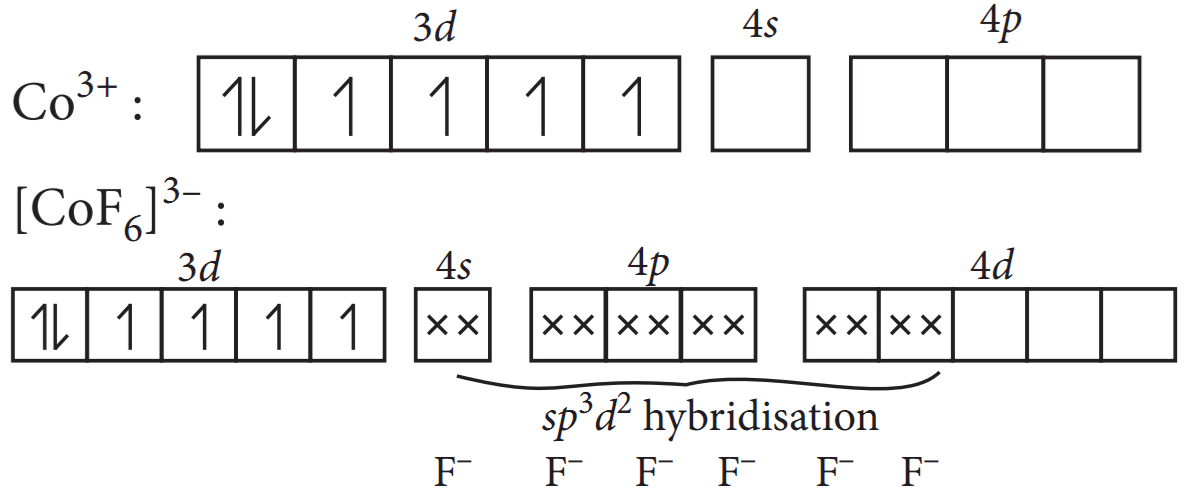
The d-orbitals involved in the hybridisation may be either inner d-orbitals i.e., $(n - 1)d$ or outer d-orbitals i.e., nd. For example, $Co^{3+}$ forms both inner orbital and outer orbital complexes, with ammonia it forms $[Co(NH_3)_6]^{3+}$ and with fluorine it forms $[CoF_6]^{3-}$ complex ion.
The following questions are multiple choice questions. Choose the most appropriate answer:
  1. Which of the following is not true for $[CoF_6]^{3-}?$
  1. It is paramagnetic.
  2. It has coordination number of $6.$
  3. It is outer orbital complex.
  4. It involves $d^2sp^3$ hybridisation.
  1. $[Cr(H_2O)_6]Cl_3 ($at. no. of $Cr = 24)$ has a magnetic moment of $3.83B.M.$ The correct distribution of $3d-$electrons in the central metal of the complex is:
  1. $3\text{d}^1_\text{xy},3\text{d}^1_{\text{x}^2-\text{y}^2},3\text{d}^1_\text{yz}$
  2. $3\text{d}^1_\text{xy},3\text{d}^1_{\text{yz}},3\text{d}^1_\text{zx}$
  3. $3\text{d}^1_\text{xy},3\text{d}^1_{\text{zy}},3\text{d}^1_{\text{z}^2}$
  4. $3\text{d}^1_{\text{x}^2-\text{y}^2},3\text{d}^1_{\text{z}^2},3\text{d}^1_\text{xz}$
  1. Which of the following is true for $[Co(NH_3)_6]^{3+}?$
  1. It is an octahedral, di magnetic and outer orbital complex.
  2. It is an octahedral, paramagnetic and outer orbital complex.
  3. It is an octahedral, paramagnetic and inner orbital complex.
  4. It is an octahedral, di magnetic and inner orbital complex.
  1. The paramagnetism of $[CoF_6]^{3-}$ is due to.
  1. $3$ electrons.
  2. $4$ electrons.
  3. $2$ electrons.
  4. $1$ electron.
  1. Which of the following is an inner orbital or low spin complex?
  1. $[Ni(H_2O)_6]^{3+}$
  2. $[FeF_6]^{3-}$
  3. $[Co(CN)_6]^{3-}$
  4. $[NiCl_4]^{2-}$
Answer
  1. (d) It involves $d^2sp^3$ hybridisation.
Explanation:

lt involves $sp^3d^2$ hybridisation and not $d^2sp^3.$​​​​​​​
  1. (b) $3\text{d}^1_\text{xy},3\text{d}^1_{\text{yz}},3\text{d}^1_\text{zx}$
Explanation:

Magnetic moment of $3.83B.M.$ suggests that it has $3$ unpaired electrons,

$\therefore n = 3$ i.e., $Cr^{3+}: 3d^3$​​​​​​​

It involves $d^2sp^3$ hybridisation so correct distribution of electrons is $3\text{d}^1_\text{xy},3\text{d}^1_{\text{yz}},3\text{d}^1_\text{zx}.$
  1. (d) It is an octahedral, di magnetic and inner orbital complex.
Explanation:

$[Co(NH_3)_6]^{3+}$ is $d^2sp^3$ hybridised with all electrons paired hence, it is diamagnetic and inner orbital complex.
  1. (b) $4$ electrons.
Explanation:

  1. (c) $[Co(CN)_6]^{3-}$​​​​​​​
Explanation:

Inner orbital complexes are formed with strong ligands as they force electrons to pair up and hence the complex will be either diamagnetic or will have less number of unpaired electrons.
View full question & answer
Question 54 Marks
Read the passage given below and answer the following questions:
Werner, a Swiss chemist in $1892$ prepared and characterised a large number of coordination compounds and studied their physical and chemical behaviour. He proposed that, in coordination compounds, metals possess two types of valencies, viz. primary valencies, which are normally ionisable and secondary valencies which are non-ionisable. ln a series of compounds of cobalt (III) chloride with ammonia, it was found that some of the chloride ions could be precipitated as $AgCl$ on adding excess of $AgNO_3$ solution in cold, but some remained in solution. The number ofions furnished by a complex in a solution can be determined by precipitation reactions. The measurement of molar conductance of solutions of coordination compounds helps to estimate the number of ions furnished by the compound in solution.
In these questions (Q. No. i-iv), a statement of assertion followed by a statement ofreason is given. Choose the correct answer out of the following choices.
  1. Assertion and reason both are correct statements and reason is correct explanation for assertion.
  2. Assertion and reason both are correct statements but reason is not correct explanation for assertion.
  3. Assertion is correct statement but reason is wrong statement.
  4. Assertion is wrong statement but reason is correct statement.
The following questions are multiple choice questions. Choose the most appropriate answer:
  1. Assertion: The complex $[Co(NH_3)_3Cl_3]$ does not give precipitate with silver nitrate solution.
Reason: The given complex is non-ionisable.
  1. Assertion: The complex $[Co(NH_3)_4Cl_2]Cl$ gives precipitate corresponding to 2 mol of AgCl with $AgNO_3$ solution.
Reason: It ionises as $[Co(NH_3)_4Cl_2]^+ + Cl^-.$
  1. Assertion: $CoCl_3. 4NH_3$ gives 1 mol of AgCl on reacting with $AgNO_3$​​​​​​​, its secondary valency is 6.
Reason: Secondary valency corresponds to coordination number.
  1. Assertion: 1 mol of $[CrCl_2(H_2O)_4]Cl· 2H_2O$ will give 1 mol of AgCl on treating with $AgNO_3$​​​​​​​.
Reason: $Cl^-$ ions satisfying secondary valanceis will not be precipitated.
  1. Assertion: $CoCl_3. 3NH_3$ is not conducting while $CoCl_3. 5NH_3$​​​​​​​ is conducting.
Reason: The complex of $CoCl_3. 3NH_3$ is $[CoCl_3(NH_3)_3]$ while that of $CoCl_3· 5NH_3$ is $[CoCl(NH_3)_5]Cl_3$.
Answer
  1. (a) Assertion and reason both are correct statements and reason is correct explanation for assertion.
  2. (d) Assertion is wrong statement but reason is correct statement.
Explanation:

$[\text{Co(NH}_3)_4\text{Cl}_2]\text{Cl}+\text{AgNO}_3\rightarrow[\text{Co(NH}_3)_4\text{Cl}_2]^++\text{AgCl}\downarrow$

Thus it gives precipitate of 1 mol of AgCI.
  1. (b) Assertion and reason both are correct statements but reason is not correct explanation for assertion.
Explanation:

$CoCl_3$. $4NH_3$ gives 1 mol AgCl on reaction with $AgNO_3$, hence the complex can be represented as $[CoCl_2(NH_3)_4]CI$.
  1. (a) Assertion and reason both are correct statements and reason is correct explanation for assertion.
Explanation:

The $Cl^-$ ions outside the coordination sphere can only be precipitated.
  1. (a) Assertion and reason both are correct statements and reason is correct explanation for assertion.
View full question & answer
Question 64 Marks
Read the passage given below and answer the following questions: For understanding the structure and bonding in transition metal complexes, the magnetic properties are very helpful. Low spin complexes are generally diamagnetic because of pairing of electrons, whereas high spin complexes are usually paramagnetic because of presence of unpaired electrons. Larger the number of unpaired electrons, stronger will be the paramagnetism. However magnetic behaviour of a complex can be confirmed from magnetic moment measurement. Magnetic moment $\mu=\sqrt{\text{n(n+2)}}\text{B.M.}$ where n = number of unpaired electrons. Greater the number of unpaired electrons, more will be the magnetic moment. In these questions (Q. No. i-iv), a statement of assertion followed by a statement ofreason is given. Choose the correct answer out of the following choices.
  1. Assertion and reason both are correct statements and reason is correct explanation for assertion.
  2. Assertion and reason both are correct statements but reason is not correct explanation for assertion.
  3. Assertion is correct statement but reason is wrong statement.
  4. Assertion is wrong statement but reason is correct statement.
The following questions are multiple choice questions. Choose the most appropriate answer:
  1. Assertion: Both $[Cr(H_2O)_6]^{2+}$ and $[Fe(H_2O)_6]^{2+}$ have same magnetic moment.
Reason: Number of unpaired electrons in $Cr^{2+}$ and $Fe^{2+}$ are same.
  1. Assertion: $[Fe(H_2O)_5NO]SO_4$ is paramagnetic.
Reason: The Fe in $[Fe(H_2O)_5NO]SO_4$ has three unpaired electrons.
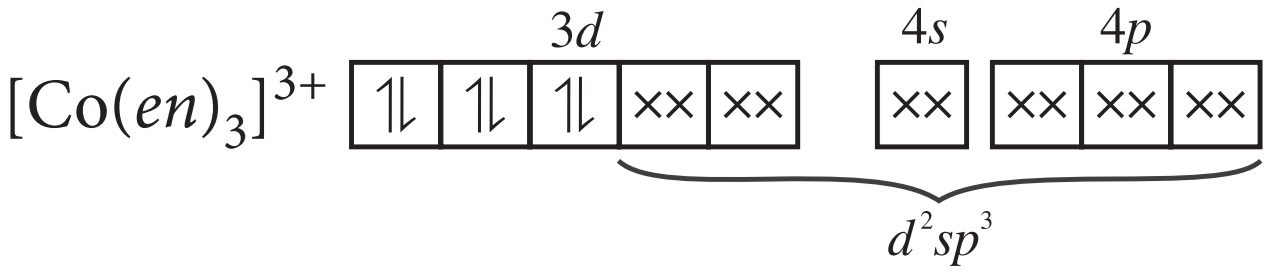
  1. Assertion: $[Co(en)_3]^{3+}$ is paramagnetic.
Reason: It is an inner orbital complex.
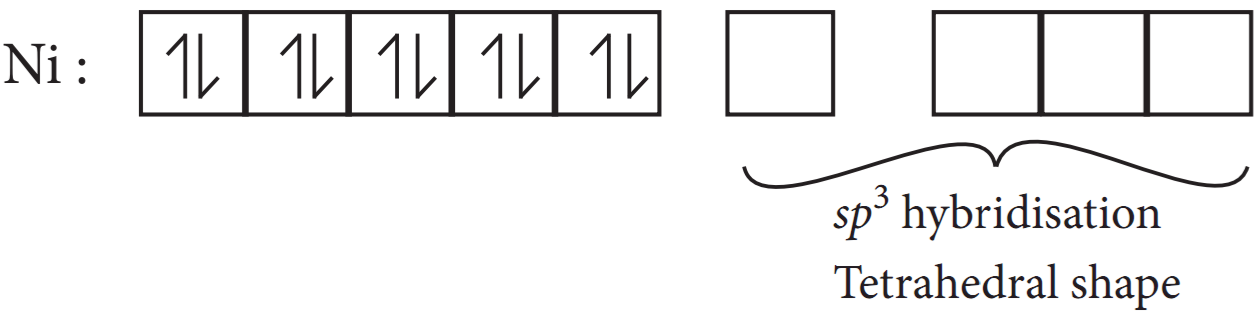
  1. Assertion: $[Ni(CO)_4]$ is diamagnetic and tetrahedral in shape.
Reason: $[Ni(CO)_4]$ contains no unpaired electrons and involves $dsp^2$ hybridisation.
  1. Assertion: $[Ni(CN)_4]^{2-}$ is diamagnetic complex.
Reason: It involves $dsp^2$ hybridisation and there is no unpaired electron.
Answer
  1. (a) Assertion and reason both are correct statements and reason is correct explanation for assertion.
Explanation:
Spinonlymagneticmoment, $\mu=\sqrt{\text{n(n+2)}}$ where $n =$ number of unpaired electrons.
As the number of unpaired electrons in $Cr^{2+}[(Ar)3d^{4]}$ and $Fe^{2+}[(Ar)3d^6]$ are same, hence $[Cr(H_2O)_6]^{2+}$ and $[Fe(H_2O)_6]^{2+}$ will have same magnetic moment.
  1. (a) Assertion and reason both are correct statements and reason is correct explanation for assertion.
Explanation:
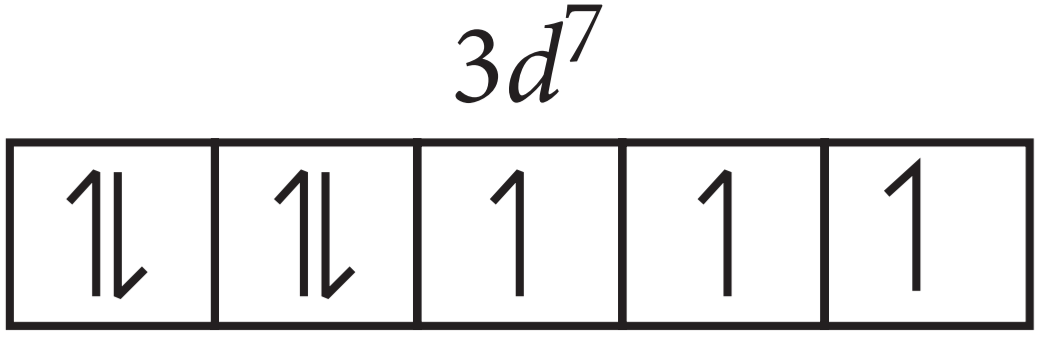
$Fe^+: [Ar)3d^74s^0$
When the weak field ligand $H_2O$ and strong field ligand $NO^+$ attack, the configuration changes as follows: $Fe^+: [Ar)3d^74s^0$​​​​​​​

$\therefore Fe^{2+}$ has $3$ unpaired electrons.
  1. (d) Assertion is wrong statement but reason is correct statement.
Explanation:

In presence of strong ethylenediamine ligand the electrons get paired.

Thus inner orbital complex with no unpaired electrons.
  1. (c) Assertion is correct statement but reason is wrong statement.
Explanation:
$[Ni(CO)_4]$ contains $Ni(O).$​​​​​​​

$CO$ is strong ligand thus,
  1. (a) Assertion and reason both are correct statements and reason is correct explanation for assertion.
View full question & answer
Question 74 Marks

Read the passage given below and answer the following questions:
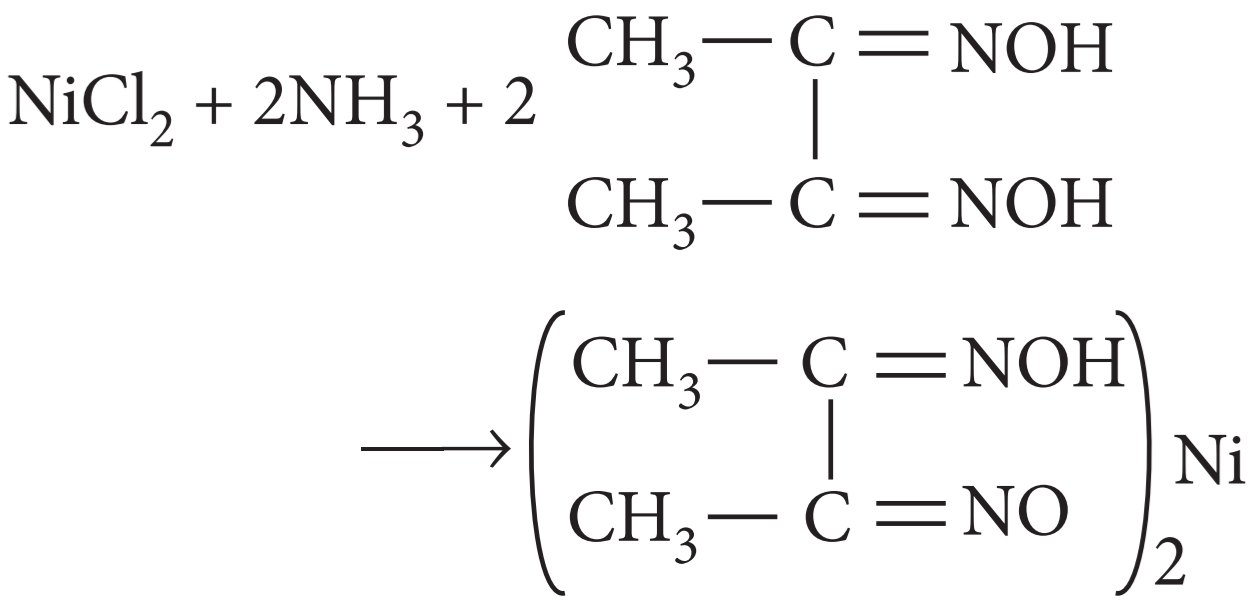
The molecular compounds which are formed from the combination of two or more simple stable compounds and retain their identity in the solid as well as in the dissolved state are called coordination compounds. Their properties are completely different from the constituents. ln coordination compounds, the central metal atom or ion is linked to a number ofions or neutral molecules, called ligands, by coordinate bonds. For example, Dimethylglyoxime (dmg) is a bid en date ligand chelating large amounts of metals. When dimethyl glyoxime is added to alcoholic solution of $NiCl_2$ and ammonium hydroxide is slowly added to it, a rosy red precipitate of a complex is formed.
The following questions are multiple choice questions. Choose the most appropriate answer:
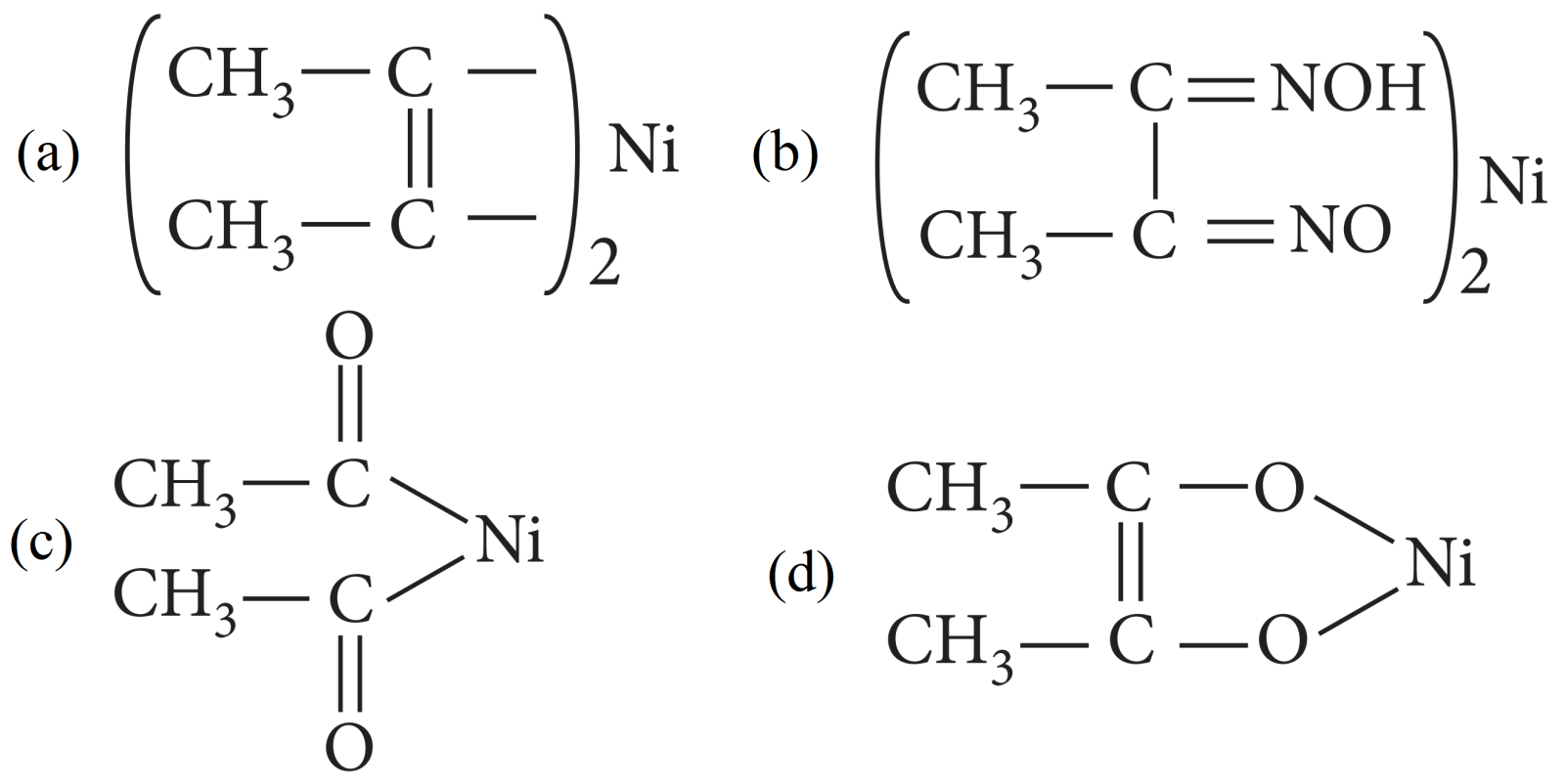
  1. The structure of the complex is:
  1. Oxidation number of Ni in the given complex is:
  1. $+3$
  2. $+1$
  3. $+2$
  4. $Zero$
  1. Hybridisation and structure of the complex is:
  1. $Sp^3$​​​​​​​, tetrahedral.
  2. $dsp^2$​​​​​​​, square planar.
  3. $Sp^3$​​​​​​​, square planar.
  4. $Sp^3d$, trigonal bipyramidal.
  1. Which of the following is true about this complex?
  1. It is paramagnetic, containing $2$ unpaired electrons.
  2. It is paramagnetic, containing $1$ unpaired electron.
  3. It is paramagnetic, containing $4$ unpaired electrons.
  4. It is diamagnetic with no unpaired electron.
  1. Which one will give test for $Fe^{3+}$​​​​​​​ ions in the solution?
  1. $[Fe(CN)_6]^{3-}$
  2. $[Fe(CN)_6]^{2-}$
  3. $(NH_4)_2SO_4·FeSO_4·6H_2O$
  4. $Fe_2(S0_4)_3$​​​​​​​
Answer
  1. (b)
  1. (c) $+2$
  2. (b) $dsp^2$, square planar.
  3. (d) It is diamagnetic with no unpaired electron.
  4. (d) $Fe_2(S0_4)_3$​​​​​​​
Explanation:
(a) and (b) are coordination compounds hence cannot give free $Fe ^{2+}$ or $Fe ^{3+}$ ions in solution. (c) and (d) represent simple compounds hence are free to give ions in solution, but only $Fe _2\left( SO _4\right)_3$ contains $Fe ^{3+}$ ions. $\left( NH _4\right)_2 SO _4$. $FeSO _4$. $6 H _2 O$ contains $Fe ^{2+}$ ions not $Fe ^{3+}$ ions.
View full question & answer
Question 84 Marks
Read the passage given below and answer the following questions:
Metal carbonyl is an example of coordination compounds in which carbon monoxide (CO) acts as ligand. These are also called homoleptic carbonyls. These compounds contain both $\sigma$ and $\pi$ character. Some carbonyls have metal-metal bonds. The reactivity of metal carbonyls is due to (i) the metal centre and (ii) the CO ligands. CO is capable of accepting an appreciable amount of electron density from the metal atom into their empty $\pi$ or $\pi-\text{orbital}.$ These types of ligands are called $\pi-\text{accepter}$ or $\pi-\text{acid}$ ligands. These interactions increases the $\Delta_0$ value.
The following questions are multiple choice questions. Choose the most appropriate answer:
  1. What is the oxidation state of metal in $[Mn_2(CO)_{10}]?$
  1. $+1$
  2. $-1$
  3. $+2$
  4. $0$
  1. Among the following metal carbonyls, the $C-O$ bond order is lowest in:
  1. $[Mn(CO)_6]^+$
  2. $[Fe(CO)_5]$
  3. $[Cr(CO)_6]$
  4. $[V(CO)_6]^-$
  1. Which of the following can be reduced easily?
  1. $V(CO)_6$
  2. $Mo(CO)_6$
  3. $[Co(CO)_4]^-$
  4. $Fe(CO)_5$
  1. The oxidation state of cobalt in $K[Co(CO)_4]$ is:
  1. $+1$
  2. $+3$
  3. $-1$
  4. $0$
  1. Structure of decacarbonyl manganese is:
  1. Trigonal bipyramidial
  2. Octahedral
  3. Tetrahedral
  4. Square pyramidal
Answer
  1. (d) $0$
Explanation:

Oxidation state of $Mn$ in $[Mn_2(CO)_{10}]$ is zero.
  1. (d) $[V(CO)_6]^-$​​​​​​​
Explanation:

In $[V(CO)_6]^-$, the anionic carbonyl complex can delocalise more electron density to antibonding $\pi-\text{orbital}$ ($\text{d}\pi-\text{p}\pi$ back bonding) of $CO$ and thus lowers the bond order.
  1. (a) $V(CO)_6$
Explanation:

$V(CO)_6$ can be easily reduced to $[V(CO)_6]^-. V(CO)_6$ has a total of $17$ bonding electrons, hence it is very reactive and unstable. $[V(CO)_6]^-$ on the other hand has complete set of $18$ bonding electrons as an electron is added into the bonding orbital when $V(CO)_6$ gets reduced to $[V(CO)_6]^-.$ All others have 18 bonding electrons.​​​​​​​
  1. (c) $-1$
Explanation:

$K[Co(CO)_4]$

$+1 + (x) + 4(0) = 0$ or $x = -1$
  1. (d) Square pyramidal.
Explanation:

$Mn_2(CO)_{10}$ is made up of two square pyramidal $Mn(CO)_5$ units joined by Mn-Mn bond.
View full question & answer
Question 94 Marks
Read the passage given below and answer the following questions:
Iron forms many complexes in its $+2$ and $+3$ oxidation states such as $[Fe(H_2O)_6]^{2+} (A); [Fe(CN)_6]^{4-} (B); [Fe(H_2O)_6]^{3+} (C); [Fe(CN)_6]^{3-} (D),$ etc., They exhibit, different magnetic properties and undergo different hybridisation of iron.
The following questions are multiple choice questions. Choose the most appropriate answer:
  1. Which of the following statements is correct?
  1. $(B)$ is paramagnetic while $(C)$ is diamagnetic.
  2. Both $(B)$ and $(D)$ are outer orbital complexe.
  3. Both $(A)$ and $(C)$ are paramagnetic.
  4. $(A)$ is outer orbital complex and $(C)$ is inner orbital complex.
  1. The complex having maximum magnetic moment is:
  1. $(A)$
  2. $(B)$
  3. $(C)$
  4. $(D)$
  1. Which of the following does not represent correct configuration of the d-orbitals in the given complexes?
  1. $\text{(A)}:\text{t}^4_{2\text{g}}\text{e}^2_\text{g}$
  2. $\text{(B)}:\text{t}^6_{2\text{g}}\text{e}^0_\text{g}$
  3. $\text{(C)}:\text{t}^4_{2\text{g}}\text{e}^1_\text{g}$
  4. $\text{(D)}:\text{t}^5_{2\text{g}}\text{e}^0_\text{g}$
  1. The spin only magnetic moment of complexes $(A), (B), (C)$ and $(D)$ are respectively $($in $BM).$
  1. $2\sqrt{6},0,\sqrt{35},\sqrt{3}$
  2. $0,2\sqrt{6},\sqrt{35},\sqrt{3}$
  3. $\sqrt{15,}2\sqrt{6},\sqrt{3},0$
  4. $\sqrt{3},\sqrt{8},0,\sqrt{15}$
  1. Which of the given complexes are outer orbital complexes?
  1. $(A)$ and $(B)$ only
  2. $(B)$ and $(C)$ only
  3. $(A)$ and $(C)$ only
  4. $(B)$ and $(D)$ only
Answer
  1. $(c)$ Both $(A)$ and $(C)$ are paramagnetic.
Explanation:

(A): $sp^3d^2$ hybridisation (outer orbital)

No. of unpaired electrons $= 4$

(B): $d^2sp^3$ hybridisation (inner orbital)

No. of unpaired electrons $= 0$

(C): $sp^3d^2$ hybridisation (outer orbital)

No. of unpaired electrons $= 5$

(D): $d^2sp^3$ hybridisation (inner orbital)

No. of unpaired electron $= 1$
  1. (c) $(C)$
Explanation:

It has $5$ unpaired electrons.
  1. (c) $\text{(C)}:\text{t}^4_{2\text{g}}\text{e}^1_\text{g}$
Explanation:

As $H_2​​​​​​​O$ is a weak ligand so, it should be $\text{t}^4_{2\text{g}}\text{e}^1_\text{g}.$
  1. (a) $2\sqrt{6},0,\sqrt{35},\sqrt{3}$
Explanation:

Magnetic moments of $(A), (B), (C)$ and $(D)$ are respectively.

$\sqrt{4(4+2)},0,\sqrt{5(5+2)},\sqrt{1(1+2)}$
  1. (c) $(A)$ and $(C)$ only
View full question & answer
Question 104 Marks
Read the passage given below and answer the following questions:
Ligands are atoms or ions which can donate electrons to the central atoms. Ligands can be monodentate, bidentate or polydentate as well. Few ligands can coordinate with the central atom through more than one site, these are called ambidentate ligands. When a di- or polydentate ligand uses its two or more donor atoms to bind a single metal ion, it is said to be a chelating ligand.
In these questions (Q. No. i-iv), a statement of assertion followed by a statement ofreason is given. Choose the correct answer out of the following choices.
  1. Assertion and reason both are correct statements and reason is correct explanation for assertion.
  2. Assertion and reason both are correct statements but reason is not correct explanation for assertion.
  3. Assertion is correct statement but reason is wrong statement.
  4. Assertion is wrong statement but reason is correct statement.
The following questions are multiple choice questions. Choose the most appropriate answer:
  1. Assertion: Glycinate ion is an example of monodentate ligand.
Reason: Glycinate contains $N$ and $O$ as donor atoms.
  1. Assertion: EDTA forms complex with divalent metals of 3d-series in the ratio of $1 : 1.$
Reason: EDTA has $4 - COOH$ groups.
  1. Assertion: Oxalate ion is a bidentate ligan.
Reason: Oxalate ion has two donor atoms.
  1. Assertion: A chelating ligand must possess two or more lone pairs at such a distance that it may form suitable strain free $5$ and $6$ membered rings with the metal ion.
Reason: $H_2N - NH_2$ is a chelating ligand.
  1. Assertion: In Zeise's salt coordination number of Pt is five.
Reason: Ethene is a monodentate ligand.
Answer
  1. (d) Assertion is wrong statement but reason is correct statement.
Explanation:

Glycinate ion is an example of bidentate ligand. It contains $N$ and $O$ as donor atoms.
  1. (b) Assertion and reason both are correct statements but reason is not correct explanation for assertion.
Explanation:

EDTA is a hexadentate ligand. It forms complex with central metal in the ratio $1 : 1$ in which it binds through two nitrogen atoms and four oxygen atoms.
  1. (a) Assertion and reason both are correct statements and reason is correct explanation for assertion.
  2. (c) Assertion is correct statement but reason is wrong statement.
Explanation:

$H_2N - NH_2$ does not act as chelating ligand. The coordination by hydrazine leads to a three member highly unstable strained ring and thus it does not act as chelating agent.
  1. (d) Assertion is wrong statement but reason is correct statement.
Explanation:

In Zeise's salt, coordination no. of Pt is $4$. Ethylene is a monodentate ligand.
View full question & answer