Question 15 Marks
A trust invested some money in two type of bonds. The first bond pays 10% interest and bond pays 12% interest. The trust received 2,800 as interest. However, if trust had interchanged money in bonds, they would have got 100 less as interest. Using matrix method, find the amount invested by the trust. Which value is reflected in this question?
Answerlet ₹ x be invested in first bond and, ₹ y be invested in second bond then in the system of equations is:$\begin{matrix} \frac{10\text{x}}{100} + \frac{12\text{y}}{100} = 2800 & \\ \frac{\text{12x}}{100} + \frac{10\text{y}}{100} = 2700 & \\ \end{matrix}\Rightarrow\begin{matrix} \text{5x + 6y = 140000}\\ \text{6x + 5y = 135000}\\ \end{matrix}$
$\text{let A} = \begin{bmatrix} 5 & 6 \\ 6 & 5 \\ \end{bmatrix} ;\text{X} = \begin{bmatrix} \text{x} \\ \text{y} \\ \end{bmatrix};\text{B} = \begin{bmatrix} \text{140000} \\ \text{135000} \\ \end{bmatrix} $
$|\text{A}| = -11; \text{A}^{-1} =\frac{1}{-11} \begin{bmatrix} 5& -6 \\ -6& 5 \\ \end{bmatrix} $
$\therefore \text{Solution is X = A}^{-1}\text{B} \Rightarrow \begin{bmatrix} \text{x} \\ \text{y} \\ \end{bmatrix} = \frac{1}{-11} \begin{bmatrix} 5& -6 \\ -6& 5 \\ \end{bmatrix} \begin{bmatrix} \text{140000} \\ \text{135000} \\ \end{bmatrix} = \begin{bmatrix} \text{10000} \\ \text{15000} \\ \end{bmatrix}$
$ \therefore\text{x = 10000, y = 15000,}\therefore\text{Amount invested} =\text{₹ } 25000 $
Value: caring elders
View full question & answer→Question 25 Marks
There are two types of fertilisers 'A' and 'B'. 'A' consists of 12 % nitrogen and 5 % phosphoric acid whereas 'B' consists of 4 % nitrogen and 5 % phosphoric acid. After testing the soil conditions, farmer finds that he needs at least 12 kg of nitrogen and 12 kg of phosphoric acid for his crops. If 'A' costs 10 per kg and 'B' cost 8 per kg, then graphically determine how much of each type of fertiliser should be used so that nutrient requirements are met at a minimum cost.
Answer
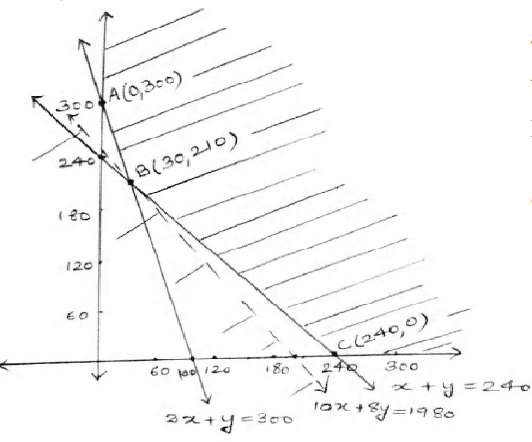 Let x kg of fertiliser A be used
and y kg of fertiliser B be used
then the linear programming problem is:
Minimise cost: $\text{z = 10x + 8y}$
Subject to $ \begin{matrix} \frac{12\text{x}}{100} + \frac{\text{4y}}{100} \geq12\Rightarrow\text{3x + y}\geq300 \\ \frac{\text{5x}}{100} + \frac{\text{5y}}{100}\geq12\Rightarrow \text{x + y} \geq 240 \\ \text{x, y}\geq0 \end{matrix} $
Value of Z at corners of the unbounded region ABC:
$ \begin{matrix} \frac{\text{Corner}}{\text{A(0, 300)}} & \frac{\text{Value of Z}}{2400} \\ \text{B(30,210)} & \text{1980 (Minimum)} \\ \text{C (240, 0)} & 2400 \end{matrix} $
The region of $\text{10x + 8y < 1980 or 5x + 4y < 990}$ has no point in common to the feasible region. Hence, minimum cost $\text{= 1980 at x = 30 and y = 210}$ View full question & answer→Question 35 Marks
There are 2 families A and B. There are 4 men, 6 women and 2 children in family A, and 2 men, 2 women and 4 children in family B. The recommended daily amount of calories is 2400 for men, 1900 for women, 1800 for children and 45 grams of proteins for men, 55 grams for women and 33 grams for children. Represent the above information using matrices. Using matrix multiplication, calculate the total requirement of calories and proteins for each of the 2 families. What awareness can you create among people about the balanced diet from this question?
Answer$ \begin{matrix} \text{Family} &\text{A} & \Rightarrow \\ \text{Family} & \text{B} & \Rightarrow \\ \end{matrix} \begin{bmatrix} 4 & 6 & 2 \\ 2 & 2 & 4 \\ \end{bmatrix} \begin{bmatrix} 2400 & 45 \\ 1900 & 55 \\ 1800 & 33 \end{bmatrix} $
Writing Matrix Multiplication as $ \begin{bmatrix} 24600 & 576 \\ 15800 & 332 \\ \end{bmatrix} $
Writing about awareness of balanced diet.
View full question & answer→Question 45 Marks
Solve the following linear programming problem graphically.Minimise $\text{z = 3x + 5y}$
subject to the constraints
$\text{x + 2y}\geq 10$
$\text{x + y}\geq 6$
$\text{3x + y}\geq 8$
$\text{x, y}\geq 0.$
Answer
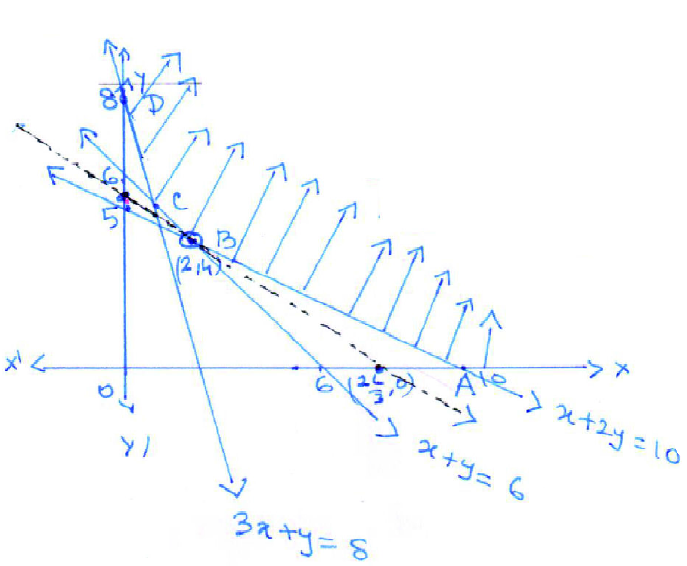 Vertices are A (10, 0), 2, 4 ), C(1, 5) & D (0, 8)$\text{Z = 3 x + 5y}$ is minimum
at B (2, 4) and the minimum Value is 26.
on Ploting $\text{(3x + 5y < 26)}$
since these it no common point with the feasible
region, Hence, $\text{x = 2, y = 4}$ gives minimum Z View full question & answer→Question 55 Marks
Solve the following linear programming problem graphically:
Maximise Z = 7x + 10y
subject to the constraints
4x + 6y $\leq$ 240
6x + 3y $\leq$ 240
x $\geq$ 10
x $\geq$ 0, y $\geq$ 0
Answer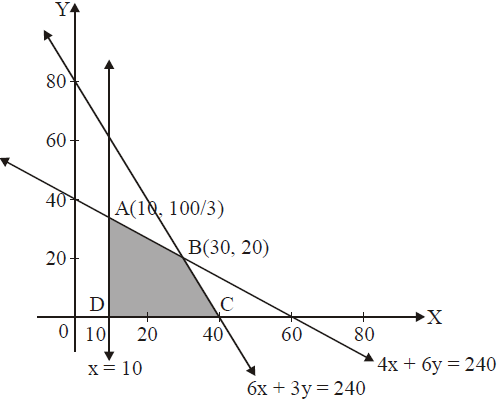
Maximise z = 7x + 10y, subject to 4x + 6y $\leq$ 240;
6x + 3y $\leq$ 240; x $\geq$ 10, x $\geq$ 0, y $\geq$ 0
Correct graph of three lines
For correct shading
$\text{Z}(\text{A})=\text{Z}\Big(10,\frac{200}{6}\Big)=70+10\times\frac{100}{3}=403\frac{1}{3}$
Z(B) = Z(30, 20) = 210 + 200 = 410
Z(C) = Z(40, 0) = 280 + 0 = 280
Z(D) = Z(10, 0) = 70 + 0 = 70
⇒ Max (= 410) at x = 30, y = 20 View full question & answer→Question 65 Marks
A trust invested some money in two type of bonds. The first bond pays 10% interest and bond pays 12% interest. The trust received 2,800 as interest. However, if trust had interchanged money in bonds, they would have got 100 less as interest. Using matrix method, find the amount invested by the trust. Which value is reflected in this question?
Answerlet ₹ x be invested in first bond and, ₹ y be invested in second bond then in the system of equations is:$\begin{matrix} \frac{10\text{x}}{100} + \frac{12\text{y}}{100} = 2800 & \\ \frac{\text{12x}}{100} + \frac{10\text{y}}{100} = 2700 & \\ \end{matrix}\Rightarrow\begin{matrix} \text{5x + 6y = 140000}\\ \text{6x + 5y = 135000}\\ \end{matrix}$
$\text{let A} = \begin{bmatrix} 5 & 6 \\ 6 & 5 \\ \end{bmatrix} ;\text{X} = \begin{bmatrix} \text{x} \\ \text{y} \\ \end{bmatrix};\text{B} = \begin{bmatrix} \text{140000} \\ \text{135000} \\ \end{bmatrix} $
$|\text{A}| = -11; \text{A}^{-1} =\frac{1}{-11} \begin{bmatrix} 5& -6 \\ -6& 5 \\ \end{bmatrix} $
$\therefore \text{Solution is X = A}^{-1}\text{B} \Rightarrow \begin{bmatrix} \text{x} \\ \text{y} \\ \end{bmatrix} = \frac{1}{-11} \begin{bmatrix} 5& -6 \\ -6& 5 \\ \end{bmatrix} \begin{bmatrix} \text{140000} \\ \text{135000} \\ \end{bmatrix} = \begin{bmatrix} \text{10000} \\ \text{15000} \\ \end{bmatrix}$
$ \therefore\text{x = 10000, y = 15000,}\therefore\text{Amount invested} =\text{₹ } 25000 $
Value: caring elders
View full question & answer→Question 75 Marks
There are two types of fertilisers 'A' and 'B'. 'A' consists of 12 % nitrogen and 5 % phosphoric acid whereas 'B' consists of 4 % nitrogen and 5 % phosphoric acid. After testing the soil conditions, farmer finds that he needs at least 12 kg of nitrogen and 12 kg of phosphoric acid for his crops. If 'A' costs 10 per kg and 'B' cost 8 per kg, then graphically determine how much of each type of fertiliser should be used so that nutrient requirements are met at a minimum cost.
Answer
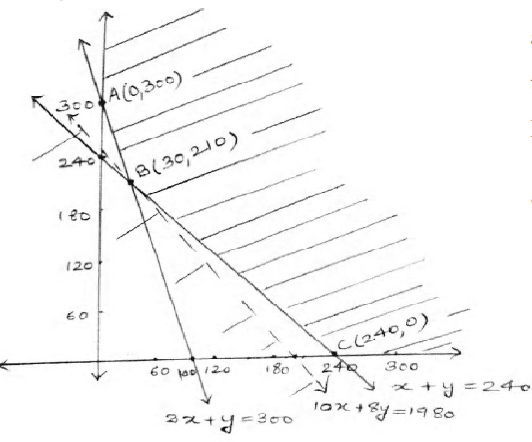 Let x kg of fertiliser A be used
and y kg of fertiliser B be used
then the linear programming problem is:
Minimise cost: $\text{z = 10x + 8y}$
Subject to $ \begin{matrix} \frac{12\text{x}}{100} + \frac{\text{4y}}{100} \geq12\Rightarrow\text{3x + y}\geq300 \\ \frac{\text{5x}}{100} + \frac{\text{5y}}{100}\geq12\Rightarrow \text{x + y} \geq 240 \\ \text{x, y}\geq0 \end{matrix} $
Value of Z at corners of the unbounded region ABC:
$ \begin{matrix} \frac{\text{Corner}}{\text{A(0, 300)}} & \frac{\text{Value of Z}}{2400} \\ \text{B(30,210)} & \text{1980 (Minimum)} \\ \text{C (240, 0)} & 2400 \end{matrix} $
The region of $\text{10x + 8y < 1980 or 5x + 4y < 990}$ has no point in common to the feasible region. Hence, minimum cost $\text{= 1980 at x = 30 and y = 210}$ View full question & answer→Question 85 Marks
There are 2 families A and B. There are 4 men, 6 women and 2 children in family A, and 2 men, 2 women and 4 children in family B. The recommended daily amount of calories is 2400 for men, 1900 for women, 1800 for children and 45 grams of proteins for men, 55 grams for women and 33 grams for children. Represent the above information using matrices. Using matrix multiplication, calculate the total requirement of calories and proteins for each of the 2 families. What awareness can you create among people about the balanced diet from this question?
Answer$ \begin{matrix} \text{Family} &\text{A} & \Rightarrow \\ \text{Family} & \text{B} & \Rightarrow \\ \end{matrix} \begin{bmatrix} 4 & 6 & 2 \\ 2 & 2 & 4 \\ \end{bmatrix} \begin{bmatrix} 2400 & 45 \\ 1900 & 55 \\ 1800 & 33 \end{bmatrix} $
Writing Matrix Multiplication as $ \begin{bmatrix} 24600 & 576 \\ 15800 & 332 \\ \end{bmatrix} $
Writing about awareness of balanced diet.
View full question & answer→Question 95 Marks
Solve the following linear programming problem graphically.Minimise $\text{z = 3x + 5y}$
subject to the constraints
$\text{x + 2y}\geq 10$
$\text{x + y}\geq 6$
$\text{3x + y}\geq 8$
$\text{x, y}\geq 0.$
Answer
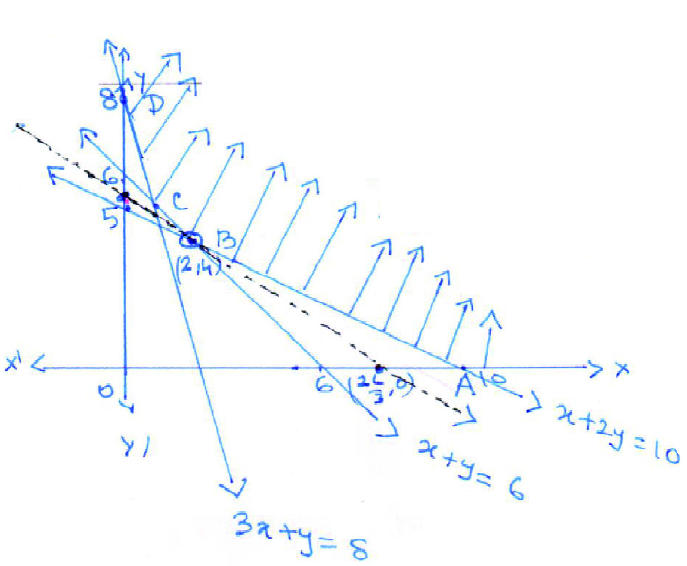 Vertices are A (10, 0), 2, 4 ), C(1, 5) & D (0, 8)$\text{Z = 3 x + 5y}$ is minimum
at B (2, 4) and the minimum Value is 26.
on Ploting $\text{(3x + 5y < 26)}$
since these it no common point with the feasible
region, Hence, $\text{x = 2, y = 4}$ gives minimum Z View full question & answer→Question 105 Marks
Solve the following linear programming problem graphically :
Maximise Z = 34x + 45y
under the following constraints
x + y $\leq$ 300
2x + 3y$\leq$ 70
x $\geq$ 0, y $\geq$ 0
Answer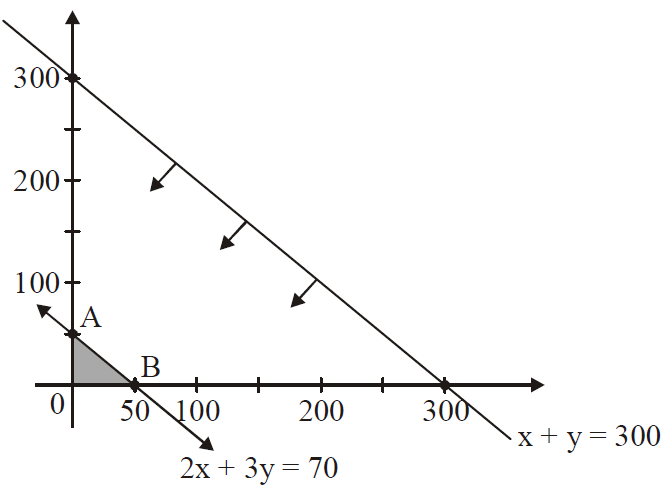
Maximise: z = 34x + 45y subject to x + y $\leq$ 300,
2x + 3y $\leq$ 70, x $\geq$ 0, y $\geq$ 0
Plotting the two lines.
Correct shading
$\text{Z(A)}=\text{Z}\Big(0,\frac{70}{3}\Big)=1050$
$\text{Z(B)}=\text{Z}(35,0)=1190$
⇒ max (1190) at x = 35, y = 0. View full question & answer→Question 115 Marks
A trust invested some money in two type of bonds. The first bond pays 10% interest and bond pays 12% interest. The trust received 2,800 as interest. However, if trust had interchanged money in bonds, they would have got 100 less as interest. Using matrix method, find the amount invested by the trust. Which value is reflected in this question?
Answerlet ₹ x be invested in first bond and, ₹ y be invested in second bond then in the system of equations is:$\begin{matrix} \frac{10\text{x}}{100} + \frac{12\text{y}}{100} = 2800 & \\ \frac{\text{12x}}{100} + \frac{10\text{y}}{100} = 2700 & \\ \end{matrix}\Rightarrow\begin{matrix} \text{5x + 6y = 140000}\\ \text{6x + 5y = 135000}\\ \end{matrix}$
$\text{let A} = \begin{bmatrix} 5 & 6 \\ 6 & 5 \\ \end{bmatrix} ;\text{X} = \begin{bmatrix} \text{x} \\ \text{y} \\ \end{bmatrix};\text{B} = \begin{bmatrix} \text{140000} \\ \text{135000} \\ \end{bmatrix} $
$|\text{A}| = -11; \text{A}^{-1} =\frac{1}{-11} \begin{bmatrix} 5& -6 \\ -6& 5 \\ \end{bmatrix} $
$\therefore \text{Solution is X = A}^{-1}\text{B} \Rightarrow \begin{bmatrix} \text{x} \\ \text{y} \\ \end{bmatrix} = \frac{1}{-11} \begin{bmatrix} 5& -6 \\ -6& 5 \\ \end{bmatrix} \begin{bmatrix} \text{140000} \\ \text{135000} \\ \end{bmatrix} = \begin{bmatrix} \text{10000} \\ \text{15000} \\ \end{bmatrix}$
$ \therefore\text{x = 10000, y = 15000,}\therefore\text{Amount invested} =\text{₹ }25000 $
Value: caring elders
View full question & answer→Question 125 Marks
There are two types of fertilisers 'A' and 'B'. 'A' consists of 12 % nitrogen and 5 % phosphoric acid whereas 'B' consists of 4 % nitrogen and 5 % phosphoric acid. After testing the soil conditions, farmer finds that he needs at least 12 kg of nitrogen and 12 kg of phosphoric acid for his crops. If 'A' costs 10 per kg and 'B' cost 8 per kg, then graphically determine how much of each type of fertiliser should be used so that nutrient requirements are met at a minimum cost.
Answer
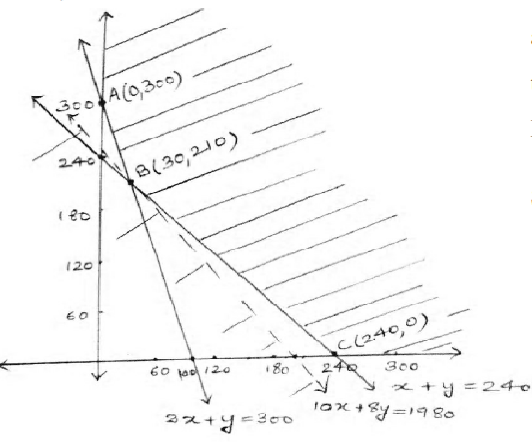 Let x kg of fertiliser A be used
and y kg of fertiliser B be used
then the linear programming problem is:
Minimise cost: $\text{z = 10x + 8y}$
Subject to $ \begin{matrix} \frac{12\text{x}}{100} + \frac{\text{4y}}{100} \geq12\Rightarrow\text{3x + y}\geq300 \\ \frac{\text{5x}}{100} + \frac{\text{5y}}{100}\geq12\Rightarrow \text{x + y} \geq 240 \\ \text{x, y}\geq0 \end{matrix} $
Value of Z at corners of the unbounded region ABC:
$ \begin{matrix} \frac{\text{Corner}}{\text{A(0, 300)}} & \frac{\text{Value of Z}}{2400} \\ \text{B(30,210)} & \text{1980 (Minimum)} \\ \text{C (240, 0)} & 2400 \end{matrix} $
The region of $\text{10x + 8y < 1980 or 5x + 4y < 990}$ has no point in common to the feasible region. Hence, minimum cost $\text{= 1980 at x = 30 and y = 210}$ View full question & answer→Question 135 Marks
There are 2 families A and B. There are 4 men, 6 women and 2 children in family A, and 2 men, 2 women and 4 children in family B. The recommended daily amount of calories is 2400 for men, 1900 for women, 1800 for children and 45 grams of proteins for men, 55 grams for women and 33 grams for children. Represent the above information using matrices. Using matrix multiplication, calculate the total requirement of calories and proteins for each of the 2 families. What awareness can you create among people about the balanced diet from this question?
Question 145 Marks
Solve the following linear programming problem graphically.Minimise $\text{z = 3x + 5y}$
subject to the constraints
$\text{x + 2y}\geq 10$
$\text{x + y}\geq 6$
$\text{3x + y}\geq 8$
$\text{x, y}\geq 0.$
Answer
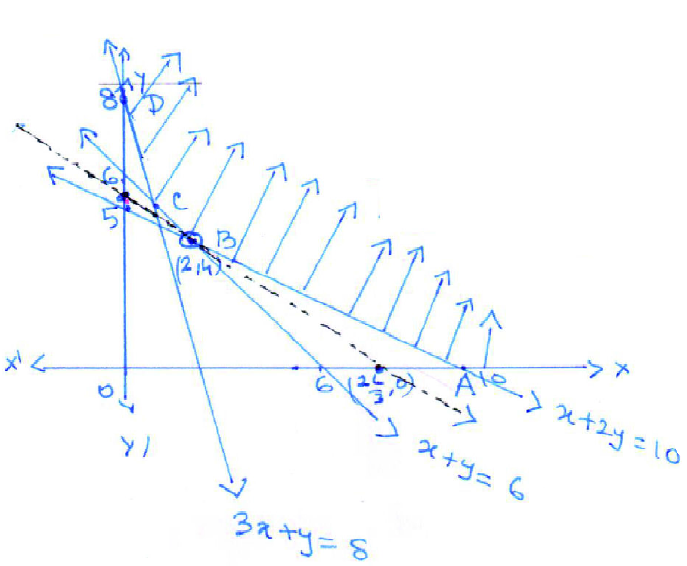 Vertices are A (10, 0), 2, 4 ), C(1, 5) & D (0, 8)$\text{Z = 3 x + 5y}$ is minimum
at B (2, 4) and the minimum Value is 26.
on Ploting $\text{(3x + 5y < 26)}$
since these it no common point with the feasible
region, Hence, $\text{x = 2, y = 4}$ gives minimum Z View full question & answer→Question 155 Marks
Maximise Z = x + 2y
subject to the constraints
$\text{x + 2y} \geq 100\\ \text{2x - y} \leq 0\\ \text{2x + y} \leq 200\\ \text{x, y} \geq 0$
Solve the above LPP graphically.
Answer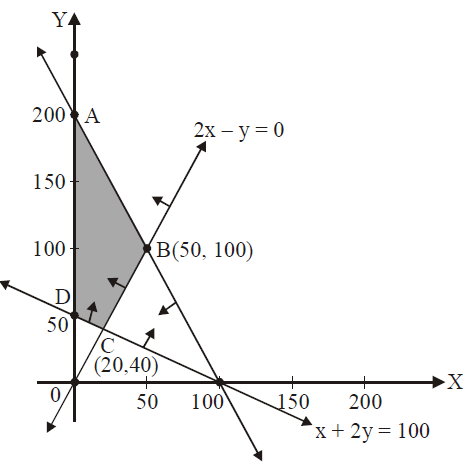
$\text{Z = x + 2y s.t x + 2y} \geq 100, \text{2x - y} \leq 0, \text{2x + y} \leq 200, \text{x, y} \geq 0$
Z(A) = 0 + 400 = 400
Z(B) = 50 + 200 = 250
Z(C) = 20 + 80 = 100
Z(D) = 0 + 100 = 100
$\therefore$ Max (= 400) at x = 0, y = 200 View full question & answer→Question 165 Marks
A manufacturer considers that men and women workers are equally efficient and so he pays them at the same rate. He has 30 and 17 units of workers (male and female) and capital respectively, which he uses to produce two types of goods A and B. To produce one unit of A, 2 workers and 3 units of capital are required while 3 workers and 1 unit of capital is required to produce one unit of B. If A and B are priced at

100 and

120 per unit respectively, how should he use his resources to maximise the total revenue? Form the above as an LPP and solve graphically. Do you agree with this view of the manufacturer that men and women workers are equally efficient and so should be paid at the same rate?
AnswerLet x, y unit of goods A and B are produced respectively.
Let Z be total revenue
Here Z = 100x + 120y - - - - - (i)
Also 2x + 3y $\le$ 30 - - - -- (ii)
3x + y $\le$ 17 - - - - - -- (iii)
x $\ge$ 0 - - - -- - -- - (iv)
y $\ge$ 0 - - - -- - (v)
On plotting graph of above constants or inequalities (ii), (iii), (iv) and (v). We get shaded region as feasible region having corner points A, O, B and C.
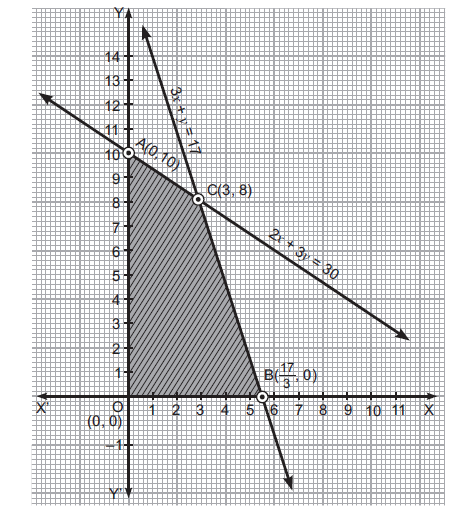
For co-ordinate of 'C'
Two equations (ii) and (iii) are solved and we get coordinate of C = (3, 8)
Now the value of Z is evaluated at corner point as:
| Corner point |
Z = 100x + 120y |
| (0, 10) |
1200 |
| (0,0) |
0 |
| $\bigg(\frac{17}{3},0\bigg)$ |
$\frac{1700}{3}$ |
| (3,8) |
1260 $\leftarrow\text{ Maximum}$ |
Therefore maximum revenue is 1,260 when 2 workers and 8 units capital are used for production.
Yes, although women workers have less physical efficiency but it can be managed by her other efficiency. View full question & answer→Question 175 Marks
A dietician wishes to mix two types of foods in such a way that the vitamin contents of the mixture contains at least 8 units of vitamin $A$ and $10$ units of vitamin $C$. Food I contains $2$ units/kg of vitamin $A$ and $1$ unit/kg of vitamin $C$ while Food II contain $1$ unit/kg of vitamin A and $2$ units/kg of vitamin $C$. It costs  $5$ per kg to purchase Food I and
  $7$ per kg to purchase Food II. Determine the minimum cost of such a mixture. Formulate the above as a LPP and solve it graphically.
 AnswerLet the mixture contain $x$ kg of food I and $y$ kg of food II
Getting the objective function as
$Z = 5x + 7y$
Getting the constraints
$2x + y > 8$
$x + 2y > 10$
$x, y > 0$
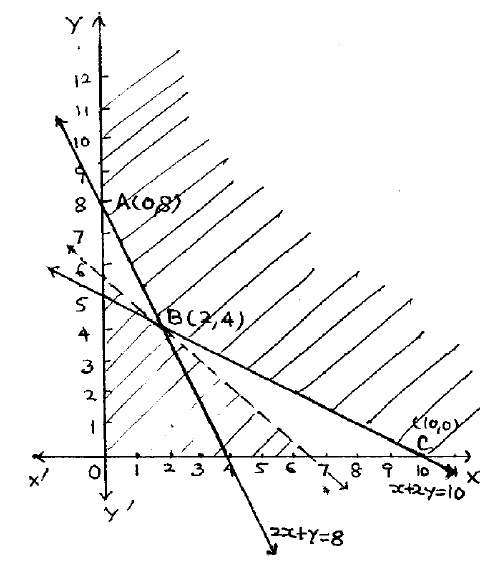
Getting the corners of feasible
region as $A(0, 8), B (2, 4), C (10, 0)$
$Z_A= 5 \times 0 + 7 \times 8 = 56$
$Z_B = 5 \times 2 + 7 \times 4 = 38$ minimum
$Z_C = 5 \times 10 + 7 \times 10 = 50$
since $5x + 7y < 38$ has
no common regionwith the feasible region
$\therefore$ For minimum cost
$x = 2$ kg and $y = 4$ kg.
View full question & answer→Question 185 Marks
A merchant plans to sell two types of personal computers - a desktop model and a portable, model that will costRs. 25,000 andRs. 40,000 respectively. He estimates that the total monthly demand of computers will not exceed 250 units. Determine the number of units of each type of computers which the merchant should stock to get maximum profit if he does not want to invest more than Rs. 70 lakhs and his profit on the desktop model is Rs. 4,500 and on the portable model is Rs. 5,000. Make an L.P.P. and solve it graphically.
AnswerLet the number of desktop models, he stock be x and the number of portable model be y
L.P.P. is,Maximise P = 4500 x + 5000y
subject to x + y < 250
25000 x + 40000 y < 7000000
(or 5x + 8y < 1400)
x > 0, y > 0
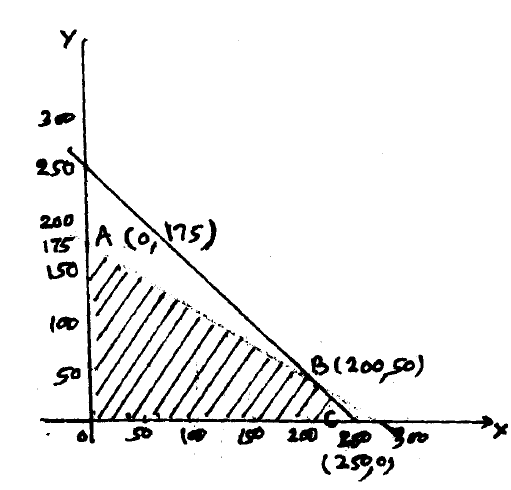
Vertices of feasible region are
A (0, 175), B (200, 50), C (250, 0)
P(A) = Rs. 875000
P(B) = Rs. 900000 + 250000 = Rs. 1150000
P(C) = Rs. 1125000
$\therefore$ For max. Profit destop model = 200
Portable Model = 50. View full question & answer→Question 195 Marks
One kind of cake requires 300 g of flour and 15 g of fat, another kind of cake requires 150 g of flour and 30 g of fat. Find the maximum number of cakes which can be made from 7.5 kg of flour and 600 g of fat, assuming that there is no shortage of the other ingradients used in making the cakes. Make it as an L.P.P. and solve it graphically.
AnswerLet x cakes of first type and y cakes of second type are made Maximise S = x + y 1 subject to 300x + 150y < 7500 or 2x + y < 50 15x + 30y < 600 or x + 2y < 40 x > 0, y > 0
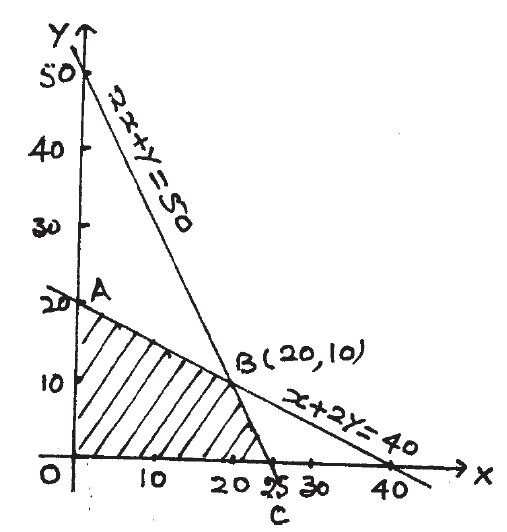
Vertices of feasible region are A (0, 20), B (20, 10) C (25, 0) Maximum cakes = 20 + 10 = 30
View full question & answer→Question 205 Marks
A diet for a sick person must contain at least $4000$ units of vitamins, $50$ units of minerals and $1400$ units of calories. Two foods $A$ and $B$ are available at a cost of Rs. $5$ and Rs. $4$ per unit respectively. One unit of the food A contains $200$ units of vitamins, $1$ unit of minerals and $40$ units of calories, while one unit of the food $B$ contains $100$ units of vitamins, $2$ units of minerals and $40$ units of calories. Find what combination of the foods $A$ and $B$ should be used to have least cost, but it must satisfy the requirements of the sick person. Form the question as LPP and solve it graphically.
Answer
| Contents |
Food |
|
Requirement (in units) |
| of food |
$A$ |
$B$ |
|
| Vitamins |
$200$ |
$100$ |
$4000$ |
| Minerals |
$1$ |
$2$ |
$50$ |
| Calories |
$40$ |
$40$ |
$1400$ |
| Cost (per unit) |
Rs $5$ |
Rs $4$ |
|
Let $x$ units of Food $A$ and $y$ units of Food $B$ are taken
Getting the constraints
$200x + 100y > 4000 \Rightarrow 2x + y > 40$
$x + 2y > 50 \Rightarrow x + 2y > 50$
$40 (x + y) > 1400 \Rightarrow x + y > 35$
$x > 0, y > 0$
Cost $C = 5x + 4y$
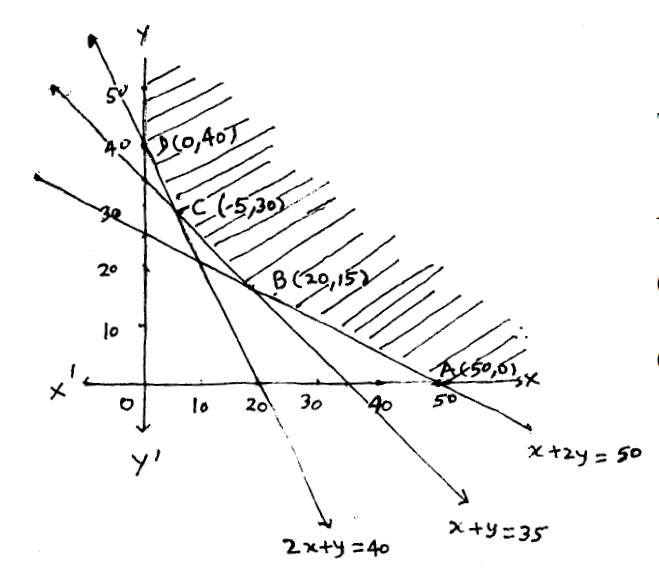
The vertices of feasible region are
$A (50, 0), B (20, 15), C (5, 30), D (0, 40)$
$C_A = 250, C_B = 160, C_C = 145, C_D = 160$
Cost is least at $x = 5, y = 30$
$\therefore 5$ units of Food A and $30$ units of Food $B$ be
mixed for minimum cost meeting the requirements. View full question & answer→Question 215 Marks
David wants to invest at most $Rs. 12,000$ in Bonds $A$ and $B$. According to the rule, he has to invest at least $Rs. 2,000$ in Bond A and at least $Rs. 4,000$ in Bond $B.$ If the rates of interest on Bonds $A$ and $B$ respectively are $8\%$ and $10\%$ per annum, formulate the problem as L.P.P. and solve it graphically for maximum interest. Also determine the maximum interest received in a year.
AnswerLet Amount invested in Bonds $A = Rs. x$
And Amount invested in Bonds $B = Rs. y$
$\therefore$ L.P.P. becomes: Maximise I = $\frac{\text{8x}}{100}+\frac{\text{10y}}{100}$
Subject to: $x + y < 12000$
$x > 2000$
$y > 4000$
$x > 0, y > 0$
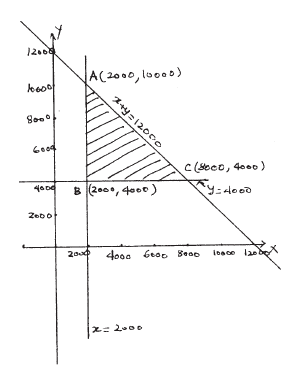
$I_A = 160 + 1000 = 1160$
$I_B = 160 + 400 = 560$
$I_C = 640 + 400 = 1040$
$\therefore$ For Maximum Interest
Amount invested in Bond $A = Rs. 2000$
Amount invested in Bond $B = Rs. 10,000$
Maximum Interest recieved $= Rs. 1160.$
View full question & answer→Question 225 Marks
Solve the following LPP graphically:
Maximise Z = 105x + 90y
subject to the constraints
x + y $\leq$ 50
2x + y $\leq$80
x $\geq$ 0, y $\geq$ 0.
Answer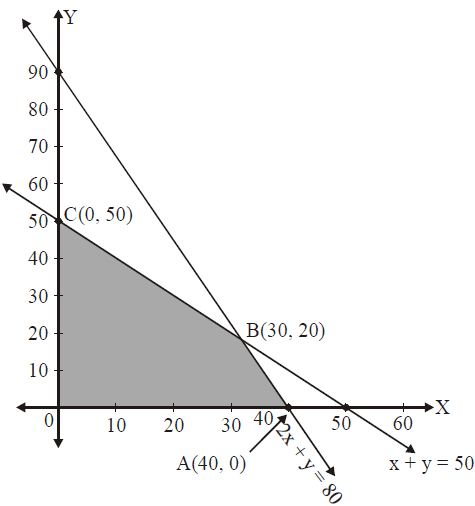
Z(O) = 0
Z(A) = 4200
Z(B) = 4950
Z(C) = 4500
$\therefore\ $Maximum value of Z is 4950
at x = 30, y = 20 View full question & answer→Question 235 Marks
In order to supplement daily diet, a person wishes to take $X$ and $Y$ tablets. The contents $($in milligrams per tablet$)$ of iron, calcium and vitamins in $X$ and $Y$ are given as below:
| Tablets |
Iron |
Calcium |
Vitamin |
| $X$ |
$6$ |
$3$ |
$2$ |
| $Y$ |
$2$ |
$3$ |
$4$ |
The person needs to supplement at least $18$ milligrams of iron, $21$ milligrams of calcium and $16$ milligrams of vitamins. The price of each tablet of $X$ and $Y$ is $₹ 2$ and $₹1$ respectively. How many tablets of each type should the person take in order to satisfy the above requirement at the minimum cost? Make an LPP and solve graphically. Answer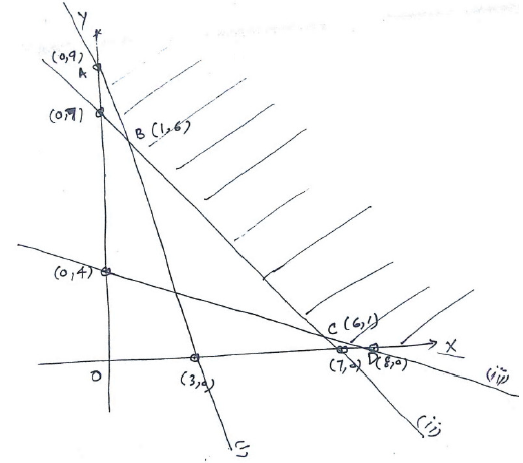
Let $x$ tablets of type $X$ and $y$ tablets of type $Y$ are taken
Minimise $C = 2x + y$
subjected to
$\text{6x + 2y}\geq 18\\ \text{3x + 3y} \geq 21\\ \text{2x + 4y} \geq 16\\ \text{x, y} \geq 0$
$C|_{A(0, 9)} = 9$
$C|_{B (1, 6)} = 8 \leftarrow$ Minimum value
$C|_{C (6, 1)} = 13$
$C|_{D (8, 0)} = 16$
$2x + y < 8$ does not pass through unbounded region.
Thus, minimum value of $C = 8$ at $x = 1, y = 6.$ View full question & answer→Question 245 Marks
Solve the following LPP graphically:
Minimise Z = 3x + 9y
subject to the constraints
x + 3y $\leq$ 60
x + y $\geq$ 10
x $\leq$ y
x $\geq$ 0, y $\geq$ 0.
Answer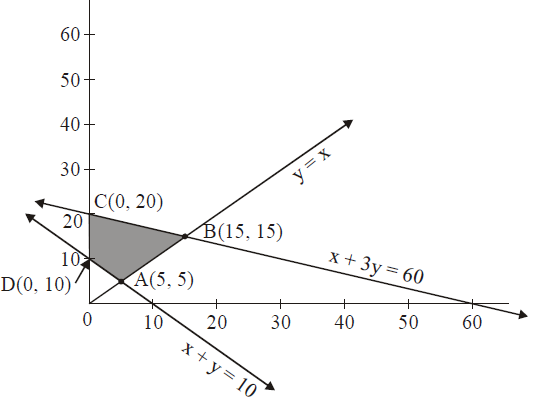
Z(A) = 60
Z(B) = 180
Z(C) = 180
Z(D) = 90
$\therefore $ Minimum value of z is 60 when x = 5, y = 5 View full question & answer→Question 255 Marks
In order to supplement daily diet, a person wishes to take $X$ and $Y$ tablets. The contents (in milligrams per tablet) of iron, calcium and vitamins in $X$ and $Y$ are given as below:
| Tablets |
Iron |
Calcium |
Vitamin |
| $X$ |
$6$ |
$3$ |
$2$ |
| $Y$ |
$2$ |
$3$ |
$4$ |
The person needs to supplement at least $18$ milligrams of iron, $21$ milligrams of calcium and $16$ milligrams of vitamins. The price of each tablet of $X$ and $Y$ is $₹ 2$ and $₹1$ respectively. How many tablets of each type should the person take in order to satisfy the above requirement at the minimum cost? Make an LPP and solve graphically. Answer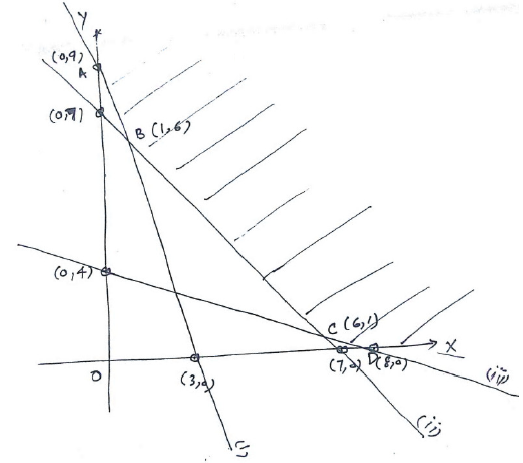
Let x tablets of type X and y tablets of type Y are taken
Minimise $C = 2x + y$
subjected to
$\text{6x + 2y}\geq 18\\ \text{3x + 3y} \geq 21\\ \text{2x + 4y} \geq 16\\ \text{x, y} \geq 0$
$C|_{A(0, 9)} = 9$
$C|_{B (1, 6)} = 8 \leftarrow$ Minimum value
$C|_{C (6, 1)} = 13$
$C|_{D (8, 0)} = 16$
$2x + y < 8$ does not pass through unbounded region.
Thus, minimum value of $C = 8$ at $x = 1, y = 6.$ View full question & answer→Question 265 Marks
Solve the following LPP graphically:
Maximise Z = 1000x + 600y
subject to the constraints
$\text{ }\text{x + y} \leq 200\\ \text{ }\text{ }\text{ }\text{ }\text{ }\text{ }\text{ }\text{ }\text{ }\text{ }\text{x} \geq 20\\ \text{ }\text{ }\text{ }\text{ }\text{y - 4x} \geq 0\\ \text{ }\text{ }\text{ }\text{ }\text{ }\text{ }\text{ }\text{x, y} \geq 0. $
Answer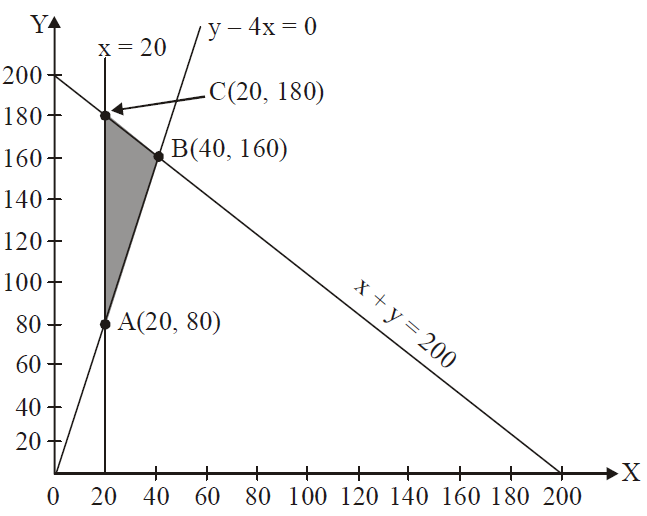
Z(A) = 68,0000
Z(B) = 1,36,000
Z(C) = 1,28,000
$\therefore$ Maximum value of Z = 1,36,000 at x = 40, y = 160 View full question & answer→Question 275 Marks
In order to supplement daily diet, a person wishes to take $X$ and $Y$ tablets. The contents $($in milligrams per tablet$)$ of iron, calcium and vitamins in $X$ and $Y$ are given as below:
| Tablets |
Iron |
Calcium |
Vitamin |
| $X$ |
$6$ |
$3$ |
$2$ |
| $Y$ |
$2$ |
$3$ |
$4$ |
The person needs to supplement at least $18$ milligrams of iron, $21$ milligrams of calcium and $16$ milligrams of vitamins. The price of each tablet of $X$ and $Y$ is $₹ 2$ and $₹1$ respectively. How many tablets of each type should the person take in order to satisfy the above requirement at the minimum cost? Make an LPP and solve graphically. Answer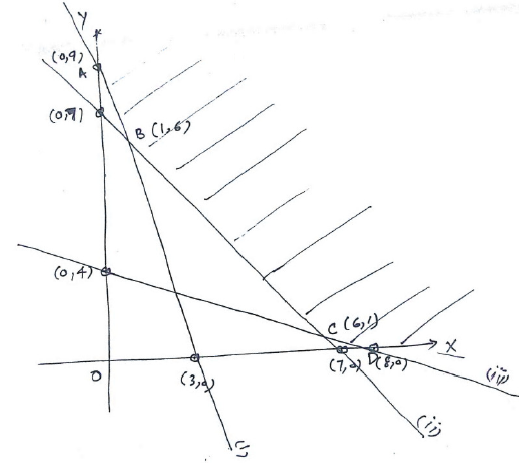
Let $x$ tablets of type $X$ and $y$ tablets of type $Y$ are taken
Minimise $C = 2x + y$
subjected to
$\text{6x + 2y}\geq 18\\ \text{3x + 3y} \geq 21\\ \text{2x + 4y} \geq 16\\ \text{x, y} \geq 0$
$C|_{A(0, 9)} = 9$
$C|_{B (1, 6)} = 8 $ $\leftarrow$ Minimum value
$C|_{C (6, 1)} = 13$
$C|_{D (8, 0)} = 16$
$2x + y < 8$ does not pass through unbounded region.
Thus, minimum value of $C = 8$ at $x = 1, y = 6.$ View full question & answer→Question 285 Marks
Solve the following L.P.P. graphically:
Maximise $Z = 20x + 10y$
Subject to the following constraints $x + 2y \leq 28,$
$3x + y \leq 24,$
$x \geq 2,$
$x, y \geq 0$
Answer
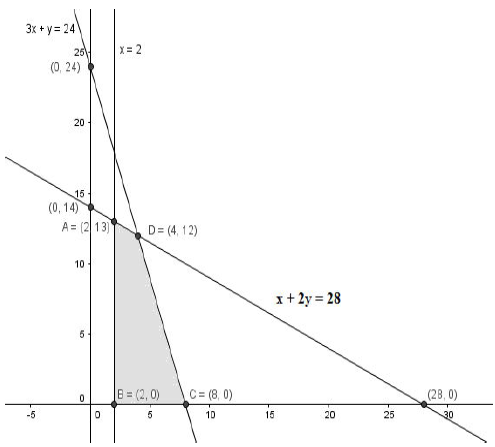
$Z = 20x + 10y$
$Z|_{A(2, 13)} = 170$
$Z|_{B(2, 0)} = 40$
$Z|_{C(8, 0)} = 160$
$Z|_{D(4, 12}) = 200$
Miximum value of $Z = 200$ at $x = 4, y = 12$ View full question & answer→Question 295 Marks
A manufacturer produces two products A and B. Both the products are processed on two different machines. The available capacity of first machine is 12 hours and that of second machine is 9 hours per day. Each unit of product A requires 3 hours on both machines, and each unit of product B requires 2 hours on first machine and 1 hour on second machine. Each unit of product A is sold at ₹ 7 profit and that of B at a profit of ₹ 4. Find the production level per day for maximum profit graphically.
Answer
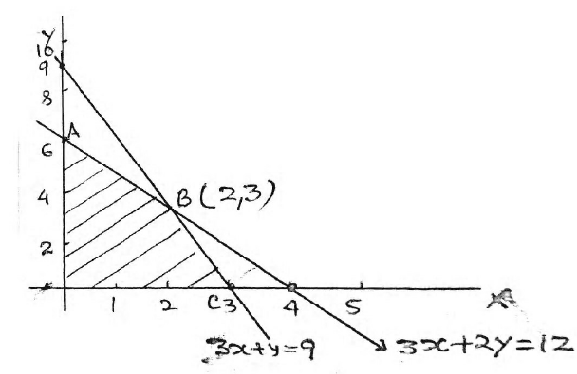 Let production of A, B (per day) be x, y respectively
Maximise $\text{P = 7x + 4y} $
$\text{Subject to} \begin{matrix} \text{3x} + & \text{2y}\leq & 12 \\ \text{3x} + & \text{y}\leq & 9 \\ \text{x} \geq 0 & \text{y}\geq & 0 \end{matrix} $
$\text{P(A)} = 24$
$\text{P(B)} = 26$
$\text{P(C)} = 21$
$\therefore$ 2 units of product A and 3 units of product B for maximum profit. View full question & answer→Question 305 Marks
Three schools A, B and C organised a mela for collecting funds for helping the rehabilitation of flood victims. They sold hand made fans, mats and plates from recycled material at a cost of
₹ 25,
₹ 100 and
₹ 50 each. The number of articles sold are given below:
| School |
A |
B |
C |
| Article |
| Hand - fans |
40 |
25 |
35 |
| Mats |
50 |
40 |
50 |
| Plates |
20 |
30 |
40 |
Find the funds collected by each school separately by selling the above articles. Also find the total funds collected for the purpose.
Write one value generated by the above situation.
Answer
| $\begin{bmatrix} \text{A}\\ \text{B} \\ \text{C} \end{bmatrix}$ |
$ \begin{bmatrix} \text{HF.} & \text{M} & \text{T}\\ 40 & 50 & 20 \\25 & 40 & 30 \\ 35 & 50 & 40 \end{bmatrix}$ |
$\begin{bmatrix} 25 \\ 100 \\ 50 \end{bmatrix}$ |
= |
$\begin{bmatrix} 7000\\ 6125 \\ 7875 \end{bmatrix} $ |
Funds collected by school A: Rs. 7000,
School B: Rs. 6125, School C: Rs. 7875
Total collected: Rs. 21000
For writing one value View full question & answer→Question 315 Marks
Find graphically, the maximum value of $\text{z = 2x + 5y},$ subject to constraints given below:
$2x + 4y \leq 8$
$3x + y \leq 6$
$x + y \leq 4$
$x\geq 0, y\geq 0$
Answer
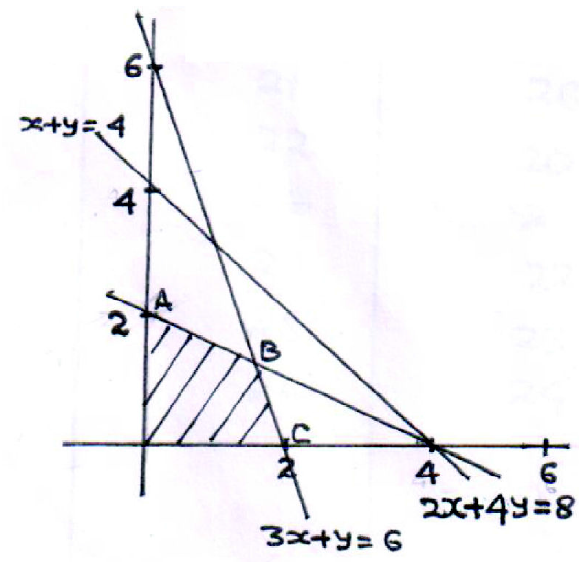 Vertices are:
$\text{A (0, 2), B(1.6, 1.2), C (2, .0)}$
$\text{Z = 2x + 5y is maximum}$
at A (0, 2) and maximum value = 10 View full question & answer→Question 325 Marks
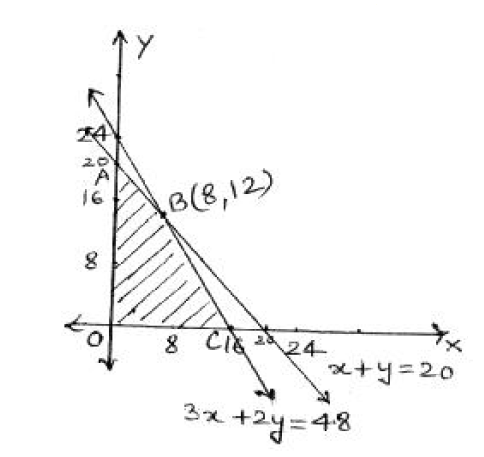
A dealer in rural area wishes to purchase a number of sewing machines. He has only ₹ 5,760 to invest and has space for at most 20 items for storage. An electronic sewing machine costs him ₹ 360 and a manually operated sewing machine ₹ 240. He can sell the sewing machine at a profit of ₹ 22 and a manually operated sewing machine at a profit of ₹ 18. Assuming that he can sell all the items that he can buy, how should he invest his money in order to maximize his profit? Make it as an LPP and solve it graphically.
AnswerLet x and y be electronic and manually operated sewing machines purchased respectively,
$\therefore\text{ L.P.P. is Maximize P} = 22\text{x} + 18\text{y}$
subject to 360x + 240y $\leq$ 5760
or 3x + 2y $\leq$ 48
x + y $\leq$ 20
x $\geq$ 0, y $\geq$ 0
vertices of the feasible region are
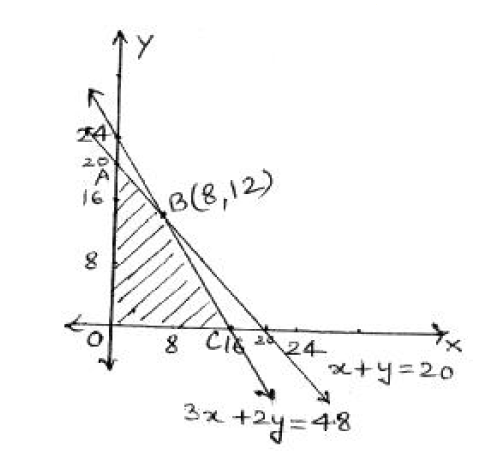
A (0, 20), B(8, 12), C(16, 0) & O(0, 0)
P(A) = 360, P(B) = 392, P(C) = 352
$\therefore$ For Maximum P,Electronic machines = 8
Manual machines = 12. View full question & answer→Question 335 Marks
Solve the following L.P.P. graphically:
$\text{Miximise}\ \ \ \ \ \ \ \ \ \ \ \ \ \ \ \ \ \ \ \ \ \ \ \ \ \ \ \ \ \ \ \ \ \ \ \ \ \ \ \text{ }\text{ }\text{ }\text{Z} = 4x + \text{y}\\ \text{Subect to following constraints} \text{ }\text{ }\text{ }\text{ }\text{ }x + \text{y} \leq 50\\ \ \ \ \ \ \ \ \ \ \ \ \text{}\text{} \text{ }\ \ \ \ \ \ \ \ \ \ \ \ \ \ \ \ \ \ \ \ \ \ \ \ \ \ \ \ \ \ \ \ \ \ \ \ \ \ \ \ \ \ \ \ \ \ 3x + \text{y} \leq 90\\ \text{ }\text{ }\text{ }\text{ }\text{ }\text{ }\text{ }\text{ }\text{ }\text{ }\text{ }\text{ }\text{ }\text{ }\text{ }\text{ }\text{ }\text{ }\text{ }\text{ }\text{ }\ \ \ \ \ \ \ \ \ \ \ \ \ \ \ \ \ \ \ \ \ \ \ \ \ \ \ \ \ \ \ \ \ \ \ \ \ x \ \geq 10\\ \text{ }\text{ }\text{ }\text{ }\text{ }\text{ }\ \ \ \ \ \ \ \ \ \ \ \ \ \ \ \ \ \ \ \ \ \ \ \ \ \ \ \ \ \ \ \ \ \ \ \ \ \ \ \ \ \ \ \ \ \ \ \ \ \ \ \ x, \text{y} \geq 0$
Answer
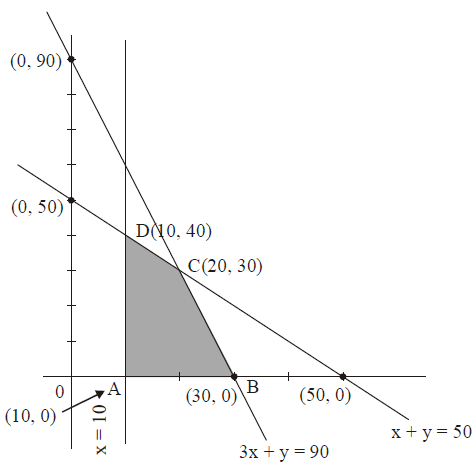
$Z|_{A(10, 0)} = 40$
$Z|_{B(30, 0)} = 120$
$Z|_{C(20, 30)} = 110$
$Z|_{D(10, 40}) = 80$
Minimum value of $Z = 120$ at $(30, 0)$ View full question & answer→Question 345 Marks
A manufacturer produces two products A and B. Both the products are processed on two different machines. The available capacity of first machine is 12 hours and that of second machine is 9 hours per day. Each unit of product A requires 3 hours on both machines, and each unit of product B requires 2 hours on first machine and 1 hour on second machine. Each unit of product A is sold at ₹ 7 profit and that of B at a profit of ₹ 4. Find the production level per day for maximum profit graphically.
Answer
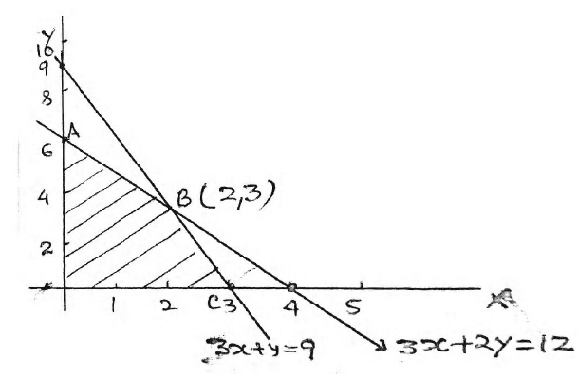 Let production of A, B (per day) be x, y respectively
Maximise $\text{P = 7x + 4y} $
$\text{Subject to} \begin{matrix} \text{3x} + & \text{2y}\leq & 12 \\ \text{3x} + & \text{y}\leq & 9 \\ \text{x} \geq 0 & \text{y}\geq & 0 \end{matrix} $
$\text{P(A)} = 24$
$\text{P(B)} = 26$
$\text{P(C)} = 21$
$\therefore$ 2 units of product A and 3 units of product B for maximum profit. View full question & answer→Question 355 Marks
Three schools A, B and C organised a mela for collecting funds for helping the rehabilitation of flood victims. They sold hand made fans, mats and plates from recycled material at a cost of
₹ 25,
₹ 100 and
₹ 50 each. The number of articles sold are given below:
| School |
A |
B |
C |
| Article |
| Hand - fans |
40 |
25 |
35 |
| Mats |
50 |
40 |
50 |
| Plates |
20 |
30 |
40 |
Find the funds collected by each school separately by selling the above articles. Also find the total funds collected for the purpose.
Write one value generated by the above situation.
Answer
| $\begin{bmatrix} \text{A}\\ \text{B} \\ \text{C} \end{bmatrix}$ |
$ \begin{bmatrix} \text{HF.} & \text{M} & \text{T}\\ 40 & 50 & 20 \\25 & 40 & 30 \\ 35 & 50 & 40 \end{bmatrix}$ |
$\begin{bmatrix} 25 \\ 100 \\ 50 \end{bmatrix}$ |
= |
$\begin{bmatrix} 7000\\ 6125 \\ 7875 \end{bmatrix} $ |
Funds collected by school A: Rs. 7000,
School B: Rs. 6125, School C: Rs. 7875
Total collected: Rs. 21000
For writing one value View full question & answer→Question 365 Marks
Find graphically, the maximum value of $\text{z = 2x + 5y},$ subject to constraints given below:
$2x + 4y \leq 8$
$3x + y \leq 6$
$x + y \leq 4$
$x\geq 0, y\geq 0$
Answer
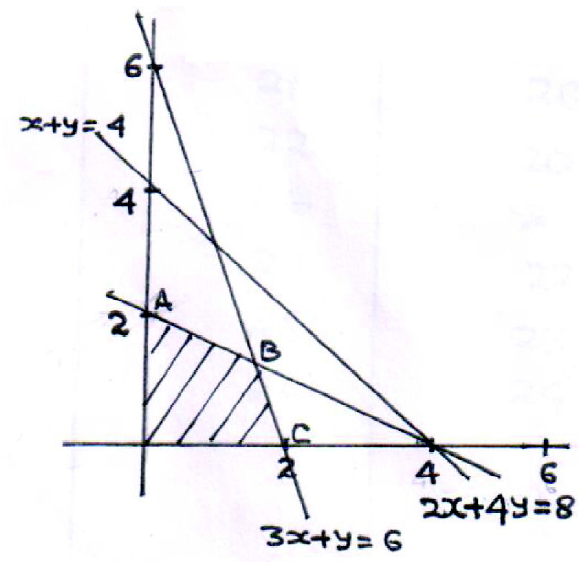 Vertices are:
$\text{A (0, 2), B(1.6, 1.2), C (2, .0)}$
$\text{Z = 2x + 5y is maximum}$
at A (0, 2) and maximum value = 10 View full question & answer→Question 375 Marks
A dealer in rural area wishes to purchase a number of sewing machines. He has only ₹ 5,760 to invest and has space for at most 20 items for storage. An electronic sewing machine costs him ₹ 360 and a manually operated sewing machine ₹ 240. He can sell the sewing machine at a profit of ₹ 22 and a manually operated sewing machine at a profit of ₹ 18. Assuming that he can sell all the items that he can buy, how should he invest his money in order to maximize his profit? Make it as an LPP and solve it graphically.
AnswerLet x and y be electronic and manually operated sewing machines purchased respectively,
$\therefore\text{ L.P.P. is Maximize P} = 22\text{x} + 18\text{y}$
subject to 360x + 240y $\leq$ 5760
or 3x + 2y $\leq$ 48
x + y $\leq$ 20
x $\geq$ 0, y $\geq$ 0
vertices of the feasible region are
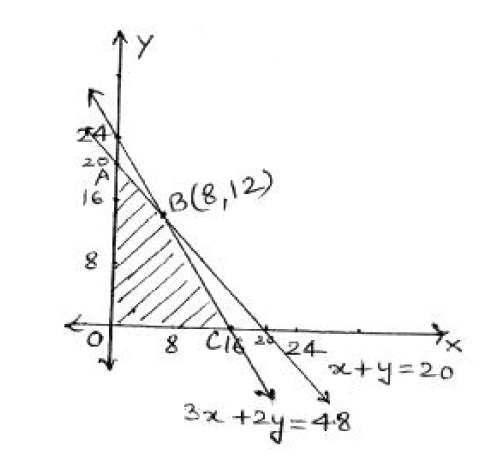
A (0, 20), B(8, 12), C(16, 0) & O(0, 0)
P(A) = 360, P(B) = 392, P(C) = 352
$\therefore$ For Maximum P,Electronic machines = 8
Manual machines = 12. View full question & answer→Question 385 Marks
Solve the following L.P.P. graphically:
$\text{Minimise} \text{ }\text{ }\text{ }\text{Z} = 5x + 10\text{y}\\\text{Subect to} \text{ }\text{ }\text{ }\text{ }\text{ }x + \text{2y} \leq 120\\\text{Constraints} \text{ }x + \text{y} \geq 60\\\text{ }\text{ }\text{ }\text{ }\text{ }\text{ }\text{ }\text{ }\text{ }\text{ }\text{ }\text{ }\text{ }\text{ }\text{ }\text{ }\text{ }\text{ }\text{ }\text{ }\text{ }x - \text{2y} \geq 0\\\text{ }\text{ }\text{ }\text{ }\text{ }\text{ }\text{and}\text{ }\text{ }\text{ }\text{ }\text{ }\text{ }\text{ }\text{ }x, \text{y} \geq 0$
Answer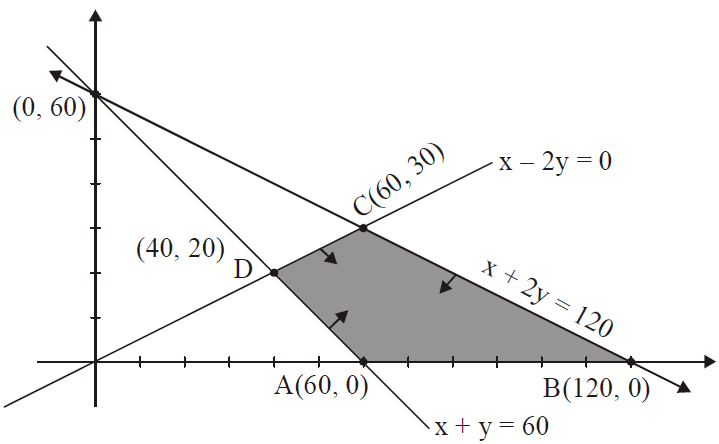
$Z = 5x + 10y$
$Z|_{A(60, 0)} = 300$
$Z|_{B(120, 0)} = 600$
$Z|_{C(60, 30)} = 60$
$Z|_{D(40, 20}) = 400$
Minimum value of $Z = 300$ at $x = 60, y = 0$ View full question & answer→Question 395 Marks
A manufacturer produces two products A and B. Both the products are processed on two different machines. The available capacity of first machine is 12 hours and that of second machine is 9 hours per day. Each unit of product A requires 3 hours on both machines, and each unit of product B requires 2 hours on first machine and 1 hour on second machine. Each unit of product A is sold at ₹ 7 profit and that of B at a profit of ₹ 4. Find the production level per day for maximum profit graphically.
Answer
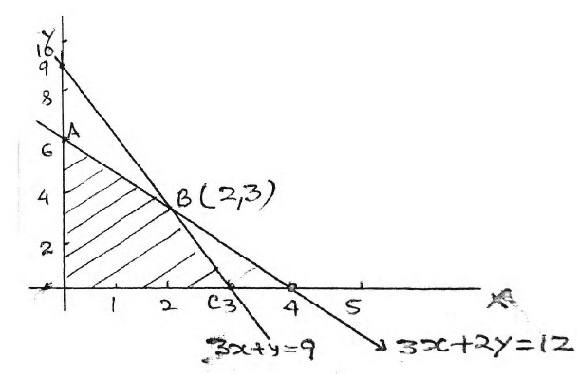 Let production of A, B (per day) be x, y respectively
Maximise $\text{P = 7x + 4y} $
$\text{Subject to} \begin{matrix} \text{3x} + & \text{2y}\leq & 12 \\ \text{3x} + & \text{y}\leq & 9 \\ \text{x} \geq 0 & \text{y}\geq & 0 \end{matrix} $
$\text{P(A)} = 24$
$\text{P(B)} = 26$
$\text{P(C)} = 21$
$\therefore$ 2 units of product A and 3 units of product B for maximum profit. View full question & answer→Question 405 Marks
Three schools A, B and C organised a mela for collecting funds for helping the rehabilitation of flood victims. They sold hand made fans, mats and plates from recycled material at a cost of
₹ 25,
₹ 100 and
₹ 50 each. The number of articles sold are given below:
| School |
A |
B |
C |
| Article |
| Hand - fans |
40 |
25 |
35 |
| Mats |
50 |
40 |
50 |
| Plates |
20 |
30 |
40 |
Find the funds collected by each school separately by selling the above articles. Also find the total funds collected for the purpose.
Write one value generated by the above situation.
Answer
| $\begin{bmatrix} \text{A}\\ \text{B} \\ \text{C} \end{bmatrix}$ |
$ \begin{bmatrix} \text{HF.} & \text{M} & \text{T}\\ 40 & 50 & 20 \\25 & 40 & 30 \\ 35 & 50 & 40 \end{bmatrix}$ |
$\begin{bmatrix} 25 \\ 100 \\ 50 \end{bmatrix}$ |
= |
$\begin{bmatrix} 7000\\ 6125 \\ 7875 \end{bmatrix} $ |
Funds collected by school A: Rs. 7000,
School B: Rs. 6125, School C: Rs. 7875
Total collected: Rs. 21000
For writing one value View full question & answer→Question 415 Marks
Find graphically, the maximum value of $\text{z = 2x + 5y},$ subject to constraints given below:
$2x + 4y \leq 8$
$3x + y \leq 6$
$x + y \leq 4$
$x\geq 0, y\geq 0$
Answer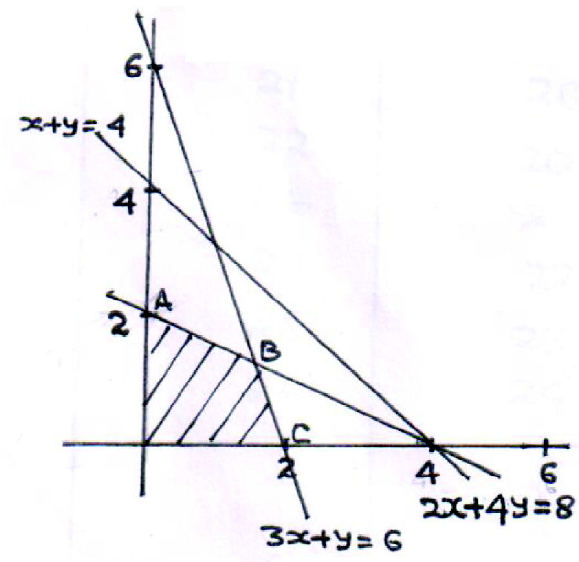
Vertices are:
$\text{A (0, 2), B(1.6, 1.2), C (2, .0)}$
$\text{Z = 2x + 5y is maximum}$
at A (0, 2) and maximum value = 10 View full question & answer→Question 425 Marks
A dealer in rural area wishes to purchase a number of sewing machines. He has only ₹ 5,760 to invest and has space for at most 20 items for storage. An electronic sewing machine costs him ₹ 360 and a manually operated sewing machine ₹240. He can sell the sewing machine at a profit of ₹ 22 and a manually operated sewing machine at a profit of ₹ 18. Assuming that he can sell all the items that he can buy, how should he invest his money in order to maximize his profit? Make it as an LPP and solve it graphically.
AnswerLet x and y be electronic and manually operated sewing machines purchased respectively,
$\therefore\text{ L.P.P. is Maximize P} = 22\text{x} + 18\text{y}$
subject to 360x + 240y $\leq$ 5760
or 3x + 2y $\leq$ 48
x + y $\leq$ 20
x $\geq$ 0, y $\geq$ 0
vertices of the feasible region are
A (0, 20), B(8, 12), C(16, 0) & O(0, 0)
P(A) = 360, P(B) = 392, P(C) = 352
$\therefore$ For Maximum P,Electronic machines = 8
Manual machines = 12. View full question & answer→Question 435 Marks
A manufacturer produces nuts and bolts. It takes 1 hour of work on machine A and 3 hours on machine B to produce a package of nuts. It takes 3 hours on machine A and 1 hour on machine B to produce a package of bolts. He earns a profit of

17.50 per package on nuts and

7 per package of bolts. How many packages of each should be produced each day so as to maximise his profits if he operates his machines for at the most 12 hours a day? Form the above as a linear programming problem and solve it graphically.
AnswerLet x packages of nuts and y packages of bolts be produced each day a
LPP is maximise P = 17.5x + 7y
subject to x + 3y < 12
3x + y < 12
x > 0, y > 0
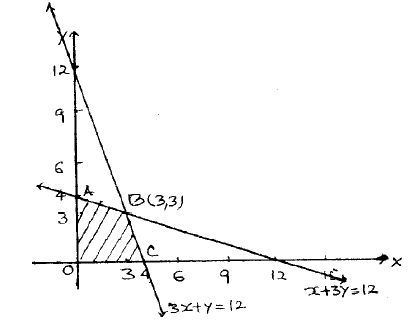
vertices of feasible region are A(0, 4), B (3, 3), C (4, 0).
Profit is Maximum at B(3, 3) i.e 3 packages of nuts and 3 packages of bolts.
View full question & answer→Question 445 Marks
A factory makes tennis rackets and cricket bats.A tennis racket takes 1.5 hours of machine time and 3 hours of craftman's time in its making while a cricket bat takes 3 hours of machine time and 1 hour of craftman's time. In a day, the factory has the availability of not more than 42 hours of machine time and 24 hours of craftsman's time. If the profit on a racket and on a bat is Rs. 20 and Rs. 10 respectively, find the number of tennis rackets and crickets bats that the factory must manufacture to earn the maximum profit.Make it as an L.P.P. and solve graphically.
AnswerLet number of tennis rackets be 'x' and cricket bats be 'y'
$\therefore$ LLP is
Maximise z = 20x + 10y
s.t. 1.5x + 3y $\leq$ 42
3x + y $\leq$ 24
x $\geq$ 0, y$\geq$ 0
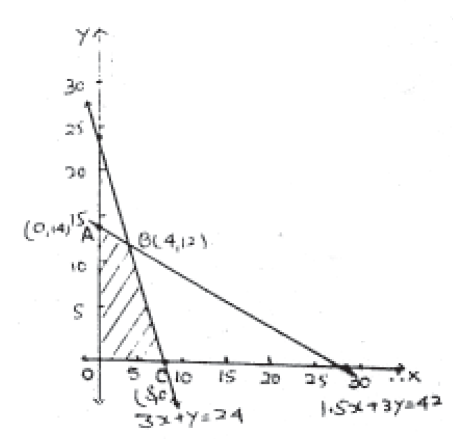
Vertices of feasible region are
A(0, 14), B(4, 12), C(8, 0)
P(A) = Rs. 140, P(B) = Rs. 200, P(C) = Rs.160
For Maximum profit
Number of Rackets = 4
Number of bats = 12. View full question & answer→Question 455 Marks
A small firm manufactures gold rings and chains. The total number of rings and chains manufactured per day is atmost $24$. It takes $1$ hour to make a ring and $30$ minutes to make a chain. The maximum number of hours available per day is $16$. If the profit on a ring is Rs. $300$ and that on a chain is Rs. $190,$ find the number of rings and chains that should be manufactured per day, so as to earn the maximum profit. Make it as an L.P.P. and solve it graphically.
AnswerLet $x$ be the number of gold rings and $y,$ the number of chains.
The objective function is $ Z = 300 x + 190 y$
Constraints are:
$x + y < 24$
$2x + y < 32$
$x > 0, y > 0$
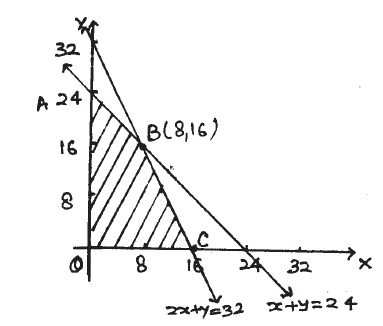
Getting corners of feasible region as
$A (0, 24), B (8, 16)$
$C (16, 0), O (0, 0)$
$Z_{(0, 0)} = 0, Z_A = 45 60, Z_C = 4800$
$Z_B = 300 \times 8 + 190 \times 16 = 2400 + 3040 = 5440$
$\therefore Z $ is maximum at $B (8. 16)$
$\therefore$ For maximum profit, Rings $= 8,$ chains $= 16.$
View full question & answer→Question 465 Marks
A factory owner purchases two types of machines, A and B for his factory. The requirements and the limitations for the machines are-as follows:
|
Machine
|
Area occupied
|
Labour force
|
Daily output ( in units)
|
|
A
|
$1000m^2$
|
12 men
|
60
|
|
B
|
$1200m^2$
|
8 men
|
40
|
He has maximum area of $9000 \text{m}^{2}$ available, and 72 skilled labourers who can operate both the machines. How many machines of each type should he buy to maximise the daily output? Answer
|
|
Machine A
|
Machine B
|
Max available
|
|
Area needed
|
$1000m^2$
|
$1200m^2$
|
$9000m^2$
|
|
Labour Force
|
12
|
8
|
72
|
|
Daily Outpit
|
60 units
|
40 units
|
|
Let x and y be the number of machines A and B respectively Getting the constraints
$\text{1000 x + 1200 y} \leq 9000 \Rightarrow \text{5x+ 6y} \leq 45 $
$\text{12 x + 8 y} \leq 72 \Rightarrow \text{3x + 2y} \leq 18$
$\text{x} \geq 0, 60\text{x} + 40{\text{y}}$
The vertices of feasible region are
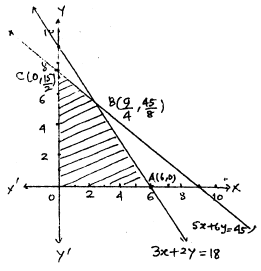
$0(0, 0), \text{A}(6,0), \text{B} \bigg(\frac{9}{4}, \frac{45}{8}\bigg), \text{c} \bigg(0, \frac{15}{2}\bigg)$
Correct graph
$\text{P (0, 0) = 0}$
$\text{P(6, 0) = 360}$
$\text{P} \bigg(0, \frac{15}{2}\bigg) = 300$
$\text{P} \bigg(\frac{9}{4}, \frac{45}{8}\bigg) = 60\times \frac{9}{4} + \frac{45}{8 } \times 40$
$= 135 + 225 = 360$
$\therefore \text{P is equal 360 at A and B}$ View full question & answer→Question 475 Marks
If a young man rides his motorcycle at 25 km/hour, he had to spend Rs. 2 per km on petrol. If he rides at a faster speed of 40 km/hour, the petrol cost increases at Rs. 5 per km. He has Rs. 100 to spend on petrol and wishes to find what is the maximum distance he can travel within one hour. Express this as an LPP and solve it graphically.
AnswerLet x km be the distance covered at 25 km/hour, and y km be the distance covered at 40 km/hour
We have to Maximise $\text{z = x + y}$
Subjext to $2x + 5y \leq 100$
and $8x + 5y \leq 200, y \geq 0, y\geq 0$
For Correct graph with shade
Vertices of feasible region are:
$\text{A} \bigg(\frac{50}{3}, \frac{40}{3} \bigg) B (0, 20), C (25, 0)$
$\text{Z}_{A} = \bigg(\frac{50}{3} + \frac{40}{3} \bigg) \text{km = 30 km}$
$\text{Z}_{B} = (0 + 20) \text{km = 20 km}$
$\text{Z}_{C} = (25 + 0) \text{km = 25 km}$
$\therefore \text{Z is maximum (30 km) at x} = \frac{50}{3} \text{km, y} =\frac{40}{3}\text{km}$
View full question & answer→Question 485 Marks
A and B are partners sharing profits and losses in the ratio 3 : 4 respectively. They admit C as a new partner, the new profit sharing ratio being 2 : 2 : 3 between A, B and C respectively. C pays Rs. 12,000 as premium for goodwill. Find the amount of premium shared by A and B.
AnswerProfit sharing ratio of A and B initially $= 3:4 $$A = \frac{3}{7}, B = \frac{4}{7}$
Profit sharing ratio after joining of C $= 2 : 2 : 3$
$A = \frac{2}{7}, B =\frac{2}{7}, C = \frac{3}{7}$
$\therefore$ Sacrificing ratio of A and B $= \frac{3}{7} -\frac{2}{7} : \frac{4}{7}- \frac{2}{7} $
$= 1 : 2$
$\therefore$ Share of A in premium = Rs. 4000
$\therefore$ Share of B in premium = Rs. 8000
View full question & answer→Question 495 Marks
Find the present worth of an ordinary annuity of Rs. 1,200 per annum for 10 years at 12% per annum, compounded annually.$\text[ {Use} : ( 1.12)^{-10} = 0.03221]$
AnswerWe have $V = R \bigg[\frac{1- (1 + r)^{-n}}{r}\bigg]$Here $R = 1200, n = 10, r = 0.12$
$\therefore V = 1200 \times \bigg[\frac{1 - (1.12)^{-10}}{0.10}\bigg]= 1200 \times \bigg[\frac{1-0.3221}{0.12}\bigg]$
$= \frac{1200 \times 0.6779}{0.12} = 6779$
$\therefore$ Present value of ordinary annuity is Rs 6779
View full question & answer→Question 505 Marks
A dealer wishes to purchase a number of fans and sewing machines. He has only Rs. 5,760 to invest and has space for at most 20 items. A fan and sewing machine cost Rs. 360 and Rs. 240 respectively. He can sell a fan at a profit of Rs. 22 and sewing machine at a profit of Rs. 18. Assuming that he can sell whatever he buys, how should he invest his money in order to maximise his profit ? Translate the problem into LPP and solve it graphically.
Answer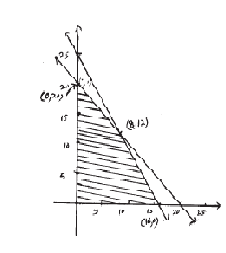 Profit function P = 22 x +18 y, where x is the number 1 m of fans sold and y the number of sewing machines sold.
Constraints are $x + y \leq 20, 360x + 240y \leq 5760 $
$x \geq 0, y^{.} \geq 0$
Graphing of problem and getting feasible region as (0, 0), (16, 0) (8, 12) (0, 20)
$P_{(0,0)} = 0, P_{16,0} = 352, P_{(8,12)} = 392$
$P_{(0, 20)} = 360$
$\therefore$ P is maximum for 8 fans and 12 sewing machines. View full question & answer→Question 515 Marks
A factory manufactures two types of screws A and B, each type requiring the use of two machines, an automatic and a hand-operated. It takes 4 minutes on the automatic and 6 minutes on the hand-operated machines to manufacture a packet of screws ‘A’ while it takes 6 minutes on the automatic and 3 minutes on the hand-operated machine to manufacture a packet of screws ‘B’. Each machine is available for at most 4 hours on any day. The manufacturer can sell a packet of screws ‘A’ at a profit of 70 paise and screws ‘B’ at a profit of Rs. 1. Assuming that he can sell all the screws he manufactures, how many packets of each type should the factory owner produce in a day in order to maximize his profit? Formulate the above LPP and solve it graphically and find the maximum profit.
AnswerLet the number of package of screw A = x Number of packages of screw B = y
|
Item
|
Number
|
Machine A
|
Machine B
|
Profit
|
|
Screw A
|
x
|
4 minutes
|
6 minutes
|
To paise = 7 Rs
|
|
Screw B
|
y
|
6 minutes
|
3 minutes
|
Rs. 1
|
|
Max time
Available
|
|
4 hours
= 240 min
|
4 hours
= 240 minutes
|
|
Automated Machine
Works for screw A → 4 min
Works on screw B → 6 min
$\therefore4\text{x}+6\text{y}\leq240$
$2\text{x}+3\text{y}\leq120$
$\text{x},\text{y}\geq0$ |
Hand operated machine
Works on screw A → 6 min
Works on screw B → 3 min
$\therefore6\text{x}+3\text{y}\leq240$
$2\text{x}+\text{y}\leq80$
$\text{x},\text{y}\geq0$ |
Now max Z = 0.7 x + y $2\text{x}+3\text{y}\leq120$ $2\text{x}+\text{y}\leq80$ $\text{x},\text{y}\geq0$ $2\text{x}+3\text{y}\leq120$ $\begin{array}{c|c} \text{x}&0 & 60 \\ \hline \text{y}&40 & 0 \end{array}$ $2\text{x}+\text{y}\leq80$ $\begin{array}{c|c} \text{x}&0 & 40 \\ \hline \text{y}&80 & 0 \end{array}$ 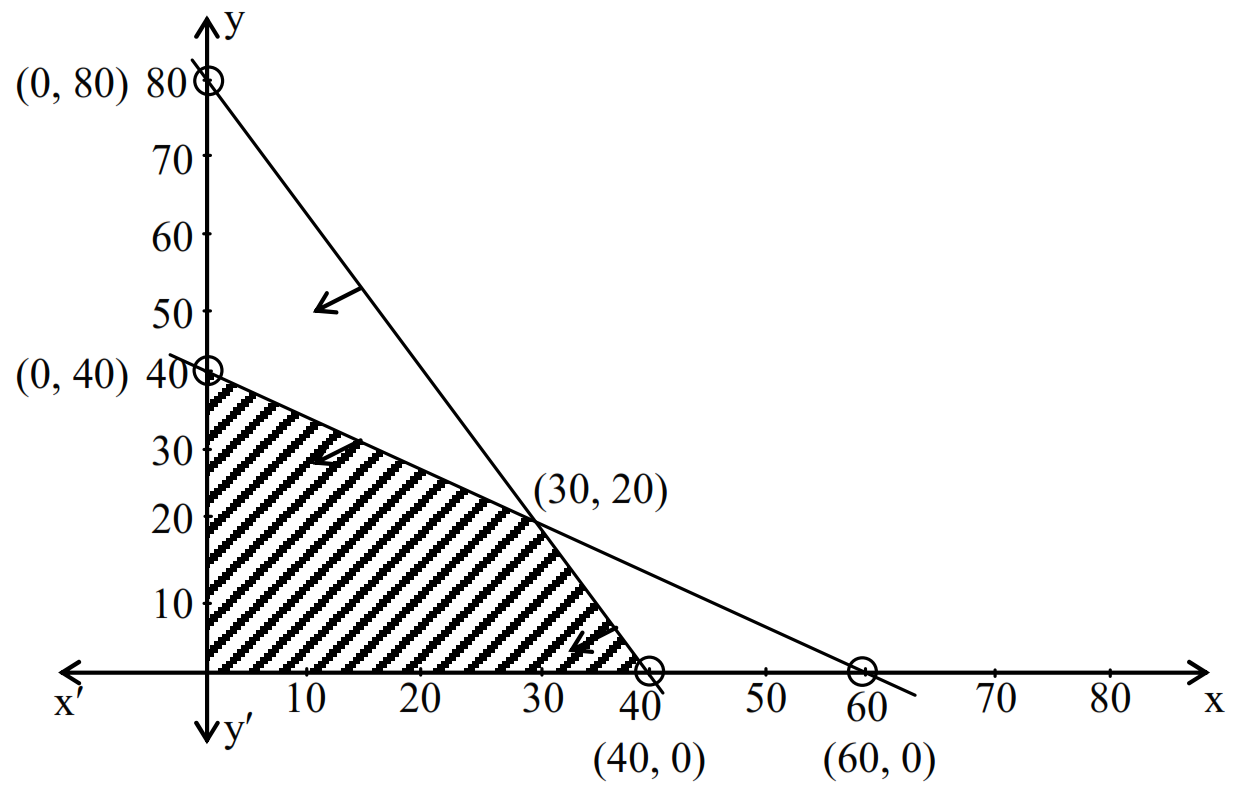
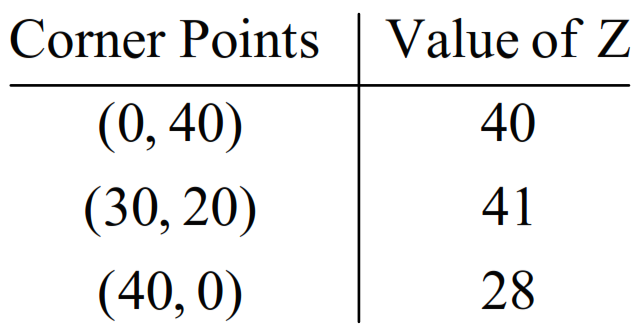 Hence, profit will be maximum, if the company produces, 30 packages of screw A 20 packages of screw B Maximum Profit = Rs. 41.
 View full question & answer→Question 525 Marks
A factory manufactures two types of screws A and B, each type requiring the use of two machines, an automatic and a hand-operated. It takes 4 minutes on the automatic and 6 minutes on the hand-operated machines to manufacture a packet of screws ‘A’ while it takes 6 minutes on the automatic and 3 minutes on the hand-operated machine to manufacture a packet of screws ‘B’. Each machine is available for at most 4 hours on any day. The manufacturer can sell a packet of screws ‘A’ at a profit of 70 paise and screws ‘B’ at a profit of Rs. 1. Assuming that he can sell all the screws he manufactures, how many packets of each type should the factory owner produce in a day in order to maximize his profit? Formulate the above LPP and solve it graphically and find the maximum profit.
AnswerLet the number of package of screw A = x Number of packages of screw B = y
|
Item
|
Number
|
Machine A
|
Machine B
|
Profit
|
|
Screw A
|
x
|
4 minutes
|
6 minutes
|
To paise = 7 Rs
|
|
Screw B
|
y
|
6 minutes
|
3 minutes
|
Rs. 1
|
|
Max time
Available
|
|
4 hours
= 240 min
|
4 hours
= 240 minutes
|
|
Automated Machine
Works for screw A → 4 min
Works on screw B → 6 min
$\therefore4\text{x}+6\text{y}\leq240$
$2\text{x}+3\text{y}\leq120$
$\text{x},\text{y}\geq0$ |
Hand operated machine
Works on screw A → 6 min
Works on screw B → 3 min
$\therefore6\text{x}+3\text{y}\leq240$
$2\text{x}+\text{y}\leq80$
$\text{x},\text{y}\geq0$ |
Now max Z = 0.7 x + y $2\text{x}+3\text{y}\leq120$ $2\text{x}+\text{y}\leq80$ $\text{x},\text{y}\geq0$ $2\text{x}+3\text{y}\leq120$ $\begin{array}{c|c} \text{x}&0 & 60 \\ \hline \text{y}&40 & 0 \end{array}$ $2\text{x}+\text{y}\leq80$ $\begin{array}{c|c} \text{x}&0 & 40 \\ \hline \text{y}&80 & 0 \end{array}$ 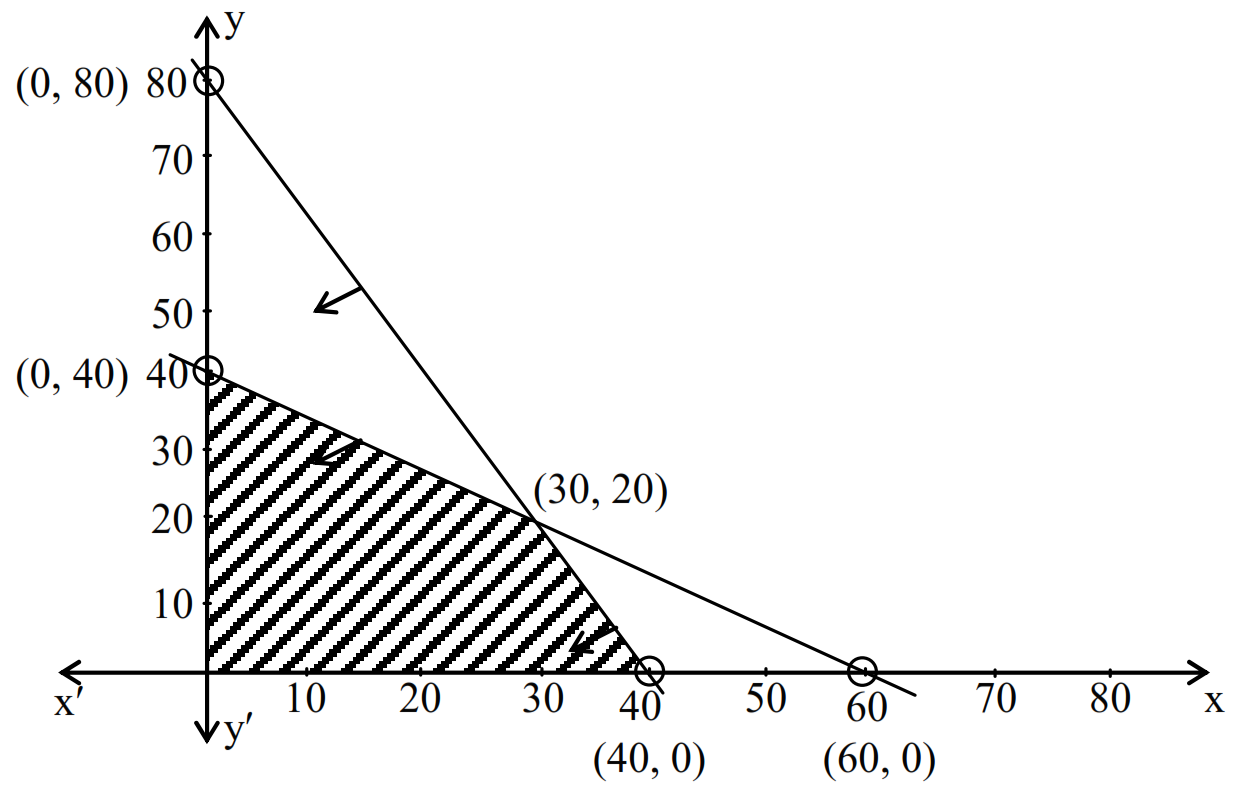
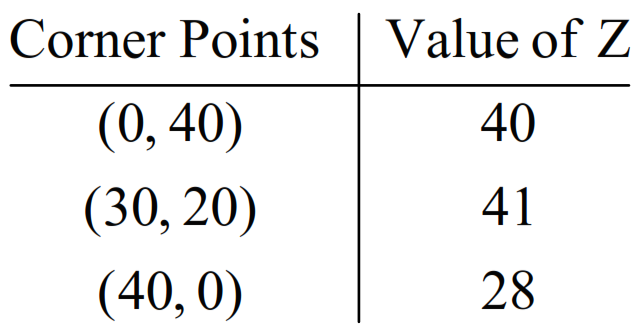 Hence, profit will be maximum, if the company produces, 30 packages of screw A 20 packages of screw B Maximum Profit = Rs. 41.
 View full question & answer→Question 535 Marks
A factory manufactures two types of screws A and B, each type requiring the use of two machines, an automatic and a hand-operated. It takes 4 minutes on the automatic and 6 minutes on the hand-operated machines to manufacture a packet of screws ‘A’ while it takes 6 minutes on the automatic and 3 minutes on the hand-operated machine to manufacture a packet of screws ‘B’. Each machine is available for at most 4 hours on any day. The manufacturer can sell a packet of screws ‘A’ at a profit of 70 paise and screws ‘B’ at a profit of Rs. 1. Assuming that he can sell all the screws he manufactures, how many packets of each type should the factory owner produce in a day in order to maximize his profit? Formulate the above LPP and solve it graphically and find the maximum profit.
AnswerLet the number of package of screw A = x Number of packages of screw B = y
|
Item
|
Number
|
Machine A
|
Machine B
|
Profit
|
|
Screw A
|
x
|
4 minutes
|
6 minutes
|
To paise = 7 Rs
|
|
Screw B
|
y
|
6 minutes
|
3 minutes
|
Rs. 1
|
|
Max time
Available
|
|
4 hours
= 240 min
|
4 hours
= 240 minutes
|
|
Automated Machine
Works for screw A → 4 min
Works on screw B → 6 min
$\therefore4\text{x}+6\text{y}\leq240$
$2\text{x}+3\text{y}\leq120$
$\text{x},\text{y}\geq0$ |
Hand operated machine
Works on screw A → 6 min
Works on screw B → 3 min
$\therefore6\text{x}+3\text{y}\leq240$
$2\text{x}+\text{y}\leq80$
$\text{x},\text{y}\geq0$ |
Now max Z = 0.7 x + y $2\text{x}+3\text{y}\leq120$ $2\text{x}+\text{y}\leq80$ $\text{x},\text{y}\geq0$ $2\text{x}+3\text{y}\leq120$ $\begin{array}{c|c} \text{x}&0 & 60 \\ \hline \text{y}&40 & 0 \end{array}$ $2\text{x}+\text{y}\leq80$ $\begin{array}{c|c} \text{x}&0 & 40 \\ \hline \text{y}&80 & 0 \end{array}$ 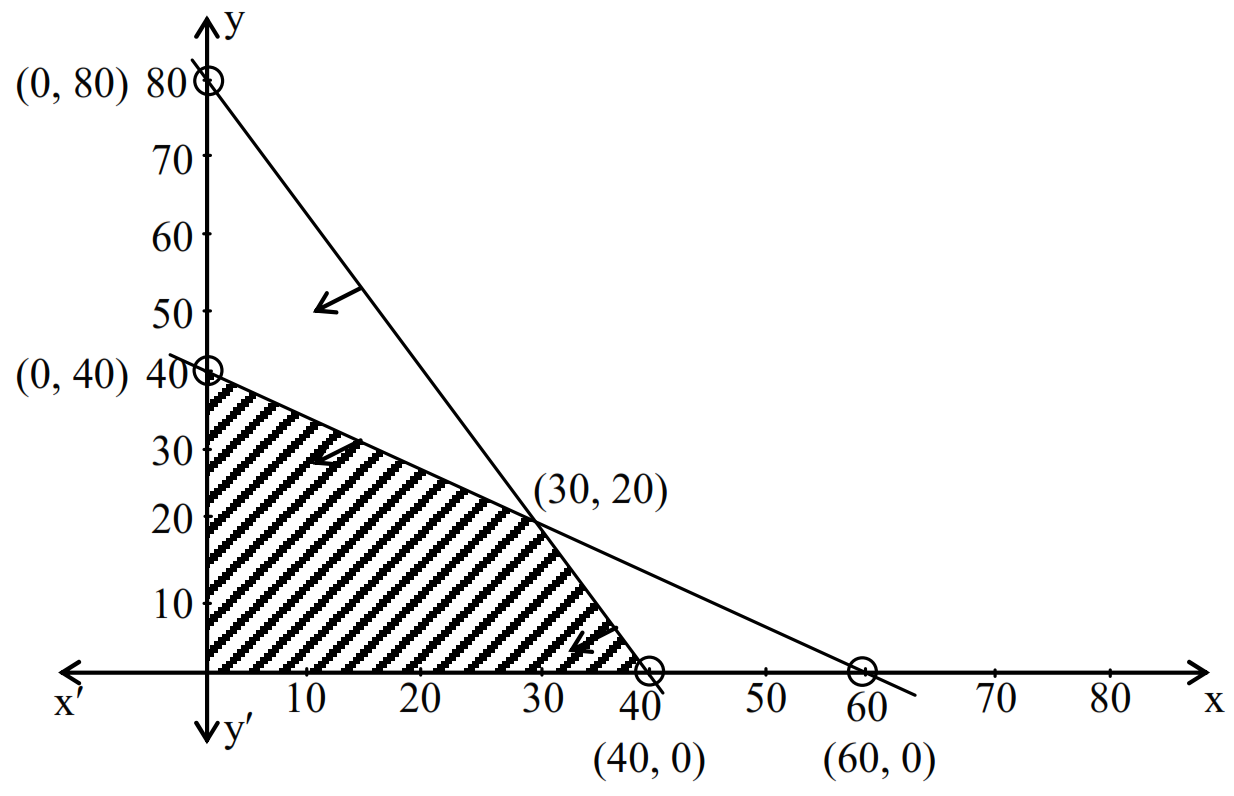
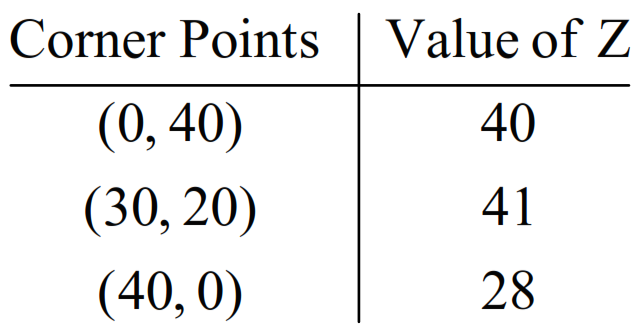 Hence, profit will be maximum, if the company produces, 30 packages of screw A 20 packages of screw B Maximum Profit = Rs. 41.
 View full question & answer→Question 545 Marks
A furniture trader deals in only two items – chairs and tables. He has ₹ 50,000 to invest and a space to store at most 35 items. A chair costs him ₹ 1000 and a table costs him ₹ 2000 The trader earns a profit of ₹ 150 and ₹ 250 on a chair and table, respectively. Formulate the above problem as an LPP to maximise the profit and solve it graphically.
AnswerLet x and y be the number of chairs and tables.
cost of x table = ₹ 2000 and cost of y chair = ₹ 1000
Since the dealer is maximum invest ₹ 50,000 and the maximum number of items.
Also, the dealer want to sell a chair and table at the profit ₹ 150 and ₹ 250 respectively.
So, from the above explanation, we get following mathematical form as follows
2000x + 1000y ≤ 50,000
x + 2y ≤ 50
x + y ≤ 35, x ≥ 0, y ≥ 0
and objective function Z = 150x + 250y
Now, we have to maximize Z = 250x + 150y
Subject to constraints
x + 2y = 50
x + y = 35,
x = 0, y = 0
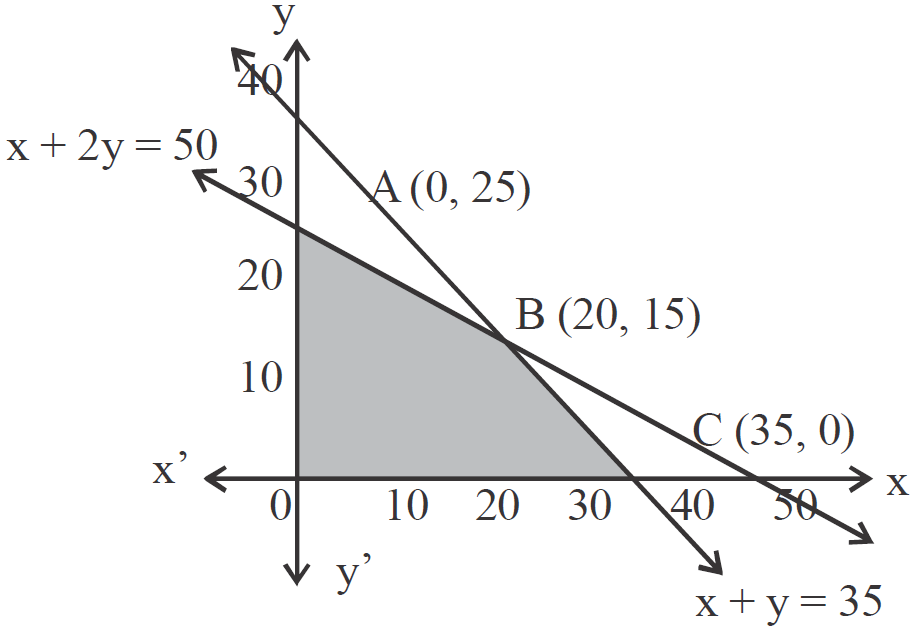
Corner Points Z = 150x + 250y
A(0, 25)
Z = 150 ₹ 0 + 250 ₹ 25
Z = 6250
B(20, 15)
Z = 150 ₹ 20 + 250 ₹ 15
Z = 3000 + 3750
Z = 6750
C(35, 0)
Z = 150 ₹ 35 + 250 ₹ 0
Z = 5250
Hence, the value of Z = 6750 is the maximum value
6750 = 150x + 250y
675 = 15x + 25y
135 = 3x + 5y ...(i)
35 = x + y ...(ii)
x = 35 - y
3(35 - y) + 5y = 135
105 - 3y +5y = 135
2y = 135 - 105
2y = 30
y = 15 Tables
x = 35 - 15
x = 20 Chairs.
View full question & answer→Question 555 Marks
A manufacturer has employed 5 skilled men and 10 semi-skilled men and makes two models A and B of an article. The making of one item of model A requires 2 hours work by a skilled man and 2 hours work by a semi-skilled man. One item of model B requires 1 hour by a skilled man and 3 hours by a semi-skilled man. No man is expected to work more than 8 hours per day. The manufacturer’s profit on an item of model A is Rs. 15 and on an item of model B is Rs. 10. How many of items of each model should be made per day in order to maximize daily profit? Formulate the above LPP and solve it graphically and find the maximum profit.
AnswerLet x articles of model A and y articles of model B be made. Number of articles cannot be negative. Therefore, $\text{x},\text{y}\leq0$ According to the question, the making of a model A requires 2 hrs. work by a skilled man and the model B requires 1 hrs. by a skilled man $2\text{x}+\text{y}\leq40$ The making of a model A requires 2 hrs. work by a semi-skilled man model B requires 3 hrs. work by a semi-skilled man. $2\text{x}+3\text{y}\leq80$ Total profit = Z = 15x + 10y which is to be maximised Thus, the mathematical formulation of the given linear programmimg problem is Max Z = 15x + 10y Subject to $2\text{x}+\text{y}\leq40$ $2\text{x}+3\text{y}\leq80$ $\text{x}\geq0$ $\text{y}\geq0$ The feasible region determined by the system of constraints is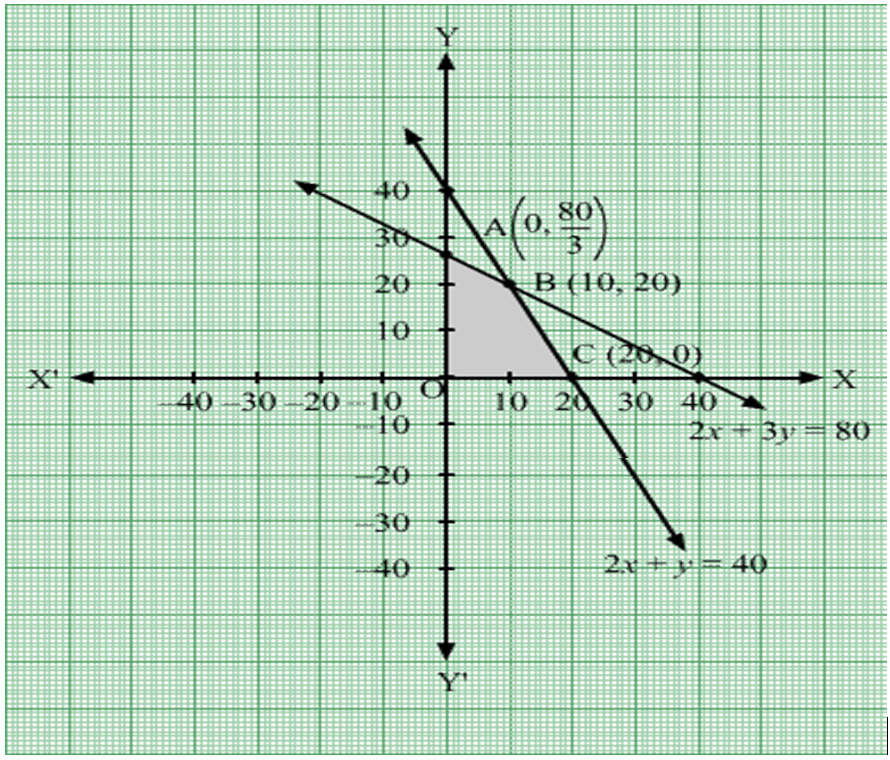
The corner points are $\text{A}\Big(\frac{80}{3}\Big), \text{B}(10, 20), \text{C}(20, 0)$ The values of Z at these corner points are as follows
| Corner point |
Z = 15x + 10y |
| A |
$\frac{800}{3}$ |
| B |
$350$ |
| C |
$300$ |
The maximum value of Z is 300 which is attained at C(20, 0) Thus, the maximum profit is Rs. 300 obtained when 10 units of deluxe model and 20 unit of ordinary model is produced. View full question & answer→Question 565 Marks
A furniture trader deals in only two items – chairs and tables. He has ₹ 50,000 to invest and a space to store at most 35 items. A chair costs him ₹ 1000 and a table costs him ₹ 2000 The trader earns a profit of ₹ 150 and ₹ 250 on a chair and table, respectively. Formulate the above problem as an LPP to maximise the profit and solve it graphically.
AnswerLet x and y be the number of chairs and tables.
cost of x table = ₹ 2000 and cost of y chair = ₹ 1000
Since the dealer is maximum invest ₹ 50,000 and the maximum number of items.
Also, the dealer want to sell a chair and table at the profit ₹ 150 and ₹ 250 respectively.
So, from the above explanation, we get following mathematical form as follows
2000x + 1000y ≤ 50,000
x + 2y ≤ 50
x + y ≤ 35, x ≥ 0, y ≥ 0
and objective function Z = 150x + 250y
Now, we have to maximize Z = 250x + 150y
Subject to constraints
x + 2y = 50
x + y = 35,
x = 0, y = 0
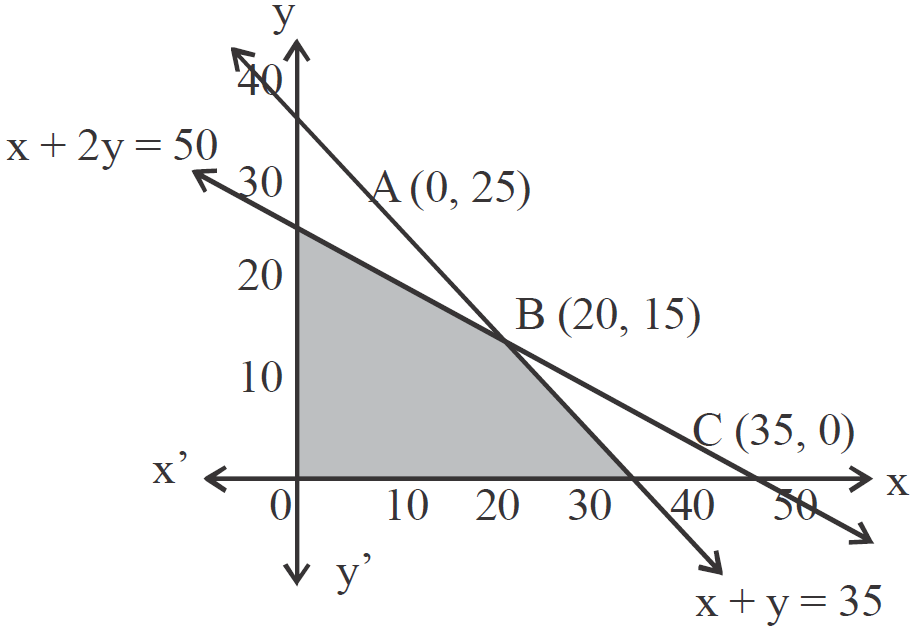
Corner Points Z = 150x + 250y
A(0, 25)
Z = 150 ₹ 0 + 250 ₹ 25
Z = 6250
B(20, 15)
Z = 150 ₹ 20 + 250 ₹ 15
Z = 3000 + 3750
Z = 6750
C(35, 0)
Z = 150 ₹ 35 + 250 ₹ 0
Z = 5250
Hence, the value of Z = 6750 is the maximum value
6750 = 150x + 250y
675 = 15x + 25y
135 = 3x + 5y ...(i)
35 = x + y ...(ii)
x = 35 - y
3(35 - y) + 5y = 135
105 - 3y +5y = 135
2y = 135 - 105
2y = 30
y = 15 Tables
x = 35 - 15
x = 20 Chairs.
View full question & answer→Question 575 Marks
A manufacturer has employed 5 skilled men and 10 semi-skilled men and makes two models A and B of an article. The making of one item of model A requires 2 hours work by a skilled man and 2 hours work by a semi-skilled man. One item of model B requires 1 hour by a skilled man and 3 hours by a semi-skilled man. No man is expected to work more than 8 hours per day. The manufacturer’s profit on an item of model A is Rs. 15 and on an item of model B is Rs. 10. How many of items of each model should be made per day in order to maximize daily profit? Formulate the above LPP and solve it graphically and find the maximum profit.
AnswerLet x articles of model A and y articles of model B be made. Number of articles cannot be negative. Therefore, $\text{x},\text{y}\leq0$ According to the question, the making of a model A requires 2 hrs. work by a skilled man and the model B requires 1 hrs. by a skilled man $2\text{x}+\text{y}\leq40$ The making of a model A requires 2 hrs. work by a semi-skilled man model B requires 3 hrs. work by a semi-skilled man. $2\text{x}+3\text{y}\leq80$ Total profit = Z = 15x + 10y which is to be maximised Thus, the mathematical formulation of the given linear programmimg problem is Max Z = 15x + 10y Subject to $2\text{x}+\text{y}\leq40$ $2\text{x}+3\text{y}\leq80$ $\text{x}\geq0$ $\text{y}\geq0$ The feasible region determined by the system of constraints is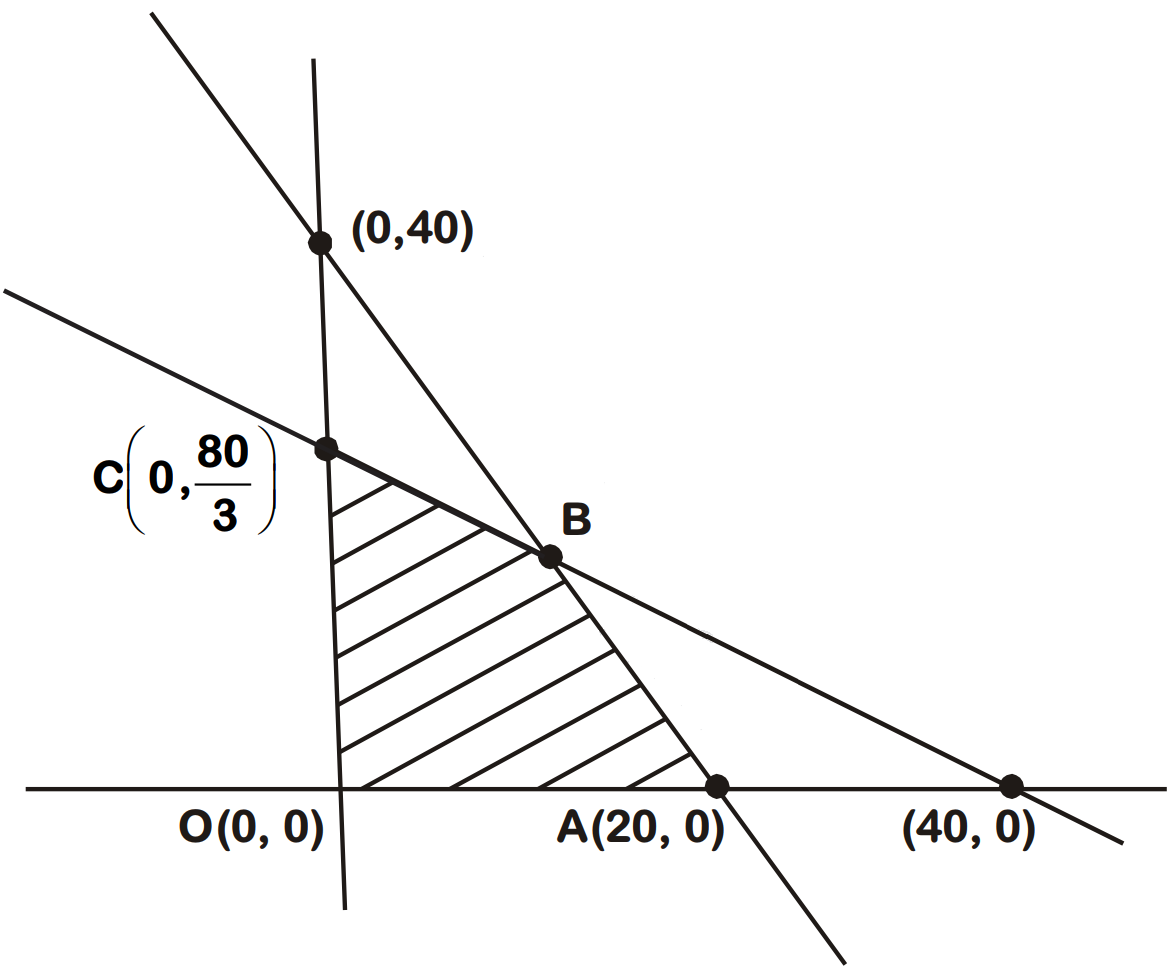
The corner points are $\text{A}\Big(\frac{80}{3}\Big),\text{B}(10,20),\text{C}(20,0)$ The values of Z at these corner points are as follows
| Corner point |
Z = 15x + 10y |
| A |
$\frac{800}{3}$ |
| B |
$350$ |
| C |
$300$ |
The maximum value of Z is 300 which is attained at C(20, 0) Thus, the maximum profit is Rs. 300 obtained when 10 units of deluxe model and 20 unit of ordinary model is produced. View full question & answer→Question 585 Marks
A furniture trader deals in only two items – chairs and tables. He has ₹ 50,000 to invest and a space to store at most 35 items. A chair costs him ₹ 1000 and a table costs him ₹ 2000 The trader earns a profit of ₹ 150 and ₹ 250 on a chair and table, respectively. Formulate the above problem as an LPP to maximise the profit and solve it graphically.
AnswerLet x and y be the number of chairs and tables.
cost of x table = ₹ 2000 and cost of y chair = ₹ 1000
Since the dealer is maximum invest ₹ 50,000 and the maximum number of items.
Also, the dealer want to sell a chair and table at the profit ₹ 150 and ₹ 250 respectively.
So, from the above explanation, we get following mathematical form as follows
2000x + 1000y ≤ 50,000
x + 2y ≤ 50
x + y ≤ 35, x ≥ 0, y ≥ 0
and objective function Z = 150x + 250y
Now, we have to maximize Z = 250x + 150y
Subject to constraints
x + 2y = 50
x + y = 35,
x = 0, y = 0
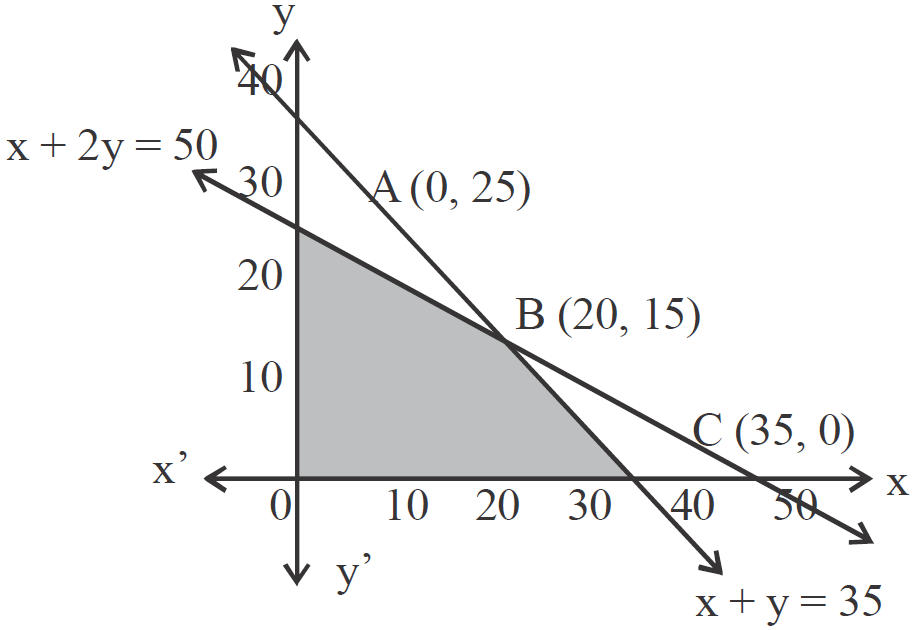
Corner Points Z = 150x + 250y
A(0, 25)
Z = 150 ₹ 0 + 250 ₹ 25
Z = 6250
B(20, 15)
Z = 150 ₹ 20 + 250 ₹ 15
Z = 3000 + 3750
Z = 6750
C(35, 0)
Z = 150 ₹ 35 + 250 ₹ 0
Z = 5250
Hence, the value of Z = 6750 is the maximum value
6750 = 150x + 250y
675 = 15x + 25y
135 = 3x + 5y ...(i)
35 = x + y ...(ii)
x = 35 - y
3(35 - y) + 5y = 135
105 - 3y +5y = 135
2y = 135 - 105
2y = 30
y = 15 Tables
x = 35 - 15
x = 20 Chairs.
View full question & answer→Question 595 Marks
A manufacturer has employed 5 skilled men and 10 semi-skilled men and makes two models A and B of an article. The making of one item of model A requires 2 hours work by a skilled man and 2 hours work by a semi-skilled man. One item of model B requires 1 hour by a skilled man and 3 hours by a semi-skilled man. No man is expected to work more than 8 hours per day. The manufacturer’s profit on an item of model A is Rs. 15 and on an item of model B is Rs. 10. How many of items of each model should be made per day in order to maximize daily profit? Formulate the above LPP and solve it graphically and find the maximum profit.
AnswerLet x articles of model A and y articles of model B be made. Number of articles cannot be negative. Therefore, $\text{x},\text{y}\leq0$ According to the question, the making of a model A requires 2 hrs. work by a skilled man and the model B requires 1 hrs. By a skilled man $2\text{x}+\text{y}\leq40$ The making of a model A requires 3 hrs. work by a semi-skilled man model B requires 3 hrs. Work by a semi-skilled man. $2\text{x}+3\text{y}\leq80$ Total profit = Z = 15x + 10y which is to be maximised Thus, the mathematical formulation of the given linear programmimg problem is Max Z = 15x + 10y Subject to, $2\text{x}+\text{y}\leq40$ $2\text{x}+3\text{y}\leq80$ $\text{x}\geq0$ $\text{y}\geq0$ The feasible region determined by the system of constraints is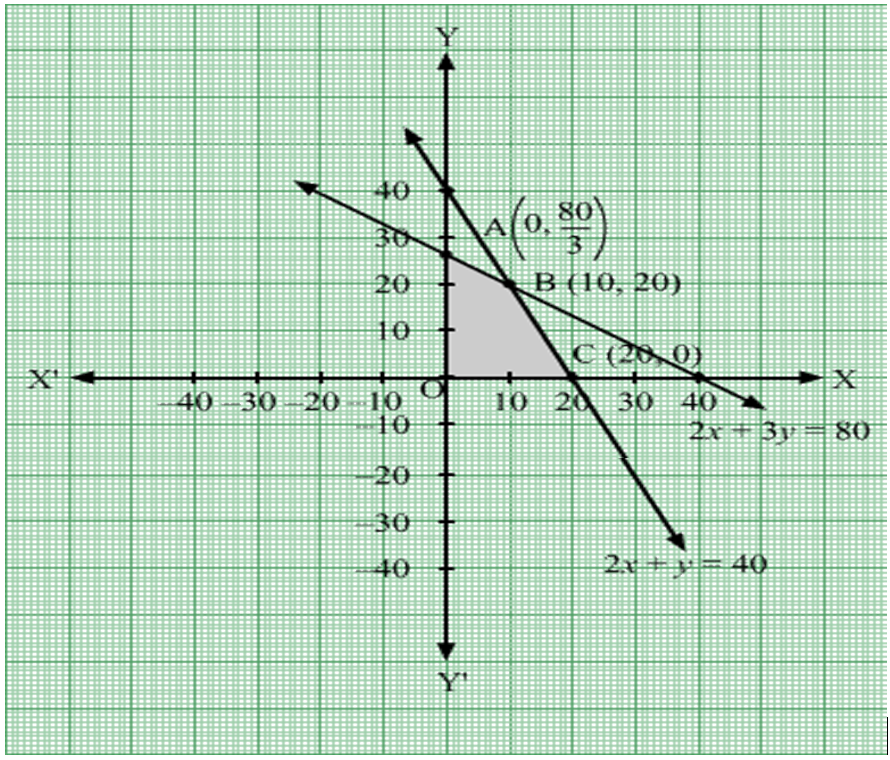
The corner points are $\text{A}=0,\frac{80}{3}$, B(10, 20), C(20, 0) The values of Z at these corner points are as follows
| Corner point |
Z = 15x + 10y |
| A |
$\frac{800}{3}$ |
| B |
$350$ |
| C |
$300$ |
The maximum value of Z is 300 which is attained at C(20, 0) Thus, the maximum profit is Rs. 300 obtained when 10 units of deluxe model and 20 unit of ordinary model is produced. View full question & answer→Question 605 Marks
A company manufactures two types of sweaters: type A and type B. It costs Rs. 360 to make a type A sweater and Rs. 120 to make a type B sweater. The company can make at most 300 sweaters and spend at most Rs. 72000 a day. The number of sweaters of type B cannot exceed the number of sweaters of type A by more than 100. The company makes a profit of Rs. 200 for each sweater of type A and Rs. 120 for every sweater of type B.
AnswerLet the company manufactures x number of type A sweaters and y number of type B.
The Company spend at most Rs. 7200 a day.
$\therefore360\text{x}+120\text{y}\leq72000$
$\Rightarrow3\text{x}+\text{y}\leq600\ .....(\text{i})$
Also, company can make at most 300 sweaters.
$\therefore\text{x}+\text{y}\leq300\ .....(\text{ii})$
Also, the number of sweatrrs of type B cannot exceed the bumber of swqaters of type A by more than 100 i.e., $\text{y}-\text{x}\leq100$
The company makes a profit of Rs. 200 for each sweater of typ0e A and Rs. 120 for sweater of type B so, the obective function for profit is Z = 200x + 120y subject to constraints.
$3\text{x}+\text{y}\leq600$
$\text{x}+\text{y}\leq300$
$\text{x}-\text{y}\geq-100$
$\text{x}\geq0,\text{y}\geq0$
View full question & answer→Question 615 Marks
Solve the following LPP graphically:
Manimize Z = 6x + 3y
Subject to the constraints:
$4\text{x}+\text{y}\geq80$
$\text{x}+5\text{y}\geq115$
$3\text{x}+2\text{y}\leq150$
$\text{x}\geq0,\text{y}\geq0$
AnswerThe given contraints are:
$4\text{x}+\text{y}\geq80$
$\text{x}+5\text{y}\geq115$
$3\text{x}+2\text{y}\leq150$
$\text{x}\geq0,\text{y}\geq0$
Converting the given inequation into equation, we get
4x + y = 80, x + 5y = 115, 3x + 2y = 150, x = 0 and y = 0
These lines are drawn on the graph and the shaded region ABC represents the feasible region of the given LPP.
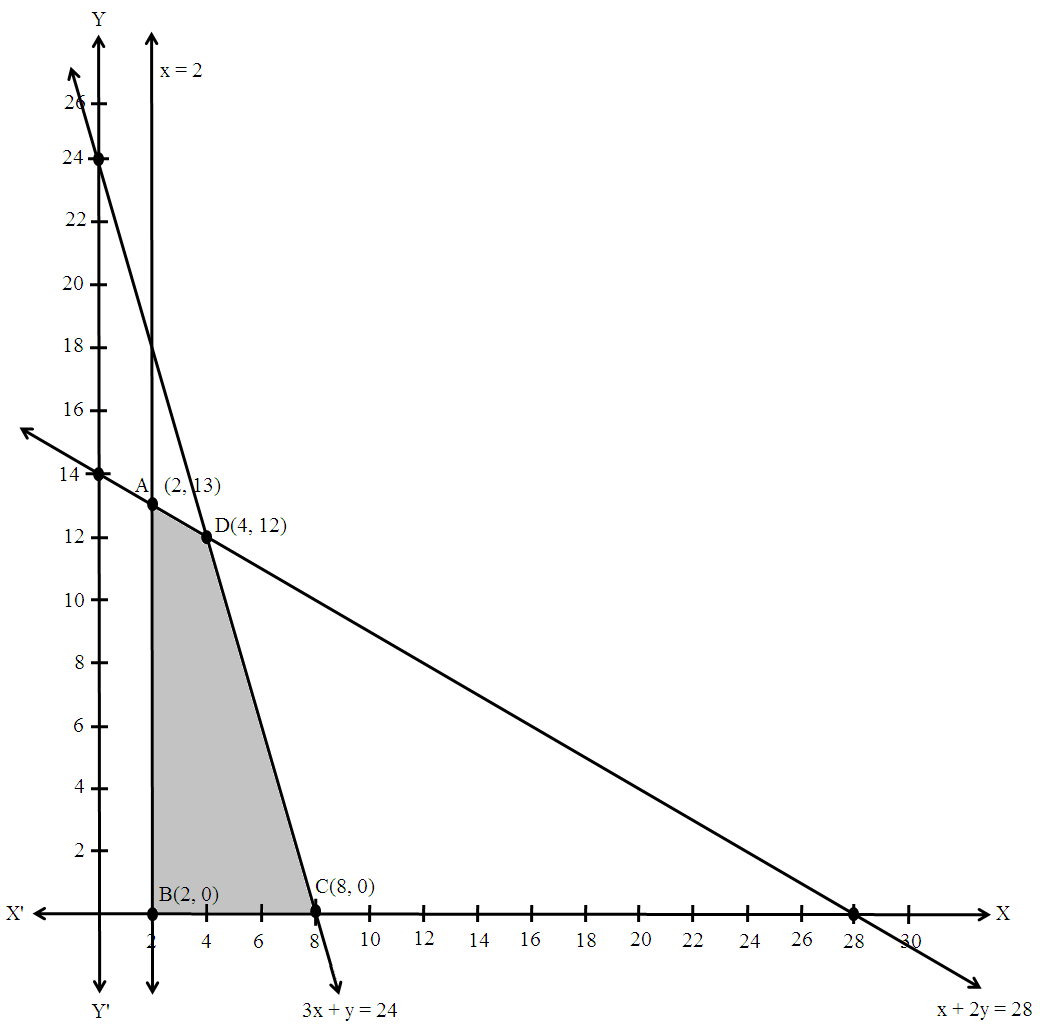
It can be observed that the feasible region is bounded.
The coordinates of the corner points of the feasible region are A(2, 72), B(15, 20), and C(40, 15).
The values of the objective function, Z at these corner points are given in the following table:
| Corner point |
Value of the objective Function Z = 6x + 3y |
| A(2, 72) |
Z = 6 × 2 + 3 × 72 = 228 |
| B(15, 20) |
Z = 6 × 15 + 3 × 20 = 150 |
| C(40, 15) |
Z = 6 × 40 + 3 × 15 = 150 |
From the table, Z is manimum at x = 15 and y = 20 and the manimum value of Z is 150.
Thus, the manimum value of Z is 150. View full question & answer→Question 625 Marks
A firm has to transport 1200 packages using large vans which can carry 200 packages each and small vans which can take 80 packages each. The cost for engaging each large van is Rs. 400 and each small van is Rs. 200. Not more than Rs. 3000 is to be spent on the job and the number of large vans can not exceed the number of small vans. Formulate this problem as a LPP given that the objective is to minimise cost.
AnswerLet the firm has x number of large vans and y number of small vans. From the given information, we have following corresponding constraint table.
|
|
Large vans (x)
|
Small vans (y)
|
Maximum/Minimum
|
|
Package
|
200
|
80
|
1200
|
|
Cast
|
400
|
200
|
3000
|
Thus, objective function for minimum cost is Z = 400 x + 200y.
Subject to constraints
$200\text{x}+80\text{y}\geq1200$
$\Rightarrow5\text{x}+2\text{y}\geq30\ .....(\text{i})$
and $400\text{x}+200\text{y}\leq3000$
$\Rightarrow2\text{x}+\text{y}\leq15\ .....(\text{ii})$
and $\text{x}\leq\text{y}\ .....(\text{iii})$
and $\text{x}\geq0,\text{y}\geq0\ .....(\text{iv})$
Thus, required LPP to minimize cost is minimize z = 400x + 200y, subject to
$5\text{x}+2\text{y}\geq30$
$2\text{x}+\text{y}\leq15$
$\text{x}\leq\text{y}$
$\text{x}\geq0,\text{y}\geq0$ View full question & answer→Question 635 Marks
Maximum Z = 10x + 6y
Subject to
$3\text{x}+\text{y}\leq12$
$2\text{x}+5\text{y}\leq34$
$\text{x},\text{y}\geq0$
AnswerConverting the given inequations in to equations.
3x + y = 12, 2x + 5y = 34, x = y = 0
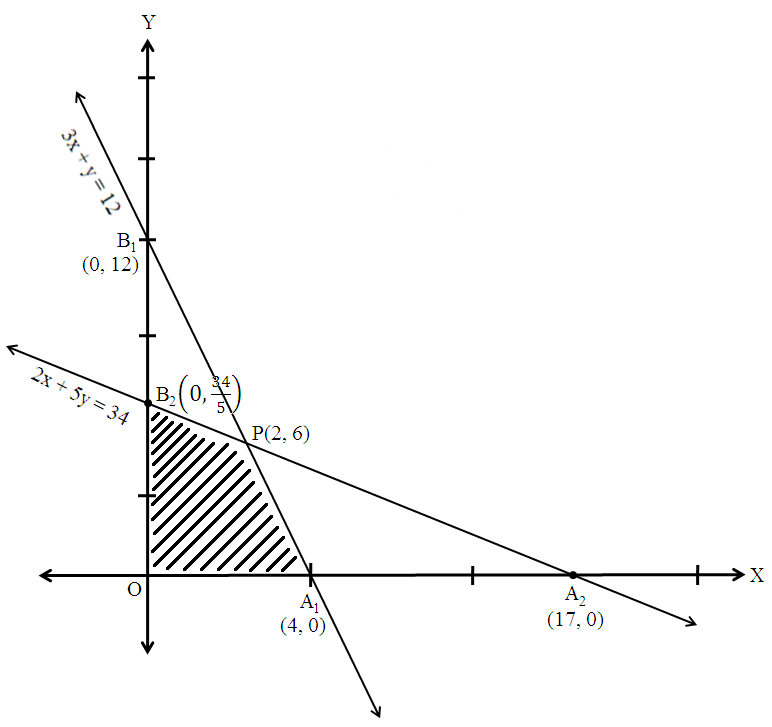
Region represented by $3\text{x}+\text{y}\leq12$:
Line 3x + y = 12 meets the coordinate axes at $A_1(4, 0)$ and B(0, 12), clearly, (0, 0) satisfies $3\text{x}+\text{y}\leq12$, so, region containing origin is represented by $3\text{x}+\text{y}\leq12$ in xy-plane.
Region represented by $2\text{x}+5\text{y}\leq34$:
Line 2x +y = 34 meets coordinate axes at $A_2 (17, 0)$ and $\text{B}\Big(0,\frac{34}{5}\Big)$ clearly, (0, 0) satisfies the $2\text{x}+5\text{y}\leq34$ so, region containing origin represents $2\text{x}+5\text{y}\leq34$ in xy-plane.
Region represented by $\text{x},\text{y}\geq0$:
It represent the first quadrant in xy-plane
Therefore, shaded area $OA_1PB_2$ is the feasible region.
The coordinate of P(2, 6) is obtained by solving 2x + 5y = 34 and 3x + y = 12
The value of Z = 10x + 6y at
$\text{O}(0, 0) = 10(0) + 6(0) = 0$
$\text{A}_1(4, 0) = 10(4) + 6(0) = 40$
$\text{P}(2, 6) = 10(2) + 6(6) = 56$
$\text{B}_2\Big(0,\frac{34}{5}\Big)=10(0)+6\Big(\frac{34}{5}\Big)=\frac{204}{5}=40\frac{4}{5}$
Hence, maximum Z = 56 at x = 2, y = 6. View full question & answer→Question 645 Marks
Maximize Z = 9x + 3y
Subject to
$2\text{x}+3\text{y}\leq13$
$3\text{x}+\text{y}\leq5$
$\text{x},\text{y}\geq0$
AnswerCoverting the given inequation into equations, we get
2x + 3y = 13, 3x + y = 5 and x = 0, y = 0
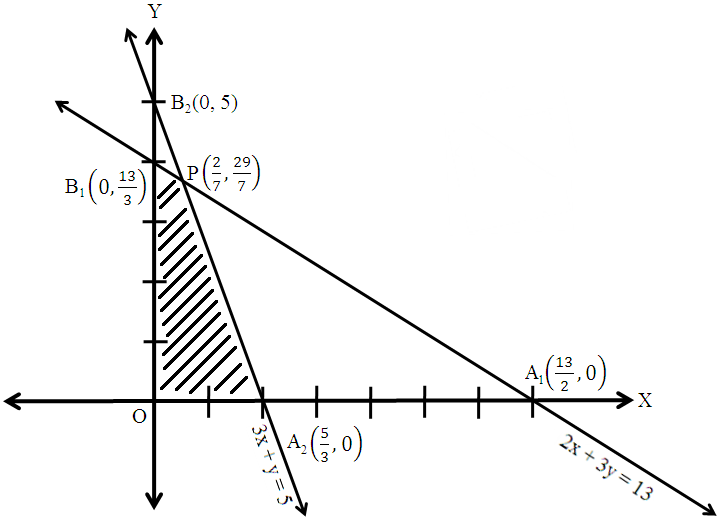
Region represented by $2\text{x}+3\text{y}\leq13:$
The line meets coordinate axes at $\text{A}_1\Big(\frac{13}{2},0\Big)$ and $\text{B}_1\Big(0,\frac{13}{3}\Big)$ respectively.
Join these points to obtain the line 2x + 3y = 13, clearly, (0,0) satisfies the in eqation $2\text{x}+3\text{y}\leq13$, so, the region in xy-plane that contains origin represents the solution set of $2\text{x}+3\text{y}\leq13$.
Region represented by $3\text{x}+\text{y}\leq5:$
The line meets coordinate axes at $\text{A}_2\Big(\frac{5}{3},0\Big)$ and $B_2(0, 5)$ respectively.
Join these points to obtain the line 3x + y = 5, clearly, (0, 0) satisfies the in eqation $3\text{x}+\text{y}\leq5$, so, the region in xy-plane that contains origin represents the solution set of $3\text{x}+\text{y}\leq5$.
Region represented by $\text{x},\text{y}\geq0:$
It clearly represent first quadrant of xy-plane.
The common region to regions represented by above in equalities.
The coordinates of the corner points of the shaded region are $\text{O}(0,0),\text{A}\Big(\frac{5}{3},0\Big),\text{P}\Big(\frac{2}{7},\frac{29}{7}\Big),\text{B}_2\Big(0,\frac{13}{3}\Big)$.
The value of Z = 9x + 3y at
$\text{O}(0,0)=9(0)+3(0)=0$
$\text{A}_1\Big(\frac{5}{3},0\Big)=9\Big(\frac{5}{3}\Big)+3(0)=15$
$\text{P}\Big(\frac{2}{7},\frac{29}{7}\Big)=9\Big(\frac{2}{7}\Big)+3\Big(\frac{29}{7}\Big)=15$
$\text{B}_2\Big(0,\frac{13}{3}\Big)=9(0)+3\Big(\frac{13}{3}\Big)=13$
Clearly, Z is maximum at every point on the line joining $A_1$ and P, So
$\text{x}=\frac{2}{7}$ or $\frac{2}{7}$, $\text{y}=0$ or $\frac{29}{7}$
and maximum Z = 15. View full question & answer→Question 655 Marks
In the feasible region (shaded) for a LPP is shown. Determine the maximum and minimum value of Z = x + 2y.
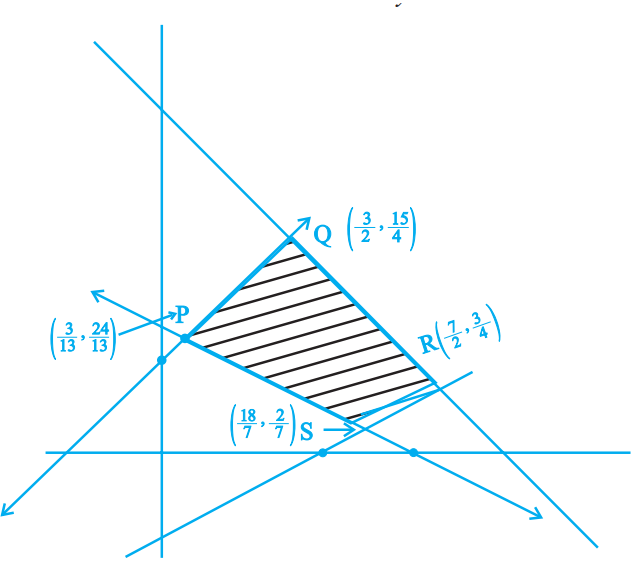
AnswerFrom the shaded bounded region, it is clear that the coordinates of corner points are $\Big(\frac{3}{13},\frac{24}{13}\Big),\Big(\frac{8}{7},\frac{2}{7}\Big),\Big(\frac{7}{2},\frac{3}{4}\Big)$and $\Big(\frac{3}{2},\frac{15}{4}\Big)$
Also, we have to determine maximum and minimum value of Z = x + 2y.
| Corner points |
Corresponding value of Z |
| $\Big(\frac{3}{13},\frac{24}{13}\Big)$ |
$\frac{3}{13}+\frac{48}{13}=\frac{51}{13}=3\frac{12}{13}$ |
| $\Big(\frac{8}{7},\frac{2}{7}\Big)$ |
$\frac{18}{7}+\frac{4}{7}=\frac{22}{7}=3\frac{1}{7}(\text{Minimum})$ |
| $\Big(\frac{7}{2},\frac{3}{4}\Big)$ |
$\frac{7}{2}+\frac{6}{4}=\frac{20}{4}=5$ |
| $\Big(\frac{3}{2},\frac{15}{4}\Big)$ |
$\frac{3}{2}+\frac{30}{4}=\frac{36}{4}=9(\text{Maximum})$ |
Hence, the maximum and minimum value of are 9 and $3\frac{1}{7}$ respectively. View full question & answer→Question 665 Marks
A man rides his motorcycle at the speed of 50km/ hour. He has to spend Rs. 2 per km on petrol. If he rides it at a faster speed of 80km/ hour, the petrol cost increases to Rs. 3 per km. He has atmost Rs. 120 to spend on petrol and one hour’s time. He wishes to find the maximum distance that he can travel.
Express this problem as a linear programming problem.
AnswerLet the man rides to his motorcycle to a distance x km at the speed of 50km/h and to a distance y km at the speed of 80 km/h.Therefore, he has to spend Rs. 120 at most on petrol.
$\therefore2\text{x}+3\text{y}\leq120\ ......(\text{i})$
Also, he has at most 1 hour time.
$\therefore\frac{\text{x}}{50}+\frac{\text{y}}{80}\leq1$
$\Rightarrow8\text{x}+5\text{y}\leq400\ .....(\text{ii})$
Also, we have $\text{x}\geq0,\text{y}\geq0$ [non-negative constraints]
Thus, required LPP to travel maximum distance by him is
Maximise $\text{Z}=\text{x}+\text{y},$ subject to $2\text{x}+3\text{y}\leq120,8\text{x}+5\text{y}\leq400,\text{x}\geq0,\text{y}\geq0.$
View full question & answer→Question 675 Marks
Maximum Z = 3x + 4y
Subject to
$2\text{x}+2\text{y}\leq80$
$2\text{x}+4\text{y}\leq120$
AnswerWe have to maximize Z = 3x + 4y First, we will convert the given inequations into equations, we obtain the following equations: 2x + 2y = 80, 2x + 4y = 120 Region represented by 2x + 2y ≤ 80: The line 2x + 2y = 80 meets the coordinate axes at A(40, 0) and B(0, 40) respectively. By joining these points we obtain the line 2x + 2y = 80. Clearly (0, 0) satisfies the inequation 2x + 2y ≤ 80. So,the region containing the origin represents the solution set of the inequation 2x + 2y ≤ 80. Region represented by 2x + 4y ≤ 120: The line 2x + 4y = 120 meets the coordinate axes at C(60, 0) and D(0, 30) respectively. By joining these points we obtain the line 2x + 4y ≤ 120. Clearly (0, 0) satisfies the inequation 2x + 4y ≤ 120. So,the region containing the origin represents the solution set of the inequation 2x + 4y ≤ 120. The feasible region determined by the system of constraints, 2x + 2y ≤ 80, 2x + 4y ≤ 120 are as follows:
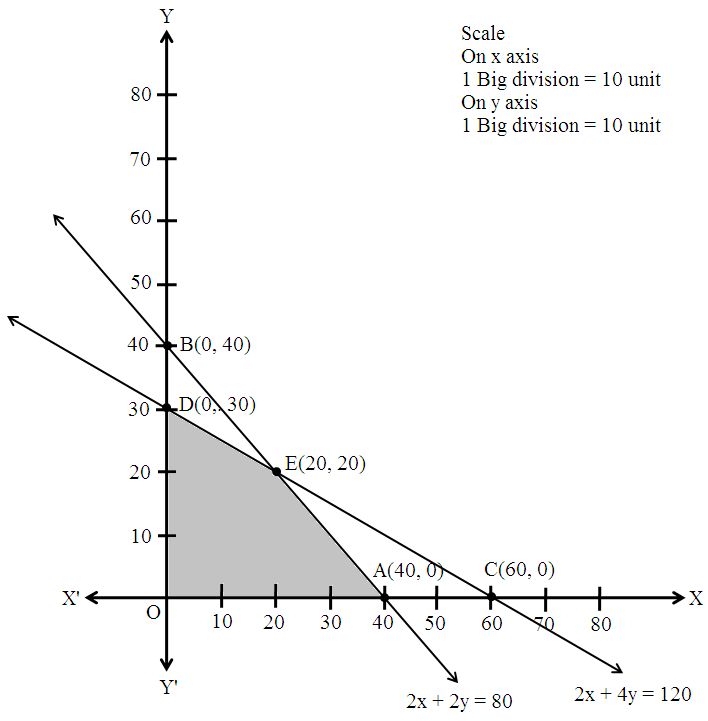
The corner points of the feasible region are O(0, 0), A(40, 0), E(20, 20) and D(0, 30). The values of Z at these corner points are as follows:
|
Corner point
|
Z = 3x +4y
|
|
O(0, 0)
|
3 × 0 + 4 × 0 = 0
|
|
A(40, 0)
|
3 × 40 + 4 × 0 = 120
|
|
E(20, 20)
|
3 × 20 + 4 × 20 = 140
|
|
D(0, 30)
|
10 × 0 + 4 × 30 = 120
|
We see that the maximum value of the objective function Z is 140 which is at E(20, 20) that means at x = 20 and y = 20. Thus, the optimal value of Z is 140.
View full question & answer→Question 685 Marks
Maximize Z = 5x + 3y
Subject to
$3\text{x}+5\text{y}\leq15$
$5\text{x}+2\text{y}\leq10$
$\text{x},\text{y}\geq0$
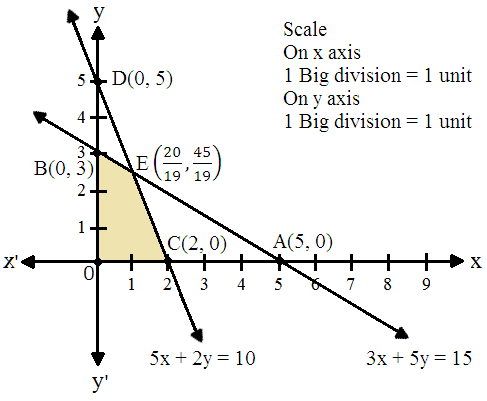
AnswerFirst, we will convert the given inequations into equations, we obtain the following equations:
3x + 5y = 15, 5x + 2 y = 10, x = 0 and y = 0
Region represented by $3\text{x}+5\text{y}\leq15:$
The line 3x + 5y = 15 meets the coordinate axes at A(5, 0) and B(0, 3) respectively.
By joining these points we obtain the line 3x + 5y = 15.
Clearly (0, 0) satisfies the inequation $3\text{x}+5\text{y}\leq15$.
So, the region containing the origin represents the solution set of the inequation $3\text{x}+5\text{y}\leq15$.
Region represented by $5\text{x}+2\text{y}\leq10:$
The line 5x + 2y = 10 meets the coordinate axes at C(2, 0) and D(0, 5) respectively.
By joining these points we obtain the line 5x + 2y = 10.
Clearly (0, 0) satisfies the inequation $5\text{x}+2\text{y}\leq10$.
So, the region containing the origin represents the solution set of the inequation $5\text{x}+2\text{y}\leq10$.
Region represented by $\text{x}\geq0$ and $\text{y}\geq0:$
Since, every point in the first quadrant satisfies these inequations.
So, the first quadrant is the region represented by the inequations $\text{x}\geq0$, and $\text{y}\geq0$.
The feasible region determined by the system of constraints, $3\text{x}+5\text{y}\leq15,5\text{x}+2\text{y}\leq10,\text{x}\geq0$ and $\text{y}\geq0$,are as follows.
View full question & answer→Question 695 Marks
The feasible region for a LPP is shown in Evaluate Z = 4x + y at each of the corner points of this region. Find the minimum value of Z, if it exists.
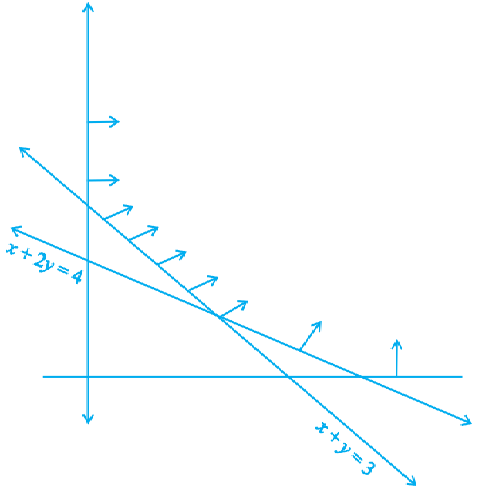
AnswerLines x + 2y = 4 and x + y = 3 interdect at (2, 1)
From the it is unbounded shaded regiobn with the cornre points A(4, 0), B (2, 1) and C(0, 3)
Also, We have z = 4x + y.
|
Corner points
|
Corresponding value of Z
|
|
(4, 0)
(2, 1)
(0, 3)
|
16
9
3 $\leftarrow$ minimum
|
Now, we see that 3 is the smallest value of Z at the corner point (0, 3). Note that here we see that the region is unbounded, therefore 3 may or may not be the minimum value of Z. To decide this issue, we graph the inequality 4x + y < 3 and check whether the resulting open half plan has no point in common with feasible region otherwise, Z has no minimum value.
From the shown graph above, it is clear that there is no point in common with feasible region and hence Z has minimum value of 3 at (0, 3). View full question & answer→Question 705 Marks
A small firm manufactures necklaces and bracelets. The total number of necklaces and bracelets that it can handle per day is at most 24. It takes one hour to make a bracelet and half an hour to make a necklace. The maximum number of hours available per day is 16. If the profit on a necklace is Rs. 100 and that on a bracelet is Rs. 300. Formulate on L.P.P. for finding how many of each should be produced daily to maximize the profit?
It is being given that at least one of each must be produced.
AnswerLet the number of necklaces manufacture be x, and the number of bracelets manufacture be y.
Since the total number of items are at most 24.
$\text{x}+\text{y}\leq24\ ....(1)$
Bracelets takes 1 hour to manufacture and necklaces takes half an hour to manufacture.
x item takes x hour to manufacture and y items take y/2 hour to manufacture and maximum time available is 16 hours. therefore
$\text{x}_2+\text{y}\leq16\ ....(2)$
the profit on one necklace is Rs. 100 and the profit on one bracelet is Rs. 300
Let the profit be Z.
Now we wish to maximize the profit.
So,
Max Z = 100x + 300y ....(3)
So,
$\text{x}+\text{y}\leq24$
$\text{x}_2+\text{y}\leq16$
Max Z = 100x + 300 is the required L.P.P.
View full question & answer→Question 715 Marks
Solve the following LPP graphically:
Maximize Z = 20x + 10y
Subject to the following constraints
$\text{x}+2\text{y}\leq28$
$3\text{x}+\text{y}\leq24$
$\text{x}\geq2$
$\text{x},\text{y}\geq0$
AnswerThe given contraints are:
$\text{x}+2\text{y}\leq28$
$3\text{x}+\text{y}\leq24$
$\text{x}\geq2$
$\text{x},\text{y}\geq0$
Converting the given inequation into equation, we get
x + 2y = 28, 3x + y = 24, x = 2 and y = 0
These lines are drawn on the graph and the shaded region ABCD represents the feasible region of the given LPP.
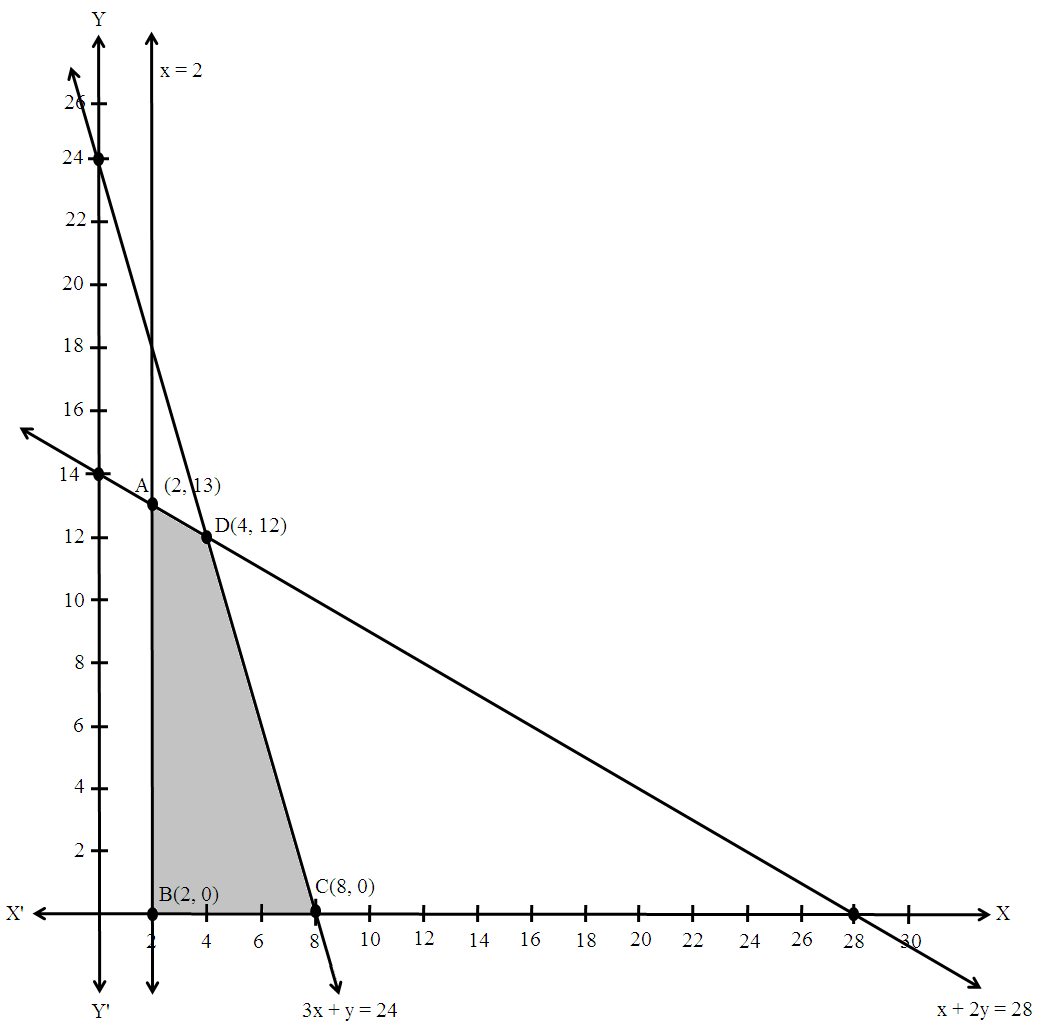
It can be observed that the feasible region is bounded.
The coordinates of the corner points of the feasible region are A(2, 13), B(2, 0), C(4, 12) and D(8, 0).
The values of the objective function, Z at these corner points are given in the following table:
| Corner point |
Value of the objective Function Z = 20x + 10y |
| A(2, 13) |
Z = 20 × 2 + 10 × 13 = 170 |
| B(2, 0) |
Z =20 × 2 + 10 × 0 = 40 |
| C(8, 0) |
Z = 20 × 8 + 10 × 0 = 160 |
| D(4, 12) |
Z = 20 × 4 + 10 × 12 = 200 |
From the table, Z is maximum at x = 4 and y = 12 and the maximum value of Z is 200.
Thus, the maximum value of Z is 200. View full question & answer→Question 725 Marks
Determine the maximum distance that the man can travel.
Answer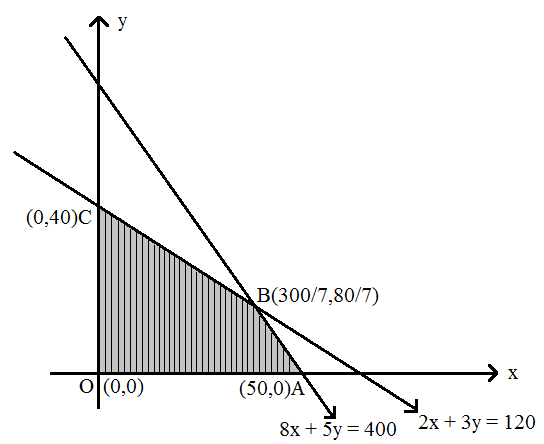
We have to maximize z = x + y subject to constraints.
$2\text{x}+3\text{y}\leq120,8\text{x}+5\text{y}\leq400,\text{x}\geq0,\text{y}\geq0$
These inequalities are plotted as shown in the following figure.
From the figure shaded region is bounded with the corner points O(0, 0), A(50, 0), $\text{B}\Big(\frac{300}{7},\frac{80}{7}\Big),$ C(0, 0)
|
Corner points
|
Corresponding value of Z = x + y
|
|
(0, 0)
|
0
|
|
(50, 2)
|
50
|
|
$\Big(\frac{300}{7},\frac{80}{7}\Big)$
|
$\frac{380}{7}=54\frac{2}{7}\text{km (maximum)}$
|
|
(0, 40)
|
40
|
Hence, the maximum distance that the man can travel is $54\frac{2}{7}\text{km}.$ View full question & answer→Question 735 Marks
Maximum Z = 15x + 10y
Subject to
$3\text{x}+2\text{y}\leq80$
$2\text{x}+3\text{y}\leq70$
$\text{x},\text{y}\geq0$
AnswerFirst, we will convert the given inequations into equations, we obtain the following equations:
3x + 2y = 80, 2x + 3y = 70, x = 0 and y=0
Region represented by $3\text{x}+2\text{y}\leq80:$
The line 3x + 2y = 80 meets the coordinate axes at $\text{A}\Big(\frac{80}{3},0\Big)$ and B(0, 40) respectively.
By joining these points we obtain the line 3x + 2y = 80.
Clearly (0,0) satisfies the inequation $3\text{x}+2\text{y}\leq80$.
So, the region containing the origin represents the solution set of the inequation $3\text{x}+2\text{y}\leq80$.
Region represented by $2\text{x}+3\text{y}\leq70:$
The line 2x + 3y = 70 meets the coordinate axes at C(35, 0) and $\text{D}\Big(0,\frac{70}{3}\Big)$ respectively.
By joining these points we obtain the line $2\text{x}+3\text{y}\leq70$.
Clearly (0,0) satisfies the inequation $2\text{x}+3\text{y}\leq70$.
So, the region containing the origin represents the solution set of the inequation $2\text{x}+3\text{y}\leq70$.
Region represented by $\text{x}\geq0$ and $\text{y}\geq0$.
Since, every point in the first quadrant satisfies these inequations.
So, the first quadrant is the region represented by the inequations $\text{x}\geq0$ and $\text{y}\geq0$.
The feasible region determined by the system of constraints $3\text{x}+2\text{y}\leq80$, $2\text{x}+3\text{y}\leq70$, $\text{x}\geq0$ and $\text{y}\geq0$ are as follows.
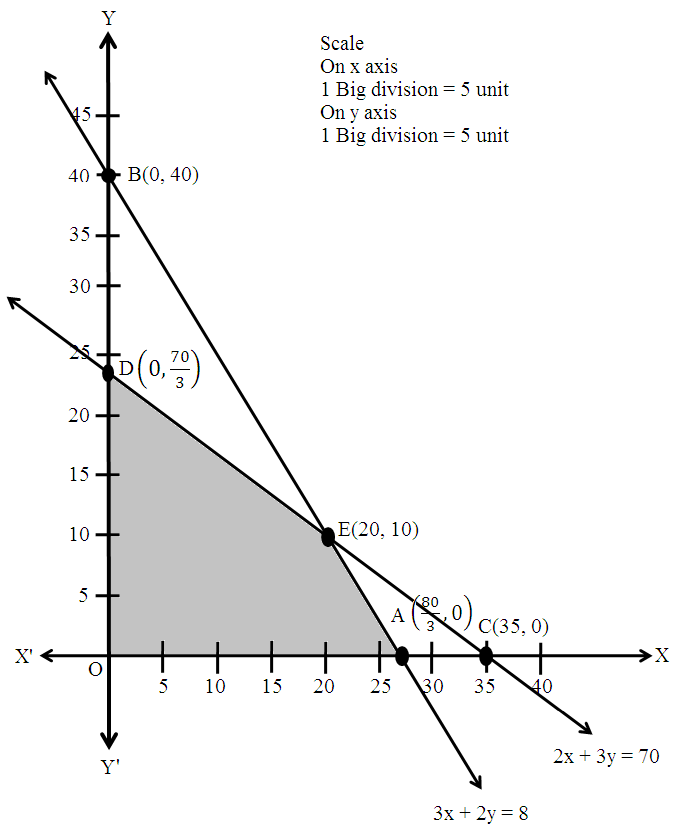
The corner points of the feasible are O(0, 0), $\text{A}\Big(\frac{80}{3},0\Big)\text{E}(20,10)$ and $\text{D}\Big(0,\frac{700}{3}\Big)$ .
The values of Z at these corner point are as follows.
|
$\text{Corner point}$
|
$\text{Z}=15\text{x}+10\text{y}$
|
|
$\text{O}(0, 0)$
|
$15\times0+10\times0=0$
|
|
$\text{A}\Big(\frac{80}{3},0\Big)$
|
$15\times\frac{80}{3}+10\times0=400$
|
|
$\text{E}(20, 10)$
|
$15\times20+10\times10=400$
|
|
$\text{D}\Big(0,\frac{70}{3}\Big)$
|
$15\times0+10\times\frac{70}{3}=\frac{700}{3}$
|
We see that maximum value of the objective functioin Z is 400 which is at $\text{A}\Big(\frac{80}{3},0\Big)$ and E(20, 10).
Thus, the optimal value of Z is 400. View full question & answer→Question 745 Marks
Minimise $\text{Z}=13\text{x}-15\text{y},$ subject to the constraints: $\text{x}+\text{y}\leq7,2\text{x}-3\text{y}+6\geq0,\text{x}\geq0,\text{y}\geq0.$
AnswerMinimise $\text{Z}=13\text{x}-15\text{y},$ subject to the constraints
$\text{x}+\text{y}\leq7,2\text{x}-3\text{y}+6\geq0,\text{x}\geq0,\text{y}\geq0.$
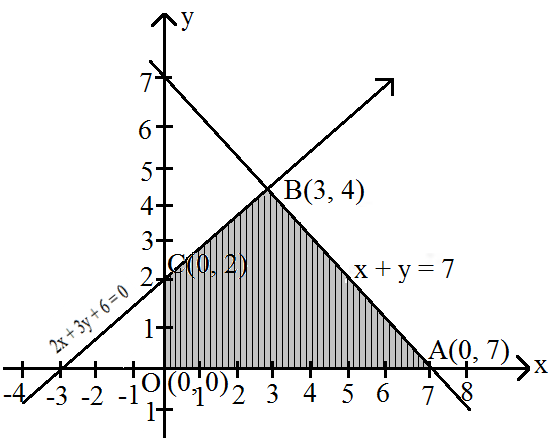
replace (0, 7) by (7, 0) in horizontal line
Shaded region shown as OABC is bounded and coordinates of its corner points are (0, 0), (7, 0), (3, 4) and (0, 2), respectively.
|
Corner points
|
Corresponding value of Z
|
|
(0, 0)
(7, 0)
(3, 4)
(0, 2)
|
0
91
-21
-30 (Minimum)
|
Hence, the minimum value of Z is -30 at (0, 2). View full question & answer→Question 755 Marks
How many sweaters of each type should the company make in a day to get a maximum profit? What is the maximum profit.
AnswerWe have
Maximize Z =200x + 120y
Subject to constraints
$\text{x}+\text{y}\leq3000,$
$3\text{x}+\text{y}<600,$
$\text{x}-\text{y}\leq100,$
$\text{x}\geq0$ and $\text{y}\geq0.$
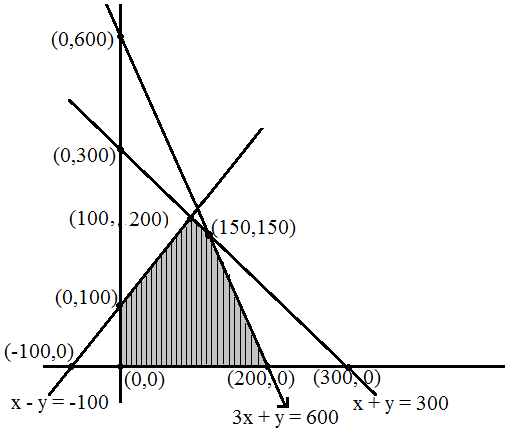
Now, on solving x + y = 300 and 3x + y = 600, we get
x = 150, y = 150
again, on solving x - y = 100 and x + y = 300, we get
x = 100, y = 200
Thus, from the graph the feasible region is the shaded region with coordinates of corner points as (0, 0), (200, 0), (150, 150), (100, 200) and (0, 100).
|
Corner points
|
Corresponding value of Z = 200x + 120y
|
|
(0, 0)
(200, 0)
(150, 150)
(100, 200)
(0, 100)
|
0
40000
150 × 200 + 120 × 150 = 48000 (Maximum)
100 × 200 + 120 × 200 = 44000
120 × 100 = 12000
|
Hence, 150 sweaters of each type made by company and maximum profit = Rs. 48000. View full question & answer→Question 765 Marks
A manufacturer produces two Models of bikes-Model X and Model Y. Model X takes a 6 man-hours to make per unit, while Model Y takes 10 man-hours per unit. There is a total of 450 man-hour available per week. Handling and Marketing costs are Rs. 2000 and Rs. 1000 per unit for Models X and Y respectively. The total funds available for these purposes are Rs. 80,000 per week. Profits per unit for Models X and Y are Rs. 1000 and Rs. 500, respectively.
How many bikes of each model should the manufacturer produce so as to yield a maximum profit? Find the maximum profit.
Answer
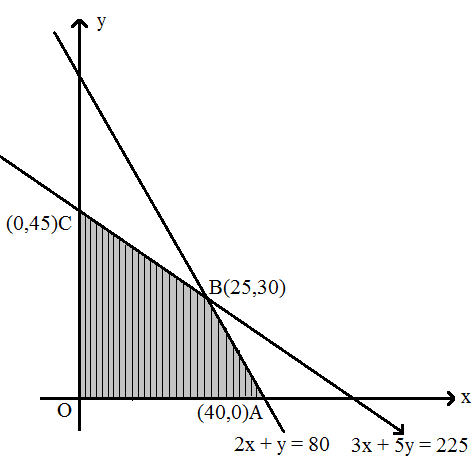 Let the manufacturer produces x number of models X and y number of model Y bikes. Model X takes 6 man-hours to make per unit and model Y takes 10 man-hours to make per unit.
There is total of 450 man-hours available per week.
$\therefore6\text{x}+10\text{y}\leq450$
$\Rightarrow3\text{x}+5\text{y}\leq225\ .....(\text{i})$
For model X and Y, handling and marketing costs are Rs. 2000 and Rs. 1000, respectively, total funds available for these purposes are Rs. 80000 per week.
$\therefore2000\text{x}+1000\text{y}\leq80000$
$\Rightarrow2\text{x}+\text{y}\leq80\ .....(\text{ii})$
Also $\text{x}\geq0,\text{y}\geq0$
the profits per unit for models X and Y are Rs. 1000 and Rs. 500, respectively,
So, we have to maximize Z - 1000x + 500y Subject to $3\text{x}+5\text{y}\leq225,2\text{x}+\text{y}\leq80,\text{x}\geq0,\text{y}\geq0$
These inequalities are plotted as shown in the figure.
|
Corner points
|
Value of Z = 1000x + 500y
|
|
(0, 0)
|
0
|
|
(40, 0)
|
40000 (Maximum)
|
|
(25, 30)
|
40000 (Maximum)
|
|
(0, 45)
|
22500
|
So, for maximum profit manufacturer must produces 25 number of model X and 30 number of model bikes. View full question & answer→Question 775 Marks
A company manufactures two types of screws A and B. All the screws have to pass through a threading machine and a slotting machine. A box of Type A screws requires 2 minutes on the threading machine and 3 minutes on the slotting machine. A box of type B screws requires 8 minutes of threading on the threading machine and 2 minutes on the slotting machine. In a week, each machine is available for 60 hours.
On selling these screws, the company gets a profit of Rs 100 per box on type A screws and Rs 170 per box on type B screws.
AnswerLet the company manufacture x boxes of type A screws and y boxes of type B screws. From the given information, we have following corresponding constraint table.
|
|
Type A(x)
|
Type B(x)
|
Maximum time available on each machine in a week
|
|
Time required for screws on threading machine
|
2
|
8
|
60 × 60 (min)
|
|
Time required for screws on slotting machine
|
3
|
2
|
60 × 60 (min)
|
Thus, we see that objective function for maximum profit is Z = 100x + 170y.
Subject to constraints.
$2\text{x}+8\text{y}\leq60\times60$ [time constraint for threading machine]
$\Rightarrow\text{x}+4\text{y}\leq1800\ ....(\text{i})$
And $3\text{x}+2\text{y}\leq60\times60$ [time constraint for slotting machine]
$\Rightarrow3\text{x}+2\text{y}\leq3600\ ....(\text{ii})$
Also, $\text{x}\geq0,\text{y}\geq0$ [non-negative constraints] …(iii)
$\therefore$ Required LPP is,
Maximise $\text{z}=100\text{x}+170\text{y}$
Subject to constraints $\text{x}+4\text{y}\leq1800,3\text{x}+2\text{y}\leq3600,\text{x}\geq0,\text{y}\geq0$ View full question & answer→Question 785 Marks
What will be the minimum cost?
Answer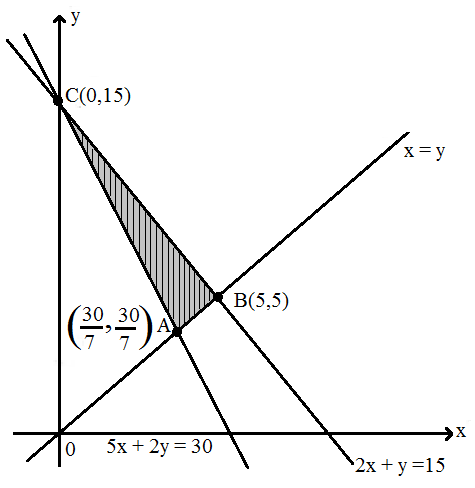
We have minimize z = 400x + 200y, subject to
$5\text{x}+2\text{y}\geq30$
$2\text{x}+\text{y}\leq15$
$\text{x}\leq\text{y}$
$\text{x}\geq0,\text{y}\geq0$
These inequalities are plotted as shown in the adjucent figure.
From the figure shaded region is bounded with the corner points $\text{A}\Big(\frac{30}{7},\frac{30}{7}\Big),$ B(5, 5) and C(0, 15).
|
Corner points
|
Corresponding value of Z = 400x + 200
|
|
$(0, 15)$
|
$3000$
|
|
$(5,5)$
|
$3000$
|
|
$\Big(\frac{30}{7},\frac{30}{7}\Big)$
|
$400\times\frac{30}{7}+200\times\frac{30}{7}=\frac{18000}{7}=2571.43$ (Minimum)
|
Hence, the minimum cast is Rs. 2571.43. View full question & answer→Question 795 Marks
Maximise Z = x + y subject to $\text{x}+4\text{y}\leq8,2\text{x}+3\text{y}\leq12,3\text{x}+\text{y}\leq9,\text{x}\geq0,\text{y}\geq0.$
AnswerWe have to Maximise z = x + y
Subject to constraints,
$\text{x}+4\text{y}\leq8,$
$2\text{x}+3\text{y}\leq12,$
$3\text{x}+\text{y}\leq9,$
$\text{x}\geq0$ and $\text{y}\geq0.$
These inequalities are plotted as shown in the following figure:
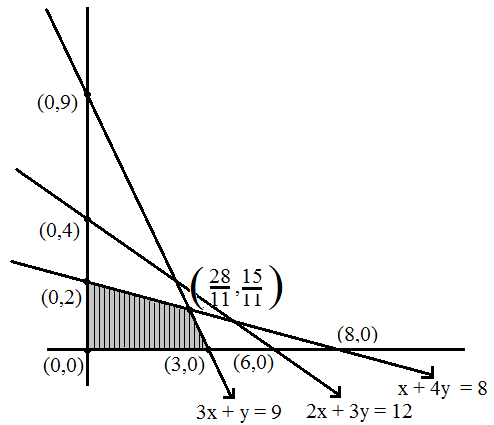
On solving x + 4y = 8 and 3x + y = 9, we get $\text{x}=\frac{28}{11},\text{y}=\frac{15}{11}$
From the graph, feasible region is bounded with corner points (0, 0), (3, 0), $\Big(\frac{28}{11},\frac{15}{11}\Big)$ and (0, 2)
|
Corner points
|
Value of Z = x + y
|
|
(0, 0)
(3, 0)
$\Big(\frac{28}{11},\frac{15}{11}\Big)$
(0, 2)
|
0
3
$\frac{43}{11}=3\frac{10}{11}$ (Maximum)
2
|
Hence, the maximum value is $3\frac{10}{11}.$ View full question & answer→Question 805 Marks
Maximise Z = 3x + 4y, subject to the constraints: $\text{x}+\text{y}\leq1,\text{x}\geq0,\text{y}\geq0.$
AnswerWe have to maximise Z = 3x + 4y,
Subject to the constraints
$\text{x}+\text{y}\leq1$
$\text{x}\geq0$
And $\text{y}\geq0.$
All these inequalities are plotted as shown below,
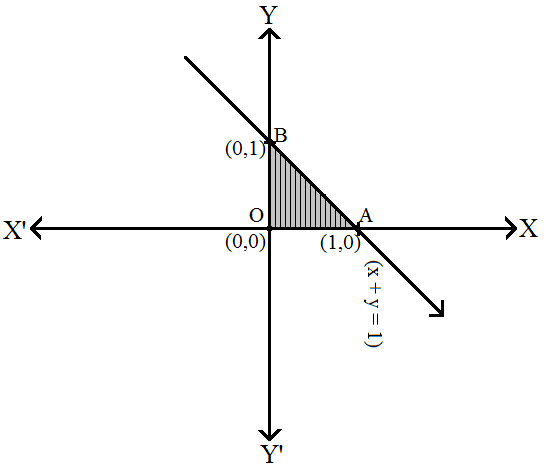
The shaded region shown in the figure as OAB is bounded and the coordinates of corner points O,
A and Bare (0, 0), (1, 0) and (0, 1), respectively.
|
corner points
|
Corresponding value of Z
|
|
(0, 0)
(1, 0)
(0, 1)
|
0
3
4 (Maximum)
|
Hence, the maximum value of Z is 4 at (0, 1). View full question & answer→Question 815 Marks
Solve the linear programming problem and determine the maximum profit to the manufacturer.
AnswerWe have Maximise Z = 100x + 170y Subject to
$3\text{x}+2\text{y}\leq3600,\text{x}+4\text{y}\leq1800,\text{x}\geq0,\text{y}\geq0$
From the shaded feasible region it is clear that the coordinates of corner points are (0, 0), (1200, 0), (1080, 180) and (0, 450).
On solving x + 4y = 1800 and 3x + 2y = 3600, we get x = 1080 and y = 180.
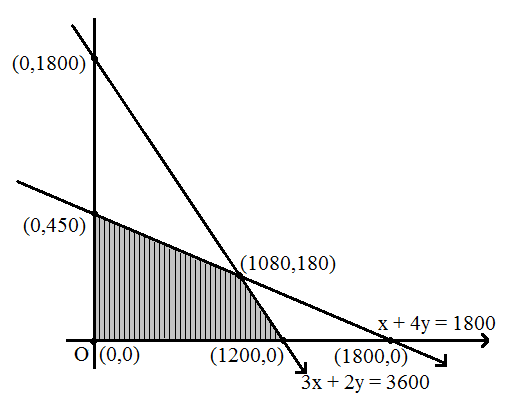
|
Corner points
|
Corresponding value of Z = 100x + 170y
|
|
(0, 0)
(1200, 0)
(1080, 180)
(0, 450)
|
0
1200 ×100 = 12000
100 × 1080 + 170 × 180 = 138600 (maximum)
0 + 170 × 450 = 76500
|
Hence, the maximum profit to the manufacture is 138600. View full question & answer→Question 825 Marks
Minimise Z = -3x + 4 y
subject to $\text{x}+2\text{y}\leq8,\ 3\text{x}+2\text{y}\leq12,\ \text{x}\geq0,\ \text{y}\geq0.$
Answer
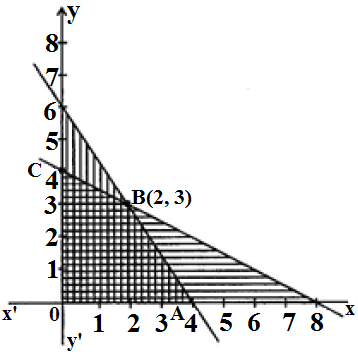 Consider $\text{x}+2\text{y}\leq8$
Let x + 2y = 8
$\Rightarrow\frac{\text{x}}{8}+\frac{\text{y}}{4}=1$
$\therefore$ a = 8, b = 4
Since, (0, 0) satisfies the inequaitons $\text{x}+2\text{y}\leq8$
Therefore, its solution contains (0, 0)
Again $3\text{x}+2\text{y}\leq12$
Let 3x + 2y = 12
$\Rightarrow\frac{\text{x}}{4}+\frac{\text{y}}{6}=1$
Again, (0, 0) satisfies $3\text{x}+2\text{y}\leq12$
Therefore its solution contains (0, 0).
The feasible region is the solution set which is double shaded and is OABCO.
| At |
O(0, 0) |
Z = 0 |
| At |
A(4, 0) |
Z = -3 × 4 = -12 |
| At |
B(2, 3) |
Z = -3 × 2 + 4 × 3 = 6 |
| At |
C(0, 4) |
Z = 4 × 4 = 16 |
Hence, minimum Z = -12 at x = 4, y = 0. View full question & answer→Question 835 Marks
Maximum Z = 5x + 3y Subject to $2\text{x}+\text{y}\geq10$ $\text{x}+3\text{y}\geq15$ $\text{x}\leq10$$\text{y}\leq8$
$\text{x},\text{y}\geq0$
AnswerFirst, we will convert the given inequations into equations, we obtain the following equations:
2x + y = 10, x + 3y = 15, x = 10, y = 8
Region represented by $2\text{x}+\text{y}\geq10$:
The line 2x + y = 10 meets the coordinate axes at A(5, 0) and B(0, 10) respectively.
By joining these points we obtain the line 2x + y = 10. Clearly (0, 0) does not satisfies the inequation $2\text{x}+\text{y}\geq10$.
So,the region in xy plane which does not contain the origin represents the solution set of the inequation $2\text{x}+\text{y}\geq10$.
Region represented by $\text{x}+3\text{y}\geq15$:
The line x + 3y = 15 meets the coordinate axes at C(15, 0) and D(0, 5) respectively.
By joining these points we obtain the line x + 3y = 15.
Clearly (0, 0) satisfies the inequation $\text{x}+3\text{y}\geq15$. o, the region in xy plane which does not contain the origin represents the solution set of the inequation $\text{x}+3\text{y}\geq15$.
The line x = 10 is the line that passes through the point (10, 0) and is parallel to Y axis. $\text{x}\leq10$ is the region to the left of the line x = 10.
The line y = 8 is the line that passes through the point (0, 8) and is parallel to X axis. $\text{y}\leq8$ is the region below the line y = 8.
Region represented by $\text{x}\geq0$ and $\text{y}\geq0$:
Since, every point in the first quadrant satisfies these inequations.
So, the first quadrant is the region represented by the inequations $\text{x}\geq0$ and $\text{y}\geq0$.
The feasible region determined by the system of constraints, $2\text{x}+\text{y}\geq10$, $\text{x}+3\text{y}\geq15$, $\text{x}\leq10$, $\text{y}\leq8$, $\text{x}\geq0$ and $\text{y}\geq0$ are as follows.
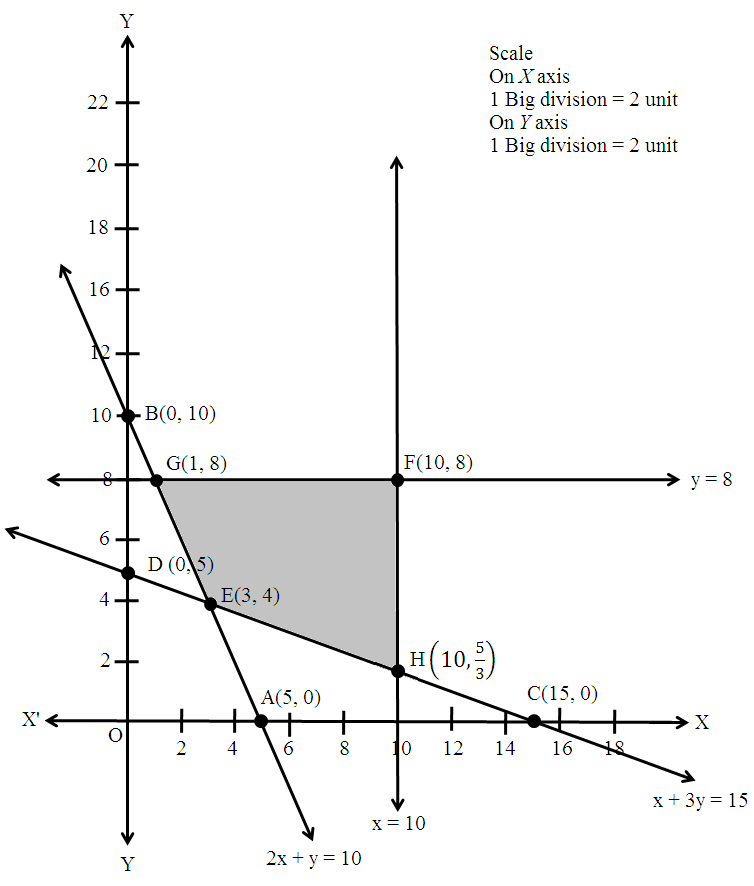
The corner point of the feasible region are E(3, 4), $\text{H}\Big(10,\frac{5}{3}\Big),$ F(10, 8) and G(1, 8).
The values of Z at these corner points are as follows.
|
$\text{Corner point}$
|
$\text{Z}=5\text{x}+3\text{y}$
|
|
$\text{E}(3, 4)$
|
$5\times3+3\times4=27$
|
|
$\text{H}\Big(10,\frac{5}{3}\Big)$
|
$5\times10+3\times\frac{5}{3}=55$
|
|
$\text{F}(10, 8)$
|
$5\times10+3\times8=74$
|
|
$\text{G}(1, 8)$
|
$5\times1+3\times8=29$
|
Therefore, the minimum value of Z is 27 at the point F(3, 4).
Hence, x = 3 and y = 4 is the optimal solution of the given LPP.
Thus, the optimal value of Z is 27. View full question & answer→Question 845 Marks
Minimise and Maximise Z = x + 2y
subject to $\text{x}+2\text{y}\geq100,\ 2\text{x}-\text{y}\leq0,\ 2\text{x}+ \text{y}\leq200;\ \text{x},\ \text{y}\geq0.$
Answer
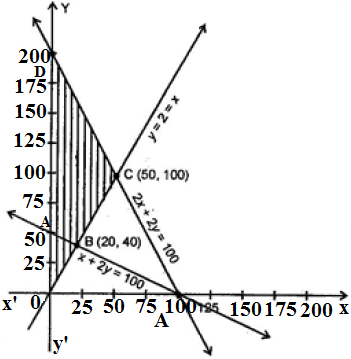 Consider $\text{x}+2\text{y}\geq100$
Let x + 2y = 100 ⇒ $\frac{\text{x}}{100}+\frac{\text{y}}{50}=1$
$\text{x}+2\text{y}\geq100$ represents which does not include (0, 0) as it does not made it true.
gain consider $2\text{x}-\text{y}\leq0$
Let 2x - y = 0 ⇒ y = 2x
Let the test point be (10, 0).
| x |
0 |
25 |
50 |
100 |
| y |
0 |
50 |
100 |
200 |
$\therefore2\times10-0\leq0$ which is false.
herefore, the required half does not contain (10, 0).
Again consider $2\text{x}+\text{y}\leq200$
Let 2x + y = 200
$\Rightarrow\frac{\text{x}}{100}+\frac{\text{y}}{200}=1$
Now (0, 0) satisfies $2\text{x}+\text{y}\leq200$
Therefore, the required half place contains (0, 0).
Now triple shaded region is ABCDA which is the required feasible region.
| At |
A (0, 50) |
| |
Z = x + 2y = 0 + 2 × 50 = 100 |
| At |
B(20, 40), Z = 20 + 2 × 40 = 100 |
| At |
C(50, 100), Z = 50 + 2 × 100 = 250 |
| At |
D(0, 200), Z = 0 + 2 × 200 = 400 |
Hence maximum Z = 400 at x = 0, y = 200 and minimum Z = 100 at x = 0, y = 50 or x = 20, y = 40. View full question & answer→Question 855 Marks
A firm manufactures two types of products $A$ and $B$ and sells them at a profit of Rs $2$ on type $A$ and Rs $3$ on type $B.$ Each product is processed on two machines $M_1$ and $M_2.$ Type A requires one minute of processing time on $M_1$ and two minutes of $M_2;$ type $B$ requires one minute on $M_1$ and one minute on $M_2$. The machine $M_1$ is available for not more than $6$ hours $40$ minutes while machine $M_2$ is available for $10$ hours during any working day. Formulate the problem as a LPP.
AnswerLet the firm produces $x$ units of product $A$ and $y$ units of product $B.$
Since, each unit of product A requires one minute on machine M, and two minutes on machine $M_2$
Therefore, $x$ units of product A will require product $x$ minutes on machine $M,$ and $2x$ minutes on machine $M_2$
Also,
Since each unit of product $B$ requires one minute on machine $M$, and one minute on machine $M_2$
Therefore, $y$ units of product $A$ will require product $y$ minutes on machine $M$, and $y$ minutes on machine $M_2$
It is given that the machine $M_1$ is available for $6$ hours and $40$ minutes i.e. $400$ minutes and machine $M_2$ is available for $10$ hours i.e. $600$ minutes.
Thus,
$\text{x}+\text{y}\leq400$
$2\text{x}+\text{y}\leq600$
Since, units of the products cannot be negative, so $\text{x},\text{y}\geq0$
Let $Z$ denotes the total profit
$\therefore Z = 2x + 3y$ which is to be maximised
Hence, the required LPP is as follows:
Maximize $Z = 2x + 3y$
Subject to
$\text{x}+\text{y}\leq400$
$2\text{x}+\text{y}\leq600$
$\text{x},\text{y}\geq0$.
View full question & answer→Question 865 Marks
Maximize Z = 3x + 3y, if possible,
Subject to the constraints
$\text{x}-\text{y}\leq1$
$\text{x}+\text{y}\geq3$
$\text{x},\text{y}\geq0$
AnswerFirst, we will convert the given inequations into equations, we obtain the following equations:
x − y = 1, x + y = 3, x = 0 and y = 0
Region represented by x − y ≤ 1:
The line x − y = 1 meets the coordinate axes at A(1, 0) and B(0, −1) respectively.
By joining these points we obtain the line x − y = 1.
Clearly (0, 0) satisfies the inequation x + y ≤ 8.
So,the region in xy plane which contain the origin represents the solution set of the inequation x − y ≤ 1.
Region represented by x + y ≥ 3:
The line x + y = 3 meets the coordinate axes at C(3, 0) and D(0, 3) respectively.
By joining these points we obtain the line x + y = 3.
Clearly (0, 0) satisfies the inequation x + y ≥ 3.
So,the region in xy plane which does not contain the origin represents the solution set of the inequation x + y ≥ 3.
Region represented by x ≥ 0 and y ≥ 0:
Since, every point in the first quadrant satisfies these inequations.
So, the first quadrant is the region represented by the inequations x ≥ 0 and y ≥ 0.
The feasible region determined by the system of constraints x − y ≤ 1, x + y ≥ 3, x ≥ 0 and y ≥ 0 are as follows.
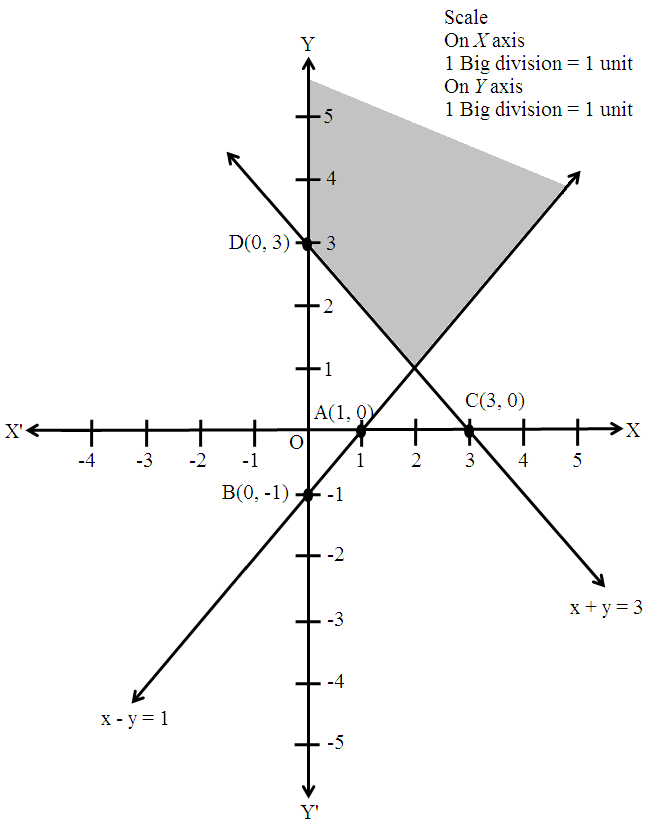
The feasible region is unbounded.
We would obtain the maximum value at infinity.
Therefore, maximum value will be infinity i.e. the solution is unbounded.
View full question & answer→Question 875 Marks
A box manufacturer makes large and small boxes from a large piece of cardboard. The large boxes require $4$ sq. metre per box while the small boxes require $3$ sq. metre per box. The manufacturer is required to make at least three large boxes and at least twice as many small boxes as large boxes. If $60$ sq. metre of cardboard is in stock, and if the profits on the large and small boxes are Rs. $3$ and Rs. $2$ per box, how many of each should be made in order to maximize the total profit?
AnswerLet required quantity of large and small boxes are $x$ and $y$ respectively.
Since, profits on each unit of large and small boxes are Rs. $3$ and Rs. $2$ respectively, so, profit on x units of large and y units of small boxes are Rs. $3x$ and Rs. $2y$ respectively
Let $Z$ be total profit so,
$Z = 3x + 2y$
Since each large and small box require $4$ sq. m. and $3$ sq. m. cardboard respectively, so, $x$ units of large and y units of small boxes require $4x$ and $3y$ sq.m. cardboard respectivley but only $60$ sq. m. of cardboard is available, so
$4x + 3y \leq 60 ($first constraint$)$
Since manufacturer is required to make at least three large boxes, so,
$X \geq 3 ($second constraint$)$
Since manufacturer is required to make at least twice as many small boxes as large boxes, so,
$y \geq 2x ($third constraint$)$
Hence, mathematical formulation of LPP is find $x$ and $y$ which
Maximize $Z = 20x + 15y$
Subject to constriants,
$4x + 3y \leq 60$
$x \geq 3$
$y \geq 2x$
$x, y \geq 0 [$Since production can not be less than zero$]$
Region $4x + 3y \leq 60:$
Line $4x + 3y = 60$ meets axes at $A_1(15, 0), B_1(0, 20)$ respectively.
Region containing origin represents $4x + 3y \leq 60$ as $(0, 0)$ satisfies $4x + 3y \leq 60.$
Region $x \geq 3:$
Line $x = 3 $ is parallel to $y-$axis meets $x-$axes at $A_2(3, 0).$
Region containing origin represents $x \geq 70$ as$(0, 0)$ satisfies $x \geq 3.$
Region $y \geq 2x:$
Line $y = 2x$ is passes throgh origin and $P(3, 6).$
Region containging $B_1(0, 20)$ represents $y \geq 2x$ as $(0, 20)$ satisfies $y \geq 2x.$
Region $x, y \geq 0:$
It represent first quandrant.
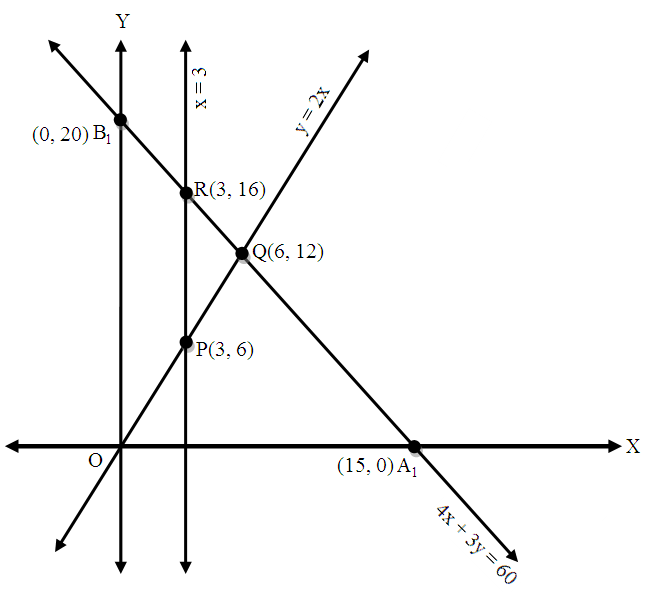
Shaded region $PQR$ represents feasible region.
Point $Q(6, 12)$ is obtained by solving $y = 2x$ and $4x + 3y = 60$
Point $R(3, 16)$ is obtained by solving $x = 3$ and $4x + 3y = 60.$
The value of $Z = 3x + 2y$ at
$P(3, 6) = 3(3) +2(6) = 21$
$Q(6, 12) = 3(6) + 2(12) = 42$
$R(3, 16) = 3(3) +2(16) = 41$
Maximum $Z = 42$ at $x = 6, y = 12$
Number of large box $= 6,$ small box $=12$
Maximum profit $-$ Rs. $42.$
View full question & answer→Question 885 Marks
A farmer has a 100 acre farm. He can sell the tomatoes, lettuce, or radishes he can raise. The price he can obtain is Rs 1 per kilogram for tomatoes, Rs 0.75 a head for lettuce and Rs 2 per kilogram for radishes. The average yield per acre is 2000 kgs for radishes, 3000 heads of lettuce and 1000 kilograms of radishes. Fertilizer is available at Rs 0.50 per kg and the amount required per acre is 100 kgs each for tomatoes and lettuce and 50 kilograms for radishes. Labour required for sowing, cultivating and harvesting per acre is 5 man-days for tomatoes and radishes and 6 man-days for lettuce. A total of 400 man-days of labour are available at Rs 20 per man-day. Formulate this problem as a LPP to maximize the farmer's total profit.
AnswerLet the farmer sow tomatoes in x acres, lettuce in y acres & radishes in z acres of the farm.
Average yield per acre is 2000 kgs for tomatoes, 3000 kgs of lettuce and 1000 kg of radishes.
Thus, the farmer raised 2000x kg of tomatoes, 3000y kg of lettuce and 1000z kg of radishes.
Given, price he can obtain is Re 1 per kilogram for tomatoes, Re 0.75 a head for lettuce and Rs. 2 per kilogram for radishes.
$\therefore$ Selling price = Rs. [2000x(1)+3000y(0.75)+1000z(2)]
=Rs.(2000x + 2250y + 2000z)
Labour required for sowing, cultvating and harvesting per acre is 5 man-days for tomatoes and radishes and 6 man-days for lettuce.
Therefore, labour required for sowing, cultivating and harvesting per acre is 5x for tomatoes, 6y for lettuce and 5z for radishes.
Number of man-days required in sowing, cultivating and harvesting
= 5x + 6y + 5z
Price of one man-day = Rs. 20
$\therefore$ Labour cost = 20(5x + 6y + 5z) = 100x + 120y +100z
Also, fertilizer is available at Re 0.50 per kg and the amount required per acre is 100 kgs each for tomatoes and lettuce and 50 kgs for radishes.
Therefore, fertilizer required is 100x kgs for the tomatoes sown in x acres, 100y kgs for the lettuce sown in y acres and 50z kgs for radishes sown in z acres of land.
Hence, total fertilizer used= (100x + 100y +50z) kgs
Thus, fertilizer's cost
= Rs. 0.5 × (100x + 100y + 5z) = Rs. (50x + 50y + 25z)
So, the total price that has been cost to farmer = Labour cost + Fertilizer cost
= Rs. (150x + 170y + 125z)
Profit made by farmer = selling Price - cost price
= Rs. (2000x + 2250y 2000z) - Rs. (150x + 170y + 125z)
= Rs. (1850x + 2080y + 1875z)
Let Z denotes the total profit
$\therefore$ Z = 1850x + 2080y + 1875z
Now,
Total area of the farm = 100 acres
$\text{x}+\text{y}+\text{z}\leq100$
Also, it is given thet the total man - dayas available are 400.
Thus, $5\text{x}+6\text{y}+5\text{z}\leq400$
Area of the land cannot be negative.
Therefore, $\text{x}+\text{y}\geq0$
Hence, the required LPP is as follows:
Maximize Z = 1850x + 2080y + 1875z
Subject to
$\text{x}+\text{y}+\text{z}\leq100$
$5\text{x}+6\text{y}+5\text{z}\leq400$
$\text{x}+\text{y}\geq0$
View full question & answer→Question 895 Marks
An oil company has two depots A and B with capacities of 7000 L and 4000 L respectively. The company is to supply oil to three petrol pumps, D, E and F whose requirements are 4500L, 3000L and 3500L respectively. The distances (in km) between the depots and the petrol pumps is given in the following table:
|
Distance in (km.)
|
|
From / To
|
A
|
B
|
|
D
E
F
|
7
6
3
|
3
4
2
|
Assuming that the transportation cost of 10 litres of oil is Re 1 per km, how should the delivery be scheduled in order that the transportation cost is minimum? What is the minimum cost?
AnswerLet x liters of oil is supplied from depot A to petrol pump D and y liters of oil supplied from depot A to petrol pump E then 7000 - (x + y) liters of oil will be supplied from depot A to petrol pump F.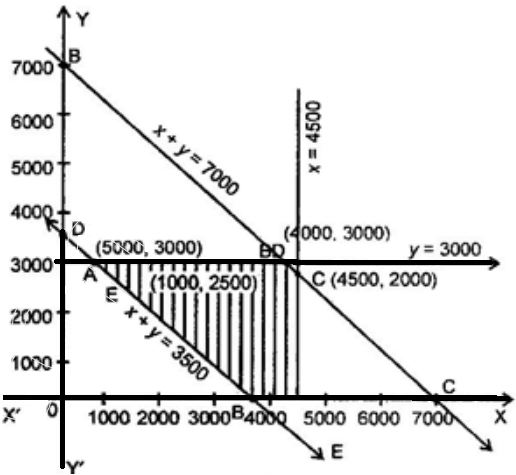
$\therefore\ \text{we have x}\geq0,\ \text{y}\geq0\text{ and }7000-(\text{x}+\text{y})\geq0$ $\Rightarrow\ \text{x}+\text{y}\leq700$ Since requirements of oil at petrol pump, D, E and F are (4500 - x), (5000 - x) and [3500-(x + y)] liters respectively. $\therefore\ 4500-\text{x}\geq0$ $\Rightarrow\ \text{x}\leq4500$ And $300-\text{y}\geq0\Rightarrow\ \text{y}\leq3000$ And $3500-[7000-(\text{x}+\text{y})]\geq0\ \Rightarrow\ \text{x}+\text{y}\geq3500$ $\therefore\ $The cost of transportation per km for 10 liters oil is Re 1 $\therefore\ $The cost of transportation per km per liter $=\text{Rs}.\frac{1}{10}$ $\therefore\ $The cost of transportation Z = 0.7x + 0.6y + 0.3[700 -(x + y)] + 0.3(4500 - x) + 0.4(3000 - y) + [(x + y) -3500] Z = 0.3x + 0.1y + 3950 Therefore, the feasible region is ABECD. Its corners are A(500, 3000), B(35, 0), E(4500, 0), C(4500, 2500), D(4000, 3000). Now Z = 0.3 + 0.1y + 3950
| At |
A(500, 3000) |
Z = 0.3 × 500 + 0.1 × 3000 + 3950 = 4400 |
| At |
B(3500, 0) |
Z = 0.3 × 3500 + 0.1 × 0 + 3950 = 5000 |
| At |
E(4500, 0) |
Z = 0.3 × 4500 + 0.1 × 0 + 3950 = 5300 |
| At |
C(4500, 2500) |
Z = 0.3 × 4500 + 0.1 × 2500 + 3950 = 5550 |
| At |
D(4000, 3000) |
Z = 0.3 × 4000 + 0.1 × 3000 + 3950 = 5450 |
Minimum transportation charges are Rs. 4400 at x = 500, y = 3000 Hence, 500 liters, 3000 liters and 3500 liters of oil should be transported from depot A to petrol pumps D, E, F and 4000 liters, 0 liter and 0 liter of oil be transported from depot B to petrol pumps D, E and F with minimum cost of transportation of Rs. 4400. View full question & answer→Question 905 Marks
Maximise Z = -x + 2y, subject to the constraints:
$\text{x}\geq3,\ \text{x}+\text{y}\geq5,\ \text{x}+ 2\text{y}\geq6,\ \text{y}\geq0.$
Answer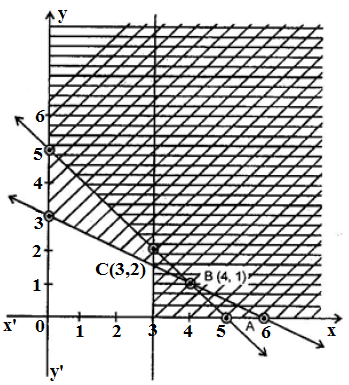
Consider $\text{x}\geq3$
Let x = 3 which is a line parallel to y-axis at a positive distance of 3 from it.
Since $\text{x}\geq3,$ therefore the required half-plane does not contain (0, 0).
Now consider $\text{x}+\text{y}\geq5$
Let x + y = 5
$\Rightarrow\frac{\text{x}}{5}+\frac{\text{y}}{5}=1$
Now (0, 0) does not satisfy $\text{x}+\text{y}\geq5,$ therefore the required half plane does not contain (0, 0).
Again consider $\text{x}+2\text{y}\geq6$
Let x + 2y = 6
$\Rightarrow\frac{\text{x}}{6}+\frac{\text{y}}{3}=1$
Here also (0, 0) does not satisfy $\text{x}+2\text{y}\geq6,$ therefore the required half plane does not contain (0, 0).
The corners of the feasible region are A(6, 0), B(4, 1) and C(3, 2).
| At |
A(6, 0) |
Z = -6 + 2 × 0 = -6 |
| At |
B(4, 1) |
Z = -4 + 2 × 1 = -2 |
| At |
C(3, 2) |
Z = -3 + 2 × 2 = 1 |
Hence, maximum Z = 1 at x = 3, y = 2. View full question & answer→Question 915 Marks
Maximize $Z = 3x_1 + 4x_2,$ if possible,
Subject to the constraints
$\text{x}_1-\text{x}_2\leq-1$
$-\text{x}_1+\text{x}_2\leq0$
$\text{x}_1,\text{x}_2\geq0$
AnswerFirst, we will convert the given inequations into equations, we obtain the following equations:
$X_1 - X_2 = -1, -X_1 + x_2 = 0, X_1 = 0$ and $X_2 = 0$
Region represented by $\text{x}_1-\text{x}_2\leq-1$:
The line $x_1 - x_2 = -1$ meets the coordinate axes at $A(-1, 0)$ and $B(0, 1)$ respectively.
By joining these points we obtain the line $x_1 - x_2 = -1.$
Clearly $(0, 0)$ does not satisfies the inequation $\text{x}_1-\text{x}_2\leq-1$.
So,the region in the plane which does not contain the origin represents the solution set of the inequation $\text{x}_1-\text{x}_2\leq-1$.
Region represented by $-\text{x}_1+\text{x}_2\leq0$ or $\text{x}_1\geq\text{x}_2$:
The line $-X_1 + x_2 = 0$ or $X_1 = x_2$_ is the line passing through $(0, 0).$
The region to the right of the line $x1 = x2$ will satisfy the given inequation $-\text{x}_1+\text{x}_2\leq0$.
If we take a point $(1, 3)$ to the left of the line $x_1 = x_2.$
Here, $1\leq3$ which is not satifying the inequation $\text{x}_1\geq\text{x}_2$.
Therefore, region to the right of the line $x_1 = x_2$_ will satisfy the given inequation $-\text{x}_1+\text{x}_2\leq0$.
Region represented by $\text{x}_1\geq0$ and $\text{x}_2\geq0$:
Since, every point in the first quadrant satisfies these inequations.
So, the first quadrant is the region represented by the inequations $\text{x}_1\geq0$ and $\text{x}_2\geq0$.
The feasible region determined by the system of constraints, $\text{x}_1-\text{x}_2\leq-1,-\text{x}_1+\text{x}_2\leq0,\text{x}_1\geq0$ and $\text{x}_2\geq0$, are as follows.
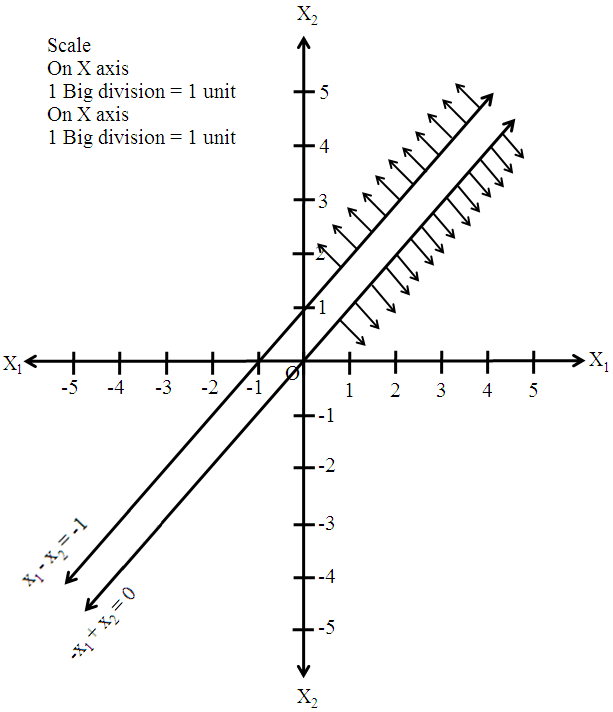
We observe that the feasible region of the given LPP does not exist.
View full question & answer→Question 925 Marks
Find the maximum and minimum value of 2x + y subject to the constraints:
$\text{x}+3\text{y}\geq6,\text{x}-3\text{y}\leq3,3\text{x}+4\text{y}\leq24,$ $-3\text{x}+2\text{y}\leq6,5\text{x}+\text{y}\geq5,\text{x},\text{y}\geq0$
AnswerFirst, we will convert the given inequations into equations, we obtain the following equations:
x + y = 4, x + y = 3, x - 2y = 2, x = 0 and y = 0.
The line x + 3y = 6 meets the coordinate axis at A(6, 0) and B(0, 2).
Join these points to obtain the line x + 3y = 6.
Clearly, (0, 0) does not satisfies the inequation $\text{x}+3\text{y}\geq6$.
So, the region in xy-plane that does not contains the origin represents the solution set of the given equation.
The line x - 3y = 3 meets the coordinate axis at C(3, 0) and D(0, -1).
Join these points to obtain the line x - 3y = 3.
Clearly, (0, 0) satisfies the inequation $\text{x}-3\text{y}\leq3$.
So, the region in xy-plane that contains the origin represents the solution set of the given equation.
The line 3x + 4y = 24 meets the coordinate axis at E(8, 0) and F(0, 6).
Join these points to obtain the line 3x + 4y = 24.
Clearly, (0, 0) satisfies the inequation $3\text{x}+4\text{y}\leq24$.
So, the region in xy-plane that contains the origin represents the solution set of the given equation.
The line -3x + 2y = 6 meets the coordinate axis at G(-2, 0) and H(0, 3).
Join these points to obtain the line -3x + 2y = 6.
Clearly, (0, 0) satisfies the inequation $-3\text{x}+2\text{y}\leq6$.
So, the region in xy-plane that contains the origin represents the solution set of the given equation.
The line 5x + y = 5 meets the coordinate axis at I(1, 0) and J(0, 5).
Join these points to obtain the line 5x + y = 5.
Clearly, (0, 0) does not satisfies the inequation $5\text{x}+\text{y}\geq5$.
So, the region in xy-plane that does not contains the origin represents the solution set of the given equation.
Region represented by $\text{x}\geq0$ and $\text{y}\geq0$:
Since, every point in the first quadrant satisfies these inequations.
So, the first quadrant is the region represented by the inequations.
These lines are drawn using a suitable scale.
View full question & answer→Question 935 Marks
An aeroplane can carry a maximum of 200 passengers. A profit of Rs. 1000 is made on each executive class ticket and a profit of Rs 600 is made on each economy class ticket. The airline reserves at least 20 seats for executive class. However, at least 4 times as many passengers prefer to travel by economy class than by the executive class. Determine how many tickets of each type must be sold in order to maximise the profit for the airline. What is the maximum profit?
AnswerLet number of tickets of executive class sold = x and number of tickets of economy class sold = y
We have to maximize = Z = 1000x + 600 y subject to $\text{x}+\text{y}\leq200,\ \text{x}\geq20\text{ and y}\geq4\text{x }\text{ x}\geq0,\ \text{y}\geq0$
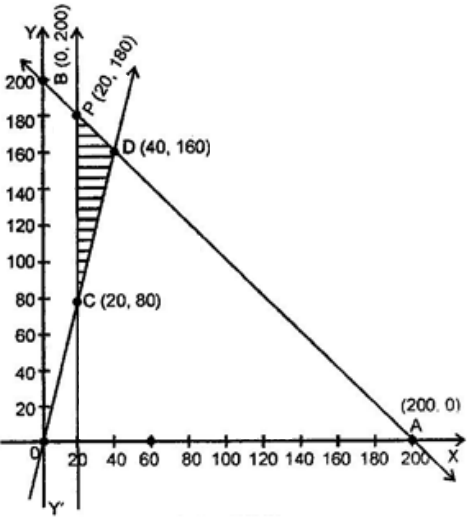
consider $\text{x}+\text{y}\leq200$
Let x + y = 200
$\Rightarrow\ \frac{\text{x}}{200}+\frac{\text{y}}{200}=1$
$\therefore\ $Points A(200, 0) and B(0, 200) are on the line and therefore (0, 0) is included in the required half plane. Again consider $\text{x}\geq20$
Let x = 20
It is the line parallel to y-axis at a positive distance 20 and the half plane lies towards right of it. Again consider $\text{y}\geq4\text{x}$
Let y = 4x
| |
O |
C |
D |
| X |
0 |
20 |
40 |
| Y |
0 |
80 |
160 |
Here, (40, 0) does not satisfy $\text{y}\geq4\text{x},$ therefore plane does not include (40, 0).
The shaded portion is the feasible region. Its corners are C(20, 80), D(40, 160) and P(20, 180)
Now Z = 1000x + 600y
| At |
C(20, 80) |
Z = 1000 × 20 + 600 × 80 = 20000 + 48000 = 68,000 |
| At |
D(40, 60) |
Z = 1000 × 40 + 600 × 60 = 40000 + 96000 = 1,36,000 |
| At |
P(20, 180) |
Z = 1000 × 20 + 600 × 180 = 20000 + 108000 = 1,228,000 |
Hence Maximum profit Z = Rs. 1,36,000 at x = 40, y = 160. View full question & answer→Question 945 Marks
A factory manufactures two types of screws, A and B. Each type of screw requires the use of two machines, an automatic and a hand operated. It takes 4 minutes on the automatic and 6 minutes on hand operated machines to manufacture a package of screws A, while it takes 6 minutes on automatic and 3 minutes on the hand operated machines to manufacture a package of screws B. Each machine is available for at the most 4 hours on any day. The manufacturer can sell a package of screws A at a profit of Rs 7 and screws B at a profit of Rs 10. Assuming that he can sell all the screws he manufactures, how many packages of each type should the factory owner produce in a day in order to maximise his profit? Determine the maximum profit.
AnswerLet the factory manufacture x screws of type A and y screws of type B on each day. Therefore, $\text{x}\ge0\text{ and y}\ge0.$
The given information can be compiled in a table as follows.
| |
Screw A |
Screw B |
Availability |
| Automatic Machine (min) |
4 |
6 |
4 × 60 = 120 |
| Hand Operated Machine (min) |
6 |
3 |
4 × 60 = 120 |
The proflt on a package of screws A is Rs 7 and on the package of screws B is Rs 10.
Therefore, the constraints are
$4\text{x}+6\text{y}\le240\\6\text{x}+3\text{y}\le240$
Total profit, z = 7x + 10y
The mathematical formulation of the given problem is Maximize Z = 7x + 10y ... (1)
subject to the constraints,
$4\text{x}+6\text{y}\le240\dots(2)\\6\text{x}+3\text{y}\le240\dots(3)\\\text{x},\ \text{y}\ge0\dots(4)$
The feasible region determined by the system of constraints is
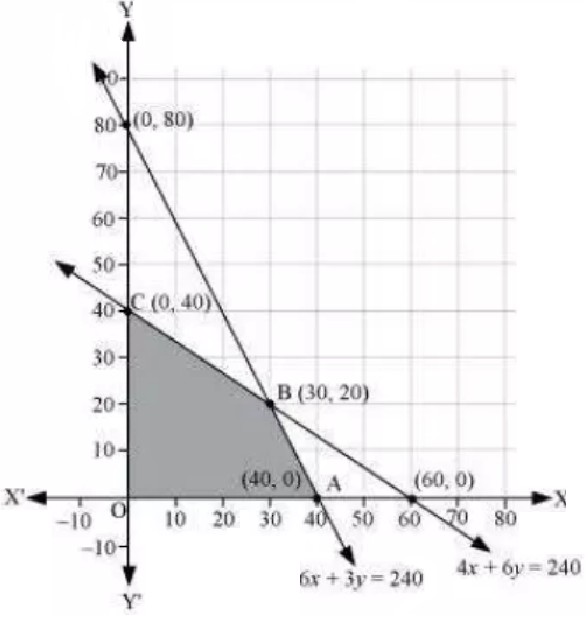
The corner points are A(40, 0), B(30, 20), and C(0, 40).
The values of Z at these corner points are as follows.
| Corner point |
Z = 7x + 10y |
|
| A(40, 0) |
280 |
|
| B(30, 20) |
410 |
→ Maximum |
| C(0, 40) |
400 |
|
The maximum value of Z is 410 at (30, 20).
Thus, the factory should produce 30 packages of screws A and 20 packages of screws B to get the maximum profit of Rs 410. View full question & answer→Question 955 Marks
Maximise and Minimise Z = 3x – 4y subject to:
$\text{x}-2\text{y}\leq0$
$-3\text{x}+\text{y}\leq4$
$\text{x}-\text{y}\leq6$
$\text{x},\text{y}\geq0$
AnswerGiven LPP is
Maximise and minimise z = 3x - 4y subject to
$\text{x}-2\text{y}\leq0,-3\text{x}+\text{y}\leq4,\text{x}-\text{y}\leq6,\text{x},\text{y}\geq0.$
[ On solving x - y = 6 and x - 2y = 0, we get x = 12, y = 6]
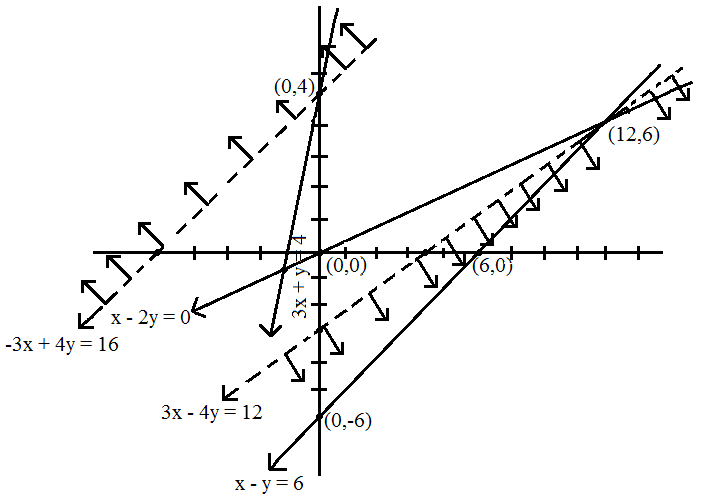 From the shown graph, for the feasible region, we see that it is unbounded and coordinates of corner points are (0, 0), (12, 6) and (0, 4).
|
Corner points
|
Corresponding value of Z = 3x - 4y
|
|
(0, 0)
(0, 4)
(12, 6)
|
0
-16 (minimum)
12 (maximum)
|
For given unbounded region the minimum value of Z may or may not be -16. So, for deciding this, we graph the inequality.
3x - 4y < -16
And check whether the resulting open half plane has common points with feasible region or not.
Thus, from the figures it shows it has common points with feasible region, So, it does not have any minimise value.
Also, similarly for maximum value, we graph the inequality 3x - 4y > 12
And see that resulting open half plane has no common points with the feasible region and hence maximum value of 12 exits for Z = 3x - 4y. View full question & answer→Question 965 Marks
There are two factories located one at place P and the other at place Q. From these locations, a certain commodity is to be delivered to each of the three depots situated at A, B and C. The weekly requirements of the depots are respectively 5, 5 and 4 units of the commodity while the production capacity of the factories at P and Q are respectively 8 and 6 units. The cost of transportation per unit is given below:
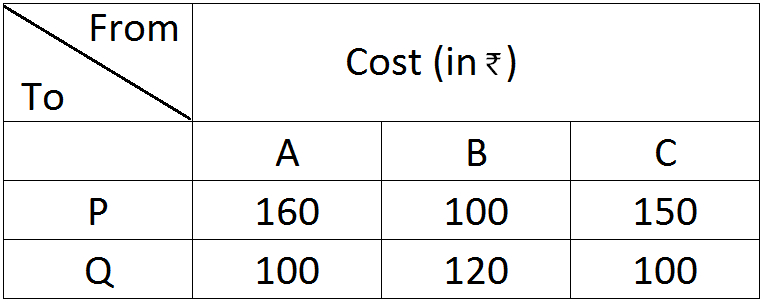
How many units should be transported from each factory to each depot in order that the transportation cost is minimum. What will be the minimum transportation cost?
AnswerHere, demand of the commodity (5 + 5 + 4 = 14 units) is equal the supply of the commodity (8 + 6 = 14 units).
So, no commodity would be left at the two factories.
Let x units and y units of the commodity be transported from the factory P to the depots at A and B, respectively.
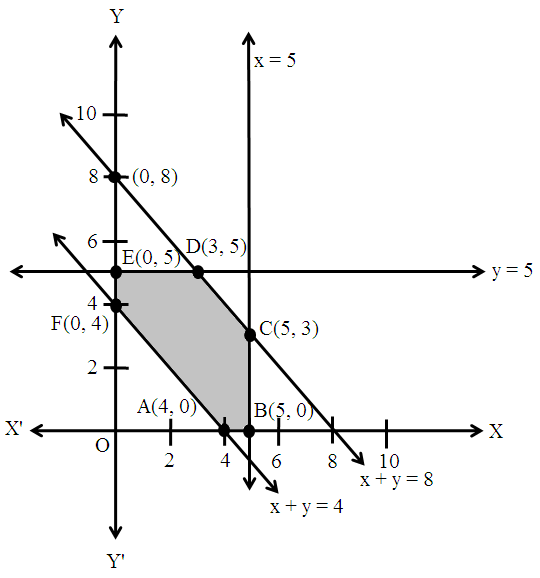
Then, (8 − x − y) units of the commodity will be transported from the factory P to the depot C.
Now, the weekly requirement of depot A is 5 units of the commodity.
Now, x units of the commodity are transported from factory P, so the remaining (5 − x) units of the commodity are transported from the factory Q to the depot A.
The weekly requirement of depot B is 5 units of the commodity.
Now, y units of the commodity are transported from factory P, so the remaining (5 − y) units of the commodity are transported from the factory Q to the depot B.
Similarly, 6 − (5 − x) − (5 − y) = (x + y − 4) units of the commodity will be transported from the factory Q to the depot C.
Since the number of units of commodity transported are from the factories to the depots are non-negative, therefore,
x ≥ 0, y ≥ 0, 8 − x − y ≥ 0, 5 − x ≥ 0, 5 − y ≥ 0, x + y − 4 ≥ 0
Or x ≥ 0, y ≥ 0, x + y ≤ 8, x ≤ 5, y ≤ 5, x + y ≥ 4
Total transportation cost = 160x + 100y + 150(8 − x − y) + 100(5 − x) + 120(5 − y) + 100(x + y − 4) = 10x − 70y + 1900
Thus, the given linear programming problem is
Minimise Z = 10x − 70y + 1900
Subject to the constraints
x + y ≤ 8
x ≤ 5
y ≤ 5
x + y ≥ 4
x ≥ 0, y ≥ 0
The feasible region determined by the given constraints can be diagrammatically represented as,
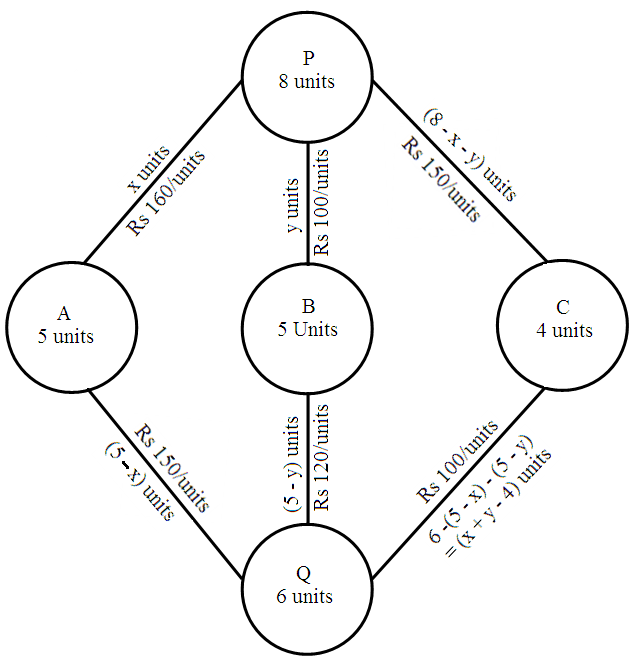
The coordinates of the corner points of the feasible region are A(4, 0), B(5, 0), C(5, 3), D(3, 5), E(0, 5) and F(0, 4).
The value of the objective function at these points are given in the following table.
|
Corner Point
|
Z = 10x - 70y + 1900
|
|
(4, 0)
|
10 × 4 - 70 × 0 + 1900 = 1940
|
|
(5, 0)
|
10 × 5 - 70 × 0 + 1900 = 1950
|
|
(5, 3)
|
10 × 5 - 70 × 3 + 1900 = 1740
|
|
(3, 5)
|
10 × 3 - 70 × 5 + 1900 = 15800
|
|
(0, 5)
|
10 × 0 - 70 × 5+ 1900 = 1550 → Maximum
|
| (0, 4) |
10 × 0 - 70 × 4 + 1900 = 1620 |
The minimum value of Z is 1550 at x = 0, y = 5.
Hence, for minimum transportation cost, factory P should supply 0, 5, 3 units of commodity to depots A, B, C respectively and factory Q should supply 5, 0, 1 units of commodity to depots A, B, C respectively.
The minimum transportation cost is Rs. 1,550.
View full question & answer→Question 975 Marks
Vitamins $A$ and $B$ are found in two different foods $F_1$ and $F_2$. One unit of food $F_1$ contains $2$ units of vitamin $A$ and 3 units of vitamin $B$. One unit of food $F_2$ contains $4$ units of vitamin $A$ and 2 units of vitamin $B$. One unit of food $F_1$ and $F_2$ cost Rs $50$ and $25$ respectively. The minimum daily requirements for a person of vitamin $A$ and $B$ is $40$ and $50$ units respectively. Assuming that anything in excess of daily minimum requirement of vitamin $A$ and $B$ is not harmful, find out the optimum mixture of food $F _1$ and $F _2$ at the minimum cost which meets the daily minimum requirement of vitamin $A$ and $B$. Formulate this as a LPP.
AnswerLet x and y units of food $F_1$ and food $F_2$ were mixed.
Clearly, $\text{x}\geq0$ and $\text{y}\geq0$
One unit of food $F_1$ contains 2 units of vitamin $A$ and one unit of of food $F_2$ contains 4 units of vitamin $A$. Therefore, $x$ and $y$ units of food $F_1$ and food $F_2$ respectively contains $2 x$ and $4 y$ units of vitamin $A$. It is given that the minimum daily requirements for a person of vitamin $A$ is 40 units. Hence, $2 x+4 y \geq 40$ One unit of food $F_1$ contains 3 units of vitamin $B$ and one unit of food $F_2$ contains 2 units of of vitamin $B$. Therefore, $x$ and $y$ units of $F_1$ and $F_2$ respectively contains $3 x$ and $2 y$ units of vitamin $B$. It is given that the minimum daily requirements for a person of vitamin $B$ is 50 units. Hence, $3 x+2 y \geq 50$ One unit of food $F_1$ and food $F_2$ cost Rs 50 and 25 respectively.
Therefore, $x$ and $y$ units of food $F_1$ and food $F_2$ costs Rs. $50 x$ and Rs. $25 y$ respectively.
Let $Z$ denote the total cost
Then, $Z=$ Rs. $(50 x +25 y )$
Hence, the required LPP is Minimize $Z=50 x+25 y$
subject to
$2\text{x}+4\text{y}\geq40$
$3\text{x}+2\text{y}\geq50$
$\text{x}\geq0,\text{y}\geq0$
View full question & answer→Question 985 Marks
A publisher sells a hard cover edition of a text book for Rs. $72.00$ and paperback edition of the same ext for Rs. $40.00$. Costs to the publisher are Rs. $56.00$ and Rs. $28.00$ per book respectively in addition to weekly costs of Rs. $9600.00.$ Both types require $5$ minutes of printing time, although hardcover requires $10$ minutes binding time and the paperback requires only $2$ minutes. Both the printing and binding operations have $4,800$ minutes available each week. How many of each type of book should be produced in order to maximize profit?
AnswerLet the sale of hand cover edition be 'h' and that of paperback editions be $'t'.$
SP of a hard cover edition of the textbook $= Rs. 72$
SP of a paperback edition of the textbook $= Rs. 40$
Cost to the publisher for hard cover edition $= Rs. 56$
Cost to the publisher for a paperback edition $= Rs. 28$
Weekly cost to the publisher $= Rs. 9600$
Profit to be maximised, $Z = (72 − 56) h + (40 − 28) t − 9600$
$\Rightarrow Z = 16h + 12t – 9600$
$5(h + t) \leq 4800$
$10h + 2t \leq 4800$
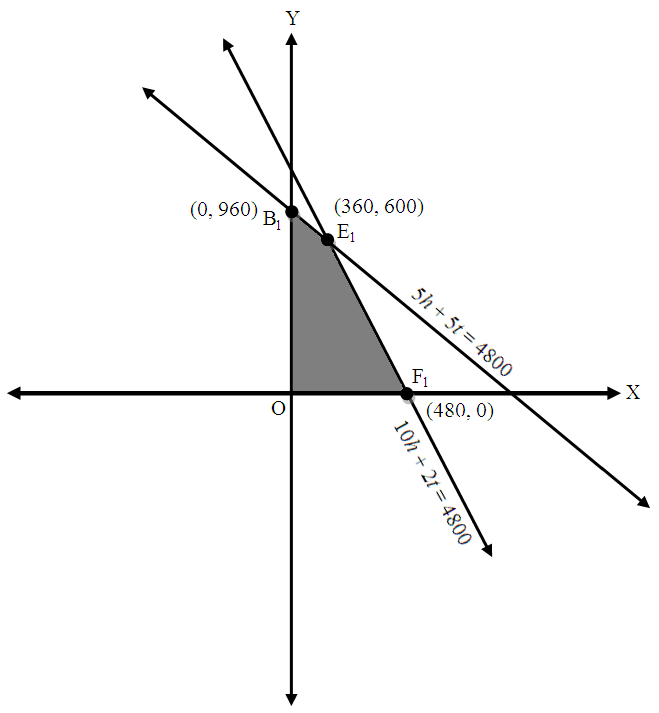
The corner points are $O(0, 0), B_1(0, 960), E_1(360, 600)$ and $F_1(480, 0).$
The values of $Z$ at these corner points are as follows:
|
Corner point
|
$Z = 16h + 12t - 9600$
|
|
$O$
|
$-9600$
|
|
$B_1$
|
$1920$ |
|
$G_1$
|
$3360$ |
|
$F_1$
|
$-1920$ |
The maximum value of $Z$ is $3360$ which is attained at $E_1(360, 600).$
The maximum profit is $3360$ which is obtained by selling $360$ copies of hardcover edition and $600$ copies of paperback edition.
View full question & answer→Question 995 Marks
Amit's mathematics teacher has given him three very long lists of problems with the instruction to submit not more than 100 of them (correctly solved) for credit. The problem in the first set are worth 5 points each, those in the second set are worth 4 points each, and those in the third set are worth 6 points each. Amit knows from experience that he requires on the average 3 minutes to solve a 5 point problem, 2 minutes to solve a 4 point problem, and 4 minutes to solve a 6 point problem. Because he has other subjects to worry about, he can not afford to devote more than $3\frac{1}{2}$ hours altogether to his mathematics assignment. Moreover, the first two sets of problems involve numerical calculations and he knows that he cannot stand more than $2\frac{1}{2}$ hours work on this type of problem. Under these circumstances, how many problems in each of these categories shall he do in order to get maximum possible credit for his efforts? Formulate this as a LPP.
AnswerGiven information can be tabulated as below:
|
Sets
|
Time requirement
|
points
|
|
I
|
3
|
5
|
|
II
|
2
|
|
|
III
|
4
|
6
|
|
Time for all three sets $=3\frac{1}{2}$ hours
Time for set I and II $=2\frac{1}{2}$ hours
Number of quations maximum 100
|
Given, each question from set I, II, III earn 5,4,6 points respectively, so x questions of set I, y questions of set II and z questions of set III earn 5x, 4y and 6z points, let total point credit be U
So, U = 5x + 4y + 6z
Given, each question of set I, II and III require 3,2 and 4 minutes respectively, so x questions of set I, y questions of set II and z questions of set III require 3x, 2y and 4z mimutes respectively but given that total time to devote in all three sets is
$3\frac{1}{2}$ hours = 210 minutes and first two sets is $2\frac{1}{2}$ hours = 150 minutes
So,
$3\text{x}+2\text{y}+4\text{z}\leq210$ (First constraint)
$3\text{x}+2\text{y}\leq150$ (Second constraint)
Given, total number of questions cannot exceed 100
So, $\text{x}+\text{y}+\text{z}\leq100$ (Third constraint)
Hence, mathematical formulation of LPP is
Find x and y which maximize U = 5x + 4y + 6z
Subject to constraint,
$3\text{x}+2\text{y}+4\text{z}\leq210$
$3\text{x}+2\text{y}\leq150$
$\text{x}+\text{y}+\text{z}\leq100$
$\text{x},\text{y},\text{z}\geq0$
[Since number of questions to solve from each set cannot be less than zero]. View full question & answer→Question 1005 Marks
A manufacturer produces two products A and B. Both the products are processed on two different machines. The available capacity of first machine is 12 hours and that of second machine is 9 hours per day. Each unit of product A requires 3 hours on both machines and each unit of product B requires 2 hours on first machine and 1 hour on second machine. Each unit of product A is sold at Rs. 7 profit and that of B at a profit of Rs. 4. Find the production level per day for maximum profit graphically.
AnswerLet x units of product A and y units of product B be manufactured by the manufacturer per day.
It is given that one unit of product A requires 3 hours of processing time on first machine, while one unit of product B requires 2 hours of processing time on first machine.
It is also given that first machine is available for 12 hours per day.
$\therefore$ 3x + 2y ≤ 12
Also, one unit of product A requires 3 hours of processing time on second machine, while one unit of product B requires 1 hour of processing time on second machine.
It is also given that second machine is available for 9 hours per day.
$\therefore$ 3x + y ≤ 9
The profits on one unit each of product A and product B is Rs. 7 and Rs 4, respectively.
So, the objective function is given by Z = Rs. (7x + 4y).
Therefore, the mathematical formulation of the given linear programming problem can be stated as:
Maximize Z = 7x + 4y
Subject to the constraints
3x + 2y ≤ 12 .....(1)
3x + y ≤ 9 .....(2)
x ≥ 0, y ≥ 0 .....(3)
The feasible region determined by constraints (1) to (3) is graphically represented as:
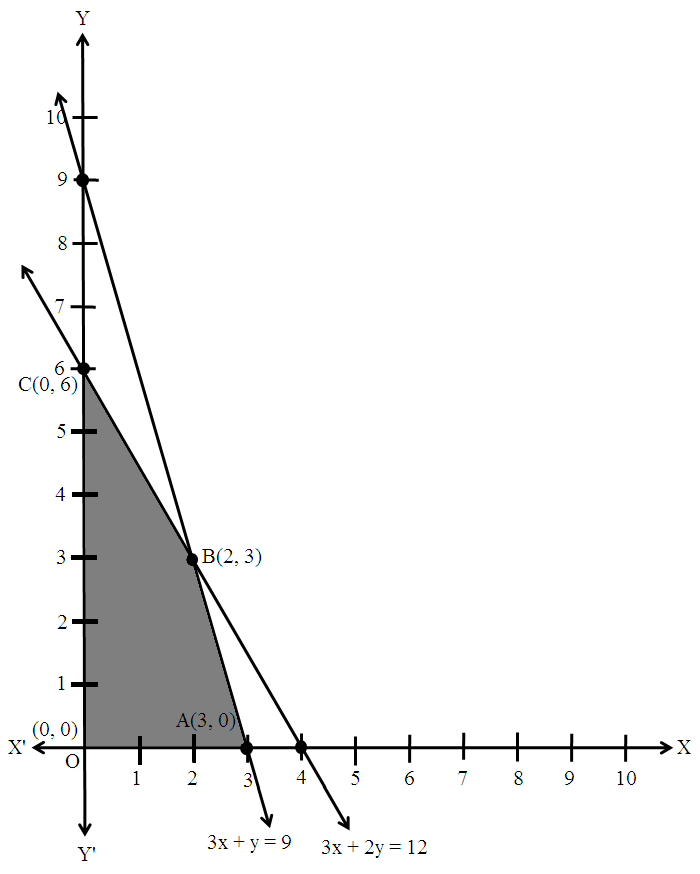
Here, it is seen that OABCO is the feasible region and it is bounded.
The values of Z at the corner points of the feasible region are represented in tabular form as:
|
Corner point
|
Z = 7x + 4y
|
|
O(0, 0)
|
Z = 7 × 0 + 4 × 0 = 0
|
|
A(0, 10)
|
Z = 7 × 3 + 4 × 0 = 21
|
|
B(173, 0)
|
Z = 7 × 2 + 4 × 3 = 26
|
|
C(3, 8)
|
Z = 7 × 0 + 4 × 6 = 24
|
The maximum value of Z is 26, which is obtained at x = 2 and y = 3.
Thus, 2 units of product A and 3 units of product B should be manufactured by the manufacturer per day in order to maximize the profit.
Also, the maximum daily profit of the manufacturer is Rs. 26.
View full question & answer→Question 1015 Marks
Maximum Z = 4x + 3y
Subject to
$3\text{x}+4\text{y}\leq24$
$8\text{x}+6\text{y}\leq48$
$\text{x}\leq5$
$\text{y}\leq6$
$\text{x},\text{y}\geq0$
AnswerWe need to maximize Z= 4x + 3y
First, we will convert the given inequations into equations, we obtain the following equations:
3x + 4y = 24, 8x + 6y = 48, x = 5, y = 6, x = 0 and y = 0.
The line 3x + 4y = 24 meets the coordinate axis at A(8, 0) and B(0, 6).
Join these points to obtain the line 3x + 4y = 24.
Clearly, (0, 0) satisfies the inequation $3\text{x}+4\text{y}\leq24$.
So, the region in xy-plane that contains the origin represents the solution set of the given equation.
The line 8x + 6y = 48 meets the coordinate axis at C(6, 0) and D(0, 8).
Join these points to obtain the line 8x + 6y = 48.
Clearly, (0, 0) satisfies the inequation $8\text{x}+6\text{y}\leq48$.
So, the region in xy-plane that contains the origin represents the solution set of the given equation.
x = 5 is the line passing through x = 5 parallel to the Y axis.
y = 6 is the line passing through y = 6 parallel to the X axis.
Region represented by $\text{x}\geq0$ and $\text{y}\geq0$: Since, every point in the first quadrant satisfies these inequations.
So, the first quadrant is the region represented by the inequations.
These lines are drawn using a suitable scale.
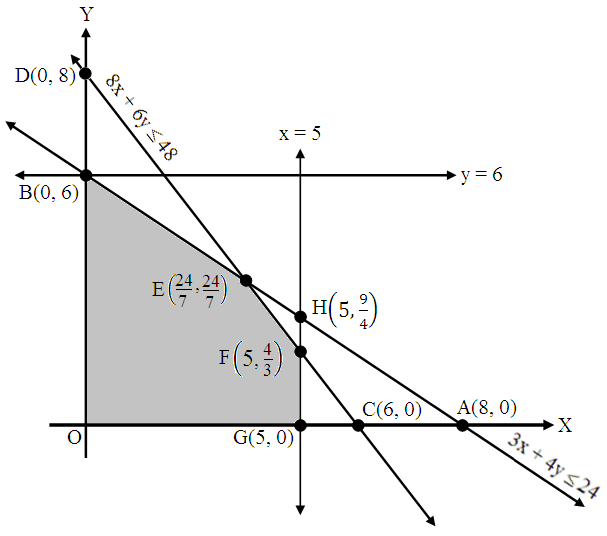
The corner points of the feasible region are O(0, 0), G(5, 0), $\text{F}\Big(5,\frac{4}{3}\Big),\text{E}\Big(\frac{24}{7},\frac{24}{7}\Big)$ and B(0, 6).
The values of Z at these corner points are as follows.
| $\text{Corner point}$ |
$\text{Z}=4\text{x}+3\text{y}$ |
| $\text{O}(0, 0)$ |
$4\times0+3\times0=0$ |
| $\text{G}(5, 0)$ |
$4\times5+3\times0=20$ |
| $\text{F}\Big(5,\frac{4}{3}\Big)$ |
$4\times5+3\times\frac{4}{3}=24$ |
| $\text{E}\Big(\frac{24}{7},\frac{24}{7}\Big)$ |
$4\times\frac{24}{7}+3\times\frac{24}{7}=\frac{196}{7}=24$ |
| $\text{B}(0, 6)$ |
$4\times0+3\times6=18$ |
We see that the maximum value of the objective function Z is 24 which is at $\text{F}\Big(5,\frac{4}{3}\Big)$ and $\text{E}\Big(\frac{24}{7},\frac{24}{7}\Big)$.
Thus. the optimal value of is 24. View full question & answer→Question 1025 Marks
A small manufacturing firm produces two types of gadgets A and B, which are first processed in the foundry, then sent to the machine shop for finishing. The number of man-hours of labour required in each shop for the production of each unit of A and B, and the number of man-hours the firm has available per week are as follows:
|
Gadget
|
Fondry
|
Machine-shop
|
|
A
B
|
10
6
|
5
4
|
|
Firm's capacity per week
|
1000
|
600
|
The profit on the sale of A is Rs. 30 per unit as compared with Rs. 20 per unit of B. The problem is to determine the weekly production of gadgets A and B, so that the total profit is maximized. Formulate this problem as a LPP.
AnswerThe given data may be put in the following tabular from:-
|
Gadget
|
Fondry
|
Machine-shop
|
Profit
|
|
A
B
|
10
6
|
5
4
|
Rs. 30
Rs. 20
|
|
Firm's capacity per week
|
1000
|
600
|
|
Let required weekly production of gadgets A and B be x and y respectively.
Given that, profit on each gadget A is Rs 30
So, profit on x gadget of type A = 30x
Profit on each gadget of type B = Rs. 20
So, profit on y gadget of type B = 20y
Let Z denote the total profit, so
Z = 30x + 20y
Given, production of one gadget A requires 10 hours per week for foundry and gadget B requires 6 hours per week for foundry.
So, x units of gadget A requires 10x hours per week and y units of gadget B requires by hours per week, But the maximum capacity of foundry per week is 1000 hours, so
10x + 6y s 1000
This is first constraint.
Given, production of one unit gadget A requires 5 hours per week of machine shop and production of one unit of gadget B requires 4 hours per week of machine shop.
So, x units of gadget A requires 5x hours per week and y units of gadget B requires 4y hours per week, but the maximum capacity of machine shop is 600
hours per week.
So, 5x + 4y = 600
This is second constraint.
Hence, mathematical formulation of LPP is:
Find x and y which
Maximize Z = 30x + 2y
Subject to constraints,
10x + 6y ≤ 1000
5x + 4y ≤ 600
And, x, y ≥ 0 [Since production cannot be less than zero]
View full question & answer→Question 1035 Marks
A library has to accommodate two different types of books on a shelf. The books are 6 cm and 4 cm thick and weigh 1kg and $1\frac{1}{2}$ kg each respectively. The shelf is 96 cm long and at most can support a weight of 21kg. How should the shelf be filled with the books of two types in order to include the greatest number of books? Make it as an LPP and solve it graphically.
AnswerLet x books of first type and y books of second type were accommodated. Number of books cannot be negative.
Therefore, x, y ≥ 0
According to question, the given information can be tabulated as:
| |
Thickness(cm) |
Weight(kg) |
| First type(x) |
6 |
1 |
| Second type(v) |
4 |
1.5 |
| Capacity of shelf |
96 |
21 |
Therefore, the constraints
6x + 4y ≤ 96
x + 1.5y ≤ 21
Number of books = Z = x + y which is to be maximised
Thus, the mathematical formulation of the given linear programmimg problem is
Max Imize Z = x + y
Subject to
6x + 4y ≤ 96
x + 1.5y ≤ 21
First we will convert inequations into equations as follows:
6x + 4y = 96, x + 1.5y = 21, x = 0 and y = 0
Region represented by 6x + 4y ≤ 96:
The line 6x + 4y = 96 meets the coordinate axes at A(16, 0) and B(O, 24) respectively.
By joining these points we obtain the line 6x + 4y = 96.
Clearly (0, 0) satisfies the 6x + 4y = 96.
So, the region which contains the origin represents the solution set of the inequation 6x + 4y ≤ 96.
Region represented by x + 1.5y ≤ 21:
The line x + 1.5y = 21 meets the coordinate axes at C(21, 0) and D(O, 14) respectively.
By joining these points we obtain the line x + 1.5y = 21.
Clearly (0, 0) satisfies the inequation x + 1.5y ≤ 21.
So, the region which contains the origin represents the solution set of the inequation x + 1.5y ≤ 21.
Region represented by x ≥ 0 and y ≥ 0:
Since, every point in the first quadrant satisfies these inequations.
So, the first quadrant is the region represented by the inequations x ≥ 0, and y ≥ 0.
The feasible region determined by the system of constraints 6x + 4y ≤ 96, x + 1.5y ≤ 21, x ≥ 0 and y ≥ 0 are as follows.
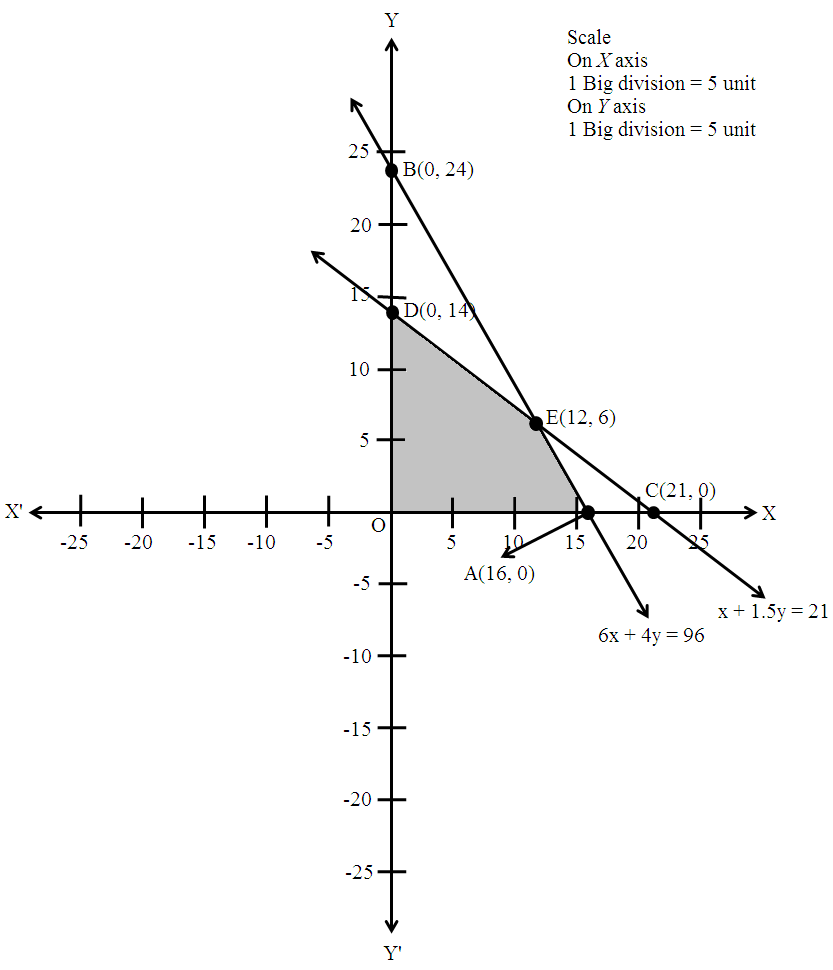
The corner points are O(0, 0), D(0, 14), E(12, 6), A(16,0)
The values of Z at these corner points are as follows.
|
Corner point
|
Z = x + y
|
|
O
|
0
|
|
D
|
14
|
|
E
|
18
|
|
A
|
16
|
The maximum value of Z is 18 which is attained at E(12, 6).
Thus, maximum number of books that can be arranged on shelf is 18 where 12 books are of first type and 6 books are the other type.
View full question & answer→Question 1045 Marks
A company produces two types of leather belts, say type A and B. Belt A is a superior quality and belt B is of a lower quality. Profits on each type of belt are Rs. 2 and Rs. 1.50 per belt, respectively. Each belt of type A requires twice as much time as required by a belt of type B. If all belts were of type B, the company could produce 1000 belts per day. But the supply of leather is sufficient only for 800 belts per day (both A and B combined). Belt A requires a fancy buckle and only 400 fancy buckles are available for this per day. For belt of type B, only 700 buckles are available per day.
How should the company manufacture the two types of belts in order to have a maximum overall profit?
AnswerLet the company produces x belts of type A and y belts of type B.
Number of belts cannot be negative.
Therefore, $\text{x},\text{y}\geq0$
It is given that leather is sufficient only for 800 belts per day (both A and B combined).
Therefore, $\text{x}+\text{y}\leq800$
It is given that the rate of production of belts of type B is 1000 per day.
Hence, the time taken to produce y belts of type B is $\frac{\text{y}}{1000}$
And, since each belt of type A requires twice as much time as a belt of type B, the rate of production of belts of type A is 500 per day and therefore, total time taken to produce x belts of type A is *
Thus, we have
$\frac{\text{x}}{500},\frac{\text{y}}{1000}\leq1$
$\Rightarrow2\text{x}+\text{y}\leq1000$
Belt A requires a fancy buckle and only 400 fancy buckles are available for this per day.
$\text{x}\leq400$
For belt of type B, only 700 buckles are available per day.
$\text{y}\leq700$
Profits on each type of belt are Rs. 2 and Rs. 1.50 per belt, respectively.
Therefore, profit gained on x belts of type A and y belts of type B is Rs. 2x and Rs. 1.50 yrespectively.
Hence, the total profit would be Rs. (2x + 1.50y).
Let Z denote the total profit.
$Z = 2x + 1.5y$
Thus, the mathematical formulation of the given linear programming problem is Max $Z = 2x + 1.5y$
Subject to
Max $Z = 2x + 1.5y$
Subject to
$\text{x}+\text{y}\leq800$
$2\text{x}+\text{y}\leq1000$
$\text{x}\leq400$
$\text{y}\leq700$
$\text{x},\text{y}\geq0$
First we will convert inequations into equations as follows:
$x + y = 800$
$2x + y = 1000$
$x = 400$
$y = 700$
$x = 0$
$y = 0$
Region represented by $\text{x}+\text{y}\leq800$:
The line x + y = 800 meets the coordinate axes at $A_1(800, 0)$ and $B_1(0, 800)$ respectively.
By joining these points we obtain the line $x + y = 800.$
Clearly (0, 0) satisfies the $x + y = 800.$
So, the region which contains the origin represents the solution set of the inequation $\text{x}+\text{y}\leq800$.
Region represented by $2\text{x}+\text{y}\leq1000$:
The line 2x + y = 1000 meets the coordinate axes at $C_1(500, 0)$ and $D_1(0, 1000)$ respectively.
By joining these points we obtain the line $2x + y = 1000.$
Clearly (0, 0) satisfies the inequation $2\text{x}+\text{y}\leq1000$.
So,the region which contains the origin represents the solution set of the inequation $2\text{x}+\text{y}\leq1000$
Region represented by $\text{x}\leq400$:
The line x = 400 will pass through $E_1(400, 0).$
The region to the left of the line x = 400 will satisfy the inequation $\text{x}\leq400$.
Region represented by $\text{y}\leq700$:
The line y = 700 will pass through $F_1(0, 700).$
The region below the line $\text{y}\leq700$ will satisfy the inequation $\text{y}\leq700$.
Region represented by $\text{x}\geq0$ and $\text{y}\geq0$:
Since, every point in the first quadrant satisfies these inequations.
So, the first quadrant is the region represented by the inequations $\text{x}\geq0$, and $\text{y}\geq0$.
The feasible region determined by the system of constraints $\text{x}+\text{y}\leq800,2\text{x}+\text{y}\leq1000,\text{x}\leq400,\text{y}\leq700,\text{x}\geq0$ and $\text{y}\geq0$ are as follows.
The feasible region determined by the system of constraints is:
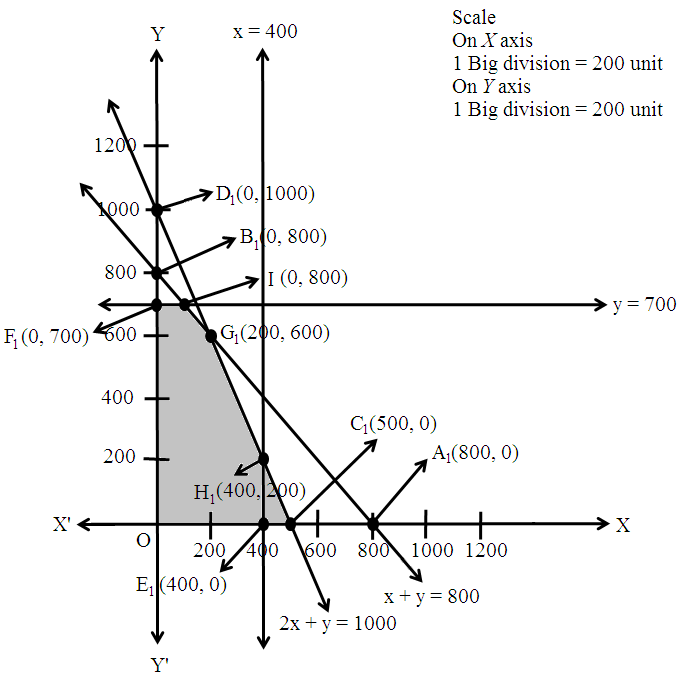
The corner points are $F_1(0, 700), G_1(200, 600), H_1(400, 200)$ and $E_1(400, 0).$
The values of Z at these corner points are as follows.
|
Corner point
|
$Z = 2x + 1.5y$
|
|
$F_1(0, 700)$
|
$1050$ |
|
$G_1(200, 600)$
|
$1300$ |
|
$H_1(400, 200)$
|
$1100$ |
| $E_1(400, 0)$ |
$800$ |
The maximum value of Z is $1300$ which is attained at $G_1(200, 600).$
Thus, the maximum profit is Rs. $1300 $ obtained when 200 belts of type A and $600$ belts of type $8$ were produced. View full question & answer→Question 1055 Marks
Reshma wishes to mix two types of food P and Q in such a way that the vitamin contents of the mixture contains at least 8 units of vitamin A and 11 units of vitamin B. Food P costs Rs 60/kg and food Q costs Rs 80/kg. Food P contains 3 units/kg of vitamin A and 5 units/kg of vitamin B while food Q contains 4 units/kg of vitamin A and 2 units/kg of vitamin B. Determine the minimum cost of the mixture.
AnswerLet x units of food P and y units of food Q are mixed together to make the mixture.
The cost of food P is Rs. 60/kg and that of Q is Rs. 80/kg.
So, x kg of food P and ykg of food Q will cost Rs. (60x+ 80y).
Since one kg of food P contains 3 units of vitamin A and one kg of food Q contains 4 units of vitamin A, therefore, x kg of food P and y kg of food Q will contain (3x+4y) units of vitamin A.
But, the mixture should contain atleast 8 units of vitamin A.
$3\text{x}+4\text{y}\geq8$
Similarly, x kg of food and y kg of food Q will contain (5x + 2y) units of vitamin B.
But, the mixture should contain atleast 11 units of vitamin B. 5x+ 2y 11.
Thus, the given linear programming problem is Minimise Z = 60x + 80y
Subject to the constraints
$3\text{x}+4\text{y}\geq8$
$5\text{x}+2\text{y}\geq11$
$\text{x},\text{y}\geq0$
The feasible region determined by the given constraints can be diagrammatically represented as,
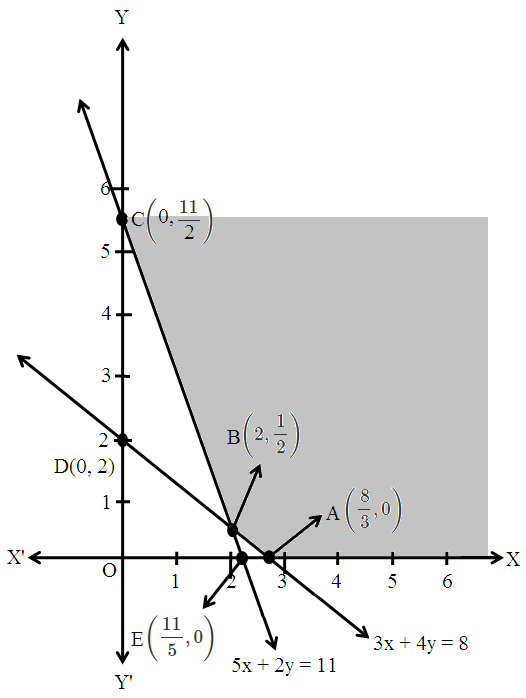
The coordinates of the corner points of the feasible region are points of the feasible region are $\text{A}\Big(\frac{8}{3},0\Big)\text{B}\Big(2,\frac{1}{2}\Big)$ and $\text{C}\Big(0,\frac{11}{2}\Big)$.
The value of the objective function at these points are given in the following table.
| $\text{Corner point}$ |
$\text{Z}=60\text{x}+80\text{y}$ |
| $\Big(\frac{8}{3},0\Big)$ |
$60\times\frac{8}{3}+80\times0=160\rightarrow\text{Minimum}$ |
| $\Big(2,\frac{1}{2}\Big)$ |
$60\times2+80\times\frac{1}{2}=160\rightarrow\text{Minimum}$ |
| $\Big(0,\frac{11}{2}\Big)$ |
$60\times0+80\times\frac{11}{2}=440$ |
The smallest value of Z is 160 which is obtained at the points $\Big(\frac{8}{3},0\Big)$ and $\Big(2,\frac{1}{2}\Big)$.
It can be verified that the open half-plane represented by $60\text{x}+80\text{y}\leq160$ has no common points with the feasible region.
So, the minimum value of Z is 160.
Hence, the minimum cost of the mixture is Rs. 160. View full question & answer→Question 1065 Marks
Maximum Z = x - 5y + 20
Subject to
$\text{x}-\text{y}\geq0$
$-\text{x}+2\text{y}\geq2$
$\text{x}\geq3$
$\text{y}\geq4$
$\text{x},\text{y}\geq0$
AnswerFirst, we will convert the given inequations into equations, we obtain the following equations:
x - y = 0, -x + 2y = 2, x = 3, y = 4, x = 0 and y = 0.
Region represented by $\text{x}-\text{y}\geq0$ or $\text{x}\geq\text{y}$:
The line x - y = 0 or x = y passes through the origin.
The region to the right of the line x = y will satisfy the given inequation.
Let's check by taking an example like if we take a point (4, 3) to the right of the line x = y.
Here $\text{x}\geq\text{y}$.
So, it satisfy the given inequation.
Take a point (4, 5) to the left of the line x = y.
Here, $\text{x}\leq\text{y}$.
That means it does not satisfy the given inequation.
Region represented by $-\text{x}+2\text{y}\geq2$:
The line -x + 2y = 2 meets the coordinate axes at A(-2, 0) and B(0, 1) respectively.
By joining these points we obtain the line - x + 2y = 2.
Clearly (0, 0) does not satisfies the inequation $-\text{x}+2\text{y}\geq2$.
So, the region in xy plane which does not contain the origin represents the solution set of the inequation $-\text{x}+2\text{y}\geq2$.
The line x = 3 is the line that passes through the point (3, 0) and is parallel to Y axis. $\text{x}\geq3$ is the region to the right of the line x = 3.
The line y = 4 is the line that passes through the point (0, 4) and is parallel to X axis. $\text{y}\geq4$ is the region below the line y = 4.
Region represented by $\text{x}\geq0$ and $\text{y}\geq0$:
Since, every point in the first quadrant satisfies these inequations.
So, the first quadrant is the region represented by the inequations $\text{x}\geq0$ and $\text{y}\geq0$.
The feasible region determined by the system of constraints $\text{x}-\text{y}\geq0,-\text{x}+2\text{y}\geq2,\text{x}\geq3,\text{y}\geq4,\text{x}\geq0,$and $\text{y}\geq0$ are as follows.
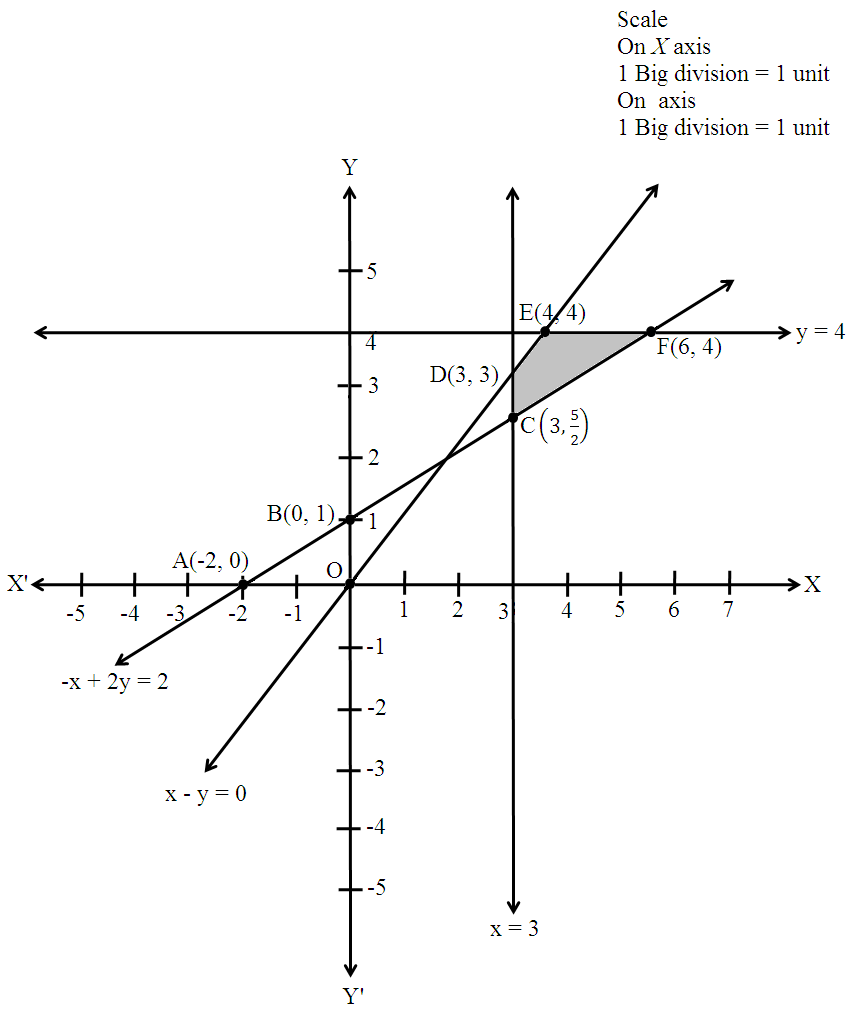
The corner points of the feasible region are $\text{C}\Big(3,\frac{5}{2}\Big),\text{D}(3, 3),\text{E}(4, 4)$ and $\text{F}(6, 4)$.
The values of Z at these corner points are as follows.
|
$\text{Corner point}$
|
$\text{Z}=\text{x}-5\text{y}+20$
|
|
$\text{C}\Big(3,\frac{5}{2}\Big)$
|
$3-5\times\frac{5}{2}+20=\frac{21}{2}$
|
|
$\text{D}(3, 3)$
|
$3-5\times3+20=8$
|
|
$\text{E}(4, 4)$
|
$4-5\times4+20=4$
|
|
$\text{F}(6, 4)$
|
$6-5\times4+20=6$
|
Therefore, the minimum value of Z is 4 at the point E(4, 4).
Hence, x = 4 and y = 4 is the optimal solution of the given LPP.
Thus, the optimal value of Z is 4. View full question & answer→Question 1075 Marks
A factory makes tennis rackets and cricket bats. A tennis racket takes $1.5$ hours of machine time and $3$ hours of craftman's time in its making while a cricket bat takes $3$ hours of machine time and $1$ hour of craftman's time. In a day, the factory has the availability of not more than $42$ hours of machine time and $24$ hours of craftman's time.
- What number of rackets and bats must be made if the factory is to work at full capacity?
- If the profit on a racket and on a bat is Rs. $20$ and Rs. $10$ respectively, find the maximum profit of the factory when it works at full capacity.
AnswerLet $x$ number of tennis rackets and y number of cricket bats were sold.
Number of tennis rackets and cricket balls cannot be negative.
Therefore, $x \geq 0, y \geq 0$
It is given that a tennis racket takes $1.5$ hours of machine time and $3$ hours of craftman's time in its making while a cricket bat takes 3 hours of machine time and $1$ hour of craftman's time.
Also, the factory has the availability of not more than $42$ hours of machine time and $24$ hours of craftman's time.
Therefore,
$1.5 x$ plus $3 y$ less or equal than $42$
$3 x$ plus $y$ less or equal than $24$
If the profit on a racket and on a bat is Rs. $20$ and Rs. $10$ respectively.
Therefore, profit made on x tennis rackets and y cricket bats is Rs. $20x$ and Rs. $10y$ respectively.
Total profit $= Z = 20x + 10y$
The mathematical form of the given LPP is:
Maximize $Z = 20x + 10y$
Subject to constraints:
$1.5 x$ plus $3 y$ less or equal than $42$
$3 x$ plus $y$ less or equal than $24$
$x \geq 0, y \geq 0$
First we will convert inequations into equations as follows:
$1.5x + 3y = 42, 3x + y = 24, x = 0$ and $y = 0$
Region represented by $1.5x + 3y \leq 42:$
The line $1.5x + 3y = 42$ meets the coordinate axes at $A_1(28, 0)$ and $B_1(0, 14)$ respectively.
By joining these points we obtain the line $1.5x + 3y = 42.$
Clearly $(0, 0)$ satisfies the $1.5x + 3y = 42.$
So, the region which contains the origin represents the solution set of the inequation $1.5x + 3y \leq 42.$
Region represented by $3x + y \leq 24:$
The line $3x + y = 24$ meets the coordinate axes at $C_1(8,0)$ and $D_1(0, 24)$ respectively.
By joining these points we obtain the line $3x + y = 24.$
Clearly $(0, 0)$ satisfies the inequation $3x + y \leq 24.$
So the region which contains the origin represents the solution set of the inequation $3x + y \leq 24.$
Region represented by $x \geq 0$ and $y \geq 0:$
Since, every point in the first quadrant satisfies these inequations.
So, the first quadrant is the region represented by the inequations $x \geq 0$ and $y \geq 0.$
The feasible region determined by the system of constraints $1.5x + 3y \leq 42, 3x + y \leq 24, x \geq 0$ and $y \geq 0$ are as follows.
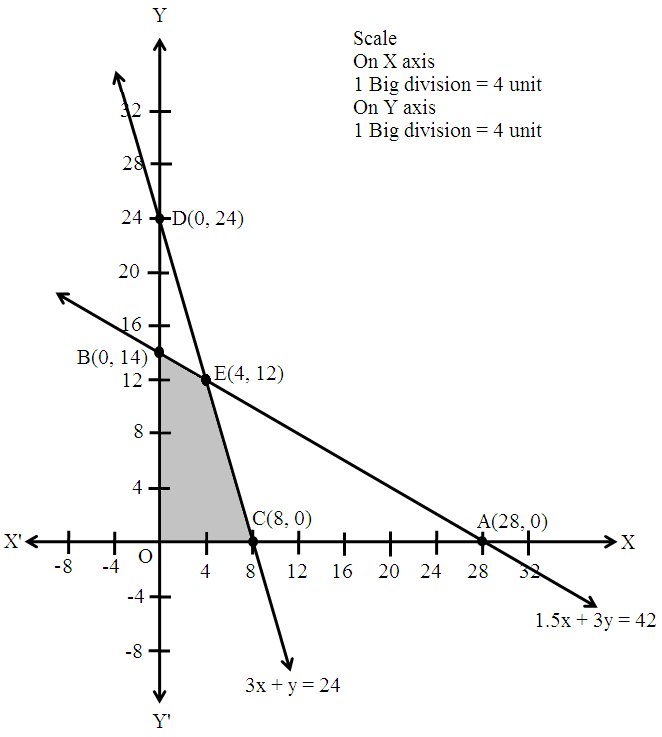
In the above graph, the shaded region is the feasible region.
The corner points are $O(0, 0), B_1(0, 14), E_1(04, 12),$ and $C_1(8, 0).$
The values of the objective function Z at corner points of the feasible region are given in the following table:
|
Corner Points
|
$Z = 20x + 10y$
|
|
|
$O(0, 0)$
|
$0$
|
|
|
$B_1(0, 14)$
|
$140$
|
|
|
$E_1(4, 12)$
|
$200$
|
Maximum
|
|
$C_1(8, 0)$
|
$160$
|
|
Clearly, $Z$ is maximum at $x = 4$ and $y= 12 $and the maximum value of $Z$ at this point is $200.$
Thus, maximum profit is of Rs. $200$ obtained when $4$ tennis rackets and $12$ cricket bats were sold.
View full question & answer→Question 1085 Marks
A manufacturing company makes two models $A$ and $B$ of a product. Each piece of model A requires $9$ labour hours for fabricating and $1$ labour hour for finishing. Each piece of model $B$ requires $12$ labour hours for fabricating and $3$ labour hours for finishing. For fabricating and finishing, the maximum labour hours available are $180$ and $30$ respectively. The company makes a profit of Rs. $8000$ on each piece of model $A$ and Rs. $12000$ on each piece of model $B$. How many pieces of model $A$ and model $B$ should be manufactured per week to realise a maximum profit? What is the maximum profit per week?
AnswerThe given data can be written in the tabular form as follows:
|
Model
|
A
|
B
|
Maximum hours
|
|
Fabricating
|
$9$
|
$12$
|
$180$
|
|
Finishing
|
$1$
|
$3$
|
$30$
|
|
Profit
|
$8000$
|
$12000$
|
|
Let $x$ be the number of pieces of $A$ and $y$ be the number of pieces of $B$ manufactured to earn the maximum profit.
Then the mathematical model of the LPP is as follows:
Maximize $Z = 8000x + 12000$ Subject to $9x + 12y \leq 180, x + 3y \leq 30$ and $x \geq 0, y \geq 0.$
To solve the LPP We draw the lines, $9x + 12y = 180, x + 3y = 30$
The feasible region of the LPP is shaded in graph.
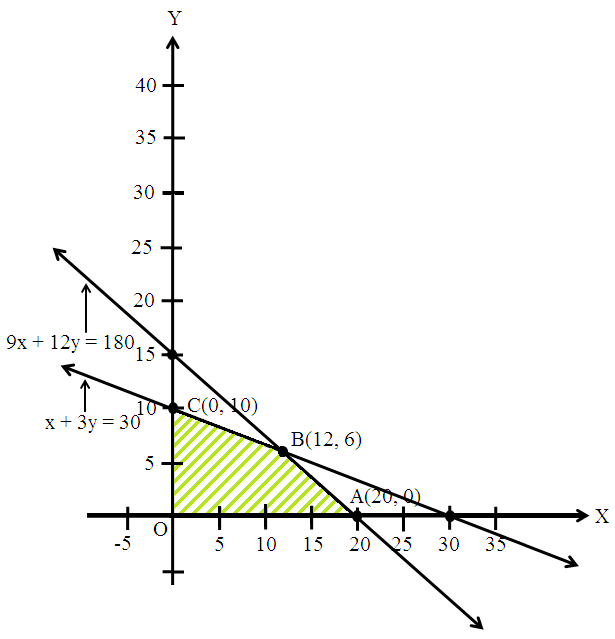
The coordinates of the vertices (Corner - points) of shaded feasible region $ABC$ are $A (20, 0), B(12,6)$ and $C(0, 10).$
The values of the objective of function at these points are given in the following table:
|
Paint $(X_1, X_1)$
|
Value of objective function $Z = 8,000x + 12,000y$
|
|
$A(20, 0)$
|
$Z = 1,60,000$
|
|
$B(12, 6)$
|
$Z = 1,68,000$
|
|
$C(0, 10)$
|
$Z = 1,20,000$
|
$12$ pieces of Model $A$ and $6$ pieces of Model $B$ should be eaned maximize the profit.
The maximum profit that can be eared is Rs. $1,68,000.$
View full question & answer→Question 1095 Marks
There are two types of fertilisers $F_1$ and $F_2. F_1$ consists of $10\%$ nitrogen and $6\%$ phosphoric acid and $F_2$ consists of $5\%$ nitrogen and $10\%$ phosphoric acid. After testing the soil conditions, a farmer finds that she needs atleast $14$ kg of nitrogen and $14$ kg of phosphoric acid for her crop. If $F_1$ costs Rs $6$/kg and $F2$ costs Rs $5$/kg, determine how much of each type of fertiliser should be used so that nutrient requirements are met at a minimum cost. What is the minimum cost?
AnswerLet the farmer buy $x$ kg of fertilizer $F_1$ and y kg of fertilizer $F_2.$ Therefore,
$\text{x}\ge0\text{ and y}\ge0$
The given information can be complied in a table as follows.
| |
Nitrogen (%) |
Phosphoric Acid (%) |
Cost (Rs/kg) |
| $F_1(x)$ |
$10$ |
$6$ |
$6$ |
| $F_2(y)$ |
$5$ |
$10$ |
$5$ |
| Requirement (kg) |
$14$ |
$14$ |
|
$F_1$ consists of $10\%$ nitrogen and $F_2$ consists of $5\%$ nitrogen. However, the farmer requires at least $14$ kg of nitrogen.
$\therefore10\%\text{ of x}+5\%\text{ of y}\ge14$
$\frac{\text{x}}{10}+\frac{\text{y}}{20}\geq14$
$2\text{x}+\text{y}\ge280$
$F_1$ consists of $6\%$ phosphoric acid and $F_2$ consists of $10\%$ phosphoric acid. However, the farmer requires at least 14 kg of phosphoric acid.
farmer requires at least 14 kg of phosphoric acid.
$\therefore6\%\text{ of x}+10\%\text{ of y}\ge14$
$\frac{\text{6x}}{100}+\frac{\text{10y}}{100}\geq14$
$3\text{x}+56\text{y}\ge700$
Total cost of fertilizers, $Z = 6x + 5y$
The mathematical formulation of the given problem is Minimize $z = 6x + 5y ... (1)$
subject to the constraints,
$2\text{x}+\text{y}\ge280\dots(2)$
$3\text{x}+5\text{y}\ge700\dots(3)$
$\text{x},\ \text{y}\ge0\dots(4)$
The feasible region determined by the system of constraints is as follows.
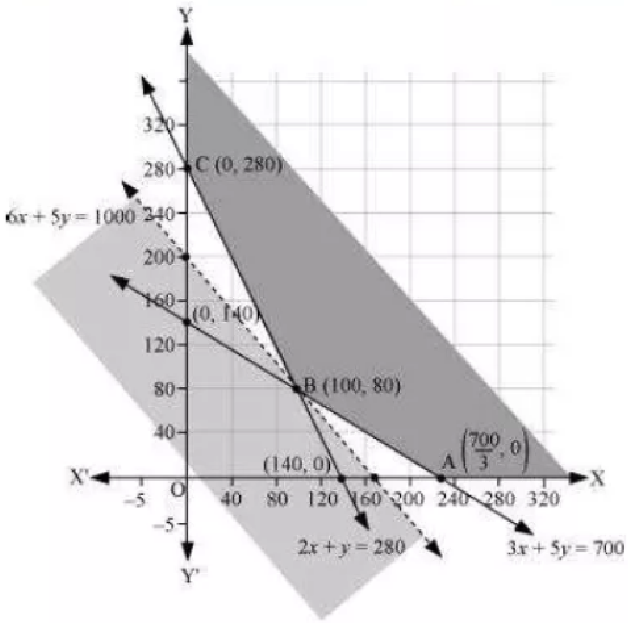
It can be seen that the feasible region ls unbounded.
The corner points are $\text{A}\Big(\frac{700}{3},\ 0\Big),\ \text{B}(100,\ 80),\ \text{and C}(0,\ 280).$
The values of $Z$ at these points are as follows.
| Corner point |
$Z = 6x + 5y$ |
|
| $\text{A}\Big(\frac{700}{3},\ 0\Big)$ |
$1400$ |
|
| $B(100, 80)$ |
$1000$ |
\rightarrow Minimum |
| $C(0, 280)$ |
$1400$ |
|
As the teasible region is unbounded, therefore, $1000$ mav or may not be the minimum value of $Z.$
For this, we draw a graph of the inequality, $6x + 5y < 1000$, and check whether the resulting half plane has points in common with the feasible region or not.
It can be seen that the feasible region has no common point with $6x + 5y < 1000$ Therefore, $100$ kg of fertiliser $F_1$ and $80$ kg of fertilizer $F_2$ should be used to minimize the cost. The minimurn cost is Rs $1000.$ View full question & answer→Question 1105 Marks
A diet of two foods $F_1$ and $F_2$ contains nutrients thiamine, phosphorous and iron.
The amount of each nutrient in each of the food $($in milligrams per $25$gms$) $is given in the following table:
| Nutrients |
Food |
$F_1$ |
$F_2$ |
| Thiamine |
$0.25$ |
$0.10$ |
| Phosphorous |
$0.75$ |
$1.50$ |
| Iron |
$1.60$ |
$0.80$ |
The minimum requirement of the nutrients in the diet are $1.00$mg of thiamine, $7.50$mg of phosphorous and $10.00$mg of iron.
The cost of $F_1$ is $20$ paise per $25$gms while the cost of $F_2$ is 15 paise per 25gms.
Find the minimum cost of diet. AnswerLet $25x$ grams of food $F_1$ and $25y$ grams of food $F_2$ be used to fulfil the minimum requirement of thiamine, phosphorus and iron.
As, we are given,
| Nutrients |
Food |
$F_1$ |
$F_2$ |
| Thiamine |
$0.25$ |
$0.10$ |
| Phosphorous |
$0.75$ |
$1.50$ |
| Iron |
$1.60$ |
0.80 |
And the minimum requirement of the nutrients in the diet are $1.00$mg of thiamine, $7.50$mg of phosphorous and $10.00$mg of iron.
Therefore, $0.25\text{x}+0.10\text{y}\geq1$
$0.75\text{x}+1.50\text{y}\geq7.5$
$1.6\text{x}+0.8\text{y}\geq10$
Since the quantity cannot be negative
$\therefore\text{x},\text{y}\geq0$
The cost of $F_1$ is 20 paise per $25$gms while the cost of $F_2$ is $15$ paise per $25$ gms.
Therefore, the cost of 25x grams of food $F_1$ and 25y grams of food $F_2$ is Rs. $(0.20x + 0.15y).$
Hence,
Minimize $Z = 0.20x + 0.15y$
Subject to
$0.25\text{x}+0.10\text{y}\geq1,0.75\text{x}+1.50\text{y}\geq7.5,$ $1.6\text{x}+0.8\text{y}\geq10,\text{x},\text{y}\geq0.$
First, we will convert the given inequations into equations, we obtain the following equations:
$0.25x + 0.10y = 1, 0.75x + 1.50y = 7.5, 1.6x + 0.8y = 10, x = 0$ and $y = 0.$
The line $0.25x + 0.10y = 1$ meets the coordinate axis at $A(4, 0)$ and $B(0, 10).$
Join these points to obtain the line $0.25x + 0.10y = 1.$
Clearly, $(0, 0) $ does not satisfies the inequation $0.25\text{x}+0.10\text{y}\geq1$.
So, the region in xy-plane that does not contains the origin represents the solution set of the given equation.
The line $0.75x + 1.50y = 7.5$. meets the coordinate axis at $C(10, 0)$ and $D(0, 5).$
Join these points to obtain the line $0.75x + 1.50y = 7.5.$
Clearly, $(0, 0)$ does not satisfies the inequation $0.75\text{x}+1.50\text{y}\geq7.5$.
So, the region in xyplane that does not contains the origin represents the solution set of the given equation.
The line $1.6x + 0.8y = 10$ meets the coordinate axis at $\text{E}\Big(\frac{25}{4},0\Big)$ and $\text{F}\Big(0,\frac{25}{2}\Big).$
Join these points to obtain the line $1.6x + 0.8y = 10.$
Clearly, $(0, 0)$ does not satisfies the inequation $1.6\text{x}+0.8\text{y}\geq10$.
So, the region in xy-plane that does not contains the origin represents the solution set of the given equation.
Region represented by $\text{x}\geq0$ and $\text{y}\geq0$:
Since, every point in the first quadrant satisfies these inequations.
So, the first quadrant is the region represented by the inequations.
These lines are drawn using a suitable scale.
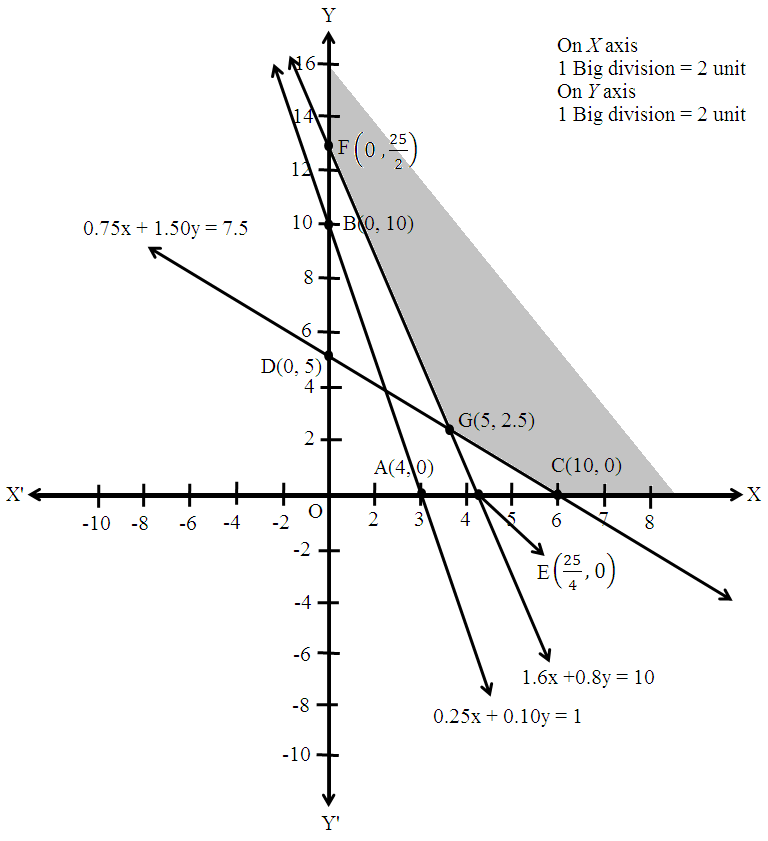
The corner points of the feasible region are $F(0, 12.5), G(5, 2.5), C(10, 0)$
The value of the objective function at these points are given by the following table:
| Points |
Value of Z |
| $F$ |
$0.20(0) + 0.15(12.5) = 1.875$ |
| $G$ |
$0.20(5) + 0.15(2.5) = 1.375$ |
| $C$ |
$0.20(10) + 0.15(0) = 200$ |
Thus, the minimum cost is at $G$ which is Rs. $1.375.$ View full question & answer→Question 1115 Marks
Reshma wishes to mix two types of food P and Q in such a way that the vitamin contents of the mixture contain at least 8 units of vitamin A and 11 units of vitamin B. Food P costs Rs 60/kg and Food Q costs Rs 80/kg. Food P contains 3 units/kg of Vitamin A and 5 units/kg of Vitamin B while food Q contains 4 units/kg of Vitamin A and 2 units/kg of vitamin B. Determine the minimum cost of the mixture?
AnswerLet the mixture contain x kg of food P and y kg of food Q. Therefore,
$\text{x}\geq0\text{ and }\text{y}\geq0$
The given inforrnation can be compiled in a table as follows.
| |
Vitamin A (units/kg) |
Vitamin B (units/kg) |
Cost (Rs/kg) |
| Food P |
3 |
5 |
60 |
| Food Q |
4 |
2 |
80 |
| Requirement (units/kg) |
8 |
11 |
|
The mixture must contain at least 8 units of vitamin A and 11 units of vitamin B.
Therefore, the constraints are
$3\text{x}+4\text{y}\geq8$
$5\text{x}+2\text{y}\geq11$
Total cost, z, of purchasing food is, z = 60x + 8oy
The methematical formulation of the given problem is Minimise Z = 60x + 80y ... (1)
subject to the constraints,
$3\text{x}+4\text{y}\geq8\dots(2)$
$5\text{x}+2\text{y}\geq11\dots(3)$
$\text{x},\ \text{y}\geq0\dots(4)$
The feasible region determined by the system of constraints is as follows.
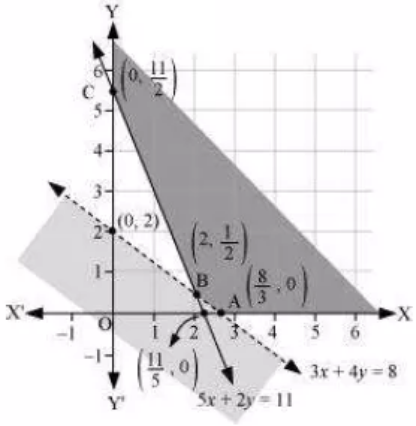
It can be seen that the feasible region is unbounded.
The corner points of the feasible region are $\text{A}\Big(\frac83,\ 0\Big),\ \text{B}\Big(2,\ \frac12\Big),\ \text{and C}\Big(0,\frac{11}{2}\Big)$
The values of z at these corner points are as follows.
| Corner point |
Z = 60x + 80y |
|
| $\text{A}\Big(\frac83,\ 0\Big)$ |
160 |
$\Bigg\}\rightarrow\text{Minimum}$ |
| $\text{B}\Big(2,\frac12\Big)$ |
160 |
| $\text{C}\Big(0,\frac{11}{2}\Big)$ |
440 |
|
As the feasible region is unbounded, therefore, 160 may or may not be the minimum value of z.
For this, we graph the inequality, 60x + 80y < 160 or 3x + 4y < 8, and check whether the resulting half plane has points in common with the feasible region or not.
It can be seen that the feasible region has no common point with 3x + 4y < 8 Therefore, the minimum cost of the mixture will be Rs 160 at the line segment joining the points $\Big(\frac83,\ 0\Big)\text{ and }\Big(2,\ \frac12\Big).$ View full question & answer→Question 1125 Marks
A factory manufactures two types of screws, A and B, each type requiring the use of two machines - an automatic and a hand-operated. It takes 4 minute on the automatic and 6 minutes on the hand-operated machines to manufacture a package of screws 'A', while it takes 6 minutes on the automatic and 3 minutes on the hand-operated machine to manufacture a package of screws 'B'. Each machine is available for at most 4 hours on any day. The manufacturer can sell a package of screws 'A' at a profit of 70 P and screws 'B' at a profit of Rs. 1. Assuming that he can sell all the screws he can manufacture, how many packages of each type should the factory owner produce in a day in order to maximize his profit? Determine the maximum profit.
AnswerLet the factory manufacture x screws of type A and y screws of type B on each day.
Therefore, $\text{x}\geq0$ and $\text{y}\geq0$
The given information can be compiled in a table as follows.
|
|
Screw A
|
Screw B
|
Availability
|
|
Automatic Machine (min)
|
4
|
6
|
4 × 60 = 120
|
|
Hand Operated Machine (min)
|
6
|
3
|
4 × 60 = 120
|
The profit on a package of screws A is Rs. 7 and on the package of screws B is Rs. 10.
Therefore, the constraints are
$4\text{x}+6\text{y}\geq240$
$6\text{x}+3\text{y}\geq240$
Total profit, Z = 7x + 10y.
The mathematical formulation of the given problem is,
Maximize Z = 7x + 10y ...(1)
Subject to the constraints, $4\text{x}+6\text{y}\geq240\dots(2)$
$6\text{x}+3\text{y}\geq240\dots(3)$
$\text{x},\text{y}\geq0\dots(4)$
The feasible region determined by the system of constraints is
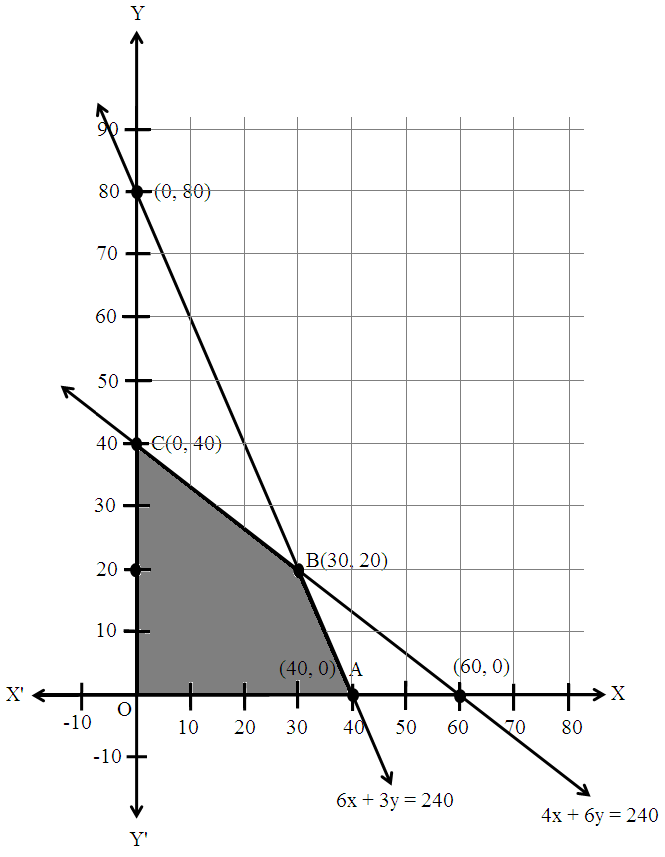
The corner points are A(40, 0), B(30, 20) and C(0, 40).
The values of Z at these corner points are as follows.
|
Corner point
|
Z = 7x + 10y
|
|
|
A(40, 0)
|
280
|
|
|
B(30, 20)
|
410
|
→ Maximum
|
|
C(0, 40)
|
400
|
|
The maximum value of Z is 410 at (30, 20).
Thus, the factory should produce 30 packages of screws A and 20 packages of screws B to get the maximum profit of Rs 410. View full question & answer→Question 1135 Marks
Maximize Z = 18x + 10y
Subject to
$4\text{x}+\text{y}\geq20$
$2\text{x}+3\text{y}\geq30$
$\text{x},\text{y}\geq0$
AnswerFirst, we will convert the given inequations into equations, we obtain the following equations: 4x + y = 20, 2x + 3y = 30, x = 0 and y = 0 Region represented by 4x + y ≥ 20: The line 4x + y = 20 meets the coordinate axes at A(5, 0) and B(0, 20) respectively. By joining these points we obtain the line 4x + y = 20. Clearly (0, 0) does not satisfies the inequation 4x + y ≥ 20. So, the region in xy plane which does not contain the origin represents the solution set of the inequation 4x + y ≥ 20. Region represented by 2x + 3y ≥ 30: The line 2x + 3y = 30 meets the coordinate axes at C(15, 0) and D(0, 10) respectively. By joining these points we obtain the line 2x + 3y = 30. Clearly (0, 0) does not satisfies the inequation 2x + 3y ≥ 30. So, the region which does not contain the origin represents the solution set of the inequation 2x + 3y ≥ 30. Region represented by x ≥ 0 and y ≥ 0: Since, every point in the first quadrant satisfies these inequations. So, the first quadrant is the region represented by the inequations x ≥ 0, and y ≥ 0. The feasible region determined by the system of constraints, 4x + y ≥ 20, 2x + 3y ≥ 30, x ≥ 0, and y ≥ 0, are as follows.
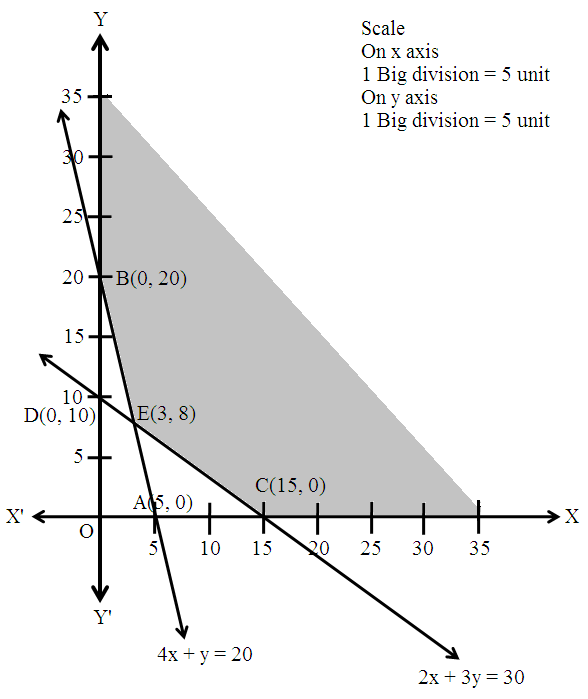
The corner points of the feasible region are B(0, 20), C(15, 0), E(3, 8) and C(15, 0). The values of Z at these corner points are as follows.
|
Corner point
|
Z = 18x + 10y
|
|
B(0, 20)
|
18 × 0 + 10 × 20 = 200
|
|
E(3, 8)
|
18 × 3 + 10 × 8 = 134
|
|
C(15, 0)
|
18 × 15 + 10 × 0 = 270
|
Therefore, the minimum value of Z is 134 at the point E(3, 8). Hence, x = 3 and y = 8 is the optimal solution of the given LPP. Thus, the optimal value of Z is 134.
View full question & answer→Question 1145 Marks
Maximise Z = 3x + 5y
subject to $\text{x}+2\text{y}\leq10,\ 3\text{x}+\text{y}\leq15,\ \text{x},\ \text{y}\geq0.$
AnswerConsider $\text{x}+2\text{y}\leq10$
Let x + 2y = 10
$\Rightarrow\frac{\text{x}}{10}+\frac{\text{y}}{5}=1$
Since, (0, 0) satisfies the inequation, therefore the half plane containing (0, 0) is the required plane.
Again $3\text{x}+\text{y}\leq15$
Let 3x + y = 15
$\Rightarrow\frac{\text{x}}{5}+\frac{\text{y}}{15}=1$
It also satisfies by (0, 0) and its required half plane contains (0, 0). Now double shaded region in the first quadrant contains the solution. Now OABC represents the feasible region.
Z = 3x + 2y
| At |
O(0, 0) |
Z = 3 × 0 + 2 × 0 = 0 |
| At |
A(5, 0) |
Z = 3 × 5 + 2 × 0 = 15 |
| At |
B(4, 3) |
Z = 3 × 4 + 2 × 3 = 18 |
| At |
C(0, 5) |
Z = 3 × 0 + 2 × 5 = 10 |
Hence, Z is maximum i.e., 18 at x = 4, y = 3. View full question & answer→Question 1155 Marks
A firm manufactures two types of products $A$ and $B$ and sells them at a profit of Rs. $5$ per unit of type $A$ and Rs 3 per unit of type $B$. Each product is processed on two machines $\mathrm{M}_1$ and $\mathrm{M}_2$. One unit of type $A$ requires one minute of processing time on $M_1$ and two minutes of processing time on $M_2$, whereas one unit of type $B$ requires one minute of processing time on $\mathrm{M}_1$ and one minute on $\mathrm{M}_2$. Machines $\mathrm{M}_1$ and $\mathrm{M}_2$ are respectively available for at most $5$ hours and $6$ hours in a day. Find out how many units of each type of product should the firm produce a day in order to maximize the profit. Solve the problem graphically.
AnswerLet required number of product $A$ and $B$ be $x$ and $y$ respectively.
Since, profit on each product $A$ and B are Rs. $5$ and Rs. $3$ respectively, so, profits on x product $A$ and $y$ product $B$ are Rs. 5x and Rs. $3y$ respectively
Let $Z$ be total profit so
$Z = 5x + 3y$
Since each unit of product $A$ and $B$ require one min. each on machine $M_1$
So, $x$ unit of product $A$ and $y$ units of product $B$ require $x$ and $y$ min. respectivley on machine $M_1$ but $M_1$ can work at most $5 x 60= 300$ min., so
$x +y \leq 300 ($first constraint$)$
Since each unit of product A and B require $2$ and one min. respectively on machine $M_2.$
S0, $x$ unit of product A and y units of product B require $2x$ and $y$ min. respectivley on machine $M_2$ but $M_2$ can work at most $6 \times 60 = 360$ min., so
$2x +y \leq 360$ (second constraint)
Hence, mathematical formulation of LPP is find x and y which
maximize $Z = 5x + 3y$
Subject to constriants,
$x + y \leq 300$
$= 2x + y \leq 360$
$x, y \geq 0 [$Since production can not be less than zero$]$
Region $x + y \leq 300:$
Line $x + y = 300$ meets axes at $A_1(300, 0), B_1(0, 300)$ respectively,
Region containing origin represents $x +y \leq 300$ as $(0, 0)$ satisfies $x + y = 300.$
Region $2x + y \leq 360:$
Line $2x + y = 360$ meets axes at $A_2(180, 0), B_2(0, 360)$ respectively.
Region containing origin represents $2x + y \leq 360$ as $(0, 0)$ satisfies $2x + y \leq 360$
Region $x, y \geq 0:$
It represent first quandrant
Shaded region $OA_2PB_2,$ represents feasible region.
Point $P(60, 240)$ is obtained by solving
$x +y = 300$ and $2x + y = 360$
$$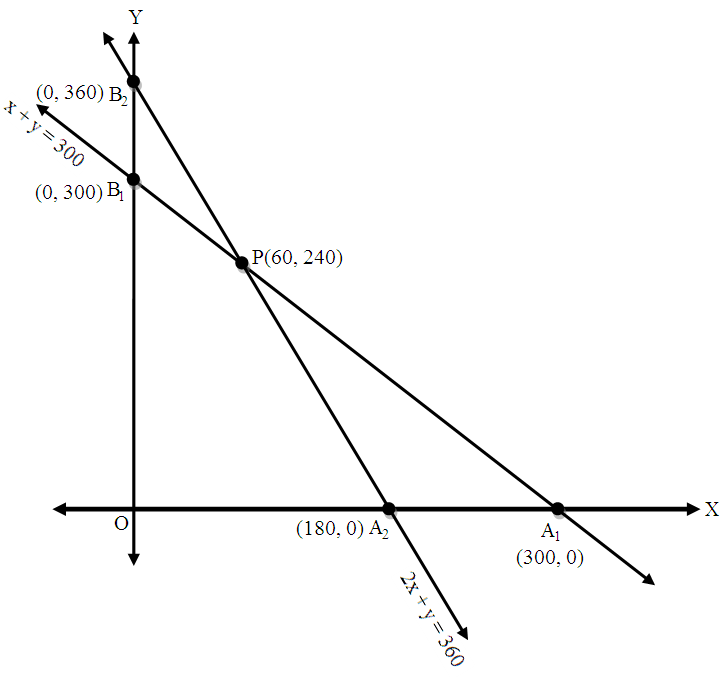
The value of $Z = 5x + 3y at$
$O(0, 0) = 5(0) + 3(0) = 0$
$A_2(180, 0) = 5(180) + 3(0) = 900$
$P(60, 240) = 5(60) + 3(240) = 1020$
$B_1(0, 300) = 5(0) + 3(300) = 900$
Maximum $Z = 1020$ at $x = 60, y = 240$
Number of product $A = 60,$ product $B = 240$
Maximum profit $= Rs. 1020.$
View full question & answer→Question 1165 Marks
How many of circuits of Type A and of Type B, should be produced by the manufacturer so as to maximise his profit? Determine the maximum profit.
AnswerWe have
Maximise Z = 50x + 60y,
Subject to constraints,
$2\text{x}+\text{y}\leq20,$
$\text{x}+2\text{y}\leq12,$
$\text{x}+3\text{y}\leq15$
And $\text{x}\geq0,\text{y}\geq0$
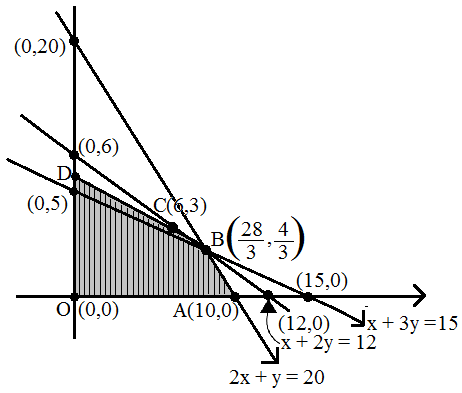
From the figure, feasible region is OABCD and is bounded and the coordinates of corner points are (0, 0), (10, 0), $\Big(\frac{28}{3},\frac{4}{3}\Big),$ (6, 3) and (0, 5), respectively,
[Since, x + 2y = 12 and 32x + y = 20 $\Rightarrow\text{x}=\frac{28}{3},\text{y}=\frac{4}{3}$ and x + 3y = 15 and x + 2y = 12 ⇒ y = 3 and x = 6]
| Corner points |
Corresponding value of Z = 50x + 60y |
(0, 0)
(10, 0)
$\Big(\frac{28}{3},\frac{4}{3}\Big)$
(6, 3)
(0, 5) |
0
500
$\frac{1400}{3}+\frac{240}{3}=\frac{16400}{3}=546.66$ (Maximum)
480
300 |
Since, the manufacturer is required to produce two types of circuits A and B and it is clear that parts of resistor, transistor and capacitor cannot be in fraction, so the required maximum profit is 480 where circuits of type A is B and circuits of type 6 is 3. View full question & answer→Question 1175 Marks
To maintain one's health, a person must fulfil certain minimum daily requirements for the following three nutrients: calcium, protein and calories. The diet consists of only items I and II whose prices and nutrient contents are shown below:
| |
Food I |
Food II |
Minimum daily requirement |
| Calcium |
10 |
4 |
20 |
| Protein |
5 |
6 |
20 |
| Calories |
2 |
6 |
12 |
| Price |
Rs. 0.60 per unit |
Rs. 1.00 per unit |
|
Find the combination of food items so that the cost may be minimum.
AnswerLet the person takes x units and y units of food I and II respectively that were taken in the diet.Since, per unit of food I costs Rs. 0.60 and that of food II costs Rs. 1.00.
Therefore, x lbs of food I costs Rs. 0.60 x and y lbs of food II costs Rs. 1.00y.
Total cost per day = Rs. (0.60x + 1.00y)
Let Z denote the total cost per day
Then, Z = 0.60x + 1.00y
Since, each unit of food I contains 10 units of calcium.
Therefore, x units of food I contains 10x units of calcium.
Each unit of food II contains 4 units of calcium.
So, y units of food II contains 4y units of calcium.
Thus, x units of food I and y units of food II contains (10x + 4y) units of calcium.
But, the minimum requirement is 20 units of calcium.
$\therefore10\text{x}+4\text{y}\geq20$
Since, each unit of food I contains 5 units of protein.
Therefore, x units of food I contains 5x units of protein.
Each unit of food II contains 6 units of protein.
So, y units of food II contains 6y units of protein.
Thus, x units of food I and y units of food II contains (5x + 6y) units of protein.
But, the minimum requirement is 20 lbs of protein.
$\therefore5\text{x}+6\text{y}\geq20$
Since, each unit of food I contains 2 units of calories.
Therefore, x units of food I contains 2x units of calories.
Each unit of food II contains 6 units of calories.
So, y units of food II contains 6y units of calories.
Thus, x units of food I and y units of food II contains (2x + 6y) units of calories.
But, the minimum requirement is 12 lbs of calories.
$\therefore2\text{x}+6\text{y}\geq12$
Finally, the quantities of food I and food II are non negative values.
So, $\text{x},\text{y}\geq0$
Hence, the required LPP is as follow:
Min Z = 0.66x + 1.00y
Subject to
$10\text{x}+4\text{y}\geq20$
$5\text{x}+6\text{y}\geq20$
$2\text{x}+6\text{y}\geq12$
$\text{x},\text{y}\geq0$
First, we will convert the given inequations into equations, we obtain the following equations:
10x + 4y = 20, 5x +6y = 20, 2x + 6y = 12, x = 0 and y = 0
Region represented by 10x + 4y ≥ 20:
The line 10x + 4y = 20 meets the coordinate axes at A(2, 0) and B(0, 5) respectively.
By joining these points we obtain the line 10x + 4y = 20.
Clearly (0, 0) does not satisfies the inequation 10x + 4y ≥ 20.
So, the region in xy plane which does not contain the origin represents the solution set of the inequation 10x + 4y ≥ 20.
Region represented by $5\text{x}+6\text{y}\geq20$:
The line 5x + 6y = 20 meets the coordinate axes at C(4, 0) and $\text{D}\Big(0,\frac{10}{3}\Big)$ respectively.
By joining these points we obtain the line 5x + 6y = 20.
Clearly (0, 0) does not satisfies the inequation $5\text{x}+6\text{y}\geq20$.
So, the region in xy plane which does not contain the origin represents the solution set of the inequation $5\text{x}+6\text{y}\geq20$.
Region represented by 2x + 6y ≥ 12:
The line 2x + 6y =12 meets the coordinate axes at E(6, 0) and F(0, 2) respectively.
By joining these points we obtain the line 2x + 6y =12.
Clearly (0, 0) does not satisfies the inequation 2x + 6y ≥ 12.
So, the region which does not contains the origin represents the solution set of the inequation 2x + 6y ≥ 12.
Region represented by x ≥ 0 and y ≥ 0:
Since, every point in the first quadrant satisfies these inequations.
So, the first quadrant is the region represented by the inequations x ≥ 0, and y ≥ 0.
The feasible region determined by the system of constraints 10x + 4y ≥ 20, 5x +6y ≥ 20, 2x + 6y ≥ 12, x ≥ 0, and y ≥ 0 are as follows.
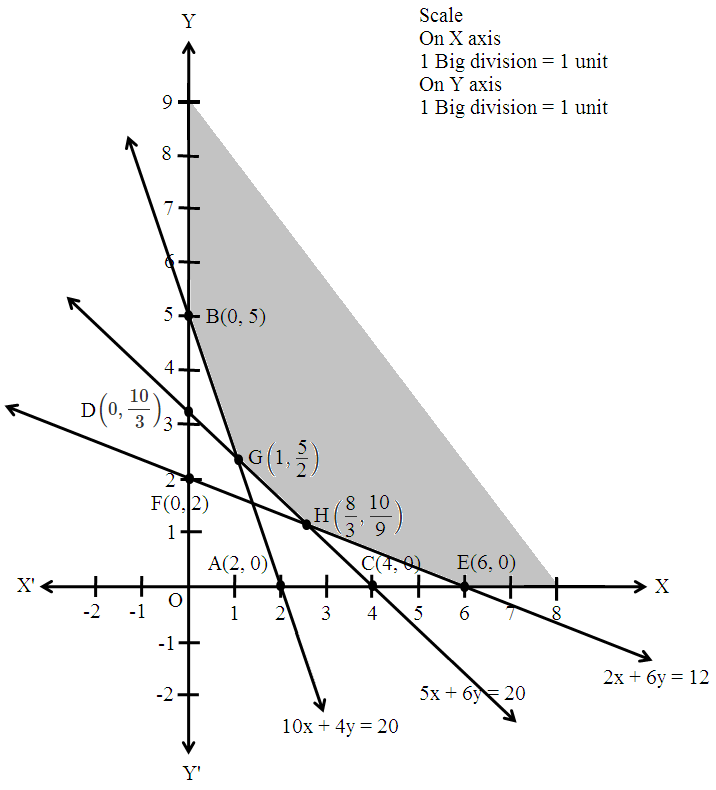
The set of all feasible solutions of the above LPP is represented by the feasible region shaded in the graph.
The corner points of the feasible region are B(0, 5), $\text{G}\Big(1,\frac{5}{2}\Big),\text{H}\Big(\frac{8}{3},\frac{10}{9}\Big)$ and E(6, 0).
The value of the objective function at these points are given by the following table:
| $\text{Points}$ |
$\text{Value of Z}$ |
| $\text{B}$ |
$0.6(0)+5=5$ |
| $\text{G}$ |
$0.6(1)+\frac{5}{2}=3.1$ |
| $\text{H}$ |
$0.6\Big(\frac{8}{3}\Big)+\Big(\frac{10}{9}\Big)=1.6+1.1=2.7$ |
| $\text{E}$ |
$0.6(6)+(0)=3.6$ |
We see that the minimum cost is 2.7 which is at $\Big(\frac{8}{3},\frac{10}{9}\Big)$.
Thus, at minimum cost, $\frac{8}{3}$ unit of food I and $\frac{10}{9}$ units of food II should be included in the diet. View full question & answer→Question 1185 Marks
A company sells two different products A and B. The two products are produced in a common production process and are sold in two different markets. The production process has a total capacity of 45000 man-hours. It takes 5 hours to produce a unit of A and 3 hours to produce a unit of B. The market has been surveyed and company officials feel that the maximum number of units of A that can be sold is 7000 and that of B is 10,000. If the profit is Rs. 60 per unit for the product A and Rs. 40 per unit for the product B, how many units of each product should be sold to maximize profit? Formulate the problem as LPP.
Answer
|
Product
|
Man hours
|
Maximum demand
|
Profit
|
|
A
|
5
|
7000
|
60
|
|
B
|
3
|
10000
|
40
|
|
Total capacity
|
45000
|
|
|
Let required production of product A be x units and production of product B be y units.
Given, profits on one unit of product A and B are Rs. 60 and Rs. 40 respectively, so profits on x units of product A and y units of product B are Rs. 60x and Rs. 40y.
Let Z be the total profit, so
Z = 60x + 40y
Given, production of one unit of product A and B require 5 hours and 3 hours respectively man hours, so x unit of product A and y units of product 8 require 5x hours and 3y hours of man hours respectively but total man hours available are 45000 hours, so
5x + 3y = 45000 (First constraint)
Given, dem and for product A is maximum 7000, so
$\times\leq7000$ (Second constraint)
Hence, mathematical formulation of LPP is,
Find x and y which
maximize Z = 60x + 40y
Subject to constraints,
$5\text{x}+3\text{y}\leq45000$
$\text{x}\leq7000$
$\text{y}\leq10000$
$\text{x},\text{y}\geq0$ [Since production can not be less than zero]. View full question & answer→Question 1195 Marks
A furniture manufacturing company plans to make two products : chairs and tables. From its available resources which consists of 400 square feet to teak wood and 450 man hours. It is known that to make a chair requires 5 square feet of wood and 10 man-hours and yields a profit of Rs. 45, while each table uses 20 square feet of wood and 25 man-hours and yields a profit of Rs. 80. How many items of each product should be produced by the company so that the profit is maximum?
AnswerLet x units of chairs and y units of tables were produced
Therefore, $\text{x},\text{y}\geq0$
The given information can be tabulated as follows:
| |
Wood (square feet)
|
Man hours
|
|
Chairs (x)
|
5
|
10
|
|
Tables (y)
|
20
|
25
|
|
Availability
|
400
|
450
|
Therefore, the constraints are
$5\text{x}+20\text{y}\leq400$
$10\text{x}+25\text{y}\leq450$
It is known that to make a chair requires 5 square feet of wood and 10 man-hours and yields a profit of Rs. 45, while each table uses 20 square feet of wood and 25 man-hours and yields a profit of Rs. 80.
Therefore, profit gained to make x chairs and y tables is Rs. 45x and Rs. 80y respectively Total profit = Z = 45x +80y which is to be maximised.
Thus, the mathematical formulation of the given linear programming problem is
Max 2 = 45x + 80y
Subject to
$5\text{x}+20\text{y}\leq400$
$10\text{x}+25\text{y}\leq450$
$\text{x},\text{y}\geq0$
First we will convert inequations into equations as follows:
5x + 20y = 400, 10x + 25y = 450, X = 0 and y = 0
Region represented by $5\text{x}+20\text{y}\leq400$:
The line 5x + 20y = 400 meets the coordinate axes at A(80, 0) and B(0, 20) respectively.
By joining these points we obtain the line 5x + 20y = 400.
Clearly (0, 0) satisfies the $5\text{x}+20\text{y}\leq400$.
So, the region which contains the origin represents the solution set of the inequation $5\text{x}+20\text{y}\leq400$.
Region represented by $10\text{x}+25\text{y}\leq450$:
The line 10x + 25y = 450 meets the coordinate axes at C(45, 0) and D(0, 18) respectively.
By joining these points we obtain the line 10x + 25y = 450.
Clearly (0, 0) satisfies the inequation $10\text{x}+25\text{y}\leq450$.
So the region which contains the origin represents the solution set of the inequation $10\text{x}+25\text{y}\leq450$.
Region represented by $\text{x}\geq0$ and $\text{y}\geq0$:
Since, every point in the first quadrant satisfies these inequations.
So, the first quadrant is the region represented by the inequations $\text{x}\geq0$, and $\text{y}\geq0$.
The feasible region determined by the system of constraints $5\text{x}+20\text{y}\leq400,10\text{x}+25\text{y}\leq450,\text{x}\geq0,$ and $\text{y}\geq0$ are as follows.
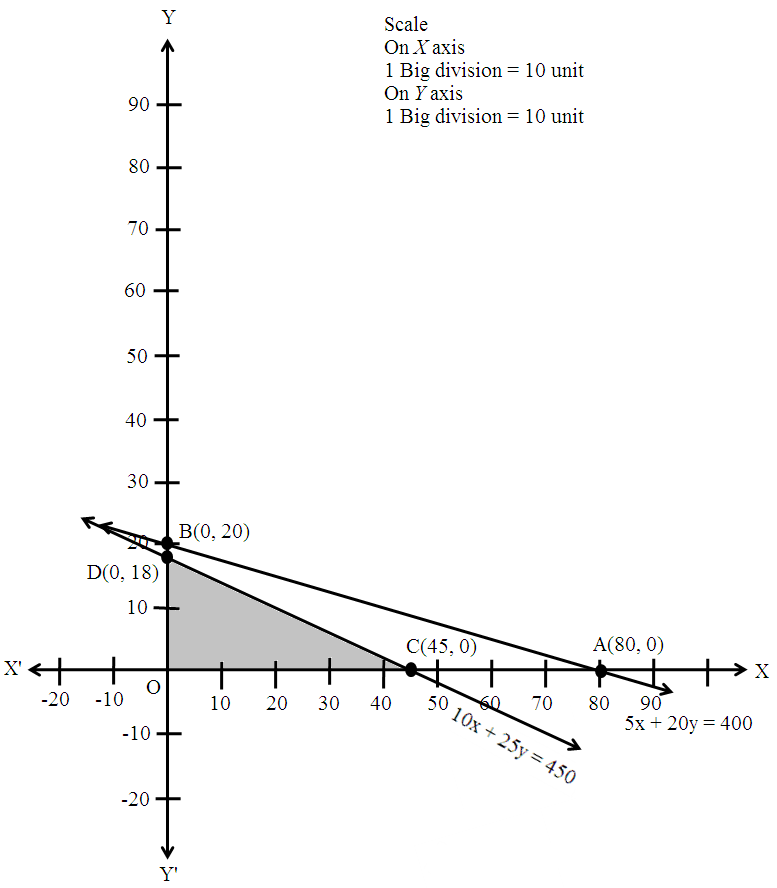
The corner points are A(0, 18), B(45, 0)
The values of Z at these corner points are as follows.
|
Corner point
|
Z = 45x + 80y
|
|
A
|
1440
|
|
B
|
2025
|
The maximum value of Z is 2025 which is attained at B(45, 0).
Thus, the maximum profit is of Rs. 2025 obtained when 45 units of chairs and no units of tables are produced. View full question & answer→Question 1205 Marks
A company is making two products A and B. The cost of producing one unit of products A and B are Rs 60 and Rs 80 respectively. As per the agreement, the company has to supply at least 200 units of product B to its regular customers. One unit of product A requires one machine hour whereas product B has machine hours available abundantly within the company. Total machine hours available for product A are 400 hours. One unit of each product A and B requires one labour hour each and total of 500 labour hours are available. The company wants to minimize the cost of production by satisfying the given requirements. Formulate the problem as a LPP.
AnswerLet the company produces x units of product A and y units of product B.
Since, each unit of product A costs Rs. 60 and each unit of product B costs Rs. 80.Therefore, x units of product A and y units of product B will cost Rs. 60x and Rs 80y respectively.
Let Z denotes the total cost.
$\therefore$ Z = Rs. (60x + 80y)
Also, one unit of product A requires one machine hour.
The total machine hours available with the company for product A are 400 hours.
$\therefore\text{x}\leq400$
This is our first constraint
Also, one unit of product A and B require 1 labour hour each and there are a total of 500 labours hours.
Thus, $\text{x}+\text{y}\leq500$
This is our second constraint.
Since, x and y are non negative integers, therefore $\text{x},\text{y}\geq\text{x},\text{y}\geq00$
Also, as per agreement, the company has to supply atleast 200 units of product B to its regular customers.
$\therefore\text{y}\geq200$
Hence, the required LPP is as follows:
Minimize Z = 60x + 80y
Subject to
$\text{x}\leq400$
$\text{x}+\text{y}\leq500$
$\text{y}\geq200$
$\text{x},\text{y}\geq0$
View full question & answer→Question 1215 Marks
How many packets of each food should be used to maximise the amount of vitamin A in the diet? What is the maximum amount of vitamin A in the diet?
Answer
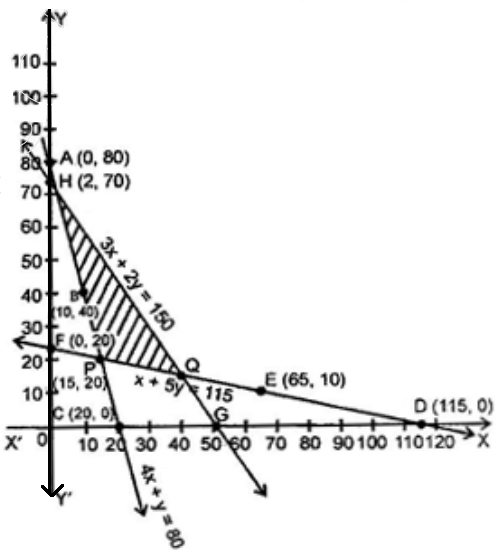 Let x and y be the number of packets of food P and Q respectively, $\text{x}\ge0,\ \text{y}\ge0.$
We have to maximize Z = 6x + 3y (vitamin A) subject to the constraints $12\text{x}+3\text{y}\ge240$ (constraints on Calcium), $\text{i.e., }4\text{x}+\text{y}\ge80\dots(\text{i})$
$\text{And }4\text{x}+50\text{y}\ge460$ (constraints on Iron), $\text{i.e., }\text{x}+5\text{y}\ge115\dots(\text{ii})$
$\text{Also }6\text{x}+4\text{y}\le300$ (constraints on Cholesterol), i.e., $3\text{x}+2\text{y}\le150\dots(\text{iii})$
$\text{x}\ge0,\ \text{y}\ge0\dots(\text{iv})$
Consider $4\text{x}+\text{y}\ge80$
Let 4x + y = 80
⇒ y = 80 - 4x
| |
A |
B |
C |
| x |
0 |
10 |
20 |
| y |
80 |
40 |
0 |
Here, (0, 0) does not satisfy this inequation, therefore the required half plane does not include the point (0, 0)
Again consider $\text{x}+5\text{y}\ge115$
Let x + 5y = 115
⇒ x = 115 - 5y
| |
D |
E |
F |
| x |
115 |
65 |
0 |
| y |
0 |
10 |
23 |
Here, also (0, 0) does not satisfy this inequation, therefore the required half plane does not include the point (0, 0)
Again consider $3\text{x}+2\text{y}\le150$
$\text{Let }3\text{x}+2\text{y}=150\Rightarrow\frac{\text{x}}{50}+\frac{\text{y}}{75}=1$
Therefore, G(50, 0) and H(0, 75) satisfy the equation.
As (0, 0) satisfies the inequation 3x + 2y = 150, therefore the required half plane contains (0, 0). The shaded region is the feasible solution and its corners are P(15, 20), Q(40, 15) and R(2, 72).
| Now |
|
Z = 6x + 3y |
| At |
P(15, 20) |
Z = 6 × 15 + 3 × 20 = 90 + 60 = 150 |
| At |
Q(40, 15) |
Z = 6 × 40 + 3 × 15 = 240 + 45 = 285 |
| At |
R(2, 72) |
Z = 6 × 2 + 3 × 72 = 12 + 216 = 228 |
Hence, maximum Z = 285 units of vitamin A at x = 40, y = 15. View full question & answer→Question 1225 Marks
Maximise $Z = 3x + 5y$
such that $\text{x}+3\text{y}\geq3,\ \text{x}+\text{y}\geq2,\ \text{x},\ \text{y}\geq0.$
Answer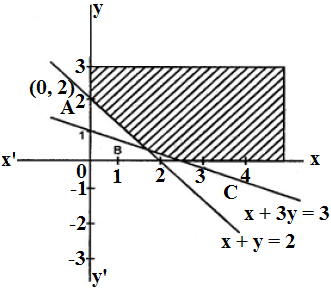
For plotting the graphs of x + 3y = 3 and x + y = 2, we have the following tables:
For $eq^n x + 3y = 3$,
For $eq^n x + y = 2$,
The feasible portion represented by the inequalities $\text{x}+3\text{y}\geq3,\ \text{x}+\text{y}\geq2\text{ and x},\text{ y}\geq0$ is ABC which is shaded in the figure. The coordinates of point B are $\Big(\frac32,\ \frac12\Big).$
Which can be obtained by solving x + 3y = 3 and x + y = 2.
| At |
A(0, 2) |
| |
Z = 3 × 0 + 5 × 2 = 10 |
| At |
$\text{B}\Big(\frac32, \frac12\Big)$ |
$\text{Z}=3\times\frac32+5\times\frac12=\frac92+\frac52=\frac{14}{2}=7$
At C(3, 0)
Z = 3 × 3 + 5 × 0 = 9
Hence, Z is minimum is 7 when $\text{x}=\frac32\text{ and y}=\frac12.$ View full question & answer→Question 1235 Marks
A diet is to contain at least $80$ units of vitamin $A$ and $100$ units of minerals. Two foods $F_1$ and $F_2$ are available. Food $F_1$ costs Rs $4$ per unit and $F_2$ costs Rs $6$ per unit one unit of food $F_1$ contains $3$ units of vitamin $A$ and $4$ units of minerals. One unit of food $F_2$ contains $6$ units of vitamin $A$ and $3$ units of minerals. Formulate this as a linear programming problem and find graphically the minimum cost for diet that consists of mixture of these foods and also meets the mineral nutritional requirements.
AnswerLet the dietician wishes to mix $x$ units of food $F_1$ and y kg of $F_2.$
Clearly, $\text{x},\text{y}\geq0$
The given information can be tabulated as follows:
| |
Vitamin A
|
Vitamin B
|
|
Food $F_1$
|
$3$ |
$4$ |
|
Food $F_2$
|
$6$ |
$3$ |
| Minimum requirement |
$80$ |
$100$ |
The constraints are
$3\text{x}+6\text{y}\geq80$
$4\text{x}+3\text{y}\geq100$
It is given that cost of food $F_1$ and $F_2$ is Rs. $4$ and Rs. $6$ per unit respectively.
Therefore, cost of x units of food $F_1$ and y units of food $F_2$ is Rs. $4x$ and Rs. $6y$ respectively.
Let $Z$ denote the total cost
$\therefore Z = 4x + 6y$
Thus, the mathematical formulation of the given linear programmimg problem is Minimize $Z = 4x+6y$
subject to
$3\text{x}+6\text{y}\geq80$
$4\text{x}+3\text{y}\geq100$
$\text{x},\text{y}\geq0$
First, we will convert the given inequations into equations, we obtain the following equations:
$3x + 6y = 80, 4x + 3y = 100, x = 0$ and $y = 0$
The line 3x + 6y = 80 meets the coordinate axis at $\text{A}\Big(\frac{80}{3},0\Big)$ and $\text{B}\Big(0,\frac{40}{3}\Big)$.
Join these points to obtain the line $3x + 6y= 80.$
Clearly, $(0, 0)$ does not satisfies the inequation $3\text{x}+6\text{y}\geq80$.
So, the region in xy-plane that does not contains the origin represents the solution set of the given equation.
The line $4x + 3y = 100$ meets the coordinate axis at $C(25, 0)$ and $\text{D}\Big(0,\frac{100}{3}\Big)$.
Join these points to obtain the line $4x + 3y = 100.$
Clearly, $(0, 0)$ does not satisfies the inequation $4\text{x}+3\text{y}\geq100$.
So, the region in xyplane that does not contains the origin represents the solution set of the given equation.
Region represented by $x \geq 0$ and $y \geq 0:$
Since, every point in the first quadrant satisfies these inequations.
So, the first quadrant is the region represented by the inequations.
These lines are drawn using a suitable scale.
The feasible region determined by the system of constraints is
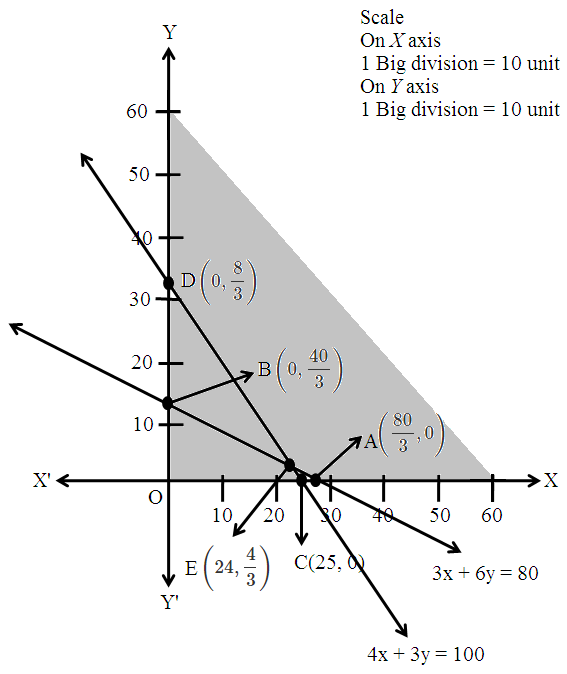
The corner points are $\text{D}\Big(0,\frac{100}{3}\Big),\text{E}\Big(24,\frac{4}{3}\Big)$ and $\text{A}\Big(\frac{80}{3},0\Big)$.
The values of $Z$ at these corner points are as follows:
| $\text{Corner point}$ |
$\text{Z}=4\text{x}+6\text{y}$ |
| $\text{D}\Big(0,\frac{100}{3}\Big)$ |
$200$ |
| $\text{E}\Big(24,\frac{4}{3}\Big)$ |
$104$ |
| $\text{A}\Big(\frac{80}{3},0\Big)$ |
$\frac{320}{3}$ |
The minimum value of $Z$ is Rs. $104$ which is at $\text{E}\Big(24,\frac{4}{3}\Big)$. View full question & answer→Question 1245 Marks
A factory owner purchases two types of machines, $A$ and $B,$ for his factory. The requirements and limitations for the machines are as follows:
|
|
Area occupied by the
machine
|
Labour force for each
machine
|
Daliy outputin
units
|
|
Machines
|
$1000$ sp.m
|
$12$ mem
|
$60$
|
|
Machines
|
$1200$ sp.m
|
$8$ mem
|
$40$
|
He has an area of $7600$ sq. m available and $72$ skilled men who can operate the machines.
How many machines of each type should he buy to maximize the daily output? AnswerLet required number of machine $A$ and $B$ are $x$ and $y$ respectively.
Since, production of each machine $A$ and $B$ are $60$ and $40$ units daily respectively.
So, productions by $x$ number of machine $A$ and $y$ number of machine $B$ are $60x$ and $40y$ respectively,
Let $z$ denote total output daily, so,
$Z = 60x + 40y$
Since, each machine of type $A$ and $B$ require $1000$ sq.m and $1200 $ sq.m area so, $x$ machine of type A and y machine of type $B$ require $100x$ and $1200y$ sq.m area but, Total area available for machine is 7600 sq.m. so,
$1000\text{x}+1200\text{y}\leq7600$
$5\text{x}+6\text{y}\leq38$ (first constraint)
Since, each machine of type $A$ and $B$ require $12$ men and 8 men to work respectively so, $x$ machine of type $A$ and $y$ machine of type B require 12x and By men to work respectively but, Total $72$ men available for work so,
$12\text{x}+8\text{y}\leq72$
$3\text{x}+2\text{y}\leq18$ (second constraint)
Hence, mathematical formulation of LPP is,
Find x and y which maximize
$Z = 60x + 40y$
Subject to constraints,
$5\text{x}+6\text{y}\leq38$
$3\text{x}+2\text{y}\leq18$
$\text{x},\text{y}\geq0$ [Number of machines can not be less than zero]
Region $5\text{x}+6\text{y}\leq38$:
Line $5x + 6y = 38$ meets axes at $\text{A}_2\Big(\frac{38}{5},0\Big),\text{B}_1\Big(0,\frac{19}{3}\Big)$ respectively.
Region containing origin represents $5\text{x}+6\text{y}\leq38$ as origin satisfies $5\text{x}+6\text{y}\leq38$.
Region $3\text{x}+2\text{y}\leq18$:
line $3x + 2y = 18$ meets axes at $A_2(6, 0), B_2(0, 9)$ respectively.
Region containing origin represents $3x + 2y = 18$ as $(0, 0)$ satisfies $3\text{x}+2\text{y}\leq18$.
Region $\text{x},\text{y}\geq0$:
It represents first quadrant.
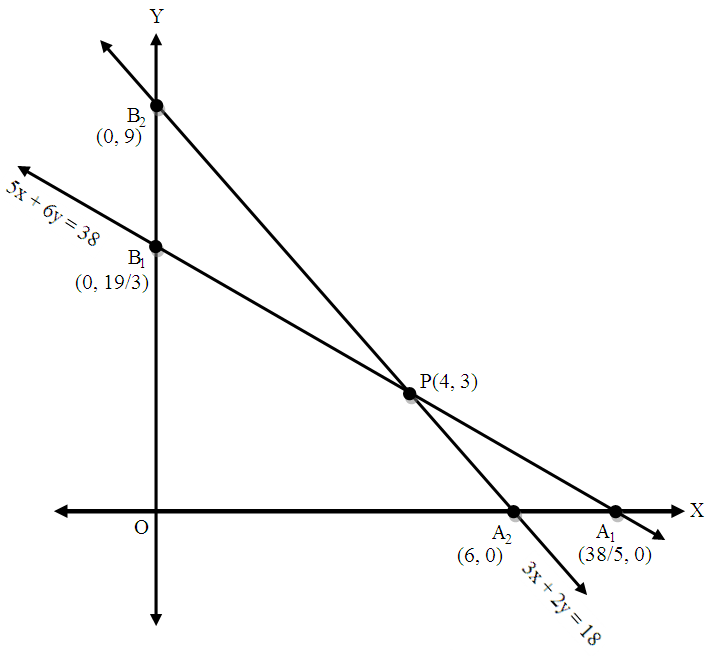
Shaded region $OA_2PB_1, $ is the feasible region $P(4, 3)$ is obtained by solving $3x + 2y = 18$ and $5x+6y - 38$
The value of $Z = 60x + 40y$ at
$\text{O}(0, 0) = 60(0) + 40(0) = 0$
$\text{A}_2(6, 0) = 60(6) + 40(0) = 360$
$\text{P}(4,3) =60(4)+ 40 (3) = 360$
$\text{B}_1\Big(0,\frac{19}{3}\Big)=60(0)+ 40\Big(\frac{19}{3}\Big)=\frac{760}{3}$
Therefore maximum $2 = 360$ at $x = 4, y = 3$ or $x = 6, y = 0$
Output is maximum when $4$ machines of type $A$ and $3$ machine of type $B$ or $6$ machines of type $A$ and no machine of type $B.$
View full question & answer→Question 1255 Marks
A man owns a field of area 1000 sq.m. He wants to plant fruit trees in it. He has a sum of Rs. 1400 to purchase young trees. He has the choice of two types of trees. Type A requires 10 sq.m of ground per tree and costs Rs. 20 per tree and type B requires 20 sq.m of ground per tree and costs Rs. 25 per tree. When fully grown, type A produces an average of 20kg of fruit which can be sold at a profit of Rs. 2.00 per kg and type B produces an average of 40kg of fruit which can be sold at a profit of Rs. 1.50 per kg. How many of each type should be planted to achieve maximum profit when the trees are fully grown? What is the maximum profit?
AnswerLet the man planted x trees of type A and y trees of type B.
Number of trees cannot be negative.
Therefore, x, y ≥ 0
To plant tree of type A requires 10 sq. m and type B requires 20 sq. m of ground per tree.
And, it is given that a man owns a field of area 1000 sq. m.
Therefore,
10x + 20y ≤ 1000
Type A costs Rs 20 per tree and type B costs Rs. 25 per tree.
Therefore, x trees of type A and y trees of type B costs Rs. 20x and Rs. 25y respectively.
A man has a sum of Rs 1400 to purchase young trees.
20x + 25y ≤ 1400
Thus, the mathematical formulation of the given linear programmimg problem is
Max Z = 40x - 20x + 60y - 25y = 20x + 35y
Subject to
10x + 20y ≤ 1000, 20x + 25y ≤ 1400
The feasible region determined by the system of constraints is
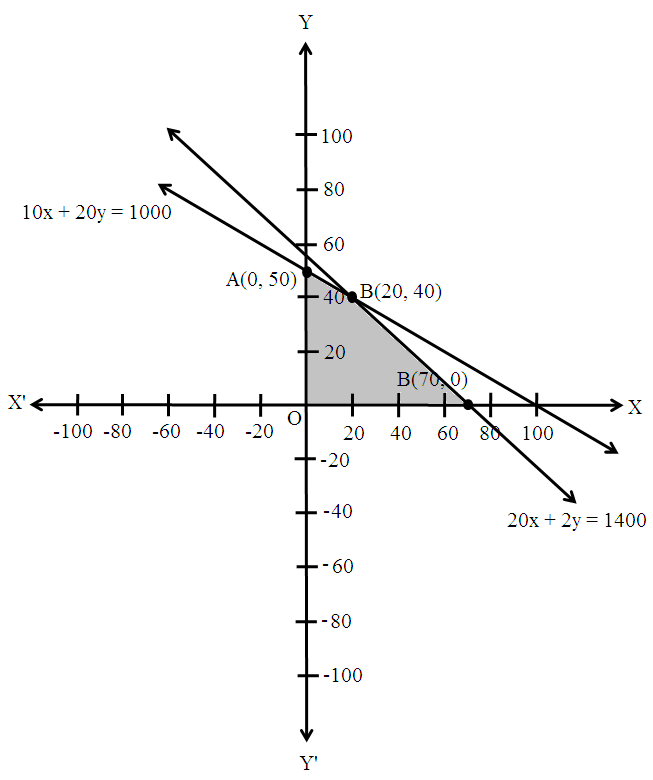
The corner points are A(0, 50), B(20, 40), C(70, 0)
The values of Z at these corner points are as follows:
|
Corner point
|
Z = 20x + 35y
|
|
A
|
1750
|
|
B
|
1800
|
|
C
|
1400
|
The maximum value of Z is 1800 which is attained at B(20, 40)
Thus, the maximum profit is Rs. 1800 obtained when Rs. 20 were invested on type A and Rs. 40 were invested on type B.
View full question & answer→Question 1265 Marks
Maximum Z = 30x + 20y Subject to $\text{x}+\text{y}\leq8$ $\text{x}+4\text{y}\geq12$ $5\text{x}+8\text{y}=20$$\text{x},\text{y}\geq0$
AnswerFirst, we will convert the given inequations into equations, we obtain the following equations: x + y = 8, x + 4y = 12, x = 0 and y = 0 5x + 8y = 20 is already an equation. Region represented by x + y ≤ 8: The line x + y = 8 meets the coordinate axes at A(8, 0) and B(0, 8) respectively. By joining these points. we obtain the line x + y = 8. Clearly (0, 0) satisfies the inequation x + y ≤ 8. So,the region in xy plane which contain the origin represents the solution set of the inequation x + y ≤ 8.Region represented by x + 4y ≥ 12:
The line x + 4y = 12 meets the coordinate axes at C(12, 0) and D(0, 3) respectively.
By joining these points we obtain the line x + 4y = 12.Clearly (0,0) satisfies the inequation x + 4y ≥ 12.
So,the region in xy plane which does not contain the origin represents the solution set of the inequation x + 4y ≥ 12.
The line 5x + 8y = 20 is the line that passes through E(4, 0) and $\text{F}\Big(0,\frac{5}{2}\Big)$.
Region represented by x ≥ 0 and y ≥ 0: Since, every point in the first quadrant satisfies these inequations. So, the first quadrant is the region represented by the inequations x ≥ 0 and y ≥ 0. The feasible region determined by the system of constraints, x + y ≤ 8, x + 4y ≥ 12, 5x + 8y = 20, x ≥ 0 and y ≥ 0 are as follows.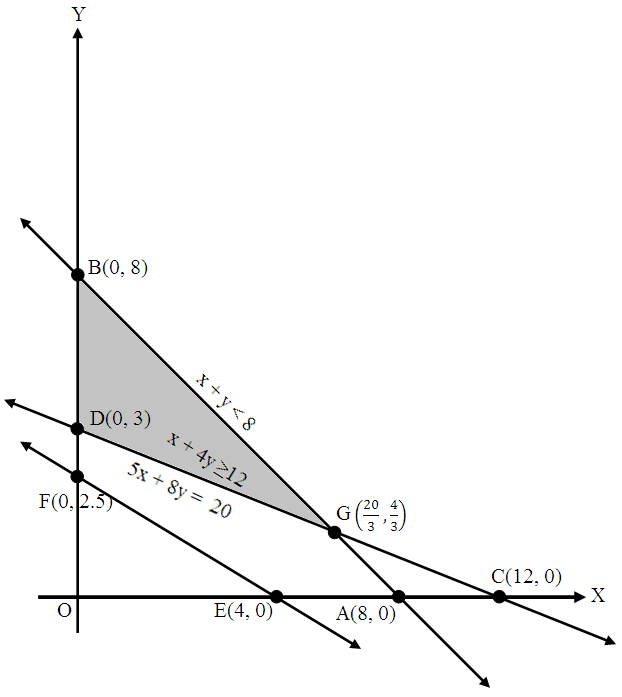
The corner point of the feasible region are B(0, 8), D(0, 3), $\text{G}\Big(\frac{20}{3},\frac{4}{3}\Big)$. The value of Z at these corner points are as follows.
|
$\text{Corner point}$
|
$\text{Z}=30\text{x}+20\text{y}$
|
|
$\text{B}(0,8)$
|
$160$
|
|
$\text{D}(0,3)$
|
$60$
|
|
$\text{G}\Big(\frac{20}{3},\frac{4}{3}\Big)$
|
$266.66$
|
Therefore, the minimum value of Z is 60 at the point D(0, 3). Hence, x = 0 and y = 3 is the optimal solution of the given LPP. Thus, the optimal value of Z is 60. View full question & answer→Question 1275 Marks
A manufacturer produces two types of steel trunks. He has two machines $A$ and $B$. For completing, the first types of the trunk requires $3$ hours on machine $A$ and $3$ hours on machine $B$, whereas the second type of the trunk requires $3$ hours on machine $A$ and $2$ hours on machine $B$. Machines $A$ and $B$ can work at most for $18$ hours and $15$ hours per day respectively. He earns a profit of Rs. $30$ and Rs. $25$ per trunk of the first type and the second type respectively. How many trunks of each type must he make each day to make maximum profit?
AnswerLet $x$ trunks of first type and $y$ trunks of second type were manufactured.
Number of trunks cannot be negative.
Therefore,
$x, y \geq 0$
According to question, the given information can be tabulated as
|
|
Machine A (hrs)
|
Machine B (hrs)
|
|
First type $(x)$
|
$3$
|
$3$
|
|
Second type $(y)$
|
$3$
|
$2$
|
|
Availability
|
$18$
|
$15$
|
Therefore, the constraints are
$3\text{x}+3\text{y}\leq18$
$3\text{x}+2\text{y}\leq15$
He earns a profit of Rs. $30$ and Rs. $25$ per trunk of the first type and the second type respectively.
Therefore, profit gained by him from x trunks of first type and y trunks of second type is Rs. $30x$ and Rs. $25y$ respectively.
Total profit $= Z = 30x + 25y$ which is to be maximised
Thus, the mathematical formulation of the given linear programmimg problem is
Max $Z = 30x + 25y$
Subject to
$3\text{x}+3\text{y}\leq18$
$3\text{x}+2\text{y}\leq15$
$\text{x},\text{y}\geq0$
First we will convert inequations into equations as follows:
$3x + 3y = 18, 3x + 2y = 15, x = 0$ and $y = 0$
Region represented by $3x + 3y \leq 18:$
The line $3x + 3y = 18$ meets the coordinate axes at $A_1(6, 0)$ and $B_1(0, 6)$ respectively.
By joining these points we obtain the line $3x + 3y = 18.$
Clearly $(0, 0)$ satisfies the $3x + 3y = 18.$
So, the region which contains the origin represents the solution set of the inequation $3x + 3y \leq 18.$
Region represented by $3x + 2y \leq 15:$
The line $3x + 2y = 15$ meets the coordinate axes at $C_1(5, 0)$ and $\text{D}_1\Big(0,\frac{15}{2}\Big)$ respectively.
By joining these points we obtain the line $3x + 2y = 15.$
Clearly $(0, 0)$ satisfies the inequation $3x + 2y \leq 15.$
So, the region which contains the origin represents the solution set of the inequation $3x + 2y \leq 15.$
Region represented by $x \geq 0$ and $y \geq 0:$
Since, every point in the first quadrant satisfies these inequations.
So, the first quadrant is the region represented by the inequations $x \geq 0,$ and $y \geq 0.$
The feasible region determined by the system of constraints $3x + 3y \leq 18, 3x + 2y \leq 15, x \geq 0$ and $y \geq 0$ are as follows.
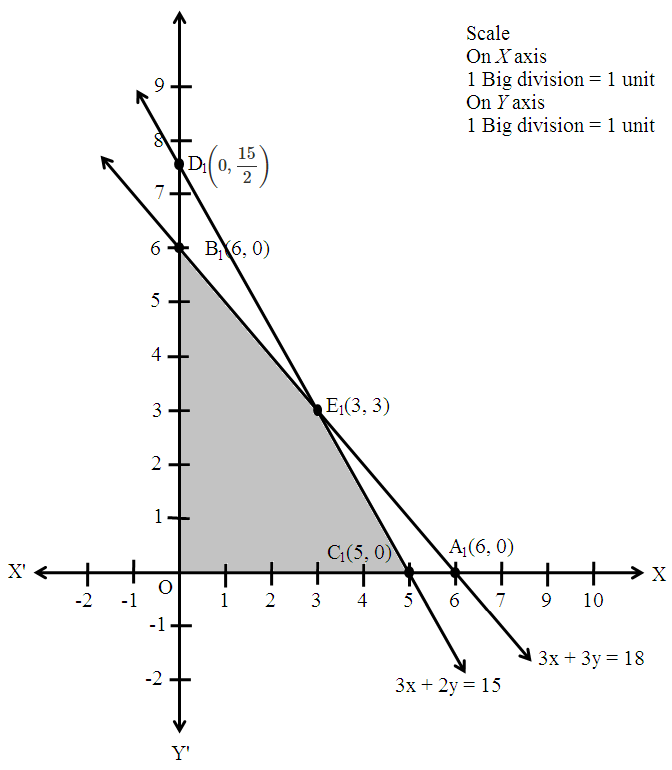
The corner points are $O(0, 0), B_1(0, 6), E_1(3, 3)$ and $C_1(5, 0).$
The values of $Z$ at these corner points are as follows.
|
Corner point
|
$Z = 30x + 25y$
|
| $O$ |
$0$
|
|
$B_1$
|
$15$
|
| $E_1$ |
$165$
|
| $C_1$ |
$150$ |
The maximum value of $Z$ is $165$ which is attained at $E_1(3, 3).$
Thus, the maximum profit is Rs. $165$ obtained when 3 units of each type of trunk is manufactured.
View full question & answer→Question 1285 Marks
A dietician wishes to mix together two kinds of food X and Y in such a way that the mixture contains at least 10 units of vitamin A, 12 units of vitamin B and 8 units of vitamin C. The vitamin contents of one kg food is given below:
| Food |
Vitamin A |
Vitamin B |
Vitamin C |
| X |
1 |
2 |
3 |
| Y |
2 |
2 |
1 |
One kg of food X costs Rs. 16 and one kg of food Y costs Rs. 20. Find the least cost of the mixture which will produce the required diet?
AnswerLet in the mixture food X weighs = x kg and in the mixture food Y weighs = y kg. We have to minimize Z = 16x + 20 y subject to constraints $\text{x}+2\text{y}\geq10,\ 2\text{x}+2\text{y}\geq12,\ 3\text{x}+\text{y}\geq8,\ \text{x}\geq0,\ \text{y}\geq0$ Consider $\text{x}+2\text{y}\geq10$ Let x + 2y = 10 $\Rightarrow\ \frac{\text{x}}{10}+\frac{\text{y}}{5}=1$ $\therefore\ $Points A(10, 0) and B(0, 5) lies on the line. Here, (0, 0) does not satisfy the inequation $\text{x}+2\text{y}\geq10,$ therefore the required half plane does not include (0, 0). Again consider $2\text{x}+2\text{y}\geq12$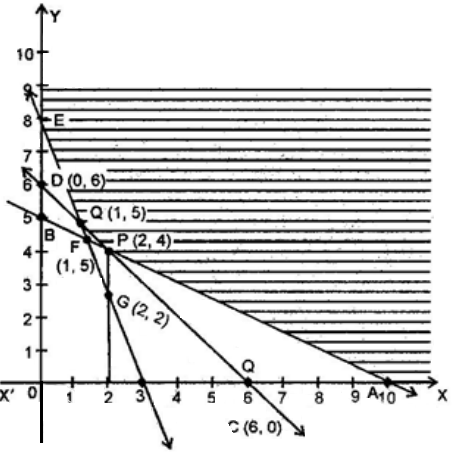
Let 2x + 2y = 12 $\Rightarrow\ $ x + y = 6 $\Rightarrow\ \frac{\text{x}}{6}+\frac{\text{x}}{6}=1$ $\therefore\ $Points C(6, 0) and D(0, 6) lies on the line. Again consider $3\text{x}+\text{y}\geq8$ Let 3x + y = 8 $\Rightarrow\ \text{y}=8-3\text{x}$ Again in the inequation (0, 0) is not included in the required half plane.
| |
E |
F |
G |
| X |
0 |
100 |
200 |
| Y |
140 |
80 |
20 |
The shaded region is our feasible solution A(10, 0), P(2, 4), Q(1, 5), E(0, 8). The corners of the feasible region are A(10, 0), P(2, 4), Q(1, 5), E(0, 8). Now Z = 16x + 20y
| At |
A(10, 0) |
Z = 16 × 10 + 20 × 0 = 160 |
| At |
P(2, 4) |
Z = 16 × 2 + 20 × 4 = 112 |
| At |
Q(1, 5) |
Z = 16 × 1 + 20 × 5 = 116 |
| At |
E(0, 8) |
Z = 16 × 0 +20 × 8 = 160 |
Therefore minimum Z = Rs. 112 at x = 2, y = 4 Hence, minimum cost of the mixture = Rs. 112 when he mixes 2 kg of food X and 4 kg of food Y. View full question & answer→Question 1295 Marks
A company sells two different products, $A$ and $B$. The two products are produced in a common production process, which has a total capacity of $500$ man-hours. It takes 5 hours to produce a unit of A and $3$ hours to produce a unit of B. The market has been surveyed and company officials feel that the maximum number of unit of A that can be sold is $70$ and that for B is $125$. If the profit is Rs. $20$ per unit for the product A and Rs. $15$ per unit for the product B, how many units of each product should be sold to maximize profit?
AnswerLet $x$ units of product $A$ and $y$ units of product $B$ were manufactured.
Clearly, $x \geq 0, y \geq 0$
It takes 5 hours to produce a unit of $A$ and 3 hours to produce $a$ unit of $B$.
The two products are produced in a common production process, which has a total capacity of 500 man-hours.
$5 x+3 y \leq 500$
The maximum number of unit of $A$ that can be sold is 70 and that for $B$ is 125 .
$x \leq 70$
$y \leq 125$
If the profit is Rs. 20 per unit for the product $A$ and Rs. 15 per unit for the product $B$.
Therefore, profit $x$ units of product $A$ and $y$ units of product $B$ is Rs. 20x and Rs. 15y respectively.
$\text { Total profit }=Z=20 x+15 y$
The mathematical formulation of the given problem is
Max $Z = 20x + 15y$
Subject to
$5x + 3y \leq 500$
$x \leq 70$
$y \leq 125$
$x \geq 0$
$y \geq 0$
First we will convert inequations into equations as follows:
$5 x+3 y=500, x=70, y=125, x=0 \text { and } y=0$
Region represented by $5 x+3 y \leq 500$ :
The line $5 x+3 y=500$ meets the coordinate axes at $A_1(100,0)$ and $B_1(0,5003)$ respectively.
By joining these points we obtain the line $5 x+3 y=500$.
Clearly $(0,0)$ satisfies the $5 x+3 y=500$.
So, the region which contains the origin represents the solution set of the inequation $5 x+3 y \leq 500$.
Region represented by $x \leq 70$ :
The line $x=70$ is the line passes through $C_1(70,0)$ and is parallel to $Y$ axis.
The region to the left of the line $x=70$ will satisfy the inequation $x \leq 70$.
Region represented by $y \leq 125$ :
The line $y=125$ is the line passes through $D_1(0,125)$ and is parallel to $X$ axis.
The region below the the line $y=125$ will satisfy the inequation $y \leq 125$.
Region represented by $x \geq 0$ and $y \geq 0$ :
Since, every point in the first quadrant satisfies these inequations.
So, the first quadrant is the region represented by the inequations $x \geq 0$, and $y \geq 0$.
The feasible region determined by the system of constraints $5 x+3 y \leq 500, x \leq 70, y \leq 125, x \geq 0$ and $y \geq 0$ are as follows.
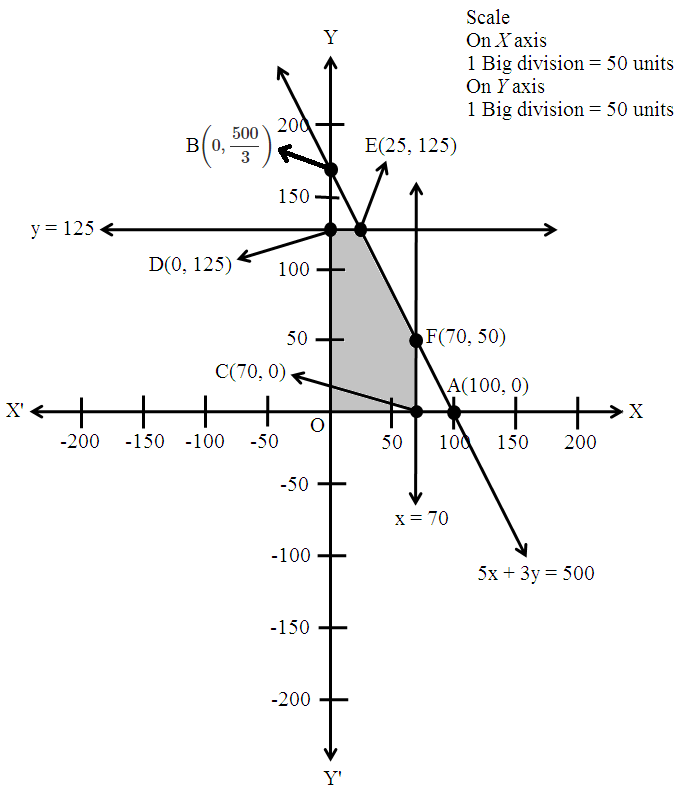
The corner points are $O(0, 0), D_1(0, 125), E_1(25, 125), F_1(70, 50)$ and $C_1(70, 0)$.
The values of $Z$ at the corner points are
|
Corner points
|
Z = 20x + 15y
|
|
O
|
$0$
|
|
$D_1$
|
$1875$
|
|
$E_1$
|
$2375$
|
|
$F_1$
|
$2150$
|
|
$C_1$
|
$1400$
|
The maximum value of $Z$ is $2375$ which is at $E_1(25, 125).$
Thus, maximum profit is Rs. $2375, 25$ units of A and $125$ units of $B$ should be manufactured. View full question & answer→Question 1305 Marks
Kellogg is a new cereal formed of a mixture of bran and rice that contains at least 88 grams of protein and at least 36 milligrams of iron. Knowing that bran contains 80 grams of protein and 40 milligrams of iron per kilogram, and that rice contains 100 grams of protein and 30 milligrams of iron per kilogram, find the minimum cost of producing this new cereal if bran costs Rs. 5 per kg and rice costs Rs 4 per kg.
AnswerLet required quantity of bran and rice be x kg and y kg.
Given, costs of one kg of bran and rice are Rs. 5 and Rs. 4 per kg,
So, costs of X unit of bran and Y kg of rice are 5x and Rs 4y respectively,
Let total cost of bran and rice be Z, so,
Z = 5x + 4y
Since one kg of bran and rice contain 80 and 100 mg of protien, so, x kg of bran and y kg of rice contain 80x and 100y grms of protien respectively, but minimum requirement of protien for kelloggs is 88 gms, so
$80\text{x}+100\text{y}\geq88$
$20\text{x}+25\text{y}\geq22$ (first constraint)
Since one kg of bran and rice contain 40 mg and 30 mg of iron, so, x kg of bran and y kg of rice contain 40x and 30y mg of iron respectively, but minimum requirement of iron is 36 mg for kelloggs, so $40\text{x}+30\text{y}\geq36$
$40\text{x}+30\text{y}\geq36$ (second constraint)
Hence, mathematical formulation of LPP is,
Find x and y which minimize
Z = 5x + 4y
subject to constraints,
$20\text{x}+25\text{y}\geq22$
$40\text{x}+30\text{y}\geq36$
$\text{x},\text{y}\geq0$ [Since quantity of bran and rice can not be less than zero]
Region $20\text{x}+25\text{y}\geq22$: line 20x + 25y = 22 meets axes at $\text{A}_1\Big(\frac{11}{10},0\Big),\text{B}_1\Big(0,\frac{22}{25}\Big)$ espectively.
Region not containing origin represents $20\text{x}+25\text{y}\geq22$ as (0, 0) does not satisfy $20\text{x}+25\text{y}\geq22$.
Region $40\text{x}+30\text{y}\geq36$ line 40x + 30y = 36 meets axes at $\text{A}_1\Big(\frac{9}{10},0\Big),\text{B}_1\Big(0,\frac{6}{5}\Big)$
Region not containing origin represents $40\text{x}+30\text{y}\geq36$ as (0, 0) does not satisfy $40\text{x}+30\text{y}\geq36$.
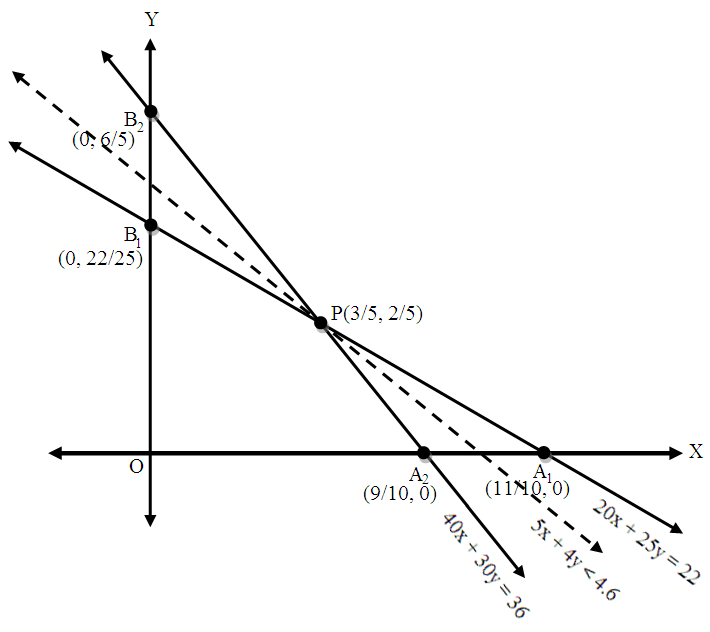
The value of Z = 5x + 4y at
$\text{A}_1\Big(\frac{11}{10},0\Big)=5\Big(\frac{11}{10}\Big)+4(0)=5.5$
$\text{P}\Big(\frac{3}{5},\frac{2}{5}\Big)=5\Big(\frac{3}{5}\Big)+4\Big(\frac{6}{5}\Big)=4.6$
$\text{B}_2\Big(0,\frac{6}{5}\Big)=5(0)+4\Big(\frac{6}{5}\Big)=4.8$
Smallest value of Z is 4.6.
Now open half plane 5x + 4y < 4.6 has no point in common with feasible region so, smallest value z is the minimum value.
Hence,
Minimum cost of mixture = Rs 4.6 View full question & answer→Question 1315 Marks
A company manufactures two types of novelty souvenirs made of plywood. Souvenirs of type A require 5 minutes each for cutting and 10 minutes each for assembling. Souvenirs of type B require 8 minutes each for cutting and 8 minutes each for assembling. There are 3 hours 20 minutes available for cutting and 4 hours for assembling. The profit is Rs 5 each for type A and Rs 6 each for type B souvenirs. How many souvenirs of each type should the company manufacture in order to maximise the profit?
AnswerLet the company manufacture x souvenirs of type A and y souvenirs of type B.
Therefore, $\text{x}\ge0\text{ and y}\ge0$
The given information can be complied in a table as follows.
| |
Type A |
Type B |
Availability |
| Cutting (min) |
5 |
8 |
3 × 60 + 20 = 200 |
| Assembling (min) |
10 |
8 |
4 × 60 = 240 |
The profit on type A souvenirs is Rs 5 and on type B souvenirs is Rs 6. Therefore, the constraints are
$5\text{x}+8\text{y}\le200\\10\text{x}+8\text{y}\le240\text{ i.e.},\ 5\text{x}+4\text{y}\le120$
Total profit, z = 5x + 6y
The mathematical formulation of the given problem is Maximize Z = 5x + 6y ... (1)
subject to the constraints,
$5\text{x}+8\text{y}\le200\dots(2)\\5\text{x}+4\text{y}\le120\dots(3)\\\text{x},\ \text{y}\ge0\dots(4)$
The feasible region determined by the system of constraints is as follows.
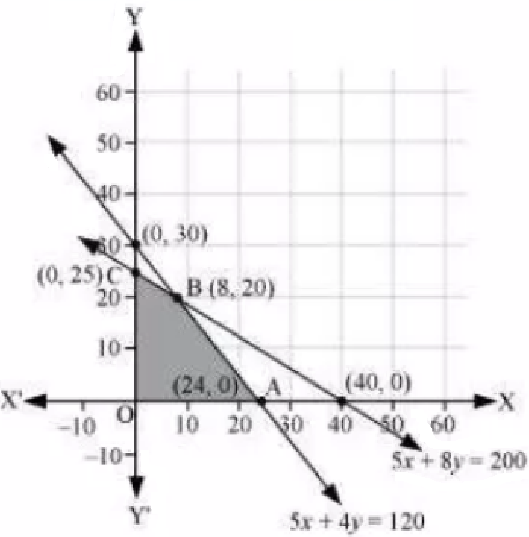
The corner points are A(24, 0), B(8, 20), and C(0, 25).
The values of z at these corner points are as follows.
| Corner point |
Z = 5x + 6y |
|
| A(24, 0) |
120 |
|
| B(8, 20) |
160 |
→ Maximum |
| C(8, 25) |
150 |
|
The maximum value of z is 200 at (8, 20).
Thus, 8 souvenirs of type A and 20 souvenirs of type B should be produced each day to get the maximum profit of Rs 160. View full question & answer→Question 1325 Marks
A firm manufacturing two types of electric items, $A$ and $B,$ can make a profit of Rs. $20$ per unit of A and Rs. $30$ per unit of $B$. Each unit of $A$ requires $3$ motors and $4$ transformers and each unit of $B$ requires $2$ motors and $4$ transformers. The total supply of these per month is restricted to $210$ motors and $300$ transformers. Type $B$ is an export model requiring a voltage stabilizer which has a supply restricted to $65$ units per month. Formulate the linear programing problem for maximum profit and solve it graphically.
AnswerLet $x$ units of item $A$ and $y$ units of item $B$ were manufactured.
Number of items cannot be negative.
Therefore, $\text{x},\text{y}\geq0$
The given information can be tabulated as follows:
|
Product
|
Motors
|
Transformers
|
|
$A(x)$
|
$3$
|
$4$
|
|
$B(y)$
|
$2$
|
$4$
|
|
Availability
|
$210$
|
$300$
|
Further, it is given that type B is an export model, whose supply is restricted to 65 units per month.
Therefore, the constraints are
$3\text{x}+2\text{y}\leq210$
$4\text{x}+4\text{y}\leq300$
$\text{y}\leq65$
A and B can make a profit of Rs. $20$ per unit of A and Rs. $30$ per unit of $B.$
Therefore, profit gained from x units of item A and y units of item B is Rs. $20x$ and Rs. $30y$ respectively.
Total profit $= Z = 20x + 30y$ which is to be maximised.
Thus, the mathematical formulation of the given linear programmimg problem is
Max $Z = 20x + 30y$
Subject to
$3\text{x}+2\text{y}\leq210$
$4\text{x}+4\text{y}\leq300$
$\text{y}\leq65$
$\text{x},\text{y}\geq0$
First we will convert inequations into equations as follows:
$3x + 2y = 210, 4x + 4y = 300, y = 65, x = 0$ and $y = 0$
Region represented by $3\text{x}+2\text{y}\leq210$:
The line $3x + 2y = 210$ meets the coordinate axes at $A_1(70, 0)$ and $B_1(0, 105)$ respectively.
By joining these points we obtain the line $3x + 2y = 210.$
Clearly $(0, 0)$ satisfies the $3x + 2y = 210.$
So, the region which contains the origin represents the solution set of the inequation $3\text{x}+2\text{y}\leq210$.
Region represented by $4\text{x}+4\text{y}\leq300$:
The line $4x + 4y = 300$ meets the coordinate axes at $C_1(75,0)$ and $D_1(0,75)$ respectively.
By joining these points we obtain the line $4x + 4y = 300.$
Clearly $(0, 0)$ satisfies the inequation $4\text{x}+4\text{y}\leq300$.
So,the region which contains the origin represents the solution set of the inequation $4\text{x}+4\text{y}\leq300$.
$y = 65$ is the line passing through the point $E_1(0, 65)$ and is parallel to $X$ axis.
Region represented by $\text{x}\geq0$ and $\text{y}\geq0$:
Since, every point in the first quadrant satisfies these inequations.
So, the first quadrant is the region represented by the inequations $\text{x}\geq0$, and $\text{y}\geq0$.
The feasible region determined by the system of constraints $3\text{x}+2\text{y}\leq210,4\text{x}+4\text{y}\leq300,\text{x}\geq0,$ and $\text{y}\geq0$ are as follows:
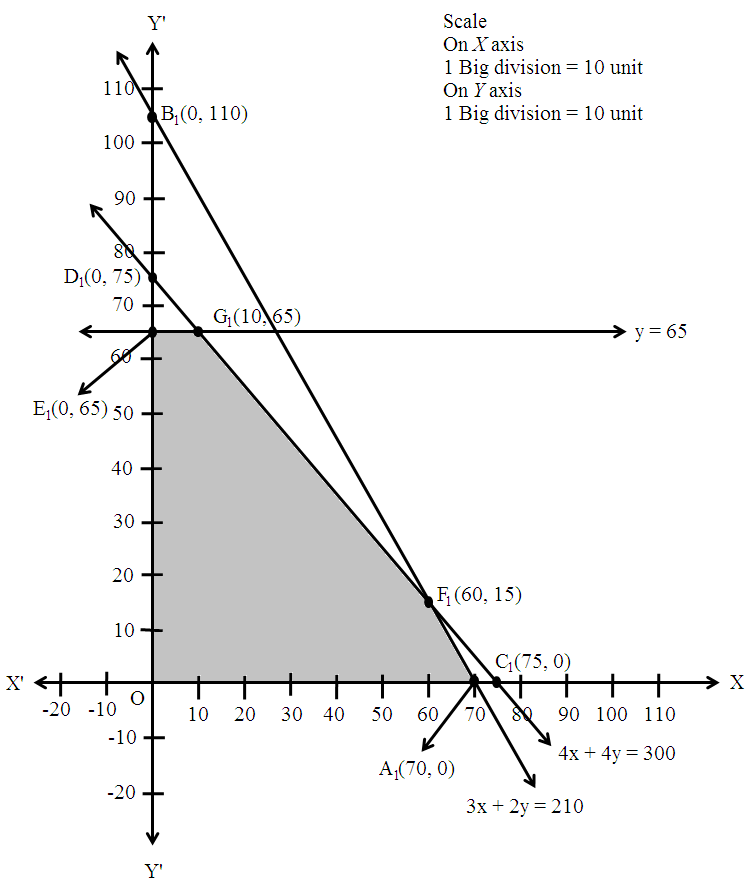
The corner points are $O(0, 0), E_1(0, 65), G_1(10, 65), F_1(60, 15)$ and $A_1(70, 0).$
The values of Z at these corner points are as follows.
|
Corner point
|
$Z = 20x + 30y$
|
|
$O$
|
$0$
|
|
$E_1$
|
$1950$
|
|
$G_1$
|
$2150$
|
|
$F_1$
|
$1650$
|
|
$A_1$
|
$1400$
|
The maximum value of $Z$ is $2150$ which is attained at $G(10, 65).$
Thus, the maximum profit is Rs.$ 2150$ obtained when $10$ units of item A and 65 units of item Bwere manufactured.
View full question & answer→Question 1335 Marks
A factory uses three different resources for the manufacture of two different products, $20$ units of the resources $A, 12$ units of $B$ and $16$ units of C being available. $1$ unit of the first product requires $2, 2$ and $4$ units of the respective resources and $1$ unit of the second product requires $4, 2$ and $0$ units of respective resources. It is known that the first product gives a profit of $2$ monetary units per unit and the second $3$. Formulate the linear programming problem. How many units of each product should be manufactured for maximizing the profit? Solve it graphically.
AnswerLet x units of first product and y units of second product be manufactured.
Therefore, $x, y \geq 0$
The given information can be tabulated as follows:
|
Product
|
Resource A |
Resource B |
Resource C |
|
First$(x)$
|
$2$ |
$2$ |
$4$ |
|
Second $(y)$
|
$4$ |
$2$ |
$0$ |
|
Availability
|
$20$
|
$12$ |
$16$ |
Therefore, the constraints are
$2\text{x}+4\text{y}\leq20$
$2\text{x}+2\text{y}\leq12$
$4\text{x}+0\text{y}\leq16$
$4\text{x}\leq16$
It is known that the first product gives a profit of $2$ monetary units per unit and the second $3.$
Therefore, profit gained from $x$ units of first product and y units of second product is $2x$ monetary units and $4y$ monetary units respectively.
Total profit $= Z = 2x + 3y$ which is to be maximised
Thus, the mathematical formulation of the given linear programmimg problem is
Max $Z = 2x + 3y$
Subject to
$2\text{x}+4\text{y}\leq20$
$2\text{x}+2\text{y}\leq12$
$4\text{x}+0\text{y}\leq16$
$4\text{x}\leq16$
$\text{x},\text{y}\geq0$
First we will convert inequations into equations as follows:
$2x + 4y = 20, 2x + 2y = 12, 4x = 16, x = 0$ and $y = 0$
Region represented by $2x + 4y \leq 20:$
The line $2x + 4y = 20$ meets the coordinate axes at $A_1(10, 0)$ and $B_1(0, 5)$ respectively.
By joining these points we obtain the line $2x + 4y = 20.$
Clearly $(0, 0)$ satisfies the $3x + 2y = 210.$
So, the region which contains the origin represents the solution set of the inequation $2x + 4y \leq 20.$
Region represented by $2x + 2y \leq 12:$
The line $2x + 2y = 16$ meets the coordinate axes at $C_1(6, 0)$ and $D_1(0, 6)$ respectively.
By joining these points we obtain the line $2x + 2y = 12.$
Clearly $(0, 0)$ satisfies the inequation $2x + 2y \leq 12.$
So, the region which contains the origin represents the solution set of the inequation $2x + 2y \leq 12$.
Region represented by $4x \leq 16:$
The line $4x =16$ or $x = 4$ is the line passing through the point $E_1(4, 0)$ and is parallel to $Y$ axis.
The region to the left of the line $x = 4$ would satisfy the inequation $4x \leq 16.$
Region represented by $x \geq 0$ and $y \geq 0:$
Since, every point in the first quadrant satisfies these inequations.
So, the first quadrant is the region represented by the inequations $x \geq 0,$ and $y \geq 0.$
The feasible region determined by the system of constraints $2x + 4y \leq 20, 2x + 2y \leq 12, 4x \leq 16, x \geq 0$ and $y \geq 0$ are as follows.
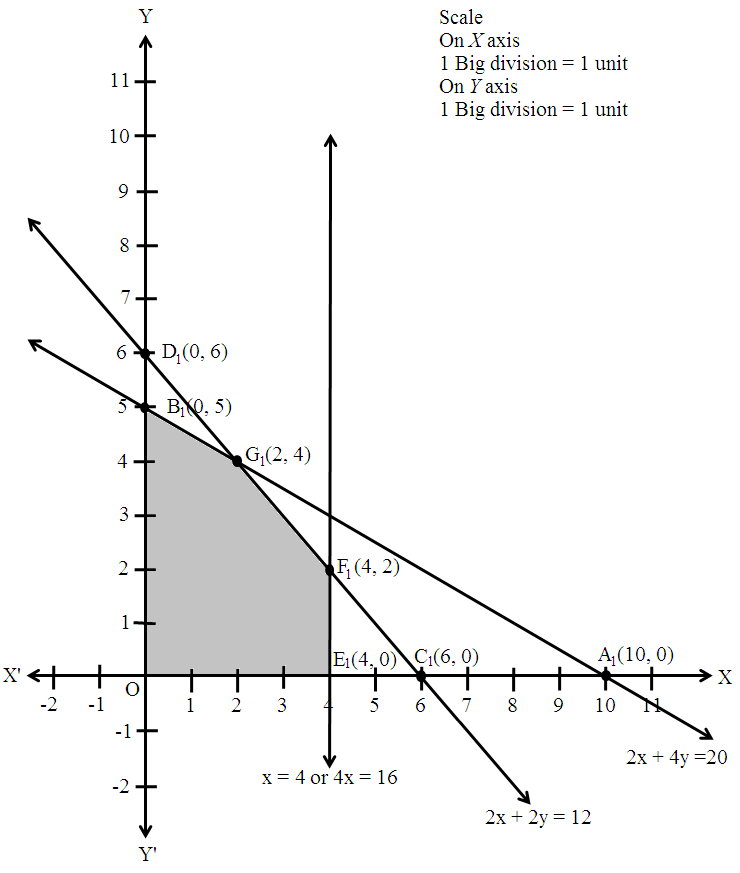
The corner points are $O(0, 0), B_1(0, 5), G_1(2, 4), F_1(4, 2)$ and $E_1(4, 0).$
The values of $Z$ at these corner points are as follows.
|
Corner point
|
$Z = 2x + 3y$
|
|
$O$
|
$0$
|
|
$B_1$
|
$15$
|
|
$G_1$
|
$16$ |
|
$F_1$
|
$14$
|
| $E_1$ |
$8$ |
The maximum value of $Z$ is $16$ which is attained at $G_1(2, 4)$
Thus, the maximum profit is $16$ monetary units obtained when $2$ units of first product and $4$ units of second product were manufactured.
View full question & answer→Question 1345 Marks
A dietician wishes to mix together two kinds of food X and Y in such a way that the mixture contains at least 10 units of vitamin A, 12 units of vitamin B and 8 units of vitamin C. The vitamin contents of one kg food is given below:
|
Food
|
Vitamin A
|
Vitamin B
|
Vitamin C
|
|
X
|
1
|
2
|
3
|
|
Y
|
2
|
2
|
1
|
One kg of food X costs Rs. 16 and one kg of food Y costs Rs 20. Find the least cost of the mixture which will produce the required diet?
AnswerLet x be the amount of food X and Y be the amount of food Y that is to be mixed which will produce the required diet.
Then the mathematical modal of the LPP is as follows:
Minimise Z = 16x + 20y
Subject to
$2\text{x}+2\text{y}\geq12$
$3\text{x}+\text{y}\geq8$
$\text{x}\geq0,\text{y}\geq0$
To solve the LPP we draw the lines,
x + 2y = 10
2x + 2y = 12
3x + y = 8
The feasible region of the LPP is shaded in graph.
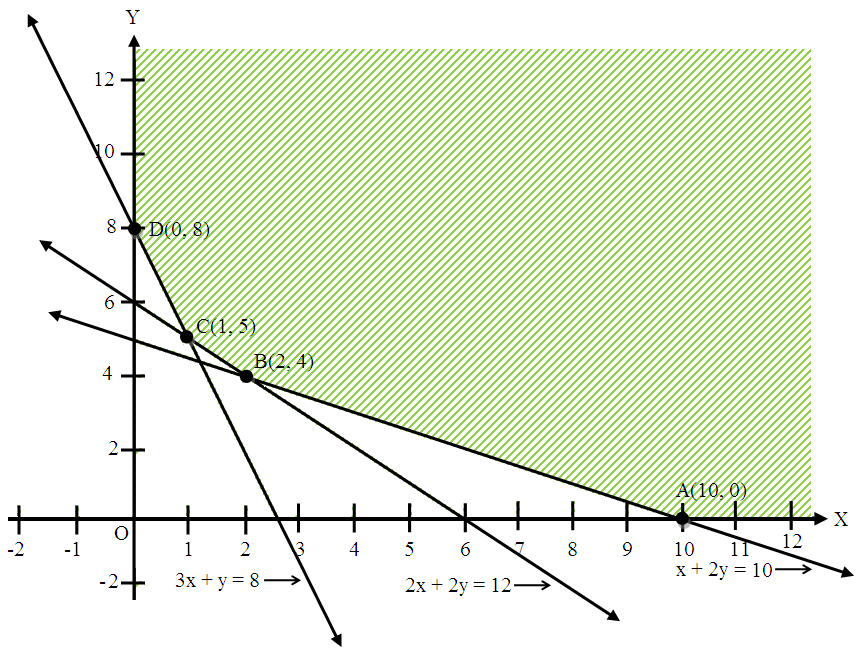
The coordinates of the vertices (corner points) of the feasible region ABCD are A(10, 0), B(2, 4), C(1, 5) and D(0, 8).
The value of the objective function at these points are given in the following table.
|
Point $(x_1, x_2)$
|
Value of objective function Z = 16x + 20y
|
| A(10, 0) |
Z = 160 |
|
B(2, 4)
|
Z = 112
|
| C(1, 5) |
Z = 116 |
| D(0, 8) |
Z = 160 |
2kg of food X and 4kg of food Y will be required to minimize the cost of the diet.
The least cost of the mixture is Rs. 112. View full question & answer→Question 1355 Marks
A manufacturer produces nuts and bolts. It takes 1 hour of work on machine A and 3 hours on machine B to produce a package of nuts. It takes 3 hours on machine A and 1 hour on machine B to produce a package of bolts. He earns a profit of Rs 17.50 per package on nuts and Rs 7.00 per package on bolts. How many packages of each should be produced each day so as to maximise his profit, if he operates his machines for at the most 12 hours a day?
AnswerLet the manufacturer produce x packages of nuts and y packages of bolts. Therefore, $\text{x}\ge0\text{ and y}\ge0.$
The given information can be compiled in a table as follows.
| |
Nuts |
Bolts |
Availability |
| Machine A (h) |
1 |
3 |
12 |
| Machine B (h) |
3 |
1 |
12 |
The profit on a package of nuts is Rs 17.50 and on a package of bolts is Rs 7. Therefore, the constraints are
$\text{x}+3\text{y}\le12\\3\text{x}+\text{y}\le12$
Total profit, z = 17.5x + 7y
The mathematical formulation of the given problem is
Maximise Z = 17.5x + 7y ... (1)
subject to the constraints,
$\text{x}+3\text{y}\le12\dots(2)\\3\text{x}+\text{y}\le12\dots(3)\\\text{x},\ \text{y}\ge0\dots(4)$
The feasible region determined by the system of constraints is as follows.
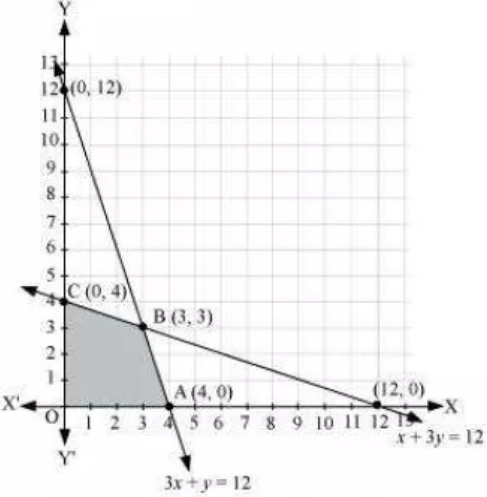
The corner points are A(4, 0), B(3, 3), and C(0, 4).
The values of Z at these corner points are as follows.
| Corner point |
Z = 17.5x + 7y |
|
| O(0, 0) |
0 |
|
| A(4, 0) |
70 |
|
| B(3, 3) |
73.5 |
→ Maximum |
| C(0, 4) |
28 |
|
The maximum value of Z is Rs 73.50 at (3, 3).
Thus, 3 packages of nuts and 3 packages of bolts should be produced each day to get the maximum profit of Rs 73.50. View full question & answer→Question 1365 Marks
An airline agrees to charter planes for a group. The group needs at least 160 first class seats and at least 300 tourist class seats. The airline must use at least two of its model 314 planes which have 20 first class and 30 tourist class seats. The airline will also use some of its model 535 planes which have 20 first class seats and 60 tourist class seats. Each flight of a model 314 plane costs the company Rs 100,000 and each flight of a model 535 plane costs Rs 150,000. How many of each type of plane should be used to minimize the flight cost? Formulate this as a LPP.
AnswerLet x number of model 314 planes and y number of model 535 planes were used.
It is given that cost of one model 314 plane is Rs 100000 and cost of one model 535 plane is Rs 150000.
Therefore, cost of x model 314 plane is Rs 100000x and cost of y model 535 plane is Rs 150000y.
Total cost price = 100000x +150000 y
Let Z denote the total cost
Then, Z = 100000x +150000y
Also,
Each model 314 planes have 20 first class and 30 tourist class seats and each model 535 planes has 20 first class and 60 tourist class seats.
The group needs 160 first class seats and 300 tourist class seats.
$\therefore20\text{x}+20\text{y}\geq160,30\text{x}+60\text{y}\geq300$
Number of planes cannot be negative.
Therefore, $\text{x},\text{y}\geq0$
Hence, the required LPP is as follows:
Min Z = 100000x+150000y
Subject to
$\therefore20\text{x}+20\text{y}\geq160$
$30\text{x}+60\text{y}\geq300$
$\text{x}\geq0,\text{y}\geq0$
View full question & answer→Question 1375 Marks
A firm makes items A and B and the total number of items it can make in a day is 24. It takes one hour to make an item of A and half an hour to make an item of B. The maximum time available per day is 16 hours. The profit on an item of A is Rs. 300 and on one item of B is Rs. 160. How many items of each type should be produced to maximize the profit? Solve the problem graphically.
AnswerLet the number of item A produced be x, and the number of item B produced be y. Since the total number of items are at most 24. $\text{x} + \text{y} \leq 24 \ \dots(1)$ Item A takes 1 hour to manufacture and item B takes half an hour to manufacture. x item takes x hour to manufacture and y items take $\frac{\text{y}}{2}$ hour to a manufacture. and maximum time available is 16 hours. $\therefore \text{x} + \frac{\text{y}}{2}\leq16 \dots (2)$ The profit on one unit of A is Rs. 300 and the profit on one unit of B is Rs. 160 Since we want to maximize profit. Let the profit be z. Max z = 300x + 160y .....(3)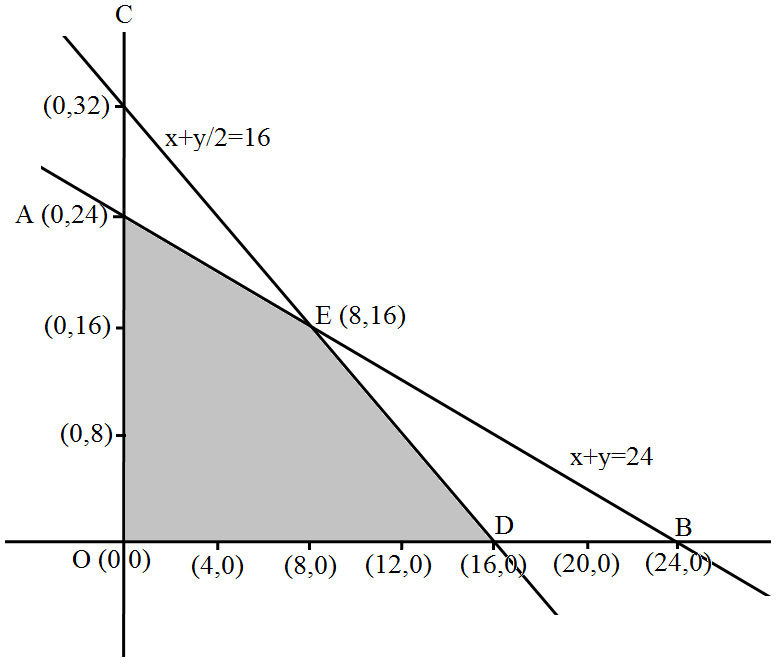
The shaded region will satisfy the equation (1) and (2), their intersection point is E(8, 16). Vertices of OAED are O(0, 0), A(0, 24), E(8, 16) and D(16, 0). At A Z = 160 × 24 = 3840 At E Z = 300 × 8 + 160 × 16 = 2400 + 2560 = 4960 At D Z = 300 × 16 + 160 × 0 = 4800 Therefore the maximum value is at point E. i.e. x = 8 and y = 16 Thus they should produce 8 items of type A and 16 items of type B. View full question & answer→Question 1385 Marks
Determine the maximum value of $\text{Z}=11\text{x}+7\text{y}$ subject to the constraints:
$2\text{x}+\text{y}\leq6,\text{x}\leq2,\text{x}\geq0,\text{y}\geq0. $
AnswerWe have, maximise $\text{Z}=11\text{x}+7\text{y}\ .....(\text{i})$
Subject to the constraints
$2\text{x}+\text{y}\leq6\ .....(\text{ii})$
$\text{x}\leq2\ ......(\text{iii})$
$\text{x}\geq0,\text{y}\geq0\ .....(\text{iv}) $
We see that, the feasible region as shaded determined by the system of constraint (ii) to (iv) is OABC and is bounded. So, now we shall use corner point method to determine the maximum value of Z.
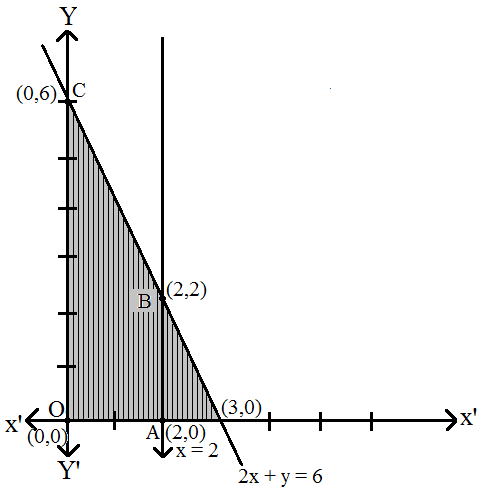
|
Corner Points
|
Corresponding value of Z
|
|
(0, 0)
(2, 0)
(2, 2)
(0, 6)
|
0
22
36
42 (Maximum)
|
Hence, the maximum value of Z is 42 at (0, 6). View full question & answer→Question 1395 Marks
Maximum Z = 2x + 4y Subject to$\text{x}+\text{y}\geq8$
$\text{x}+4\text{y}\geq12$
$\text{x}\geq3,\text{y}\geq2$
AnswerFirst, we will convert the given inequations into equations, we obtain the following equations:
x + y = 8, x + 4y = 12, x = 3, y = 2
Region represented by x + y ≥ 8:
The line x + y = 8 meets the coordinate axes at A(8, 0) and B(0, 8) respectively. By joining these points we obtain the line x + y = 8.
Clearly (0, 0) does not satisfies the inequation x + y ≥ 8.
So, the region in xy plane which does not contain the origin represents the solution set of the inequation x + y ≥ 8.
Region represented by x + 4y ≥ 12:
The line x + 4y = 12 meets the coordinate axes at C(12, 0) and D(0, 3) respectively. By joining these points we obtain the line x + 4y = 12.
Clearly (0, 0) satisfies the inequation x + 4y ≥ 12.
So, the region in xy plane which contain the origin represents the solution set of the inequation x + 4y ≥ 12.
The line x = 3 is the line that passes through the point (3, 0) and is parallel to Y axis. x ≥ 3 is the region to the right of the line x = 3.
The line y = 2 is the line that passes through the point (0, 12) and is parallel to X axis. y ≥ 2 is the region above the line y = 2.
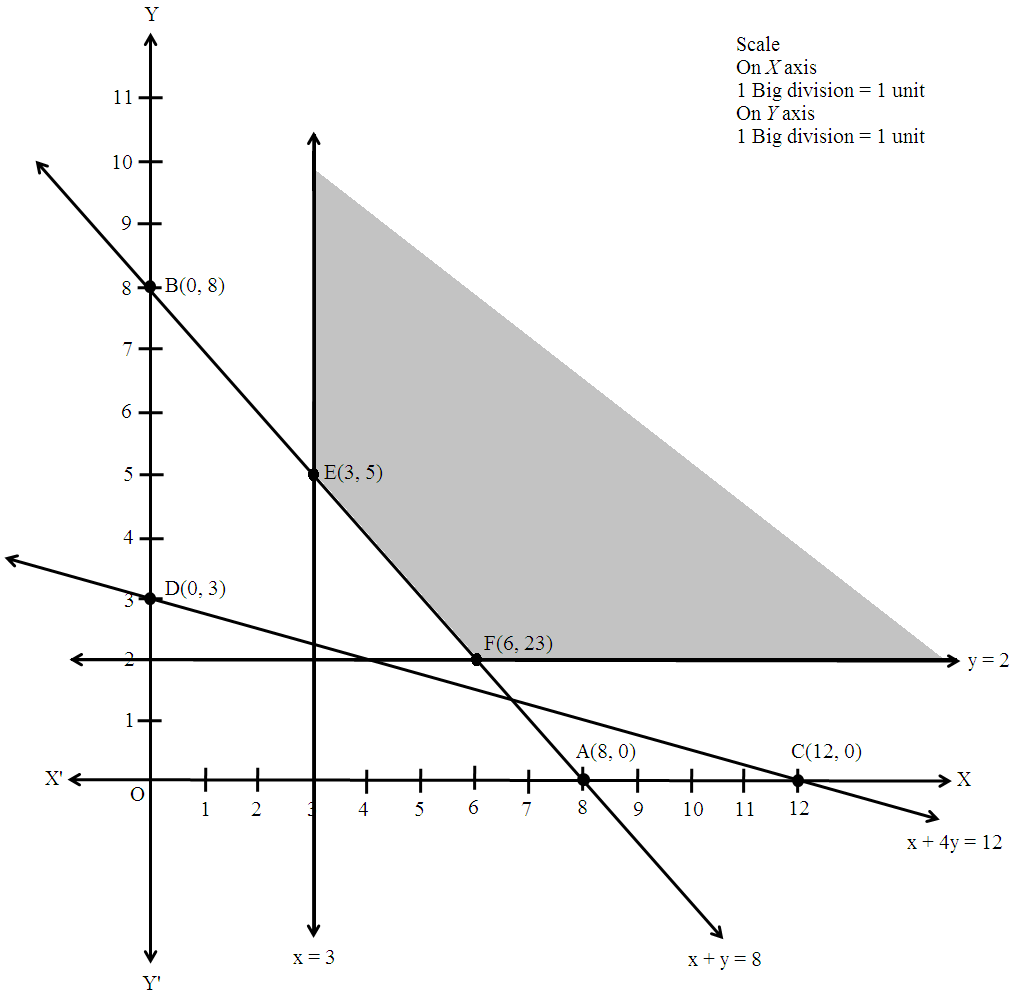
The corner points of the feasible region are E(3, 5) and F(6, 2).
The values of Z at these corner points are as follows.
|
Corner point
|
Z = 2x + 4y
|
|
E(3, 5)
|
2 × 3 + 4 × 5 = 26
|
|
F(6, 2)
|
2 × 6 + 4 × 2 = 20
|
Therefore, the minimum value of Z is 20 at the point F(6, 2).
Hence, x = 6 and y = 2 is the optimal solution of the given LPP.
Thus, the optimal value of Z is 20.
View full question & answer→Question 1405 Marks
Show the solution zone of the following inequalities on a graph paper:
$5\text{x}+\text{y}\geq10$
$\text{x}+\text{y}\geq6$
$\text{x}+4\text{y}\geq12$
$\text{x}\geq,\text{y}\geq0$
AnswerConverting the given inequations into equations
5x + y = 10, x + y = 6, x + 4y = 12, x = y = 0
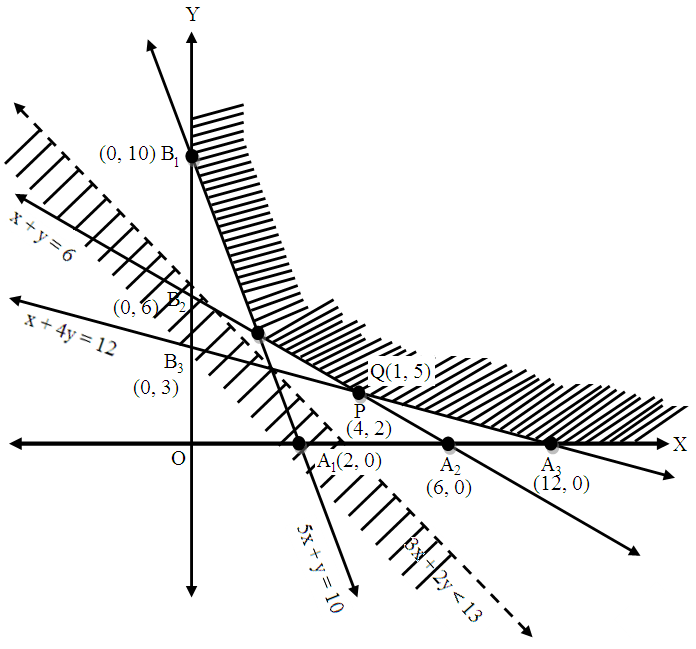
Region represented by $5\text{x}+\text{y}\geq10$:
Line 5x + y - 10 meets coordinate axes at $A_1(2, 0)$ and $B_1(0, 10).$
Clearly, (0, 0) does not satisfy $5\text{x}+\text{y}\geq10$, so region not containing origin represents $5\text{x}+\text{y}\geq10$ in xy -plane.
Region represented by $\text{x}+\text{y}\geq6$:
Line x + y = 6 meets coordinate axes at $A_2(6, 0)$ and $B_2(0, 6)$.
Clearly, (0, 0) does not satisfy $\text{x}+\text{y}\geq6$, so region not containing origin represents $\text{x}+\text{y}\geq6$ in xy -plane.
Region represented by $\text{x}+4\text{y}\geq12$:
Line x + 4y = 12 meets coordinate axes at $A_3(12, 0)$ and $B_3(0, 3).$
Clearly, (0, 0) does not satisfy $\text{x}+4\text{y}\geq12$, so, region not containing origin $\text{x}+4\text{y}\geq12$ in xy - plane.
Region represented by $\text{x}\geq,\text{y}\geq0$:
It represents first quadrant in xy-plane.
The unbounded shaded region with corner points $A_3(12, 0), P(4, 2), Q(1, 5), B_1(0, 10)$ represents feasible region.
Point P is obtained by solving x + 4y = 12 and x + y = 6, Q by solving x + y = 6 and 5x + y = 10.
The value of Z = 3x + 2y at
$A_3(12, 0) = 3(12) + 2(0) = 36$
P(4, 2) = 3(4) + 2(2) = 16
Q(1, 5) = 3(1) + 2(5) = 13
B(0, 10) = 3(0) + 2(10) = 20
Smallest value of Z = 13,
Now open half plane $3\text{x}+2\text{y}\leq13$ has no point in common with feasible region, so, smallest value is the minimum value of Z,
Hence,
Minimum z = 13 at x = 1, y = 5 View full question & answer→Question 1415 Marks
A company manufactures two articles A and B. There are two departments through which these articles are processed: (i) assembly and (ii) finishing departments. The maximum capacity of the first department is 60 hours a week and that of other department is 48 hours per week. The product of each unit of article A requires 4 hours in assembly and 2 hours in finishing and that of each unit of B requires 2 hours in assembly and 4 hours in finishing. If the profit is Rs. 6 for each unit of A and Rs 8 for each unit of B, find the number of units of A and B to be produced per week in order to have maximum profit.
AnswerLet x units and y units of articles A and B are produced respectively.
Number of articles cannot be negative.
Therefore, x, y ≥ 0
The product of each unit of article A requires 4 hours in assembly and that of article B requires 2 hours in assembly and the maximum capacity of the assembly department is 60 hours a week
4x + 2y ≤ 60
The product of each unit of article A requires 2 hours in finishing and that of article B requires 4 hours in assembly and the maximum capacity of the finishing department is 48 hours a week.
2x + 4y ≤ 48
If the profit is Rs. 6 for each unit of A and Rs. 8 for each unit of B.
Therefore, profit gained from x units and y units of articles A and B respectively is Rs. 6x and Rs. 8y respectively.
Total revenue = Z = 6x + 8y which is to be maximised.
Thus, the mathematical formulation of the given linear programmimg problem is
Max Z = 6x + 8y
Subject to
2x + 4y ≤ 48
4x + 2y ≤ 60
x, y ≥ 0
First we will convert inequations into equations as follows:
2x + 4y = 48, 4x + 2y = 60, x = 0 and y = 0
Region represented by 2x + 4y ≤ 48:
The line 2x + 4y = 48 meets the coordinate axes at $A_1(24, 0)$ and $B_1(0, 12)$ respectively.
By joining these points we obtain the line 2x + 4y = 48.
Clearly (0, 0) satisfies the 2x + 4y = 48.
So, the region which contains the origin represents the solution set of the inequation 2x + 4y ≤ 48.
Region represented by 4x + 2y ≤ 60:
The line 4x + 2y = 60 meets the coordinate axes at $C_1(15, 0)$ and $D1(0, 30)$ respectively.
By joining these points we obtain the line 4x + 2y = 60.
Clearly (0, 0) satisfies the inequation 4x + 2y ≤ 60.
So, the region which contains the origin represents the solution set of the inequation 4x + 2y ≤ 60.
Region represented by x ≥ 0 and y ≥ 0:
Since, every point in the first quadrant satisfies these inequations.
So, the first quadrant is the region represented by the inequations x ≥ 0, and y ≥ 0.
The feasible region determined by the system of constraints 2x + 4y ≤ 48, 4x + 2y ≤ 60, x ≥ 0 and y ≥ 0 are as follows.
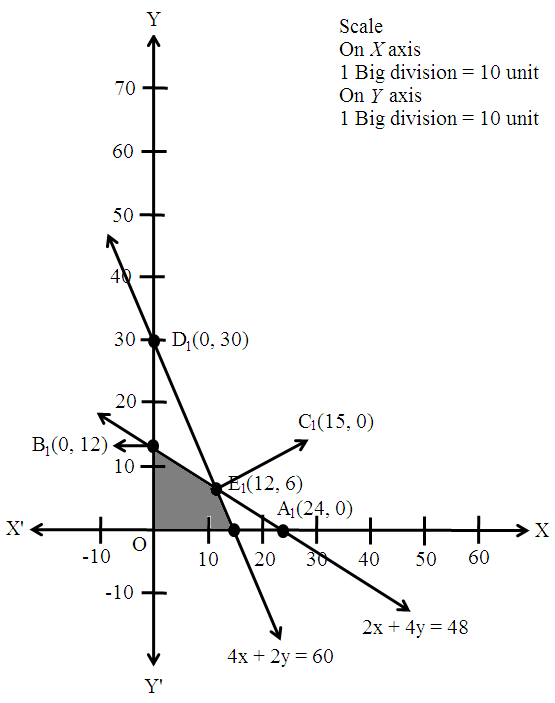
The corner points are $O(0, 0), B_1(0, 12), E_1(12, 6)$ and $C_1(15, 0)$.
The values of Z at these corner points are as follows.
|
Corner points
|
Z = 6x + 8y
|
|
$O$
|
0
|
|
$B_1$
|
96 |
|
$E_1$
|
120
|
|
$C_1$
|
90
|
The maximum value of Z is 120 which is attained at $E_1(12, 6)$.
Thus, the maximum profit is Rs. 120 obtained when 12 units of article A and 6 units of article B were manufactured.
View full question & answer→Question 1425 Marks
A company produces two types of goods, A and B, that require gold and silver. Each unit of type A requires 3gm of silver and 1 gm of gold while that of type B requires 1 gm of silver and 2gm of gold. The company can produce 9gm of silver and 8gm of gold. If each unit of type A brings a profit of Rs. 40 and that of type B Rs. 50, find the number of units of each type that the company should produce to maximize the profit. What is the maximum profit?
AnswerLet number of goods A and B are x and y respectively.
Since, profits on each A and B are Rs. 40 and Rs. 50 respectively.
So, profits on x of type A and y of type B are 40x and 50y respectively, Let Z be total profit on A and B, so,
Z = 40x + 50y
Since, each A and B require 3gm and 1gm of silver respectively.
So, x of type A and y type B require 3x and y gm silver respectively but, Total silver available is 9 gm. so,
$3\text{x}+\text{y}\leq9$ (first constraint)
Since, each A and B require 1gm and 2gm of gold respectively.
So, x of type A and y type B require x and 2y gm of gold respectively but, Total gold available is 8 gm, so,
$\text{x}+2\text{y}\leq8$ (second constraint)
Hence, mathematical formulation of LPP is,
Find x and y which maximize
Z = 40x + 50y
Subject to constraints,
$3\text{x}+\text{y}\leq9$
$\text{x}+2\text{y}\leq8$
$\text{x},\text{y}\geq0$ [Since production of A and B can not be less than zero]
Region $3\text{x}+\text{y}\leq9$:
Line 3x +y = 9 meets axes at A(3, 0), B(0, 9) respectively.
Region containing origin represents $3\text{x}+\text{y}\leq9$ as (0, 0) satisfies $3\text{x}+\text{y}\leq9$.
Region $\text{x}+2\text{y}\leq8$:
Line x +2y = 8 meets axes at $A_2(8, 0), B_2(0, 4)$ respectively.
Region containing origin represents $\text{x}+2\text{y}\leq8$ as (0, 0) satisfies $\text{x}+2\text{y}\leq8$.
Region $\text{x},\text{y}\geq0$:
It represents first quadrant.
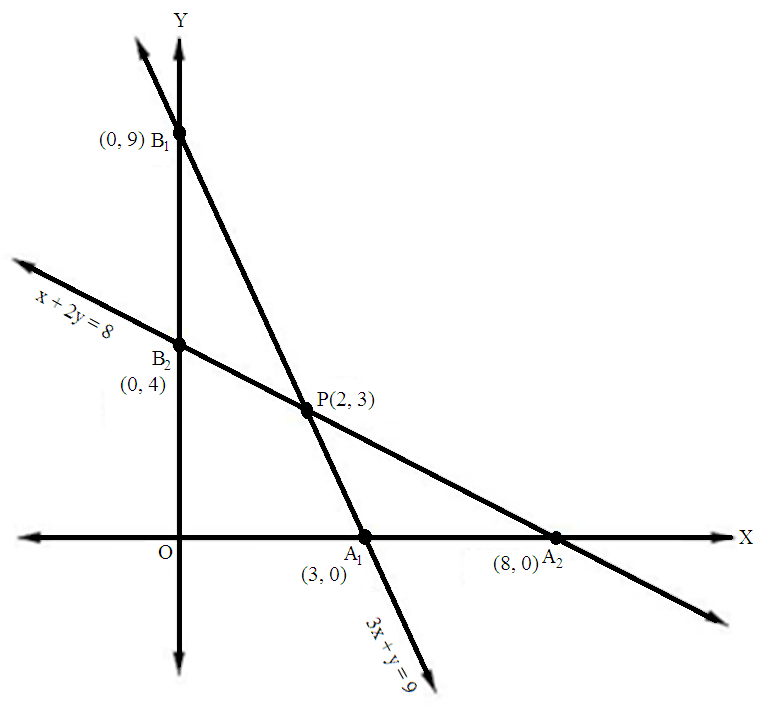
Shaded region $OA_2PB_2$ is the feasible region.
Point P(2, 3) is obtained by solving 3x + y - 9 and x + 2y = 8
The value of $Z = 40x + 50y$ at
$O(0, 0) = 40(0) + 50(0) = 0$
$A_1(3, 0) = 40(3) + 50(0) = 120$
$P(2, 3) = 40(2) + 50(3) = 230$
$B_2(0, 4) = 40(0) + 50(4) = 200$
Therefore maximum Z = 230 at x = 2, y = 3
Hence,
Maximum profit = Rs. 230 number of goods of type A = 2, type B = 3 View full question & answer→Question 1435 Marks
Minimise and Maximise Z = 5x + 10y
Subject to $\text{x}+2\text{y}\leq120,\ \text{x}+\text{y}\geq60,\ \text{x}- 2\text{y}\geq0,\ \text{x},\ \text{y}\geq0.$
Answer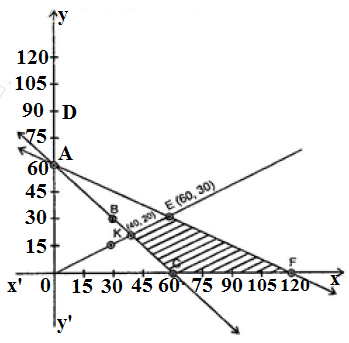
Consider $\text{x}+2\text{y}\leq120$
Let x + 2y = 120
$\Rightarrow\frac{\text{x}}{120}+\frac{\text{y}}{60}=1$
The half plane containing (0, 0) is the required half plane as (0, 0) makes $\text{x}+2\text{y}\leq120$, true.
gain $\text{x}+\text{y}\geq6$
Let x + y = 60
Also the half plane containing (0, 0) does not make $\text{x}+\text{y}\geq6$ true.
Therefore, the required half plane does not contain (0, 0).
Again $\text{x}-2\text{y}\geq0$
Let x - 2y = 0 ⇒ x = 2y
Let test point be (30, 0).
$\Rightarrow\text{x}-2\text{y}\geq0\Rightarrow30-2\times0\geq0$ It is true.
Therefore, the half plane contains (30, 0).
The region CFEKC represents the feasible region.
| At |
C(60, 0) |
Z = 5 × 60 = 300 |
| At |
F(120, 0) |
Z = 5 × 120 = 600 |
| At |
E(60, 30) |
Z = 5 × 60 + 10 × 30 = 600 |
| At |
K(40, 20) |
Z = 5 × 40 + 10 × 20 = 400 |
Hence, minimum Z = 300 at x = 60, y = 0 and maximum Z = 600 at x = 120, y = 0 or x = 60, y = 30. View full question & answer→Question 1445 Marks
A small manufacturer has employed 5 skilled men and 10 semi-skilled men and makes an article in two qualities deluxe model and an ordinary model. The making of a deluxe model requires 2 hrs. work by a skilled man and 2 hrs. work by a semi-skilled man. The ordinary model requires 1 hr by a skilled man and 3 hrs. by a semi-skilled man. By union rules no man may work more than 8 hrs per day. The manufacturers clear profit on deluxe model is Rs. 15 and on an ordinary model is Rs. 10. How many of each type should be made in order to maximize his total daily profit.
AnswerLet x articles of deluxe model and y articles of an ordinary model be made.
Number of articles cannot be negative.
Therefore, $\text{x},\text{y}\geq0$
According to the question, the making of a deluxe model requires 2 hrs.
Work by a skilled man and the ordinary model requires 1 hr by a skilled man
$2\text{x}+\text{y}\leq40$
The making of a deluxe model requires 2 hrs.
Work by a semi-skilled man ordinary model requires 3 hrs.
Work by a semi-skilled man. $2\text{x}+3\text{y}\leq80$
Total profit = Z = 152 + 10y which is to be maximised
Thus, the mathematical formulation of the given linear programmimg problem is
Max Z = 15x + 10y
Subject to
$2\text{x}+\text{y}\leq40$
$2\text{x}+3\text{y}\leq80$
$\text{x}\geq0$
$\text{y}\geq0$
The feasible region determined by the system of constraints is:
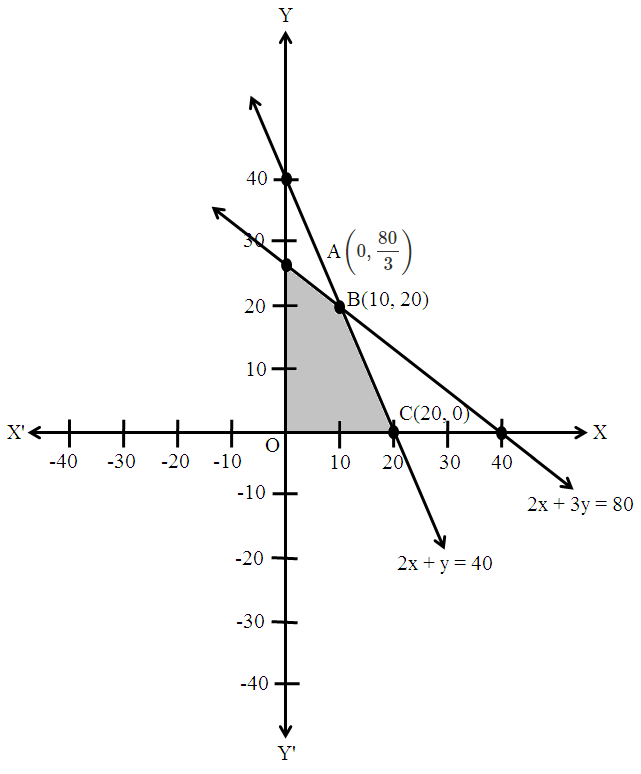
The corner points are $\text{A}\Big(0,\frac{800}{3}\Big)$, B(10, 20), C(20, 0).
The values of Z at these corner points are as follows.
|
Corner point
|
Z = 15x + 10y
|
|
A
|
$\frac{800}{3}$
|
|
B
|
350
|
|
C
|
300
|
The maximum value of Z is 300 which is attained at C(20, 0).
Thus, the maximum profit is Rs. 300 obtained when 10 units of deluxe modal and 20 unit of ordinary model is produced. View full question & answer→Question 1455 Marks
Show the solution zone of the following inequalities on a graph paper:
$\text{x}+\text{y}\leq50$
$3\text{x}+\text{y}\geq90$
$\text{x},\text{y}\geq0$
AnswerWe have to maximize Z = 60x + 15y.
First, we will convert the given inequations into equations, we obtain the following equations:
x + y = 50, 3x + y = 90, x = 0 and y = 0
Region represented by $\text{x}+\text{y}\leq50$.
The line x + y = 50 meets the coordinate axes at A(50, 0) and B(0, 50) respectively.
By joining these points we obtain the line 3x + 5y = 15.
Clearly (0, 0) satisfies the inequation $\text{x}+\text{y}\leq50$.
So, the region containing the origin represents the solution set of the inequation $\text{x}+\text{y}\leq50$.
Region represented by $3\text{x}+\text{y}\geq90$.
The line 3x + y = 90 meets the coordinate axes at C(30, 0) and D(0, 90) respectively.
By joining these points we obtain the line $3\text{x}+\text{y}\geq90$.
Clearly (0, 0) satisfies the inequation $3\text{x}+\text{y}\geq90$.
So, the region containing the origin represents the solution set of the inequation $3\text{x}+\text{y}\geq90$.
Region represented by $\text{x}\geq0$ and $\text{y}\geq0$:
Since, every point in the first quadrant satisfies these inequations.
So, the first quadrant is the region represented by the inequations $\text{x}\geq0$ and $\text{y}\geq0$:
The feasible region determined by the system of constraints,
$\text{x}+\text{y}\leq50,3\text{x}+\text{y}\geq90,\text{x}\geq0$ and $\text{y}\geq0$, are as follows.
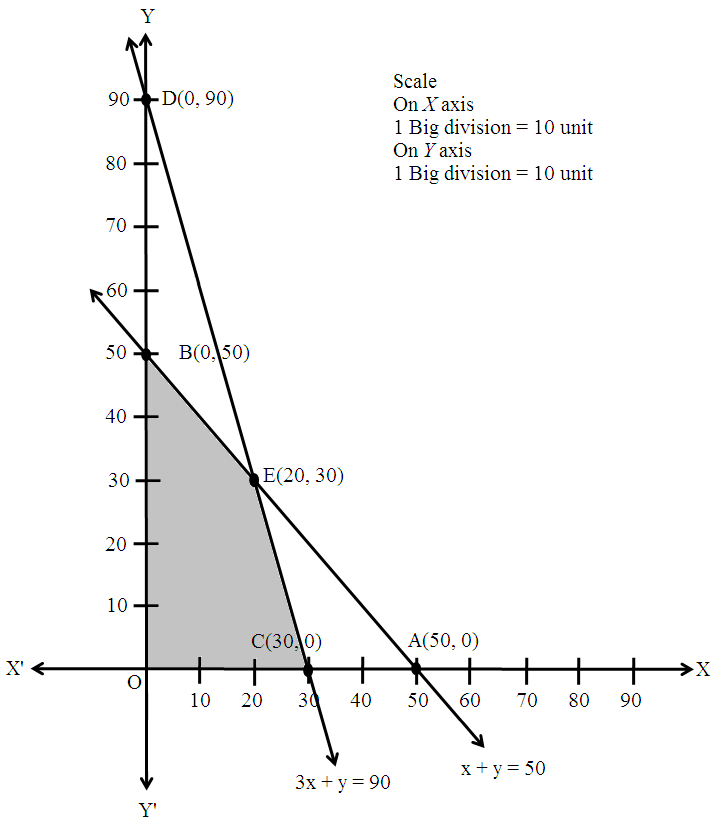
The corner points of the feasible region are O(0, 0), C(30, 0), E(20, 30 ) and B(0, 50).
The values of Z at these corner points are as follows.
| Corner point |
Z = 60x + 15y |
| O(0, 0) |
60 × 0 + 15 × 0 = 0 |
| C(30, 0) |
60 × 30 + 15 × 0 = 1800 |
| E(20, 30) |
60 × 20 + 15 × 30 = 1650 |
| B(0, 50) |
60 × 0 + 15 × 50 = 50 |
Therefore, the maximum value of Z is 1800 at the point (30, 0).
Hence, x = 30 and y = 0 is the optimal solution of the given LPP.
Thus, the optimal value of Z is 1800. View full question & answer→Question 1465 Marks
Maximise Z = 5x + 3y
subject to $3\text{x}+5\text{y}\leq15,\ 5\text{x}+2\text{y}\leq10,\ \text{x}\geq0,\ \text{y}\geq0.$
Answer
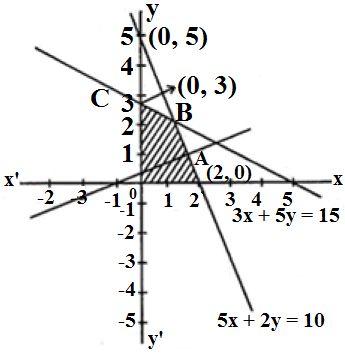 We first draw the graph of equation 3x + 5y = 15
$\Rightarrow\text{x}=\frac{15-5\text{y}}{3}$
For y = 3, x = 0
And for y = 0, x = 5
Similarly, for equation 5x + 2y = 10, the points are (2, 0) and (0, 5).
As (0, 0) satisfies both the inequations and also $\text{x}\geq0,\ \text{y}\geq0,$ then the feasible require contains the half-plane containing (0, 0).
Therefore, the feasible portion is OABC which is shown as shaded in the graph.
Co-ordinates of point B can be obtained by solving 3x + 5y = 15 and 5x + 2y = 10 and it is $\text{B}\Big(\frac{20}{19},\ \frac{45}{19}\Big).$
Thus, co-ordinates of O, A, B and C are (0, 0), (2, 0), $\Big(\frac{20}{19},\ \frac{45}{19}\Big)$ and (0, 3).
Z = 5x + 3y = 0 (if x = 0, y = 0)
Z = 5 × 2 + 3 × 0 = 10 (if x = 2, y = 0)
$\text{Z}=5\times\frac{20}{19}+3\times\frac{45}{19}=\frac{235}{19}$ $\Big(\text{if x}=\frac{20}{19},\ \text{y}=\frac{45}{19}\Big)$
Z = 5 × 0 + 3 × 3 = 9 (if x = 0, y = 3)
Hence, $\text{z}=\frac{235}{19}$ is maximum when $\text{x}=\frac{20}{19},\ \text{y}=\frac{45}{19}.$ View full question & answer→Question 1475 Marks
A fruit grower can use two types of fertilizer in his garden, brand P and Q. The amounts (in kg) of nitrogen, phosphoric acid, potash, and chlorine in a bag of each brand are given in the table. Tests indicate that the garden needs at least 240kg of phosphoric acid, at least 270kg of potash and at most 310kg of chlorine.
|
Kg per bag
|
|
|
Brand P
|
Brand P
|
|
Nitrogen
|
32
|
3.5
|
|
Phosphoric
|
1
|
2
|
|
Potash
|
3
|
1.5
|
|
Chlorine
|
1.5
|
2
|
If the grower wants to minimize the amount of nitrogen added to the garden, how many bags of each brand should be used? What is the minimum amount of nitrogen added in the garden?
AnswerLet x bags of fertilizer P and Y bags of fertilizer Q used in the garden to minimize the usage of nitrogen.
Then the mathematical modal of the LPP is as follows:
Minimise Z = 3x + 3.5y
Subject to
$\text{x}+2\text{y}\geq240$
$3\text{x}+1.5\text{y}\geq270$
$1.5\text{x}+2\text{y}\leq310$
$\text{x}\geq0,\text{y}\geq0$
To solve the LPP we draw the lines,
x + 2y = 240
3x + 1.5y = 270
1.5x + 2y = 310
The feasible region of the LPP is shaded in graph.
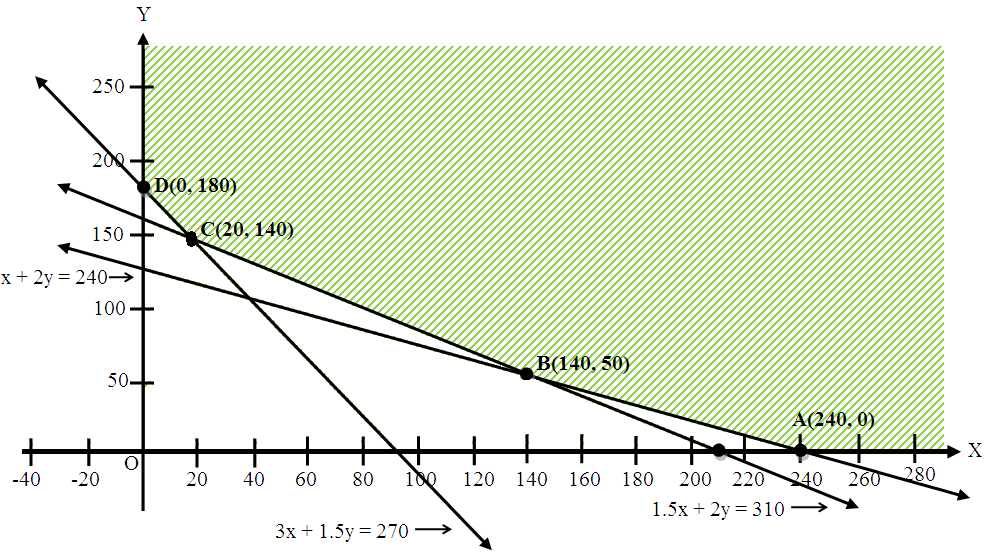
The coordinates of the vertices (corner points) of the feasible region ABC are A(40, 100), B(140, 50), and C(20, 140).
The value of the objective function at these points are given in the following table.
|
Point $(x_1, x_2)$
|
Value of objective function Z = 3x + 3.5y
|
| A(40, 100) |
Z = 470 |
|
B(140, 50)
|
Z = 595
|
| C(20, 140) |
Z = 550 |
| D(0, 8) |
Z = 160 |
40 bags of brand P and 100 bags of brand Q should be used to minimize.
The amount of nitrogen added to the garden.
The minimum amount of notrogen added in the garden is 470kg. View full question & answer→Question 1485 Marks
A medical company has factories at two places, A and B. From these places, supply is made to each of its three agencies situated at P, Q and R. The monthly requirements of the agencies are respectively 40, 40 and 50 packets of the medicines, while the production capacity of the factories, A and B, are 60 and 70 packets respectively. The transportation cost per packet from the factories to the agencies are given below:
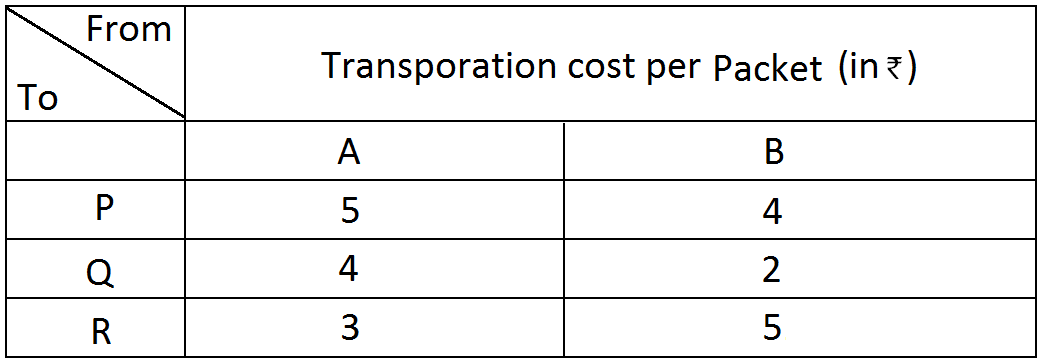
How many packets from each factory be transported to each agency so that the cost of transportation is minimum? Also find the minimum cost?
AnswerThe given information can be exhibited diagramatically as below:
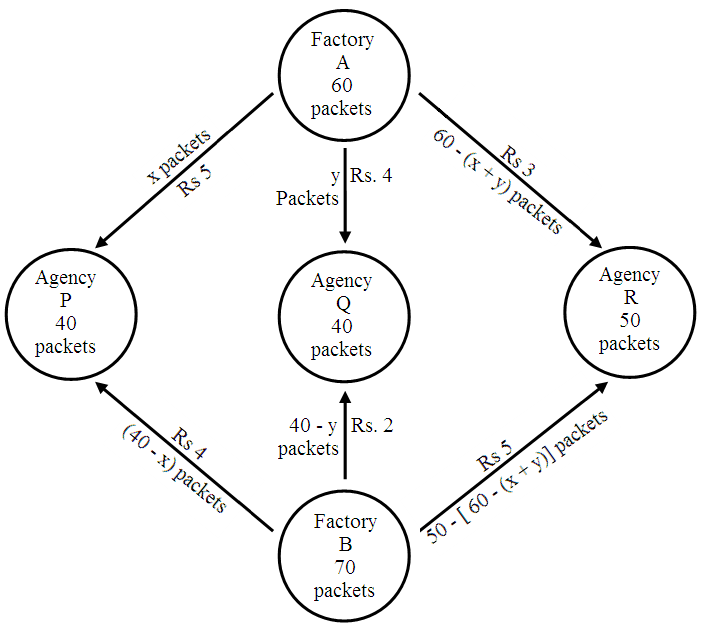
Let factory A transports x packets to agency P and y packet to agency Q.
Since factory A has capacity of 60 packets so, rest [60 - (x + y)] packets transported to agency R.
Since requirements are always non negative so,
= x , y ≥ 0 (first constraint)
and
60 = (x + y) ≥ 0
(x + y) ≥ 60 (second constraint)
Since requirement of agency P is 40 packet but it has recieved x packet, so (40 - x) packets are transported from factory B, requirement of agency Q is 40 packets but it has recieved y packets, so (40 - y) packets are transported from factory B.
Requirement of agency R is 50 packets but it has recieved (60 - x - y) packets from factory A, so 50 - (60 - x - y) - (x + y - 10) is transported from factory B, As the requirements of agencies P, Q, R are always non negative, so,
40 - x ≥ 0
X ≤ 40 (third constraint)
40- y ≥ 0
y ≤ 40 (fourth constraint)
x + y - 10 ≥ 0
x + y ≥ 10 (fifth constraint)
Costs of transportation of each packet from factory A to agency P, Q, R are Rs. 5,4,3 respectively and costs of transportation of each packet from factory 8 to agency P, Q, R are Rs. 4, 2, 5 respectively,
Let Z be total cost of transportation so,
Z = 5x + 4y + 3(60 - x - y) + 4(40 - x) + 2(40 - y) + 5(x + y - 10)
= 5x + 4y + 180 - 3x - 3y + 160 - 4x + 80 - 2y + 5x + 5y - 50
= 3x + 4y + 370
Hence, mathematical formulation of LPP is find x and y which
Maximize Z = 3x + 4y + 370
Subject to constraints,
x, y ≥ 0
x + y ≤ 60
x ≤ 40
y ≤ 0
x + y ≥ 10
Region x, y ≥ 0:
It is represents first quandrant.
Region x + y ≤ 60:
Line x + y ≤ 60 meets axes at $A_1(60, 0), B_1(0, 60)$ respectively.
Region containing origin represents x +y ≤ 60 as (0, 0) satisfies x + y ≤ 60
Region X ≤ 40:
Line x = 40 is parallel to y-axis and meets x-axis at $A_2(40, 0)$.
Region containing origin represents x ≤ 40 as (0, 0) satisfies x ≤ 40.
Region y ≤ 40:
line y = 40 is parallel to x-axis and meets y-axis at $B_2(0, 40)$.
Region containing origin represents y ≤ 40 as (0, 0) satisfies y ≤ 40.
Region x + y ≥ 10:
Line x + y = 10 meets axes at $A_2(10, 0), B_3(0, 10)$ respectively.
Region containing origin represents x + y ≥ 10 as (0, 0) does not satisfy x + y ≥ 10.
Shaded region $A_2A_2PQB_2B_3$ represents feasible region.
Point P(40, 20) is obtained by solving x = 40 and x + y = 60
Point Q(20, 40) is obtained by solving y = 40 and x + y = 60
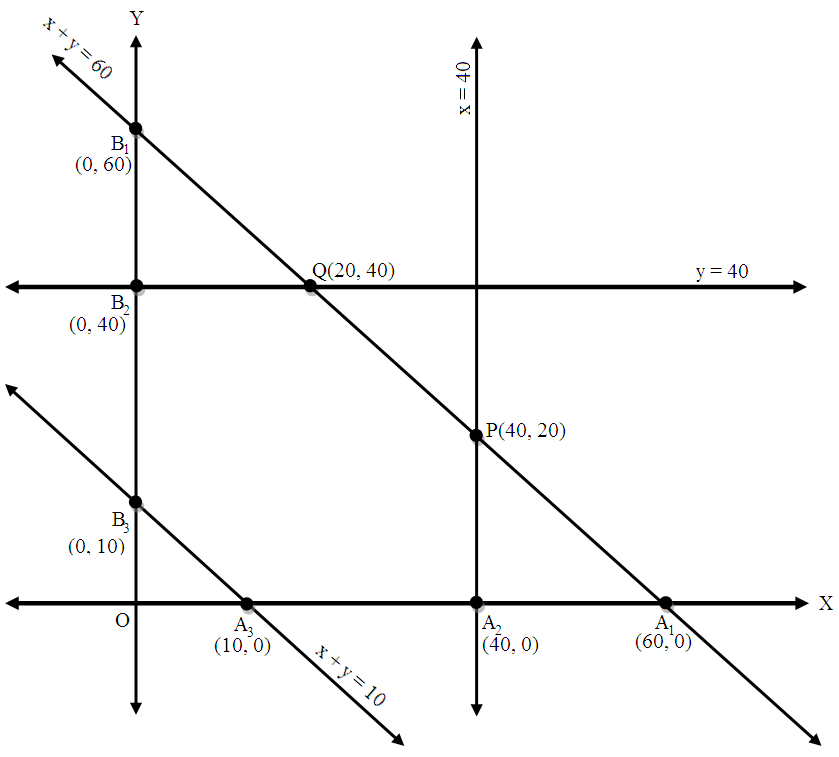
The value of Z = 3x + 4y + 370 at
$A_3(10, 0) = 3(10) + 4(0) + 370 = 400$
$A_2(40, 0) = 3(40) + 4(0) + 370 = 490$
$P(40, 20) = 3(40) + 4(20) + 370 = 570$
$Q(20, 40) = 3(20) + 4(40) + 370 = 590$
$B_2(0, 40) = 3(0) + 4(40) + 370 = 530$
$B_3(0, 10) = 3(0) + 4(10) + 370 = 410$
Minimum Z = 400 at x = 10, y = 0
From A → P = 10 packets
From A → Q = 0 packets
From A → R = 50 packets
From B → P = 30 packets
From B → Q = 40 packets
From B → R = O packets
Minimum cost = Rs. 400 View full question & answer→Question 1495 Marks
A producer has 30 and 17 units of labour and capital respectively which he can use to produce two type of goods x and y. To produce one unit of x, 2 units of labour and 3 units of capital are required. Similarly, 3 units of labour and 1 unit of capital is required to produce one unit of y. If x and y are priced at Rs. 100 and Rs. 120 per unit respectively, how should be producer use his resources to maximize the total revenue? Solve the problem graphically.
AnswerLet xl and yl units of goods x and y were produced respectively.
Number of units of goods cannot be negative.
Therefore, $x_1, y_1 \geq 0$
To produce one unit of x, 2 units of labour and for one unit of y, 3 units of labour are required.
$2x_1 + 3y_1 \leq 30$
To produce one unit of x, 3 units of capital is required and 1 unit of capital is required to produce one unit of y
$3x_1 + y_1 \leq 17$
If x and y are priced at Rs. 100 and Rs. 120 per unit respectively,
Therefore, cost of $x_1$ and $y_1$ units of goods x and y is Rs. $100x_1$ and Rs. $120y_1$ respectively.
Total revenue $= Z = 100x_1 + 120y_1$ which is to be maximised.
Thus, the mathematical formulation of the given linear programmimg problem is
Max $Z = 100x_1 + 120y_1$
Subject to
$2x_1 + 3y_1 \leq 30$
$3x_1 + y_1 \leq 17$
$x_1, y_1 \geq 0$
First we will convert inequations into equations as follows:
$2x_1 + 3y_1 = 30, 3x_1 + y_1 = 17, x = 0$ and $y = 0$
Region represented by $2x_1 + 3y_1 \leq 30$:
The line $2x_1 + 3y_1 = 30$ meets the coordinate axes at A(15, 0) and B(0, 10) respectively.
By joining these points we obtain the line $2x_1 + 3y_1 = 30$.
Clearly (0, 0) satisfies the $2x_1 + 3y_1 = 30$.
So, the region which contains the origin represents the solution set of the inequation $2x_1 + 3y_1 \leq 30$.
Region represented by $3x_1 + y_1 \leq 17$:
The line $3x_1 + y_1 = 17$ meets the coordinate axes at $C(173, 0)$ and $D(0, 17)$ respectively.
By joining these points we obtain the line $3x_1 + y_1 = 17$.
Clearly (0, 0) satisfies the inequation $3x_1 + y_1 \leq 17$.
So, the region which contains the origin represents the solution set of the inequation $3x_1 + y_1 \leq 17$.
Region represented by $x_1 \geq 0$ and $y_1 \geq 0$:
Since, every point in the first quadrant satisfies these inequations.
So, the first quadrant is the region represented by the inequations $x_1 \geq 0$, and $y_1 \geq 0$.
The feasible region determined by the system of constraints $2x_1 + 3y_1 \leq 30, 3x_1 + y_1 \leq 17, x_1 \geq 0$ and $y_1 \geq 0$ are as follows.
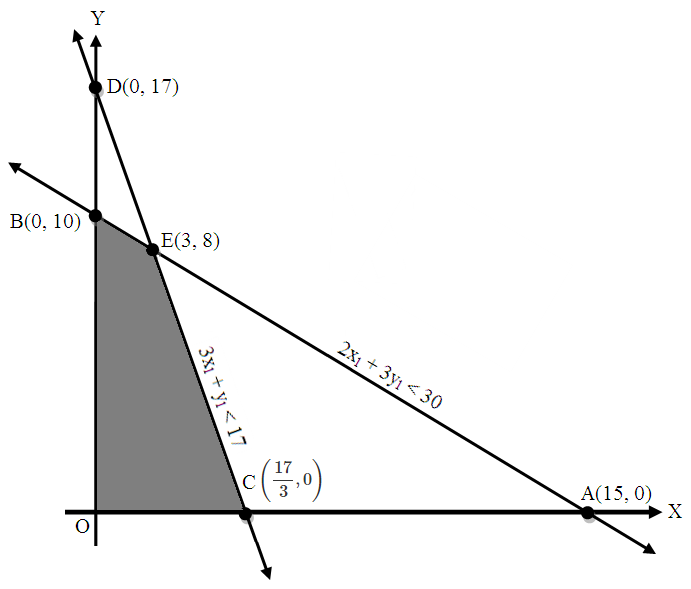
The corner points are B(0, 10), E(3, 8) and C(173, 0).
The values of Z at these corner points are as follows.
|
Corner point
|
$Z = 100x_1 + 120y_1$
|
|
B
|
1200
|
|
E
|
1260
|
|
C
|
17003
|
The maximum value of Z is 1260 which is attained at E(3, 8).
Thus, the maximum revenue is Rs. 1260 obtained when 3 units of x and 8 units of y were produced. View full question & answer→Question 1505 Marks
Maximize $Z = x + y$
Subject to
$-2\text{x}+\text{y}\leq1$
$\text{x}\leq2$
$\text{x}+\text{y}\leq3$
$\text{x},\text{y}\geq0$
AnswerConverting the given inequations into equation,
-2x + y = 1, x = 2, x + y = 3, x= y = 0
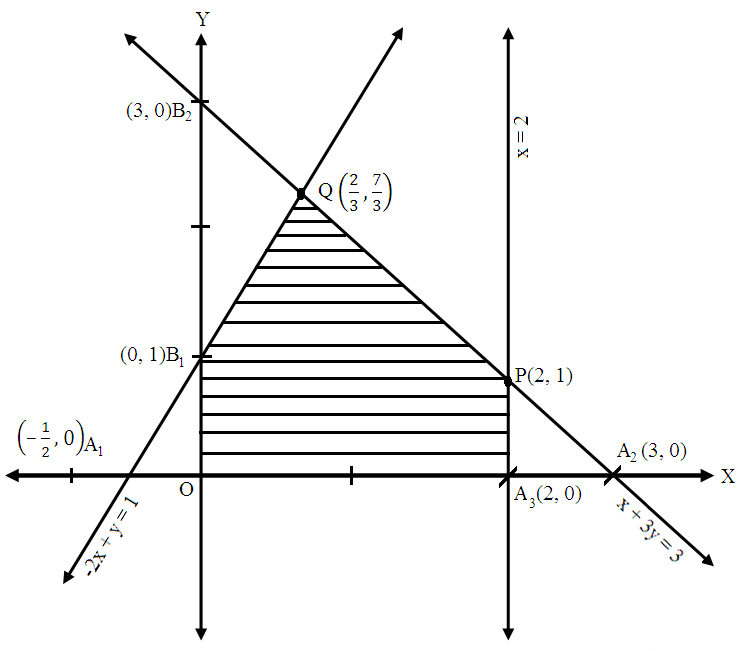
Region represented by - 2x + y = 1:
Line - 2x + y = 1 meets coordinate axes at $\text{A}_1\Big(\frac{-1}{2},0\Big)$ and $B_1(0, 1)$, clearly, $(0, 0)$ satisfies $-2\text{x}+\text{y}\leq1$, so region containing origin represents $-2\text{x}+\text{y}\leq1$ in xy-plane.
Region represented by $\text{x}\leq2$:
Linex - 2 is parallel to y-axis and meets x-axis at $A_3(2, 0)$.
Clearly, (0, 0) satisfies $\text{x}\leq2$, so region containing origin represents $\text{x}\leq2$ in xy-plane.
Region represented by $\text{x}+\text{y}\leq3$:
Line $x + y - 3$ meets coordinate axes at $A_2(3, 0)$ and $B_2(0, 3)$.
Clearly, (0, 0) satisfies $\text{x}+\text{y}\leq3$, so region containing origin represents $\text{x}+\text{y}\leq3$ in xy-plane.
Region represented $\text{x},\text{y}\geq0$:
It represents first quadrant in xy-plane.
So, shaded region $OA_3PQ8$, represents the feasible region.
Coordinates of P(2, 1) is obtained by solving x + y = 3 and x = 2, $\text{Q}\Big(\frac{2}{3},\frac{7}{3}\Big)$ by solving -2x + y = 1 and x + y = 3.
The value of Z = x + y at
$\text{O}(0, 0) = 0 + 0 = 0$
$\text{A}_3(2, 0) = 2 + 0 = 2$
$\text{P}(2, 1) = 2 +1 = 2$
$\text{Q}\Big(\frac{2}{3},\frac{7}{3}\Big)=\frac{2}{3}+\frac{7}{3}=3$
$\text{B}_1(0, 1) = 0 + 1 = 1$
So, maximum Z = 3 is at every point on the line joining PQ.
Hence, maximum z = 3 at x = 2 and y = 1 Or $\text{x}=\frac{2}{3}$ and $\text{y}=\frac{7}{3}.$ View full question & answer→Question 1515 Marks
If a young man drives his scooter at a speed of 25km/hr, he has to spend Rs. 2 per km on petrol. If he drives the scooter at a speed of 40km/hr, it produces air pollution and increases his expenditure on petrol to Rs. 5 per km. He has a maximum of Rs. 100 to spend on petrol and travel a maximum distance in one hour time with less polution. Express this problem as an LPP and solve it graphically. What value do you find here.
AnswerLet the distance covered with speed 25 km/hr = x km
And, the distance covered with speed 40 km/hr = y km
We know that,
$\text{Time} = \frac{\text{Distance}}{\text{Speed}}$
Thus, Maximum speed covered within one hour $= \frac{\text{x}}{25} + \frac{\text{y}}{40} \leq 1$
Thus, According to question,
Maximum speed covered, $\text{Z}_\text{max} = \text{x} + \text{y}$
Subject to the constrains, $\text{2x + 5y} \leq 100$
$\frac{\text{x}}{25} + \frac{\text{y}}{40} \leq 1$
$\text{x} , \text{y} \geq 0$
Now plotting both line on graph paper, we have,
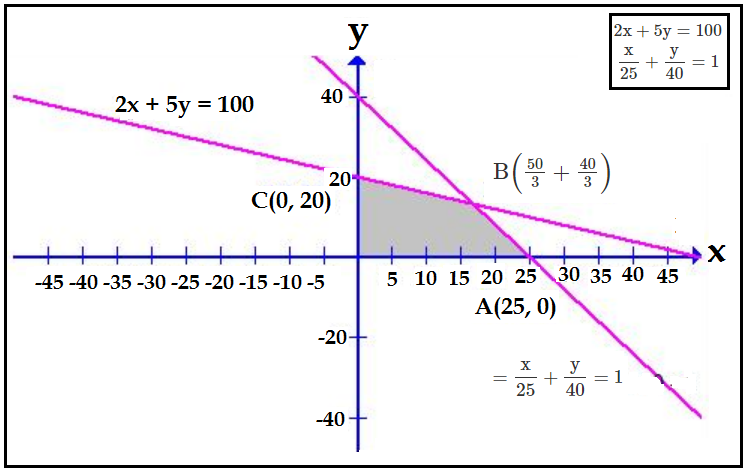
from graph, OABC is feasible region.
Thus, maximum distance covered $= \frac{50}{3} + \frac{40}{3} = 30 \text{km}$ View full question & answer→Question 1525 Marks
Maximum $Z = 3x + 5y$
Subject to
$\text{x}+2\text{y}\leq20$
$\text{x}+\text{y}\leq15$
$\text{y}\leq5$
$\text{x},\text{y}\geq0$
AnswerConverting the given inequations into equation:-
x + 2y = 20, x + y = 15, x = y = 0
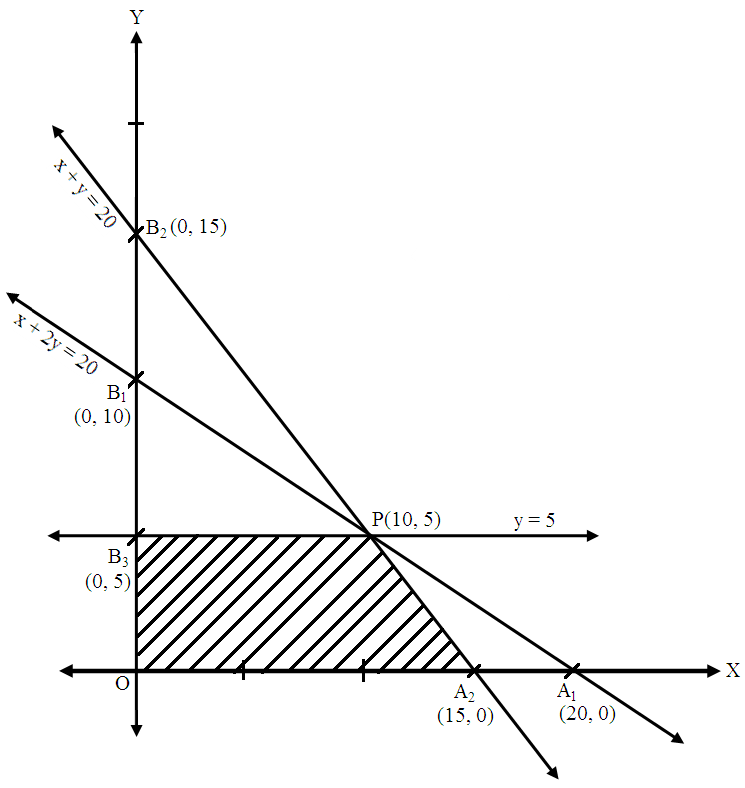
Region represented by x + 2y = 20:
Line x + 2y = 20 meets coordinate axes at $A_1(20, 0)$ and $B_1(0, 10)$, clearly, $(0, 0)$ satisfies $\text{x}+2\text{y}\leq20$, so region containing origin represents $\text{x}+2\text{y}\leq20$ in xy -plane.
Region represented by $\text{x}+\text{y}\leq15$:
Line x + y = 15 meets coordinate axes at $A_2(15, 0)$ and $B_2(0, 15)$, clearly, (0, 0) satisfies $\text{x}+\text{y}\leq15$, so region containing origin represents x + y = 15 in xy-plane.
Region represented by $\text{y}\leq5$:
Line y = 5 is parallel to x-axis and meets at $B_3(0, 5)$ on y-axis.
Clearly (0, 0) satisfies $\text{y}\leq5$, so region containing origin represents y s 5 in xy-plane.
Region represented by $\text{x},\text{y}\geq0$:
It represent the first quadrant in xy-plane.
So, shaded region $OA_2PB_3$ represents the feasible region.
Coordinate of P(10, 5) is obtained by solving x + 2y = 20 and y - 5
The value of Z = 3x + 5y at
$O(0, 0) = 3(0) + 5(0) = 0$
$A_2(15, 0) = 3(15) + 5(0) = 45$
$P(10, 5) = 3(10) + 5(5) = 55$
$B_3(0, 5) = 3(0) + 5(5) = 25$
Hence, maximum Z = 55 at x = 10 and y = 5 View full question & answer→Question 1535 Marks
A small firm manufactures gold rings and chains. The total number of rings and chains manufactured per day is at most 24. It takes 1 hour to make a ring and 30 minutes to make a chain. The maximum number of hours available per day is 16. If the profit on a ring is Rs. 300 and that on a chain is Rs. 190, find the number of rings and chains that should be manufactured per day, so as to earn the maximum profit. Make it as an LPP and solve it graphically.
AnswerLet required number of gold rings and chains are x and y respectively.
Since,profits on each ring and chains are Rs. 300 and Rs. 190 respectively, so, profit on x units of ring and y units of chains are Rs. 300x and Rs. 190y respectively
Let Z be total profit so
Z = 300x + 190y
Since each unit of ring and chain require 1 hr and 30 min. to make respectively, so,
X units of rings and y units of rings require 60x and 30y min. to make respectivley, but total time available to make is 16 × 60 = 960, so,
60x + 30y ≤ 960
= 2x + y ≤ 32 (first constraint)
Given, total number of rings and chains manufactured is at most 24, so,
x + y ≤ 24 (second constraint)
Hence, mathematical formulation of LPP is find x and y which
Maximize Z = 300x + 160y
Subject to constriants,
2x + y ≤ 32
x + y ≤ 4
x, y ≥ 0 [Since production can not be less than zero]
Region 2x + y ≤ 32:
Line 2x + y = 32 meets axes at $A_1(16, 0), B_1(0, 32)$ respectively.
Region containing origin represents 2x + y ≤ 32 as (0, 0) satisfies 2x +y ≤ 32
Region x + y ≤ 24:
Line x + y = 24 meets axes at $A_2(24, 0), B_2(0, 24)$ respectively.
Region containing origin represents x + y ≤ 24 as (0, 0) satisfies x + y ≤ 24.
Region x, y ≥ 0:
It represent first quandrant
Shaded region $OA_1PB_2$ represents feasible region.
Point P(8, 16) is obtained by solving 2x + y = 32 and x + y = 24.
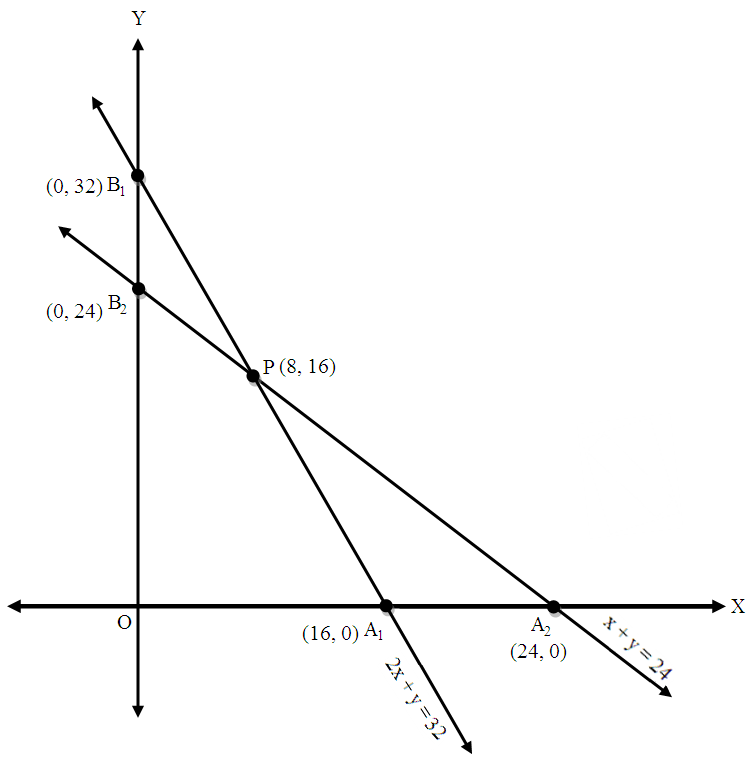
The value of $Z = 300x + 160y$ at
$O(0, 0) = 300(0) + 160(0) = 0$
$A_1(16, 0) = 300(16) + 160(0) = 4800$
$P(8, 16) = 300(8) + 160(16) = 4960$
$B_2(0, 24) = 300(0) + 160(24) = 3840$
Maximum Z = 4960 at x = 8, y = 16
Number of rings = 8, chains = 16
Maximum profit = Rs. 4960 View full question & answer→Question 1545 Marks
Maximize Z = 50x + 30y
Subject to
$2\text{x}+\text{y}\leq18$
$3\text{x}+2\text{y}\leq34$
$\text{x},\text{y}\geq0$
AnswerFirst, we will convert the given inequations into equations, we obtain the following equations:
2x + y = 18, 3x + 2y = 34
Region represented by 2x + y ≥ 18:
The line 2x + y = 18 meets the coordinate axes at A(9, 0) and B(0, 18) respectively. By joining these points we obtain the line 2x + y = 18.
Clearly (0,0) does not satisfies the inequation 2x + y ≥ 18.
So,the region in xy plane which does not contain the origin represents the solution set of the inequation 2x + y ≥ 18.
Region represented by 3x + 2y ≤ 34:
The line 3x + 2y = 34 meets the coordinate axes at $\text{C}\Big(\frac{34}{3},0\Big)$ and D(0, 17) respectively. By joining these points we abtain the line 3x + 2y = 34.
Clearly (0. 0) satisfies the inequation 3x + 2y ≤ 34. So, the region containing the origin represents the silution set of the inequation 3x + 2y ≤ 34.
The corner of the feasible region are A(9, 0), $\text{C}\Big(\frac{34}{3},0\Big)$ and E(2, 14).
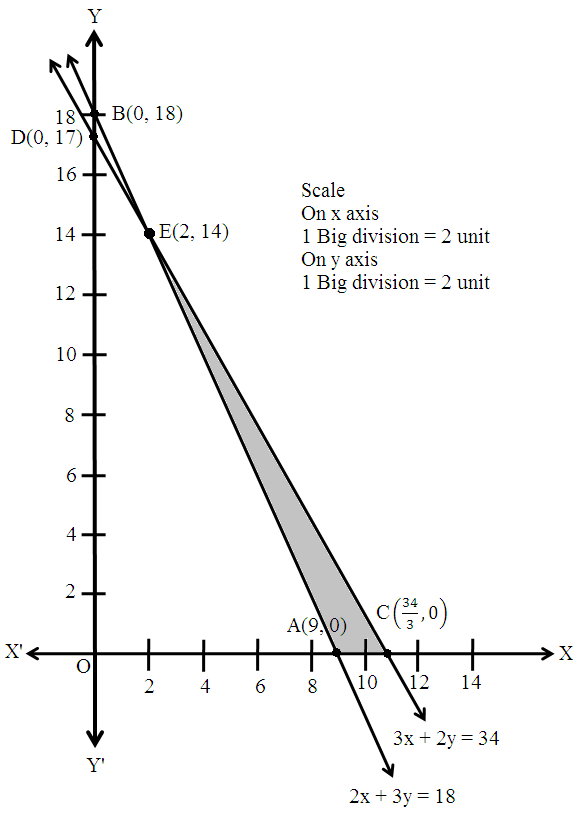
The values of Z at these corner points are as follows.
|
$\text{Corner point}$
|
$\text{Z}=50\text{x}+30\text{y}$
|
|
$\text{A}(9, 0)$
|
$50\times9+3\times0=450$
|
|
$\text{C}\Big(\frac{34}{3},0\Big)$
|
$50\times\frac{34}{3}+30\times0=\frac{1700}{3}$
|
|
$\text{E}(2, 14)$
|
$50\times2+30\times14=520$
|
Therefore, the maximum value of Z $\frac{1700}{3}$ is at the point $\Big(\frac{34}{3},0\Big)$.
Hence, $\text{x}=\frac{34}{3}$ and $\text{y}=0$ is the optimal solution of the given LPP.
Thus, the optimal value of Z is $\frac{1700}{3}$. View full question & answer→Question 1555 Marks
There are two types of fertilisers 'A' and 'B'. 'A' consists of 12% nitrogen and 5% phosphoric acid whereas 'B' consists of 4% nitrogen and 5% phosphoric acid. After testing the soil conditions, farmer finds that he needs at least 12kg of nitrogen and 12kg of phosphoric acid for his crops. If 'A' costs Rs. 10 per kg and 'B' cost Rs. 8 per kg, then graphically determine how much of each type of fertiliser should be used so that nutrient requiremnets are met at a minimum cost.
AnswerThe given information can tabulated as follows:
|
Fertilizer
|
Nitrogen
|
Phosphoric Acid
|
Cost/kg (in Rs.)
|
|
A
|
12%
|
5%
|
10
|
|
B
|
4%
|
5%
|
8
|
Let the requirement of fertilizer A by the farmer be x kg and that of B be y kg.
It is given that farmer requires atleast 12kg of nitrogen and 12kg of phosphoric acid for his crops.
The inequations thus formed based on the given information are as follows:
12100x + 4100y ≥ 12
⇒ 12x + 4y ≥ 1200
⇒ 3x + y ≥ 300 .....(1)
Also,
5x100 + 5y100 ≥ 12
⇒ 5x + 5y ≥ 1200
⇒ x + y ≥ 240 .....(2)
Total cost of the fertilizer Z = Rs. (10x + 8y)
Therefore, the mathematical formulation of the given linear programming problem can be stated as:
Minimize Z = 10x + 8y
Subject to the constraints
3x + y ≥ 300 .....(1)
x + y ≥ 240 .....(2)
x ≥ 0, y ≥ 0 .....(3)
The feasible region determined by constraints (1) to (3) is graphically represented as:
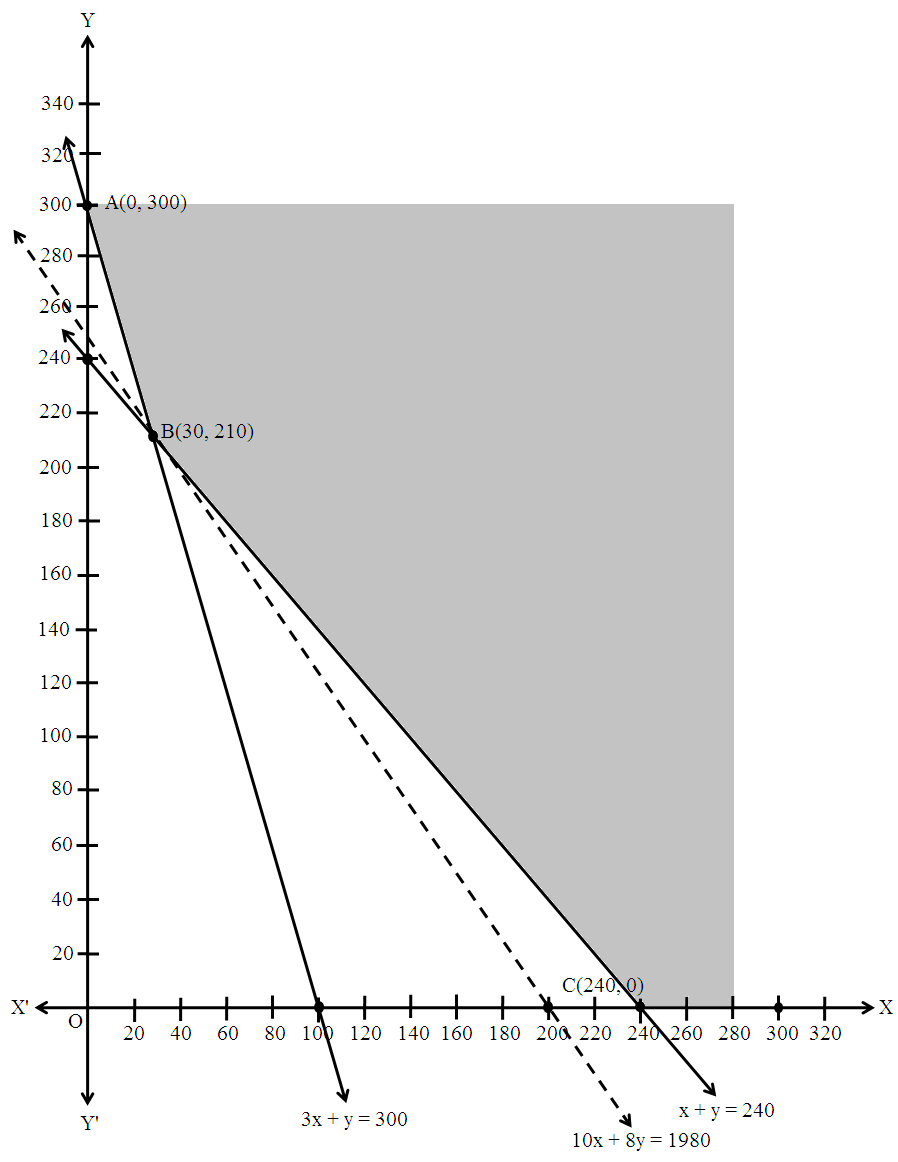
Here, it is seen that the feasible region is unbounded.
The values of Z at the corner points of the feasible region are represented in tabular form as:
|
Corner point
|
Z = 10x + 8y
|
|
A(0, 300)
|
Z = 10 × 0 + 8 × 300 = 2400
|
|
B(30, 210)
|
Z = 10 × 30 + 8 × 210 =1980
|
|
C(240, 0)
|
Z = 7 × 240 + 8 × 0 = 2400
|
The open half plane determined by 10x + 8y < 1980 has no point in common with the feasible region.
So, the minimum value of Z is 1980.
The minimum value of Z is 1980, which is obtained at x = 30 and y = 210.
Thus, the minimum requirement of fertilizer of type A will be 30 kg and that of type B will be 210 kg.
Also, the total minimum cost of the fertilisers is Rs. 1980.
View full question & answer→Question 1565 Marks
Two tailors, A and B earn Rs. 15 and Rs. 20 per day respectively. A can stitch 6 shirts and 4 pants while B can stitch 10 shirts and 4 pants per day. How many days shall each work if it is desired to produce (at least) 60 shirts and 32 pants at a minimum labour cost?
AnswerSuppose tailor A and B work for x and y days respectively.
Since, tailor A and B earn Rs. 15 and Rs. 20 respectively.
So, tailor A and B earn is X and Y days Rs. 15x and 20y respectively, let z denote maximum profit that gives minimum labour cost, so,
Z = 15x + 20y
Since, Tailor A and B stitch 6 and 10 shirts respectively in a day, so, tailor A can stitch 6x and B can stitch 10y shirts in x and y days respectively, but it is desired to produce 60 shirts at least, so
$6\text{x}+10\text{y}\geq60$
$3\text{x}+5\text{y}\geq30$ (first constraint)
Since, Tailor A and B stitch 4 pants per day each, so, tailor A can stitch 4x and B can stitch 4y pants in x and y days respectively, but it is desired to produce at least 32 pants, so
$4\text{x}+4\text{y}\geq32$
$\text{x}+\text{y}\geq8$ (second constraint)
Hence, mathematical formulation of LPP is,
Find x and y which minimize
Z = 15x + 20y
Subject to constraints,
$3\text{x}+5\text{y}\geq30$
$\text{x}+\text{y}\geq8$
$\text{x},\text{y}\geq0$ [Since x and y not be less than zero]
Region $3\text{x}+5\text{y}\geq30$:
Line 3x + 5y = 30 meets axes at $A_1(10, 0), B_1(0, 6)$ respectively.
Region not containing origin represents $3\text{x}+5\text{y}\geq30$ as (0, 0) does not satisfy $3\text{x}+5\text{y}\geq30$.
Region $\text{x}+\text{y}\geq8$:
Line x + y = 8 meets axes at $A_2(8, 0), B_2(0, 8)$ respectively.
Region not containing origin represents $\text{x}+\text{y}\geq8$ as (0, 0) does not satisfy $\text{x}+\text{y}\geq8$.
Region $\text{x},\text{y}\geq0$:
It represent first quadrant.
Unbounded shaded region $AP_1B_2$ represents feasible region with corner points $A_1(10, 0), P(5, 3),B_2(0, 8)$.
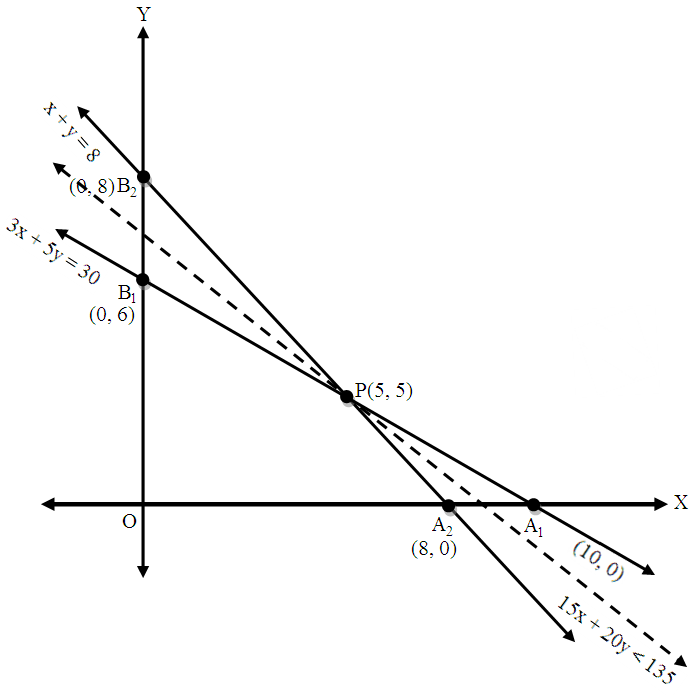
The value of $Z = 15x + 20y$ at
$A_1(10, 0) = 15(10) + 20(0) = 150$
$P(5, 3) = 15(5) + 20(3) = 135$
$B_2(0, 8) = 15(0) + 20(8) = 160$
Smallest value of Z is 135,
Now open half plane 15x + 20y < 135 has no point in common with feasible region, so smallest value is the minimum value.
So, Z = 135, at x = 5, y = 3
Tailor A should work for 5 days and B should work for 3 days. View full question & answer→Question 1575 Marks
Two godowns A and B have grain capacity of 100 quintals and 50 quintals respectively. They supply to 3 ration shops, D, E and F whose requirements are 60, 50 and 40 quintals respectively. The cost of transportation per quintal from the godowns to the shops are given in the following table:
|
Transportation cost per quintal (in Rs)
|
|
From/ To
|
A
|
B
|
|
D
E
F
|
6
3
2.50
|
4
2
3
|
How should the supplies be transported in order that the transportation cost is minimum? What is the minimum cost?
AnswerLet godown A supplies x quintals of grain to the ration shop D and y quintals to ration shop E. We have to minimize $\text{Z}=6\text{x}+3\text{y}+\frac{5}{2}$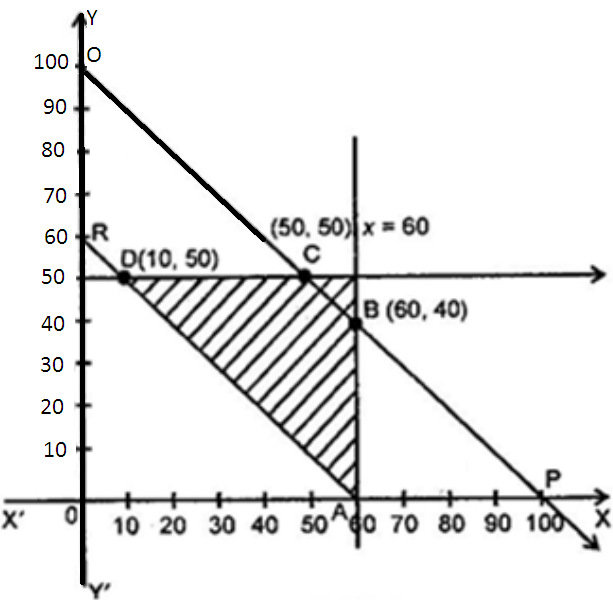
$(100-\text{x}-\text{y})+4(60-\text{x})+2(50-\text{y})+3(\text{x}+\text{y}-10)$ $\Rightarrow\ \text{Z}=\frac{5\text{x}}{2}+\frac{3\text{y}}{2}+410$ Subject to $\text{x}+\text{y}\leq100,\ \text{x}\leq60,\ \text{y}\leq50\text{ and }\text{x}+\text{y}\geq60,\ \text{x}\geq0,\ \text{y}\geq0.$ Consider $\text{x}+\text{y}\leq100$ Let x + y = 100 $\Rightarrow\ \frac{\text{x}}{100}+\frac{\text{y}}{100}=1$ $\therefore\ $Points P(100, 0) and Q(0, 100) lie on the line and it represents the half-plane containing (0, 0). Again we consider $\text{x}\leq60\text{ and }\text{y}\leq50$ We draw x = 60 and y = 50 Again consider $\text{x}+\text{y}\geq60$ Let x + y = 60 $\Rightarrow\ \frac{\text{x}}{60}+\frac{\text{y}}{60}=1$ $\therefore\ $Points A(60, 0) and R(0, 60) lie on the line and it represents the half-plane containing (0, 0) The shaded region is the feasible solution. Its corners are A(60, 0), B(60, 40), C(50, 50) and D(10, 50). Now $\text{Z}=\frac{5\text{x}}{2}+\frac{3\text{y}}{2}+410$
| $\text{At }\ \ \ \text{ A}(60, 0)$ |
$\text{Z}=\frac{5}{2}\times60+\frac{3}{2}\times0+410=150+410=560$ |
| $\text{At }\ \ \ \text{ B}(60, 40)$ |
$\text{Z}=\frac{5}{2}\times60+\frac{3}{2}\times40+410=150+60+410=620$ |
| $\text{At }\ \ \ \text{ C}(50, 50)$ |
$\text{Z}=\frac{5}{2}\times50+\frac{3}{2}\times50+410=125+75+410=610$ |
| $\text{At }\ \ \ \text{ D}(10, 50)$ |
$\text{Z}=\frac{5}{2}\times10+\frac{3}{2}\times50+410=25+75+410=510$ |
Hence minimum value is Z = 510 at x = 10, y = 50. View full question & answer→Question 1585 Marks
An automobile manufacturer makes automobiles and trucks in a factory that is divided into two shops. Shop A, which performs the basic assembly operation, must work 5 man-days on each truck but only 2 man-days on each automobile. Shop B, which performs finishing operations, must work 3 man-days for each automobile or truck that it produces. Because of men and machine limitations, shop A has 180 man-days per week available while shop B has 135 man-days per week. If the manufacturer makes a profit of Rs 30000 on each truck and Rs 2000 on each automobile, how many of each should he produce to maximize his profit? Formulate this as a LPP.
AnswerLet x number of trucks and y number of automobiles were produced to maximize the profit.
Since, the manufacturer makes profit of Rs. 30000 on each truck and Rs. 2000 on each automobile.
Therefore, on x number of trucks and y number of automobiles profit would be Rs. 30000x and Rs. 2000yrespectively.
Total profit = Rs. (30000x + 2000y)
Let Z denote the total profit
Then, Z = 30000x + 2000y
Since, 5 man-days and 2 man-days were required to produce each truck and automobile at shop A.
Therefore, 5x man-days and 2y man-days are required to produce x trucks and y automobiles at shop A.
Also,
Since 3 man-days were required to produce each truck and automobile at shop B.
Therefore, 3x man-days and 3y man-days are required to produce x trucks and y automobiles.
As, shop A has 180 man-days per week available while shop B has 135 man-days per week.
$\therefore5\text{x}+2\text{y}\leq180,3\text{x}+3\text{y}\leq135$
Number of trucks and automobiles cannot be negative.
$\therefore\text{x},\text{y}\geq0$
Hence, the required LPP is as follows:
Maximize Z = 30000x + 2000y
Subject to
$5\text{x}+2\text{y}\leq180,$
$3\text{x}+3\text{y}\leq135,$
$\text{x}\geq0,\text{y}\geq0$
View full question & answer→Question 1595 Marks
A manufacturer has three machine I, II, III installed in his factory. Machines I and II are capable of being operated for at most 12 hours whereas machine III must be operated for atleast 5 hours a day. She produces only two items M and N each requiring the use of all the three machines.
The number of hours required for producing 1 unit each of M and N on the three machines are given in the following table:
|
Item
|
Number of hours required on machines
|
|
|
I
|
II
|
III
|
|
M
|
1
|
2
|
1
|
|
N
|
2
|
1
|
1.25
|
She makes a profit of Rs. 600 and Rs. 400 on items M and N respectively. How many of each item should she produce so as to maximise her profit assuming that she can sell all the items that she produced? What will be the maximum profit?
AnswerSuppose x units of item M and y units of item N are produced to maximise the profit.
Since each unit of item M require 1 hours on machine I and each unit of item N require 2 hours on machine I, therefore, the total hours required for producing x units of item M and yunits of item N on machine I are (2x + y).
But, machines I is capable of being operated for at most 12 hours.
2x + y ≤ 12 Similarly, each unit of item M require 2 hours on machine II and each unit of item N require 1 hour on machine II, therefore, the total hours required for producing x units of item M and yunits of item N on machine II are (x + 2y).
But, machines II is capable of being operated for at most 12 hours.
x + 2y ≤ 12 Also, each unit of item M require 1 hour on machine III and each unit of item N require 1.25 hour on machine III, therefore, the total hours required for producing x units of item M and yunits of item N on machine III are (x+ 1.25y).
But, machines III must be operated for atleast 5 hours.
x + 1.25 ≥ 5
The profit from each unit of item M is 2600 and each unit of item N is Rs. 400.
Therefore, the total profit from x units of item M and yunits of item N is Rs. (600x + 400y).
Thus, the given linear programming problem is Maximise Z = 600x + 400y
Subject to the constraints
2x + y ≤ 12
x + 2y ≤ 12
x + 1.25y ≥ 5
x, y ≥ 0
The feasible region determined by the given constraints can be diagrammatically represented.
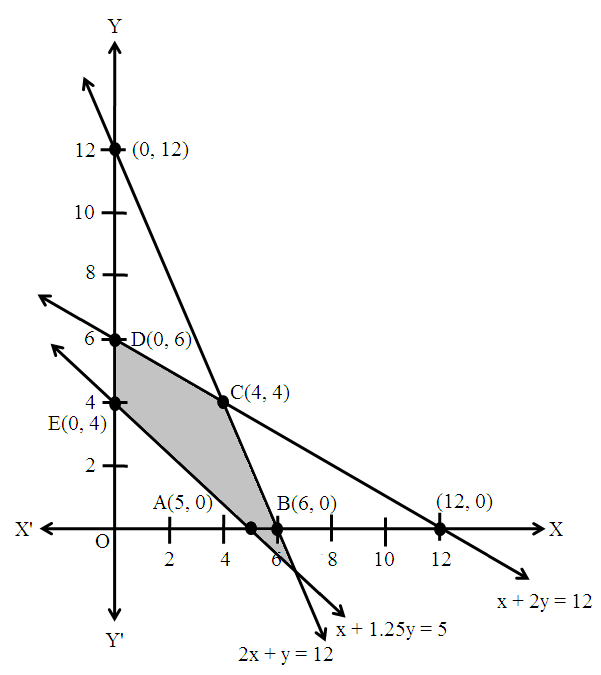
The coordinates of the corner points of the feasible region are A(5, 0), B(6, 0), C(4, 4), D(0, 6) and E(0, 4).
The value of the objective function at these points are given in the following table.
|
Corner Point
|
Z = 600x + 400y
|
|
|
(5, 0)
|
600 × 5 + 400 × 0 = 3000
|
|
|
(6, 0)
|
600 × 6 + 400 × 0 = 3600
|
|
|
(4, 4)
|
600 × 4 + 400 × 4 = 4000
|
→ Maximum |
|
(0, 6)
|
600 × 0 + 400 × 6 = 2400
|
|
|
(0, 4)
|
600 × 0 + 400 × 4 = 1600
|
|
The maximum value of Z is 4000 at x = 4, y = 4.
Hence, 4 units of item M and 4 units of item N should be produced to maximise the profit.
The maximum profit of the manufacturer is Rs. 4,000.
View full question & answer→Question 1605 Marks
A firm manufactures 3 products A, B and C. The profits are Rs. 3, Rs. 2 and Rs. 4 respectively. The firm has 2 machines and below is the required processing time in minutes for each machine on each product:
|
Machine
|
Products
|
|
A
|
B
|
C
|
|
$M_1$
|
4
|
3
|
5
|
|
$M_2$
|
2
|
2
|
4
|
Machines $M_1$ and $M_2$ have 2000 and 2500 machine minutes respectively. The firm must manufacture 100 A's, 200 B's and 50 C's but not more than 150 A's. Set up a LPP to maximize the profit. Answer
|
Product
|
Machine $(M_1)$
|
Machine $(M_2)$
|
Profit
|
|
A
|
4
|
2
|
3
|
|
B
|
3
|
2
|
2
|
|
C
|
5
|
4
|
4
|
|
Capacity maximum
|
2000
|
2500
|
|
Let required production of product A, B and C bex,y and z units respectively.
Given, profit on one unit of product A, B and C are Rs. 3, RS. 2, RS. 4, so Profit on x unit of A, y unit of B and z unit of C are given by Rs. 3x, Rs. 2y, Rs. 4z.
Let U be the total profit, so
U = 3x + 2y + 4z
Given, one unit of product A, B and C requires 4,3 and 5 minutes on machine M. So, x units of product A, y units of B and z units of product C need 4x, 3y and 5z minutes on machine M, is 2000 minutes, so
$4\text{x}+3\text{y}+5\text{z}\leq200$ (First constraint)
Given, one unit of product A, B and C requires 2,2 and 4 minutes on machine M2. So, X units of A, y units of B and z units of C require 2x, 2y and 4z minutes on machine M2 is 2500 minutes, so
$2\text{x}+2\text{y}+4\text{z}\leq2500$ (Second constraint)
Also, given that firm must manufacture 100 A's, 200 B's and 50 C's but not more than 150 A's.
$100\leq\times\leq150$
$\text{y}\geq200$ (Other constraints)
$\text{z}\geq50$
Hence, mathematical formulation of LPP is:-
Find x, y and z which
maximize U = 3x + 2y + 4z
Subject to constraints,
$4\text{x}+3\text{y}+5\text{z}\leq2000$
$2\text{x}+2\text{y}+4\text{z}\leq2500$
$100\leq\times\leq150$
$\text{y}\geq200$
$\text{z}\geq50$
And, $\text{x},\text{y},\text{z}\geq0$ [Since, x, y, z are non-negative] View full question & answer→Question 1615 Marks
Tow godowns, A and B, have grain storage capacity of 100 quintals and 50 quintals respectively. They supply to 3 ration shops, D, E and F, whose requirements are 60, 50 and 40 quintals respectively. The cost of transportation per quintal from the godowns to the shops are given in the following table:
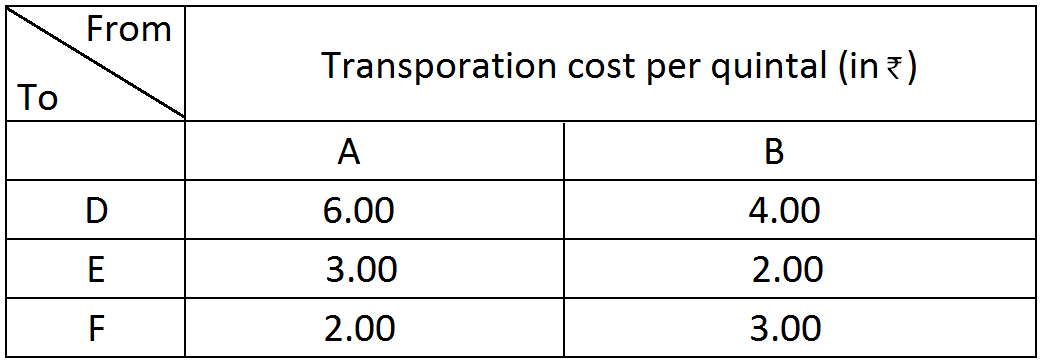
How should the supplies be transported in order that the transportation cost is minimum?
AnswerLet godown A supply x quintals and y quintals of grain to the shops D and E respectively.
Then, (100 - x - y) will be supplied to shop F.
The requirement at shop D is 60 quintals since, x quintals are transported from godown A.
Therefore, the remaining (60 - x) quintals will be transported from godown B.
Similarly, (50 - y) quintals and 40 - (100 - x - y) i.e. (x + y - 60) quintals will be transported from godown B to shop E and F respectively.
The given problem can be represented diagrammatically as follows.
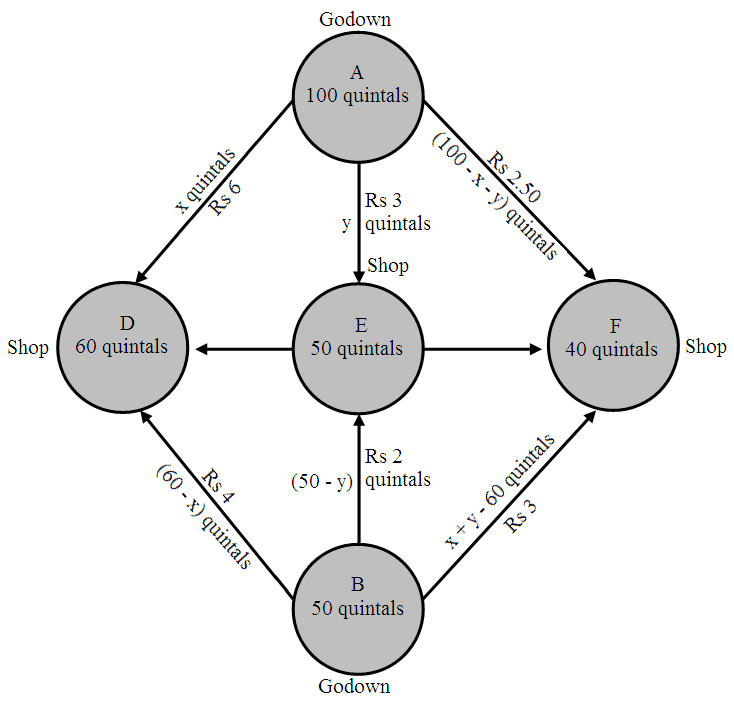
Quantity of the grain cannot be negative.
Therefore, x ≥ 0, y ≥ 0, and 100 - x - y ≥ 0
x ≥ 0, y ≥ 0, and x + y ≤ 100
60 - x ≥ 0, 50 - y ≥ 0, and x + y - 60 ≥ 0
x ≤ 60, y ≤ 50, and x + y ≥ 60
Total transportation cost Z is given by,
Z = 6x + 3y + 2.5 (100 - x - y) + 4(60 - x) + 2(50 - y) + 3(x + y - 60)
= 6x + 3y + 250 - 2.5x - 2. 5y + 240 - 4x + 100 - 2y + 3x + 3y - 180
= 2.5x + 1. 5y + 410
The given problem can be formulated as:
Minimize Z = 2.5x + 1.5y + 410
Subject to the constraints,
x + y ≤ 100
X ≤ 60
y ≤ 50
x + y ≥ 60
x, y ≥ 0
First we will convert inequations into equations as follows:
x + y = 100, x = 60, y = 50, x + y = 60, x = 0 and y = 0
Region represented by x + y ≤ 100:
The line x + y = 100 meets the coordinate axes at $A_1(100, 0)$ and $B_1(0, 100)$ respectively.
By joining these points we obtain the line x + y = 100.
Clearly (0, 0) satisfies the x + y ≤ 100.
So, the region which contains the origin represents the solution set of the inequation
x + y ≤ 100.
Region represented by x ≤ 60:
x = 60 is the line that passes (60, 0) and is parallel to the y-axis.
The region to the left of the line x = 60 will satisfy the inequation x ≤ 60.
Region represented by y ≤ 50:
y = 50 is the line that passes (0, 50) and is parallel to the x-axis.
The region below the line y = 50 will satisfy the inequation y ≤ 50.
Region represented by x + y ≥ 60:
The line x + y= 60 meets the coordinate axes at $C_1(60, 0)$ and $D_1(0, 60)$ respectively.
By joining these points we obtain the line x + y = 60.
Clearly (0, 0) does not satisfies the inequation x + y ≥ 60.
So, the region which does not contain the origin represents the solution set of the inequation x + y ≥ 60.
Region represented by x ≥ 0 and y ≥ 0:
Since, every point in the first quadrant satisfies these inequations.
So, the first quadrant is the region represented by the inequations x ≥ 0, and y ≥ 0.
The feasible region determined by the system of constraints x + y ≤ 100, x ≤ 60, y ≤ 50, x + y ≥ 60, x ≥ 0 and y ≥ 0 are as follows.
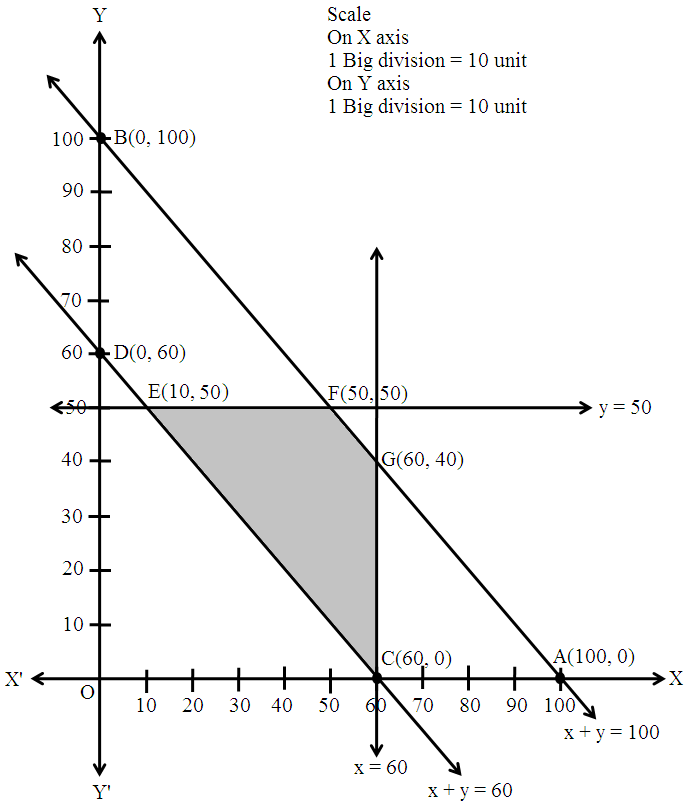
The corner points are $C_1(60, 0), G_1(60, 40), F_1(50, 50),$ and $E_1(10, 50)$.
The values of Z at these corner points are as follows:
|
Corner point
|
Z = 2.5x + 1.5y + 410
|
|
$C_1(60, 0)$
|
560
|
|
$G_1(60, 0)$
|
620
|
|
$F_1(50, 5)$
|
610
|
|
$E_1(10, 0)$
|
510
|
The minimum value of Z is 510 at $E_1(10, 50)$.
Thus, the amount of grain transported from A to D, E, and F is 10 quintals, 50 quintals, and 40 quintals respectively and from B to D, E, and F is 50 quintals, 0 quintals, and 0 quintals respectively.
The minimum cost is Rs. 510. View full question & answer→Question 1625 Marks
Maximum Z = 2x + 3y
Subject to
$\text{x}+\text{y}\geq1$
$10\text{x}+\text{y}\geq5$
$\text{x}+10\text{y}\geq1$
$\text{x},\text{y}\geq0$
AnswerFirst, we will convert the given inequations into equations, we obtain the following equations:
x + y = 1, 10x +y = 5, x + 10y = 1, x = 0 and y = 0
Region represented by x + y ≥ 1:
The line x + y = 1 meets the coordinate axes at A(1, 0) and B(0, 1) respectively.
By joining these points we obtain the line x + y = 1.
Clearly (0, 0) does not satisfies the inequation x + y ≥ 1.
So, the region in xy plane which does not contain the origin represents the solution set of the inequation x + y ≥ 1.
Region represented by 10x + y ≥ 5:
The line 10x + y = 5 meets the coordinate axes at $\text{C}\Big(\frac{1}{2},0\Big)$ and D(0, 5) respectively.
By joining these points we obtain the line 10x + y = 5.
Clearly (0, 0) does not satisfies the inequation 10x + y ≥ 5.
So, the region which does not contains the origin represents the solution set of the inequation 10x +y ≥ 5.
Region represented by x + 10y ≥ 1:
The line x + 10y = 1 meets the coordinate axes at A(1, 0) and $\text{F}\Big(0,\frac{1}{2}\Big)$ respectively.
By joining these points we obtain the line.
x + 10y = 1.
Clearly (0, 0) does not satisfies the inequation x + 10y ≥ 1.
So, the region which does not contains the origin represents the solution set of the inequation x + 10y ≥ 1.
Region represented by x ≥ 0 and y ≥ 0:
Since, every point in the first quadrant satisfies these inequations.
So, the first quadrant is the region represented by the inequations x ≥ 0, and y ≥ 0.
The feasible region determined by the system of constraints x + y ≥ 1, 10x + y ≥ 5, x + 10y ≥ 1, x ≥ 0, and y ≥ 0, are as follows.
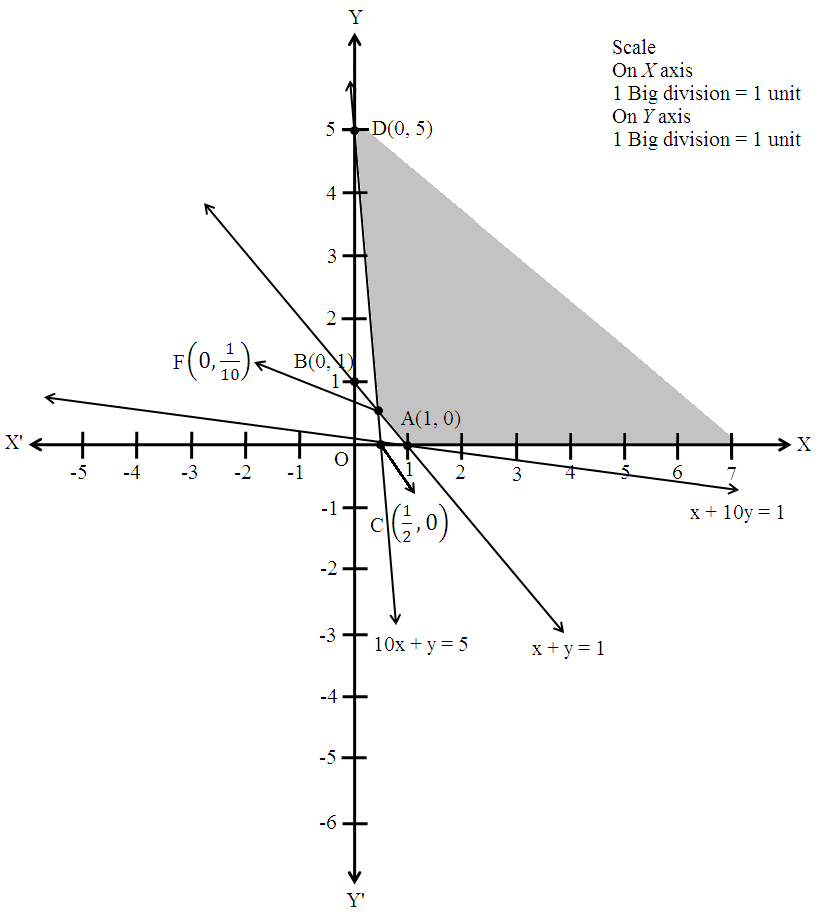
The feasible region is unbounded.
Therefore, the maximum value is infinity i.e. the solution is unbounded. View full question & answer→Question 1635 Marks
Maximize $Z = -x_1 + 2x_2$
Subject to
$-\text{x}_1+3\text{x}_2\leq10$
$\text{x}_1+\text{x}_2\leq6$
$\text{x}_1+\text{x}_2\leq2$
$\text{x}_1,\text{x}_2\geq0$
AnswerFirst, we will convert the given inequations into equations, we obtain the following equations:
$-X_1 + 3 x 2 = 10, x_1 + x_2 = 6, X_1 + X_2 = 2, X_1 = 0$ and $X_2 = 0$
Region represented by $-\text{x}_1+3\text{x}_2\leq10$:
The line $–x1 + 3 x 2 = 10$ meets the coordinate axes at A(-10, 0) and $\text{B}\Big(0,\frac{10}{3}\Big)$ respectively.
By joining these points we obtain the line $-X_1 + 3 x 2 = 10$.
Clearly (0, 0) satisfies the inequation $-\text{x}_1+3\text{x}_2\leq10$.
So, the region in the plane which contain the origin represents the solution set of the inequation $-\text{x}_1+3\text{x}_2\leq10$.
Region represented by $\text{x}_1+\text{x}_2\leq6$:
The line $x_1 + x_2 = 6$ meets the coordinate axes at C(6, 0) and D(0, 6) respectively.
By joining these points we obtain the line $X_1 + X_2 = 6$.
Clearly (0, 0) satisfies the inequation $\text{x}_1+\text{x}_2\leq6$.
So, the region containing the origin represents the solution set of the inequation $\text{x}_1+\text{x}_2\leq6$.
Region represented by $\text{x}_1+\text{x}_2\leq2$:
The line $x_1 - x_2 = 2$ meets the coordinate axes at E(2, 0) and F(0, -2) respectively.
By joining these points we obtain the line $x_1 - x_2 = 2$.
Clearly (0, 0) satisfies the inequation $\text{x}_1+\text{x}_2\leq2$.
So, the region containing the origin represents the solution set of the inequation $\text{x}_1+\text{x}_2\leq2$.
Region represented by $\text{x}_1\geq0$ and $\text{x}_2\geq0$:
Since, every point in the first quadrant satisfies these inequations.
So, the first quadrant is the region represented by the inequations $\text{x}_1\geq0$ and $\text{x}_2\geq0$.
The feasible region determined by the system of constraints, $\text{x}_1+3\text{x}_2\leq10,\text{x}_1+\text{x}_2\leq6,\text{x}_1+\text{x}_2\leq2,\text{x}_1\geq0$, and $\text{x}_2\geq0$, are as follows.
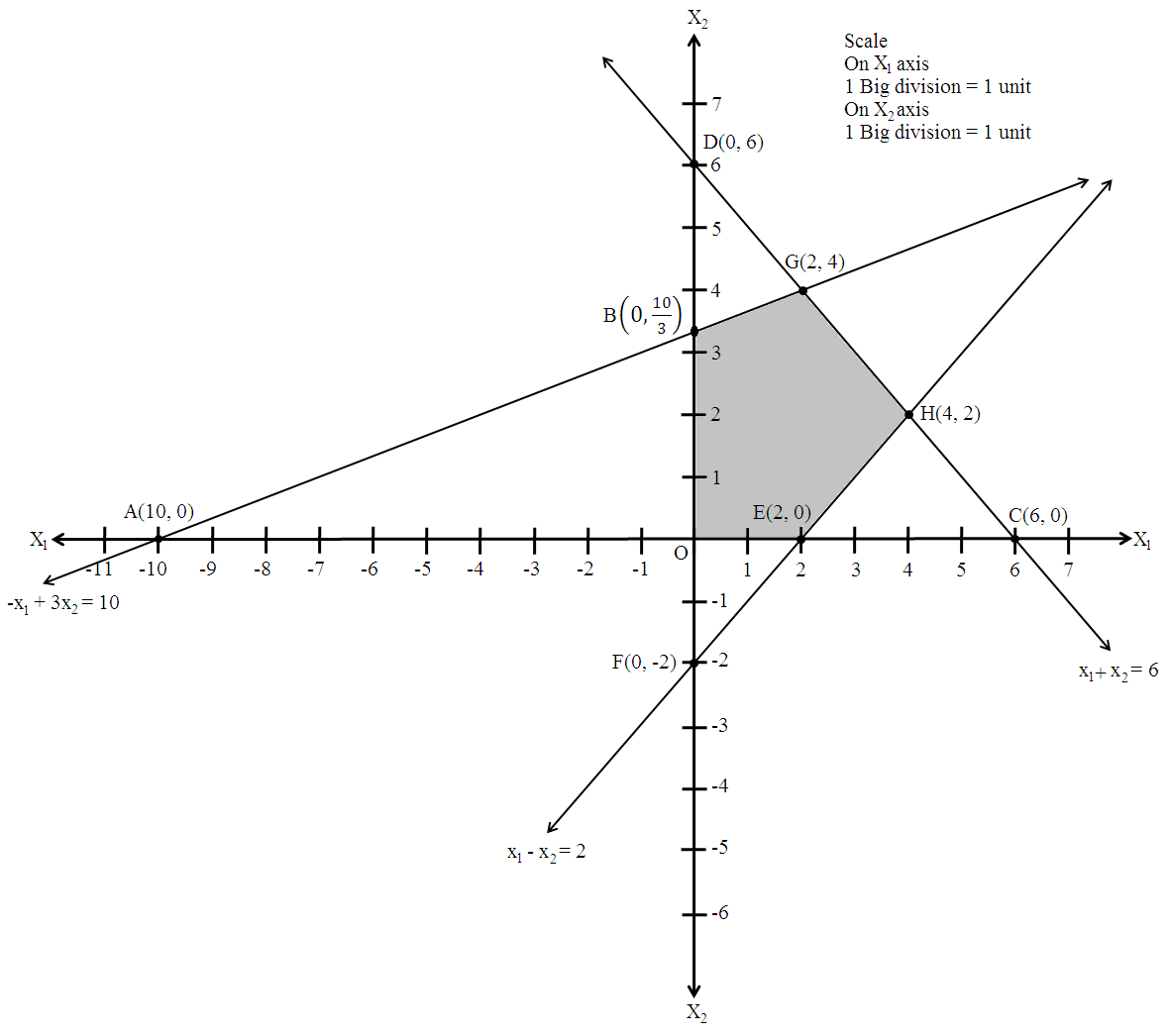
The corner points of the feasible region are O(0, 0), E(2, 0), H(4, 2), G(2, 4) and $\text{B}\Big(0,\frac{10}{3}\Big)$.
The values of Z at these corner points are as follows.
|
$\text{Corner point}$
|
$\text{Z}=-\text{x}_1+2\text{x}_2$
|
|
$\text{O}(0, 0)$
|
$-1\times0+2\times0=0$
|
|
$\text{E}(2, 0)$
|
$-1\times2+2\times0=-2$
|
|
$\text{H}(4, 2)$
|
$-1\times4+2\times2=0$
|
|
$\text{G}(2, 4)$
|
$-1\times2+2\times4=6$
|
|
$\text{B}\Big(0,\frac{10}{3}\Big)$
|
$-1\times0+2\times\frac{10}{3}=\frac{20}{3} $
|
We see that the maximum value of the objective function Z is $\frac{20}{3}$ which is at $\text{B}\Big(0,\frac{10}{3}\Big)$. View full question & answer→Question 1645 Marks
There are two types of fertilizers $F_1$ and $F_2. F_1$ consists of 10% nitrogen and 6% phosphoric acid and $F_2$ consists of 5% nitrogen and 10% phosphoric acid. After testing the soil conditions, a farmer finds the she needs atleast 14kg of nitrogen and 14kg of phosphoric acid for her crop. If $F_1$ costs Rs 6/kg and $F_2$ costs Rs 5/kg, determine how much of each type of fertilizer should be used so that the nutrient requirements are met at minimum cost. What is the minimum cost?
AnswerSuppose x kg of fertilizer $F_1$ and and y kg of fertilizer $F_2$ is used to meet the nutrient requirements.
$F_1$ consists of 10% nitrogen and $F_2$ consists of 5% nitrogen.
But, the farmer needs atleast 14kg of nitorgen for the crops.
10% of x kg + 5% of y kg 14kg
$\Rightarrow\frac{\text{x}}{10}+\frac{\text{y}}{20}\geq14$
$\Rightarrow2\text{x}+\text{y}\geq280$
Similarly, $F_1$ consists of 6% phosphoric acid and $F_2$ consists of 10% phosphoric acid.
But, the farmer needs atleast 14kg of phosphoric acid for the crops.
$\Rightarrow\frac{6\text{x}}{100}+\frac{10\text{y}}{100}\geq14$
$\Rightarrow3\text{x}+5\text{y}\geq700$
The cost of fertilizer F_1 is Rs. 6/kg and fertilizer F_2 is Rs. 5/kg,
Therefore, total cost of x kg of fertilizer F_1 and and y kg of fertilizer F_2 is Rs. $(6x + 5y)$.
Thus, the given linear programming problem is
Minimise Z = 6x + 5y
Subject to the constraints
2x + y ≥ 280
3x + 5y ≥ 700
x, y ≥ 0
The feasible region determined by the given constraints can be diagrammatically represented as,
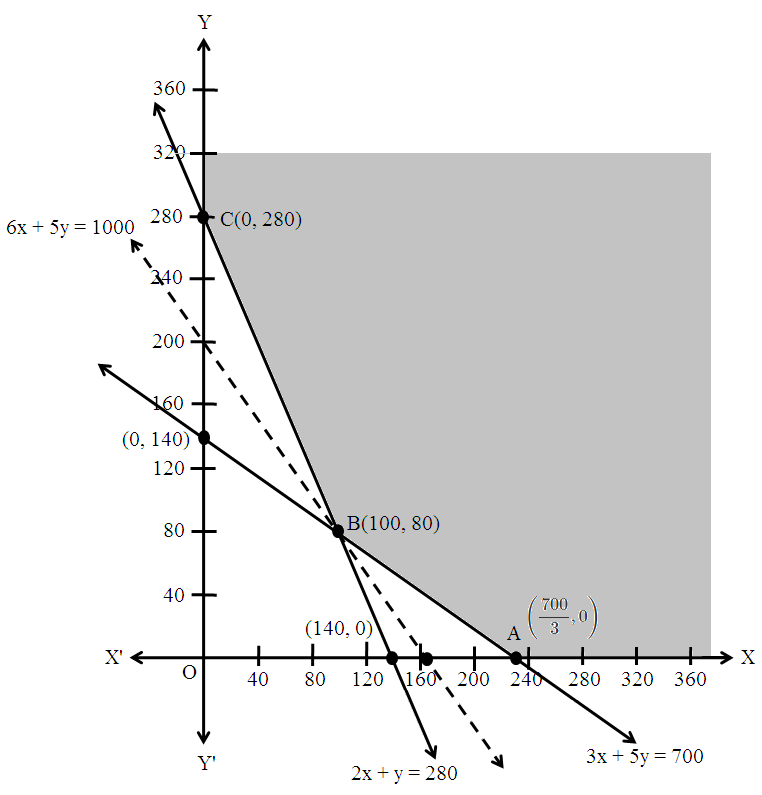
The coordinates of the corner points of the feasible region are al $\text{A}\Big(\frac{700}{3},0\Big),$ B(100, 80) and C(0, 280).
The value of the objective function at these points are given in the following table.
| $\text{Corner Point}$ |
$\text{Z} = 6\text{x} + 5\text{y}$ |
| $\Big(\frac{700}{3},0\Big)$ |
$6\times\frac{700}{3}+5 \times 0= 1400$ |
| $(100, 80)$ |
$6 \times 100+ 5 \times 80 = 1000 → \text{Minimum}$ |
| $(0, 280)$ |
$6 \times 0 + 5 \times 280 =1400$ |
The smallest value of Z is 1000 which is obtained at x = 100, y = 80.
It can be seen that the open half-plane represented by has no common points with the feasible region.
So, the minimum value of Z is 1000.
Hence, 100kg of fertilizer $F_1$ and 80kg of fretilizer $F_2$ should be used so that the nutrient requirements are met at minimum cost.
The minimum cost is Rs. 1,000. View full question & answer→Question 1655 Marks
A dietician has to develop a special diet using two foods P and Q. Each packet (containing 30g) of food P contains 12 units of calcium, 4 units of iron, 6 units of cholesterol and 6 units of vitamin A. Each packet of the same quantity of food Q contains 3 units of calcium, 20 units of iron, 4 units of cholesterol and 3 units of vitamin A. The diet requires atleast 240 units of calcium, atleast 460 units of iron and at most 300 units of cholesterol. How many packets of each food should be used to minimise the amount of vitamin A in the diet? What is the minimum Amount of vitamin A.
AnswerLet x packets of food P and y packets of food Q be used to make the diet.
Each packet of food P contains 6 units of vitamin A and each packet of food Q contains 3 units of vitamin A.
Therefore, x packets of food P and y packets of food Q contains (6x + 3y) units of vitamin A.
Since each packet of food P contains 12 units of calcium and each packet of food Q contains 3 units of calcium, therefore, x packets food P and y packets of food Q will contain (12x + 4y) units of calcium.
But, the diet should contain atleast 240 units of calcium.
$\therefore12\text{x}+3\text{y}\geq240$
$\Rightarrow4\text{x}+\text{y}\geq80$
Similarly, x packets of food P and y packets of food Q will contain (4x + 207) units of iron. But, the diet should contain atleast 460 units of iron.
$\therefore4\text{x}+20\text{y}\geq460$
$\Rightarrow\text{x}+5\text{y}\geq115$
Also, x packets of food P and y packets of food Q will contain (6x + 4y) units of cholesterol.
But, the diet should contain atmost 300 units of cholesterol.
$\therefore6\text{x}+4\text{y}\leq300$
$3\text{x}+2\text{y}\leq150$
Thus, the given linear programming problem is
Minimise Z = 6x + 3y
subject to the constraints
$4\text{x}+\text{y}\geq80$
$\text{x}+5\text{y}\geq115$
$3\text{x}+2\text{y}\leq150$
$\text{x},\text{y}\geq0$
The feasible region determined by the given constraints can be diagrammatically represented as,
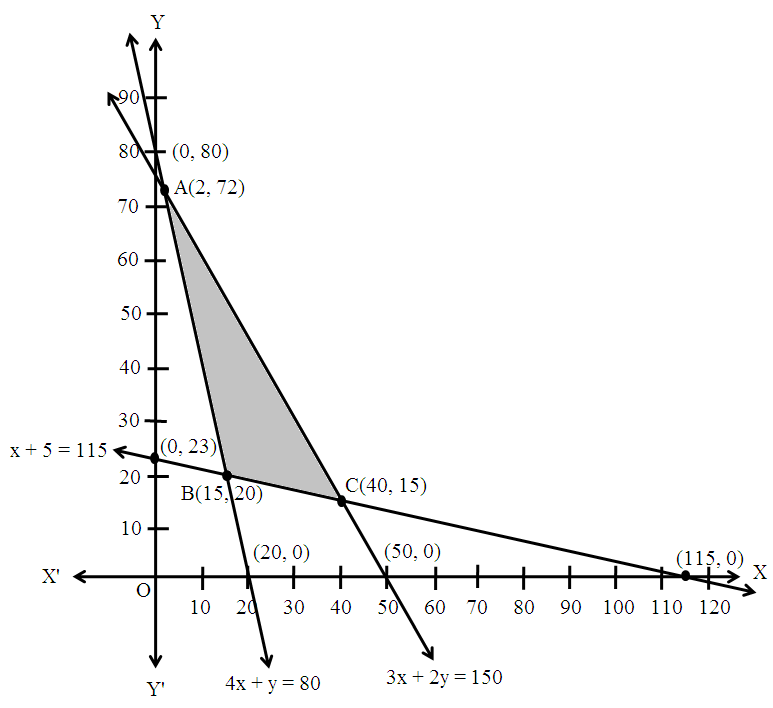
The coordinates of the corner points of the feasible region are A(2, 72), B(15, 20) and C(40, 15).
The value of the objective function at these points are given in the following table.
|
Corner Point
|
Z = 6x + 3y
|
|
(2, 72)
|
6 × 0 + 3 × 72 = 216
|
|
(15, 20)
|
6 × 15 + 3 × 20 = 150
|
| (40, 15) |
6 × 40 + 3 × 15 = 285 |
The smallest value of Z is 150 which is obtained at x = 15 and y = 20.
It can be verified that the open half-plane represented by $6\text{x}+3\text{y}\leq150$ has no common points with the feasible region.
Thus, 15 packets of food P and 20 packets of food Q should be used to minimise the amount of vitamin A in the diet.
Hence, the minimum amount of vitamin A is 150 units. View full question & answer→Question 1665 Marks
A fruit grower can use two types of fertilizer in his garden, brand P and brand Q. The amounts (in kg) of nitrogen, phosphoric acid, potash, and chlorine in a bag of each brand are given in the table. Tests indicate that the garden needs at least 240 kg of phosphoric acid, at least 270 kg of potash and at most 310 kg of chlorine.
If the grower wants to minimise the amount of nitrogen added to the garden, how many bags of each brand should be used? What is the minimum amount of nitrogen added in the garden?
|
kg per bag
|
|
|
Brand P
|
Brand Q
|
|
Nitrogen
Phosphoric acid
Potash
Chlorine
|
3
1
3
1.5
|
3.5
2
1.5
2
|
AnswerLet amount of Brand P of fertilizer = x bags and amount of Brand Q of fertilizer = y bags
We have to minimize Z = 3x + 3.5y subject to $\text{x}+2\text{y}\geq240,\ 3\text{x}+1.5\text{y}\geq270,\ 1.5\text{x}+2\text{y}\leq310\text{x}\geq0,\ \text{y}0$
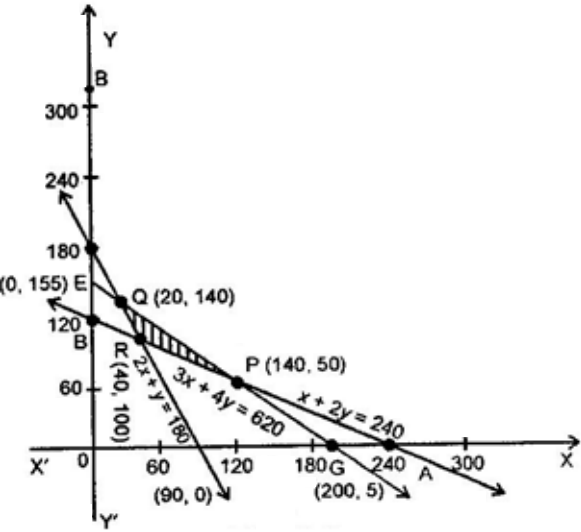
Consider $\text{x}+2\text{y}\geq240$
Let x + 2y = 240
$\Rightarrow\ \frac{\text{x}}{240}+\frac{\text{y}}{120}=1$
$\therefore\ $Points A(240, 0) and B(0, 120) lie on the line.
And (0, 0) does not lie on the required half-plane of this in equation
Again consider $3\text{x}+1.5\text{y}\geq270$
Let 3x + 1.5y = 270
$\Rightarrow\ 2\text{x}+\text{y}=180$
$\Rightarrow\ \frac{\text{x}}{90}+\frac{\text{y}}{180}=1$
$\therefore\ $Points C(90, 0) and D(0, 180) lie on the line.
Here also (0, 0) does not lie on the required half-plane of this inequation.
Again consider $1.5\text{x}+2\text{y}=310\ \Rightarrow\ 3\text{x}+4\text{y}=620$
$\Rightarrow\ \text{y}=\frac{620-3\text{x}}{4}$
| |
E |
F |
G |
| x |
0 |
100 |
200 |
| y |
155 |
80 |
5 |
Here also (0, 0) does not lie on the required half-plane of this inequation.
The shaded portion is the feasible region. Its corners are P(140, 50), Q(20, 140) and R(40, 100).
Now Z = 3x + 3.5y
| At |
P(140, 50) |
Z = 3 × 140 + 3.5 × 50 = 420 + 175 = 595 |
| At |
Q(20, 140) |
Z = 3 × 50 + 3.5 × 140 = 60 + 490 = 550 |
| At |
R(40, 100) |
Z = 3 × 40 + 3.5 × 100 = 120 + 350 = 470 |
Hence minimum Z = 470 at x = 40, y = 100. View full question & answer→Question 1675 Marks
A manufacturer makes two types A and B of tea-cups. Three machines are needed for the manufacture and the time in minutes required for each cup on the machines is given below:
| |
Machines |
| I |
II |
III |
| A |
12 |
18 |
6 |
| B |
6 |
0 |
9 |
Each machine is available for a maximum of 6 hours per day. If the profit on each cup A is 75 paise and that on each cup B is 50 paise, show that 15 tea-cups of type A and 30 of type B should be manufactured in a day to get the maximum profit.
AnswerLet x units of type A and y units of type B cups were made. Quantities cannot be negative.
Therefore, $\text{x},\text{y}\geq0$
As we are given,
| |
Machines |
| I |
II |
III |
| A |
12 |
18 |
6 |
| B |
6 |
0 |
9 |
Every machine is available for a maximum of 6 hours per day i.e. 360 minutes per day.
Therefore, the constraints are
$12\text{x}+6\text{y}\leq360$
$18\text{x}+0\text{y}\leq360$
$6\text{x}+9\text{y}\leq360$
If the profit on each cup A is 75 paise and that on each cup B is 50 paise.
Total profit = Z = 0.75x + 0.50y which is to be maximised.
Thus, the mathematical formulation of the given linear programmimg problem is
Max Z = 0.75x + 0.50y
Subject to
$12\text{x}+6\text{y}\leq360$
$18\text{x}+0\text{y}\leq360$
$6\text{x}+9\text{y}\leq360$
$\text{x},\text{y}\geq0$
First we will convert inequations into equations as follows:
$12\text{x}+6\text{y}\leq360,18\text{x}+0\text{y}\leq360,6\text{x}+9\text{y}\leq360,\text{x}\geq0$and $\text{y}\geq0$
Region represented by $12\text{x}+6\text{y}\leq360$:
The line 12x + 6y = 360 meets the coordinate axes at $A_1(30, 0)$ and $B_1(0, 60)$ respectively.
By joining these points we obtain the line 12x + 6y = 360.
Clearly (0, 0) satisfies the 12x + 6y = 360.
So, the region which contains the origin represents the solution set of the inequation $12\text{x}+6\text{y}\leq360$.
Region represented by $18\text{x}+0\text{y}\leq360$:
The line 18x + 0y = 360 meets the coordinate axes at $C_1(20, 0)$.
We obtain the line 18x + 0y = 360.
Clearly (0, 0) satisfies the inequation $18\text{x}+0\text{y}\leq360$.
So, the region which contains the origin represents the solution set of the inequation $18\text{x}+0\text{y}\leq360$.
Region represented by $6\text{x}+9\text{y}\leq360$:
The line 6x + 9y = 360 meets the coordinate axes at $E_1(60, 0)$ and $F_1(0, 40)$ respectively.
By joining these points we obtain the line 6x + 9y = 360.
Clearly (0, 0) satisfies the inequation $6\text{x}+9\text{y}\leq360$.
So, the region which contains the origin represents the solution set of the inequation $6\text{x}+9\text{y}\leq360$.
Region represented by $\text{x}\geq0$ and $\text{y}\geq0$:
Since, every point in the first quadrant satisfies these inequations.
So, the first quadrant is the region represented by the inequations $\text{x}\geq0$, and $\text{y}\geq0$.
The feasible region determined by the system of constraints $12\text{x}+6\text{y}\leq360,18\text{x}+0\text{y}\leq360,6\text{x}+9\text{y}\leq360,\text{x}\geq0$ and $\text{y}\geq0$ are as follows.
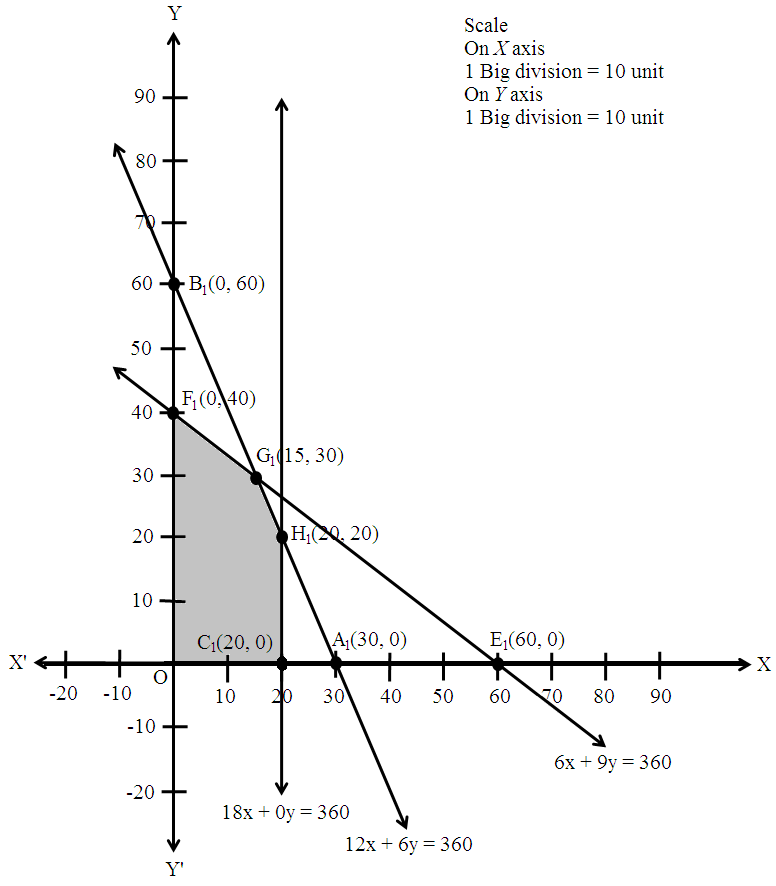
The corner points are $O(0, 0) F_1(0, 40), G_1(15, 30), H_1(20, 20)$ and $C_1(20, 0)$.
The values of Z at these corner points are as follows:
|
Corner point
|
Z = 0.75x + 0.50y
|
|
$O$
|
0
|
|
$F_1$
|
20
|
|
$G_1$
|
26.25
|
|
$H_1$
|
25
|
|
$C_1$
|
15
|
Thus, the maximum profit is Rs. 26.25 obtained when 15 unit of type A and 30 unit of type B cups were made. View full question & answer→Question 1685 Marks
A small firm manufacturers items A and B. The total number of items A and B that it can manufacture in a day is at the most 24. Item A takes one hour to make while item B takes only half an hour. The maximum time available per day is 16 hours. If the profit on one unit of item A be Rs. 300 and one unit of item B be Rs. 160, how many of each type of item be produced to maximize the profit? Solve the problem graphically.
AnswerLet required quantity of item A and B produced be x and y respectively.
Since, profits on each item A and B are Rs. 300 and Rs. 160 respectively, so, profits on X unit of item A and y units of item 8 are Rs. 300x and Rs. 160y respectively
Let z be total profit so
Z = 300x + 160y
Since one unit of item A and B require one and $\frac{1}{2}$ hr respectively, so, x units of item A and y units of item B require x and $\frac{1}{2} \text{y}$ hr. respectivley but maximum time available is 16 hours., so
$\text{x}+\frac{1}{2}\text{y}\leq16$
$\Rightarrow2\text{x}+\text{y}\leq32$ (first constraint)
Given, manufacturer can produce at most 24 items, so,
$\Rightarrow\text{x}+\text{y}\leq24$ (second constraint)
Hence, mathematical formulation of LPP is find x and y which
Maximize Z = 300x + 160y
Subject to constriants,
$2\text{x}+\text{y}\leq32$
$\text{x}+\text{y}\leq24$
$\text{x},\text{y}\geq0$ [Since production can not be less than zero]
Region $2\text{x}+\text{y}\leq32$:
Line 2x + y = 32 meets axes at $A_1(16, 0), B_1(0, 32)$ respectively.
Region containing origin represents $2\text{x}+\text{y}\leq32$ as (0, 0) satisfies $2\text{x}+\text{y}\leq32$.
Region $\text{x}+\text{y}\leq24$:
Line x + y = 24 meets axes at $A_2(24 ,0), B_2(0, 24)$ respectively.
Region containing origin represents $\text{x}+\text{y}\leq24$ as (0, 0) satisfies $\text{x}+\text{y}\leq24$.
Region $\text{x},\text{y}\geq0$:
It represent first quandrant
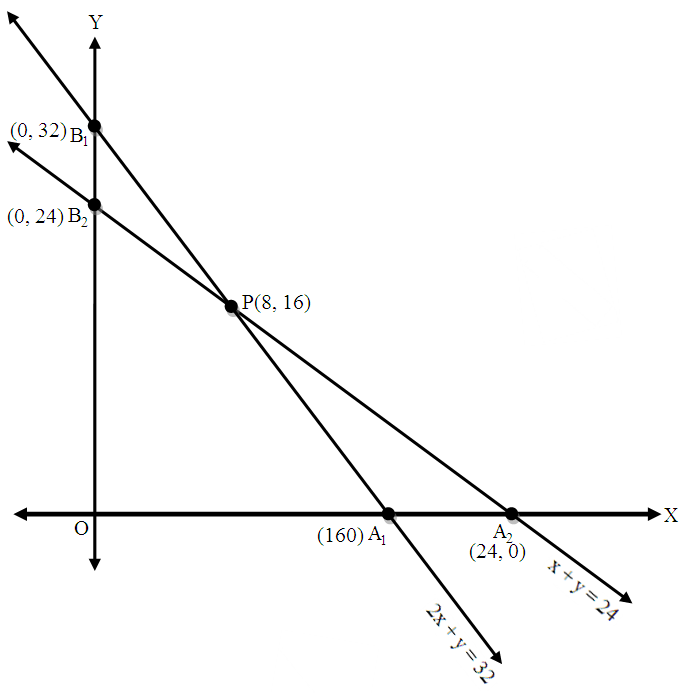
Shaded region $OA_1PB_2$ represents feasible region.
Point P is obtained by solving
x + y = 24 and 2x + y = 32
The value of $Z = 300x + 160y$ at
$O(0, 0) = 300(0) + 160(0) = 0$
$A_1(16, 0) = 300(180) + 160(0) = 4800$
$P(8, 16) = 300(8) + 160(16) = 4960$
$B_2(0, 24) = 300(0) + 160(24) = 3640$
Maximum Z = 4960
Number of item A = 8, item B = 16
Maximum profit = Rs. 4960. View full question & answer→Question 1695 Marks
A diet is to contain at least 80 units of vitamin A and 100 units of minerals. Two foods $F_1$ and $F_2$ are available. Food $F_1$ costs Rs 4 per unit food and $F_2$ costs Rs 6 per unit. One unit of food $F_1$ contains 3 units of vitamin A and 4 units of minerals. One unit of food $F_2$ contains 6 units of vitamin A and 3 units of minerals. Formulate this as a linear programming problem. Find the minimum cost for diet that consists of mixture of these two foods and also meets the minimal nutritional requirements.
AnswerLet the diet contain x units of food $F_1$ and y units of food $F_2$. Therefore,
$\text{x}\ge0\text{ and y}\ge0$
The given information can be complied in a table as follows.
| |
Vitamin A (units) |
Mineral (units) |
Cost per unit (Rs) |
| Food $F_1$ (x) |
3 |
4 |
4 |
| Food $F_2$ (y) |
6 |
3 |
6 |
| Requirement |
80 |
100 |
|
The cost of food $F_1$ is Rs 4 per unit and of Food $F_2$ is Rs 6 per unit. Therefore, the constraints are
$3\text{x}+6\text{y}\ge80\\4\text{x}+3\text{y}\ge100\\\text{x},\ \text{y}\ge0$
Total cost of the diet, z = 4x + 6y
The mathematical fonnulation of the given problem is Minimise Z = 4x + 6y ... (1)
subject to the constraints,
$3\text{x}+6\text{y}\ge80\dots(2)\\4\text{x}+3\text{y}\ge100\dots(3)\\\text{x},\ \text{y}\ge0\dots(4)$
The feasible region determined by the constraints is as follows.
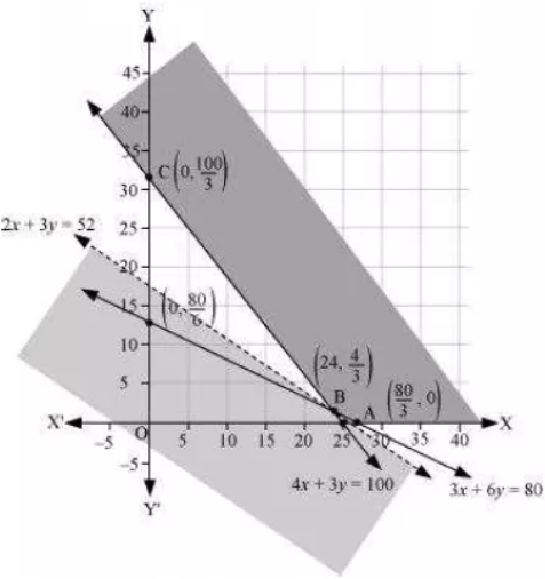
It can be seen that the feasible region is unbounded.
The corner points of the feasible region are $\text{A}\Big(\frac83,\ 0\Big),\ \text{B}\Big(2,\ \frac12\Big),\ \text{and C}\Big(0,\ \frac{11}{2}\Big)$
The corner points are $\text{A}\Big(\frac{80}{3},\ 0\Big),\ \text{B}\Big(24,\ \frac{4}{3}\Big),\ \text{and C}\Big(0,\ \frac{100}{3}\Big)$
The values of Z at these corner points are as follows.
| Corner point |
z = 4x + 6y |
|
| $\text{A}\Big(\frac{80}{3},\ 0\Big)$ |
$\frac{320}{3}=106.67$ |
|
| $\text{B}\Big(24,\ \frac{4}{3}\Big)$ |
104 |
→ Minimum |
| $\text{C}\Big(0,\ \frac{100}{3}\Big)$ |
200 |
|
As the feasible region is unbounded, therefore, 104 may or may not be the minlmurn value of z.
For this, we draw a graph of the inequality, 4x + 6y < 104 or 2x + 3y < 52, and check whether the resulting half plane has points in common with the feasible region or not. It can be seen that the feasible region has no common point with 2x + 3y < 52 Therefore, the minimum cost of the mixture will be Rs 104. View full question & answer→Question 1705 Marks
A company makes 3 model of calculators: A, B and C at factory I and factory II. The company has orders for at least 6400 calculators of model A, 4000 calculator of model B and 4800 calculator of model C. At factory I, 50 calculators of model A, 50 of model B and 30 of model C are made every day; at factory II, 40 calculators of model A, 20 of model B and 40 of model C are made everyday. It costs Rs. 12000 and Rs. 15000 each day to operate factory I and II, respectively. Find the number of days each factory should operate to minimise the operating costs and still meet the demand.
AnswerLet the factory I operate for x days and the factory II operate for y days.
At factory I, 50 calculators of model A and at the factory II, 40 calculators of model A are made everyday. Also, company has ordered for at least 6400 calculators of model A.
$\therefore50\text{x}+40\text{y}\geq6400$
$\Rightarrow5\text{x}+4\text{y}\geq640\ .....(\text{i})$
Also, at factory I, 50 calculators of model B and at factory II, 20 calculators of model B are made everyday.
Since, the company has ordered at least 4000 calculators of model B.
$\therefore50\text{x}+20\text{y}\geq4000$
$\Rightarrow5\text{x}+2\text{y}\geq400\ .....(\text{ii})$
Similarly, for model C, $30\text{x}+40\text{y}\geq480$
$\Rightarrow3\text{x}+4\text{y}\geq480\ .....(\text{iii})$
Also, $\text{x}\geq0,\text{y}\geq0\ ......(\text{iv})$
[since, x and y are non-negative]
It costs Rs. 12000 and Rs. 15000 each day to operate factories factories I and II, respectively.
$\therefore$ Corresponding LPP is
Minimise $\text{Z}=12000\text{x}+15000\text{y},$ subject to
$5\text{x}+4\text{y}\geq640$
$5\text{x}+2\text{y}\geq400$
$3\text{x}+4\text{y}\geq480$
$\text{x}\geq0,\text{y}\geq0$
On solving 3x + 4y = 480 and 5x + 4y = 640, we get x = 80 and y = 60.
On solving 5x + 4y = 640 and 5x + 2y = 400, we get x = 32, y = 120
Thus, from the graph, it is clear that feasible region is unbounded and the coordinates of corner points A, B, C and D are (160, 0), (80, 60), (32, 120), and (0, 200), respectively.
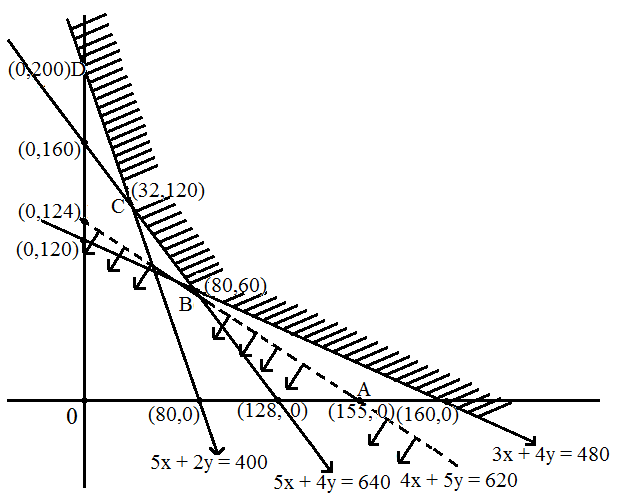
|
Corner points
|
Value of Z = 12000x + 15000y
|
|
(160, 0)
(80, 60)
(32, 120)
(0, 200)
|
160 × 12000 = 1620000
(80 × 12 + 60 × 15) × 1000 = 1860000 (minimum)
(32 × 12 + 120 × 15) × 1000 = 2184000
0 + 200 × 15000 = 3000000
|
From the above table, it is clear that for given unbounded region the minimum value of Z may or may not be 1860000.
Now, for deciding this, we graph the inequality
12000x + 15000y < 1860000
⇒ 4x + 5y < 620
And check whether the resulting open half plane has point in common with feasible region or not.
Thus, as shown in the figure, it has no common points so Z = 120000x + 15000y has minimum value of 1860000.
So, number of days for factory I should be operated is 80 and number of days for factory II should be operated is 60 for the minimum cost and satisfying the given constraints. View full question & answer→Question 1715 Marks
A firm has to transport at least 1200 packages daily using large vans which carry 200 packages each and small vans which can take 80 packages each. The cost of engaging each large van is Rs 400 and each small van is Rs 200. Not more than Rs 3000 is to be spent daily on the job and the number of large vans cannot exceed the number of small vans. Formulate this problem as a LPP given that the objective is to minimize cost.
AnswerLet the number of large vans and small vans used for transporting the packages be x and y, respectively.
It is given that the cost of engaging each large van is Rs. 400 and each small van is Rs. 200
Cost of engaging x large vans = Rs. 400x
Cost of engaging y small vans = Rs. 200y
Let Z be the total cost of engaging xlarge vans and y small vans.
$\therefore$ Z = Rs. (400x + 200y)
The firm has to transport at least 1200 packages daily using large vans which carry 200 packages each and small vans which can take 80 packages each.
$\therefore$ Number of packages transported by xlarge vehicles + Number of packages transported by y small vehicles $\geq1200$
$\Rightarrow200\text{x}+80\text{y}\geq1200$
Not more than Rs.3000 is to be spent daily on the transportation.
$\therefore400\text{x}+200\text{y}\leq3000$
Also, the number of large vans cannot exceed the number of small vans.
$\therefore\text{x}\leq\text{y}$
Thus, the linear programming problem of the given problem is
Minimise Z = Rs. (400x + 2007)
Subject to constraints
$\Rightarrow200\text{x}+80\text{y}\geq1200$
$400\text{x}+200\text{y}\leq3000$
$\text{x}\leq\text{y}$
$\text{x}\geq0,\text{y}\geq0$
View full question & answer→Question 1725 Marks
In order to supplement daily diet, a person wishes to take some X and some wishes Y tablets. The contents of iron, calcium and vitamins in X and Y(in milligrams per tablet) are given as below:
|
Tablets
|
Iron
|
Calcium
|
Vitamin
|
|
x
|
6
|
3
|
2
|
|
y
|
2
|
3
|
4
|
The person needs at least 18 milligrams of iron, 21 milligrams of calcium and 16 milligram of vitamins. The price of each tablet of X and Y is Rs. 2 and Rs. 1 respectively. How many tablets of each should the person take inorder to satisfy the above requirement at the minimum cost?
AnswerLet the person takes x units of tablet X and y units of tablet Y.
So, from the given information, we have
$6\text{x}+2\text{y}\geq18$
$\Rightarrow3\text{x}+\text{y}\geq9\ .....(\text{i})$
$3\text{x}+3\text{y}\geq21$
$\Rightarrow\text{x}+\text{y}\geq7\ ......(\text{ii})$
And $2\text{x}+4\text{y}\geq16$
$\Rightarrow\text{x}+2\text{y}\geq8\ .....(\text{iii})$
Also, we know that here $\text{x}\geq0,\text{y}\geq0\ ......(\text{iv})$
The price of each tablet of X and Y is Rs. 2 and Rs. 1, respectively.
So, we have to minimise Z = 2x + y,
Subject to constraints,
$3\text{x}+\text{y}\geq9,$
$\text{x}+\text{y}\geq7$
$\text{x}+2\text{y}\geq8,$
$\text{x}\geq0$ and $\text{y}\geq0$
These inequalities are plotted as shown below:
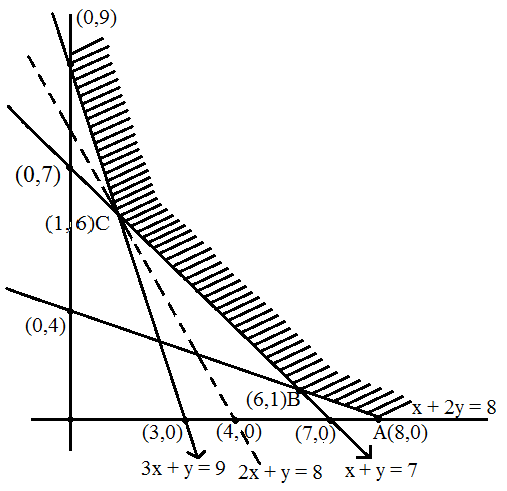
On solving x + 2y = 8 and x + y = 7, we get
x = 6, y = 1
Again on solving 3x + y = 9 and x + y = 7,we get
x = 1, y = 6
Thus, from graph feasible region is unbounded region with corner points A, B, C and D as (8, 0), (6, 1), (1, 6), and (0, 9), respectively.
|
Corner points
|
Value of Z = 2x + y
|
|
(8, 0)
(6, 1)
(1, 6)
(0, 9)
|
16
13
8 (Minimum)
9
|
Thus, we see that 8 is the minimum value of Z at the corner point (1, 6).
Now, as the feasible region is unbounded, 8 may or may not be the minimum value of Z. For this, we graph the inequality $2\text{x}+\text{y}\leq8$ and check whether the resulting open half has points in common with feasible region or not. If it has common point, then 8 will not be the minimum value of Z, otherwise 8 will be the minimum value of Z.
Thus, from the graph it is clear that, it has no common point.
Therefore, Z = 2x + y has 8 as minimum value subject to the given constraints. Hence, the person should take 1 unit of X tablet and 6 units of Y tablets to satisfy the given requirements and at the minimum cost of Rs. 8. View full question & answer→Question 1735 Marks
Maximize Z = 4x + 3y
Subject to
$3\text{x}+4\text{y}\leq24$
$8\text{x}+6\text{y}\leq48$
$\text{x}\leq5$
$\text{y}\leq5$
$\text{x},\text{y}\geq0$
Answer
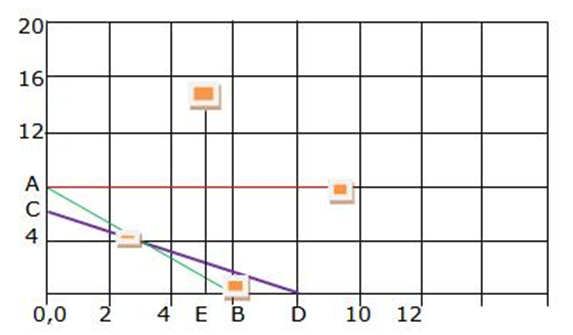 $\text{3x}+\text{4y }\leq24\ ;$ when x = 0, y = 6 & when y = 0, x = 8, line AB
$\text{8x}+\text{6y }\leq48\ ;$ when x = 0, y = 8 & when y = 0, x = 8, line CD
Plotting $\text{x}\leq5$ given line EF; Plotting $\text{y}\leq6$ given line AG
The feasible area is 0, 0 - C - H - G - E
| Corner point |
Value of Z = 4x + 3y |
| 0, 0 |
0 |
| 0, 6 |
18 |
| 3.4, 3.4 |
24 |
| 5, 1 |
23 |
| 5, 0 |
20 |
The maximum of Z = 4x + 3y, occurs at x = 3.4, y = 3.4 View full question & answer→Question 1745 Marks
A manufacturer makes two types of toys A and B. Three machines are needed for this purpose and the time (in minutes) required for each toy on the machines is given below:
| Types of Toys |
Machines |
| I |
II |
III |
| A |
12 |
18 |
6 |
| B |
6 |
0 |
9 |
Each machine is available for a maximum of 6 hours per day. If the profit on each toy of type A is Rs. 7.50 and that on each toy of type B is Rs. 5, show that 15 toys of type A and 30 of type B should be manufactured in a day to get maximum profit.
AnswerLet x units of toys A and y units of toys B are produced by the manufacturer. Time spent on machine I to produce x units of toys A and y units of toys B = (12x + 6y) minutes.
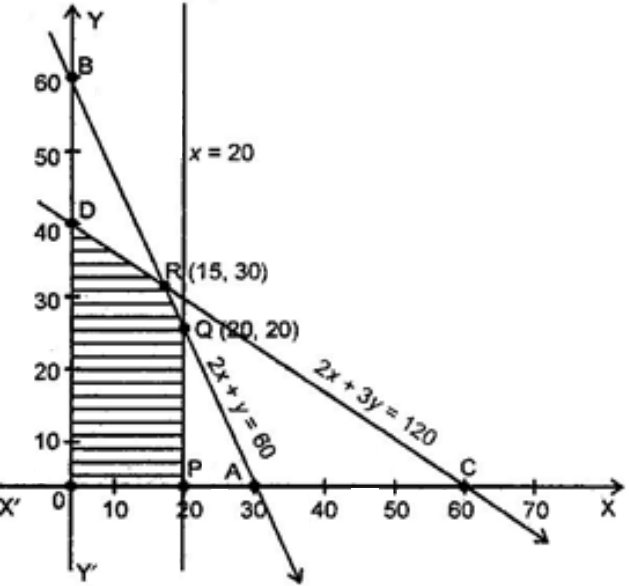
Since each machine is available for a maximum of 6 x 60 = 360 minutes.
Therefore, we have $12\text{x}+6\text{y}\leq360\ \Rightarrow\ 2\text{x}+\text{y}\leq60$
$18\text{x}\leq360\text{ and }2\text{x}+3\text{y}\leq120$
now, the profit Z earned by the manufacturer to produce x units of type A and y units of type B is 7.50x + 5y.
we have to maximize Z = 7.50x + 5y i.e., 4Z = 3x + 2y subject to constraints $2\text{x}+\text{y}\leq6,\ \text{x}\leq20,\ 2\text{x}+3\text{y}\leq120\text{ and }\text{x}\geq0,\ \text{y}\geq0.$
Consider $2\text{x}+\text{y}\leq6$
Let 2x + y = 6
$\Rightarrow\ \frac{\text{x}}{30}+\frac{\text{y}}{60}-1$
$\therefore\ $Points A(30, 0) and B(0, 60) lies on the line. Also (0, 0) lies in the required half plane. Again consider $\text{x}\leq20$
Let x = 20
It represent the half plane to the left of x = 20.
Again consider $2\text{x}+3\text{y}\leq120$
Let 2x + 3y = 120
$\Rightarrow\ \frac{\text{x}}{60}+\frac{\text{y}}{40}=1$
$\therefore\ $Points C(60, 0) and D(0, 40) lies on the line. Therefore, (0, 0) lies in the required half plane. The shaded portion is our feasible region. Its corners are O(0, 0), P(20, 0), Q(20, 20), R(15, 30), D(0, 40).
Now Z = 7.50x + 5y
| At |
O(0, 0) |
Z = 7.5 × 0 + 5 × 0 = 0 |
| At |
P(20, 0) |
Z = 7.5 × 00 + 5 × 0 = 150 |
| At |
Q(20, 20) |
Z = 7.5 × 20 + 5 × 20 = 250 |
| At |
R(15, 30) |
Z = 7.5 × 15 + 5 × 30 = 262.50 |
| At |
D(0, 40) |
Z = 7.5 × 0 + 5 × 40 = 200 |
Now maximum profit = Z = Rs. 262.50, when he manufacturers 15 toys of types A and 30 of type B in a day. View full question & answer→Question 1755 Marks
A cooperative society of farmers has 50 hectares of land to grow two crops X and Y. The profits from crops X and Y per hectare are estimated as Rs. 10,500 and Rs. 9,000 respectively. To control weeds, a liquid herbicide has to be used for crops X and Y at the rate of 20 litres and 10 litres per hectare, respectively. Further not more than 800 litres of herbicide should be used in order to protect fish and wildlife using a pond which collects drainage from this land. How much land should be allocated to each crop so as to maximise the total profit of the society?
AnswerLet x hectores of land grows crop X.
Let y hectores of land grows crop Y.
Then the mathematical model of the LPP is as follows:
Maximize Z = 10,500x + 9,000
Subject to x + y <50, 20x + 10y 5800 and x 20, y20
To solve the LPP we draw the lines, x + y = 50, 20x + 10y = 800
The feasible region of the LPP is shaded in graph
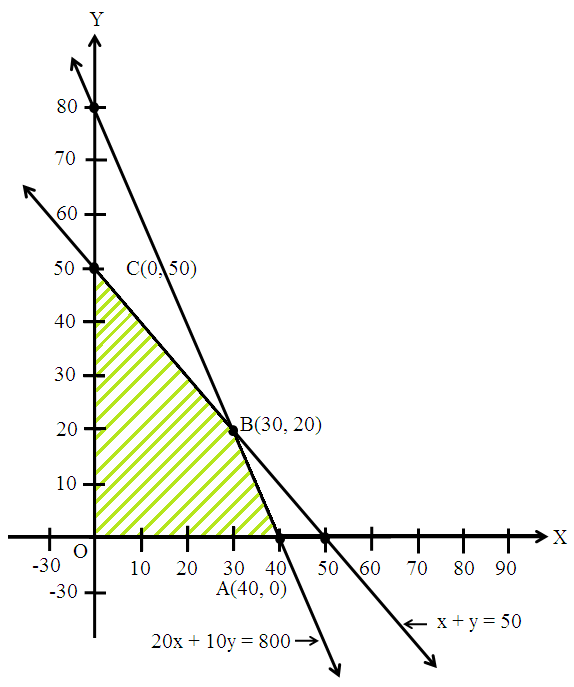
The coordinates of the vertices (Corner - points) of shaded feasible region ABC are A(40, 0), B(30, 20) and C(0, 50).
The values of the objective of function at these points are given in the following table:
|
Point $(x_1, x_2)$
|
Value of objective function = Z = 10,500x + 9,000y
|
|
A(40, 0)
|
Z = 4,20,000
|
|
B(30, 20)
|
Z = 4,95,000
|
|
C(0, 50)
|
Z = 4,50,000
|
30 hectors of land should be allocated to crop X and
20 hectors of land should be allocated to crop Y to maximize the profit
The maximum profit that can be eared is Rs. 4,95,000. View full question & answer→Question 1765 Marks
Maximum Z = 3x + 4y Subject to$\text{x}+\text{y}\leq30000$
$\text{y}\leq12000$
$\text{x}\geq6000$
$\text{x}\geq\text{y}$
$\text{x},\text{y}\geq0$
AnswerWe have to maximize Z = 7x + 10y
First, we will convert the given inequations into equations, we obtain the following equations:
x + y = 30000.y = 12000, x = 6000, x = y, x = 0 and y = 0.
Region represented by $\text{x}+\text{y}\leq30000$:
The line x + y = 30000 meets the coordinate axes at A(30000, 0) and B(0, 30000) respectively.
By joining these points we obtain the line x + y = 30000. Clearly (0, 0) satisfies the inequation $\text{x}+\text{y}\leq30000$.
So, the region containing the origin represents the solution set of the inequation $\text{x}+\text{y}\leq30000$.
The line y = 12000 is the line that passes through C(0, 12000) and parallel to x axis.
The line x = 6000 is the line that passes through (6000, 0) and parallel to y axis.
Region represented by $\text{x}\geq\text{y}$
The line x = y is the line that passes through origin.
The points to the right of the line x=y satisfy the inequation $\text{x}\geq\text{y}$.
Like by taking the point (-12000, 6000).
Here, 6000 > -12000 which implies y > x.
Hence, the points to the left of the line x = y will not satisfy the given inequation $\text{x}\geq\text{y}$.
Region represented by $\text{x}\geq0$ and $\text{y}\geq0$: Since, every point in the first quadrant satisfies these inequations. So, the first quadrant is the region represented by the inequations $\text{x}\geq0$ and $\text{y}\geq0$.
The feasible region determined by the system of constraints, $\text{x}+\text{y}\leq30000,\text{y}\leq12000,\text{x}\geq6000,\text{x}\geq\text{y},\text{x}\geq0$ and $\text{y}\geq0$ are as follows:
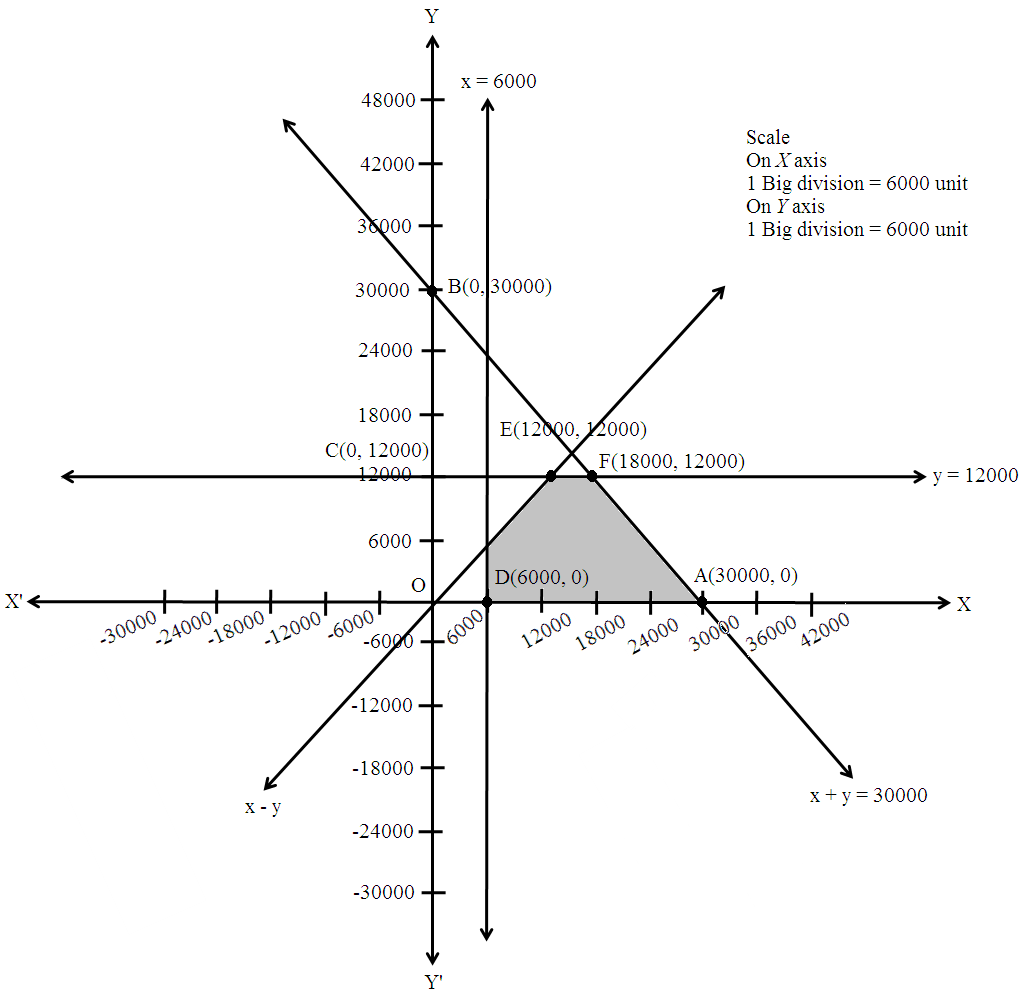
The corner points of the feasible region are D(6000, 0), A(3000,0), F(18000, 12000) and E(12000, 12000).
The values of Z at these corner points are as follows: View full question & answer→Question 1775 Marks
Find the minimum value of 3x + 5y subject to the constraints:
$-2\text{x}+\text{y}\leq4,\text{x}+\text{y}\geq3,$ $\text{x}-2\text{y}\leq2,\text{x},\text{y}\geq0.$
AnswerFirst, we will convert the given inequations into equations, we obtain the following equations:
-2x + y = 4, x + y = 3, x - 2y = 2, x = 0 and y = 0.
The line -2x + y = 4 meets the coordinate axis at A(-2, 0) and B(0, 4).
Join these points to obtain the line -2x + y = 4.
Clearly, (0, 0) satisfies the inequation $-2\text{x}+\text{y}\leq4$.
So, the region in xy-plane that contains the origin represents the solution set of the given equation.
The line x + y = 3 meets the coordinate axis at C(3, 0) and D(0, 3).
Join these points to obtain the line x + y = 3.
Clearly, (0, 0) does not satisfies the inequation $\text{x}+\text{y}\geq3$.
So, the region in xy-plane that does not contains the origin represents the solution set of the given equation.
The line x - 2y = 2 meets the coordinate axis at E(2, 0) and F(0, -1).
Join these points to obtain the line x - 2y = 2.
Clearly, (0, 0) satisfies the inequation $\text{x}-2\text{y}\leq2$.
So, the region in xy-plane that contains the origin represents the solution set of the given equation.
Region represented by $\text{x}\geq0$ and $\text{y}\geq0$:
Since, every point in the first quadrant satisfies these inequations.
So, the first quadrant is the region represented by the inequations.
These lines are drawn using a suitable scale.
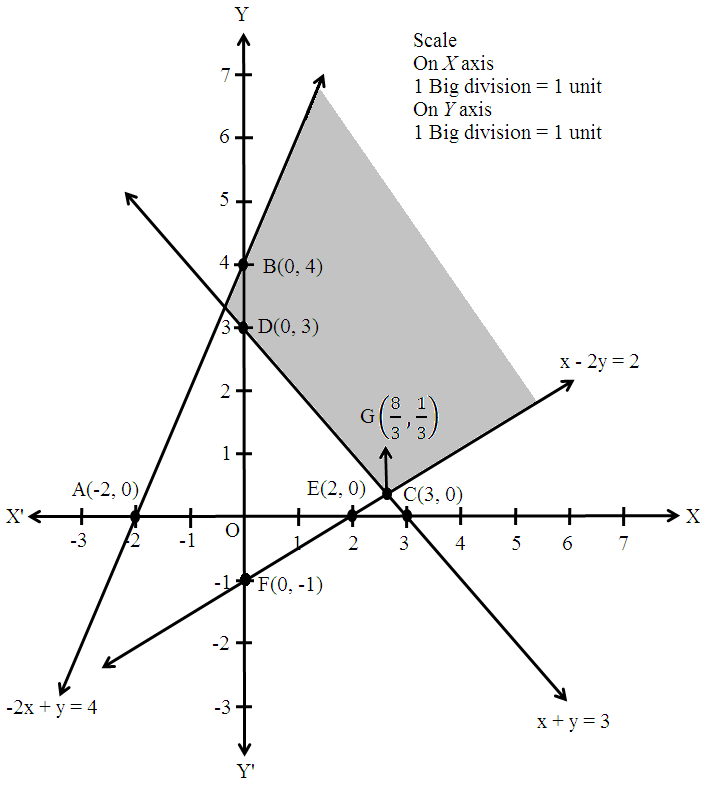
The cornerpoint of the feasible region are B(0, 4), D(0, 3) and $\text{G}\Big(\frac{8}{3},\frac{1}{3}\Big)$.
The values of Z at these corner points are as follows.
|
$\text{Corner point}$
|
$\text{Z}=3\text{x}+5\text{y}$
|
|
$\text{B}(0, 4)$
|
$3\times0+5\times4=20$
|
|
$\text{D}(0, 3)$
|
$3\times0+5\times3=15$
|
|
$\text{G}\Big(\frac{8}{3},\frac{1}{3}\Big)$
|
$3\times\frac{8}{3}+5\times\frac{1}{3}=\frac{29}{3}$
|
We see that minimum value of the objective function Z is $\frac{29}{3}$ which is at $\text{G}\Big(\frac{8}{3},\frac{1}{3}\Big)$.
Thus, the optimal value of Z is $\frac{29}{3}$. View full question & answer→Question 1785 Marks
One kind of cake requires 200g of flour and 25g of fat, and another kind of cake requires 100g of flour and 50g of fat. Find the maximum number of cakes which can be made from 5kg of flour and 1kg of fat assuming that there is no shortage of the other ingredients used in making the cakes.
AnswerLet the number of cakes of one kind and another kind be x and y, respectively.
Therefore, the total number of cakes produced are (x + y).
One kind of cake requires 200g of flour and another kind of cake requires 100g of flour.
So, x cakes of one kind and ycakes of another kind requires (200x + 100y)g of flour.
But, cakes should contain atmost 5kg of flour.
$200\text{x}+100\text{y}\leq1000$
$2\text{x}+\text{y}\leq50$
One kind of cake requires 25g of fat and another kind of cake requires 50g of fat.
So, X cakes of one kind and y cakes of another kind requires (25x + 50y)g of fat.
But, cakes should contain atmost 1 kg of fat.
$25\text{x}+50\text{y}\leq1000$
$\text{x}+2\text{y}\leq40$
Thus, the given linear programming problem is Minimise
Z= x + y
Subject to the constraints
$2\text{x}+\text{y}\leq50$
$\text{x}+2\text{y}\leq40$
$\text{x},\text{y}\geq0$
The feasible region determined by the given constraints can be diagrammatically represented as,
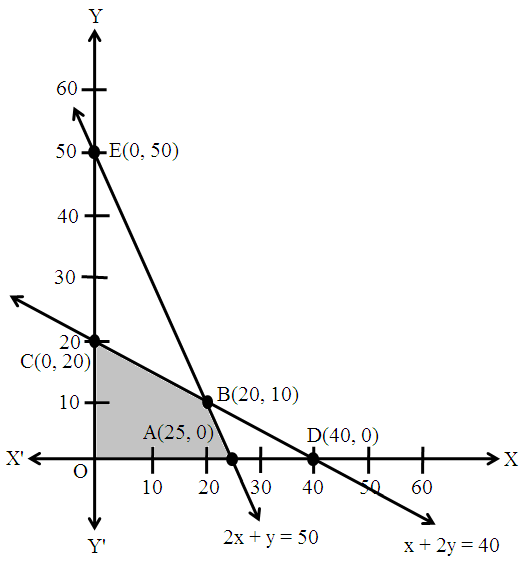
The coordinates of the corner points of the feasible region are O(0, 0), A(25, 0), B(20, 10) and C(0, 20).
The value of the objective function at these points are given in the following table.
|
Corner Point
|
Z = x + y
|
|
(0, 0)
|
0 + 0 = 0
|
|
(25, 0)
|
25 + 0 = 25
|
|
(20, 10)
|
20 + 10 = 30 → Maximum
|
|
(0, 20)
|
0 + 20 = 20
|
Thus, the maximum value of Z is 30 at x = 20, y = 10.
Hence, the maximum number of cakes which can be made are 30. View full question & answer→Question 1795 Marks
A chemical company produces two compounds, A and B. The following table gives the units of ingredients, C and D per kg of compounds A and B as well as minimum requirements of C and D and costs per kg of A and B. Find the quantities of A and B which would give a supply of C and D at a minimum cost.
|
|
Compound
|
Minimum requirement
|
|
A
|
B
|
|
|
Ingredient C
|
1
|
2
|
80
|
|
Ingredient D
|
3
|
1
|
75
|
|
Coist (in Rs.) per Kg
|
4
|
6
|
|
AnswerLet required quantity of compound A and B are x and y kg.
Since, cost of one kg of compound A and B are Rs. 4 and Rs. 6 per kg.
So, cost of x kg. of compound A and y kg. of compound B are Rs. 4x and Rs by respectively,
Let Z be the total cost of compounds, so,
Z = 4x + 6y
Since, compound A and B contain 1 and 2 units of ingredient c per kg, respectively, so, x kg. of compound A and y kg. of compound B contain x and 2y units of ingredient C respectively but minimum requirement of ingredient C is 80 units, so,
$\text{x}+2\text{y}\geq80$ (first constraint)
Since, compound A and B contain 3 and 1 unit of ingredient D per kg, respectively, so, x kg. of compound A and y kg. of compound B contain 3x and y units of ingredient respectively but minimum requirement of ingredient D is 75 units, so,
$3\text{x}+\text{y}\geq75$ (second constraint)
Hence, mathematical formulation of LPP is,
Find x and y which minimize
Z = 4x + 6y
Subject to constraints,
$\text{x}+2\text{y}\geq80$
$3\text{x}+\text{y}\geq75$
$\text{x},\text{y}\geq0$ [Since production can not be less than zero]
Region $\text{x}+2\text{y}\geq80$:
Line x + 2y = 80 meets axes at $A_1(80, 0), B_1(0, 40)$ respectively.
Region not containing origin represents $\text{x}+2\text{y}\geq80$ as (0, 0) does not satisfy $\text{x}+2\text{y}\geq80$.
Region $3\text{x}+\text{y}\geq75$:
Line 3x +y = 75 meets axes at $A_2(25, 0), B_2(0, 75)$ respectively.
Region not containing origin represents $3\text{x}+\text{y}\geq75$ as (0, 0) does not satisfy $3\text{x}+\text{y}\geq75$.
Region $\text{x},\text{y}\geq0$:
It represents first quadrant.
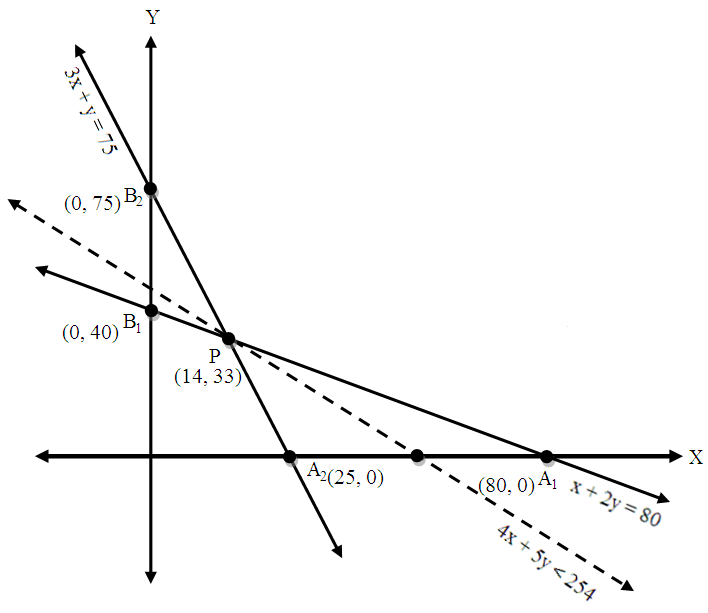
Unbouded shaded region $A_1PB_2$ represents feasible region point is obtained by solving x + 2y = 80 and 3x + y = 75
The value of $Z = 4x + 6y$ at
$A_1(80, 0) = 4(80) + 6(0) = 320$
$P(14, 33) = 4(14) + 6(33) = 254$
$B_2(0, 75) = 4(0) + 6(75) = 450$
Smallest value of Z = 254 open half plane 4x + 6y < 254 has no point in common with feasible region.
So,
Smallest value is the minimum value.
Minimum cost = Rs. 254
Quantity of A = 14kg
Quantity of B = 33kg. View full question & answer→Question 1805 Marks
One kind of cake requires 200 g of flour and 25 g of fat, and another kind of cake requires 100 g of flour and 50 g of fat. Find the maximum number of cakes which can be made from 5 kg of flour and 1 kg of fat assuming that there is no shortage of the other ingredients used in making the cakes.
AnswerLet there be x cakes of first kind and y cakes of second kind. Therefore, $\text{x}\geq0\text{ and y}\ge0$
The given information can be complied in a table as follows.
| |
Flour (g) |
Fat (g) |
| Cakes of first kind, x |
200 |
25 |
| Cakes of second kind, y |
100 |
50 |
| Availability |
5000 |
1000 |
$\therefore200\text{x}+100\text{y}\le5000$
$\Rightarrow2\text{x}+\text{y}\le50$
$25\text{x}+50\text{y}\le1000$
$\Rightarrow\text{x}+2\text{y}\le40$
Total numbers of cakes, Z, that can be made are, Z = x + y
The mathematical formulation of the given problem is Maximize z = x + y ... (1)
subject to the constraints,
$2\text{x}+\text{y}\le50\dots(2)$
$\text{x}+2\text{y}\le40\dots(3)$
$\text{x}+\text{y}\ge0\dots(4)$
The feasible region determined by the system of constraints is as follows.
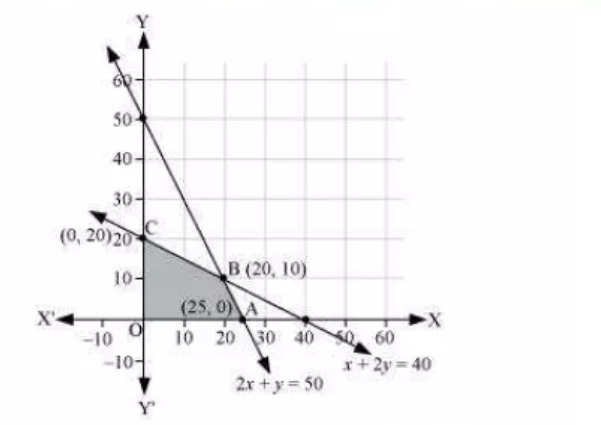
The corner points are A(25, 0), B(20, 10), O(0, 0), and C(0, 20).
The values of Z at these corner points are as follows.
| Corner point |
Z = x + y |
|
| A(25, 0) |
25 |
|
| B(20, 10) |
30 |
→ Maximum |
| C(0, 20) |
20 |
|
| O(0, 0) |
0 |
|
Thus, the maximum numbers of cakes that can be made are 30 (20 of one kind and 10 of the other kind). View full question & answer→Question 1815 Marks
A farmer mixes two brands P and Q of cattle feed. Brand P, costing Rs. 250 per bag, contains 3 units of nutritional element A, 2.5 units of element B and 2 units of element C. Brand Q costing Rs. 200 per bag contains 1.5 units of nutritional element A, 11.25 units of element B, and 3 units of element C. The minimum of nutrients A, B and C are 18 units, 45 units and 24 units respectively. Determine the number of bags of each brand which should be mixed in order to produce a mixture having a minimum cost per bag? What is the minimum cost of the mixture per bag?
AnswerLet number of bags of cattle feed brand P = x and number of bags of cattle feed brand Q = y
We have to minimize Z = 250x + 200y subject to the constraints $3\text{x}+1.5\text{y}\geq18,$
$2.5\text{x}+11.25\text{y}\geq45,\ 2\text{x}+3\text{y}\geq24,$
$\text{x}\geq0,\ \text{y}\geq0$
Consider $3\text{x}+1.5\text{y}\geq18$
Let 3x + 1.5y = 18
$\Rightarrow\ $ 2x + y = 12
$\Rightarrow\ \frac{\text{x}}{6}+\frac{\text{y}}{12}=1$
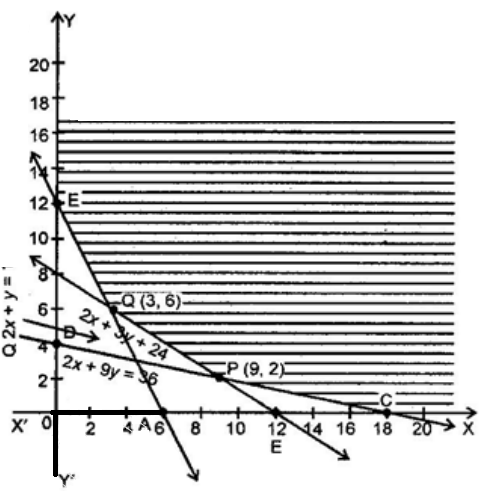
Now the points are A(6, 0) and B(0, 12).
Now clearly (0, 0) does not lie in the required half plane as
(0, 0) does not satisfy the inequation $3\text{x}+1.5\text{y}\geq18.$
Again consider $2.5\text{x}+11.25\text{y}\geq45$
Let 2.5x + 11.25y = 45
$\Rightarrow\ $ 2x + 9y = 36
$\Rightarrow\ \frac{\text{x}}{18}+\frac{\text{y}}{4}=1$
Now point C(18, 0) and D(0, 4) lie on the line.
Now again (0, 0) does not lie in the required half plane as (0, 0) does not satisfy the inequation
$2.5\text{x}+11.25\text{y}\geq45.$
Again consider $2\text{x}+3\text{y}\geq24$
Let 2x + 3y = 24
$\Rightarrow\ \frac{\text{x}}{12}+\frac{\text{y}}{8}=1$
Here, the points E(12, 0) and F(0, 8) lie on the line.
Again also (0, 0) does not lie on the half plane as (0, 0) does not satisfy this inequation.
The feasible region of XCPQEY and the co-ordinates of corners are C(18, 0), P(9, 2), Q(3, 6) and E(0, 12).
Now Z = 250x + 200y
|
At
|
C(18, 0) |
Z = 250 × 18 + 200 × 0 = 4500
|
|
At
|
P(9, 2) |
Z = 250 × 9 + 200 × 2 = 2450
|
|
At
|
Q(3, 6) |
Z = 250 × 3 + 200 × 6 = 1950
|
|
At
|
E(0, 12) |
Z = 250 × 0 + 200 × 12 = 2400
|
Here, minimum cost Z = Rs. 1950 when x = 3, y = 6
Hence, number of bags of brand P = 3 and number of bags of brand Q = 6 and minimum cost of
the mixture per bag $=\text{Rs}.\frac{1950}{9}=\text{Rs}. 216.67 \text{ per bag}.$ View full question & answer→Question 1825 Marks
An oil company has two depots, $A$ and $B$, with capacities of $7000$ litres and $4000$ litres respectively. The company is to supply oil to three petrol pumps, $D, E, F$ whose requirements are $4500, 3000$ and $3500$ litres respectively. The distance (in km) between the depots and petrol pumps is given in the following table:
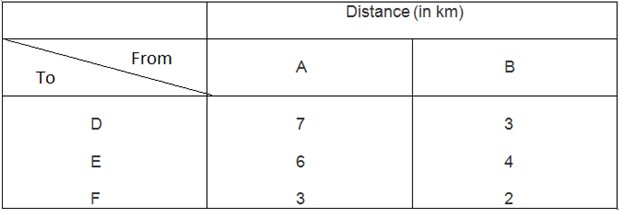
Assuming that the transportation cost per km is Rs. $1.00$ per litre, how should the delivery be scheduled in order that the transportation cost is minimum? AnswerLet x and y litres of oil be supplied from A to the petrol pumps D and E.
Then, (7000 − x − y) L will be supplied from A to petrol pump F.
The requirement at petrol pump D is 4500 L.
Since, x L are transported from depot A, the remaining (4500 − x) L will be transported from petrol pump B.
Similarly, (3000 − y) L and [3500 − (7000 − x − y)]
L i.e. (x + y − 3500) L will be transported from depot B to petrol pump E and F. respectively.
The given problem can be represented diagrammatically as follows.
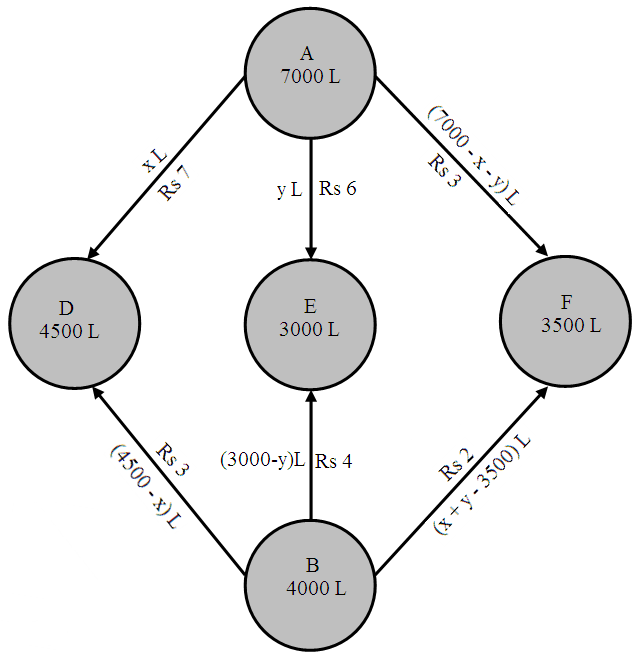
Since, quantity of oil are non-negative quantities.
Therefore,
x ≥ 0, y ≥ 0 and (7000 - x - y) ≥ 0
⇒ x ≥ 0, y ≥ 0 and x + y ≤ 7000
4500 - x ≥ 0, 3000 - y ≥ 0 and x + y - 3500 ≥ 0
⇒ x ≤ 4500, y ≤ 3000 and x + y ≥ 3500
Cost of transporting 10 L of petrol = RS. 1
Cost of transporting 1 L of petrol = Rs. 110
Therefore, total transportation cost is given by,
$\text{Z}=\frac{7}{10}\times\text{x}+\frac{6}{10}\text{y}+\frac{3}{10}(7000-\text{x}-\text{y})+\frac{3}{10}(4500-\text{x})\\+\frac{4}{10}(3000-\text{y})+\frac{2}{10}(\text{x}+\text{y}-3500)$$$
= 0.3x + 0.1y + 3950
The problem can be formulated as follows.
Minimize Z = 0.3x + 0.1y + 3950
Subject to the constraints,
x + y ≤ 7000
x ≤ 4500
y ≤ 3000
x + y ≥ 3500
x, y ≥ 0
First we will convert inequations into equations as follows:
x + y = 7000, x = 4500, y = 3000, x + y = 3500, x = 0 and y = 0
Region represented by x + y ≤ 7000:
The line x + y = 7000 meets the coordinate axes at $A_1(7000, 0)$ and $B_1(0, 7000)$ respectively.
By joining these points we obtain the line x + y = 7000.
Clearly (0, 0) satisfies the x + y = 7000.
So, the region which contains the origin represents the solution set of the inequation x + y ≤ 7000.
Region represented by x ≤ 4500:
The line x = 4500 is the line passes through $C_1(4500, 0)$ and is parallel to Y axis.
The region to the left of the line x = 4500 will satisfy the inequation x ≤ 4500.
Region represented by y ≤ 3000:
The line y = 3000 is the line passes through $D_1(0, 3000)$ and is parallel to X axis.
The region below the line y = 3000 will satisfy the inequation y ≤ 3000.
Region represented by x + y ≥ 3500:
The line x + y = 7000 meets the coordinate axes at $E_1(3500, 0)$ and $F_1(0, 3500)$ respectively.
By joining these points we obtain the line x + y = 3500.
Clearly (0, 0) satisfies the x + y = 3500.
So, the region which contains the origin represents the solution set of the inequation x + y ≥ 3500.
Region represented by x ≥ 0 and y ≥ 0:
Since, every point in the first quadrant satisfies these inequations.
So, the first quadrant is the region represented by the inequations x ≥ 0, and y ≥ 0.
The feasible region determined by the system of constraints x + y ≤ 7000, x ≤ 4500, y ≤ 3000, x + y ≥ 3500, x ≥ 0 and y ≥ 0 are as follows.
GRAPH
The corner points of the feasible region are $E_1(3500, 0), C_1(4500, 0), I_1(4500, 2500), H_1(4000, 3000), and G_1(500, 3000)$.
The values of Z at these corner points are as follows.
|
Corner point
|
Z = 0.3 + 0.1y + 3950
|
|
$E_1(3500, 0)$
|
5000
|
|
$C_1(4500, 0)$
|
5300
|
|
$I_1(4500, 2500)$
|
5550
|
|
$H_1(4000, 3000)$
|
5450
|
|
$G_1(500, 3000)$
|
4400
|
The minimum value of Z is 4400 at $G_1(500, 3000)$.
Thus, the oil supplied from depot A is 500 L, 3000 L, and 3500 L and from depot B is 4000 L, 0 L, and 0 L to petrol pumps D, E, and F respectively.
The minimum transportation cost is Rs 4400. View full question & answer→Question 1835 Marks
A cottage industry manufactures pedestal lamps and wooden shades, each requiring the use of grinding/cutting machine and sprayer. It takes 2 hours on the grinding/cutting machine and 3 hours on the sprayer to manufacture a pedestal lamp while it takes 1 hour on the grinding/cutting machine and 2 hours on the sprayer to manufacture a shade. On any day, the sprayer is available for at most 20 hours and the grinding/cutting machine for at most 12 hours. The profit from the sale of a lamp is Rs. 5.00 and a shade is Rs. 3.00. Assuming that the manufacturer can sell all the lamps and shades that he produces, how should he schedule his daily production in order to maximise his profit?
AnswerLet the cottage industry manufacture x pedestal lamps and y wooden shades.
Therefore, x ≥ 0 and y ≥ 0
The given information can be compiled in a table as follows.
|
|
Lamps
|
shades
|
Availability
|
|
Grinding/Cutting Machine (h)
|
2
|
1
|
12
|
|
Sprayer (h)
|
3
|
2
|
20
|
The profit on a lamp is Rs. 5 and on the shades is Rs 3.
Therefore, the constraints are
2x + y ≤ 12
3x + 2y ≤ 0
Total profit, Z = 5x + 3y
The mathematical formulation of the given problem is Maximize Z = 5x + 3y ... (1)
subject to the constraints,
2x + y ≤ 12... (2)
3x +2y ≤ 0... (3)
X, y ≥ 0... (4)
The feasible region determined by the system of constraints is as follows.
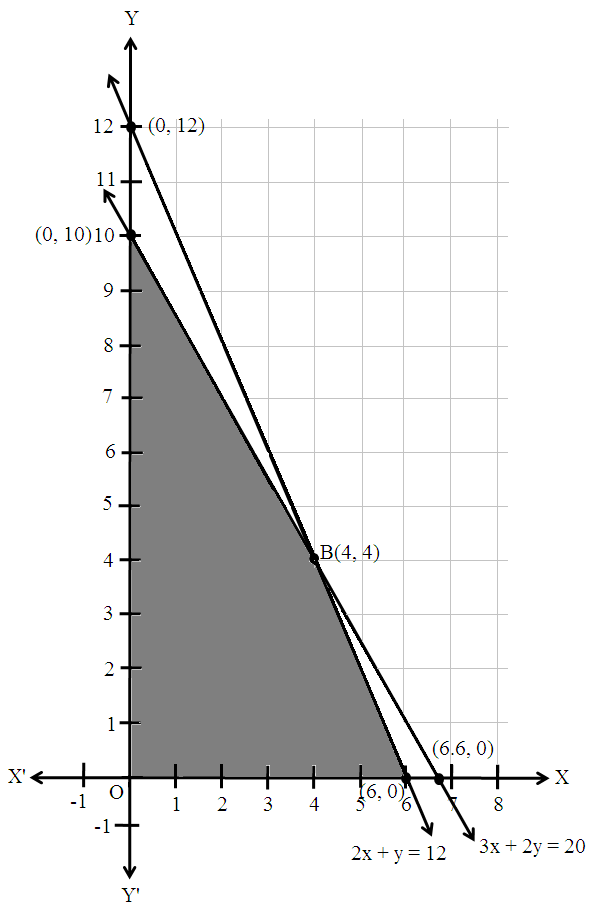
The corner points are A(6, 0), B(4, 4) and C(0, 10).
The values of Z at these corner points are as follows.
| Corner point |
Z = 5x + 3y |
|
| A(6, 0) |
30 |
|
| B(4, 4) |
32 |
→ Maximum |
| C(0, 10) |
30 |
|
The maximum value of Z is 32 at (4, 4).
Thus, the manufacturer should produce 4 pedestal lamps and 4 wooden shades to maximize his profits.
View full question & answer→Question 1845 Marks
Minimise Z = x + 2y
subject to $2\text{x}+\text{y}\geq3,\ \text{x}+2\text{y}\geq6,\ \text{x},\ \text{y}\geq0.$
Show that the minimum of Z occurs at more than two points.
Answer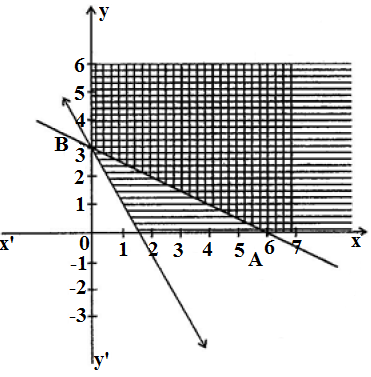
Consider $2\text{x}+\text{y}\geq3$
Let 2x + y = 3 ⇒ y = 3 - 2x
(0, 0) is not contained in the required half plane as (0, 0) does not satisfy the inequation $2\text{x}+\text{y}\geq3.$
inequation $2\text{x}+\text{y}\geq3.$
Again $\text{x}+2\text{y}\geq6.$
Let x + 2y = 6
$\Rightarrow\frac{\text{x}}{6}+\frac{\text{y}}{3}=1$
Here also (0, 0) does not contain the required half plane. The double shaded region XABY is the solution set. Its corners are A (6, 0) and B (0, 3).
At A(6, 0) Z = 6 + 0 = 6
At B(0, 3) Z = 0 + 2 × 3 = 6
Therefore, at both points the value of Z = 6 which is minimum. In fact at every point on the line AB makes Z = 6 which is also minimum. View full question & answer→Question 1855 Marks
A firm manufactures two products A and B. Each product is processed on two machines $M_1$ and $M_2$. Product A requires 4 minutes of processing time on $M_1$ and 8 min. on $M_2$; product B requires 4 minutes on $M_1$ and 4 min. on $M_2$. The machine $M_1$ is available for not more than 8 hrs 20 min. while machine $M_2$ is available for 10 hrs. during any working day. The products A and B are sold at a profit of Rs. 3 and Rs. 4 respectively.
Formulate the problem as a linear programming problem and find how many products of each type should be produced by the firm each day in order to get maximum profit.
AnswerLet required production of product A and B be x and y respectively.
Since, profit on each product A and B are Rs. 3 and Rs. 4 respectively,
So, profit on x product A and y product B are Rs. 3x and Rs. 4y respectively, Let z be the total profit on product, so,
Z = 3x + 4y
Since, each product A and B requires 4 minutes each on machine $M_1$ so, x product A and y product B require 4x and 4y minutes on machine $M_1$ respectively but maximum available time on machine $M_1$ is 8 hrs 20 min.= 500 min. so,
$4\text{x}+4\text{y}\leq500$
$\text{x}+\text{y}\leq125$ (first constraint)
Since, each product A and B requires 8 minutes and 4 min. on machine $M_2$ respectively. so, x product A and y product B require 8x and 4y min. respectively on machine $M_2$ but, maximum available time on machine $M_2$ is 10 hrs = 600 min. so,
$8\text{x}+4\text{y}\leq600$
$2\text{x}+\text{y}\leq150$ (second constraint)
Hence, mathematical formulation of LPP is,
Find x and y which maximize
Z = 3x + 4y
Subject to constraints,
$\text{x}+\text{y}\leq125$
$2\text{x}+\text{y}\leq150$
$\text{x},\text{y}\geq0$
Since number of product can not be less than zero]
Region $\text{x}+\text{y}\leq125$:
Line x + y = 125 meets axis at $A_1(125, 0),B_1(0, 125)$ respectively.
Region $\text{x}+\text{y}\leq125$
Contains origin represents as (0, 0) satisfies x + y s 125.
Region $2\text{x}+\text{y}\leq150$:
Line 2x + y = 150 meets axis at $A_2(75, 0), B_2(0, 150)$ respectively.
Region containing origin represents $2\text{x}+\text{y}\leq150$ as (0, 0) satisfies $2\text{x}+\text{y}\leq150$
Region $\text{x},\text{y}\geq0$:
It represents first quadrant.
Shaded region $OA_2PB_1$ is feasible region P(25, 100) is obtained by solving x + y = 125 and 2x + y = 150
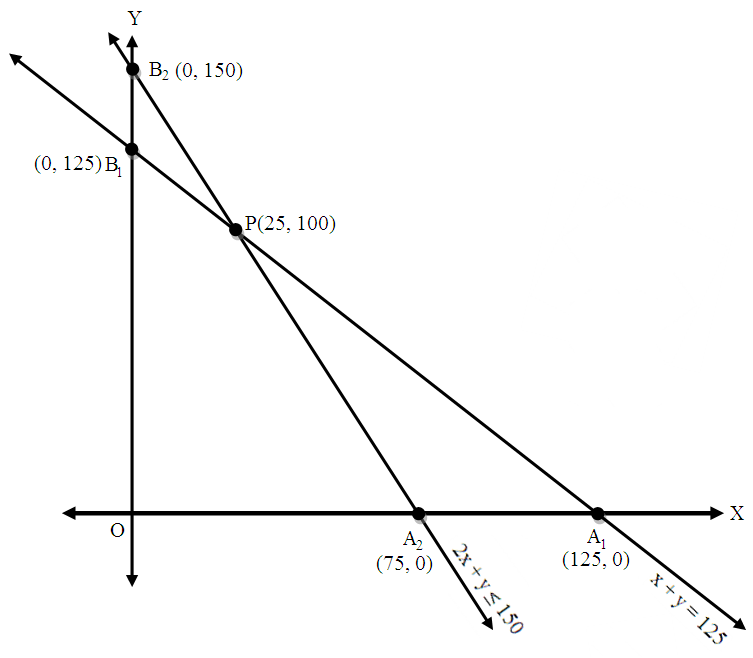
The value of $Z = 3x + 4y$ at
$0(0, 0) = 3(0) + 4(0) = 0$
$A_2(75, 0) = 3(75) + 4(0) = 225$
$P(25, 100) = 3(25) + 4(100) = 475$
$B_1(0, 125) = 3(0) + 4(125) = 500$
Maximum profit = Rs. 500, product A = 0
Product B = 125. View full question & answer→Question 1865 Marks
A manufacturer makes two types of toys A and B. Three machines are needed for this purpose and the time (in minutes) required for each toy on the machines is given below:
|
Type of Toys
|
Machine
|
|
|
I
|
II
|
III
|
|
A
|
12
|
18
|
6
|
|
B
|
6
|
0
|
9
|
Each machine is available for a maximum of 6 hours per day. If the profit on each toy of type A is Rs. 7.50 and that on each toy of type B is Rs. 5, show that 15 toys of type A and 30 toys of type B should be manufactured in a day to get maximum profit.
AnswerSuppose the manufacturer makes x toys of type A and y toys of type B.
Since each toy of type A require 12 minutes on machine I and each toy of type B require 6 minutes on machine I, therefore, x toys of type A and y toys of type B require (12x + 6y) minutes on machine I.
But, machines I is available for at most 6 hours.
12x + 6y ≤ 360
2x + y ≤ 60
Similarly, each toy of type A require 18 minutes on machine II and each toy of type B require 0 minutes on machine II, therefore, xtoys of type A and ytoys of type B require (18x + Oy) minutes on machine II.
But, machines II is available for at most 6 hours.
18x + 6y ≤ 360
x ≤ 20 Also, each toy of type A require 6 minutes on machine III and each toy of type B require 9 minutes on machine III, therefore, x toys of type A and y toys of type B require (6x + 9y) minutes on machine III.
But, machines III is available for at most 6 hours.
6x + 9y ≤ 360
2x + 3y ≤ 120
The profit on each toy of type A is Rs. 7.50 and each toy of type B is Rs. 5.
Therefore, the total profit from x to y of type A and y toys of type B is Rs. (7.50x + 5y).
Thus, the given linear programming problem is Maximise Z = 7.5x + 5y
Subject to the constraints
2x + y ≤ 60
x ≤ 20
2x + 3y ≤ 120
x, y ≥ 0
The feasible region determined by the given constraints can be diagrammatically represented as
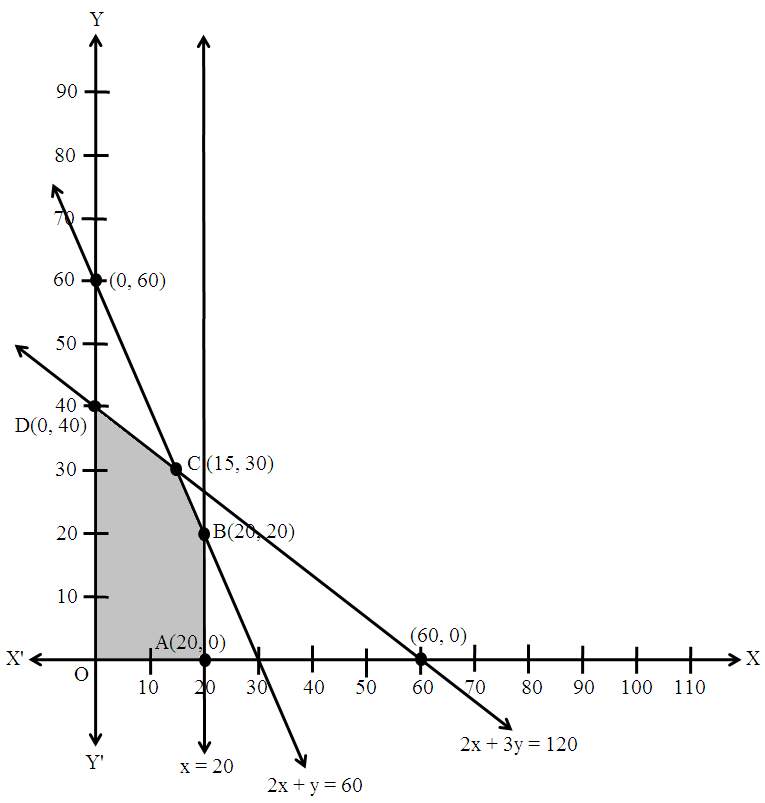
Hence, 15 toys of type A and 30 toys of type B should be manufactured in a day to get maximum profit.
The maximum profit is Rs. 262.50.
The coordinates of the corner points of the feasible region are O(0, 0), A(20, 0), B(20, 20), C(15, 30) and D(0, 40).
The value of the objective function at these points are given in the following table.
|
Corner Point
|
Z = 7.5x + 5y
|
|
(0, 0)
|
7.5 × 0 + 5 × 0 = 0
|
|
(20, 0)
|
7.5 × 20 + 5 × 0 =150
|
|
(20, 20)
|
7.5 × 20 + 5 × 20 = 250
|
|
(15, 30)
|
7.5 × 15 + 5 × 30 = 262.5 → Maximum
|
|
(0, 40)
|
7.5 × 0 +5 × 40 = 200
|
The maximum value of Z is 262.5 at x = 15, y = 30.
Hence, 15 toys of type A and 30 toys of type B should be manufactured in a day to get maximum profit.
The maximum profit is Rs. 262.50.
View full question & answer→Question 1875 Marks
Maximise Z = x + y, subject to $\text{x}-\text{y}\leq-1,\ -\text{x}+\text{y}\leq0,\ \text{x},\ \text{y}\geq0.$
AnswerConsider $\text{x}-\text{y}\leq-1$
Let x - y = -1
⇒ x = y - 1
| |
A |
B |
C |
D |
| x |
-1 |
0 |
2 |
3 |
| y |
0 |
1 |
3 |
4 |
If (0, 0) is the test point then $\text{x}-\text{y}\leq-1\Rightarrow0\leq-1$ which is false and thus the required plane does not include (0, 0).
Again $-\text{x}+\text{y}\leq0$
Let -x + y = 0
⇒ y = x
For $(1,\ 0)-1\leq0$ which is true, therefore the required half-plane include (1, 0).
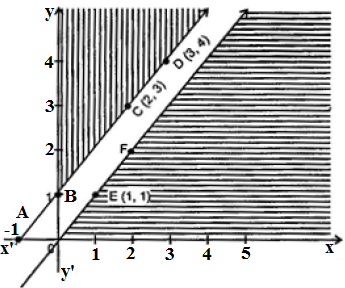
It is clear that the two required half planes do not intersect at all, i.e., they do not have a common region.
Hence there is no maximum Z. View full question & answer→Question 1885 Marks
A rubber company is engaged in producing three types of tyres A, B and C. Each type requires processing in two plants, Plant I and Plant II. The capacities of the two plants, in number of tyres per day, are as follows:
|
Plant
|
A
|
B
|
C
|
| I |
50
|
100
|
100
|
| II |
60
|
60
|
200
|
The monthly demand for tyre A, B and C is 2500, 3000 and 7000 respectively. If plant I costs Rs. 2500 per day, and plant II costs Rs. 3500 per day to operate, how many days should each be run per month to minimize cost while meeting the demand? Formulate the problem as LPP.
AnswerLet plant I be run for x days and plant II be run for y dayes
Then,
|
Tyres
|
Plant I (4)
|
Plant II (y)
|
Demand
|
|
A
|
50
|
60
|
2500
|
| B |
100
|
60
|
3000
|
|
C
|
100
|
200
|
7000
|
Minimum demand for Tyres A,B and C is 2500, 3000 and 7000 respectively. The demand can be more then the minimum demand.
Therefore, the incquations will be.
$50\text{x}+60\text{y}\geq2500$
$100\text{x}+60\text{y}\geq3000$
$100\text{x}+200\text{y}\geq7000$
Also, the objective function is Z = 2500x + 3500y
Hence, the required LPP is as follows:
Minimise Z = 2500x + 3500y
subject to
$50\text{x}+60\text{y}\geq2500$
$100\text{x}+60\text{y}\geq3000$
$100\text{x}+200\text{y}\geq7000$ View full question & answer→Question 1895 Marks
A manufacturer considers that men and women workers are equally efficient and so he pays them at the same rate. He has 30 and 17 units of workers (male and female) and capital respectively, which he uses to produce two types of goods A and B. To produce one unit of A, 2 workers and 3 units of capital are required while 3 workers and 1 unit of capital is required to produce one unit of B. If A and B are priced at Rs. 100 and Rs. 120 per unit respectively, how should he use his resources to maximise the total revenue? Form the above as an LPP and solve graphically. Do you agree with this view of the manufacturer that men and women workers are equally efficient and so should be paid at the same rate?
AnswerLet x units of A and y units of B be produced by the manufacturer.
The price of one unit of A is Rs. 100 and the price of one unit of B is Rs. 120.
Therefore, the total price of x units of A and y units of B or the total revenue is Rs. (100x + 120y).
One unit of A requires 2 workers and one unit of B requires 3 workers.
Therefore, x units of A and y units of B requires (2x + 3y) workers.
But, the manufacturer has 30 workers.
$\therefore$ 2x + 3y ≤ 30
Similarly, one unit of A requires 3 units of capital and one unit of B requires 1 unit of capital.
Therefore, x units of A and y units of B requires (3x + y) units of capital.
But, the manufacturer has 17 units of capital.
$\therefore$ 3x + y ≤ 17
Thus, the given linear programming problem is
Maximise Z = 100x + 120y
Subject to the constraints
2x + 3y ≤ 30
3x + y ≤ 17
x, y ≥ 0
The feasible region determined by the given constraints can be diagrammatically represented as,
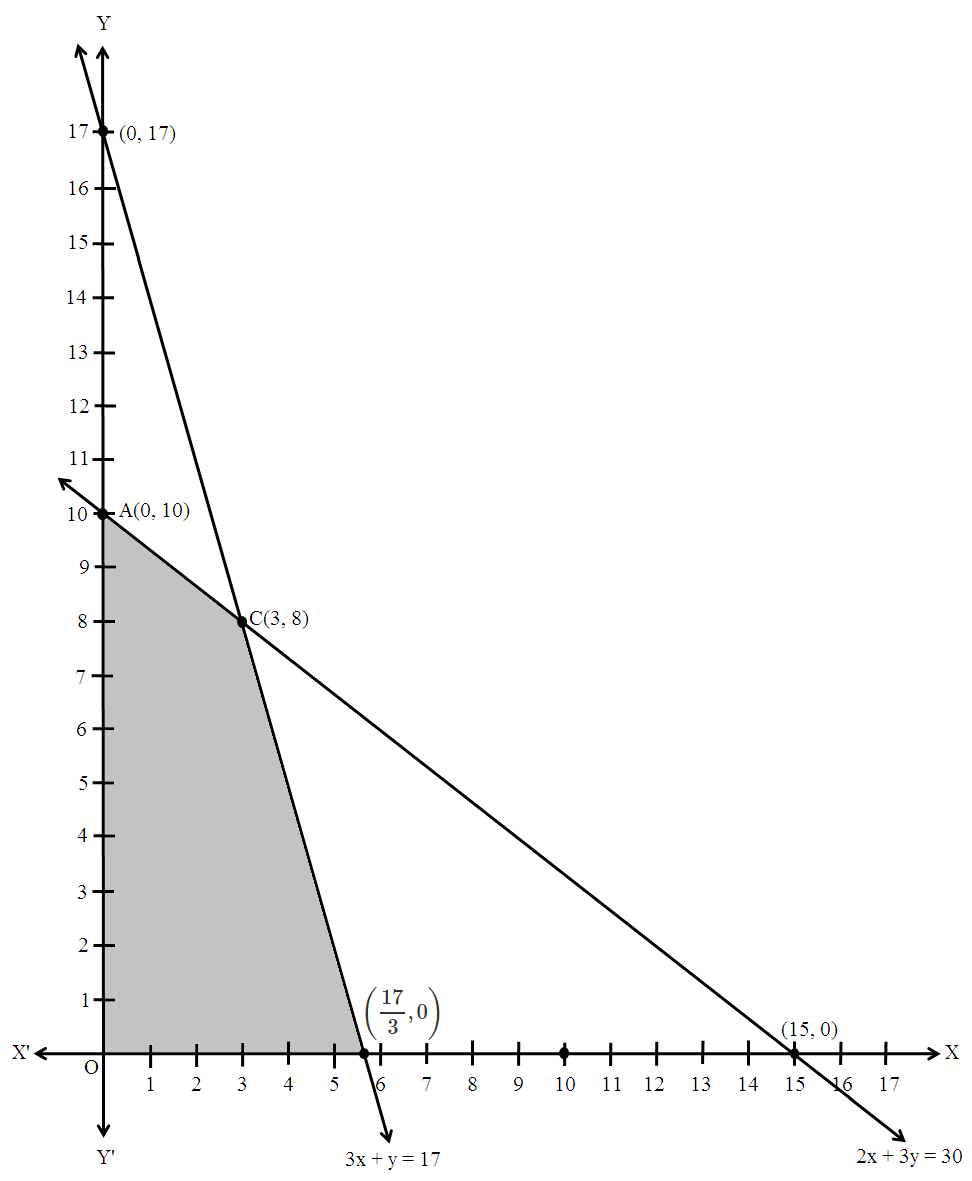
The coordinates of the corner points of the feasible region are O(0, 0), A(0, 10), B(173, 0) and C(3, 8).
The value of the objective function at these points are given in the following table:
|
Corner point
|
Z = 100x + 120y
|
|
(0, 0)
|
100 × 0 + 120 × 0 = 0
|
|
(0, 10)
|
100 × 0 + 120 × 10 = 1200
|
|
(173, 0)
|
100 × 173 + 120 × 0 = 17003
|
|
(3, 8)
|
100 × 3 + 120 × 8 = 1260
|
The maximum value of Z is 1260 at x = 3, y = 8.
Hence, the maximum total revenue is Rs. 1,260 when 3 units of A and 8 units of B are produced.
Yes, because the efficiency of a worker does not depend on whether the worker is a male or a female.
View full question & answer→Question 1905 Marks
A firm manufactures two products, each of which must be processed through two departments, 1 and 2. The hourly requirements per unit for each product in each department, the weekly capacities in each department, selling price per unit, labour cost per unit, and raw material cost per unit are summarized as follows:
|
|
Product A
|
Product B
|
Weekly capacity
|
|
Department 1
|
3
|
2
|
130
|
|
Department 2
|
4
|
6
|
260
|
|
Selling price per unit
|
Rs. 25
|
Rs. 30
|
|
|
Labour cost per unit
|
Rs. 16
|
Rs. 20
|
|
|
Raw material cost per unit
|
Rs. 4
|
Rs. 4
|
|
The problem is to determine the number of units to produce each product so as to maximize total contribution to profit. Formulate this as a LPP.
AnswerGiven information can be tabulated below:
|
Product
|
Department 1
|
Department 2
|
Selling price
|
Labour cost
|
Row material cost
|
|
A
|
3
|
4
|
25
|
16
|
4
|
|
B
|
2
|
6
|
30
|
20
|
4
|
|
Capacity
|
130
|
260
|
|
|
|
Let the required product of product A and B be x and y units respectively.
Given, labour cost and raw material cost of one unit of product A is Rs 16 and Rs 4, so total cost of product A is Rs 16 + RS 4 = Rs 20 And given selling price of 1 unit of product A is Rs 25, So, profit on one unit of product.
A - 25 - 20 - Rs 5
Again, given labour cost and raw material cost of one unit of product B is Rs 20 and Rs 4 So, that cost of product B is Rs 20 + RS 4 - Rs 24 And given selling price of 1 unit of product B is Rs 30 So, profit on one unit of product B = 30 - 24 = Rs 6
Hence, profits on x unit of product A and y units of product B are Rs 5x and Rs 6y respectively.
Let z be the total profit, so Z = 5x + 6y
Given, production of one unit of product A and B need to process for 3 and 4 hours respectively in department 1, so production of x units of product A and y units of product 8 need to process for 3x and 4 hours respectively in Department 1. But to tal capacity of Department 1 is 130 hour, So, $\text{3x}+\text{2y}\leq130$ (First constraint)
Given, production of one unit of product A and B need to process for 4 and 6 hours respectively in department 2, so production of x units of product A and y units of product B need to process for 4x and 6y hours respectively in Department 2 but total capacity of Department 2 is 260 hours So, $\text{4x}+\text{6y}\leq 260$ (Second constraint)
Hence, mathematical formulation of LPP IS, Find x and y which Maximize z = 5x + 6y
Subject to constraint,
$\text{3x}+\text{2y}\leq130$
$\text{4x}+\text{6y}\leq260$
$\text{X,Y}\geq 0$ [Since production cannot be less than zero] View full question & answer→Question 1915 Marks
A manufacturer of electronic circuits has a stock of 200 resistors, 120 transistors and 150 capacitors and is required to produce two types of circuits A and B. Type A requires 20 resistors, 10 transistors and 10 capacitors. Type B requires 10 resistors, 20 transistors and 30 capacitors. If the profit on type A circuit is Rs. 50 and that on type B circuit is Rs. 60, formulate this problem as a LPP so that the manufacturer can maximise his profit.
AnswerLet the manufacturer produces x units of type A circuits and y units of type B circuits. Form the given information, we have following corresponding constraint table.
|
|
Type A (x)
|
Type B (y)
|
Maximum stock
|
|
Resistors
Transistors
Capacitors
|
20
10
10
|
10
20
30
|
200
120
150
|
|
Profit
|
Rs. 50
|
Rs. 60
|
|
Thus, we see that total profit Z = 50x + 60y (in Rs.).
Thus the given problem can be represented as the following condition,
Maximise Z = 50x + 60y ...(i)
Subject to the constraints.
$20\text{x}+10\text{y}\leq200$ [Resistors constraint]
$\Rightarrow2\text{x}+\text{y}\leq20\ .....(\text{ii})$
And $10\text{x}+20\text{y}\leq120$ [Transistor constraint]
$\Rightarrow\text{x}+2\text{y}\leq12\ .....(\text{iii})$
And $10\text{x}+30\text{y}\leq150$ [Capacitor constraint]
$\Rightarrow\text{x}+3\text{y}\leq15\ .....(\text{iv})$
And $\text{x}\geq0,\text{y}\geq0$ [Non-negativeconstraint] ......(v)
So, maximise Z = 50x + 60y, subject to $2\text{x}+\text{y}\leq20,\text{x}+2\text{y}\leq12,$ $\text{x}+3\text{y}\leq15,\text{x}\geq0,\text{y}\geq0.$ View full question & answer→Question 1925 Marks
A firm manufactures headache pills in two sizes A and B. Size A contains 2 grains of aspirin, 5 grains of bicarbonate and 1 grain of codeine; size B contains 1 grain of aspirin, 8 grains of bicarbonate and 66 grains of codeine. It has been found by users that it requires at least 12 grains of aspirin, 7.4 grains of bicarbonate and 24 grains of codeine for providing immediate effects. Determine graphically the least number of pills a patient should have to get immediate relief. Determine also the quantity of codeine consumed by patient
AnswerLet the number of size A pill be x and the number of size B pill be y.
Therefore, the constraints are
$2\text{x}+\text{y}\geq12$
$5\text{x}+8\text{y}\geq7.4$
$4\text{x}+66\text{y}\geq24$
Z = x + y which is to be minimised
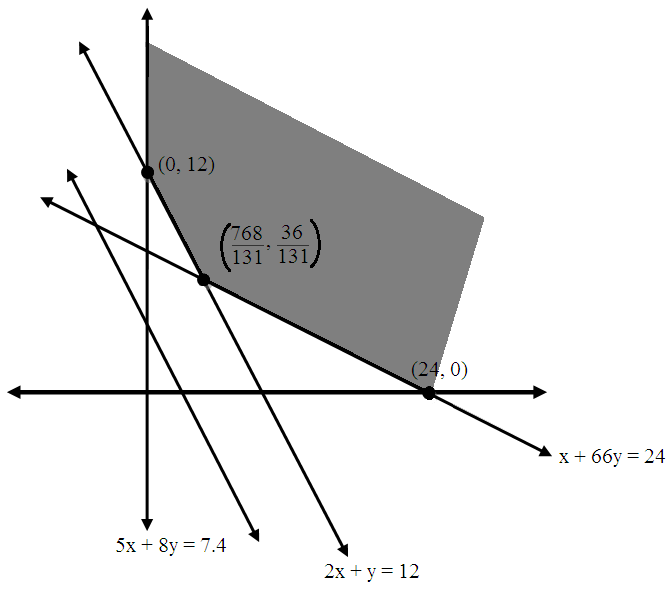
The corner points are (0, 12), (24, 0) and 768131, 36131.
The values of Z at these corner points are as follows:
|
Corner point
|
Z = x + y
|
|
(0, 12)
|
12
|
|
(24, 0)
|
24
|
|
768131, 36131
|
6.1373
|
The minimum value of Z is 6.1373 but the region is unbounded so check whether x + y < 6.1373 has common region with the feasible solution.
Clearly, it can be seen that it doesn't has any common region.
So,
x = 768131, y = 36131
This is the least quantity of pill A and B.
Codline quantity = 768131 + 66 x 36131 =24 grains. View full question & answer→Question 1935 Marks
A toy company manufactures two types of dolls, A and B. Market tests and available resources have indicated that the combined production level should not exceed 1200 dolls per week and the demand for dolls of type B is at most half of that for dolls of type A. Further, the production level of dolls of type A can exceed three times the production of dolls of other type by at most 600 units. If the company makes profit of Rs. 12 and Rs. 16 per doll respectively on dolls A and B, how many of each should be produced weekly in order to maximise the profit?
AnswerLet the number of dolls of type A = x and number of dolls of type B = y
We have to maximize Z = 12x + 16y subject to $\text{x}+\text{y}\leq1200,\ \text{y}\leq\frac{1}{2}\text{x},\ \text{x}-3\text{y}\leq600,\ \text{x}\geq0,\ \text{y}\geq0$
Consider $\text{x}+\text{y}\leq1200$
Let x + y = 1200
$\Rightarrow\ \text{y}=1200-\text{x}$
| |
A |
B |
C |
| x |
0 |
600 |
1200 |
| y |
1200 |
600 |
0 |
Here, (0, 0) is included in the required half plane and satisfies this inequation.
Again consider $\text{y}\leq\frac{1}{2}\text{x}$
Let $\text{y}=\frac{1}{2}\text{x}$
Here, (100, 0) satisfies the inequation $$$\text{y}\leq\frac{1}{2}\text{x },$ therefore the required half plane includes (100, 0).
| |
O |
E |
F |
| x |
1200 |
800 |
600 |
| y |
600 |
400 |
300 |
Again consider $\text{x}-3\text{y}\leq600$
Let x - 3y = 600
$\Rightarrow\ \text{x}=600+3\text{y}$
| |
D |
P |
Q |
| x |
600 |
900 |
1200 |
| y |
0 |
100 |
200 |
Here, also (0, 0) is included in the required half-plane.
The shaded region DRSOD is the feasible region whose corners are D(600, 0), R(1050, 150), S(800, 400) and O(0, 0).
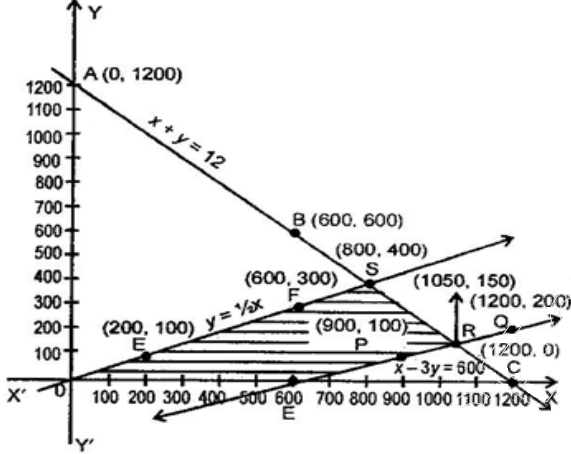
Now Z = 12x + 16y
| At |
D(600, 0) |
Z = 12 × 600 + 16 × 0 = 7200 |
| At |
R(1050, 150) |
Z = 12 × 105 + 16 × 150 = 12600 + 2400 = 15, 000 |
| At |
S(800, 400) |
Z = 12 × 800 + 16 × 400 = 9600 + 6400 = 16, 000 |
| At |
O(0, 0) |
Z = 12 × 0 + 16 × 0 = 0 |
Hence maximum profit Z = Rs. 16, 000 at x = 800, y = 400. View full question & answer→Question 1945 Marks
A merchant plans to sell two types of personal computers- a desktop model and a portable model that will cost Rs 25000 and Rs 40000 respectively. He estimates that the total monthly demand of computers will not exceed 250 units. Determine the number of units of each type of computers which the merchant should stock to get maximum profit if he does not want to invest more than Rs 70 lakhs and if his profit on the desktop model is Rs 4500 and on portable model is Rs 5000.
AnswerLet the merchant stock x desktop models and y portable models. Therefore, $\text{x}\ge0\text{ and y}\ge0.$
The cost of a desktop model is Rs 25000 and of a portable model is Rs 4000. However, the merchant can Invest a maximum of Rs 70 lakhs.
$\therefore2500\text{x}+40000\text{y}\le7000000\\5\text{x}+8\text{y}\le1400$
The monthly demand of computers will not exceed 250 units.
$\therefore\text{x}+\text{y}\le250$
The profit on a desktop model is Rs 4500 and the profit on a portable model is Rs 5000.
Total profit, Z = 4500x + 5000y ... (1)
subject to the constraints,
$5\text{x}+8\text{y}\le1400\dots(2)\\\text{x}+\text{y}\le250\dots(3)\\\text{x},\ \text{y}\ge0\dots(4)$
The feasible region determined by the system of constraints is as follows.
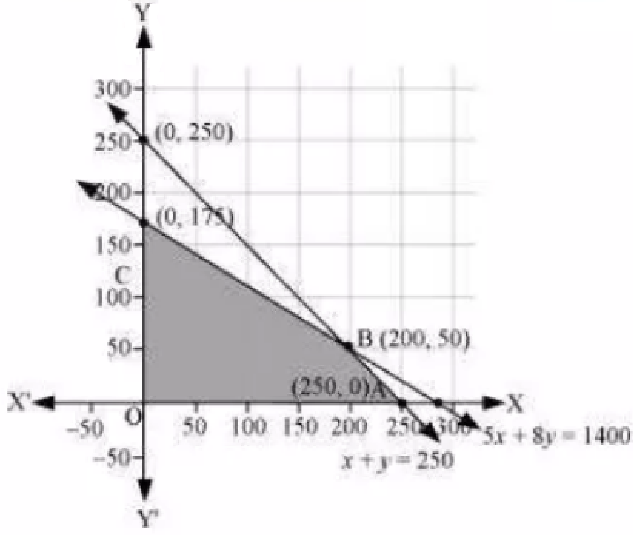
The corner points are A(250, 0), B(200, 50), and C(0, 175).
The values of Z at these corner points are as follows.
| Corner point |
Z = 4500x + 5000y |
|
| A(250, 0) |
1125000 |
|
| 6(200, 50) |
1150000 |
→ Maximum |
| C(0, 175) |
875000 |
|
The maximum value of Z is 1150000 at (200, 50).
Thus, the merchant should stock 200 desktop models and 50 portable models to get the maximum profit of Rs 1150000. View full question & answer→Question 1955 Marks
A gardener has supply of fertilizer of type I which consists of 10% nitrogen and 6% phosphoric acid and type II fertilizer which consists of 5% nitrogen and 10% phosphoric acid. After testing the soil conditions, he finds that he needs at least 14kg of nitrogen and 14kg of phosphoric acid for his crop. If the type I fertilizer costs 60 paise per kg and type II fertilizer costs 40 paise per kg, determine how many kilograms of each fertilizer should be used so that nutrient requirements are met at a minimum cost. What is the minimum cost?
AnswerLet x kg of type 1 fertilizer and y kg of type II fertilizer are supplied.
Quantity of fertilizer cannot be negative.
Therefore, x, y ≥ 0
A gardener has supply of fertilizer of type I which consists of 10% nitrogen and type II fertilizer consists of 5% nitrogen and he needs at least 14kg of nitrogen for his crop.
10 × 100 + 5 × 100 ≥ 14 = 10x + 5x ≥ 1400
A gardener has supply of fertilizer of type I which consists 6% phosphoric acid and type II fertilizer consists of 10% phosphoric acid.
And he needs 14kg of phosphoric acid for his crop.
6 × 100 + 10 × 100 ≥ 14 = 6x + 10x ≥ 1400
Therefore, according to the question, constraints are 10x + 5y ≥ 1400, 6x + 10y ≥ 1400
If the type I fertilizer costs 60 paise per kg and type II fertilizer costs 40 paise per kg.
Therefore, cost of x kg of type 1 fertilizer and y kg of type II fertilizer is Rs. 0.60x and Rs. 0.40y respectively.
Total cost = Z = 0.60x + 0.40y which is to be minimised.
Thus, the mathematical formulation of the given linear programmimg problem is
Min Z = 0.60x + 0.40y
Subject to
6x + 10y ≥ 1400
10x + 5y ≥ 1400
x, y ≥ 0
First we will convert inequations into equations as follows:
6x + 10y = 1400, 10x + 5y = 1400, x = 0 and y = 0
Region represented by 6x +10y ≥ 1400:
The line 6x +10y = 1400 meets the coordinate axes at A(7003, 0) and B(0, 140) respectively.
By joining these points we obtain the line 6x + 10y = 1400.
Clearly (0, 0) does not satisfies the 6x + 10y = 1400.
So, the region which does not contain the origin represents the solution set of the inequation 6x + 10y ≥ 1400.
Region represented by 10x + 5y ≥ 1400:
The line 10x + 5y = 1400 meets the coordinate axes at C(140, 0) and D(0, 280) respectively.
By joining these points we obtain the line 10x + 5y = 1400.
Clearly (0, 0) does not satisfies the inequation 10x + 5y 1400.
So, the region which does not contain the origin represents the solution set of the inequation 10x + 5y ≥ 1400.
Region represented by x ≥ 0 and y ≥ 20:
Since, every point in the first quadrant satisfies these inequations.
So, the first quadrant is the region represented by the inequations x ≥ 0, and y ≥ 0.
The feasible region determined by the system of constraints 6x + 10y ≥ 1400, 10x + 5y ≥ 1400, X ≥ 0 and y ≥ 0 are as follows.
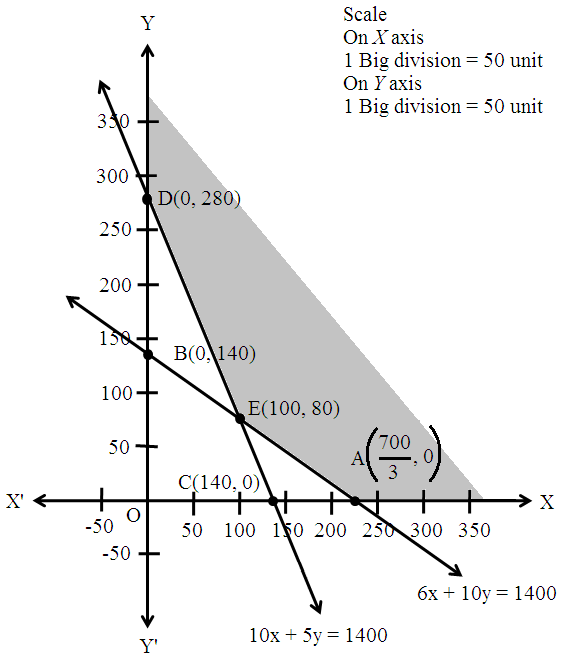
The corner points are D(0, 280), E(100, 80) and $\text{A}\Big(\frac{700}{3}, 0\Big).$
The values of Z at these corner points are as follows:
|
Corner point
|
Z = 0.60x + 0.40y
|
|
D
|
112
|
|
E
|
92
|
|
A
|
140
|
The minimum value of Z is Rs. 92 which is attained at E(100, 80).
Thus, the minimum cost is Rs. 92 obtained when 100kg of type I fertilizer and 80kg of type II fertilizer were supplied. View full question & answer→Question 1965 Marks
A merchant plans to sell two types of personal computers a desktop model and a portable model that will cost Rs. 25,000 and Rs. 40,000 respectively. He estimates that the total monthly demand of computers will not exceed 250 units. Determine the number of units of each type of computers which the merchant should stock to get maximum profit if he does not want to invest more than Rs. 70 lakhs and his profit on the desktop model is Rs. 4500 and on the portable model is Rs. 5000.
AnswerLet x and y be the number of desktop model and portable model respectively.
Number of desktop model and portable model cannot be negative.
Therefore,
It is given that the monthly demand will not exist 250 units.
$\therefore$ x + y ≤ 250
Cost of desktop and portable model is Rs. 25,000 and Rs. 40,000 respectively.
Therefore, cost of x desktop model and y portable model is Rs. 25,000 and Rs. 40,000 respectively and he does not want to invest more than Rs. 70 lakhs.
25000x + 40000y ≤ 7000000
Profit on the desktop model is Rs. 4500 and on the portable model is Rs. 5000.
Therefore, profit made by x desktop model and y portable model is Rs. 4500x and Rs. 5000y respectively.
Total profit = Z = 4500x + 5000y
The mathematical form of the given LPP is:
Maximize Z = 4500x + 5000y
Subject to constraints:
x + y ≤ 250
25000x + 40000y ≤ 7000000
First we will convert inequations into equations as follows:
x + y = 250, 25000x + 40000y = 7000000, x = 0 and y = 0
Region represented by x + y ≤ 250:
The line x + y = 250 meets the coordinate axes at A(250, 0) and B(0, 250) respectively.
By joining these points we obtain the line x + y = 250.
Clearly (0, 0) satisfies the x + y = 250.
So, the region which contains the origin represents the solution set of the inequation x + y ≤ 250.
Region represented by 25000x + 40000y ≤ 7000000:
The line 25000x + 40000y = 7000000 meets the coordinate axes at C(280, 0) and D(0, 175) respectively.
By joining these points we obtain the line 25000x + 40000y = 7000000.
Clearly (0, 0) satisfies the inequation 25000x + 40000y ≤ 7000000.
So, the region which contains the origin represents the solution set of the inequation 25000x + 40000y ≤ 7000000.
Region represented by x ≥ 0 and y ≥ 0:
Since, every point in the first quadrant satisfies these inequations.
So, the first quadrant is the region represented by the inequations x ≥ 0, and y ≥ 0.
The feasible region determined by the system of constraints x + y ≤ 250, 25000x + 40000y ≤ 7000000, x ≥ 0 and y ≥ 0 are as follows.
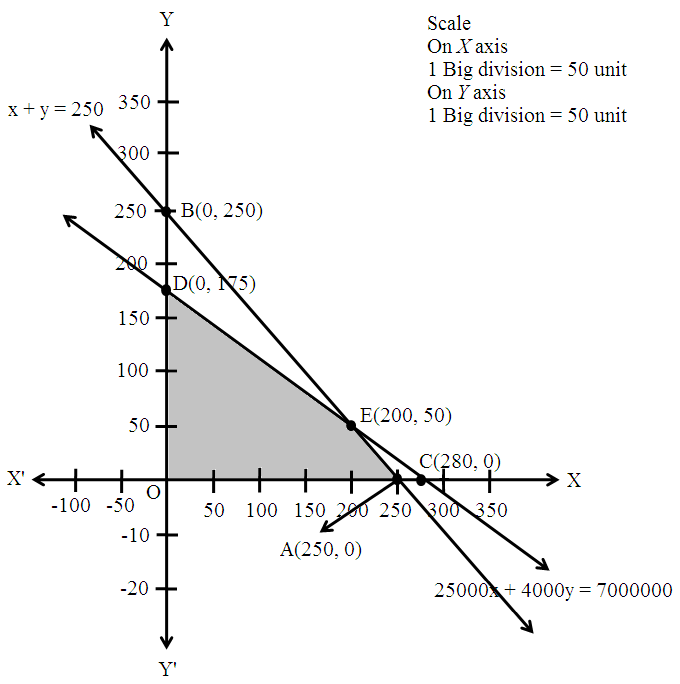
The corner points are O(0, 0), D(0, 175), E(200, 50) and A(250, 0).
The values of the objective function Z at corner points of the feasible region are given in the following table:
|
Corner Points
|
Z = 4500x + 5000 |
|
| O(0, 0) |
0 |
|
| D(0, 175) |
875000 |
|
| E(200, 50) |
1150000 |
→ Maximum |
| A(250, 0) |
1125000 |
|
Clearly, Z is maximum at x = 200 and y = 50 and the maximum value of Z at this point is 1150000.
Thus, 200 desktop models and 50 portable units should be sold to maximize the profit. View full question & answer→Question 1975 Marks
A toy company manufactures two types of dolls, A and B. Market tests and available resources have indicated that the combined production level should not exceed 1200 dolls per week and the demand for dolls type B is at most half of that for dolls of types A. Further, the production level of dolls of type A can exceed three times the production of dolls of other type by at most 600 units. If the company makes profit of Rs. 12 and Rs. 16 per doll respectively on dolls A and B, how many of each should be produced weekly in order to maximize the profit ?
AnswerLet x dolls of type A and y dolls of type B be produced to have the maximum profit.
The company makes profit of Rs. 12 and Rs. 16 per doll respectively on doll A and doll B
Step I
= Z = 12x + 16y
The production level of x + y should not exceed 1200
x + y ≤ 1200
The production level of dolls of type A exceeds three times the production of dolls of type B by at most 600
x - 3y ≤ 600
Demand for dolls of type B is at most of that for dolls of type A.
$\text{y}\leq\frac{\text{x}}{2}$
Hence we can say the LPP is subject to maximize Z = 12x + 16y and to constraints
$\text{x}+\text{y}\leq1200$
$\text{x}-3\text{y}\leq600$
$\text{y}\leq\frac{\text{x}}{2}$
$\text{x},\text{y}\geq0$
Step II
- The line x + y = 1200 passes through A(1200, 0),B(0, 1200)
Put x = 0, y = 0 in x + y ≤ 1200
We get 0 ≤ 1200 which is true.
$\therefore$ x + y ≤ 1200 lies on and below AB
- The line x - 3y = 600, passes through C(600, 0),D(0, –200)
Put x = 0,y = 0 in x - 3y 5600
Clearly 0 ≤ 600 is true.
Hence x - 3y ≤ 600 lies above the line CDCD
- $\text{y}\leq\frac{\text{x}}{2}$ passes through (400, 200) and (0, 0)
Put x = 200, y = 0 in $\text{y}\leq\frac{\text{x}}{2}$
$0\text{}\leq\frac{\text{200}}{2}$ is also true.
→ (200, 0) lies in the region (i.e) below OP
- x ≥ 0 lies on and to the right of y-axis.
- y ≥ 0 lies on and above X-axis.
The shaded portion PQCO represents the feasible region.
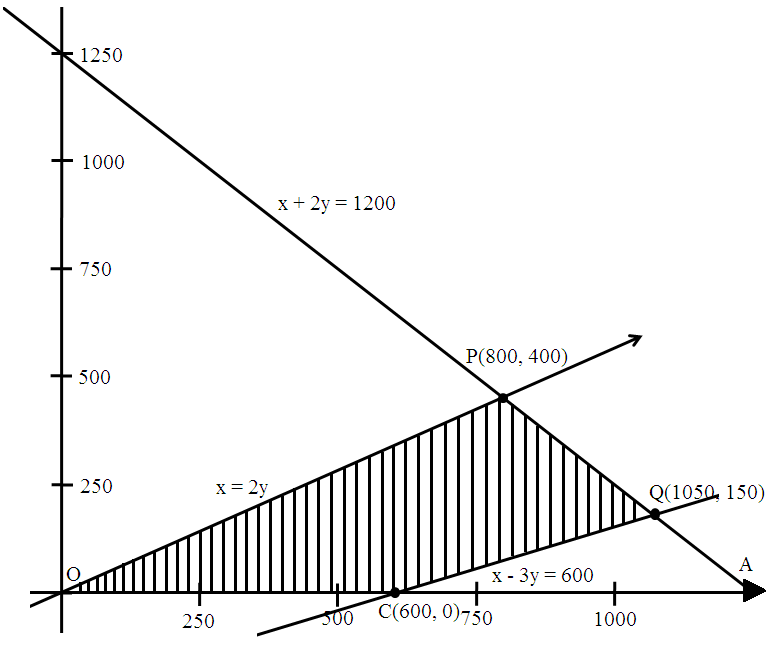
Step III
The point P is in the intersection of the lines x + y = 1200,
$\text{y}\leq\frac{\text{x}}{2}$
⇒ 2y = x
On solving these two equations we get,
x = 800 and y = 400
The point Q is in the intersection of the lines x + y = 1200 and x - 3y = 600
Let us solve these two equations to get the value of x and y
x + y = 1200
x - 3y = 600
4y = 600
y = 150
Hence x = 1050
The coordinates of Q are (1050, 150).
The point C is (600, 0)
The objective function is Z = 12x + 16y
Step IV
Let us now obtain the values of objective function as follows:
At the points (x, y) the value of the objective function Z = 12x + 16
At P(800, 400) the value of the objective function
Z = 12 × 800 + 16 × 400 = 16,000
At Q(1050, 150) the value of the objective function
Z = 12 × 1050 + 16 × 150 = 15,000
At C(600, 0) the value of the objective function Z = 12 × 600 + 16 × 0 = 7200
At 0(0, 0) the value of the objective function Z =12 × 0 + 16 × 0 = 0
It is clear that Z is maximum at P(800, 400).
The maximum value of Z is Rs. 16,000.
Thus to maximize the profit 800 dolls of type A and 400 dolls of type B should be produced to get a maximum profit of Rs. 16,000. View full question & answer→Question 1985 Marks
A manufacturer of Furniture makes two products : chairs and tables. processing of these products is done on two machines A and B. A chair requires 2 hrs on machine A and 6 hrs on machine B. A table requires 4 hrs on machine A and 2 hrs on machine B. There are 16 hrs of time per day available on machine A and 30 hrs on machine B. Profit gained by the manufacturer from a chair and a table is Rs. 3 and Rs. 5 respectively. Find with the help of graph what should be the daily production of each of the two products so as to maximize his profit.
AnswerLet x chairs and y tables were produced. Number of chairs and tables cannot be negative.
Therefore, $\text{x},\text{y}\geq0$
The given information can be tabulated as follows:
|
|
Time on machine A(hrs)
|
Time on machine B (hrs)
|
|
Chairs
|
2
|
6
|
|
Tables
|
4
|
2
|
|
Availability
|
16
|
30
|
Therefore, the constraints are
$2\text{x}+4\text{y}\leq16$
$6\text{x}+2\text{y}\leq30$
Profit gained by the manufacturer from a chair and a table is Rs. 3 and Rs. 5 respectively.
Therefore, profit gained from x chairs and y tables is Rs. 3x and Rs 5y.
Total profit = Z = 3x + 5y which is to be maximised
Thus, the mathematical formulation of the given linear programmimg problem is
Max Z = 3x + 5y
subject to
$2\text{x}+4\text{y}\leq16$
$6\text{x}+2\text{y}\leq30$
$\text{x},\text{y}\geq0$
First we will convert inequations into equations as follows:
2x + 4y = 16, 6x + 2y =30, x = 0 and y = 0
Region represented by $2\text{x}+4\text{y}\leq16$:
The line 2x + 4y = 16 meets the coordinate axes at A1(8, 0) and B(0, 4) respectively.
By joining these points we obtain the line 2x + 4y = 16.
Clearly (0, 0) satisfies the $2\text{x}+4\text{y}\leq16$.
So, the region which contains the origin represents the solution set of the inequation $2\text{x}+4\text{y}\leq16$.
Region represented by $6\text{x}+2\text{y}\leq30$:
The line 6x + 2y =30 meets the coordinate axes at C (5, 0) and D (0, 15) respectively.
By joining these points we obtain the line 6x + 2y =30.
Clearly (0, 0) satisfies the inequation $6\text{x}+2\text{y}\leq30$.
So, the region which contains the origin represents the solution set of the inequation $6\text{x}+2\text{y}\leq30$.
Region represented by $\text{x}\geq0$ and $\text{y}\geq0$:
Since, every point in the first quadrant satisfies these inequations.
So, the first quadrant is the region represented by the inequations $\text{x}\geq0$, and $\text{y}\geq0$.
The feasible region determined by the system of constraints $2\text{x}+4\text{y}\leq16,6\text{x}+2\text{y}\leq30,\text{x}\geq0,$ and $\text{y}\geq0$ are as follows.
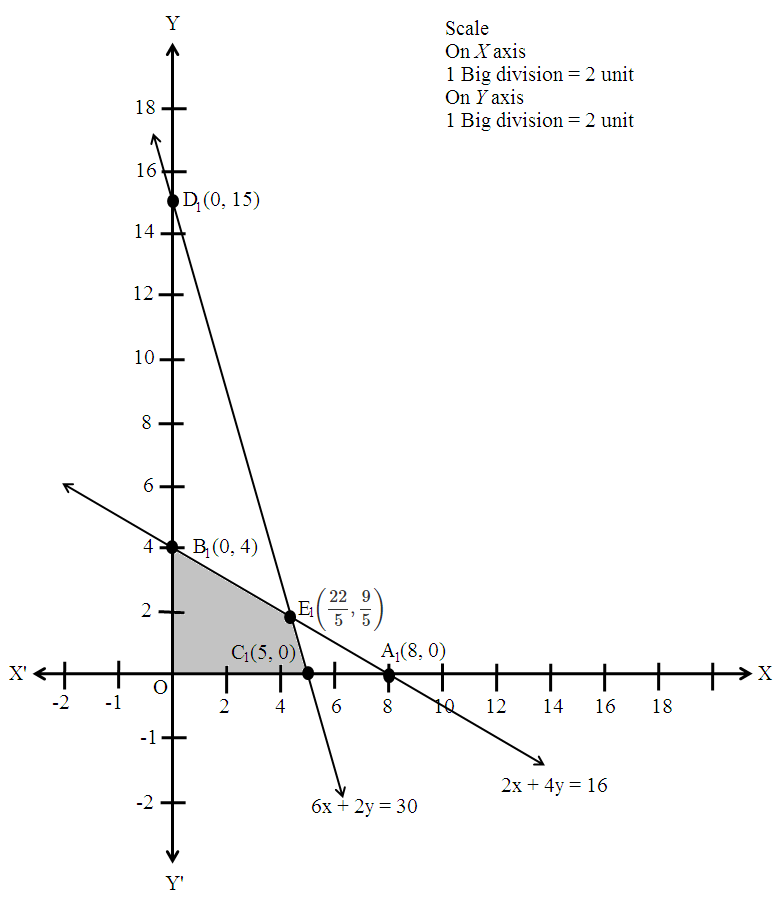
The corner points are $O(0, 0), B_1(0, 4), \text{E}_1\Big(\frac{22}{5},\frac{9}{5}\Big)$ and $C_1(5, 0)$.
The values of Z at these corner points are as follows.
|
Corner point
|
Z = 3x + 5y
|
|
$O$
|
0
|
|
$B_1$
|
20
|
|
$E_1$
|
22.2
|
|
$C_1$
|
15
|
The maximum value of Z is 22.2 which is attained at $\text{B}_1\Big(\frac{22}{5},\frac{9}{5}\Big)$.
Thus, the maximum profit is of Rs. $\frac{22}{5}$ obtained when $\frac{9}{5}$ units of chairs and 95 units of tables are produced. View full question & answer→Question 1995 Marks
A factory makes tennis rackets and cricket bats. A tennis racket takes 1.5 hours of machine time and 3 hours of craftman’s time in its making while a cricket bat takes 3 hour of machine time and 1 hour of craftman’s time. In a day, the factory has the availability of not more than 42 hours of machine time and 24 hours of craftsman’s time.
- What number of rackets and bats must be made if the factory is to work at full capacity?
- If the profit on a racket and on a bat is Rs 20 and Rs 10 respectively, find the maximum profit of the factory when it works at full capacity.
Answer
- Let the number of rackets and the number of bats to be made be x and y respectively.
The machine time is not available for more than 42 hours.
$\therefore1.5\text{x}+3\text{y}\leq42\dots(1)$
The craftsman's time is not available for more than 24 hours.
$\therefore3\text{x}+\text{y}\leq24\dots(2)$
The factory is to work at full capacity. Therefore,
1.5x + 3y = 42
3x + y = 24
On solving these equations, we obtain
x = 4 and y = 12
Thus, 4 rackets and 12 bats must be made.
- The given information can be complied in a table as follows.
| |
Tennis Racket |
Cricket Bat |
Availability |
| Machine Time (h) |
1.5 |
3 |
42 |
| Craftsman's Time (h) |
3 |
1 |
24 |
$\therefore1.5\text{x}+3\text{y}\leq42$
$3\text{x}+\text{y}\leq24$
$\text{x},\ \text{y}\ge0$
The profit on a racket is Rs 20 and on a bat is Rs 10.
$\therefore\text{Z}=20\text{x}+10\text{y}$
The mathematical formulation of the given problem is Maximize Z = 20x + 10y ... (1)
subject to the constraints,
$1.5\text{x}+3\text{y}\leq42\dots(2 )$
$3\text{x}+\text{y}\leq24\dots(3)$
$\text{x}+\text{y}\geq0\dots(4)$
The feasible region determined by the system of constraints is as follows.
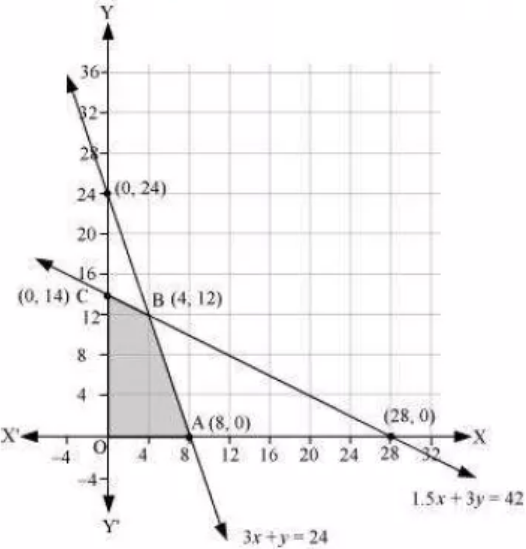
The corner points are A(8, 0), B(4, 12), C(0, 14), and O(0, 0).
The values of Z at these corner points are as follows.
| Corner point |
Z = 20x + 10y |
|
| A(8, 0) |
160 |
|
| B(4, 12) |
200 |
→ Maximum |
| C(0, 14) |
140 |
|
| O(0, 0) |
0 |
|
Thus, the maximum profit of the factory when it works to its full capacity is Rs 200. View full question & answer→Question 2005 Marks
Refer to Question 8. If the grower wants to maximize the amount of nitrogen added to the garden, how many bags of each brand should be added? What is the maximum amount of nitrogen added?
AnswerLet the fruit grower use x bags of brand P and y bags of brand Q. The problem can be formulated as follows. Maximize z = 3x + 3.5y ... (1) subject to the constraints, $\text{x}+2\text{y}\geq240\ \ \ \ ...(2)$ $\text{x}+0.5\text{y}\geq90\ \ \ \ ...(3)$ $1.5\text{x}+2\text{y}\leq310\ \ \ \ ...(4)$ $\text{x},\ \text{y}\geq0\ \ \ \ ...(5)$ The feasible region determined by the system of constraints is as follows.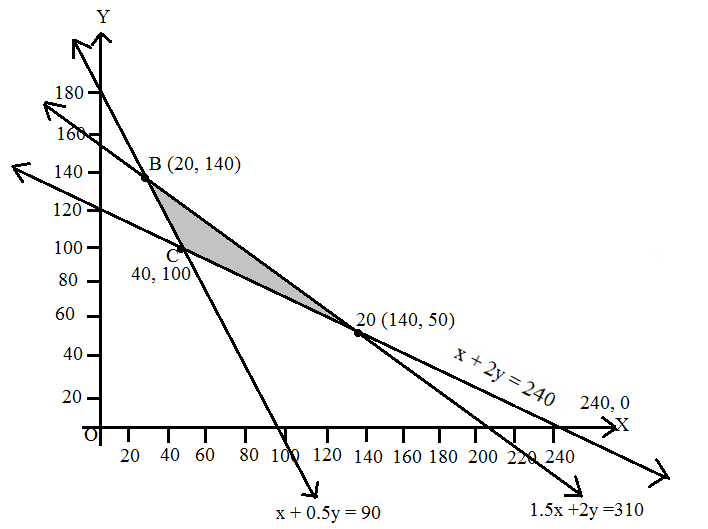
The corner points are A(140, 50), B(20, 140), and C(40, 100). The values of z at these corner points are as follows.
| Corner point |
Z = 3x + 3.5y |
|
| A(140, 50) |
595 |
→ Maximum |
| B(20, 140) |
550 |
|
| C(40, 100) |
470 |
|
The maximum value of z is 595 at (140, 50). Thus, 140 bags of brand P and 50 bags of brand Q should be used to maximize the amount of nitrogen. The maximum amount of nitrogen added to the garden is 595 kg. View full question & answer→Question 2015 Marks
A hospital dietician wishes to find the cheapest combination of two foods, A and B, that contains at least 0.5 milligram of thiamin and at least 600 calories. Each unit of A contains 0.12 milligram of thiamin and 100 calories, while each unit of B contains 0.10 milligram of thiamin and 150 calories. If each food costs 10 paise per unit, how many units of each should be combined at a minimum cost?
AnswerLet required quantity of food A and food B bex and y units.
Given, costs of one unit of food A and B are 10 paise per unit each, so costs ofx unit of food A and y unit of food B are 10x and 10y respectively, let z be total cost of foods, so
Z = 10x + 10y
Since one unit of food A and B contain 0.12mg and 0.10mg of Thiamin respectively, so, x units of food A and y units of food B contain 0.12xmg and 0.10ymg of Thiamin respectively but minimum requirement of Thiamin is 0.4 mg, so
$0.12\text{x}+10\text{y}\geq0.5$
$12\text{x}+10\text{y}\geq50$
$6\text{x}+5\text{y}\geq25$ (first constraint)
Since one unit of food A and B contain 100 and 150 calories respectively, so x units of food A and y units of food B contain 100x and 150y units of Calories but minimum requirement of Calories is 600, so
$100\text{x}+150\text{y}\geq600$
$\Rightarrow2\text{x}+3\text{y}\geq12$ (second constraint)
Hence, mathematical formulation of LPP is find x and y which
minimize Z = 10x + 10y
Subject to constraint,
$6\text{x}+5\text{y}\geq25$
$2\text{x}+3\text{y}\geq12$
$\text{x},\text{y}\geq0$ [Since quantity of food A and B can not be less than zero]
Region $6\text{x}+5\text{y}\geq25$:
6x + 5y = 25 meets axes at $\text{A}_1\Big(\frac{25}{6},0\Big), B_1(0, 5)$.
Region not containing origin represents $6\text{x}+5\text{y}\geq25$ as (0, 0) does not satisfy $6\text{x}+5\text{y}\geq25$.
Region $2\text{x}+3\text{y}\geq12$:
Line 2x + 3y = 12 meets axes at $A_2(6, 0), B_2(0, 4)$.
Region not containing origin represents $2\text{x}+3\text{y}\geq12$ as (0, 0) does not satisfy $2\text{x}+3\text{y}\geq12$.
Region $\text{x},\text{y}\geq0$ represent first quadrant in xy-plane.
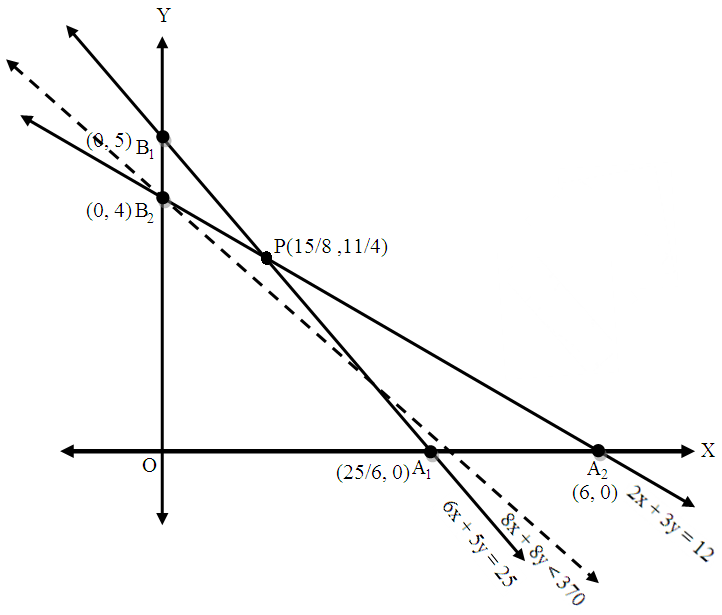
Unbounded shaded region $A_2PB_1$ represents feasible region with corner points $A_2(6, 0), \text{P}\Big(\frac{15}{8},\frac{11}{4}\Big), B_1(0, 5)$
The value of Z = 10x + 10y at
$A_2(6, 0) = 10 (6) + 10(0) = 60$
$\text{P}\Big(\frac{15}{8},\frac{11}{4}\Big)=10\Big(\frac{15}{8}\Big)+10\Big(\frac{11}{4}\Big)=\frac{370}{8}=46\frac{1}{4}$
$B_1(0, 5) = 10(0) + 10(5) = 50$
Smallest value of Z is $46\frac{1}{4}.$
Now open half plane $10\text{x}+10\text{y}<\frac{370}{8}$
= 8x + 8y < 370 has no point in common with feasible region, so smallest value is the minimum value.
Hence,
Required quantity of food $\text{A}=\frac{15}{8}$ units, food $\text{B}=\frac{11}{4}$ units
minimum cost - Rs 46.25
$\Rightarrow\frac{15}{8}=1.875$ units of food A and $\frac{11}{4}=2.75$ units of B. View full question & answer→Question 2025 Marks
A merchant plans to sell two types of personal computers a desktop model and a portable model that will cost Rs. 25,000 and Rs. 40,000 respectively. He estimates that the total monthly demand of computers will not exceed 250 units. Determine the number of units of each type of computers which the merchant should stock to get maximum profit if he does not want to invest more than Rs. 70 lakhs and his profit on the desktop model is Rs. 4500 and on the portable model is Rs. 5000. Make an LPP and solve it graphically.
AnswerLet x and y be the number of desktop model and portable model respectively.
Number of desktop model and portable model cannot be negative.
Therefore,
x ≥ 0, y ≥ 0:
It is given that the monthly demand will not exist 250 units.
$\therefore$ x + y ≤ 250
Cost of desktop and portable model is Rs. 25,000 and Rs. 40,000 respectively.
Therefore, cost of x desktop model and y portable model is Rs. 25,000 and Rs. 40,000 respectively and he does not want to invest more than Rs. 70 lakhs.
25000x + 40000y ≤ 7000000
Profit on the desktop model is Rs. 4500 and on the portable model is Rs. 5000.
Therefore, profit made by x desktop model and y portable model is Rs. 4500x and Rs. 5000y respectively.
Total profit = Z = 4500x + 5000y
The mathematical form of the given LPP is:
Maximize Z = 4500x + 5000y
Subject to constraints:
x + y ≤ 250
25000x + 40000y ≤ 7000000
x ≥ 0, y ≥ 0:
First we will convert inequations into equations as follows:
x + y = 250, 25000x + 40000y = 7000000, x = 0 and y = 0
Region represented by x + y ≤ 250:
The line x + y = 250 meets the coordinate axes at A(250, 0) and B(0, 250) respectively.
By joining these points we obtain the line x + y = 250.
Clearly (0, 0) satisfies the x + y = 250.
So, the region which contains the origin represents the solution set of the inequation x + y ≤ 250.
Region represented by 25000x + 40000y ≤ 7000000:
The line 25000x + 40000y = 7000000 meets the coordinate axes at C(280, 0) and D(0, 175) respectively.
By joining these points we obtain the line 25000x + 40000y = 7000000.
Clearly (0, 0) satisfies the inequation 25000x + 40000y ≤ 7000000.
So, the region which contains the origin represents the solution set of the inequation 25000x + 40000y ≤ 7000000.
Region represented by x ≥ 0 and y ≥ 0:
Since, every point in the first quadrant satisfies these inequations.
So, the first quadrant is the region represented by the inequations x ≥ 0, and y ≥ 0.
The feasible region determined by the system of constraints x + y ≤ 250, 25000x + 40000y ≤ 7000000, x ≥ 0 and y ≥ 0 are as follows.
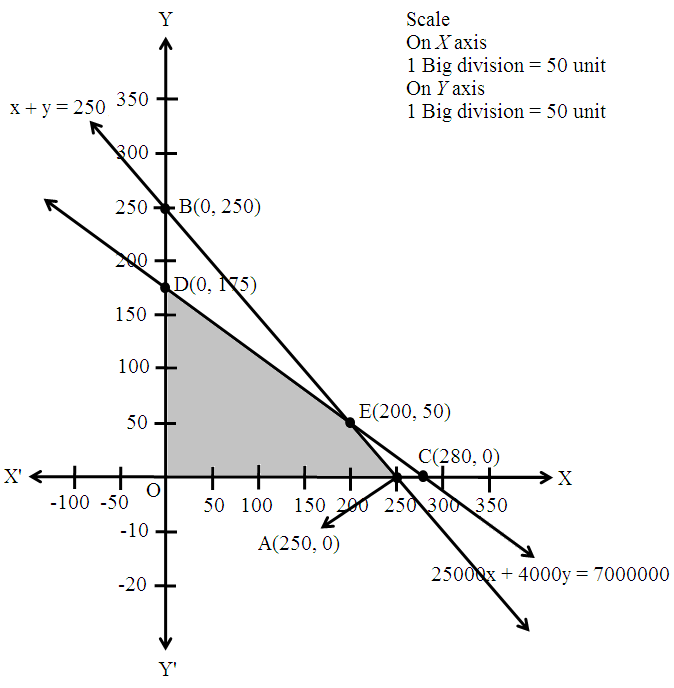
The corner points are O(0, 0), D(0, 175), E(200, 50) and A(250, 0).
The values of the objective function Z at corner points of the feasible region are given in the following table:
|
Corner point
|
Z = 4500x + 5000y
|
|
|
O(0, 0)
|
0
|
|
|
D(0, 175)
|
875000
|
|
|
E(200, 50)
|
1150000
|
→ Maximum
|
|
A(250, 0)
|
1125000
|
|
Clearly, Z is maximum at x = 200 and y = 50 and the maximum value of Z at this point is 1150000.
Thus, 200 desktop models and 50 portable units should be sold to maximize the profit.
View full question & answer→Question 2035 Marks
A diet for a sick person must contain at least 4000 units of vitamins, 50 units of minerals and 1400 of calories. Two foods A and B, are available at a cost of Rs 4 and Rs 3 per unit respectively. If one unit of A contains 200 units of vitamin, 1 unit of mineral and 40 calories and one unit of food B contains 100 units of vitamin, 2 units of minerals and 40 calories, find what combination of foods should be used to have the least cost?
AnswerLet required quantity of food A and B be x and y units respectively.
Costs of one unit of food A and B are Rs. 4 and Rs. 3 per unit respectively, so, costs of x unit of food A and y unit of food B are 4x and 3y respectively.
Let Z be minimum total cost, so
Z = 4x + 3y
Since one unit of food A and B contain 200 and 100 units of vitamin respectively.
So, x units of food A and y units of food B contain 200x and 100y units of vitamin but minimum requirement of vitamin is 4000 units, so
$200\text{x}+100\text{y}\geq4000$
$\Rightarrow2\text{x}+\text{y}\geq40$ (first constraint)
Since one unit of food A and B contain 1 unit and 2 unit of minerals, so x units of food A and y units of food B contain x and 2y units of minerals respectively but minimum requirement of minerals is 50 units, so
$\text{x}+2\text{y}\geq50$ (second constraint)
Since one unit of food A and B contain 40 calories each, so x units of food A and y units of food B contain 40x and 40y calories respectively but minimum requirement of calories is 1400, so
$40\text{x}+40\text{y}\geq1400$
$\Rightarrow2\text{x}+2\text{y}\geq70$
$\Rightarrow\text{x}+\text{y}\geq35$ (third constraint)
So, mathematical formulation of LPP is find x and y which
minimize Z = 4x + 3y
Subject to constraint,
$2\text{x}+\text{y}\geq40$
$\text{x}+2\text{y}\geq50$
$\text{x}+\text{y}\geq35$
$\text{x},\text{y}\geq0$ [Since quantity of food can not be less than zero]
Region $2\text{x}+\text{y}\geq40$:
Line 2x + y = 40 meets axes at $A_1(20, 0), B_1(0, 40)$ region not containing origin represents 2x +y > 40 as (0, 0) does not satisfy $2\text{x}+\text{y}\geq40$.
Region $\text{x}+2\text{y}\geq50$:
Line x + 2y = 50 meets axes at $A_2(50, 0), B_2(0, 25)$.
Region not containing origin represents $\text{x}+2\text{y}\geq50$ as (0, 0) does not satisfy x + 2y = 50.
Region $\text{x}+\text{y}\geq35$:
Line x + y = 35 meets axes at $A_3 (35, 0), B_3(0, 35)$.
Region not containing origin represents $\text{x}+\text{y}\geq35$ as (0, 0) does not satisfy $\text{x}+\text{y}\geq35$.
Region $\text{x},\text{y}\geq0$:
It represent first quadrant in xy-plane.
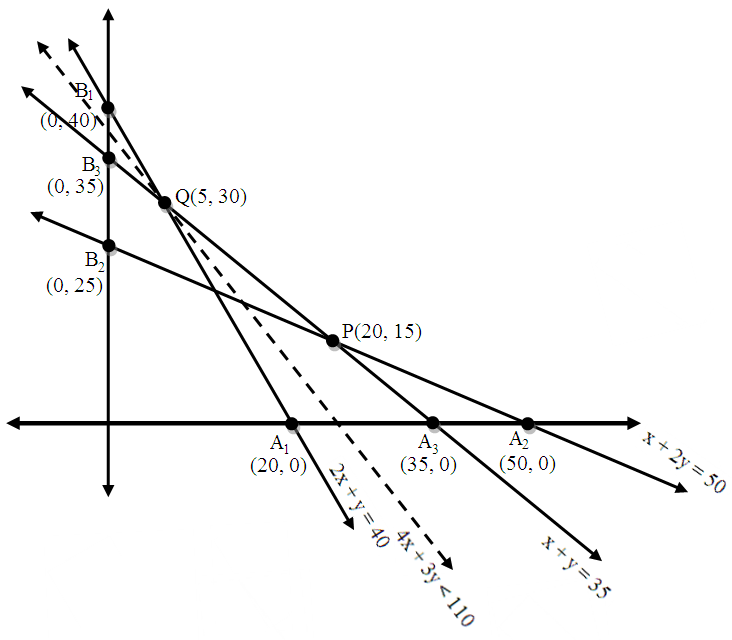
Unbounded shaded region $A_2PQB_1$ represents feasible region with corner points $A_2(50, 0), P(20,15), Q(5, 30), B_2(0, 40)$
The value of Z = 4x + 3y at
$A_2(50, 0) = 4(50) + 3(0) = 2000$
$P(20, 15) = 4(20) + 3(15) = 125$
$Q(5, 30) = 4(5) + 3(30) = 110$
$B_1(0, 40) = 4(0) + 3(40) = 110$
Smallest value of Z = 110
Open half plane $4\text{x}+3\text{y}\leq110$ has no point in common with feasible region, so, smallest value is the minimum value.
Hence,
quantity of food A = x = 5 unit
quantity of food B = y = 30 unit
minimum cost = Rs 110. View full question & answer→Question 2045 Marks
A manufacturer can produce two products, A and B, during a given time period. Each of these products requires four different manufacturing operations: grinding, turning, assembling and testing. The manufacturing requirements in hours per unit of products A and B are given below.
|
|
A
|
B
|
|
Grinding
|
1
|
2
|
|
Turning
|
3
|
1
|
|
Assembling
|
6
|
3
|
|
Testing
|
5
|
4
|
The available capacities of these operations in hours for the given time period are: grinding 30; turning 60, assembling 200; testing 200. The contribution to profit is Rs 20 for each unit of A and Rs 30 for each unit of B. The firm can sell all that it produces at the prevailing market price. Determine the optimum amount of A and B to produce during the given time period. Formulate this as a LPP.
AnswerGiven inform ation can be tabulated:-
|
Product
|
Grinding
|
Turning
|
Assembling
|
Testing
|
Profit
|
|
A
|
1
|
3
|
6
|
5
|
2
|
|
B
|
2
|
1
|
3
|
4
|
3
|
|
Maximum
capacity
|
30 hours
|
60 hours
|
200 hours
|
200 hours
|
|
Let required production of product A and B be x and y respectively
Given, profits on one unit of product A and B are Rs. 2 and Rs. 3 respectively, so profits on x units of product A and y units of product B are given by 2x and 3y respectively. Let Z be total profit, so
Z = 2x + 3y
Given, production of 1 unit of product A and B require 1 hour and 2 hours of grinding respectively, so, production of x units of product A and y units of of product B require x hours and 2y hours of grinding respectively but maximum time available for grinding is 3 hours, so
$\text{x}+2\text{y}\leq30$ (First constraint)
Given, production of 1 unit of product A and B require 3 hours and 1 hours of turning respectively, so x units of product A and y units of of product B require 3x hours and y hours of turning respectively but total time available for turning is 60 hours, so
$3\text{x}+\text{y}\leq60$ (Second constraint)
Given, production of 1 unit of product A and B require 6 hour and 3 hours of assembling respectively, so productinon of x units of product A and y units of product 8 require 6x hours and 3y hours of assembling respectively but total time available for assembling is 200 hours, so
$6\text{x}+3\text{y}\leq200$ (Third constraint)
Given, production of 1 unit of product A and B require 5 hours and 4 hours of testing respectively, so productinon of x units of product A and y units of product B require 5x hours and 4y hours of testing respectively but total time available for testing is 200 hours, so
$5\text{x}+4\text{y}\leq200$ (Fourth constraint)
Hence, mathematical formulation of LPP is,
Find x and y which
maximize Z = 2x + 3y
Subject to constraints,
$\text{x}+2\text{y}\leq30$
$3\text{x}+\text{y}\leq60$
$6\text{x}+3\text{y}\leq200$
$5\text{x}+4\text{y}\leq200$
and, $\text{x},\text{y}\geq0$ [Since production can not be negative]. View full question & answer→Question 2055 Marks
A cottage industry manufactures pedestal lamps and wooden shades, each requiring the use of a grinding/ cutting machine and a sprayer. It takes 2 hours on grinding/ cutting machine and 3 hours on the sprayer to manufacture a pedestal lamp. It takes 1 hour on the grinding/ cutting machine and 2 hours on the sprayer to manufacture a shade. On any day, the sprayer is available for at the most 20 hours and the grinding/ cutting machine for at the most 12 hours. The profit from the sale of a lamp is Rs 5 and that from a shade is Rs 3. Assuming that the manufacturer can sell all the lamps and shades that he produces, how should he schedule his daily production in order to maximise his profit?
AnswerLet the cottage industry manufacture x pedestal lamps and y wooden shades. Therefore, $\text{x}\ge0\text{ and y}\ge0$
The given information can be compiled in a table as follows.
| |
Lamps |
Shades |
Availability |
| Grinding/ Cutting Machine (h) |
2 |
1 |
12 |
| Sprayer (h) |
3 |
2 |
20 |
The profit on a lamp is Rs 5 and on the shades is Rs 3. Therefore, the constraints are
$2\text{x}+\text{y}\le12\\3\text{x}+2\text{y}\le20$
Total profit, z = 5x + 3y
The mathematical formulation of the given problem is Maximize z = 5x + 3y ... (1)
subject to the constraints,
$2\text{x}+\text{y}\le12\dots(2)\\3\text{x}+2\text{y}\le20\dots(3)\\\text{x},\ \text{y}\ge0\dots(4)$
The feasible region determined by the system of constraints is as follows.
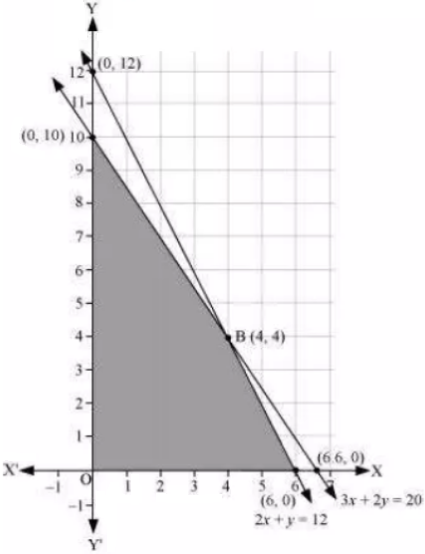
The corner points are A(6, 0), B(4, 4), and C(0, 10).
The values of z at these corner points are as follows.
| Corner point |
Z = 5x + 3y |
|
| A(6, 0) |
30 |
|
| B(4, 4) |
32 |
→ Maximum |
| C(0, 10) |
30 |
|
The maximum value of Z is 32 at (4, 4).
Thus, the manufacturer should produce 4 pedestal lamps and 4 wooden shades to maximize his profits. View full question & answer→Question 2065 Marks
A manufacturer of patent medicines is preparing a production plan on medicines, A and B. There are sufficient raw materials available to make 20000 bottles of A and 40000 bottles of B, but there are only 45000 bottles into which either of the medicines can be put. Further, it takes 3 hours to prepare enough material to fill 1000 bottles of A, it takes 1 hour to prepare enough material to fill 1000 bottles of B and there are 66 hours available for this operation. The profit is Rs. 8 per bottle for A and Rs. 7 per bottle for B. How should the manufacturer schedule his production in order to maximize his profit?
AnswerLet x bottles of medicine A and y bottles of medicine B are prepared. Number of bottles cannot be negative.
Therefore, x, y ≥ 0
According to question, the constraints are
x ≤ 20000
y ≤ 40000
x + y ≤ 45000
It takes 3 hours to prepare enough material to fill 1000 bottles of A, it takes 1 hour to prepare enough material to fill 1000 bottles of B Time taken to fill one bottle of A is 31000 hrs and time taken by to fill one bottle of B is 11000 hrs.
Therefore, time taken to fill x bottles of A and y bottles of B is 3x 1000 hrs and y1000hrs respectively.
It is given that there are 66 hours available for this operation.
$\therefore$ 3x1000 + y1000 ≤ 66
The profit is Rs. 8 per bottle for A and Rs. 7 per bottle for B.
Therefore, profit gained on x bottles of medicine A and y bottles of medicine B is 8x and 7y respectively.
Total profit = Z = 8x + 7y which is to be maximised.
Thus, the mathematical formulation of the given linear programmimg problem is
Max Z = 8x + 7y subject to
X ≤ 20000
y ≤ 40000
x + y ≤ 45000
3x 1000 + y1000 ≤ 66 = 3x + y ≤ 66000
x, y ≥ 0
First we will convert inequations into equations as follows:
x = 20000, y = 40000, x + y = 45000, 3x + y = 66000, x = 0 and y = 0
Region represented by x ≤ 20000:
The line x = 20000 is the line that passes through $A_1(20000, 0)$ and is parallel to Y axis.
The region to the left of the line x = 20000 will satisfy the inequation x ≤ 20000.
Region represented by y ≤ 40000:
The line y = 40000 is the line that passes through $B_1(0, 40000)$ and is parallel to X axis.
The region below the line y = 40000 will satisfy the inequation y ≤ 40000.
Region represented by x + y ≤ 45000:
The line x + y = 45000 meets the coordinate axes at $C_1(45000, 0)$ and $D_1(0, 45000)$ respectively By joining these points we obtain the line x + y = 45000.
Clearly (0, 0) satisfies the inequation x + y ≤ 45000.
So, the region which contains the origin represents the solution set of the inequation x + y ≤ 45000.
Region represented by 3x + y ≤ 66000:
The line 3x + y = 66000 meets the coordinate axes at $E_1(22000, 0)$ and $F_1(0, 66000)$ respectively.
By joining these points we obtain the line 3x + y = 66000.
Clearly (0, 0) satisfies the inequation 3x + y = 66000.
So, the region which contains the origin represents the solution set of the inequation 3x + y ≤ 66000.
Region represented by x ≥ 0 and y ≥ 0:
Since, every point in the first quadrant satisfies these inequations.
So, the first quadrant is the region represented by the inequations x ≥ 0, and y ≥ 0.
The feasible region determined by the system of constraints x ≤ 20000, y ≤ 40000, x + y ≤ 45000, 3x + y ≤ 66000, x ≥ 0 and y ≥ 0 are as follows.
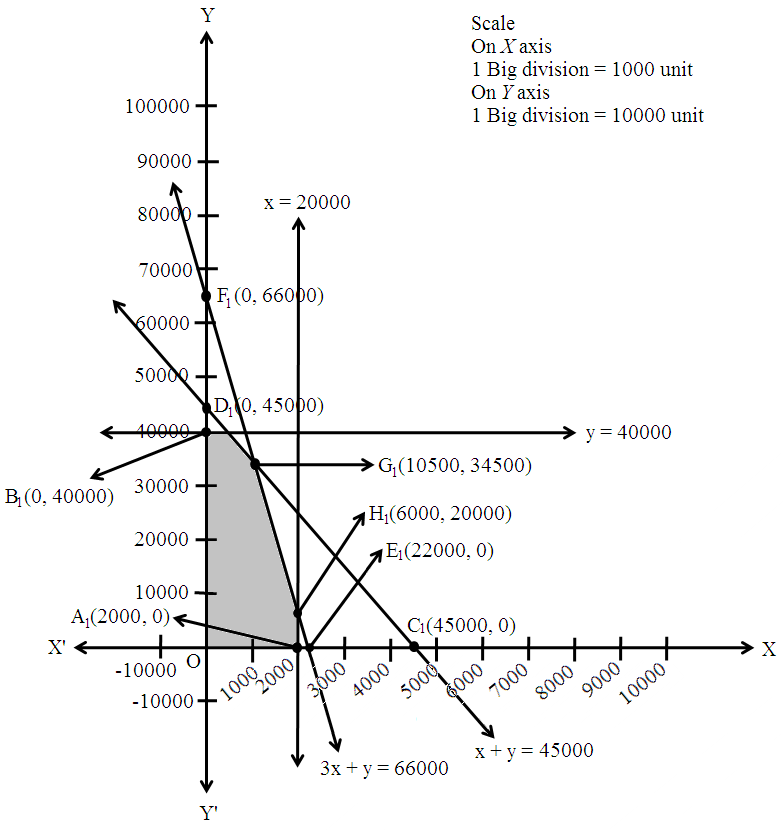
The corner points are $O(0, 0), B_1(0, 40000), G_1(10500, 34500), H_1(6000, 20000)$ and $A_1(20000, 0)$.
The values of Z at these corner points are as follows:
|
Corner point
|
Z = 8x + 7y
|
| $O$ |
0
|
|
$B_1$
|
280000 |
| $E_1$ |
325500 |
| $C_1$ |
188000 |
| $A_1$ |
160000 |
The maximum value of Z is 325500 which is attained at $G_1(10500, 34500)$.
Thus, the maximum profit is Rs. 325500 obtained when 10500 bottles of A and 34500 bottals of B were manufactured.
View full question & answer→Question 2075 Marks
Maximise Z = 3x + 4y
subject to the constraints: $\text{x}+\text{y}\leq4,\text{x}\geq0,\ \text{y}\geq0.$
Answer
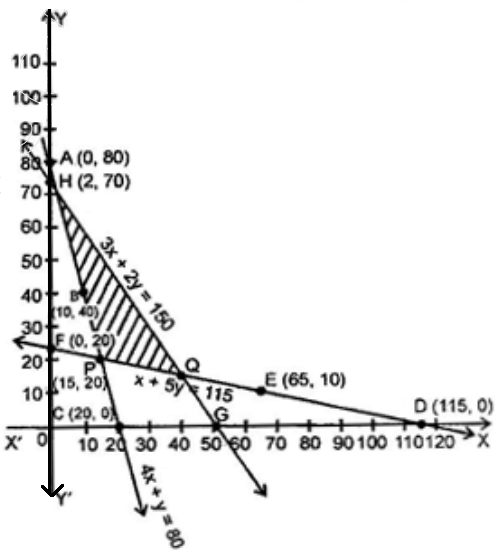 $\text{As x}\geq0,\ \text{y}\geq0,$ therefore we shall shade the other inequalities in the first quadrant only.
Now $\text{x}+\text{y}\leq4$
Let x + y = 4
$\Rightarrow\frac{\text{x}}{\text{4}}+\frac{\text{y}}{4}=1$
Thus the line has 4 and 4 as intercepts along the axes. Now, (0, 0) satisfies the inequation, i.e., $0+0\leq4.$ Therefore, shaded region OAB is the feasible solution.
Its corners are O(0, 0), A(4, 0), B(0, 4)
| At O(0, 0) |
Z = 0 |
| At A(4, 0) |
Z = 3 × 4 = 12 |
| At B(0, 4) |
Z = 4 × 4 = 16 |
Hence, max Z = 16 at x = 0, y = 4. View full question & answer→Question 2085 Marks
Find graphically, the maximum value of Z = 2x + 5y, subject to constraints given below:
$2\text{x}+4\text{y}\leq8$
$3\text{x}+\text{y}\leq6$
$\text{x}+\text{y}\leq4$
$\text{x}\geq0,\text{y}\geq0$
AnswerConverting the inequations into equations, ew obtain the lines.
2x + 4y = 8, 3x + y = 6, x + y =4, x = 0, y = 0.
These lines are drawn on a suitable scale and the feasible region of the LPP is shaded in the graph.
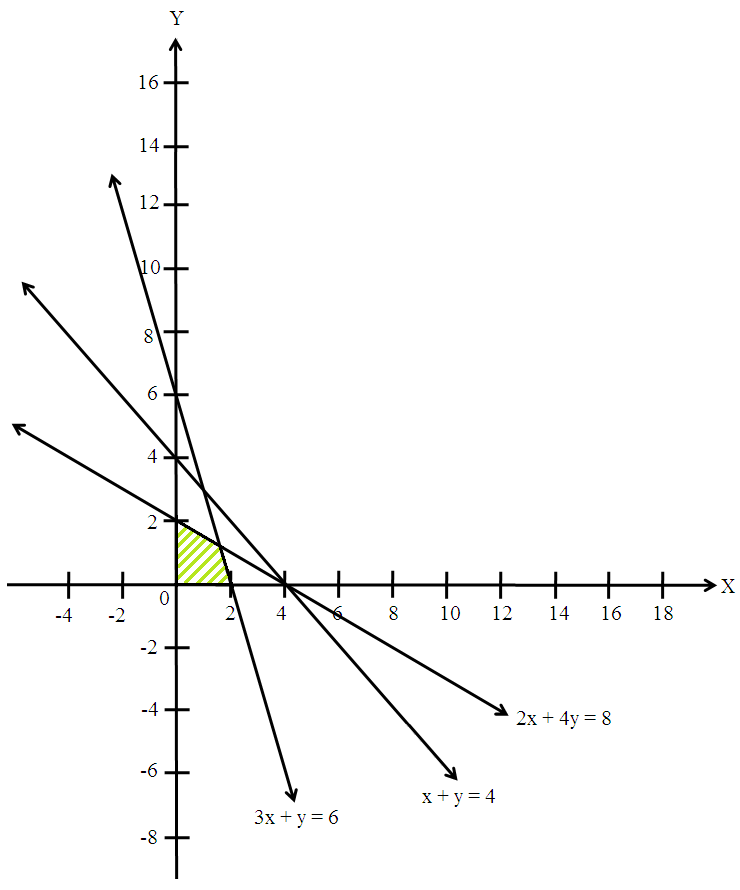
From the graph we can see the corner point as (0, 2) and (2, 0).
Now, solving the equations 3x + y = 6 and 2x +4y = 8 we get the values of x and y as $\text{x}=\frac{8}{5}$ and $\text{y}=\frac{6}{5}$.
Substituting $\text{x}=\frac{8}{5}$ and $\text{y}=\frac{6}{5}$ in Z = 2x + 5y we get,
$\text{z}=2\Big(\frac{8}{5}\Big)+5\Big(\frac{6}{5}\Big)$
$\text{z}=\frac{46}{5}$
Hence maximum value of Z is $\frac{46}{5}$ at $\text{x}=\frac{8}{5}$ and $\text{y}=\frac{6}{5}$. View full question & answer→Question 2095 Marks
A manufacturer has three machines installed in his factory. machines $I$ and $II$ are capable of being operated for at most $12$ hours whereas Machine $III$ must operate at least for $5$ hours a day. He produces only two items, each requiring the use of three machines. The number of hours required for producing one unit each of the items on the three machines is given in the following table:
| Item |
Number of hours required by the machine |
| |
$I$ |
$II$ |
$III$ |
| $A$ |
$1$ |
$2$ |
$1$ |
| $B$ |
$2$ |
$1$ |
$\frac{5}{4}$ |
He makes a profit of Rs. $6.00$ on item A and Rs. $4.00$ on item $B$. Assuming that he can sell all that he produces, how many of each item should he produces so as to maximize his profit? Determine his maximum profit. Formulate this LPP mathematically and then solve it. AnswerLet x units of item A and Y units of item B be manufactured.
Therefore,
As we are given,
| Item |
Number of hours required by the machine |
| |
$I$ |
$II$ |
$III$ |
| A |
$1$ |
$2$ |
$1$ |
| B |
$2$ |
$1$ |
$\frac{5}{4}$ |
Machines $I$ and $II$ are capable of being operated for at most $12$ hours whereas Machine Ill must operate at least for $5$ hours a day.
According to question, the constraints are
$\text{x}+2\text{y}\leq12$
$2\text{x}+\text{y}\leq12$
$\text{x}+\frac{5}{4}\text{y}\geq5$
He makes a profit of Rs. 6.00 on item $A$ and Rs $4.00$ on item $B.$
Profit made by him in producing $x$ items of $A$ and $y$ items of $B$ is $6 x+4 y$.
Total profit $Z=6 x+4 y$ which is to be maximised.
Thus, the mathematical formulation of the given linear programming problem is
$\operatorname{Max} Z=6 x+4 y$
Subject to
$\text{x}+2\text{y}\leq12$
$2\text{x}+\text{y}\leq12$
$\text{x}+\frac{5}{4}\text{y}\geq5$
$\text{x},\text{y}\geq0$
First we will convert inequations into equations as follows:
$x + 2y = 12$
$2x + y= 12,$
$\text{x}+\frac{5}{4}\text{y}=5$
$x = 0$ and $y = 0$
Region represented by $\text{x}+2\text{y}\leq12$:
The line $x+2 y=12$ meets the coordinate axes at $A_1(12,0)$ and $B_1(0,6)$ respectively.
By joining these points we obtain the line $x+2 y=12$.
Clearly $(0,0)$ satisfies the $x+2 y=12$.
So, the region which contains the origin represents the solution set of the inequation $x +2 y \leq 12$.
Region represented by $2 x + y \leq 12$ :
The line $2 x+y=12$ meets the coordinate axes at $C_1(6,0)$ and $D_1(0,12)$ respectively.
By joining these points we obtain the line $2 x+y=12$.
Clearly $(0,0)$ satisfies the inequation $2 x + y \leq 12$.
So, the region which contains the origin represents the solution set of the inequation $2 x + y \leq 12$.
Region represented by $x+\frac{5}{4} y \geq 5$ :
The line $x +\frac{5}{4} y \geq 5$ meets the coordinate axes at $E _1(5,0)$ and $F _1(0,4)$ respectively.
By joining these points we obtain the line $x+2 y=5$.
Clearly $(0,0)$ does not satisfies the inequation $x+\frac{5}{4} y \geq 5$.
So,the region which does not contains the origin represents the solution set of the inequation.
Region represented by $x \geq 0$ and $y \geq 0$ :
Since, every point in the first quadrant satisfies these inequations.
So, the first quadrant is the region represented by the inequations, $x \geq 0$ and $y \geq 0$.
The feasible region determined by the system of constraints $x+2 y \leq 12,2 x+y \leq 12, x+\frac{5}{4} y \geq 5, x \geq 0$ and $y \geq 0$ are as follows.
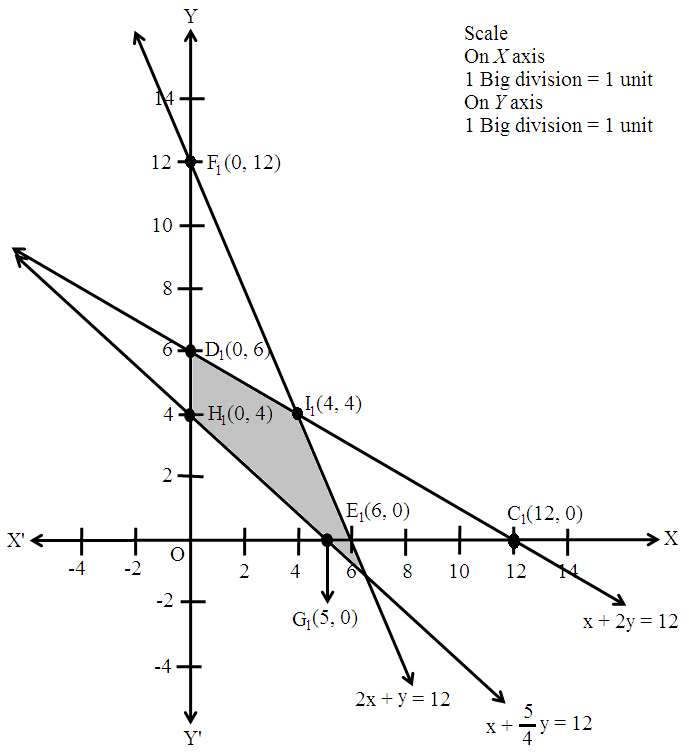
Thus, the maximum profit is $Rs. 40$ obtained when 4 units each of item A and B are manufactured.
The corner points are $B(0, 6), G(4, 4), C(6, 0), E(5, 0)$ and $F(0, 4).$
The values of Z at these corner points are as follows:
|
Corner point
|
$Z = 6x + 4y$
|
|
$B_1$
|
$24$
|
|
$G_1$
|
$40$
|
|
$C_1$
|
$36$
|
|
$E_1$
|
$30$
|
|
$F_1$
|
$16$
|
The maximum value of Z is 40 which is attained at $G (4, 4).$ View full question & answer→Question 2105 Marks
A box manufacturer makes large and small boxes from a large piece of cardboard. The large boxes require 4 sq. metre per box while the small boxes require 3 sq. metre per box. The manufacturer is required to make at least three large boxes and at least twice as many small boxes as large boxes. If 60 sq. metre of cardboard is in stock, and if the profits on the large and small boxes are Rs. 3 and Rs. 2 per box, how many of each should be made in order to maximize the total profit?
AnswerThe given data can be written in the tabular form as follows:
|
Product
|
A
|
B
|
Working week
|
Turn over
|
|
Time
|
0.5
|
1
|
40
|
|
|
Prise
|
200
|
300
|
|
10000
|
|
Profit
|
20
|
30
|
|
|
|
Permanent order
|
14
|
16
|
|
|
Let x be the number of units of A and y be the number of units of B produced to earn the maximum profit.
Then the mathematical model of the LPP is as follows:
Maximize Z = 20x + 30y
Subject to 0.5x + y ≤ 40
200x + 300y ≥ 10000
x ≥ 14
y ≥ 16
To solve the LPP we draw the lines,
0.5x + y = 40,
200x + 300y = 10000
x = 14,
y = 16
The feasible region of the LPP is shaded in graph.
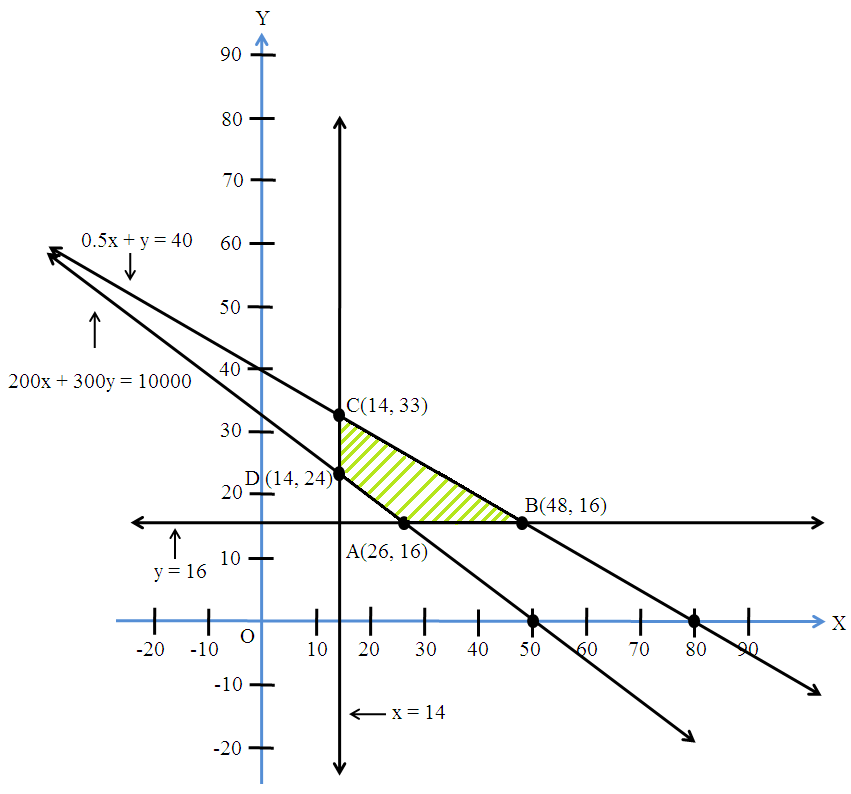
The coordinates of the vertices (Corner - points) of shaded feasible region ABCD are A(26, 16), B(48, 16), C(14, 33) and D(14, 24).
The values of the objective of function at these points are given in the following table:
|
Point $(x_1, x_2)$
|
Value of objective function Z = 20x + 30y
|
|
A(26, 16)
|
Z = 1000
|
|
B(48, 16)
|
Z = 1440
|
|
C(14, 33)
|
Z = 1270
|
|
D(14, 24)
|
Z = 600
|
48 units of product A and 16 units of product B should be produced to earn the maximum profit of Rs. 1440. View full question & answer→Question 2115 Marks
If a young man drives his vehicle at 25 km/hr, he has to spend Rs. 2 per km on petrol. If he drives it at a faster speed of 40 km/hr, the petrol cost increases to Rs. 5 per km. He has Rs. 100 to spend on petrol and travel within one hour. Express this as an LPP and solve the same.
AnswerLet young man drives x km at a speed of 25 km/hr and y km at a speed of 40 km/hr.
Clearly, x, y ≥ 0
It is given that, he spends Rs. 2 per km if he drives at a speed of 25 km/hr and Rs 5 per km if he drives at a speed of 40 km/hr.
Therefore, money spent by him when he travelled x km and y km is Rs. 2x and Rs. 5y respectively.
It is given that he has a maximum of Rs. 100 to spend.
Thus, 2x + 5y ≤ 100
Time spent by him when travelling with a speed of 25 km/hr = x25hr
Time spent by him when travelling with a speed of 40 km/hr = x40hr
Also, the available time is of 1 hour.
x25 + y40 ≤ I = 40x + 25y ≤ 1000
The distance covered is Z = x + y which is to be maximised.
Max Z = x + y
Subject to
2x + 5y ≤ 100
40x + 25y ≤ 1000
x, y ≥ 0
First we will convert inequations into equations as follows:
2x + 5y = 100, 40x + 25y = 1000, x = 0 and y = 0
Region represented by 2x + 5y ≤ 100:
The line 2x + 5y = 100 meets the coordinate axes at A(50, 0) and B(0, 20) respectively.
By joining these points we obtain the line 2x + 5y = 100.
Clearly (0, 0) satisfies the 2x + 5y = 100.
So, the region which contains the origin represents the solution set of the inequation 2x + 5y ≤ 100.
Region represented by 40x + 25y ≤ 1000:
The line 40x + 25y = 1000 meets the coordinate axes at C(25, 0) and D(O, 40) respectively.
By joining these points we obtain the line 2x + y = 12.
Clearly (0, 0) satisfies the inequation 40x + 25y ≤ 1000.
So, the region which contains the origin represents the solution set of the inequation 40x + 25y ≤ 1000.
Region represented by x ≥ 0 and y ≥ 0:
Since, every point in the first quadrant satisfies these inequations.
So, the first quadrant is the region represented by the inequations x ≥ 0, and y ≥ 0.
The feasible region determined by the system of constraints 2x + 5y ≤ 100, 40x + 25y ≤ 1000, X ≥ 0, and y ≥ 0 are as follows.
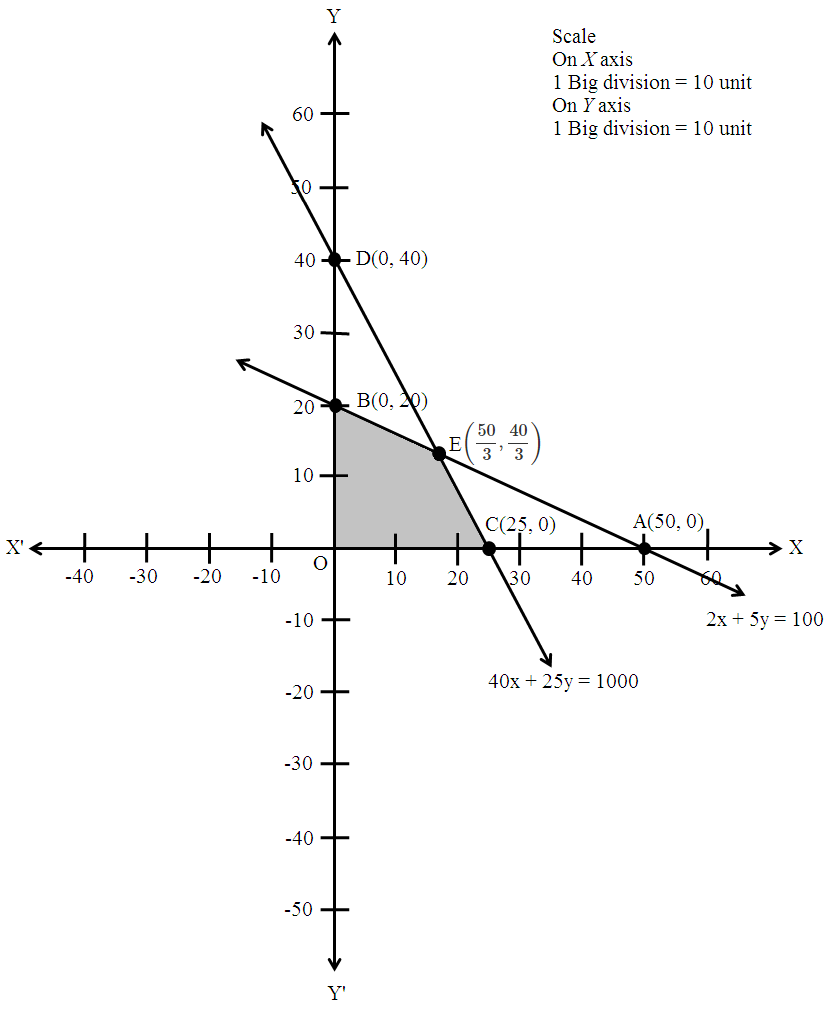
The corner points are O(0, 0), B(0, 20), E(503, 403) and C(25, 0).
The values of Z at these corner points are as follows.
|
Corner point
|
Z = x + y
|
|
O
|
0
|
|
B
|
20
|
|
E
|
30
|
|
C
|
25
|
The maximum value of Z is 30 which is attained at E.
Thus, the maximum distance travelled by the young man is 30kms,
If he drives 503 km at a speed of 25 km/hr and 403km at a speed of 40 km/hr.
View full question & answer→Question 2125 Marks
A factory makes tennis rackets and cricket bats. A tennis racket takes 1.5 hours of machine time and 3 hours of craftman's time in its making while a cricket bat takes 3 hours of machine time and 1 hour of craftman's time. In a day, the factory has the availability of not more than 42 hours of machine time and 24 hours of craftman's time. If the profit on a racket and on a bat is Rs. 20 and Rs. 10 respectively, find the number of tennis rackets and cricket bats that the factory must manufacture to earn the maximum profit. Make it as an LPP and solve it graphically.
AnswerLet x number of tennis rackets and y number of cricket bats were sold.
Number of tennis rackets and cricket balls cannot be negative.
Therefore, x ≥ 0, y ≥ 0
It is given that a tennis racket takes 1.5 hours of machine time and 3 hours of craftman's time in its making while a cricket bat takes 3 hours of machine time and 1 hour of craftman's time.
Also, the factory has the availability of not more than 42 hours of machine time and 24 hours of craftman's time.
Therefore,
1.5x plus 3y less or equal than 42
3x plus y less or equal than 24
If the profit on a racket and on a bat is Rs. 20 and Rs. 10 respectively.
Therefore, profit made on x tennis rackets and y cricket bats is Rs. 20x and Rs. 10y respectively.
Total profit = Z = 20x + 10y
The mathematical form of the given LPP is
Maximize Z = 20x + 10y
Subject to constraints:
1.5 x plus 3y less or equal than 42
3x plus y less or equal than 24
x ≥ 0, y ≥ 0
First we will convert inequations into equations as follows:
1.5x + 3y = 42, 3x + y = 24, x = 0 and y = 0
Region represented by 1.5x + 3y ≤ 42:
The line 1.5x + 3y = 42 meets the coordinate axes at $A_1(28, 0)$ and $B_1(0, 14)$ respectively.
By joining these points we obtain the line 1.5x + 3y = 42.
Clearly (0, 0) satisfies the 1.5x + 3y = 42.
So, the region which contains the origin represents the solution set of the inequation 1.5x + 3y ≤ 42.
Region represented by 3x + y ≤ 24:
The line 3x + y = 24 meets the coordinate axes at $C_1(8, 0)$ and $D_1(0, 24)$ respectively.
By joining these points we obtain the line 3x + y = 24.
Clearly (0, 0) satisfies the inequation 3x + y ≤ 24.
So, the region which contains the origin represents the solution set of the inequation 3x + y ≤ 24.
Region represented by x ≥ 0 and y ≥ 0:
Since, every point in the first quadrant satisfies these inequations.
So, the first quadrant is the region represented by the inequations x ≥ 0, and y ≥ 0.
The feasible region determined by the system of constraints 1.5x + 3y ≤ 42, 3x + y ≤ 24, X ≥ 0 and y ≥ 0 are as follows.
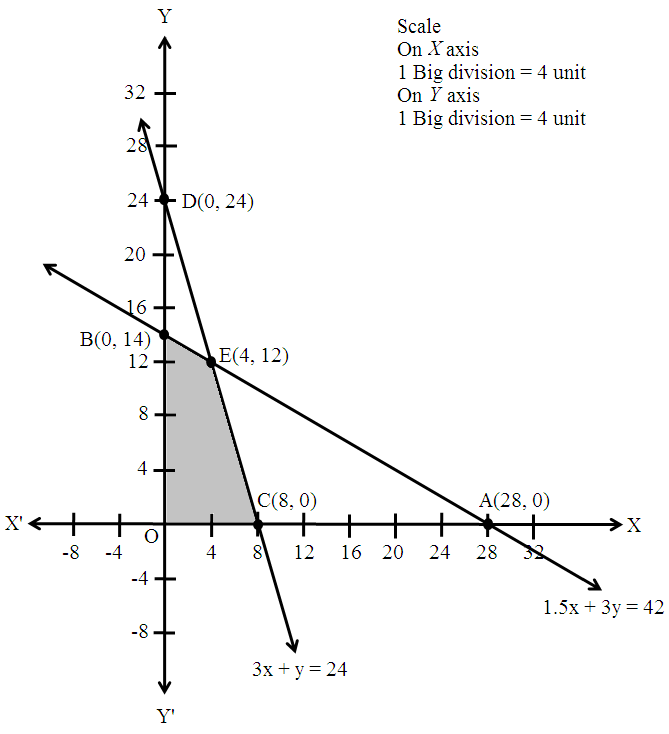
In the above graph, the shaded region is the feasible region.
The corner points are $O(0, 0), B_1(0, 14), E_1(4, 12),$ and $C_1(8, 0)$.
The values of the objective function Z at corner points of the feasible region are given in the following table:
|
Corner Points
|
Z = 20x + 10y
|
|
|
$O(0, 0)$
|
0
|
|
|
$B_1(0, 14)$
|
140
|
|
|
$E_1(4, 12)$
|
200
|
→ Maximum
|
|
$C_1(8, 0)$
|
16
|
|
Clearly, Z is maximum at x = 4 and y = 12 and the maximum value of Z at this point is 200.
Thus, maximum profit is of Rs. 200 obtained when 4 tennis rackets and 12 cricket bats were sold. View full question & answer→Question 2135 Marks
Anil wants to invest at most Rs. 12000 in Saving Certificates and National Saving Bonds. According to rules, he has to invest at least Rs. 2000 in Saving Certificates and at least Rs. 4000 in National Saving Bonds. If the rate of interest on saving certificate is 8% per annum and the rate of interest on National Saving Bond is 10% per annum, how much money should he invest to earn maximum yearly income? Find also his maximum yearly income.
AnswerLet Anil invests Rs. x in Saving certificates and Rs. y in National Saving bonds.
Therefore,
x, y ≥ 0
Anil wants to invest at most Rs. 12000 in Saving Certificates and National Saving Bonds.
x + y ≤ 12000
According to rules, he has to invest at least Rs. 2000 in Saving Certificates and at least Rs. 4000 in National Saving Bonds.
x ≥ 2000
y ≥ 4000
If the rate of interest on saving certificate is 8% per annum and the rate of interest on National Saving Bond is 10% per annum.
Total earning from investment $=\text{Z}=\frac{8\text{x}}{100}+\frac{10\text{y}}{100}$ which is to be maximised.
Thus, the mathematical formulation of the given linear programmimg problem is
Max $\text{Z}=\frac{8\text{x}}{100}+\frac{10\text{y}}{100}$
Subject
x + y ≤ 12000
x ≥ 2000
y ≥ 4000
First we will convert inequations into equations as follows:
x + y = 12000, x = 2000, y = 4000, x = 0 and y = 0
Region represented by x + y ≤ 12000:
The line x + y = 12000 meets the coordinate axes at A(12000, 0) and B(0, 12000) respectively.
By joining these points we obtain the line x + y = 12000.
Clearly (0, 0) satisfies the inequation x + y ≤ 12000.
So, the region which contains the origin represents the solution set of the inequation x + y ≤ 12000.
Region represented by x ≥ 2000:
The line x = 2000 is the line that passes through (2000, 0) and is parallel to Y axis.
The region to the right of the line x = 2000 will satisfy the inequation x ≥ 2000.
Region represented by y ≥ 4000:
The line y = 4000 is the line that passes through (0, 4000) and is parallel to X axis.
The region above the line y = 4000 will satisfy the inequation y ≥ 4000.
Region represented by x ≥ 0 and y ≥ 0:
Since, every point in the first quadrant satisfies these inequations.
So, the first quadrant is the region represented by the inequations x ≥ 0, and y ≥ 0.
The feasible region determined by the system of constraints is
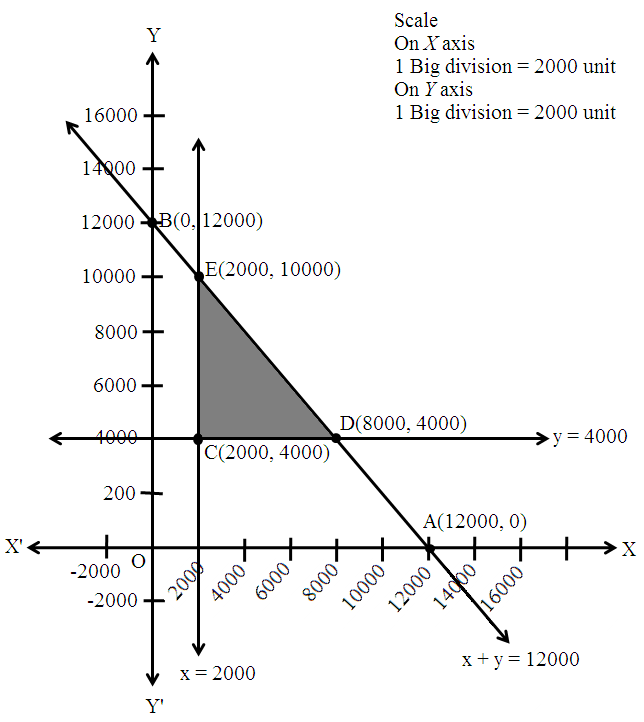
The corner points are E(2000, 10000), D(8000, 4000), C(2000, 4000)
The values of Z at these corner points are as follows.
|
$\text{Corner point}$
|
$\text{Z}=\frac{8\text{x}}{100}+\frac{10\text{y}}{100}$
|
|
E
|
1160
|
|
D
|
1040
|
|
C
|
560
|
The maximum value of Z is 1160 which is attained at E(2000, 10000).
Thus, the maximum earning is Rs. 1160 obtained when Rs. 2000 were invested in Saving's certificates and Rs. 10000 were invested in National Saving Bond. View full question & answer→Question 2145 Marks
Two tailors A and B earn Rs 150 and Rs 200 per day respectively. A can stitch 6 shirts and 4 pants per day while B can stitch 10 shirts and 4 pants per day. Form a linear programming problem to minimize the labour cost to produce at least 60 shirts and 32 pants.
AnswerLet tailor A work for x days and tailor B work for y days.
In one day, A can stitch 6 shirts and 4 pants whereas B can stitch 10 shirts and 4 pants. Thus, in x days A can stitch 6x shirts and 4x pants. Similarly, in y days B can stitch 10y shirts and 4y pants.
It is given that the minimum requirement of the shirts and pants are respectively 60 and 32 respectively.
Thus,
$6\text{x}+10\text{y}\geq60,4\text{x}+4\text{y}\geq32$
Further it is given that A and B earn Rs 150 and Rs 200 per day respectively. Thus, in x days and y days, A and B earn Rs 150x and Rs 200y respectively.
Let Z denotes the total cost
$\therefore$ Z = Rs 150x + 200 y
Number of days cannot be negative.
Therefore, $\text{x},\text{y}\geq0$
Hence, the required LPP is as follows:
Minimize Z=150x + 200 y
Subject to
$6\text{x}+10\text{y}\geq60$
$4\text{x}+4\text{y}\geq32$
$\text{x}\geq0,\text{y}\geq0$
View full question & answer→Question 2155 Marks
To maintain his health a person must fulfil certain minimum daily requirements for several kinds of nutrients. Assuming that there are only three kinds of nutrients-calcium, protein and calories and the person's diet consists of only two food items, I and II, whose price and nutrient contents are shown in the table below:
|
|
Food I
(per Ib)
|
Food II
(per Ib)
|
Minimum daliy requarement
for the nutrient
|
|
Calcium
|
10
|
5
|
20
|
|
Protein
|
5
|
4
|
20
|
|
Calories
|
2
|
6
|
13
|
|
Price (Rs)
|
60
|
100
|
|
What combination of two food items will satisfy the daily requirement and entail the least cost? Formulate this as a LPP.
AnswerLet the person takes x lbs and y lbs of food I and II respectively that were taken in the diet. Since, per lb of food I costs Rs 60 and that of food II costs Rs 100.
Therefore, x lbs of food I costs Rs 60x and y lbs of food II costs Rs 100y.
Total cost per day = Rs (60x + 100y)
Let Z denote the total cost per day
Then, Z = 60x + 100 y
Total amount of calcium in the diet is 10x+5y
Since, each lb of food I contains 10 units of calcium. Therefore, x lbs of food I contains 10x units of calciumn.
Each lb of food II contains 5 units of calciu.So,y lbs of food II contains 5y units of calcium.
Thus, x lbs of food I and y lbs of food II contains 10x + 5y units of calcium.
But, the minimum requirement is 20 lbs of calcium.
$\therefore10\text{x}+5\text{y}\geq20$
Since, each lb of food I contains 5 units of protein. Therefore, x lbs of food I contains 5x units of protein,
Each lb of food II contains 4 units of protein. So,y lbs of food II contains 4y units of protein,
Thus, x lbs of food I and y lbs of food II contains 5x + 4y units of protein.
But, the minimum requirement is 20 lbs of protein.
$\therefore5\text{x}+4\text{y}\geq20$
Since, each lb of food I contains 2 units of calories. Therefore, x lbs of food I contains 2x units of calories.
Each lb of food II contains units of calories. So,y lbs of food II contains by units of calories.
Thus, x lbs of food I and y lbs of food II contains 2x + 6y units of calories.
But, the minimum requirement is 13 lbs of calories.
$\therefore2\text{x}+6\text{y}\geq13$
Finally, the quantities of food I and food II are non negative values.
So,$\text{x},\text{y}\geq0$
Hence, the required LPP is as follows:
Min Z = 60x + 100y
subject to
$10\text{x}+5\text{y}\geq20$
$5\text{x}+4\text{y}\geq20$
$2\text{x}+6\text{y}\geq13$
$\text{x},\text{y}\geq0$
View full question & answer→Question 2165 Marks
A company manufactures two types of toys A and B. Type A requires 5 minutes each for cutting and 10 minutes each for assembling. Type B requires 8 minutes each for cutting and 8 minutes each for assembling. There are 3 hours available for cutting and 4 hours available for assembling in a day. The profit is Rs. 50 each on type A and Rs. 60 each on type B. How many toys of each type should the company manufacture in a day to maximize the profit?
AnswerLet x toys of type A and y toys of type B were manufactured.
The given information can be tabulated as follows:
|
|
Cutting time (minutes)
|
Assembling time (minutes)
|
|
Toy A(x)
|
5
|
10
|
|
Toy B(y)
|
8
|
8
|
|
Availability
|
180
|
240
|
The constraints are
5x + 8y ≤ 180
10x + 8y ≤ 240
The profit is Rs. 50 each on type A and Rs. 60 each on type B.
Therefore, profit gained on x toys of type A and y toys of type B is Rs. 50x and Rs. 60 y respectively.
Total profit = Z = 50x + 60y
The mathematical formulation of the given problem is
Max Z = 50x + 60y
Subject to
5x +8y ≤ 180
10x + 8y ≤ 240
x, y ≥ 0
First we will convert inequations into equations as follows:
5x + 8y = 180, 10x + 8y = 240, x = 0 and y = 0
Region represented by 5x + 8y ≤ 180:
The line 5x + 8y = 180 meets the coordinate axes at $A_1(36,0)$ and $B_1(0, 452)$ respectively.
By joining these points we obtain the line 5x + 8y = 180.
Clearly, (0, 0) satisfies the 5x + 8y = 180.
So, the region which contains the origin represents the solution set of the inequation 5x + 8y ≤ 180.
Region represented by 10x + 8y ≤ 240:
The line 10x + 8y = 240 meets the coordinate axes at $C_1(24, 0)$ and $D_1(0, 30)$ respectively.
By joining these points we obtain the line 10x + 8y = 240.
Clearly (0, 0) satisfies the inequation 10x + 8y ≤ 240.
So, the region which contains the origin represents the solution set of the inequation 10x + 8y ≤ 240.
Region represented by x ≥ 0 and y ≥ 0:
Since, every point in the first quadrant satisfies these inequations.
So, the first quadrant is the region represented by the inequations x ≥ 0, and y ≥ 0.
The feasible region determined by the system of constraints 5x + 8y ≤ 180, 10x + 8y ≤ 240, x ≥ 0 and y ≥ 0 are as follows.
The feasible region is shown in the figure:
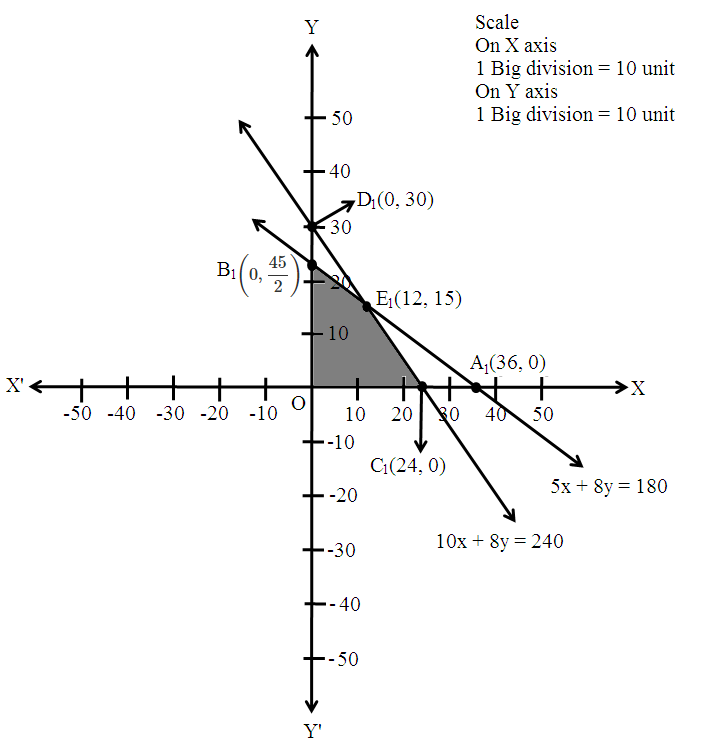
The corner points are $B_1(0, 452), E_1(12, 15)$ and $C_1(24,0)$.
The values of Z at the corner points are.
|
Corner points
|
Z = 50x + 60y
|
|
$O$
|
0
|
|
$B_1$
|
1350
|
|
$E_1$
|
1500
|
|
$C_1$
|
1200
|
The maximum value of Z is 1500 which is at $E_1(12, 15)$.
Thus, for maximum profit, 12 units of toy A and 15 units of toy B should be manufactured. View full question & answer→Question 2175 Marks
A manufacturer makes two products A and B. Product A sells at Rs. 200 each and takes 1/2 hour to make. Product B sells at Rs. 300 each and takes 1 hour to make. There is a permanent order for 14 of product A and 16 of product B. A working week consists of 40 hours of production and weekly turnover must not be less than Rs 10000. If the profit on each of product A is Rs. 20 and on product B is Rs. 30, then how many of each should be produced so that the profit is maximum. Also, find the maximum profit.
AnswerLet x units of product A and y units of product B were manufactured.
Number of units cannot be negative.
Therefore, x, y ≥ 0
According to question, the given information can be tabulated as
|
|
Type A
|
Type B
|
Availability
|
|
Cutting (min)
|
5
|
8
|
3 × 60 + 20 = 200
|
|
Assembling (min)
|
10
|
8
|
4 × 60 = 240
|
Also, the availability of time is 40 hours and the revenue should be atleast Rs 10000.
Further, it is given that there is a permanent order for 14 units of product A and 16 units of product B.
Therefore, the constraints are
$200\text{x}+300\text{y}\geq10000$
$0.5\text{x}+\text{y}\leq40$
$\text{x}\geq14$
$\text{y}\geq16$
If the profit on each of product A is Rs 20 and on product B is Rs 30.Therefore, profit gained on x units of product A and y units of product B is Rs 20x and Rs 30y respectively.
Total profit = Z = 20x+30y which is to be maximised
Thus, the mathematical formulation of the given linear programmimg problem is
Max Z = 20x + 30y
Subject to
$2\text{x}+3\text{y}\geq100$
$\text{x}+2\text{y}\leq80$
$\text{x}\geq14$
$\text{y}\geq16$
$\text{x},\text{y}\geq0$
First we will convert inequations into equations as follows:
2x + 3y = 100
x + 2y = 80
x = 14
y = 16
x = 0
y = 0
Region represented by 2x + 3y ≥ 100:
The line 2x + 3y = 100 meets the coordinate axes at $A_1(50, 0)$ and $\text{B}_1\Big(0,\frac{100}3{}\Big)$ respectively.
By joining these points we obtain the line 2x + 3y = 100.
Clearly (0, 0) does not satisfies the 2x + 3y = 100.
So, the region which does not contain the origin represents the solution set of the inequation 2x + 3y ≥ 100.
Region represented by x + 2y ≤ 80:
The line x + 2y = 80 meets the coordinate axes at $C_1(80, 0)$ and $D_1(0, 40)$ respectively.
By joining these points we obtain the line x + 2y = 80.
Clearly (0, 0) satisfies the inequation x + 2y ≤ 80.
So, the region which contains the origin represents the solution set of the inequation x + 2y ≤ 80.
Region represented by x ≥ 14
x = 14 is the line passes through (14, 0) and is parallel to the Y axis.
The region to the right of the line x = 14 will satisfy the inequation.
Region represented by y ≥ 16
y = 16 is the line passes through (0, 16) and is parallel to the X axis.
The region above the line y = 16 will satisfy the inequation.
Region represented by x ≥ 0 and y ≥ 0:
Since, every point in the first quadrant satisfies these inequations.
So, the first quadrant is the region represented by the inequations x ≥ 0, and y ≥ 0.
The feasible region determined by the system of constraints 2x + 3y ≥ 100, x + 2y ≤ 80, x ≥ 14, y ≥ 16, x ≥ 0 and y ≥ 0 are as follows.
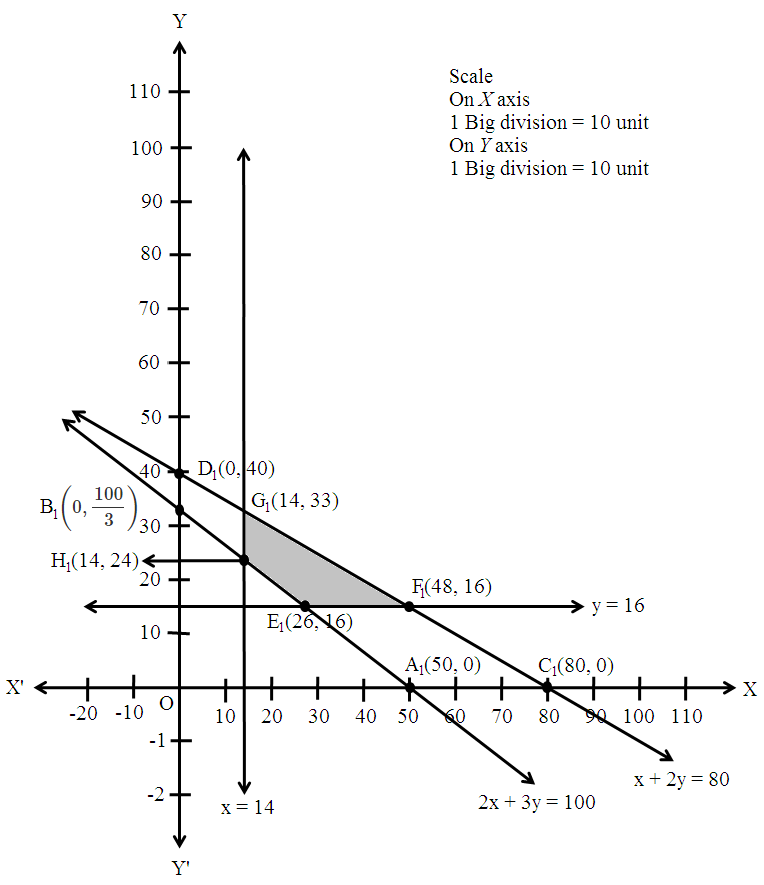
The corner points of the feasible region are $E_1(26, 16), F_1(48, 16), G_1(14, 33)$ and $H_1(14, 24)$
The values of Z at these corner points are as follows.
|
Corner point
|
Z = 5x + 6y
|
| $E_1$ |
1000
|
|
$F_1$
|
1440
|
| $G_1$ |
1270
|
| $H_1$ |
1000 |
The maximum value of Z is Rs 1440 which is attained at $F_1(48, 16)$.
Thus, the maximum profit is Rs 1440 obtained when 48 units of product A and 16 units of product B were manufactured.
View full question & answer→Question 2185 Marks
An aeroplane can carry a maximum of 200 passengers. A profit of Rs. 400 is made on each first class ticket and a profit of Rs. 600 is made on each economy class ticket. The airline reserves at least 20 seats of first class. However, at least 4 times as many passengers prefer to travel by economy class to the first class. Determine how many each type of tickets must be sold in order to maximize the profit for the airline. What is the maximum profit.
AnswerLet required number of first class and economy class tickets be x and y respectively.
Each ticket of first class and economy class make profit of Rs. 400 and Rs. 600 respectively.
So, x ticket of first class and y tickets of economy class make profits of Rs. 400x and Rs. 600y respectively,
Let total profit be Z, so,
Z = 400x + 600y
Given, aeroplane can carry a maximum of 200 passengers, so
= x + y ≤ 200 (first constraint)
Given, airline reservesa at least 20 seats for first class, so,
= x ≥ 20 (second constraint)
Given, at least 4 times as many passengers prefer to travel by economy class to the first class, so,
y ≥ 4x
x = 4x - y ≤ 0 (third constraint)
Hence, mathematical formulation of LPP is find x and y which
maximize Z = 400x + 600y
Subject to constriants,
x + y ≤ 200
x ≥ 20
x = 4x - y ≤ 0
X, Y ≥ 0 [Since seats of both the classes can not be less than zero]
Region x + y ≤ 200:
Line x + y = 200 meets axes at $A_1(200, 0), B_1(0, 200)$ respectively.
Region containing origin represents x + y ≤ 200 as (0, 0) satisfies x + y ≤ 200.
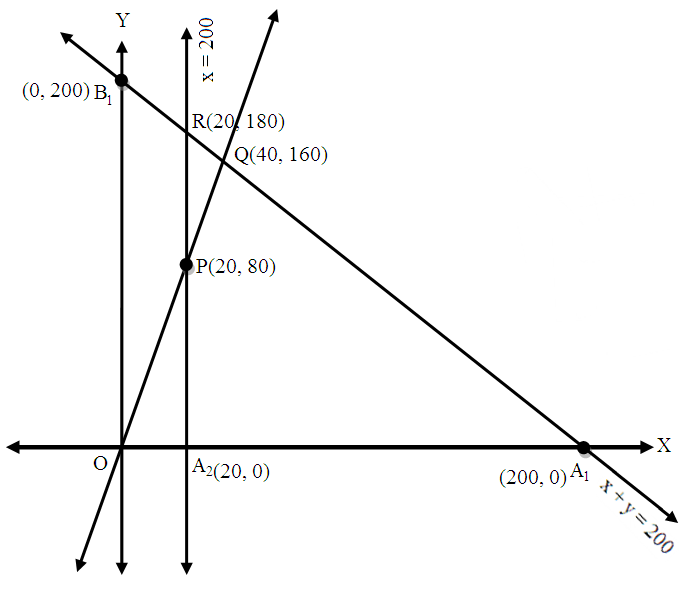
Shaded region POR represents feasible region. Q(40, 160) is obtained by solving x + y = 200 and 4x - y = 0, R(20, 180) is obtained by solving x = 20 and x + y = 200
The value of Z = 400x + 600y at
P(20, 80) = 400(20)+600 (80) = 56000
Q(40, 160) = 400(40) + 600(160) = 112000
R(20, 180) = 400(20) + 600(180) = 116000
So,
Maximum Z = Rs. 116000 at x = 20, y = 180
Number of first class ticket = 20,
Number of economy class ticket = 180
Maximum profit - Rs. 116000. View full question & answer→Question 2195 Marks
Maximum $Z = 3x_1 + 5y_2$
Subject to
$\text{x}_1+3\text{x}_2\geq3$
$\text{x}_1+\text{x}_2\geq2$
$\text{x}_1,\text{x}_2\geq0$
AnswerFirst, we will convert the given inequations into equations, we obtain the following equations:
$X_1 + 3 x 2 = 3, x_1 + x_2 = 2, x_1 = 0$ and $x_2 = 0$
Region represented by $\text{x}_1+3\text{x}_2\geq3$:
The line $x_1 + 3x_2 = 3$ meets the coordinate axes at A (3, 0) and B (0, 1) respectively.
By joining these points we obtain the line $\text{x}_1+3\text{x}_2\geq3$.
Clearly (0, 0) does not satisfies the inequation $\text{x}_1+3\text{x}_2\geq3$.
So, the region in the plane which does not contain the origin represents the solution set of the inequation $\text{x}_1+3\text{x}_2\geq3$.
Region represented by $\text{x}_1+\text{x}_2\geq2$:
The line $x_1 + x_2 = 2$ meets the coordinate axes at C(2, 0) and D(0, 2) respectively.
By joining these points we obtain the line $x_1 + x_2 = 2$.
Clearly (0, 0) does not satisfies the inequation $\text{x}_1+\text{x}_2\geq2$.
So, the region containing the origin represents the solution set of the inequation $\text{x}_1+\text{x}_2\geq2$.
Region represented by $\text{x}_1\geq0$ and $\text{x}_2\geq0$:
Since, every point in the first quadrant satisfies these inequations.
So, the first quadrant is the region represented by the inequations $\text{x}_1\geq0$ and $\text{x}_2\geq0$.
The feasible region determined by the system of constraints, $\text{x}_1+3\text{x}_2\geq3,\text{x}_1+\text{x}_2\geq2,\text{x}_1\geq0,$ and $\text{x}_2\geq0$, are as follows.
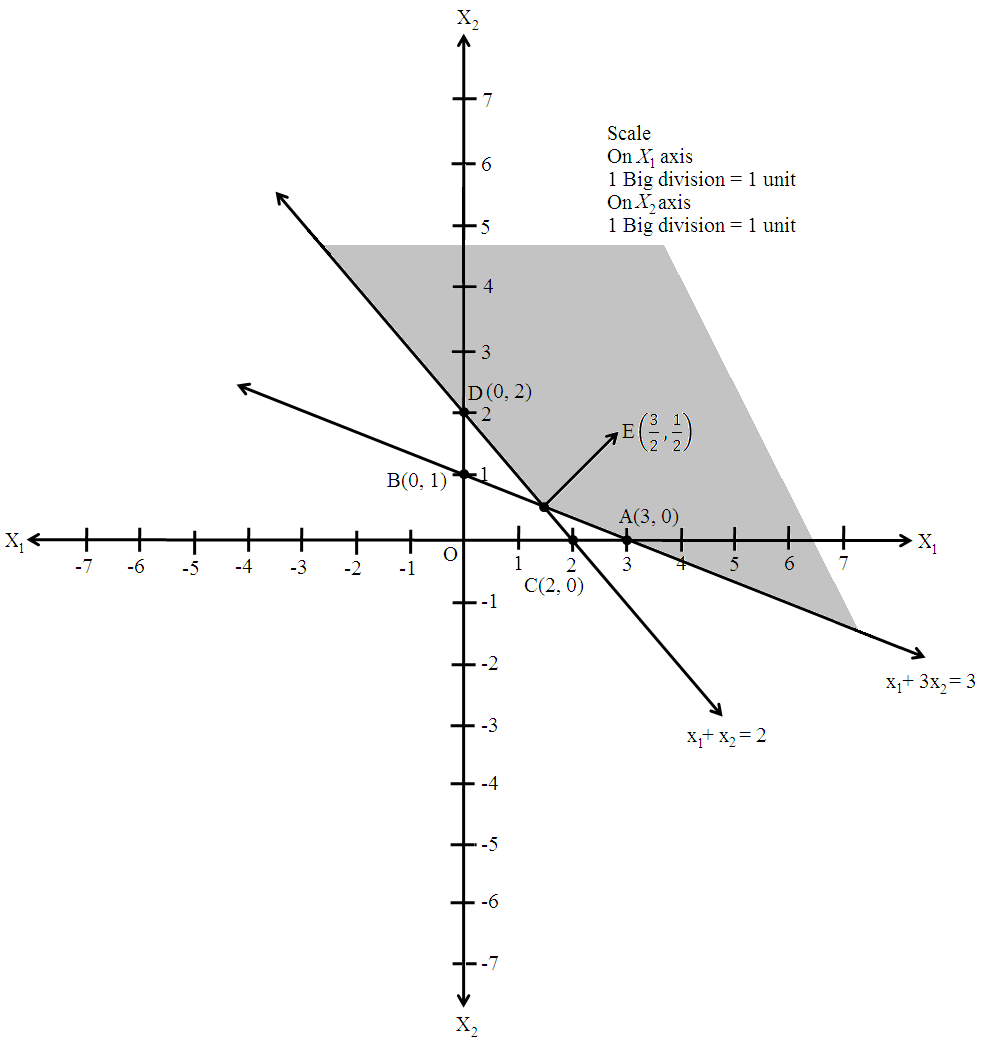
The corner points of the feasible region are O(0, 0), B(0, 1), $\text{E}\Big(\frac{3}{2} ,\frac{1}{2} \Big)$ and C(2, 0).
The value of Z at these corner points are as follows.
|
$\text{Corner point}$
|
$\text{Z}=3\text{x}_1+5\text{x}_2$
|
|
$\text{O}(0, 0)$
|
$3\times0+5\times0=0$
|
|
$\text{B}(0, 1)$
|
$3\times0+5\times1=5$
|
|
$\text{E}\Big(\frac{3}{2} ,\frac{1}{2} \Big)$
|
$3\times\frac{3}{2} +5\times\frac{1}{2} =7$
|
|
$\text{C}(2, 0)$
|
$3\times2+5\times0=6$
|
Therefore, the minimum value of Z is 0 at the point O(0, 0).
Hence, $X_1 = 0$ and $x_2 = 0$ is the optimal solution of the given LPP.
Thus, the optimal value of Z is 0. View full question & answer→Question 2205 Marks
A company manufactures two types of novelty Souvenirs made of plywood. Souvenirs of type A require 5 minutes each for cutting and 10 minutes each for assembling. Souvenirs of type B require 8 minutes each for cutting and 8 minutes each for assembling. There are 3 hours 20 minutes available for cutting and 4 hours available for assembling. The profit is 50 paise each for type A and 60 paise each for type B souvenirs. How many souvenirs of each type should the company manufacture in order to maximize the profit?
AnswerLet the company manufacture x souvenirs of type A and y souvenirs of type B.
Therefore, $\text{x}\geq0$ and $\text{y}\geq0$ The given information can be complied in a table as follows.
|
|
Type A
|
Type B
|
Availability
|
|
Cutting (min)
|
5
|
8
|
3 × 60 + 20 = 200
|
|
Assembling (min)
|
10
|
8
|
4 × 60 = 240
|
The profit on type A souvenirs is Rs. 5 and on type B souvenirs is Rs. 6.
Therefore, the constraints are
$5\text{x}+8\text{y}\leq200$
$10\text{x}+8\text{y}\leq240$
i.e., $5\text{x}+4\text{y}\leq120$
Total profit, Z = 5x + 6y
The mathematical formulation of the given problem is
Maximize Z = 5x + 6y ... (1)
Subject to the constraints,
$5\text{x}+8\text{y}\leq200 \dots (2)$
$5\text{x}+4\text{y}\leq120\dots(3)$
$\text{x},\text{y}\geq0\dots(4)$
The feasible region determined by the system of constraints is as follows.
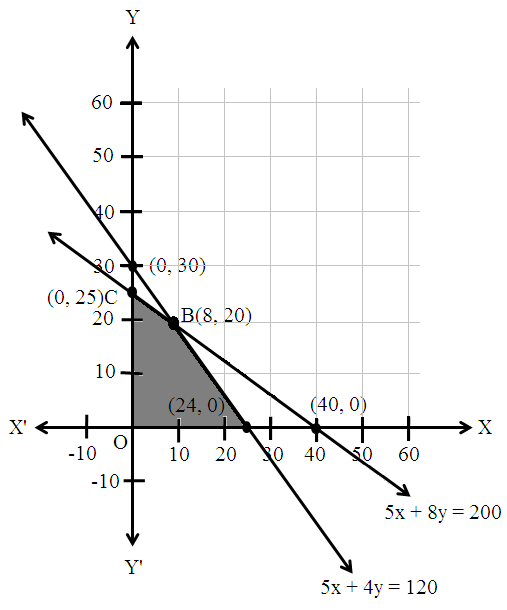
The corner point are A(24, 0), B(8, 20), and C(0, 25).
The values of Z at these corner points are as follows.
|
Corner point
|
Z = 5x + 6y
|
|
|
A(24, 0)
|
120
|
|
|
B(8, 20)
|
160
|
→ Maximum
|
|
C(0, 25)
|
150
|
|
The maximum value of Z is 200 at (8, 20).
Thus, 8 souvenirs of type A and 20 souvenirs of type B should be produced each day to get the maximum profit of Rs. 160. View full question & answer→Question 2215 Marks
One kind of cake requires 300gm of flour and 15gm of fat, another kind of cake requires 150gm of flour and 30gm of fat. Find the maximum number of cakes which can be made from 7.5kg of flour and 600gm of fat, assuming that there is no shortage of the other ingradients used in making the cake. Make it as an LPP and solve it graphically.
AnswerLet required number of cakes of type A and B arex and y respectively.
Let Z be total number of cakes, so,
Z = x + y
Since one unit of cake of type A and B contain 300gm and 150gm flour respectively, so, x unit of cake of type A and y units of cake of type B require 300x and 150y gms of flour respectivley, but maximum flour available is 7.5 x 1000 - 7500gm, so
$300\text{x}+150\text{y}\leq7500$
$2\text{x}+\text{y}\leq50$ (first constraint)
Since one unit of cake of type A and B contain 15 and 30gm fat respectively, so, x unit of cake of type A and y units of cake of type B contain 15x and 30y gms of fat respectivley, but maximum fat available is 600gm, so
$15\text{x}+300\text{y}\leq600$
$\text{x}+2\text{y}\leq40$ (second constraint)
Hence, mathematical formulation of LPP is,
Find x and y which maximize
Z = x + y
Subject to constriants,
$2\text{x}+\text{y}\leq50$
$\text{x}+2\text{y}\leq40$
$\text{x},\text{y}\geq0$ [Since number of cakes can not be less than zero]
Region $2\text{x}+\text{y}\leq50$:
Line 2x + y = 50 meets axes at $A_1(25, 0), B_1(0, 50)$ respectively.
Region containing origin represents $2\text{x}+\text{y}\leq50$ as (0, 0) satisfies 2x + y = 50.
Region $\text{x}+2\text{y}\leq40$:
Line x + 2y = 40 meets axes at $A_2(40, 0), B_2(0, 20)$ respectively.
Region containing origin represents $\text{x}+2\text{y}\leq40$ as (0, 0) satisfies $\text{x}+2\text{y}\leq40$.
Region $\text{x},\text{y}\geq0$:
It represent first quandrant.
Shaded region $OA_1PB_2$ represents feasible region.
Point P(20, 10) is obtained by solving x + 2y = 40 and 2x + y = 50
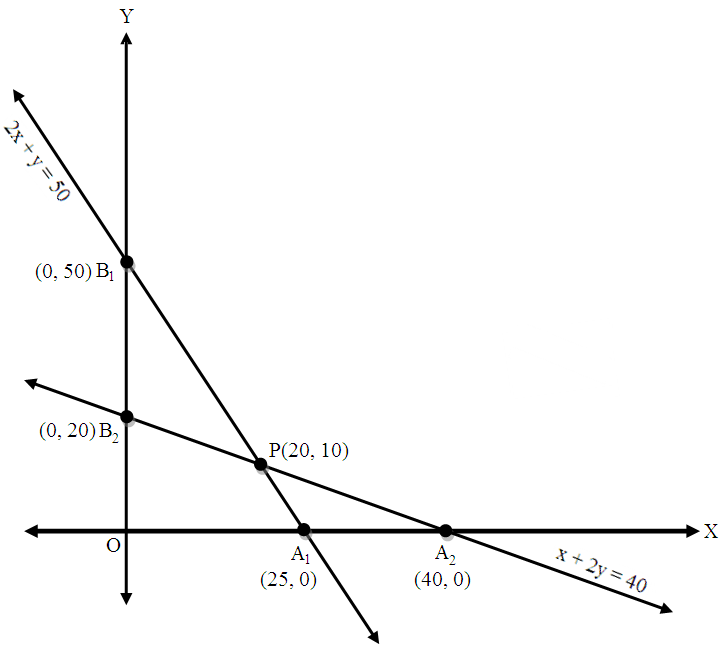
The value of $Z = x +y$ at
$O(0, 0) = 0 + 0 = 0$
$A_1(25, 0) = 25 + 0 = 25$
$P(20, 10) = 20 + 10 = 30$
$B_2(0, 20) = 0 + 20 = 20$
maximum Z = 30 at x = 20, y = 10
Number of books of type A = 20, type B = 10 View full question & answer→Question 2225 Marks
A wholesale dealer deals in two kinds, $A$ and $B$ (say) of mixture of nuts. Each kg of mixture $A$ contains $60$ grams of almonds, $30$ grams of cashew nuts and $30$ grams of hazel nuts. Each kg of mixture $B$ contains $30$ grams of almonds, $60$ grams of cashew nuts and $180$ grams of hazel nuts. The remainder of both mixtures is per nuts. The dealer is contemplating to use mixtures $A$ and $B$ to make a bag which will contain at least $240$ grams of almonds, $300$ grams of cashew nuts and $540$ grams of hazel nuts. Mixture $A$ costs Rs. $8$ per kg. and mixture $B$ costs Rs. $12$ per kg. Assuming that mixtures A and B are uniform, use graphical method to determine the number of kg . of each mixture which he should use to minimise the cost of the bag.
AnswerLet required number of bag A and bag B be x and y respectively.
Since, costs of each bag A and bag B are Rs. 8 and Rs. 12 per kg.
So, cost of x number of bag A and y number of bag B are Rs. 8x and Rs. 12y respectively,Let z be total cost of bags, so,
Z = 8x + 12y
Since, each bag A and B contain 60 and 30gms of almonds respectively.
So, x bags of A and y bags of B contain 60x and 30ygms. of almonds respectively but, mixtures should contain at least 240gms almonds, so,
$60\text{x}+30\text{y}\geq240$
$2\text{x}+\text{y}\geq8$ (first constraint)
Since, each bag A and B contain 30 and 60 gms of cashew nuts respectively.
So, x bags of A and y bags of B contain 30x and 60y gms. of cashew nuts respectively but, mixtures should contain at least 300 gms of cashew nuts, so
$30\text{x}+60\text{y}\geq300$
$\text{x}+2\text{y}\geq10$ (second constraint)
Since, each bag A and B contain 30 and 180 gms. of hazel nuts respectively.
So, x bags of A and y bags of B contain 30x and 180y gms. of hazel nuts respectively but, mixtures should contain at least 540gms of hazel nuts, so,
$30\text{x}+180\text{y}\geq540$
$\text{x}+6\text{y}\geq18$ (third constraint)
Hence, mathematical formulation of LPP is,
Find x and y which maximize
Z = 8x + 12y
Subject to constraints,
$2\text{x}+\text{y}\geq8$
$\text{x}+2\text{y}\geq10$
$\text{x}+6\text{y}\geq18$
$\text{x},\text{y}\geq0$ [Since quantity of bags can not be less than zero]
Region $2\text{x}+\text{y}\geq8$:
line 2x + y = 8 meets axes at $A_1(4, 0), B_1(0, 8)$ respectively.
Region not containing origin represents $2\text{x}+\text{y}\geq8$ as (0, 0) does not satisfy $2\text{x}+\text{y}\geq8$.
Region $\text{x}+2\text{y}\geq10$:
line x + 2y = 10 meets axes at $A_2(10, 0), B_2(0, 5)$ respectively.
Region not containing origin represents $\text{x}+2\text{y}\geq10$ as (0, 0) does not satisfy $\text{x}+2\text{y}\geq10$.
Region $\text{x}+6\text{y}\geq18$:
line x + 6y = 18 meets axes at $A_3(18, 0), B_3(0, 3)$ respectively.
Region not containing origin represents $\text{x}+6\text{y}\geq18$ as (0, 0) does not satisfy $\text{x}+6\text{y}\geq18$.
Region $\text{x},\text{y}\geq0$: it represents first quadrant.
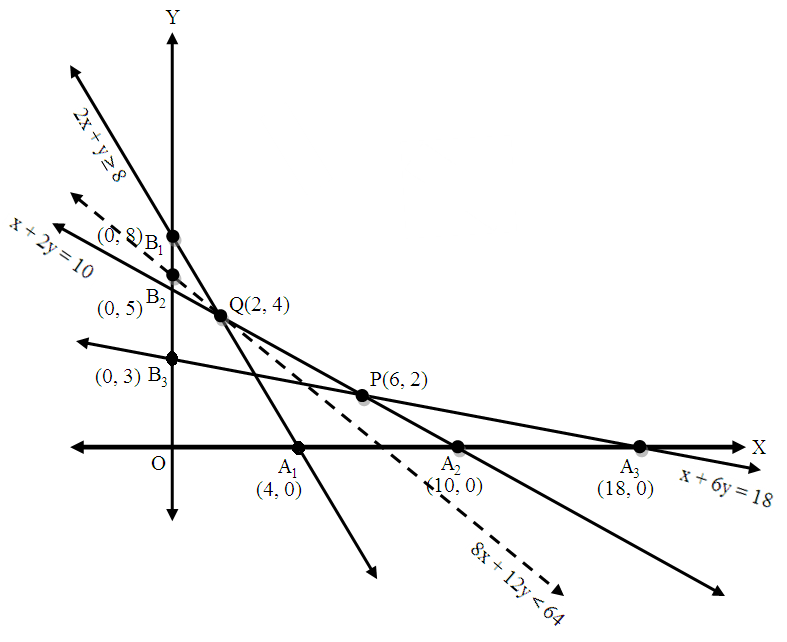
Unbouded shaded region $A_3 P Q B_1$ is feasible region with corner point $A_3(18,0), P(6,2) Q(2,4), B_1(0,8)$.
$P$ is obtained by solving $x+6 y=18$ and $x+2 y=10, Q$ is obtained by solving $2 x+y=8$ and $x+2 y=10$
The value of $z=8 x+12 y$ at
$A_3(18,0)=8(18)+12(0)=144$
$P(6,2)=8(6)+12(2)=72$
$Q(2,4)=8(2)+12(4)=64$
$B_1(0,8)=8(0)+12(8)=96$
Smallest value of $Z$ is 64 , open half plane $8 x+12 y \geq 64$ has no point is common with feasible region, so, smallest value is the minimum value
Minimum cost = Rs. 64
quantity of mixture $A =2 kg$.
quantity of mixture $8=4 kg$. View full question & answer→Question 2235 Marks
A farmer mixes two brands P and Q of cattle feed. Brand P, costing Rs. 250 per bag, contains 3 units of nutritional element A, 2.5 units of element B and 2 units of element C. Brand Q costing Rs. 200 per bag contains 1.5 units of nutritional element A, 11.25 units of element B and 3 units of element C. The minimum requirements of nutrients A, B and C are 18 units, 45 units and 24 units respectively. Determine the number of bags of each brand which should be mixed in order to produce a mixture having a minimum cost per bag? What is the minimum cost of the mixture per bag?
AnswerLet x bags of brand P and y bags of brand Q should be mixed to produce the mixture.
Each bag of brand P costs Rs. 250 and each bag of brand Q costs Rs. 200.
Therefore, x bags of brand P and y bags of brand Q costs Rs. (250x + 200y).
Since each bag of brand P contains 3 units of nutritional element A and each bag of brand Q contains 1.5 units of nutritional element A, therefore, x bag of brand P and y bag of brand Q will contain (3x + 1.5y) units of nutritional element A.
But, the minimum requirement of nutrients A is 18 units.
$3\text{x}+1.5\text{y}\geq18$
$2\text{x}+\text{y}\geq12$
Similarly, x bag of brand P and y bag of brand Q will contain (2.5x + 11.25y) units of nutritional element B.
But, the minimum requirement of nutrients B is 45 units.
$2.5\text{x}+11.25\text{y}\geq45$
$2\text{x}+9\text{y}\geq36$
Also, x bag of brand P and y bag of brand Q will contain (2x + 3y) units of nutritional element B.
But, the minimum requirement of nutrients C is 24 units.
$2\text{x}+3\text{y}\geq24$
Thus, the given linear programming problem is,
Minimise Z = 250x + 200y
Subject to the constraints
$2\text{x}+\text{y}\geq12$
$2\text{x}+9\text{y}\geq36$
$2\text{x}+3\text{y}\geq24$
$\text{x},\text{y}\geq0$
The feasible region determined by the given constraints can be diagrammatically represented as,
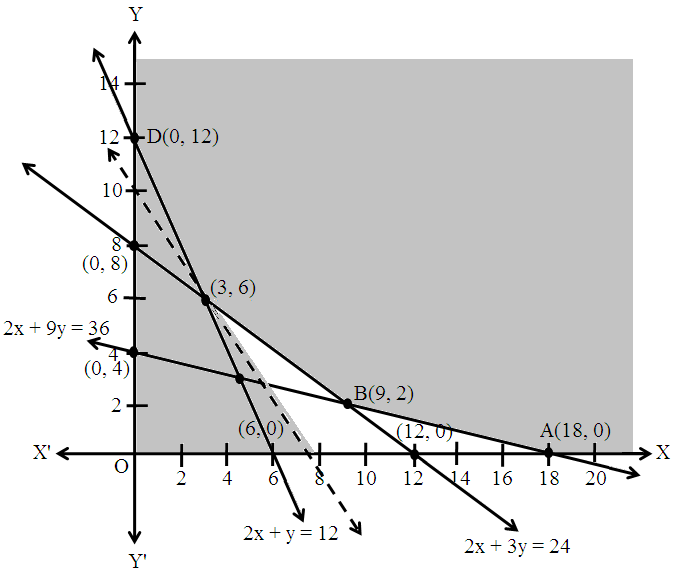
The coordinates of the corner points of the feasible region are A(18, 0), B(9, 2), C(3, 6) and D(0, 12).
The value of the objective function at these points are given in the following table.
= 250x+ 200y
|
Corner Point
|
Z = 250x + 200y
|
|
(18, 0)
|
50 × 18 + 200 × 0 = 4500
|
|
(9, 2)
|
250 × 9 + 200 × 2 = 2650
|
| (3, 6) |
250 × 3 + 200 × 6 = 1950 → Minimum |
| (0, 12) |
250 × 0 + 200 × 12 = 2400 |
The smallest value of Z is 1950 which is obtained at (3, 6).
It can be seen that the open half-plane represented by 250x + 200y < 1950 or 5x + 4y < 39 has no common points with the feasible region.
So, 3 bags of brand P and 6 bags of brand Q should be used in the mixture to minimise the cost.
Hence, the minimum cost of the mixture per bag is 1950. View full question & answer→Question 2245 Marks
An aeroplane can carry a maximum of 200 passengers. A profit of Rs.1000 is made on each executive class ticket and a profit of Rs.600 is made on each economy class ticket. The airline reserves atleast 20 seats for executive class. However, atleast 4 times as many passengers prefer to travel by economy class than by the executive class. Determine how many tickets of each type must be sold in order to maximise the profit of the airline. What is the maximum profit?
AnswerSuppose x tickets of executive class and y tickets of economy class are sold by the airline.
The profit on each executive class ticket is Rs. 1000 and on each economy class ticket is Rs.600.
Therefore, the total profit from x executive class tickets and y economy class ticket is Rs.(1000x + 600y).
Now, the aeroplane can carry a maximum of 200 passengers.
x + y ≤ 200
The airline reserves atleast 20 seats for executive class.
x ≥ 20
Also, atleast 4 times as many passengers prefer to travel by economy class than by the executive class.
y ≥ 4x
Thus, the given linear programming problem is
Maximise Z = 1000x + 600y
Subject to the constraints
x + y ≤ 200
x ≥ 20
y ≥ 4x
x, y ≥ 0
The feasible region determined by the given constraints can be diagrammatically represented as,
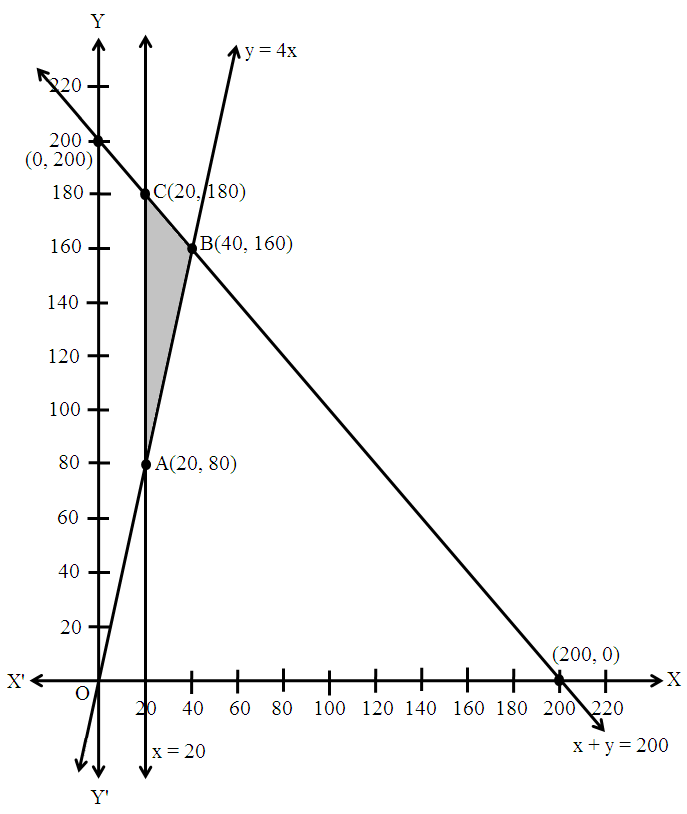
The coordinates of the corner points of the feasible region are A(20, 80), B(40, 160) and C(20, 180).
The value of the objective function at these points are given in the following table.
|
Corner Point
|
Z =1000x + 600y
|
|
(20, 8)
|
1000 × 20 + 600 × 80 = 68000
|
|
(40, 10)
|
1000 × 40 + 600 × 160 = 136000 → Maximum
|
|
(20, 180)
|
1000 × 20 + 600 × 180 =128000
|
The maximum value of Z is 136000 at x = 40, y = 160.
Hence, 40 tickets of executive class and 160 tickets of economy class should be sold to maximise the profit.
The maximum profit of the airline is Rs. 1,36,000.
View full question & answer→Question 2255 Marks
A dietician mixes together two kinds of food in such a way that the mixture contains at least 6 units of vitamin A, 7 units of vitamin B, 11 units of vitamin C and 9 units of vitamin D. The vitamin contents of 1kg of food X and 1kg of food Y are given below:
| |
Vitamin
A
|
Vitamin
B
|
Vitamin
C
|
Vitamin
D
|
|
Food X
|
1
|
1
|
1
|
2
|
|
Food Y
|
2
|
1
|
3
|
1
|
One kg food X costs Rs. 5, whereas one kg of food Y costs Rs. 8.
Find the least cost of the mixture which will produce the desired diet.
AnswerLet the dietician wishes to mix x kg of food X and y kg of Y.
Therefore,
As we are given,
| |
Vitamin
A
|
Vitamin
B
|
Vitamin
C
|
Vitamin
D
|
|
Food X
|
1
|
1
|
1
|
2
|
|
Food Y
|
2
|
1
|
3
|
1
|
It is given that the mixture should contain at least 6 units of vitamin A, 7 units of vitamin B, 11 units of vitamin C and 9 units of vitamin D.
Therefore, the constrants are
$\text{x}+2\text{y}\geq6$
$\text{x}+\text{y}\geq7$
$\text{x}+3\text{y}\geq11$
$2\text{x}+\text{y}\geq9$
It is given that cost of food X is Rs 5 per kg and cost of food Y is Rs. 8 per kg.
Thus, Z= 5x+8y
Thus, the mathematical formulation of the given linear programmimg problem is
Minimize Z= 5x+8y
subject to
$\text{x}+2\text{y}\geq6$
$\text{x}+\text{y}\geq7$
$\text{x}+3\text{y}\geq11$
$2\text{x}+\text{y}\geq9$
First, we will convert the given inequations into equations, we obtain the following equations:
x + 2y = 6, x + y = 7, x + 3y = 11, 2x + y =9, x = 0 and y=0.
The line x + 2y = 6 meets the coordinate axis at $A_1(6, 0)$ and $B_1(0, 3)$.
Join these points to obtain the line x + 2y = 6.
Clearly, (0, 0) does not satisfies the inequation $\text{x}+2\text{y}\geq6$.
So, the region in xy-plane that does not contains the origin represents the solution set of the given equation.
The line x + y = 7 meets the coordinate axis at $C_1(7, 0)$ and $D_1(0, 7)$.
Join these points to obtain the line x + y = 7.
Clearly, (0, 0) does not satisfies the inequation $\text{x}+\text{y}\geq7$.
So, the region in xy-plane that does not contains the origin represents the solution set of the given equation.
The line x + 3y = 11 meets the coordinate axis at $E_1(11, 0)$ and $\text{F}_1\Big(0,\frac{11}{3}\Big)$.
Join these points to obtain the line x + 3y = 11.
Clearly, (0, 0) does not satisfies the inequation $\text{x}+3\text{y}\geq11$.
So, the region in xy-plane that does not contains the origin represents the solution set of the given equation.
The line 2x + y = 9 meets the coordinate axis at $\text{G}_1\Big(\frac{9}{2},0\Big)$ and H(0, 9).
Join these points to obtain the line 2x + y = 9.
Clearly, (0, 0) does not satisfies the inequation $2\text{x}+\text{y}\geq9$.
So, the region in xy-plane that does not contains the origin represents the solution set of the given equation.
Region represented by $\text{x}\geq0$ and $\text{y}\geq0$:
Since, every point in the first quadrant satisfies these inequations.
So, the first quadrant is the region represented by the inequations.
These lines are drawn using a suitable scale.
The feasible region determined by the system of constraints is
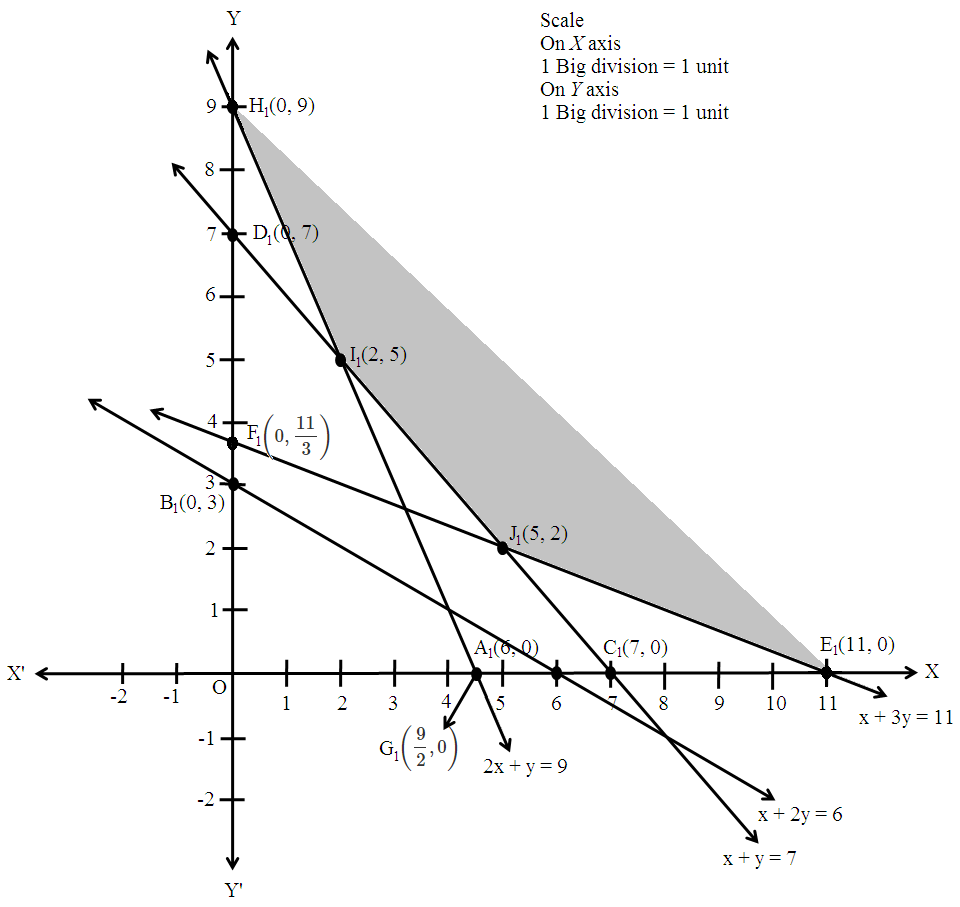
The corner points are $H_1(0, 9), I_1(2, 5), J_1(5, 2), E_1(11, 0)$.
The values of Z at these corner points are as follows
|
Corner point
|
Z =5x + 8y
|
|
$H_1$
|
72
|
|
$I_1$
|
50
|
|
$J_1$
|
41
|
|
$E_1$
|
55
|
The minimum value of Z is at $J_1(5, 2)$ which is Rs. 41.
Hence, cheapest combination of foods will be 5 units of food X and 2 units of food Y. View full question & answer→